Abdul El-Sayed embraces role as GOP foil, while defending progressive agenda
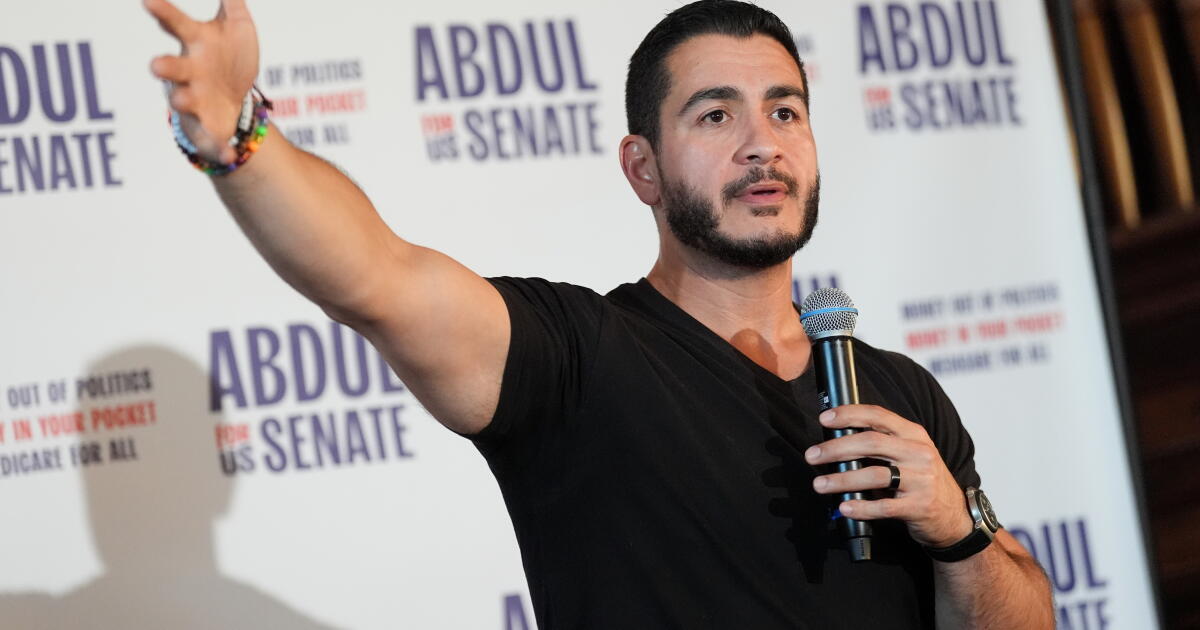
PORT HURON, Mich. — Abdul El-Sayed, holding a microphone and wearing his signature V-neck black T-shirt, slowly shook his head as a woman at his town hall described how she burned through her savings after undergoing emergency brain surgery.
“I’m really sorry for your experience, and I hope that you’re on the mend,” said El-Sayed, the Democratic nominee for U.S. Senate in Michigan, after outlining proposals for guaranteed healthcare and paid leave.
Later that night, while talking to reporters in the basement below the theater, his tone was far different. El-Sayed called his Republican opponent, Mike Rogers, a “coward” and said President Trump was “afraid” to visit the state, and he dismissed as “dumb” a question about whether Iran or Israel posed a greater threat to the United States.
The exchanges captured two sides of a candidate who is the central figure in one of the nation’s most consequential Senate races. El-Sayed would be the country’s first Muslim senator, and he’s crisscrossing the state to counter a Republican effort, fueled by tens of millions of dollars, to portray him as a dangerous radical. But he has also embraced his confrontational side by mocking and taunting Trump and Rogers.
“If they want to make me the main character in the midterms, I’m not shying away from it,” El-Sayed said in an interview. “Run against me. See how well that works out for you.”
El-Sayed’s resolute confidence rubbed some Democrats the wrong way during a divisive primary against Rep. Haley Stevens. The former public health official has shown little interest in toning it down, defending his progressive agenda and adversarial approach toward Republicans, emboldening supporters who believe he’s the right candidate for an angry electorate that has lost faith in the political establishment.
But his doubters fear he’ll cost Democrats control of the Senate by failing to unite his party’s disparate factions ahead of November.
“If you want their votes, you have to make nice with those people, and he’s not really doing that,” said Michigan political strategist Adrian Hemond, who supported Stevens. “Maybe he doesn’t have to. The entire theory of this candidacy has been he can remake what the electorate looks like.”
A Republican target
Even though Michigan backed Trump twice in his three presidential campaigns, no Republican has won a Senate race in the state since 1994.
The political landscape is no friendlier this year. Trump started an unpopular war with Iran, leading to higher gas prices and related inflation. Rogers has opted for a low-key campaign with fewer public events than El-Sayed as he tries to make the race all about his Democratic opponent.
As of Saturday, Republicans had outspent Democrats by $78 million to $63 million in the Michigan Senate race, according to AdImpact, which tracks political advertising. Around $40 million in Republican spending has gone toward negative advertisements, compared with around $20 million from Democrats.
The ads portray El-Sayed as “dangerously radical” and “too extreme,” highlighting his past calls to defund the police and relax immigration enforcement. Others tie him to Hasan Piker, a popular online streamer with whom El-Sayed has appeared and who has drawn criticism for past comments, including saying that “America deserved 9/11.”
On Friday, Rogers appeared alongside Louisiana Sen. John Kennedy, who told reporters that El-Sayed “sleeps in a Bin Laden jersey.” Rogers laughed.
Vice President JD Vance has called El-Sayed “evil.” In one social media post, Trump shared a photo of himself with First Lady Melania Trump alongside a photo of El-Sayed and his wife, who wears a hijab, with the caption: “Two VERY DIFFERENT America’s.”
Late Wednesday, Trump referred to El-Sayed as “Mohammed” and said he “goes back to the days of the Jihad.”
El-Sayed has hardly backed down. At the campaign stop in Port Huron, he taunted Trump and invited him to visit Michigan, suggesting Rogers and other Republicans were afraid the president would hurt their chances.
“Donald, if you’re watching, don’t wuss out, man,” El-Sayed said.
And he responded to Kennedy’s attack by suggesting the Republican is in the Ku Klux Klan.
“That’s rich coming from someone who wears his bed sheets out at night,” El-Sayed posted on social media.
A personal touch with voters
Before the Port Huron town hall, El-Sayed worked his way down a line of people who couldn’t fit inside the theater, shaking hands, taking photos and stopping for conversations.
Jeff Petrucella and his wife, Alice, traveled from Macomb County to see El-Sayed. They described themselves as politically “middle of the road” and said they had voted Republican in the past.
“I’m pretty done with the Republicans right now,” Jeff said.
Alice said she was “looking for a change that is better for my granddaughters,” pointing to El-Sayed’s support for Medicare for All. Nor was she put off by his more confrontational appearances on Fox News.
“I think he expresses himself well. You can tell he’s a well-spoken, educated man,” she said.
Pat Kreiner was among those who waited nearly an hour to see El-Sayed. Her children had persuaded her to support him in the Democratic primary.
“My son said to me, ‘I have been living with this trickle-down economy since the day I was born,’” Kreiner said. “‘It doesn’t work for me.’”
Kreiner also expressed anger about Trump’s trade war with Canada, just across the river from Port Huron.
“We are heartsick about our neighbors,” she said. “They used to come over a lot. We don’t see them now.”
Visiting smaller towns such as Port Huron has become central to El-Sayed’s campaign, with his team recently saying he’s held more than 500 events in over 100 cities across the state.
“Go everywhere. Talk to everyone. That’s what we do,” El-Sayed said in an interview.
The personal approach has not erased all the skepticism surrounding El-Sayed, including within his party.
His criticism of Israel and association with Piker have raised concerns among some Jewish Democrats. El-Sayed has held a series of private gatherings with undecided Jewish voters as he works to win their support.
He has also sought to strengthen his standing with Black voters. In the Democratic primary, Stevens drew more support in Wayne County, home to Detroit and its large Black population.
Ahead of Thursday’s debate, El-Sayed attended two events with Black leaders before stopping at a Black barbershop, where he moved from chair to chair talking with customers. He stopped at one point to speak with a pregnant woman, congratulating her and asking when her baby was due.
“November 8th? Make sure you vote early, huh?” the candidate joked.
A race about more than just Michigan
While El-Sayed has spent much of his campaign trying to win over Michigan voters, his candidacy has taken on significance far beyond the state. Republicans have made him a symbol of what they say is an increasingly radical Democratic Party, while progressives see his campaign as a chance to prove their politics can win in a closely divided state.
At a New York City fundraiser on Oct. 5, Rep. Alexandria Ocasio-Cortez cast his campaign as a test for progressives nationwide.
“If Abdul can win in Michigan, anybody can win anywhere,” said the New York Democrat, a potential presidential candidate.
Ocasio-Cortez plans to campaign with El-Sayed in Michigan this week, followed by former President Obama on Oct. 24.
The national stakes have also drawn renewed opposition. United Democracy Project, a super PAC affiliated with the pro-Israel group AIPAC, disclosed an initial $94,000 expenditure against El-Sayed on Friday, after spending nearly $30 million to oppose him in the Democratic primary.
And El-Sayed, while maintaining that the election should focus on Michigan voters and their economic struggles, has also embraced the larger implications of his candidacy.
“I am grateful for your support,” he told the audience at the New York fundraiser, according to remarks obtained by the Associated Press. He said he had two goals: “pick up a U.S. Senate seat” and “change the nature of our politics for the better.”
Cappelletti writes for the Associated Press.