German President Frank-Walter Steinmeier (R) welcomes Ukrainian President Volodymyr Zelensky (L) at Bellevue Palace in Berlin on Monday ahead of three way talks between European, American and Ukrainian delegations on efforts to hammer out a peace deal that is acceptable to all sides. Photo by Hannibal Hanschke/EPA
Dec. 15 (UPI) — British Prime Minister Keir Starmer and German Chancellor Friedrich Merz were set to meet with Ukrainian President Volodymyr Zelensky and U.S. officials in Berlin on Monday in an effort to reach a consensus on what any peace deal with Russia should look like.
The European leaders, along with French President Emmanuel Macron, who has yet to confirm his attendance, will seek to negotiate an alternative to the U.S.-Russia plan currently on the table with a stronger deal for Ukraine with better protections for its security.
The talks will also attempt to keep afloat an EU-brokered agreement to loan Ukraine some of the $246.7 billion of Russia’s assets frozen in European banks and other institutions to help it defend itself and take “forward peace talks from a position of strength,” amid mounting opposition to the plan.
The meeting follows five hours of talks on Sunday between Zelensky and U.S. Special Envoy Steve Witkoff and President Donald Trump‘s son-in-law, Jared Kushner, at the Federal Chancellery that Witkoff said were productive and would resume on Monday.
“Representatives held in-depth discussions regarding the 20-point plan for peace, economic agendas, and more. A lot of progress was made, and they will meet again tomorrow morning,” Witkoff posted on X on Sunday evening.
Zelensky was reported to have dropped demands for NATO membership, if it was what was required to end the war, in exchange for a bilateral defense agreement with the United States similar to an Article 5-like guarantee, along with other guarantees from Ukraine’s European partners.
Article 5 is a cast-iron guarantee, a collective defense principle enshrined in NATO’s constitution under which an armed attack on one member is considered an attack on all members and triggers an obligation for each member to come to its defense.
Following the initial discussions on Monday, Merz’s spokesman confirmed the group would be widened to include “numerous European heads of state and government, as well as the leaders of the EU and NATO.”
The diplomatic focus will shift to Brussels on Thursday when the leaders of all 27 EU nations converge on the Belgian capital for a meeting of the European Council with Ukraine and European security topping the agenda.
Council President Antonio Costa said the summit would address how best to continue defending Europe’s interests and how to “strengthen Ukraine’s negotiating position,” a key element of which necessitated “increased pressure on Russia.”
Costa said that having already committed to providing for Ukraine’s urgent financial needs for 2026-2027, including funding for its military and defense, it was now time to decide how to implement it and that leaders must keep talking on Thursday until an agreement was reached.
Earlier this month, European Commission President Ursula von der Leyen unveiled two options — both controversial — to provide Ukraine with $105.8 billion of the $158.6 it is estimated it will need in the two years through 2027 to keep the country running and being able to continue fighting Russia.
The so-called “reparations loan” option involving using frozen Russian assets only requires a two-thirds majority of EU states to vote for it. The second option under which the EU would use its budget to go borrow on the international capital markets is more problematic because it could be blocked by a single state.
Hungary and Slovakia have indicated they are opposed to either route, while Belgium, home to Euroclear, the clearing house where the majority of Russia’s frozen assets are held, has expressed strong worries that it could be taken to court by Russia were the frozen assets tapped or that it may scare off foreign investors.
Russia has protested that appropriating its assets amounts to theft but the EU says that is not the case because there was nothing to preclude Russia from reclaiming the funds in future — after it has paid war reparations to Ukraine.
Ukraine is set to run out of money early in the New Year.

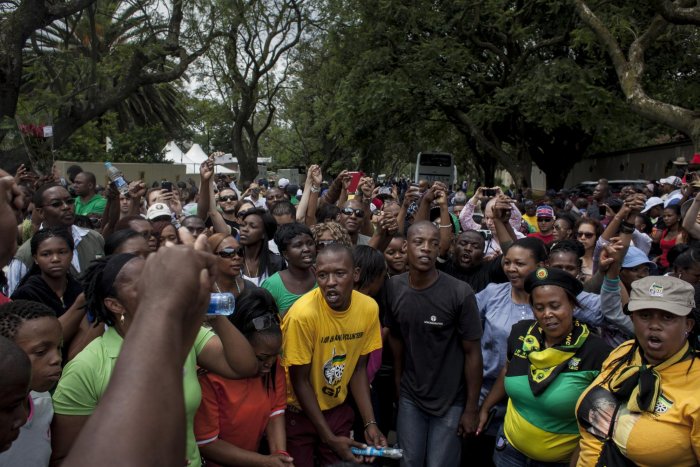
South Africans honor Nelson Mandela
Large crowds gather outside Nelson Mandela’s former home in the Johannesburg suburb of Houghton to pay their respects on December 7, 2013. Mandela, former South African president and a global icon of the anti-apartheid movement, died on December 5 at age 95 after complications from a recurring lung infection. Photo by Charlie Shoemaker/UPI | License Photo