ONE airline is returning to the UK after more than a decade with a direct route from London.
Cyprus Airways is relaunching daily direct flights to Larnaca on April 23, 2027.
New flights will launch from London Stansted to Larnaca in April 2027Credit: AlamyThe daily service has return flights from £355Credit: Getty
The airline last regularly served London until 2015, also flying to Stansted – although it was a different company at the time under government ownership.
It will be a year-round service and according to its website, return trips start from €423 (£355) in Economy Basic.
Sign up for the Travel newsletter
Thank you!
With this option, holidaymakers get one 10kg cabin bag included and a personal item.
Another is Economy Flex which includes one 10kg cabin baggage and a personal item as well as one checked bag at 23kg included – there’s also free seat selection.
Cyprus Airways also has Business Class which has in-flight service, lounge access and priority check-in.
The ticket includes 15kg cabin baggage, two 32kg checked bags, seat selection, fast track, meals included and priority boarding.
Thanos Pascalis, chief executive of Cyprus Airways, said: “By adding London Stansted to our network from April 2027, we are providing our customers with greater choice and flexibility while further strengthening our presence in one of Cyprus’ most significant international markets.
“We look forward to welcoming passengers on board and offering them the convenience, reliability and authentic Cypriot hospitality that define Cyprus Airways.”
For those Brits who arrive in Larnaca in April, they can expect average highs of around 18C.
It’s a popular spot for the cooler months as well as in October it still has highs of 22C and it remains as high as 14C in December.
Singer Peter Andre has his own holiday home in LarnacaCredit: Alamy
There shouldn’t be a long wait in the airport either as Cyprus doesn’t require EES checks.
Brits with a valid passport can visit the country for up to 90 days without the need for a visa.
The island itself gets over 300 days of sunshine each year and is known for having beautiful beaches – including one of the best in the world.
In the Europe list of ‘World’s Best Beaches‘, Golden Beach found on the Karpaz Peninsula in the north of the island comes in at number 30 out of 50.
The beach has 2.4 miles of sand and is known for its wild beauty and sand dunes – it’s a place where you’ll find sea turtle nesting grounds.
Talking to Sun Travel he said: “For anyone going to Larnaca, I have three recommendations. One is a new restaurants called Theta in Perivolia which is very near the airport.”
Peter also loves to go to a Japanese restaurant called Nippon.
He also added: “There’s another one called Opa Souvlaki Kiti, it’s not fancy, but if you want a proper Greek kebab done the Cypriot way, go there.”
Speeding effortlessly towards the slopes by train, you might wonder why you ever flew to a ski resort. On paper, it seems a short hop by plane; in reality, airport queues, cramped flights and long transfers can mean the journey eats up a whole day.
Measured door-to-door, daytime rail travel from London can be as fast as flying, while taking a sleeper train gets you extra time on the slopes. And with Alpine glaciers suffering significant loss of snow cover as global temperatures rise, rail travel constitutes the biggest emissions saving a skier can make.
An exciting recent development is the arrival of a dedicated sleeper train for skiers, the Travelski Night Express (TNE), launched last winter and with an additional new route for the coming one. Each carriage has couchette berths, but the train’s crowning glory is its large, speakeasy-cafe-bar-restaurant, with retro decor, soft lighting and music – you get the romance of overnight rail travel with the potential for two extra days’ skiing thrown in.
The TNE has two routes: one from Paris, the other from Amsterdam and Brussels, going out on Fridays and returning on Saturdays. Both routes access Moûtiers, Aime-la-Plagne and Bourg-Saint-Maurice – stations in the popular Tarentaise region of the French Alps. UK-based skiers can connect to the TNE by Eurostar to Paris or Brussels.
Overnight journeys to Austria are also possible, with a Eurostar to Paris or Brussels and then a Nightjet sleeper train to the Salzburgerland region; or, for Innsbruck and the Tirol, a Nightjet from Amsterdam and Cologne.
An array of resorts in France and beyond can be reached every day of the week by taking the Eurostar to Paris Nord, getting a taxi or the RER for the short transfer to Gare de Lyon, and from there catching a fast TGV train south.
The most direct daytime option is Eurostar’s flagship ski service, Eurostar Snow, which carries snowboards and skis free of charge on top of the usual luggage allowance. Skiers take it from London to Lille, then switch to an adjacent platform for the onward train to Bourg-Saint-Maurice.
Unfortunately, the final outbound departure for this coming season is on 20 February, leaving the ski industry frustrated. Eurostar’s explanation is that it needs to “deploy rolling stock to where it best meets customer demand. Historically, March has not always been the strongest period for Eurostar Snow.”
Iain Martin, founder of sustainable ski-travel campaign Ski Flight Free, says: “It’s ridiculous for Eurostar to curtail their flagship service and blame lack of demand. If Eurostar worked effectively with the ski industry and ski tour operators to market the train, they could sell it out many times over.”
Ski tour operators are certainly hungry for more train seats. “We’re keen on promoting rail travel to the French Alps and we know clients want this,” says Alison Willis, managing director of French ski specialist Peak Retreats. “While changing in Paris is straightforward, we know that direct services are an even more compelling alternative for those who usually fly. March ski holidays, with longer days and excellent conditions, are really popular. So, we’d welcome more direct rail options across as much of the ski season as possible.”
It’s a view echoed by ski tour operator Inghams, which has increased its range of rail-inclusive packages to include 75% of its French destinations, as well as some in Switzerland, Italy and Austria. “There’s a genuine appetite among skiers to travel to the mountains by train,” says head of sustainability Krissy Roe.
Here are 12 resorts you can reach easily by rail.
St Anton am Arlberg, Austria
Photograph: Roger Cracknell Photography/Getty Images
“The cradle of skiing”, St Anton is consistently ranked among the best resorts in the world. While its slopes are known for being challenging and exhilarating (the mighty Valluga being the pinnacle), there are plenty of gentler areas, too. St Anton isn’t just about skiing, either: this delightful village offers a host of activities, including swimming, bowling, indoor rock climbing and some of the best toboggan runs in the Alps. Completing its ski-hard, party-hard image, the resort is renowned for its après-ski, with a long list of celebrated terraces where visitors can dance to live music while knocking back schnapps.
By train: 10h 30min
Depart London St Pancras on the 07.31 Eurostar to Paris Gare du Nord; transfer to Paris Gare de Lyon and take the 12.22 TGV to Zurich; then the 16.40 Railjet to St Anton, arriving at 19.01.
Where to stay
Ski Solutions offers seven nights at the Hotel Post from £1,870pp half-board, including return rail travel.
Alpbach, Austria
Photograph: Ski Juwel
Comprising antique, chocolate-box chalets, Alpbach is perhaps the prettiest village on this list, with fantastic skiing to boot. Despite its low altitude, the resort’s north-facing slopes protect fresh powder, with the best off-piste and snowboarding terrain being on the far side of the Wiedersbergerhorn. Alpbach has gone to great lengths to preserve its rustic character. The main lifts are a short shuttle ride away from the village, and you’ll find gorgeous Tyrolean dishes at mountain hut restaurants such as Böglalm, torchlit walking trails, horse-drawn carriage rides and an Alpine coaster. Pick up a free Alpbachtal Card for access to local activities.
By train: 16h 49min
Depart London St Pancras on the 15.04 Eurostar to Brussels-Midi; then catch the 18.25 ICE to Cologne; get on the 21.45 Nightjet to Jenbach, arriving at 08.53. From there, it’s 20 minutes by bus or taxi.
Where to stay
STC Ski offers the four-star Hotel Alphof, with doubles from £955pp for seven nights’ half-board.
Sainte-Foy-Tarentaise, France
Sainte-Foy, the smallest resort on this list, is highly regarded among ski writers as a “hidden gem”. Just 25 minutes from Bourg-Saint-Maurice station, it has retained its cosy, quiet ambience, thanks to bigger nearby names drawing the crowds. Yet Sainte-Foy has truly excellent skiing: powder that lasts on its untracked, north-facing slopes, and fantastic provisions for children and beginners. Despite some development, the village has remained rustic, with traditional dishes served in 16th-century farmhouses and glasses of local rosé downed on sunny terraces. The quiet pine woods are perfect for snowshoeing, while adrenaline junkies can try their hand at paragliding high above the Tarentaise.
By train: 7h 58min
Eurostar Snow departs London St Pancras at 09.01 to Lille Europe; switch to the 11.35 Eurostar Snow continental train to Bourg-Saint-Maurice, arriving at 17.45. From there, it’s 25 minutes by bus or taxi.
Where to stay
Premiere Neige offers seven nights’ self-catering in the three-bedroom Panorama apartment from €600pp, based on six people sharing.
La Rosière, France
Photograph: Real Image/Alamy
Commanding spectacular views of the Tarentaise valley, La Rosière is as beautiful as it is convenient. Its position on the Franco-Italian border allows skiers to choose between south- and north-facing slopes (in neighbouring La Thuile), while its two core villages are relaxed and compact, in classic chalet style. La Rosière has kept up an excellent pace of development, exemplified by the new high-speed Petit-Bois chair, ensuring a high-quality experience all-round. Sledging is popular, including the new sunset toboggan run from the top of the Les Eucherts lift. While fairly quiet, you’ll find some decent après-ski and DJ sets at Le Comptoir, too.
By train: 7h 44min
Eurostar Snow departs London St Pancras at 09.01 to Lille Europe; switch to the 11.35 Eurostar Snow continental train to Bourg-Saint-Maurice, arriving at 17.45. From there, it’s 40 minutes by bus or taxi to the resort centre.
Where to stay
Traditional chalet-hotel L’Accroche-Cœur has double rooms from €240 a night B&B.
Part of the famous Three Valleys, Les Menuires is one of the best value-for-money resorts in the Alps: 600km of piste but without the high price tag of Méribel or Courchevel. Unsurprisingly, it’s very popular with families who love the resort’s early-access ski patrol lessons with ESF Club Piou-Piou. Dining is similarly family-oriented: expect hearty, locally sourced Savoyard meals at restaurants such as Chez Pépé Nicolas. Finally, in March, Les Menuires hosts a seasonal silly slalom, Complètement à la Masse, open to all ages.
By train: 13h 5min
Depart London St Pancras on the 17.31 Eurostar to Paris Gare du Nord; transfer to Paris Gare de Lyon and take the 22.52 Travelski Night Express to Moûtiers, arriving at 07.36. From there it’s 45 minutes by bus or taxi.
Where to stay
Travelski offers seven nights at Hôtel Les Menuires Les Bruyères from £1,356pp B&B, including rail travel from Paris, transfers and seven-day ski pass. The Eurostar to Paris needs to be booked independently.
Montgenèvre, France
Photograph: Michele D’Ottavio/Alamy
France’s oldest ski resort, Montgenèvre was the stomping ground of the Parisian set before British skiers started arriving in the 90s, attracted by its bargain prices and easy access to Italy. Pleasantly old world and fully pedestrianised, “Monty” is the ideal family resort, with an extensive beginners’ zone and affordable accommodation. Intermediates will enjoy the network of red and blue runs, while experts can plough through off-piste powder in the Gondrans bowl and off the Col de l’Alpet. Over the past year, the resort has extensively redeveloped its lift system to dramatically improve speed and ease – in time for hosting the 2030 Winter Olympics.
Depart London St Pancras on the 08.01 Eurostar to Paris Gare du Nord; transfer to Paris Gare de Lyon and take the 12.46 TGV to arrive at Oulx at 17.21. From there it’s 35 minutes by bus or taxi.
Where to stay
Peak Retreats offers seven nights B&B in a suite in Hôtel Anova from £1,046pp, including rail travel, based on four sharing.
Peisey-Vallandry, France
Peisey-Vallandry offers a wealth of activities, including skijoring – skiers being pulled across the snow by a horse.
Peisey-Vallandry occupies a prime position between Les Arcs and La Plagne, connecting to both via the immense Paradiski domain. Its sunny, west-facing piste offers something for everyone: a high-altitude beginners’ area, picturesque intermediate tree runs to the Chapelle Notre-Dame, and two challenging blacks (plus some fairly gnarly freeriding and all 425km of Paradiski). Thanks to its golden child, Olympic champion Éric Perrot, the resort has a strong reputation for cross-country, including a new Nordic centre, shooting range and 43km of high-quality trails (open for ages 3+). For something more unusual, try Summit Bike’s electric snow-biking sessions or skijoring (putting on skis and being pulled across the snow by a horse).
By train: 7h 47min
Eurostar Snow departs London St Pancras at 09.01 to Lille Europe; switch to the 11.35 Eurostar Snow continental train to Landry, arriving at 17.34. From there, it’s 25-35 minutes by bus or taxi.
Where to stay
The ski-in-ski-out, fully renovated Hotel Émeraude has doubles from €130 B&B.
Saint-Gervais-les-Bains, France
Le Topo, a climbing facility in Saint-Gervais-les-Bains. Photograph: Arthur Delicque
Saint-Gervais has been a popular tourist destination since the middle ages, owing to its natural hot springs. Today, the resort’s state-of-the-art thermal baths are still a huge draw for skiers seeking the ultimate wellness holiday. Combined with more than 455km of quiet piste and the best views of Mont Blanc in France, Saint-Gervais is a must-visit. In 2022, the resort opened a world-class indoor climbing facility, Le Topo. Dining, meanwhile, remains suitably traditional, including Savoyard platters, fondue and local craft beer. It’s also perfect for holidaying by rail, with a station-to-village gondola, Le Valléen, plus the Mont-Blanc tramway, one of the highest in Europe.
By train: 8h 45min
Depart London St Pancras on the 09.31 Eurostar to Paris Gare du Nord; transfer to Paris Gare de Lyon and take the 14.18 TGV to Bellegarde; then the 17.15 TER to Saint-Gervais-les-Bains, arriving at 19.16. From there, it’s five minutes by the Valléen gondola to the village centre.
Where to stay
Seven nights’ self-catering in a two-bedroom apartment in Les Sources de Canopée in Saint-Gervais, with Peak Retreats, costs from £645pp, including rail travel, based on four sharing.
Val Cenis, France
Photograph: Sebastien Tachet
Val Cenis recently invested €25m in sustainable development and infrastructure, and the results are showing. The resort has successfully created a second “recycled” chairlift, Combe de l’Ours, using secondhand seats, pylons and cables to reduce new materials tenfold. A new panoramic treetop walkway and energy-efficient gondola will greet guests this winter, giving easy access to its 125km of high-quality, north-facing piste. As a year-round working community, the resort comprises several well-stocked villages with a wide variety of shops, restaurants and bars, as well as a bowling alley. Off-piste snowshoeing in the spectacular Vanoise national park is a popular activity; locals Thierry Bardagi and Hélène Degano offer a combined snowshoeing and mountain refuge package, with a cooked breakfast overlooking the mountain sunrise.
By train: 7h 47min
Depart London St Pancras on the 08.01 Eurostar to Paris Gare du Nord; change to Paris Gare de Lyon and take the 12.46 TGV to arrive at Modane at 16.48. From there, it’s 30 minutes by bus or taxi.
Where to stay
Erna Low offers seven nights’ self-catering in a one-bedroom apartment in Les Balcons de Val Cenis Village, from £132pp, based on four sharing, travel not included.
Villars-sur-Ollon, Switzerland
Les Bains de Villars in Villars-sur-Ollon. Photograph: Riton/Henri-Ravise Noel
Villars is one of French-speaking Switzerland’s quieter and (relatively) affordable resorts, perfect for an active holiday. Its respectable 130km of piste spreads across neighbouring Les Diablerets and Gryon, providing something for all ages and abilities, as well as cross-country, touring and toboggan trails. Plus, there’s a spectacular 1,500-metre off-piste descent from Les Diablerets glacier to the village. After a long day’s skiing, book in for a spa massage at Les Bains de Villars or a dip in the hot springs at Lavey, before a night of music and malt whisky in the bar at Les Mazots du Clos.
By train: 8h 49min
Depart London St Pancras on the 09.31 Eurostar to Paris Gare du Nord; transfer to Paris Gare de Lyon and take the 14.18 TGV to Geneva; then the 18.05 InterRegio train to Aigle, arriving at 19.20. From there, it’s 20 minutes by bus or taxi.
Andorra’s duty-free status makes Grandvalira particularly attractive to visitors looking for shopping and high-quality, low-cost accommodation. Spread across three high-altitude villages, the resort is by far the largest in the Pyrenees, with 215km of piste best suited to intermediates. The village of Pas de la Casa has garnered a reputation for its après-ski, while further along, Soldeu is home to some swanky four- and five-star hotels. The ace up Grandvalira’s sleeve, however, is its unique Catalan cuisine, quite unlike traditional Alpine fare, with an emphasis on flame-grilled meats and hearty vegetable stews.
By train: 15h 12min
Depart London St Pancras on the 17.31 Eurostar to Paris Gare du Nord; transfer to Paris Gare d’Austerlitz and take the 22.14 Intercités de Nuit to Andorre-L’Hospitalet, arriving at 09.43. From there, it’s 35-55 minutes by bus or taxi.
Where to stay
Alpine Answers offers seven nights in a double room (with balcony) at the four-star Sport Hotel Village, from £1,030pp B&B.
Sestriere, Italy
Photograph: Michele D’Ottavio/Alamy
Europe’s first purpose-built ski resort remains cheap and cheerful, catering best to families and young adults on a budget. Sestriere’s slopes are some of the best in the Via Lattea domain (which includes France’s Montgenèvre and neighbouring Sauze d’Oulx), ranging from sprawling nursery meadows to the steep Col de Sises Olympic giant slalom. Local amenities are well-organised and non-ski activities abundant, including a sizable leisure centre and swimming pool, open-air ice rink and dog-sledding. Après-ski is also surprisingly lively for a family-focused resort, with several popular pubs in the centre of town, alongside a good, old-fashioned discoteca, Tabata.
By train: 8h 20min
Depart London St Pancras on the 08.01 Eurostar to Paris Gare du Nord; transfer to Paris Gare de Lyon and take the 12.46 TGV to arrive at Oulx at 17.21. From there, it’s 35 minutes by bus or taxi.
Where to stay
Inghams offers seven nights at Grand Hotel Sestriere, from £1,134pp, including rail travel and transfers.
Accommodation prices are for the 2026/27 season and were correct at the time of publication
FANCY travelling through Europe in the comfort of your own private cabin rather than a cramped plane? This new sleeper train might be the answer.
Nox Mobility is launching next year as an alternative to short-haul flights – and they’re pretty cheap too.
Nox Mobility is launching a sleeper train service next yearCredit: Nox MobilityThe suites are private for each passengerCredit: Nox Mobility
The sleeper train will launch in March next year with its first journey between Hamburg and Munich with stops in Bremen and Augsburg.
The inaugural run will leave Hamburg at 9.22pm and arrive at 8.14am – there will go in each direction three times per week.
Sign up for the Travel newsletter
Thank you!
Tickets are affordable too with one-way fares starting from €65 (£55).
Rather than regular train carriages, inside will be Nox Suites – a private area for each passenger with a seat that opens into a lounge to work or unwind.
Inside is also a two-metre-long bed, storage, charging ports and a window to gaze out of.
There’s also no restaurant carriage on Nox Mobility, however you can pre-order meals to be served in your cabin and breakfast is available as an optional add-on.
On Nox, children under the age of four are allowed to travel for free with an adult passenger.
It also teased future rooms which are actually private cabins.
The Single Loft has a seat and desk for the day with a bed for during the night.
The Double Loft is the most spacious room with a 170cm wide bed, two seats and a panoramic window to take in the views.
The first route is between Hamburg and Munichnoxmobility.com/enCredit: Nox Mobility
The Double Vista has ‘two seats by day and two beds by night’ in a private room with a full window.
In fact by 2035 it aims to connect 100 European cities.
Thibault Constant, co-founder of Nox said: “Sleeping while a train gets you across Europe is a great concept. But today people have to share their cabins with strangers, beds are tight, and it’s often more expensive than air travel.
“We want to change that and make night trains an essential part of European travel.”
It later hopes to expand its network to the likes of Sweden and ItalyCredit: Nox Mobility
Northern Germany probably isn’t the first place you’d think of to look for a U.S. Navy and Marine Corps classic attack jet. However, contract aggressor company Top Aces flies a squadron of deeply upgraded Douglas A-4N Skyhawks to support European air arms for their “red air” training needs.
Nearly 3,000 A-4s were built between 1956 and 1979, and TWZ’s Jamie Hunter traveled to the Germany Navy base at Nordholz for the latest episode of our “Special Access” to witness some of the last, and by far the most modern, Skyhawks operating up close.
There he learned what it was like operating the iconic but nearly antique jets against some of the world’s most capable fighters. He also discovered that significant developments are on the horizon for Top Aces in Europe, principally the arrival of F-16s that will further enhance the company’s aggressor services for its growing list of European customers.
Enjoy the show!
Skyhawks On Steroids Playing The Bad Guys In European Skies
Kim Huybrechts will come in as a replacement as the Belgian is the highest-ranked player from the 2026 European Tour rankings who had not qualified.
Huybrechts will face Ryan Searle when the European Championship starts in Dortmund on Thursday, while Gerwyn Price will play Rob Cross and defending champion Gian van Veen will take on Andrew Gilding among the night’s eight matches.
World number one and PDC world champion Luke Littler will start his challenge on Friday with a match against William O’Connor.
The last outgoing flight is from Newcastle at 4.25pm with fares starting from £21.99.
The last inbound flight from Brussels to Newcastle is at 7.30pm with prices from £214.99.
At Brussels Airport in Zaventem, The Brussels Times reported that the only Ryanair route that will remain will be to Dublin.
By January 2027, the price of aviation tax will have risen by 50 percent going from €2 (£1.68) in January 2025 to €7 (£5.87) in January 2027.
Ryanair boss Michael O’Leary called the measure a “failed and stupid initiative.”
According to reports, eight routes will be discontinued from Brussels Airport in Zaventem.
More than 1.1million seats will be affected by the cancellationCredit: AFPThe Newcastle to Brussels South Charleroi Airport route is set to be axedCredit: Getty
Meanwhile, 12 routes will be cut from Brussels South Charleroi Airport.
The new strategy shifts the bloc’s focus from long-term climate concerns to urgent security measures.
Published On 20 Oct 202620 Oct 2026
The European Commission has unveiled a new Arctic strategy for the European Union that lists security and resilience first among four priorities, alongside climate change, economic prosperity and opportunities for Arctic communities.
The strategy calls for a new maritime security hub to help member states and partners share information and monitor maritime activity in the Arctic, the Commission said on Tuesday.
Recommended Stories
list of 3 itemsend of list
The hub would later expand to track shadow fleet vessels, detect illegal fishing and pollution, and improve search and rescue coordination.
The Commission also said the EU will work to expand European icebreaker capacity. Icebreakers are specialised vessels designed to navigate ice-covered waters by breaking up sea ice and maintaining safe shipping routes.
“The Arctic is one place where the tectonic plates of geopolitics are colliding,” European Commission President Ursula von der Leyen said, adding that sovereignty and territorial integrity can no longer be taken for granted.
EU foreign policy chief Kaja Kallas said Russia is expanding its military footprint in the high north, citing drone incursions, GPS jamming and cable sabotage, the AFP news agency reported.
Cutting reliance on Washington
Several measures appear aimed at reducing dependence on the United States. The Commission said the EU will back a strategic pan-Arctic fibre-optic telecommunications cable project linking Greenland directly to Europe. It is part of a wider plan that would also connect Canada, Japan and South Korea.
The EU will also provide secure satellite connectivity for government communications through the IRIS² constellation, a constellation AFP said is meant to rival US tech mogul Elon Musk’s Starlink.
The shift follows US President Donald Trump’s repeated demands to take control of Greenland, a Danish autonomous territory. Although his tone has softened this year, with a security deal signed with Greenland and Denmark, many in Europe remain wary, AFP said.
Member states press for action
The strategy follows last month’s meeting of leaders from 12 countries, including Germany, France, Finland and Denmark. Member states urged the EU to take a more strategic and proactive role, according to a joint statement.
Participants identified Russia as the largest threat while noting the ambitions of China and the US.
At the meeting, German Chancellor Friedrich Merz said the era of “high north, low attention” was over. Finnish Prime Minister Petteri Orpo called Russia the most significant long-term threat and said the EU must treat the Arctic as a strategic frontier.
The Commission reiterated the EU’s position remains that oil, coal and gas should stay in the ground, including in the Arctic.
To combat increasing climate concerns, the Commission pledged to “strengthen climate research, observation and monitoring to better understand these changes and support effective responses”, while working in tandem with the people who live and work in the Arctic.
Nvidia is stepping up its investment in Europe’s AI sector, announcing plans to back four German startups: Agile Robots, Avelios Medical, Mirelo, and Reflex Aerospace. The company did not say how much it will invest in each. The announcement came as German Chancellor Friedrich Merz urged businesses, especially
Hundreds of thousands of Europeans took to the streets for separate demonstrations putting pressure on governments across the EU.
Published On 17 Oct 202617 Oct 2026
Hundreds of thousands of Europeans have taken to the streets in separate, uncoordinated demonstrations to protest against the rising cost of living in their countries.
Saturday’s protests were in Belgium, France, Italy and Portugal in a wave of unrest that has put pressure on national governments across the European Union.
Recommended Stories
list of 3 itemsend of list
France experienced one of its most turbulent days of protests in decades, with over 550,000 people joining demonstrations and police facing off with protesters across the country – but it was not the only country to see significant demonstrations.
In Belgium’s capital Brussels – which has already seen weeks of protests by students against university registration fees – police fired tear gas and water cannon to disperse protesters, who they accused of launching missiles at them and setting fires.
In Liege, a smaller city east of Brussels, police also deployed water cannon to break up demonstrations. Police did not say how many people attended.
An estimated tens of thousands of protesters marched in Lisbon, the Portuguese capital, against the cost of living crisis, low wages and an inability to access housing in major cities. House prices in Portugal have more than doubled since 2017, while rents for new leases have increased nearly as much.
Portuguese Parliamentary Affairs Minister Carlos Abreu Amorim said on Friday that the “government will not yield to shouts from the street”.Protesters said their leaders are “out of touch” with the problem.
In Milan and Bologna, Italian police reported that, alongside peaceful cost of living rallies, protesters threw stones and clashed with officers.
Italian media reported several injuries and arrests.
Portuguese demonstrators in Lisbon set up tents to protest against the housing shortage, soaring rents and low wages [Filipe Amorim/AFP]
French protests spill over
None of the protests reached the same scale as the nationwide rallies in France but they may be a sign of spilling over into other European nations, according to Alberto Alemanno, Professor of EU Law & Policy at HEC Paris business school.
“France is the epicentre of this movement … and there are signs now that this is spreading beyond France,” Alemanno told Al Jazeera.
He said Saturday’s protests may not be the last in many of these countries and new hotspots could emerge.
In Greece, Germany, and Austria, the “early stages” of a movement is emerging, with mobilisation expected “in the coming week”, he said.
They are not a single movement, he explained, but several protests happening at the same time, with some “shared grievances”: underfunded education, rising costs and, for students, uncertain prospects after graduation.
The unrest comes at a crucial time for Europe, as the continent prepares for what Alemanno called an “unprecedented super-cycle of national elections” in the coming 12 months, with votes scheduled in Spain, France, Italy and Poland.
“Inevitably, all these protests, all these mobilisations, are going to be at the centre of the political conversation,” Alemanno said.
Riot police fire water cannon during a youth protest in Brussels [Nicolas Maeterlinck/AFP]
It was a night soundtracked by the Impossible Dream.
And it was no coincidence that was the song chosen at the Vitality Stadium before Bournemouth’s first European home game in the club’s 127-year history.
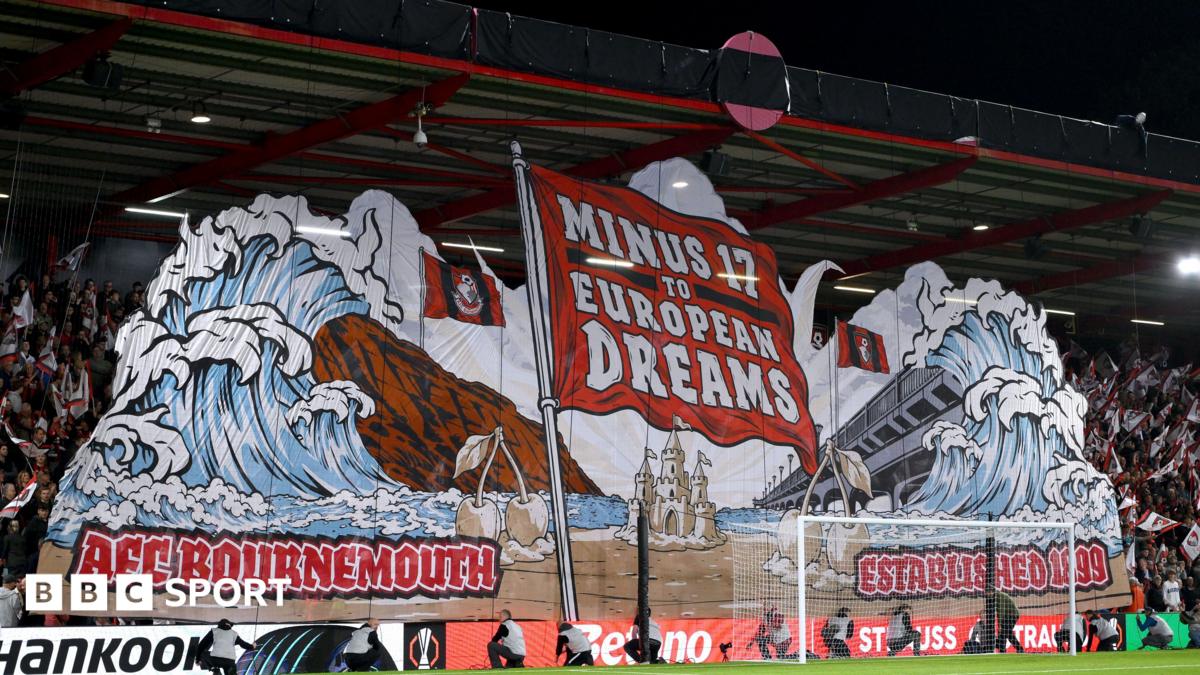
As supporters lucky enough to bag a ticket for the historic occasion waved flags to the Andy Williams classic, a giant tifo rose from behind one of the stands, bearing the words ‘Minus 17 to European dreams. AFC Bournemouth, established 1899’.
As recently as 2008, a night like this would have been unthinkable for Cherries supporters.
Just 18 years ago, Bournemouth were facing the prospect of no longer existing.
After entering administration, the club were relegated from League One after being handed a 10-point deduction.
But that was not the end of their troubles. To be allowed to compete in the 2008-09 season, Bournemouth, then managed by Eddie Howe, had to accept a further 17-point deduction in League Two.
It left them at the bottom of the Football League and seemingly destined for life as a non-league side.
By the end of the season, the Cherries had not only completed one of the greatest escapes in English football history to secure a 21st-place finish and survival, but had also laid the foundations for a decade of success, which culminated in a first promotion to the Premier League in 2015.
Fast-forward to the present day and Bournemouth are making history for all the right reasons in the Europa League. Thursday’s 3-0 win over Sturm Graz meant they became only the second English side to win their first two matches in a major European competition since Bolton achieved the feat in the Uefa Cup 21 years ago.
“It’s a moment that will live long in their memories,” former defender Joel Ward told TNT Sports. “The club should relish this night.
“The owner [Bill Foley] manifested this moment when he first came into the club. He set the standards for this club, he has invested a lot into it and he wanted to see this club in Europe.
“He got his wish, and they have certainly started incredibly well so far.”
Some find success sweet but fleeting, others spend years building to the pinnacle, and then there are those whose lasting glory evolves into a dynasty.
After tearing Manchester City apart in large spells of their 4-2 Champions League victory on Wednesday, Paris St-Germain look well on track to join the latter bracket.
The back-to-back European champions sliced through City with astonishing ease to take a 3-0 lead into half-time, and were still able to score another despite a spirited second-half fightback from the Premier League leaders.
After obliterating Inter Milan 5-0 in the 2025 final before squeezing past Arsenal on penalties in last season’s showpiece game, Luis Enrique’s side are aiming to win a third consecutive European crown.
They would be the fifth team to do so going back to 1956, and just the second in the Champions League era.
“This PSG team are on a different level,” Chris Sutton told BBC Radio 5 Live at half-time.
“They have just run all over Manchester City, who haven’t been able to string passes together. It’s been an absolute pummelling for Man City.”
To mark PSG’s latest display of attacking excellence, we’re looking at how the Parisians compare to those clubs who have enjoyed the most dominant eras in European competition.
Some will point out that football existed before the European Champion Clubs’ Cup began in 1955 – so apologies to Stan Cullis’ ‘world-champion’ Wolves outfit and the Mitropa Cup’s early Vienna heavyweights.
However, this top 10 debate is centred around winning European football’s grandest prize.
Paris St-Germain 2025-present
OK, straight in with the current champions, because this is a dynasty in the making.
Paris St-Germain are hoping to enter that bracket and the 4-2 win against Manchester City on Wednesday reminded the rest of Europe why you shouldn’t bet against them becoming continental champions for a third successive season.
PSG had a lacklustre start to the domestic season – they always do, don’t they? – but boast an uncanny ability to click into gear when it matters.
In Manchester, Luis Enrique’s side were at their unstoppable best. A ruthless blend of silky flicks and slick off-the-ball movement that saw a dazed City caught several frames behind.
“Unbelievable. PSG, what a team,” Sutton said.
“PSG’s press, I don’t think there’s another team that press with their intensity and ferocity.
“This [City] is one of the best teams in the Premier League getting an absolutely roasting. This is them [PSG] having a slow start to the season. Heaven help everyone.”
The Parisians have been France’s most dominant force since the arrival of Qatar Sports Investments 15 years ago, but it took a change of approach for the holy grail of continental success to arrive.
“It’s the end of the glitter,” professed president Nasser Al-Khelaifi after years of lavish spending, ushering out the “flashy, bling-bling” era.
Instead, Enrique arrived in 2023 intent on building a coherent team. There was still significant investment, but on younger players who could be moulded by his philosophy and discipline while given room to flourish.
The result was two scintillating Champions League triumphs.
Ryanair services daily direct flights on the route for just £15 but from April next year, layovers will now be required for those wanting to fly to fly from the UK to this city
Ryanair plans to cut all flights to a European airport next year(Image: Getty Images/Stock Image)
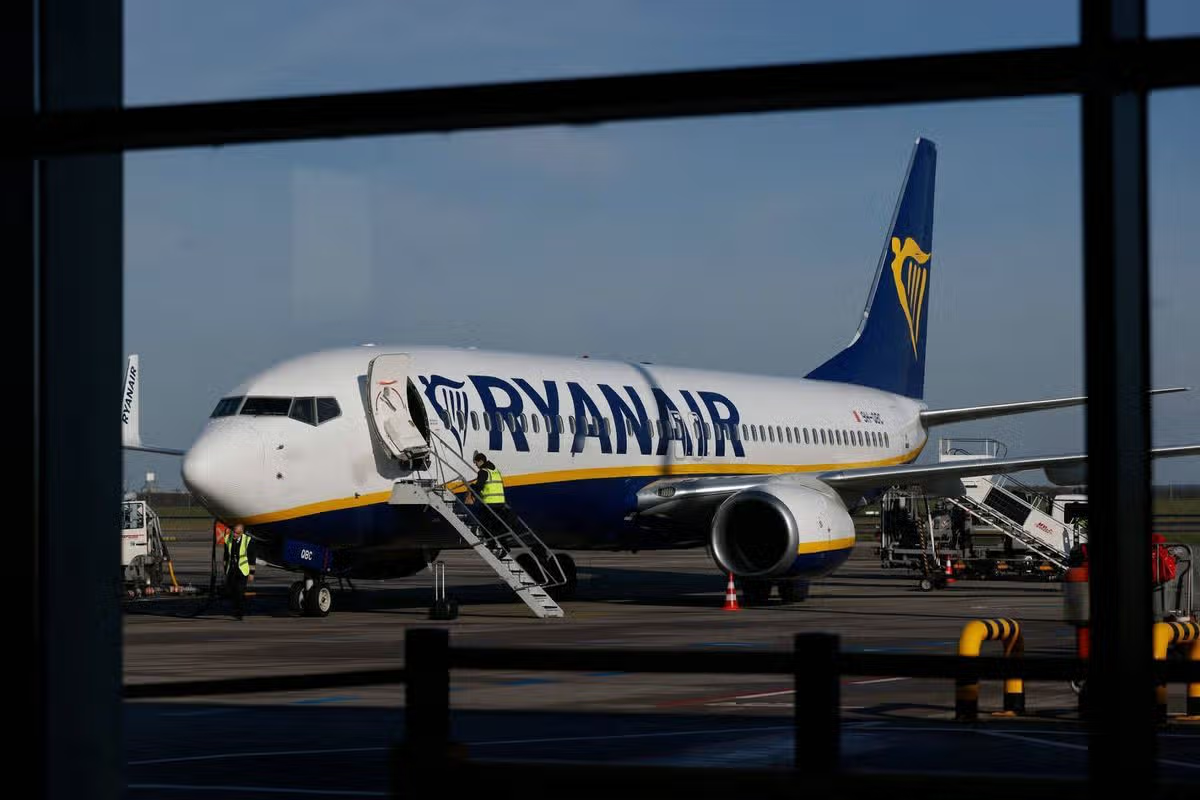
Ryanair plans to cut all flights to a European airport next year. From April 2027, Europe’s biggest budget airline will no longer fly to Bremen in Germany.
This will axe around 500,000 seats. At present, Ryanair services daily flights on the route from London Stansted to Bremen for just £15. The airline’s website appears to have tickets for the final flights to Bremen scheduled for March 27, 2027.
Ryanair previously announced it would be cancelling 24 routes to and from Germany, cutting 800,000 seats in total. Nine airports will be affected by the decision, affecting major cities and popular with tourist spots:
Berlin
Hamburg
Memmingen
Baden-Württemberg
Cologne
Frankfurt-Hahn
Dortmund
Dresden
Leipzig
Earlier this year Ryanair said it will be reducing its flight schedule to and from Berlin by 50 per cent.
CEO Eddie Wilson subsequently said that Germany’s aviation market is “broken”. He also said it “needs an urgent fix.”
“As a result of these high government taxes/fees (the highest in Europe), and Lufthansa’s high-fare monopoly, German citizens/visitors now pay the highest air fares in Europe,” Mr Wilson said.
Airbus and Kratos Defense & Security Solutions have completed the first flight of the U740 Valkyrie uncrewed combat aircraft, a Europeanized version of the XQ-58A Valkyrie, advancing their bid to deliver a combat-ready system to Germany by 2029. The flight comes as the German Air Force, or Luftwaffe, moves toward acquiring a new class of jet-powered combat drones, in what could become a major shift in the country’s traditionally limited armed-uncrewed-aircraft capabilities.
The ride of the Valkyrie ⚔️ With the successful first flight of the Airbus U740 Valkyrie in Europe, we are one step closer to introducing an operational uncrewed Collaborative Combat Aircraft (CCA) to the German and other European Armed Forces. The flight achieved all… pic.twitter.com/S2sFrtdmGA
The flight took place at an unnamed test facility in northern Europe, Airbus announced on October 12. The aircraft conducted a rocket-assisted takeoff, maneuvers at different altitudes, and flight at speeds of up to Mach 0.8. The test also included in-flight mission adjustments, with Airbus reporting that all objectives were met.
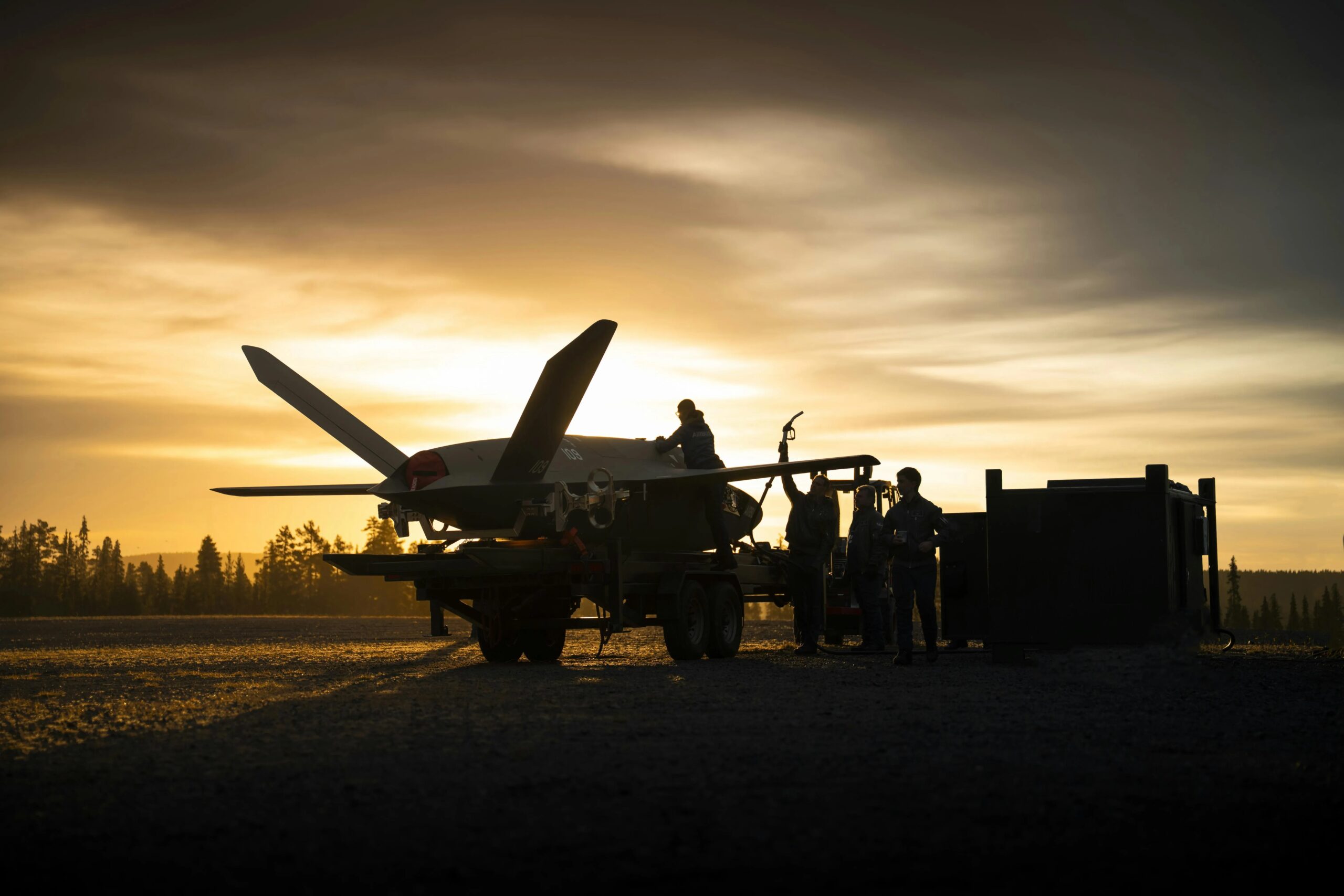
The U740 Valkyrie uncrewed combat aircraft is prepared for launch. Airbus
The next phase will introduce Airbus’ Multi-platform Autonomous Reconfigurable and Secure (MARS) mission system, which is intended to provide the aircraft’s European-controlled software and mission-management architecture. Airbus says MARS will support autonomous operations and coordination between multiple uncrewed aircraft while retaining human oversight of critical decisions.
The U740 is based on Kratos’ American-developed XQ-58A, an uncrewed aircraft designed as a relatively affordable combat platform. Airbus is adapting the aircraft with its MARS mission system and presenting the combination as a way to provide Germany with a sovereign European capability without waiting for an entirely new airframe to mature.
The U740 Valkyrie on its launch trailer. Airbus
Published performance figures for the U740 include a maximum takeoff weight of around 3,000 kilograms (6,600 pounds). Airbus lists a range exceeding 5,000 kilometers (3,100 miles) and a service ceiling of 45,000 feet. It has an internal weapons bay and external payload stations beneath its wings.
A U.S. Marine Corps XQ-58A Valkyrie conducts a test flight with a U.S. Air Force F-16. U.S. Air Force photo
One distinctive feature is the U740’s rocket-assisted launch capability, which reduces its dependence on conventional runways. The original Valkyrie design is primarily recovered by parachute, but newer versions can take off with rocket assistance and land on a runway, offering greater flexibility in how and where they operate. That could help the Luftwaffe disperse operations or launch aircraft from locations where established airfields are unavailable or under threat. The XQ-58 family has also shown some potential for scaling to different requirements, as detailed in these earlier reports on runway launch and recovery and further platform development. In particular, the U.S. Marine Corps has been exploring ways to expand the XQ-58’s flexibility, including further development of the Valkyrie to meet its own mission requirements.
If adopted, the rocket-assisted launch capability would provide an intriguing throwback to practical German studies during the Cold War, in which F-104G Starfighter fighter-bombers used the Zero-Length Launch (ZELL) system to take off from dispersed locations.
F104 Starfighter At Zell Start, Zero Length Launch.
Airbus says the U740 will be able to operate autonomously or under the direction of crewed fighters such as the Eurofighter. The company sees it as a means of increasing the reach, firepower, and survivability of existing combat aircraft, with uncrewed platforms undertaking higher-risk missions.
With the MARS system, Airbus intends to give European customers control over mission applications, data, and key software functions, while enabling autonomous mission execution and coordination between aircraft. This is particularly relevant for Germany, which will likely want to integrate national weapons, sensors, and operational requirements without becoming dependent on a foreign-controlled mission architecture.
The U740 Valkyrie. Airbus
Since the underlying airframe is American, the degree of sovereignty Germany ultimately obtains will depend on the practical ability to control and modify software, integrate national systems, and support the aircraft throughout its service life.
The European flight is an important step for the Valkyrie program, but substantial work remains before it can be considered combat-ready. Mission-system integration, further testing, and the demonstration of effective cooperation with crewed aircraft will be central to meeting the companies’ 2029 target.
Another view of the U740 Valkyrie. Airbus
The effort is also unfolding as Germany develops its requirements for what has been described in press reports as a Jagdbomberdrohne, or fighter-bomber drone. The precise operational concept has yet to emerge publicly, including whether the Luftwaffe primarily wants an uncrewed aircraft to accompany crewed fighters or a platform capable of conducting independent long-range strike missions.
Germany has historically lagged behind several other major military powers in fielding armed uncrewed aircraft. Previous attempts to acquire larger reconnaissance drones encountered major technical and procurement difficulties, while political resistance to armed drones delayed the development of a strike capability for years.
The U740 Valkyrie seen moments after launch. Airbus
The Luftwaffe’s current larger uncrewed aircraft fleet remains limited to five leased Israeli-made Heron TP medium-altitude, long-endurance drones. Germany is also participating in the Eurodrone program, while uncrewed systems were expected to form part of the wider Future Combat Air System (FCAS), before that Franco-German-led effort hit the buffers earlier this year.
A German Air Force Heron TP at Jagel Air Base in 2024. Bundeswehr/Ann-Kathrin Steinbring
Russia’s full-scale invasion of Ukraine in 2022 and Germany’s subsequent military buildup have intensified pressure to address these gaps. Berlin has set a goal of being ready for war by 2029, and reports indicate that the Luftwaffe wants a new combat-drone capability on a similarly ambitious timeline.
The CA-1 Europa from the German defense startup Helsing. Helsing
The various proposals reflect a broader shift toward uncrewed aircraft that can deliver additional weapons, sensors, and electronic warfare capabilities without putting a pilot at risk. But Germany’s terminology raises an important question about the intended role.
A conventional collaborative combat aircraft, or CCA, would be designed to work alongside crewed fighters, extending their reach and providing additional combat mass. A platform intended to operate independently against targets deep inside enemy territory would place greater emphasis on range and survivability. These roles are not mutually exclusive, but the Luftwaffe’s final requirements will shape the aircraft it chooses.
Germany may not be looking for a single drone to do everything. One option might be a split high-low approach that could pair more capable, longer-range systems for deep-strike missions with cheaper, attritable collaborative combat aircraft that can fly alongside crewed fighters. At this point, it should also be noted that CCAs could also give older fourth-generation fighters a new lease on life, boosting their lethality and survivability by extending their sensor reach, adding weapons capacity, and allowing uncrewed aircraft to take on more dangerous tasks.
Meanwhile, Airbus is also working on its larger U760 Ravenstorm, intended for service in the early 2030s. The Ravenstorm gives Airbus a longer-term path toward a more advanced European-designed uncrewed combat aircraft as it pursues the nearer-term Valkyrie effort.
The Airbus U760 Ravenstorm, a combat drone designed to operate alongside fighter aircraft in air-to-air combat, strike missions, and electronic warfare roles. Airbus
In the short term, the Luftwaffe will need to determine which capabilities must be available in an initial operational fleet and which can be introduced later. Even an aircraft based on an established design requires substantial integration, testing, training, and infrastructure before it can be employed effectively in combat.
Germany’s 2029 target leaves little time for a program that still has to integrate its mission system and demonstrate how the aircraft will be used operationally. That is a particular challenge for the Luftwaffe, which has little experience operating large uncrewed aircraft, let alone jet-powered systems intended for combat.
A rear view of the U740 Valkyrie. Airbus
The European flight gives Airbus and Kratos a head start in testing the U740 for German requirements, but the next major milestone will be flying it with the MARS mission system. How quickly that work progresses will help determine whether the Valkyrie can meet the Luftwaffe’s timetable.
Ryanair has announced it is axing all flights to and from Bremen in GermanyCredit: AlamyThe city currently has a direct route from London Stansted which will end in April 2027Credit: Alamy
Currently, Ryanair offers daily flights from London Stansted to Bremen for as little as £15.
But in a new announcement, these will come to an end in April 2027.
Sign up for the Travel newsletter
Thank you!
On the Ryanair website, it appears tickets for the final flights to Bremen are scheduled for March 27, 2027.
The German city is known for its maritime history and gothic look that some often say looks ‘fairytale-like’.
With Ryanair withdrawing the route, there will be no direct links to Bremen from the UK.
Those wanting to visit the German city will have to take stopover flights which can take over double the time.
The shortest is with KLM, which has a stopover in Amsterdam and takes three hours and 20minutes.
Last year, Ryanair announced it would be dropping 24 routes to and from Germany, cutting nearly 800,000 seats in total.
It was revealed that nine airports would be affected, along with the plans of those wanting a winter break, and including major cities that are popular with tourists.
These are:
Berlin
Hamburg
Memmingen
Baden-Württemberg
Cologne
Frankfurt-Hahn
Dortmund
Dresden
Leipzig
Bremen has been compared to a ‘fairytale’ by visitorsCredit: Alamy
In April of this year, the airline confirmed it would be reducing its flight schedule to and from Berlin by 50 per cent.
Ryanair’s CEO Eddie Wilson said back in August: “Germany’s air travel market is broken and needs an urgent fix.
“As a result of these high government taxes/fees (the highest in Europe), and Lufthansa’s high-fare monopoly, German citizens/visitors now pay the highest air fares in Europe.”
AUTUMN is the perfect time for a city break holiday abroad.
Fewer crowds, cooler temperatures, and quieter restaurants – there’s something to be said for a long weekend post-summer.
And with hundreds of countries under our belts, as the Travel Team at The Sun, we know which are the best spots to visit after summer but before winter is in full swing.
Here are our favourite cities to visit this autumn, along with our top tips, cheap pints and very affordable flights thrown in.
Warsaw, Poland
Try the cosy Hala Koszyki food hall for some fantastic foodCredit: Alamy
Known as the Grinch by friends due to my ambivalence to Christmas, Warsaw is the perfect place to visit in autumn before the festive season takes over.
Not only is it also frequently named one of the cheapest city break destinations, but it was named top city to visit by European Best Destinations 2026.
The architecture of the city is stunning, with historic 17th century buildings compared to the more modern Brutalist blocks.
Start with a wander around the beautiful Old Town which was reconstructed after WWII, when 85 per cent of it was destroyed.
Then head over to the Neon Museum, with hundreds of huge neon signs from the Cold War (one to get your camera out for, definitely).
The food scene is fantastic too – I highly rate Momu which specialises in Polish dishes using a smoke-roasting oven, or huge food hall Hala Koszyki which was the first of its kind in the city.
You can find really cheap hotels – ibis budgets start from as little as £35 (so £17.50 each), while Ryanair flights are £30 return. So a mega cheap holiday!
Or you can find two-night city breaks for just over £100pp with loveholidays. Kara Godfrey, Deputy Travel Editor
Lisbon, Portugal
Lisbon is still warm but just as beautiful outside of summer with lots to doCredit: AlamyHow about trying to design your own street art on a graffiti workshop?
The Portuguese capital comes into its own in autumn, with oodles of sunshine and warm temperatures perfect for exploring its maze of hilly streets, grand squares and spectacular architecture.
I’ve just returned from a perfect weekend break that went beyond the tourist trail with the help of the new Andaz Lisbon hotel (rooms from £242 a night).
Just steps from the grand, riverfront square Praca do Comercio, the hotel in a former grand bank has a spectacular rooftop restaurant and bar.
Their exclusive experiences pair you with locals to delve deeper – like renowned street artist Migeul Brum who not only gave us a whistle-stop tour of some incredible murals and installations but allowed us to get hands on and create our own with a graffiti workshop.
Their Seven Hills by Night revealed some of the city’s vibrant neighbourhoods for fun after dark.
We sipped classic cocktails in hidden speakeasy Foxtrot and enjoyed a live performance of traditional Fado music at Bohemia Lx Se.
And for a glimpse of the glorious seafaring history, a tuk tuk tour took us to the arty district of Belem where we explored the Belem Tower and Monument to the Discoveries.
And of course, no visit to the district would be complete without sampling the irresistible custard tarts at the original bakery, Pastels de Belem.
Flights to Lisbon from £14.99 from the UK. Lisa Minot, Head of Travel
Tallin, Estonia
You can get pints of hot chocolate – the perfect drink for an autumnal stayCredit: Alamy
The capital of Estonia might not be your first thought for a city break but it should be.
With a three-hour flight time, the city is far enough away to feel a bit more of an autumn chill but not so far that the flight feels like a strain.
Tallinn is an easy city to walk around; all the main sights are close to each other, especially in the UNESCO World Heritage-listed Old Town.
Here you’ll find Gothic spires, cobbled alleyways and the Kiek in de Kök Fortifications Museum which even explores the city’s coffee culture.
And everything is super cheap – I managed to visit the KGB Prison Cells and then grab lunch afterward for around £15.
A pint will set you back a few euros, as will a PINT of hot chocolate – yes really.
The benefit of go in autumn is that the freezing weather of winter hasn’t quite kicked in yet and you can enjoy exploring the city crowd-free.
With LastMinute.com, you could head away for three nights to Citybox Tallinn City Center Hotel, which has a modern interior and light airy rooms for £194pp for three nights including flights. Cyann Fielding, Travel Reporter
Seville, Spain
Seville comes into its own in shoulder seasonsCredit: Alamy
Seville is the Spanish city that comes alive in shoulder season – seeing as summer has unbearable highs that approach 40C.
But that drops off in autumn, meaning you can get some post-summer warmth within just a few hours.
And there are some fantastic, must-see attractions, from the Seville Cathedral (the largest gothic cathedral in the world) and the Moorish Royal Alcazar of Seville.
Skip the expensive flamenco shows and watch the many free performances in the parks.
The ultimate cheap breakfast is at Bar Alfafa, a tiny restaurant squeezed between two roads where you will find coffee and toast for just €2.10 (£1.78), as long as you can find a table between the locals.
The beauty of Spain is that wine is cheap (expect to pay around €2-€3 (£1.69-£2.54) per glass), but head to the local chain 100 Montaditos where you can get beers for under €1.50 (£1.27).
TUI has three-night breaks for as little as £180 each, with your hotel and flights thrown in.
Cheap booze, quick flights and 28C highs in autumn – what more could you want? Kara Godfrey, Deputy Travel Editor
Vilnius, Lithuania
Go back in time as the leaves change colour in VilniusCredit: Getty
If you aren’t still longing after lounging about on beaches or sun-searching, but are ready to embrace autumn in all its glory, I’d say a trip to Vilnius is on the cards.
The capital of Lithuania, especially its medieval Old Town is beautiful with cobblestone streets, towering church towers and shops with autumnal window displays.
With its old-school look, I felt almost as if I’d stepped back in time.
It’s quiet too as Lithuania gets far fewer visitors in general than the likes of Spain or Portugal.
When I popped out early on a Sunday morning for a wander around the Old Town, it was practically deserted.
To make it even better, food and drink is cheap too. One cafe called Vynomanai sold coffee for €2 (£1.70) and beer for €3 (£2.55).
The best snack I tried and a must-try is called kepta duona. Essentially it’s fried bread in garlic – which is like the UK’s version of pork scratchings.
Flights start from £19 with Ryanair, or Loveholidays has seven-night breaks from £249pp. Alice Penwill, Travel Reporter
Amsterdam, The Netherlands
The famous canals come alive in autumnCredit: Alamy
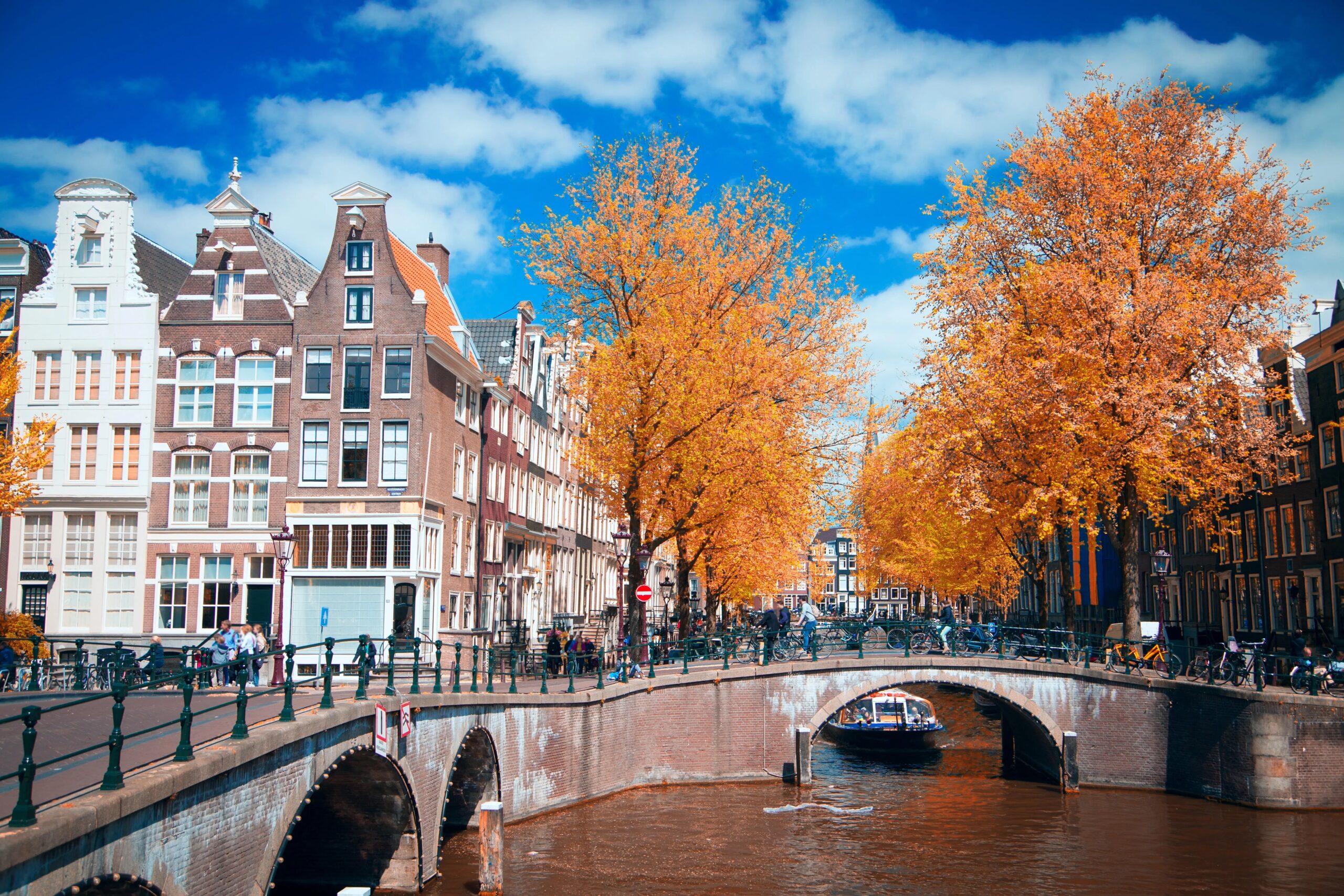
Amsterdam is big on nature. Canals weave between its Baroque buildings and the cobblestone streets are lined by bushy trees that look even more spectacular in the autumn months, painting the streets in shades of red and orange.
While summer time is all about beer, the coming months focus on hot and cosy tipples like Warme Chocolademelk (Dutch Hot Chocolate) and Gluwhein (similar to mulled wine), both from around €4.
Grab yourself a glass from one of the traditional brown bars which tend to feature large windows from which visitors can watch the world go by, drink in hand.
Make sure to gobble back some Dutch classics. Comfort food is a staple in these parts and autumn is the perfect time of year to sample them.
Keep your eyes peeled for Stamppot, a hearty dish, made of mashed potato, sausages and sauerkraut – Moeders in the Jordaan whips up a truly authentic version.
Make sure to pick up some stroopwafels, too, a classic sweet treat which comprises of sticky caramel sandwiched between two thin, circular waffles.
You can still bag EasyJet flights from around £25 from London airports in November this year. Sophie Swietochowski, Assistant Travel Editor
Tirana, Albania
Tirana is often overlooked in favour of the Albanian Riviera but its a beautiful weekend destinationCredit: Alamy
It takes around three hours to reach the capital of Albania and once you’re there, there is plenty to do over a weekend at a leisurely pace.
In the centre of the city, visit Skanderbeg Square, the city’s central plaza featuring a towering clock tower.
Another top spot is the free Pyramid of Tirana – it’s a bit of a work-out to reach the top but the view of the city is well worth it.
And if there is one thing you shouldn’t miss, make sure to visit Bunk’Art 1 & 2 which are massive underground Cold War bunkers converted into museums, including one all about surveillance.
Street food will cost you a few quid and coffee or a pint is under £2 each.
What’s even better is that return flights cost as little as £28 per person. Cyann Fielding, Travel Reporter
Paris, France
Get some Christmas shopping done in the world’s fashion capitalCredit: AlamyIt’s one of the best places to come for food and shopping, says Sophie
I can think of no better place than Paris to transition you from summer, seamlessly into the cosy season. For me, it’s the shopping that draws me back year after year.
It is the fashion capital of the world, after all.
So make sure to travel with an empty suitcase so you can pick out your winter wardrobe while you’re here from the many vintage boutiques littered around the Le Marais district in the 3rd and 4th Arrondissements.
Here you’ll find classic kilo shops that sell bargain items priced by weight – you could pick up a whole outfit for €15.
Plus the city is just a hop, skip and a jumper over the Channel, reachable by plane, train or car – take your pick.
The culinary scene is another huge draw in autumn, too. Now is time to trade out the rosé wine for something more wintry and, in my opinion, no where in the world produces better red wine than France.
Le Barav, in the same region as the vintage shops, houses a wine shop on one side and restaurant on the other.
You can go and pick your wine for a supermarket price and then pay a €7 corkage fee to drink it in the restaurant area while tucking into a cracking charcuterie and cheese platter.
Wowcher city breaks with flights included start from £99. Sophie Swietochowski, Assistant Travel Editor
Deportivo, Parma, Hamburg. Not just a football hipster’s holiday hit-list, but a sample of erstwhile headline acts who have returned to their respective top flights in recent years.
You can throw Leeds United, Nottingham Forest, Schalke and Malaga into the mix too.
But with such footballing royalty back in the big time, where can you find Europe’s current sleeping giants? Which one-mighty sides are still snoozing?
We first need to establish some criteria – history, heritage, fanbase, stadium. Clubs with huge potential who currently exist outside the top flight.
Calling a big city home helps, but it is not a deal-maker – sorry to fans of Bristol City and second-tier Russian outfit FC Ufa, where the local population tops one million.
Likewise, some clubs with good-sized stadiums have not made the cut. Bari, whose Stadio San Nicola is the third-largest in Italy and was built for Italia ’90, stands out, though some of their calcio colleagues outside Serie A also have grounds of more than 30,000 – Hellas Verona, Messina and Palermo among them.
There’s a plethora of ex-Premier League teams with top-flight worthy arenas and storied pasts, while Germany is stacked full of historic clubs with huge homes who arguably deserve a spot – Fortuna Dusseldorf, Wolfsburg, Hannover 96 – but we can’t include them all.
A sleeping giant must have experienced some element of former glory and Pro Vercelli are the obvious candidate there, winning seven Italian titles by 1922. But, despite being under new ownership, the third-tier side boast neither the ground nor local population to awaken that historic status any time soon.
The other nuance is, that success cannot have come too recently. West Ham, for example, won a European competition three years ago, Wolves are recent top-flight regulars; likewise Stade de Reims, twice European Cup runners-up, and eight-time French champions Nantes.
Leaving out Steaua Bucharest was another big call. European Cup winners 40 years ago and Romania’s most dominant club, they now play in Liga II. But, following a deeply divisive split, many of the traditional fanbase follow top-flight FCSB. So who really owns that legacy?
And there was a case for Boavista, title winners in 2001 but whose existence now hangs by a thread. Facing financial ruin, despite fans’ best efforts, they have been ejected from Portugal’s professional leagues.
Anyway, let’s get on with this. Piped through the matrix above, here are my top 10 European sleeping giants – you can have your say in the comments, too.
The United States has imposed a new set of sanctions against the International Criminal Court (ICC), prompting several countries – including US allies – to condemn the move and reiterate their support for the world’s war crimes tribunal.
On Friday, US Secretary of State Marco Rubio announced that Washington would be banning transactions with the “rogue court, cutting off their resources and crippling its ability to operate”, adding that President Donald Trump would “never allow” the Hague to prosecute Americans.
Recommended Stories
list of 3 itemsend of list
The ICC was created in 2002 to prosecute individuals accused of genocide, war crimes and crimes against humanity when national authorities are unable or unwilling to do so.
The US Treasury Department announced the penalties with a six-month initial grace period and other exemptions that would allow some transactions for telecommunications, software, pension payments and transactions related to detainees.
Rubio said the sanctions would give the court and its member states an opportunity to address US concerns and would be adjusted if they did not meet those demands.
The Trump administration says the court has exceeded its authority by pursuing officials from countries that are not ICC members, such as Israel. The United States and Israel have never joined the court.
In response to the sanctions, the ICC said that the move was an “assault on the rule of law and on the very foundations of the international legal order”. It called on its 125 member states to defend the institution.
“The Court cannot stand alone. Its fate now rests also in the hands of the states that created it,” the ICC said in a statement. “This is not just about defending a single institution, but about safeguarding the international order grounded upon the rule of law. History will judge this moment.”
Soon after the US announcement, top United Nations officials condemned the move.
UN Secretary-General Antonio Guterres was “deeply alarmed” by the expected impact of the sanctions on the court as a whole, particularly its ability to carry out its mandate, a statement from his spokesperson Stephane Dujarric said.
“Today’s decision marks a serious blow to our collective pursuit of international criminal justice, of which the ICC is a key pillar,” the statement added.
UN Human Rights chief Volker Turk called for immediate measures to protect the ICC. “These sanctions – the latest in a series of retaliatory steps against the ICC and its personnel for the work they do every day to advance accountability for the very worst violations of human rights – are unacceptable,” he said.
ICC member states that are US allies also expressed dismay at the decision.
Dutch Foreign Minister Tom Berendsen, whose country hosts the ICC, said the US’s decision was “deeply regrettable”.
“We will stand firm in defence of the court. At the same time, it’s important to note that the sanctions will not take effect immediately and that service providers can continue to work for the ICC. The six-month period before the sanctions take effect creates scope for dialogue,” he said.
In a joint statement, the foreign ministers of Britain, Denmark, France, Germany, Italy, the Netherlands, Canada and Japan said they “regret and strongly disagree” with the sanctions.
“If put into effect, these sanctions will have a significant impact on the Court’s work, its dedicated staff and their families … We remain both united in our support for the ICC and committed to engaging in constructive and inclusive dialogue with non-States Parties,” they said.
Belgian Foreign Minister Maxime Prevot also said Brussels would discuss support for the ICC with European Union foreign affairs colleagues on Monday and at the upcoming European Council.
“We will press for concrete protection. The court’s independence cannot depend on whom it investigates. Europe must act. Belgium is calling for the activation of the EU Blocking Statute to protect the court,” Prevot said.
US aims to ‘ultimately destroy’ ICC
Similarly, organisations and rights groups sounded the alarm over the implications of the US decision.
Philippe Bolopion, executive director of US-based Human Rights Watch, said the Trump administration had made clear its aim to “destroy” the ICC and “shield US and Israeli officials from facing charges before the court”.
“The ICC was created to ensure that no one, no matter how powerful, is above the law. Governments that value human rights and accountability should condemn this outrageous move and take swift action to protect the ICC, its staff, and all those who cooperate with it, starting with the European Union using its laws to mitigate the sanctions’ impact in the region,” he said.
The Executive Director of the Open Society Justice Initiative, James Goldston, said the sanctions were a “calculated attack on the rule of law and the principles of judicial independence and equality that underpin it.”
“This is the latest move in a campaign of coercion intended to destroy the system of international justice,” he said.
Amnesty International called on countries to “resist”. Trump’s “sanctions are designed to isolate and ultimately destroy the International Criminal Court”, Erika Guevara Rosas, Amnesty’s senior director for research, policy, advocacy and campaigns, said in a statement. “This existential attack must fail. States must take concrete action to resist the imposition of these measures.”
Amid widespread criticism, Israel commended the US move.
Prime Minister Benjamin Netanyahu hailed the sanctions and praised Trump and Rubio for taking this “critical decision”.
“The ICC is not a court. It is a political body that poses a mortal threat to law-abiding democracies worldwide and to the very idea of national sovereignty,” Netanyahu wrote on X.
In 2024 the ICC issued an arrest warrant for Netanyahu on war crimes and crimes against humanity charges for the war on Gaza.
A MAJOR airport has been hit by strike action with thousands of passengers facing cancelled strikes.
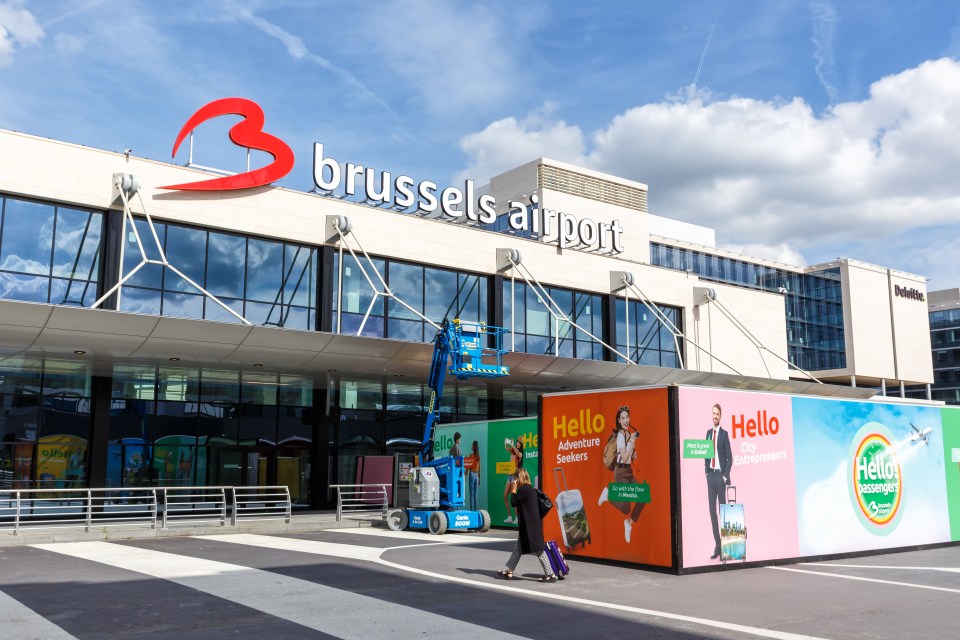
Ground handling group, Alyzia, are taking part in a national strike which affects airlines like Brussels Airlines, ITA Airways, Air Arabia and United Airlines.
Staff at Brussels Airport is staging a walkoutCredit: Getty
The airport expects only half of the flights handled by Alyzia to operate as planned.
Brussels Airport said that airlines working with Alyzia have contacted passengers directly to inform them about the status of their flight and their options.
Sign up for the Travel newsletter
Thank you!
It added: “We regret the inconvenience caused by this union action.”
The strike action comes as workers protest against governmental policies.
According to FlightRadar which monitors movements of planes, Brussels Airport has had 103 cancellations today and 34 flights have been delayed.
As this strike is outside the control of individual airlines, it will be deemed an ‘extraordinary circumstance’, which means if your flight is cancelled you will not be entitled to compensation.
Public transport is also expected to be disrupted in Brussels today too.
The good news for Brits is that flights handled by Aviapartner will not be affected.
This includes major airlines serving UK destinations such as British Airways, easyJet, Ryanair, Tui, and Wizz Air.
The airport told The Independent that around 400 flights will still operate as usual today.
The strike is expected to affect almost 20 airlinesCredit: AP
Flight compensation rules
A look at your rights if a flight is delayed or cancelled, when your entitled to compensation and if your travel insurance can cover the costs.
What are my rights if my flight is cancelled or delayed?
Under UK law, airlines have to provide compensation if your flight arrives at its destination more than three hours late.
If you’re flying to or from the UK, your airline must let you choose a refund or an alternative flight.
You will be able to get your money back for the part of your ticket that you haven’t used yet.
So if you booked a return flight and the outbound leg is cancelled, you can get the full cost of the return ticket refunded.
But if travelling is essential, then your airline has to find you an alternative flight. This could even be with another airline.
When am I not entitled to compensation?
The airline doesn’t have to give you a refund if the flight was cancelled due to reasons beyond their control, such as extreme weather.
Disruptions caused by things like extreme weather, airport or air traffic control employee strikes or other ‘extraordinary circumstances’ are not eligible for compensation.
Some airlines may stretch the definition of “extraordinary circumstances” but you can challenge them through the aviation regulator the Civil Aviation Authority (CAA).
Will my insurance cover me if my flight is cancelled?
If you can’t claim compensation directly through the airline, your travel insurance may refund you.
Policies vary so you should check the small print, but a delay of eight to 12 hours will normally mean you qualify for some money from your insurer.
Remember to get written confirmation of your delay from the airport as your insurer will need proof.
If your flight is cancelled entirely, you’re unlikely to be covered by your insurance.
Tucked away off a pretty shopping street in a beautiful art nouveau building is one of Stockholm’s oldest spas, Centralbadet where a day ticket costs from £23. As winter darkness descends, candles are lit around the pool and a quiet calm envelops you. Swimming by candlelight is a treat. Next a sauna followed by an ice-cold plunge. Afterwards a nightcap is in order so it’s a brisk walk in the cold crisp air to Fotografiska restaurant. It’s a great spot to savour one of Stockholm’s best views; the old town Gamla Stan and the twinkling lights on Lake Mälaren. Sarah Rochfort
‘Completely timeless and immersive’: birdwatching in Norfolk
A misty evening on Salthouse marshes. Photograph: Ernie Janes/Alamy
Birdwatching at the Cley and Salthouse marshes in Cley-next-the-sea, Norfolk. The two bird hides are meditative and relaxed spaces. The windows open directly on to the pools of saltwater where many different species of birds obliviously wander around. It’s a place that is completely timeless and immersive. Your only job is to gaze out at the birds. It’s a very popular spot for birdwatching but the atmosphere is friendly and quiet. Someone even let us have a go with their binoculars. We particularly enjoyed watching a nest of baby swallows huddled in the corner of the hide. The marshes cover a wide area and are so important for biodiversity, providing an essential resting place for resident and migratory birds. You might even spot a spoonbill, which have returned to the UK from 2010 after being absent for hundreds of years. Well worth a wellness visit, even if you don’t really know anything about birds (like me). Petra
Hampshire’s Scandi sauna huts
Hello Outdoors shepherd’s hut sauna. Photograph: Jason Ludlow/PR
A fresh ginger concoction, orange slices and a friendly sauna master greeted us at the Hello Outdoors shepherd’s hut sauna, which has a picture window overlooking the historic Lymington Sea Water Baths. The deep blue of the sky and water, Swedish sauna hats, the calming scent of our chosen essential oil, a soothing soundtrack and the option to ease the sauna heat with an exhilarating plunge in an ice-cold tub or more genial dip in the sun-warmed sea baths made for a very enjoyable and restorative couple of hours away from real life. We didn’t want to leave. Claire Edwards
Profile
Readers’ tips: send a tip for a chance to win a £200 voucher for a Coolstays break
Show
Guardian Travel readers’ tips
Every week we ask our readers for recommendations from their travels. A selection of tips will be featured online and may appear in print. To enter the latest competition visit the readers’ tips homepage
–
Forest bathing in Croatia
The village of Radoboj. Photograph: Zvonimir Atletic/Alamy
For five days in Radoboj, northern Croatia, we forest-bathed beneath the trees, walked slowly, practised breathing and meditation and ate simple local food. No luxury spa, no expensive treatments – just nature and time. I wore an Oura smart ring throughout. My resting heart rate fell markedly and, by day four, the ring recorded four and a half hours of restorative time. More importantly, I felt profoundly different. It completely overturned what I thought wellness travel was. Sometimes the most restorative place isn’t a spa. It’s a forest. Bex Hamilton
Bath time near Sofia, Bulgaria
The Bankya Central Mineral Baths. Photograph: PR
The natural mineral springs in Sofia mean bathhouses are a way of life. Bankya is on the outskirts of the city, so I travelled by bus to visit the Central Mineral Bath Bankya. This opulent bathhouse is owned by the Sofia municipality, meaning the atmosphere is a mix of the everyday council baths and extraordinary architecture from the early 20th century. You can visit from under €10 and, as well as the promised health benefits of the natural spring water, there is a thermal zone, a salt room, aromatherapy, saunas and steam rooms with an array of massages too. Sarah Collings
The perfect spa and skiing combo in Poland
A winter landscape of Zakopane and the Tatra mountains. Photograph: Zoonar/Alamy
While skiing in Zakopane, Poland, we made a lot of use of Terma Bania, an incredible pool and spa centre right in the heart of the ski resort. There is something magical about watching the sun go down in blissfully warm water and surrounded by snow. There is an astonishing array of saunas, pools and steam rooms, surrounded by mountain views. We discovered there are also several thermal pool and spa complexes in the surrounding area, and ended up spending as much of our holiday in the spas as we did on the slopes! Frances
The sauna at West Coast Wellness. Photograph: Murdo MacLeod/The Guardian
The Lochside Sauna at West Coast Wellness (£17 for 2.5 hours) in Evanachan sits on the shore of Loch Fyne. Hidden away from the single track road, a 10-minute walk takes you to one of the most peaceful saunas in the UK. From the giant window, sit back and watch the water of the loch (keep an eye out for dolphins), slowly preparing yourself to make the short walk down and take a dip in between the heat. Alternatively there is a cold water plunge which if anything is colder than the loch! The centre also offers yoga and pilates sessions and there’s the delicious Inver restaurant just around the corner. Lewis
Wild swimming and wildlife in North Yorkshire
Wild swimming at Pool Bridge Farm. Photograph: PR
Wild swimming at Pool Bridge Farm guarantees a wholesome retreat from the vibrant bustle of neighbouring York. Transformed from old fishing ponds, the sprawling site comprises four lakes and ample space for lounging and lunching. A revitalising dip is best paired with a stop in the sauna (£16.50), priming those brave enough for the raw, heady thrill of the next plunge. To top it off, head to nearby Wheldrake Ings nature reserve, one of North Yorkshire’s top wildlife destinations, especially for waterfowl. As the flood waters rise from autumn, so does the abundance of migratory birds. A serene natural scene to soothe the soul. Fin
Sensory walk in the Black Forest, Germany
My two teenagers and I stumbled on a wellness experience for the mind, body and soul while we were wandering around the Black Forest near our holiday base of Freiburg last summer. A friendly German walker with a tree branch for a stick and a large husky for a companion told us to try a barefoot sensory trail at Park mit Allen Sinnen (park of all the senses) as we walked along together through the forest. So we followed his advice. It involved walking barefoot over grass, sand, woodchips, stone, mud and more while trying to tune into our five senses. We began by putting our hands into hollowed-out trees with our eyes closed to guess what objects were placed there. There were bright, colourful flowers, natural scents to imagine and huts to relax and sit in full of sounds and smells to immerse ourselves in with eyes closed. We repeated these walks for three days, heightening our contact with our own senses – and treating ourselves to rye bread and cheese sandwiches with forest fruits berry juice from simple forest cafe cabins as a reward. Helen
Winning tip: County Donegal’s peerless sauna on the pier
A boat trip to the Sliabh Liag sea cliffs. Photograph: Christopher Hill /Scenic Ireland/Alamy
If you find yourself on the wild coast of south County Donegal, head to the Sliabh Liag Sauna at Teelin pier. After a day of hiking (and maybe one or two pints of porter the evening before), the small wood-fired sauna right on the pier was the perfect unwind. We followed it up by taking a sea dip in the bay just steps away. If you have plenty of time, combine the sauna with a nearby boat trip to the unforgettable Sliabh Liag sea cliffs towering 601 metres (1,972ft) above the sea. Peter Henry
Talks will focus on the €1 billion daily deficit and rare earth export restrictions.
Published On 7 Oct 20267 Oct 2026
European Trade Commissioner Maros Sefcovic has arrived in Beijing for talks on the European Union’s (EU) growing trade deficit with China.
Sefcovic will meet Chinese Commerce Minister Wang Wentao on Thursday and Friday after months of discussions over the EU’s trade deficit of more than €1bn ($1.12bn) daily, as well as Chinese curbs on exports of rare earths and other critical minerals.
Recommended Stories
list of 3 itemsend of list
Meanwhile, Chinese companies are increasingly challenging Europe’s top car brands. China rejected the EU request for voluntary curbs on Chinese hybrid car exports as the two sides enter negotiations, the Financial Times reported on Wednesday. The European Commission now hopes to get Beijing to accept a unilateral EU measure to cap hybrid imports instead, the outlet said, citing two diplomats briefed on the plan.
The two days of discussions come just as a majority of EU lawmakers called for a more assertive trade policy towards Beijing in a non-binding resolution on Wednesday. China vowed a “resolute response” to safeguard its industries if the European Union goes ahead with restrictions against Chinese companies or products, according to its commerce ministry.
Germany and France propose rapid EU measure
French President Emmanuel Macron and German Chancellor Friedrich Merz, leaders of the bloc’s two biggest powers, on Tuesday urged the EU to prepare a “credible instrument” that could be quickly activated to strike back against countries that harm the bloc economically.
The new measure would not target any specific country. German officials said the EU needed a tool as powerful as the Section 301 tariffs imposed by the United States or China’s restrictions on critical-mineral exports.
The proposed weapon – to be discussed at an EU leaders’ summit next week – would give the European Commission the power to respond to a trade aggression within days.
China responded to the letter by urging Paris and Berlin to steer clear of “protectionist” measures.
“We hope that France and Germany, as major economies in the world, will uphold openness, cooperation and free trade,” the commerce ministry said in a statement.
“They should avoid going down the wrong path in the wrong way, only to ultimately suffer the consequences themselves.”
G20 finance leaders, except China’s, agreed in September to act against “non-market” distortions that exacerbate imbalances. Beijing says that hyping up issues such as economic imbalances and overcapacity is a form of protectionism designed to exert pressure on and restrict China.
Ongoing trade talks
EU and Chinese officials have been discussing trade imbalances since June. Sefcovic said he wanted “tangible results by October” as well as some form of commitment that can be put to EU leaders meeting in Brussels.
Trade relations with China top the summit’s agenda next week, as ballooning debt has prompted auditors to warn about the next seven-year EU budget and has spurred protests in France.
European Commission President Ursula von der Leyen told the European Parliament last month that the trade imbalance had reached a tipping point and that Europe would use every tool at its disposal to rebalance the relationship.






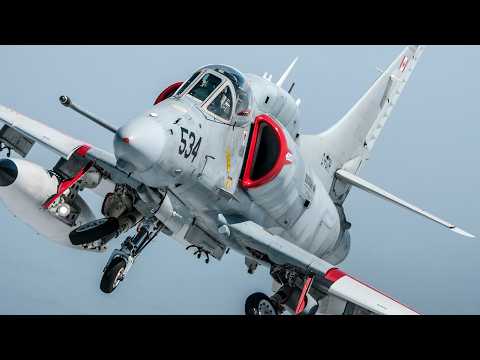

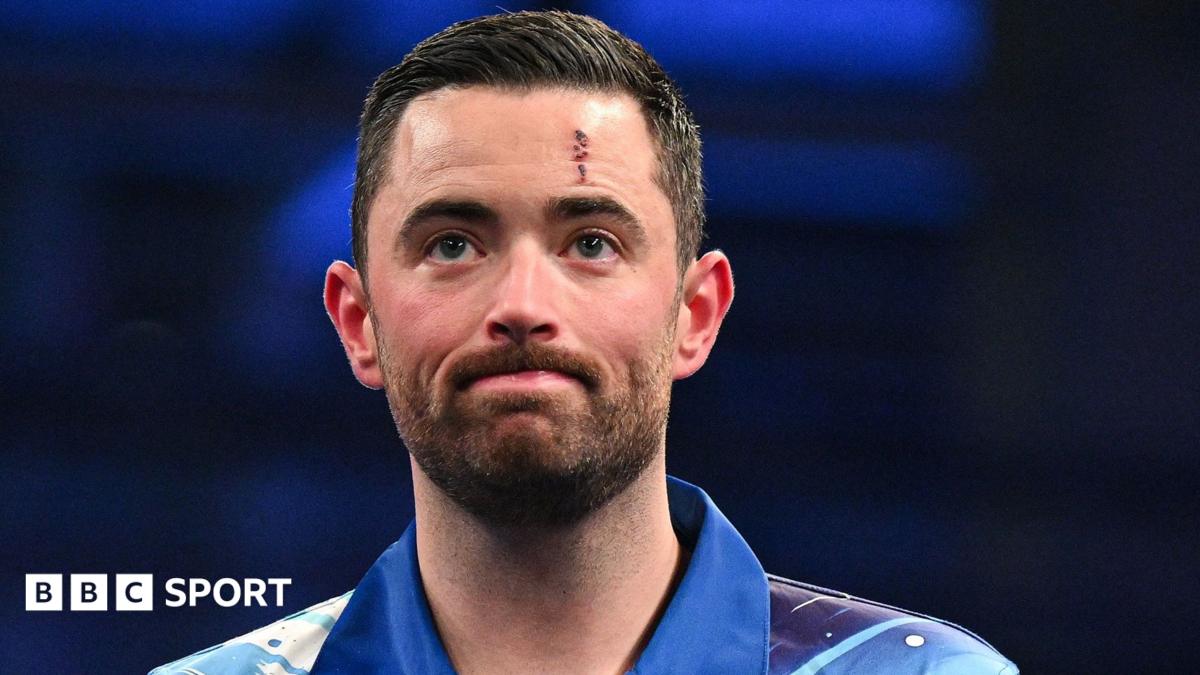









![Demonstrators sit amid 40 tents set up to protest against housing shortage, soaring rents and low wages on Rossio square in central Lisbon on October 17, 2026. Thousands of people marched on October 17, 2026 through the centre of Lisbon at the call of the CGTP trade union to protest against increasingly difficult living conditions. The slogans and demands focus mainly on higher wages and pensions, as well as protests against the rising cost of housing and fuel. [Filipe Amorim/AFP]](https://i0.wp.com/occasionaldigest.com/wp-content/uploads/2026/10/AFP__20261017__D3LK2MC__v1__HighRes__PortugalPoliticsHousingDemo-1792267175.jpg?w=640&ssl=1)
![Riot police uses a water cannon against demonstrators in Brussels during a youth protest [Nicolas Maeterlinck/AFP]](https://i0.wp.com/occasionaldigest.com/wp-content/uploads/2026/10/afp_6ad3d52b2c56-1792267563.jpg?w=640&ssl=1)