Gerald Barry is today’s rare opera composer with a draught-dry wit. Is there such a thing as a soaking wet wit, the opposite of the parched variety, because he has that, too. He is Irish. He has some Beckett in him. And a helping of Oscar Wilde.
At the behest of British composer Thomas Adès, the Los Angeles Philharmonic has given, over the past 20 years, the U.S. or world premieres of four Barry operas in its Green Umbrella new music series, all conducted by Adès. The first, “The Triumph of Beauty and Deceit,” seemed to take zaniness to outlandish operatic extremes, which led to the orchestra commissioning the next three. “The Importance of Being Ernest” and “Alice’s Adventures Underground,” in 2011 and 2016 respectively, proved each funnier and more outrageous musical spectacle than the last.
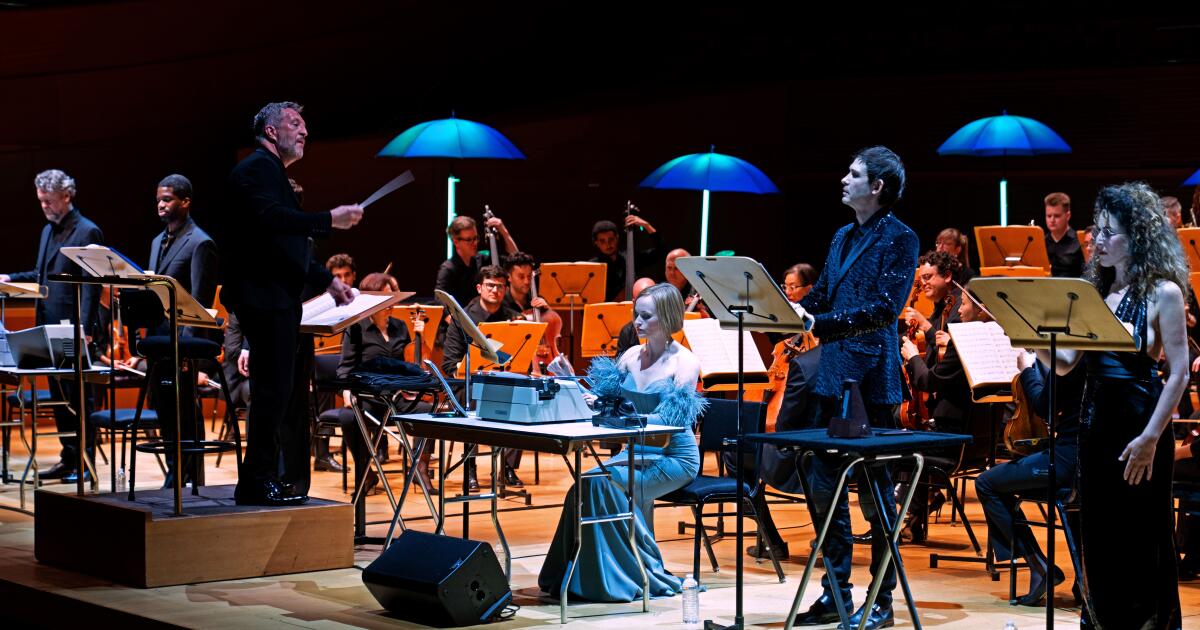
On Tuesday night, the L.A. Phil New Music Group and a cast of extraordinary singers gave the U.S. premiere of “Salome” at Walt Disney Concert Hall. Here we go again.
The description by the composer (who is also his librettist) can hardly be bettered. He has cut Wilde’s play by about half. And, in that half, explored another less knowable side of the moon represented by Richard Strauss’ well-known “Salome,” which helped usher in 20th-century operatic modernism. Barry says his “Salome” is “an opera of voyeurism, the moon, French, God, punishment of sin, misunderstanding, sex, the metronome, suicide, hysteria, hunger, blood, typing, speaking correctly, sterility, ‘The Blue Danube,’ fever, art, Wilde, dreaming, beheading, Frankenstein, kissing.”
No nudity, though, and no dance. Salome is a typist. Her dance of the seven veils is sexy typing.
Barry begins where Wilde begins and Strauss (who follows the original play closely) with a pair of soldiers in Herod’s court peering at the moon, one moonstruck by the beauty of Herod’s daughter Salome. Salome has other ideas. She’s taken, perversely, with John the Baptist, imprisoned in a cistern and prophesying doom for the decadent, Godless heathens, Salome in particular. All of this readily registers on Barry’s Dada-absurdity meter.
Even so, Barry has an oracular outlook. He goes in for proclamatory melody, each note an event, when punched out by brass and lower string like hammering spikes in the ground. Harmonies can be raw. There is a Stravinskyan quality, but nothing is ever predictable.
The orchestral introduction to “Salome” is like that. But it gets screwy fast. Other than Salome, the characters are not named, rather treated as types. John the Baptist is The Prisoner. Herod and Herodias are The King and The Queen. All have some Alice in a different wonderland about them.
The Prisoner could be straight out of a Godard film. He speaks only French (Wilde’s play was first published in French in 1893). He speaks more than he sings and finds outrage everywhere he looks. The surtitles intentionally refrain from translating much of what he says, leaving the audience to rely on his loony spoken tone and loony tunes to carry meaning. His way of impatiently rebuffing Salome’s inappropriate advances is to give her singing lessons.
That’s the last thing she needs. Her part, like that of Alice in Barry’s previous opera, is enlivened by delightfully squeaky high notes in unexpected places. She’s Barbie with exceptional smarts and grotesque sexual fantasies. Soprano Alison Scherzer, who has starred in Barry’s other operas and in Adès’ “Powder Her Face,” is spectacular.
Everyone is odd. The half-crazed King, magnificently sung by the ever-disruptive Timur, lusts after Salome by speaking and singing at different speeds he selects on a metronome, as he entices her to type for him. When she first refuses, the King has everyone sing “The Blue Danube,” because that’s what you do when Salome won’t sexy type for you.
Sara Hershkowitz’s wildly contemptuous Queen adds further soprano glory. The baritone, Vincent Casagrande, a marvelously cantankerous Prisoner, tells us only sick people dream, and of course everyone on stage automatically enters a dream state.
The shock of Wilde’s play, amplified in Strauss’ opera, is the sheer horror of Salome demanding as a reward for her striptease the decapitated head of the prophet, whose bloody lips she desires to kiss. In this case, her typing, which is accompanied by the two soldiers (Justin Hopkins and Karl Huml) on their own typewriters, leads to a dismemberment Frankenstein-style. The ghoulish ending is not unhappy.
Barry’s score remains as uncanny as his sense of drama. He plays with our senses of normality. He frequently uses the instrumentalists in the chamber orchestra like theatrical characters. The ensemble contradicts the singers but also eggs them on. Adès, who has his own unpredictably whimsical side, conducts as though he had written the score himself and shares his pleasure with every delightful effect.
The premiere of “Salome,” intended for 2021 in Disney, was disrupted by the pandemic. The first performance, then, became a staging in Magdeburg, Germany, last year. Barry said Tuesday in the pre-concert Upbeat Live that he is often happier with concert performances, like at this Green Umbrella. He has good reason.
The magic of this “Salome” is its transcendence of silliness into acceptance. When presented without theatrical aspect but as a private process of the imagination, it becomes a lavishly lovable antidote to our too often accepting the world’s absurdity only as dooms-scrollable tragedy.