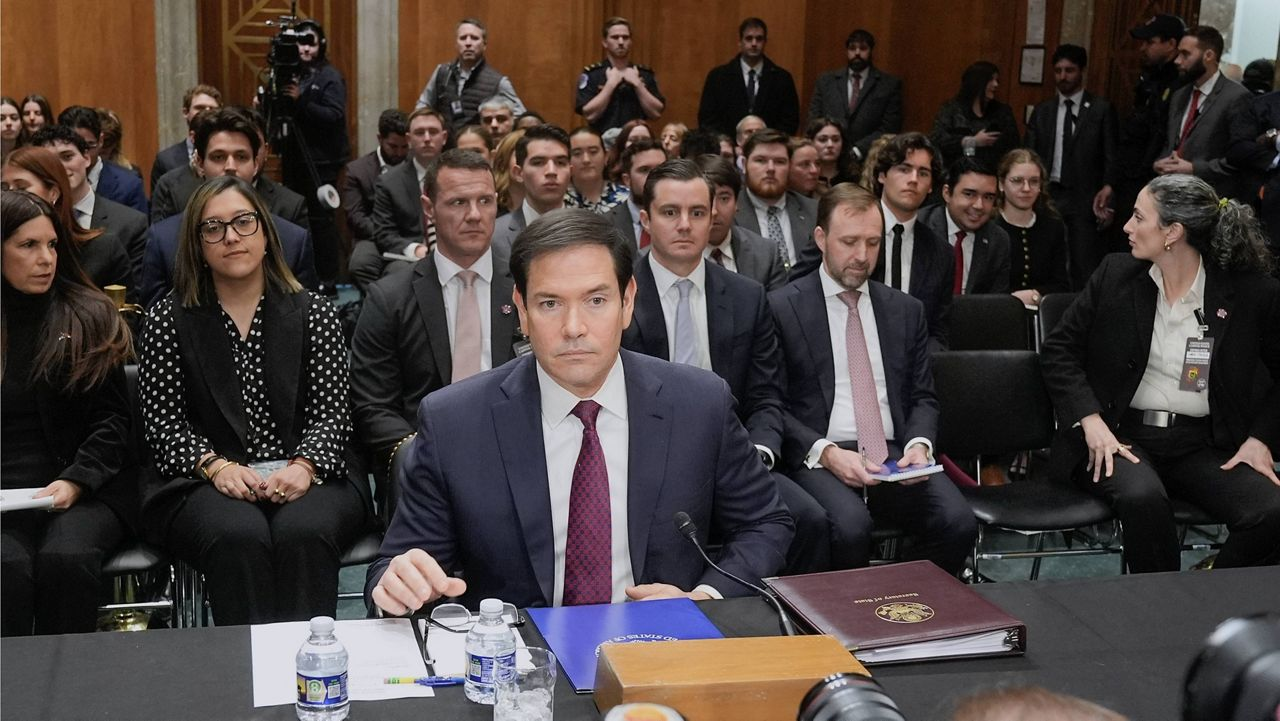
On the Trump administration’s decision to work with Delcy Rodríguez
Forcing Maduro out: “We made multiple attempts to get Maduro to leave voluntarily and to avoid all of this. Because we understood that he was an impediment to progress. You couldn’t make a deal with this guy.”
The first goal wasn’t a rushed attempt at a democratic transition or vote: “You can have elections all day. But if the opposition has no access to the media, if opposition candidates are routinely dismissed and unable to be on the ballot because of the government, then those aren’t free and fair elections. That’s the endstate that we want. Free, fair, prosperous and friendly Venezuela. We are not gonna get there in three weeks. It’s going to take some time. So objective number one was stability.”
Not a quick, straightforward process: “For the first time in over a decade and a half there’s a real possibility of transformation. And a lot of it will depend on them. There are many people living in Florida and across the country who would like to go back and be a part of Venezuela’s economic life. Many of them are eager to do so. And Venezuela is going to need them to go back and rebuild the businesses that were taken (…) This is not a frozen dinner that you put in a microwave and two and a half minutes later it comes out ready to eat. These are complex things. We’ve seen this play out. I use the example of Paraguay and Spain, there are others. When there’s a transition from autocracy to democracy, it’s not linear.”
Rubio didn’t want to get involved in the issue of an investigation into Delcy by US prosecutors. She wasn’t arrested because she hasn’t been indicted like Maduro, and they work with her because those who control the weapons and the institutions are regime figures. The US managed to avoid war, millions of people were prevented from fleeing to Colombia, by establishing communication with key regime actors.
To critics of US policy in Venezuela, Rubio put it this way: “You told us you didn’t want any more regime change, and now you criticize us for not changing the regime.”
Rubio said he doesn’t want chavismo to entrench. According to him, the US goal is not to leave “people from this system” in power (who he claims not to trust), but right now it’s necessary to preserve a level of respect and communication maintained so far (since the January 3 military intervention).
On Venezuelan oil
The Secretary of State insisted that the chavista regime was sustained by corruption, something that is no longer sustainable, and that oil money “will not go to the drug cartels.”
Funds from the oil sales will go into a Venezuela-owned account in Qatar that the US will be able to supervise: “They needed money quickly to fund the police officers, the sanitation workers, the daily operations of government. So we’ve been able to create a short-term mechanism. This is not gonna be the permanent mechanism, but this is a mechanism in which the needs of the Venezuelan people can be met through a process that we’ve created where they will submit every month a budget of what needs to be funded. We will provide for them at the front end what that money cannot be used for. And they’ve been very cooperative in this regard. In fact, they have pledged to use a substantial amount of those funds to purchase medicine and equipment directly from the US.”
Rubio also said another $300 million might come in, but Delcy & Co. first must allow an audit of the initial funds to ensure they are being used appropriately.
On the other hand, China can buy Venezuelan oil, but at market price. No Maduro-era discounts set as a result of US sanctions. The Secretary of State said the US wants to lift said sanctions to boost economic activity, but he doesn’t expect the recovery to involve US spending.
Rubio celebrated the amendment process of the Hydrocarbons Law, which basically eliminates many of the restrictions on foreign investment in the oil industry. It doesn’t go far enough to attract more investment, but it’s a big step compared to where things were three weeks ago.”
He suggested that companies would invest in Venezuela knowing their money is safe and their assets wouldn’t be taken away. The goal is to create the conditions for a normal, stable and transparent business environment in Venezuela. Their heavy crude isn’t unique, Canada has it too: “It’s not irreplaceable. But we understand that that is the lifeline and their natural resources will allow Venezuela to be stable and prosperous moving forward. what we hope to do is transition to a mechanism that allows that to be sold in a normal way, a normal oil industry, not one dominated by cronies, graft and corruption.”
Threats to the Rodríguez regime
Rubio expressed the regime’s performance is being assessed based on actions, not discourse. Stopping Venezuela from being the backyard of China, Russia and Iran would be a huge step.
“For the first time in 20 years, we are having serious conversations about eroding and eliminating the Iranian presence, the Chinese influence, the Russian presence as well. In fact, I will tell you that there are many elements there in Venezuela that welcome a return to establishing relations with the United States on multiple fronts,” Rubio said.
He acknowledged that political prisoners are being released, though not at the pace he desires, and that US officials would be mindful of how opposition leaders coming out from hiding would be treated (Delsa Solórzano being the last example).
Rubio said the US is generally pleased with how things have evolved in the past three weeks, but “we’ll let them know” if that changes. He does not anticipate any further military action in Venezuela in the short term. He claimed the use of force would depend on the stabilization goals being met, not on helping those goals.
“The only military presence you will see in Venezuela is our Marine guards at an embassy. That is our goal, that is our expectation, and that is what everything that outlines towards. That said, if an Iranian drone factory pops up and threatens our forces in the region, the president retains the option to eliminate that threat.”
On the future
Rubio was reluctant to provide a precise timeline for the current arrangement between Venezuelan authorities and the US. The Trump administration wants to see rapid progress, he suggested. And in five months, the situation must be different to what they currently see.
In the long term, the US wants Venezuela to have a democratically-elected government. But that stage wouldn’t be achieved in a matter of weeks (see quote in sub-section one). Rubio said he wants María Corina to be part of the transition and to be able to participate in an election at some point. He acknowledged they’ve known each other for the past 12 years, and both him and Trump respect the opposition leader.
Finally, Rubio explicitly labeled the Venezuelan opposition as diverse. He said that both opposition figures like Maria Corina who never supported chavismo and chavistas that disliked Maduro (which he called people “committed to chavista ideology) should have representation, and that internal reconciliation would allow those sectors to participate in national politics. The ultimate goal is legitimate democratic elections, and whatever happens, Rubio hopes the next Venezuelan leaders will have cordial relations with the US.