ABC’s Sunday telecast of the 98th Oscars averaged 17.9 million viewers, ending a four-year streak of audience increases.
The figure from Nielsen is down 9% from the 19.7 million viewers who watched the telecast on ABC and Hulu in 2025.
After ratings for the Oscars cratered to an all-time low of 10.5 million viewers in 2021, the event’s audience levels ticked back up in recent years.
But the show has not topped 20 million viewers since 2019, as younger viewers are content to watch highlights of the ceremony on social media, rather than sit through a three-hour-plus telecast on traditional TV.
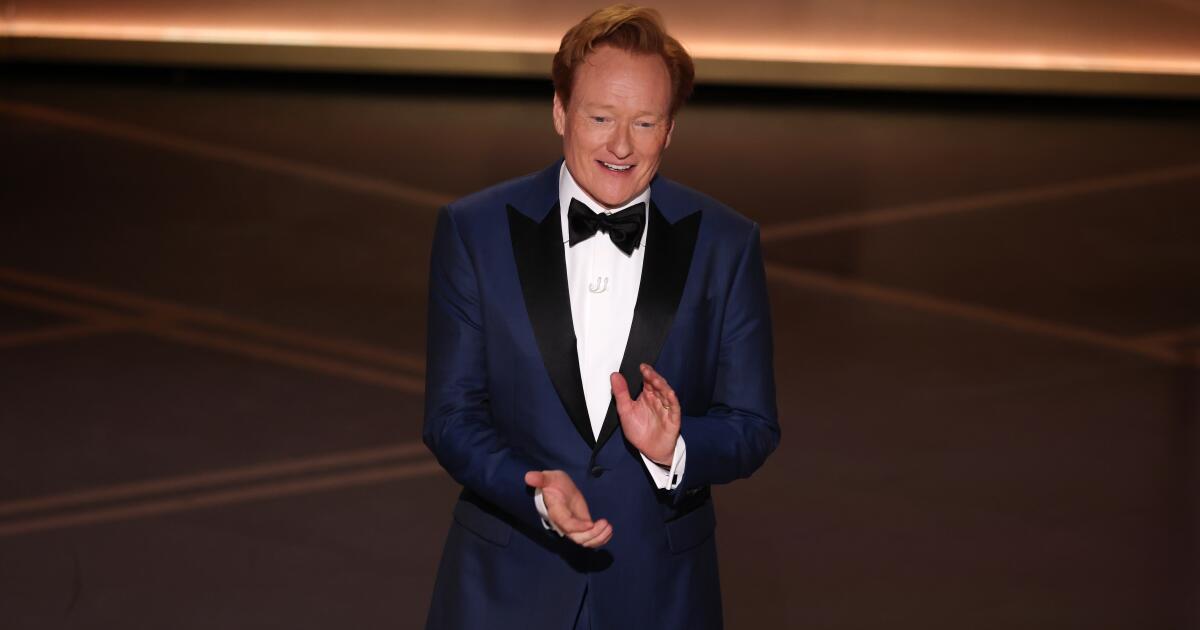
The awards held at the Dolby Theatre in Hollywood honored “One Battle After Another” for best picture, Michael B. Jordan for lead actor in “Sinners,” and Jessie Buckley for lead actress in “Hamnet.” Conan O’Brien was the host for the second straight year.
Critics said the ceremony was light on political statements about President Trump, whose name was not mentioned during the telecast. The show’s highlight was an extended “In Memoriam” segment that gave extra tribute to legendary actor and filmmaker Robert Redford and slain actor, director and producer Rob Reiner.
ABC had success in selling out the commercials for the Oscars, which is perennially the most watched non-sports telecast of the year. But the network will only have the event for two more years as the Academy of Motion Picture Arts and Sciences chose to take a better financial offer from YouTube for the rights to the telecast starting in 2029.
O’Brien poked fun at the YouTube move. He closed with a video that shows him being appointed Oscars “host for life.” As he takes in the honor, poison gas seeps into the office he is given. After O’Brien’s lifeless body is wheeled out, a name plaque with a new host is put on the door. His successor is YouTube star Mr. Beast.
Long before he became an NBA Hall of Famer, Paul Pierce was a senior at Inglewood High School thrilled to be chosen to play in the 1995 McDonald’s All-American Game, a nationally televised showcase that has brought together 24 of the best prep players in the country every year since 1978.
The McDonald’s all-time scoring record of 30 points had been set in 1981 by (who else?) Michael Jordan a month after his 18th birthday. Fourteen years later Pierce scored at a blistering pace, yet because someone had stolen his jersey, he played a portion of the game with the name “McCoy” on the back.
Broadcasters credited “McCoy” with several baskets and apparently the scorekeeper couldn’t keep track either. In the box score, Pierce was credited with 28 points. In his mind, he was certain he had more than 30.
He painstakingly watched the game tape and, sure enough, he had scored 31 points. Yet the official McDonald’s record book didn’t recognize it, and Jordan continued to hold the record until Jonathan Bender put up 31 in 1999.
That is just one of the delightful, insightful stories included in the feature-length documentary “Meal Ticket,” an exhaustively researched labor of love by co-directors Corey Colvin and Carlton Gerard Sabbs of production company Stony & Yates. The film will premiere Thursday on Prime Video.
Meanwhile, Jordan had his own beef with McDonald’s — or at least his mother did. He was not given the John R. Wooden Award as Most Valuable Player in that 1981 game even though he set the scoring record and made shots during the East team’s last five possessions, including the winning basket in a 96-95 victory.
Chase Budinger, left, and Kevin Durant, co-MVPs of the 2006 McDonald’s All-American High School basketball game, hold the MVP trophy in front of legendary coach John Wooden, center.
(Denis Poroy / Associated Press)
Deloris Jordan was not happy. On the elevator leaving the arena, she told broadcaster Billy Packer, “Poor Michael. My poor son Michael. He never gets any recognition. He never gets any respect.”
Soon, of course, her son would get his due, first for leading North Carolina to the NCAA title as a freshman — again sinking the winning shot — then for leading the Chicago Bulls to a record six NBA titles in eight years while winning 10 scoring titles. Michael Jordan is widely considered the greatest basketball player of all time.
Produced by Roc Nation, Known Originals and Creative Control, “Meal Ticket” chronicles the 49-year history of the McDonald’s All-American Games. Nearly 50 Naismith Hall of Famers were participants, and many reminisce for the documentary.
For most, the showcase was their first time on national television. At 17 or 18 years old, they were fresh-faced, eager and ultra-competitive. Colvin, 41, and Sabbs, 39, dug deep into archives of games and surrounding activities provided by McDonald’s and ESPN, and the result is a balanced blend of action footage and fond memories.
“We tried to illustrate the parallel between the McDonald’s game and the growth of the sport,” Colvin said. “I honestly feel it’s a power hidden within the McDonald’s game that people haven’t paid attention to. If you want to know where basketball is going, watch the McDonald’s game.”
Among the key developments was founder Bob Geoghan expanding the event to include girls’ basketball, launching a doubleheader format with the boys beginning in 2002 that proved immensely popular.
Two years later Candace Parker won the annual Slam Dunk Contest, defeating among others JR Smith and Josh Smith, both of whom would be NBA first-round picks within months. Parker’s achievement was so unlikely that her own brother hung up on her when she called to tell the family, according to the documentary. Just another nugget unearthed by Colvin and Sabbs.
The creative careers of the Chicago South Side products began with directing branded content, and their mentors, directors Coodie Simmons and Chike Ozah, helped them make a pitch to McDonald’s in 2022 for an independent documentary.
Early fears that the fast-food colossus would be overly brand conscious and dictate content were allayed. Mickey D’s not only gave the directors the rights to tell the story, but also provided game footage while steering clear of editorial meddling.
Bronny James of the West team talks to his dad, LeBron James of the Lakers, at the 2003 McDonald’s All-American Game in Houston, Texas.
(Alex Bierens de Haan / Getty Images)
“You’d think with McDonald’s, they’d be very hands-on to position and push the brand,” Sabbs said. “But they were good partners. We were even concerned about the name, ‘Meal Ticket,’ because it’s kind of edgy, a quadruple entendre. Would McDonald’s approve it? They stood by us. Nobody micromanaged us. And when they were around, we knew we’d be getting some french fries.”
The closest Sabbs and Colvin came to deviating from McDonald’s sanitized version of events came when the directors recognized the role Geoghan played in launching the Games. Amateur basketball luminaries Wooden — the legendary former UCLA coach with 10 national championships — Sonny Vaccaro and Sonny Hill were drawn into promoting the Games largely because Geoghan earmarked profits for the Ronald McDonald House Charities.
The documentary team immersed itself in the 2022 McDonald’s All-American Games, shadowing two boys and two girls throughout the weekend. Part of that story was the outpouring of emotion for Geoghan, who died at 87 in February 2022 and was honored at the Games a month later.
“When we were filming in 2022 we saw how deeply everyone respected Bob,” Sabbs said. “They did a tribute on the Jumbotron before the game and put a Bob Geoghan jersey and a dozen roses on the seat where he watched games.
“Bob never wanted to get rich off the McDonald’s Games. He was a humble guy who some said died penniless. I hope this film helps him and his family get some recognition for what he contributed to basketball. He really ought to be in the Naismith Hall of Fame and I hope that happens.”
All indications point to Geoghan redirecting attention to the court and the sheer number of precocious youngsters who went on from the showcase to legendary professional careers. California has produced the most McDonald’s players on both the boys and the girls teams. And simply considering those who eventually made their marks with the Lakers is staggering.
Magic Johnson starred in the first McDonald’s game in 1978. James Worthy played alongside Isiah Thomas, Dominique Wilkins and Ralph Sampson the next year. Shaquille O’Neal was MVP in 1989. Kobe Bryant made highlight reel plays in 1996. JJ Redick was 2002 MVP and won the three-point shootout. LeBron James was MVP in 2003.
Bryant and James, of course, were among the elite players to jump straight from the showcase to the NBA, skipping college. Another player who did so, Amar’e Stoudemire, was physically dominant even when sharing the court with other future greats.
“I was a different kind of beast, man,” Stoudemire says in the documentary. “I’m not doing a finger roll off the glass move. I’m attacking the basket and I’m shaking the whole backboard. I think from that point on, everyone knew, ‘Stoud, he’s going to the NBA. He ain’t going to college.’ By the time we left, I’m sure there were a few screws and hinges that had left the rim.”
JR Smith also realized he was going to skip college for the NBA after dominating the McDonald’s Game in 2004, scoring 25 points on an assortment of dunks and long-range jumpers. He was committed to North Carolina but had made no secret that he didn’t want to go there.
Upon returning to the hotel after the game, Smith began running through the halls, yelling, “I’m going to the league!”
This year’s Games will take place March 31 at Desert Diamond Arena in Glendale, Ariz. The West boys roster will include Southern California products Brandon McCoy Jr. and Maximo Adams from Sierra Canyon, Christian Collins from St. John Bosco and James Crowe Jr. from Inglewood. Jerzy Robinson from Sierra Canyon and Cyndee Bryant from Corona Centennial will play in the girls game.
Even with NIL money seeping into players’ bank accounts, Sabbs and Colvin haven’t noticed a change in how the best of the best approach the McDonald’s All-American Games.
“All you hear are these stories from all-star games that the players don’t care anymore because there’s too much easy money,” Colvin said. “But these guys are competing, playing defense, diving on the floor. The McDonald’s Games are still a precursor for where the game is going, from elevating the girls to NIL, and we hope that comes across in the film.”
SACRAMENTO — A corporate tax policy that costs California billions in lost tax revenue each year could be coming to an end as the state struggles to backfill federal cuts and resolve a looming budget deficit.
The proposed legislation, Assembly Bill 1790, would repeal the so-called “water’s edge” tax break, a filing option that allows multinational corporations to exclude the income of their foreign subsidiaries from state taxation.
“The tax bills of the wealthiest, most powerful corporations in the world are at all-time lows,” Assemblymember Damon Connolly (D-San Rafael), one of the primary sponsors of the bill, told The Times. “Meanwhile, we’re struggling to fund programs that feed children — I think everyone understands that now is the time for long-term budget solutions.”
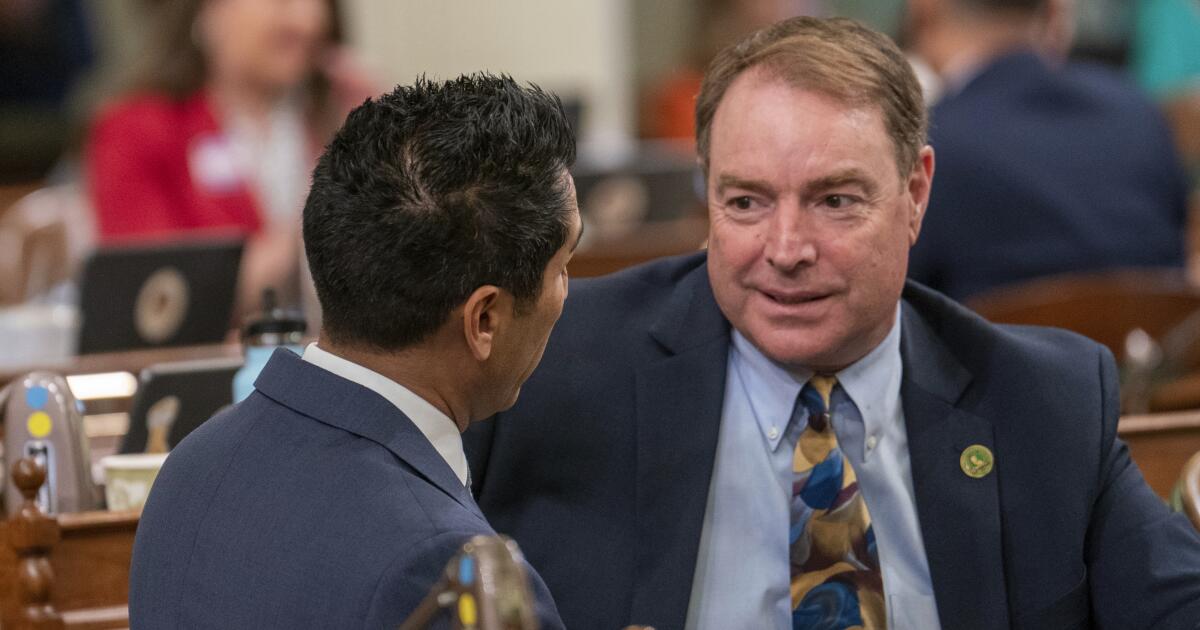
Republican Sen. Roger Niello, vice chair of the Senate Budget and Fiscal Review Committee, said the bill to repeal water’s edge won’t receive support from GOP lawmakers. He said the legislation would lead to double taxation, meaning the same income would be taxed twice by different countries, and compared taxing corporations’ foreign profits to enacting tariffs.
“California already has the reputation of being not particularly business friendly,” said Niello (R-Fair Oaks). “This would really just compound that.”
A spokesperson for Gov. Gavin Newsom did not respond to a request for comment about the governor’s views on the proposal. Newsom, however, has largely shunned new tax increase proposals.
Legislation to increase taxes requires a two-thirds approval vote instead of a simple majority. Democrats in California hold a supermajority in both the Assembly and Senate, meaning the bill could still pass without Republican support, but it would require backing from the progressive and moderate wings of the party.
Kayla Kitson, a senior analyst at the California Budget and Policy Center, said the measure has a decent chance of winning support among moderate Democrats due to the state’s budgetary woes.
“The stakes are really high this year,” she said. “With any tax policy, it’s certainly hard to get folks beyond the progressive community on board, but there are a lot of discussions happening behind closed doors given the challenges that the state knows it’s going to have to deal with in the next few years.”
When filing taxes, a multinational corporation in the United States can currently choose between two methods. Worldwide reporting takes into account all of the corporation’s global profits or losses, while the water’s edge option allows the U.S.-based parent company to exclude the income of foreign subsidiaries. This can help corporations that own profitable foreign companies pay less taxes in the United States.
California is scrambling for solutions as the state is facing an estimated $18-billion budget deficit and fallout from federal cuts that slashed healthcare. A Republican-backed tax and spending bill signed last year by President Trump shifted federal funding away from safety net programs and toward tax cuts and immigration enforcement.
Carl Davis, a research director for the Institute on Taxation and Economic Policy, said the idea is picking up momentum nationwide, with states like Maryland, Minnesota and New Hampshire also considering a repeal in recent years, due to a growing awareness about profit shifting — a loophole in the water’s edge tax break that some corporations use to reduce their tax burdens by shifting profits made in a high-tax country into tax havens.
“Folks are outraged when they hear that these companies are pretending that they are earning their profits in the Caymans or in Switzerland and are skipping out on paying U.S. taxes as a result,” he said. “That feels insulting to a lot of people who are paying the taxes they owe every day.”
During an informational hearing at the Legislature last month, Rowan Isaaks, an economist with the nonpartisan Legislative Analyst’s Office, said the state does not know the extent to which corporations use profit shifting, which makes it impossible to determine exactly how much revenue California would gain by eliminating the water’s edge tax exemption. But he estimated it would bring in “single digit billions” for the state each year.
“While there would be revenue gains, the Legislature also faces a trade-off between broadening the tax base but also managing additional uncertainty,” said Isaaks, explaining it could increase budget volatility because foreign income is more sensitive to global economic conditions.
Issaks added that the Legislative Analyst’s Office has found no strong evidence that companies would flee California if the water’s edge tax break was repealed.
Jennifer Barton, director of the legislative services bureau for the California Franchise Tax Board, told legislators that mandating worldwide reporting wouldn’t be difficult for the state from an administrative standpoint, only requiring some additional outreach or educational efforts.
California Tax Foundation visiting fellow Jared Walczak said that the water’s edge option exists for a reason and that it would be unfair to mandate worldwide reporting. “The vast majority of the activity abroad is true economic activity abroad,” he told lawmakers. “Companies don’t just exist in the United States; they have sales, they have manufacturing, they do things abroad.”
A survey last year from the nonpartisan Pew Research Center found 63% of adult Americans believe large corporations or businesses should pay more in taxes, while 19% want corporate taxes to be lower and 17% believe corporate tax policy should remain the same.
Tech companies appear to be particularly aggressive with profit shifting. Six U.S. multinational corporations — Apple, Cisco, EBay, Facebook, Google and Microsoft — may have underpaid their U.S. corporate income taxes by $277 billion over varying periods from 2009 through 2022, according to a report from the Center on Budget and Policy Priorities.
Repealing the water’s edge tax break isn’t the only tax-related proposal being considered as the state seeks to increase revenue. The Billionaire Tax Act is a controversial proposed state ballot initiative that would levy a one-time, 5% tax on the state’s billionaires to help offset federal cuts. Newsom is among its critics.
Davis believes it will continue to be a hot topic regardless of the bill’s outcome this year.
“There is very good reason to think this [repeal] is going to happen at some point,” he said. “This is a debate that is certainly not going away.”
The Disney-owned streaming platform has pulled the plug on its much-anticipated “Buffy the Vampire” revival, a year after star Sarah Michelle Gellar confirmed the series was officially in the works. A “really sad” Gellar delivered news of the pre-debut cancellation to fans in a brief Instagram video shared Saturday. She was set to executive produce the series, tentatively titled “Buffy: New Sunnydale,” with Oscar-winning filmmaker Chloé Zhao set to direct.
“I never thought I would find myself back in Buffy’s stylish yet affordable boots and thanks to Chloé I was reminded [of] how much I love her and how much she means not only to me but to all of you,” Gellar said. “This doesn’t change any of that.”
She added: “I promise if the apocalypse actually comes you can still beep me.”
Gellar’s bittersweet announcement prompted Los Angeles resident Bren O’Brien to organize a rally on Monday outside Hulu’s headquarters in Santa Monica. O’Brien, a lifelong “Buffy” fan, displayed several posters urging the streamer to reconsider its decision along the sidewalk. One bright red poster read “Bring Buffy Back!!” scrawled in black ink. Another, bearing Gellar’s likeness, asserted, “Canceling Buffy Isn’t smart, the world needs a hero!”
“I’m really sad. This was a moment that I’ve been waiting decades for,” O’Brien said.
Hulu officially began production on the “Buffy” sequel series after years of careful consideration by Gellar. Last year, the cast for the pilot was assembled while Gellar vowed , “We will only make this show if we can do it right.”
The “Buffy” star did not share additional details about the cancellation in her weekend post, but Zhao said at the 2026 Academy Awards red carpet that she was “not surprised” by Hulu’s decision.
“I had an incredible, incredible time with Sarah, with all the cast and crew doing this. We, first and foremost, see ourselves as the guardians of the original show,” the “Hamnet” filmmaker told Variety on Sunday. “Our priority for Sarah and for us has always been to be truthful to the show, to be truthful to our fans. So, things happen for a reason, and we keep our hearts open and we welcome the mystery.”
Actor Ryan Kiera Armstrong, who was set to lead the show as a supernatural slayer opposite Gellar, lamented the cancellation on Instagram. “Your slayer,” she captioned a photo of herself in costume.
“Buffy” premiered in 1997 and aired on the WB until 2001 when it moved to UPN. Though the series ended in 2003 , it spawned the spinoff series “Angel” which aired from 1999 to 2004 on the WB. Other prospective “Buffy” revivals, however, reportedly struggled to make it past development. Additionally, several actors in recent years have accused “Buffy” creator Joss Whedon of misconduct.
After Gellar broke the cancellation news, “Buffy” fans reacted online, with many of them slamming Hulu for its “terrible decision.” A representative for Hulu did not immediately respond to a request for comment on Monday.
O’Brien, among the disappointed fans, said he began posting about the cancellation online, creating posters and promoting his rally. He said he was surprised by Hulu’s decision because “Buffy” is “such a valuable IP to have,” considering its generations of fans.
“It’s just a no-brainer,” he added.
Erin McClory, a fellow “Buffy” fan, joined O’Brien outside of Hulu’s headquarters and held a poster depicting a wooden stake through a broken heart. She said she hopes rallying around the slain “Buffy” series can help persuade Hulu to reconsider its decision or prompt another network to pick up the show.
“It seems crazy for them to not even give it a chance,” she said.
Though both O’Brien and McClory say they’re eager for new “Buffy” material down the line, their support for the show remains steadfast.
“We’ll just keep doing what we’ve been doing and keep sharing Buffy edits [on social media],” O’Brien said, then sighed. “I want new content.”
Dodgers star Shohei Ohtani expressed regret Monday for his “shortcomings” following Japan’s early exit from the World Baseball Classic.
It is unclear what those shortcomings might have been. Over four games during this year’s tournament, Ohtani led Japan with a .462 batting average, three home runs and seven RBI in 13 at-bats.
Those stats are even better than the ones he posted as the MVP of the last WBC. Over seven games in 2023, Ohtani hit .435 with one home run and eight home runs in 23 at-bats to lead Japan to its third WBC championship.
Overall, however, Japan finished with a .284 batting average, down from a .299 average three years ago. Ohtani did account for his team’s final out of the 2026 tournament — an infield popup to seal an 8-5 quarterfinal loss to Venezuela on Saturday — and took to Instagram two days later.
“Thank you to all the fans for your support. Your cheers pushed us forward every day,” Ohtani wrote in Japanese. “We didn’t achieve the results we hoped for, and I deeply regret my own shortcomings.”
The two-way superstar did not pitch in this year’s WBC, after famously striking out then-Angels teammate Mike Trout of the United States for the final out of the 2023 championship game and going 2-0 with one save and a 1.86 ERA in that tournament.
PHOENIX — It’s only fitting that the pitcher who recorded the Dodgers’ final eight outs of the World Series will take the mound on opening day, as the club tries to pick up where it left off in 2025 and chase a third straight championship in 2026.
Dodgers manager Dave Roberts said Monday that World Series MVP Yoshinobu Yamamoto will toe the rubber for the March 26 opener at Dodger Stadium against the Arizona Diamondbacks — the second straight year he’s had the honor and the first time at home, after pitching last season’s opener in Tokyo against the Chicago Cubs.
Roberts added Yamamoto is expected to return to Camelback Ranch soon, after participating in the World Baseball Classic with Team Japan. The Samurai Warriors, seeking a second straight WBC title, were eliminated by Team Venezuela Saturday night in the quarterfinals.
Yamamoto is expected to make one more start in the Cactus League before opening day, although the date has yet to be scheduled, according to Roberts.
Shohei Ohtani returned to Dodgers camp Monday morning, and Roberts plans to have a conversation with him soon about configuring his throwing plan leading up to regular season play. Per Roberts, Ohtani threw four innings in a simulated game while with Team Japan last Thursday.
“He’s going to get here and throw a bullpen,” Roberts said, adding: “I’m trying to figure out when we can get him into a game, but it should be here in the next day or two, to take some at bats. But as far as his progression, there’s going to be a bullpen soon, and [we’re] trying to figure out what day he’s going to pitch this week. It should be this week, but I’m not sure which day yet.”
Ohtani has not pitched in a Cactus League game and did not pitch in the WBC. Roberts does not expect the four-time MVP to be fully stretched out by the start of the regular season. Still, as Roberts notes, he’s further along than he was at this time a year ago, when he was working his way back from Tommy John surgery.
“I think this year we’re certainly north of that, I don’t see how we won’t be able to get to three or four innings in a major league game, so that’s certainly a better jumping-off point than last year, so we’ll see how it goes,” Roberts said.
Beyond Yamamoto, Ohtani and trusty veteran Tyler Glasnow, the Dodgers’ back end of the rotation is still taking shape. Though Roberts had considered a six-man rotation to begin regular season play, he indicated Monday that he expects the club to use a five-man rotation, noting that things are still “fluid.”
Last week, Roberts said he “didn’t see a world in which Roki Sasaki doesn’t break [camp] as a starter.” That would leave one rotation spot up for the taking, with 25-year-old Justin Wrobleski, 26-year-old Emmet Sheehan and 27-year-old River Ryan among those in the running.
An Oscars slugfest for the ages ran its course, with “Sinners” and “One Battle After Another” duking it out and tallying up wins while the low but steady hum of host Conan O’Brien’s patented brand of weirdness tied the room together. A few unnecessarily curt speech interruptions threatened the calm, but mainly, this was a smoothly run machine of a show, devoid of mishaps. Even the rare circumstance of a tie was handled expertly by live-action-short award presenter Kumail Nanjiani, never bringing to mind the immortal confusion of “Moonlight” vs. “La La Land.”
But what didn’t make it to the telecast? Here are some flavorful takeaways — small yet memorable — that stick in mind from our several reporters in the room on Sunday.
A parade of praise for Jessie Buckley
Jessie Buckley arrives on the red carpet at the 98th Annual Academy Awards.
(Myung J. Chun / Los Angeles Times)
As she strode through the lobby of the Dolby Theatre pre-show, Jessie Buckley, nominated for lead actress for her role in “Hamnet,” was fanned with praise by other attendees. Even in the restroom, she couldn’t escape the well-wishers. On her way back to the buzzing lobby, she held the train of her red and pink Chanel gown graciously saying, “Thank you, thank you.” — Brittany Levine Beckman
The pressure’s off for stars during commercial breaks
Elle Fanning and Demi Moore hug during the 98th Academy Awards.
(Robert Gauthier / Los Angeles Times)
During the telecast’s first commercial break, supporting actress nominee Elle Fanning of “Sentimental Value” took her loss in stride and leaned over her seat to chat with former “A Complete Unknown” costar Timothée Chalamet, nominated this year for “Marty Supreme,” and his partner, Kylie Jenner.
Across the aisle, “One Battle After Another’s” Leonardo DiCaprio stood up and reached over to lock fingers with Benicio Del Toro. — Yvonne Villarreal
The Oscars address inflation with a goodie box
A note from Conan O’Brien left for attendees in snack boxes.
(Jessica Gelt / Los Angeles Times)
Each year, guests at the Academy Awards are given a small cardboard box of snacks left beneath their seats to get them through the always lengthy ceremony. A note from the host is generally inside. This year’s note, signed by Conan O’Brien, read, “I hope you enjoy this Conan O’Brien ‘Moderately Happy Meal’ ™. These snacks may not look like much but in any movie theater they would run you $85.” The snacks in question were a box of Junior Mints (Times reporter Josh Rottenberg got Raisinets), a small bag of Skinny Pop and a tin bottle of water. — Jessica Gelt
Jesse Plemons won’t succumb to ‘peer pressure’
Kirsten Dunst and Jesse Plemons arrive at the 98th Academy Awards at the Dolby Theatre in Hollywood.
(Myung J. Chun / Los Angeles Times)
“Bugonia” star Jesse Plemons stood near the main lobby bar talking with friends and posing for pictures with fans while finishing the dregs of a drink. A server approached him and asked if he’d like another. Plemons politely declined and the server laughed, saying, “Sorry, I didn’t mean to give you any peer pressure.” — Jessica Gelt
Amy Madigan inquires about press room rules; ‘Is it like bingo?’
Amy Madigan after winning the Oscar for supporting actress for “Weapons.”
(Kayla Bartkowski / Los Angeles Times)
After taking the stage to accept her first Oscar win for “Weapons” on Sunday, Amy Madigan paused operations in the press room to ask how moderators decide who gets to ask questions of the night’s winners.
“Is it like bingo?” the actor asked. As laughter swelled across the crowd in response, she clarified hers was a “serious question.” — Malia Mendez
After a loss, Stellan Skarsgård knows the meaning of ‘Sentimental Value’
Megan Everett-Skarsgård and Stellan Skarsgård at the 98th Annual Academy Awards.
(Myung J. Chun / Los Angeles Times)
Stellan Skarsgård, of “Sentimental Value,” enjoyed a cocktail in a VIP room just off the main auditorium fresh off of losing the Oscar for supporting actor to Sean Penn for his performance in “One Battle After Another.”
Fans rushed Skarsgård anyway, shaking his hand and telling him how much his performance as a troubled alcoholic father and artist resonated with them. “We had four actor nominations on an international film,” Skarsgård told one of them. “That’s never happened before.” — Jessica Gelt
Two of this Oscar season’s tallest figures share a moment
During a commercial break, 6-foot-5 “Frankenstein” star Jacob Elordi and 6-foot-6 Oliver Laxe, director of international feature nominee “Sirāt,” greeted one another at the lobby bar. The pair, who have been impossible to miss as two of the tallest people at various events throughout awards season, shared a warm, high-altitude embrace and Elordi introduced the French-born Laxe to his date for the Oscars: his mother, Melissa. — Josh Rottenberg
‘The Singers’ and ‘Two People Exchanging Saliva’ winners are happy to share their Oscars success
From left, producer Jack Piatt and director Sam A. Davis, makers of “The Singers,” pose with Natalie Musteata and Alexandre Singh, co-directors of “Two People Exchanging Saliva.” All of them won Oscars for live-action short.
(Kayla Bartkowski / Los Angeles Times)
Gasps erupted in the press room after presenter Kumail Nanjiani announced the seventh-ever tie in Academy Awards history Sunday evening, between live-action shorts “The Singers,” directed by Sam A. Davis and produced by Jack Piatt, and “Two People Exchanging Saliva,” directed by Alexandre Singh and Natalie Musteata.
Speaking to the press room after the ultra-rare event, Piatt was unbothered and even enthused by the outcome, saying he wished there could be a “five-way tie” among all the category’s nominees.
Davis agreed, confiding that he’d previously told the “Two People Exchanging Saliva” team “in confidence, that if we lost, I hope we lost to them.”
Shortly thereafter, Musteata said tying with “The Singers” folks was “such a dream.”
“Someone on Reddit asked us if we would be happy to share the award, and we were like, ‘Heck yeah, we would love to share it with another film that is equally beautiful and totally different.’ ” — Malia Mendez
Elle Fanning soothes Timothée Chalamet after lead actor Oscar goes to Michael B. Jordan
Elle Fanning talks with Stellan Skarsgård during the 98th Academy Awards. Timothée Chalamet was seated in front of Fanning during the show.
(Robert Gauthier / Los Angeles Times)
When Michael B. Jordan walked off stage and the show went to commercial break, Timothée Chalamet, who was up against Jordan in the lead actor category, took a sip of his drink as Elle Fanning, sitting behind him, gave him a pat on the back.
Fanning talked to her “A Complete Unknown” co-star throughout the night, who barely turned around to look at her. Kylie Jenner kept rubbing and patting Chalamet’s hand while he nervously jiggled his right leg. — Yvonne Villarreal and Jessica Gelt
Autumn Durald Arkapaw receives standing ovation in press room after historic win
Autumn Durald Arkapaw accepts the Oscar for cinematography for “Sinners” — the first woman to win the award.
(Robert Gauthier / Los Angeles Times)
“Sinners” shooter Autumn Durald Arkapaw on Sunday became the first woman to win the Oscar for cinematography. As she arrived backstage following her historic win, the press room erupted into applause, with many reporters delivering a standing ovation.
Arkapaw was equally thrilled, telling the room, “A lot of little girls that look like me will sleep really well tonight.”
“I heard Karen O say once at a concert… ‘You have to see you to be you,’” she said. “Ryan gives us, the women on this film, and our heads of department, he gives us those opportunities to shine and be ourselves and work in a creative environment where we’re leading.”
Such trust is rarely extended by directors, Arkapaw said, and she is grateful. — Malia Mendez
Former L.A. mayor and current candidate for governor Antonio Villaraigosa wants voters to know that he navigated billion-dollar budgets, cracked down on violent crime and championed the expansion of bus and rail lines.
The onetime state Assembly speaker argues he’s the only Democratic candidate with the experience to do the complicated job of running California.
But Villaraigosa left City Hall in 2013 — eons ago in the world of politics. President Obama was still in office, singer Robin Thicke’s “Blurred Lines” was atop the charts and Apple Watches weren’t yet a thing.
Because of his distance from elected office, combined with a decent but overshadowed fundraising effort, Villaraigosa lacks a high-profile platform to attract attention in today’s fractured media universe, an essential ingredient he needs to remind voters about his experience and accomplishments as mayor and a state lawmaker.
Antonio Villaraigosa gets his photo taken with students from Hazeltine Avenue Elementary School while visiting Placita Olvera in 2013.
(Irfan Khan / Los Angeles Times)
Recent polls show Villaraigosa, 73, wallowing at the bottom of the field, though none of the major Democratic candidates have an overwhelming edge.
Villaraigosa also ran for governor in 2018, coming in third in the primary election behind Democratic rival Gavin Newsom, who went on to win and is now serving his second term, and little-known Republican businessman John Cox.
Political strategist Mike Madrid, who worked for Villaraigosa on that campaign, said the former mayor’s absence from politics in recent years is a major liability in this race.
“He’s a dogged, determined candidate,” Madrid said. “But there are pretty stiff headwinds.”
Villaraigosa got a boost last week when the State Building and Construction Trades Council of California pledged $1 million to an outside committee supporting him.
His allies argue voters aren’t paying attention to the governor’s race because eyes are on President Trump, immigration raids and the Iran war.
But the new funding is a pittance compared to some of his rivals. Billionaire Tom Steyer is tapping tens of millions of his own money to pump out ads. Tech companies and billionaire Rick Caruso are supporting Matt Mahan, the mayor of San José, with millions.
Another contender, Rep. Eric Swalwell (D-Dublin), has the power of incumbency. Swalwell launched his campaign on “Jimmy Kimmel Live!” and is a regular on cable news shows, while former Orange County Rep. Katie Porter, who is also running, recently served in Congress and campaigned for the U.S. Senate two years ago.
With the June primary looming, Villaraigosa’s campaign risks sputtering out.
Angeleno Celine Mares holds a copy of Newsweek featuring newly elected Los Angeles Mayor Antonio Villaraigosa as he is sworn into office on the steps of City Hall July 1, 2005.
(David McNew / Getty Images)
Leaving a Compton church earlier this month, he reacted to Mahan’s support from technology companies, and the billionaire money in the race.
“When you have overwhelming sums of money influencing elections, there’s a great deal of concern for those of us who care about our democracy,” said Villaraigosa. “As much as they say it’s about free speech, it actually drowns out speech.”
(During his 2018 bid for governor, though, Villaraigosa was a major beneficiary of Californians using their wealth to wield political influence. Charter school backers, including Netflix co-founder Reed Hastings and philanthropist Eli Broad, spent around $23 million on efforts to boost his campaign. )
Earlier in the morning, he rallied runners at a 10K road race in L.A.’s Chinatown, lighting firecrackers, posing for photos and looking as energetic as when he was mayor and would dart into the street to personally fill potholes.
Villaraigosa flitted around the racers’ VIP tent, spotted a bowl of fortune cookies and made a beeline. “You have an active mind and a keen imagination,” he read aloud.
“Antonio V.!” a middle-aged man called out as the former mayor passed.
Minutes later, Villaraigosa swapped his black and white Veja sneakers and jeans for dress shoes and a suit for the church service in Compton, at which an overwhelmingly Black audience gave him a warm reception.
Building a coalition of Black and Latino voters helped him win the 2005 L.A. mayor’s race in a dramatic upset of then-Mayor Jim Hahn, and brought wide attention to the one-time high school dropout, who was raised by a single mother on Los Angeles’ eastside.
Newsweek magazine featured Villaraigosa on its cover with the headline, “Latino Power: L.A.’s New Mayor and How Hispanics will change American Politics.”
But national acclaim can be fleeting. Today, voters aren’t as interested in identity-based politics, said Fernando Guerra, a professor of political science at Loyola Marymount University who has known Villaraigosa for decades.
Guerra said Villaraigosa is struggling to differentiate himself in the race because his pitch to voters is not unlike the moderate path taken by Mahan. Another contender, former Health and Human Services Secretary Xavier Becerra, overlaps with Villaraigosa when it comes to biographical details: Both are from the L.A. area, Latino and relatively close in age.
“What’s made it so difficult is that [Villaraigosa said], ‘Here’s my path,’” said Guerra. “Well, guess what, there are one to two more candidates who are also on that path.”
Strategist Madrid questioned whether voters even want to hear about a candidate’s experience at a time when anti-Trump messages rally Californians. “They want a fighter,” he said.
Since leaving the mayor’s office, Villaraigosa has enjoyed success in the lucrative private sector. He purchased a $3.3 million home in the L.A. neighborhood of Beverly Hills Post Office in 2020. . A recent campaign filing shows he’s spent the last few years advising companies including the health company AltaMed, financial lender Change Company and crypto currency exchange Coinbase Global.
Then mayor Antonio Villaraigosa holds a news conference at the Department of Water and Power on Hope Street July 22, 2005, urging all of Los Angeles to conserve energy in an effort to ensure Southern California avoids blackouts.
(Ken Hively / Los Angeles Times)
He also worked for a few years for consulting firm Actum and briefly advised the Newsom administration on infrastructure projects.
“It’s not that I didn’t like the public sector,” said Villaraigosa, explaining his decision to run again. As he talked about his desire to serve, he cast a gauzy image of the aughts in Los Angeles, taking credit for the downtown resurgence, skyline full of construction cranes and fewer homeless people on the streets during that period.
“Most people look back on those years and say they were some of the best years we’ve had in the last 25 — at least,” said Villaraigosa.
Stuart Waldman, president of the business group Valley Industry and Commerce Assn., argues Villaraigosa’s experience in the private sector and distance from elected office is a good thing.
“Look at what the economy was like, look at what the city was like” under Villaraigosa, said Waldman. “That’s what he’s going to be judged on.”
Villaraigosa started his career working for labor and civil rights groups before entering politics. Elected to the state Assembly in 1994, he pushed legislation that banned assault weapons and created healthcare coverage for children. His outgoing personality established him as a coveted fundraiser for Democrats in Sacramento and paved the way for him to be chosen as Assembly speaker.
As L.A. mayor, he brought down gang crime through a program that used former gang members to broker truces. Voters backed his ballot measure to expand L.A.’s transit system through new sales tax money in the middle of the Great Recession. He drove down pension costs after a bruising battle with city unions. At the same time, he established himself as a national leader on climate issues and education.
His reputation took a hit after an affair with a television reporter led to the breakup of his marriage.
The media scene that covered Villaraigosa back then is vastly diminished, with young people now getting news from TikTok videos, message boards or Instagram posts.
Weighing in on recent TV news layoffs in Los Angeles, Villaraigosa called himself “lucky” that there were plenty of newspaper and television reporters covering him as mayor, recalling that he’d get a dozen cameras to his press conferences.
Asked to compare his 2018 campaign for governor with this one, he said, “I didn’t have to reintroduce myself last time in quite the way I’ve had to this time.”
Villaraigosa spent a significant time in Mexico in recent years to see his now ex-wife Patricia Govea, a clothing designer. “She was in Mexico 80% of the time, the last six years. So I` went to Mexico a lot.” The pair’s divorce was finalized last year.
During a debate in front of Jewish voters on L.A.’s westside last month, Villaraigosa appeared to seize on the fact that he was the sole Angeleno on the stage, introducing himself by saying, “It’s good to be home.”
He told the crowd about his work as president of the American Civil Liberties Union of Southern California and criticized UCLA — his alma matter — for its handling of incidents targeting Jewish students on its campus.
It remains to be seen if he’ll have a hometown advantage. In the 2018 race for governor, Newsom won more votes than Villaraigosa in Los Angeles County. While Villaraigosa did well in Latino communities in central L.A. and on the Eastside, Newsom captured more votes in wealthier, whiter areas.
But at the Compton church, a security guard approached Villaraigosa and told him she’d worked on his 2005 campaign, while others promised to vote for him.
“I know he has a track record,” said Valerie Bland, a 63-year-old former port worker from Long Beach, as she watched Villaraigosa work the pews. “I haven’t even looked at anyone else.”
Former Assembly speaker Fabian Núñez, a longtime friend of Villaraigosa and managing partner at Actum, hopes voters dig into Villaraigosa’s record.
“We have short-term memories in this country,” said Núñez.
SACRAMENTO — Gov. Gavin Newsom’s former chief of staff, Dana Williamson, left state service with two things: a federal corruption investigation and more than $50,000 in pay for vacation time she accrued but never took.
State payroll records reviewed by The Times show Williamson used approximately $30,000 in unused vacation time to remain on California’s payroll through Jan. 31 — seven weeks after Newsom’s office indicated she had departed — before collecting an additional $22,000 lump-sum payout for the hours she had left.
Large cash-outs for departing state workers with hundreds of hours of time off on the books have been a recurring issue in California. The state’s unfunded liability for vacation and other leave owed to employees has ballooned in recent years to $5.6 billion, fueled by generous time-off provisions and a long-standing failure to enforce policies that cap most employees’ vacation balances at 640 hours.
Many state workers accumulate large balances of unused vacation after decades of being on the government payroll. The typical public employee retires with more than two decades in public service, according the California Public Employees’ Retirement System. Their unused time off is paid when they leave state employment at their final rate of pay.
Williamson, however, amassed 462 hours of unused leave in less than two years on the job. She earned $19,612 a month as the governor’s chief of staff.
John Moorlach, director at the conservative think tank the Center for Public Accountability at the California Policy Center, said that a job like Williamson had probably involved incredibly long workdays but that the pace in which employees accumulate days off is a major financial burden.
“A normal blue-collar worker would say, ‘Really? Really?“” said Moorlach, a former Republican state senator from Orange County. “You don’t find this perk in the private sector.”
Williamson notified Newsom in November 2024 that she was under federal investigation and was put on paid administrative leave through Dec. 16, the governor’s office said.
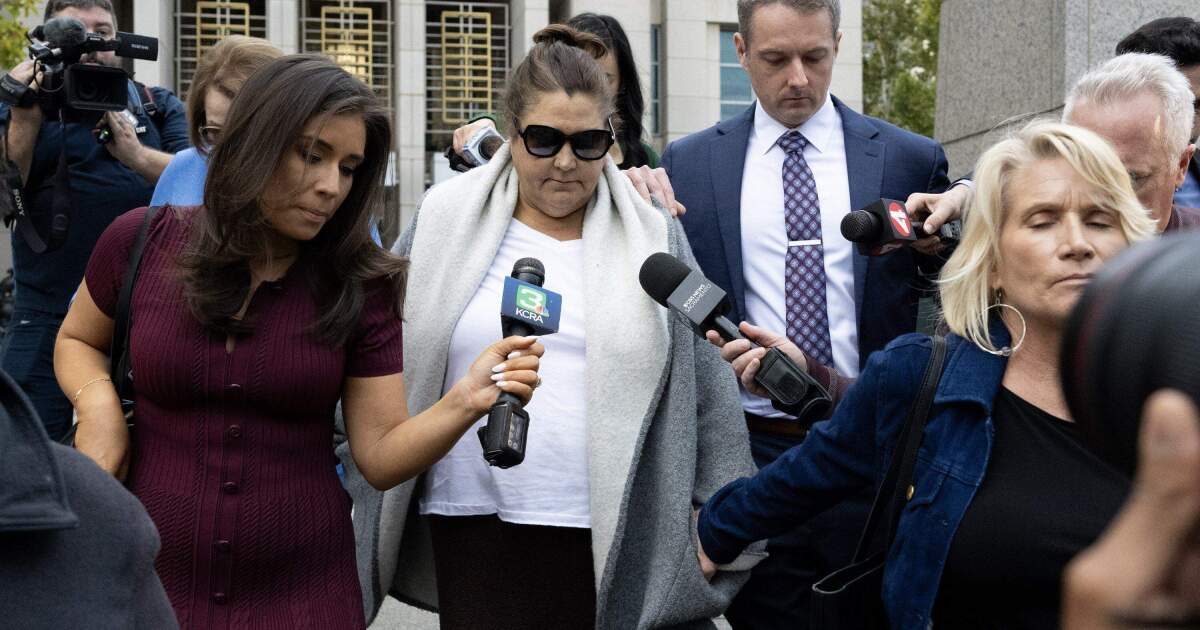
Federal charges against Williamson, which were filed in November 2025, allege she siphoned $225,000 out of a dormant state campaign account belonging to gubernatorial hopeful Xavier Becerra and illegally claimed $1 million in luxury handbags and travel as business expenses on her tax returns. She pleaded not guilty to the charges.
A status conference in Williamson’s case was moved to April 16 after she recently underwent a successful liver transplant and due to the large volume of discovery — more than 280,000 pages so far — according to court records filed last month.
Williamson’s attorney, McGregor Scott, did not respond to a request for comment.
State payroll records show Williamson earned $40,000 in regular pay in 2025, which the state controller’s office said included her December 2024 and January 2025 paychecks. The governor’s office said Williamson’s December 2024 paycheck included 11 days of paid administrative leave, and the remainder of both paychecks was covered by her unused leave.
With her final cash-out of $22,000 in remaining time off, she made a total of $62,000 last year — all tied to administrative leave and unused vacation time rather than time worked.
“That’s shocking, honestly,” said Assemblyman Josh Hoover (R-Folsom), adding that stockpiled vacation time overall is something the state Legislature should look into.
The state paid $453 million in unused leave benefits to state workers in 2025. That was an average of more than $20,000 to the 21,000 employees who received a lump-sum check. The amount paid to departing or retiring state workers has steadily increased each year. In 2024, the state paid $413 million for unused time off.
“Obviously, employees are an important part of our state and they accrue vacation time,” Hoover said. “But, if this is something being used to pad people’s salaries … we need to look into that and possibly reform that.”
Last year, 80 state employees took home at least $250,000 in unused time off, and 1,081 employees were paid more than $100,000. Those numbers have been increasing each year. For example, the state paid 16 state workers more than $250,000 for unused time off in 2010, and 309 employees were paid more than $100,000.
In 2024, the state paid out a record $1.2 million to a prison supervising dentist for unused time off. Last year, the top amount paid for unused leave was about $650,000 to an assistant fire chief with the California Department of Forestry and Fire Protection.
The state owed nearly $5.6 billion to state workers for unused vacation and other leave benefits in 2024, according to the most recent financial accounting report issued by the state controller’s office. Although that unfunded liability held steady when compared with 2023, it has risen sharply from pre-pandemic amounts.
In 2019, the state owed $3.9 billion for employees’ unused time off before COVID-19 curtailed travel and work-from-home policies resulted in fewer workers taking time off. State employees have argued that under-staffing at state agencies can make it difficult to take vacations.
Nick Schroeder, a policy analyst at the nonpartisan California Legislative Analyst’s Office, said the state has plans to reduce unfunded liabilities for pensions and retiree healthcare, but that isn’t the case with unused time off.
“There isn’t a plan to address it,” Schroeder said.
When an employee retires with a large leave balance, the department where that person worked last is on the hook for the amount.
“It can be a big effect on that individual department’s budget,” Schroeder said.
During budget deficits — including in the current fiscal year — the state has cut employee pay or deferred annual raises in exchange for additional days off, a strategy that helps balance budgets but also adds to workers’ growing vacation balances.
In Newsom’s January budget proposal, which estimated a $3-billion deficit, the governor recommended providing $91 million in ongoing funding to the California Department of Corrections and Rehabilitation to help the prison system pay departing employees for their unused time off. The department said that from 2020 to 2025, it paid about $130 million annually on average to employees leaving state service, according to a Legislative Analyst’s Office report.
When employees cash out banked leave, the state pays them not only for the hours they have accumulated, but also for the additional vacation and holidays they would have earned had they taken that time off.
That means a person with 640 hours of vacation would also be paid for all of the vacation and holidays they would have earned had they taken those 80 days off. Each hour of leave is paid based on an employee’s final salary — not what they were earning when the time was accrued.
Most private-sector employers cap vacation accrual between 40 and 400 hours and stop employees from earning additional time once they reach those limits. Some companies have moved in the opposite direction, adopting “unlimited paid time off” policies. Under those systems, employees do not accumulate vacation days that can be banked or cashed out, but critics say the policies can lead to workers taking less time off because there is no guaranteed number of days and employees may feel pressure not to appear absent.
Jon Coupal, president of the Howard Jarvis Taxpayers Assn., said there appears to be little appetite in the state Capitol to address California’s burgeoning vacation liability.
“This problem is systemic within California government and no one seems willing to take it on,” Coupal said. “At the same time, they are clamoring that there is a budget crisis. I suspect they will continue to kick the can down the road.”
When Julie Uhrman and a fledgling ownership group that would quickly grow to more than 100 announced plans to start a women’s soccer club in the summer of 2020, the goal was to build something unique and different.
And in that she was wildly successful: four years after its founding, Angel City became the most valuable team in the history of women’s professional sports while funneling millions of dollars to community programs throughout Southern California.
What the team hasn’t done is win. And that, Uhrman said, has to change.
“It’s time to win,” said Uhrman, who this month is stepping down as the team’s chief executive to take a new role as principal advisor. “We’re in L.A. We live in a city of champions and we want to be on the same mantle as them. It’s a process but we have the right team in place, on and off the pitch, to accomplish that.”
Angel City will kick off its fifth season Sunday at BMO Stadium against the Chicago Stars. Over its previous four seasons, Angel City lost 12 more games than it won, finished with a winning record only once and made just one playoff appearance. And it has used four coaches, three sporting directors and more than 70 players in its search for success.
“We needed to rip it up and start again,” Straus said.
As a result, more than half the players on the opening day roster weren’t with Angel City at the start of last season. And nine women who started at least a half-dozen games last season aren’t there this year.
“This is Angel City 2.0,” Parsons said. “We’ve gone through a huge amount of staff change. We’ve gone through a huge amount of roster change. And January 2026 has become Year 1.
“Year 5 is Year 1 of building what we believe is a sporting organization that can get to the top and stay at the top.”
That’s probably not what the team’s long-suffering fans wanted to hear. They wanted to hear that this is the year Angel City wins a trophy. But after watching his team finish 11th in the 14-team NWSL in 2025, Parsons said that’s not realistic.
“You don’t go from 11th to being a top-four team. I think you come from 11th and you become a playoff team ,” said Parsons who, as a manager, took a Portland Thorns team with a losing record to an NWSL Shield and a league title in his first two seasons. “Last year was a tough year. Now we’re in a better place. So we’re still on the journey.”
Angel City coach Alexander Straus watches over a practice session at the team’s training facility in Thousand Oaks in February.
(Damian Dovarganes / Associated Press)
So is the league. With the addition of expansion franchises in Denver and Boston, the NWSL entered its 14th season Friday with a record 16 teams, meaning each club will play a record 30 games. The top eight finishers in the table will make the playoffs.
For Angel City, the makeover to 2.0 really launched about six months before Parsons arrived when Disney CEO Bob Iger and his wife, Willow Bay, dean of the USC Annenberg School for Communication and Journalism, became controlling owners of the club and committed $50 million to improving it. Part of that investment paid for the purchase and renovation of a sprawling state-of-the-art training center at Cal Lutheran University and part of it allowed Parsons to come in and tear things up.
When he took over as sporting director last winter, Parsons quickly set about overhauling the roster, leaving Angel City with one of the youngest teams in the NWSL, averaging 25 years of age, this season. Two players are still in their teens and eight others have yet to turn 23.
A year ago, eight players on the roster were 32 or older.
Among the key offseason additions are defender Emily Sams, an Olympic champion with the U.S. national team, and midfielder Ary Borges, a Brazilian international. They will join a core that includes Japanese midfielder Hina Sugita and Zambian striker Prisca Chilufya, who joined the team at the end of last season.
Of the four, only Sugita, a two-time World Cup veteran, is older than 26.
“We’re getting closer to competing for trophies,” Parsons said. “But making [the] playoffs right now is a logical next step. This year is about showing that we’re going in the right direction. But we can’t jump from 11th to one. Those days are over.
“We have overachieved the last 12 months in building a sporting organization, staffing departments and [constructing a] roster. There’s going to be ups and downs this year, like there is every year.”
Goalkeeper Angelina Anderson, entering her fourth season with Angel City, making her one of the team’s longest-tenured players, believes in Parsons’ deliberate approach and is confident the team is about to turn the corner.
“Having that methodical approach is really smart and it gives us kind of an overview of like, we want to win the championship, we feel like we’re in a really good spot, but there are daily, monthly, season-long challenges that we’re going to have to overcome if that’s where we want to get to,” said Anderson, one of three team captains. “It’s actually a very smart way for all of us to manage our expectations.”
Uhrman agrees too but being realistic is hard. When she helped launch Angel City, it was with the vision of building a winning team and nearly six years later, she’s still waiting for that vision to be released.
“Our aspiration is to win the championship. Our goal is to make the playoffs,” she said. “And we feel very comfortable that we can do that. It is a process. We’re realistic about where we are in the process and what we need to do to develop and grow.
“Believing in the fact that it’s a process is comforting because we are being realistic about what we are. But that doesn’t change what we want to accomplish.”
In late November, Gabriela Jaquez scored 29 points against Tennessee. It wasn’t her career high; that came when she tallied 30 points two years prior.
But that game, when Tennessee had no answers for a player who was then the UCLA women’s basketball team’s fifth offensive option, felt like Jaquez’s coming-out party after years as a quieter cog in the Bruins’ rotation. It changed the way teams had to defend her. Previously known more for attacking the rim than for shooting from outside, Jaquez showcased a different dimension.
Suddenly, one of the best teams in the nation had one of the best breakout stars. Entering the NCAA tournament, the 31-1 Big Ten champion Bruins are relying on Jaquez as one of their super seniors to guide them back to the Final Four.
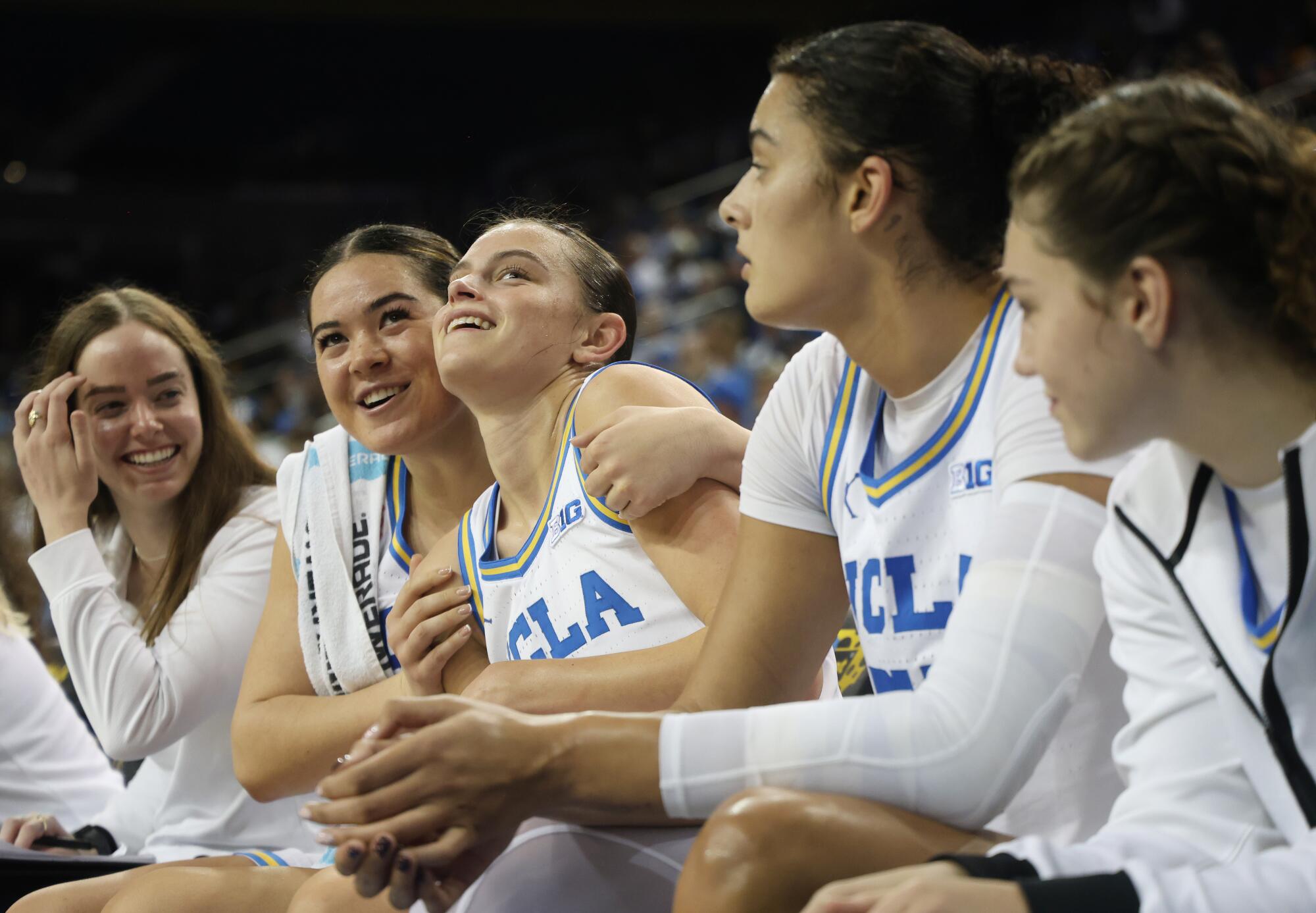
UCLA guard Charlisse Leger-Walker hugs teammate Gabriela Jaquez, who led the Bruins in scoring during a win over Tennessee on Nov. 30 at Pauley Pavilion.
(Luiza Moraes / Getty Images)
“I do think she’s always been that player,” said senior guard Kiki Rice, who has played four seasons with Jaquez. “But I do think she’s had a lot more opportunity to demonstrate that, and you saw that in the beginning of the year. She just started off such a hot shooter, and the way that she’s developed every single year, gotten better and just found a way to impact the team.”
Though she hasn’t reached that same scoring peak again, Jaquez has quietly buoyed UCLA’s dominant run this season as the Bruins have emerged as one of the favorites to win a national title. She ranks second on UCLA (among players with at least 30 attempts) in field-goal percentage at 54.3%, second in three-point shooting at 41.1% and third in scoring.
Jaquez has gotten attention for being part of a family legacy at UCLA and spending an offseason with the Bruins’ softball team. But in the background, even when she hasn’t been the leader for the UCLA women’s basketball team, Jaquez has honed herself into one of just 25 Power Four conference players shooting better than 40% from deep this season.
Jaquez, who tallied her 1,000th career point early this season, is having a career-best season with 13.6 points per game, has added double-digits in 25 of her 31 games this season.
“There’s so much depth to her,” said guard Charlisse Leger-Walker, who often dances alongside Jaquez in videos posted on social media and Leger-Walker’s YouTube video series. “Getting to understand her off the court, I think has really helped our connection on the court, and kind of how her personality is so outgoing. She likes to bring people along. You can see that on the court.”
Jaquez came in as a 5-foot-11 freshman who played primarily as an undersized forward and would crash the net and collect rebounds.
The shooting, though, has been the biggest change this season.
“I think of her as someone who, especially early on, like she doesn’t need to have the ball on hand, she doesn’t need to have plays run for her to impact the game,” Rice said. “But then she’s been shooting so well too.”
Early in the season, teams doubled Lauren Betts, who leads the team with 16.4 points per game as a center, which opened Jaquez to shoot from deep, establishing herself as someone who needed to be keyed on.
UCLA’s Gabriela Jaquez shoots the ball under pressure from Oregon’s Katie Fiso on Dec. 7 at Pauley Pavilion.
(Luke Hales / Getty Images)
Her 107 three-point attempts are a career-high this season, with her shot selection jumping to 32.4% coming from behind the arc. That’s come with a career-high 2.2 assists per game and an 85.2 defensive rating, ranked in the top 20% of the nation.
“She can shoot the ball, she can finish, she defends,” shooting guard Gianna Kneepkens said. “I love playing with Gabs. Sometimes I get caught watching her because she’s just so amazing.”
Now, Jaquez projects as a first-round WNBA pick, in large part because of her versatility on offense. She is listed as a guard on the Bruins’ roster, but often starts at forward, where she can stretch the floor. Her 5.4 rebounds per game are third on the team, thanks in large part because of her ability to fill positions one through five.
During UCLA’s Big Ten semifinal win over Ohio State, Jaquez shot four for 12 but Bruins coach Cori Close noted Jaquez’s importance when her shooting isn’t on target.
“What I liked about that the most is that she struggled a little bit in the middle of the second half,” Close said. “It just showed a lot of her mental toughness that, when we needed her the most, she was going to be there for us on the defensive end and on the rebounding end.”
While all five starters have been mentioned as possible WNBA first-rounders, Jaquez has perhaps made the biggest leap, two WNBA scouts not authorized to publicly discuss prospects said.
UCLA senior Gabriela Jaquez celebrates with the Big Ten tournament trophy after the Bruins beat Iowa in the finals on March 8 in Indianapolis.
(Michael Conroy / Associated Press)
When Rice and Leger-Walker are on the bench, Jaquez has taken on point guard duties.
“She does all those little hustle plays,” Leger-Walker said. “She will score if you need her to, she’ll cut, she’ll rebound, like, she’s so versatile. You know what you’re getting from her, and she’s kind of that person who’s the engine of our team.”
Jaquez hasn’t thought much about what happens after this season. This year’s mantra of joy has resonated after last year’s crushing Final Four loss to Connecticut.
“It’s been fuel,” Jaquez said. “That started [last] spring and into the offseason, knowing exactly what to work on, how to prepare…. But I just love the team aspect of basketball, I love this group of girls specifically and I think having so much fun out there has [been the most important thing] and winning has made it even better.”
The night Jaquez hit five three-pointers against Tennessee may have felt like her arrival. But for the teammates who have watched her develop for four years, it looked less like a breakthrough and more like the rest of the country finally catching up.
The rest of the country may have only noticed this season. But inside UCLA’s locker room, Jaquez has been that player all along.
“Gabs is an extremely confident person, so I feel like if you’d asked her this freshman year, she would have believed that she’d become just the incredible player that she is,” Rice said. “Just the opportunity, her experience at this level these past few years has really helped her develop into what she is.”
WASHINGTON — Anti-Muslim rhetoric from some Republicans in Congress intensified this week against the backdrop of the Iran war, with several lawmakers — including one who said that “Muslims don’t belong in American society” — drawing condemnation from Democrats but little response from GOP leaders.
The derogatory language has been percolating among Republican officials for months, often prominent when criticizing New York Mayor Zohran Mamdani, who is Muslim. But against the backdrop of the Iran war, a country with an overwhelmingly Muslim population, and attacks at a synagogue in Michigan and a college in Virginia, the tone sharpened this week.
“The enemy is inside our gates,” Sen. Tommy Tuberville of Alabama wrote Thursday in response to a photo of Mamdani sitting on the ground during an iftar dinner at New York City Hall. The photo was juxtaposed with a picture of the Sept. 11 attacks.
Hours later, Tuberville added: “To be clear, I didn’t ‘suggest’ Islamists are the enemy. I said it plainly.”
The rhetoric intensified Friday as GOP lawmakers responded to the attacks in Michigan and Virginia by urging a halt to all immigration into the United States. Some singled out Muslims specifically.
For many Muslims, it’s a political moment that carries echoes from the early 2000s, when the Sept. 11 attacks and the Afghanistan and Iraq wars generated hostility toward Muslim communities in the United States, often accompanied by discrimination and racist violence.
“When members of Congress speak, it’s not just words,” said Iman Awad, the national director for policy and advocacy for the Muslim American advocacy group Emgage Action. “It shapes public perception. It legitimizes prejudice.”
GOP rhetoric targeting Muslims spreads online
Rep. Andy Ogles (R-Tenn.) in his social media post stated flatly that Muslims don’t belong in the United States. He stood behind it after criticism mounted, later writing that “paperwork doesn’t magically make you American” and that “Muslims are unable to assimilate; they all have to go back.”
Asked about Ogles’ post Tuesday, House Speaker Mike Johnson (R-La.) said he had spoken to members “about our tone and our message and what we say.” He said Ogles used “different language than I would use,” but added that he believes the issue raised by the comments is “serious.”
“There’s a lot of energy in the country, and a lot of popular sentiment that the demand to impose sharia law in America is a serious problem,” Johnson said. “That’s what animates this.”
Sharia is a religious framework that guides many Muslims’ moral and spiritual conduct. References to “sharia law” have often been invoked by officials to suggest Muslims are attempting to impose religious practices on communities in the United States.
Many Republicans point to a Muslim-centered planned community near Dallas as proof of “sharia law” — though the developers have denied the allegations and said they are being targeted only because they are Muslim.
With Johnson not condemning Ogles’ remarks — or recent comments from Rep. Randy Fine (R-Fla.) that “the choice between dogs and Muslims is not a difficult one” — the anti-Muslim rhetoric grew louder. After the photo circulated of Mamdani at the iftar dinner, several Republicans responded with critical posts.
Democrats broadly condemned the Republican messages. Sen. Chuck Schumer of New York, the leader of Senate Democrats, called Tuberville’s post “mindless hate.”
“Islamophobic hate like this is fundamentally un-American and we must confront and overcome it whenever it rears its ugly head,” Schumer said.
Mamdani — in response to Tuberville’s post that “the enemy is inside our gates” — said: “Let there be as much outrage from politicians in Washington when kids go hungry as there is when I break bread with New Yorkers.”
Attacks in Michigan and Virginia spark more rhetoric
Federal officials identified a man who rammed his vehicle into a hallway at Temple Israel in West Bloomfield Township, Mich., this week as a naturalized citizen born in Lebanon. Officials have said that the man — who was killed by security guards at the temple — had lost four family members in an Israeli airstrike in Lebanon during the ongoing war in the Middle East, just after sunset as they were having their fast-breaking meal during the Muslim holy month of Ramadan.
In Virginia, Mohamed Bailor Jalloh opened fire in a classroom at Old Dominion University before ROTC students subdued and killed him. Court documents showed that he had served time for attempting to aid the militant group Islamic State and was released less than two years ago.
Some Republican lawmakers claimed vindication for their views. Others pushed for legislation. Rep. Tom Emmer of Minnesota, the House Republican whip, said that “the security of our nation hinges on our ability to denaturalize and deport terrorists.”
Rep. Riley M. Moore (R-W.Va.) said he would introduce a bill to denaturalize and deport any naturalized citizen who “commits an act of terrorism, plots to commit an act of terrorism, joins a terrorist organization or otherwise aids and abets terrorism against the American people.”
Similar rhetoric and policy efforts have surfaced before and stoked controversy. Protesters connected to demonstrations in recent years over the Israel-Hamas war were arrested and targeted by authorities, including former Columbia University graduate student Mahmoud Khalil, a Palestinian activist the government has sought to detain and deport.
Mamdani responds
Middle East conflicts bringing domestic tensions is nothing new. With the war in Gaza, both Muslim and Jewish communities have faced faith-based discrimination and attacks.
Mamdani said the posts invoking the 9/11 attacks are problematic not just because of the words, but because of “the actions that often accompany them.”
“I think too of the smaller indignities, the indignities that many New Yorkers face, but that Muslims are expected to face in silence,” the mayor said. “Of the exhaustion of having to explain yourself to those who are not interested in understanding. Of the men who introduce themselves by their given name only to be called Muhammad for years on end.”
The stark silence from Republican leaders, including President Trump, reflects a broader change in the party. After the Sept. 11 attacks in 2001, Republican President George W. Bush visited the Islamic Center of Washington to explicitly warn against Muslim discrimination.
“America counts millions of Muslims amongst our citizens, and Muslims make an incredibly valuable contribution to our country,” Bush said during the visit, adding: “They need to be treated with respect. In our anger and emotion, our fellow Americans must treat each other with respect.
“Those who feel like they can intimidate our fellow citizens to take out their anger don’t represent the best of America, they represent the worst of humankind, and they should be ashamed of that kind of behavior,” Bush said.
Good morning, and welcome to L.A. on the Record — our City Hall newsletter. It’s Noah Goldberg, with an assist from David Zahniser and Melissa Gomez, giving you the latest on city and county government.
Former Deputy City Atty. Michelle McGinnis wants to know why she was escorted out of City Hall in front of her colleagues, forced to turn in her work computer and placed on administrative leave in April 2024.
In her search for answers, a separate issue has arisen: whether her former boss is withholding or deleting text messages.
In a lawsuit against the city, McGinnis subpoenaed text messages about her between City Atty. Hydee Feldstein Soto and one of her top deputies, Denise Mills.
But according to a new petition that McGinnis filed in Los Angeles County Superior Court, Feldstein Soto produced zero text messages between her and Mills, and Mills produced just three with Feldstein Soto. The subpoena also asked for messages on Signal and other apps.
McGinnis’ lawyer, Caleb Mason, said the lack of texts strains credulity and probably means that some were deleted or withheld. McGinnis, who headed the criminal branch of the City Attorney’s Office, was fired in January 2025.
“It is obviously relevant and critical … to see what Ms. Feldstein [Soto] and Ms. Mills were saying to one another about Ms. McGinnis … that led to the extraordinary and unprecedented action of escorting a Branch Chief out of the building,” Mason wrote in a Feb. 23 brief.
A deputy city attorney representing Feldstein Soto and Mills disputed Mason’s claims in court filings, calling the new petition “uncomprehensible [sic]” and asserting that the two officials complied with the subpoenas. The attorney also sent 2,061 pages of documents to Mason.
Feldstein Soto, in a declaration, said that she “diligently searched for any documents” and shared them with her lawyer.
Mills said she did the same. In an effort to “retrieve any backup text messages,” she performed a factory reset of her phone on Jan. 30. McGinnis said the subpoenas were served on Dec. 15.
McGinnis’ lawyer said that was tantamount to spoliation — or destruction of evidence.
“Every court and every attorney in the country knows that ‘performing a factory reset’ means erasing information from a phone,” he wrote.
“It is reckless or negligent to reset a device when you know the opposing party is seeking that info,” said Laurie Levenson, a professor of law at Loyola Law School.
Still, Levenson said, politicians and lawyers often prefer speaking in person or on the phone to avoid their communications being exposed in a lawsuit. So it’s possible that the two didn’t exchange many text messages.
Feldstein Soto said in a statement that she has turned over all text messages about McGinnis. “There is nothing new here,” she said. “Ms. McGinnis was terminated, for cause. We remain confident in that decision.”
The city has argued that McGinnis “routinely opposed” Feldstein Soto’s policy and prosecutorial decisions.
McGinnis was placed on administrative leave due to a “pattern of insubordination and failure to meet minimal job requirements,” the city wrote in a legal filing in 2024.
The lawsuit that McGinnis filed against the city in 2024 alleged that Feldstein Soto retaliated against McGinnis and made prosecutorial decisions based on “personal relationships” or “perceived political gain.” The lawsuit also accused Feldstein Soto and Mills of “inappropriate alcohol consumption” in the office.
Other local politicians have also coughed up remarkably few text messages in response to public records requests.
Mayor Karen Bass came under scrutiny following the Palisades fire over the fact that her text messages auto-delete after 30 days, destroying potentially critical information about her decisions surrounding the devastating blaze. The Times sued the city after Bass’ counsel argued that her texts were “ephemeral” and not subject to public records requests. L.A. County Supervisor Kathryn Barger also said she auto-deletes messages after 30 days — and sometimes manually deletes them.
City Council President Marqueece Harris Dawson, meanwhile, turned over zero texts, emails, Signal and WhatsApp messages in response to a Times public records request for his communications with Bass from Jan. 6 to Jan. 16, 2025 — before, during and after the Palisades fire.
Harris-Dawson’s office said it had “conducted a search and found no responsive records for this request.”
You’re reading the L.A. on the Record newsletter
State of play
— IDK, VOTERS SAY: A majority of Angelenos have not made up their minds about the June 2 mayoral primary, according to a poll released this week. Bass had the most support at 20%, while reality TV star Spencer Pratt had 10% and Councilmember Nithya Raman had 9%, the poll found.
— HOMELESS DEATHS DROP: For the first time in the decade that homeless mortality has been tracked in Los Angeles County, fewer people have died on the streets and in shelters than the year before, the Department of Public Health reported Tuesday. A sharp decrease in overdose deaths drove a decline of 10% in the rate of homeless deaths from all causes in 2024, the most recent data analyzed by the county.
—LAST-MINUTE MEMO: The City Council was set to vote on a $177-million contract for the Legal Aid Foundation of Los Angeles to continue representing tenants for the next three years, with other groups providing related services. But the night before the March 3 vote, Feldstein Soto sent a confidential memo to council offices recommending that council members “reconsider the award of such a large contract to a frequent litigant against the city.”
— CAMPAIGN REVELATION: Community organizer Jordan Rivers, who is running against incumbent Tim McOsker to represent Council District 15, said he will continue his campaign after a report surfaced that he stabbed a neighbor when he was 12. Rivers, now 22, stabbed the 8-year-old boy in the neck and shoulders, inflicting “severe and life threatening physical and emotional injuries,” a lawsuit said. On Monday, Rivers said it was an “accident” that happened a decade ago.
“I do not believe that past situations or indeed past mistakes define or determine who a person is or what they are,” he said.
— LAPD REFORMS: A series of proposed changes to the city’s charter — essentially its constitution — could give elected leaders in Los Angeles more oversight over the Police Department and enable the police chief to fire problem officers. The changes, recommended by the city’s Charter Reform Commission, have long been sought by advocates and are likely to face fierce opposition.
— SUPE SPEAKS: Embattled Los Angeles schools chief Alberto Carvalho made his first public statement since the FBI raided his home and district office on Feb. 25. He denied any wrongdoing and asked to return to his duties.
“While the government’s investigation remains ongoing, no evidence has been presented by prosecutors supporting any allegation that Mr. Carvalho violated federal law,” the statement said.
— A WEEK OF WIPEOUTS: With city officials finalizing the list of candidates for the June 2 election, a number of hopefuls failed to gather enough signatures to qualify for the ballot. They include community leader Eddie Ha, publicist Dory Frank and entrepreneur Jeremy Wineberg on the Westside; residential connectivity specialist Rosa Requeno on the Eastside; neighborhood council member Jon Rawlings in the San Fernando Valley; and neighborhood council president Adriana Cabrera, civil rights attorney Chris Martin and social worker Michelle Washington in South L.A.
— REWORKING ULA (TAKE 3): The City Council voted Wednesday to create an ad hoc committee to look at potential changes to Measure ULA, the tax on high-end property sales passed in 2022. City leaders have made two previous moves to rewrite the measure, neither of which succeeded.
— VOTING OLYMPIC VALUES: The council voted Friday to “express concern” about LA28 Olympics committee chairman Casey Wasserman, saying his appearance in the Epstein files poses a “potential conflict” with the values of the Olympic movement. Several elected officials at City Hall, including Bass, had already called for Wasserman to step down.
— MEETING OF MAYORS: On Friday, about 20 mayors and city council members from across L.A. County, including Bass, came together to discuss the impact that immigration raids have had on their communities. Many raised concerns about the role of local law enforcement in allowing federal agents to act with what they described as impunity.
One mayor suggested that all the cities that contract with the L.A. County Sheriff’s Department should get together to demand accountability for deputies in their interactions with immigration agents.
QUICK HITS
Where is Inside Safe? The mayor’s signature program went to Washington and Lincoln boulevards in Councilmember Traci Park‘s district, bringing more than 20 people inside, according to a mayoral spokesperson.
On the docket next week: The Los Angeles chapter of the Democratic Socialists of America will meet on Saturday, March 21, at Immanuel Presbyterian in Koreatown. Members are expected to vote on whether to make an endorsement in the mayoral primary.
Stay in touch
That’s it for this week! Send your questions, comments and gossip to LAontheRecord@latimes.com. Did a friend forward you this email? Sign up here to get it in your inbox every Saturday morning.
President Trump announced on social media Friday that Richard Grenell, the former ambassador to Germany who Trump appointed as president of the John F. Kennedy Center for the Performing Arts more than a year ago, is stepping down. Grenell will be replaced by Matt Floca, the vice president of facilities operations at the center.
“Ric Grenell has done an excellent job in helping to coordinate various elements of the Center during the transition period, and I want to thank him for the outstanding work he has done,” Trump posted on Truth Social, adding that after an upcoming two-year closure for renovations, the center “will be, at its completion, the finest facility of its kind anywhere in the World!”
The Trump administration on Friday moved to roll back Biden-era limits on emissions of ethylene oxide, a cancer-causing chemical often used in the sterilization of medical devices.
The Environmental Protection Agency said repealing the rules, which fall under the National Emission Standards for Hazardous Air Pollutants, would “safeguard the supply of essential medical equipment” — saving approximately $630 million for companies over 20 years. California is home to about a dozen such facilities.
The government said the emissions are part and parcel of protecting people from “lethal or significantly debilitating infections that would result without properly sterilized medical equipment.”
“The Trump EPA is committed to ensuring life-saving medical devices remain available for the critical care of America’s children, elderly, and all patients without unnecessary exposure to communities,” EPA Administrator Lee Zeldin said in a statement.
An estimated 50% of sterile medical devices in the U.S. are treated with ethylene oxide, or EtO, particularly those that can’t be cleaned using steam or radiation. The colorless gas is also used to make chemicals found in products such as antifreeze, detergents, plastics and adhesives.
But EtO poses health risks. Short-term exposure by inhalation can cause headaches, dizziness, nausea, fatigue respiratory irritation and other adverse health effects, according to the federal Agency for Toxic Substances and Disease Registry.
Longer-term exposure increases the risk of cancers of the white blood cells, such as non-Hodgkin’s lymphoma, as well as breast cancer. A now-deleted page from the EPA’s website stated, “EtO is a human carcinogen. It causes cancer in humans.”
Friday’s proposal specifically targets updated rules for EtO emissions that were passed by the Biden administration in 2024 following pressure from environmental justice groups, particularly those in Louisiana’s heavily industrialized “Cancer Alley.” The change sought to reduce the amount of EtO released from commercial sterilizers by 90% and lessen the hazards for nearby communities.
The tighter rules were in part based on EPA’s own scientific study that found it to be 60 times more carcinogenic than previously thought, which the agency now says should be reassessed.
If finalized, the plan would give facilities the choice between installing continuous real-time monitoring systems for EtO emissions or complying with modified pollution control requirements at facilities that emit more than 10 tons a year, the EPA said.
The proposal follows other moves by the Trump administration to rescind regulations that it says are burdensome and costly for industries, such as those governing emissions from coal power plants. Last month, the EPA repealed the endangerment finding, which affirmed the dangers of greenhouse gas emissions and underpinned the agency’s ability to regulate those emissions from vehicles.
The action around ethylene oxide would affect about 90 commercial sterilization facilities owned and operated by approximately 50 companies. Three California companies applied for and received presidential exemptions for their EtO emissions in July.
The Sterigenics facility, center, in Vernon is pictured in 2022.
(Myung J. Chun / Los Angeles Times)
They are located in Ontario and Vernon and operated by the company Sterigenics, which provides industrial sterilization technology for medical devices and other commercial products.
In January, a coalition of environmental and community groups challenged the EtO exemptions in federal court. The lawsuit from the Southern Environmental Law Center and the Natural Resources Defense Council argues that technology exists for facilities to comply with the tighter Biden-era standards without raising costs, and many facilities are already using it.
“EPA’s 2024 rule was an important and overdue step to reduce toxic ethylene oxide pollution and protect communities,” said Irena Como, senior attorney at the Southern Environmental Law Center, in a statement Friday. “Repealing this rule that is proven to significantly lower pollution exposure and cancer risks will subject even more people who work, live, and send their children to schools located near these facilities to harm that is entirely preventable.”
Sterilization and chemical industry groups support the plan.
“The EPA rule concerning ethylene oxide use in commercial sterilizers threatens to severely restrict access to vital medical products nationwide,” the American Chemistry Council said in a statement. “We commend the EPA for their commitment to reevaluating these policies.”
The EPA will hold a 45-day comment period about the proposal after it is published in the federal register. A final decision is expected sometime this year.
ACTOR Warwick Davis’s mystery lover is a woman named Yvette who he has been dating for a year.
The star, whose wife Samantha died in 2024, affectionately referred to his new partner as “Sponge” in a speech last year.
Sign up for the Showbiz newsletter
Thank you!
Warwick Davis’s mystery lover is a woman named Yvette who he has been dating for a yearCredit: GettyWarwick’s wide Samantha Davis died aged 53 at University College Hospital in London in 2024Credit: PA
“She has no interest in being a public figure and — although she has accompanied Warwick to events — Yvette does not court the limelight.
“Yvette is so proud of Warwick and loves to be by his side at events, but she will stand back and allow him to be in the spotlight.
“Yvette is close with his children and they have a lovely life together.
“All anyone wanted was to see Warwick happy and he has that with Yvette.”
Warwick revealed he had started dating again at the Bafta Film Awards in February last year.
After accepting the Bafta Fellowship on stage, he said: “Above all I’d like to dedicate and thank my wonderful wife Sammy, who died almost a year ago.
“Since then life has been pretty tough for me, but thanks to the support of our wonderful children Annabelle and Harrison, I’ve been able to continue working and engaging in life.
“A special mention too should go to Sponge, you know who you are.
“Thank you for showing me that life can still have meaning and helping me to laugh and to love again.”
This week at his investiture, Yvette was spotted in the background with his children while her partner spoke to William.
Warwick, who was born with a rare form of dwarfism called spondyloepiphyseal dysplasia congenita, was named in King Charles’ New Year Honours list.
He was praised for his work supporting people with dwarfism, co-founding the charity Little People UK in 2012 with Samantha.
Twenty-three years ago, the Oscars were in turmoil. President George W. Bush had just begun an invasion of Iraq after the Sept. 11 attacks, and as the nation’s TV screens filled with the “shock and awe” campaign, many did not know quite how to proceed with Hollywood’s biggest night.
ABC wanted to postpone, presenters begged off, Jack Nicholson urged his fellow actor nominees to boycott (animated feature winner Hayao Miyazaki did), documentary winner Michael Moore attempted to directly shame Bush from the stage (to loud boos) and many of the acceptance speeches acknowledged the war and included pleas for peace.
President Trump’s recent decision to attack Iran is not precisely the same — American troops have thus far not invaded and the Bush administration’s media blitz of rockets lighting up the sky is absent. No one expected the Oscars to be canceled or delayed and there has been no talk of boycotts; whether the war and (if polls are to be believed) its general unpopularity are noted, either by host Conan O’Brien (who has already said he will not be mentioning Trump) or the winners, remains to be seen.
But if recent history is any indication, it could go unmentioned. Which would be something of a political statement in itself: It would be terrible if the false notion that awards shows have become too political had a chilling effect on anyone who wanted to use their platform to speak about something important they care about.
Thus far, film and television awards winners have stayed away from the issues that have prompted widespread public outrage and protests this year — including the often brutal methods of Immigration and Customs Enforcement, the ongoing concern over the war in Gaza and the endless revelations of the Epstein files.
Despite complaints from certain quarters, awards shows, particularly the Oscars, rarely have more than one or two truly political moments. But this year, the absence has been notable.
Compared with the Grammy Awards, where Trevor Noah, in his final stint as host, roasted Trump and anti-ICE sentiment reigned in speeches and on pins, this year’s Golden Globes (which aired three weeks before the Grammys) appeared to exist in another world. A few stars wore similar pins and spoke on the red carpet, but aside from a few digs about Epstein and CBS News from host Nikki Glaser, there was no mention of the many issues roiling the nation. (As he was beginning to make late-in-speech remarks about this being an important time to make films, Kleber Mendonça Filho, Brazilian director of the non-English language film winner “The Secret Agent,” ran over time and was played off.)
Has Hollywood lost its spine? Or, having been beset for years by grievances that the Oscars have become “too political” and “too woke,” are filmmakers and actors saving their outrage and passion for social media and bowing to pressure to keep their acceptance speeches grateful and celebratory?
“I know that there are people who find it annoying when actors take opportunities like this to talk about social and political things,” said Jean Smart on the Golden Globes red carpet, adding, when she won for actress in a TV comedy: “There’s just a lot that could be said tonight. I said my rant on the red carpet, so I won’t do it here.”
It was an echo of Jane Fonda’s famous 1972 Oscar speech: “There’s a great deal to say, and I’m not going to say it tonight.” And, perhaps, a response to more recent “shut up and dribble” criticism, as distilled by 2020 Golden Globes host Ricky Gervais, who cautioned the audience: “If you do win an award tonight, don’t use it as a platform to make a political speech. You’re in no position to lecture the public about anything. You know nothing about the real world.”
Indeed, as Oscars ratings have plummeted over the last 20 years, some have suggested that political speechifying is to blame. This is patently absurd. Viewership for just about everything except the Super Bowl has dropped dramatically, and the Oscars ratings do not take into account the millions who watch portions of the show on social media. (We’ll see what happens when the Oscars move to YouTube in 2029.)
And the Oscars have never been particularly political.
Speeches that deviate from the ubiquitous laundry list of thank yous always get more attention, whether they’re political or not, for the simple reason that they’re so dang unusual. But taken as a whole, either by decade or particular telecast, the Oscars is mostly, and consistently, apolitical. As in, almost every minute of a three-hour-plus show, year after year after year.
Unless, of course, you consider thanking God to be political. Which I do not. Nor do I categorize as such any speech that underlines the fact of a historic win (as Halle Berry did in 2002), encourages Hollywood to tell more diverse stories (as Cate Blanchett did in 2014) or reminds audiences in a general way that systemic oppression and war are bad (as Adrian Brody did amid his ramblings in 2025).
Many of the speeches that have been branded as “political” are simply underscoring the themes of the films being honored — in 2009, both Dustin Lance Black and Sean Penn advocated for gay rights when accepting Oscars for “Milk,” which chronicled the life of assassinated gay rights activist Harvey Milk. Likewise, John Irving supporting abortion rights and Planned Parenthood after winning for “The Cider House Rules” in 2000 and John Legend and Common speaking passionately about civil rights, past and present, after winning for “Glory,” a song from the civil rights drama “Selma,” in 2015 was only natural.
Sacheen Littlefeather refuses the lead actor Academy Award on behalf of Marlon Brando in 1973.
(Bettmann Archive)
A purely political speech, to my mind, directly calls out specific leaders, policies or crises, which may or may not have anything to do with the film being awarded. The most famous are, of course, Marlon Brando’s decision to send Sacheen Littlefeather to accept his Oscar for “The Godfather” and protest the treatment of Native Americans, and Vanessa Redgrave’s 1978 denunciation of “Zionist hoodlums” who were demonstrating against her involvement in a pro-Palestinian documentary even as she accepted for supporting actress in “Julia.”
In 1993, while many Oscars attendees wore red ribbons to honor those living with HIV/AIDS and call for government assistance, then-couple Susan Sarandon and Tim Robbins took it further, using their time as presenters to ask the U.S. government to allow HIV-positive Haitians being held at Guantanamo Bay to be let into the country. That same year, presenter Richard Gere used the fact that “1 billion people” were watching to send “sanity” to Chinese leader Deng Xiaoping in the hopes that he would allow the people of Tibet to “live free.” (Then-Oscars producer Gil Cates quickly denounced the three presenters; Gere did not return to the Oscars until 2013.)
A year after Moore blasted Bush over Iraq, Errol Morris, winning for “The Fog of War,” briefly compared the war in Iraq to the “rabbit hole” of Vietnam (which was the subject of his film). In 2015, “Boyhood” star Patricia Arquette used most of her supporting actress speech to demand equal wages for women. That same year, “Birdman” director Alejandro G. Iñárritu dedicated his award to his fellow Mexicans, with the hope that they would be treated by Americans “with dignity and respect” so that together, they could build a “great immigrant nation.” (Which frankly plays more purely political now than it did at the time.) A year later, Leonardo DiCaprio spoke about climate change after winning for “The Revenant.”
In 2019, Spike Lee, accepting for adapted screenplay (“BlacKkKlansman”), called on voters in the upcoming election to mobilize and “be on the right side of history” and in 2024, “Zone of Interest” director Jonathan Glazer, accepting for international film, riled many by comparing the dehumanization required for the Holocaust to occur with events in Gaza.
Even now, the most notable examples of political speeches, the ones that are always mentioned, are from the freaking‘70s. Which certainly obliterates the idea that the Oscars have grown more political and undermines the argument that it is a Big Problem.
Put these relatively few moments next to the endless hours of acceptance speeches that, with varying degrees of emotion, honor the art of movie-making and the legions that support those who are doing it (including God, parents, spouses, children, some random but heaven-sent teacher) and it’s difficult to see much “wokeness.”
The people who gather at the Oscars are storytellers, and many of the stories they tell deal with uncomfortable truths about our collective past, present and future (including best picture front-runners “One Battle After Another” and “Sinners”). Of course nominees and winners have opinions about politics, science, social issues, international conflict and those suffering without recourse or voice — that’s why they make movies. So if a few of them decide to skip thanking their manager or the studio head and say a few words about climate change or whatever current law/policy/presidential action they believe is making lives worse for a lot of people, that’s their choice. They just won an Oscar!
For those uncomfortable watching it, just use the 45 seconds to grab a snack and by the time you’re back, the host will be moaning about how long the show is and the next five winners will inevitably cry and smile; praise their fellow nominees; thank the producers; say something sweet about their cast, crew and mamas; before telling their kids they love them and it’s time to go to bed.
If David Nihill was a philosopher, his credo might be “I digress, therefore I am.”
Instead, Nihill is a comedian. Kind of. “I don’t know if I think of myself in those terms,” says Nihill, whose “Cultural Appreciation” special has 2.5 million views on YouTube. “I wouldn’t even call mine comedy specials.”
Nihill is a conversational storyteller who rarely even moves on stage. “I don’t know how to do performance,” he says, “but I do know how to talk.”
His current show, “Taking Tangents,” which takes him to Irvine, Pasadena and Los Angeles from March 13 to 17, is a wide-ranging collection of tales, with some material shifting from show to show. We’ll come back to it, but first, a few tangents.
Growing up in Ireland, Nihill, 47, struggled to learn, hampered by dyslexia — “I came in the lowest five percentile in the whole country of Ireland for spelling, and I didn’t even spell my name right on the test” — and an aversion to math. He was made to feel inferior because of his difficulties. “I was 100% in the ‘I am a moron’ category,” he says.
Nihill was shoved into a vocational program and most of his friends dropped out of school. He stayed in, but even when his father offered to buy him a Super Nintendo for certain math scores, Nihill fell short. His father bought it for him anyway, he says, “but I sold it and bought myself a motorcycle even though I was 15 and not legally old enough to drive.”
He finished high school and became a poorly paid, overworked apprentice electrician. That was enough to motivate him to go to college; there, he figured out how his brain worked and how to learn. He even developed a passion for reading: His last show, “Shelf Life,” wove in dozens of book recommendations.
During our conversation via video after a New York show, I’d ask one question, then follow Nihill as he ambled through his personal history. He started with a story about jumping off a cliff in Greece and shattering his leg — a part of “Tangents” — then going to Australia, before he stumbled into a master’s degree studying business back in Ireland (despite botching his application). A new friend there took him to his first-ever comedy show in Glasgow — there are even tangents within his digressions — before getting him a job with Enterprise Ireland, the government’s investment fund to boost Irish business overseas. That landed him in San Francisco, part of the “Cultural Appreciation” special. He left to pursue business opportunities in Mexico but, due to a hurricane, somehow ended up in Chile, spent a year wandering north toward America, and then scored an internship in Colombia.
Nihill is a conversational storyteller who rarely even moves on stage. “I don’t know how to do performance,” he says, “but I do know how to talk.”
(Jim McCambridge)
Eventually, Nihill’s story works its way to his current career, which began by accident. “It was never a dream or a goal,” he says. A friend in San Francisco had suffered a spinal cord injury and Nihill wanted to run a fundraiser, but dreaded public speaking.
That leads to a minor diversion, back to a college public speaking course in which Nihill was so terrified that he got drunk before his presentation and introduced himself “as an exchange student from Southern Yemen.”
In San Francisco, he started doing live comedy to overcome that fear. Meanwhile, his business background led him to see an opportunity and he created FunnyBizz, a company and conference where comedians help teach business leaders, like Kevin Harrington of “As Seen on TV,” how to use humor to communicate. The business bankrolled Nihill’s early days in comedy.
While Nihill has lived in America for years, most recently in Los Angeles, he remains passionately Irish, which shapes his shows in several ways.
In Ireland, “your nature is to just default to funny stories.”
He says American stand-up is about taking a topic and making it funny, aspiring for a five-minute joke-filled late night TV spot. Irish comedians say, “This thing happened to me and I think that’s funny. Let me just repeat it.”
The new show is named after “tangents” so that Nihill can go down different rabbit holes each night if he wants. “My head is always doing 60 different things,” he says, and he loves keeping his storytelling “free form and unfiltered,” whether he’s in a pub or on stage (or, apparently, in an interview).
The new show’s subjects will be familiar to Nihill’s fans: his parents, his foolish behavior (there are drunken college-age antics in a story that somehow eventually weaves in White House press secretary Karoline Leavitt) and Irish culture. “There are few countries that punch above their weight in social justice and social impact,” he says, and he always looks to draw connections with other cultures around the world. But the observations and connections he draws are new.
In New York, he added a bit about how 35% of Jamaicans have some Irish roots, quipping “imagine how fast they’d be without that” (in a nod to legendary sprinters like Usain Bolt). But for Nihill, that joke only works if it’s couched within the larger context of the cross-cultural connections, including the fact that Jamaican-born political activist Marcus Garvey drew upon the Irish independence movement for inspiration.
“There has to be some social value to doing it,” he says, although he’s quick to add his comedy isn’t overtly political. “My dad’s a teacher and that lives inside of me. Humor can be the ultimate tool for social activism. I am deliberately getting people to expand their minds in understanding these connections. I want comedy that makes everyone feel good and maybe learn something.”
Nihill on stage at Hollywood Improv.
(Jim McCambridge)
That “feel good” part is central: While he discusses his mother’s death from cancer last year, he leaves out a beautiful but poignant part of their final days together. “I’m deliberately avoiding that,” he says, because he wants to maintain an upbeat mood.
He digresses to tell me the story, however, and it’s literally longer than this entire article’s word count. “A very long answer to a very short question,” he admits, before swerving into a tale about back when his father had overstayed his visa in New York — it involves his dad being interviewed on CNN, getting into a bar fight and avoiding deportation because the immigration officer hailed from County Cork and Nihill’s dad burst into a song from there, earning him a six-month visa extension. The humanity of that scene “in contrast to a 5-year-old being dragged off to a detention center” may end up in a future Nihill show.
Nihill loves sharing the stories that come from observing and listening to people but says he doesn’t love the spotlight, which, he admits, makes comedy an odd career choice. He says he prefers telling stories to just a few people.
“With comedy, the best part for me is that before a show I eat half a chocolate bar and I leave the other half in the hotel room,” he says. “After the show, I get to finish it. That’s true happiness.”
ISLA Fisher shows she’s a match for any red carpet.
The Australian star, 50, beamed in a crimson dress at the Time Women of the Year Gala.
Sign up for the Showbiz newsletter
Thank you!
Isla Fisher, 50, wows in a crimson dress at the Time Women of the Year GalaCredit: GettyIsla has revealed she is ready to embrace life following her split from Sacha Baron CohenCredit: Getty
Trent McDuffie was a young high school player in Southern California when the Rams returned from St. Louis to Los Angeles in 2016.
During Rams training camp that summer, McDuffie watched HBO “Hard Knocks” episodes about the team with his parents, and they were enamored by coach Sean McVay.
“I remember just being like, ‘Dang, I would like to play for that guy,’” McDuffie said Thursday.
McDuffie, an All-Pro cornerback acquired by the Rams in a blockbuster trade, recalled those thoughts during an introductory news conference at the team’s facility in Woodland Hills after he signed a record-breaking four-year extension that reportedly includes $100 million in guarantees.
“Fast forward all these years, and now I’m here and it’s just a full-circle moment,” he said of getting to play for McVay. “Watched this guy, wanted to play for this guy and now this guy wants me.”
To land McDuffie, Rams general manager Les Snead sent the Kansas City Chiefs the 29th overall pick and fifth- and sixth-round picks in this year’s draft, and a 2027 third-round pick.
The moves were a complete departure from last year, when the Rams wrongly gambled that a young and aggressive pass rush could offset their decision to not make a single upgrade to the secondary.
The additions of McDuffie and Watson to an already deep and talented roster that features reigning NFL most valuable player Matthew Stafford, the Rams will be a favorite to play in Super Bowl LXI at SoFi Stadium in February.
And make no mistake: Like they did in 2021, the Rams will do anything possible to ensure that owner Stan Kroenke is walking the Super Bowl sideline in the stadium he built in Inglewood.
McDuffie noted that the Rams have been “knocking on the door, year-in and year-out” since his rookie season with the Chiefs in 2022. A winning culture already is in place.
“This team is ready to go,” said McDuffie, a first-round pick out of Washington who starred in high school at Anaheim Servite and Bellflower St. John Bosco highs. “I don’t think I’m coming in here with a team that doesn’t understand the value that they have.
“So those little nuggets that I feel I can just pour into guys that can get us over the hump, I’m going to do everything I can.”
Rams cornerback Jaylen Watson speaks during his introductory news conference in Woodland Hills on Thursday.
(William Liang / Associated Press)
McDuffie and Watson, a 2022 seventh-round pick, were part of Chiefs teams that won two championships in three Super Bowl appearances.
“We really learned what it takes to win a Super Bowl, get to the Super Bowl, the preparation and the time it takes to be detailed in your craft,” McDuffie said.
When news about the trade broke last week, one of the first calls McDuffie answered was from Rams star receiver Puka Nacua, a former Washington teammate.
“He was just screaming at the top of his lungs,” McDuffie said. “I’m like ‘Puka, bro, I miss this energy. I miss what you bring.’ I’m just excited to be back on the field with him.”
McDuffie and Watson also are excited about continuing their partnership, which began when they were among five defensive backs drafted by the Chiefs four years ago.
Watson, 27, grew up in Georgia but played two seasons at Ventura College before finishing his college career at Washington State.
Like McDuffie, he is happy to be back in Southern California weather.
“Everyone’s just so nice here,” Watson said of the region, before quipping, “then you’ve got your taxes.”
The 5-foot-11 McDuffie and the 6-2 Watson will give secondary coach Jimmy Lake — who coached McDuffie in college — options for matchups.
“That’s why I think me and Trent complement each other so well,” Watson said. “His strengths are short-area quickness, the small shifty guys. And my strengths are the big receivers.
“So we should be pretty diverse. We should be able to match up pretty well against a lot of different looks we get.”
McDuffie and Watson join a cornerback group that includes Emmanuel Forbes Jr. The Rams have until May 1 to determine if they will exercise a fifth-year option on Forbes, a 2023 first-round draft pick by Washington who was claimed off waivers by the Rams in 2024.
Forbes will earn about $2 million this season, but would be guaranteed $12.6 million if the Rams exercise the option.
The Rams will begin offseason workouts in April.
McDuffie is happy to be back home.
“It’s hot, the sun’s out,” he said. “It’s a beautiful thing.”
KATIE Price’s furious sister Sophie has revealed her true thoughts on the glamour model’s whirlwind marriage to Lee Andrews – admitting she was left shocked over the nuptials.
Katie Price’s sister has revealed the star ‘ruined my year’ with her shock wedding to Lee Andrews – which left her family blindsidedCredit: @KatiePriceYoutube/BackgridKatie married Lee in January just ten days after meeting him in a Dubai ceremony, shocking family and fans back homeCredit: wesleeeandrews/instagramWe revealed earlier this year how Sophie and Katie’s mum Amy were concerned for the star over Lee’s intentionsCredit: Instagram
As they spoke about their mum Amy, Sophie added that Katie had “traumatised” the whole family with her shock romance.
The pair then moved on to other news throughout the episode as Sophie said she “didn’t want to hear it” when it came to conversation surrounding Lee.
Katie and her sister took almost two months away from recording their podcast following the wedding, with the former admitting she didn’t blame her family for being ‘angry’Credit: InstagramAnd in the new episode, Sophie described her sister as a ‘pain in the a**’The former glamour model returned home earlier this month after spending several weeks in DubaiCredit: wesleeandrews/Instagram
WASHINGTON — The Senate passed a broad bill on Thursday to make U.S. housing more accessible and affordable, a rare bipartisan effort in Congress to address a growing national problem.
The bill, which passed 89 to 10, would reduce regulations, regulate corporate investors and expand how housing dollars can be used to build affordable homes and rentals. It will now head back to the House, which passed a similar bill earlier this year.
“We have a housing shortage all across America,” said Sen. Elizabeth Warren (D-Mass.), who worked with Republicans to win overwhelming support from both parties for the legislation. “We need more housing of every kind. More housing for first-time home buyers, more housing for renters, more housing for seniors, more housing for people with disabilities, more rural housing, more urban housing, more, more, and more.”
The legislation, she said “will help drive down prices.”
Senate Banking Committee Chairman Tim Scott (R-S.C.), led the effort with Warren. He said ahead of the vote that the Senate could “do what so many people failed to do in this legislative body for the last few decades, and that is pass consequential legislation that makes it easier to become a homeowner.”
Roadblocks ahead for the legislation
Despite the overwhelming bipartisan vote in the Senate, It’s unclear whether the House will pass the legislation again — or if President Trump will sign it.
Trump has strongly backed the bill through the bipartisan negotiations, but he has also slowed its momentum with a declaration last weekend that he won’t sign any new measures unless Congress passes legislation that would require voters to show proof of citizenship and end most mail-in balloting. The Senate is expected to begin consideration of that bill next week, but it is unlikely to pass as all Democrats oppose it.
At the same time, House leaders have indicated that they are unlikely to accept the Senate version of the housing legislation and have suggested they could launch a formal conference process to negotiate a final deal between the chambers — a process that could take months.
Senate Majority Leader John Thune (R-S.D.) said ahead of the bill’s passage on Thursday that conference negotiations are a possibility, “but obviously the quickest way to do this would be to pick up the Senate bill and pass it.”
If the White House wants that to happen, he said, “they’ll probably have to make that argument to House leadership.”
Making housing more attainable
The bill would give local governments more power on housing issues, allow banks to invest more in affordable housing and lift limits on the number of units in a public housing development that can receive private financing through Section 8 funding that helps rehabilitate properties.
“You’ve got many provisions in this bill that stop treating the U.S. like one single housing market and start giving local leaders the tools they need to fix their unique regional puzzle,” said Peter Carroll with Cotality, a company that tracks housing data.
The bill aims to make homebuilding easier by streamlining some regulations that require environmental reviews and inspections. It also eliminates a limit on a grant for emergency shelter beds and street homelessness outreach.
As many affordable housing developers are leaning on manufactured and modular homes that can be transported to areas that need housing, the legislation also lifts the requirement that they have to be built on a permanent chassis, making them easier to build and design.
Housing advocacy and policy groups say they wish the bill went further by investing money in building more housing and assisting renters.
“This legislation is the product of essentially senators and House members wanting to come up with something that could pass with both Democratic and Republican votes, which means it’s inherently less ambitious,” said Yonah Freemark, a researcher at Urban Institute.
Corporate investors
One of the more contested provisions of the bill would bar institutional investors from buying single-family homes — a top priority for Trump.
The bill defines such investors as any that directly or indirectly own 350 or more single-family homes. Investors of any size would not be required to sell single-family homes bought before the date that the bill becomes a law.
They would still be allowed to buy or build single-family homes if they rent them out, but would be required to sell them to an individual homebuyer after seven years and offer that buyer “price concessions” and give tenants a 30-day “first-look” period when the time comes to sell the home.
A need for reform
The U.S. housing market has been in a slump dating back to 2022, when mortgage rates began to climb from pandemic-era lows.
Sales of previously occupied U.S. homes have been hovering close to a 4-million annual pace now going back to 2023 — well short of the 5.2-million annual pace that’s historically been the norm. They slowed last year to a 30-year low and have remained sluggish so far this year, declining in January and February versus a year earlier.
A sharp run-up in home prices, especially in the early years of this decade, and a chronic shortage of homes nationally worsened by years of below-average home construction have left many aspiring homeowners priced out of the market.
Meanwhile, while the median U.S. monthly rent has been declining for more than two years, it was still 15.2% higher in January than it was at the start of 2020, according to data from Realtor.com.
The trends have ratcheted pressure on lawmakers this year, with midterm elections looming in November, to show they’re working on ways to make homeownership and rental housing costs more affordable.
Kramon, Veiga and Jalonick write for the Associated Press. Kramon reported from Atlanta and Veiga reported from Los Angeles.