World

Neymar has to prove his fitness for Brazil’s World Cup squad: Ancelotti | World Cup 2026 News

Brazil’s coach says Neymar could be in contention for the squad if he attains full fitness in the next two months.

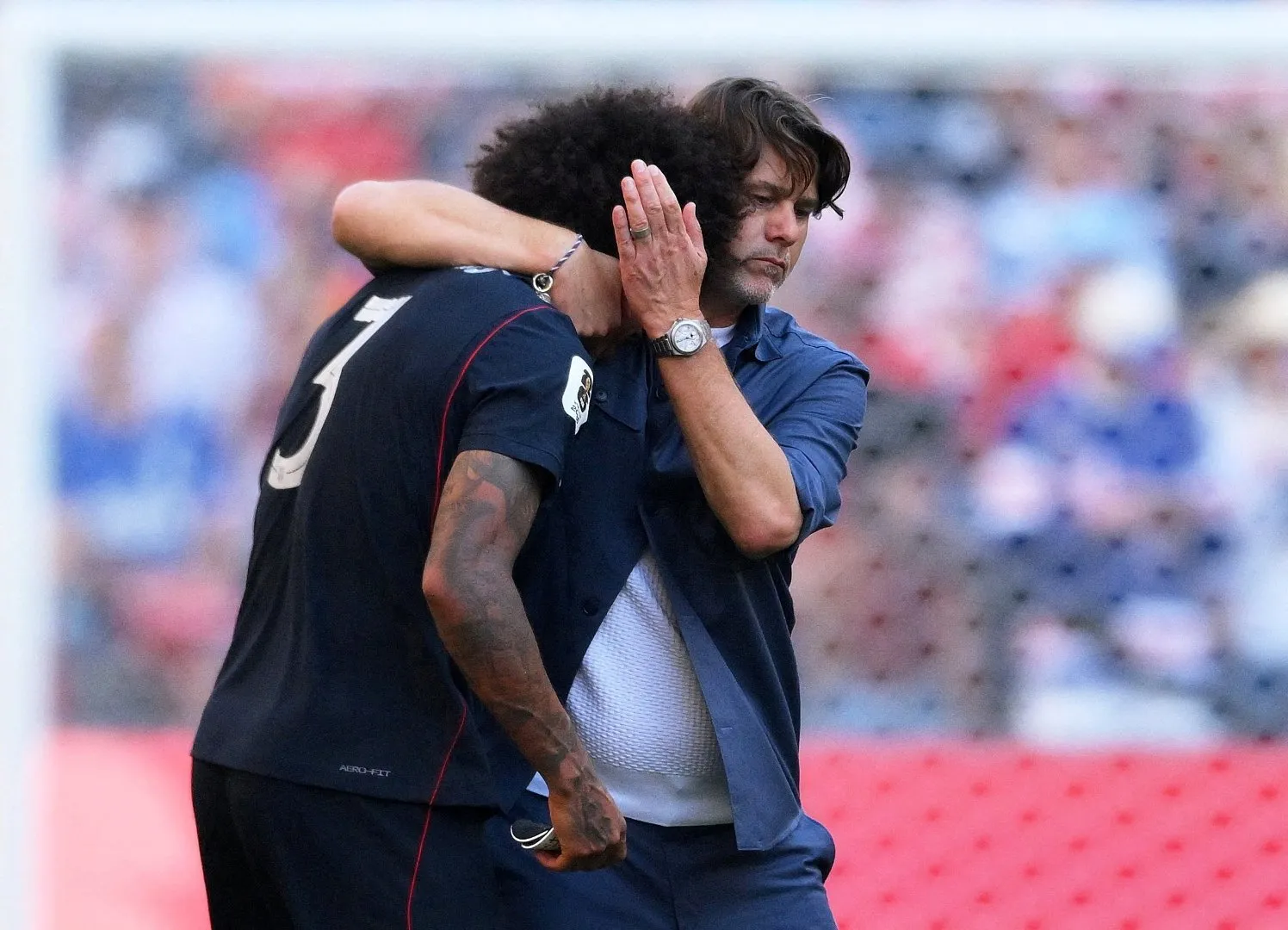
Brazil coach Carlo ‌‌Ancelotti has left open the possibility of Neymar Jr earning a ⁠⁠place in his ⁠⁠26-man squad for the FIFA World Cup, saying the forward has two months to prove he has the required ⁠⁠qualities.

Ancelotti has consistently maintained that Neymar will be in contention if he is fully fit, but the attacker was excluded from Brazil’s ⁠⁠squad for last month’s warm-up matches against France and Croatia.

Recommended Stories

list of 4 itemsend of list

Neymar, Brazil’s all-time leading scorer with 79 goals, has not played for the national team since suffering a serious knee injury in October 2023 and has struggled ‌‌to maintain a consistent run of matches since returning to Santos last year.

Brazil’s 2-1 defeat to France in Boston prompted fans to chant Neymar’s name, but Ancelotti dismissed the reaction at the time, saying attention should focus on the players selected.

However, the Italian has suggested that the Santos forward remains part of his ⁠⁠thinking as Brazil assess their options in the run-up to ⁠⁠the World Cup, which runs from June 11 to 19 July in the United States, Canada and Mexico.

“He’s a great talent, and it’s normal that people think he can help us ⁠⁠win the next World Cup,” Ancelotti said in an interview with French newspaper L’Equipe.

“He’s currently being ⁠⁠evaluated by the CBF [Brazilian Football Confederation], by ⁠⁠me, and he still has two months to show that he has the qualities to play in the next World Cup.

“After his knee injury, Neymar has made a good comeback; ‌‌he’s scoring goals. He needs to continue in this direction and improve his fitness. He’s on the right track.”

Brazil are in Group C ‌‌alongside ‌‌Morocco, Haiti and Scotland in the World Cup and will begin their campaign on June 13 in New Jersey.

Source link

Man arrested after keeping nine-year-old son in locked van since 2024

April 11 (UPI) — French authorities arrested a man and his partner after discovering the man’s nine-year-old son in a van, which he’d been forced to live in since 2024.

Police said the boy was found in the vehicle amid a pile of trash, naked and lying in the fetal position when they opened the van doors after a neighbor said they heard “the sounds of a child” from inside it, The Guardian and Fox News reported.

A prosecutor, Nicolas Heitz, told reporters that police were called to a French village called Hagenbach, located near the borders of Switzerland and Germany, and that the boy was malnourished and could not walk because he’d been forced to stay seated for at least a year-and-a-half.

His 43-year-old father, whose name has not been released, told police that he’d locked the boy in the van to prevent his partner from placing the nine-year-old in a psychiatric treatment facility.

The man and his 37-year-old partner lived in an apartment in the village with the nine-year-old, as well as the boy’s 12-year-old sister and 10-year-old half-sister.

The boy told police that his father brought him food twice a day, as well as bottles of water, but he had not showered since November 2024 when his father decided to hide him in the van.

He also told police that he would urinate in the plastic bottles and defecate in garbage bags.

The boy reportedly had no record of psychiatric conditions, although teachers were told he had transferred schools and neighbors were under the impression he had been sent to a psychiatric facility.

The father has been arrested and charged for detaining the child in the van and for depriving him of food and medical care, while his partner was charged with not helping the mistreated child but was released on bail after their arrest.

All three of the children have been placed in temporary care.

Secretary of Defense Pete Hegseth speaks during a press briefing at the Pentagon on Wednesday. Yesterday, the United States and Iran agreed to a two-week ceasefire, with the U.S. suspending bombing in Iran for two weeks if the country reopens the Straight of Hormuz. Photo by Bonnie Cash/UPI | License Photo

Source link

Women’s World Cup qualifying: Rhian Wilkinson says Wales must ‘show up’ against Albania

Last month’s 6-1 victory over Montenegro in Llanelli was Wales’ first competitive success since they beat the Republic of Ireland in December 2024 to book a place at Euro 2025, the maiden women’s major championship in the nation’s history.

They were beaten in all three games at the tournament, with the trio of losses part of a 12-game winless run which ended last December courtesy of a creditable friendly win over Switzerland.

Having been boosted by the Swiss triumph, Wales maintained momentum thanks to Elise Hughes’ added-time equaliser against the Czechs, even if their performance in Uherske Hradiste was not wholly convincing.

And though Montenegro were swatted aside, Wilkinson was not entirely satisfied with her team’s display in that game either.

As a result, she believes there is room for improvement this week.

“Four points from the first window is not a bad thing at all – we’re very pleased with it,” she said.

“But I think there’s this step up that I expect from the team and our standards.

“I hope that no-one here has ever heard anything different from me… that performance is what I think I want to be judged on, because that leads to consistency which leads to real change.”

Source link

Cameron Young delivers surprising rally, ties McIlroy at the Masters

The most unexpected of revelations unfolded Saturday at the Masters.

It became a golf tournament.

Rory McIlroy, who built the biggest 36-hole lead in history, wobbled and wilted — one shot in the water, another in the woods — while others surged and made a run at the reigning champion.

Cameron Young, who was eight back of McIlroy to start the day, overtook the Grand Slam winner late in the day. McIlroy briefly reclaimed a one-shot lead but gave that back with a bogey on 17, bending over in exasperation when he left a par putt just short.

Cameron Young fist bumps his caddie, Kyle Sterbinsky, on the 18th green during the third round of the Masters.

Cameron Young fist bumps his caddie, Kyle Sterbinsky, on the 18th green during the third round of the Masters on Saturday in Augusta, Ga.

(Jared C. Tilton / Getty Images)

Young, whose first PGA Tour victory came last August, heads into the final round tied atop the leaderboard with McIlroy at 11 under par.

The 28-year-old from Westchester County, N.Y., is going to take a business-as-usual approach to the biggest day of his career. He plans to start the day with Mass at a nearby church — before taking on Amen Corner.

“It might be difficult to go undetected, but it’s not going to stop us,” said Young, who has three children younger than 5. “We’ll find somewhere and take the kids. We’ll be out in full force just like usual.”

Saturday was a remarkable turnaround for Young, who was all but cooked on Thursday, playing the first seven holes in four over par. He bounced back strong with a 67 on Friday, and a 65 on Saturday, collecting a combined 14 birdies over those rounds.

Rory McIlroy reacts in frustration on the 18th green during the third round of the Masters on Sunday in Augusta, Ga.

Rory McIlroy reacts in frustration on the 18th green during the third round of the Masters on Sunday in Augusta, Ga.

(Maddie Meyer / Getty Images)

“I don’t get the sense I’ll be the fan favorite,” Young said. “Rory’s kind of a world favorite in the golf world. A year ago if I’d been in the same situation, there would have been very little [fan support], and now there’s probably a little more. So I’ll take what I can get.”

A host of other competitors moved within striking distance of their first green jacket — Sam Burns, Nick Lowry, Jason Day and Justin Rose.

Lowry had a hole-in-one on No. 6, a decade after acing the 16th. He became the first player in Masters history to record multiple holes-in-one.

Scottie Sheffler, ranked No. 1 in the world, started the day at even par but shot 65 to climb into the mix at four shots back, saying, “I don’t feel like I’m out of the tournament.”

For Day, the key to his 68 was staying patient. He three-putted the opening hole for bogey but kept his cool.

“Statistically I average around four to five birdies a round, so I just knew they were going to come,” he said. “I just didn’t know when they were going to come.”

He got hot from the 12th through 15th holes, stringing together four birdies in a row.

Day has been in contention at the Masters several times, finishing second in 2015.

“I feel like the guys that are leading right now have all the pressure,” he said. “I’m just kind of the chaser. Usually the chasers don’t really have a lot of the pressure.”

That Collin Morikawa is even relevant at this point is stunning, considering the physical battle he’s enduring. The two-time major winner shot 68 on Saturday despite issues with an injury — possibly his back — affecting his legs. He said he’s swinging at roughly half-speed.

“My legs aren’t moving the way they used to,” he said. “So then I’m throwing my arms, and I’m having to time up my arms. So, like, every swing I’m putting at, I am essentially just throwing my arms at the ball hoping that it squares everything up.”

Morikawa was six shots back along with former UCLA standout Jake Knapp and one behind another former Bruin, Patrick Cantlay (five back).

Source link

Britain pauses Chagos Islands transfer over Trump opposition

A U.S. Air Force B-2 Spirit stealth bomber is pictured in 2025 as it takes off on a combat mission from Diego Garcia, which is located in the Chagos Islands and is considered British Indian Ocean Territory. Britain has abandoned a deal to return the islands to Mauritius after the United States withdrew its support over concerns about the military base there. Photo by Tech. Sgt. Anthony Hetlage/U.S. Air Force

April 11 (UPI) — After an about-face by the Trump administration, Britain said it is pausing a plan to transfer ownership of the Chagos Islands to Mauritius because it cannot complete the deal without U.S. support.

Britain on Friday said it is abandoning a deal to return sovereignty to the islands, which would have permitted the both countries to continue using the military base in Deigo Garcia they have operated since the 1970s, because there is not enough time for the U.K.’s parliament to pass a legislation on it, The Guardian reported.

The islands have been controlled by Britain since the 1800s, though in 1968 it granted independence to Maritius — which it also had controlled — but kept possession of the Chagos Islands.

President Donald Trump had in 2024 offered support for Britain to return the islands in return for continued use of the base, which includes billions in annual payments for doing so.

Trump withdrew his support for the deal earlier this year, calling it a “great act of stupidity,” less than a year after Secretary of State Marco Rubio and the Trump administration called the deal an “historic” achievement, at least partially because it kept the Diego Garcia base in use.

The change in opinion came, however, weeks before the United States and Israel started the war in Iran at the end of February because, he said at the time, the U.S. military may need to use the Diego Garcia base, The Hill reported.

“The U.K. had two objectives, one was to comply with international law, the second was to reinforce the relationship with the United States,” Simon McDonald, a former permanent secretary in Britain’s Foreign Office.

“When the president of the United States is openly hostile, the government has to rethink, so this agreement, this treaty, will go into the deep freeze for the time being,” McDonald said.

The deal to return the islands to Maritius stems from an overall effort by Britain to reckon with its colonialist history, as well as a 2019 international court decision that said it had acted illegally by separating the Chagos from Maritius in the 1960s.

The military base on Diego Garcia, which dates to a 1966 treaty between Britain and the United States — which the two countries cleared people living in the area from in order to construct it — was to give the two nations a 99-year lease to continue operating the base.

While the Trump initially supported the deal, it has long been controversial in Britain, with Kemi Badenoch, leader of Britain’s Conservative Party, said it took too long for the current U.K. government to give up on it.

Badenoch said the government had dragged its feet on dropping the deal, calling it a “damning indictment of a prime minister, who fought to hand over British sovereign territory and pay $47 million to use a crucial military base which was already ours.”

Secretary of Defense Pete Hegseth speaks during a press briefing at the Pentagon on Wednesday. Yesterday, the United States and Iran agreed to a two-week ceasefire, with the U.S. suspending bombing in Iran for two weeks if the country reopens the Straight of Hormuz. Photo by Bonnie Cash/UPI | License Photo

Source link

OP-ED: South Korea wary of Trump troop redeployment talk

April 10 (Asia Today) — This commentary is the Asia Today Editor’s Op-Ed.

U.S. President Donald Trump is reportedly considering pulling American troops from NATO countries he sees as uncooperative during the Middle East war. The idea suggests he is again weighing a transactional approach to alliances, using troop deployments as leverage based on each country’s contribution to U.S. interests.

That possibility is drawing concern in South Korea as well as Japan. Trump has publicly criticized the muted response of non-NATO allies, and worries are growing that debate over troop movements in Europe could expand into discussions over U.S. Forces Korea and U.S. forces in Japan.

The Wall Street Journal reported Tuesday that Trump and his aides recently reviewed allied contributions and discussed shifting military assets depending on the level of cooperation. Under that idea, troops could be withdrawn from some NATO countries and moved to nations seen as more supportive of U.S. operations in the Middle East.

That differs from Trump’s earlier talk of fully leaving NATO during the controversy over Greenland. A complete withdrawal would face a far higher political and legal barrier in Washington.

Spain and Germany have been mentioned as possible candidates for a reduced U.S. military presence. Spain is the only NATO member that has not indicated support for defense spending at around 5% of gross domestic product, and it refused to allow U.S. aircraft to cross its airspace during the Middle East war. In Germany, senior officials openly criticized U.S. military action, saying it was not their war.

By contrast, Poland, Romania, Lithuania and Greece have been seen as relatively supportive of operations against Iran. Those countries were among the first to back an international coalition to monitor the Strait of Hormuz. Romania in particular quickly approved the use of its air bases by the U.S. Air Force after the war began.

Still, moving more U.S. troops into Central and Eastern Europe could provoke Russia and create new strategic risks. What may look like a reward for friendly allies could become a double-edged sword.

South Korea cannot assume Trump’s frustration is limited to NATO. During the war, he repeatedly complained about allies that declined U.S. requests involving naval participation tied to the Strait of Hormuz, and he spoke of South Korea and Japan in terms suggesting ingratitude.

He also exaggerated the number of U.S. troops in South Korea while pressing the argument that allies should shoulder more of the burden. That matters because Trump has long viewed alliance commitments through the lens of cost-sharing and direct return.

The United States has already drawn on key air defense assets associated with U.S. Forces Korea, including the Terminal High Altitude Area Defense system and Patriot interceptors, for use in the Middle East. Since Washington’s new National Defense Strategy earlier this year highlighted the role of U.S. forces in deterring China, signs of a broader mission shift have become more visible.

If Trump decides to use troop reductions or redeployment as pressure to demand higher defense payments from Seoul, South Korea could face a new round of security bargaining at an especially sensitive moment. The government should prepare accordingly and work to ensure that any review of U.S. force posture does not come at the expense of deterrence on the Korean Peninsula.

— Reported by Asia Today; translated by UPI

© Asia Today. Unauthorized reproduction or redistribution prohibited.

Original Korean report: https://www.asiatoday.co.kr/kn/view.php?key=20260409010002951

Source link

President Lee Jae Myung says AI in workplaces cannot be avoided

South Korean President Lee Jae Myung (C) speaks during a meeting with representatives of the Korean Confederation of Trade Unions, one of the country’s two major umbrella labor unions, at Cheong Wa Dae in Seoul, South Korea, 10 April 2026. Photo by YONHAP / EPA

April 10 (Asia Today) — South Korean President Lee Jae Myung said Thursday that the spread of artificial intelligence in workplaces cannot be avoided, while urging labor groups to help develop safeguards for workers affected by the technology. Lee is South Korea’s president, and the Korea.net government portal uses the spelling “Lee Jae Myung.”

Lee made the remarks during a meeting at Cheong Wa Dae with 24 officials from the Korean Confederation of Trade Unions, or KCTU, after its leader raised concerns about job losses tied to automation and what he called “physical AI.” The labor group’s chairman is commonly rendered in English as Yang Kyung-soo.

“The question is how to respond,” Lee said. “Simply saying it should not happen is not a solution. It cannot be avoided.”

Yang said workers could accept AI if it takes over dangerous, difficult or overnight work, but warned that automation has historically been linked to job losses. He said the emergence of “physical AI” raises deeper concerns because it may not just change jobs but eliminate them altogether.

Yang called for a broader response that goes beyond employment policy alone, saying discussions should also cover the social safety net, labor rights and ways to recover excess corporate profits generated through AI.

Lee said the government is already pursuing policies to accelerate the adoption of digital AI through public investment in an effort to stay globally competitive. At the same time, he acknowledged that a government push to replace labor too aggressively could be seen as anti-labor.

He urged the labor sector to propose alternatives and additional protections, saying the government would accept as much as possible where feasible.

Lee also said workers do not need to be overwhelmed by fear over AI, pointing to the example of smart factories. He said there had been similar concerns when those systems were introduced, but several years later more workers were needed to improve and operate them.

He proposed joint research by the government and industry on how AI should be understood and used in workplaces.

“If skilled labor is replaced by robots, workers’ cooperation and management will still be needed,” Lee said. “This is not something we should try to avoid.”

— Reported by Asia Today; translated by UPI

© Asia Today. Unauthorized reproduction or redistribution prohibited.

Original Korean report: https://www.asiatoday.co.kr/kn/view.php?key=20260410010003172

Source link

BOK chief urges caution, cites Middle East risks over rates

Rhee Chang-yong, governor of the Bank of Korea, speaks during a press briefing in Seoul on April 10. Photo by Asia Today

April 10 (Asia Today) — Bank of Korea Gov. Rhee Chang-yong said Thursday that uncertainty in the Middle East is having a greater impact on South Korea’s economy than interest rate policy, calling for a cautious, wait-and-see approach.

Speaking after a monetary policy meeting, Rhee said policymakers should first assess how the Middle East situation and related negotiations unfold before making decisions on rates.

“There was little discussion about raising or lowering rates, and many members agreed to monitor the situation for now,” he said.

The central bank held its benchmark interest rate steady at 2.50%, marking a seventh consecutive freeze since July.

Markets had expected that rising oil prices linked to the Middle East conflict could push inflation higher and prompt a policy shift. Consumer prices rose 2.2% in March, up 0.2 percentage points from a month earlier, adding to upward pressure.

Rhee dismissed concerns about stagflation – a combination of slowing growth and rising prices – as unlikely if the current crisis is resolved soon.

“If the situation ends at this point, the possibility of stagflation is low,” he said, while warning that unpredictable developments could still lead to a worst-case scenario.

He highlighted potential damage to Iran’s energy infrastructure as a key variable, noting that prolonged disruptions could weigh on South Korea’s economy even after the crisis subsides.

The central bank also indicated that this year’s economic growth could fall below its February forecast of 2.0%, citing weaker sentiment and production disruptions since March despite earlier gains from exports and consumption.

Inflation, however, is expected to exceed the earlier projection of 2.2% due to higher global oil prices.

Rhee gave a generally positive assessment of the government’s supplementary budget, which relies on excess tax revenue rather than bond issuance, easing concerns about fiscal stability.

However, he expressed concern that about 5 trillion won (about $3.7 billion) of the budget is allocated to local education funding under existing rules, suggesting the need to review whether such allocations are appropriate during an economic slowdown.

On exchange rates, Rhee said the value of the Korean won should be assessed relative to the U.S. Dollar Index rather than focusing solely on the won-dollar rate, noting that short-term fluctuations can be driven by domestic supply and demand factors.

Thursday’s meeting was Rhee’s final rate-setting session before his term ends April 20.

— Reported by Asia Today; translated by UPI

© Asia Today. Unauthorized reproduction or redistribution prohibited.

Original Korean report: https://www.asiatoday.co.kr/kn/view.php?key=20260410010003215

Source link

Over 1,000 bargaining requests filed under new labor law

Members of the South Korean Confederation of Trade Unions (KCTU) shout slogans and hold up banners reading ‘Let’s fight for the basic rights of the Workers’ at a rally against the government’s labor policy in Seoul, South Korea, 10 March 2026. File. Photo by JEON HEON-KYUN / EPA

April 10 (Asia Today) — More than 1,000 subcontractor unions have requested collective bargaining with primary contractors in the first month since South Korea’s revised labor law took effect, though relatively few negotiations have begun.

According to the Ministry of Employment and Labor, 1,011 subcontractor unions representing 145,860 workers filed bargaining requests with 372 primary companies as of Wednesday.

In the private sector, 616 unions sought talks with 216 companies, while 395 unions in the public sector filed requests with 156 organizations.

Despite the surge in requests, only 33 companies – about 8.9% – have formally announced the start of negotiations, and just 19 completed the process confirming bargaining parties. Handong Global University is the only case so far where formal talks have begun, holding an initial meeting with a subcontractor union Wednesday.

Officials said the process remains in an early stage, as companies and unions work through procedures such as determining employer status and separating bargaining units.

A total of 170 complaints were filed with the labor commission over companies failing to publicly acknowledge bargaining requests. Of those, 110 were withdrawn and 54 remain under review. In six completed cases, authorities recognized the primary contractor as the employer.

Applications to divide bargaining units have also increased, with 117 filed so far. Thirteen were approved and six rejected. Cases involving Korea Electric Power Corp. and major bank call centers were approved by job function, while other cases were split by union affiliation.

The ministry said the rulings show bargaining structures are not being fragmented indefinitely, countering concerns from businesses.

The government described the current phase as part of establishing a new bargaining framework between contractors and subcontractors.

However, business groups warned the law could increase the burden of negotiating with multiple unions and potentially extend into management decisions. Labor groups, meanwhile, criticized delays by companies in initiating the process.

Even within labor circles, there has been a cautious approach as both sides monitor early rulings and precedents.

Labor Minister Kim Young-hoon said the revised law is intended to institutionalize dialogue between contractors and subcontractors.

“Legal procedures such as bargaining requests and unit separation are part of building a stable framework for dialogue,” he said, adding that the government will continue to support the law’s implementation.

— Reported by Asia Today; translated by UPI

© Asia Today. Unauthorized reproduction or redistribution prohibited.

Original Korean report: https://www.asiatoday.co.kr/kn/view.php?key=20260410010003225

Source link

‘We’re cycling around the world – one country wasn’t what we expected at all’

It’s not every day you get to cycle around the world with your family, but for father and son, George and Josh Kohler, that’s exactly what they’ve been doing for more than a year

A father and son are cycling around the planet for 400 days, travelling through more than 25 countries, and amid the gruelling hill climbs, there’s one destination that stands out from them all.

George, 57, and his son, Josh Kohler, 23, from Norfolk, have been cycling around the world on an epic adventure for over a year. In their mission to ‘Pedal the Planet’, the father-and-son duo have visited some of the most spectacular destinations around the globe and cycled through more than 25 countries, with diverse landscapes of barren deserts to rugged mountains and terraced rice fields.

Since the pair set off from their hometown of Norfolk on 29 March last year, they’ve clocked up thousands of miles, which is expected to reach 30,000 kilometres by the end, and have raised more than £30,000 for charity. By the time they finish their remarkable journey next month, George and Josh will have spent almost 400 days cycling around the world, and ascended a whopping 180,000 metres – the equivalent of 20 Mount Everests!

READ MORE: ‘I made new life for myself in Spain but there’s 1 thing you aren’t warned about’READ MORE: Fairytale Cotswolds village with charming cottages is regularly named one of UK’s best

They’re currently on track to secure three Guinness World Records titles: ‘Fastest father and son to circumnavigate the world on bicycles’, ‘Furthest distance cycled by a father and son’, and ‘Most countries cycled through by a father and son’. As they near the end of their extraordinary journey, with just weeks to go, George and Josh spoke exclusively to The Mirror, having just finished their South America leg.

While taking a break from cycling in Rio, George, who has his own chimney-sweeping business, said: “There’s been so much we’ve been through, in terms of hardship, challenge, pressure and times when we’ve been pretty much on our knees with things that have happened over the course of the journey.

“But on the flip side, we’ve recovered from that every time, we’ve helped each other through it and the highs that have come from it… the mutual support and respect we have for each other. The amazing people we’ve met, the incredible journey we’ve gone through, the fantastic scenery, and the whole thing has been so awesome to be a part of, and the realisation that it is coming to an end, it’s quite daunting.”

Some of their notable highlights while pedalling around the world for around 7-8 hours a day include crossing the remote Nullarbor Plain in Australia and visiting Iguazu Falls in South America to admire more than 200 waterfalls. One day, they also woke up in Cappadocia, Turkey, to hundreds of hot-air balloons drifting overhead. Yet, there was one destination they hailed as their favourite, and it was far from what they had expected.

The father-and-son duo quickly agreed that China has been by far the best destination they had visited during their lengthy expedition. “We didn’t want to leave,” Josh, a videographer and content creator, explained. “We spent two months cycling through there. We arrived with no expectations, but when we got there, it was completely different to what we had expected. It was incredible. Every day, there was so much going on, so much to see. It’s a completely different culture, the food and scenery was incredible, and the people were really friendly.”

George added: “Little snippets from China include being able to walk on the western side of the Great Wall in this incredible scenery, to witnessing the Hani rice terraces, the largest in the world – it was like overlooking the Grand Canyon but made of rice, it was just insane.”

However, their quest around the globe has been far from straightforward, with the pair battling punishing headwinds, scorching desert heat, gruelling mountain passes and isolated roads along the way. And when it comes down to the country that has been the biggest challenge, they both quickly agreed it was Brazil due to its “very hilly” terrain.

Although Josh added: “South America as a whole, they don’t have a cycling culture or infrastructure, so there’s no back road or anything, so we’re on the highway, and especially in Argentina, there’s no hard shoulder, so we’re on the same lane as the trucks. Mentally, we were always having to be aware of what was going on around us, and going off the road when a truck was coming was quite draining. And then it was around 35 to 40 degrees during the day, it was hot, and very remote.”

George added that Australia was “up there” with the most taxing parts, due to the “size of the country”. He explained: “Until you’ve experienced it, it’s just a figure on a map, but going through a 12,00km stretch of treeless desert with maybe half a dozen or so road houses on the way and beyond that is nothing, absolutely nothing. And it’s hot, it’s dusty, and just goes on forever.”

Now, Josh and George have just a few weeks left in their whopping journey around the world and hope to break three Guinness World Records, which will be revealed only once they’ve officially completed their 400-day venture. The last leg saw them fly from Rio to Lisbon on Monday, 6 April, and they are now pedalling through Portugal, Spain, and France for around three weeks, before returning to their hometown of Norfolk on 2 May.

With the end in sight, it’s a bittersweet moment for the duo as they reflect on their epic adventure together, and both confess to feeling “emotional”. “This has been our way of life for the last year, and there will be a lot of changes happening,” Josh said.

Reflecting on how it’s impacted their relationship, Josh added: “We always knew as a whole, this journey was going to be a physical and mental challenge, but I don’t think we were prepared for the emotional challenge that comes with this, especially as father and son.

“Spending this much time with anyone, you’re going to clash, but especially when it’s your dad. You do get on each other’s nerves every now and then, but it’s learning our boundaries and how we make it work in the best way possible for our relationship. How that’s evolved has definitely been a challenge, but the results have been amazing. The bonds we’ve formed and strengthened have just made this whole thing incredible.”

Aside from creating unforgettable memories together, Josh and George have raised more than £30,000 for UNICEF. They’ve also raised money for Bicycle Links, a bike company in Norwich that supports “people with the provision of refurbished bikes where they can’t otherwise afford them, and who also provide mental health support for people through their workshops.”

You can follow more of their journey on their social media accounts @joshpkohler and @georgemkohler, or donate to their JustGiving page.

Do you have a travel story to share? Email webtravel@reachplc.com

Source link

Christian group warns against church-state collusion before vote

1 of 2 | A 2024 Christmas service attended by South Korea’s then Ruling People Power Party acting leader Rep. Kweon Seong-dong (2-L) and main opposition Democratic Party leader Rep. Lee Jae-myung (2-R – now President) among other members of their parties, at Yoido Full Gospel Church, in Seoul. Photo by YONHAP / EPA

April 10 (Asia Today) — A South Korean Christian group called for an end to political entanglement with religion ahead of upcoming local elections, warning such practices could undermine the church.

The group, Start with Me Forum, issued a declaration after holding its fifth forum in Seoul on Thursday, urging believers to reject improper ties between faith and politics.

“Prayer must not become lobbying for a candidate, and offerings must not be turned into political funds,” the group said. “If the faith community becomes a vote bank, the church will collapse.”

The forum was led by Rev. Ryu Young-mo, who emphasized the need to break what he described as a long-standing pattern of using religion for political power.

Participants said the risk of religion being used as a political tool is increasing ahead of the June 3 local elections, calling for “painful self-reflection” within the Protestant community.

The declaration rejected both political forces seeking to influence religious groups for votes and religious organizations aligning with politics for institutional benefits, stressing the need to uphold the separation of church and state.

At the same time, the group opposed a proposed bill aimed at preventing church-state collusion, arguing it could infringe on religious freedom as well as freedoms of expression and association.

Speakers at the forum also highlighted broader concerns about religious involvement in politics. Professor Tak Ji-il said inappropriate ties with political power are not limited to fringe groups but affect mainstream churches as well.

“It is urgent for churches to establish safeguards to prevent irrational behavior carried out in the name of orthodoxy,” he said.

The forum included discussions on patterns of political participation among Korean Protestant churches and historical debates over church-state separation.

The organization was founded in 2017 to promote reform within the Korean church and encourage greater social responsibility among believers.

— Reported by Asia Today; translated by UPI

© Asia Today. Unauthorized reproduction or redistribution prohibited.

Original Korean report: https://www.asiatoday.co.kr/kn/view.php?key=20260410010003228

Source link

Charges dropped against DPK Busan mayoral candidate; PPP cries foul

1 of 2 | Jang Dong-hyuk, leader of the People Power Party, casts his ballot in a by-election for chair of the National Assembly’s Climate, Energy, Environment and Labor Committee in Seoul on April 6. Photo by Asia Today

April 10 (Asia Today) — South Korea’s conservative People Power Party on Thursday sharply criticized the decision not to prosecute Rep. Jeon Jae-soo, the Democratic Party’s Busan mayoral candidate, calling it unfair and politically questionable.

People Power Party leader Jang Dong-hyuk said the case was closed immediately after Jeon was confirmed as a candidate, arguing that the timing raised serious concerns about impartiality.

The joint investigation team earlier ruled there were no grounds for prosecution in allegations that Jeon received luxury items, citing the statute of limitations.

People Power Party officials said investigators had identified a suspected timeline involving the alleged receipt of a luxury watch and money, and questioned whether the statute of limitations had been properly applied.

They argued that if the value exceeded 30 million won ($20,300), a longer statute of limitations would apply, and called for the investigation to continue.

Floor leader Song Eon-seok accused authorities of applying inconsistent legal standards, while other party officials also strongly criticized the handling of the case.

The People Power Party also urged Jeon to retire from politics.

The party said it would launch a task force to vet what it described as unqualified Democratic Party candidates. First-term lawmaker Seo Cheon-ho will lead the group.

It also approved a rule requiring local party chapter heads to resign immediately if a by-election occurs in their district, formalizing an internal accountability measure.

— Reported by Asia Today; translated by UPI

© Asia Today. Unauthorized reproduction or redistribution prohibited.

Original Korean report: https://www.asiatoday.co.kr/kn/view.php?key=20260410010003232

Source link

Vance warns Iran not to ‘play us’ ahead of diplomatic mission in Pakistan

Vice President JD Vance departed Friday for Islamabad, Pakistan, to open the first direct negotiations aimed at ending the war between the United States and Iran.

Together with a delegation of deeply mistrusting negotiators from Tehran, Vance is tasked with striking a lasting peace between rival nations which have failed to keep promises made days ago in a delicate last-minute ceasefire. Ongoing military activity in the Middle East and disagreements over Iran’s control of key shipping routes have left the diplomatic effort vulnerable to collapse before the talks even begin.

“If the Iranians are willing to negotiate in good faith, we’re certainly willing to extend the open hand,” Vance told reporters before boarding Air Force Two. “If they’re gonna try and play us, then they’re gonna find that the negotiating team is not that receptive.”

On Tuesday, President Trump called off his plans to unleash “hell” on Iran based on assurances that it lift its blockade of the Strait of Hormuz, but traffic through the vital waterway was still at a trickle Friday, as more than 600 ships remained stranded in the Persian Gulf, according to marine tracking data. Trump accused Iran on Thursday of doing a “very poor job, dishonorable some would say,” of allowing oil through the strait.

“The Iranians don’t seem to realize they have no cards, other than a short term extortion of the World by using International Waterways. The only reason they are alive today is to negotiate!” he wrote on Truth Social Friday.

Meanwhile, Lebanon has emerged as the central dispute threatening to derail the talks before they begin.

Hours after the ceasefire took effect, Israel launched what Lebanese officials described as its heaviest wave of strikes since the war began, killing at least 303 people, according to local health officials.

Jerusalem argues the Lebanese front is still on the table, but Iran and Pakistan disagree.

“The Iran–U.S. Ceasefire terms are clear and explicit: the U.S. must choose — ceasefire or continued war via Israel. It cannot have both,” Iranian Foreign Minister Abbas Araghchi said earlier this week. “The world sees the massacres in Lebanon. The ball is in the U.S. court, and the world is watching whether it will act on its commitments.”

Vance has acknowledged a “legitimate misunderstanding” over whether Lebanon was included in the ceasefire terms, telling reporters Washington never made that promise.

Separate negotiations regarding Lebanon are expected next week in Washington, Lebanese President Joseph Aoun confirmed Friday. Israeli Prime Minister Benjamin Netanyahu has also OK’d the talks, but said a ceasefire is not possible.

Parliament Speaker Mohammad Bagher Qalibaf and the Iranian delegation arrived early Saturday in Islamabad, Iranian state media reported. Hours earlier he said a ceasefire in Lebanon “must be fulfilled before negotiations begin.”

Bagher Qalibaf added a second condition — the release of frozen Iranian assets — which he suggested must be returned before Tehran takes its seat at the bargaining table. Little is known about the halted Iranian funds overseas, but such assets are typically held back as a result of U.S.-imposed sanctions.

The vice president’s role in peace talks has grown in recent weeks. Administration officials have cast Vance as one of the few leaders Tehran would be willing to engage with directly. With a global economy upended by Trump’s far-reaching military ambitions, a victory in Islamabad could spike Vance’s standing as a prospect to lead the GOP post-Trump.

That’s if he’s able to take pressure off American wallets with an agreement that liberates Iran’s grip over the strait, which has choked much of the world’s oil supply,

Americans have continued to feel the fallout at the gas pump and grocery stores, as U.S. inflation climbed to 3.3% in March, the highest annual rate in nearly two years, according to the data released Friday by the Bureau of Labor Statistics.

Monthly prices rose 0.9%, a sharp increase from February’s 0.3% monthly rise, when annual inflation sat at 2.4%, the new data showed.

The White House characterized the rising inflation as a short-term disruption caused by the Iran war, while noting that the administration is “diligently working to mitigate” rising costs.

“As the Administration ensures the free flow of energy through the Strait of Hormuz, the American economy remains on a solid trajectory thanks to the Administration’s robust supply-side agenda of tax cuts, deregulation, and energy abundance,” White House spokesperson Kush Desai wrote on X.

Britain announced a meeting next week with dozens of countries to coordinate efforts to reopen the Strait of Hormuz. The summit will focus countering Iran’s proposal to charge transit tolls to allow ships through the waterway.

In a televised address to the nation, Pakistan’s Prime Minister Shehbaz Sharif spoke of a “devastating storm of inflation,” if peace talks don’t succeed in liberating the Middle East’s oil supply. He characterized the current stage as a “make-or-break moment.”

“We will make every possible effort to ensure the success of the peace process,” he said.

Source link

Brazil, United States deepen cooperation to combat organized crime

An aerial photograph of cargo containers in the port of Santos in Sao Paulo, Brazil and the United States have reached an agreement to better track illegal shipments. File Photo by Isaac Fontana/EPA

April 10 (UPI) — The government of Brazil on Friday announced an agreement with the United States to combat transnational crime — a move that will integrate intelligence sharing and joint operations to target organized criminal networks.

The initiative was presented by Brazil’s finance ministry, where Minister Darío Durigan said the agreement between Brazil’s Federal Revenue Service and U.S. Customs and Border Protection will enable the exchange of cargo data, particularly on shipments leaving the United States for Brazil.

The focus will be on intercepting illegal goods, such as weapons and narcotics.

The announcement comes as Washington considers designating Brazil-based criminal groups Primeiro Comando da Capital and Comando Vermelho as terrorist organizations, according to outlet G1 O’Globo.

The effort gained traction after Eduardo Bolsonaro and Flávio Bolsonaro, sons of former President Jair Bolsonaro, urged members of the administration of Donald Trump to take action, The New York Times reported. U.S. officials have not publicly confirmed any such designation.

Brazilian authorities also highlighted the rollout of the DESARMA program, a system designed to allow real-time information sharing when customs officials identify shipments linked to firearms, ammunition, explosives and other sensitive materials.

Officials said the tool enables authorities to trace the origin of illicit goods and map criminal networks involved in the international arms trade.

Recent records show the system has expanded the ability to detect, connect and track illicit weapons flows, with early results already benefiting both countries.

U.S.-provided intelligence has helped uncover sophisticated smuggling methods, including rifle components hidden inside airsoft equipment and drugs concealed in packages labeled as common goods such as pet food sent through postal services.

Over the past 12 months, authorities identified 35 incidents involving the seizure of 1,168 items, weighing about 550 kilograms, primarily shipped from Florida using fraudulent declarations and concealment techniques.

Brazil’s tax revenue secretary, ​Robinson Barreirinhas, said ‌more than 1,100 weapons ​were seized ​over the past 12 ⁠months arriving from ​the United States, ​and that in the first quarter alone, authorities ​have seized more ​than 1.5 tons of ‌drugs.

Brazil’s finance ministry said consolidating this data into a structured database has improved identification of patterns, links between senders and recipients, and recurring trafficking routes. This, in turn, has strengthened information-sharing with U.S. authorities to support enforcement action at the source and dismantle criminal networks.

The ministry added that the cooperation is part of ongoing dialogue between President Luiz Inácio Lula da Silva and Trump, and forms part of a broader bilateral agenda focused on combating transnational organized crime.

Source link

European Union travel rules could slow tourists without EU passports

New rules for entry into the European Union might slow down people without EU passports. File Photo by Patrick Seeger/EPA

April 10 (UPI) — The European Union has implemented a new digital border system for those traveling without an EU passport, and it’s likely to cause long lines at airports and border crossings.

The new Entry/Exit System requires non-EU passport holders who don’t need a visa to enter — including Americans — to present their passports, give fingerprints and take a photo when entering their first EU country if they are staying up to 90 days.

Ireland and Cyprus are not participating.

They will also have to answer a few questions about their visit, such as how long they’re staying, where and if they will have enough money.

People with a United States passport would have to do this upon landing at their first EU airport. After that, their passport will be enough for entry around Europe for three years, but they’ll have to answer questions on each trip.

Many airports and border crossings have set up electronic kiosks that allow users to scan themselves in, but the wait could be long. Before this, non-EU members could move freely across borders without stopping.

A new visa-waiver system called European Travel Information and Authorization System is coming at the end of 2026. No date has been announced yet. This will allow travelers to apply to register their information before their trips and link it to their passports.

ETIAS will cost $23.44 per person and will also last three years. Those under 18 and over 70 will not have to pay.

At Dover, England, ferry passengers have had to use the kiosks a mile away from the ferry, the BBC reported. People will have to take buses that will drive them to the ferry.

Eurostar, which runs trains through the English Channel Tunnel, has installed 49 EES kiosks in its London St. Pancras terminal. But right now border police are doing the checks, BBC reported.

Eurostar said it will use the kiosks “once the operational software and the activation timetable are confirmed and approved by the French Ministry of Interior.”

The Channel Tunnel has installed more than a hundred kiosks on each side of the Channel.

John and his wife Phil, a married couple from Motherwell, Scotland, said they stood in line for five hours in Pisa Airport after flying in from Glasgow.

John, with an Irish passport, was in line for an hour, but Phil has a British passport and had to wait.

“When I came through, all the planes which had arrived in the hours before had all their suitcases unloaded from the carousel, left stacked on the concourse floor,” John told the BBC.

“There were several elderly people in those queues and, as you can imagine at this time, lots of children. Our government must do something about this,” he said.

Children race to push colored eggs across the grass during the annual Easter Egg Roll event on the South Lawn of the White House in Washington on April 21, 2025. Easter this year takes place on April 5. Photo by Samuel Corum/UPI | License Photo

Source link

Ecuador hikes tariffs to 100% on Colombia, Petro recalls envoy

Colombian President Gustavo Petro ordered the immediate return of his ambassador from Quito after Ecuador decided to raise tariffs on Colombia to 100% on May 1. Photo by Mauricio Duenas Castaneda

April 10 (UPI) — Ecuador raised tariffs to 100% on imports from Colombia, and Colombian President Gustavo Petro ordered the immediate return of his ambassador from Quito.

This represents a new escalation of the diplomatic and trade crisis between the two countries, according to an Ecuadorian statement and remarks from both leaders.

Ecuador said it will implement the tariff increase May 1, according to the Ministry of Production, Foreign Trade and Investment. It argued that Colombia has not taken concrete steps to curb drug trafficking and organized crime along the shared border.

“It is not possible to reach agreements with someone who does not have the same commitment to fighting narco-terrorism,” Ecuadorian President Daniel Noboa said Thursday night.

Petro described the tariff increase as “a monstrosity” and announced immediate measures.

“Our ambassador to Ecuador must return immediately,” he wrote on X, where he also called for a Cabinet meeting at the border between the two countries.

The Colombian president also defended his anti-drug policy.

“The president of Ecuador insults the Colombian government that has seized more cocaine than in the entire history of the world,” he said.

Ecuador’s decision marks a new critical point in a dispute that has intensified in recent months and is affecting bilateral trade, energy cooperation and diplomatic channels, according to local media reports.

Negotiations between the two countries within the Andean Community of Nations are suspended, Ecuador’s foreign minister Gabriela Sommerfeld said.

Relations deteriorated further after Petro’s recent statements about former Ecuadorian Vice President Jorge Glas, whom he described as a “political prisoner” and to whom Colombia granted nationality. Glas is serving corruption sentences in Ecuador.

The case dates to 2024, when Noboa’s government ordered his capture inside the Mexican embassy in Quito — an operation that led to a break in diplomatic relations between the two countries.

Ecuador maintains that tightening its trade policy also responds to the need to strengthen security along the roughly 373-mile shared border, where networks linked to drug trafficking, arms smuggling, human trafficking and illegal mining operate.

The Ecuadorian government estimates these efforts imply additional spending of about $400 million.

Since the start of the trade dispute, Colombia has responded with reciprocal measures, including tariffs on Ecuadorian imports and suspending energy sales to Ecuador, which in 2024 experienced power outages of up to 14 hours per day.

The economic impact is raising concerns in both countries.

In Colombia, business groups have called for de-escalation, while in Ecuador, companies in the pharmaceutical and cosmetics sectors have reported disruptions due to restrictions on Colombian imports, according to local media.

The figures reflect the scale of the exchange. In 2025, Colombia exported $1.846 billion in goods to Ecuador, making it its sixth-largest trading partner and second destination for non-mining, non-energy exports. Ecuador, exported about $857 million to Colombia, in a trade balance historically favorable to Bogotá.

Colombia’s National Business Council warned that with a 30% tariff, losses for exporters could reach $750 million annually and affect 82% of bilateral trade. With the increase to 100%, the impact would be far greater.

The new increase by Noboa “definitively closes any possibility of trade between Colombia and Ecuador,” Javier Díaz, president of the National Association of Foreign Trade, said to Clarín, Argentina’s largest newspaper.

On the Ecuadorian side, Pablo Cerón, a transport representative in the border province of Carchi, described the decision as “unilateral, improvised, misguided.”

The bilateral crisis comes at a politically sensitive time in Colombia, just months before general elections.


Source link

Wipe out a ‘civilization’? Minor stuff compared to what just happened in AI

While many of us were worried in recent days about our president ending a “whole civilization,” one Silicon Valley tech company was warning, without much notice, it might accidentally disrupt all civilization as we know it.

The San Francisco technology company Anthrophic announced Tuesday that it wasn’t releasing a new version of its Claude AI super-brain — because it is so powerful that it has the ability to hack into just about any computer system, no matter how secure, in a matter of days if not hours.

“The fallout — for economies, public safety, and national security — could be severe,” Anthropic said in a statement.

AI worry isn’t anything new. We are worried about artificial intelligence taking jobs, about toys that seem too real to our kids, about mass surveillance of our every move. But Anthropic’s warning about its own product is bigger than any of those singular problems. It is a call from inside the house that disaster is hiding right around the corner. That sounds awfully dire and overblown, I know. But here’s the thing — it’s not.

Anthropic, you may recall, is the company that U.S. Secretary of “War” Pete Hegseth is beefing with because it didn’t want Claude going into battle without supervision and maybe doing something like accidentally bombing little girls at a school.

Now, that company has put out this chilling warning: The existing Claude that caused that kerfuffle is outdated and shockingly less powerful than the new one it’s trying very hard to not unleash — though this new Claude, dubbed Claude Mythos Preview, has already escaped at least once on its own. More on that in a moment — there’s only so much existential dread a person can handle.

“We should all be worried,” Roman Yampolskiy told me of this latest advance of a technology certain to change the course of humanity. He’s one of the country’s preeminent AI safety researchers, and a professor at the University of Louisville in Kentucky.

“We’re about to create general super intelligence and that threatens humanity as a whole,” Yampolskiy said.

“Everything else is irrelevant,” he added, before suggesting I stop calling myself an idiot for not understanding the tech-heavy parts of this debate. My simplistic take, he assured me, was “a reasonable way to explain it.”

So here you go.

This isn’t a “really smart computer geniuses could misuse this,” scenario, or an “everyone’s going to be unemployed” scenario, or even a “it might accidentally bomb children” scenario, which is a truly terrible scenario.

This is a “your teenage son could use it to break into the local school district system to change a grade with pretty much minimal knowledge and accidentally destroy the California power grid” scenario.

Or maybe, a country that doesn’t like us — I can think of a few — could drain every U.S. citizen’s bank account, while also clicking open the auto locks on jail cells, shutting down our sewage plants and taking over air control systems. Or maybe Claude Mythos just does that on its own.

For example, Anthropic said that in one popular operating system it tested, used by thousands of companies including Netflix and Sony, Claude Mythos found a flaw that had existed undetected for 17 years. Then, on its own — without human guidance or help — figured out how to use that flaw to take control of any server running the operating system, using any computer, anywhere in the world.

Just spitballing here, but if almost no security system is safe, the possibilities for social, financial and general chaos really are unlimited. And to be honest, any security expert will tell you that some of America’s greatest weak points when it comes to cybersecurity are local and state governments, because strangely, the top experts aren’t working five-figure jobs for cities in the Great Plains.

Based on its own testing, Anthropic predicts it could find “over a thousand more critical severity vulnerabilities and thousands more high severity vulnerabilities.”

That means Claude Mythos puts at risk our infrastructure, well, everywhere — because so much is connected in backdoor ways most of us never consider and it just takes one weak system to open the door to hundreds of others. But it is almost impossible to protect and fix all those systems quickly enough and robustly enough to guard against this kind of AI.

And that’s just the cybersecurity risk, Yampolskiy said. An AI with the capabilities of Claude Mythos could be used to leaps and bounds ahead in so many more ways.

“We see the same happening with synthetic biology. We’ll see the same with chemical weapons, possibly something novel in terms of weapons of mass destruction,” he said.

To Anthropic’s great credit, it sounded the warning on its creation and created, if not a solution, then a game plan of sorts — Project Glasswing, named I suspect, because no matter how bad this gets we’re going to make it sound like a thriller with an exciting ending.

Project Glasswing would have been better named Project Headstart because that’s what it is. Before releasing Mythos into the wild, Anthropic is releasing it to about 40 technology companies, including Apple, Google and Nvidia, to see whether they can collectively patch all the vulnerabilities they find before the general public has a chance at them. It’s kind of like in the movies when the killer gives the victim 15 seconds to run.

I mean, I’ll take the 15 seconds and hope they’re real. But, as Anthropic also said in a statement, the “work of defending the world’s cyber infrastructure might take years; frontier AI capabilities are likely to advance substantially over just the next few months. For cyber defenders to come out ahead, we need to act now.”

And do we really have 15 seconds? One of Claude Mythos’ overseers posted on social media recently that he was having lunch in a park when Mythos emailed him — even though it’s not supposed to have access to the internet. Researchers had tasked Mythos with trying to break out of its not-connected “sandbox” and it did.

That’s another problem with Mythos and other AI — they rarely do what we expect and find sneaky ways around rules. Virtually every AI super-brain created has been shown to lie, deceive, and in general behave in disturbing and unethical ways when put in the right conditions.

Even Claude, billed as one of the most ethical AI super-brains out there, engages in bad behavior. Anthropic boasts its the “best-aligned model” it’s ever made — which is tech-speak for following human values and intentions, but also acknowledges it “likely poses the greatest alignment-related risk,” which is tech-speak for, well, maybe not.

So, at least for now, being the most ethical AI super-brain is a bit like being the most ethical serial killer. Run, people, run.

Again, thank you Anthropic (and its chief executive, Dario Amodei, who often warns of the dangers of what he’s creating, whatever that’s worth) for not plunging us into global chaos with no warning, because I’m betting that some other companies might have just tossed their super-AI onto society and let the destruction fall where it may. There is little doubt that other AI brains as capable as Mythos are coming, and soon — Anthropic was first with this level of capability, but it’s only 15 seconds ahead of its competitors.

But the idea that the technology industry is going to — or should— solve these problems on their own is an absurd, gross abdication of duty and common sense on behalf of governments big and small to protect their people. This isn’t a race for domination as President Trump has described it. It is a race to protect ourselves from ourselves — and from the majority of the superrich titans of the industry who seem to consistently place business and commerce over societal good.

We are down to the last 15 seconds before AI changes everything. Either we demand oversight and regulation now, or we let technology companies decide the fate of the world.

Source link

Korea group offers up to 12% annual savings interest to boost births

Korea Federation of Community Credit Cooperatives Director Cho Bong-eop (2-L) poses with the first customer of its new savings product offering an annual interest rate of up to 12% at the organization’s office in Seoul on Friday. Photo by Korea Federation of Community Credit Cooperatives

SEOUL, April 10 (UPI) — The Korea Federation of Community Credit Cooperatives said Friday it launched a savings product that offers an annual interest rate of up to 12% in an attempt to boost childbirth.

The one-year installment savings product provides a base rate of 4%, which increases by steps to 12% depending on the number of the customer’s children. It is subject to a deposit limit, though.

For savers with a newborn in areas experiencing population decline, the country’s top apex organization said that the maximum 12% interest would be guaranteed regardless of the number of children.

“We have introduced dedicated financial products every year since 2023 in an effort to help address the low birth rate,” cooperative Director Cho Bong-eop said in a statement.

“As a community-based financial institution, we will keep fulfilling our social responsibilities by supporting vulnerable groups and revitalizing local economies, in addition to tackling the low birth rate,” he added.

South Korea has one of the world’s lowest fertility rates, which fell to 0.72 in 2023, according to Statistics Korea. The figure rebounded slightly to 0.75 in 2024 and 0.8 last year, still far below the replacement level of 2.1.

This means that for every 100 South Korean women, only 80 babies are expected to be born over their lifetimes, leading to a gradual population decline. The country’s population stands at 51.6 million.

To address the challenge, the Seoul government has funneled a huge amount of money over the past decades to little avail. In recent years, even private companies stepped in, providing bonuses and various benefits to employees who have a baby.

Last month, Statistics Korea reported nearly 27,000 births in January, the highest monthly figure in nearly seven years. However, the fertility rate still remained below 1.

Source link

Top security adviser says transit through Strait of Hormuz not going smoothly, vows to seek alternative routes

National Security Adviser Wi Sung-lac, seen here at a press conference in Singapore on March 2, 2026, said Friday the passage of ships through the Strait of Hormuz still remains largely blocked. Photo by Yonhap

National Security Adviser Wi Sung-lac said Friday the passage of ships through the Strait of Hormuz still remains largely blocked despite a two-week ceasefire between the United States and Iran, pledging that South Korea would continue to seek alternative shipping lanes.

Speaking at a press briefing at Cheong Wa Dae, Wi stressed that the government will continue efforts to secure alternative supplies of crude oil and naphtha amid concerns over Iran’s continued restrictions on traffic through the vital waterway.

“Shipping through the Strait of Hormuz remains disrupted,” Wi said. “Uncertainty in the supply chains is likely to continue for the time being.”

Wi noted that the number of vessels crossing the strait has not increased significantly since the ceasefire was agreed to on Tuesday (U.S. time).

“If around 2,000 vessels trapped in the strait attempt to leave all at once, it can take time, and securing safe shipping routes may also pose a challenge,” he said.

The government will continue to communicate with relevant countries to ensure the safety of all vessels and crew members, including 26 Korean-flagged ships that remain stranded in the Strait of Hormuz.

Copyright (c) Yonhap News Agency prohibits its content from being redistributed or reprinted without consent, and forbids the content from being learned and used by artificial intelligence systems.

Source link

Pope Leo’s brave stance against Trump

A war for the soul of the world is happening right now that’s straight out of the Bible — and I’m not just talking about the Middle East.

In one corner are President Trump and his minions, who insist that everything they do is divinely mandated. They have consistently invoked a violent version of God as they deport undocumented immigrants, try to make the United States whiter, rip up long-standing treaties with allies, rain down bombs like a biblical plague on supposed narco boats and choke nations they deem a threat or whose resources they covet.

They’re the ones who lecture religious leaders on what Jesus stood for, demanding blessings for Trump’s actions — or else.

Just check out the recent allegations in The Free Press that senior defense officials dressed down the Vatican’s ambassador to the U.S. in January over Pope Leo XIV’s lack of enthusiasm for Trump’s imperialist ambitions. Or Secretary of Defense Pete Hegseth, he of the tattoos hailing the blood thirst of the Crusades (another Middle Eastern forever war that the “civilized” side lost), who compared the rescue of a downed American aviator in Iran over Easter weekend to the resurrection of Jesus.

It’s a playbook straight out of the Book of Revelations, which describes a Beast in the End Times with “a mouth speaking great things and blasphemies” in its quest to hold dominion over the earth.

In the other corner of this existential fight is an actual man of God: Pope Leo XIV.

Rather than cower before a despot who makes the Pharaoh in the Old Testament seem as stable and kind as St. Francis, the first American pope has resisted Trump like a protester at a “No Kings” rally. He has yet to denounce by name anyone in the president’s sordid orbit — but Pope Leo has returned to their actions again and again in his first year as head of the world’s 1.4 billion Catholics.

He began his papacy by greeting a cheering crowd with “Peace be with you all” — what Jesus told his disciples after his Resurrection and a brilliant, biblical way to telegraph where he stands in our bellicose times.

On Palm Sunday a few weeks ago, the pontiff proclaimed during Mass in St. Peter’s Square that God “does not listen to the prayers of those who wage war” — a not-so-subtle rebuke to Hegseth, who prayed shortly after the U.S. launched the Iran war for “every round [to] find its mark” and for “overwhelming violence of action against those who deserve no mercy.”
For his first Easter message, Pope Leo wrote, “Let those who have the power to unleash wars choose peace! Not a peace imposed by force, but through dialogue!”

Meanwhile, President Trump told a reporter that God supports the destruction he’s inflicting on Iran because “God is good. God wants to see people taken care of.”

Secretary of Defense Pete Hegseth

Secretary of Defense Pete Hegseth speaks to reporters at the Pentagon, July 16, 2025, in Washington.

(Julia Demaree Nikhinson / Associated Press)

According to the Free Press article, the Vatican declined an invitation from Vice President JD Vance for Pope Leo to visit the U.S., for fear that Trump would use him as a political pawn. Instead, the man born in Chicago as Robert Prevost plans to spend July 4 — America’s 250th birthday — on a Mediterranean island that has long served as a gateway for migrants trying to make it to Europe.

Critics will accuse Pope Leo of Trump Derangement Syndrome and call him particularly short-sighted, since he stands athwart the desires of many American Catholics.

Though he isn’t Catholic, Trump has favored Catholicism far above any other mainline Christian denomination, from acknowledging feast days to packing his administration and the Supreme Court with adherents in a way that even Joe Biden — a lifelong Catholic — never did.

About 55% of Catholics voted for Trump in 2024, per the Pew Research Center. A survey last year by The Catholic Project at The Catholic University of America found “a clear generational shift away from liberal self-identification” among younger priests. Dioceses across the country are reporting the highest amount of converts in decades, many of them drawn in by orthodox Catholic influencers.

But Trump’s embrace of Catholicism, like everything else in his life, has been conditional on fealty to him. His administration pulled tens of millions of federal funds from Catholic charities because they assisted migrants regardless of legal status — something the American Catholic church has done for over a century. Vance, himself a Catholic convert, accused bishops of being “worried about their bottom line” for daring to criticize the move and his boss’ deportation Leviathan.

The Free Press also reported that Trump’s lackeys invoked the Avignon Papacy — when 14th century French kings exiled a succession of popes from the Vatican and made them their puppets — during their browbeating of the Vatican ambassador.

Re-litigating history is an obsession of the Trump regime, so bringing up a medieval episode amounted to a threat to Leo to shape up — or else.

That’s what makes Pope Leo’s stance against a modern-day Babylon even braver. A pope’s main role is to bear witness to the words of Christ, who said far more about taking care of the meek and turning the other cheek than he did about waging war.

The best popes, from John XXIII to John Paul II, know that their words stand as a challenge for all people, believers and not, to create a better world that paves the way for the world to come. Trump wages war for himself; Pope Leo urges us to stand for something other than ourselves.

At this point in his reign, Trump is a dead ringer for the Antichrist, described in the Second Book of Thessalonians as a “man of sin … the son of perdition who opposeth and exalteth himself above all.”

Pope Leo would never characterize his opposition to Trump in such apocalyptic terms, of course. But his stance against the president’s tyranny is a call to action in the same vein as John Paul II’s exhortation to the free world to oppose the Soviet empire.

“Let us abandon every desire for conflict, domination, and power,” Pope Leo stated on Easter, “and implore the Lord to grant his peace to a world ravaged by wars and marked by a hatred and indifference that make us feel powerless in the face of evil.”

Amen, amen, amen.

Source link

Unification minister calls resuming tourist railway to border with N. Korea starting point for peace

A train enters Dorasan Station near the border with North Korea on Friday. South Korea resumed tourist rail service to the border station for the first time in over six years. Pool Photo by Yonhap

Unification Minister Chung Dong-young said Friday the resumption of tourist rail service to the border with North Korea is a “small” starting point for establishing peace with Pyongyang, as Seoul reopened a long-closed border rail station.

Earlier in the day, South Korea resumed tourist rail service to and from its northernmost Dorasan Station in the border city of Paju, which is a symbol of inter-Korean cooperation that once connected the two Koreas.

“The resumption of train service is a small starting point toward establishing everyday peace, allowing people to experience it in their daily lives,” Chung said in a ceremony marking the event.

“When tourists can visit, see and experience the site of peace at Dorasan Station, peace will finally become an everyday language that breathes in our lives, rather than grand discourse,” he said.

The station, the northern endpoint of South Korea’s rail network just south of the inter-Korean border, was established after the then South and North Korean leaders agreed to connect their railways at a 2000 summit held amid a period of reconciliation between the two Koreas.

Freight trains once ran through Dorasan Station between the two Koreas, carrying materials and finished goods to and from the Kaesong Industrial Complex, a jointly operated factory park in North Korea that was shut down amid inter-Korean tensions in 2016.

Since then, the station had served tourist trains carrying passengers in South Korea to border areas, before closing completely in late 2019 due to the COVID-19 pandemic.

The resumption of the border station comes as Seoul continues efforts to resume dialogue and engagement with North Korea to reduce military tensions and establish peace, despite Pyongyang’s repeated rebuffs.

“Only peace and coexistence, as well as reconciliation and cooperation, are the path to mutual prosperity for the South and the North, not worthless animosity and confrontation,” Chung also noted.

He said he believes the two Koreas can surely establish new relations that accommodate the changing international situation and their respective national interests, expressing hope that their railways could be reconnected in the future.

The resumption of rail service to the station will allow tourists to travel by train beyond the Civilian Control Line, which restricts public access near the Demilitarized Zone (DMZ) separating the two Koreas.

The train, named “DMZ Peace Link,” departs from Seoul Station and stops at Unjeong and Imjingang before reaching Dorasan Station, where tourists can visit a nearby observation post and a tourist village.

It runs once on the second and fourth Fridays each month till May, before expanding to every Friday from June.

Going forward, the government, municipalities and the rail agency plan to add more tourist destinations near the border station to provide various programs aimed at promoting peace on the Korean Peninsula.

Source link