Hope Not Hate said current attempts to tackle online abuse often focused too heavily on what happens after a racist post had already been seen.
Players can block users, report messages and platforms can suspend accounts, but Hermansson says those measures do not address the way abusive content is amplified.
“X doesn’t take racism seriously enough,” he added. “We’ve seen it for a number of years now. There is no change or improvement.”
He said social media companies already had the tools to alter how their algorithms recommended content, particularly during periods when abuse is surging.
“It’s actually a relatively small number of accounts and originating tweets that then get tons of replies,” he said.
“I think it’s entirely feasible to stop this, or a vast amount of it.”
Hope Not Hate said one option would be to downrank posts attracting large volumes of abuse, meaning they were recommended to fewer people.
Before the new Premier League season the group called on UK’s media regulator Ofcom to use its existing powers under the Online Safety Act more effectively and address predictable spikes in hate.
They want Ofcom to outlaw the algorithms fulling abuse and also to designate major sporting events as “high risk”.
This would require platforms to deploy strict safety-by-design rules, remove abuse proactively and downrank rapidly escalating viral hate through algorithmic adjustments.
In a statement to BBC Sport, Ofcom said: “We’re pushing tech firms hard to make their services safer, and we’ll be holding them to account if they don’t.”
Ofcom also cited a new partnership with police and footballing bodies before the World Cup to tackle online abuse.
Aug. 19 (UPI) — A study released Wednesday shows that the Atlantic Ocean and Mediterranean Sea are far hotter than normal, threatening ecosystems and coastal communities.
In the water, the high temps harm marine life, raise jellyfish populations and increase the risk of stronger storms later in the year.
“This summer, we’ve seen some really exceptional ocean temperatures around Europe,” said Catherine Gregory, a climate scientist at the University of Bern who contributed to the study, Politico reported.
“By July, the average temperature of the entire Mediterranean Sea was just over 27C [80.6 degrees Fahrenheit], which was the highest July value on record,” she added. “We’ve had a buoy reading to the west of Mallorca measuring more than 33C [91.4F] in open water … and we’ve seen similarly extreme conditions in the North Atlantic.”
The scientists analyzed four regions: the Eastern and Western Mediterranean; the Atlantic around the Bay of Biscay and Iberian Peninsula; and the seas around Ireland and western Britain.
“We find it’s the most extreme July marine heat wave conditions in the record for the Western Mediterranean, the Celtic region and for the Bay of Biscay-Iberian Peninsula region,” Gregory told Politico.
The scientists found that climate change raised temperatures in both Mediterranean regions by 35.6 degrees Fahrenheit, and Iberian waters increased by 34.52 degrees. The Irish seas rose by 34.34 degrees.
Oceans absorb most of the excess heat from burning fossil fuels. The warming waters push some species to search for cooler water, while those that can’t move, such as corals or seagrasses, could see mass die-offs.
“We have what we call winners and losers. So a lot of species wane in abundance or completely disappear while others bloom and proliferate,” said John Bruno, an ecologist from the University of North Carolina at Chapel Hill and one of the study’s co-authors.
A scuba diver points to the change in color of a distressed brain coral as warmer than normal sea temperatures affect the overall health of the reef system offshore from Boynton Beach, Fla., on August 5, 2023. Photo by Joe Marino/UPI | License Photo
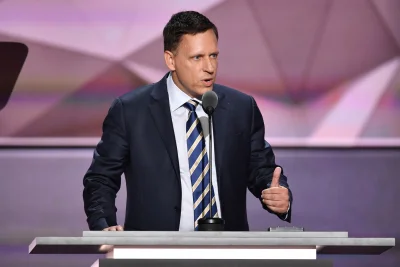
Aug. 19 (UPI) — Billionaire tech investor Peter Thiel has withdrawn from a high-profile libertarian summit in Argentina where he was scheduled to appear alongside President Javier Milei, days after protesters dressed as Gandalf demonstrated outside his $12 million Buenos Aires mansion.
Thiel had been scheduled as one of the central speakers at the “Vientos de Cambio,” or “Winds of Change,” summit on Sept. 1 and 2 in Buenos Aires, organized by the Libertad y Progreso Foundation. He was expected to hold a public conversation with Chilean commentator Axel Kaiser, while Milei was scheduled to close the gathering, according to Argentine news outlet elDiarioAR.
The foundation said Thiel canceled because of scheduling and logistical issues and did not connect his decision to the protest.
“Due to scheduling and logistical reasons completely unrelated to the organization of the event, Peter Thiel will ultimately be unable to travel to Buenos Aires,” Libertad y Progreso said in a statement cited by elDiarioAR. The organization said Thiel and his team had tried to reconcile the appearance with previous commitments but that travel difficulties made his participation impossible.
The summit is intended to showcase Argentina’s economic transformation under Milei and will bring together government officials, investors, academics and think tanks from Latin America, the United States and Europe. Economy Minister Luis Caputo and Deregulation Minister Federico Sturzenegger are among the government officials scheduled to participate, according to La Nación.
Thiel’s withdrawal came after an unusual demonstration Monday outside his home in Barrio Parque, one of Buenos Aires’ most exclusive neighborhoods.
A group of protesters wearing gray robes, pointed hats and white beards dressed as Gandalf, the wizard from J.R.R. Tolkien‘s The Lord of the Rings, gathered outside the property carrying a banner reading, “You shall not pass,” La Nación reported.
Peter Thiel can run, but he can’t hide.
A squad of Gandalf’s held a banner that said “You Shall Not Pass” at the door of his new home in Buenos Aires. pic.twitter.com/8HQhr02FTD— Jason Bassler (@JasonBassler1) August 18, 2026
The choice of character was a pointed reference to Thiel’s well-documented fascination with Tolkien. Thiel co-founded data analytics company Palantir Technologies, whose name comes from the “palantíri,” seeing stones in Tolkien’s fictional universe that allow their users to communicate across long distances and view faraway events.
The demonstrators protested Thiel’s growing presence and investments in Argentina, including a recently disclosed $76 million stake in oil producer Vista Energy, according to elDiarioAR.
Thiel Macro LLC reported holding 1,189,792 American depositary shares of Vista at the end of the second quarter, worth approximately $76 million and representing about 1% of the company, according to a U.S. Securities and Exchange Commission filing cited by La Nación. The Vista investment was the fund’s second-largest reported equity position behind Amazon and represented about 18% of its reported stock portfolio.
Vista is one of the major operators in Vaca Muerta, Argentina’s massive shale oil and gas formation, making the investment Thiel’s most significant publicly disclosed financial bet in the country.
His financial expansion has come alongside increasingly visible ties to Milei and senior members of his government.
Thiel met with Milei at the Casa Rosada presidential palace in April, part of a series of meetings between the two over the past two years. El País reported that the April meeting was their fourth since 2024, following encounters at the Casa Rosada in January 2024, at the Milken Institute conference in Los Angeles that May and another meeting in Buenos Aires.
During his latest stay in Argentina, Thiel also met with presidential adviser Santiago Caputo, while Economy Minister Luis Caputo received him at the Economy Ministry in May, La Nación reported.
Thiel temporarily settled in Buenos Aires with his husband and children in early April and purchased a six-bedroom mansion in Barrio Parque for about $12 million, according to La Nación.
His outreach has extended beyond Milei’s political circle. On June 3, Thiel held a more than three-hour meeting at his home with opposition lawmaker and social leader Juan Grabois, one of Milei’s most outspoken political opponents. Grabois later said the meeting was intended to help him understand the political and technological project of Silicon Valley’s emerging elite.
Seven people were killed in a helicopter crash in Kenya. Image courtesy of UPI
Aug. 19 (UPI) — A helicopter pilot and six passengers are dead after a crash at Mount Ololokwe in central Kenya, officials reported.
The passengers were tourists, but the Aircraft Accident Investigation Department said the nationalities of the pilot and passengers are not yet confirmed.
The accident happened in Samburu county at 9:13 a.m. local time. The helicopter was a Eurocopter EC130 B4, the Kenya Civil Aviation Authority said.
The scenic flight was from a wildlife conservancy in Loisaba to Ewaso Ng’iro, a river that flows along several national reserves.
The Kenya Red Cross said the site of the crash isn’t yet accessible but drones have assessed the scene, the BBC reported.
“Search and recovery efforts are ongoing, hampered by difficult terrain access and an active fire at the crash site,” the Kenya Red Cross said on X. “An additional team has been dispatched from Isiolo to reinforce the operation.”
Kenya has a history of multiple helicopter crashes.
In March 2024, Kenya’s Chief of Defense Gen. Francis Omondi Ogolla and nine others were killed in a helicopter crash in the country. Two people survived.
In 2012, three people were killed and six were injured in a crash on takeoff at the Masai Mara game reserve in Kenya.
Martin Luther King Jr. delivers his famed “I Have a Dream” speech from the steps of the Lincoln Memorial in Washington on August 28, 1963. The speech galvanized the nation’s civil rights movements and led to the passage of the 1964 Civil Rights Act, the 1965 Voting Rights Act and the 1968 Fair Housing Act. File photo by UPI | License Photo
Military vehicles line up at Camp Humphreys, the main U.S. base in Pyeongtaek, on Wednesday as the allies conduct the annual Ulchi Freedom Shield combined exercise. Seoul announced Wednesday the drills would be cut short following orders by U.S. President Donald Trump. Photo by Yonhap
SEOUL, Aug. 19 (UPI) — South Korea and the United States will significantly scale down their ongoing Ulchi Freedom Shield joint military exercise, Seoul’s Joint Chiefs of Staff said Wednesday, cutting it short by almost a week following an order by U.S. President Donald Trump.
“South Korea and the United States have agreed to make partial adjustments to the exercise period and scale at the suggestion of the U.S. side,” the JCS said in a statement.
“First, it was decided to adjust the duration of this UFS exercise to run from the 17th to the 21st,” the statement said. “Second, it was decided to conduct the combined field maneuver training on a reduced scale.”
The allies are discussing specific details of the field training reduction, the JCS added.
Ulchi Freedom Shield began Monday and was originally scheduled to run through Aug. 27.
The move comes after Trump called for the drills to be “substantially reduced” in a Truth Social post Sunday, saying they are expensive and “send a signal that is totally inappropriate and hostile” to North Korea.
South Korean Foreign Minister Cho Hyun said Wednesday morning that Seoul was not given advance notice of Trump’s directive.
“Neither our government nor officials within the U.S. government had any prior knowledge of what President Trump revealed on Truth Social,” Cho said at a parliamentary hearing. “Consequently, we were not notified beforehand.”
In his Sunday post, Trump said Pyongyang “has been unthreatening and respectful” while he has been in the White House.
Speaking to reporters in the Oval Office on Monday, Trump touted his personal relationship with North Korean leader Kim Jong Un, saying Kim had “always treated me with great respect.”
“I understand him. He understands me,” Trump said, adding that Kim had responded to his requests for talks but providing no further details.
The Wall Street Journal, citing U.S. officials, reported Tuesday that Trump is pushing aides to arrange a meeting with Kim as soon as this fall, although no official planning is underway. Trump has privately discussed holding talks during his next trip to Asia, which could come in November when world leaders gather for the Asia-Pacific Economic Cooperation summit in Shenzhen, China.
North Korea, meanwhile, has not publicly responded to Trump’s overture. In a commentary published earlier Wednesday, before Seoul announced the reduction, the state-run Korean Central News Agency criticized Ulchi Freedom Shield as “frantic exercises” pushing the Korean Peninsula to the “threshold of a war.”
The commentary threatened that Pyongyang would continue exercising its “right to self-defence” to counter what it called military threats from the allies.
North Korea frequently condemns U.S.-South Korean military drills as rehearsals for an invasion.
Trump similarly called for suspending or scaling back the exercises in his first term, when he pursued direct diplomacy with Kim that included summits in Singapore and Hanoi and a brief meeting at the DMZ.
After the 2018 Singapore summit, Trump surprised observers by announcing that the United States would halt what he called “provocative” joint military exercises with South Korea. That year’s Ulchi Freedom Guardian exercise was canceled, while several subsequent drills were reduced in scale.
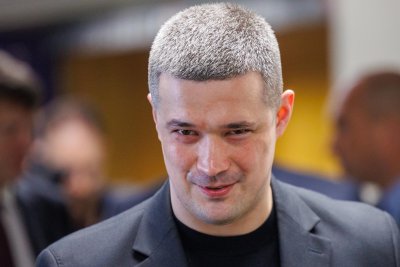
Former Defense Minister Mykhailo Fedorov called Tuesday for elections in Ukraine, arguing that the suspension of democracy was incompatible with the country’s war goals. File photo by Olivier Matthys/EPA
Aug. 19 (UPI) — Former Ukrainian Defense Minister Mykhailo Fedorov called for elections in Ukraine, arguing that the war with Russia was not an excuse and that the suspension of democracy was incompatible with the goal of the war, which was freedom.
Fedorov said in a YouTube video Tuesday that as Ukraine grappled with the fundamental question of how a state should function if war lasts for years he was convinced that the answer was not to effectively give Russia a veto over when Ukrainians could exercise their democratic rights again.
“Democracy cannot be held hostage by Russia. We are fighting precisely because we want to remain a free European state. Therefore, we must find a legal, safe, and realistic mechanism that will allow Ukraine to restore a full democratic process even amidst a prolonged war,” said Fedorov, who was dismissed as defense minister in July.
Fedorov, whose removal sparked protests across Ukraine, added that democracy was not a “peacetime luxury” but was part of “what we are fighting for today, saying that people could not “endlessly live in a state where they do not understand why certain decisions are made.”
Fedorov acknowleged the complexities of holding wartime elections, in particular guaranteeing the voting rights of military personnel, millions of Ukrainians living abroad. and of people living in regions on the frontline.
“We need to ensure the security of the electoral process, the independence of institutions, and trust in the outcome, he said, but stressed that complexity did not mean it could not be done.
“Ukraine has repeatedly done what the world considered impossible. We can find a solution here as well,” said Fedorov.
President Volodymyr Zelensky signed a decree imposing martial law in Ukraine on Feb. 24, 2022, immediately after Russia launched its full-scale invasion of the country, suspending certain fundamental rights and processes, including elections.
Zelensky’s five-year term expired more than two years in May 2024, but elections cannot be held while martial law remains in effect, according to the constitution.
In December, Zelensky held up the prospect of holding elections within the next three months in response to allegations by U.S. President Donald Trump that his administration was using the war as an excuse to stay in power.
Zelensky said he was ready for elections and would seek to hold them on condition that the United States and other allies provided guarantees to keep voters safe at a time when Ukraine’s cities were under attack day and night.
“I’m asking now, and stating this openly, for the United States to help me. Together with our European partners, we can ensure the security needed to hold elections. If that happens, Ukraine will be ready to conduct elections in the next 60 to 90 days,” said Zelensky.
The offer came after Trump called for elections, complaining that Ukraine liked to talk about democracy “but it gets to a point where it’s not a democracy anymore.”
A drone strike on a minibus in the Ukrainian frontline city of Kherson killed at least 4 people and injured 5 others amid a rise in Russian attacks on the approximately one-third of the province still controlled by Ukraine. File photo by State Emergency Service of Ukraine/EPA-EFE
Aug. 19 (UPI) — At least four people riding a minibus in Ukraine‘s frontline Kherson region were killed Wednesday morning after the vehicle was hit by a Russian drone.
Kherson Gov. Oleksandr Prokudin said in an online post that five women injured in the strike in the Korabelnyi district of Kherson city were being treated in the hospital.
“This morning, the Russians hit an ordinary minibus in Kherson with a First-Person-View drone. It is clear that the bus was civilian. The brutal Russian ‘safari’ against our people in Kherson has long gone beyond what any normal person can imagine,” said Prokudin.
He added that during the past 24 hours, nine other people had been injured in Russian strikes targeting critical infrastructure and residential areas in the province, damaging three apartment blocks, a restaurant and several cars.
“These are the realities of everyday life in Ukraine’s frontline regions. While partners hesitate over additional supplies of defense equipment, the Russians have gone long beyond the bounds of what is acceptable” Ukrainian President Volodymyr Zelenskywrote on X.
The United Nations’ humanitarian chief, Tom Fletcher, just back from visiting Ukraine’s Mykolaiv and Kherson regions, told BBC Radio that Kherson was coming under attack from thousands of drones each week with civilians telling him they were the targets.
Moscow insists it only attacks legitimate military and military-related targets.
Russia overran and occupied Kherson province at the start of the war in Feb. 2022, eventually annexing the province by September, but Kyiv routed Russian forces in a fall 2022 counter-offensive, recapturing around a third of its territory, including Kherson, the provincial capital.
Ukraine’s Air Force said in an update on Telegram that it dealt with airborne attacks on the north, south and east of the country overnight involving two Iskander-M ballistic missiles and 65 drones and other munitions, of which 10 got past air defenses to strike their targets.
Falling debris from downed missiles and drones fell in another three locations.
Martin Luther King Jr. delivers his famed “I Have a Dream” speech from the steps of the Lincoln Memorial in Washington on August 28, 1963. The speech galvanized the nation’s civil rights movements and led to the passage of the 1964 Civil Rights Act, the 1965 Voting Rights Act and the 1968 Fair Housing Act. File photo by UPI | License Photo
Iranian Zulfiqar road-mobile, ballistic missiles are displayed during a pro-government demonstration in Tehran, Iran, on Friday, July 24, 2026. Photo by Behnam Tofighi/UPI | License Photo
Aug. 19 (UPI) — The United Arab Emirates announced it was indefinitely severing trade relations with Iran on Wednesday after accusing Tehran of firing two ballistic missiles at it.
The move was announced by the UAE’s Foreign Affairs Ministry communications director, Afra Al Hameli, who said “in light of regional escalations that undermine regional and international peace and security, all trade, commercial exchanges and financial transactions with Iran have been halted until further notice.”
“The UAE remains firmly committed to safeguarding the integrity of the international financial system, in line with international law and the highest global standards,” she said in a statement, while stressing the UAE’s “steadfast commitment to dialogue cooperation and regional integration as essential means of advancing peace, stability and prosperity in the region.”
The UAE-Iran trade relationship was worth billions a year, with the Observatory of Economic Complexity platform stating the UAE exports nearly $6 billion in goods, mostly electronics, to Iran each year, while Iran exports nearly $500 million, mostly in grapes, nuts and crustaceans.
The announcement came hours after the UAE’s Ministry of Defense said its air defense systems had detected two ballistic missiles fired from Tehran toward maritime traffic, with both falling into the sea, one within the UAE’s territorial waters.
“The Ministry of Defense confirms that it is on high alert and readiness to deal with any threats, and to firmly confront everything that targets undermining the state’s security or the security of navigation in the region, thereby ensuring the preservation of the state’s sovereignty, security and stability, and protecting its interests and national capabilities,” it said in a statement.
Iranian Foreign Ministry spokesman Esmaeil Baghaei rejected the accusations that Iran had launched missiles toward the UAE, saying Abu Dhabi was violating “the principle of good-neighborly relations” in doing so, Iran’s Mehr News Agency reported.
According to the UAE’s Ministry of Defense, its air defenses have engaged more than 550 ballistic missiles, 29 cruise missiles and more than 2,265 drones fired at it by Iran since the war began on Feb. 28. However, Tuesday’s launches were the first since May.
French Foreign Minister Jean-Noel Barrot on Tuesday announced two Iranian diplomats would be expelled from France. The move comes in retaliation for incident last month in Tehran in which two French diplomats were arrested. File Photo by Radek Pietruszka/EPA
Aug. 18 (UPI) — France will expel two Iranian diplomats in retaliation for an attack on a pair of French diplomats in Tehran in July, French Foreign Minister Jean-Noël Barrot said Tuesday.
After first telling a French regional newspaper group of his plans, Barrot confirmed the story with a social media post in which he declared, “I had announced that this intolerable act would be followed by consequences. It has been done.
“Two Iranian diplomats in France will be expelled in the coming days.”
The move deepens the standoff between Paris and Tehran over the July 19 incident, in which France says Iranian agents “deliberately assaulted” and detained without reason two French diplomats in Tehran.
Barrot said the two were questioned for hours and, in one case, “assaulted,” calling the incident “an extremely serious and unacceptable attack on the integrity of our agents [which] cannot go unpunished.”
After the pair returned to France, Iran declared them persona non grata and ineligible to re-enter the country.
On Tuesday, Barrot denounced that decision and followed through with his threat of retaliation while claiming the diplomats were attacked because of France’s support for the Iranian people in their struggle against repression.
“The Iranian people, a great people, are the primary victims of this period of extreme tension in the Middle East, caught in a vise between the bloody repression of the January 2026 protests and the [U.S.-Israeli] bombings,” he wrote.
“It is precisely because France stands alongside the Iranian people, supporting its artists, scientists, and researchers, that two French diplomats were scandalously and deliberately assaulted last July 19.”
The Iranian Foreign Ministry, meanwhile, said the two were banned because they had taken part in a “secret meeting” with suspects of a major case involving “foreign infiltration and interference.”
The ministry told the semi-official IRNA News Agency the diplomats’ activities were “in violation of international law, especially the Vienna Convention on Diplomatic Relations of 1961.”
Iran contended the move was made because the French government “has not taken any action to rectify their behavior and guarantee the non-recurrence of such conduct weeks after the disclosure of their illegal behaviors.”
In 2007, the actor Felicia Day debuted “The Guild,” one of the first works, maybe the first, to demonstrate that the web could be a legitimate platform for full-blown, character-driven, narrative comedy. (YouTube was only two years old at the time.)
Online since there was a line to be on, Day — also known also for “Supernatural,” “Buffy the Vampire Slayer,” “Eureka,” “Mystery Science Theater 3000” and as the female lead in Joss Whedon’s “Dr. Horrible’s Sing-Along Blog” alongside Neil Patrick Harris and Nathan Fillion — played Cyd, a.k.a. Codex, a young woman at loose ends who finds community with a group of gamers whose quirkiness puts her own into perspective. The series, which she created and wrote, from experience, grew more ambitious and technically impressive across its six seasons, with cameos by the likes of Fillion, Zachary Levi, Stan Lee, Brent Spiner, late Mythbuster Grant Imahara and Wil Wheaton. There was a cultural specificity to the setting and storytelling — lots of gaming jargon and jokes — but the humor in the characters was universal, and the show, for all its well-proportioned silliness, felt very alive.
Now, as the series’ 20th anniversary approaches, Day is reviving “The Guild” as a feature, “The Guild: Ren Faire’d,” through a Kickstarter campaign due to end Friday. By the time I pledged, early on the first day of fundraising, the campaign had already met its initial $1.5-million goal — the minimum required, Day calculated, to pull off a version of her script. As of this writing, with just a few days to go, the campaign has raised more than $5 million. Everything over $4.5 million will go to making the film even better, but also support “Conludo,” a new game-playing series with Wheaton along the lines of their “Table Top,” created in 2012 for the Day-founded YouTube channel Geek & Sundry.
Day is also the author of a charming memoir, “You’re Never Weird on the Internet,” and a mental exercise book, “Embrace Your Weird: Face Your Fears and Unleash Creativity.” Earlier this year, Simon & Schuster published “The Lost Daughter of Sparta,” her graphic novel (with illustrator Rowan MacColl) about Philonoe, Helen of Troy’s lesser-known fourth sister, an on-brand tale of self-determination and embrace of one’s difference.
I interviewed Day by email as she traveled the convention circuit.
Day’s Kickstarter surpassed $5 million, allowing her to make not only “The Guild: Ren Faire’d” but also a new game-playing series.(Parker Burr / For The Times)
How does it feel to be back wearing, or about to wear, the character of Codex?
It’s so empowering to go back to this world that I crafted and this character that means so much to me and my fans. She and I have diverged a lot over the years, but her voice is still strong and clear in my ear, and I’ve had so much fun writing for her again. I haven’t been in charge of my own stories on this scale in a long time, so this all definitely feels like coming home.
It was an offer to turn “The Guild” into a television show that prompted you to get the film going. Had you thought of the possibility of bringing it back before then?
Early in 2025, I’d been thinking about the 20th anniversary of the show and how to celebrate it, but a movie is a huge project, one I was wary of committing to. A phone call with a very nice Hollywood executive wanting me to reboot the show with younger actors was the kick in the pants I needed. The business has been so hard on me, and a lot of people, especially these last five or so years. To even think about having the one project I held dear taken away from me? That got my fire lit.
How did you know to hang on to your IP?
I had met a few people in the early web days who’d sold their show to producers and networks, only to have them buried in development hell and never be seen again. My audience meant, and still means, so much to me, that I didn’t see the point in losing control of the show when it felt like we were doing all the right things on our own. The fans’ support gave me that confidence, and thank goodness for it, or I wouldn’t be able to make a movie today.
How did you cast the original show? Were any of the actors already gamers?
I wrote two of the main parts for improv friends, Zaboo (Sandeep Parikh) and Vork (Jeff Lewis), and I found the rest of the actors from a Backstage casting call. Several of them were already gamers, but a few were anything but (namely, Amy Okuda, who played Tinkerballa — she took some arm twisting). Over the years, though, they’ve all turned into gamers. We’ve enjoyed many a Fortnite session together, especially during COVID times.
Felicia Day as Codex. Other characters returning for “The Guild: Ren Faire’d” are Zaboo (Sandeep Parikh) and Vork (Jeff Lewis).
How has your reunion been going?
I had to make sure the script was good enough before I asked my fans to support it, so in February I had a table read with the main cast. Truly, it felt like no time had passed. We were all laughing so hard, ribbing each other on any little mistakes. It was so much fun to rediscover our characters together again. What we have together as a group is magic, and I can’t wait to get the band back together on set again.
You have a “no AI” sign on the Kickstarter page. What are your thoughts about artificial intelligence versus human creativity?
I look at AI as a great robber of humanity. Not only in the sheer existence of the AI itself, which is comprised of literal stolen material, but in robbing creators of their process. Because process is everything. It’s the whole point, in my opinion. That challenging struggle to write a first draft is how you discover who you are as an artist. But if you don’t do the work, you’ll never truly find out what you want to say to the world. You can’t create anything truly unique to yourself. It just makes me sad. To use a tool filled with other people’s stolen ideas in order to fast forward to an end result for attention, well, that isn’t art. That’s a cheap dopamine hit. And you’re no better a creator for having done it. Please don’t rob yourself like that.
The movie will be set at a Renaissance Faire. What’s your own history with them? Do you go in costume?
I’ve gone to Ren Faires for over a decade. We have a few great ones in SoCal I encourage everyone to explore. The costumes, the vendors, the food — all of it transports you to another world in such a magical way. I want to celebrate everything I love about the setting in our movie. I often go in costume, now with my 9-year-old daughter. It’s actually our Mother’s Day tradition and very dear to my heart.
Day on her work and motherhood: “I’ve learned that, especially as an artist, you have to be your own protector, own advocate, and give yourself unconditional love to be able to tap into what makes your art your own.”
(Parker Burr / For The Times)
Has motherhood changed how you work?
Absolutely. I had no idea how to parent myself before I parented another person. I’ve learned that, especially as an artist, you have to be your own protector, own advocate, and give yourself unconditional love to be able to tap into what makes your art your own. My experience writing this movie has been entirely different from in the past, when I let fear and outside pressure take the fun out of creating. This time, I allowed myself room to play and to make mistakes, just like I encourage my daughter to do. I think my work has benefited greatly from that gentle parenting.
The original “Guild” and the way you’ve mounted this campaign feels like the work of friends, like Mickey and Judy getting the gang together in a someone’s uncle’s barn to put on a show. (Which isn’t to say “amateur.”)
The heart of everything I do is this: I just want to play with my friends and my fans. I want to delight them with new ideas. I want to surprise them with laughs. The industry often divorces us from what got us into the business in the first place: making believe. Creating together. I like my work to embody the kind of spirit you can’t have in more mainstream media where there are levels of approvals over everything and the budgets are so high that the pressure takes the fun out of it. Yes, it’s challenging to make anything with fewer resources, but the community can see the ins and outs of my process and I hope that empowers them, in turn, to create their own things with their own friends one day.
What inspired your new graphic novel?
Being cut off from Hollywood over COVID made me brave enough to write a story I knew wouldn’t be anything an executive would care about if I pitched it. For many years, I didn’t allow myself to develop ideas like that. What was the use if they didn’t find it useful? But in allowing myself the space to write this story set in the world of Greek mythology, I’ve found new confidence as a writer. I want to keep telling stories only I can tell, in whatever format I can. I never want to discard them again because other people won’t find them useful. I hope that anyone reading the book feels the same encouragement to follow their inner muse. Because everyone deserves to be loved for exactly who they are, even our stories.
A ship came under attack in the Strait of Hormuz on Tuesday amid claims by Tehran’s top negotiator that the critically important sea route would remain closed. The unnamed vessel was sailing eastbound out from Persian Gulf when it was hit. File photo by Olivier Hoslet/EPA
Aug. 18 (UPI) — A ship transiting the Strait of Hormuz came under attack on Tuesday, sustaining at least one casualty, amid claims by Tehran’s top negotiator that the critically important sea route would remain closed pending the lifting of the U.S. naval blockade and the unfreezing of Iranian assets.
The British Royal Navy’s U.K. Maritime Trade Operations center said in an alert that the security officer of the ship’s owner had reported that the engine room of the vessel was struck by an unknown projectile while sailing outbound through Strait of Hormuz [from the Persian Gulf].
“The impact caused damage to the engine room and resulted in a crew casualty. The remaining crew are currently being assisted by the Omani Coast Guard. At present, no environmental impact has been reported,” said UKMTO which did not identify the ship.
It was not immediately clear if the affected crew member was injured or killed, or what type of weapon was used in the attack.
The incident coincided with comments by Bagher Ghalibaf, speaker of the Iranian parliament, vowing not to permit shipping to pass through the strait until the United States complied with terms set out in a cease-fire deal the two sides signed in June, including the lifting of sanctions preventing Iran from selling oil abroad.
“I want to state clearly that the Strait of Hormuz will not be opened until the American commitments stipulated in the memorandum of understanding… are implemented,” Ghalibaf said in an address carried on Iranian state television.
Sailings through the strait have remained drastically curtailed, as they have been since the war started on Feb. 28, despite the 14-point framework calling for it to be reopened to commercial vessels for the duration of the 60-day deal, which expired Monday.
The state-run Islamic Republic News Agency added the ending of all military threats and operations by the United States to Ghalibaf’s list of demands.
The U.S. Navy is currently enforcing a blockade preventing ships from entering or leaving Iranian ports.
Martin Luther King Jr. delivers his famed “I Have a Dream” speech from the steps of the Lincoln Memorial in Washington on August 28, 1963. The speech galvanized the nation’s civil rights movements and led to the passage of the 1964 Civil Rights Act, the 1965 Voting Rights Act and the 1968 Fair Housing Act. File photo by UPI | License Photo
Earlier this year, Colman Domingo devoted a portion of his monologue on “Saturday Night Live” to a few things he is famous for. One example? “When you come to my house, the vibes are spectacular.”
Those vibes must have transitive properties: On a recent morning in a borrowed backyard in Santa Monica, the vibes were as impeccable as one of the actor’s famously natty red-carpet looks. Posing for photos poolside, Domingo was the picture of laid-back charm, chatting with the crew in that commanding leather-and-gravel voice and flashing a toothsome smile.
With four projects in 2026 alone and more than 100 credits across film, television and the stage dating back to 1994, you definitely know Domingo from something. Increasingly, people recognize him from several things. Or, as the case may be with a performer of his caliber, they don’t — and that has been the highest compliment of all for the 56-year-old Philly native.
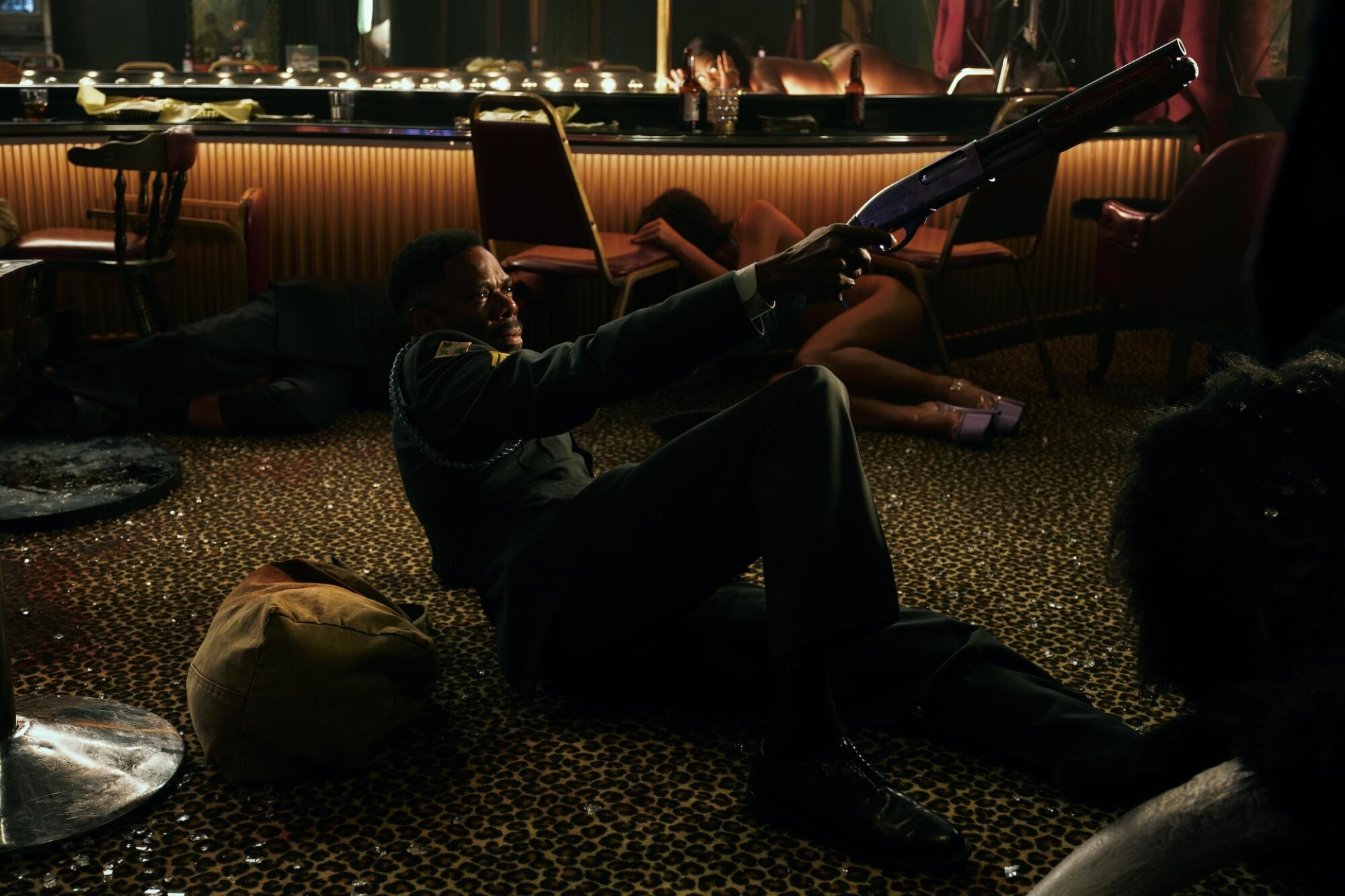
“It is the wildest thing,” says Domingo, stretched out on a sectional in the shade. He recounts how people have approached him about his role as Danny, the elegantly snarky architect on the Netflix comedy “The Four Seasons,” and were flummoxed to discover that he also plays the tightly wound Ali, he of shaken faith and sawed-off shotgun, on the recently concluded HBO drama “Euphoria.” “I’ve had so many people who saw me as one character, but they didn’t know I played the other character, even if they watched both. They’re like, ‘Wait a minute, that’s the same guy?’”
Domingo in “Euphoria.”
(Patrick Wymore / HBO)
That’s the same guy. Familiarity has bred respect as Domingo nabbed Emmy nominations for both roles for the second time — supporting actor in a comedy for “The Four Seasons” and guest actor in a drama for “Euphoria,” a trophy he took home in 2022.
“I get the yin and yang,” he says of the pleasure and challenge of inhabiting men from such different worlds.
Domingo credits “Euphoria” creator Sam Levinson with the complexities of Ali’s journey, which were showcased in the finale in breathtaking extremes of violence and grace and included a poignant monologue about the limits of empathy as he grieved the loss of his sponsee Rue (Zendaya). “It was so beautiful,” says Domingo of the conclusion of his arc. “Sam gave me words that are not just for Rue. They’re like a prayer for the world, sitting down at tables and having the hard conversations and trying to get people to come to their personal truths. To have a breakthrough in their lives. That’s how he’s been utilizing me for the series.”
(Evan Mulling / For The Times)
Conversely, Tina Fey and the writing staff of “The Four Seasons” have been using Domingo’s Danny as, among other things, a brutally effective vehicle to deploy acidic one-liners. (A favorite: “This the town Tracy Chapman sped away from.”)
“He is fictitious, but in many ways there’s a lot more of me in him than I personally have seen [in my previous characters],” he says of the man whose bravado masks an unsettled energy as he encounters the challenges of midlife. “Even in my notes to Tina and the showrunners, I started to craft a character that was closer to myself. I’m like, ‘I don’t see the mes in the world, queer men who are mostly in heteronormative worlds and how we activate and how we love and our friendships that are not just based on the fact that we are queer.’”
Domingo’s own midlife — conversations about fiber and the proliferation of readers in every room aside — is enviable. In addition to the two series, he appeared in two of the most talked-about films of the year, the blockbuster Michael Jackson biopic “Michael” and Steven Spielberg’s sci-fi thriller “Disclosure Day.” In another instance of playing a set of disparate characters, he was the imperious patriarch Joe Jackson in the former and the rebellious, empathetic whistleblower Hugo Wakefield in the latter.
“I wanted to challenge myself in different spaces,” says Domingo with gratitude for those roles as well as other 2026 opportunities, like his “SNL” appearance — which brought him back to his “Big Gay Sketch Show” days — and his recent guest-hosting stint on “Jimmy Kimmel Live!” “I never want to get caught up just doing the same thing.” He recalls a time when he played a couple of villains in a row and similar offers poured in. “I thought, ‘Oh no, I’ve done that.’ I knew it was time to move on to something else. And even ‘The Four Seasons,’ when that came along, I had been going back to back with dramatic roles — ‘Sing Sing,’ ‘The Color Purple,’ ‘Rustin.’ It takes a little toll on you.”
Domingo with Marco Calvani in “The Four Seasons.”
(Emily V. Aragones / Netflix)
Fortunately, all of that work has helped Domingo amass a very comfy set of laurels (upon which he refuses to rest). While his success has been a slow burn, including years of work on Broadway as an actor and playwright — Domingo co-wrote the book for “Summer: The Donna Summer Musical” as well as several straight plays — and his stint as a series regular on “Fear the Walking Dead” the last five years lighted the fuse on the rocket.
In that time, Domingo has won four NAACP Image Awards, been nominated for back-to-back lead actor Oscars, Golden Globes and BAFTA awards, and received a second Tony Award nomination, this one for best play as a co-producer of the “Hamlet” adaptation “Fat Ham.” (His previous Tony nod came in 2011 for featured actor in a musical for “The Scottsboro Boys.”)
Colman Domingo.
(Evan Mulling / For The Times)
“I’m very happy that this has happened the way it has,” he says of this golden period of work and creativity in his 50s. It’s not that he wouldn’t have appreciated or been ready for it in his youth, he says, but he has seen the pitfalls of success that happens too young. “At this age, I know myself. I know what I need. I have boundaries. I know how to still be a person in the world. And that’s the part that’s important to me, which is not being so isolated.”
There’s little danger of that given how often he is now stopped on the street. But he is cheered by the interactions because, whether fans love him as a good guy, a bad guy or a character in between, they all want the same thing. “Whatever I’ve done, people always ask, ‘Can I have a hug?’” Maybe the vibes are not about the house, but Domingo himself.
When David Lynch moved from Philadelphia to Los Angeles in the summer of 1970, he was stunned by the sunshine that radiated onto the city — the “most beautiful light I’d ever seen in my life,” he wrote with Kristine McKenna in his 2018 memoir “Room to Dream.” In that book, he described his first morning walking out of an apartment on San Vicente Boulevard.
David Lynch in 2016.
(Wally Skalij / Los Angeles Times)
“I kept kind of moving around with my arms outstretched and I almost got hit by a car wandering into the street,” he wrote.
That light — and Los Angeles itself — continued to inspire and energize the filmmaker and artist throughout his five-plus decades of calling L.A. home, until his death last year at the age of 78. In “Room to Dream,” he wrote about the “magical street” of Mulholland Drive and all its twists and turns: “It’s really got a history, and if you’re in Los Angeles long enough you start hearing stories about things that have happened on it that get your mind going.” In an interview with the Filmographers, he told the story of how his character in “Twin Peaks” was a name plucked from Billy Wilder’s “Sunset Boulevard,” which very well may have been inspired by Wilder’s commute to Paramount that passed the Hollywood streets Gordon and Cole. And the dissolve from Naomi Watts’ face in “Mulholland Drive” to rows of palm trees has become a classic shot for representing his work and his love for the city, hopeful and drenched in his beloved sunlight.
Much like L.A., the artistic legacy of Lynch is difficult to encapsulate — trying to describe his work is like attempting to explain a dream. His films so strongly defied categorization that they necessitated an eponymous term: Lynchian.
The Hollywood Sign, as seen from Beachwood Drive. (Myung J. Chun / Los Angeles Times)
Palm trees, which Lynch often used as a symbol in his films, tower above the city. (David McNew / Getty Images)
Unsettling to many, beloved by more, he refused to explain his work, allowing and challenging his audience to parse through it and imbue their own meanings and discoveries. The reward, for him, was in the doing, in taking a daydream and forming it into an idea that he could shape into something real in the world, blending the mundane and the macabre.
Here are some places around L.A. that offer a glimpse into Lynch’s world.
Note: the Lynch compound and all other residential locations mentioned are all private residences, and not to be disturbed.
Classic diners, especially Bob’s Big Boy Burbank
Lynch would often to go to Bob’s Big Boy in Burbank to meet with creative collaborators, or simply sit and think
(Jill Connelly / For The Times)
Lynch was fond of the straightforwardness of a diner, and he considered them to be ideal for creative thinking and work meetings. In his book “Catching the Big Fish,” he said: “I’d have a milkshake and sit and think. There’s a safety in thinking in a diner. You can have your coffee or your milkshake, and you can go off into strange dark areas, and always come back to the safety of the diner.”
One of the most viscerally terrifying scenes of “Mulholland Drive” takes place behind the dumpster at the abandoned Caesar’s diner in Gardena. And he liked having meals with his family at what is now the Denny’s in Gower Gulch, a place where aspiring cowboy actors once congregated. But the most significant diner in Lynch’s legacy is Bob’s Big Boy in Burbank. He spoke of going to Bob’s almost every day from the mid-’70s until the early ’80s. In an interview with Charlie Rose, Lynch claimed he saw a man at the counter who inspired the Frank Booth character in “Blue Velvet.”
Signs of Lynch at Bob’s Big Boy: His headshot displayed alongside actors Kyle MacLachlan and Laura Dern; a milkshake at the counter.(Stephanie Breijo / Los Angeles Times)
Lynch’s order included a chocolate milkshake and coffee, the cold sugar and caffeine fueling his ideas. He believed 2:30 p.m. was the perfect time to order the milkshake, specifically ”after the lunch rush when the machine had enough time to chill, the silver goblet would be frosted when it arrives at the table, and the ice cream is almost like butter, like cold butter, it’s almost solid, and it has specks of chocolate in it, and it almost gets a frost on it when it arrives,” he said in a conversation with the Filmosophers.
Today there is a framed photo of Lynch over the door of the Burbank location, indicating that his love for the restaurant was mutual. After his death, Bob’s became the de facto location for fans needing to pay homage to the beloved director, piled high with tributes of cigarettes, cans of Coke, donuts, slices of pie and tear-stained letters of gratitude.
Franklin Canyon Park
Leaves illuminated by sunlight under a canopy of trees in Franklin Canyon.
(Blake Fagan / For The Times)
Franklin Canyon Park was once a summer retreat for the Doheny family, who built a Spanish-style home at the base of the canyon in the 1930s. The 605 acres were purchased by the National Park Service in 1981.
A frame overlooks the water in Franklin Canyon, which stood in for many interstitial woodsy scenes in “Twin Peaks.”
(Blake Fagan / For The Times)
The mysterious woods are an essential element in Lynch’s world of “Twin Peaks.” While the pilot for the TV drama and the film prequel “Fire Walk With Me” were filmed in Washington (and there’s lots of scenic footage from the Pacific Northwest throughout the series), much of the show was filmed on Southern California soundstages. And for the many interstitial scenes in the woods, Franklin Canyon and its lush forest stood in. Lynch and co-creator Mark Frost opened an esoteric window to prime-time viewers with the concept of the Black Lodge. The filming location of its entrance, known as Glastonbury Grove in the show, is in Franklin Canyon Park.
Doheny landmarks
In an interview with Charlie Rose, Lynch stated that “everybody is a detective and the unknown is a magnet.” He invited his audiences to look at a door and investigate what lurks behind it. This philosophy ties to his connections with an L.A. legacy, one that contains its own mysteries and contrasts: the Doheny family and its historic properties:
The Doheny Mansion
Glimpses of the Doheny Mansion, clockwise from left: the music room; a stained glass sky light; a sculpture adorns a table in the Pompeian Room.(Blake Fagan / For The Times)
The sprawling and opulent Doheny Mansion, now part of the Mt. St. Mary’s campus, was built in 1899 by architects Theodore Eisen and Sumner Hunt. Patriarch and oil baron Ed Doheny and wife Estelle acquired the home in 1901 and the Doheny family made it their home for nearly 60 years. Lynch used the mansion as the home for Laura Dern’s character in his 2006 film “Inland Empire,” and also filmed an Armani commercial there in the 1990s.
Greystone Mansion
The central courtyard at the Greystone Mansion.
(Blake Fagan / For The Times)
In the 1970s, Lynch was a fellow at the newly founded American Film Institute, based at Greystone Mansion at the time. He eventually took over the mansion’s stables, converting them into a production studio and occasionally (and illegally) living there while he filmed his debut feature, “Eraserhead.” He slept in the room that became the bedroom for the character Henry. “I’d lock myself in there in such a way that from the outside it looked as if no one could possibly be inside,” Lynch said in Mark Altman’s 1990 book “Twin Peaks: Behind The Scenes.” “We’d put these special blankets up on the walls to deaden the sound for shooting and it was quiet.”
Scenes from the Greystone Mansion.(Blake Fagan / For The Times)
Greystone Mansion carried an air of secrecy in itself. Built in 1928 by Gordon Kaufmann, and a gift from Edward Doheny to his son Ned and his family, the stately Tudor Revival was home to a horrific tragedy. Months after moving in, Ned and his lifelong friend and personal secretary, Hugh Plunkett, were found in a guest bedroom, victims of a murder-suicide. While their motives were never defined for certain, the accepted belief was the tragedy was tied to their involvement in the Teapot Dome political corruption scandal and Plunkett’s looming testimony that could’ve implicated the Dohenys.
The city of Beverly Hills purchased the grand manor in 1965 and installed an underground reservoir, and leased the property to the newly formed American Film Institute in 1969 for $1 a year, with the agreement that the school would maintain the property. Greystone was dedicated as a public park in 1971 and is now listed on the National Register of Historic Places.
L.A.’s Transcendental Meditation centers
After moving to Los Angeles, Lynch started visiting the Spiritual Regeneration Movement Center in Santa Monica and it altered his life. Here he learned the methods of Transcendental Meditation, developed by Maharishi Mahesh Yogi, with the focus of seeking enlightenment. His first meditation session was July 1, 1973, and from there, he practiced twice a day, every single day.
“Before I started meditating I worried that doing it would make me lose my edge, and I didn’t want to lose the fire to make stuff,” Lynch wrote in “Room to Dream.” “I found out it gives you more fire to make stuff and more happiness in the doing and way more of an edge. People think anger is an edge, but anger is a weakness that poisons you and the environment around you.”
Lynch became a staunch devotee of Transcendental Meditation and spoke about the positive effects he believed it could have for everyone, particularly veterans, those suffering from PTSD and women who have survived violence. He started the David Lynch Foundation for Consciousness-Based Education and World Peace in 2005 to offer children throughout the world the opportunity to learn to meditate. The foundation recommends several Transcendental Meditation centers in Los Angeles, including the center on Hillhurst Avenue in Los Feliz.
The Pink House, David Lynch’s compound in Hollywood Hills and his final resting place at Hollywood Forever
The historic Tower Theater, built in 1927, was converted into the Apple Tower Theatre.
(Mel Melcon / Los Angeles Times)
On screen, Lynch loved the old glamour of Los Angeles — the majestic Tower Theater in downtown Los Angeles was used in “Mulholland Drive,” “Inland Empire” and “Twin Peaks: The Return.” His characters lived in equally memorable spaces, with the women of “Mulholland Drive” going from the grandeur of the Il Borghese apartments (architect Charles Gault, 1929) to meet tragic endings in the fairy-tale-esque “Snow White” apartments (architect Ben Sherwood, 1931) that are believed to have also inspired Walt Disney. (It’s worth noting that this theater has been refurbished into an Apple store. A beautiful achievement of preservation work, but it’s hard not to see the consumer-driven sleekness and think about a theme in Lynch’s work: the terrors lurking inside a changing America.)
Personally, Lynch loved modern architecture, and experienced love at first sight with the home he purchased in the mid-’80s in the Hollywood Hills. The Pink House, as Lynch referred to it, was designed by Lloyd Wright Jr. for writer Beverly Johnson in 1963. Lynch commissioned Eric Wright (Lloyd’s son and Frank Lloyd Wright’s grandson) to add a pool and pool house in 1991. He told the Wall Street Journal that he preferred Lloyd Wright’s work over his father’s, explaining, “Lloyd Wright is more minimal. More pure. But just as beautiful.”
The house is semi-secluded against a lush hill, beneath the actual Mulholland Drive, and has a subtle chevron pattern detail that runs throughout the house, similar to the floor of the “Twin Peaks” red room. Lynch loved this house and spent much of his time in Los Angeles here, particularly in his later years. He gradually added two neighboring properties to form what would become the Lynch compound.
A “Twin Peaks” coffee cup that was gifted to David Lynch by a fan.
(Chris Pizzello / Invision / AP)
When filming began on “Lost Highway,” he struggled to find the right location for the home of the lead characters, Fred and Renee Madison. This set piece would be crucial to building their sense of dread. Lynch then had an idea: He would use the Brutalist structure in his compound. He transformed the interior and altered the exterior windows, making it difficult for the characters to see the dangers circling outside. “Some people open windows of houses, but I like interiors and don’t care about windows,” Lynch wrote in “Room to Dream.” “I like to go deeper into a house and find things underneath things.”
For the next two decades, the compound was Lynch’s dream space where he could create anything he imagined, including his 2000s-era daily weather reports for local radio stations and his website, a hobby he revived during 2020. Homebound the last few years because of emphysema, he was forced to relocate during the Sunset fire in January 2025, and died shortly after. David Lynch’s final resting place is at Hollywood Forever, across from the Fairbanks Lawn where movies are shown, under the stars.
A missile strike by Russian forces on a rural community in Ukraine’s northeastern Kharkiv province early Tuesday killed at least 10 people and injured eight others, authorities said. File photo by Sergey Kozlov/EPA/
Aug. 18 (UPI) — A strike by Russian forces on a rural community in Ukraine‘s northeastern Kharkiv province on Tuesday morning killed at least 10 people and injured eight others, authorities said.
Kharkiv Gov. Oleh Syniehubov said in a post online that a missile hit a residential area of the small town of Pechenihy, 30 miles southeast of Kharkiv.
“This morning, the Russians brutally struck a crowded intersection in Pechenihy, where the post office and shops are located, and around where there are only residential buildings.
“Many people are injured, they are being provided with all necessary medical assistance. Rescuers have already extinguished the fire, all emergency and operational services continue to work at the scene. All the circumstances of this tragedy are being clarified,” wrote Syniehubov.
Syniehubov said 10 private houses, a cafe, a post office, a shop and at least seven cars were also damaged in the attack.
Meanwhile, Ukraine continued to send swarms of attack drones into Russia overnight for a third straight day, hitting and damaging a warehouse outside of Moscow belonging to Russian e-commerce giant Wildberries and setting ablaze an aluminum plant in Filimonovo, 40 miles northwest of Moscow.
Moscow Mayor Sergey Sobyanin said 620 Ukrainian drones approached Moscow and the Moscow Region between Monday evening and 5 a.m. local time on Tuesday, of which 180 were downed by air defenses, causing some indirect damage on the ground.
“Emergency services are working at the sites where debris fell,” said Sobyanin.
The state-run TASS news agency said that by its calculations the attack was the largest in two year, eclipsing an attack overnight Saturday that saw 600 drones bear down on the Russian capital, of which 201 were destroyed in the air.
Smoke rises near the town of Domodedovo following a Ukrainian drone attack in the Moscow Region on July 20, 2026. Russia on Tuesday threatened Britain over supplying Ukraine with drones. File Photo by EPA
Aug. 18 (UPI) — Russia is warning Britain that there will be “consequences” following reports that Ukraine has struck within Russian territory with drones provided by London and made by British companies.
In a statement Tuesday, the Embassy of Russia to the United Kingdom accused London of escalating Russia’s war against Ukraine by providing the weaponry, while chastising it for “hypocritically professing a desire for peace.”
“London’s actions will inevitably carry consequences for which it will have to answer,” the embassy said.
“The deeper its involvement in the conflict and the greater its support of Kiev’s terrorist machinery, the higher the price it will pay.”
Britain has been an ardent supporter of Ukraine’s defense against Russia, which invaded its eastern neighbor in February 2022, launching the four-year war.
According to a July factsheet from the British government, London has committed more than $33 billion to Ukraine, including more than $21.6 billion in military assistance.
Britain has for years been focused on supplying Ukraine with drones, which have proved effective in Kyiv’s defense against the Kremlin. In April, its Ministry of Defense announced it would deliver at least 120,000 drones to Ukraine by the end of this year, a number it increased to 150,000 in June.
The threat from the embassy follows reports stating drones built by British companies were being used by Ukraine to hit targets within the borders of Russia, resulting in more than $47.3 billion in damages.
In response to the embassy, Britain’s Ministry of Defense told BBC News in a statement that London stands “shoulder to shoulder” with Kyiv.
“Russia should be in no doubt about the resolve of this government to stand against Russian aggression, in Ukraine and against the UK and our allies,” the ministry spokesperson said.
Hayden Panettiere spent much of her life in front of a camera, beginning her acting career before she was even a year old, starring in commercials. At the tender age of 4, she landed her big break with a recurring role on the ABC soap opera “One Life to Live,” which led to a role on another soap opera, CBS’ “Guiding Light.” Over the years, she performed in a number of films and TV series, landing notable roles that made her a staple of network television. In addition to her onscreen work, she did voice acting for animated films like “A Bug’s Life” and “Dinosaur,” as well as the video game franchises “Kingdom Hearts” and “Until Dawn.”
The actor, who died Sunday at 36, was a versatile performer whose no-nonsense attitude and vocal range added depth to roles. Here is a guide to some of her notable work.
‘Remember the Titans’
Disney’s 2000 sports drama was based on the real story of Herman Boone, a Black football coach who was installed as head coach at the desegregated T.C. Williams High School in Arlington, Va., and led the team to a perfect season and state championship. In the film, Panettiere plays Sheryl Yoast, the young daughter of coach Bill Yoast (Will Patton), whose job Boone is given by the school district to placate Black community members as racial tensions rise. Panettiere’s Sheryl makes an impression right away, with a fiery speech directed at an official who comes to tell Yoast that Boone will now be head football coach of T.C. Williams. “You can’t just walk in here and take my daddy’s job away,” she cries as she stomps away, but not before kicking said official in the back of the leg. Later, she understands the implications of the decision, even if it comes at the cost of her father’s selection into the high school football hall of fame, preferring to put the team and their teamwork first: “Bunch of old rednecks … Let’s knock ‘em dead at state, coach.” (Watch on Hulu and Disney+.) — Maira Garcia
‘Ice Princess’
In Disney’s 2005 film, Panettiere was a little too good at playing the popular mean girl. She was even better at playing the popular mean girl who lets her icy walls melt away to welcome in the new girl. As talented figure skater Gennifer Harwood, Panettiere faithfully portrayed the evolution of friendships — especially for young women — in highly competitive sports and the tension between young athletes and their well-intended, but overbearing parents. While Panettiere could stand on her own talents, her performance was even more memorable for the dynamic she shared with screen partner Michelle Trachtenberg. The latter played Casey, a student with Ivy League ambitions whose interest in physics brings her to the figure skating world. Trachtenberg died in 2025 at 39. (Watch on Disney+.) — Alexandra Del Rosario
‘Heroes’
Claire Bennet (Hayden Panettiere) with her father Noah (Jack Coleman), also known as H.R.G., in NBC’s “Heroes.”
(Chris Haston / NBC)
This superhero series was a hit from the moment it debuted in 2006. An international cast fueled a show that featured people gifted with superpowers around the world that had a mysteriously ominous connection. At its heart was Panettiere’s Claire Bennet. An unbreakable high school cheerleader, she embraced the role of hero, facing pushback from a shadowy government group, serial killers and a twisted family dynamic. Panettiere became the face of NBC’s freshman ensemble success story, and despite an industry work stoppage and dwindling fan support afterward, the show’s viral campaign — “Save the cheerleader, save the world” — centered her, and her character’s courage, on a bona fide fandom-generating ride that ended way too soon in 2010, after four seasons. (Watch on Netflix and Tubi.) — Jevon Phillips
‘Scream’ franchise
Hayden Panettiere at the premiere of “Scream VI” in New York City in 2023.
(Nina Westervelt / Variety via Getty Images)
The actor joined the hit horror franchise in 2011’s “Scream 4” as Kirby Reed, a Woodsboro High student who is a horror film buff. One of that film’s memorable scenes featured Kirby in a tense trivia telephone showdown with the Ghostface killer, rushing through the titles of several slasher films while attempting to save one of her friends.
Although Kirby was seemingly killed off, she returned as an FBI agent in 2023‘s “Scream VI” when the franchise continued with younger characters and moved its setting to New York. “Scream” fans cheered during an early screening when Panettiere’s character appeared — she and Courtney Cox were one of the few “Scream” veterans to return for the new film.
Panettiere’s hair was longer and her role was expanded in the new “Scream.” Kirby explained that she had survived the Ghostface attack: “I was technically dead for four minutes. When I was revived, I got mad … I wanted the monsters to be afraid of me.”
Kirby also engaged in another trivia back-and-forth with Mindy Meeks-Martin (Jasmin Savoy Brown) where they agreed on the best “Nightmare on Elm Street” (“the original”) and that “Psycho 2” was “underrated,” but disagreed on the best “Friday the 13th” sequel. Although she is investigating a new set of Ghostface killings, Kirby later becomes a prime suspect. (Watch all on Paramount+.) — Greg Braxton
‘Nashville’
In ABC’s “Nashville,” Juliette Barnes’ storyline was infused with personal struggles similar to Panettiere’s.
(Katherine Bomboy-Thornton / ABC)
Panettiere was noticeably more mature when she became a co-lead role in ABC’s “Nashville” as Juliette Barnes, a crossover singer with more than a few similarities to Taylor Swift. The music-flavored drama, which premiered in 2012, starred Connie Britton as country star Rayna Jaymes, whose career was on the downturn at the same time Barnes was climbing the charts.
The actor injects her “Nashville” character with a mix of sexiness, snark and edge as Barnes becomes rivals with Jaymes. When the two first meet in a dressing room during the pilot, Jaymes is gracious while Barnes is condescending.
Panettiere said in an interview that she was tense during that scene. particularly since it was the first time the two actors had met. She said she apologized to Britton repeatedly saying, “‘I am so sorry!’ Because it was our first experience together, and I didn’t want to step on toes. Sometimes it gets real, very real, you know?”
While filming the series, Panetierre gave birth to her daughter in 2014. She detailed her struggles with postpartum depression in interviews, saying the condition was “scary and needed to be talked about.” In the series, Barnes also suffered from postpartum depression during the show’s third and fourth seasons. (Watch on Pluto TV and Netflix.) — G.B.
‘Kingdom Hearts’
Square Enix’s beloved video game series was my personal introduction to Panettiere and her acting abilities. In the first two installments, Panettiere voiced the kind island kid turned princess Kairi for the games’ English dub. Before protagonist Sora’s (voiced by a young Haley Joel Osment) world descends into darkness, Panettiere’s Kairi is playful and tender early in “Kingdom Hearts 1.” In the slightly more complicated “Kingdom Hearts 2” Panettiere’s older Kairi is contemplative, defiant and desperate to help all her friends. Kairi’s scenes are often accompanied by the powerful score from composer Yoko Shimomura, amplifying the emotion that has driven the games’ fanbase for more than two decades.
“Don’t ever forget. Wherever you go, I’m always with you,” Panettiere’s Kairi says in a memorable cut scene. — A.D.R.