World

Ex-Bolivian President Evo Morales accuses U.S. of fueling unrest

Citizens from various sectors in at least five regional capitals across Bolivia took to the streets Thursday to demand an end to the roadblocks organized by peasant unions and groups aligned with former Bolivian President Evo Morales, who are calling for the resignation of the Bolivian President Rodrigo Paz. Photo by Jorge Abrego/EPA

May 22 (UPI) — Former Bolivian President Evo Morales accused the United States of backing the government of President Rodrigo Paz and attempting to criminalize the protests shaking Bolivia.

“The United States does not defend democracy or respect international law. It finances right-wing coups. It invades countries and steals their natural resources,” Morales wrote in a message Thursday on X.

Officials from the Bolivian identified Morales as the main instigator behind the wave of protests and road blockades demanding the president’s resignation.

The historic leader of the Movement Toward Socialism party, who is entrenched in the coca-growing Chapare region, was declared in contempt by a Bolivian court this month after failing to appear at a hearing linked to a human trafficking case.

The former president was responding to a message published by Secretary of State Marco Rubio on X in which Rubiol said the United States would not allow “criminals and drug traffickers” to overthrow democratically elected governments in the hemisphere.

Morales called the remarks “a lie” and accused Washington of supporting the 2019 ouster to gain control of Bolivia’s lithium reserves.

“The United States supported the coup by the gringo against the Indigenous man in 2019 in order to seize our lithium,” he said.

In another message published on X, Morales also questioned Paz’s political legitimacy by claiming he was born in Spain, and he accused the president of “criminalizing” and “repressing” Indigenous people, farmers and students participating in the protests.

“Because he is a foreigner, he surely hates Bolivians. He criminalizes, persecutes and represses Indigenous people. He thinks and acts like an imperialist, neoliberal and neocolonial ruler,” Morales wrote.

In an interview this week with La Octava Radio Nacional, Morales called for early elections within 90 days to “pacify Bolivia,” arguing the country is facing a governance crisis.

Morales’ remarks came as Bolivia entered its third week of protests, road blockades and demonstrations led by unions, farming organizations and Indigenous groups rejecting the government’s economic reforms and denouncing fuel shortages, inflation and economic deterioration, according to reports by Bolivian media outlets La Razón and Los Tiempos.

The crisis has also begun to affect the healthcare system. Bolivia’s Health Ministry said at least four people died in recent days because they were unable to receive medical treatment or be transferred in time to healthcare centers due to road blockades and unrest in different parts of the country.

Among the victims was a 12-year-old boy, who died while being transported in an ambulance after the vehicle was unable to pass through blocked roads.

“We are calling for a humanitarian corridor,” the ministry said, according to reports by Infobae.

The Bolivian Highway Administration reported Friday that 51 road blockades were active across seven of the country’s nine departments, most of them concentrated in the highland region, including the departments of La Paz, Oruro and Cochabamba.


Source link

S. Korea to acquire U.S. SM-6 missile interceptors for deployment by 2034

South Korea said Friday it will acquire U.S. SM-6 shipborne missile interceptors and field them by 2034. The ROKS Dasan Jeong Yakyong, seen here at a launch ceremony in Ulsan on Sept. 17, 2025, will be equipped with the interceptors. File Photo by Yonhap

South Korea on Friday finalized a plan to acquire U.S. Standard Missile-6 (SM-6) shipborne missile interceptors and field them by 2034, in a bid to boost its missile defense capabilities, the state arms procurement agency said.

The Defense Project Promotion Committee, a decision-making body for arms procurement under the Defense Acquisition Program Administration (DAPA), approved the 530 billion-won (US$351.5 million) project to acquire the SM-6 long-range ship-to-air missile interceptors and related equipment, the agency said.

An SM-6 interceptor is an advanced defense missile interceptor for warships that can track and destroy a wide range of incoming threats.

It has a maximum range of 460 kilometers, with an altitude of up to 36 km, and is built to directly track targets with its own radar, allowing ships to deal with multiple threats at the same time.

The military plans to equip the 8,200-ton Aegis destroyer ROKS Dasan Jeong Yakyong, which is scheduled to enter service later this year, as well as the ROKS Daeho Kim Jong Seo, another vessel of the same class, with the SM-6 interceptors.

The SM-6 interceptors will also be installed on the already-deployed ROKS Jeongjo the Great through future capability upgrades.

“The project is expected to enhance ship-to-air defense capabilities of Aegis destroyers against enemy anti-ship ballistic missiles, aircraft and cruise missiles, as well as improve their anti-ballistic missile defense,” the DAPA said.

In November 2023, the United States approved a $650 million sale of up to 38 SM-6 missiles and related equipment to South Korea through the government-to-government Foreign Military Sales program.

Friday’s announcement by DAPA suggests that the acquisition may have been scaled back from the earlier plan. The timeline for the acquisition has also been revised to 2023-34, from the original 2023-31 schedule.

“The negotiation process took time even though we have been pushing ahead with the project since 2023,” a DAPA official said. “The system will be rolled out in stages in accordance with the schedule agreed upon with the U.S. side.”

The committee also approved a research and development (R&D) plan for a new military communications satellite system to replace older satellite and ground equipment.

The plan calls for developing and acquiring a dedicated geostationary military communications satellite and related ground infrastructure through an R&D program led by the Agency for Defense Development.

The project will run from this year through 2032, with an estimated cost of about 1.27 trillion won. DAPA plans to sign a contract agreement with a prototype developer by March next year.

Copyright (c) Yonhap News Agency prohibits its content from being redistributed or reprinted without consent, and forbids the content from being learned and used by artificial intelligence systems.

Source link

Tuchel leaves Palmer and Foden out of England’s 2026 World Cup squad | World Cup 2026 News

Real Madrid’s Trent Alexander-Arnold also left out, while Saudi-based Al-Ahli striker Ivan Toney the surprise inclusion.

Cole Palmer and Phil Foden were among a number of high-profile names excluded by Thomas Tuchel from England’s World Cup squad.

Real Madrid’s Trent Alexander-Arnold was also left out of the squad announced on Friday, with Saudi-based Al-Ahli striker Ivan Toney the surprise inclusion.

Recommended Stories

list of 4 itemsend of list

Tuchel, a Champions League winner during his time at Chelsea, has been hired to end England’s 60-year wait to win a major international tournament.

The former Paris Saint-Germain and Bayern Munich boss has made a series of bold calls, which will be harshly judged if the Three Lions fall short of glory in the coming weeks.

Foden and Palmer played a major role in England’s run to the final of Euro 2024.

However, Manchester City’s Foden and Chelsea playmaker Palmer have paid the price for poor seasons with their clubs.

Nottingham Forest midfielder Morgan Gibbs-White and Leeds striker Dominic Calvert-Lewin have also been overlooked, despite being two of the highest-scoring Englishmen in the Premier League this season.

Veteran Brentford midfielder and former Liverpool captain Jordan Henderson has been included at the expense of Crystal Palace’s Adam Wharton.

Tuchel said telling players they would not be on the plane to the United States had been tough.

“It was difficult, sometimes painfully difficult and like even in the phone calls I felt the emotion,” he said.

“So I called all players that were with us in camp at least one time, I called them, I wanted to show at least the appreciation and the respect for what they have done.”

Tuchel said he could not wait to be on the plane and “be a coach”.

“Now I’m feeling in between relieved and excited and ready to go because once you get the energy back and once you see the excitement of the players that you chose and then once the decisions are made it gives you a certain edge, it gives clarity,” he said.

Manchester United defender Harry Maguire said on Thursday he was shocked at not being included.

“I was confident I could [have] played a major part this summer for my country after the season I’ve had,” the 33-year-old posted on social media.

“I’ve been left shocked and gutted by the decision.”

Maguire’s Manchester United teammate Luke Shaw has also been overlooked.

Tuchel has taken a risk on centre-back John Stones despite his lack of involvement at Manchester City during an injury-hit season.

Toney made an impact off the bench at the Euros two years ago, but has played only two minutes of international football since moving to Saudi Arabia in 2024.

England kick off their World Cup campaign against Croatia in Dallas on June 17, before playing Ghana on June 23 and Panama four days later.

INTERACTIVE-Football FIFA How teams are group World Cup 2026-1776670778

England’s 2026 World Cup squad

Goalkeepers: Jordan Pickford, Dean Henderson, James Trafford.

Defenders: Reece James, Tino Livramento, Dan Burn, Marc Guehi, John Stones, Nico O’Reilly, Ezri Konsa, Jarell Quansah, Djed Spence.

Midfielders: Declan Rice, Elliot Anderson, Jude Bellingham, Jordan Henderson, Kobbie Mainoo, Morgan Rogers, Eberechi Eze.

Forwards: Harry Kane, Ivan Toney, Ollie Watkins, Bukayo Saka, Noni Madueke, Marcus Rashford, Anthony Gordon.

Source link

2 S. Koreans seized on Gaza-bound aid vessels return home

Activists Kim Ah-hyun (L) and Kim Dong-hyeon speak to reporters at Incheon International Airport on Friday following their release after being captured by Israeli forces aboard Gaza-bound aid flotillas. Photo by Yonhap

Two South Korean activists returned home Friday after being released by Israeli forces that had captured them aboard aid vessels bound for the Gaza Strip.

Kim Ah-hyun was aboard an aid vessel seized by Israeli forces in waters off the Gaza Strip, while Kim Dong-hyeon’s ship was intercepted near Cyprus — both earlier this week.

They were released Wednesday and flew home together, arriving at Incheon International Airport, west of Seoul, at 6:24 a.m.

“Many people are dying not only from bombings, but also from starvation,” Kim Ah-hyun told reporters at the airport. “Because there are people there, I thought that I had to attempt the voyage again, no matter how dangerous the situation in the Middle East was.”

The activist had earlier attempted to enter the territory via an aid flotilla in October without authorization. She had been detained by Israeli forces during her first attempt and was later released.

Before her latest attempt, the South Korean government had revoked her passport.

The activist claimed she had been assaulted by Israeli forces in the face after her latest capture and that she couldn’t hear properly in her left ear.

Kim Dong-hyeon, the other activist, said Israeli forces had “tortured” the activists, claiming they had suffered “unendurable violence.”

Israel has faced criticism following the release of images of captured activists kneeling on the ground with their hands bound.

On Wednesday, President Lee Jae Myung criticized Israel’s seizure of the vessels, accusing the country of violating international rules as the ships were not in Israel’s territorial waters when they were seized.

Copyright (c) Yonhap News Agency prohibits its content from being redistributed or reprinted without consent, and forbids the content from being learned and used by artificial intelligence systems.

Source link

South Korean AI power diagnostics system heads to Germany

Employees check power demand and supply at the regional office of the Korea Electric Power Corp. in Suwon, 30 kilometers south of Seoul, South Korea. Photo by YONHAP / EPA

May 21 (Asia Today) — Korea Electric Power Corp.’s AI-based preventive diagnostics technology will be introduced to Germany’s power equipment market under the company’s largest-ever single technology transfer deal.

Korea Electric Power said Wednesday it signed a $1.34 million, or about 2 billion won, contract with German power equipment company Maschinenfabrik Reinhausen in Berlin on Tuesday. The South Korean utility will receive technology transfer fees from the German company over seven years.

The technology, called SEDA, analyzes about 100,000 pieces of substation equipment data a day. The system uses AI to detect abnormalities in power facilities by linking data from Internet of Things sensors, facility specifications and maintenance records.

Maschinenfabrik Reinhausen, founded in 1868, specializes in transformer load tap changers, sensors and digital solutions. The company has annual revenue of about 19 trillion won, or $12.6 billion.

The German company plans to apply SEDA to its TESSA 2.0 power equipment asset management platform. The platform monitors the condition of transformers, switchgear and other power equipment.

Korea Electric Power began using SEDA in South Korea in 2021. The system has been applied to 359 of the country’s 925 substations, or about 40%, and the company is gradually expanding its use.

The company said SEDA has detected an average of 15 abnormal signs per year over the past five years. Last year, the system helped prevent equipment damage worth 36.6 billion won, or about $24.3 million.

“This technology transfer is highly significant because it gives Korea Electric Power a key foothold for entering global markets, including Europe and North America,” said Yeo Geun-taek, head of the company’s transmission and substation operation office.

— Reported by Asia Today; translated by UPI

© Asia Today. Unauthorized reproduction or redistribution prohibited.

Original Korean report: https://www.asiatoday.co.kr/kn/view.php?key=20260521010006459

Source link

Netflix set to launch daily stream of ‘The Breakfast Club’

Netflix subscribers will wake up to a video livestream of “The Breakfast Club” starting next month, marking the platform’s first daily live podcast.

The deal is part of the streaming platform’s ongoing focus on live programming, and the latest video podcast offering through its partnership with iHeartRadio, the company said on Thursday. The nearly three-hour show will include a live video feed exclusive to Netflix and will air every weekday morning.

“Taking this show live every day to a global audience on Netflix is a powerful example of how we’re expanding the reach of our biggest brands while giving audiences entirely new ways to experience them,” Bob Pittman, iHeartMedia’s chairman and chief executive, said in a statement. “Whether it’s morning in NYC or the afternoon in London, the conversation is live and reaching the world in real time.”

“The Breakfast Club” will air simultaneously on Netflix, the iHeartRadio app and it will continue to be syndicated by Premiere Networks on more than 100 broadcast radio stations nationwide. Netflix’s video feed is meant to provide more behind-the-scenes content, as radio formats will still need to include commercial breaks. Instead of pausing the program, Netflix watchers will get an uninterrupted stream, where those traditional breaks will be filled with exclusive segments and extended discussions.

“The media landscape will always evolve, but one thing consistently cuts through: live programming,” Charlamagne tha God said in a statement. “That’s a big reason ‘The Breakfast Club’ has sustained its reign for so long. We’re building something powerful — real‑time conversation, real community, on a global scale. The future belongs to those who can see what’s possible — and trust me, the vision for ‘The Breakfast Club’ and Netflix is crystal clear.”

The radio program first got its start in 2010 on WWPR-FM in New York. Over the years, it has become one of the most popular morning shows, rooted in Hip-Hop and R&B culture and known for its lively interviews and entertaining commentary from hosts Charlamagne Tha God, DJ Envy and Jess Hilarious. The show has welcomed guests like former President Barack Obama, and artists like Kendrick Lamar and Cardi B. In 2020, the talk show was inducted into the Radio Hall of Fame.

Netflix has heavily invested in its live programming in the worlds of sports, comedy and podcasting in recent years. In the past month, the Los Gatos-based company livestreamed “The Roast of Kevin Hart” and its latest fight between MMA fighters Ronda Rousey and Gina Carano. This weekend, the F1 Canadian Grand Prix is also set to air on Netflix. These tentpole events are in addition to some of the weekly live programming Netflix offers, including “The Bill Simmons Podcast,” which airs every Sunday.

Source link

Multicultural student population tops 200,000 in South Korea

1 of 2 | The Ministry of Gender Equality and Family government complex in Seoul. Photo by Asia Today

May 21 (Asia Today) — The number of multicultural students in South Korea topped 200,000 for the first time last year, even as the country’s overall youth population continued to decline, government data showed Wednesday.

The Ministry of Gender Equality and Family released its 2026 youth statistics, covering 36 indicators in eight areas, to mark Youth Month in May.

The data showed the number of multicultural students reached 202,208 last year, up 4.3% from a year earlier. They accounted for 4% of all students.

Elementary school students made up 57.7% of multicultural students, followed by middle school students at 25.3% and high school students at 16.6%.

South Korea’s youth population, defined as people ages 9 to 24, stood at 7.409 million this year, accounting for 14.4% of the total population. That was down from 7.626 million, or 14.8%, last year.

Education indicators showed mixed trends. Seven in 10 students said they enjoyed going to school, up 1 percentage point from the previous year. The share was highest among elementary school students at 79.2%, followed by middle school students at 71.9% and high school students at 69.2%.

The private education participation rate among elementary, middle and high school students fell to 75.7%, down 4.3 percentage points from a year earlier. Average weekly time spent in private education also declined by 30 minutes to 7.1 hours.

The school dropout rate edged up to 1.1%, while the share of high school graduates advancing to higher education in South Korea or abroad rose to 74.4%.

Labor data showed the employment rate for people ages 15 to 29 was 45.0% in 2025, down 1.1 percentage points from the previous year. The unemployment rate rose 0.2 percentage points to 6.1%.

Among middle and high school students, 5.1% said they had worked part-time during the past year.

Income was the top factor young people considered when choosing a job. Teenagers and young adults ages 13 to 24 ranked income first, followed by aptitude and interest, then job stability.

Large companies were the most preferred workplaces, followed by government agencies and public corporations.

The share of young people prioritizing income has steadily increased since 2013, when it stood at 27.0%. The trend was stronger among male youths at 42.8% than female youths at 35.9%. Women were more likely than men to cite aptitude and interest as a key factor.

— Reported by Asia Today; translated by UPI

© Asia Today. Unauthorized reproduction or redistribution prohibited.

Source link

NYC launches lottery for $50 World Cup football tickets | World Cup 2026

New York City is launching a lottery for 1,000 discounted World Cup tickets priced at $50. The city’s Mayor, Zohran Mamdani said match prices had soared into the thousands of dollars. The scheme is intended to give working-class New Yorkers access to matches.

Source link

Airbnb to add grocery delivery and car rentals ahead of World Cup

Airbnb unveiled a new set of services for guests on Wednesday, adding car rentals, airport pickup and grocery delivery to its online marketplace that connects travelers with local hosts.

Customers can now get groceries delivered to their Airbnb through a partnership with Instacart and have a driver meet them at the airport with Airbnb’s Welcome Pickups. The app is also offering luggage storage in partnership with Bounce and will add in-app car rentals later this summer.

At the same time, Airbnb is ramping up its use of AI by adding AI-powered review summaries and lodging comparisons, the company said.

The company has been expanding beyond lodging since last year, when it introduced Airbnb Experiences & Services, giving guests the option to book private tours and chef-cooked meals through the app.

In an earnings call earlier this month, the company’s chief executive, Brian Chesky, said the company is at “the very, very beginning of how AI is going to change how we all do our jobs.”

The changes are coming in time for the 2026 FIFA World Cup, which will take place in 16 cities across the U.S., Mexico and Canada. The company said it is offering exclusive World Cup experiences, such as watch parties and access to stadiums.

“In terms of what we’ve seen in cumulative bookings heading into the event, the World Cup is slated to be the largest event in Airbnb’s history,” the company’s chief financial officer, Ellie Mertz, said on the earnings call.

Airbnb gained popularity for offering travelers unique and homey stays on other people’s property, but it added boutique hotel bookings to its platform late last year. The move had some customers questioning if the app was straying too far from its original purpose.

In its announcement this week, the company said it is partnering with more independent hotels in 20 top destinations, including New York, London and Singapore. On the earnings call, Chesky said hotels on Airbnb could become a multibillion-dollar revenue business.

The San Francisco-based company was founded in 2007 and gave homeowners the opportunity to earn money by renting out their space to travelers seeking something different from a hotel. Airbnb bookings can range from private bedrooms in a shared home to luxury mansions and yachts.

The company’s revenue grew 18% year over year to $2.7 billion in the first quarter, while net income increased slightly to $160 million. Airbnb’s new services and offerings could transform it from a home-sharing platform to a holistic travel marketplace, analysts said.

Shares of the company have increased by 14% over the last six months and fell by less than 1% on Thursday.

Source link

Mayor cuts limited World Cup tickets for New Yorkers to $50 after furore | World Cup 2026 News

Pricing for 2026 World Cup has been under heavy scrutiny, including in New York where city mayor cuts limited tickets.

Some lucky New York City residents will soon get a chance to snag cheap seats to this summer’s high-priced World Cup.

Mayor Zohran Mamdani announced on Thursday that 1,000 tickets costing $50 will be made available to city residents of the city of more than 8 million for the world’s most watched sporting event.

Recommended Stories

list of 4 itemsend of list

“To put that into perspective, that is five lattes in New York City,” Mamdani quipped from a bar in Harlem’s Little Senegal neighbourhood, alongside US men’s national team star Timothy Weah.

The tickets will be available for seven of the eight games played at the 82,000-seat MetLife Stadium in New Jersey, across the river from Manhattan. The lone exception is the high demand July 19 final, where some seats are costing nearly $33,000.

The tickets will also include free round-trip bus transportation to the stadium and will be distributed via a lottery starting May 25.

With persistent concerns about the sky-high costs for tickets to the games, Mamdani said the city ensure the ones they distribute go to New York City residents and are not resold on the secondary market.

He said the tickets will be non-transferable, with a “variety of ways” used by city officials to verify residency. They will only be handed out directly to fans as they board buses on game day.

“We are making sure that working people will not be priced out of the game that they helped to create,” Mamdani said.

The Democrat, who took office in January, said the effort underscores how his administration is not simply focused on making everyday things like housing and groceries more affordable.

“It extends to making it possible for every New Yorker to take part in the things that make us human,” he said.

During his campaign, Mamdani called on FIFA, football’s global governing body, to make it cheaper for New Yorkers to go to games by setting aside 15% of tickets at discounted prices. He had launched a petition calling on FIFA to reverse its plan to set ticket prices based on demand.

The $50 tickets don’t come directly from FIFA, but from those allotted to New York and New Jersey’s joint host committee for the games, according to the mayor’s office.

Previously, FIFA had made some $60 tickets available for every game at the tournament in North America following backlash over exorbitant prices.

Those reduced price tickets, though, went to the national federations of the teams playing, with the federations deciding how to distribute them to loyal fans who have attended previous games at home and away.

Besides the final, the home stadium for both the NFL’s New York Giants and New York Jets is set to host five group World Cup matches and two knockout stage games. Group stage matches for former winners Brazil, France, Germany and England, along with other nations, begin on June 13.

Source link

England World Cup squad: Harry Maguire and Fikayo Tomori to be left out

Harry Maguire and Fikayo Tomori are among the central defensive options to be left out of England’s World Cup squad.

Both players were named in Thomas Tuchel’s previous squad, for the friendlies against Japan and Uruguay, but will not make the plane to North America.

In a post on Instagram, Maguire confirmed: “I was confident I could have played a major part this summer for my country after the season I’ve had. I’ve been left shocked and gutted by the decision. I wish the players all the best.”

Maguire’s Manchester United team-mate Luke Shaw is also set to miss out despite his impressive season.

Shaw was named in Tuchel’s 55-man provisional squad and there has been a clamour for his inclusion.

But, with Newcastle’s Dan Burn and Manchester City’s Nico O’Reilly in line to be called-up, Shaw is expected to miss out.

Arsenal winger Noni Madueke is expected to make the final 26-man squad, joining team-mates Bukayo Saka and Declan Rice.

Tuchel is set to name his squad on Friday for the World Cup, which starts on 11 June.

Source link

Germany make Neuer first-choice World Cup keeper to cap retirement U-turn | World Cup 2026 News

Manuel Neuer to start for Germany in World Cup upon his return, despite Oliver ⁠Baumann long being labelled team’s first choice.

Bayern Munich’s Manuel ‌Neuer has come out of international retirement to compete in next month’s ⁠World Cup after being ⁠named on Thursday as the starting goalkeeper in Germany coach Julian Nagelsmann’s squad for the tournament.

Nagelsmann made the decision after having long labelled Hoffenheim’s Oliver ⁠Baumann as his first-choice keeper.

Recommended Stories

list of 4 itemsend of list

“Yes, I plan with that [with Neuer as number one],” Nagelsmann told a press conference. “The main task was to nominate the best three keepers. So we ⁠decided that these three are part of that.”

“We contacted Manuel and asked him if he wanted to play for the national team again,” said Nagelsmann.

The 40-year-old Neuer, who last competed for Germany at Euro 2024 before his international retirement, is now set to play in his fifth ‌successive World Cup, joining an elite group of football players with five or more tournaments.

Neuer, a 2014 World Cup winner, enjoyed a solid season with champions Bayern, who could win the domestic double with victory over VfB Stuttgart in the German Cup final on Saturday.

He signed a contract extension with Bayern last week.

There were few other major surprises in Nagelsmann’s 26-man squad for the tournament starting next month. But the coach also ⁠called up Bayern’s teenage player Lennart Karl, who enjoyed a meteoric ⁠rise this season, as well as Nadiem Amiri and Leroy Sane, who both had outside chances of earning a spot.

“They [players] fit well together. It is a good mix. Many have been playing since their youth together,” Nagelsmann ⁠said. “We are happy with our choice, but know others will stay at home who have performed very well.”

Germany, who face Curacao, ⁠Ecuador and Ivory Coast in Group E at the World ⁠Cup, have set their sights on a fifth title after shock first-round exits in the past two editions in 2018 and 2022.

“The statement stands,” Nagelsmann said. “We want to become world champions. Every player who is nominated needs ‌to show it now every day.”

Germany squad for FIFA World Cup 2026:

Goalkeepers: Manuel Neuer, Oliver Baumann, Alexander Nubel

Defenders: Nico Schlotterbeck, David Raum, Nathaniel Brown, Jonathan Tah, Waldemar Anton, Pascal Gross, Joshua Kimmich, Felix Nmecha, Malick Thiaw, ‌Aleksandar ‌Pavlovic, Antonio Rudiger, Angelo Stiller

Midfielders/Forwards: Leon Goretzka, Maximilian Beier, Jamal Musiala, Nadiem Amiri, Jamie Leweling, Kai Havertz, Lennart Karl, Florian Wirtz, Deniz Undav, Nick Woltemade, Leroy Sane

Source link

Higher fuel prices have Americans scaling back travel plans

As someone who is “not the best person with bugs and stuff,” Stephanie Bernaba never imagined herself becoming an outdoorsy mom.

But the mother of three is getting more daring as gas prices and other travel costs make vacations more expensive. Bernaba, 47, has been steering her family toward local beaches, bike rides and hiking trails near their home in coastal Rhode Island instead of the faraway trips they once took.

“I’ve been trying to do more of that because one, it’s quality time. Two, it’s fresh air. And three, we’re not spending an arm and a leg,” she said.

That kind of calibration is shaping the summer travel season, which gets its traditional start in the U.S. with the long Memorial Day holiday weekend. Higher fuel prices resulting from the Iran war and other inflationary pressures are making most forms of travel costlier as people in many parts of the world form their plans.

The U.S. Travel Assn. expects annual travel spending to grow by a modest 1% this year, powered largely by domestic leisure travel despite the FIFA World Cup giving soccer fans from other countries a reason to visit the U.S. Airfares have climbed around the world along with the price of jet fuel as the war constrains global oil supplies.

Sticking closer to home may not cushion the sticker shock. The nonprofit Institute on Taxation and Economic Policy estimated Americans would collectively spend an extra $3.5 billion on gasoline over the holiday weekend. The average price for a gallon of regular gas in the U.S. was $4.56 on Thursday compared to $3.18 a year ago, according to the motor club AAA.

Other travel expenses have gone up too. The latest consumer price index showed airfares were 20.7% higher in April from a year earlier, the cost of intracity transit, such as buses and subways, rose 5.6%, lodging cost 4.3% more, and eating out got 3.6% pricier.

Changing travel patterns

Despite elevated prices, industry forecasts suggest Americans still want to get away, even if it means replacing long trips with long weekends, choosing destinations closer to home and finding ways to cut costs by cooking meals or using buses and trains instead of driving.

AAA predicted that 45 million U.S. residents would travel at least 50 miles from home between Thursday and Monday. The Transportation Security Administration said it expects to screen 18.3 million passengers from Thursday to next Wednesday.

Many households are planning summer vacations but making tradeoffs such as shorter trips or cheaper lodging, according to Bank of America analysts. Mastercard said in a recent report that consumers appeared increasingly focused on value and were adjusting their destinations and timing instead of not going away at all.

“Generally, it’s certainly more of a demand reshuffling than a demand softening,” David Tinsley, a senior economist at Bank of America Institute, said.

For the Bernaba family, that has meant trading a big vacation for a shorter trip nearby this summer. Their scaled-back itinerary still is pricey: more than $400 for a ferry to Martha’s Vineyard for their car and passengers, and about $800 a night for each of the two hotel rooms the family of five needs.

Another family that had planned to join them backed out after seeing the price tag.

“The pinch is being felt all the way around,” Bernaba said.

Analysts have increasingly described travel spending as “K-shaped,” with higher-income households continuing to spend while lower-income families pull back or opt out entirely. Bank of America said lower-income households were significantly more likely to report having no summer travel plans this year.

Travelers are confronting other stressors besides cost.

Airlines around the world have canceled flights and trimmed routes to save on fuel and operating costs, leaving passengers with fewer options. Recent U.S. government shutdowns — which caused major flight disruptions and long security lines — are likely still fresh in travelers’ minds. The conflict in the Middle East and broader geopolitical tensions add another layer of concern, especially for those considering trips abroad.

The various factors impacting travel right now have made planning trips more mentally taxing and may be pushing people toward simpler and more accessible vacations that feel easier to manage, said Marta Soligo, a tourism sociologist at the University of Nevada, Las Vegas.

“The keyword here is unpredictability,” Soligo said. “Tourists don’t like unpredictability.”

Quality over quantity

Jim Wang, a personal finance blogger who lives in Maryland with his wife and four children, said his family’s original plan to travel to Spain to see a full solar eclipse in August began to unravel once they looked at the logistics.

Beyond thousands of dollars in airfare, the trip would have required multiple connecting flights, plus a car rental to reach northern Spain, where the path of totality is expected to pass.

“It’s like, ‘Oh, I don’t know if I want to see the eclipse that much,’” Wang said.

Instead, Wang’s family plans to head this summer to the Lake Tahoe area straddling California and Nevada, where they can stay at a relative’s cabin for free, hike and enjoy a slower pace with limited cellphone service. His wife’s parents and sister expect to join them.

“We’re still going to travel. It’ll just be different,” Wang said. “The vacations are no longer as grand for the adults. But for our kids, it’s still exciting.”

Nancy McGehee, a Virginia Tech hospitality professor who studies consumer behavior, said travelers are increasingly focusing more on the “why than the where” when it comes to vacations.

“What we’re seeing is people are saying, ‘All right, we can’t do that big splashy trip we wanted to do, but what else can we do?’” McGehee said. “It’s more quality over quantity that we’re seeing people go for.”

Back in Rhode Island, Bernaba has accepted that travel may look different for her family for a while.

“I think that’s probably why my mind has gone to doing more nature-y things,” she said. “Let’s learn how to use the earth to enjoy ourselves because that’s not going to cost as much money.”

Yamat writes for the Associated Press.

Source link

Iran World Cup squad members apply for US, Canada visas in Turkiye | World Cup 2026 News

A number of players submitted visa applications in person at the US embassy in Ankara ahead of their training camp.

Iran’s football team have attended visa appointments in Turkiye ahead of the World Cup, with the whole squad applying for Canadian visas and some players also submitting applications for entry into the United States.

A number of players submitted applications in the Turkish capital Ankara on Thursday, an Iranian football federation official told Reuters news agency.

The whole squad attended appointments for Canadian visas, while some players who had not applied for American visas before the US and Israel attacked Iran in February also submitted their visa applications in person at the embassy.

Some foreign-based Iranian players joined the squad in Ankara before later travelling to the team’s training camp in Antalya on Turkiye’s Mediterranean coast, the official said.

Iran's national football team players and members of their delegation leave the US Embassy in Ankara after submitting their visa applications ahead of the 2026 FIFA World Cup, on May 21, 2026. The Iranian football federation vice-president said on May 20, 2026 he was "very confident" in FIFA's protocols as the team prepare to play at the World Cup in the United States. The players are to stay several weeks before heading to the World Cup that is being co-hosted by the US, which began bombing Iran on February 28 alongside Israel, sparking a wider war in the Middle East. (Photo by Adem ALTAN / AFP)
The players and delegation members submitted US visa applications in the Turkish capital [Adem Altan/AFP]

The World Cup will ⁠⁠be cohosted by the US, Canada and Mexico, with Iran due to play all three of their group-stage matches on the US West Coast.

Iran are scheduled to face New Zealand on June 15 and Belgium on June 21 in Los Angeles before taking on Egypt in Seattle five days later. They would require access to Canada if they progress to the knockout rounds.

Iran is holding a pre-tournament camp in Turkiye following the suspension of the Iranian domestic league in March, leaving many players short of match fitness.

The team trained in Antalya earlier this week as coach Amir Ghalenoei attempted to prepare his squad after most domestic-based players went seven weeks without competitive football during the suspension of the Iranian league.

Iran qualified early for the expanded 48-team World Cup, but preparations have been overshadowed by uncertainty over travel and security arrangements following the US-Israeli war on Iran.

Iran’s football federation had previously said US visa applications for the team would be handled in Turkiye after discussions with FIFA.

Iran are due to play Gambia in a friendly on May 29 before Ghalenoei names his final 26-man World Cup squad by FIFA’s June 1 deadline.

Source link

Neymar set to shake off injury scare to play for Brazil at World Cup | World Cup 2026 News

All-time record Brazil scorer Neymar misses Santos draw with San Lorenzo in the Copa Sudamericana due to calf injury.

Neymar has suffered ‌a minor calf injury but is expected to recover in ⁠time to join ⁠Brazil’s camp next week, before the World Cup starting on June 11 in the United States, Canada and Mexico.

The ⁠34-year-old, Brazil’s all-time leading scorer, was named in the squad on Monday, marking his return after a prolonged injury layoff that kept ⁠him out for much of the qualifying campaign, as Brazil chase a record-extending sixth title.

Recommended Stories

list of 4 itemsend of list

Much of the build-up to the squad announcement centred on coach Carlo Ancelotti’s decision over whether to include Neymar.

The Italian, who took ‌charge of Brazil last year, had not previously recalled the former Barcelona and Paris St Germain attacker, who now plays for Santos and is set to feature at his fourth World Cup in pursuit of his first world title.

“Neymar has a minor calf injury, an oedema,” Santos’ head of medical services Rodrigo Zogaib told ⁠Brazil’s ge.globo on Wednesday. “But, according to our planning, ⁠his progress will allow him to be fit next week when he will join up with the national team.”

Neymar, who has 79 goals in 128 internationals and has not ⁠featured for Brazil since 2023, continues to face scrutiny over his fitness and form.

His stint at ⁠Saudi club Al-Hilal was disrupted by injuries, ⁠and he returned to boyhood club Santos last year but has struggled to recapture his form.

Neymar missed Santos’s 2-2 home draw with San Lorenzo in the Copa Sudamericana on ‌Wednesday.

Brazil open their World Cup campaign against Morocco on June 13 in New Jersey, before facing Haiti and Scotland in Group C.

They are ‌scheduled ‌to play warm-up matches against Panama on May 31 and Egypt in the lead-up to the tournament.

Source link

Chinese President Xi likely to visit N. Korea as early as next week: sources

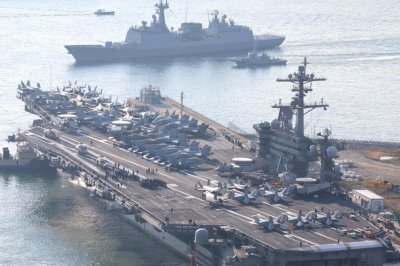
Chinese President Xi Jinping (R) will likely visit North Korea as early as next week, sources said Wednesday. In this photo, Xi shakes hands with North Korean leader Kim Jong Un during a meeting in Beijing. File Photo by KCNA/EPA

Chinese President Xi Jinping will likely visit North Korea as early as next week, sources said Wednesday.

“We have obtained intelligence indicating that President Xi Jinping will visit North Korea soon,” a high-ranking government official told Yonhap News Agency.

Another government official also said there is a high possibility of Xi visiting North Korea later this month or early next month, noting Chinese Foreign Minister Wang Yi‘s visit to Pyongyang last month and the recent trips by Xi’s security guards and ceremonial staff to the North Korean capital.

During the meeting with Wang, North Korean leader Kim Jong-un expressed willingness to strengthen high-level exchanges and enhance strategic communication with Beijing, as he recalled his visit to China last year.

The two nations mark the 65th anniversary of signing a comprehensive treaty on cooperation this year.

Xi’s possible visit to the reclusive regime also follows summit talks with U.S President Donald Trump in Beijing last week. During the talks, the two leaders reaffirmed their shared goal of denuclearizing North Korea.

A separate government source said the Chinese leader could seek to mediate relations between North Korea and the United States.

During his state visit to China in January, South Korean President Lee Jae Myung asked Xi to help mediate inter-Korean relations, and the Chinese leader responded positively to the request, according to the source.
Copyright (c) Yonhap News Agency prohibits its content from being redistributed or reprinted without consent, and forbids the content from being learned and used by artificial intelligence systems.

Source link

Column: Obama’s strong terms curbed Iran. Trump struggles to secure even a weak deal

President Trump, it’s well known, is into gold. Every day brings new evidence that he’s thoroughly enjoying the “golden age” he pronounced in his inaugural address — as few other Americans are — with stock trades, crypto profiteering and much more, even a new taxpayer-financed slush fund to reward his allies.

As for me, I’ve gone into silver. That is, I constantly look for the silver linings in Trump’s heinous acts.

One silver lining, of course, is his cratering job-approval numbers in the polls, especially among the young and Latino voters who made his reelection possible. But here’s another: By his humiliating failure to bring Iran to heel, nearly three months after starting a war that he said would last weeks at most, Trump has brought new, more positive attention to what he again this week derided as “Barack Hussein Obama’s Iran nuclear deal.” (The emphasis on “Hussein” is Trump’s, always.)

The president, along with his Republican cheerleaders, counts his first-term abrogation of the 2015 Iran nuclear agreement, the Joint Comprehensive Plan of Action, as a signature achievement. This week, yet again, he falsely claimed that had he not done so, Iran would have a nuclear weapon. In fact, his action in 2018 taking the United States out of the multinational deal subsequently led to Iran’s rebuilding of its nuclear program, the emboldening of the Iranian hard-liners now in power and the Middle East morass in which the United States is now mired.

That quagmire has left Trump seeming desperate for a deal — almost certainly a worse deal than the one Obama struck. Call it JCPOA Lite.

If he were able to get Iran’s sign-off on the sort of detailed, restrictive agreement that Obama and other world leaders won 11 years ago, he’d be trumpeting himself as the world’s greatest dealmaker. (He does that anyway, but his record proves otherwise.) Instead, by his own failure to date, Trump has invited reconsideration of the very agreement he decried as the “worst deal ever” on his march to election and reelection.

No sooner was the 2015 deal signed than Trump and Republicans succeeded in defining it as a giveaway to Iran that assured, not hindered, its development of a nuclear weapon to threaten Israel and the world. Opponents condemned the agreement for not addressing Iran’s other threats, notably its support for militant proxies throughout the Mideast. Some Democrats, notably Senate Minority Leader Chuck Schumer of New York, were among the foes. Other Democrats, cowed by opposition to the agreement by Benjamin Netanyahu’s Israeli government and pro-Israel lobbyists, were all but mute in the pact’s defense.

Now some Democrats are belatedly finding their voice (and, post-Gaza, some willingness to defy Israel). Along with nonpartisan experts, those Democrats are drawing comparisons between the 2015 agreement, flawed yet successful, and Trump’s promised yet ever-elusive alternative. What’s ironic for Israel and Netanyahu, still implacably against negotiating with Tehran, is that they could end up, under Trump, with a nuclear deal that gives Iran more leeway than the hated JCPOA did.

As Americans are being reminded, the 2015 deal wasn’t just between Iran and Obama, as Trump has long suggested; other signatories were China, Russia, Britain, France, Germany and the 27-nation European Union. Reconstituting that group would be all but impossible today.

The pact’s 159 highly technical pages and five appendices — a far cry from the short-lived one-pager that Trump officials teased earlier this month — required Iran for 15 years to limit its nuclear program to civilian purposes, forfeit more than 97% of its enriched uranium and submit to intrusive monitoring by the International Atomic Energy Agency to ensure compliance. In return, Iran gradually got relief from some, but not all, international economic sanctions and access to Iranian funds that were frozen after the 1979 Islamic revolution. Presumably, after 15 years, the agreement would have been extended somehow.

By all accounts, including those of Trump’s first-term intelligence and national security officials, Iran was complying when he abandoned the deal. Its “breakout time” for building a nuclear weapon was about a year — time enough for the world to intervene — instead of two to three months. Now, though the president boasts he barred Iran from having that weapon by breaking the Iran nuclear deal, he incessantly tells Americans that he went to war against Iran on Feb. 28 because it was on the brink of a bomb — never mind that he also said he had “obliterated” Iran’s nuclear program last summer, a program that was in a well-monitored box until he first took office.

If you’re confused, you’re paying attention.

A month ago, Trump posted online that he was close to a deal “FAR BETTER” than the 2015 accord. “I am under no pressure whatsoever, ⁠although, it will all happen, relatively quickly!” To several reporters, he suggested he in fact had a deal and that Iran had agreed both to suspend its nuclear activities and to forfeit all of its enriched, near-weapons-grade uranium.

Preposterous claims, given Iran’s current government, and Tehran promptly denied them. It was a sign of Trump’s squandered credibility that few, if anyone, believed him in the first place. Nor have folks believed his more recent talk of imminent success; oil markets, too, have learned not to trust the president, as prices at the pumps attest.

On Tuesday at the White House, amid a noisy tour of the billion-dollar-ballroom construction site, Trump told reporters he’d been “an hour away” from striking Iran again that very day but Mideast leaders asked for more time for negotiations.

Don’t hold your breath.

But for the tragic consequences, Obama might be enjoying some justifiable schadenfreude about Trump’s travails.

“We pulled it off without firing a missile. We got 97% of the enriched uranium out,” he told Stephen Colbert in an interview last week. Both U.S. and Israeli intelligence agreed that Iran was abiding by the nuclear limits, Obama added, “and we didn’t have to kill a whole bunch of people or shut down the Strait of Hormuz.”

That sure doesn’t sound like the “worst deal ever.” It wasn’t.

Bluesky: @jackiecalmes
Threads: @jkcalmes
X: @jackiekcalmes

Source link

Lebanon continues its gamble in U.S.-backed peace talks with Israel

A damaged mosque is shown Wednesday, a day after an Israeli airstrike hit the village of Maashouk in southern Lebanon. According to the Disaster Management Unit of the Lebanese government, Israeli attacks across Lebanon have killed more than 3,045 people and injured more than 9,310 others since the start of renewed hostilities between Israel and Hezbollah. Photo by Wael Hamzeh/EPA

BEIRUT, Lebanon, May 21 (UPI) — Lebanon took a gamble by engaging in direct negotiations with Israel that opened the door to security and political talks. Yet, that failed to stop the fighting despite a 45-day extension of a cease-fire.

The U.S.-brokered talks emerged as Lebanon’s last resort to end the raging war between Israel and Hezbollah that broke out when the Iran-backed militant group opened a support front for Gaza on Oct. 8, 2023.

A first cease-fire was achieved Nov. 27, 2024, but it failed to restrain Israel, prompting Hezbollah to resume fighting March 2 after 15 months of inactivity as it regrouped from heavy losses.

A second cease-fire, reached April 16, was extended for 45 days Friday during the third round of Lebanon-Israel negotiations in Washington.

The new truce did not take effect on the ground, as Israel and Hezbollah continued to clash, while talks in Washington were set to proceed under fire.

Israel continued to focus largely on southern Lebanon, carrying out airstrikes and expanding its ground operations, while Hezbollah maintained its fighting with new tactics that involved fiber-optic drones and small first-person-view systems.

Riad Kahwaji, a Middle East security analyst, said the extended cease-fire does not cover areas in which Hezbollah is active, especially southern Lebanon, but applies to Beirut and other parts of Lebanon.

“It is obvious that this is being done under the pretext of allowing Israel to retain its right to act against threats from Hezbollah,” Kahwaji said.

The latest casualty count released by the Lebanese Health Ministry on Wednesday showed that 3,073 people have been killed and 9,362 wounded since March 2.

Despite Hezbollah’s rejection of direct negotiations and its insistence on maintaining its anti-Israel resistance, Lebanese President Joseph Aoun remained committed to continuing the Washington talks.

“We are proceeding with this process because there is no other option. We are betting on the U.S. to help more,” a Lebanese official source told UPI.

The source said that the U.S. officials have been showing “understanding” of Lebanon’s position, but it is yet to be seen if “they would force Israel to abide by the cease-fire and withdraw” from southern Lebanon.

Lebanon — while not ready to conclude a peace agreement or normalize ties with Israel — engaged in the negotiations with five demands: consolidate the cease-fire, secure Israel’s withdrawal from occupied Lebanese territories, obtain release of Lebanese prisoners captured during the war, enable return of displaced people to their homes and villages, and initiate reconstruction.

Lebanese and Israeli military delegations are to meet on May 29 at the Pentagon in Washington in a “security track” aimed at, as the U.S. State Department put it, “meaningfully improving communication and coordination” between the two countries under U.S. facilitation.

While Lebanon prepares its military delegation, that meeting is expected to focus on enforcing and maintaining the cease-fire through structured military coordination.

According to Lebanese retired Maj. Gen. Abdul Rahman Chehaitli, the 45-day extension of the truce was a “window of time” for Israel to end or stop its military operations and for Lebanon to build confidence in its capacity to carry out its mission in southern Lebanon.

Supporting and equipping the Lebanese Army will be part of the discussions, aimed at enabling its forces to deploy and take control of southern Lebanon following any eventual Israeli withdrawal.

“All military operations should then stop completely for the Lebanese Army to begin deploying,” Chehaitli told UPI.

In addition to creating conditions for an Israeli withdrawal, the issue of Hezbollah’s disarmament would be on the table.

Kahwaji noted that Israel and Lebanon are heading into the Pentagon meeting with their own expectations and objectives.

“Lebanon wants the army to be strengthened, but there is so far no intention to forcibly disarm Hezbollah,” he said, adding that the United States and Israel expect the Lebanese Army to handle disarmament and security in southern Lebanon once properly equipped.

If an agreement is reached, the disarmament process would not succeed without Hezbollah’s consent and cooperation.

“Hezbollah would have to inform the army of all the locations where its weapons and missiles are hidden. That would require a decision by Hezbollah’s leadership, as these are secret locations not known to many.” Chehaitli said. “If this happens, we could then say that the war in Lebanon is over.”

However, the final word remains with Iran, which has heavily financed and armed Hezbollah since its establishment in the early 1980s.

“The key is in Iran’s hands. Ending the war and Iran’s military investment in Lebanon is the necessary entry point for the negotiations,” Chehaitli said.

While Lebanon seeks to break free from Iran and has opted for U.S.-brokered direct negotiations with Israel, it is working to revive the 1949 Armistice Treaty as a basis for ending hostilities in the upcoming political track expected in early June.

According to the official source, the plan is an “Armistice Treaty Plus” with some modifications — a feasible objective that would end the state of war between the two countries and resolve their border disputes.

“The Armistice Treaty is fully valid but requires some geographical and military amendments, which are easily addressed,” said Chehaitli, who is the author of The Lebanese Land and Maritime Borders: A Historical, Geographical and Political Study.

“It is either the solution or the gateway to a solution and could be sufficient to prevent any future war.”

He said military observers from the United Nations Truce Supervision Organization — placed under the operational command of the U.N. peacekeeping force in southern Lebanon, or UNIFIL, after the 2006 Israel-Hezbollah war — would resume their primary role of observing ceasefires and supervising armistice agreements.

UNIFIL’s mandate is set to expire in January.

Such an agreement to end the war would “keep the door open for a future peace deal that could involve political and economic relations,” Kahwaji argued.

That would largely depend on Israel’s acceptance and on the U.S. acting as guarantor.

“But the U.S. has not always been an honest broker, and will always side with Israel,” Kahwaji said.

Source link

DR Congo cancel World Cup training camp in Kinshasa over Ebola outbreak | World Cup 2026 News

DRC’s public sendoff in the capital was also cancelled before their departure for the FIFA World Cup.

The Democratic Republic of the Congo (DRC) football team have cancelled a three-day World Cup preparation training camp and a planned public farewell to fans in the capital, Kinshasa, because of an Ebola outbreak in the east of the country.

DRC are scheduled to play World Cup warm-up games against Denmark in Liege, Belgium, on June 3, and Chile in southern Spain on June 9. Both matches are going ahead as planned, team spokesman Jerry Kalemo told The Associated Press on Wednesday.

Recommended Stories

list of 4 itemsend of list

“There were three stages of preparation: In Kinshasa to say goodbye to the public, Belgium and Spain with two friendly matches against Denmark in Liege and Chile in Spain, and the third stage from June 11 in Houston, United States. Only one stage was canceled – the one in Kinshasa,” Kalemo said.

The team’s pre-tournament preparations will now take place elsewhere after an outbreak of a rare type of Ebola known as Bundibugyo, which is thought to have killed more than 130 people and caused nearly 600 suspected cases.

The World Health Organization has declared it a public health emergency of international concern.

All of the DRC players and the team’s French coach, Sebastien Desabre, are based outside of the central African country, with most of them playing in France.

A number of team staff who are based in DRC “are leaving in the next hours”, Kalemo said.

Football’s governing body FIFA issued a statement that “it is aware of and monitoring the situation regarding an Ebola outbreak and is in close communication with the DRC Football Association to ensure that the team are made aware of all medical and security guidance.”

The American Centers for Disease Control and Prevention said this week that the US would ban the entry of all foreign nationals who had been in DRC, Uganda and South Sudan within the past three weeks. The ban lasts for 30 days.

A US official said the Congolese World Cup team would not be affected by the CDC entry ban because they had been training in Europe for the past several weeks. That means team members, coaches and other officials who have not returned to DRC in the past three weeks would not be subject to the entry ban, according to the official who spoke on condition of anonymity because the policy has not been publicly announced.

Those members of the Congolese World Cup delegation who did return to DRC during the 21 days will be subject to the same quarantine requirements as US citizens seeking to return from affected countries, according to the official. That exception will not apply to Congolese fans who want to attend the World Cup, the official said.

The White House World Cup Task Force, housed under the Department of Homeland Security, stressed that it is “coordinating closely” with various agencies on health and security matters and that the government is “closely monitoring” the outbreak.

DRC, who qualified for the World Cup after winning a playoff tournament in Mexico, have been drawn in Group K. They face Portugal in their opening game in Houston on June 17.

The Leopards then face Colombia in Guadalajara on June 23 before playing Uzbekistan in Atlanta for their final group game on June 27.

DRC’s first World Cup qualification since 1974, when the country was called Zaire, led to scenes of jubilation across the nation, which has been battered by decades of conflict.

Source link

Japan presses U.S. lawmakers on North Korea abductions

1 of 2 | US President Donald Trump (R) and Japan Prime Minister Sanae Takaichi (L) attend a meeting with relatives of Japanese nationals abducted by North Korea at the Akasaka Palace State Guest House in Tokyo, Japan. Photo by KIYOSHI OTA / EPA

May 20 (Asia Today) — Japan is intensifying efforts to pressure U.S. political leaders and public opinion over the issue of Japanese citizens abducted by North Korea, seeking to ensure the matter remains part of future U.S. policy toward Pyongyang.

The campaign reflects growing concern in Tokyo that the abductee issue could be sidelined if Washington resumes negotiations with North Korea focused primarily on nuclear weapons and missile programs.

Japanese newspaper Sankei Shimbun reported Tuesday that the Japanese government has, since last year, sought meetings with former members of the U.S. Congress and expanded outreach efforts targeting American political and policy circles.

Officials from the Japanese Embassy in Washington have reportedly led the effort, while Tokyo has also engaged experts and opinion leaders with influence over U.S. public discourse. Japan has additionally used opinion advertisements published in The Washington Post as part of its advocacy campaign.

Japan officially recognizes 17 citizens as victims of abduction by North Korea. Pyongyang admitted to abducting Japanese citizens during a summit between the two countries in 2002, and five victims returned to Japan later that year.

However, the fate of the remaining abductees remains unresolved.

The Japanese government has consistently maintained that normalization of diplomatic ties with North Korea cannot proceed without resolution of the abductee issue. Japan’s Foreign Ministry and headquarters for abductee affairs classify the matter as a major issue involving national sovereignty and the safety of citizens.

According to the Sankei report, some U.S. lawmakers questioned why Japan had failed to resolve the issue independently over such a long period.

Japanese officials responded by arguing that the abductee issue is not simply a bilateral dispute but also a broader matter involving human rights and international security.

Tokyo views Washington as essential leverage because North Korea has largely refused direct negotiations with Japan. Japanese officials want to ensure the abductee issue remains included whenever the United States adjusts North Korea policy or enters diplomatic talks with Pyongyang.

Concerns have grown amid speculation that the Trump administration could again pursue direct engagement with North Korea, potentially pushing the abductee issue behind nuclear and missile concerns.

The issue also has parallels in South Korea. According to Seoul’s Ministry of Unification, North Korea is currently believed to be detaining seven South Korean nationals, including missionaries Kim Jung-wook, Kim Kook-kie and Choi Chun-gil, along with four North Korean defectors who later obtained South Korean citizenship.

South Korea also estimates that around 100,000 civilians were abducted during the 1950-53 Korean War. About 82,000 South Korean soldiers were listed as missing after the armistice, while only 8,343 prisoners of war returned through prisoner exchanges.

Despite those figures, the issue has received less sustained public and political attention in South Korea than Japan’s abductee campaign. While Seoul has pursued interagency initiatives and operates awareness campaigns such as the “Three Forget-Me-Nots” project, public focus has remained centered more heavily on nuclear threats, inter-Korean relations and military tensions.

— Reported by Asia Today; translated by UPI

© Asia Today. Unauthorized reproduction or redistribution prohibited.

Original Korean report: https://www.asiatoday.co.kr/kn/view.php?key=20260520010005721

Source link