Israeli settlers have carried out attacks and pogroms disrupting the Palestinian olive harvest in the West Bank, while Israeli forces separately detained several Palestinians across the occupied territory.
At least 19 settler attacks were recorded on Friday by the Palestinian Colonization and Wall Resistance Commission, a Palestinian government body operating under the Palestine Liberation Organization (PLO).
Recommended Stories
list of 3 itemsend of list
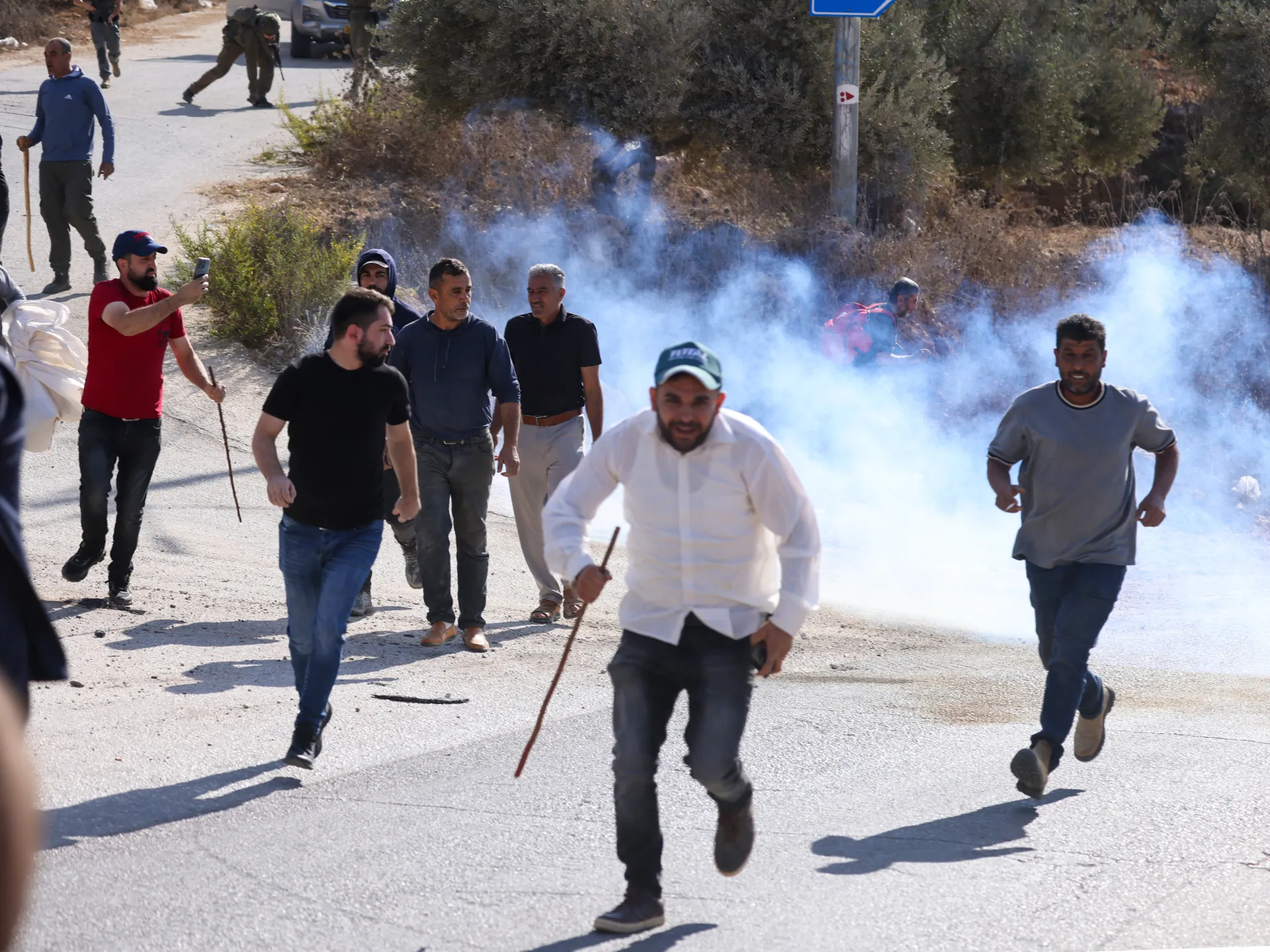
The commission said the incidents included attacks on Palestinian olive harvesters, the burning and uprooting of olive trees, and the theft of crops and livestock. Other Palestinians and their vehicles were also targeted.
Settlers set fire to Palestinian-owned groves and stole olives in what is considered the most important season for harvesting the single-seeded stone fruit.
More than 50 olive trees were uprooted by settlers in Qusra, the commission said.
Settlers also assaulted and injured Palestinian farmers involved in the harvest in the Tal, where a Palestinian-owned vehicle was set on fire, it added.
Additionally, olive harvesters were attacked in Jorish, Beita, Naqoura, Birzeit, Deir Bzeih and Farata.
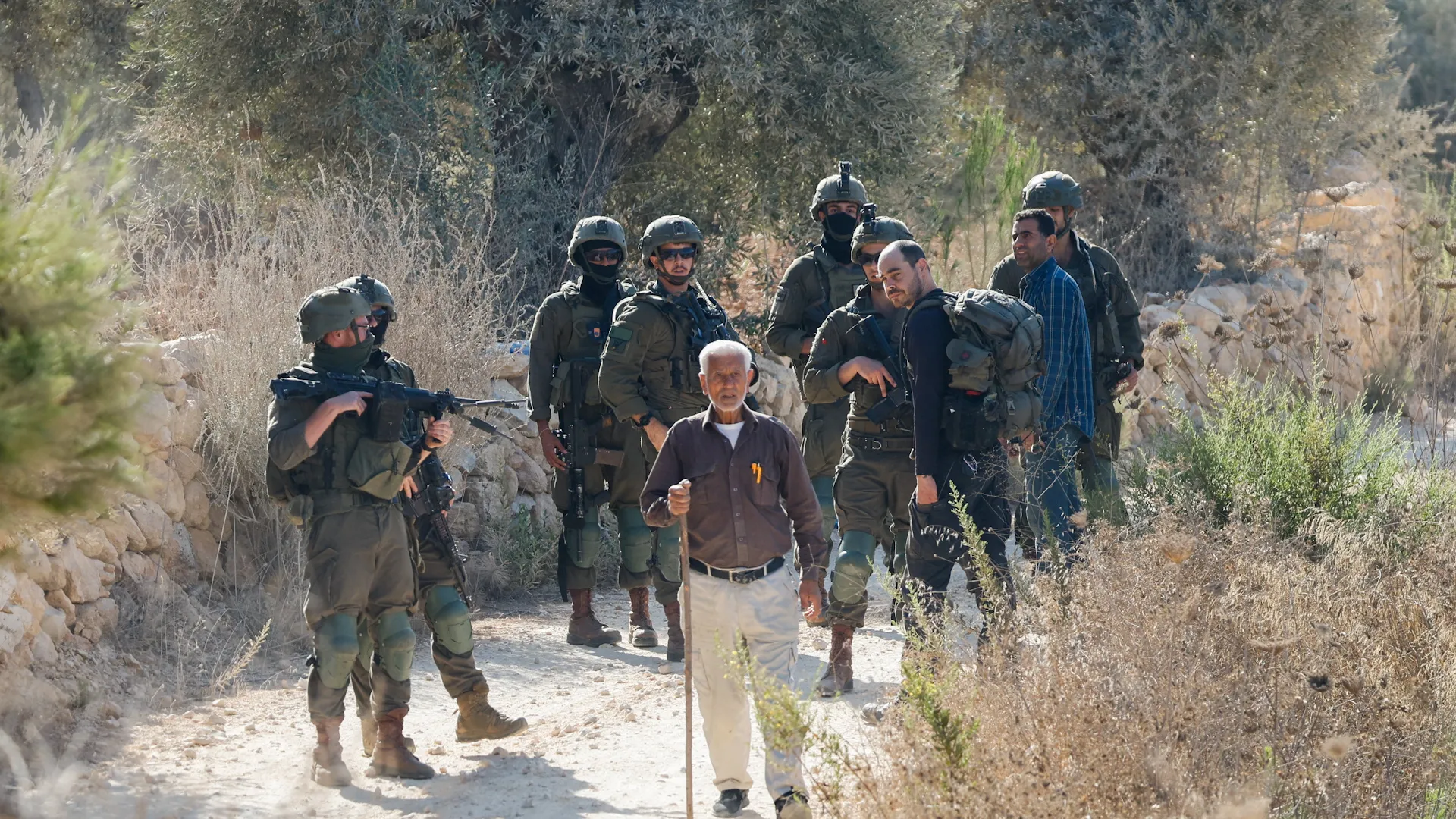
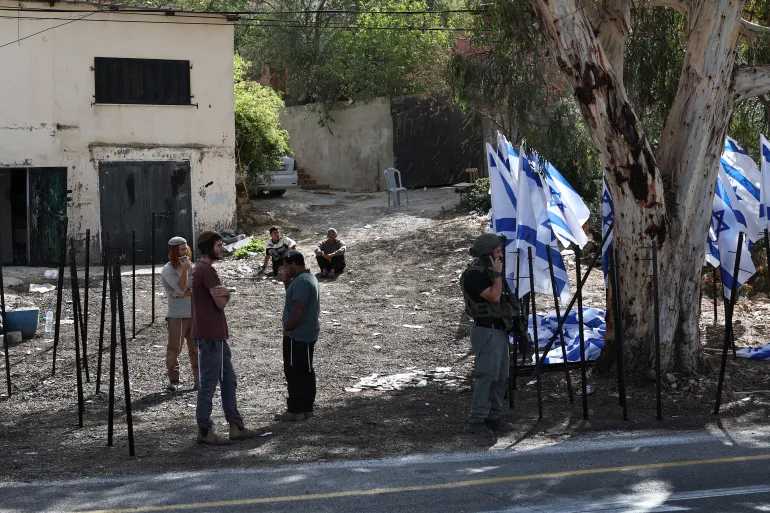
An Israeli security personnel member and Israeli settlers stand near Mou’ayad Mahmoud’s shop in al-Lubban Asharqiya, near Nablus in the West Bank, October 8, 2026 [Atef Safadi/EPA]
A farmer was injured in reported gunfire in Kafr ad-Dik, and the use of live ammunition was reported during a settler pogrom, backed by Israeli forces, in Deir Ballut.
Elsewhere, an elderly Palestinian woman in Berin, east of Hebron, was injured after settlers set their dogs on farmers while sheep were stolen in Ein Qinya.
A Palestinian man and his child were attacked and their vehicle stolen by settlers in Yabrud. Settler attacks on Palestinian-owned vehicles were also reported in the towns of Sarda and al-Rihan.
Brazen attacks against Palestinians
Al Jazeera’s Nida Ibrahim reporting from Ramallah in the occupied West Bank said settlers, backed Israeli forces, have grown more brazen in their attacks against Palestinians during the olive harvest despite the presence of foreign activists and observers.
“Palestinians have to go about the harvest in large groups, that include international solidarity activists, to try to stop settler intimidation and attacks,” Ibrahim said, adding that the settlers wait for the groups to start leaving at the end of the harvest, before springing into action.
“It has become a very difficult journey, as the Palestinians try to leave the harvesting areas, Israeli settlers continue to intimidate them under the protection of the Israeli army,” she said.
As Ibrahim reported, a Palestinian family was under attack by Israeli settlers who recently started building an illegal settlement outpost near Ramallah, “using it as a base to attack Palestinians”, she said.
“No one is being spared,” said Ibrahim.
For Palestinians, the olive harvest is supposed to be a joyous season, but instead, they fear settler attacks and intimidation backed by the Israeli forces.
Sixteen Palestinians arrested
As settler attacks and pogroms continue, the Israeli army arrested 16 Palestinians in raids across the occupied West Bank on Friday, according to the Palestinian Wafa news agency and local sources speaking to the Anadolu news agency.
In Hebron, southern West Bank, Israeli forces arrested nine Palestinians after raiding and searching their homes, including Ibrahimi Mosque Director Moataz Abu Sneineh and Hammam Abu Markhiya, an official responsible for the mosque’s custodians, Wafa reported.
In the city of Qalqilya, Israeli forces arrested five Palestinians during a raid, local sources said.
Two other Palestinians were arrested after Israeli forces raided and searched several homes in Beita, south of Nablus, the sources said.
ATHENS — U.S. Secretary of State Marco Rubio called for the nations of the West to return to their civilizational roots and restore the values that drove the rise of Europe and North America to global dominance for centuries.
In Athens to discuss deepening economic, energy and security cooperation with Greece, Rubio delivered a speech later Wednesday near the ruins of the Acropolis, a widely recognizable symbol of the city’s ancient civilization associated with the creation of popular participatory government and the social contract.
Rubio aimed to remind listeners of qualities he says were born in Greece and later defined the West, such as curiosity, courage, ambition, a restless spirit of exploration and a drive to discover the unknown.
“It has become fashionable today to believe that enlightened foreign policy means prioritizing the ‘global community’ over one’s own people. And I think here, too, we have much more to learn from the men of Ancient Greece. They knew that there was nothing selfish or wrong about loyalty to your nation, nor anything selfish or wrong about fighting to defend its interests above all else,” Rubio said.
Rubio urges Europe to uphold its traditional values
“Today, we find ourselves at a crossroads,” he said. “The next decade will write the story of the next century. The course we take will determine whether the West maintains its place at the head of the world, or resigns itself to a future of atrophy, and servitude, and decline. We will either choose to act now or lose the choice to act at all.”
Rubio is seen by many as the gentle face of the Trump administration and has been frequently dispatched to clarify or otherwise address concerns about the president’s frequently undiplomatic statements.
Rubio, along with Vice President JD Vance, is seen as one of the leading contenders to assume Trump’s mantle at the top of the Republican Party, which faces stiff challenges in next month’s congressional midterm elections. Republican Party, which faces stiff challenges in next month’s congressional midterm elections.
The Trump administration has repeatedly accused countries in Europe of backsliding on their traditional values and democratic principles by stifling the free speech of conservatives and falling short on commitments to international partners like the United States.
Many of those countries have rejected the complaints and accused the U.S. under Trump of being guilty of similar behavior and worse with its staunch anti-immigration stance that some believe is racist.
Left-wing groups protest across Greece
Ahead of his visit to Athens, about 1,500 people gathered to protest Rubio’s presence and the war in Iran, chanting “American killers!”
The demonstration was organized by a communist labor union and other left-wing groups and was held ahead of extensive road closures planned in Athens. Organizers said similar protests were held in at least 12 other Greek cities. Police banned public demonstrations Wednesday in central.
Rubio seeks to reassure NATO allies
Rubio is on the second leg of a three-nation tour of NATO allies that has already taken him to Iceland and will end in Portugal on Thursday. The trip is aimed at reassuring U.S. partners that the Trump administration is committed to their success and security despite what has been an often brusque and sometimes rude approach to traditional friends that has stirred unease.
Rubio began emphasizing historical themes on Thursday, when he met Iceland’s foreign minister at the site of the landmark 1986 summit between former President Ronald Reagan and then Soviet leader Mikhail Gorbachev, a meeting that many believe marked the beginning of the end of the Cold War and was a catalyst for the eventual dissolution of the Soviet Union.
It remains unclear what impact Rubio’s visits will have, although on Tuesday in Reykjavik, he sought to reassure Iceland that President Trump’s administration has no designs on the island. Rather, he said the U.S. shares Iceland’s deep concerns about Arctic security as tensions between the U.S. and Russia rise in the High North and elsewhere.
Iceland has been uneasy about Trump’s intentions toward it after he posted a map showing the colors of the U.S. flag sprawling across all of North America and extending to Iceland and Greenland. That wariness has persisted despite an agreement last month to increase the U.S. presence in the neighboring Danish territory of Greenland that appears to have ended Trump’s demands for the U.S. to take full control of the island.
But after Rubio’s talks in Reykjavik, those tensions appeared to be on the wane. Rubio said the United States would not do anything in Iceland without Iceland’s consent.
Visit follows allegations of misconduct by U.S. ambassador
Before delivering his speech in Athens, Rubio declined to comment when he was asked about allegations of misconduct leveled at U.S. Ambassador to Greece Kimberly Guilfoyle.
At a joint news conference with the Greek foreign minister, Rubio said he would not address the matter while visiting a foreign country, but added: “Suffice it to say our embassy here is doing a great job. Our ambassador has been a strong ambassador here.”
The top Democrats on the Senate Foreign Relations and House Foreign Affairs committees, Sen. Jeanne Shaheen and Rep. Gregory Meeks, have initiated probes into claims reported last month by the Wall Street Journal that Guilfoyle acted improperly while serving as the top U.S. envoy to Greece.
The Journal reported that Guilfoyle told guests at a reception that the U.S. could undermine the Greek government if it chose to, promoted the business interests of one particular Greek construction and energy company, and allowed its lobbyist into private diplomatic meetings.
Guilfoyle, a former Fox News Channel host and California prosecutor who was once engaged to Trump’s son Donald Jr., has denied any wrongdoing, and Rubio has defended her before.
Lee writes for the Associated Press. AP writer Derek Gatopoulos in Athens contributed to this report.
Al-Awsaj, occupied West Bank – On September 23, weeks before Israel’s parliamentary elections, ministers and lawmakers gathered on an occupied West Bank hilltop to inaugurate a new settlement, Metzoke Eretz, illegal under international law. Finance Minister Bezalel Smotrich used the ceremony to salute the settler outpost that made the eventual settlement possible.
“The first pioneering settlers who were here on the farm… we will lift them up as our greatest joy,” Smotrich said. “It shows that the method works: establish a farm, seize the land, prepare it, turn it into a community, move to the next point. There are many, many such heroes – those who prove they are not doing real estate. They are doing Zionism.”
Recommended Stories
list of 3 itemsend of list
Metzoke Eretz was previously an outpost – the name given to the Jewish settlements illegal even under Israeli law – called Netzah Harel, established in 2023 in the middle of al-Muarrajat, a Bedouin community on private Palestinian land east of Ramallah. Alia Mleihat, 29, and others from the community remember those settlers well. “Of course, this outpost played a major role in displacing the Palestinian Bedouin communities in al-Muarrajat and the areas east of Ramallah,” said Alia, now living in a tent in al-Awsaj, a few kilometres away, after her forced displacement in July 2025. “[The Netzah Harel settlers] took part in every attack the settlers carried out on families, and confiscated sheep, under the protection of the Israeli police and army.”
Dror Etkes, founder of Israeli NGO Kerem Navot, said Smotrich’s description of his “method” was spot-on – except for one omission. “The political discourse skips the [Palestinian] expulsion chapter,” said Etkes, suggesting Smotrich and other politicians avoid doing so explicitly to avoid potential scrutiny from international criminal courts. “They want it to happen, and they know that it happens, and they let it happen.”
Haaretz reported that Metzoke Eretz is one of 19 outposts legalised by the Netanyahu government after nearby Palestinians were violently expelled.
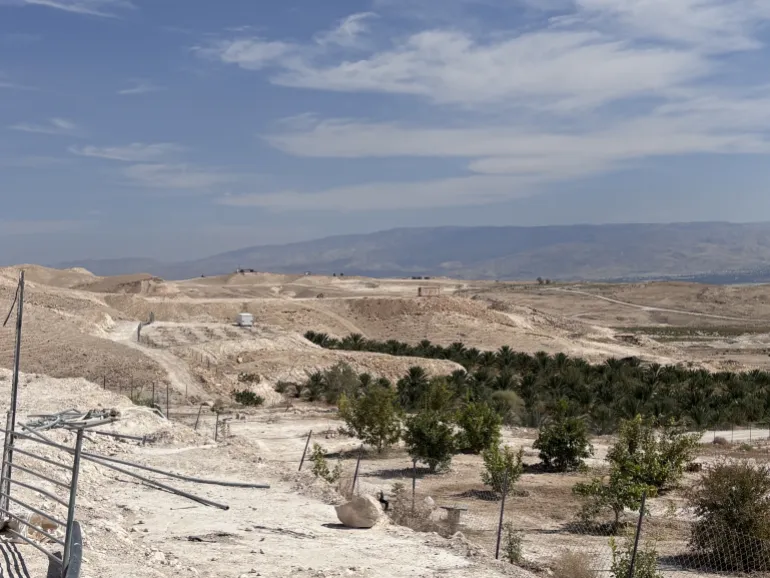
The view from Muhammad Ghawanmeh’s home in al-Awsaj, looking out towards an Israeli outpost on a hill in the background [Al Jazeera]
‘Not a single moment of joy’
Jamal Mleihat, Alia’s 45-year-old uncle, sits with eight relatives nestled inside a bare concrete-block house on the ridge in al-Awsaj, with his daughter Sewar hanging off his lap.
Below the ridge, rows of young trees climb a cultivated slope towards a factory at the foot of the hills. The ridge itself is rock and dust, now home to about 25 families from al-Muarrajat, among others forcibly displaced in the past three years.
“Before October 7 [2023 Hamas attack on Israel, and Israel’s subsequent genocidal war on Gaza], we were in the pastures – no harassment, we moved around freely,” said Jamal, a father of seven. “We had healthcare. We had a school. We had water in the same encampment. Life was a million times better than this.”
Since October 7, the Israeli government has stepped up its raids on the occupied West Bank, while settlers have largely been given free rein to pursue a pogrom against Palestinians, with little pushback from within Israel.
Just below Jamal’s shelter, alone on a slope, Muhammad Ghawanmeh lives with his wife and seven children. His toilet does not work; he relies on water tanks and has almost no electricity. The rocky track to the Mleihats’ area is too steep to drive. He built a fence around the house after recent settler attacks, and now faces constant drone surveillance from Israeli settlers.
Ghawanmeh is from Ras Ein al-Auja, which had been the largest Bedouin community in the central Jordan Valley – so robust that humanitarian coordinators told Al Jazeera in October 2023 that the village’s displacement was unlikely. Instead, its more than 600 Palestinian inhabitants experienced the largest single-community expulsion of Bedouins in the last three years, after repeated attacks by settlers from four surrounding outposts.
“From my childhood, the land was open. The water was open. We were living happily. We’d graze 10 kilometres, 15 kilometres with the sheep, and come back,” he said. “Today we can’t go 500 metres from the house.”
His flock has shrunk from about 300 to roughly 100 physically thinning sheep, which he now must buy fodder for, instead of letting them graze on the land, which he now says is largely forbidden by Israeli settlers and the army.
Jamal Mleihat with his daughter Sewar in al-Awsaj in the occupied West Bank [Al Jazeera]
‘Nothing was left except this’
A few hundred metres beyond Ghawanmeh’s fence, a white trailer and a few containers mark an Israeli outpost, established about six months ago on a hill overlooking Highway 90 and the displaced families along the ridge. Two months ago, Ghawanmeh said, soldiers came to his house and told him he could no longer pass to the highway. The settlers, he said, “are with the army”.
“You leave this place, go to another one, and it follows you – the same problem, unsolved,” Ghawanmeh said. “Every three months, there’s a displacement operation.”
Al-Awsaj barely existed as an inhabited place before, but Bedouin from different depopulated communities have now converged on this barren ridge, overlooking land largely declared – again – off-limits to grazing.
Allegra Pacheco, head of the West Bank Protection Consortium, calls al-Awsaj “basically a refugee camp, an internally displaced camp, that we see in other countries. But here, there’s no safe space. Wherever people like in al-Awsaj go, they’re chased by settlers or their tents are demolished by the Israelis.”
“It’s been very painful to get the authorities, the Palestinian authorities, the international leaders, to recognise that this is a mass displacement happening in front of us, and people have nowhere to go,” she said.
Project of forced transfer
In the West Bank, the United Nations Office for the Coordination of Humanitarian Affairs (OCHA) counts at least 130 Palestinian communities fully or partly displaced by settler attacks and related restrictions since January 2023, and more than 6,400 people uprooted. According to the Palestinian Colonization and Wall Resistance Commission, since October 7, 2023 there have been almost 15,000 attacks by settlers, with 66 Palestinians killed by settlers. OCHA says the rate of settler attacks increased from about three a day before October 7, 2023, to almost seven per day this year.
The increase in displacement after October 2023 can also be seen in the numbers for that year. Nearly 80 percent of all Palestinians displaced by settler violence in 2023 were uprooted after October 7.
A report by Peace Now and Kerem Navot found that Israeli farm outposts had seized roughly 18 percent of the West Bank by the end of 2025. “We’re talking about a land area bigger than the size of the Gaza Strip altogether,” Pacheco said.
“What we’re seeing is a continuous, sustained project of forced transfer and mass destruction,” she said. “Israeli authority demolitions and destructions by the Israeli army, and Israeli civilians – armed groups – carrying out destructions and sowing fear to push people out.”
Israeli NGO B’Tselem’s September report, “The Elimination Project”, links this to Smotrich’s 2017 “Decisive Plan”, which offers Palestinians three choices: live under Jewish supremacy, leave, or face violent repression.
“The Smotrich Plan has been implemented,” Pacheco said. “He laid out exactly what is going on now, and he’s very proud of his success. He now wants to transfer that success to [other areas of the West Bank], and also in the Galilee [an area in Israel with a large population of Palestinian citizens of Israel]. Wherever there are Palestinians living, he wants to make life so difficult that they will leave.”
With Smotrich exercising broad powers over the West Bank through the Settlement Administration within the Ministry of Defence, and leaders in the Israeli West Bank military command increasingly coming from far-right, settler backgrounds themselves, Palestinians across the West Bank describe a deepening symbiosis of military, police, administration and settlers in exacting Palestinian dispossession. “They all work together, like a cell, one completing the other,” said Jamal Mleihat. “The army, the police, the settlers – they’re the ones who displace, they’re the ones who establish the settlement, they’re the ones who take part in the thefts, in everything. And the army covers for them.”
Al Jazeera has reached out to the Israeli authorities for comment on this piece, but has yet to receive a response.
Worse future
Smotrich has withheld part or all of the tax revenues Israel collects for the Palestinian Authority – roughly 60 percent of its income – for much of the past three years. The PA now struggles to provide the most basic of services. In al-Awsaj and elsewhere, that means classrooms that do not open. “The government school is shut down today, no salaries,” Ghawanmeh said.
There is no school bus; families pay for private transport, and “one day they study, one day they don’t, depending on the mood of the driver,” Jamal said. It has left the displaced alone on an inhospitable patch of rock.
“Palestinians have no protection in the West Bank,” said Pacheco. “They are completely vulnerable to assault, attempted murder, arson, invasion of their homes. The Israeli army is supposed to protect them and doesn’t. The Palestinian Authority can’t come in, and the international community is not protecting them.”
“We started to feel there’s no safety anywhere,” Ghawanmeh said. “Fear. Terror. Persecution. Ethnic cleansing. That’s what we feel.”
Amid the dispossession, Ghawanmeh looks out at the unwelcoming land he knows will not be his family’s refuge – only another transient stop. He sees his own brother now only once every month and a half or two. “The threats to Bedouin life have almost become extinction,” he said. “We now live in enclaves, separated.”
“For three years now, the day that’s passing is better than the one that’s coming,” Ghawanmeh said. “Yesterday is better than today. Today is better than tomorrow.”
NORTH West was seen towering over her glam step-mum Bianca Censori, as they made a rare family appearance with Kanye West at a festival.
The rapper, 49, shares his eldest child, 13, along with Saint, 10, Chicago, eight, and Psalm, seven, with his ex-wife Kim Kardashian, 45.
North West towered over her step mum Bianca Censori at an event in LA with her dad, Kanye WestCredit: GettyThe trio were spotted at a convention in LACredit: Getty
The teenage reality star, who is famed for her family’s show The Kardashians, stepped out at ComplexCon with her famous dad and his wife.
Arriving at the Los Angeles Convention Centre for the event, and flanked by a 10-strong security team, the trio looked happy and relaxed.
Sign up for the Showbiz newsletter
Thank you!
With her striking blue hair and full face of heavy make-up, North looked older than her 13 years, as she towered over her step mum Bianca Censori, 31.
The young star’s dad’s wife also looked glam and was wearing a lot more clothes for the occasion than she usually does.
The reality queen’s eldest is currently riding high as a TikTok star, and is also following in her father Kanye West‘s footsteps by forging a music career.
North stood out with her striking blue and heavy make-upCredit: GettyNorth is the eldest of Kanye’s kids, whom he shares with ex-wife Kim KardashianCredit: Instagram
Speaking to the Sunday Timesin the US, mum-of-four Kim, who is datingF1 superstar Lewis Hamilton, 41, said: “I do worry about it. Each kid does what they’re comfortable with.
“So, my little ones come around when I’m filming but they don’t really do storylines.
“North loves it a little bit more than the rest. I hold her back.
“All she wants to do is forward-facing projects.
“And so it’s like us really kind of trying to savour those moments and not doing everything that comes her way, so we can really make sure that we manage it the right way.”
Shai Hope’s 162 leads the West Indies to a record cricket run chase as they beat India by five wickets in the third ODI.
Published On 4 Oct 20264 Oct 2026
Captain Shai Hope’s unbeaten 162 led West Indies to a record run-chase win against India in one-day international cricket in Chandigarh.
The West Indies achieved their highest ODI run chase on Saturday, reaching 352-5 and winning by five wickets with 10 balls to spare after India made 351-7, featuring Lokesh Rahul’s 129 not out.
Recommended Stories
list of 4 itemsend of list
India had already won the three-match series after eight-wicket wins in Thiruvananthapuram and Guwahati. But the West Indies, chasing for the first time in the series, overcame India for the first time since 2023.
Hope promoted himself to opening batter after Jewel Andrew reportedly injured a finger making a catch and had to go to hospital. After keeping wicket for all of India’s 50 overs in high humidity, he batted brilliantly to score his second successive hundred in the series but struggled in the last overs.
Fittingly, he hit the winning run.
“Felt something around the groin area but wanted to fight through till the end,” Hope said.
His second-highest ODI score, from 143 balls, included 17 boundaries and three sixes. Amir Jangoo added 67 off 56 and Keemo Paul 44 off 35.
“[Chasing is] always a lot easier in India, especially with the dew,” Hope said. “Glad we got over the line.”
Hope and Jangoo added 109 off 99 balls for the second wicket to defy an India bowling attack that recalled Mohammed Siraj and all-rounder Nitish Reddy and included debutant pacer Anshul Kamboj, who went wicketless.
Jangoo was run out in the 21st over, but Sherfane Rutherford (24) did not let the momentum slip. He added 56 with Hope, who reached 50 off 46 balls and 100 off 104 in his 21st ODI hundred and fifth against India.
Paul’s cameo included five fours as he added 65 off 61 balls with his skipper. Hope shifted gears after Paul was dismissed in the 41st over, caught off Gurnoor Brar.
Hope hit seven more fours and two sixes after his milestone, taking 62 off the last 39 balls faced to rush West Indies to victory.
India had to serve a slow over rate penalty for the last four overs, with an additional fielder inside the 30-yard circle, as Hope and Gudakesh Motie (19 not out) added 62 off 29 balls for the sixth wicket.
India won the toss again but skipper Shubman Gill was caught behind on 1 and Virat Kohli was bowled for a golden duck. Both fell to Jayden Seales.
Only 28 runs came in the first 10 overs, then Rohit Sharma and Rahul propelled the hosts.
Sharma resurrected the innings with 92 off 85 balls, adding 137 for the third wicket with Ruturaj Gaikwad.
Sharma took his time and was unlucky to miss a second consecutive hundred in the series; he was caught off Paul in the 25th over.
Four overs later, Gaikwad — 57 off 69 — was Seales’s third wicket.
That brought Rahul to the crease, and he led the charge past 350.
Rahul hit six sixes and 10 fours. He scored 50 off 41 balls and his second 50 off 39 balls. He enjoyed good partnerships with Naman Dhir and Brar and finished 129 not out off only 87 balls.
The teams begin a five-match Twenty20 series on Tuesday, starting in Lucknow, Uttar Pradesh.
BRITAIN’S railways continue to see a major overhaul as operators continue to be nationalised – with more to follow in the coming year.
Last week, the Government announced that Avanti West Coast would be taken into public ownership next spring.
Four British train operators are set to be nationalised in the next yearCredit: Alamy
Britain’s railways continue to see major changes as four rail companies are set to be nationalised in the next year.
The decision to take the majority of British train operators into public ownership formed a major part of Labour’s manifesto in 2024, believing the reforms would make trains more reliable and cheaper.
Sign up for the Travel newsletter
Thank you!
It laid out plans to bring all major railways out of the private sector by 2027.
Great Western Railway is set to be taken into public ownership on December 13, 2026.
This is expected to be followed by East Midlands Railway at some point in the latter months of 2026.
The next to be nationalised will be Avanti West Coast, following the announcement last weekend revealing Labour will take control of the private operator from March 7, 2027.
The Government revealed it would be taking Avanti into public ownership “at the earliest opportunity” with Transport Secretary, Heidi Alexander, saying that the service had been “underperforming”, leaving customers “paying the price”.
CrossCountry is the final operator set to be nationalised.
A date for this is yet to be confirmed, however reports indicate it is expected to take place in autumn 2027.
Great Western Railway – December 13, 2026
East Midlands Railway – expected December 2026
Avanti West Coast – March 7, 2027
CrossCountry – TBC (expected autumn 2027)
Many rail companies have made their way into public ownership more recently, as private contracts with the Department for Transport ended.
The following services were all renationalised from 2025:
South Western Railway (SWR) – May 25, 2025
c2c – July 20, 2025
Greater Anglia – October 12, 2025
West Midlands Trains (including West Midlands Railway and London Northwestern Railway) – February 1, 2026
Govia Thameslink Railway (including Gatwick Express, Great Northern, Southern and Thameslink) – May 31, 2026
Chiltern Railways – September 20, 2026
LNER, Northern, Southeastern, TransPennine Express, ScotRail and Transport for Wales Rail are already in the public sector.
While nearly all passenger train operators are set to be taken into public ownership, some services, including private open-access firms, rolling stock companies and rail freight, will not be nationalised.
Israeli settlers and soldiers have attacked and blocked Palestinian farmers from harvesting olives as the season begins. More than 80,000 Palestinian families rely on the olive harvest as a source of income.
Heading into the Birmingham-Cleveland high school football game on Friday night, something had to give in the West Valley League opener. The host Patriots hadn’t lost a league game since 2017 and had beaten Cleveland 13 consecutive times, by an average score of 40-8.
Cleveland, however, was undefeated and looking for its first 6-0 start since 2004.
It wasn’t pretty, but a superlative defensive effort and two impressive first-half drives gave the Cavaliers just enough to defeat the Patriots 14-9. Birmingham fell to 1-5.
Neither team’s most potent offensive weapon was able to take over the game.
Cleveland running back Moyosoreoluwa Odebunmi did most of his damage early, rushing for 40 yards on the Cavaliers’ opening drive, which ended with quarterback Julio Avalos’ one-yard touchdown run.
Odebunmi again carried much of the load on Cleveland’s second drive, contributing 39 yards and scoring on a two-yard run to give the Cavaliers a 14-0 lead.
While Odebunmi was producing for Cleveland, the Cavaliers largely stifled Birmingham’s top offensive threat, wide receiver Paul Turner.
Turner’s biggest play was a 45-yard punt return that set up the Patriots’ lone touchdown, a six-yard pass from quarterback Daniel Kakooza to Aidin Irizary late in the third quarter that cut Cleveland’s lead to 14-9.
“We knew that was one of the keys to getting the win, containing him,” Cleveland coach Mario Guzman said of Turner. “We knew he’d get his catches. That’s inevitable — the kid’s a baller. But we knew if we could contain him, rally and tackle, we’d be in a good position.”
The fourth quarter turned into a comedy of errors. Birmingham blocked a punt to take over at the Cleveland 11, only to have Cleveland block the ensuing field-goal attempt. The Patriots later got another opportunity when Chris Barrera recovered a fumble.
Kakooza then rediscovered Turner, connecting with him six times on the drive as Birmingham drove to the Cleveland three-yard line. But the Patriots again came away empty.
Saeed Ayed* watches over his livestock herd. The animals are starving and parched due to a two-week-long Israeli siege on the Ras al-Ahmar Bedouin community in the occupied West Bank’s Jordan Valley.
Access to the community has been blocked since mid-September, as Israeli forces continue building a barrier through Palestinian land in the area, including a road for military patrols, trenches and embankments.
Recommended Stories
list of 3 itemsend of list
Since the road closures began, movement for Palestinians has been severely restricted. They are forced to move around at night, transporting water, fodder and milk via donkeys under the cover of darkness to avoid detection by Israeli soldiers and settlers.
Ayed told Al Jazeera that no water had entered the community over the past three days after Israeli forces sealed the access points residents had been using to bring in supplies.
“The situation is dire. We are completely besieged, and the livestock cannot survive without water and food for this long,” Ayed said. “We own 15,000 head of livestock, and we fear they will perish because of the siege.”
Ras al-Ahmar is a 300-person village home to around 50 families who have lived off livestock and herding since the 1970s. Ayed said that Israeli settler attacks – part of a wider pogrom against Palestinians across the West Bank – had intensified since February, accusing settlers of trying to force residents out to seize their land.
“We have faced livestock theft, attacks on our dwellings, beatings of residents and vandalism of our homes. This was happening almost daily, yet we refused to leave. Now, they are completely besieging us to force us out,” he added.
The greatest challenge facing residents is restricted access to medical care as a result of the siege, a particular concern for the elderly.
Disease is also rampant among livestock, particularly newborn animals. And with veterinary teams unable to reach the area and treat the animals, deaths have been reported.
The military barrier – which Israel calls Crimson Thread and says it is needed for security – runs for roughly 20km (12 miles) through the northern Jordan Valley, with a width of up to 50 metres (165 feet).
Construction expanded early this year, including the digging of trenches and the bulldozing of agricultural land that damaged wells, water networks and greenhouses. The Israeli military seized nearly 115 hectares, 85 percent of which is privately owned Palestinian land, according to Kerem Navot, which monitors Israeli land policies in the West Bank.
Abdullah Bisharat, head of the village council of Ras al-Ahmar and Atuf, a nearby rural area also facing the military blockade, told Al Jazeera that the Israeli blockade has stopped 51 schoolchildren from attending classes for two weeks because vehicles can no longer reach them.
Israeli forces confiscated a tractor belonging to the village council on Sunday, detaining its driver as he was delivering animal fodder and water to Ras al-Ahmar, Bisharat said.
“We reached out to human rights organisations, but unfortunately no one was able to break the siege. Hundreds of people there are suffering, the majority of whom are women and children,” Bisharat added.
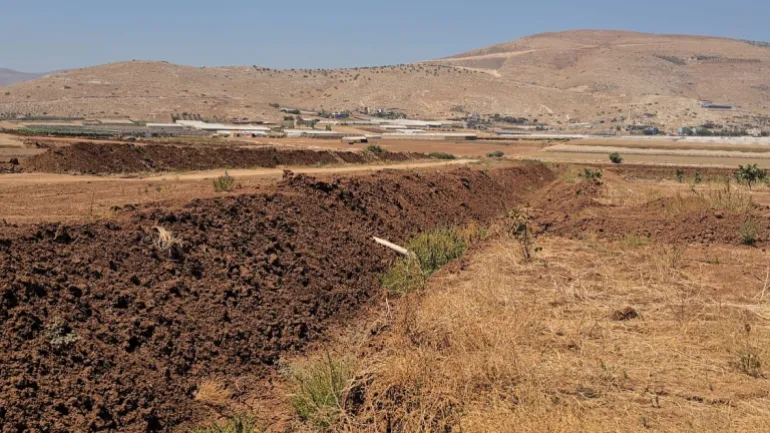
A trench dug by Israel around the rural Bedouin community of Ras al-Ahmar has restricted their movement [File: Moath Ghannam/Al Jazeera]
Broader context
The targeting of Bedouin and herding communities in the Jordan Valley is part of a mounting pressure campaign on residents to abandon their properties by restricting access to land and pastures. The tactics include settler violence, the demolition of structures and the closure of roads and access points.
The United Nations Office for the Coordination of Humanitarian Affairs (OCHA) has described Bedouin and herding communities as among the groups most vulnerable to displacement in the West Bank. Dozens of Palestinian communities across the West Bank have been entirely or partially displaced since 2023, when Israel began its genocide in Gaza and ramped up its attacks on the West Bank after the October 7 Hamas attack.
OCHA has reported that at least 130 Palestinian communities have experienced full or partial displacement since January 2023, with 48 communities completely displaced, including 12 from January to August.
According to OCHA, more than 2,500 Palestinians were displaced in 2026 due to settler attacks and related access restrictions, out of a total of more than 6,400 displaced since 2023.
As the Israeli elections – scheduled for October 27 – approach, Palestinian analysts and rights advocates argue that the measures being implemented on the ground are entrenching a new reality that may persist regardless of the next government.
Hassan Mleihat, chairman of the al-Baydar Organization for Defense of Bedouin Rights, told Al Jazeera that settlers appear to be rapidly intensifying measures aimed at displacing Bedouin communities in the lead-up to the elections.
Mleihat said that Israel’s objective was to expel as many Palestinians as possible and seize control of their land.
“The road being constructed near Ras al-Ahmar aims to dominate the area’s land under security pretexts and to isolate Palestinian communities into tiny geographical pockets, effectively confining their presence there,” he said.
A new reality
Observers believe the significance of these Israeli measures against Palestinian communities extends beyond their immediate impact on the population, creating demographic, geographic and security-related changes that may prove irreversible even if the Israeli political landscape shifts after the elections.
Adel Shadid, an expert on Israeli affairs, told Al Jazeera that Israel currently exercises an unprecedented degree of control over Palestinian territory in the West Bank. Palestinians, he said, live in small, fragmented and scattered enclaves with Israeli control over security, military and economic matters, as well as the minutiae of daily life.
He said the change was not only limited to geography but also entails normalising the presence of illegal Israeli settlements in the West Bank so that they are viewed as an integral part of the region’s fabric, rather than a temporary presence or a reality subject to change.
“This shift is accompanied by the entrenchment of the perception that the West Bank is no longer viewed as a Palestinian area – or even a disputed one – but rather as a territory where Jews have the right to live in safety and security,” he said.
Shadid argued that this perspective also shapes how Israeli and Palestinian communities in the West Bank are perceived by the Israeli state. Israeli settlers are presented as a population requiring protection, while Palestinians are increasingly framed primarily as a security threat.
“This logic extends to how the land and the very elements of life are treated. A tree, for instance, might be viewed as a potential resource for acts targeting the Jewish community; consequently, cutting it down is seen, within this framework, as a security measure that warrants no intervention,” he said.
Shadid said this was also changing perceptions of the role of the Israeli army and police in the West Bank. He argued that the security forces’ role was increasingly seen as protecting settlers against a so-called “Palestinian threat”, rather than restraining settler aggression against Palestinians.
“This new reality is not tied to the current Israeli government. Rather, it creates a dynamic that will persist beyond the elections, regardless of the outcome,” Shadid said.
*Saeed Ayed is a pseudonym used at the individual’s request for security reasons.
It is increasingly difficult to regard what is happening in the West Bank as merely a series of measures that the Israeli government justifies on security grounds or as part of counterterrorism operations. Taken together, the cumulative pattern and expanding scope of these measures point to a broader political and territorial trajectory: one aimed at reshaping the West Bank, imposing new facts on the ground, entrenching Israeli control and advancing the de facto annexation of large parts of the territory while simultaneously subjecting Palestinians to mounting pressure that, directly or indirectly, pushes them from their land.
Israeli, journalistic and research reports have documented the intensification of this trajectory through settlement expansion, land confiscation, restrictions on Palestinian movement, control over water resources and grazing areas as well as military operations and repeated internal displacement in several parts of the West Bank.
Considered individually, each of these measures may appear to be a separate issue. Viewed together, however, they reveal a more consequential development: an effort to re-engineer the geography and demography of the West Bank in ways that undermine the prospect of establishing a contiguous and viable Palestinian state.
The question, therefore, is no longer simply what is happening in the West Bank.
The more urgent question is how can Jordan, the Palestinians, the Arab world and the international community prevent this trajectory from becoming a permanent reality.
Jordan Valley at the heart of the equation
The Jordan Valley assumes exceptional importance in this context, not only because of its geographical and security significance but also because of its agricultural and economic importance and its water resources for the Palestinian people.
Reports concerning the construction of a new Israeli barrier, referred to as the “Crimson Thread”, extending roughly 480km (300 miles) from the Golan Heights to the Red Sea, warrant serious Jordanian, Arab and international scrutiny, particularly if such a project is intended to isolate the Jordan Valley and place as much as 83 percent of its total area under Israeli control.
Such a development could in effect sever the West Bank from Jordan and deprive Palestinians of one of their most important agricultural and water resources.
Borders, walls, roads and settlements cease to be merely physical infrastructure when they are combined with control over land and water. They become instruments for reshaping political and demographic geography and weakening the ability of Palestinians to remain on their land.
This is precisely where the Palestinian issue intersects directly with Jordan’s national security.
Jordan faces a different phase
Jordan cannot treat developments in the West Bank as an exclusively Palestinian matter. At its core, this is an issue of Jordanian national security, regional stability and the future of the Palestinian cause.
Any fundamental change to the geographical or demographic reality of the West Bank will inevitably carry direct consequences for Jordan because of geography, history and proximity. And if the eventual outcome is forced displacement, then, as King Abdullah II has repeatedly made clear, such a scenario would amount to a declaration of war on Jordan.
The policy required of Jordan at this stage, therefore, must be proactive: one that anticipates possible scenarios and prepares for them politically, diplomatically, economically and in security terms.
First: Protect Jordanian national unity
Jordan’s first line of defence is its national unity.
At this stage, it is essential to strengthen the concepts of citizenship and the state, consolidate full equality among Jordanians, and reject any discourse or practice that creates divisions on the basis of origin, region or roots.
The Palestinian cause must remain a national, Arab and humanitarian cause. It must not be allowed to become a source of division within Jordanian society.
Responsibility falls on both the state and society to confront hate speech and incitement, apply the law equally and fairly, and protect the national fabric from attempts to exploit regional turmoil to sow division among Jordanians.
One of the gravest outcomes Jordan must prevent is the transfer of the conflict into its own domestic sphere. Relations among Jordanians of different origins, including those of Jordanian and Palestinian heritage, must never become a vulnerable fault line through which those seeking discord, whether from within the country or from abroad, can operate.
National unity, therefore, is not merely a social value. It is an integral component of Jordan’s national security architecture.
Second: Move from diplomacy of protest to diplomacy of pressure and proportionate action
Jordan has accumulated considerable international credibility and diplomatic capital. The present phase, however, requires Jordan to expand the tools at its disposal.
It is no longer sufficient simply to condemn settlement activity, reject annexation or warn against displacement. What is needed is an Arab, Islamic and international diplomatic front capable of translating political positions into practical measures.
In coordination with Palestine and Arab and Islamic states, Jordan should work to:
Mobilise countries that reject annexation and settlement expansion.
Support international legal action.
Push for concrete measures and sanctions not only against settlements but also against state policies that enable and encourage them.
Systematically document violations.
Use Arab political and economic relations with influential states more strategically, expanding economic cooperation with countries that adopt firm positions against the Israeli occupation while recalibrating engagement with those that remain reluctant to take clear positions towards Israeli policies.
Build an international coalition capable of preventing the imposition of irreversible facts by force.
A comparison with Russia’s war in Ukraine is instructive. When Russia occupied large areas of Ukrainian territory, sanctions were not confined to the territories under occupation; they were imposed on Russia itself. The question, therefore, is why a different standard should apply elsewhere.
The international community does not lack resolutions or statements. What it lacks is the conversion of political will into a tangible cost for those who violate international law.
Third: Establish an Arab and Islamic fund for Palestinian resilience
If the objective is to prevent displacement and enable Palestinians to remain on their land, financial support must become a sustained strategic policy rather than seasonal assistance tied to moments of crisis.
One option would be to establish an Arab, Islamic and international fund dedicated to strengthening Palestinian resilience with a mandate to finance specific projects in the West Bank and Gaza, including:
Protecting land threatened with confiscation.
Supporting farmers.
Developing water resources and irrigation networks.
Assisting affected families.
Financing housing projects in vulnerable areas.
Supporting education and health services.
Assisting municipalities and local councils.
Providing alternative sources of income to families who have lost employment as a result of Israeli measures.
Resilience is not merely a political slogan. It is a material reality.
Every Palestinian family who remains on its land, every farmer who continues to cultivate his fields and every village that retains access to its water resources represents part of the effort to prevent displacement.
Fourth: Treat the Jordan Valley as a Jordanian national security issue
Jordan should address developments in the Jordan Valley as a permanent strategic file.
A specialised Jordanian mechanism should be established to monitor:
Settlement expansion.
Land confiscation.
The construction of roads, barriers and walls.
Demographic changes.
Control over water resources.
Population movements and displacement.
Any measures that could permanently alter the status quo.
These developments should be documented through maps, satellite imagery, statistics and official records so Jordan maintains a comprehensive dossier that can be used politically and legally before the international community.
Struggles over land are not determined by force alone. They are also shaped by documentation, maps, law and the ability to present an authoritative, evidence-based account of what is happening.
Fifth: Strengthen Jordan’s national defence architecture
Strengthening Jordan’s ability to protect its security, borders and national interests is not optional.
Jordan is a country with limited resources, but it possesses significant human and institutional expertise. It can further develop an advanced national defence, civil protection and crisis-management architecture.
This could include strengthening national service and training programmes, enhancing civil defence preparedness, protecting critical infrastructure, reinforcing cybersecurity and border security, and improving disaster and emergency management.
Jordan could also draw on the extensive experience of retired military personnel through structured national programmes under the supervision of appropriate state institutions, thereby strengthening the country’s overall defensive readiness.
The strength Jordan requires is the strength of deterrence, protection and preparedness, not an impulse towards an ill-considered confrontation.
Sixth: Prevent Jordan from becoming an “alternative homeland”
This issue must remain at the centre of Jordanian strategic calculations.
Any project that directly or indirectly leads to the depopulation of the West Bank or pushes large numbers of Palestinians towards Jordan is not merely a humanitarian question. It would carry profound political, security and demographic consequences for the kingdom.
Jordan’s position, therefore, must remain unequivocal: Resolving the Palestinian question cannot come at Jordan’s expense; displacement is not a political solution; and Jordan is not an alternative homeland for the Palestinian people.
At the same time, Jordan must preserve the humanitarian and legal dimensions of its response to any forced developments, so that opposition to displacement does not translate into further suffering for civilians.
The views expressed in this article are the author’s own and do not necessarily reflect Al Jazeera’s editorial stance.
Gaza’s health toll mounts, with 1,439 dead and 5,052 injured since the ceasefire began in October 2025.
Published On 1 Oct 20261 Oct 2026
An Israeli drone strike has killed a Palestinian man and wounded several others in southern Gaza while settlers shot dead another Palestinian man near Ramallah in the occupied West Bank.
The body of Tamer al-Hamayda, 42, and three wounded people were brought to Nasser Medical Complex on Thursday after the strike hit a tent sheltering displaced Palestinians in the al-Mawasi area, west of Khan Younis on the southern coast of the Gaza Strip.
Recommended Stories
list of 3 itemsend of list
Another Palestinian succumbed to wounds sustained in an earlier Israeli drone strike on Tuesday that targeted a gathering of Palestinians in Jabalia refugee camp in northern Gaza, according to medical personnel in Nasser Medical Complex.
Israeli forces also carried out a large-scale demolition operation targeting buildings east of Gaza City’s al-Tuffah neighbourhood.
The Gaza Health Ministry reported eight new deaths and 26 wounded over the past 24 hours, putting the toll since the “ceasefire” took effect in October 2025 at 1,439 killed and 5,052 wounded, with 834 bodies recovered from the rubble.
Israel’s war on Gaza has killed at least 74,040 Palestinians and wounded 175,168 since October 2023, the ministry said.
Occupied West Bank pogroms
In the occupied West Bank, Israeli settlers shot dead a Palestinian man and wounded another during a raid on the village of Yasuf, north of Ramallah, on Thursday.
51-year-old Mashhour Yassin was shot dead by settler gunfire, the Palestinian Health Ministry said.
Describing the attack, the Palestinian Ministry of Foreign Affairs said Israeli forces had detained an ambulance, seizing its key and throwing it aside, “in a crime that reflects clear coordination between the settlers and occupation forces.”
It said the killing “falls within the framework of a serious and continuous escalation in organised settler crimes,” saying Israel gives free rein to settler “terrorism against our people in the service of settlement, annexation, forced displacement and ethnic cleansing plans.”
Yasuf Mayor Jumaa Abdel Fattah told the AFP news agency that dozens of Israeli settlers armed with sticks and firearms had attacked the village, which lies between four Israeli settlements.
“Yassin was at his doorstep when the settlers attacked the village homes. He went out to defend his house,” Abdel Fattah said, adding that Yassin’s nephew was also wounded in the attack.
Abdel Fattah said the settlers had come from Havat Anton, an illegal Israeli settlement established in July that has previously attacked the village’s residents.
Palestinians in the occupied West Bank have reported a surge in settler pogrom attacks in recent months.
More than 500,000 Israelis live in West Bank settlements considered illegal under international law.
According to the UN, at least 1,112 Palestinians in the occupied West Bank have been killed by Israeli forces or settlers in the territory since October 2023, including at least 37 killed by settlers.
Fighting in Sudan’s Kordofan region has intensified since late 2025, turning it into one of the main battlegrounds in the war between the Sudanese Armed Forces (SAF) and the paramilitary Rapid Support Forces (RSF), now in its fourth year.
The vast region, which comprises North, West and South Kordofan states, lies where the two sides’ areas of control meet, between the army-held central region and the RSF-controlled Darfur in the West. In recent months, the SAF has pushed the RSF out of much of North Kordofan.
The battle is increasingly being fought from the air. Drone strikes on towns in North Kordofan are growing more frequent and deadly, and civilian infrastructure has been hit across the region.
Since the war began in April 2023, one in five recorded attacks in Sudan has taken place in Kordofan.
Al Jazeera maps where the fighting is concentrated in Kordofan and across Sudan, and the displacement that has followed.
Who controls what on the ground?
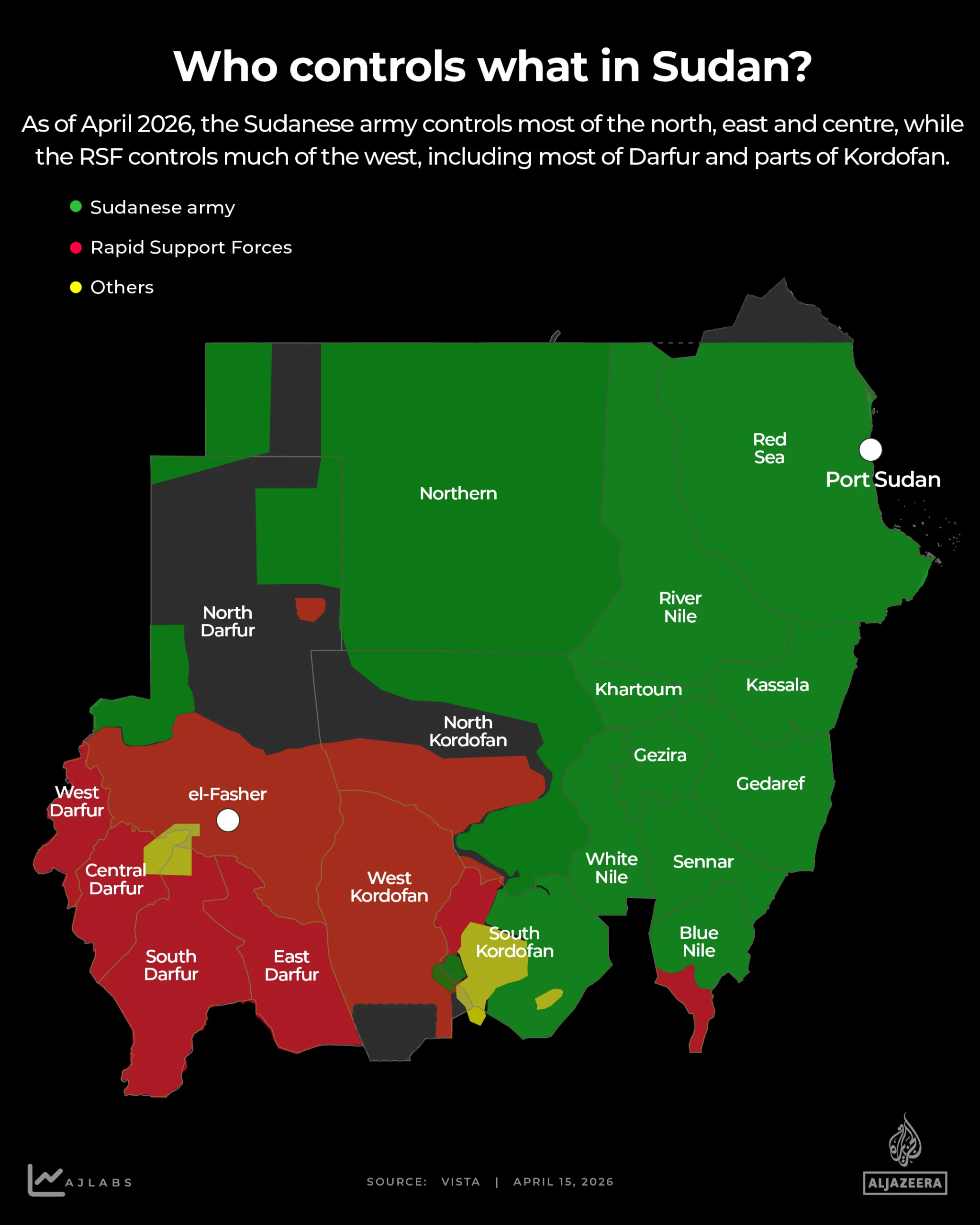
Sudan is broadly divided between the two sides. The SAF controls the capital, Khartoum, and most of the north, east and centre, while the RSF controls the west, including almost all of Darfur and parts of Kordofan. Smaller armed groups, including the RSF-allied Sudan People’s Liberation Movement-North (SPLM-N), hold pockets of territory in the south.
The army has the upper hand in the north, the RSF in the west, and South Kordofan remains contested.
Where have most attacks occurred?
According to an Al Jazeera analysis of data from the Armed Conflict Location and Event Data (ACLED), an independent conflict monitor, there were 14,648 recorded attacks between the start of the war on April 15, 2023, and September 19, 2026.
The four most affected states include:
Khartoum: The capital region has seen the most, with 5,719 attacks, or 39 percent of the total, almost three times as many as North Darfur, the second-highest
North Darfur has witnessed 1,999 attacks (13.7 percent)
Gezira state has seen 1,435 attacks (9.8 percent)
Kordofan emerged as a major centre for fighting. North, South and West Kordofan together recorded 2,876 attacks, or about 19.7 percent of all recorded attacks, putting the region behind only Khartoum when considered collectively.
Who has carried out the most attacks?
The SAF is associated with the largest share of recorded attacks between April 15, 2023 and September 19, 2026, accounting for just over half (52 percent), compared with just over a third (34.7 percent) for the RSF and 13.3 percent for other actors.
Smoke billows after drone strikes by the paramilitary Rapid Support Forces (RSF) targeted the northern port in the Red Sea city of Port Sudan, Sudan, on May 6, 2025 [AP Photo]
The balance of attacks has shifted over time. The SAF was associated with more recorded attacks than the RSF in the first year and a half of the war, before the RSF overtook it in number of attacks from late 2024 to mid-2025.
Since August 2025, the two sides’ monthly attack counts have been closer, with the SAF generally recording slightly more, even as the overall number of attacks has fallen sharply.
Where have attacks in Kordofan occurred?
After the fall of el-Fasher, the last major Darfur city held by the army and its allies, in October 2025, attention shifted to Kordofan. The region sits between RSF-held Darfur and the army-held centre, north and east, forming a corridor between the two sides’ heartlands.
Kordofan’s three states recorded 2,717 attacks: North Kordofan had 1,205 (44 percent), South Kordofan 789 and West Kordofan 723. Adding Abyei, a disputed oil-rich area on the Sudan-South Sudan border that was historically part of Kordofan, brings the total to 2,878.
Soldiers arrive at the Allafah market, in an area recently recaptured by Sudan’s army from the Rapid Support Forces paramilitary group, in the al-Kalalah district, south of Khartoum, Sudan, on March 27, 2025 [AP Photo]
The concentration of attacks differs from state to state. In North Kordofan, Sheikan locality alone accounted for 497 attacks, or 41 percent of the state’s total. Sheikan is home to the state capital, el-Obeid, a commercial and administrative hub linking central Sudan with the west. Taking the city would open a route east towards Khartoum for the RSF.
On September 9, a drone strike on a college in el-Obeid tore the roof off the building and killed a security guard, the college’s dean, Abdel Aziz al-Sheikh, told Reuters.
“As you can see, the entire faculty is destroyed and we feel that our dreams are destroyed, our future is destroyed,” Omnia Aboul Gassim, a student who had sat her exams at the el-Obeid college just one day before the attack, told Reuters.
In South Kordofan, Dilling locality was the main hotspot, with 242 attacks (31 percent), followed by Kadugli with 107 (14 percent) and Al Quoz with 94 (12 percent).
Attacks in West Kordofan were spread more evenly across localities. Babnusa recorded the most, with 142, followed by En Nuhud (119), Al Khiwai (112) and Abu Zabad (111).
ACLED has recorded at least 12,314 reported fatalities in Kordofan since April 2023.
The SAF was associated with 1,323 attacks (46 percent) across all three states in Kordofan, compared with 920 (32 percent) for the RSF and 633 (22 percent) for other actors.
How many people are displaced?
About 8.6 million people remain internally displaced across Sudan, according to the latest United Nations figures, down from a peak of 11.6 million in January 2025 as millions returned home to areas retaken by the army. New displacement continues in Kordofan, Darfur and Blue Nile.
Darfur hosts the largest concentrations of internally displaced people (IDPs), particularly South and North Darfur.
Returns have steadily increased since 2025, reaching about 5.1 million by August 2026. Khartoum has seen a major return of displaced people, with about 2.7 million returnees.
A displaced woman from Dalanj braids her grandmother’s hair at a displacement registration centre in El Obeid, North Kordofan State, Sudan, on January 15, 2026 [El Tayeb Siddig/Reuters]
Despite the decline, millions remain displaced more than three years into the war. The International Organization for Migration (IOM) says the number of people newly displaced in Kordofan since fighting escalated in October 2025 has risen 65 percent in four months, from more than 132,000 in February to at least 219,000 by late June.
The agency has warned that el-Obeid, which shelters about 500,000 people, including more than 83,000 displaced, faces a looming threat of a full-scale invasion.
“The warning signs are impossible to ignore,” said IOM Director General Amy Pope earlier this month. “Across Sudan, families are fleeing violence, losing access to water, electricity and healthcare, and now facing the added burden of destructive floods.”
The resolution cites a ‘lack of accountability’ by Israel’s government and an ‘inability to secure justice’ by the US.
The United States Senate has blocked a resolution that would have required President Donald Trump’s administration to report on the killing of nine Americans in the occupied West Bank and on Israel’s treatment of Palestinian children in military detention.
The resolution failed 47-53 on Tuesday, with senators voting largely along party lines.
Recommended Stories
list of 4 itemsend of list
It was brought to the floor by Senator Chris Van Hollen, a Democrat from Maryland, and cited a “lack of accountability” from the government of Israeli Prime Minister Benjamin Netanyahu and an “inability to secure justice” from the US government.
Senator John Fetterman of Pennsylvania was the only Democrat to vote against advancing the resolution, while Senator Rand Paul, a Republican from Kentucky, joined Democrats in supporting it.
Van Hollen forced the vote under the Foreign Assistance Act of 1961, which allows individual members of Congress to demand a formal State Department report on the human rights practices of any country that receives US security assistance.
“Violence is raging in the West Bank, & despite the deaths of nine Americans, the wrongful detention of even more, & the daily torment of Palestinians, we have no accountability from the U.S. or Israeli govt”, Van Hollen wrote on X before the resolution was brought to a vote.
Nine Americans killed
The resolution called for an unclassified report within 30 days of adoption. It would have detailed investigations into the deaths of the Americans, the treatment of US citizens held in Israeli prisons, and the conditions facing Palestinian children in Israeli military detention.
The measure cited the deaths of nine American citizens in the occupied West Bank since January 2022, including Shireen Abu Akleh, a Palestinian-American journalist and Al Jazeera correspondent who was shot in the head and killed in May 2022 while reporting in the city of Jenin.
It also included Aysenur Ezgi Eygi, who was shot in the head and killed by an Israeli soldier in September 2024, and Sayfollah Kamel Musallet, who was beaten to death by Israeli settlers in July 2025.
The others were Amer Mohammad Saada Rabee, who was 14; Tawfic Abdel Jabbar and Mohamed Ahmad Alkhdour, both 17; Omar Assad; Khamid Ayyad; Nasrallah Abu Siyam; and Khamis Rabee Jabara.
The resolution also noted the arrests of several Palestinian-American children by Israeli forces.
Among them was Mohammed Ibrahim, a 16-year-old from Florida, who was arrested in February 2025 and held in pretrial detention for nine months without contact with his family. It noted that US embassy officials and lawyers who met him told his family that he had lost nearly a quarter of his body weight, contracted scabies, and was beaten and tortured.
Other Palestinian Americans who remain in custody include Adam Wajeh Abdelfattah Karakrah, 16, and Sama Safi, 20, a student detained in June in raids targeting students at Birzeit University.
The resolution cited rights groups that have documented the deaths of at least 44 Palestinians in Israeli military camps since the Hamas-led attacks of October 7, 2023. Those groups, it said, have documented widespread abuses, including beatings, sexual violence, harassment and threats, “pointing to systemic and deliberate mistreatment”.
It also went on to note a sharp escalation in Israeli settler pogroms in the occupied West Bank, and stressed that there have been no convictions for the killings of Palestinian civilians by Israeli settlers since 2020.
Mohammed Abu Hijleh still finds it hard to believe that his mother passed away just over a week ago; she had suffered from nothing more than diabetes. But the restrictions Israel imposes on various cities, towns, and villages in the occupied West Bank can alter a Palestinian’s life in an instant.
Zahriya Abu Hijleh, 66, was attending her niece’s wedding reception in her hometown of Deir Istiya, northwest of Salfit, on September 20, when she suddenly felt dizzy and collapsed.
Recommended Stories
list of 3 itemsend of list
After she was taken to the town’s medical centre, the doctor immediately ordered her transfer to Salfit Governmental Hospital, a facility just an eight-minute drive from Deir Istiya.
Mohammed requested an ambulance, but the vehicle could not enter the town because the iron gate operated by Israeli forces at the entrance was closed. Instead, an ambulance from the medical centre transported her to the gate, and from there, she was taken off the stretcher, carried past the gate on foot, and transferred to a second ambulance waiting on the other side.
It is a scenario that happens repeatedly in the occupied West Bank, Mohammed told Al Jazeera.
“My mother was breathing her last; had the gate been open, we wouldn’t have lost her on the way,” he said.
Medics later determined that Zahriya had suffered a pulmonary embolism and required urgent treatment, according to her family.
“Sadly, she died due to the delay,” Mohammed said. “She had no prior health issues other than diabetes.”
A Palestinian student crosses an Israeli checkpoint as students return to school for the new academic year, near Hebron in the Israeli-occupied West Bank, September 6, 2026 [Mussa Qawasma/Reuters]
Comprehensive closures
The military checkpoints and iron gates erected by Israel in the West Bank have become a significant source of misery for Palestinians.
They disrupt daily life, causing delays for people trying to reach work, schools, and universities, while also posing a daily threat to the lives of the sick.
Israel periodically imposes closures on the West Bank for various reasons, including Jewish holidays. The current closure runs from September 27 to October 3, coinciding with the Jewish festival of Sukkot.
While Israeli settlers move freely between West Bank cities, and even storm Palestinian villages and towns under Israeli army protection, Palestinians are forced to wait for hours at closed checkpoints.
Ibtihal Mansour from Nablus endured such an ordeal last Friday while visiting her in-laws’ home in the village of al-Janiya, near Ramallah.
The family left the village at 10am, hoping to reach Nablus within 45 minutes. But they encountered closures at the Atara and Ein Siniya checkpoints north of Ramallah, effectively trapping them in the area.
“We tried taking alternative routes west of Ramallah, but were surprised to find the road between Ramallah and Nablus blocked by settlers, with all vehicle traffic completely halted. We remained on the roads, trying to find any way through, until midnight, a span of more than 14 hours,” she told Al Jazeera.
Her children were crying, exhausted after spending so long confined in the vehicle. Passing through one roadblock near Nablus, in an area called al-Lubban Asharqiya, a soldier forced Ibtihal to wake the children. When her 11-year-old son did not wake up, she said that the soldier punched him in the head, causing him to jolt awake crying.
“The scene was heartbreaking; I felt a deep lump in my throat and profound sorrow. Long hours of waiting in the vehicle ended with an assault like this, and the ordeal didn’t even end there,” she said, explaining that they had to turn back. “We were forced to spend the night at my sister-in-law’s home in Ramallah before setting out early the next morning for Nablus.”
Like Ibtihal’s family, many Palestinians travelling between cities and villages are forced to stay overnight in hotels or at relatives’ homes. Some municipalities have converted wedding halls and mosques into shelters for those stranded, providing meals donated by residents of towns near the checkpoints.
The Colonization and Wall Resistance Commission (CRRC) recorded 942 checkpoints, closure points, and obstacles across the occupied West Bank as of September 25, up from 793 in March 2024.
The total length of the obstacles amounts to approximately 107.7km (70 miles), according to data from the UN Office for the Coordination of Humanitarian Affairs.
The CRRC says the closures effectively fragment Palestinian communities, making access to workplaces, schools, medical facilities, and agricultural land dependent on whether roads and crossings are open.
Al Jazeera has reached out to Israeli authorities for comment on the road closures and the allegations from Palestinians in this article, but has yet to receive a response.
Strangling Hebron and Jerusalem
In Hebron – which has an Israeli settler presence in the centre of the Old City – the Israeli army has closed the Ibrahimi Mosque to Palestinians and tightened restrictions at checkpoints and gates leading to the site until Wednesday, all while securing access for settlers to celebrate Jewish holidays.
Issa Amro, coordinator of the Youth Against Settlements group, told Al Jazeera that soldiers have closed checkpoints and imposed curfews in several city neighbourhoods, restricting resident movement and making it increasingly difficult to reach the Old City and the Ibrahimi Mosque.
“The area west of the mosque contains settlements and closed zones, while access from the east is limited to a few roads. These measures make reaching the site both more difficult and more dangerous,” he explained.
The situation in occupied East Jerusalem is also fraught, as Israel imposes strict restrictions on Palestinian movement and access to the Al-Aqsa Mosque, while thousands of Israeli settlers enter the site and move about unhindered under heavy security escort.
Activist Fakhri Abu Diab told Al Jazeera that Israel’s closures in occupied East Jerusalem during the Jewish holidays are part of attempts to impose religious sovereignty over the city.
Abu Diab explained that Israeli settlers and hardliners head either to storm the Al-Aqsa Mosque or to synagogues to perform religious rituals, while Palestinians are forced to remain at home.
He described how the closures disrupt daily life in East Jerusalem, shutting shops, schools, and workplaces, and halting movement.
“Israeli police restrict the movement of Jerusalemites. Families and vehicles attempting to move about risk being attacked by extremists and settlers, while the latter are permitted to roam freely and dominate the streets,” he said.
Kohli remained not out on 139 off 88 balls as the hosts romped to an eight-wicket win in their first ODI of the series.
Published On 28 Sep 202628 Sep 2026
Virat Kohli has become only the second batter after Sachin Tendulkar to reach 15,000 runs in men’s one-day international (ODI) cricket, achieving the milestone with an unbeaten century as India cruised to an eight-wicket victory over West Indies.
Kohli struck 139 not out from 88 balls and Shubman Gill made 110 as India chased down 296 with 50 balls to spare to take a 1-0 lead in the three-match ODI series on Sunday.
Recommended Stories
list of 4 itemsend of list
The milestone comes just days after Kohli announced that he would retire from national duty after next year’s 50-over World Cup. The leading century-maker in ODIs has already retired from T20 internationals and Test cricket and now represents India only in the 50-over format.
Rohit Sharma and Gill launched the chase with a 74-run opening stand before Sharma was dismissed in the 12th over. Gill, the world’s top-ranked ODI batter, then took control, maintaining the aggressive approach and bringing up his 10th ODI century with a sweep.
Kohli came in at number three and notched his 86th international century, while Gill struck 110 in 108 deliveries as the pair put on a dominant 151-run stand off 132 balls that all but sealed the contest on Sunday.
Roston Chase eventually removed Gill, but Ruturaj Gaikwad made 13 off 19 balls and helped Kohli steer India home without further alarm. Kohli sealed victory with successive boundaries.
Put in to bat after the toss, Justin Greaves and John Campbell gave the West Indies a strong start, adding 135 from 117 balls for the opening wicket.
India struggled to find a breakthrough for much of the first 20 overs as the pair dominated the bowling and provided a solid platform.
Greaves, who was dropped by Sharma on 16, made India pay with a maiden ODI century and top-scored for the visitors.
The momentum shifted when Kuldeep Yadav dismissed Campbell in the 20th over, beating him in the air as he swept a catch to short fine leg. Yadav and Prasidh Krishna then applied the brakes on the West Indies innings as they lost four wickets for 22 runs between the 31st and 36th overs.
Yadav finished with 4-40 on his ODI return, but Amir Jangoo counterattacked with 58 off 43 balls. With support from Chase, he helped the West Indies recover from 198-5 and post 295.
ANDY Burnham is set to nationalise Avanti West Coast next year as Labour pledges to start “delivering for passengers”.
The Government will take control of the private operator from March 7 as the PM said passengers had been failed “time and time again”.
Avanti West Coast is set to be nationalised from next year, the government has announcedCredit: Getty
An extra £10million is set to be invested in power and signalling maintenance in addition to £840million earmarked for infrastructure on the West Coast Main Line, reports ITV.
The government hopes timetable changes will also improve services for passengers as well as boosted WiFi connectivity.
Sign up for the Travel newsletter
Thank you!
It was also announced that Euston station in London will receive a £50million upgrade.
Transport Secretary, Heidi Alexander said: “For years, we’ve heard stories of Avanti underperforming, with passengers left paying the price. Enough is enough.
“That is why we will bring Avanti into public ownership at the earliest opportunity, in March next year.
“This Labour Government is committed to putting essential services back in public hands, connecting people to opportunity and delivering growth in every postcode and this move reflects that commitment.
“We will also introduce a comprehensive improvement plan, focused on delivering for passengers, not shareholders.”
Avanti West Coast’s contract is due to come to an end on March 7, 2027.
That will leave East Midlands Railway and Cross Country as the only train operators yet to be nationalised.
Prime Minister Andy Burnham blasted Avanti, saying they had failed passengers “time and time again”.
In a post on X he said: “We’re putting essential services back in public hands and building a railway that actually works for the people who use it.”
It comes as Avanti West Coast recorded the highest number of cancellations in the UK this summer, according to analysis by The Times.
That is double the national average as they made 1.4million delay repay claims in the year to March – around a million more than in 2019, according to the outlet.
Andy Mellors, managing director at Avanti West Coast, said: “We’re proud of what we’ve achieved over the last six years – from refurbishing our Pendolino fleet and introducing our new Evero trains to running more services than ever before.
“Together, these improvements have given customers greater choice, more capacity and better connectivity, while we’ve continued to innovate to shape the future of the West Coast and wider rail industry.
“Over the coming months, we’ll work closely with the government to ensure a seamless transition into public ownership while remaining focused on delivering for our customers and communities.”
A reduced timetable will also continue between Christmas and the new year due to engineering works, with the scheduled change aiming to “save taxpayers money“.
Smotrich told Ynet News that Israel needs to “go to war in Judea and Samaria, to do there what we did in Gaza’.
Published On 27 Sep 202627 Sep 2026
Far-right Finance Minister Bezalel Smotrich says the Israeli military should “go to war” in the occupied West Bank and repeat what it “did in Gaza”.
Using a biblical term for the occupied West Bank, the minister told Ynet News in an interview published on Sunday that Israel needs to “go to war in Judea and Samaria, to do there what we did in Gaza, to dismantle the Palestinian Authority, which is a terror authority”.
Recommended Stories
list of 3 itemsend of list
Smotrich was responding to a question on how Israel should combat the increasing “security tensions” in the occupied West Bank, where Israeli violence against Palestinians has been steadily growing since the eruption of Israel’s genocidal war on Gaza in October 2023, but the attacks have intensified significantly this year.
“We need to tell” Israeli forces, he said, “Just as you dismantled Hamas in Gaza, there won’t be terror infrastructure in Judea and Samaria”. “No terrorists, no weapons, no tunnels.”
The United Nations Office for the Coordination of Humanitarian Affairs (OCHA) recorded more than 1,330 settler-related attacks on Palestinians in the West Bank from January to late July, averaging six a day, the highest rate in about 20 years.
Various settler groups, often supported or protected by Israeli soldiers, have attacked Palestinians in several ways, including shootings, besieging homes and engaging in other forms of communal violence that experts have described as “pogroms“.
Rights groups warn that settlers are increasingly armed with military-issued weaponry and wear military uniforms during attacks, blurring the line between settler and soldier.
Military closure
The comments come as Israeli authorities announced a comprehensive military closure across the occupied West Bank, citing the Jewish holiday of Sukkot. The heightened restrictions on the movement of Palestinians are set to remain in place until October 3.
Meanwhile, in occupied East Jerusalem, hundreds of Israelis stormed the courtyards of Al-Aqsa Mosque under heavy protection from Israeli police on Sunday.
Palestinian news agency Wafa reported that the Israelis entered the compound through the Moroccan Gate and performed Talmudic rituals, as Israeli forces increased restrictions around the mosque and across Jerusalem’s Old City.


![The view from Muhammad Ghawanmeh’s home in al-Awsaj, looking out towards an Israeli outpost on a hill in the background [Al Jazeera]](https://i0.wp.com/www.aljazeera.com/wp-content/uploads/2026/10/View-from-Muhammads-looking-out-towards-the-outpost-seen-on-hill-in-background-1791321948.jpeg?w=640&ssl=1)
![Jamal Mleihat with his daughter Sewar in al-Awsaj in the occupied West Bank [Al Jazeera]](https://i0.wp.com/www.aljazeera.com/wp-content/uploads/2026/10/Jamal-Mleihat-with-his-daughter-Sewar-1791322462.jpeg?w=640&ssl=1)