Countries raise concerns after Chinese military test-launches ballistic missile from submarine in the Pacific Ocean.
Published On 6 Jul 20266 Jul 2026
China has test-fired a missile from a nuclear submarine that landed in “designated waters” in the Pacific Ocean, state news agency Xinhua reports, drawing criticism and concerns from Japan, Australia and New Zealand.
The Chinese navy test-launched the long-range ballistic missile at 12:01pm (04:01 GMT) on Monday from one of its nuclear-powered submarines in the South Pacific, Xinhua reported.
Recommended Stories
list of 3 itemsend of list
Xinhua said the test was a “routine arrangement” of China’s annual military training and was not directed at any specific target.
Australian Foreign Minister Penny Wong confirmed that China had notified the government of plans to conduct a sea-based missile test into the Pacific but said the action was “destabilising” to the region.
“Australia has been clear that this proposed test is in the context of a rapid military build-up by China, which is lacking in the transparency and reassurance as to intent that the region expects,” Wong told reporters at a news conference in the Fijian capital, Suva.
Japan’s government said it was notified of the missile launch and had urged China to reconsider.
“We expressed our grave concern over the Chinese military’s increased activity,” the government said, adding that Japan’s coastguard had been notified on Sunday by Chinese authorities about falling space debris that could fall within Japan’s exclusive economic zone.
The New Zealand government said it was informed of the planned launch within hours of it taking place.
“New Zealand considers this an unwelcome and concerning development. We, like our neighbours in other Pacific countries, have no interest in China using the South Pacific as a testing site for missile capability,” Foreign Minister Winston Peters said in a statement.
Weekly insights and analysis on the latest developments in military technology, strategy, and foreign policy.
Imagery has recently appeared showing a Russian Sukhoi Su-57 Felon fighter with an unusual external weapons load of short-range air-to-air missiles, as well as what looks like a previously unseen type of targeting pod. While we cannot say for sure, we may just have gotten our first close look at a Su-57 equipped to counter the Ukrainian kamikaze drones and cruise missiles that are now a regular menace to air defenses increasingly deep inside Russia.
Two photos, the original source of which is unclear, show a Su-57 configured with a pair of R-73/R-74 (AA-11 Archer) series short-range air-to-air missiles on pylons under the wings. One of those photos further shows the mysterious targeting pod below the left engine nacelle.
This rear view of a Su-57 reveals the two missiles underwing as well as the targeting pod below the left engine nacelle. via X
Both show a Su-57 seen from the rear inside a large shelter. One photo apparently surfaced on the TikTok social media platform. Somewhat surprisingly, it is one of a pair that also show apparent teenagers posing alongside the Felon — one of them inside the fighter’s cockpit — suggesting some kind of unofficial tour of the base.
The photos have been reposted on Russian social media, with military bloggers identifying them as showing Su-57s configured to hunt and shoot down Ukrainian drones.
A civilian, apparently a teenager, sits in the cockpit of a Su-57. via X
While this certainly seems likely, we should not rule out some other possibilities, including a Felon involved in some kind of weapons trials. On the other hand, it is unusual to see Su-57s, in operational service or otherwise, carrying short-range air-to-air missiles externally. After all, the jet has internal bays specifically for this purpose, something we have described in detail in the past.
A pre-production Su-57. The triangular, canoe-like wing-root weapons bays are visible outboard of the aircraft’s engine intakes. Vitaly Kuzmin
At the very least, this would appear to be a load-out optimized for close-range engagements, of the kind that would be required for hunting Ukrainian long-range one-way attack drones and, increasingly, cruise missiles.
It is also worth noting the large shelter in which the Su-57 is parked. This looks to be of the same type that has been installed at the airfield at Akhtubinsk in the Astrakhan region of the Russian Federation, located more than 350 miles from the front line. In June of 2024, Akhtubinsk was itself hit by Ukrainian drones, which appear to have severely damaged, if not destroyed, a Felon parked in the open.
‼️ Вперше уражено Су-57
💥 8 червня 2024 року на території аеродрому «ахтубінск» в астраханській області рф, розташованому за 589 кілометрів від лінії бойового зіткнення, уражено багатоцільовий винищувач держави-агресора Су-57.
— Defence Intelligence of Ukraine (@DI_Ukraine) June 9, 2024
Russian military bloggers complained bitterly about the lack of protection from drone attacks at Akhtubinsk.
This reflected wider questions about the ability of Russia’s widely dispersed and heavily targeted air defenses to counter Ukrainian drone incursions and the ability to protect its own aircraft. Almost all of these assets, at the start of the conflict, sat in the open without any sort of shelters, let alone hardened ones. This is an area that Russia has since begun to address, even extending this to its long-range bomber fleet.
The Su-57 is very much a prized, ‘silver bullet’ asset of the Russian Aerospace Forces (VKS). But it is also notably well-equipped for countering drones and cruise missiles, as we will come onto later.
The scope of the Su-57’s contribution to Russia’s conflict in Ukraine is hard to quantify.
The U.K. Ministry of Defense has stated that Su-57s have been used in Ukraine since “at least June 2022.”
Prior to that statement, there had been on-and-off claims of the Felon being used to launch standoff strikes, mirroring tactics for other Russian jets involved in similar missions, in which they avoid the highly contested airspace over Ukraine itself.
For this purpose, the Felon can be armed with the Kh-69 stealthy cruise missile, intended to destroy small, hardened targets at distances of over 180 miles. It also carries the Kh-58UShK anti-radiation missile (including in its internal weapons bays) with a maximum range of around 150 miles, depending on launch parameters.
Meanwhile, the Su-57 has very impressive air-to-air capabilities.
Most impressively, it is armed with the 124-mile-range R-37M (AA-13 Axehead) air-to-air missile, complemented by the R-77-1 (AA-12 Adder) air-to-air missile, with a range of 68 miles, which are also capable of engaging Ukrainian aircraft ‘across the border’ in some scenarios.
Using high-end, fifth-generation, or equivalent fighter jets to tackle hostile drones and cruise missiles would not be unique to Russia. The U.S. military, as well as Israel and the United Kingdom, have called upon their F-35 fleets to deal with lower-end threats like these in the Middle East.
The Su-57 is the only operational Russian fighter available in any kind of meaningful numbers with an active electronically scanned array (AESA) radar.
The N036 radar, which has five separate AESA arrays, is part of a broader, integrated fire-control system that includes the 101KS electro-optical suite, the N036Sh identification friend or foe (IFF) system, and the L402 electronic countermeasures suite.
You can clearly see one of the supplemental side radar apertures below the ‘chine line’ under the aerial refueling probe. Russian Embassy
AESA radars are, in general, much better able to deal with drone and cruise missile threats.
Overall, any kind of AESA radar provides a significant boost to modern combat aircraft. In comparison with traditional mechanically scanned array technology, an AESA can find and track a target at a much greater range, more quickly, and with a greater degree of accuracy. This also applies to smaller threats, including those with limited radar signatures, or flying at very low levels, such as drones and cruise missiles.
The passive 101KS electro-optical suite should also be very useful against the same kinds of threats. It comprises an infrared search-and-track (IRST) sensor ahead of the cockpit, four ultraviolet missile-approach warning sensors, two directional infrared countermeasures turrets, and one imaging infrared sensor for low-level flying. Using the IRST, in particular, for counter-drone and cruise missile work, would reflect U.S. fighters’ employment of podded infrared sensors for the same. These sensors allow for long-range detection of low-radar-signature targets, including drones and cruise missiles. They can work collaboratively with the radar and other sensors to detect, classify, and engage these kinds of hard-to-spot targets at long distances.
The Su-57’s 101KS-V IRST is mounted where it is found traditionally on Russian fighters and is not the best spot for low observability. UAC Russia
Furthermore, unlike previous Russian tactical fighters, the Su-57 has a navigation and targeting pod, the 101KS-N, developed for it from the outset. Again, these kinds of stores have begun to be employed much more widely in efforts to counter drones and cruise missiles.
While targeting pods were first fielded for air-to-ground applications, they can also be used for air-to-air engagement, being highly important for visual ID at range. The laser designator can also be employed to illuminate, or ‘laze,’ a target, although that does not come into play with the Felon, since the aircraft has no laser-guided air-to-air weapons that we know of.
Most likely this is the 101KS-N Atoll from UOMZ. If that’s the case, that’s actually very good—UOMZ usually produces some pretty low-quality stuff. https://t.co/54laFDZ6gcpic.twitter.com/6cqMFyYIzw
— 𝔗𝔥𝔢 𝕯𝔢𝔞𝔡 𝕯𝔦𝔰𝔱𝔯𝔦𝔠𝔱△ 🇬🇪🇺🇦🇺🇲🇬🇷 (@TheDeadDistrict) May 18, 2026
Interestingly, the pod seen in the accompanying image has a different rear end from the standard 101KS-N. It is unclear if it represents a new version of the pod, or even one that is optimized for air-to-air engagements, but that is a possibility. We also should not rule out that this is another type of store entirely, although its position on the nacelle makes that less likely.
Meanwhile, despite claims that Russia is developing laser-guided rockets that can be used for air-to-air engagements, like the U.S. developments of the 70mm Advanced Precision Kill Weapon System II (APKWS II) rocket as a lower-cost way to down drones, there is no evidence that these have yet been fielded. This leaves the R-73/R-74 series short-range air-to-air missiles as the cheapest option for bringing down these kinds of threats.
When the R-73 first emerged in the early 1980s, it soon established itself as a very capable short-range air-to-air missile. Its combination of an all-aspect infrared seeker, high off-boresight capability, thrust-vectoring controls, and the fact it could be cued by the pilot’s helmet-mounted sight was unusual for the time, but is now much more commonplace. It has also been proven as a drone-killer, as seen in the video below, of a Russian MiG-29 Fulcrum shooting down one of Georgia’s Israeli-made Hermes 450 drones over Abkhazia in March 2008.
The successor to the R-73 is the R-74M, which looks almost identical but has a new two-band infrared seeker. This provides an increased seeker range and an expanded off-boresight capability, reducing the possibility of the enemy aircraft escaping it in a tight-turning dogfight.
RVV-MD is the export name used for the Vympel R-74M. The abbreviation denotes “short-range air-to-air missile” in Russian. Rosoboronexport
However, since critical parts of the R-74M were sourced from Ukraine, Russia then moved to the R-74M2, which is optimized for internal carriage by the Su-57. This uses a Russian-made seeker and a rocket motor with increased burn time, for longer range. The weapon can also be fired in lock-on-after-launch mode, which is typically required when launched from an internal bay, the missile beginning its flight under inertial control before achieving an in-flight lock-on.
This sequence may or may not show the launch of an R-74M2 from one of the Su-57’s two small wing-root weapons bays. Russian Ministry of Defense capture
It’s unclear which of these weapons are carried under the wings of the Su-57 in these images. However, with plentiful stocks of older R-73s still available, it would make good sense to carry these externally, since they cannot be accommodated in the internal weapons bays.
Another key counter-drone and cruise missile weapon could be the Su-57’s 30mm single-barrel cannon within the starboard wing root and provided with 150 rounds of ammunition. You can see it in action here. On the other hand, downing slow and low drones with the gun is very challenging from a fighter and can be outright dangerous. The 30mm gun on the Felon also has a notably limited magazine size.
All in all, there is some circumstantial evidence that Su-57s are now being used — whether routinely, or as part of combat trials — for air defense against Ukrainian drones and cruise missiles.
Clearly, this is a growing problem for Russia, underscored very publicly by the large-scale daylight raid on Moscow last month. In what was one of the biggest attacks on the Russian capital in the conflict, multiple Ukrainian drones and cruise missiles hit several locations across the city.
In response, Russia is calling upon a wide variety of assets to help defend against the drones and cruise missiles.
Although many key assets are deployed closer to the front lines in Ukraine, there is now an array of additional layered air defenses deployed in and around key potential targets. Defensive systems extend from S-400 long-range surface-to-air missile batteries to attack helicopters tasked with gunning down drones in midair. Most prominently, Pantsir short-range air defense batteries have been positioned on rooftops and elevated towers.
The ruSSians are using a Mi-26 heavy-lift helicopter to deliver a Pantsir-SMD-E air defense system onto the roof of the Nordstar Tower business center in downtown Moscow.
Well thanks, now everyone knows where the next Ukrainian drone is going to hit 🎯 👍 pic.twitter.com/hgeIPJUwSq
— 𝔗𝔥𝔢 𝕯𝔢𝔞𝔡 𝕯𝔦𝔰𝔱𝔯𝔦𝔠𝔱△ 🇬🇪🇺🇦🇺🇲🇬🇷 (@TheDeadDistrict) May 28, 2026
Ukraine has demonstrated it can now strike targets over vast expanses of Russian territory. With its ground-based air defenses already stretched extremely thin, robustly protecting a growing landmass from potential strikes with those systems alone just isn’t possible. With Ukraine increasingly using long-range cruise missiles capable of delivering very heavy warheads, the stakes are further increased. Even if fighter aircraft were just focused on defensing key targets from the heavy cruise missile threat, it would make sense as these missiles can do huge amounts of damage and are easier to spot using both infrared and radar sensors.
New, incredibly clear footage of a Ukrainian Flamingo cruise missile slamming into Russia’s Titan-Barrikady missile plant last week. pic.twitter.com/Su30R6qRXI
In addition, we know fighters are part of the overall response equation already. For instance, they have been forward-stationed on alert at the bomber base at Engels for some time now.
These kinds of fighter activities are less visible, and the Russian authorities are unlikely to publicize them much, since the fact they are doing this work paints a less-than-impressive picture of the state of Russian air defenses, and further underlines expanding Ukrainian capabilities. This is especially true of the prized Su-57s, which may well now be involved in these lower-end defensive efforts.
The de facto US ambassador Raymond Greene says drones represent a ‘game-changing opportunity’ to enhance Taiwan’s security.
Published On 2 Jul 20262 Jul 2026
Taiwan needs a “hornet’s nest” of drones to help deter conflict and provide security, says the top United States diplomat to the self-governing island that China claims as part of its territory.
Speaking at a forum on drones in the central city of Taichung, Raymond Greene, director of the American Institute in Taiwan and the de facto US ambassador, said on Thursday that drones represented a “game-changing opportunity” to enhance Taiwan’s security and reinforce peace in the broader region.
Recommended Stories
list of 3 itemsend of list
The US, Taiwan’s most important international backer and arms supplier despite their lack of formal diplomatic ties, has strongly supported the government’s military modernisation plan and increased defence spending.
Taiwan has said it needs to bolster its defences in the face of a stepped-up threat from China.
China regards Taiwan as part of its territory and opposes Washington’s continued, though informal, backing of Taipei.
The US and Taiwan can anchor “democratic” drone production and strengthen the collective deterrence posture of the free world, Greene said.
“Fortunately for Taiwan, drones have significantly boosted defenders, even when facing overwhelming odds,” he added, referring to the war in Ukraine.
“Nothing will deter conflict more effectively than turning Taiwan into a hornet’s nest of air, surface and subsurface drones.”
While Taiwan’s government has prioritised drones and other asymmetric military systems, in May, the opposition-dominated parliament passed only two-thirds of the $40bn in extra defence spending that President William Lai Ching-te had asked for, earmarking funds only for US arms.
The government has now proposed a new 210 billion Taiwan dollars (US$6.59bn) package to pay for surveillance, coastal attack and small unmanned surface drones through the end of 2031.
However, in May, a senior US military official said Washington was putting a $14bn arms sale to Taiwan on hold to preserve munitions for the US-Israel war against Iran.
The Kuomintang (KMT), Taiwan’s main opposition party, this week proposed its own drone legislation with a spending cap set at 240 billion Taiwan dollars (US$7.5bn) over six years and annual spending capped at 40 billion Taiwan dollars (US$1.25bn).
Its plan would fund drones from the main budget rather than a special budget, which is what the government wants.
On Wednesday, Lai called the need for drones pressing.
“Facing changes in the geopolitical situation and the evolution of modern warfare, building asymmetric combat capabilities is a national defence project that is a race against time,” he said at a meeting of his Democratic Progressive Party.
Lai rejects Beijing’s sovereignty claims, saying only the island’s people can decide their future.
“Imagine the scenario; one of our Havoc hypersonic missiles loaded on an F-15EX Eagle with a mission profile locked-in and ready to go. This new missile is designed for low-cost and high-effect – it’s very difficult for an adversary to track in flight,” explains Chris Spagnoletti, chief executive officer of Ursa Major, as he discusses the company’s expanding hypersonics activities. Part of a company strategy to help overcome critical Department of War munitions shortages, Ursa Major’s Havoc was unveiled in early 2026. With a unique 3D-printed propulsion system, Havoc has been envisioned as a hypersonic missile that aims to re-write the rulebook for these types of weapons.
Ursa Major’s ambitious vision comes at a time of something of a renaissance in U.S. aerospace development and defense manufacturing, with newer firms establishing major positions within a rapidly evolving marketplace. These fresh takes on cutting-edge defense technologies also come as the United States celebrates its 250th birthday and looks back on a history of unlikely up-starts changing the world with new ideas and ways of doing business. It’s in this same spirit that Ursa Major looks to stake its claim.
Ursa Major’s Affordable Rapid Missile demonstrator, powered by the company’s Draper liquid rocket engine. U.S. Army via Ursa Major
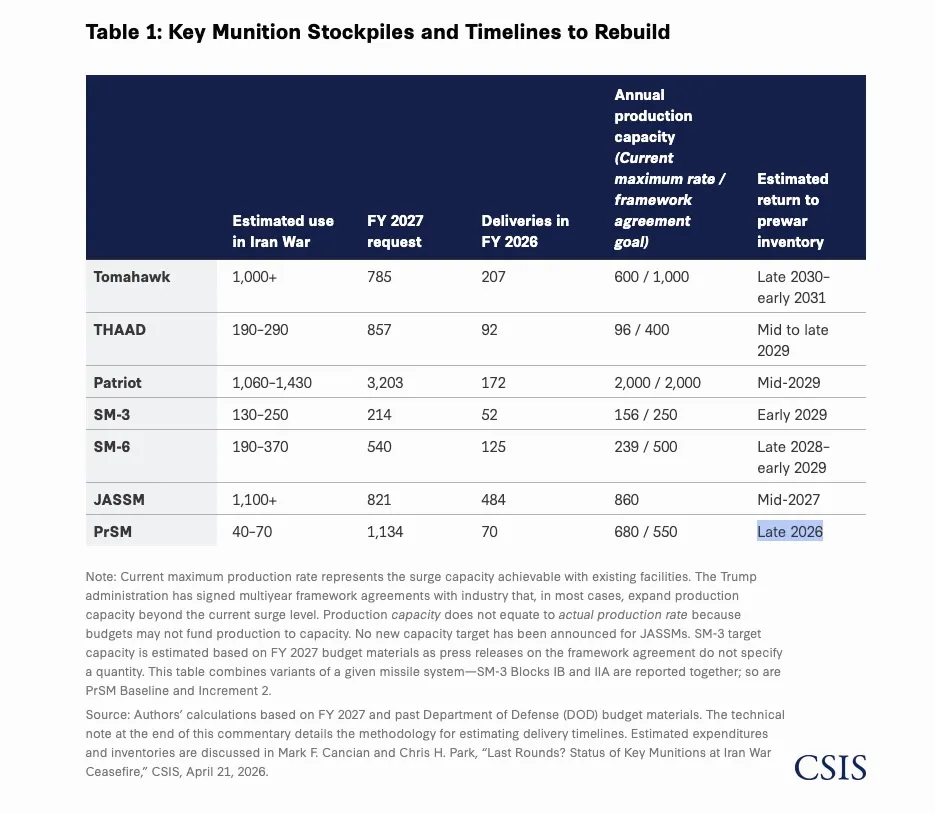
The firm is evolving from a propulsion provider into a prime contractor and integrator with a keen focus on hypersonics and solving a need for affordable high-speed missiles at scale for the U.S. and its allies. In recent operations, the U.S. has fired a vast number of standoff air-to-ground weapons including more than 850 Tomahawks cruise missiles in the recent war with Iran and hundreds of high-end interceptors, stressing a system that’s been constrained by prolonged replenishment timelines.
Spagnoletti says he strongly believes that hypersonic missiles are “the most important and pressing issue within critical munitions, with solid rocket motors coming close behind.” The company’s approach to design and production in both of these areas means Spagnoletti sees Ursa Major as being “well positioned to solve” these pressing requirements for the U.S. military.
“We are innovating on manufacturability and on new munition systems,” he continues. “It’s all under the umbrella of scalable munitions. Ursa Major’s founders really focused on developing very complicated propulsion systems, but with a strong propensity on design for manufacturability – essentially developing very high performing rocket engines as low-cost and as reliably as possible.”
Ursa Major has produced hundreds of engines and motors and accumulated more than 135,000 seconds of hotfire test time in under a decade. From its very beginnings the company has innovated through advanced manufacturing techniques that have evolved to leverage AI-enabled 3D-printing, specifically metal printing. “We’re looking at the problem set, and the landscape here is about how we can help the United States catch up as quickly as possible. We don’t just want a “me too” product, because we find there’s a lot of that in this space. This is about finding real answers to the desperate need to replenish our critical munitions fast,” says Spagnoletti.
Solid rocket motors in high demand
Having started out with liquid rocket engines, Ursa Major increasingly saw a burgeoning requirement for solid rocket motors (SRMs) for munitions, which Spagnoletti says have remained tied to traditional manufacturing approaches. Ursa Major says its approach to SRM manufacturing is designed to complement and strengthen the broader defense industrial base by providing flexible manufacturing capacity, common architectures, and modernized production methods.
Ursa Major’s manufacturing approach fundamentally changes how SRMs are designed and built using additive manufacturing, modular tooling, and software-backed production cells. This enables rapid switching between SRM variants without expensive retooling, which reduces production timelines and increases flexibility.
Ursa Major makes significant use of additive manufacturing across its engines. Ursa Major
In addition, Ursa Major’s highly-loaded grain technology increases motor performance and range without increasing motor size. By leveraging common architectures and using a limited set of qualified propellants, it says it can reduce qualification timelines and simplify production across multiple variants. The company’s energetics (solid propellent grain) strategy aims to expand domestic propellant capacity and reduce dependence on fragile supply chains, while using reliable mix, cast, and cure processes.
“Both in the liquid rocket engine side, and in solid rocket motors, the approach from the outset is deeply embedded in our culture; how we design, how we build, how we scale,” says Nick Doucette, co-founder and vice president of strategic operations for Ursa Major. “We came at the manufacturing problems from a completely different direction. We started out building liquid rocket engines, which were – to a degree – supporting the launch industry. That approach allowed us to develop new platforms that use new types of fuels or higher performance rates and lower costs.”
“From the start it helped support a growing launch industry, but very quickly it started to find its way into the hypersonics community as our engines, products, and performance points really started to solve some interesting problems. As we leaned heavily into the hypersonics needs, we realized that the early Ursa Major approach in manufacturing and the types of tech that we’re using are really solving some of the actual problems, and that led to our solid rocket motor programs.”
When building solid rocket motors, the inert part of the manufacturing leverages additive manufacturing heavily – Ursa Major avoids fixed tooling. “For example, after we qualify a motor, say a specific diameter booster, and then the government comes back to us and says that the adversaries have adapted. Now they want slightly different thrust, or maybe get additional range. We’ve already thought about that, our manufacturing line doesn’t need to change. We can use the same manufacturing line and adapt it,” explains Spagnoletti.
Solid rocket motor testing. Ursa Major
“We kept the energetics formulation essentially the same – it’s tried and true and it has been munition-tested for years – but we looked at the problem from the manufacturability of the entirety of the system. From a contracting point of view, this gives the government a lot more flexibility and to be as agile as the adversary. This has been happening on the development side for the past three years, working with several primes and the U.S. Navy. They’re inherently leveraging our ability to turn things fast, and now that’s translating into contracts for us.”
“The Navy really understood our approach to manufacturing,” adds Doucette. “They challenged us to apply our approach with liquid rockets to the solid rocket motor industry. To look at the problems and peel back the onion on solid rocket motors. What we found is that the choke point actually lies the metallic components that make what we call the inert tube section, that then gets packed with the energetics. The energetics are difficult for sure, but what actually chokes the supply chain is the 36-plus months to make the metallic tube structures. To compound the problem, all these production lines of the last 30, 40, 50 years are designed around one platform. Can you imagine an automotive company that has a huge expensive factory but only ever makes one car model! I mean, it would economically go out of business.”
“We have demonstrated that, by looking at the steps to make a solid rocket motor, be it metal printing the end domes or how we do the internal features and make the actual case to how we in some cases load the highly-loaded grain to get more performance, we can do all of it on the same production line for any motor between two inches and 22 inches in diameter. The same equipment, the same people, the same factory footprint. If we want to scale, we just copy paste the factory. If the demand signal changes in a year – which if recent conflicts give us any indication they probably will – that factory can switch over to a different munition. We just stop making one size and tool up for the new size in a matter of months.”
Ursa Major’s primary 93-acre corporate headquarters is located in Berthoud, about an hour north of Denver, Colorado. Here the company has the facilities to test its liquid rocket engines on site and it also designs, develops, and manufactures here. “Our main building is really split in half,” explains Spagnoletti. “On one side we have liquid rocket engine manufacturing and development to power hypersonics, and on the other behind a steel rolling door are the solid rocket motor development and low-rate production as part of our replenishment of critical munitions.”
Live fire testing of a small diameter solid rocket motor. Ursa Major
“At the Colorado site, we’re actually grinding, mixing, casting, curing thousands of pounds of energetics per year for our solid rocket motors, with a lot of automation built-in to not only protect the people but also to make the process more consistent. We have another site for our high volume solid rocket motor production – it needs a lot of space – and we are targeting to manufacture hundreds of thousands of pounds of energetics for use in various shapes and sizes by the middle of 2027.”
The company has expanded with more than 400 acres for SRM production in Galeton, Colorado.
Solid rocket motors of all sizes
Nick Doucette already sees the solid rocket motor work evolving. “We will eventually boost-power our Havoc system with our solid rocket motors. Remember, we got into SRMs due to seeing the critical munition needs, with an open door for manufacturing innovation and a problem we want to help solve. So we’ve built a manufacturing approach and we are now building a multitude of different size classes for different customers.”
The smallest SRM that Ursa Major is actively working on is for the Advanced Precision Kill Weapons System, or APKWS, from BAE Systems. “This currently uses a very dated motor and there’s been a lot of need in the industry to essentially innovate on that motor,” explains Doucette. “So we’ve been working extensively with both BAE Systems and the U.S. Air Force on that particular platform, especially with highly loaded grain, and we see a very promising future there.”
Doucette explains that Ursa Major has already made several hundred 2.75-inch motors for testing and development. This will be an extended range version of the motor, packing a significantly larger amount of energetic material into the same size rocket casing.
A common modular solid rocket motor in test. Ursa Major
In 2024, Ursa Major won a contract with the Naval Energetics Systems and Technologies (NEST) program to develop and test a new design to apply its SRM manufacturing processes to the Mk104 dual-thrust rocket motor that powers the U.S. Navy Standard Missile 2 (SM-2), used for surface-to-air defense, and the SM-6 anti-air, land, and sea missile.
Trusted solid rocket motor providers are in limited supply, and the versatility of Ursa Major’s production process opens up a raft of potential opportunities, particularly in the missile defense space. The 10-14-inch range is what Doucette calls a “sweet spot” for interceptor missiles.
Asked about air-to-air missiles, Doucette says: “of course, we’re looking at it. There’s been a lot of conversations around how Ursa Major would approach the problem, but we have a lot going on already, so we’re making sure we don’t try to swallow the whole critical munitions list at once.”
“Most of these larger hypersonic weapons are all boosted,” adds Doucette. “These have a booster in the back end, and we have additionally completed internal work to develop that 22-inch diameter SRM capability. So now we can do anything from 2-inch to 22-inch on that same production line using our common modular manufacturing approach.”
Unleashing Havoc
Ursa Major’s parallel efforts in hypersonics brings the story full circle. Alongside the solid rocket motors business, hypersonic missiles have become a critical part of the company’s efforts, as Nick Doucette picks up the story.
“There’s two specific products that Ursa Major makes in the hypersonics realm right now. The first is an engine that’s liquid oxygen-powered with rocket fuel. We call it Hadley, and we’ve had that for the better part of a decade. Hadley powers the Stratolaunch hypersonic Talon A testbed, for example. We don’t make the vehicle, we just provide the engine and support services, and Hadley has flown 10 times now.”
The Talon A testbed, powered by the Hadley engine. Ursa Major
“The challenge with Hadley is that it uses cryogenic liquid oxygen, which presents a whole suite of issues from a tactical perspective. A military user can’t sit and wait for the propellant to get cold, like you do with liquid oxygen. We needed to make a similar engine, slightly lower thrust, a little smaller, but essentially in the same packaging, make it storable and most importantly, make it tactical, so that you can drop it from a plane or shoot it vertically from a ship. So we switched from liquid oxygen to hydrogen peroxide.”
“The catch there was that the only way we were able to do that in the right packaging, tightness, and density, was to use 3D-printing. Fast-forward through six years of insane additive development and the Draper engine became a reality. It simply would not have been possible without massive advances in the additive world because of the complexity of what we’re doing geometrically. It’s a really challenging thing to do.”
Draper is a 4,000-pound-thrust engine that is powered by hydrogen peroxide and rocket fuel. Its use of non-cryogenic storable propellants enables long-duration storage, rapid deployment, and operational flexibility in real-world conditions. Its massive potential drove Ursa Major to search for a suitable hypersonic vehicle design to match it with.
“We strongly believed that Draper introduced a differentiating threat vector for any adversary,” Doucette continues. “China has had boost-glide hypersonics for a decade. Other hypersonic designs use a scramjet, which are costly and complex. Draper opened up hypersonic performance, where you have a wide range of trajectories and adaptability as well as other really creative mechanisms that, to be honest, the adversaries don’t have. I mean it’s wildly different, which we see as being a very valuable asset to the national security arsenal.
The Draper engine, which is powered by hydrogen peroxide and rocket fuel. Ursa Major
“The concept of using a liquid rocket engine for a hypersonic weapon is absolutely game changing. Draper can be throttled – unlike solid rocket motors that use a pre-mixed propellant and oxidizer that cannot be controlled once ignited – plus it’s designed to be more safely stored than other liquid rocket engines, providing the tactical storage capabilities that are typical of a solid rocket motor.”
Doucette says that Ursa Major looked to find a partner for the vehicle itself, but concluded that none were suitable, particularly when it came to moving fast. The decision was made to go it alone in-house with an air vehicle. The result is Havoc, which is designed like other hypersonic programs to fly in excess of mach 5, and intended to be launched in a variety of ways; as a single-stage from an aircraft or ground-launched with added booster stages. It’s also designed to run out at circa $3-million apiece. “We entered a rapid campaign in partnership with the Air Force Research Laboratory and we went from concept to flight-ready in about six months,” Doucette says.
Hypersonic missiles currently in testing with the USAF include the AGM-183A Air-Launched Rapid Response Weapon (ARRW), which is a boost-glide hypersonic system, with rocket boost and an unpowered glide vehicle inside. The Hypersonic Attack Cruise Missile, or HACM, also features rocket boosters, but with an air-breathing scramjet second stage vehicle. Both are limited to operations in the Earth’s atmosphere – whereas Havoc can operate either in or above the atmosphere.
An artist’s rendition of Havoc. Ursa Major
“With regard to propulsion in aerospace defense, there’s three main types; air-breathing, solid powered, and liquid powered,” Doucette explains. “In the world of hypersonics, specifically, we’re talking about fast-moving, somewhat unpredictable, missile systems that are moving at over five times the speed of sound. You have the same propulsion methods, but liquid fuel has never really been introduced.”
“The air-breathing hypersonic weapons are typically scramjets and ramjets, which the U.S. has been developing for a very long time. They’re expensive and exquisite, but very long range.
A hotfire test of Draper. Ursa Major
“China has something in the order of 600-700 operational boost-glide systems in its arsenal right now. This is not new to them. They’ve been practicing, watching, and rehearsing.” Doucette warns that the U.S. fielding a boost-glide or scramjet hypersonic weapon may not really change the dynamic, which is why Ursa Major’s argument for its liquid-powered weapon is so strong.
“The novelty of being liquid-powered is that it carries its own oxidizer and fuel, which means it can go anywhere – in the atmosphere, out of the atmosphere, high, low. A solid rocket can technically do the same thing, but the big difference with the liquid system is that it can turn on and off an infinite number of times. A solid is going where it’s going, but a liquid could be on one trajectory and a split second later turn it off, then instantaneously head on a different trajectory because you can maneuver it from a powered vector perspective. Draper is also fully throttleable down to 10% all the way up to 100%.”
There are currently no competing systems that have the ability to bridge the gap between running in atmosphere and out of atmosphere with such a degree of throttle control. Ursa Major is currently the only company with a hypersonic vehicle and experience in the liquid-powered hypersonic realm. It has twice ground-launched from a rail what it calls “Havoc Block 0” in partnership with the Air Force Research Laboratory, under its Affordable Rapid Missile Demonstrator (ARMD) program. These demonstrator flights have been designed as multi-domain tests. “The great thing about Havoc is that we can alter the wings, add our solid rocket motor boost system, and it means we can ground launch, VLS [vertical launch system] launch, or air-launch,” Doucette says.
A flight test of the Draper-powered Affordable Rapid Missile Demonstrator. Ursa Major
“Havoc provides something the Department of War has not previously seen,” adds Chris Spagnoletti. “Having a mid- and long-range tactical weapon that can deep throttle, turn on and off at will, is agnostic to atmosphere, rapidly change vector, accelerate and de-celerate, skim the sea, fly outside the atmosphere – this really opens up the aperture of what a munition can do. This is very tough for conventional systems to figure out what it’s intending to do.”
Rapidly scaling production
Spagnoletti says Ursa Major’s hypersonic program can scale quickly because of the company’s additive manufacturing and AI-driven manufacturing processes. Draper’s liquid propellant also has additional advantages when it comes to production. “We can drain the fuel, bring them into a facility, and that now-inert system doesn’t need massive keep-out distances,” explains Spagnoletti. “So, say in a 100,000 square foot building, we can produce 500 full-up missile systems per year inert, then fuel them right before we ship them or at the operational location.”
“Some companies are advocating for things like multi-year contracts, and that really matters to them because they’re setting up rigid long-term production lines. We’ve flipped that on its head where if a customer decides in say five years they want this weapon to look different, we have a common modular approach that we can swap things out. Most of the aerospace systems I’ve worked on in my career have long five or 10-year windows. Design, build, qualify – they don’t want to make hardware changes because it’s going to take ages and cost a lot of money to modify and qualify those systems. They’re inherently resistant to change, not because they don’t want to help and adapt, but because the system allows a massive amount of inertia, production lines have rigid tooling and processes, they can’t adapt. What’s different about Ursa Major is, again, that we design for manufacturability and leverage advanced manufacturing.’
Ursa Major Additive Manufacturing
In addition to its Colorado facilities mentioned earlier, Ursa Major also has a plant in Youngstown, Ohio, which is a center of excellence for 3D-printing, they then ship to Berthoud for final assembly and test. A lot of parts and components are manufactured in house, including valves, tanks, pressurization systems, avionics, but it does have dependency on some external suppliers where appropriate. “We have some really strong partnerships where we can’t bring things in-house. We’re such experts in additive manufacturing that we know when not to do it.”
“Importantly, we are not reducing costs by using the cheapest parts. In my 36 years in the aerospace industry, when it comes to building a critical munition, I know the devil’s in the details – it has to work every time and there’s only so cheap you can go before you start to sacrifice reliability. Some of our competitors are trying to achieve a lower cost hypersonic system, which is great, but those are typically salvo weapons where you just launch a lot of them. The Havoc missile system is more of a strategic asset.”
Ursa Major’s adaptable additive manufacturing process is known as Lynx. Ursa Major
Ursa Major is making significant moves in the U.S. military’s missile stockpile recapitalization effort. It has opened up versatile methods of producing solid rocket motors, and it has demonstrated the functionality of Havoc with the Air Force Research Laboratory, including the concept of operations with the liquid rocket. Spagnoletti points out that the U.S. used to use liquid rockets prior to the advent of solid rocket motors. Use of additive manufacturing and 3D-printing is always in the conversation too, it’s how this company can scale its innovations fast.
The next major milestone it’s driving towards is a follow-on demonstration phase for Havoc – a boosted, full hypersonic flight. “We’re pushing for that in 2027,” says Spagnoletti.
As America marks its 250th year, the dream of a hypersonic missile with a 3D-printed engine that can be delivered in large quantities at an affordable price could materialize into another significant landmark in the story of American defense innovation. At least that’s Ursa Major’s goal, and it appears to look more promising by the day.
WASHINGTON — The Supreme Court announced Tuesday that it will hear a 2nd Amendment challenge to the gun laws in Connecticut and Cook County, Ill., that ban most semiautomatic assault weapons.
Before leaving for the summer recess, the justices issued orders on new cases that will be heard in the fall. The new 2nd Amendment case figures to be a major test of what kinds of firearms and ammunition are off-limits to state or federal regulation.
The outcome will affect California and all the states led by Democrats that strictly regulate or prohibit semiautomatic rifles, such as the AR-15.
Gun-rights advocates say these are among the most common and popular weapons in the country, and they should not banned in some states.
In response, Connecticut state attorneys said only about 2% of Americans own assault weapons, and they rarely use them for self-defense.
State lawmakers said these rapid-fire guns are not needed for self-defense but can be a weapon of mass murder. All of the blue-state bans could be struck down next year if the court’s conservatives rule in favor of the 2nd Amendment claim.
Gun-rights advocates say firearms in “common use” by law-abiding owners cannot be prohibited by the government.
Four of the court’s conservatives have said in past dissents they believe the state bans on assault weapons run afoul of the 2nd Amendment. They are Justices Clarence Thomas, Samuel A. Alito, Neil M. Gorsuch and Brett M. Kavanaugh.
That suggests the fate of those state laws depends on Chief Justice John G. Roberts and Justice Amy Coney Barrett.
Joining in support of the gun-rights challenge were the state attorneys for Montana, Idaho and 25 other Republican-led states.
They urged the court to prevent liberal judges and states led by Democrats from “rewriting the 2nd Amendment … to allow hostile jurisdictions to continue infringing on their citizens’ core constitutional right to keep and bear arms.”
In 2016, California’s voters approved a ballot measure that makes possession of large-capacity magazines illegal. At least 10 states have similar laws, but they apply only to the manufacture and sale of large-capacity magazines.
Gun-rights advocates sued in San Diego, leading to nearly a decade of back-and-forth litigation. A federal judge struck down these restrictions under the 2nd Amendment, but the state appealed. They were eventually upheld by the 9th Circuit Court in an en banc ruling.
Meanwhile, the 7th Circuit Court in Chicago has upheld an Illinois law and the Cook County ordinance prohibiting semiautomatic rifles and pistols. Its opinion said rapid-fire guns do not differ significantly “from machine guns and military-grade weaponry,” which can be banned under the 2nd Amendment.
Before Tuesday, the justices had repeatedly refused to weigh in on whether the 2nd Amendment’s right to “keep and bear arms” includes the right to semiautomatic “assault weapons” and large-capacity magazines.
Since 2015, the court has turned down gun-rights appeals from blue states like Illinois and Maryland over their bans on “assault weapons,” despite dissents from Justices Thomas, Alito and Gorsuch.
As an appeals court judge in Washington, D.C., Kavanaugh voted to strike down the city’s ban on assault weapons.
Three years after John Roberts became chief justice, the court ruled for the first time in 2008 that the 2nd Amendment protected individual gun rights, not just state militias. But the 5-4 decision simply struck down a city’s ban on having a hand gun at home for self-defense.
Ever since, advocates for gun rights and gun control have been arguing over whether semiautomatic guns with large-capacity magazines can be regulated because they are uniquely dangerous or are protected because they are very common.
In the past two years, the Supreme Court has a mixed record on gun regulation.
Last year, the justices in a 6-3 decision struck down a federal regulation that banned “bump stocks,” which allow rapid-fire shooting with a semiautomatic rifle.
That regulation was adopted in the first Trump administration in response to the mass shooting at an outdoor concert in Las Vegas where a lone gunman fired as many as 1,000 shots from a hotel window.
The conservative majority ruled the bump stock devices did not fit the definition of a prohibited machine gun.
Earlier this year, however, the court in a 7-2 decision upheld a regulation prohibiting unregistered “ghost guns” that were made by parts kits.
Plan includes more than 5 billion pounds for drones and autonomous systems over four years, Ministry of Defence says.
Published On 30 Jun 202630 Jun 2026
Outgoing Prime Minister Keir Starmer has announced that Britain will spend almost 300 billion pounds ($397bn) over the next four years to modernise its armed forces amid rising threats.
Starmer, expected to leave office next month after losing the support of Labour MPs, announced on Tuesday that the overall defence budget would increase by 15 billion pounds ($20bn) over the next four years to almost 300 billion pounds as he launched his long-awaited defence investment plan.
Recommended Stories
list of 3 itemsend of list
“Last year I made the decision in the national interest to reprioritise aid spending towards defence and achieved the biggest uplift in defence spending since the end of the Cold War,” Starmer said.
“That was the right choice because the world has changed. National security is economic security.
“Today we uplift defence spending further – an additional 15 billion pounds worth of funding – by … reprioritising spending across government.”
The plan includes more than 5 billion pounds ($6.6bn) for drones and autonomous systems over the next four years, the Ministry of Defence said in a news release.
The announcement followed months of wrangling within Starmer’s Labour government over the resources required to modernise the United Kingdom’s armed forces in the face of rising threats, including from Russia.
Two defence ministers quit this month in a row over the spending proposals, including Defence Secretary John Healey, who said the plans risked making Britain “less safe”.
Starmer’s pledge came as United States President Donald Trump has repeatedly urged NATO allies to spend more on defence and become less reliant on Washington for security.
Starmer will take the plan, which foresees spending nearly 80 billion pounds ($105.7bn) a year by 2029, to Ankara for a NATO summit on July 7-8. He wants to signal Britain is on track to spend 3.5 percent of its gross domestic product on defence by 2035.
With likely successor Andy Burnham due to take power as early as July 20, Starmer acknowledged new governments could “build” on his blueprint.
Critics said the plan, delayed for more than nine months, was too little, too late.
North Korean leader Kim Jong Un oversaw tests of new weapons to bolster firepower along the inter-Korean border, state-run media reported Friday. In this May 2024 photo, Kim views a 240mm multiple rocket launcher system. File Photo by KCNA/EPA-EFE
SEOUL, June 26 (UPI) — North Korean leader Kim Jong Un oversaw tests of a new rocket launcher system and other weapons as part of a plan to bolster firepower along the inter-Korean border, state-run media reported Friday, highlighting Pyongyang’s continued effort to modernize conventional weapons capable of threatening the Seoul metropolitan area.
The new weapons, tested at an undisclosed location Thursday, included an upgraded 240mm 24-tube multiple rocket launcher with an automated guidance system and an extended range of 56 miles, the official Korean Central News Agency reported.
Also tested were shells for a 155mm self-propelled howitzer with an extended range of 40 miles and a special warhead for a tactical ballistic missile. KCNA said the warhead was “aimed at inflicting fatal damage on major targets including airfields, ports and power facilities of the enemy.”
Kim described the launches as a demonstration of the “great technological progress” made in implementing the party’s policy of “bringing about a change in the fire posture on the southern border.”
He added that the policy was intended not only to strengthen defenses but also to build a “deadly and destructive offensive posture to make no enemy dare to confront.”
Seoul, home to more than 10 million people, lies roughly 30 miles from the border, while the surrounding Gyeonggi Province is one of South Korea’s most densely populated and industrialized regions.
The tests come amid an extended push by Pyongyang to harden its military posture toward South Korea. Last month, Kim called for strengthening frontline defenses along the border to create an “impregnable fortress,” and Thursday’s weapons tests appear to represent the firepower component of that broader effort.
North Korea has ramped up fortification work near the Military Demarcation Line inside the DMZ, including the installation of barbed-wire fencing and preparations for mine-laying operations. South Korea’s Defense Ministry on Monday called the activity a violation of the armistice agreement that ended fighting in the 1950-53 Korean War.
Earlier this week, Pyongyang also commissioned its first 5,000-ton destroyer, the Choe Hyon, which Kim said is armed with nuclear-capable missiles. Images released by state media appeared to show missile launchers and radar systems resembling those found on Russian warships, prompting speculation that Pyongyang has received technical assistance from Moscow.
North Korea has deployed troops, artillery and weapons to support Russia’s war in Ukraine and is widely believed to be receiving financial support and advanced military technology in return.
While South Korean President Lee Jae Myung has sought to ease tensions with North Korea since taking office last year, he has also called for strengthening Seoul’s military capabilities in response to Pyongyang’s expanding weapons programs.
On Friday, South Korea’s Defense Ministry unveiled a plan to rapidly expand the military’s drone and counter-drone capabilities, citing lessons from modern conflicts and North Korea’s growing military cooperation with Moscow.
“Since North Korea is currently receiving technology transfer from Russia, we decided that we urgently need to proactively respond to various changes in the war operation environment,” Defense Minister Ahn Gyu-back said at a press briefing.
The plan calls for acquiring 20,000 low-cost reconnaissance and loitering drones by 2030 while accelerating the deployment of homegrown K-Lucas long-range suicide drones. It also includes expanded counter-drone capabilities, including laser weapons, high-power microwave systems and interceptor drones designed to defeat low-cost aerial threats.
As part of the strategy, South Korea aims to train 500,000 “drone warriors” across the army, navy, air force and marines. Ahn said drones should become “a universal means of combat” across the armed forces, with every soldier eventually able to operate them “like a second personal weapon.”
US President Donald Trump says Iran has agreed to not acquire nuclear weapons and will ‘suffer unbelievable consequences’ if they do. His remarks came during a meeting with Qatar’s Emir Sheikh Tamim at the G7 summit in France.
Weekly insights and analysis on the latest developments in military technology, strategy, and foreign policy.
The U.S. Air Force Weapons School at Nellis Air Force Base, in Nevada, recently completed its final weapons instructor course for the A-10 Warthog. Despite an extension in service for three A-10 squadrons to 2030, and recent combat operations in the Middle East, the Weapons School has shuttered its elite training course in line with USAF divestment plans for the type, which were previously set for the end of 2026.
TWZ’s Jamie Hunter recently visited the 66th Weapons Squadron (WPS) and got a detailed cockpit and walk-around tour of an A-10C with “Trippin,” an experienced instructor pilot attached to the unit.
A full episode that goes in-depth with the A-10 Weapons School will kick-off TWZ’s first season of Special Access on YouTube soon, so stay tuned!
A-10 Cockpit And Walk-Around Tour With A Warthog Weapons Instructor
Video released by US Central Command shows what the military says are ‘self-defence’ strikes on Iranian military surveillance capabilities, communications systems and air defence sites. The footage accompanied a statement that US forces had completed the latest wave of attacks.
Ukrainian President Volodymyr Zelenskyy arrives at No.10 Downing Street in London on March 17. On Monday, Ukrainian forces said they attacked several Russian locations overnight, including multiple oil depots. File Photo by Hugo Philpott/UPI | License Photo
June 8 (UPI) — Ukrainian forces struck oil depots in Russian-occupied Crimea as well as other command and ammunition locations in Russia, the Ukrainian military said.
The strikes took place late Sunday, the general staff of Ukraine‘s military said in a Facebook post Monday, according to a translation by Ukrinform.
The Grushevaya oil depot in Krasnodar Krai and the Feodosia and Semikolodezyanskaya oil depots in Crimea were among the targets hit during the attacks, The Kyiv Independent and Ukrinform reported. Ukraine also struck the Krasny Line Production Dispatch Station in Volgograd oblast, which supplies oil to the Volgograd refinery and the Sheskharis export terminal.
Ukrainska Pravda reported that the Grushevaya oil depot is one of the largest oil storage facilities in the Caucasus, holding between 1.3 tons to 1.5 tons of petroleum. The site is used to store and transport oil for maritime export and generates a large amount of revenue for Russia.
There were large fires and billowing smoke reported at the oil depots said to be hit.
The strikes hit Russian drone command posts in various locations in Zaporizhzhia, Donetsk and Kursk oblasts. The military also said it hit areas with concentrations of Russian personnel in Donetsk, Zaporizhizhia and Sumy oblasts.
The Russian military said it struck down 310 Ukrainian drones overnight throughout Russia, Crimea, and the Black and Azov Seas.
Troops in landing craft approach Omaha Beach on D-Day in Normandy, France, on June 6, 1944. D-Day was the largest seaborne invasion in history and turned the tide of World War II. Photo by UPI | License Photo
North Korea has released photos of Kim Jong Un inspecting huge munitions at a weapons factory ahead of Chinese president Xi Jinping’s visit. Pyongyang has ordered missile production capacity to be doubled in the next five years.
Chinese President Xi Jinping’s meeting with North Korea’s Kim Jong Un in Pyongyang on Sunday is significant for one reason.
It’s not that they are meeting: The two men met in Beijing just a year ago when China held a massive military parade to mark 80 years since Japan surrendered unconditionally to Allied forces, bringing an end to the second world war.
Recommended Stories
list of 4 itemsend of list
What’s surprising is that Xi is travelling at all.
The Chinese leader has not travelled to Pyongyang since 2019, having steadily cut down his travel in recent years, and world leaders like US President Donald Trump and Russian leader Vladimir Putin generally come to him these days.
“We need to remember that Xi Jinping has not really travelled abroad that much,” William Yang, Crisis Group’s senior analyst for Northeast Asia, told Al Jazeera. “The growing trend is foreign leaders heading to Beijing to meet with him.
“For Xi Jinping to be the one who decides to travel to Pyongyang, it shows the level of significance that China attaches to this trip.”
Xi averaged about 14 trips a year between 2013 and 2019, but dropped to approximately six a year between 2022 and 2025, according to the Asia Society. In 2020, he made just one overseas trip, and in 2021, he made none, as China grappled with the COVID-19 pandemic.
He may be travelling now, though, amid concerns about North Korea’s relationship with Russia, Yang said.
Senior partner no more?
Traditionally, Beijing played the role of senior partner in the China-North Korea relationship, with North Korea heavily dependent on China for as much as 95 percent of its trade, according to one 2022 estimate from the National Committee on North Korea, a US-based nonprofit.
That dynamic has been changing since Russia’s 2022 invasion of Ukraine, however. North Korea has provided Russia with critical weapons, artillery and manpower and is credited by observers with helping to keep Moscow’s war machine going.
South Korea’s Institute for National Security Strategy, a government-funded research institute, estimates that since 2023, Moscow has paid North Korea as much as $14.4bn for troop deployments and the export of “artillery, shells, and guided and ballistic missiles”.
The report said that North Korea may only have received between $580m and $1.5bn of that in the form of “goods”, which means there is a “significant possibility that the majority of the payment from Moscow was in the form of ‘sensitive military technology or related precision parts and materials that are difficult to observe via satellite’,” according to a translation.
Although China shares a mutual defence treaty with North Korea, it is still wary of North Korea acquiring new military technology, Yang said.
“Beijing has always been very careful about providing military assistance to North Korea because they do not see a militarily stronger North Korea as necessarily in its favour,” he said. “A North Korea that is militarily emboldened through its relationship with Russia could be a potential source of disruption to the balance of power and status quo on the Korean Peninsula.”
North Korea has already carried out eight missile launches since the start of the year, and in May unveiled a new AI-guided tactical cruise missile, according to North Korean media and the US Naval Institute.
Earlier this week, North Korean state media also released photos of Kim touring a new “weapons-grade nuclear materials” factory, which would be used to expand Pyongyang’s nuclear capability at an “exponential rate”.
Fluctuating tensions
North Korea has technically been at war with South Korea since 1950, with the conflict suspended by a 1953 armistice agreement. The two countries are divided by a 250-kilometre-long (155-mile-long) Demilitarized Zone, splitting the Korean Peninsula.
Tensions have fluctuated dramatically over the years, reaching a recent low point in 2024 when Kim abandoned the long-term goal of Korean unification.
He has largely cut off communications ever since, according to observers. On Friday, South Korea’s Ministry of Foreign Affairs said that it hopes that Xi’s trip will “play a constructive role in addressing issues related to the Korean Peninsula” – suggesting that Seoul may have lobbied the Chinese leader to try to smooth over relations.
South Korean Minister of Unification Chung Dong-young separately told reporters last month that he expects the two leaders to discuss a possible meeting between Kim and Trump later in the year.
Xi may also be alarmed by other security developments in East Asia, including news of a possible military-logistics support pact between South Korea and Japan, which was raised at the Shangri-La Dialogue of regional defence officials in Singapore last weekend.
While China and South Korea’s relationship fluctuates, its ties with Japan are acrimonious due to longstanding grievances dating back to Imperial Japan’s occupation of China in the 1930s and 1940s. Beijing has also objected to recent moves by Tokyo to expand its de facto military.
Pro-Palestine activists interrupted an army recruitment event during German Armed Forces Day. They climbed onto a tank and unfurled a banner reading ‘Genocide with German weapons’ and named Rheinmetall, a key arms supplier to Israel’s military.
Hamas says it will not hand over its weapons right now, resisting ongoing disarmament demands and stating that the ultimate fate of its military arsenal will be decided following comprehensive discussions with other Palestinian factions.
Husam Badran, a member of the Hamas political bureau, spoke exclusively to Al Jazeera about the group’s vision for a long-term ceasefire in Gaza [Mohammad Mansour/Al Jazeera]
In an exclusive interview with Al Jazeera, Husam Badran, a member of the Hamas political bureau, offered an inside look into the group’s proposed solutions to the stalled negotiations, introducing the concept of a long-term hudna (truce).
“When this Palestinian committee [the National Committee for the Administration of Gaza (NCAG)] comes to take over the Gaza Strip, there will be no visible weapons in the streets and alleys of Gaza except the official weapons belonging to this committee, which is the official Palestinian police, ” Badran told Al Jazeera. “There will be no armed manifestations like the ones we were accustomed to in the Gaza Strip.”
But he clarified that this did not mean a formal surrender of arms.
“We are not talking about handing them over; we are talking about, at least, weapons not being visible except for the official weapons of the Palestinian police,” he said. “The details of this matter will be discussed within a national framework.”
The Hamas stance comes as an informed source told Al Jazeera that the group is preparing to send its delegation to Cairo for renewed talks, which are set to begin this weekend. Hamas had briefly delayed its participation to demand a halt to ongoing Israeli assassinations—such as the recent killings of military commanders Izz al-Din al-Haddad and Mohammed Odeh—to ensure a more favourable negotiating environment.
The disarmament of Hamas and the withdrawal of Israeli troops from Gaza remain the biggest sticking points in the United States-brokered October 2025 ceasefire plan.
Factional consensus in Cairo
The upcoming Cairo meetings will gather eight key Palestinian factions to form a unified national stance. Badran confirmed the attendance of representatives from Hamas, Palestinian Islamic Jihad (PIJ), the Popular Front for the Liberation of Palestine (PFLP), the Democratic Front for the Liberation of Palestine (DFLP), the PFLP-GC, the National Initiative, the Popular Resistance Committees (PRC), and the Democratic Reform Current affiliated with the Fatah movement.
These talks aim to salvage the ceasefire originally proposed by United States President Donald Trump. However, Badran noted that Israel has failed to implement even 30 percent of its phase one obligations, making any transition to subsequent phases impossible.
“We are talking about humanitarian aid … the Rafah crossing mechanism, the infrastructure, and the assassinations,” Badran explained. “The idea was a comprehensive ceasefire, but around 1,000 people have been killed. Saying Israel implemented even 30 percent is an overstatement.”
Only 150 to 250 aid trucks are entering the Gaza Strip daily instead of the agreed-upon 600, while the critical infrastructure for electricity, hospitals and fuel remains completely decimated.
The ‘disarmament’ deadlock
While Palestinian factions demand the fulfilment of these phase one survival metrics, Israeli officials and Nickolay Mladenov, the high representative for Gaza on Trump’s “Board of Peace”, are conditioning the transition to phase two on the disarmament of armed groups.
To break the deadlock, Mladenov recently presented a 15-point “roadmap” built by the ceasefire guarantors. In a May 2026 briefing to the United Nations Security Council, Mladenov defended the plan, emphasising that its architecture rests on a strict principle of reciprocity and verification. Addressing Palestinian concerns, Mladenov clarified that the roadmap explicitly dictates that “no Palestinian armed group will be required to transfer its weapons to Israel”. Instead, the decommissioning of weapons would be gradual, sequenced, and Palestinian-led, with all arms transferred to the NCAG.
Mladenov outlined that this disarmament process is tied directly to an Israeli military pullback. The plan commits Israel to a phased withdrawal of its forces to Gaza’s perimeter on an agreed timetable, conditional upon verified progress on decommissioning and the deployment of an International Stabilization Force (ISF) to act as a buffer.
Mladenov warned the UNSC of the severe consequences of rejecting the roadmap. With 85 percent of Gaza’s buildings damaged or destroyed, he stressed that “reconstruction financing will not follow where weapons have not been laid down”. Without an agreement, he cautioned, Gaza will remain divided, with Hamas holding administrative control over less than half the territory.
‘Negotiation time’ and Israeli expansion
However, Palestinians view this 15-point framework as a stalling tactic designed to extract concessions while Israel deepens its occupation. Palestinian political analyst Wissam Afifa told Al Jazeera that Israel is exploiting “negotiation time” to exhaust the population through continuous escalation.
“They shifted from Trump’s 20 points to a new square, the 15-point square, which revolves entirely around one single clause: disarmament,” Afifa explained. He noted that the Palestinian resistance has been cornered and asked to make major concessions without real guarantees, while the Israeli government uses the talks to advance its territorial goals.
According to Afifa, Prime Minister Benjamin Netanyahu is weaponising the negotiations for domestic electoral gains, expanding Israel’s control from 60 percent of Gaza to 70 percent or more. This expansion is happening while oversight mechanisms, such as the Civil-Military Coordination Center (CMCC), have completely failed and paralysed the monitoring process.
“We are facing a scenario where the occupation has reshaped the ceasefire on its own terms,” Afifa said, adding that Mladenov has in effect adopted the Israeli and American vision by demanding disarmament without offering a clear political horizon for “the day after”.
The National Committee hurdle
This ongoing expansion complicates the transition of power. Amid accusations that Hamas is clinging to power, the group’s spokesperson, Hazem Qassem, reiterated that Hamas is fully prepared to hand over all governance and security responsibilities to the Cairo-based National Committee. Badran confirmed that Hamas has prepared all necessary administrative and security files for the transfer.
However, the NCAG itself faces massive operational barriers and has become, as Afifa described, a “hostage” to Israeli pressure.
A member of the committee, speaking to Al Jazeera on condition of anonymity, firmly denied reports that the body would enter Gaza soon, outlining strict conditions for assuming power. The committee categorically refuses to operate behind the Israeli-controlled “Yellow Line” or to cooperate with Israeli-backed armed militias currently operating in the Strip, the source said.
Furthermore, the source stressed that the committee will not enter Gaza until the International Stabilization Force is deployed in the buffer zones separating Israeli forces from Palestinian areas.
While the political deadlock continues, the human toll mounts. Mladenov acknowledged in his UN briefing that ceasefire violations continue to kill civilians and obstruct humanitarian access.
Since the ceasefire took effect, ongoing Israeli military actions have killed 933 Palestinians and injured 2,868, raising the total death toll since October 2023 to 72,942, with 172,967 people injured.
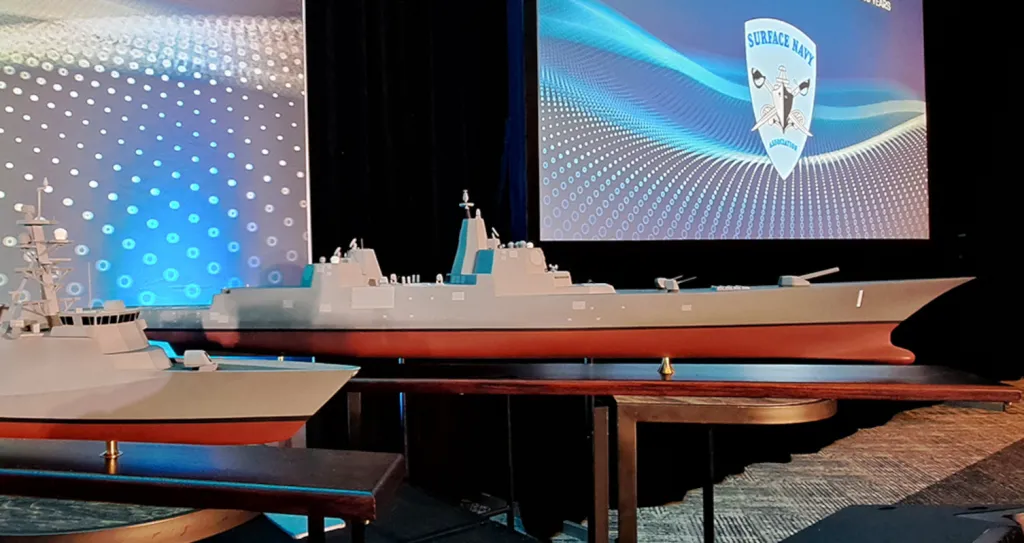
The battleship and frigate provisions are included in an early draft of the annual defense policy bill, or National Defense Authorization Act (NDAA), for the 2027 Fiscal Year, which the House Armed Services Committee released late yesterday. The Trump class battleship and FF(X) are set to be some of the Navy’s top shipbuilding priorities in the coming years.
A model of the Trump class design on display at the Surface Navy Association’s (SNA) annual symposium in January 2026. A model of the FF(X) frigate is also seen in part at the left. Eric Tegler
Tying the battleship construction timeline to weapon system progress
The section in the proposed legislation regarding the Trump class battleship is brief, reading as follows:
“The Secretary of the Navy may not enter into a contract or other agreement that includes a scope of work for the construction of the lead ship of the Battleship program until the date on which the Secretary certifies to the congressional defense committees that the weapon systems planned for inclusion in such lead ship are at a sufficiently mature technology readiness level.”
The provision does not name any particular weapon systems or define what level of “technology readiness” would be accepted as “sufficiently mature.”
A rendering of a Trump class battleship firing various weapons. USN
In terms of technological maturity, the railgun presents particular questions. Between 2005 and 2021, the Navy had an active railgun program. Despite promising developments, plans for an at-sea test were repeatedly pushed back before the entire effort was shelved. Major technical hurdles were cited as a key factor in that decision. The railgun itself was effectively placed in storage at White Sands Missile Range (WSMR) in New Mexico.
However, it emerged earlier this year that the Navy had conducted a new round of testing of the railgun at WSMR in February 2025. Whether the Navy has any plans to pick up where it left off with this prototype design, which was developed by BAE Systems, or pursue a new one remains unclear. General Atomics, which previously supported U.S. Army railgun efforts, has publicly expressed interest in being involved in arming the Trump class.
A picture showing the Navy’s prototype railgun being fired at WSMR. USN
While the Navy has been very active in developing and fielding laser directed energy weapons, this is another area where the service has faced continued challenges in expanding their operational use. The plans for the Trump class specifically call for a 300-kilowatt-class laser, which is far more powerful than any of the designs the Navy has integrated on its warships to date. The service currently has eight Arleigh Burke class destroyers with the Optical Dazzling Interdictor, Navy (ODIN), as well as another one of those warships with the High Energy Laser with Integrated Optical-dazzler and Surveillance (HELIOS). HELIOS is a 60-kilowatt-class design, though there has been talk about scaling up its power rating to 150 kilowatts. ODIN’s power rating does not appear to be officially confirmed, but it is understood to be significantly lower than that of HELIOS. You can read more about all of this here.
The Arleigh Burke class destroyer USS Preble fires its HELIOS laser directed energy weapon during a test. US Military
The Intermediate Range Conventional Prompt Strike (IRCPS) hypersonic missile, another key component of the future Trump class arsenal, is also still in development. The first test launch from a warship, the stealth destroyer USS Zumwalt, is expected to come next year. IRCPS is the Navy half of a joint program with the U.S. Army, which is working to field a land-based version of the same missile. The Army refers to its complete weapon system as the Dark Eagle. The Army had suffered significant setbacks in the past with the Dark Eagle, but the service had blamed those issues on the launcher rather than the missile.
The hypersonic missile common to the Navy’s IRCPS and Army’s Dark Eagle systems seen being test fired from a launch pad on land. US MilitaryA briefing slide showing the integration of launch tubes for IRCPS missiles on the USS Zumwalt. The Trump class battleship design is set to include a similar launch tube array for these missiles. USN
More context about what planned weapons systems for the Trump class may have prompted the House Armed Services Committee to include this section in the draft NDAA are likely to emerge as the proposed bill is refined. Nuclear propulsion and other planned aspects of the ship could present their own challenges during development and production. The U.S. Navy has not procured a nuclear-powered surface combatant of any kind since the Cold War.
“We intend to, with all we can do, use pull-through technologies, [including] things from that we’ve worked on with DDG(X),” Chief of Naval Operations Adm. Daryl Caudle said at a hearing earlier this month. “It will have the SPY-6 radar. It will have the Baseline 10 Aegis combat system. It will pull through, of course, the A1B Ford class reactor plant and all the design that goes with that. The only thing inherently new to it will be the actual hull itself, and so most of the fixtures in it. And I would say the directed energy [weapons] and up gunning, that will also be new.”
One of the “mistakes that we’ve done before, quite frankly,” is “we’ve started to build before the design is mature enough,” the CNO also said at a roundtable on the sidelines of the Navy League’s Sea Air Space 2026 in April. “And we want to make sure that we’re at [sic] least a very, very high level – I won’t try to give a percentage, but you can think like 80% or more design – before the first weld is done.”
The Navy is understood to still be in the very early phases of laying out the Trump class design.
Another rendering of a future Trump class battleship. White House/USN
The provision in the draft NDAA could easily delay the start of work on the first of these battleships, which could set back the entire schedule for the program. As it stands now, the Navy is looking to order the lead ship, set to be named the USS Defiant, in Fiscal Year 2028. With an estimated price tag of $17 billion, this ship would cost more than each of the next three Ford class aircraft carriers, and is not expected to enter service in 2036. The Navy also currently plans to buy 14 more battleships between Fiscal Years 2029 and 2055. As TWZ has previously explored in detail, many significant questions remain about the future of the Trump class, including whether the program will ultimately come to fruition at all.
Plans for future FF(X) frigate subvariants
In its current form, the draft NDAA would also require the Secretary of the Navy to “submit to the congressional defense committees a strategy for the iterative development of the FF(X) class frigate” within 180 days of the bill becoming law. The Secretary would also be compelled to provide a briefing to update legislators on their progress in devising this strategy within 90 days.
The strategy would have to include the following:
“Information on the estimated timeline for each planned variant (commonly known as a ‘‘Flight’’) of the FF(X) class frigate”
“Details on the integration of additional capabilities for future Flights of the frigate, such as vertical launch systems or improved sensors, and implications for the space, weight, power, and cost of the hull form.”
Any additional mission sets or combat functions that may be added to the concept of operation for FF(X) class frigates.”
The Navy has already confirmed that the FF(X) design will based on that of the Legend class cutter currently in service with the U.S. Coast Guard. As mentioned, the fact that the first of these frigates, at least, will lack a VLS array has raised significant questions about this program.
A rendering of the FF(X) frigate. USNThe US Coast Guard’s Legend class cutter USCGC Hamilton. USCG
The Constellation class would have featured a 32-cell Mk 41 VLS array. There had already been a debate about whether this was sufficient VLS capacity to meet operational requirements, something TWZ previously explored in detail.
A rendering of a Constellation class frigate. USN
The Navy’s current stated vision for the Flight I FF(X) configuration is to utilize containerized weapons and other systems to make up for gaps in integrated capabilities. The frigates are also expected to act as motherships for future fleets of uncrewed surface vessels, which could provide additional distributed weapons and sensor capabilities and capacity.
A briefing slide with details about the FF(X) design, including its armament package, shown at the Surface Navy Association’s (SNA) 2026 annual symposium. Eric Tegler
“While Flight I of the FF(X) Class (currently planned as at least the first 2 ships) does not incorporate a traditional fixed VLS battery, it retains the capability to deploy VLS-equivalent payloads through modular, mission-tailored configurations,” according to the Navy’s 2027 Fiscal Year budget request. “This approach provides an inherent growth path for VLS and other capabilities through containerized solutions in early flights, reinforcing the platform’s adaptability while mitigating cost, schedule, and integration risks associated with fixed VLS installation.”
A containerized VLS, in particular, would be far more limited in capacity than a traditional built-in Mk 41 and Mk 57 array.
At the same time, the Navy’s budget documents make clear that there are already plans for “studies for future flights [that] will consider expanded capabilities including Vertical Launch Systems, and Anti-Submarine Warfare systems.”
Huntington Ingalls Industries (HII), the shipbuilder behind the Legend class design on which the FF(X) will be based, has shown multiple concepts for derivatives with integrated VLS arrays and other additional capabilities in the past, as seen in the video below.
Patrol Frigate Variants – Information Video
When it comes to the battleship and FF(X) provisions in the draft NDAA, it is also important to remember that this legislation is not yet finalized and could easily change in the weeks and months ahead. The House’s version of the bill will also need to be reconciled with what the Senate puts forward, a process often marked by lengthy negotiations. The House and Senate will both need to pass the finalized version, and then the President has to sign it into law.
As the name makes clear, the battleship program is of particular significance to President Donald Trump, which will be an important factor in these processes. Even before his first term, Trump had expressed interest in returning battleships to the Navy’s combat fleets, but there had been no indications of any formal moves to pursue this ship before last year. With the schedule the Navy has laid out now, major decisions about how to proceed in the production of these ships, if at all, will fall to the next administration. There are already massive competing priorities, and some members of Congress have already questioned whether the battleship effort is the best use of available resources.
The House Armed Services Committee has at least taken steps now toward putting a hold on production of the first Trump class battleship until it is confident that key weapon systems are mature, as well as pushing the Navy to lay a formal plan for future versions of the FF(X) frigate.
Iran is ready to reassure the international community that it is not pursuing nuclear weapons or instability in the region, President Masoud Pezeshkian said on Sunday, Anadolu reports.
“Prior to the martyrdom of Ayatollah (Ali) Khamenei, Iran’s late Leader, we declared — and we reiterate now — that we are ready to assure the world we do not seek nuclear weapons,” Pezeshkian said in remarks carried by state-run news agency IRNA.
“It is rather Tel Aviv that is driving regional instability,” he said, accusing Israel of pursuing a vision of “Greater Israel.”
Iranian negotiators will never compromise on the country’s “honor and dignity,” added Pezeshkian.
His remarks came a day after US President Donald Trump on Saturday said an agreement with Iran to end the war was “largely negotiated” and awaited finalization.
Regional tensions have escalated since the US and Israel launched strikes against Iran in February. Tehran retaliated with strikes targeting Israel as well as US allies in the Gulf, along with the closure of the Strait of Hormuz.
A ceasefire took effect on April 8 through Pakistani mediation and was later extended by Trump indefinitely.
The most drastic setback to U.S. inventories involved the use of Tomahawk Land Attack Cruise Missiles (TLAMs) and THAAD and Patriot interceptors, according to CSIS. The think tank derived its expenditure figures from an internal analysis, which TWZ cannot independently verify.
CSIS
Tomahawks
The exact amount of Tomahawks on hand is secret, however, researchers at CSIS calculated that prior to the Feb. 28 launch of Epic Fury, the U.S. had about 3,100 TLAMs. CSIS said it based its estimates on Fiscal Year 2027 Pentagon budget documents.
CSIS estimated that U.S. forces lobbed more than 1,000 TLAMs at Iran during the conflict, or about a third of the entire inventory as assessed by the think tank.
Arleigh Burke-class guided-missile destroyer USS Delbert D. Black (DDG 119) fires a Tomahawk Land Attack Missile (TLAM) in support of Operation Epic Fury, Feb. 28, 2026. (U.S. Navy photo) U.S. Navy Photo
Making up that supply will take some time. Tomahawk procurement “averaged 86 missiles in the past 10 fiscal years (FY 15–FY 26), with most orders coming from the Navy,” CSIS noted.
While Raytheon, which makes the missiles, has a goal of increasing capacity to produce more than 1,000 Tomahawks per year, “the recent annual production rate is less than 200 because of small past orders,” according to the think tank. “Existing orders will begin replacing the 1,000+ Tomahawks expended during the Iran War, but will not be enough to fully restore inventories to pre-war levels.”
Another factor to consider are foreign military sales, with nearly 800 due to Japan, Australia and the Netherlands.
CSIS
THAAD
CSIS estimated that before the war began, the U.S. had about 400 THAAD interceptors and used between 190 and 290 during the war to protect American and allied interests. According to The Washington Post, about 200 were deployed defending Israel in particular.
The Army “has requested 857 THAAD interceptors in FY 2027,” CSIS explained. “Their deliveries, projected to start in mid-2029, will complete the replacement of Iran War usage by the end of calendar year 2029.”
Terminal High Altitude Area Defense (THAAD) system. (MDA)
The delivery timelines in the budget documents “imply that THAAD production is at the current surge rate of 96 interceptors a year,” the report states. “With additional facilities and tooling, Lockheed Martin plans to expand production capacity to 400 a year, a needed increase to fulfill large U.S. procurement orders and those of allies.”
The strain on the reservoir of THAAD interceptors is something we brought up last year during the 12-Day-War between Israel and Iran, when reports suggested that the U.S. Army fired off about 150 to protect Israel.
CSIS
PATRIOT
At the start of the war, there were about 2,500 Patriot interceptors in the U.S. inventory, according to CSIS, though its accompanying chart does not specify which variant. During the course of the conflict, between 1,060 and 1,430 Patriots were fired. We don’t know what that tally includes, but we do know that PAC-2 and PAC-3 series interceptors have been employed in the latest conflict with Iran.
Current production PAC-3 MSE “is around the baseline rate of 650 interceptors per year, with half the deliveries going to the United States and the rest to allies and partners,” CSIS postulated.
“Because U.S. procurement in the last decade has averaged 225 missiles per year, deliveries from prior years will not be enough to fully replace expenditures,” CSIS cautioned. “For that, the United States will need to wait for the 3,203 Patriot missiles requested in the Army’s FY 2027 budget. These are projected to start delivery in May 2029.”
Before Epic Fury, the U.S. Navy had about 400 SM-3s, capable of intercepting ballistic missiles in space, and used upwards of about 250, according to CSIS. There were about 1,250 Standard Missile-6s (SM-6), which can intercept air-breathing and ballistic missile targets, as well as attack targets on land and at sea, in the arsenal and between 190 and 370 were launched.
These munitions will take about two years to replenish to pre-war levels, CSIS estimated.
A Standard Missile-3 being launched. (DOD)
“Both missiles have lengthy production lead times,” the think tank explained. “The Missile Defense Agency and the Navy requested large quantities in the FY 2027 budget: 78 SM-3 Block IBs, 136 SM-3 Block IIAs, and 540 SM-6s. These orders will take between 36 and 39 months to begin deliveries once Congress provides appropriations.”
“Because of the small size of past orders, inventories will not return to pre-war levels until early 2029 despite the relatively low usage in the campaign,” CSIS pointed out.
There were more than an estimated 4,000 stealthy air-launched Joint Air-to-Surface Standoff Missiles (JASSM) in the U.S. arsenal before the war and U.S. aircraft fired off more than 1,100 of them. However, though heavily used, there will be “large deliveries from recent procurements.”
“U.S. forces began this campaign with a sizable JASSM inventory,” according to CSIS. “The Air Force has procured large quantities of these long-range cruise missiles since the 2000s—on average, nearly 500 a year for the past decade. To deliver these orders, current production appears to be already at the surge rate unlike the other munitions discussed in this article. Further, the missile was not used in operations until 2018. Thus, while over 1,100 JASSMs were expended, U.S. inventories will recover fairly quickly as past orders are delivered.”
F-16 carrying JASSMs on a test flight. U.S. Air Force photos by Staff Sgt. Brandi HansenCSIS
The inventory of these missiles, however, “is limited as it is a relatively new system with deliveries beginning in 2023,” CSIS highlighted, estimating that there were fewer than 100 prior to the war. During the conflict, between 40 and 70 were used, the think tank posited.
“Lockheed Martin has been scaling up PrSM production, setting an annual target of 400 units last year and announcing further increases under the framework agreement with the Trump administration.
CSIS
Asked about the CSIS report, the Pentagon did not express concerns.
“America’s military is the most powerful in the world and has everything it needs to execute at the time and place of the president’s choosing,” Pentagon spokesman Sean Parnell said in a statement to TWZ. “We have executed multiple successful operations across combatant commands while ensuring the U.S. military possesses a deep arsenal of capabilities to protect our people and our interests.”
Despite Parnell’s statement, the expenditure of weapons in Epic Fury is having a cascading effect on supplies. Last week, for instance, Acting Navy Secretary Hung Cao testified before the Senate that the U.S. is pausing arms sales to Taiwan because of the war with Iran.
“Right now we’re doing a pause in order to make sure we have the munitions we need for Epic Fury,” Cao told Sen. Mitch McConnell.
America’s reputation as an arms provider had already taken a hit when it cut off supplies of Patriots and other weapons to Ukraine last year over concerns about the U.S. stores. Deferred or slowed deliveries are common among other allied customers as well now.
During the Senate Appropriations Committee’s defense subcommittee hearing earlier today, Acting Navy Secretary Hung Cao told senators that arms shipments to Taiwan have been paused, saying “Right now we’re doing a pause in order to make sure we have the munitions we need for Epic… pic.twitter.com/DIcQCBh5hq
The president’s $1.5 trillion FY 2027 defense budget “reflects these magazine depth concerns,” CSIS suggested. “A war supplemental for additional munitions funds is expected as the DOD seeks to replace what was expended in Operation Epic Fury and then build inventories above the pre-war levels. The administration has also signed a series of framework agreements with industry to expand munitions production capacity, which could expedite future deliveries.”
Tensions around the world bring into question whether even expedited timelines for production of these weapons is adequate to meet near-term future needs. As we mentioned earlier in this story, there are concerns that China could move on Taiwan over the next few years, a conflict that could draw in the U.S. There are other flashpoints in the Pacific that could touch off a China fight.
Meanwhile, there is a non-zero chance that even more of these weapons could be expended should the U.S. and Iran resume hostilities. Just last night, a U.S. official told us that CENTCOM swatted down four Iranian drones and fired on a ground control station in Bandar Abbas about to launch a fifth.
US official: CENTCOM forces shot down 4 Iranian drones posing threat around Strait of Hormuz. U.S. forces also struck Iranian ground control station in Bandar Abbas about to launch a 5th drone. Actions were measured, purely defensive, and intended to maintain the ceasefire.
CENTCOM said Kuwaiti forces intercepted a ballistic missile Iran launched in response.
At 10:17 p.m. ET on May 27, Iran launched a ballistic missile toward Kuwait that was successfully intercepted by Kuwaiti forces. This egregious ceasefire violation by the Iranian regime occurred hours after Iranian forces launched five one-way attack drones that posed a clear…
With the shaky ceasefire marred by these intermittent kinetic exchanges and the peace negotiations sputtering on, a new drain on U.S. weapons stockpiles remains a real possibility.
Weekly insights and analysis on the latest developments in military technology, strategy, and foreign policy.
Less than a year after we got our first proper look at China’s wing-in-ground effect (WIG) craft, dubbed the ‘Bohai Sea Monster,’ the aircraft has appeared again, with evidence that it has a combat role, likely including launching weapons. We can also confirm that, contrary to some earlier assessments, the craft is powered by four turboprop engines, rather than turbofans. This confirms our original analysis that the craft may have propeller engines as opposed to jets.
The ‘Bohai Sea Monster’ is lifted by a crane in one of the newly appeared images of the craft. via Chinese internet
The Bohai Sea Monster was first identified by submarine warfare analyst HI Sutton in June 2025. The aircraft, with its distinctive flying-boat hull and joined v-tail, was spotted on a pier on the Bohai Sea, at the northwestern end of the Yellow Sea. The following month, better imagery appeared, showing the craft on the water, but without its propellers fitted, adding to speculation that it might be jet-powered.
The craft made its first appearance last year on a pier along the Bohai Sea in China. via X
New images show the Bohai Sea Monster in greater detail, including its powerplants, which appear to be regular turboprops, rather than a hybrid-electric propulsion system, something that would make a lot of sense for an aircraft of this kind. Each of the four engines drives a three-bladed propeller.
Another, earlier view of the Bohai Sea Monster, before the propellers were fitted. via X
Perhaps even more interesting is the appearance under each wing of a pair of hardpoints, which appear to be intended to release stores. Potentially, these pylons could be used to mount external fuel tanks or sensor pods. However, they appear to be fitted with shackles, which would clearly indicate a plan to release stores. While some kind of search-and-rescue payload, such as life-raft containers, is a possibility, the military paint scheme and PLA doctrine point more to the craft being armed with some kind of offensive weapons. Air-launched drones could be another payload, with this being an area of growing interest for the Chinese military.
The development raises questions about some reports that this is a “civilian” program nominally tied to the China Coast Guard, although cover stories of this kind are hardly unusual for Chinese military programs.
Another new view of the ‘Bohai Sea Monster,’ this time on the water. via Chinese internet
At the very least, the Bohai Sea Monster is certainly not a pure transport craft. Some kind of multi-role platform is also a strong possibility.
There is also the possibility, one that we raised in the past, that the Bohai Sea Monster is actually a subscale demonstrator, one that’s intended to prove out the WIG concept. If successful, this could then lead to a much larger craft and one that would, of course, have a different powerplant and much greater payload — including weapons.
The Bohai Sea Monster’s broad similarities to the now-abandoned, U.S.-designed Liberty Lifter could also point to the Chinese craft being a subscale technology demonstrator.
Aurora Flight Sciences capture
Notably, subscale demonstrators of flying boats are nothing new. Indeed, Germany built one to trial the flight characteristics of its planned Dornier Do 214 transatlantic flying boat back in World War II. In the 1950s, the Soviet Union built a single example of its first jet-powered flying boat, the Beriev R-1, before the same company fed this experience into the much larger and more ambitious Be-10 Mallow.
As for WIG craft in general, these were extensively explored by the Soviet Union during the Cold War, leading to some enormous vehicles, including anti-ship strike platforms and assault craft, which even saw some military service. In Russian parlance, they are known as Ekranoplans.
A video showing the Soviet Lun class missile-armed Ekranoplan:
Video Lun class Ekranoplan (Caspian)
Post-Cold War, the WIG concept fell from favor, but it has made something of a return in more recent years. These craft are able to skim the dense air above the surface of the water with relatively high efficiency and speed, while most are also capable of less-efficient higher-altitude flight.
In the context of the Pacific, specifically, WIG craft are seen as a potential partial answer to some of the challenges of fighting in that theater. This includes moving cargoes (including very heavy ones), as well as personnel and materiel to far-flung locations that may not be served by runways. In the process, large distances may need to be covered, and fast. It is for the logistics mission that the U.S. military was looking to the Liberty Lifter.
A full view of the same image of the ‘Bohai Sea Monster’ as seen at the top of this story. Note the apparent weapons stations below the wings. via Chinese internet
There is also the very important fact that, by skimming low over the water, a WIG craft can stay below the radar horizon, avoiding the gaze of surface- and land-based sensors. At the same time, it is immune to mines, submarines, and other hazards that can threaten even relatively safe waters. These advantages have to be weighed up against an airframe that remains generally vulnerable in a heavily contested combat zone.
For China, a platform of this kind would also be very useful, especially in the highly strategic South China Sea. In peacetime, a WIG craft could be used to support bases in the region, as well as search and rescue, and other missions. In a conflict, the same types of craft could perform rapid resupply, as well as surveillance, in island chains and littoral regions.
The People’s Liberation Army (PLA) is expected to be a recipient of the AG600 amphibious flying boat, which could perform similar missions. Unlike most militaries, the PLA has never fully moved away from operating flying boats, most recently the SH-5, a handful of which were completed, primarily for anti-submarine warfare, but were apparently withdrawn in recent years.
The fourth production AG600 amphibious aircraft completed its first flight earlier this month. via Chinese internet
When it comes to an armed WIG craft, even in its current size, the Bohai Sea Monster could be a very useful sea control platform, undertaking both anti-submarine warfare and anti-shipping strike over regional distances, perhaps as a more ‘tactical’ counterpart to the AG600 and shore-based types. It would still be large enough to accommodate sensors, with up to four torpedoes or smaller anti-ship missiles carried underwing. Depth charges are another possibility.
The Harbin SH-5 flying boat. This aircraft was equipped with a search radar in its nose and a magnetic anomaly detector (MAD) in its tail. via Chinese internet
Such a craft would be suitable for local patrols of littoral areas, as well as support of special forces, etc. A smaller WIG craft would also be valuable for combat search and rescue (CSAR), likely to be a key mission should China go to war in the Pacific.
Of course, a scaled-up Bohai Sea Monster would be much more capable across all these kinds of missions. It would likely offer the capacity for an internal stores bay, as well as a heavier payload, a more comprehensive sensor suite, and a longer range.
Exactly what role the Bohai Sea Monster will ultimately fill, and whether it represents an operational platform or merely a stepping-stone toward something far larger and more capable, remains unclear.
A cropped version of the photo showing the ‘Bohai Sea Monster’ on the water. via Chinese internet
However, its reappearance with apparent weapons-carrying provisions strongly suggests China is exploring far more than a niche transport or utility aircraft. Instead, it points to a broader effort to revive and adapt the WIG concept for modern military operations in the Pacific, where speed, range, payload, and access to austere maritime areas could all prove critical.
At the same time, the craft joins a growing list of highly ambitious and sometimes novel Chinese aerospace and naval programs that are emerging at a remarkable pace, often revealing themselves only in fragments before their true purpose becomes apparent.
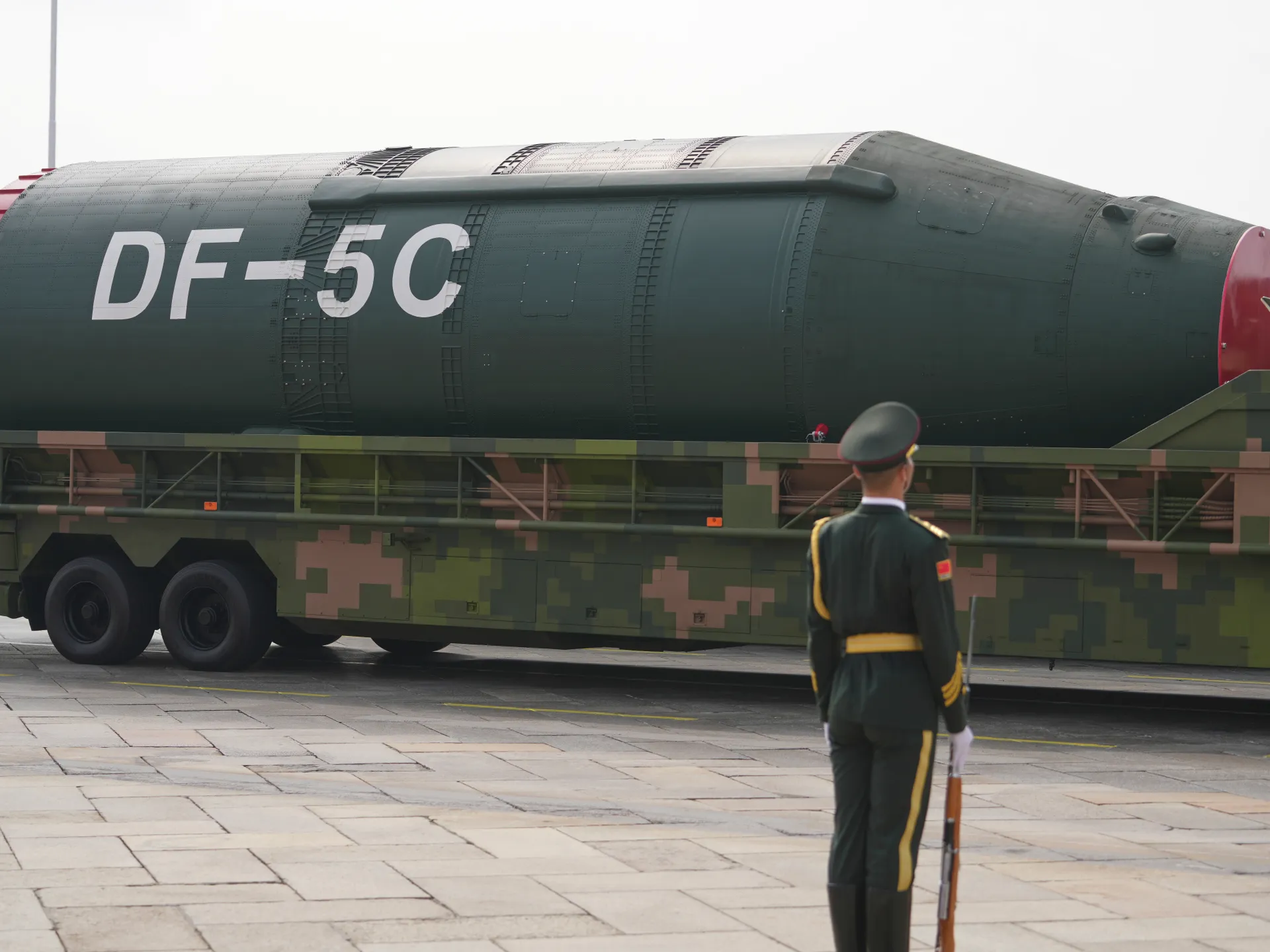
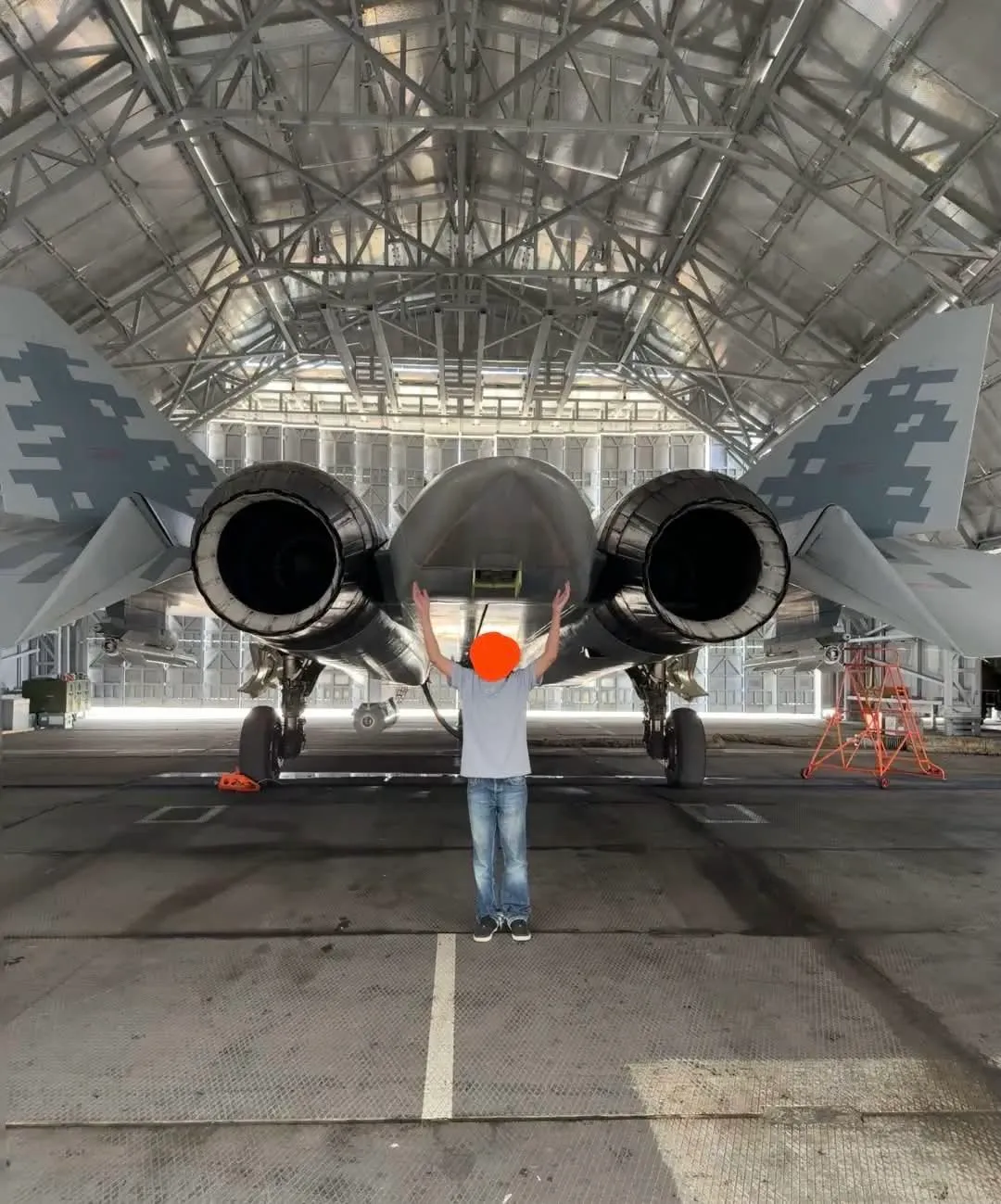








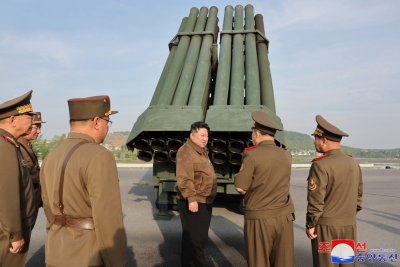




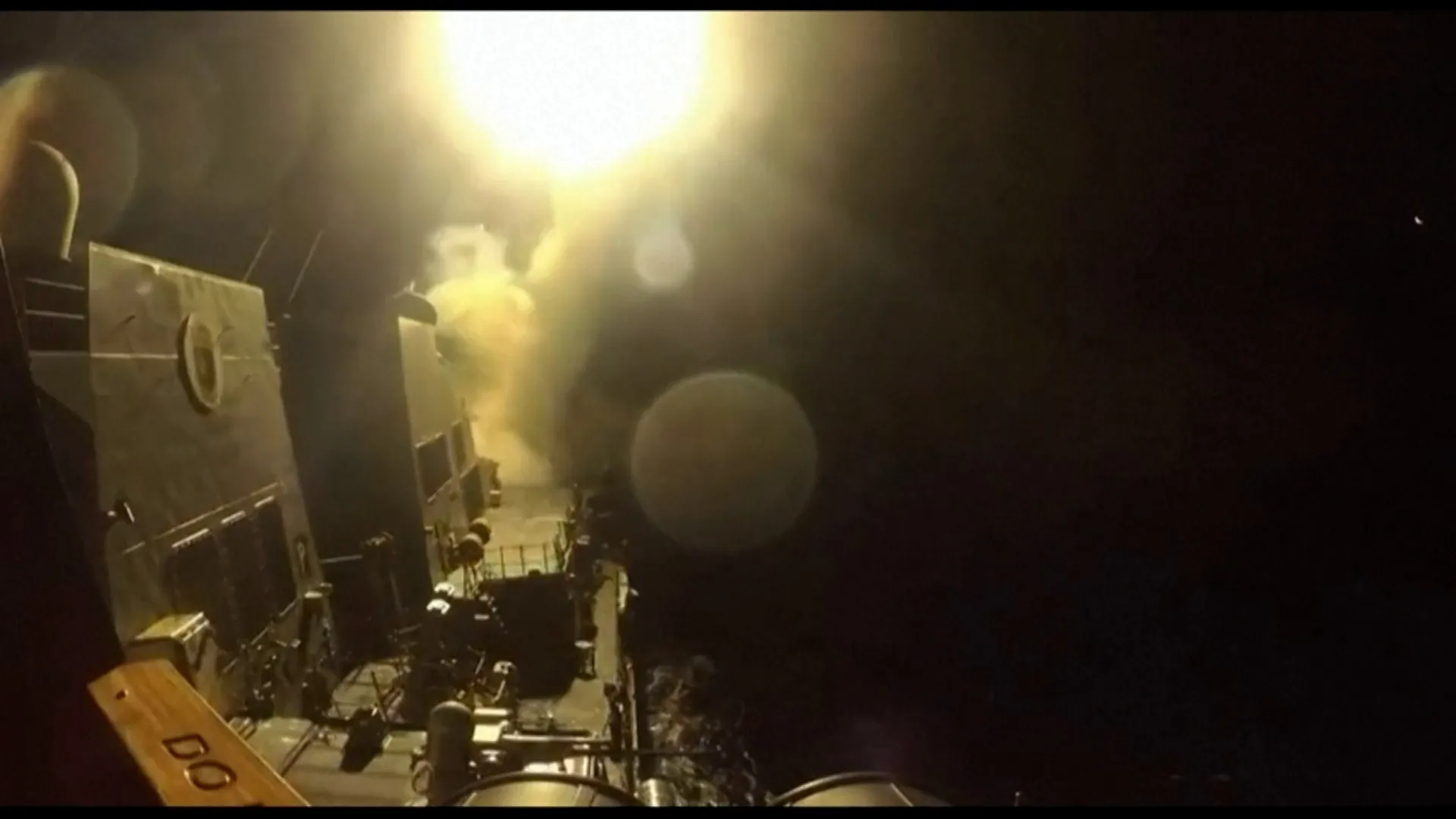


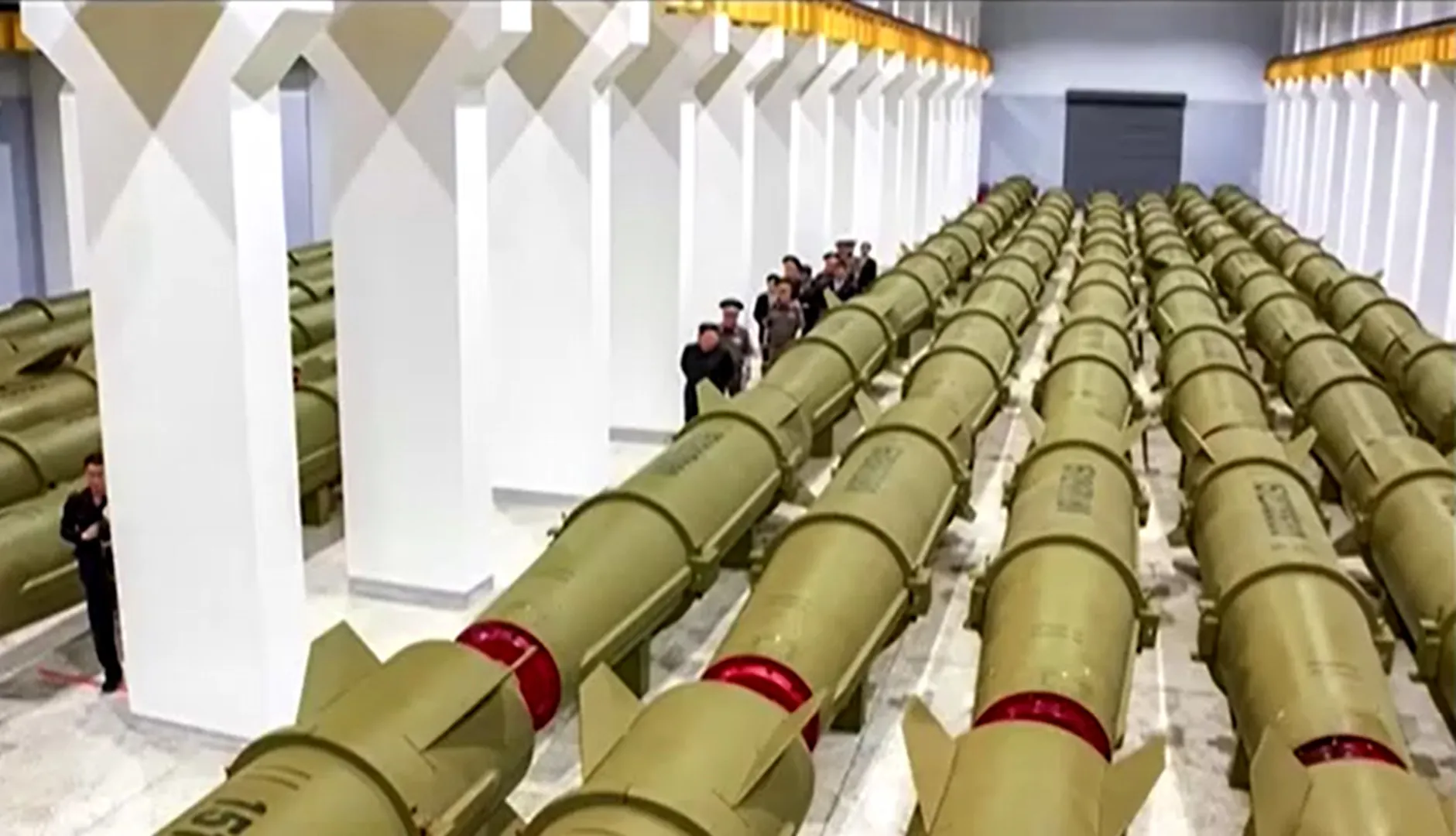



![Hossam Badran, a member of the Hamas Political Bureau, spoke exclusively to Al Jazeera about the group's vision for a long-term Hudna in Gaza. [Mohammad Mansour/Al Jazeera]](https://i0.wp.com/www.aljazeera.com/wp-content/uploads/2026/06/IMG_7408-1780572254.jpg?w=640&ssl=1)