warning

Video: Maduro rejects Trump’s warning against ‘acting tough’ | Nicolas Maduro

NewsFeed

US President Donald Trump warned Nicolas Maduro to ‘not play tough’ and to step down on Monday, while the Venezuelan leader said Trump should focus on the issues in his own country. Trump told reporters the US will keep 1.9 million barrels of oil that were seized near Venezuela in December.

Source link

Beckhams’ heartbreaking split as Brooklyn BLOCKS whole family on Instagram with no warning and Cruz reveals upset

CRUZ Beckham has claimed estranged brother Brooklyn blocked all of his family on social media – including his parents David and Victoria and his sister Harper.

It comes amid reports the former England footballer, 50, and fashion designer Victoria , 51, unfollowed their eldest son and his wife Nicola Peltz, 30, on Instagram.

Brooklyn Beckham blocked all of his family on social media – including his sister Harper and parents David and VictoriaCredit: Getty Images for Supergoop!
Nicola has also unfollowed the Beckham clanCredit: Getty
The Beckham family before the family fall outCredit: Gareth Cattermole/Getty Images

Cruz, 20, today addressed the unfollowing drama and hit back in a post on his Instagram Story.

He revealed that Brooklyn, 26, removed the entire family – including 14-year-old Harper – from his social media.

The musician confirmed his parents woke up to being banned from seeing Brooklyn’s profile, and said: “My mum and dad would never unfollow their son.

“They woke up blocked. As did I.”

POSH’S PAIN

Inside Victoria’s plans for Xmas without Brooklyn as she gives up on call hope


BECKS’ APPEAL

David Beckham sends emotional message to son Brooklyn amid family feud

Brooklyn’s wife Nicola is also not following any of the Beckham family on Instagram – weeks after the couple were absent from David’s long-awaited knighthood celebrations.

Meanwhile David and Victoria were not present for Brooklyn and Nicola’s New York wedding vow renewal in August.  

The couple, who tied the knot in 2022, were last pictured with David and Victoria last Christmas.

Victoria shared a snap on Instagram on Boxing Day alongside David with her three sons, daughter Harper and Nicola.

She wrote: “Being together for the holidays makes me so happy. I love you all so much.”

The Sun told this week how Victoria is determined not to let the fallout with Brooklyn and Nicola ruin their Christmas.

Referring to how close Brooklyn was to  his grandparents, a source told The Sun: “Brooklyn spent so much time with her parents Jackie and Tony for the first few years of his life.

“They had such a special bond, while Sandra (David’s mum) looked after him so much growing up.

“Harper really misses her big brother and Nicola.

“Victoria is hoping that Brooklyn at least calls his grandparents over Christmas.

“She’s given up on him calling her.”

ATTEMPTS TO REACH OUT

Earlier this month David appeared to send an emotional message to Brooklyn amid the extraordinary family feud.

Taking to his Instagram Stories, David, 50 shared a photo of himself, wife Victoria, 51, and children Romeo, 23, Cruz, 20 and Harper, 14, celebrating his MLS title in Miami.

However, what was poignant in the post was that he also shared a throwback snap of himself with Brooklyn, 25, and his brothers after winning the same cup as a player with LA Galaxy in 2011 and 2012.

He captioned the snaps with: “License to cry.”

The sweet post could be seen as David’s olive branch to his son, as we approach Christmas.

TELLING SWIPE

It comes as Victoria recently revealed it takes a lot for her not to get on with another woman.

She said in an interview on Andy Cohen‘s Sirius XM’s radio show: “I’m a girl’s girl. I mean you’ve got to be a real ae for me to not get on with you if you’re a woman.”

The fashion mogul continued: “Because I love, I love women, you know, and that’s part of the reason why I do what I do with fashion and beauty.

“I want to empower women. Yes. And I want to share my tips and tricks with women.”

Things took a turn in the family feud earlier this year when Brooklyn and Nicola organised a wedding vow renewal in the summer but none of the Beckhams were invited to the lavish ceremony.

In fact David and Victoria only found out about it on a US website.

A source told us at the time: “This was the final kick in the teeth for David and Victoria.”

David appeared to extend an olive branch to his son with this sweet postCredit: Instagram

Source link

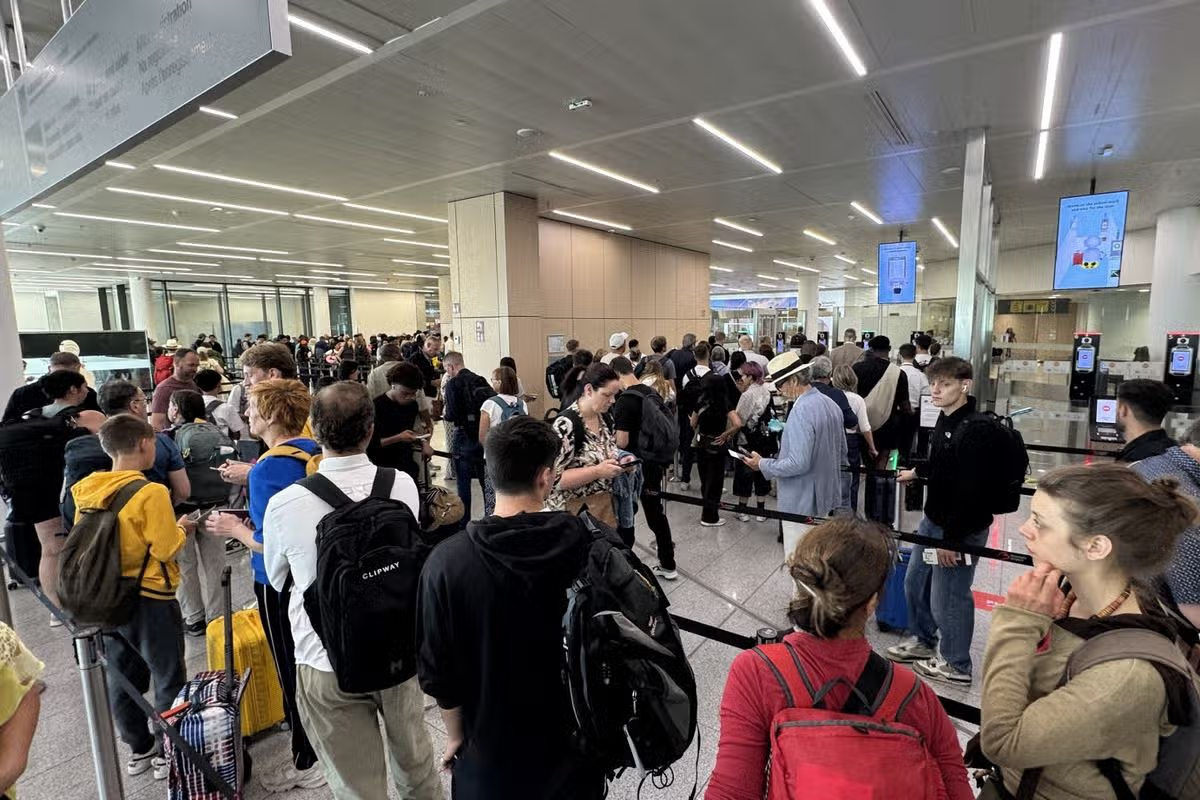
Travel warning as new EU rule rollout causes airport chaos and three hour queues

OFFICIALS have called for the new EES system to be urgently reviewed with some passengers facing three-hour queues at passport control.

The new Entry/Exit system is set to be up and running by April 10, 2026 for non-EU citizens entering the Schengen area – but there has been a concerns due to huge delays at the border.

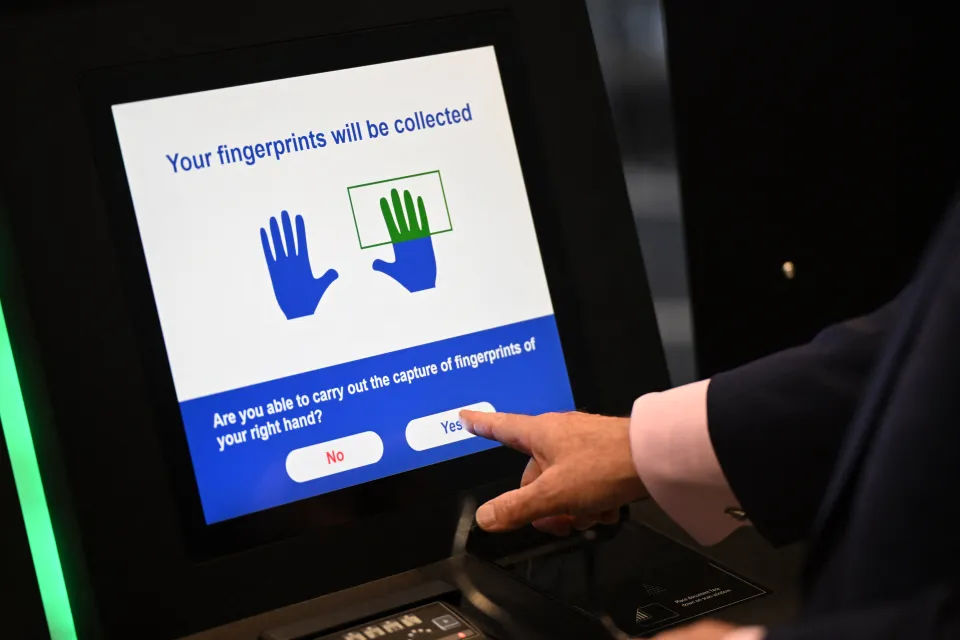
New EES systems has caused delays of up to three hours for non-EU citizensCredit: Reuters
The system is set to be completely rolled out in April 2025Credit: Reuters

The new EES system started rolling out from October 12, 2025, in order to replace manual passport stamping with digital checks for non-EU travelers.

It was designed to eventually reduce airport wait times by automating border checks with biometrics.

But reports have recorded waiting times of up to three hours – and many travellers have taken to social media too.

On December 18, one person said about Lanzarote on X: “Landed at 14.30, over 2 hours later still at airport. This new EEs just is working. Hundreds of people in queue then they stamp passports. Ridiculous”.

STREET SMARTS

I visit New York 6 times a year – my expert budget guide including £1 pizzas


SNOW WAY

All the best Xmas days out under £10 including FREE ice skating & Santa’s grotto

On the same day, The Portugal Post reported three-hour queues in the arrivals hall at Lisbon’s Humberto Delgado Airport due to a glitch with the EES system.

It even added that “officials are now weighing whether to switch the system off altogether during Christmas”.

Earlier in the month, one traveller said: “The new EU Entry/Exit System is off to a great start at Prague Airport, with a 3+ hour queue wrapped around the entire terminal right now.”

The Airports Council International (ACI) in Brussels is calling for an urgent review of the entry-exit system (EES).

ACI has said that the capturing of biometric data from third-country nationals entering the Schengen area has resulted in border control processing times at airports increasing by up to 70 per cent.

It added that this has impacted the passenger experience especially in airports across France, Germany, Greece, Iceland, Italy, Portugal and Spain.

The ACI has called for a review of the systemCredit: Reuters

The ACI has said that multiple factors have resulted in delays which include regular EES outages.

It reported persistent EES configuration problems, “including the partial deployment or unavailability of self‑service kiosks used by travelers for registration and biometric data capture”.

There is continued unavailability of Automated Border Control (ABC) gates for EES processing at many airports, and the unavailability of an effective pre-registration app.

Another factor is an insufficient amount of border guards at airports.

Olivier Jankovec, Director General of ACI EUROPE warned: “Significant discomfort is already being inflicted upon travelers, and airport operations impacted with the current threshold for registering third country nationals set at only 10 per cent.”

Currently, one in 10 travellers has to go through the digital registration.

But by January 9, 2026, the percentage is due to be raised to 35 per cent.

Mr Jankovec has warned that unless the issues are resolved this “will inevitably result in much more severe congestion and systemic disruption for airports and airlines. This will possibly involve serious safety hazards”.

He added: “We fully understand and support the importance of the EES and remain fully committed to its implementation.

“But the EES cannot be about mayhem for travelers and chaos at our airports. If the current operational issues cannot be addressed and the system stabilised by early January, we will need swift action from the European Commission and Schengen Member States to allow additional flexibility in its roll‑out.”

For more on EES checks, here’s everything you need to know about them from a travel expert.

Plus, here’s all the worst travel chaos predicted for the UK over the Christmas period.

The new EES system has resulted in queues for up to three hours during peak travel timesCredit: Reuters

Source link

Urgent ‘do not travel’ warning for popular Brit tourist destination over landmine fears

British tourists have been warned by the Foreign Office after deadly fighting erupted between two countries, with rockets fired across the border and travel insurance likely voided in affected areas

British holidaymakers travelling along a well-trodden backpacking trail have been issued a stark warning by the Foreign Office following deadly clashes between two neighbouring nations.

The UK Foreign Office issued an urgent notice to all travellers heading to Thailand and Cambodia this holiday season – as parts of the country grapple with “regular attacks”.

Residents in areas of Thailand and Cambodia sought refuge last week as both countries launched volleys of rockets across their shared frontier. Both nations have blamed each other for violating a Trump-mediated ceasefire that brought an end to intense five-day hostilities earlier this year.

Authorities have urged British holidaymakers to avoid travelling within 50km of Thailand’s entire border with Cambodia. The only exceptions are a few islands, which should only be visited if absolutely necessary. These include Koh Chang, Koh Kood and the other islands in between.

If you’re planning a trip to Thailand, make sure to read all of the Foreign Office advice.

The escalation comes as Cambodia’s senate president Hun Sen vowed to mount a fierce battle against Thailand. Last week’s unrest included brutal airstrikes and saw at least 20 people killed.

An orange alert has been issued, covering Pattani, Yala, and Narathiwat Province, alongside the districts of Chana, Thepa, Na Thawi, and Saba Yoi in southern Songkhla Province.

Approximately one million UK citizens travel to Thailand annually. In recent years, it has become commonplace for some visitors to take brief excursions over the land crossing into Cambodia by catching a coach from Thailand’s capital, Bangkok.

However, the frontier has remained shut for most of this year due to violent outbreaks, with current UK Foreign Office guidance as of this week advising that British citizens should steer clear of “all but essential travel” to areas within 31 miles of Thailand’s border with Cambodia.

The guidance states: “Land borders and crossings between Thailand and Cambodia continue to be suspended. Some tourist destinations in border areas, such as the Khao Phra Wihan/Preah Vihear temple, the Ta Kwai/Ta Krabey temple, and the Ta Muen Thom/Tamone Thom temple, are closed. There are also unexploded landmines in the border area. We advise against all but essential travel to the affected border areas.”

Whilst travelling to a region marked as ‘essential travel only’ by the Foreign Office isn’t against the law, doing so will likely invalidate your travel insurance – even if it remains valid in other parts of the same nation considered safe. This leaves you personally responsible for expenses such as medical emergencies, cancellations, or repatriation, and securing help from the British Embassy becomes considerably more challenging should problems arise.

What’s the reason behind the Thailand and Cambodia conflict and what part did Donald Trump play?

The ongoing strife between Thailand and Cambodia is a flare-up of a border disagreement that has been simmering for several decades, which until this year had only led to occasional skirmishes.

In May, the death of a Cambodian soldier in one such skirmish sparked an intensification of hostilities, culminating in five days of full-scale warfare in July. The fallout saw at least 48 fatalities and displaced 300,000 people.

A peace agreement mediated by Donald Trump was inked by the Thai and Cambodian governments in Malaysia in October, with the US President having threatened to withhold trade deals with either nation if they rejected the pact. However, this week saw a resumption of hostilities after the ceasefire was violated – with each party pointing the finger at the other for firing the first shot.

Thailand’s military alleges that Cambodia launched an assault on Thai positions with artillery, rockets and drone strikes earlier in December, following accusations of previous attacks in the days before. Conversely, Cambodia asserts that Thai forces initiated the conflict, in the Preah Vihear province.

Source link

Foreign Office says ‘be vigilant’ in UK travel warning after Bondi attack

Yvette Coop[er has issued an alert and the Foreign Office has given advice

The Government has issued a travel warning for UK citizens after the terror attack in Australia. At least 12 people have been killed and 29 injured in a terrorist attack targeting a Jewish celebration at Bondi Beach in Sydney.

Two individuals armed with guns opened fire on a crowd in the Archer Park area of Bondi Beach at 6.47pm local time on Sunday, New South Wales Police said. The attack has been declared a terrorist incident targeting a Hanukkah celebration at a park next to the beach on the first day of the Jewish festival of lights, the force confirmed.

New South Wales Premier Chris Minns told a press conference: “At approximately 6.47 this evening, two individuals began firing on crowded a group of families on Bondi Beach at Archer Park. I very sadly need to report that, as of now, there are at least 12 individuals that have been killed.

“This attack was designed to target Sydney’s Jewish community on the first day of Hanukkah, what should have been a night of peace and joy celebrated in that community with families and supporters, has been shattered by this horrifying evil attack.”

Police in the UK are stepping up patrols in Jewish communities. A Met Police spokesman said: “While there is no information to suggest any link between the attack in Sydney and the threat level in London, this morning we are stepping up our police presence, carrying out additional community patrols and engaging with the Jewish community to understand what more we can do in the coming hours and days.

“We always encourage the public to be vigilant at events and in public places. If you see anything suspicious, trust your instincts and tell us.”

Hanukkah, also known as Chanukah, is an eight-day festival of light usually observed in December.

Foreign Secretary Yvette Cooper has told any British people caught up in the Bondi Beach shooting to contact the consulate for support.

In a post on X, she said: “The scenes from Bondi Beach are deeply shocking and distressing. My thoughts are with everyone affected and Australia’s emergency services.

“British nationals should follow local police and authorities’ advice and can contact the British Consulate General Sydney for support.”

The UK Foreign Office site reads: “Terrorists are likely to try to carry out attacks in Australia.” It adds: ” There is a high threat of terrorist attack globally affecting UK interests and British nationals, including from groups and individuals who view the UK and British nationals as targets. Stay aware of your surroundings at all times.”

The Foreign Office said: ” Attacks could be indiscriminate, including in places visited by foreign nationals. You should be vigilant, keep up to date with local media reports and follow the advice of local authorities.”

Source link

Helms Stirs Furor With Warning to President : Politics: Senator says Clinton ‘better watch out’ if he visits N. Carolina bases. He later admits to ‘mistake.’

Sen. Jesse Helms (R-N.C.) set off a bipartisan tempest Tuesday by warning that President Clinton had “better watch out” for his safety if he travels to military bases in North Carolina, prompting the White House to suggest that Helms be denied chairmanship of a key Senate committee.

After GOP leaders delicately distanced themselves from Helms’ provocative remarks and Democrats loudly demanded an apology, the fiercely combative lawmaker, who is in line to chair the Senate Foreign Relations Committee, conceded that his comments had been “a mistake.”

But he stopped well short of a genuine apology. “Of course, I didn’t expect to be taken literally,” he said in a prepared statement.

In an interview published Tuesday morning in the Raleigh (N.C.) News & Observer, the 73-year-old conservative asserted that Clinton is extremely unpopular among armed forces personnel stationed at the six military bases in his home state.

“Mr. Clinton better watch out if he comes down here,” the newspaper quoted Helms as saying. “He’d better have a bodyguard.”

The President, asked about Helms’ remarks during a White House news conference, called them “unwise and inappropriate.” While asserting his authority in matters of foreign affairs, he said that it is up to Republicans to decide who will speak for them.

“The President oversees the foreign policy of the United States and the Republicans will decide in whom they will repose their trust and confidence,” Clinton said.

It was a vintage performance for Helms, a conservative ideologue who has built a career based on pugnacious rhetoric and flamboyant attacks. But his critique of Clinton prompted soul-searching among some Republicans who fear that Helms, by his intemperate remarks, will bolster Democratic charges that the GOP is a party of extremists.

“Jesse,” said a former senior official in the George Bush Administration, “has been for most Republicans an embarrassment.”

Helms’ comments were published on the 31st anniversary of President John F. Kennedy’s assassination, adding to the embarrassment of Republican lawmakers. Most declined to comment directly, noting only that each of the Senate’s 100 members speaks only for him or herself.

No such restraint was observed by Sen. Christopher J. Dodd (D-Conn.), who is locked in a race to lead the Senate’s new minority Democrats. He called on Helms to issue a formal apology to the President and to members of the armed forces, whose loyalty and patriotism, Dodd said, were called into question by Helms.

“To suggest on this day of all days . . . that an American President’s life might be in jeopardy (if he) were to visit an American military base, would suggest that my colleague from North Carolina doesn’t seem to know what country he’s living in,” Dodd said. “This is not a banana republic.”

It is not the first time that Helms has provoked a political furor. He once accused former Secretary of State George P. Shultz of “playing footsie with the Communists” by opposing apartheid in South Africa. In a floor debate over funding for AIDS research, he bluntly characterized homosexuals as “perverted.”

Helms often storms onto the Senate floor to rail against abortions and erotic art and regularly angers both Democratic and Republican colleagues by threatening to waylay measures that he dislikes by engaging in a one-man filibuster.

“This senator,” he once told fellow lawmakers, “did not come to Washington to gain popularity with his colleagues.”

His latest remarks came just four days after a television interview in which Helms questioned Clinton’s fitness to serve as commander in chief of the armed forces. Those comments drew muted criticism from Republicans and a vigorous denial from Gen. John M. Shalikashvili, chairman of the Joint Chiefs of Staff.

On Tuesday, the Secret Service, which is responsible for the President’s safety, confirmed that it is seeking a transcript of Helms’ interview with the News and Observer. But officials were quick to caution that they do not view Helms’ remarks as an effort to incite violence against the President.

Military officials in North Carolina, where Clinton visited in April, took pains to disassociate themselves from Helms’ comments.

“The President is the commander in chief. He is welcome on any base in the military that he chooses to visit,” said Capt. Bruce Sprecher, public affairs officer at Seymour-Johnson Air Force Base.

Responding to Helms’ newspaper interview, the White House publicly questioned his suitability for the Foreign Relations chairmanship. White House Chief of Staff Leon E. Panetta urged Sen. Bob Dole (R-Kan.), who is expected to be majority leader in the new Congress, to ignore tradition and pass over Helms in choosing the next chairman.

“I think those comments are not only reckless but they are dangerous and irresponsible,” Panetta told a small group of reporters. “And I think they raise a very serious question as to whether (Helms) ought to assume the chairmanship of that committee. I think the Republican leadership needs to take a very hard look as to whether or not they want somebody with these kind of extreme views to chair one of the most important committees in the Congress of the United States.”

Panetta said that Helms’ remarks and Republican leaders’ response to them “will tell us an awful lot what kind of course we’re going to take in the next Congress.”

The reaction of Republican leaders generally fell short of the repudiation that Democrats are seeking. Neither Dole nor incoming House Speaker Newt Gingrich (R-Ga.), asked about the flap at a Republican Governors Assn. session in Williamsburg, Va., would criticize Helms directly. “The President’s welcome to come to any state,” said Dole. “That’s the way it should be, that’s the way it is, that’s the way it will be.”

Gingrich said that Republicans would welcome any Clinton visit as an opportunity to engage in debate over the nation’s future.

“I would hope that (Clinton) would feel that all Americans want to respect and honor the President and that they want to welcome their President in their neighborhood and their community any time he wishes to come and visit,” he said.

Some Republicans were more blunt in their criticism of Helms.

“I wish he hadn’t said it,” said Republican political consultant Lyn Nofziger. “If it did anything, it creates a little sympathy with the prez, and I’m not in favor of that. . . . It gives people something to shoot at. And it distracts a little. But is it a permanent damage? No.”

While some Republicans stewed, Senate insiders suggested that Helms’ legislative career likely would suffer little.

“There will be no effort to muzzle anyone,” said one key Republican aide. “That’s the way this body operates. These folks are very independent people. It would be very inappropriate for someone to try to quiet Sen. Helms. And there’s a great deal of deference to committee chairmen and seniority.”

Times staff writers John M. Broder and Ronald Brownstein contributed to this story.

Tracking a Controversy

President Clinton, during a press conference Tuesday afternoon, called remarks made by Sen. Jesse Helms (R-N.C.) “inappropriate and unwise.”

* Asked if Clinton was up to the commander in chief’s job: “No I do not. And neither do people in the armed forces.”

–CNN interview last week

* On the president visiting North Carolina: “Mr. Clinton better watch out if he comes down here. He’d better have a bodyguard.”

–interview with the News & Observer of Raleigh, N.C. on Monday

* On his earlier remarks: “I made a mistake last evening which I shall not repeat.

–statement issued Tuesday

The Helms File

Past remarks by Sen. Jesse Helms (R-N.C.), the incoming Senate Foreign Relations Committee chairman:

Nov. 4, 1993: “It was well-known that (Haitian President Jean-Bertrand) Aristide is a murderer. Yet somebody decided to return him to power, if necessary, at the risk of American lives. Who is making these decisions?”

–to Secretary of State Warren Christopher at a hearing of the Foreign Relations Committee

Aug. 5, 1993: “I’m going to make her cry. I’m going to sing ‘Dixie’ to her until she cries.”

–Sen. Carol Moseley-Braun, D-Ill., quoted Helms as saying to her a month after they had debated on the Senate floor over use of the Confederate flag

May 7, 1993: “She’s not your garden-variety lesbian. She’s a militant-activist-mean lesbian, working her whole career to advance the homosexual agenda.”

–on the nomination of a gay rights activist to a Department of Housing and Urban Development post

Oct. 30, 1990: “People can do what they want in the privacy of their own homes, but when they start marching in the street and say that homosexuality should be given special privileges and be treated as a normal lifestyle, you bet I say no.”

–during a campaign stop for his 1990 Senate campaign

Oct. 24, 1990: “What is really at stake is whether or not America will allow the cultural high ground in this nation to sink slowly into an abyss of slime to placate people who clearly seek or are willing to destroy the Judaic-Christian foundations of this republic.”

–talking about National Endowment for the Arts funding to certain artists

Source: Associated Press

Helms Takes It Back

This is a statement by Sen. Jesse Helms (R-N.C.) on Tuesday regarding his remarks about President Clinton:

I made a mistake last evening which I shall not repeat.

In an informal telephone interview with a local reporter I made an offhand remark in an attempt to emphasize how strongly the American people feel about the nation’s declining defense capability and other issues in which the President has been involved and for which he is responsible.

Of course I didn’t expect to be taken literally when, to emphasize the cost and concerns I am hearing, I far too casually suggested that the President might need a bodyguard, or words to that effect.

And let me say that President Clinton will of course be welcomed by me and other citizens of North Carolina and other states any time he chooses to visit us.

The reporter asked my opinion and I tried to be candid in my response. The President has serious problems with his records of draft avoidance, with his stand on homosexuals in the military and the declining defense capability of America’s armed forces–the secretary of defense recently acknowledged that three U.S. Army divisions are not now combat ready.

I reiterate that I now wish that I had engaged in a terse interview with the reporter. I did not. As is my custom, we had an informal conversation from which he extracted an informal quote that should not have been taken literally, let alone published.

I do not fault him. I fault myself. From now on, such contacts as I may have with the media will be entirely formal.

Source: Associated Press

Source link

AA warning to Christmas shoppers in these cities with parking fees cranked up to 50%

The AA examined parking charges at the UK’s top Christmas markets to reveal the most expensive places to park – one hotspot costs £44 for four hours

As hoards of excited gift-hunters head into town for Christmas markets this winter, new research from breakdown experts shows where drivers will pay the most to park for a short festive visit, as well as the cities where prices have risen the fastest since 2024.

The AA examined parking charges at the UK’s top Christmas markets to reveal the most expensive places to park – including cities hiking fees by 50 percent.

The breakdown recovery experts found that Leicester Square Christmas Market in London is the most expensive in the country for parking at an eye-watering £22.00 for a two-hour visit, as per The AA.

Covent Garden, Edinburgh, York and Greenwich also rank among the top ten most expensive markets to park at, with each costing over £10.00 for a two-hour stay.

York and Liverpool are the cities with the biggest parking price hikes since December 2024, each increasing fees by 50% – including a new ‘event day’ fee from York Council for 2025. Bristol, Greenwich and Birmingham also feature among the top price hikers.

One of the smaller Christmas markets, Leicester Square Christmas Market is a free entry festive pop-up in the heart of London’s West End. However, parking is not free and costs £22 for a two-hour stay.

Winter Wonderland is London’s most well-known Christmas market with over 150 rides and attractions including a free Santa’s Grotto, and the UK’s largest open-air ice rink centred around the park’s bandstand. A two-hour parking stay costs £21.

Differing from traditional German-style markets, Covent Garden’s free Christmas experience is a festive takeover of the Piazza, Apple Market, and surrounding streets, and it features 300,000 lights. Parking for two hours costs £16.

Taking place across East Princes Street Gardens, West Princes Street Gardens and George Street, Edinburgh Christmas Market is also free to enter. The market features a mix of alpine-style chalets selling Scottish artisan products and Christmas gifts. A two-hour parking ticket costs £14.

York St Nicholas’ fair is a charming, free-to-enter festive event is held in the city centre in Parliament Street and St Sampson’s Square and is home to 75 alpine-style chalets offering handmade crafts, seasonal food, decorations and local produce. For two hours parking costs £10.60. York Council have introduced an ‘event day’ parking charge at the Coppergate Centre car park during the 2025 markets. Prices have increased 50% for a 2-hour stay and 29% for a 4-hour stay, although after 6pm there is a flat evening rate of £4.80.

“Christmas markets are a fantastic seasonal draw, but drivers should be aware that parking charges vary dramatically by city and by car park,” says Shaun Jones, AA Patrol of the Year. “If you’re planning a short festive trip, check the latest local parking tariffs before you go and consider public transport or park-and-ride options in city centres where parking is most expensive.”

Motorists are urged to check prices before they arrive, as many councils and car-park operators publish rates online. You should book in advance where possible using pre-booked parking as this often works out cheaper. Consider park-and-ride or outer-ring car parks- a short bus or tram ride can be cheaper and faster during peak market times.

Look for evening rates as some car parks run special evening prices that may be cheaper for market visits. Drivers are also urged to pay attention to permit or event day pricing. Markets in central locations sometimes trigger event tariffs that are higher than usual, like those in York.

Source link

Magnitude 6.7 earthquake hits Japan’s northeast, tsunami warning issued | Earthquakes News

DEVELOPING STORY,

A tsunami warning has been issued following a strong quake off northeast coast of Japan.

An earthquake with a preliminary magnitude of 6.7 has hit Japan’s northeastern region, prompting a tsunami advisory from the Japan Meteorological Agency (JMA).

The earthquake struck on Friday off the coast of Aomori Prefecture at 11:44am local time (02:44 GMT) at a depth of 20km (12.4 miles), according to the JMA.

Recommended Stories

list of 4 itemsend of list

The United States Geological Survey (USGS) also said that the quake measured 6.7.

Japan’s Nuclear Regulation Authority said there were no immediate signs of abnormalities at the region’s nuclear facilities.

National broadcaster NHK said that the level of shaking from the quake was less than a bigger magnitude 7.5 earthquake that hit in the same region on Monday and tore apart roads, smashed windows and triggered tsunami waves of up to 70 centimetres (2.3ft).

Following Monday’s quake, which injured at least 50 people, the JMA issued a rare special advisory warning to residents across a wide area, from Hokkaido in the north to Chiba, east of Tokyo, to be on alert for an increased possibility of a powerful earthquake hitting again within a week.

The northeast region is haunted by the memory of a massive magnitude 9.0 undersea quake in 2011, which triggered a tsunami that left about 18,500 people dead or missing.

The JMA issued its first special advisory in 2024 for the southern half of Japan’s Pacific coast warning of a possible “megaquake” along the Nankai Trough.

The government has said that a quake in the Nankai Trough and subsequent tsunami could kill as many as 298,000 people and cause up to $2 trillion in damages.

Amid fears of a “megaquake”, NHK reported on Thursday that people in the northeast of Japan were stocking up on disaster-related goods such as torches, water storage tanks and support poles to prevent furniture toppling over due to tremors.

One shop in Hokkaido’s Hakodate City reported sales of bottled water and disaster kits tripling following Monday’s quake.

“We decided to prepare, so I bought disaster kits for everyone,” a male customer in his 30s told NHK while visiting a shop with his family.

Japan sits on top of four major tectonic plates along the western edge of the Pacific “Ring of Fire” and is one of the world’s most seismically active countries.

A vehicle rests on the edge of a collapsed road in Tohoku town in Aomori Prefecture on December 9, 2025, following a 7.5 magnitude earthquake off northern Japan. A big quake off northern Japan left at least 30 injured, authorities said on December 9, damaging roads and leaving thousands without power in freezing temperatures. (Photo by JIJI Press / AFP) / Japan OUT / JAPAN OUT / JAPAN OUT
A vehicle rests on the edge of a collapsed road in the town of Tohoku in Aomori Prefecture, on December 9, 2025, following a magnitude 7.5 earthquake off the coast of northern Japan [JIJI Press/AFP]

Source link

Macron’s Warning, Bremen’s Wallet: Europe’s New Space-Defense Era

When French President Emmanuel Macron inaugurated France’s Space Command in Toulouse on 12 November 2025 and declared that “space is no longer a sanctuary; it has become a battlefield,” few expected such swift validation. Two weeks later, at the ESA Ministerial Council in Bremen on 26–27 November, member states delivered the largest budget in the agency’s history—€22.1 billion for 2026–2028, a 30% increase over the previous cycle—with an unprecedented focus on security, defense, and strategic autonomy. The Bremen decision has transformed Macron’s stark warning from rhetoric into funded reality and confirmed that Europe is finally awakening to the fact that the next decisive domain of great-power competition lies far above the Earth’s atmosphere.

Paris is preparing to invest about €4.2 billion in military space activities from 2026 to 2030 and around €16 billion in civilian and dual-use programs by the end of the decade. The ambition is to strengthen Europe’s resilience in orbit, reduce dependence on non-European systems, and create an industrial base capable of supporting long-term security objectives.

French planners are betting on a new generation of proximity‑inspection satellites to anchor this strategy, with demonstration flights envisaged in the second half of the decade and operational testing to follow. These satellites can approach, observe, and, if required, interdict suspicious objects in orbit. France is also exploring non‑kinetic tools—lasers and electromagnetic systems among them—designed to disrupt hostile platforms without creating debris. Paris has rejected destructive anti-satellite testing and argues that Europe must enhance space security without undermining international norms.

The European Union is entering this field late. Russia and China have already developed advanced inspection and interference capabilities. In September 2025, German Defence Minister Boris Pistorius revealed that two Russian Luch or Olymp satellites were shadowing Intelsat platforms used by the Bundeswehr. The episode underscored Europe’s lack of awareness and defensive capacity in orbit.

In Brussels, officials are floating the idea of a “European Space Shield”—a more integrated architecture to protect satellites and align EU and NATO postures. Success will depend on the willingness of member states to coordinate procurement, share data, and harmonize strategic objectives. Europe’s current system remains fragmented and is often slowed by national industrial preferences.

Macron has also called for reform of the European Space Agency’s geographic return rule, which distributes contracts according to member-state contributions rather than technical merit. The French position is that this rule limits innovation and prevents Europe from responding quickly to fast-moving threats in orbit.

There are challenges. Even non-kinetic defenses can be misinterpreted as escalatory. The orbital environment is crowded, vulnerable to miscalculation, and poorly regulated. France has therefore paired its military investments with calls for new rules of behavior and a European proposal for an orbital code of conduct. Such a framework would help prevent misunderstandings and promote transparency.

The ESA Ministerial Council that concluded in Bremen on 27 November delivered what many had doubted was possible: a €22.1 billion envelope for 2026–2028 that explicitly prioritizes space security, resilient navigation (FutureNAV), Earth-observation continuity, and dual-use technologies. Germany increased its contribution by nearly a third despite domestic fiscal constraints, while the package includes more than €1 billion for programs directly supporting defense and sovereignty. Crucially, ministers opened the door to greater flexibility on the controversial “geographic return” rule for critical security projects—a French demand that had been resisted for years. Bremen did not create a fully unified European space-defense policy overnight, but it transformed Macron’s Toulouse rhetoric into funded reality and gave the proposed European Space Shield its first serious financial and political tailwind.

Satellites underpin critical EU functions, including climate monitoring, secure communications, trade logistics, and border management. Rivals are developing tools that can dazzle, jam, or disable them. Europe cannot assume that these systems will remain safe without deliberate action.

Macron’s announcement in Toulouse should be seen as a strategic warning. Europe has the capacity to protect its interests in orbit, but only if it acts with coherence and political determination. The challenge for the European Union is not technological. It is the ability to work collectively and with a sense of urgency. In an era in which conflict begins long before military forces deploy, the EU’s strategic autonomy may depend on decisions made far above the atmosphere.

Source link