US Midterm Elections 2026

Democratic voters celebrate El-Sayed’s Michigan win in election ‘blue wave’ | Politics

Democratic voters danced as they celebrated Abdul El-Sayed’s victory in Michigan. Al Jazeera’s Mikail Malik spoke to supporters in Detroit hailing the election of the first Muslim to the US Senate.

Source link

How big is the Republican midterms loss, and is there a silver lining? | US Midterm Elections 2026 News

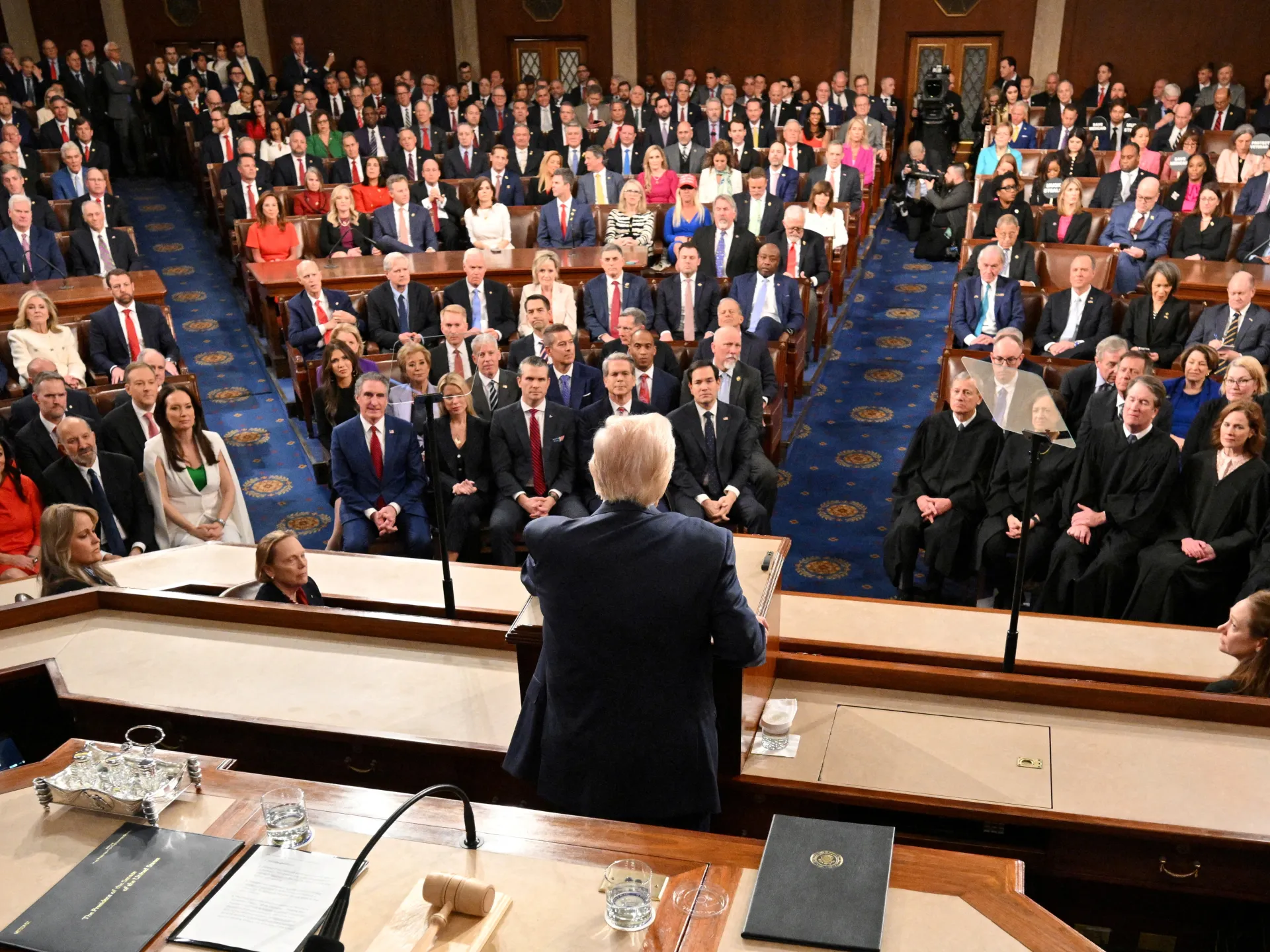
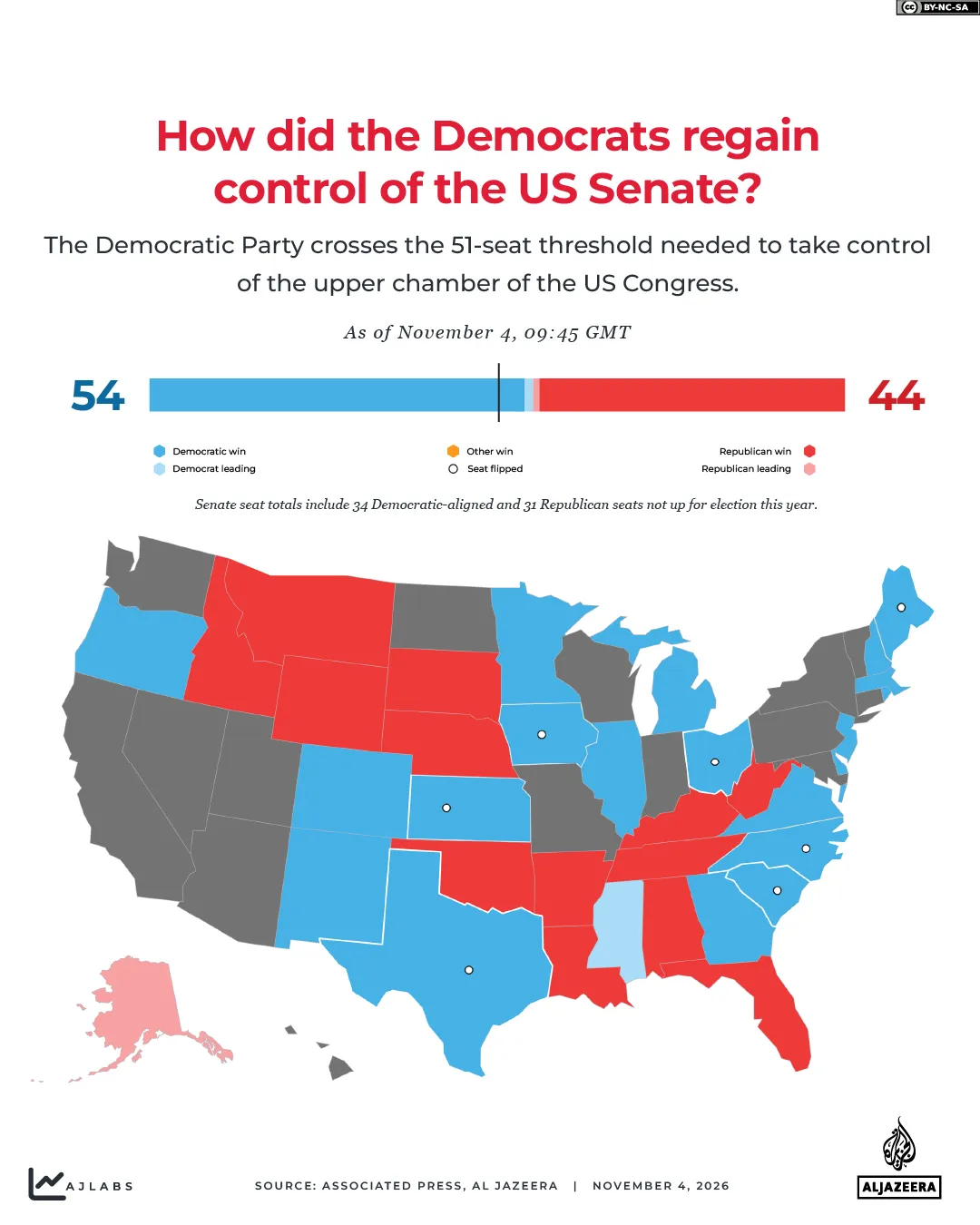
The Democrats have wrested control of the United States Congress from Republicans by winning majorities in both the House of Representatives and the Senate in a stunning blow to US President Donald Trump.

Democratic Senate candidates have shattered decades-old electoral records across traditional Republican strongholds, in particular flipping key seats in Kansas, Texas and South Carolina.

Recommended Stories

list of 3 itemsend of list

How big is the Republican midterms loss? Is there any silver lining for the political party?

Here’s what we know:

How big is the Republican Party’s loss?

The Republican Party has suffered a historic, worse-than-expected rout, losing control of both the House of Representatives and the Senate to the Democratic Party.

According to the results, in the House of Representatives, Democrats have so far won 228 seats, while the Republicans have won 139.

Democrats are also leading in 34 other seats which have yet to be called. If they win all of those, they could end up with more than 260 seats in the House, the party’s biggest majority since 1990, when the Democrats won 267 seats in the lower chamber.

Democrats also had a large majority in the House in 2008, with 257 seats, while the Republicans had 178 seats.

In the Senate, the upper chamber of Congress, Democrats have won with a majority of 54 seats while the Republicans have won 44 seats. They have not had such a clear majority in the Senate since 2008, when the party won 56 seats in the slipstream of Barack Obama’s historic first presidential election.

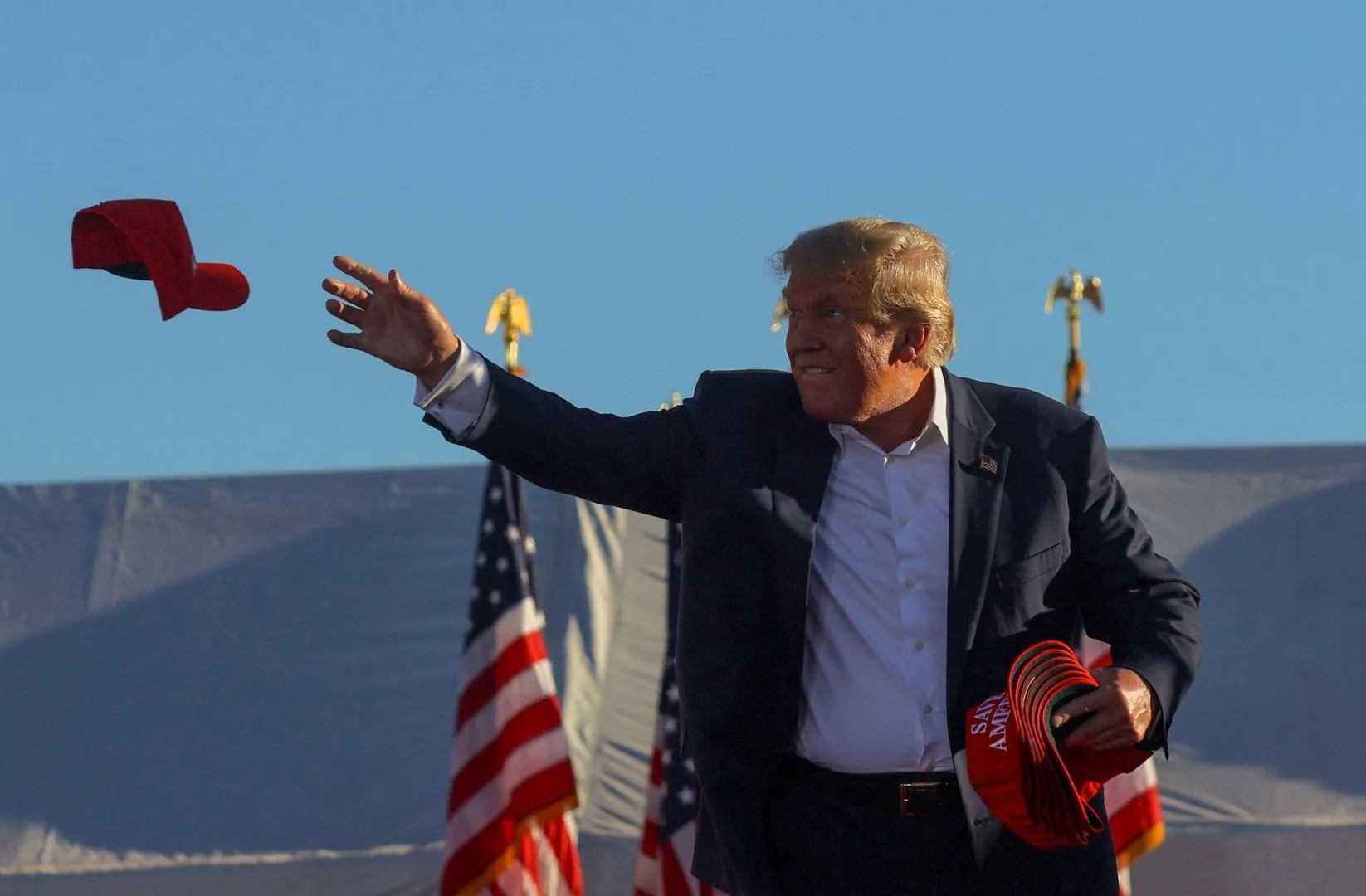
While President Donald Trump told voters to imagine he was on the ballot for this election, many of the Republican candidates he endorsed in key battleground states have been defeated by the Democrats.

In South Carolina, which had not elected a Democratic senator since 1998, Trump backed Darline Graham. But Democrat Annie Andrews won the seat.

In North Carolina, Trump had endorsed former national Republican campaign official Michael Whatley, who was beaten by Democratic Governor Roy Cooper.

In Texas, Trump promoted Attorney General Ken Paxton. But Democrat Talarico won the race.

Then in Michigan, Former US Representative Mike Rogers, Trump’s choice in Michigan, was defeated by Democrat Abdul El-Sayed.

How significant are these losses for the Republican Party?

It is usual for the governing party to lose some seats in the US midterms, but not on this scale.

A Republican Party member told Al Jazeera’s Alan Fisher in Washington, DC that the results have been much worse than expected.

“Certainly their internal polling was telling them that they might hold on to the Senate. That obviously was so far off,” Fisher reported.

Chris Featherstone, a political scientist at the University of York in the United Kingdom, said the midterm results represent a “seismic loss” for the Republicans.

He noted that many Trump-backed Republican candidates have lost throughout the country, and to both progressive and centrist Democratic candidates.

“Texas is a great example of the extent of the loss, where [James] Talarico won [the Senate seat] by almost 10 points. Texas has long been a Republican stronghold, and has been close to the heart of the intellectual and emotional heart of the party,” he said. He added that Democrat Gina Hinojosa’s win over Texas governor Greg Abbott has “come as a huge shock”, especially after redistricting which took place ahead of the midterms and through which the Republicans had hoped to win five additional seats.

“The results will change the relationship between Congress and the White House, with a huge likelihood of significant investigations and potentially impeachments for several members of the administration,” Featherstone said. “They will also change the makeup of the Democrats in Congress, increasing the appetite for aggressive opposition to Trump.”

Sudha David-Wilp, vice president of external relations at the German Marshall Fund of the United States, said that the midterm elections are usually viewed as a referendum on the party in power. She said, “a blue wave was not out of the realm of possibility”.

She told Al Jazeera that the Democrats have not just flipped seats in places like Texas, Iowa and South Carolina, where Trump is highly popular, but may have also “ushered in a new political epoch”, following these elections.

“President Trump still has a loyal following but MAGA [his voter base] has splintered and it will be hard for the GOP [Grand Old Party, a nickname for the Republican Party] to run on his brand in 2028,” she added.

INTERACTIVE_MIDTERM_WINS_SENATE

Are there any silver linings for the Republicans?

All is not doom and gloom for the Republicans who have had some wins in these elections.

In Florida, a state where Trump is very popular, Republican Senator Ashley Moody defeated Democratic state Representative Angie Nixon. Republican Byron Donalds also defeated Democrat David Jolly to win the Florida election for governor. Donalds will be Florida’s first Black governor.

In Wyoming, Republican Harriet Hageman won a Senate seat and, in Alabama, Tommy Tuberville won the race for governor of the state, defeating Democrat Doug Jones.

Republicans have also had victories in Idaho, Arkansas, Louisiana, South Dakota, Nebraska, Kentucky and West Virginia, among others.

The party has experienced similar scenarios in US election history.

In 1992, for example, when George HW Bush was president, the Republicans won only 176 seats in the Congress, compared with the Democrats who built on their majority by winning 258 seats.

Even in 2008, when George W Bush was president but Barack Obama was elected as the country’s next president, the Republicans won only 178 seats compared with the Democrats who won 257 seats.

In both those cases, however, the Republicans were able to turn things around within two years.

In 1994, while Bill Clinton was president, the Republicans won back majorities in both houses of Congress. In 2010, while the Democrats held on to control of the Senate under Obama after the midterms, they lost control of the House of Representatives.

This year could be different, for one main reason. Laurel Rapp, director of the US and North America Programme at Chatham House, said that midterms are rarely a referendum on a US president’s foreign policy, but this year, amid the US and Israel’s war on Iran, Trump’s foreign policy agenda has been a major source of ire among American voters.

She said voters have increasingly connected the Trump administration’s international affairs with rising fuel and food costs.

“And they delivered a pretty resounding verdict to the president that they would like to see a change,” she told Al Jazeera.

Rapp said that while Trump may face some constraints when it comes to navigating the global affairs landscape in the next two years, he will still have a lot of authority.

“The president still retains wide latitude to approach relations with foreign countries unilaterally, to continue to send US troops where he desires and to continue to wage wars,” she said.

Source link

Iran hails US voters rejecting war while Khamenei warns hostility won’t end | US-Israel war on Iran News

Iran’s Supreme Leader Mojtaba Khamenei has said that anyone expecting a shift in the United States’ policy towards his country is “seriously mistaken”, hours after midterm elections dealt a blow to President Donald Trump.

His comments came as other Iranian officials struck a more optimistic tone on Wednesday, following the results of the US vote, which saw Democrats score a major victory by taking control of both chambers of Congress.

Recommended Stories

list of 3 itemsend of list

“Those who still harbour even the slightest hope that the behaviour of the hegemonic system might change through partisan or factional shifts, or who imagine that making concessions to the United States can dissuade it from hostility towards the Iranian nation, are seriously mistaken,” Khamenei said in a written statement published on his website.

He said that Iran’s control of the Strait of Hormuz had shattered the “myth of America’s invincibility”, and warned that any renewed US attack would draw a far wider response.

Trump himself has acknowledged the US-Israel war on Iran that began in February likely impacted his Republican Party’s poor performance in the elections, saying voters were probably not ready “for the short-term consequence of paying more for gasoline”.

Khamenei said Iran’s confrontation with the US had reached a point where “every day and every hour” had become a time of resistance against “the Great Satan”. His message was to mark the National Day of the Fight Against Global Arrogance, which falls each year on November 4, the anniversary of the 1979 seizure of the US embassy in Tehran.

The supreme leader described Iran’s management of the strait and what he called the elimination of US military bases in regional countries as a reaction to US “aggression and crimes” during the war.

“In the event of repeated transgressions, it will take on much wider dimensions,” he said.

‘Americans said NO TO WAR’

The supreme leader struck a “cautious” note on Wednesday, warning that a party shift in the US would not persuade Washington to abandon its hostility against Iran, noted Al Jazeera’s Resul Serdar Atas, reporting from Tehran.

This contrasted with a more celebratory mood among other Iranian officials reacting to the Republican defeat, Atas said.

“Conscience or the cost of living, Americans said NO TO WAR, and we endorse this message,” said Mohammad Bagher Ghalibaf, Iran’s chief negotiator with Washington and his country’s parliament speaker.

“If the US [government] betrays their public will to serve international paymasters and blackmailers, it will learn our NO comes with a Nightmare,” he added on X.

Mohammad Mokhber, an adviser and assistant to the supreme leader, said Trump had been “slapped in the face by his own people”.

“The true winner in this arena was Iran, which transferred the cost of the war into the United States,” he wrote on X.

Judiciary chief Gholam-Hossein Mohseni-Ejei wrote on Telegram: “Trump was defeated both in war and in politics; we will certainly impose further defeats on him; this is still only the early outcome.” He added that November 4 “has always been a day of defeat for the Americans” and honoured “the dear martyred students of Minab”.

Mehdi Tabatabaei, deputy head for communications at the president’s office, said Israel’s genocidal war on Gaza, “blind adherence” to Israel’s interests and the “futile war” with Iran had handed the Republicans their biggest defeat.

Atas said Iranians believe a Democratic-controlled Congress could restrain Trump and make him “less reckless” over the war, with some Republicans wary ahead of the 2028 elections. But some in Tehran fear that because officials have framed the result as a defeat imposed by Iran, Trump could “personalise the matter” and launch a new round of war “in an act of revenge”.

The US has warned it could carry out a short but intensive military campaign against Iran after the midterms.

Hamidreza Moghadamfar, an adviser to the commander-in-chief of the Islamic Revolutionary Guard Corps (IRGC), said Iran would hit targets beyond US bases if Gulf states allowed Washington to launch attacks from their territory. Speaking at a rally in Bandar Abbas, he named the United Arab Emirates and Bahrain and said Iran would respond with a “new doctrine and new technology”.

Source link

America is heading for two years of constitutional brinkmanship | Donald Trump

To understand the coming collision between President Donald Trump and a Democratic Congress, one must first discard the textbook formulas of US governance. The United States is about to witness a political experiment for which there is no modern precedent: a purely transactional populist, entirely unmoored from traditional ideological orthodoxy, forced to share power with a legislative branch unified in partisan hostility.

The conventional wisdom predicts immediate, paralysing gridlock. That is a misreading of the terrain. Trump does not view politics through the lens of conservative dogma or constitutional restraint; he views it through the lens of the deal. Consequently, his governance will not be characterised by passive stagnation, but by an aggressive, volatile mix of transactional bipartisanship and raw executive unilateralism.

Domestically, the ideological lines will blur. For decades, the Republican Party was defined by its commitment to limited government and free markets. Trump has spent a decade dismantling that consensus. Confronted with a Democratic House of Representatives and a Democratic Senate, he will feel no tribal loyalty to standard conservative policy. Instead, expect him to seek out areas of populist overlap.

When it comes to massive infrastructure spending, protectionist trade policy and aggressive state intervention to protect domestic manufacturing, Trump is often closer to the Democratic centre-left than to the ghost of former President Ronald Reagan. He will dare the opposition majorities to vote against legislation that pours millions of dollars into their districts or levies tariffs that protect their blue-collar constituents. It will be an unholy, ad hoc alliance — issue-by-issue, fleeting, and transactional — designed to deliver the optics of victory for both a populist president and a vulnerable congressional majority.

Where such transactions fail, however, the venue will shift from the legislative chamber to the administrative state controlled by the executive. Trump will not accept the traditional boundaries of a divided government. If necessary, he will govern by decree. Executive orders, emergency declarations and expansive interpretations of federal statutes will be deployed to bypass a stubborn Capitol Hill. The administration will dare the Democratic leadership to tie up the government in the federal courts, turning the slow wheels of the judiciary into a political weapon.

Yet, the true test of this fragile constitutional architecture will not occur on the domestic stage. It will happen abroad, specifically in the volatile expanses of the Middle East, where the executive branch enjoys its greatest constitutional latitude.

The immediate flashpoint is Iran. The Trump doctrine rests on a foundation of maximum economic pressure backed by highly unpredictable, asymmetric tactical deterrence. It is a posture designed to keep adversaries off balance. But a Democratic Congress, historically wedded to the framework of multilateral diplomacy and deeply wary of congressionally unauthorised foreign entanglements, will view this unpredictability not as a strategic asset but as an existential danger.

The US is likely headed for a historic constitutional showdown over the War Powers Resolution of 1973. Democratic majorities will also aggressively use the power of the purse to place statutory fences around the commander-in-chief, attempting to defund military manoeuvres or explicitly prohibit unilateral escalations against Tehran. Trump will treat these attempts at legislative constraints with open contempt. Asserting an absolute, almost unrestrained reading of the Constitution’s Article II executive authority, the president will argue that modern geopolitical threats require executive agility, not governance by congressional committee. When the rockets fly, the president will act unilaterally, leaving Congress to meaningless academic debates.

Hanging over this entire drama is the ultimate constitutional weapon: the threat of impeachment by Congress. In a Washington where both the House and the Senate are controlled by the president’s opponents, oversight will cease to be an instrument of governance and become an engine of partisan political destruction.

Democratic congressional committee chairs will launch a relentless, multifront campaign of subpoenas and investigations. Every member of Trump’s cabinet will live in a permanent state of interrogation; every foreign policy decision will be audited for high crimes and misdemeanours. The House will almost certainly draft articles of impeachment, not as an extraordinary remedy for rare misconduct, but as a routine penalty for political nonconformity.

Yet, this strategy carries severe risks for the opposition. Trump does not fear institutional warfare; he thrives on it. He will transform the spectacle of congressional investigations into the theatre of public grievance. To his base, a hostile Congress will be framed not as a coequal branch of government performing its constitutional duty, but as an illegitimate, obstructionist cabal subverting the will of the forgotten American voter.

Because the structural math of the Senate requires a two-thirds majority for removal of the president, actual eviction from the Oval Office remains a statistical fantasy. Impeachment will therefore achieve not displacement, but a permanent state of institutional friction.

What the US is about to enter is not two years of legislative inactivity, but a phase of perpetual brinkmanship. It will be an era in which governance occurs only in the narrow, volatile intervals between constitutional crises. The US system was built to withstand institutional tension, but it also requires a basic reverence for institutional boundaries to function. With a transactional populist president in the White House and an adversarial army on Capitol Hill, those boundaries will be tested as never before. The architecture will hold, but the foundation will shake.

The views expressed in this article are the author’s own and do not necessarily reflect Al Jazeera’s editorial stance.

Source link

Why Democrats may struggle to rein in Trump’s foreign policy | Elections

US President Donald Trump’s foreign policy agenda faces new constraints after midterm losses. Chatham House’s Laurel Rapp says Congress may seek to limit the Iran war, but the president retains significant powers to continue military action.

Source link

‘Seismic shift’: World reacts to US midterm election results | US Midterm Elections 2026 News

Democrats in the United States have scored a major victory in midterm elections, taking control of both chambers of Congress in a stinging rebuke of President Donald Trump and his Republican Party.

The results are being carefully watched outside the US, as foreign leaders consider how the new political reality in Washington could affect US foreign policy – from the conflict with Iran to the Russia-Ukraine war and trade relations.

Recommended Stories

list of 3 itemsend of list

Trump himself has acknowledged the US-Israel war on Iran likely impacted his party’s poor performance in the elections, saying voters were probably not ready “for the short-term consequence of the price of gasoline”.

Here are the latest reactions from world leaders, as the scale of the Democratic victory continues to emerge:

Iran

Iranian parliament speaker Mohammad Bagher Ghalibaf, who is also the chief negotiator in talks with the US, said voters had rejected conflict.

“Americans said NO TO WAR, and we endorse this message,” wrote Ghalibaf in a post on X.

“If the US govt betrays their public will to serve international paymasters and blackmailers, it will learn our NO comes with a Nightmare,” he added.

Israel

There was no immediate reaction from Israeli Prime Minister Benjamin Netanyahu, a Trump ally whose coalition lost its own majority in Israel’s parliament in elections last week.

However, opposition figure Yair Golan, whose party is in a coalition seeking to replace Netanyahu, said the US vote reveals “just how toxic Netanyahu has become” among US Democrats and Republicans alike.

He warned that if Netanyahu and his far-right government remain in power, Israel would be on “a path toward international sanctions, global isolation, and a confrontation with the United States – our most important friend and ally.”

Israeli opposition leader Yair Lapid, also part of the anti-Netanyahu coalition, said the US vote effectively ruled out “any possibility of a unity government led by Netanyahu”.

European Union

European Parliament Vice President Christel Schaldemose said the US results left her “cautiously optimistic on Europe’s behalf”.

“Not because everything now ⁠⁠changes for the better, but because it could benefit the support for Ukraine, the green transition, and ⁠⁠relations with the rest of the world,” said Schaldemose in a post on X.

“But the EU must continue the course of standing stronger and standing on its own two feet. That’s not up for debate,” she added.

United Kingdom

Health Minister James Frith stressed that the UK would maintain steady, strong ties with Washington despite an apparent “seismic shift in domestic politics for the Americans”.

“The change of emphasis of power in the States is frequent,” Frith told British media. “But the mainstay of the relationship with the UK Government, as its closest ally, is unwavering and unchanging.”

“So I don’t expect it to change the nature of the relationship at all; it remains very strong,” he added.

France

Finance Minister Roland Lescure said France would wait to see whether Trump, who remains in control of US foreign policy, adjusts his approach.

“Either he decides to rise above the fray – acknowledging that ‌‌changes are necessary, particularly regarding gasoline prices, which directly ‌‌affect people – and, I might add, he tones down his international involvement, or he does not,” Lescure told French TV. “Frankly, this is something we will need to keep an eye on in the ⁠⁠coming days.”

Spain

Left-wing Prime Minister Pedro Sanchez said the US Democrats’ landslide victory was emblematic of the “unravelling” of the global far right.

“It happened in Brazil. It just happened in the US. And it will soon happen in Spain,” said Sanchez, whose own premiership is at stake in snap elections he called for November 29 .

Sanchez said US voters had rejected policies that “only ‌‌impoverish”, as well as hate, sexism, climate change denialism and “the privileges of the elites”.

Greece

Government spokesman Pavlos Marinakis said US-Greek relations would not be affected by the election results.

“Greek-American relations will remain strong,” he told local media. “The United States is our strategic ally, and this will continue for major projects ⁠⁠and all major agreements. Nothing will be affected by this outcome. It is obvious that we respect every outcome. The conclusions are clear.”

Russia

Deputy Foreign Minister Sergey Ryabkov stressed the need to wait for the final results of US elections to come into focus, but noted that leaders in the US Democratic Party had a “sharply negative” approach to relations with Moscow.

Russia’s position on Ukraine and broader foreign policy “is not based on short-term considerations and, naturally, does not depend on the fluctuations of the political barometer in other countries,” Ryabkov was quoted by Russian state media as saying.

“We will continue our work in accordance with the directives of the President of the Russian Federation,” he added.

China

Foreign Ministry spokesperson Mao Ning said Beijing would continue its “constructive strategic relationship” with the US, stressing that US elections are a “domestic affair”.

“China is willing to work with the US to safeguard and implement the important consensus reached by the two heads of state, strengthen communication, properly manage differences and expand cooperation, build a constructive strategic relationship based on respect and equality,” Mao told reporters in Beijing.

Japan

Chief Cabinet Secretary Minoru Kihara said whatever the outcome of the US vote, “the Japan-US alliance the is the cornerstone of Japan’s foreign and security policy.”

“As the international situation becomes turbulent and increasingly uncertain, a strong Japan-US alliance is essential for maximising Japan’s national interests and for peace and stability in the international community,” Kihara said at a press briefing.

South Africa

⁠President Cyril Ramaphosa, who has clashed with Trump over the US president’s promotion of debunked claims of a white genocide in South Africa, said the election marks “a new era in world relations”.

“We have seen that the ⁠⁠Democrats have taken ⁠⁠control of the Senate and of ⁠⁠the House, and ⁠⁠the ⁠⁠people of America have spoken,” Ramaphosa told ‌‌reporters.

Source link

Photos: US Democrats celebrate winning control of Congress | US Midterm Elections 2026 News

Democrats have seized control of the United States Congress, winning the Senate and the House of Representatives in a nationwide rebuke of President Donald Trump that is expected to slow the final two years of his term.

In a series of historic firsts, the first Black female governor, the first openly gay male senator, the first Muslim senator, and the first female Native American governor have all won office, securing landmark victories in a vote that delivered resounding gains for the Democratic Party.

The sweeping Democratic gains in Tuesday’s election hand the opposition significant power to block legislation, open wide-ranging investigations into Trump’s administration, and challenge his judicial and senior government appointments.

The results reflect deep public anger over rising living costs, tariffs, and Trump’s confrontation with Iran, which has driven up fuel prices and amplified frustration with an already deeply unpopular president.

Source link

Republicans fuming after Democrat Talarico flips Texas Senate blue | Elections

Shocked Republicans in Texas are trying to make sense of how they lost the Senate to the Democrats for the first time in almost 40 years. Al Jazeera’s Emma Withrow spoke to Ken Paxton supporters, some of whom blame Trump and now fear political retribution.

Source link

Key takeaways from the 2026 midterm elections in California | US Midterm Elections 2026 News

While votes are still being counted in California, a handful of important races in the midterm elections have already been called or are pointing firmly in one direction.

Despite its status as a reliably Democratic stronghold, the Western state has played a dynamic role in Tuesday’s United States elections, acting as a testing ground for questions as varied as partisan redistricting and tax measures targeting billionaires.

Recommended Stories

list of 3 itemsend of list

Let’s take a quick look at some of tonight’s results:

Democrats ahead in key races

While vote-counting was still under way, Democratic candidates have pulled decisively ahead in several contests seen as must-wins for the party’s effort to take control of the US House of Representatives.

To boost the party’s chances, voters a year ago approved a partisan redistricting measure promoted by Governor Gavin Newsom to net Democrats five additional seats in the US House.

One such race took place in the state’s 22nd Congressional District, located in the agriculture-rich Central Valley.

Progressive educator Randy Villegas celebrated the results of the race on Tuesday night as the Democrat held a commanding lead of about 30 percentage points over Republican incumbent David Valadao.

Democratic candidate Marni von Wilpert is also ahead in the 48th district, located in Southern California near San Diego, where she is leading Republican Jim Desmond by about 20 points.

While those advantages are considerable, The Associated Press news agency has not yet officially called those races.

Progressive Aisha Wahab is also firmly ahead in her race against Melissa Hernandez, a fellow Democrat, in the 14th district.

Wahab overcame substantial spending by pro-Israel groups to defeat the establishment-aligned Hernandez in a special election in September. She is now on track to win a full term in that seat.

With her previous victory, Wahab became the first person of Afghan ancestry elected to Congress.

In the San Francisco Bay Area, moderate Democrat Scott Wiener is leading progressive rival Connie Chan in a race for the seat of retiring Representative Nancy Pelosi, the powerful former Democratic House speaker. Wiener has a lead of about 10 points with 50 percent of the vote tallied thus far.

Republicans face another bruising defeat in gubernatorial race

While Republicans across the country have laboured to turn California into a symbol of liberal dysfunction, voters in the state remain unconvinced that conservatives offer a better alternative.

The gubernatorial race was called for the Democratic candidate, former state Attorney General Xavier Becerra, immediately after the polls closed.

Becerra’s Republican rival, British political commentator Steve Hilton, had argued that years of unbroken Democratic domination had resulted in sky-high prices and public disorder.

But his bid to underscore cost-of-living issues by holding campaign events where he offered discounted petrol fell flat at a time when many voters blame President Donald Trump’s war on Iran for eye-watering prices at the pump.

Becerra’s victory comes more than five years after Republicans tried to dislodge Newsom through a recall election that failed by a margin of more than 20 points.

In the past, Republicans could console themselves that if they remained in electoral purgatory in the most populous US state, their Democratic rivals were likewise locked out of power in conservative strongholds such as Texas.

Tuesday’s losses will sting a bit more after a series of shock wins by Democrats in states that can usually be counted on to deliver easy wins for Republicans, including Texas.

Uncertainty over some ballot measures

While some results have come in quickly, tight contests over some of the state’s ballot measures, or policy questions put directly before voters, have yet to be called.

Proposition 40, which would institute a one-time tax on the net worth of billionaires in the state to help fund programmes such as healthcare and education, is trailing with about 44 percent of the counted votes in favour and 56 percent against.

The measure won support from progressive figures, such as Senator Bernie Sanders and Representative Ro Khanna, but prompted a deluge of spending from wealthy donors and companies to oppose it.

The Associated Press has announced that Proposition 39, which would have instituted voter ID laws sought by conservatives, has been rejected by voters.

Source link

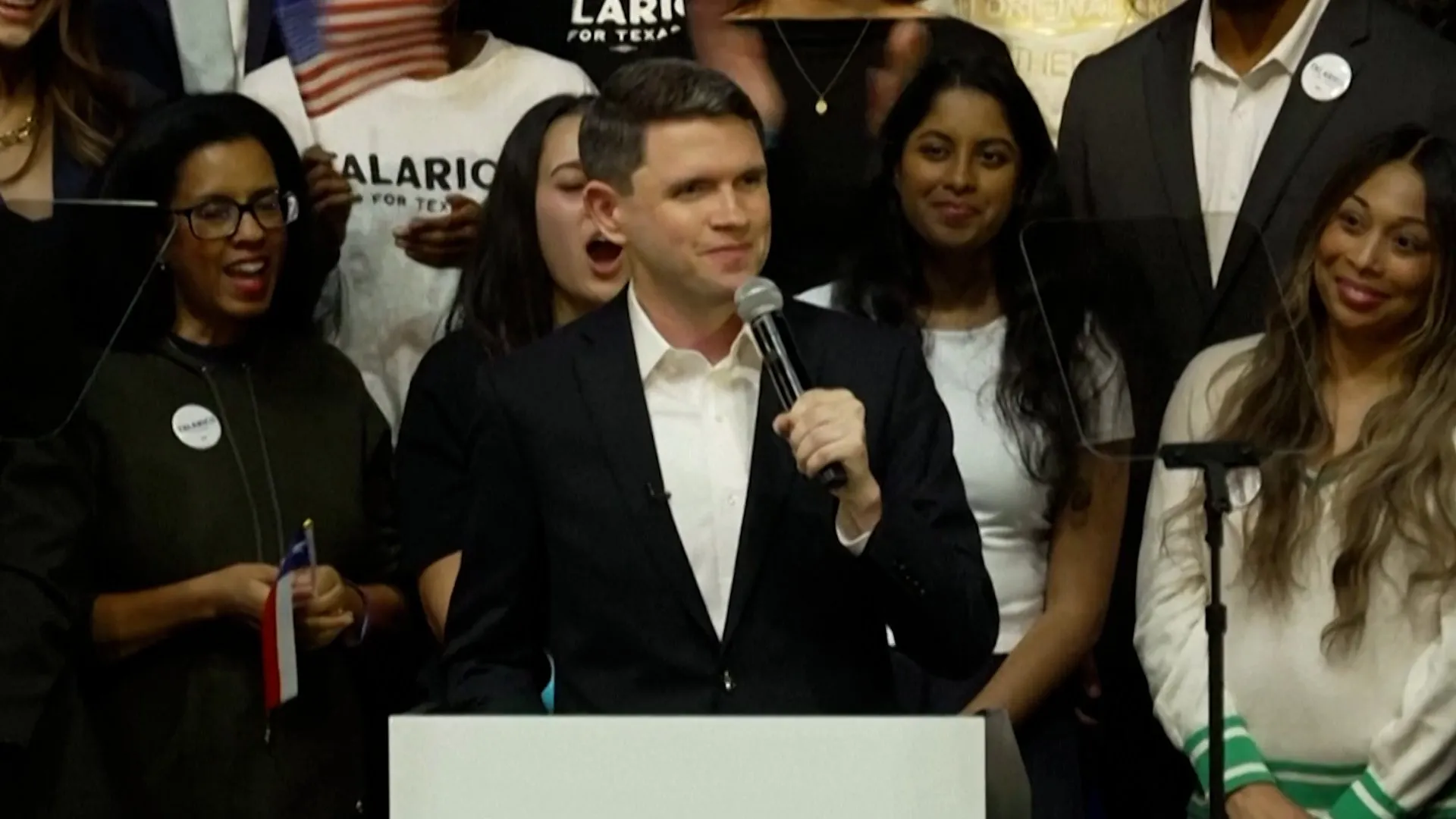
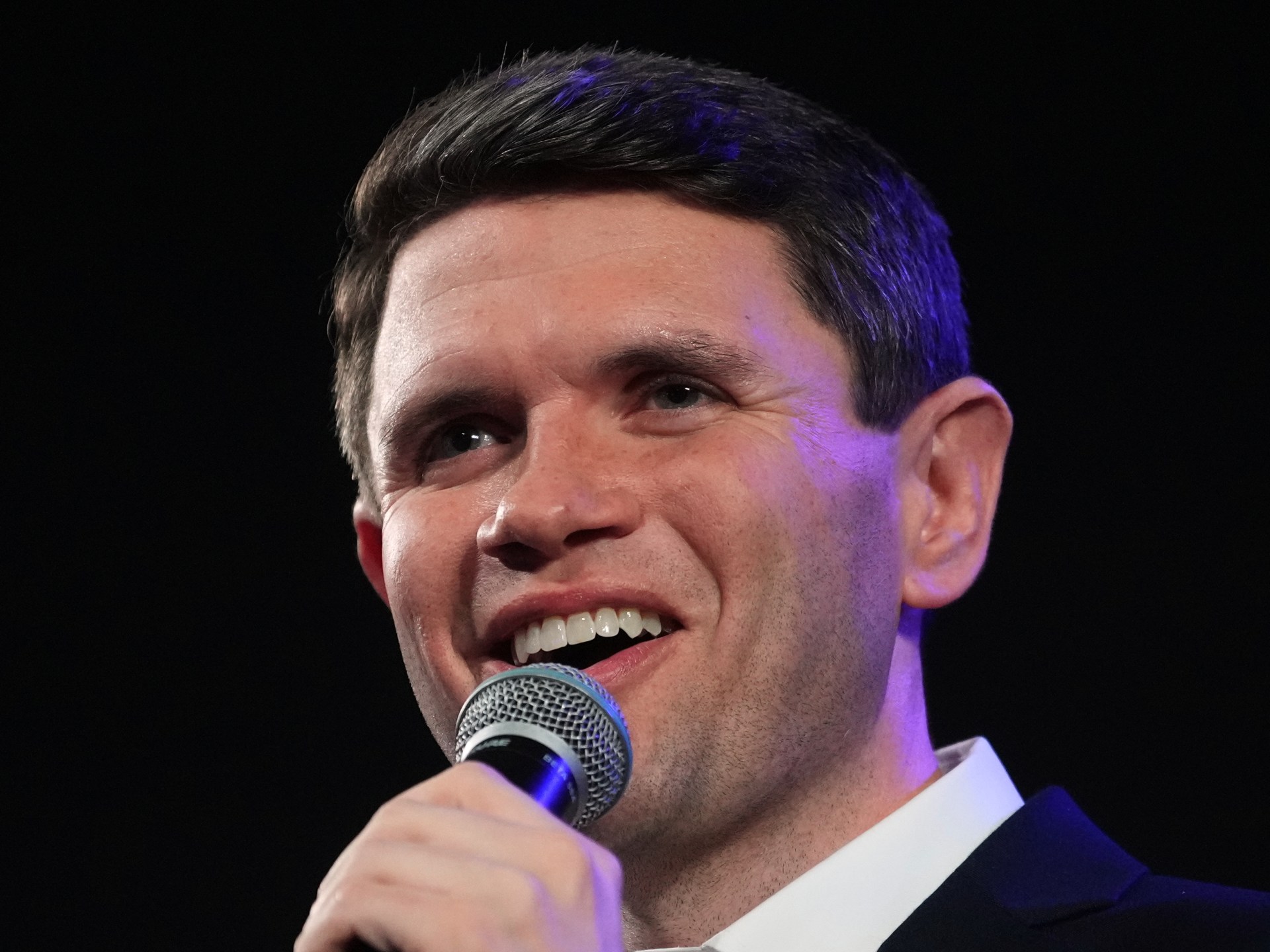
‘We defeated Goliath’: Texas Democrat James Talarico wins Senate seat | US Midterm Elections 2026 News

Democrat James Talarico wins the Texas Senate race in a historic midterm upset, ending nearly 3 decades of Republican dominance. He pledged to tackle political corruption, expand healthcare, invest in education and end what he called costly, corrupt wars.

Source link

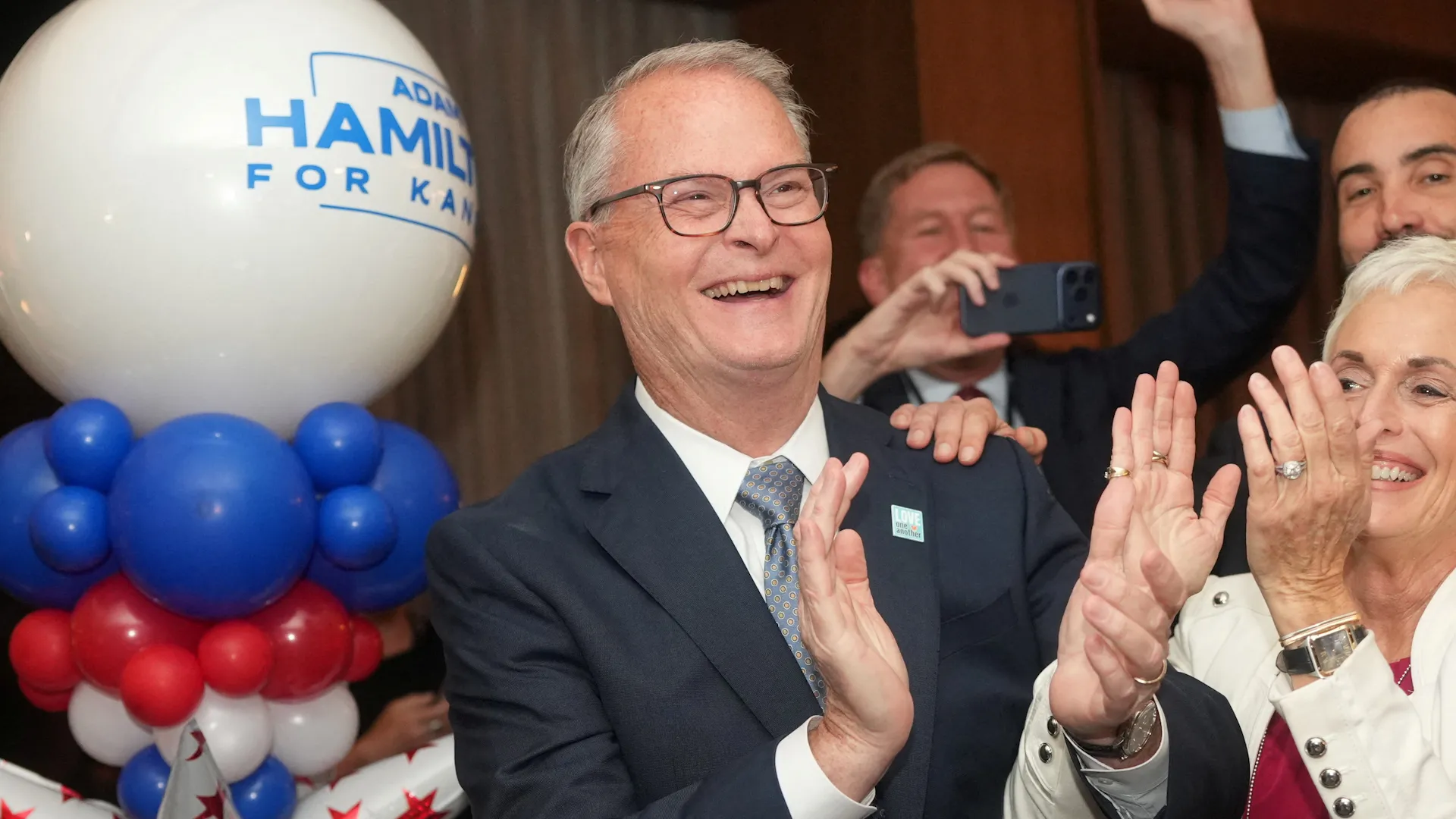
Democrat from Kansas elected to US Senate for first time since 1932 | Government

A Democrat from Kansas has been elected to the US Senate for the first time in 94 years. Christian pastor Adam Hamilton beat his Republican opponent Roger Marshall, cementing a Democratic majority in Congress.

Source link

Democrat Troy Jackson wins Maine US Senate seat in blow to Republicans | US Midterm Elections 2026 News

Longtime Republican Senator Susan Collins had held the seat for nearly three decades, but was swept away in the blue wave.

Democrat Troy Jackson, a former Maine Senate president and labour organiser who entered the race in July, has won the Senate race in Maine, flipping a seat held by the Republicans for 30 years.

Longtime Republican Senator Susan Collins conceded the race to Jackson early on Wednesday, ending nearly three decades as Senator for Maine.

Recommended Stories

list of 3 itemsend of list

Maine’s race was one of the most closely watched in the country. Republican groups spent heavily on the race, donating $76m compared with $40m by Democrats. Jackson’s campaign raised $26.9m, slightly more than the $25.2m for Collins through mid-October.

Located in the far northeastern United States bordering Canada, Maine’s economy has been affected by Trump’s tariff wars with its northern neighbour and key trading partner.

Collins, who has served as senator since 1997, has framed herself as sharing voters’ moderate politics and serving the state’s 1.4 million residents as chair of the Senate’s powerful Appropriations Committee.

Polls released shortly before the election suggested Jackson edging out Collins in a tight race shaped by negative campaigning.

Collins distanced herself from Trump during the campaign but drew criticism for voting in favour of Trump’s legislation and judicial nominees after the Supreme Court ended abortion rights.

Jackson, who campaigned on strengthening the economy and government accountability, framed Collins as a Trump ally and accused her of corruption, which she has denied.

Collins focused on her independence – she was one of the few Republicans who voted to remove Trump from office after the January 6, 2021 attack on the Capitol – and attacked Jackson for his federal inexperience and his voting record in the state legislature.

Source link

Talarico wins Texas Senate race, ending decades of Republican dominance | US Midterm Elections 2026 News

James Talarico has won the United States Senate race in Texas, the first time a Democrat has won state office since 1994.

Tuesday’s victory marks a seismic shift in Texas, which has become a standard-bearer for staunch conservative policies for the Republican Party.

The win comes after a primary intervention by US President Donald Trump, which saw him endorse scandal-ridden Texas Attorney General Ken Paxton over Republican Senate candidate John Cornyn.

But Paxton failed to generate enthusiasm, even among his own party. That came despite record-breaking spending, topping over half a billion dollars.

The largest share came from billionaire donor Elon Musk, who spent at least $212 million supporting Paxton.

Musk’s SpaceX company is based in Texas. He has spent heavily across the country, with Democrats expected to investigate his role as head of the federal cost-cutting panel, DOGE, after taking control of Congress.

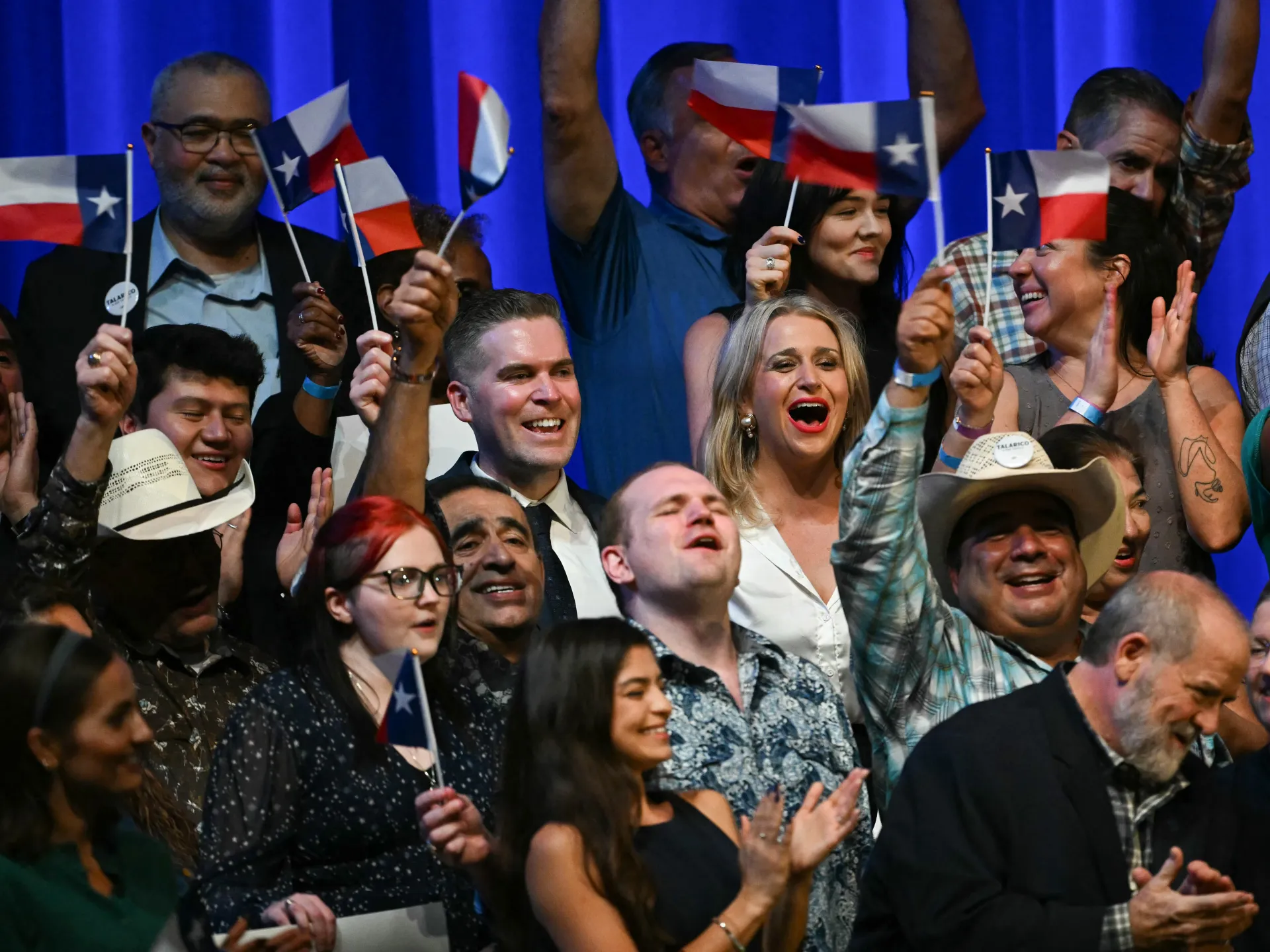
“It’s historic,” said Taylor Bell, a 27-year-old law student, who attended an election watch party in Houston.

“Hopefully we see money coming back to the people of Texas, and not more of the same we’ve seen — well, my whole life at this point.”

Congressman Christian Menefee, who represents Houston, told those gathered that “tonight Texas has restored the hope of a nation”.

“Tonight, I believe firmly that we can accomplish anything in this country if we just stand together and we fight back against hate and bigotry,” he said.

“The younger generation and all the people who want a better future came out and made their voices heard,” said 29-year-old Yvonne Nunga, who works in IT. “This party, this fight right now, is not about left or right. It’s about top versus bottom, and I’m so glad that we have candidates that are making this a pivotal point in their messaging.”

“The current politics of the current administration is not working for the people. It’s not for the people, by the people, it’s for the billionaires bought by the billionaires,” she said.

No ‘puppet governor’ for Trump

Tuesday also saw the surprise victory of Gubernatorial Democratic challenger Gina Hinojosa, whose challenge had been considered a long shot even into the final days of the race.

Hinojosa has become the first Latino governor in the history of Texas, despite Latinos making up 40 percent of the state’s population.

Alejandra Peimbert, a regional communications director for Hinojosa’s campaign, said the victory should be seen as a rebuke to the hardline immigration policies enacted under 10 years of outgoing governor Greg Abbott.

Abbott has cooperated closely with the Trump campaign in its mass deportation campaign, spearheading policies that saw local law enforcement officials conduct immigration enforcement.

“I think the Latino community and our vote has been underestimated by politicians constantly,” Peimbart told Al Jazeera, adding that the economy is so bad, and the horrendous things that ICE has done to our community, tearing apart families…I think my community finally had enough.”

“President Trump will no longer have a puppet in a governor,” she said.

Abbott’s tenure has been defined by a conservative lurch in the state, with hardline approaches not only to immigration, but to social welfare programmes, abortion rights, education and religious freedom.

Abbott’s supporters have touted rapid economic growth in recent years, spurred by tax cuts and rollbacks on regulation.

The state has long been a Republican standard bearer in the US

Critics have said the metrics of economic success have the most positive impact on corporations and the wealthy, while middle and lower class Texans see little benefit.

Texas’s poverty rate sits above the national average, with little in the way of social safety nets.

“It’s one of the biggest things Texas can ever experience because these are two strong candidates that took their time, they took their dedication, and focused with every community in Texas, and so they deserve this position,” said 21-year-old Dylan Sutter.

“Everything is blue. It’s like the ballot itself was painted blue by the time we were done with it.”

Source link

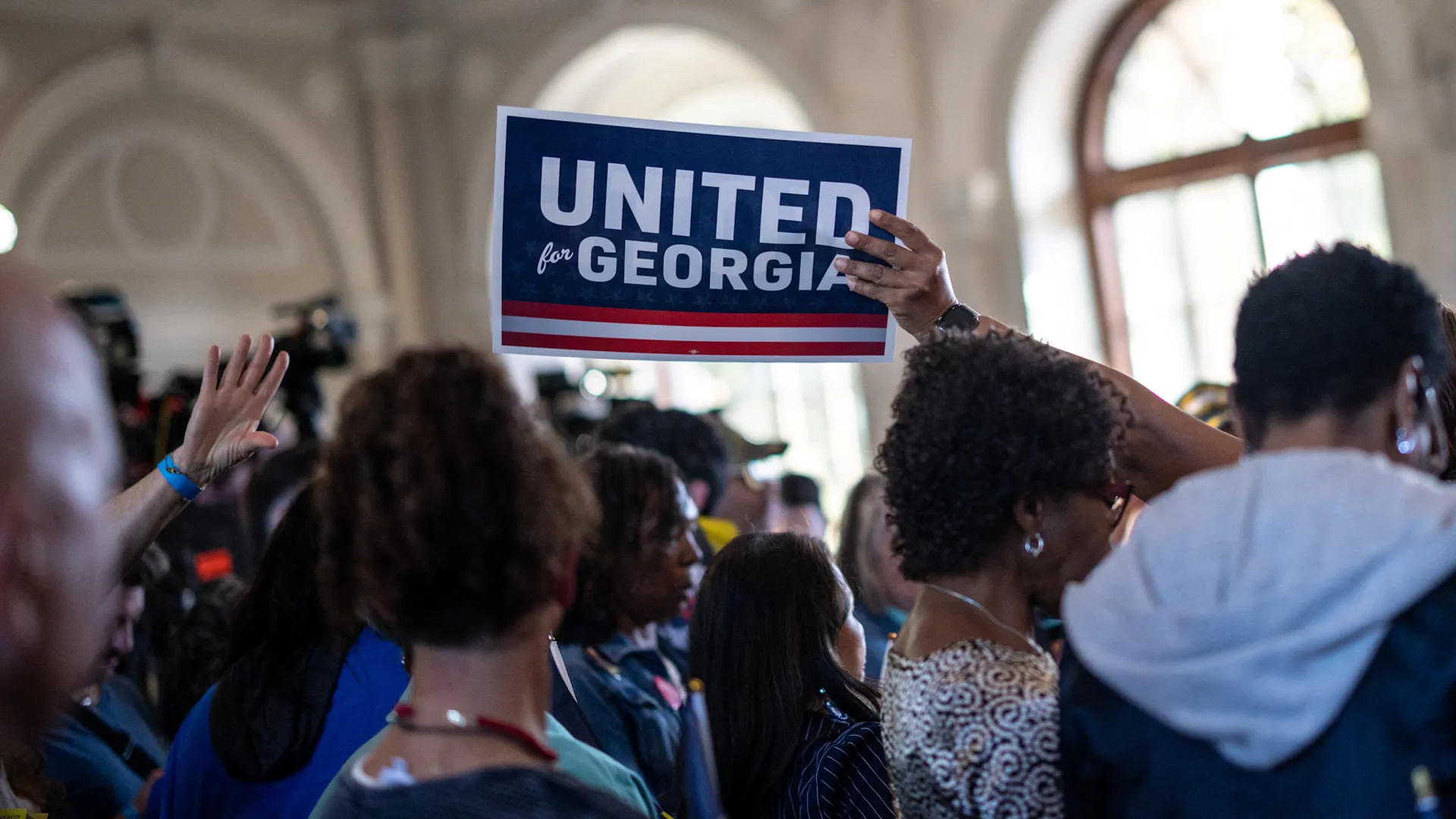
Keisha Lance Bottoms makes history as Georgia’s first Black woman governor | US Midterm Elections 2026 News

DEVELOPING STORY,

Bottoms, who formerly advised ex-President Joe Biden, beat Republican Rick Jackson.

Democrat Keisha Lance Bottoms has made history as the first Black woman elected governor in the United States.

The former Atlanta mayor emerged victorious over her billionaire opponent, Republican Rick Jackson, who spent more than $200m of his personal fortune in an attempt to succeed popular outgoing Republican Governor Brian Kemp.

Recommended Stories

list of 3 itemsend of list

Bottoms, an adviser to former US President Joe Biden, was propelled to victory in part by the state’s significant Black voting bloc, which turned out in large numbers during early voting.

During the campaign, she faced Republican attempts to characterise her time as mayor as a crime-ridden decline for the state’s largest city.

“It’s a longstanding playbook to paint Atlanta as this big bad place,” Bottoms told the Associated Press news agency.

Bottoms’s win marks the third consecutive time that Georgia Democrats have nominated a Black woman for governor. Stacey Abrams lost in 2018 and 2022 to Kemp, who is leaving office in January after eight years due to term limits.

Source link

First polls close in pivotal US midterm elections | US Midterm Elections 2026 News

With control of the US Congress on the line, results from Tuesday’s races will have marked implications for the country.

After a full day of voting, the first polls have begun closing in the consequential US midterm elections.

Control of the US Congress is on the line, with all 435 House of Representatives seats and 35 of the Senate’s 100 seats up for grabs.

Recommended Stories

list of 3 itemsend of list

Democrats, who have campaigned on promises to combat the country’s rising cost of living and end the US-Israel war on Iran, are eyeing a return to power in the US House. The party is also optimistic it could recapture control of the US Senate from Republicans when all ballots are counted.

The first clues to how the midterms may affect each party will appear in the US state of Kentucky’s highly competitive sixth congressional district, where polls closed at 6pm ET (23:00 GMT).

In the conservative district, which includes the state’s second-largest city, Lexington, Democrats have invested heavily in the campaign of US Navy veteran Zach Dembo, who is running against a Trump-backed physician and former state lawmaker, Ralph Alvarado.

If Republicans hold the seat, it could signal how the party may perform in other races across the country.

Results from all of the day’s races will continue to come in throughout Tuesday evening. But some may not be known until Wednesday, or later, as more states finish voting and officials start releasing their vote counts.

Follow all the returns on Al Jazeera’s live results page.

Source link

President Zelenskyy says US elections will impact war in Ukraine | US Midterm Elections 2026

Ukrainian President Volodmyr Zelenskyy has said that the US midterm elections will impact the ongoing war in his country. The president thanked the United States for its support, while speaking at a security conference in Germany.

Source link

Michigan US Senate race: Rogers, El-Sayed urge turnout for critical race | US Midterm Elections 2026 News

Michigan voters are casting their ballots in a charged, closely watched race that could make Democrat Abdul El-Sayed the first Muslim in the United States Senate and help decide control of the chamber.

Mike Rogers, his Republican opponent, cast his ballot at a polling station in White Lake, Michigan hours after polls opened. El-Sayed had already had his vote submitted and counted through an absentee ballot before Election Day.

Recommended Stories

list of 3 itemsend of list

The two candidates seek to fill the seat of retiring Democratic Senator Gary Peters. A final New York Times/Siena poll placed El-Sayed 11 points ahead of Rogers going into the election.

Polls opened at 7am local time (12:00 GMT) and close at 8pm (01:00 GMT on Wednesday). If the race is close, it may not be called until later on Wednesday. The US Department of Justice has announced that election monitors will be present at the polls in Michigan and all 50 other states, a first in US history.

El-Sayed, a Muslim born to Egyptian parents, is the former head of Detroit’s health department and has campaigned on progressive policies such as Medicare for All.

Rogers, a former congressman and close ally of US President Donald Trump, is seeking to come back after a narrow loss to a Democrat in a 2024 Senate race.

Democrats need to gain four seats in Tuesday’s midterm elections to wrest back the Senate from Republicans and rein in Trump. The race is also seen as a test of whether a progressive who openly criticises Israel can win in a swing state.

Both candidates made a final push on social media as voting got under way.

“It’s time. It’s up to us to show the country what’s possible. The world is watching,” El-Sayed wrote, sharing an upbeat campaign video that features former US President Barack Obama.

Rogers posted a video that featured interviews with supporters, one of whom called El-Sayed an “extremist”.

“We have a state to save”, the post read.

Democratic Senate Minority Leader Chuck Schumer gave a firm endorsement of El-Sayed after casting his own ballot in New York’s race.

“There are millions of Michiganders whose number one issue is getting their costs down,” said Schumer.

“Abdul El-Sayed is … talking to the people about those issues and doing things about them … He is going to win tonight because he’s talking about what Michiganders care about.”

‘One vote’

The El-Sayed campaign’s final days were overshadowed by a rift with Congresswoman Haley Stevens, a fellow Democrat whom El-Sayed narrowly defeated in a primary election in August.

On Sunday, Stevens endorsed Rogers, saying she was “choosing country over hate” and capping off a weeks-long row about El-Sayed’s opposition to US support for Israel.

Stevens is a staunch supporter of Israel, and the pro-Israel lobbying group the American Israel Public Affairs Committee (AIPAC) spent more than $30m backing her against El-Sayed. A majority of her large donors lined up to support Rogers after her loss, channeling $9m into a Republican group that supports him, according to The New York Times.

El-Sayed, by contrast, has accused Israel of genocide in Gaza and argued that US aid to Israel would be better spent at home.

Asked by NewsNation on her way in to vote for Rogers whether her change in support was worth it, Stevens replied: “Absolutely. Voting is always worth it, right?”

Senate leader Schumer, who had initially backed Stevens, was asked whether her defection could hand the election to Republicans. “Haley Stevens is one vote,” he replied.

Islamophobic attacks

El-Sayed, the Michigan-born son of Egyptian immigrants, has faced persistent attacks on his faith. Republican Party ads have sought to link him to “terrorism” and radicalism, with Trump joining in the inflammatory rhetoric.

The US president has repeatedly called El-Sayed a “jihadist” and a “nasty guy”, mocking his name and repeating an unfounded, widely circulated Republican claim that he belongs to the Muslim Brotherhood.

Hours before polls opened, Trump once again took aim at El-Sayed, this time in a post on his Truth Social platform.

“Abdul El-Sayed Hates Jews and Hates Blacks. Don’t feel bad, he also Hates Whites. Only fools would vote for him in the Michigan race for the U.S. Senate! He will, 100%, do you in! VOTE FOR MIKE ROGERS,” Trump wrote.

The US president also mentioned El-Sayed in a Fox News interview early on Election Day, when he said annual US financial aid to Israel should stop at the end of 2026.

“Why should we suffer the slings from lunatics like an El-Sayed when they [Israel] don’t need it?” he said.

Source link

Michigan voters face crucial choice as Trump’s grip on Congress is tested | US Midterm Elections 2026

Michigan’s closely contested Senate race and voter concerns over the economy are putting Donald Trump’s control of Washington to the test. Al Jazeera’s Mikail Malik spoke to voters in Brighton about the issues driving their vote and the stakes for control of Congress.

Source link

In Pictures: US midterm elections in 20 photos | US Midterm Elections 2026 News

Americans head to the polls on Tuesday in midterm elections that will decide control of Congress and determine how much pressure President Donald Trump faces for the rest of his term.

After two years of unified Republican control, Democrats are fighting to reclaim both the House of Representatives and the Senate, while Republicans work to defend their narrow majorities and protect Trump’s agenda on immigration, the economy and the courts.

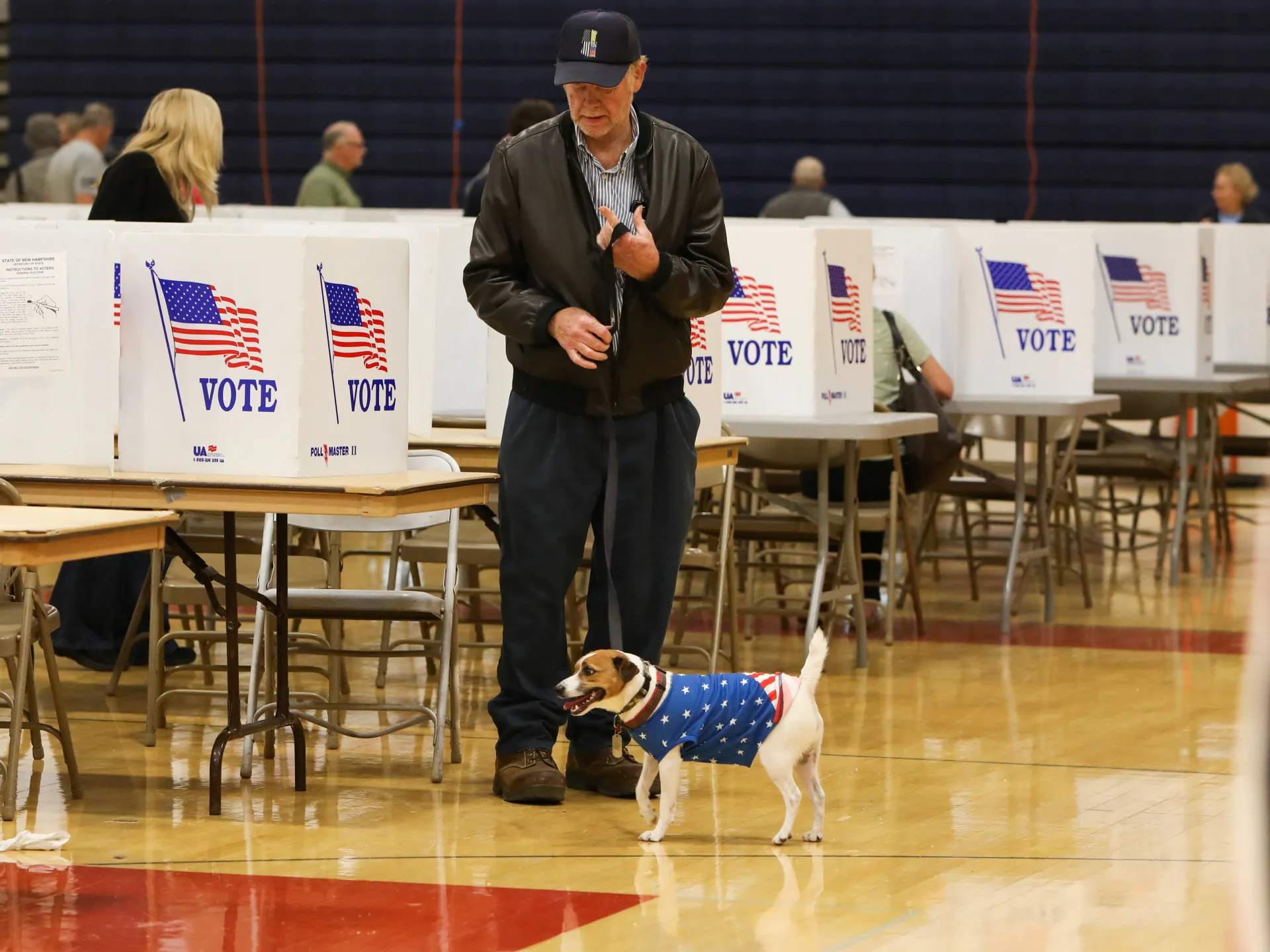
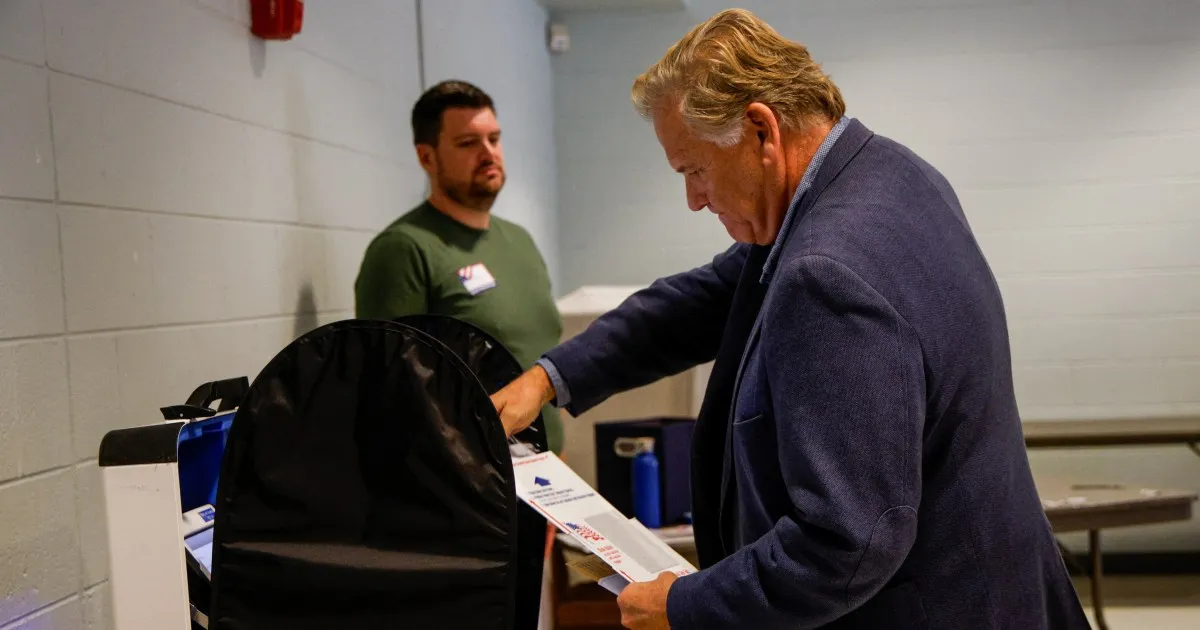
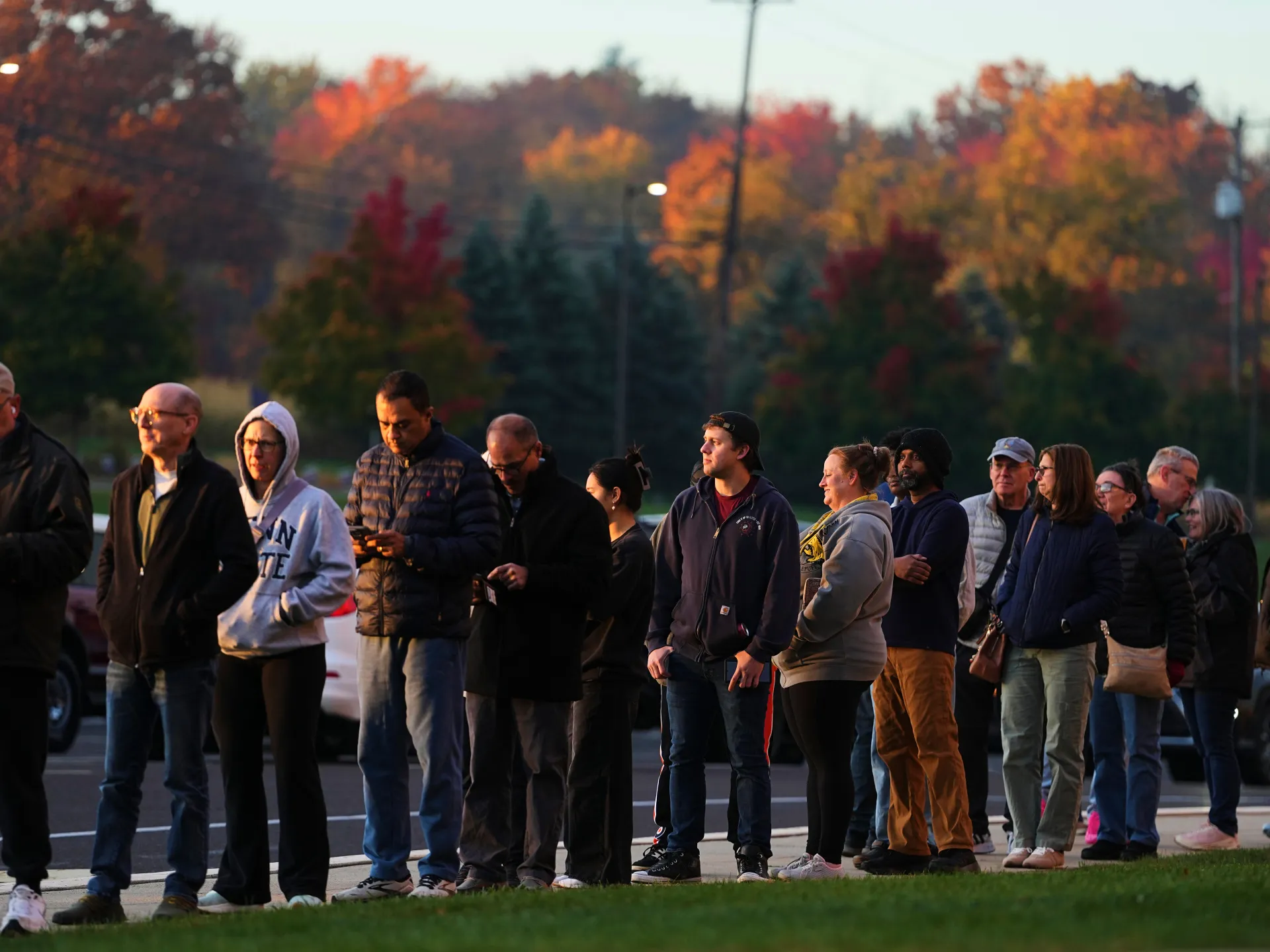
These 20 photos capture the pulse of this deeply polarised contest – from crowded polling stations and get-out-the-vote drives to last-minute campaign stops – offering a glimpse of voters at the booths and parents with children in tow across the country, all playing their part in a race set to shape the direction of American politics for years to come.

Source link

US midterm voting begins in high-stakes test of Trump’s presidency | Elections

Voting is under way across the US in midterm elections that could strip Donald Trump’s Republicans of control of Congress. All House seats and 35 Senate seats are being contested, with rising living costs and the war on Iran dominating the campaign.

Source link