US Midterm Elections 2026

Why one Republican won a redrawn Texas district despite blue tsunami | US Midterm Elections 2026 News

Dallas, Texas – Tuesday’s midterms were bruising for Republicans in Texas, a longtime right-wing stronghold.

The state elected its first Democrats to statewide office in 32 years, and the left-wing party held onto four congressional districts that were recently redesigned to favour Republicans.

Recommended Stories

list of 3 itemsend of list

But Republicans had one redistricting bright spot in a sea of unexpected defeats in Texas this midterm election cycle.

Amid the so-called blue wave, Republican Jace Yarbrough defeated Dan Barrios in Texas’s 32nd congressional district near Dallas, taking control of a heavily redrawn seat previously held by a Democrat.

Yarbrough became the only Republican this year to flip a Texas congressional seat, despite a push under United States President Donald Trump to shake up the state’s map for the right-wing party’s benefit.

So how did Yarbrough buck the trend? He was successful for two reasons, according to Matthew Wilson, a professor at Southern Methodist University who lives in the 32nd district.

“I think he did effectively pivot from a primary strategy to a general election strategy,” Wilson told Al Jazeera.

A constitutional lawyer, Yarbrough had defined his career by litigating progressive policies. But Wilson explained that the cost of living and other economic concerns took an increasingly prominent role in the final months of Yarbrough’s bid.

“In the primaries, the social issues, cultural issues were really important,” Wilson said.

“But then he pivoted very quickly and realised that those were probably not going to have the same resonance in the fall campaign. And so he did talk a lot about lowering prices. He did talk a lot about things that were of concern more to voters in the centre of the electorate.”

Wilson added there was another important factor in Yarbrough’s victory. “It was just the fact that his district was drawn to be so heavily Republican.”

The 32nd district had previously been composed of left-leaning Dallas and its immediate suburbs, but in August 2025, the Texas state legislature voted to reconfigure the congressional boundaries, with the aim of helping Republicans win five extra seats in this year’s midterms.

That push came at the behest of Trump, who called on Republican-led states across the country to follow suit.

Yarbrough’s district was redrawn to include only a portion of Dallas. It now stretches east instead, to encompass several Republican-dominated counties.

The demographics of the district also shifted dramatically.

In 2024, the district encompassed sizeable Latino, Black and Asian communities, accounting for about 60 percent of the population. The new map lowered the share of those demographics, while including several predominantly white areas.

Still, Wilson pointed out that Yarbrough’s victory was far more muted than initially expected. He won 51.5 percent of the vote to Barrios’s 48.5 percent.

“Even in his case, the race was a lot closer than he would have expected,” Wilson said. “So there was a pretty uniform Democratic swing across congressional districts.”

Latino backlash

With the dust settling on the election, Republicans will start the next congressional term in January with 24 representatives from Texas, losing one seat to Democrats this midterm cycle.

Democrats, who will have commanding control of both chambers of Congress, will have 14 House seats filled by Texans.

The four other Democrat-held districts Texas Republicans hoped to gain via redistricting were swept up in the groundswell of opposition to Trump.

In those districts, the party’s redrawn maps largely miscalculated Latino voters, a demographic that makes up 40 percent of the state’s population and swung towards Trump in 2024, according to political experts.

This year, the demographic tilted back towards Democrats with force, fuelled both by affordability concerns and dismay over Trump’s hardline immigration policies, which disproportionately affect Latino communities.

“In political science, there’s a body of literature we call ‘group threat theory’,” Michael Adams, a professor at Texas Southern University, told Al Jazeera. “When a particular group feels that they are threatened, that mobilises them, and we normally see a higher increase in terms of voter turnout.”

One of the most resounding defeats came in the ninth congressional district in Houston, which for years encompassed an area with large Black and Latino populations. Texas’s newly redrawn map cut out some Black communities but left a large population of low-propensity Latino voters.

Democratic candidate Leticia Gutierrez ended up taking nearly 58 percent of the vote against Republican Alex Mealer.

Speaking to Al Jazeera before the election, Gutierrez said her strategy focused on reaching Latino voters through aggressive Spanish-language outreach focused on pocketbook issues.

“I always say that I have a big chunk of family that are citizens registered to vote, but if they don’t hear it in Spanish, they’re probably not going to show up,” said Gutierrez.

“I’m fortunate enough to be able to speak both languages fairly well, and so just again, doing a lot of that targeted getting out the vote, getting in front of voters, door-knocking.”

Latinos make up about 60 percent of the ninth congressional district. The demographic is even more pronounced in South Texas, where Republicans hoped to pick up the 28th, 34th and 35th districts in their redistricting push.

But in a district representing the suburbs of San Antonio, Democrat Johnny Garcia handily defeated Republican Carlos De La Cruz by more than 10 percentage points.

Along the US-Mexico border, incumbent Democrat Henry Cuellar carried his district with nearly 66 percent of the vote over Republican challenger Tano Tijerina, while in the 34th district, Representative Vicente Gonzalez skated to victory by more than 15 percentage points over Republican challenger Eric Flores.

In another border district, Tejano musician Bobby Pulido, a Democrat, unseated Republican incumbent Monica De La Cruz, whose 2022 victory presaged a wider conservative shift among Latinos in the state.

Two years later, Trump carried nearly every Latino-dominated border district in Texas, seizing on unrest over immigration policies under former President Joe Biden. He also leveraged the prevalence of conservative social views among the largely Catholic population.

The area had long been considered a Democratic stronghold.

“Democrats are very conservative here. So I’m not surprised that it went for Trump in 2024,” 37-year-old voter Donato Medina told Al Jazeera from the border city of McAllen before the vote.

“But now it’s like people are kind of waking up, because his policies are affecting them directly.”


Source link

Nithya Raman wins LA mayoral race, becoming city’s first South Asian mayor | Elections News

DSA-backed Raman will lead America’s second largest city, promising action on homelessness and affordable housing.

Nithya Raman, a progressive Los Angeles City Council member, has defeated incumbent Mayor Karen Bass, putting her on track to become the first South Asian to lead the second-largest city in the United States.

The Associated Press called the race for Raman on Thursday, with Raman holding 52 percent of the vote.

Recommended Stories

list of 3 itemsend of list

Raman, 45, overtook Bass despite the incumbent’s support from prominent Democrats such as California Governor Gavin Newsom, former Vice President Kamala Harris and former House Speaker Nancy Pelosi.

Her campaign was backed by the Democratic Socialists of America (DSA), with her victory coming as part of a surge in visibility and electoral wins for the left-wing political movement.

A record number of candidates backed or affiliated with the DSA won federal offices in Tuesday’s midterm elections. On its website, the DSA has claimed credit for contributing to at least 300 candidacies or ballot referendums during the midterms, and it said it is on track to count 105 of those as victories.

Some of those wins came in congressional races, with figures such as Darializa Avila Chevalier, Claire Valdez, Melat Kiros and Chris Rabb winning their first terms as US representatives.

Raman’s victory in Los Angeles follows another high-profile democratic socialist winning a mayor’s race in New York City last year: Zohran Mamdani.

Raman was born in India and worked as an urban planner before running for office. Once an ally of Bass, she had initially endorsed her re-election campaign but reversed course, entering the mayoral race in February, just hours before the filing deadline.

In her victory speech, Raman promised to restore what she called an ambitious, creative and entrepreneurial Los Angeles.

“For too long our broken and unjust status quo has convinced Angelenos that this is the best that we can do,” she told the crowd.

Raman also pledged to expand affordable housing, improve neglected city services and take a different approach to homelessness by deploying more medical teams to assist people who are unhoused.

In addition, she called for replacing the city’s police chief over concerns about cooperation with federal immigration authorities.

Raman now faces the task of delivering on those promises in a city of more than 3.8 million people.

Los Angeles also faces the challenge of hosting the 2028 Olympic Games, which open in July of that year.

With the result, Bass has become the first Los Angeles mayor in more than two decades to lose a re-election bid.

Her defeat follows a difficult four years in office. Her administration faced mounting criticism over the city’s homelessness crisis and its response to the deadly Palisades Fire, which broke out while she was overseas and devastated communities across the Los Angeles area.

In a statement on Thursday, Bass congratulated Raman and said she was committed to ensuring a smooth transition.

“Four years ago, you elected me as the first Black woman mayor in the history of Los Angeles. You gave me the honor of serving the city that raised me, and every single day since, I have carried that responsibility with me,” Bass wrote.

“Moving this city forward is what Los Angeles needs from all of us.”

Source link

Generation Z and diversity redefine US politics in groundbreaking election | Elections News

Melat Kiros becomes the first Generation Z woman elected to Congress, embodying a new era of political representation.

The outcome of the 2026 US midterm elections has marked a historic shift in American politics, as a new generation of younger and more diverse leaders won key positions across the country.

Out of 117 Generation Z candidates who ran for Congress this year, 24 made it onto the general election ballot. Among them was Melat Kiros, a 29-year-old Ethiopian-born democratic socialist from Colorado, who became the first Gen Z woman elected to Congress. She joins Representative Maxwell Frost of Florida, who became the first Gen Z member of the House in 2022.

Democratic congressional candidate Melat Kiros speaks after winning the Democratic nomination during a primary election night watch party at The Broadway, Tuesday, June 30, 2026, in Denver. (AP Photo/Rebecca Slezak)
Democratic congressional candidate Melat Kiros speaks after winning the Democratic nomination during in Denver [File: Rebecca Slezak/AP]

Unprecedented Firsts

The election brought several historic breakthroughs for marginalized and underrepresented groups:

Recommended Stories

list of 4 itemsend of list

First Muslim American Senator: Dr. Abdul El-Sayed won his race in Michigan, becoming the first Muslim American elected to the US Senate.

First Native American Woman Senator: Peggy Flanagan was elected to the Senate, following Deb Haaland’s victory as governor of New Mexico.

Minnesota Lt. Governor Peggy Flanagan, Democratic candidate for US Senate, checks in to vote at a polling location on Election Day in St. Louis Park, Minnesota, a suburb of Minneapolis, on November 3, 2026.
Minnesota Lt. Governor Peggy Flanagan, Democratic candidate for US Senate, checks in to vote at a polling location on Election Day in St. Louis Park, Minnesota, on November 3, 2026 [AFP]

Historic Senate Representation: Illinois became the first state represented in the Senate by two women of color (Juliana Stratton and Tammy Duckworth).

Additionally, three Black women will serve in the Senate at the same time for the first time in U.S. history.

State governor races saw record-breaking diversity across the country:

Black Leadership: Keisha Lance Bottoms (Georgia) became the first Black woman elected governor in US history. Alongside new governors Byron Donalds (Florida), David Crowley (Wisconsin), Aaron Ford (Nevada), and re-elected Wes Moore (Maryland), a record five Black governors will serve together in 2027.

Latino Leadership: Gina Hinojosa became Texas’s first Latina governor after defeating incumbent Greg Abbott, while Xavier Becerra became California’s first Latino governor since 1875.

Democrat Keisha Lance Bottoms reacts at a campaign office, the day after winning Georgia's race for governor and becoming the first Black woman elected governor of a US state during the US midterm elections in Atlanta, Georgia, US, November 4, 2026. REUTERS/Carlos Barria
Democrat Keisha Lance Bottoms reacts at a campaign office, the day after winning Georgia’s race for governor and becoming the first Black woman elected governor of a US state [Carlos Barria/Reuters]

Amy Acton (Ohio), Amy Klobuchar (Minnesota), and Marsha Blackburn (Tennessee) all became the first female governors of their respective states. In total, at least 17 women will serve as governors in 2027, breaking the previous record of 14.

Women also set new records in the House of Representatives:

Democratic women won at least 100 House seats, setting a new record for the party.

Overall female representation in the House is projected to reach at least 139 seats in the upcoming 120th Congress.

Source link

Top US civil rights official resigns | US Midterm Elections 2026 News

New Democratic Congress expected to probe Trump Justice Department civil rights office’s handling of Epstein files and ICE killings.

As President Donald Trump’s administration prepares for a flurry of congressional investigations into shootings by immigration agents and the Jeffrey Epstein files, the top official in charge of the United States Department of Justice’s civil rights division has resigned.

US Attorney General Todd Blanche on Thursday confirmed Assistant Attorney General Harmeet Dhillon’s departure in a post on social media.

Recommended Stories

list of 3 itemsend of list

“Today, I accepted the resignation of Assistant Attorney General Harmeet Dhillon,” Blanche wrote on X. “She has defended the civil liberties of every American and enforced the law without fear or favor.”

A top Trump ally, Dhillon was confirmed to her role in April 2025 and has overseen a dramatic overhaul of the Justice Department’s civil rights division, which is tasked with enforcing anti-discrimination laws. Hundreds of former Justice Department officials penned a letter last December decrying the “destruction” of the agency division under Trump.

Dhillon is the first high-ranking official to resign from the Trump administration since US Democrats swept both chambers of the US Congress in the country’s pivotal midterm elections on Tuesday.

Democratic congressman Robert Garcia, who will likely become the new chair of the powerful House of Representatives Committee on Oversight and Accountability, pledged on Wednesday to take on four major investigations, including abuses of power by Immigration and Customs Enforcement (ICE) agents and the Epstein files.

Dhillon reportedly told her staff earlier this year that her office, which has typically been charged with investigating law enforcement killings by police officers, would not be looking into the fatal shootings of two US citizens – Renee Good and Alex Pretti – who were gunned down by ICE agents in Minneapolis.

In May, Garcia accused the administration of continuing to shield Trump from scrutiny related to unreleased documents tied to the Epstein investigation

During a closed-door hearing in which Blanche’s predecessor, Pam Bondi, was asked by lawmakers about the case, the California Democrat Garcia alleged Dhillon repeatedly intervened to block questions about the president’s connection to the release of the files.

The Justice Department referred Al Jazeera to Blanche’s social media post when asked when Dhillon submitted her resignation. The White House did not immediately respond to a request for comment.

Source link

Division among US Democrats over Schumer’s leadership role | Donald Trump News

After Democrats delivered a once-in-a-generation midterm thumping of Republicans in the United States midterms, their current leader, Chuck Schumer, has expressed confidence he will helm his party’s larger-than-expected majority in the US Senate.

“I’ll be re-elected as majority leader,” the New York Democrat told reporters in Washington on Wednesday.

Recommended Stories

list of 3 itemsend of list

But as calls for change reached a fever pitch among voters in this week’s pivotal elections, not every newly elected Senate Democrat is open to the idea of having Schumer, a 75-year-old stalwart of the chamber, reprise his role as the head of their agenda.

At least seven incoming Democratic freshmen have publicly suggested – or said outright – they will not commit to supporting Schumer in next month’s leadership vote:

  • Illinois Senator-elect Juliana Stratton, through a spokesperson, said she will not support Schumer.
  • Kansas Senator-elect Adam Hamilton told CNN in September: “I’m not supporting Schumer”.
  • Maine Senator-elect Troy Jackson said on Monday he told Schumer he will “support somebody else”.
  • Michigan Senator-elect Abdul El-Sayed reiterated in an interview with CNN on Thursday that he will support his soon-to-be Democratic colleague, Senator Chris Van Hollen of Maryland, as leader.
  • Minnesota Senator-elect Peggy Flanagan told reporters on Wednesday, “It is time for new leadership”.
  • New Hampshire Senator-elect Chris Pappas said in an interview last week that “voters are hungry for … a new generation of leadership in the Senate”.
  • Texas Senator-elect James Talarico has called for “new blood” in Washington, and since being elected, has indicated he wanted to “hear about [Schumer’s] vision” for the Senate before committing to back him.

Jackson has openly questioned Schumer’s ability to connect with working-class voters, while Flanagan’s staff has said the senator-elect wants “a progressive champion” who will shepherd Democrats through the final two years of Donald Trump’s presidency and into 2028.

New members, like El-Sayed, may not be won over after Schumer backed the former public health official’s opponent, Haley Stevens, in Michigan’s Democratic primary.

Schumer, the first Jewish Senate leader, has often found himself at the centre of brewing cultural and foreign-policy debates within his party.

In remarks that were posted online in February, Schumer told Jewish leaders in New York City one of his core duties was “to fight for aid to Israel”.

“We delivered more security assistance to Israel, our ally, under my leadership than ever, ever before”, he said. “We will keep doing that.”

Schumer has also faced fierce criticism for not doing enough to block Trump’s cabinet members from being confirmed. Some have even chastised the leader for retreating during last year’s government shutdown after he backed a Republican bill to reopen federal agencies without getting anything in return.

Critics in his party, including California Governor Gavin Newsom, called that a “capitulation” that abandoned key Democratic priorities, like healthcare subsidies. Michigan Congresswoman Rashida Tlaib said Schumer should have stepped down as leader over the matter.

The Democratic leader said on Wednesday the party’s new Senate plan would include launching investigations into the Trump administration, challenging the president’s agenda and ending his war in Iran.

However, that’s not good enough for some current members, like Van Hollen, who recently told Bloomberg that Democrats should not commit to Schumer without promises of a “bold agenda”.

Before Tuesday’s election, a senior campaign staff member for Senator Jon Ossoff, who was easily re-elected to his seat, would not say whether the Georgia Democrat would back Schumer.

“I do not have an answer,” the Ossoff source told Al Jazeera. “We can do all the fantasy football stuff later.”

When Democratic lawmakers return to Washington next week, voters and Democratic-aligned groups will likely pressure them to support an alternative candidate.

After calling for new leadership after the election, Indivisible, a progressive US-based organisation that bills itself as a movement “to stop the rise of authoritarianism”, released a memo on Thursday detailing their opposition to Schumer.

Senator Chris Van Hollen, right, frequently mentioned as a possible candidate for Senate Democratic leader, speaks with Kilmar Abrego Garcia, a Salvadoran citizen who was living in Maryland and deported to El Salvador by the Trump administration, in San Salvador, El Salvador
Senator Chris Van Hollen, right, frequently mentioned as a possible candidate for Senate Democratic leader, speaks with Kilmar Abrego Garcia, a Salvadoran citizen who was living in Maryland and deported to El Salvador by the Trump administration, in San Salvador, El Salvador [File: Press Office Senator Van Hollen via AP]

“Everyone with a Democratic senator – including those with newly-elected senators on their way to DC – should be demanding a contested leadership election, not a cleared field for Schumer”, the memo read.

“Any Democrat who is considering business as usual, or unwilling to fight at a level that matches the public’s demand for action – is not qualified to lead the party at this moment. Who leads the party in this era must be an open question, not a coronation. It’s time to define what the next era of the Democratic Party will be.”

Al Jazeera asked Schumer’s office how he plans to address those concerns and whether he is speaking with frustrated Democrats, but it has not yet responded.

To be re-elected, Schumer needs a simple majority of the Democratic Senate caucus, projected to comprise 54-56 members, and Schumer, who previously served as majority leader during the duration of former President Biden’s term in office, still has allies he can count on.

One of those is Democratic Senator Cory Booker of New Jersey, who told ABC on Wednesday that he commended Schumer’s handling of the midterms, saying he delivered “one of the most historic sweeps” for the party.

“We’re gonna have a family discussion,” Booker said. “But I think America should give … Chuck Schumer his due for what we were able to achieve.”

When asked Wednesday about building criticism of his leadership, Schumer demurred, saying Tuesday’s elections were “not about” him.

“This is about the American people and what they want and what they need and what we can do to help them. Plain and simple”.

Source link

Vance eyes 2028 reset, as Republicans mull pivot after US midterms drubbing | US Midterm Elections 2026 News

Hours after results confirmed that the Republican Party had lost control of both the Senate and the House of Representatives in the United States Congress in the midterm elections this week, senior Republicans were hand-wringing over what had gone so badly wrong and whether a major course correction would now be required.

As once-Republican strongholds like Texas fell to the enemy, US Vice President JD Vance took to X to declare that the “real reason we lost is obvious to almost everyone”.

Recommended Stories

list of 3 itemsend of list

“The reason we lost is the war. The president himself said so last night. If you’d like to argue it was worth it, that losing the Senate for the next 6 years was worth it, then do so. Argue it was a worthwhile cost to pay. Agree or disagree, that’s at least honest,” Vance said.

Former Trump voters had switched sides, he said, over the Iran war and the US ties to Israel.

The elephant in the room was no more.

“I remain hopeful about our country. To the people who are pissed off and want to say, ‘I told you so’: you’re right, you did tell us so. Take that energy into electing Republicans who share your worldview,” he wrote.

A poisoned chalice

Just days after the US and Israel launched strikes across Iran on February 28, Tehran effectively closed the critical Strait of Hormuz, which once transited roughly 25 percent of the world’s seaborne oil trade, triggering a massive spike in oil prices and a major global energy crisis. The price of Brent crude – the global benchmark – hit $120 in March and April and has hovered around $115 in recent weeks.

On Thursday morning, oil prices dropped to $93.82 a barrel on expectations that Republican Party losses would reduce the likelihood of US President Donald Trump renewing strikes on Iran following weeks of speculation.

But as consumers in the US struggle with sky-high petrol and diesel prices – not to mention the soaring cost of food, which has also been impacted by Trump’s trade tariffs – the midterms have forced a leadership rethink as the Trump brand appears increasingly toxic.

While no Republicans have declared their intention to run for the 2028 presidential election, some in the party are believed to be eyeing it now.

Andrew Payne, from the Chatham House think tank, told Al Jazeera that any Republican wanting to take on the 2028 election will now need to “distance themselves from the more unpopular aspects of Trump’s record”. That means the Iran war, the greatest poisoned chalice of them all.

“That, I think, is why Vance came out so clearly in blaming the war. It is evident to those who have been watching closely that he has always been the voice of scepticism behind the scenes, and he now needs to make that difference of opinion clear to the average voter. But doing so will be really hard while Trump is still in office and, presumably, wants to play an active role as kingmaker,” Payne said.

Unpopular, but not as unpopular as Trump

The most obvious pick and frontrunner for the Republican 2028 nomination is currently Vance, who is known to have ambitions to take over from Trump.

Regarded as an anti-US interventionist, Vance, while publicly supporting Trump’s Iran war, has also been privately urging him and others to end the conflict, according to the US news outlet Axios.

Last week, Vance sent a letter to the secretary of Iran’s Supreme National Security Council, Mohsen Rezaei, proposing a meeting between US and Iranian officials soon in a bid to prevent further escalation. By contrast, this week Trump said the war would only come to an end “when I want it to”.

This move, coupled with his post on X on Wednesday night, is increasingly being seen as Vance putting as much distance as he can between himself and the war.

Throwing off the Trump touch may be trickier than he thinks, however, according to one Vance ally close to the White House who spoke to Politico on Wednesday. While it is “possible for him [Vance] to modestly differentiate himself” from Trump, the source said, there is no way to completely delink himself.

“He’s still Trump’s vice president. This is still a Trump administration war. They’re still both unpopular. He’s not as unpopular as Trump but he’s unpopular,” the anonymous source said.

According to Tuesday polling from The New York Times on who is ahead in a theoretical Republican presidential primary, Vance is at 40 percent. US Secretary of State Marco Rubio follows at 21 percent, alongside Donald Trump Jr, also at 21 percent.

Rubio has yet to comment on the Republican wipeout. Still, like Vance, he is allied with Trump’s administration, which may make a presidential bid challenging.

Any potential candidate now faces a choice between two routes, Payne said. One is to “re-energise the [Make America Great Again or MAGA] movement, which I expect will be difficult, because Trump did it through sheer force of personality that is hard to replicate”.

“The second route is to keep as much of the base on board as possible while appealing to the traditional conservative groups who have drifted from the party over the past decade, thereby expanding the coalition. If he runs, I would think Marco Rubio has a better shot at doing that,” Payne said.

‘Blue tsunami’

There are other potential candidates to consider.

A former frontrunner for the 2016 presidential election, which saw Trump secure his first administration, Ted Cruz is now Texas’s only statewide Republican lawmaker.

In a post on X after the results, Cruz wrote: “2026 was not simply a blue wave; it was a blue tsunami. It was an a** kicking”.

“Food is too high, gas is too high, diesel is too high, insurance is too high, life is too high. Tariffs have made everything too expensive, and the Iran war has dragged on too long. It should have been brief, decisive, and over,” Cruz wrote.

“Understandably, people were pissed off, and elected Republicans didn’t do enough to address their very real pain. So, what do we do now? We need to listen and respond. We need to champion economic policies that make a real difference in working people’s lives, and we need to deal with the consequences.”

In September, the Wall Street Journal reported that Cruz was testing the waters for the 2028 nomination. But as one of the early cheerleaders for the Iran war, Cruz will struggle to disassociate himself from it, other than to criticise the manner of its execution.

As the blame game continues, the Republican Florida governor, Ron DeSantis, described the results of the midterms as “close to an extinction-level event” for the party.

“If the Republican Party doesn’t have Texas as an anchor, then we are not going to be viable nationally going forward,” he said.

“We’re in a very volatile political era, things shift quickly, and the leaders just got to recognise that.”

DeSantis’s time as governor ends in January after two terms, but speculation has grown about whether he also wants to throw his hat into the ring for the US presidential nomination as the playing field remains wide open.

Source link

Germany’s Merz expects Trump to keep ignoring Congress | American Voter News

Germany doesn’t expect Trump to change following the midterm losses. Chancellor Friedrich Merz believes the US president will keep using his powers to bypass the Democrats in Congress, a position he admits he envies.

Source link

Zelenskyy hopes Democratic Congress will bring more US help for Ukraine | Russia-Ukraine war News

Ukrainian President Volodymyr Zelenskyy has expressed hope that Democratic gains in the United States midterm ⁠elections will bring ⁠more help for Kyiv, as European officials urged the new US Congress to ramp up pressure on Russia to end Europe’s bloodiest conflict since World War II.

Zelenskyy’s comments on Wednesday came after American voters rebuked US President Donald Trump and his Republican Party, handing control of both the Senate and the House of Representatives to the Democratic Party.

Recommended Stories

list of 4 itemsend of list

In an interview with German broadcaster ZDF, Zelenskyy said the Democratic gains could work to Ukraine’s advantage.

“I am also grateful to the Republicans, but the Democrats speak very clearly about supporting Ukraine and providing assistance to Ukraine,” Zelenskyy said.  “They speak about renewing the connection between the United States and Europe… Therefore, there is hope that a balance of power will emerge, and that we will receive more support.”

Zelenskyy said more US aid could have an effect ‌on Russian President Vladimir Putin.

“If Congress now speaks of strong financial support or military assistance, as Europe is doing and demonstrating today, then that will be something positive that will have an impact on Putin,” he told ZDF.

Zelenskyy has worked to repair a rocky relationship with Trump since an Oval Office meeting in February 2025 at which the US president accused his Ukrainian counterpart of being “ungrateful” for Washington’s aid.

Pressure on Russia

In recent weeks, Trump has made several moves favourable to Russia, including a deal to import Russian diesel.

Last month, he waived sanctions on Russia that Congress had overwhelmingly approved as part of legislation supporting Ukraine.

Ukraine has also accused Washington of delaying deliveries of interceptor missiles.

Kaja Kallas, the European Union’s foreign policy chief, said she hoped the new Congress would “continue supporting Ukraine and also putting more pressure on Russia”.

“Europe as well as US, we are much stronger together,” Kallas said, expressing hope that joint pressure would force Moscow to end the war.

In Germany, leaders were divided. Chancellor Friedrich Merz expressed scepticism on Wednesday that Trump would change course despite the Democrats’ sweeping victory.

“Quite frankly, over the last two years, Trump has largely governed by bypassing Congress. Why should that be any different now?” Merz said at an event in Berlin, a day after US voters handed Republicans a historic defeat.

His foreign minister, Johann Wadephul, was more hopeful. He said the “very clear” Democratic victory could create “a new opportunity to launch a fresh initiative” to end the wars in Ukraine and Iran. He added that he was “quite optimistic” that aid to Ukraine, which has been slashed under Trump, would get “more discussion” from US lawmakers of both parties.

Scepticism

Others in Europe cautioned that with Trump in office for two more years, Washington’s foreign policy was unlikely to change quickly.

The US president has berated European leaders, roiled their economies with tariffs, threatened to pull the US out of NATO, and said he wants to take over Greenland, a semiautonomous territory of Denmark.

“Our security and prosperity in Austria and Europe must not depend on how people in Kansas or Iowa vote,” Austria’s foreign minister, Beate Meinl-Reisinger, said. “That’s why we are strengthening our own defence capability and our own competitiveness.”

In Moscow, Kremlin spokesman Dmitry Peskov said Russia hoped Trump “will continue his peacemaking efforts”, regardless of the election result.

Democratic aides have told US media that helping Kyiv would be a priority when the party takes control of the congressional agenda in January. But diplomacy is moving faster.

Steve Witkoff, Trump’s envoy, said Washington would bring Ukrainian and Russian delegations together in Abu Dhabi on November 10 and 11 to discuss ending the war and security arrangements for Ukraine.

Zelenskyy said on Wednesday that he has had detailed conversations with Witkoff and Trump’s son-in-law, Jared Kushner, ahead of the meeting.

“The negotiations must move forward at full throttle to bring this war to an end as quickly as possible. Ukraine is ready to take the necessary steps,” he wrote on X.

Source link

Mamdani: ‘it’s morning again in America’ after blue wave | US Midterm Elections 2026

New York City Mayor Zohran Mamdani urged fellow Democrats to ‘fulfill promises’ after sweeping wins in midterm elections nationwide. Mamdani says voters are looking for economic solutions amid rising costs in housing and food.

Source link

What’s delaying the US Senate election results in Mississippi and Alaska? | US Midterm Elections 2026 News

Democrats regained control of both chambers of the United States Congress in this year’s midterm elections, with a wave of victories that party leader Hakeem Jeffries likened to an “American tsunami”.

But as of Wednesday night, two US Senate races remain undecided.

Recommended Stories

list of 4 itemsend of list

A cliffhanger in the southeastern state of Mississippi and a scandal-plagued Alaska race are the final Senate contests to be tallied.

As it stands, the Democrats will usher in the 120th Congress on January 3 with a majority of at least 54 seats in the 100-member Senate.

If they win both Mississippi and Alaska, they will need fewer Republican breakaways to avoid the filibuster, a means by which the minority party can indefinitely stall legislation in the chamber. Filibusters can be avoided with a 60-member vote.

So, why are Alaska’s and Mississippi’s Senate races still up in the air? Al Jazeera breaks it down with this brief explainer.

What’s the hold-up in Mississippi?

The Republican stronghold of Mississippi was an unlikely Senate battleground this year.

The last time the state voted for a Democratic president was in 1976. The last time it elected a Democrat to statewide office was more than a decade ago, in 2015.

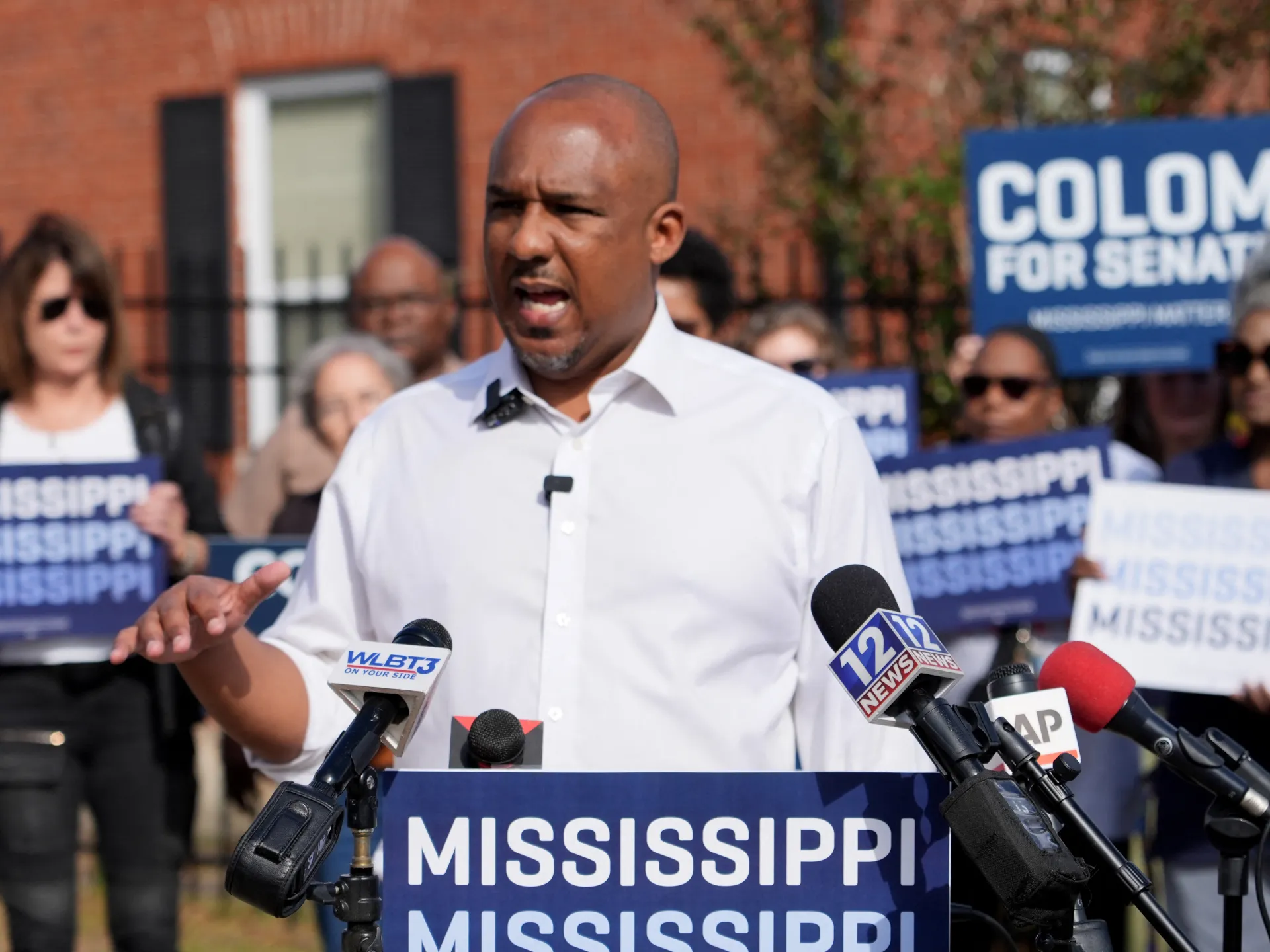
But the race between incumbent Senator Cindy Hyde-Smith, a staunch ally of President Donald Trump, and her Democratic challenger, Scott Colom, proved tighter than expected.

The contest remains too close to call, with both candidates holding about 49 percent of the vote, according to The Associated Press (AP) news agency. Ninety-six percent of the ballots have been counted so far.

As of Wednesday night, Colom was leading Hyde-Smith by a razor-thin margin of 1,138 votes, with a few thousand provisional and mail-in absentee ballots left to be counted.

Provisional ballots, also called “affidavit ballots”, are supplied to voters whose eligibility is uncertain. This can happen when a voter fails to present the appropriate identification documents at their local polling precinct.

Mississippi allows 10 days for such votes to be processed. Mail-in ballots, meanwhile, have a window of five business days to be received after the election, according to state officials.

In a statement released on Wednesday, Mississippi Secretary of State Michael Watson counted roughly 3,600 mail-in ballots still to be tallied, along with an “unknown” number of affidavit ballots.

“Counties have 10 days from the date of the election to submit their certified results to our office, which is November 13,” Watson wrote.

In the event of a deadlock, Mississippi is the only state in the country with no formal provision that would automatically authorise a recount. The candidates would need a court order to request one.

When will we know Alaska’s results?

In the northwestern state of Alaska, the Senate race could take days or weeks to be called, owing to the state’s vast rural distances and its ranked-choice voting (RCV) system.

Democrat Mary Peltola leads incumbent Republican Dan Sullivan by a meagre 637 votes as of Wednesday night, according to AP.

The race has become one of the most closely watched in the country. Nearly a quarter of the votes remain uncounted.

Ranked-choice ballots allow Alaskan voters to number the candidates in order of preference.

But the system can result in multiple vote counts. The initial count tallies the candidates ranked as voters’ top choice. If one of those candidates gets more than 50 percent of the vote, they win the election outright.

If no candidate passes the 50 percent threshold, the candidate with the fewest first-choice votes is eliminated, and a new round of vote-tallying commences. Supporters of the eliminated candidates see their votes redistributed to their second choice.

This process of elimination and recounting continues until one candidate ultimately wins a majority.

Alaska is one of only two states in the US to use ranked-choice voting for statewide elections, and critics blame the system for the slow vote tally.

According to Alaska’s Division of Elections, ranked-choice results will not be published until 15 days after the election, on November 18.

The state is also under a microscope due to a controversy in the Senate race. Two candidates named Dan Sullivan competed in the contest.

One, Dan S Sullivan, is the state’s incumbent senator and an ally of President Trump.

The other, Dan J Sullivan Jr, is a retired schoolteacher widely rumoured to have been a Democratic plant to draw votes away from the incumbent.

Trump’s Department of Justice filed a lawsuit to prevent Alaska from certifying its election results, claiming the second Sullivan amounted to an attempt to pervert voter choice.

But a federal judge dismissed the suit on Sunday. The Justice Department has nevertheless pledged to appeal, a prospect all the more likely if Peltola prevails in the vote count.

Source link

Election deniers lose races for governor in key US swing states | US Midterm Elections 2026 News

After Democrats’ stunning blowout in the United States midterm elections, five Republican election deniers have come up short in their races to become governor in top battleground states.

Congressman Andy Biggs in Arizona, Congressman John James in Michigan, State Treasurer Stacy Garrity in Pennsylvania and Congressman Tom Tiffany in Wisconsin all lost their gubernatorial races on Tuesday.

Recommended Stories

list of 3 itemsend of list

So too did billionaire Rick Jackson of Georgia, a state that was central to President Donald Trump’s efforts to overturn the 2020 presidential results.

All five candidates had either cast doubt on or voted to block Joe Biden’s victory over Trump in the 2020 election.

Republican gubernatorial candidate Rick Jackson attends a campaign rally in Atlanta
Republican gubernatorial candidate Rick Jackson attends a campaign rally in Atlanta [File: Elijah Nouvelage/Getty Images via AFP]

Jackson, for instance, had called Biden’s win “totally ridiculous” and criticised Georgia state officials for not complying with Trump’s demands to “find” extra votes.

“Our people really let us down,” Jackson said when he was pressed on the 2020 election during a campaign event earlier this year.

In January 2021, Biggs and Tiffany voted to overturn the 2020 results as members of the US House of Representatives.

Both lawmakers also signed on to a lawsuit that sought to invalidate results in Georgia, Michigan, Pennsylvania and Wisconsin, all states that Biden won in that year’s contentious presidential race.

James was not in Congress when it came time to certify the 2020 election results. He had unsuccessfully run for the US Senate during that election cycle. He later made a successful bid for the House of Representatives in the 2022 midterms.

That year, he acknowledged Biden’s victory. But he reversed his position in June, when he told podcaster Benny Johnson that the 2020 election was “rigged and manipulated”.

Republican gubernatorial candidate for Michigan John James during a midterm campaign event for Republican candidate for US Senate Mike Rodgers in Sterling Heights, Michigan on October 31, 2026.
Republican gubernatorial candidate John James speaks during a campaign event in Sterling Heights, Michigan, on Saturday [File: Jeff Kowalsky/AFP]

Garrity, who was elected to her current position in 2020, was among the right-wing politicians to campaign with Trump to reverse his election defeat.

She appeared at a rally in Pennsylvania on January 5, 2021, to call on state lawmakers to decertify the 2020 results. A day later, Trump supporters would storm the US Capitol, echoing the Republican leader’s claims of voter fraud.

Tiffany, Garrity and Jackson have since released statements or clarified their previous actions regarding the 2020 election and acknowledged that Biden won. Biggs and James, however, have not.

Al Jazeera has reached out to both of their offices for comment but has not yet heard back.

Pennsylvania state Treasurer Stacy Garrity speaks during a news conference in Treasury Department offices, Thursday, April 23, 2026, in Harrisburg, Pa. (AP Photo/Marc Levy)
Pennsylvania State Treasurer Stacy Garrity speaks during a news conference in Harrisburg, Pennsylvania [File: Marc Levy/AP Photo]

Tuesday’s midterm results are likely to have significant implications for the next presidential race in 2028.

Trump is entering the final two years of his lame-duck second term, and under the US Constitution, he is ineligible for re-election. It is unclear who will succeed him as the Republican standard-bearer.

Battleground states like Arizona, Georgia, Michigan, Pennsylvania and Wisconsin have all vacillated between presidential nominees of both parties in recent elections.

They will play critical roles in 2028, as the US looks to determine its next leader.

In some US states, governors play a major role in issues like voting access, election administration and efforts to redraw congressional maps.

Republican gubernatorial candidate Tom Tiffany talks to supporters during a campaign event, Wednesday, July 29, 2026, in Kenosha, WI. (AP Photo/Nam Y. Huh)
Republican gubernatorial candidate Tom Tiffany talks to supporters during a July 29 campaign event in Kenosha, Wisconsin [File: Nam Y Huh/AP Photo]

Over the past year and a half, Trump has sought to rally state leaders to redesign congressional maps to help Republicans get elected.

Some Democratic-led states, notably California, under Governor Gavin Newsom, have responded with their own efforts at gerrymandering.

But it is unclear whether the push for redistricting will retain its momentum after Tuesday’s midterm results.

Already, Georgia’s Governor Brian Kemp, a Republican who was prevented by term limits from running in this midterm cycle, said on Wednesday that he would not call a special session of the state’s legislature to redraw the state’s congressional maps before his Democratic successor, Keisha Lance Bottoms, is sworn in.

Trump, after years of casting doubt on US elections, told The New York Times on Tuesday night that he was “absolutely willing” to accept the midterm results.

He also pledged to engage with the Democratic Party, which handily retook control of both chambers of the US Congress.

“We’ll, you know, look forward to working with them,” Trump said of the Democrats. “We’ll probably work something out.”

Source link

Ohio’s voters tell Republicans: don’t take us for granted | Elections News

After Democrats flipped a Senate seat and recaptured the governor’s mansion in Ohio, voters say the results send a message to Republicans not to take the state for granted. Al Jazeera’s Heidi Zhou Castro reports from a diner the morning after election day.

Source link

Democrats won Congress. But can they deliver on their promises? | Donald Trump News

Democrats rode a blue wave to victory in the United States midterm elections, winning control of both chambers of Congress. Now comes the question of whether they can deliver on their promises.

The party campaigned on bringing down the cost of living, ending the war on Iran and holding President Donald Trump accountable, as well as pushing back against his immigration crackdown.

Recommended Stories

list of 4 itemsend of list

But Democrats won’t take control of Congress until January. Even then, there’s only so much they’ll be able to do without Republican cooperation.

Most bills need 60 votes to get past a filibuster in the Senate, and even if Democrats manage that, Trump can still veto their legislation. He has already threatened to do just that, telling a podcast on Monday, “I’ll veto everything.”

But the Democrats now also have other tools at their disposal, including power over Senate confirmations and control over committees that can launch investigations.

So what can Democrats realistically accomplish over the next two years, and where might they struggle to make good on their promises?

Can Democrats bring down the cost of living?

Affordability was one of the biggest issues for voters heading into Tuesday’s midterm elections, and Democrats seized on that, promising to bring down the costs of energy, housing, healthcare and groceries.

Dean Baker, an economist and cofounder of the Center for Economic and Policy Research, a US-based think tank, said one of the most effective things Democrats can do to bring down costs is push for an end to the war on Iran.

Since February, the conflict has driven up energy prices, as Iran has restricted commercial traffic through the Strait of Hormuz, a vital waterway for the oil and gas trade.

Baker argued that Democrats could use congressional investigations and oversight to pressure the Trump administration to end the war, potentially helping to give consumers relief.

Foreign policy is an area where some Republicans could find common cause with Democrats, said Baker.

Another area, he added, might be healthcare, an issue that similarly hits voters in the pocketbook.

The expiration of enhanced Affordable Care Act subsidies in 2025 has left many Americans facing higher insurance premiums.

With their new congressional majorities, Democrats could push to restore those subsidies and reverse cuts to Medicaid, the government healthcare programme for low-income Americans.

A possible path to accomplishing that goal would be to include those measures in government spending bills that Congress needs to pass, according to Baker. That would also make them harder for Trump to reject.

“Republicans living in a post-Trump world, I don’t think they want to be on the side of preventing people from getting healthcare or basically paying more for healthcare,” Baker said. “They can make the politics such that he doesn’t want to veto it.”

Trump’s tariff campaign is another factor driving up consumer costs. But Baker warned that they could be tougher to reverse, without substantial support from Republicans to override a Trump veto. Even if they do manage that, prices could take a while to actually drop.

“Prices are like rockets and feathers. They shoot up like rockets; they come down like feathers,” said Alex Jacquez, chief of policy and advocacy at Groundwork Collaborative, a progressive economic think tank.

Jacquez, however, pointed to another path Democrats could take that wouldn’t need Trump’s approval.

With majorities in Congress, Democrats could wield congressional committees to investigate companies that have been raising the prices of everything from groceries to electricity bills.

“There’s a lot of precedent for getting some real material outcomes just through having the gavels and being able to subpoena CEOs and haul people in front of Congress,” Jacquez told Al Jazeera.

While there’s no guarantee these investigations would bring down prices, they could put pressure on companies to explain or adjust their decisions.

Could a Democratic Congress hold Trump accountable?

Laura Blessing, a senior fellow at Georgetown University’s Government Affairs Institute, expects Democrats to make extensive use of their new investigative powers.

“In terms of time spent and newspaper ink spilled, this is where you’re going to see the most action from Dems, by a mile,” she told Al Jazeera in an email.

Congressional investigations do not require White House approval. But they could make life harder for Trump by scrutinising his actions both within and outside of government.

Many Democrats have signalled they plan to investigate the source of the Trump family’s wealth as part of January’s incoming Congress.

Trump’s personal wealth has soared by about $2.2bn since the start of his term, according to financial disclosure forms released earlier this year.

His family’s business empire has likewise expanded over the last two years into everything from cryptocurrency and drones to artificial intelligence and prediction markets — industries his government has favoured in its policies.

Democratic senators have already been laying the groundwork for potential investigations, sending letters to companies and government departments demanding that they preserve records.

Among the issues they could examine are whether donors to Trump’s White House ballroom received favourable treatment from the government, and whether the Justice Department targeted his political opponents.

There is no guarantee, however, that everyone will cooperate.

Trump administration officials could challenge subpoenas in court, delaying investigations. But while Blessing doesn’t expect “Trump’s nuclear family to show up to a subpoena”, she said Democrats could still question government employees and others connected to Trump’s inner circle.

Even if they uncover wrongdoing, however, there is no guarantee of legal consequences, since it’s Trump’s own Justice Department that would have to decide whether to take up the cases.

Impeachment is another possibility. Lawmakers have already introduced articles of impeachment against Defense Secretary Pete Hegseth for multiple reasons, including allegations that he waged war against Iran without seeking congressional approval first.

Republican Representative Thomas Massie has said he will try to force a House vote on Hegseth’s impeachment when the outgoing Congress returns to session next week.

Trump, who was impeached twice during his first term, however, dismissed the prospect of facing a third impeachment himself, telling reporters on Wednesday that he was “not even a little bit” worried.

“I think it would destroy the Democratic Party if they did that, because it would be impeachment for no reason,” he said.

Trump also defended Hegseth, saying he was doing “a very good job”.

Even if the House of Representatives votes to impeach a government official, the case must still be weighed in a Senate trial.

Removing an elected official would require a two-thirds vote in the Senate, meaning many Republicans would need to get on board to oust a figure like Trump or Hegseth. No president in US history has ever been removed from office as a result of an impeachment proceeding.

Could Democrats end the war on Iran?

With less than two months until the 120th Congress is sworn in, experts anticipate Trump will use his final weeks with the outgoing Republican majorities to push through any remaining legislative priorities.

It also leaves Trump a critical window in which to escalate the war on Iran, according to Trita Parsi, the executive vice president of the Quincy Institute for Responsible Statecraft, a foreign policy think tank.

“He has shown a pattern in which, in the face of humiliation and defeat, he becomes more reckless,” Parsi told Al Jazeera.

Democrats could pursue a binding resolution to wind down the war. After all, the US Constitution assigns Congress the sole authority to declare war, and laws like the War Powers Act of 1973 give lawmakers a path to ending unauthorised conflicts past the 60-day mark.

But there is no guarantee that those efforts would work, given the possibility of Trump vetoing their proposed measures.

Experts, however, say there is another way that Democrats could rein in Trump’s war powers. One of their most powerful tools will be control over government spending.

The Trump administration can continue using money already allocated for military operations, but Democrats could try to block additional funding for the war.

“It creates a limitation for how long he can pursue the war,” Parsi said. “If he needs more funding for it, we’re not talking about small sums that he can just reallocate from other places easily.”

With control of congressional committees, Democrats could also investigate the administration’s conduct during the war, including whether its military operations complied with US law.

“Rigorous oversight would not restrict military operations by itself but could raise the political costs of the war beyond what the president or other key officials are willing to endure,” said David Janovsky, a policy analyst at the Project on Government Oversight.

How much political will Democrats have to end the conflict, however, is an open question.

Blessing, the government affairs fellow, noted that the party has historically been reluctant to withhold military funding out of fear of being accused of undermining US troops.

But Parsi warned that failing to act would be politically unsustainable — and could be seen by the party’s base as a tacit endorsement of US military involvement in the Middle East.

“It will no longer be just Trump’s war,” Parsi said. “They will also co-own it, because they will be complicit, because they have the ability to stop it.”

Could Democrats rein in Trump’s immigration crackdown?

Another target for the incoming Democrat-led Congress could be Trump’s hardline immigration crackdown.

His pledge to oversee the largest mass deportation in US history has sparked widespread public backlash. A public opinion poll earlier this year found that 65 percent of Americans believe Immigration and Customs Enforcement (ICE) has “gone too far” in its efforts.

With control of both chambers of Congress, Democrats could launch investigations into ICE and other agencies involved in the crackdown.

Their probes could seek information about conditions inside detention centres, allegations of abuse and how taxpayer dollars are being used for immigration enforcement, said Heidi Altman, the vice president of policy at the National Immigration Law Center.

Altman argues Congress could also claw back the roughly $240bn already given to the Trump administration for immigration enforcement over the past two years.

That amount of money, she explained, has allowed ICE to operate with few constraints, without having to prioritise which communities to go into or who to detain.

“The only way to force a slowdown and actual sort of decision-making and prioritisation and enforcement is to dramatically curtail their budget by taking back the funding from the last session,” she said.

Doing so would require passing legislation that Trump could eventually veto. But Altman argued that Democrats should push ahead anyway.

“The worst possible thing we could do is throw up our hands and say we have limited power,” she said.

“Pass the bills, see what happens, put them on the president’s desk, and dare him to look at the American people and say he’s not signing something that they overwhelmingly demanded.”

Source link

Palestinians, Israelis react after Democrats sweep US midterms | US Midterm Elections 2026

Palestinians and Israelis are divided in their opinion following the win by Democrats in the US midterm elections. The win could reshape the next two years of President Donald Trump’s administration.

Source link

Social media reacts to Democrats’ takeover of US Congress | Elections

From Trump blaming the Iran war for Republican losses to Abdul El-Sayed’s historic Senate victory, social media is awash with reactions to Democrats’ sweeping midterm gains and the party’s takeover of Congress.

Source link

Democratic progressive wing notches win in California Central Valley | US Midterm Elections 2026 News

Democratic candidate Randy Villegas has defeated Republican incumbent David Valadao in the race for California’s 22nd congressional district, clinching one of the state’s most closely watched congressional races and notching another win for the Democratic Party’s progressive left.

Villegas, an educator who grew up in the Central Valley as the son of Mexican immigrants, ousted the Republican representative after a campaign that won support from figures such as Senator Bernie Sanders and railed against the rising cost of living, healthcare cuts, and sweeping immigration raids.

Recommended Stories

list of 3 itemsend of list

“I want to take a moment to acknowledge my family. Both of my parents, who I’m blessed to have with me here today. I’ve gotta tell you, the reason I believe in this country, the reason I believe in the United States, is because of the sacrifices that they made,” Villegas said in remarks to his supporters gathered in the city of Bakersfield on Tuesday evening, calling the result a “historic victory for the Central Valley”.

“And let me tell you, that victory is not because of me. It is because of us,” he added.

Here are some of the key takeaways from the race.

Democratic candidate Randy Villegas speaks with the press at a midterms watch party on November 3, 2026 in Bakersfield, California
Democratic candidate Randy Villegas speaks with the press at a midterms watch party on November 3, 2026 in Bakersfield, California [Brian Osgood/Al Jazeera]

Cost of living concerns

The story of the district fits a larger one playing out across the country as votes come in on election night: angry about surging prices that were driven partly by the Trump administration’s decision to launch a war on Iran, and overreach in areas such as ICE raids, voters decided to punish the president and his party.

Polls had indicated for months that the president had become deeply unpopular, and that this trend was closely linked to collapsing faith in his handling of the economy and cost of living, issues that had previously helped return him to the White House in 2024.

Despite his image as a relative moderate with strong ties to the Central Valley, Valadao did not escape that trend on Tuesday night.

Immigration raids trigger backlash among Latino voters

Following Trump’s win in 2024, much was made of the Republican Party’s successful inroads with Latino voters despite the party’s embrace of rhetoric vilifying immigrants and restrictive immigration policies.

Less than two years later, those promising gains have entirely evaporated.

Incensed over the administration’s aggressive and often indiscriminate approach to immigration enforcement and the toll of rising prices, Latino voters across the country swung heavily back towards the Democrats.

“We have people who said that they regret having voted for him [Trump], because he has not done what he promised,” a member of the United Farm Workers (UFW) labour union who knocked doors in Latino communities for Villegas, told Al Jazeera on Monday.

Residents and officials in the Central Valley said that ICE raids sent shockwaves through immigrant and Latino communities, with arrests of farmworkers and family members cutting against the administration’s claims that it was targeting criminals.

Villegas slammed the raids and linked them to Valadao’s support for a massive increase in the budget for ICE, one of the agencies at the centre of the mass deportation raids.

A recent survey from the Pew Research Center found that 56 percent of US voters now view ICE unfavourably, making it one of the least popular agencies in the federal government.

Progressives make the case for their competitiveness

Before facing off against Valadao on Tuesday night, Villegas had to win a hard-fought primary race against California State Assembly member Jasmeet Bains, a candidate aligned with the party’s establishment wing who warned that his progressive positions would be too far to the left in the traditionally conservative region.

But Villegas and his supporters challenged that premise. His populist message seems to have resonated in a race dominated by concerns about the cost of living and access to healthcare, and at a time when many feel that politics and the economy are skewed in favour of the wealthy and well-connected.

Villegas won endorsements from Senator Bernie Sanders and Representative Alexandria Ocasio-Cortez and energised supporters from the party’s base, including members of organised labour who pounded the pavement to get out the vote.

Supporters of Democratic candidate Randy Villegas dance as the results of the midterm elections come in on November 3, 2026 in Bakersfield, California
Supporters of Democratic candidate Randy Villegas dance as the results of the midterm elections come in on November 3, 2026 in Bakersfield, California [Brian Osgood/Al Jazeera]

“We beat the Democratic establishment. We beat the Republican establishment. We beat corporate PAC money. We beat AIPAC!” Villegas told supporters on Tuesday night.

Villegas can now add his name to the list of elected officials seeking to prove that progressives can win tough races outside of traditional strongholds.

“Randy’s race has shown us that the Central Valley cannot be counted out of following the really urgent change that we need in every corner of our country,” said Manpreet Kaur, the progressive vice mayor of Bakersfield who was an early supporter of Villegas. “And the Central Valley is included in that.”

Source link

Iranians celebrate Democrat victory in US midterms | US Midterm Elections 2026

Iranians celebrated the US midterm results as a victory for Iran, after US President Donald Trump acknowledged the Republicans’ crushing defeat was partly due to the war. Now, attention turns to whether a Democratic majority in Congress can challenge Trump’s military decisions.

Source link

US midterms 2026: What key races remain undecided? | US Midterm Elections 2026 News

Alaska is still waiting for the winners of its Senate, House and gubernatorial elections.

A Democratic romp in the midterms has rocked the US political landscape, but several closely contested races remain too close to call.

  • Alaska Senate: Republican Senator Dan Sullivan is seeking to retain his seat against Democratic challenger Mary Peltola, who has a 626-vote lead. If neither candidate gets more than 50 percent of the vote, then it will go to ranked-choice voting under Alaska law.
  • Alaska governor: Democrat Jonathan Kreiss-Tomkins is facing off against Republican Bernadette Wilson. Kreiss-Tomkins’s share of the vote is 49.2 percent with an estimated 74 percent of ballots counted.
  • Kansas governor: Democrat Cindy Holscher has a lead of less than a percentage point over Republican Ty Masterson. Holscher’s lead is 5,557, with an estimated 98 percent of the votes counted.
  • Mississippi Senate: Democratic candidate Scott Colom leads Republican incumbent Senator Cindy Hyde-Smith by 43 votes with an estimated 96 percent of votes counted.
  • Los Angeles mayor: Incumbent Mayor Karen Bass is locked in a tight contest with Nithya Raman, who is backed by the Democratic Socialists of America. Bass has 48.9 percent of the vote, compared with Raman’s 51.1 percent, with an estimated one-third of the ballots uncounted.
    Voters cast their ballots at a polling station inside a shopping mall in Anchorage, Alaska, on November 2, 2026
    Voters cast their ballots at a polling station inside a shopping mall in Anchorage, Alaska, on November 2, 2026 [Charly Triballeau/AFP]

Source link

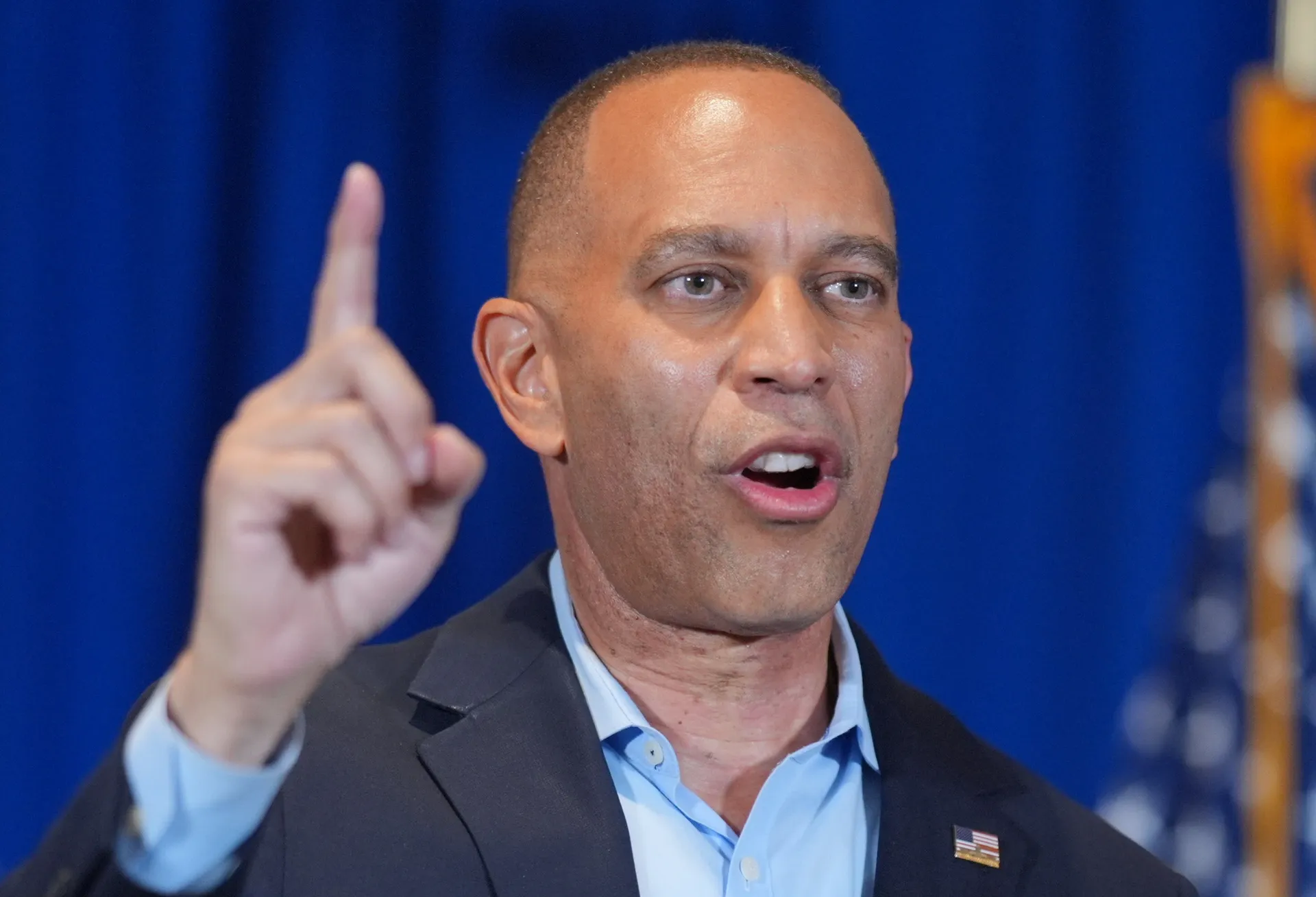
Hakeem Jeffries promises ‘affordability’ focus after Democratic midterm win | Donald Trump News

Democratic leader says party expects at least 255 House seats and promises to deliver on affordability.

Democratic House leader Hakeem Jeffries has celebrated his party’s sweeping victory in the United States midterm elections, calling the results an “American tsunami” as Democrats have taken control of both chambers of Congress.

“It wasn’t simply a blue wave. It was an American tsunami,” Jeffries said at a news conference on Wednesday, a day after Democrats pulled off upsets in several Republican strongholds.

Recommended Stories

list of 4 itemsend of list

Jeffries said Democrats expect to win at least 255 House seats once all vote counts are final, giving the party what he described as a historic majority.

“The American people have chosen common sense over corruption, chaos and cruelty,” he said.

Jeffries, who is set to become the first Black Speaker of the House when the new Congress takes office in January, said the results showed Americans wanted a change in direction.

“We’re humbled by the outcome,” he said, promising a “relentless effort to make life more affordable for everyday Americans”.

Speaking earlier on MS Now’s Morning Joe, Jeffries said Democrats would focus on getting things done rather than seeking revenge against President Donald Trump and his allies.

“We ran on affordability. We won on affordability. And now it’s our job to govern on affordability,” he said.

Democrats campaigned on bringing down the rising costs of groceries, petrol, housing and healthcare, which have left Americans feeling increasingly squeezed. But with Trump’s threats to use his presidential veto to block legislation he’s opposed to, Democrats may struggle to push through new laws even with a majority in Congress.

Jeffries pointed to a bipartisan housing affordability bill passed in July as an example of the types of legislation Democrats could pursue. The bill became law without Trump’s signature after he dismissed it as “a yawn” and “so unimportant”.

Jeffries also said Democrats would work to hold the Trump administration accountable for any wrongdoing, even as he acknowledged Americans wanted them to get things done, not “get even”.

“There’s a cost to corruption,” he said, adding that Democrats would follow the facts and the law, and “let the chips fall where they may”.

Source link

Key moments as Democrats sweep to victories in US midterms | US Midterm Elections 2026

Democrats have been celebrating across the US after a series of victories saw them take control of both chambers of Congress, flipping Republican seats in traditionally conservative states and scoring historic victories.

Source link

The new Congress may struggle to push a progressive agenda | US Midterm Elections 2026

As the dust settles on the 2026 US midterm elections, two facts are clear: First, the Democrats have achieved a historic victory – and second, Donald Trump remains president for the coming two years.

That means Congressional Democrats will have three legislative lanes to pursue: The first is constraining Trump. This includes doing what they can through Congress to bring the Iran war to a conclusion, blocking many of his nominations, particularly to the judiciary, ending ICE’s aggressive immigrant detentions, and pursuing oversight of Trump and his allies’ financial networks and alleged corruption.

The second lane will be about demonstrating a positive policy agenda to inform the 2028 cycle, when Trump will be off the ballot. This is more about “messaging bills” focused on social issues, but could also include economic measures such as tax reform proposals, as well as significant reforms of US global defence cooperation authorities and shifts to major foreign policy questions, such as aid to Israel.

The final lane will be that – perhaps narrow – set of issues where bipartisanship and cooperation with the White House is possible. Putting guardrails around America’s burgeoning artificial intelligence (AI) sector may fit in that box, although some of Trump’s biggest funders are likely to do what they can to derail progress.

Many of the bills that will be put forward in the first and second lanes would be subject to presidential veto. Others will be toned down, as the Democratic establishment seeks to resist the progressive left’s ambitious agenda. These dynamics are likely to make the upcoming Congress less productive.

On foreign policy, in particular, Congress is able to pass just a slim set of acts without presidential endorsement, such as war powers legislation, limiting the president’s ability to wage war without Congressional approval; or measures like the recent Senate resolution advanced by Maryland Democrat Chris Van Hollen to demand reporting on Israel’s human rights record; or committee subpoenas, which can be used to investigate members of the Trump administration for wrongdoing. But they are likely to be ignored or stonewalled by the White House, leading to months, if not years, of fruitless litigation.

That is not to say that introducing “stand-alone” bills on issues, such as arms transfers to Israel, would not be important even if blocked by the president. They remain useful both for framing the conversation and for getting members of Congress on the record and establishing consensus positions.

In the Senate, where several incumbents are likely to throw their hats into the upcoming presidential nomination contest, such bills could be used to highlight the progressive credentials of some candidates – or to force more conservative members into awkward positions. That might ultimately make a difference in terms of the framing and debate for the 2028 election – and a potential Democratic administration thereafter. But it will not change anything in the immediate term.

There are at least three tools available to legislators where a fierce – and perhaps impactful – debate is likely to play out. The first is that enabled by Congress’ constitutional “power of the purse”.  If the current Republican majorities do not manage to pass an annual funding bill by the end of this calendar year, the Democrats will have both the current year and the next two years of US government funding under their control.

This includes, of course, Israel’s annual allocation of $3.3bn, which Trump himself put into doubt in a surprising and as yet unclarified statement on election day. If nothing else, the president’s call for an end to security assistance to Israel may accelerate what would likely have been a steady reduction under Democratic leadership.

The new Congress will also be able to reconsider a range of funding restrictions and requirements, such as the prohibition on funding the United Nations agency for Palestinian refugees (UNRWA), or the limitations on funding the Palestinian Authority.

Passing such bills will not be simply a matter of partisan rancour — we can expect some pretty tough battles to play out within the Democratic caucus itself on some of these issues. Then it is another matter of whether the Trump administration adheres to the law with the funding it ultimately receives.

The second area to watch is that of oversight. With the majority in hand, Democrats in the House and Senate can set the agenda – deciding which actions by the Trump administration are ripe for investigation, identifying witnesses, and using the committee gavels to drive the public debate.

Party leadership will be eager to focus on the issues that are most damaging to the current administration and its likely candidates for succession, such as Vice President JD Vance or Secretary of State Marco Rubio, while being least disruptive to party unity.

And because the system relies on seniority, control of the agenda of Congressional committees that can investigate the government would rest with Democratic establishment members who would be less likely than their newer or younger peers to be critical of the US-Israel relationship.

That said, it is hard to imagine a Democratic Congress that does not at least conduct oversight of Trump’s Board of Peace and its opaque sources of funding and influence. Another likely topic is the question of US involvement in the current war with Iran.

What the Democrats choose not to pursue via oversight will also be important: The weaponisation of anti-Semitism by the current and previous Congress to attack the US education sector and civil society should come to an end under the next Congress. Though certainly Democratic leadership will be keen to find ways to demonstrate that they still care about genuine concerns from the Jewish community, one would hope that these are pursued with a more concrete grounding in reality and shared security than as a tool for repressing pro-Palestinian speech.

But many in the Democratic base would like to see the party do much more – including holding hearings into the US role in enabling Israel’s genocide in Gaza, a topic that would ensnare senior officials from the Biden administration in a very public accounting that the establishment is keen to avoid.

Here is where the details of the outcome of the midterms will truly matter. While there is no doubt that the centre point of the Democratic Congressional caucus has shifted to the left for the upcoming 120th Congress, particularly in the House, the size of the majority matters.

As recent Republican Houses have demonstrated, a small majority is a challenge for the speaker, as it empowers a small group of members to exert significant leverage through the threat of withdrawal of their support for basic procedural steps that are typically decided on a partisan vote basis.

As a result of the midterms “blue tsunami”, however, the Democratic majority is secure enough that leadership will have to make few real concessions to the left of their party, likely teeing up some tense, and almost inevitably public, tussling in the coming two years, particularly when it comes to appropriations bills.

In short, the Democrats’ campaign for legislative power has been a success, but particularly in the face of an imperious White House that has shown little interest in even longstanding legal precedent in its deference to Congress, it remains incomplete.

At the same time, being the party locked out of power has enabled the Democrats up to this point to dodge some degree of the internal wrangling that is already long overdue on key issues, such as foreign policy on Israel.

A majority in Congress may not give them complete control – but it does mean they will now own the legislative branch’s decisions. Whether they demonstrate a meaningful and proactive shift – or let themselves be constrained by establishment conservatism – may define the viability of their path to further electoral success in 2028.

Either way, the American people will be watching what Democrats do and do not do – as will the Republicans who, as Trump enters his “lame duck” years, are likely to undergo an evolution of their own on these key issues.

This makes progress in the coming Congress all the more acute an issue for the Democrats. The challenge for them is simple: take credible leadership on driving change or face the very real possibility of being outflanked by the “America First” right.

The views expressed in this article are the author’s own and do not necessarily reflect Al Jazeera’s editorial stance.

Source link

Presidential hopeful Vance appears to question Iran war after polls debacle | US Midterm Elections 2026 News

Vance cited trusted pollster saying Iran war, Israel ties were top of mind for Trump voters swinging to Democrats.

Vice President JD Vance has blamed the war on Iran for his party’s withering midterms defeat, suggesting that the conflict may not have been worth ceding control of the US Congress to Democrats.

“The reason we lost is the war. The president himself said so last night,” he wrote in a lengthy post on X. “If you’d like to argue it was worth it, that losing the Senate for the next 6 years was worth it, then do so.”

“Everyone knows why we lost. And any honest conversation about where we go from here must start there.”

Vance, a likely 2028 presidential candidate and heir apparent to Trump’s Make America Great Again movement, has been a key negotiator with Iran as the two countries search for a way out of the conflict, which has dented their economies and pushed global fuel prices up.

TOPSHOT - US Vice President JD Vance speaks at a midterm campaign rally near Eugene F. Kranz Toledo Express Airport in Swanton, Ohio on November 2, 2026.
US Vice President JD Vance speaks at a midterm campaign rally in Swanton, Ohio on November 2, 2026. [AFP]

His statements on Tehran have been more dovish than those of other key members of the administration, and his post-election note appears to mark the closest he has yet come to publicly diverging from his boss on an issue that looks set to dog Republicans as the war continues.

Citing a pollster he describes as “one of the smartest people I know”, Vance said he was told ending the Iran war and “changing our relationship with Israel” were two of the top four answers given by Americans surveyed who had voted for Trump in 2024 but were planning to vote for Democrats in the 2026 midterms.

In stark contrast, Trump said, in the wake of the rebuke at the ballot box, that he had no regrets about launching the conflict.

“I did the right thing. I would have done it again,” he told the Wall Street Journal.

Source link