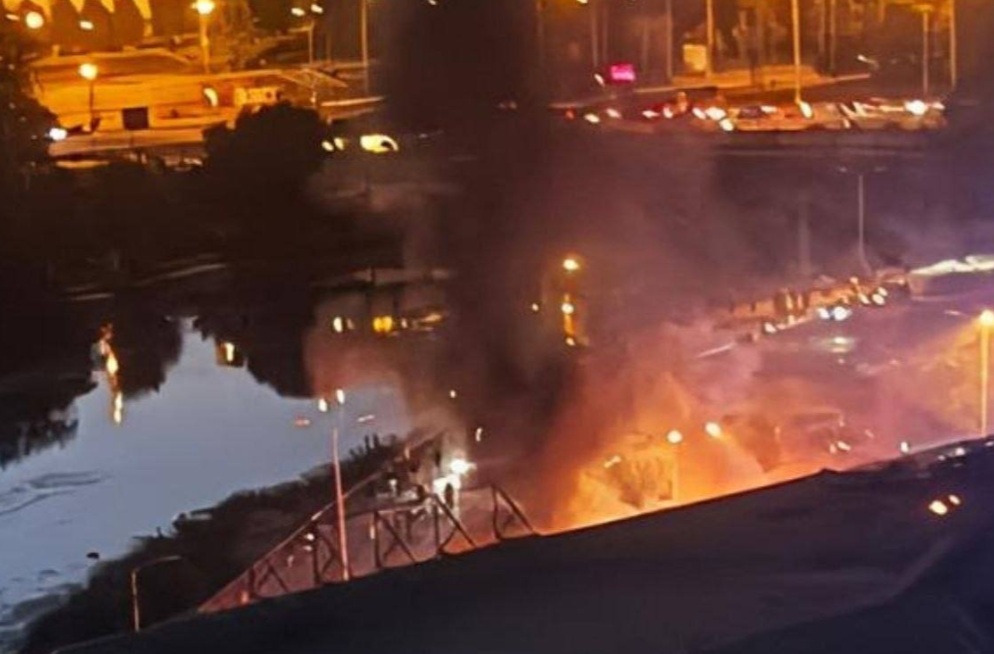
Overnight missile and drone attacks hit several Ukrainian regions as world leaders gather in New York for the UN General Assembly.
Published On 22 Sep 202622 Sep 2026
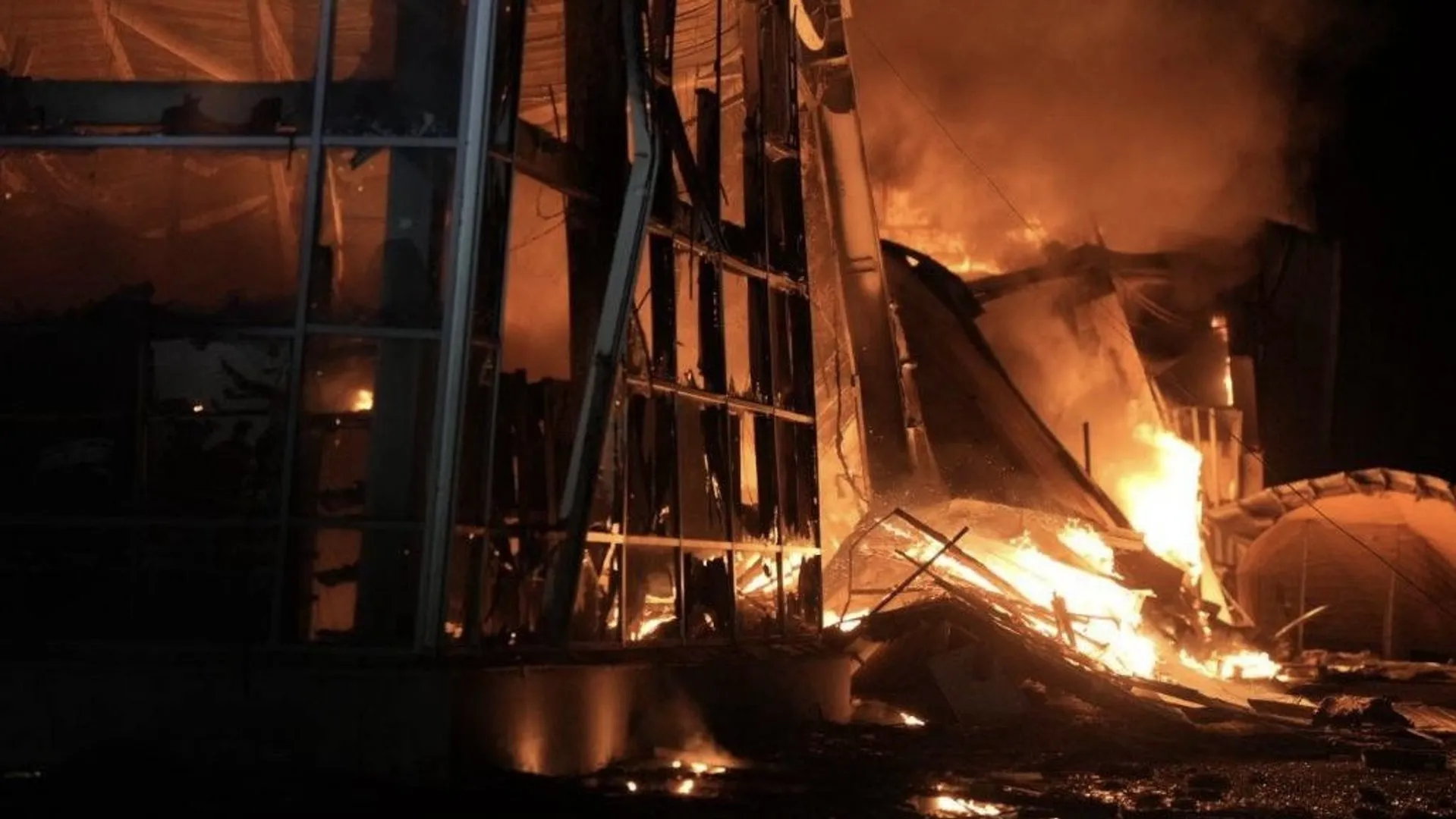
Russian forces have launched widespread attacks targeting industrial sites and critical energy infrastructure across several regions of Ukraine, killing at least three people and knocking out power to nearly 100,000 residents, Ukrainian officials said.
The strikes overnight hit industrial facilities simultaneously in the Dnipropetrovsk region, including Dnipro, Pavlohrad and Kryvyi Rih, the hometown of President Volodymyr Zelenskyy, regional Governor Oleksandr Hanzha said on Telegram on Tuesday.
Recommended Stories
list of 3 itemsend of list
Three people were killed and six others were wounded in Dnipro, where missiles, drones and artillery heavily damaged business and warehouse premises, Hanzha said.
Ukraine’s air force said Moscow’s overnight barrage involved 212 drones, four cruise missiles, and an unspecified number of Oniks antiship and ballistic missiles.
The strikes also damaged energy infrastructure. An attack on a power facility left nearly 100,000 consumers without electricity in the northern region of Chernihiv, while in the Poltava region, Governor Vitalii Diakivnych said a “massive” Russian attack hit an industrial enterprise and a critical infrastructure facility.
The Russian Ministry of Defence confirmed its forces carried out major strikes, stating it hit industrial and military facilities, the fuel and energy sector, port infrastructure and sea vessels operating for the Ukrainian military.
Meanwhile, Ukrainian drones targeted Russia’s Samara region along the Volga River, killing one person and injuring four, according to the local governor. The region hosts critically important facilities, including oil refineries.
The Russian Defence Ministry said its air defence units intercepted and destroyed 297 Ukrainian drones across various regions overnight.
Diplomatic push in New York
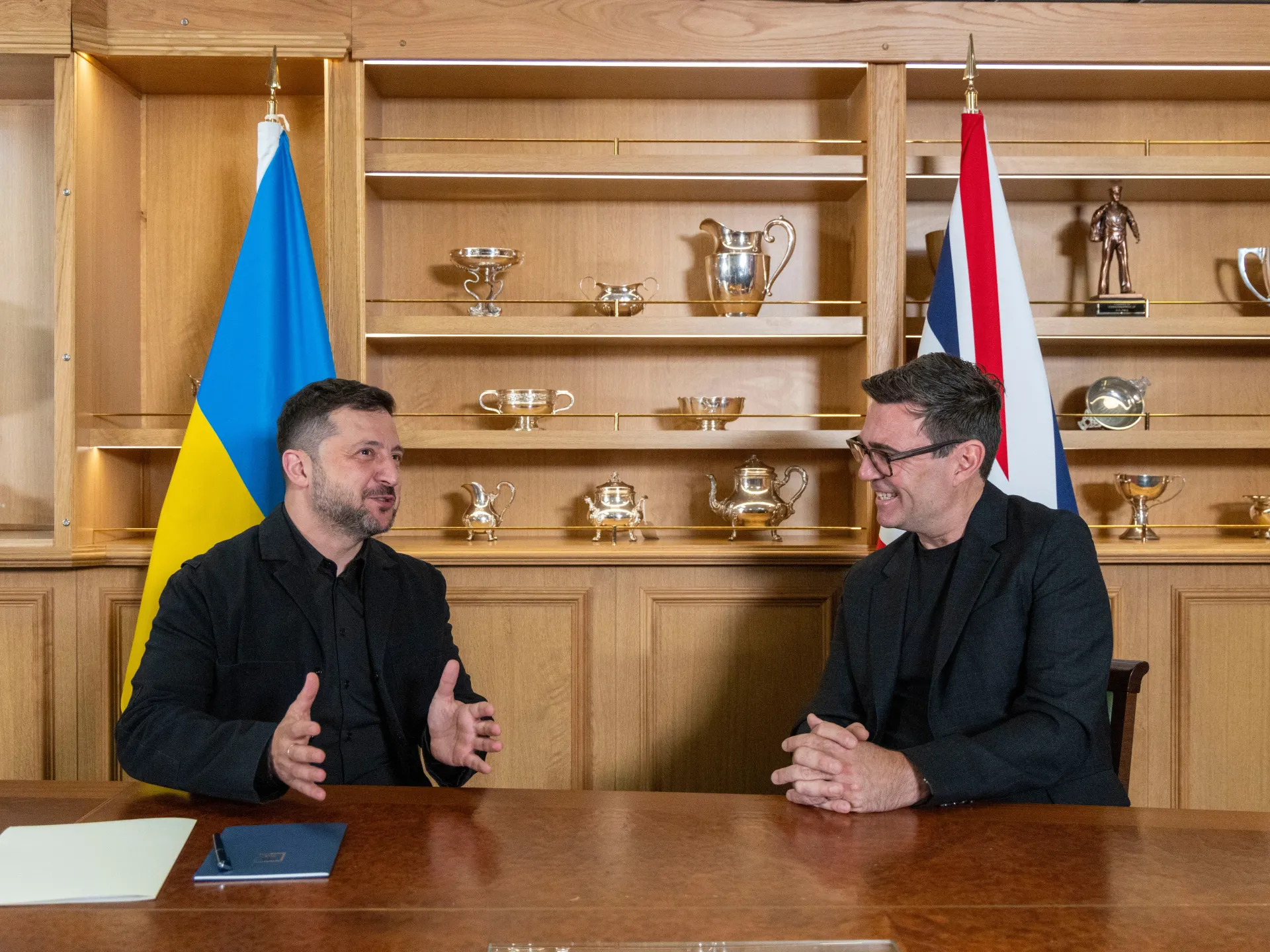
The attacks come as Zelenskyy arrived in New York for the United Nations General Assembly (UNGA), where talks on ending the war are set to be high on the agenda as nearly 130 heads of state gather.
The Ukrainian president wrote on X that a “drone deal” was ready to be signed to bolster air defence and secure funding for the war effort.
“Of course, Ukraine’s number one priority is bringing peace closer and protecting the lives of our people,” Zelenskyy posted. “There are concrete security proposals and de-escalation measures that could bring the end of the war closer. We are working to strengthen air defence and ensure sufficient financing for Ukraine.”
He said, “Around 20 meetings are planned, including with the US president, European leaders, US senators and members of the House of Representatives, heads of international organisations, leading American companies and think tanks.”
Zelenskyy met French President Emmanuel Macron on Monday and is likely to meet US President Donald Trump on Tuesday.
Earlier, Macron also met Trump, after which he said the two countries agreed to work together to secure a moratorium on strikes targeting energy networks and civilian infrastructure in Ukraine. Both Zelenskyy and Russian Foreign Minister Sergey Lavrov are set to address the UNGA later this week.
French President Emmanuel Macron, left, with his Ukrainian counterpart, Volodymyr Zelenskyy, on the sidelines of the UNGA in New York, US, September 21, 2026 [Ludovic Marin/AFP]
Victory of United Russia party strengthens Putin’s hand even as the war with Ukraine grows more unpopular.
President Vladimir Putin’s United Russia party has won a record supermajority in tightly orchestrated parliamentary polls that excluded virtually any genuine opposition, near complete official results show.
With over 58 percent of votes secured, United Russia, which has dominated Russian politics for 25 years, is on track to win more than three quarters of the seats in the lower house, the State Duma, according to the results announced on Monday after three days of voting that ended on Sunday.
Recommended Stories
list of 4 itemsend of list
The polls were the first parliamentary vote since Russian forces invaded Ukraine in 2022 and the first to include residents of four Ukrainian regions that were seized and illegally annexed by Moscow later that year.
Reporting from Moscow, Al Jazeera’s Dmitry Medvedenko said the results, along with a high voter turnout of almost 60 percent, “is likely to be seen by Moscow as emboldening, as public support for what it is doing, especially for what it’s doing in Ukraine for the continuation of the war”.
Ella Pamfilova, chair of the Central Electoral Commission, said Yabloko, the only registered anti-war party in Russia, did not win any seats at the national level. It had been removed from the ballot last month by Russia’s Supreme Court and only had a few dozen candidates in single-seat races.
A billboard in western Moscow promoting contract army service and reading ‘Time to Decide’, September 21, 2026 [AFP]
Yabloko did enter the regional parliament in western Russia’s Novgorod region. It said on social media that it received about 12,000 votes – just over six percent of votes and enough to enter the regional legislature.
Yabloko and the Communist Party, which has criticised some aspects of government policy but carefully avoided any criticism of Putin, said many of their observers were turned away from polling stations.
The Communists made it into parliament with 13.8 percent of the vote, securing 40 Duma seats. The nationalist LDPR party won 25 seats and the New People party 20.
Russia did not invite observers from the Organization for Security and Cooperation in Europe (OSCE), which the Foreign Ministry has accused of “double standards” for its criticism of the country. OSCE Parliamentary Assembly President Pere Joan Pons said the decision to exclude observers violated Russia’s commitments as a member.
‘Surprise to nobody’
Many Russians appeared unsurprised by the poll results.
“In the morning, I saw that United Russia was winning. It probably comes as a surprise to nobody,” said Moscow resident Tatyana.
Asked what she would like to change, she said: “Well, I guess everyone knows the most acute thing – the conflict in Ukraine. I’d like to see it end sooner, with peaceful methods if possible”.
The continuation of the war risks entrenching policies, which are increasingly affecting average Russians and the parliamentary supermajority may struggle to change the dynamic.
“Putin, of course, will interpret United Russia’s results as confirmation of the (public) support of the war, even though it is not the case: The overall demand for ending the war is growing,” said Tatyana Stanovaya of the Carnegie Russia Eurasia Center in an online commentary.
“The main question is: What now? There are great concerns about mobilisation, new repressions, harsher measures and escalation,” she wrote.
Western criticism
The EU’s top diplomat Kaja Kallas dismissed Russia’s “so-called” election.
“The Kremlin silenced dissent, barred the only registered party that opposed its war in Ukraine and shut out international election monitors. The veneer of democracy is all that remains in Russia,” Kallas said.
In a joint statement, five countries, including Australia, Britain and Canada, condemned Russia’s “sham” parliamentary elections in areas of occupied Ukraine, branding them “part of a wider system of occupation”.
Russian President Vladimir Putin has cast the vote as a test of support for his ongoing war in Ukraine.
Published On 20 Sep 202620 Sep 2026
Polls have closed in Russia’s first wartime parliamentary elections, with the ruling United Russia party on course to win the tightly controlled vote.
The Kremlin wants the elections, the first parliamentary vote since the start of the full-scale invasion of Ukraine in 2022, to showcase popular support for the war and legitimise its action.
Recommended Stories
list of 3 itemsend of list
Russian government officials accused Ukraine of trying to disrupt voting after Kyiv launched hundreds of drones at Moscow and other regions in what the TASS state news agency said was the biggest attack of its kind since the war began.
The drone strikes on Sunday killed at least three people in the Moscow region and two more in the Russian-held part of Ukraine’s Kherson region, including an election official, according to the region’s governor and the election commission.
Initial results showed the United Russia party comfortably ahead, and Russia’s Central Election Commission said turnout at the close of polls stood at 56.66 percent.
The first official results and turnout are expected on Monday morning.
Voting in Russian-held Ukrainian areas
The vote, which began on Friday for 111 million eligible voters, included residents of four Ukrainian regions that Moscow illegally annexed after the war began, but still doesn’t fully control, as well as those in Crimea, the Black Sea peninsula that was illegally annexed by Russia in 2014.
Authorities in Kyiv denounced the voting in the Russian-held areas as illegal and urged foreign governments not to recognise the result. The European Union on Friday called the action a “blatant violation of international law”.
Voters cast two separate ballots, filling half of the lower house’s 450 seats by selecting political parties listed on the ballot. The rest are contested in single-seat constituencies, with voters choosing individual candidates.
The main Kremlin party, United Russia, is widely expected to retain its overwhelming control of the State Duma. Several smaller parties of the “systemic opposition” that vote in sync with Putin’s views on all key issues are also expected to maintain their presence.
A massive state media campaign and tight control over the elections in the absence of genuine opposition all but assure the Kremlin will keep tight control of Russian politics amid mounting economic costs and increasing Ukrainian drone attacks deep inside the country.
The liberal Yabloko party, the only registered political entity that dared to publicly criticise the war, was removed from the ballot last month by Russia’s Supreme Court. It only has a few dozen candidates in the single-constituency races.
Additionally, some anti-war politicians were imprisoned or forced to flee abroad ahead of the campaign.
Russia didn’t invite election observers from the Organization for Security and Cooperation in Europe. The Russian Foreign Ministry has accused the body of “double standards” for its criticism of Russia.
Moscow mayor reports intercepting 1,600 drones during ‘unprecedented’ attack, accusing Ukraine of election interference.
Published On 20 Sep 202620 Sep 2026
At least two people have been killed and a major refinery has been damaged as hundreds of drones targeted the Russian capital, Moscow, and its surrounding region on the final day of the country’s parliamentary elections.
Moscow’s Mayor Sergei Sobyanin said on Sunday that more than 1,600 drones had been intercepted and shot down, 450 of which were heading for Moscow.
Recommended Stories
list of 3 itemsend of list
He also accused Ukraine of attempting to interfere with a tightly controlled three-day election that is set to tighten President Vladimir Putin’s 26-year grip on power.
“The unprecedented attack was clearly planned with the aim of disrupting the elections. The enemy did not succeed,” he said on Telegram.
Moscow regional Governor Andrey Vorobyov said on social media that a 44-year-old woman and an elderly man were killed in two separate locations.
A fire triggered by a drone crashing into a 21-storey building forced the evacuation of 400 people, Vorobyov said.
The strikes come as Kyiv has intensified its long-range drone campaign against Russia, particularly targeting energy infrastructure to cut off a vital source of Kremlin revenue used to fund its war effort, now in its fifth year.
“A facility on the territory of the Moscow Oil Refinery has been damaged,” Sobyanin added, saying that no casualties were reported so far and emergency services were on the scene.
The major refinery has already been hit by Ukrainian strikes in recent months.
The latest strike follows claims by US President Donald Trump on Monday that Ukraine and Russia had agreed not to target each other’s energy facilities.
It also comes as Russians vote in the country’s first parliamentary elections since Moscow sent troops into Ukraine in February 2022, igniting a war that has killed hundreds of thousands of people. Moscow has also organised voting in parts of Ukraine that it has seized in the four-and-a-half-year war.
Meanwhile, Ukraine’s Air Force Command reported that Russia launched 138 drones of various types across the country overnight, according to the Interfax-Ukraine news agency.
It added that air defences managed to shoot down or neutralise 101 of them.
Kremlin calls UK’s support for Ukraine an endorsement of ‘terrorism’ after recent escalation of weapons supplies.
Published On 18 Sep 202618 Sep 2026
Russia has stepped up pressure on Ukraine’s allies, summoning Britain’s top diplomat in Moscow over arms shipments to Kyiv and seizing Russian assets of several Western firms.
The Russian Ministry of Foreign Affairs summoned Britain’s charge d’affairs, Danae Dholakia, on Friday, issuing a formal protest over the UK’s “further increase” in weapons to Ukraine.
Recommended Stories
list of 3 itemsend of list
“London is placing itself in the position of an accomplice to the bloody atrocities committed by the Kyiv regime, which can only be characterised as terrorism and war crimes,” the ministry said in a statement.
Britain has maintained its support for Ukraine and says it will stand “shoulder to shoulder” with Kyiv and will provide whatever military equipment it needs, saying just last month that it will share classified weapons information.
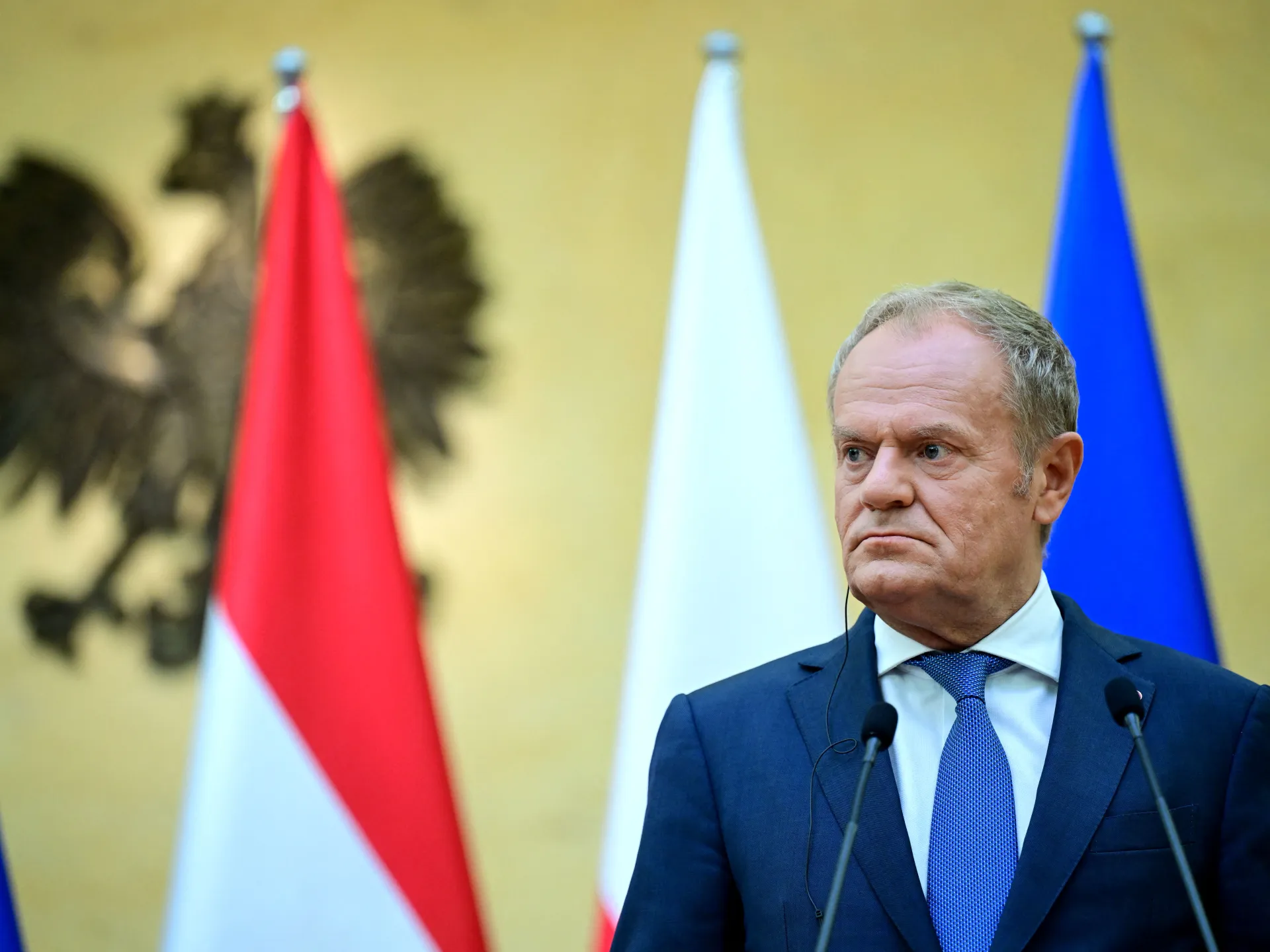
Moscow’s move comes the day after Polish Prime Minister Donald Tusk warned that Russia might be preparing to launch hybrid drone and missile strikes against countries that support Ukraine, including Poland. He said that such attacks would be framed as accidental, with the intention of weakening NATO states’ resolve to invoke collective defence provisions in the event of an attack on one of its countries.
French President Emmanuel Macron said on Friday that the threat posed by Russia’s shadow operations was growing across Europe and that Moscow had targeted France with hybrid attacks in the past few weeks.
“The Russian hybrid threat against Europeans and against France has intensified,” he said after a meeting with French political leaders.
France’s interior minister had met regional prefects to step up “vigilance in response to the Russian hybrid attacks”, Macron said, adding that he had ordered “the government to prepare a plan to protect our critical infrastructure” and the “most sensitive” defence industry and technology sites against drone and cyber-attacks.
Moscow seizes French, Swiss firms
As Russia steps up pressure on Ukraine’s political allies, it is also targeting Western companies.
Moscow has ordered the seizure of Russian businesses and assets of Swiss food giant Nestle and three French firms: retailer Auchan, DIY chain Lemana Pro (formerly Leroy Merlin) and logistics firm FM Logistics.
President Vladimir Putin signed a decree late on Thursday that changed the firms’ Russian operations to a new entity, LEV Management, which is managed by a Russian Ministry of Interior general, according to Novaya Gazeta Europe.
Nestle said it was still “assessing” the situation and its options but it remains “committed to taking all necessary steps to protect its rights”.
Kremlin spokesman Dmitry Peskov told reporters on Friday that one of the reasons behind the decision was because Nestle and Auchan are companies from “unfriendly” countries.
Their assets are only under “temporary administration” and that no decisions have been taken as of yet, Peskov added.
Overnight Russian strikes hit multiple regions in Ukraine, sparking several fires across the country, as President Volodymyr Zelenskyy is to host the inaugural Carpathian Eight summit of several European countries.
They include Romania, Poland, Slovakia, Czech Republic, Austria, Hungary and Serbia, with the European Union also set to discuss regional cooperation.
Hungary and Slovakia have refused to send Kyiv direct military assistance in the past, though Poland and Romania remain staunch allies.
A Russian strike hit a shopping centre in Zaporizhzhia, southeastern Ukraine, sparking a major fire. Peace talks between Ukraine and Russia remain stalled, even as the US broker a pause in the fighting.
Warsaw also says it has scrambled military planes in response to a Russian attack in western Ukraine, close to its border.
Published On 17 Sep 202617 Sep 2026
Polish Prime Minister Donald Tusk says that intelligence information suggests Russia plans to launch drone and missile attacks against countries supporting Ukraine.
Warsaw’s leader outlined the assessment during an address to parliament on Thursday, saying that the attacks will be meant to weaken NATO’s ability to act collectively in response.
Recommended Stories
list of 4 itemsend of list
“According to intelligence assessments, Russia’s plan … includes hybrid drone and missile strikes against countries supporting Ukraine, including Poland,” Tusk said.
European countries suspect Moscow of being behind a series of acts of sabotage in recent months to put pressure on the allies, especially Germany, helping Kyiv in its bid to resist Russia’s full-scale invasion – something the Kremlin has vigorously denied.
“These potential strikes would be quote-unquote ‘accidental’ in nature, intended to paralyse or at least weaken the resolve of NATO states to invoke the relevant NATO provisions in the event of aggression against a member country,” Tusk added.
He did not elaborate on which intelligence agencies had provided the warning.
He also said such attacks by Russia could coincide with “political changes in certain European countries granting power – or at least a powerful voice – to those who, increasingly invoking noble slogans of peace, pacifism and needless casualties, will call for peace – or rather, the total capitulation of Ukraine”.
Tusk appeared to be referring to the advance of more Russia-friendly parties such as Alternative for Germany (AfD) and National Rally in France.
Air raid near border with Poland
Earlier on Thursday, Poland said it had scrambled military planes in response to a Russian attack in western Ukraine, close to the Polish border.
Airports in Rzeszow and Lublin were temporarily closed, and residents of two eastern regions of Poland received air raid warnings. Local media reported that sirens had sounded and that pupils in some schools had sought shelter.
“Very close to the Polish border, not far from Dorohusk, a petrol station was most likely attacked again,” Tusk said.
On Sunday, a Russian drone hit a passenger train in Ukraine, just two kilometres (1.6 miles) from the Polish border.
Defence Minister Wladyslaw Kosiniak-Kamysz said Poland was strengthening airspace protection.
“We have increased F-16 and helicopter activity, and are reinforcing our air defence and rapid response systems,” he wrote on X.
Tusk said he would visit Ukrainian President Volodymyr Zelenskyy on Friday to discuss cooperation within the Integrated Anti-Ballistic Missile Coalition, a group of European countries developing an air defence system with Ukraine as a cheaper alternative to the US-built Patriot.
KYIV: A Russian drone struck a passenger bus in southern Ukraine early Wednesday, killing five people and wounding at least seven in the latest in a series of Russian strikes on civilian transportation.
Ukrainian President Volodymyr Zelensky called the attack an atrocity with no military purpose.
The strike occurred in the Nikopol district of Ukraine’s Dnipropetrovsk region, near the war’s southern front line. Oleksandr Hanzha, head of the regional military administration, said that all five were killed at the scene while the seven wounded were receiving medical care.
Zelensky described the vehicle as a minibus and said in an X post that the strike had “no military rationale” and that it was “just another atrocity.” He said the strike was connected to Russia’s targeting of logistics and critical infrastructure that has continued “unabated.”
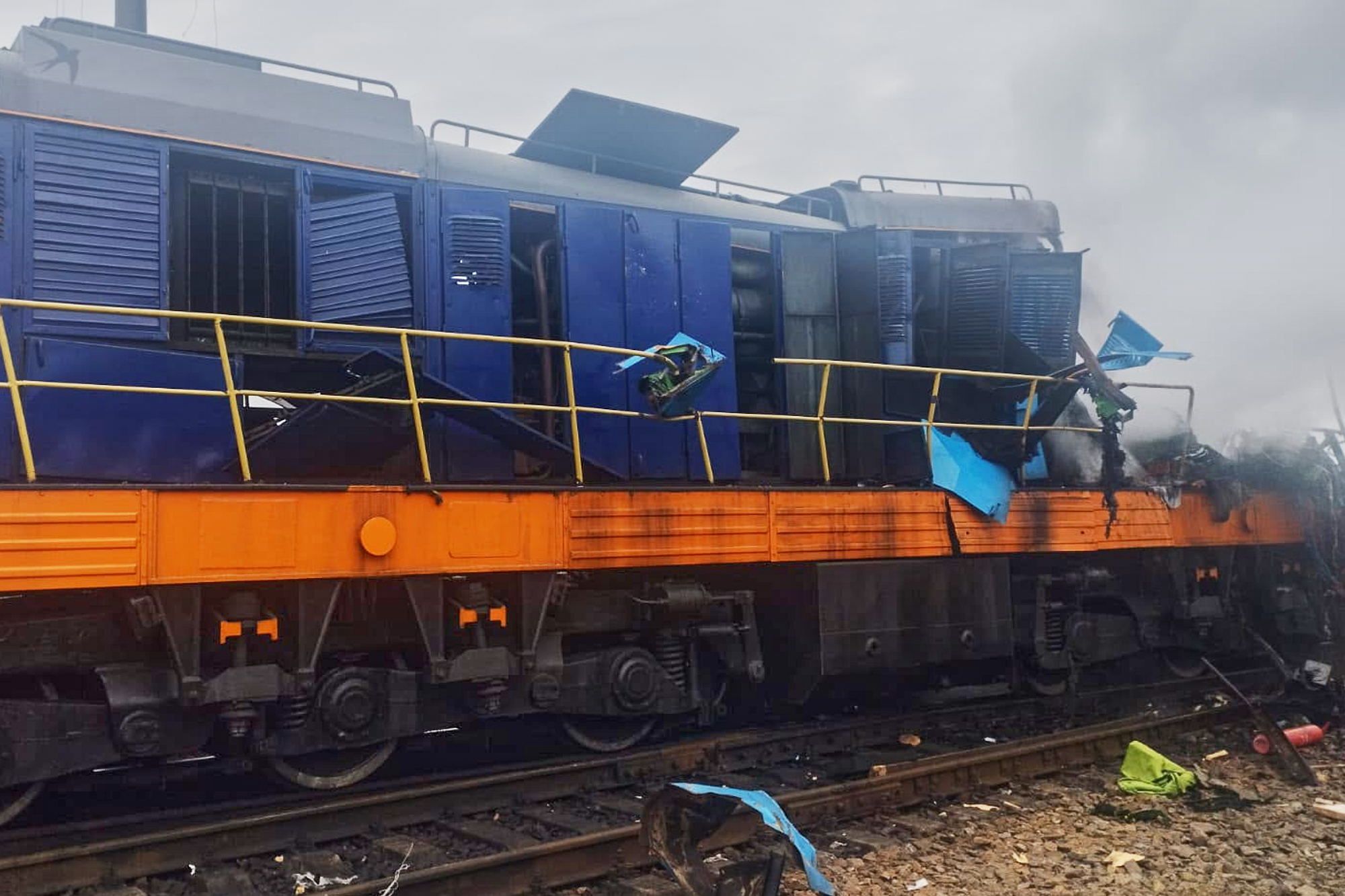
Zelensky said that a passenger train was also struck in the Mykolaiv region on Wednesday, damaging a railway station and a diesel locomotive. Nearly 170 passengers on board the train were evacuated before the strike. An electric locomotive in the northwestern city of Kovel was also struck, Zelensky said.
Ukraine requests locomotives from partners
Russian strikes on Ukraine’s rail network have resulted in more than 500 locomotives being damaged or completely destroyed since the beginning of the all-out war on Feb. 24, 2022, with more than half those strikes occurring this year, Ukrainian Foreign Minister Andrii Sybiha wrote on X on Tuesday.
Sybiha described such attacks as “systematic” and aimed at disrupting logistics across Ukraine. He said that Ukraine urgently needs replacements for damaged locomotives, and called on the country’s partners to assist in finding locomotives compatible with its 1,520-millimeter rail gauge and to assist in financing.
In another post on X on Wednesday, Sybiha said that Russian forces were striking passenger trains, locomotives, stations and railway routes “knowing exactly how essential they are for civilians, evacuations and Ukraine’s economy.”
“This is not collateral damage. It is a systematic hunt for people and an attempt to (paralyze) civilian life,” he wrote.
Zelensky says there is no truce on halting energy strikes
In an interview with CBS News on Tuesday, Zelensky pushed back against an earlier claim by US President Donald Trump that Ukraine and Russia had agreed to mutually cease attacks on each other’s energy infrastructure. Zelensky said that Ukraine was ready to enter such an agreement, if Russia stops striking Ukrainian energy facilities.
Trump said in a social media post Monday that such a truce had been reached, but didn’t offer details on the purported agreement. Previous efforts to broker even a partial ceasefire have repeatedly fallen apart within hours, with both sides accusing the other of violations.
In the CBS interview, Zelensky said that the possibility of an energy truce was discussed during a recent meeting in Kyiv with Trump’s representatives, Steve Witkoff and Jared Kushner, but that he had told them: “If the Russians are ready for an energy truce, that means there will be no attacks on energy facilities at all.”
This morning, the Russians struck a regular intercity minibus near Nikopol with an FPV drone. As of now, five people have been reported killed, and seven others are receiving medical care. No military rationale, just another atrocity. My condolences to the families and loved… pic.twitter.com/QFetF4Ww0s
— Volodymyr Zelenskyy / Володимир Зеленський (@ZelenskyyUa) September 16, 2026
Russia decorates ship captain who fired flares at Danish helicopter
Russia’s Defense Ministry said Wednesday that the captain of a Russian warship that fired two signal flares toward a Danish military helicopter on Monday, drawing ire from Denmark, has been awarded a medal for his “competent and resolute action.”
The ministry said in a statement that the Soobrazitelny corvette was on a mission in neutral waters in the Baltic Sea when its crew spotted the approaching helicopter, which failed to respond to calls made via the international communication channel.
“To prevent a provocation by the Danish helicopter, the corvette commander decided to fire two red signal flares, after which the helicopter left the area where the Russian warship was located,” the ministry said.
Russian Foreign Minister Sergey Lavrov said Wednesday that Moscow has no aggressive intentions toward Europe, but that if countries on the continent were to launch an attack on Russia, “it would be a completely different kind of war, and a very short one.”
Russian general killed in Ukrainian drone strike
The deputy head of the Russian armed forces’ military-political department, Lt. Gen. Apti Alaudinov, confirmed Wednesday that a decorated Russian general had been killed in the occupied Donetsk region.
Alaudinov, who didn’t provide details on the circumstances of Maj. Gen. Anton Grunis’ death, hailed the officer as “a hero” and “one of the most respected generals … a real man and officer and a great patriot.”
The confirmation of Grunis’ death came after Robert “Magyar” Brovdi, commander of Ukraine’s Unmanned Systems Forces, alleged on Wednesday that Grunis had been killed in occupied Donetsk by a Ukrainian drone while at a command post in the village of Kindrativka.
In July, Grunis reported to Russian President Vladimir Putin that his troops had captured the town of Kostiantynivka and he was later awarded the Hero of Russia medal. Ukraine has disputed that Kostiantynivka was fully taken by Russian forces.
Grunis had previously fought in Chechnya, a mainly Muslim republic whose bid for independence after the Soviet Union’s collapse led to years of war with Russian government forces. He also took part in Russia’s campaign in Syria.
In Ukraine, he commanded the 4th Guards Motorized Infantry Brigade.
Meanwhile, 17 other sites were damaged in Ukraine’s Kyiv region between Tuesday and Wednesday morning, according to the head of the Kyiv regional military administration, Tymur Tkachenko. Eight private homes, five vehicles, a municipal building, a hangar and a production facility were among the sites damaged, Tkachenko said on Telegram.
Zelensky said on X that the Kherson, Donetsk and Poltava regions had also come under attack.
In the northern city of Sumy, six people were injured in a Russian guided aerial bomb attack, including a 14-year-old girl, according to the head of the Sumy regional military administration Oleh Hryhorov. Two homes were destroyed and 10 others damaged in the strikes, along with damage to an educational facility, Hryhorov said, adding that two other men were hospitalized after a separate strike hit an industrial zone.
In the port city of Odesa, one person was killed in a Russian attack that sparked a fire at garages and damaged vehicles and private homes, Serhii Lysak, head of the city’s military administration, wrote on Telegram Wednesday.
Russia’s Defense Ministry said that its air defenses downed 71 Ukrainian drones overnight. In the Belgorod region, one person was killed and four others were wounded by Ukrainian strikes over the last 24 hours, according to acting governor Alexander Shuvayev.
WASHINGTON: US President Donald Trump said Monday that Ukraine and Russia had agreed not to target each other’s energy facilities, a day after he chastised Kyiv for hitting Russian oil refineries.
“Ukraine has agreed not to hit Russian Energy targets. Russia has agreed to do, likewise!” Trump said on his Truth Social network.
“The World’s Diesel price rise is mostly caused by the Russia/Ukraine War, not Iran.”
There was no immediate confirmation from Kyiv or Moscow of any deal.
Trump’s claim comes as oil prices continue to soar in the seventh month of the Iran war, raising American fuel costs and inflation just weeks before crunch US midterm elections.
The US leader has insisted that the Iran war will finish immediately after the midterms and gas prices will drop — but has in the meantime apparently found a new target to blame for the cost at the pump.
Trump had lashed out at Ukraine’s President Volodymyr Zelensky during a trip to Ireland on Sunday, saying he had to do “one thing” and “stop knocking out diesel fuel” refineries in Russia due to growing shortages.
“Let him go after targets, but not diesel fuel, because he’s causing a shortage of diesel,” Trump said, again insisting the Russia-Ukraine war — not the US-Israel conflict with Iran — was to blame.
Trump added he had spoken to Ukraine’s leader about the country’s stepped-up attacks on such sites over recent months.
“There are plenty of other targets. Don’t hit diesel fuel because that’s hurting. That’s hurting the world. We don’t want him to hit diesel fuel… He’s hitting diesel refineries.”
Ukraine has hit numerous Russian oil refineries far from its border with Russia, while Moscow has also intensified its long-range attacks in recent months, leading to a jump in civilian deaths.
Kyiv has been firing record numbers of drones at Russia, while Moscow has been launching all-time high missile attacks.
Trump said last week he had a “great conversation” with Russian President Vladimir Putin, insisting that Putin wanted to make a deal to end Moscow’s war on Ukraine.
Putin “is wanting to make a deal, and if Zelensky is wanting to make a deal, that’d be very nice,” Trump told reporters on Wednesday.
Zelensky said last week he would be willing to meet Putin at the G20 summit at Trump’s own Doral resort in Miami in December, but the Kremlin immediately ruled it out.
Tetiana Bubynets collapsed on the asphalt after a Russian drone exploded at a gas station in the southern Ukrainian city of Zaporizhzhia.
Despite the violent shockwave and blast of drone shrapnel produced by the attack on July 6, the 18-year-old accounting student had no visible wounds except for a nosebleed.
Recommended Stories
list of 3 itemsend of list
She was rushed to hospital and pronounced dead shortly after, alongside two other civilians, aged 41 and 48.
One of her lecturers, Tetiana Melikhova of Zaporizhzhia National University, said Bubynets was an only child and that her mother “lost the meaning of life” after she died.
“She couldn’t speak. At the funeral, she just lay on the coffin; she couldn’t let her child go,” Melikhova told Al Jazeera.
The strike that killed Bubynets was the first recorded case of Russia’s use of a fully autonomous attack drone powered by artificial intelligence (AI), according to a New York Times analysis.
While drone strikes have hammered Ukraine since Russia launched its full-scale invasion in February 2022, Ukrainian officials who examined the wreckage found the unmanned vehicle to be unlike others.
In place of an antenna, it featured an AI-powered minicomputer sold commercially by US technology company Nvidia, which rendered it capable of directing itself to the type of target it was programmed to spot – likely propane tanks in this case – lock on to it and proceed to strike.
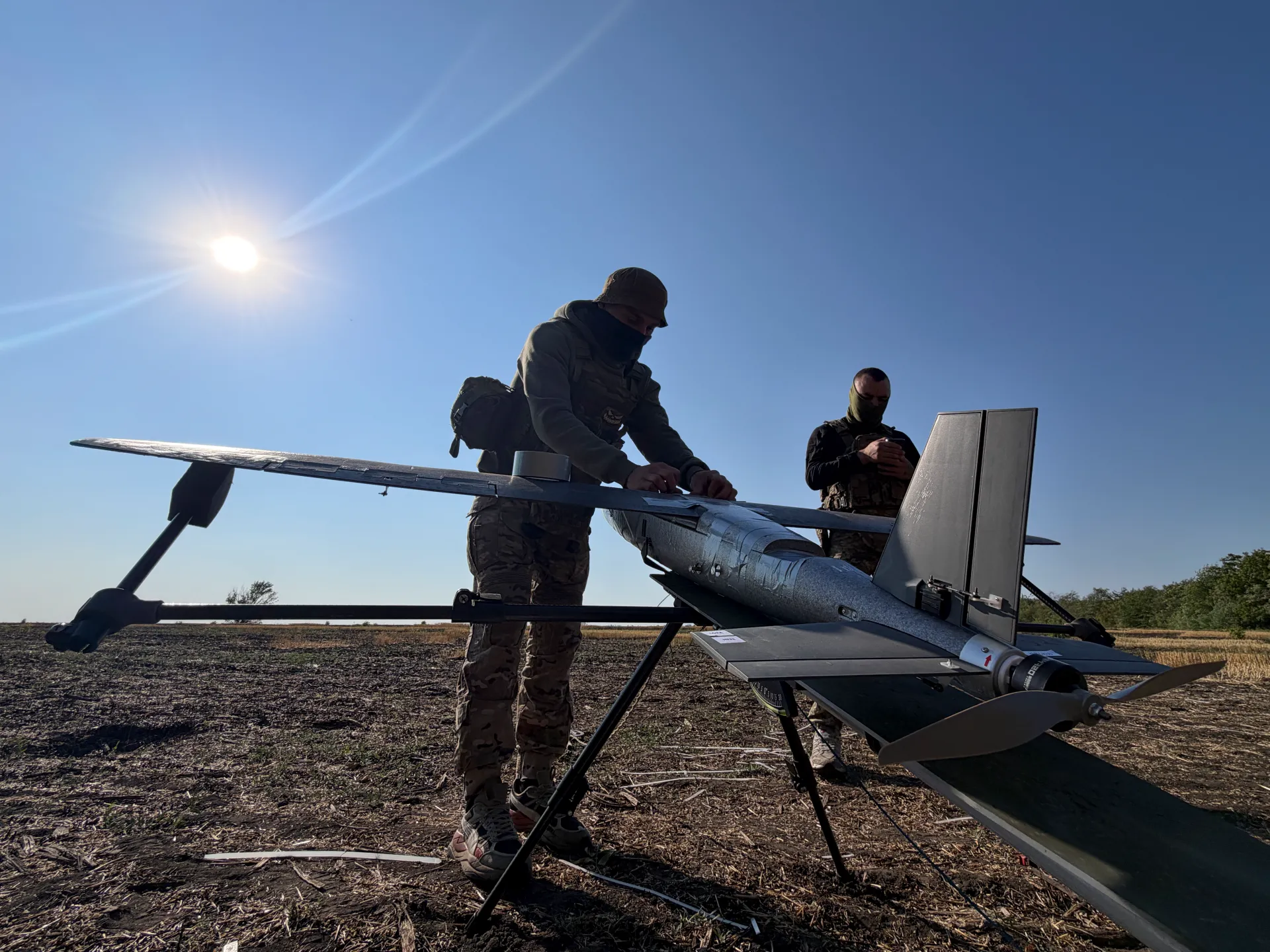
AI-powered drones are the tip of the iceberg as Russia and Ukraine race towards boosting tech infrastructure aimed at coordinating reconnaissance and attack, according to analysts.
“It’s not about a drone having AI in it, and then seeing something and striking,” Marina Miron, researcher at the defence studies department at King’s College London, said. “Rather, it’s the drone seeing something, communicating to a software complex which knows how to map the GPS coordinates on a live battlefield map, and notifying the closest artillery unit.”
Referred to as reconnaissance-strike architecture, these unified battlefield management systems act like a central command. They track the location of friendly forces and identify enemy positions.
AI acts as the accelerator, instantly processing massive amounts of data collected through sensors in drones or any other military products, including interceptor missiles or artillery units.
The tactical advantage on the battlefield is given by the system’s ability to compress the kill chain – meaning coordinating and distributing the intelligence to military assets on the ground to find, track and destroy targets in a matter of minutes.
In such an ecosystem, AI-powered automated drones are just pieces of a broader puzzle.
Ukraine is known to be developing its system, which it named DELTA. Following operational trials in late 2025, Russia has been rolling out its version, the Svod Tactical Situational Awareness Complex, to front-line units.
Both sides claim that once the battlefield data is processed, a decision support system (DSS) presents a military commander with options to choose from, keeping a human in the decision-making loop, said Miron.
“In how far that is true is, of course, impossible to find out,” she added.
Acknowledging full AI autonomy would provoke ethical and legal questions.
Even if humans were to retain final decision-making authority, research has shown AI systems subtly shape choices, predetermining outcomes.
“Under time and pressure, commanders often do as AI suggests,” said Miron, whose research focuses on military AI and remotely piloted and autonomous systems.
Towards full automation
Coordinated AI-powered military systems are the next frontier of modern warfare, said Serhiy Beskrestnov, a Ukrainian Ministry of Defence adviser on loitering munitions, known by his callsign Flash.
“That’s what it will all come to,” he posted on his Telegram channel on July 1. “Navigation, search for a target, and attacks will be fully autonomous.”
Drones with some autonomous capabilities are already being deployed at scale.
Heorhii Volkov, commander of Ukraine’s Yasni Ochi drone strike unit, said this is currently mostly used in the final phase of long-distance strikes, where first-person view (FPV) drones are likely to lose radio connection due to electronic warfare or the curvature of the Earth.
The use of AI in so-called last-mile operations solves this battlefield hitch. If the signal is lost, an integrated AI-enabled onboard module takes full control of the unmanned vehicle, autonomously locks on the target and carries the strike to completion.
Yaroslav Azhnyuk, founder of Ukrainian technology company The Fourth Law, which develops AI-powered autonomy software for unmanned vehicles, said Russia and Ukraine were working to deploy a wider range of autonomous systems.
“This is not simply a race to demonstrate a fully autonomous drone. It is a race to make autonomy reliable, affordable and deployable at scale,” Azhnyuk told Al Jazeera. “Electronic warfare, increasingly long engagement distances and the growing number of drones are making human-controlled systems less sufficient. Autonomy solves exactly these constraints.”
Azhnyuk believes autonomy will become a game-changer over the next six to 12 months.
“The decisive advantage will belong to the side that can deploy reliable autonomy across tens or hundreds of thousands of systems, not just demonstrate it in prototypes,” he said.
Kateryna Bondar, senior fellow at the Center for Strategic and International Studies (CSIS), noted the dangers of AI’s reliance on algorithms.
“The system doesn’t understand what it’s doing; it’s just following the algorithm and the rules which people created,” said Bondar, who works at the CSIS’s Wadhwani AI Center. “AI has to be trained to recognise targets and engage these targets,” but writing code that distinguishes between a bus and a tank is easier than between a Russian and a Ukrainian soldier.
Additionally, cost-effective FPV drones have low-quality cameras and their resolution can be lowered further by adverse atmospheric conditions.
Military units using autonomous systems therefore “delegate the decision to a very imperfect technology that cannot distinguish between a civilian and a military person, combatant or non-combatant”, Bondar said.
“This is why there is a conversation around who makes a decision and who has responsibility for mistakes and errors.”
KYIV: Poland and Ukraine on Sunday denounced Russian strikes close to the Polish border, including on a Warsaw-bound train and near a frontier checkpoint — as an “escalation” in the war.
Ukraine’s rail operator said former British prime minister Boris Johnson and ex-US CIA director David Petraeus were at a border train station nearby around the time the train was hit.
But the strikes came as US President Donald Trump called on Ukraine’s President Volodymyr Zelensky to halt attacks on Russian refineries, saying it was causing a shortage of diesel fuel and “there are plenty of other targets”.
Ukraine has increasingly targeted Russian oil refineries in a bid to hurt Russia’s war effort.
Russia attacked western Ukraine with drones Sunday, just days after US envoys visited Kyiv and Moscow in a bid to revive talks to end Europe’s worst conflict since World War II. European nations are meanwhile worried by what they say is increased Russian-orchestrated sabotage acts on their soil.
Poland and Ukraine said a Kyiv-Warsaw passenger train was struck just two kilometers (1.2 miles) from the Polish border, but reported no casualties.
“Shortly before the locomotive was hit at the Ukrainian-Polish border, a diplomatic train was at Yagodyn station. There were, among others, security advisers from several EU member states and former European leaders on board, including former UK Prime Minister Boris Johnson,” said the Ukrzaliznytsia rail operator.
“In another train that was at Yagodyn station at the very moment of the attack was former CIA Director David Petraeus,” it added. The operator did not say how far the officials were from the train attacked.
Zelensky said Moscow had “deliberately” struck the locomotive.
“It is precisely to prevent these strikes from spreading further into Europe that Ukrainian men and women fight every day, give their lives, and do not allow the aggression to expand,” Zelensky said.
– Poland warns of possible more attacks –
Poland has been one of Ukraine’s main allies and, with Ukrainian airspace closed, trains to Poland have been one of the main routes out of the war-torn country, used by refugees.
Poland’s Prime Minister Donald Tusk chaired an emergency meeting in Warsaw following the strikes, warning he expected Russia to escalate the war “in the coming weeks”. He added: “We cannot exclude that the escalation will also affect our territory… I hope not.”
Russia said it had hit “railway infrastructure used to transport military cargo” from European countries.
– Russia ‘knocking at Europe’s door’ –
Speaking in Kyiv, Poland’s foreign minister Radoslaw Sikorski said the “escalation” should lead to allies to “double” their support for Ukraine.
“This was just a few hundred meters from the Polish border; this affects the safety of my countrymen,” Sikorski said.
“I understand that nobody died this morning in that particular attack, but it could easily have happened.”
Ukraine’s Foreign Minister Andriy Sybiga said President Vladimir Putin considered Russia was “de facto” at war with Europe.
“Europe may consider, or reassure itself, that it is not at war with Russia, but Russia does not see it that way. De facto, it is already at war with the Euro-Atlantic space, carrying out various hostile actions,” Sybiga said.
“Putin’s terror is literally knocking at the door of the European Union and NATO.”
Russian attacks killed at least two people on Sunday in the frontline city of Kramatorsk.
Twenty people, including two children, were also wounded in a second day of attacks on the southern port city of Odesa, Ukrainian officials said.
– Three-way talks –
The Kremlin, meanwhile, said negotiations with Ukraine and the United States on the war could take place in October.
“We do not rule out such a possibility; we are talking about the foreseeable future,” Kremlin spokesman Dmitry Peskov told journalists, cited by Russia’s Ria and Tass news agencies.
Several rounds of negotiations have failed, while US-led efforts stalled during the Middle East war.
In an interview released on Saturday, Zelensky said he would be willing to meet Putin at the G20 summit in Miami in December.
But Peskov said that was “impossible”, speaking to AFP in New Delhi on Saturday, repeating Moscow’s demand that a meeting could only take place in the Russian capital.
The Ukrainian Navy is claiming one of its uncrewed surface vessels (USV) sank a Russian USV, marking the first time one of these weapons, also known as drone boats, destroyed another. The engagement is the latest iteration in the use of combat drone boats, which Ukraine has employed to devastating effect against Russia’s Black Sea Fleet vessels and facilities, forcing the general evacuation of Russian naval assets from occupied Crimea to bases in Russia proper. The use of weaponized USVs is now proliferating around the globe at an increasing rate.
The incident took place somewhere in the Black Sea, said the Ukrainian Navy, which provided no details about when it happened or exactly where. TWZ cannot independently verify this claim; however, we cannot find any evidence of a drone boat killing another drone boat in the past.
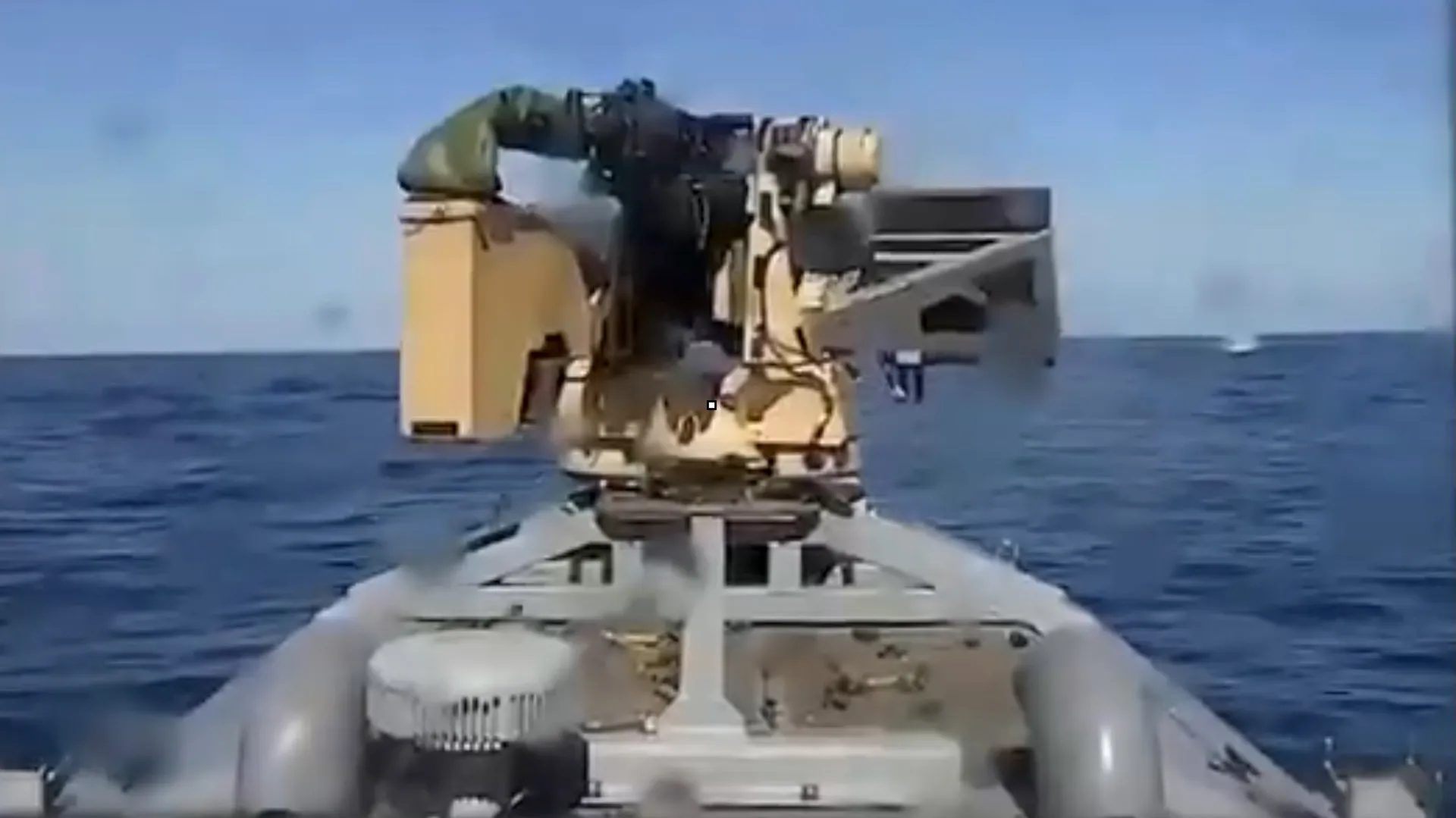
“Units of the Main Intelligence Directorate (GUR) detected the target,” the Ukrainian Navy stated on Telegram. “The Ukrainian Navy’s ‘Sargan 3000’ unmanned boat, equipped with a remotely operated weapon station (RWS) Protector 12.7 mm, successfully destroyed it. This is the first naval battle in history between unmanned boats.”
An 81-second video released by the Ukrainian Navy opens with a view from the Sargan 3000’s onboard camera. It shows the Ukrainian USV acquiring, then engaging the Russian USV with its machine gun. It then cuts to a closer view of the Protector gun system firing at the Russian drone boat. At about the 30-second mark, the view switches to a feed from an aerial platform, though it is unclear if it is piloted or a drone. The video continues with the Sargan 3000 raking the Russian USV with its heavy machine gun until pieces start flying off and it eventually sinks, stern first.
Ukraine’s Navy says a Sargan unmanned surface vessel destroyed a Russian unmanned boat with machine-gun fire in the Black Sea, the first-ever battle between unmanned surface vessels. Ukrainian Navy personnel operated in coordination with HUR. #Ukrainepic.twitter.com/Avg4ecz8m6
The Sargan 3000 (the name means needlefish in Ukrainian) was first introduced by Ukrainian President Volodymyr Zelensky in April as a “multi-purpose platform that has undergone testing and entered service with the Ukrainian Navy. These uncrewed vessels are highly maneuverable and capable of carrying out strike missions.”
“The maritime drone features a specialized low-profile hull with distinctive hydrodynamic lines and is constructed from materials that reduce its radar signature,” the publication explained. “The Sargan-3000 USV is equipped with a waterjet propulsion system (presumably powered by a diesel or hybrid engine to ensure a long operational range).”
AmalNews states that the Sargan 3000 is 6.9 meters (about 22.6 feet) long, 2.2 meters (about 7.2 feet) wide, with an operational radius of up to 1,600 km (about 994 miles) and can carry a payload of 450 kg (about 992 pounds). It travels at an estimated speed range of 40-55 knots.
During operations, the Sargan 3000 connects to Ukraine’s Delta situational awareness system, “enabling the real-time transmission of target data, video feeds, and telemetry to operators,” AmalNews noted. “It features multi-channel control capabilities, including redundant satellite communication terminals (utilizing secure Western commercial networks and NATO military networks).”
It is also equipped with “an autonomous inertial and optical navigation system to ensure operation in the event of GPS jamming, and it incorporates electronic countermeasures (ECM) modules.”
There are several variants of this USV. They include those equipped with machine guns; rockets; FPV drones; an electronic warfare version and one that lays mines, the publication added.
Ukraine’s Sargan-3000 naval drone was presented in an FPV drone carrier variant, additionally fitted with a remote weapon station. The type first appeared in combat conditions in early June, when one washed ashore and detonated in the waters of Romania’s Constanța port. #Ukrainepic.twitter.com/QyKnyJFqUq
The drone boat’s first publicly known combat engagement took place in July, when one “destroyed the Russian Federation’s FSB border guard ship Izumrud,” the Ukrainian Navy stated at the time.
“Ukrainian naval sailors sank the border guard ship of the 2nd rank with the Sargan-3000 maritime unmanned complex near Novorossiysk,” the Ukrainian Navy claimed on Facebook. “Among the crew of the ship are dead and wounded.”
It is unclear whether the USV acted as a kamikaze vessel or a weapons platform, although the former is most likely.
“It was Izumrud that on November 25, 2018, participated in the attack on the ships of the Ukrainian Navy in the Kerch Strait,” the service added. “Revenge is inevitable.”
Ukraine’s Navy has sunk the Russian FSB Border Guard patrol ship Izumrud near Novorossiysk using the Sargan-3000 unmanned maritime system.
The vessel, a Rank 2 patrol ship, reportedly sustained catastrophic damage, with casualties and injuries among its crew.
— SPRAVDI — Stratcom Centre (@StratcomCentre) July 14, 2026
One sea drone killing another is a notable development given the damage these systems can inflict and the challenge of locating and destroying them on open waters. Being able to operate on the water over long distances and timeframes, they can be used to hunt down other drone boats, as what appears to have taken place in this engagement, or serve as a picket line of sorts to protect harbors, vessels and other targets that have been attacked by USVs in the past.
The Russian drone boat, which is not identified, did not appear to be armed.
Ukraine has carried out the world’s first known combat mission in which a sea drone transported and deployed an armed ground robot behind Russian lines on the occupied Kinburn Spit. pic.twitter.com/zyJdFXWxVb
The U.S. used drone boats as kamikaze weapons for the first time in July, during an attack “on a submarine and ship maintenance facility in Iran,” U.S. Central Command (CENTCOM) announced on X at the time.
Yesterday, using multiple one-way attack surface drones, CENTCOM forces successfully struck a submarine and ship maintenance facility in Iran. Three Corsair unmanned surface vessels hit the port at Bandar Abbas Naval Base, marking the first time American forces have employed sea… pic.twitter.com/bOM2kmgRxz
Regardless, it looks like history was made with this incident in the Black Sea. But this involved a sea drone hunting down and destroying another that couldn’t fight back. Given the rapid pace of weapons development by both sides in the Ukraine war, it seems inevitable that a duel between two armed drones boats could soon follow.
The first naval battle between two Unmanned Surface Vessels (USVs) has taken place in the Black Sea. The Ukrainian Navy said on Saturday that one of its naval drones sank a Russian vessel.
Second day of strikes on fuel stations suggest a new campaign focused on civilian areas in the Ukrainian capital.
Published On 11 Sep 202611 Sep 2026
Russian drone attacks on two fuel stations in Kyiv have killed two people and injured others, as Moscow continues to target civilian areas.
They were struck early on Friday within ten minutes of each other in the capital’s Obolonskyi and Dniprovskyi districts, shortly after emergency sirens rang out, Mayor Vitali Klitschko said in a statement.
Recommended Stories
list of 3 itemsend of list
Russia also targeted fuel stations in Kyiv on Thursday, suggesting a new campaign focused on civilian areas in the capital. Ukrainian authorities have warned people to avoid filling up when air raid sirens sound.
One person died at the scene of one of the attacks, Klitschko said, while the other died in hospital. Six people required hospital treatment.
While fuel stations near the eastern and southern battle lines have been hit regularly for months, authorities have long warned that the attacks could extend to the capital as an intimidation strategy.
Russia and Ukraine both deny targeting civilians as the conflict – started with Moscow’s invasion in February 2022 – has developed into a series of daily attacks with missiles and drones.
Other Russian drone strikes overnight hit near a shopping mall in Pavlohrad, leaving five dead and 67 injured, while a mother and son were injured in Zaporizhzhia when a drone hit an apartment building and a mall.
Ukraine’s Minister of Foreign Affairs, Andrii Sybiha, declared Friday a day of mourning.
On Thursday, he condemned Russia for attacking civilian areas in a bid to sow fear.
“Russia is systematically attacking places where it knows people will be spending their time going about their daily lives, seeking to maximise casualties, spread fear and put pressure on Ukrainian society,” he stated.
Ukraine unleashed its own large-scale drone attack through the night, with Russia’s Ministry of Defence reporting that its forces shot down 777 drones in 16 regions.
Two people were killed and three injured in Tula, to the south of Moscow, local authorities reported.
Russian President Vladimir Putin met with US envoys Steve Witkoff and Jared Kushner at the Kremlin on Saturday, before they headed to Kyiv for talks with Ukrainian President Volodymyr Velensky. Both sides agreed to pause all strikes on the other’s capital while the Americans were in town. Why now? Have we finally reached the point in the conflict where all parties are left without cards to play?
In August 2025, Donald Trump met Putin at a US military base in Anchorage. No Ukraine ceasefire occurred in the aftermath. After discussing the two states’ long history and their efforts in the Second World War, Putin mentioned there was an “agreement” but failed to offer more details. He stressed that the situation in Ukraine was associated with “fundamental threats to our national security.”
Declassified documents from the US National Security Archive noted discussions on NATO expansion during the administration of President Bill Clinton. They show that, in 1993, American officials led Russian President Boris Yeltsin to believe that the Partnership for Peace offered an alternative to NATO expansion, rather than being a precursor to it. By the fall of 1993, discussions between supporters of the expansion of the alliance and those who proposed a more cautious approach and cooperation with Russia and Ukraine led to the formation of a “double track” approach in Washington.
Kyiv has recently been striking more deeply inside Russian territory, bringing the conflict home to ordinary citizens
Dr. Diana Galeeva
On June 22, 1994, Russia joined the program. But on Dec. 1, NATO announced that it would begin considering the admission of new members. Yeltsin later accused the US and NATO of provoking a post-Cold War “cold peace.” Clinton met Putin in the summer of 2000 at the Kremlin. Putin said that Clinton called the idea of Russia joining NATO “interesting.” However, after a conversation with his team, the US leader apparently said that “it’s not possible now.”
Since 2022, the Russian president has repeatedly criticized the expansion of NATO, calling it a threat to his country’s security. In 2024, Putin announced Moscow’s conditions for a ceasefire, including the withdrawal of Ukrainian troops from the Donbas, Zaporizhzhia and Kherson regions and the recognition of these regions as being part of Russia, along with Crimea.
Zelensky appears open to returning to negotiations after CIA Director John Ratcliffe last month “secretly” visited Moscow and proposed a trilateral Trump-Putin-Zelensky meeting. Zelensky said any ceasefire is set to involve the US proposal for a free economic zone in Ukraine’s eastern Donbas region — to be administered by a third party. Earlier, Zelensky was pressured by Trump, who told him “you don’t have the cards.” But is it only Ukraine and Zelensky that ended up with no cards to play, or is it all sides involved?
Kyiv has recently been striking more deeply inside Russian territory, bringing the conflict home to ordinary citizens. It has been using Starlink-guided drones and hastily developed missiles, hitting bombers, oil refineries, air defenses and even retail warehouses.
The Ukraine war, just like the Second World War, has revealed that no party to conflict receives any benefits
Dr. Diana Galeeva
Europe was the first side to lose the Ukraine war. The war revealed a critical weakness at the heart of Europe’s energy system. Reuters reported that the energy shock Europe suffered in the early weeks of the war “revealed a hard truth,” with the crisis reaching the heart of all European capitals. The Iran war and the closure of the Strait of Hormuz contributed further to this dynamic, with prices climbing 13 percent at the start of July.
Putin suggested in November 2025 that Russia was ready to fight “until the last Ukrainian dies” if Zelensky does not surrender. But the Iran war has changed the game, with the Kiel Institute publishing a report in June titled “Endgame” that highlighted how Russia’s war economy had “hit its limits.” Russia last week downgraded its oil output forecast for this year to a 17-year low. In June, Putin announced that Russia was ready to discuss a settlement with Ukraine based on the agreements reached in Anchorage and in Istanbul in 2022.
Meanwhile, the US, which committed about $68.2 billion in defense support of Ukraine between February 2022 and June 2026, is unlikely to continue such spending as a result of the Iran war. Washington and Iran have been exchanging strikes since Feb. 28 and, as of June, Iranian attacks had damaged 20 US military sites in the region.
Domestic factors are also pressuring the White House to prioritize peace, as Trump’s approval rate was last month stuck at 33 percent, while some 71 percent of poll respondents disapproved of Trump’s handling of the cost of living.
Is all this surprising? No. The end of the conflict is inevitable, as all sides have ended up with no cards to play. The Ukraine war, just like the Second World War, has revealed that no party to conflict receives any benefits, only military and economic damage. Most importantly, nearly 2 million casualties have occurred since 2022. This war has again demonstrated that a wise government’s approach is always about prioritizing the success of its own nation. A peaceful future for Europe would be a win-win approach for all.
Dr. Diana Galeeva, a former visiting scholar to the Centre of Islamic Studies at the University of Cambridge, is the author of four books, most recently “Islam in Russia: Formations of Tolerance” (Routledge, 2024).
In a historic move last week, the United Nations General Assembly voted overwhelmingly to encourage the use of new world maps which more accurately depict continents with their true sizes.
The move followed months of lobbying by the African Union, which itself adopted a new map earlier in February. A total of 164 countries voted in favour while six abstained.
Recommended Stories
list of 4 itemsend of list
The United States was the only member to oppose it. US representative Yaryna Ferencevych said before the vote that the resolution was “the reason this institution is losing its credibility”.
“Instead of focusing on genuine problems … this body is debating map projects from the 16th century,” she said.
But since the resolution was approved, at least three other countries have voiced concerns about the changes: India, Ukraine and Japan.
None are explicitly opposed to adopting a new projection. However, they are raising concerns about how certain disputed territories should be depicted.
Here’s what we know:
Why is there a new world map?
The UN endorsed a resolution promoting the Equal Earth projection of the world map, rather than the Mercator projection, which is currently widely used.
The resolution does not ban Mercator or impose a particular replacement – it merely encourages nations to adopt the Equal Earth version, which was created by three researchers in 2018.
The Mercator projection, which was produced by Flemish cartographer Gerardus Mercator in 1569 when the West was busy “conquering” new territories, attempts to show a three-dimensional globe on a two-dimensional surface. That is why countries closer to the poles appear much larger than countries at the equator.
For decades, map experts have pointed out that Mercator’s projection disproportionately shrinks the true size of the African continent and that of other developing regions, while making Europe and the US seem much larger by comparison.
For example, Greenland is shown as roughly the same size as Africa, but, in reality, it could fit into the continent 14 times over. Europe, which is portrayed as bigger than South America, is actually half its size.
Advocates from African countries pointed out that the map is problematic because of the size issues. Importantly, they argued, it reinforces negative perceptions of Africa.
Several cartographers have attempted to develop equal area maps. However, African activists specifically pushed for the Equal Earth projection map, which significantly expands Africa and shrinks Europe and the US.
Experts say while maps are inherently inaccurate because of the constraints of depicting a spherical world on a flat plane, the Equal Earth projection is as close as it gets.
Why is Ukraine worried about the new map?
Ukraine was one of six countries which abstained from the vote at the UNGA, along with Estonia, Georgia, Moldova, Serbia and Lithuania, who voted in solidarity with Ukraine.
Kyiv has complained that the Equal Earth projection depicts the Russian-occupied Crimean peninsula in a distinctly lighter shade than mainland Ukraine.
Russia illegally occupied and annexed Crimea in February 2014, a move the UN has denounced.
Although the peninsula is also shaded differently from mainland Russia on the new map, its yellowish tint appears closer to the Russian shade than Ukraine’s.
“Ukraine does not in principle oppose the core issue addressed in this draft resolution,” Andrii Melnyk, the country’s permanent representative to the UN, said in an address to the assembly.
Melnyk said Kyiv had asked for corrections before the vote but had not received positive responses. The new map, he said, could be tantamount to opening a Pandora’s box, enabling the “abuse and distortion” of the world map.
“It would be a truly fatal mistake for all of us, and for this General Assembly, to seek to correct a historical injustice in the geographical depiction of countries and continents by simultaneously allowing a deeply troubling interpretation of the text of this draft resolution,” he added.
What is Japan demanding?
Meanwhile, on Thursday, Tokyo, which voted in favour of the new map, said it had also asked for corrections to the Equal Earth projection because the map uses the same colours and shades for Russian territory as it does for the disputed Kuril Islands.
Russia and Japan have long fought over control of the four islands, known in Russia as the Southern Kurils and in Japan as the Northern Territories. In 1945, during World War II, the Soviet Union invaded and annexed the islands as part of a pact with Western Allies that stipulated the Soviets would take the disputed territory. The islands’ Japanese inhabitants were removed.
Subsequently, Japan and the US have claimed that the islands were not part of the original pact. The islands, however, remain under Russian administration.
In August this year, Russia’s President Vladimir Putin paid his first-ever visit to the islands, drawing condemnation from Japan. Prime Minister Sanae Takaichi called the visit “absolutely unacceptable”, saying it “offends the sentiments of the Japanese people”.
This week, Chief Cabinet Secretary Minoru Kihara said the Japanese embassy in the US has asked Equal Earth’s creators to change the map.
“Displays that contradict the Japanese government’s position are seen [on the map],” Kihara said at a news conference. “We need to prevent incorrect perceptions regarding our country’s territories and geographical names from spreading.”
Why is India uneasy about the map?
India also voted in favour of the Equal Earth projection, but on Sunday, the Ministry of External Affairs published a caveat regarding depictions of the disputed border territory of Kashmir.
Following the Indian partition of 1947, both Pakistan and India lay claim to the former state of Jammu and Kashmir, which had been controlled by the British through indirect rule. The region has subsequently been a flashpoint for tensions between the two rivals and has led to several wars.
Parts of Kashmir are administered by Pakistan, while other parts are administered by India. China, which also disputes some Kashmir territory with India, administers its northeastern portion.
In his statement, spokesperson Randhir Jaiswal noted that the UN vote was in favour of encouraging the use of equal area projections and that it had not made the use of any one map mandatory.
“India’s sovereign territory, including the Union Territories of Jammu and Kashmir and Ladakh, must be depicted in accordance with India’s official map,” he said. “Any inaccurate or misleading depiction is unacceptable.”
Ukraine launches one of its deepest strikes to date, targeting gas plants in Russia’s Arctic region.
Published On 10 Sep 202610 Sep 2026
Russian forces have launched attacks across Ukraine, killing at least seven people, according to Ukrainian officials, as Kyiv claimed responsibility for a drone attack that set off a fire at a natural gas plant deep in Russia’s Arctic region.
Four people were killed in a Russian attack in Mykolaiv in southern Ukraine overnight on Thursday, while three were killed in a drone attack on a shopping centre in the northeastern city of Sumy, according to Ukrainian authorities.
Recommended Stories
list of 3 itemsend of list
Heorhii Reshetilov, the acting governor of the Mykolaiv region, said the Russian strikes there hit both civilian and industrial infrastructure, killing two men and two women. At least 19 others were wounded, he said on Telegram.
The attack in Sumy left at least 14 people wounded, according to Oleh Hryhorov, head of the Sumy Regional Military Administration. Three of the victims were children, he said on Telegram.
The Russian Ministry of Defence confirmed the attack in Mykolaiv, but said it targeted a drone warehouse. The ministry said it also hit the Ukrainian port of Chornomorsk and two vessels near Odesa on the Black Sea.
The targets of the strikes were being used for military purposes, the ministry claimed.
The attacks came after Russian authorities said Ukrainian forces had launched a drone attack on the country’s Yamal-Nenets region, which is located some 2,800 kilometres (1,700 miles) from the Ukrainian border.
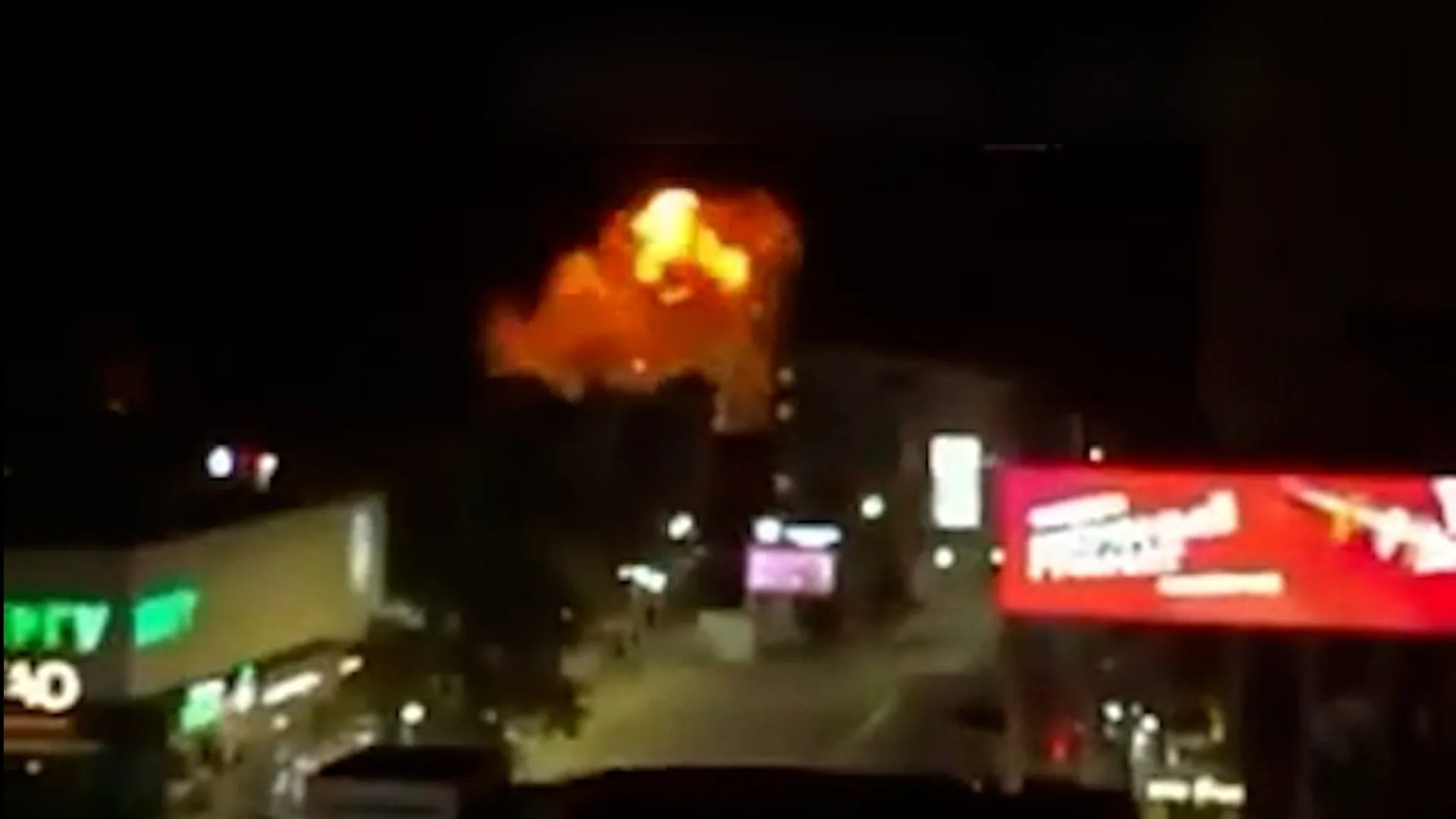
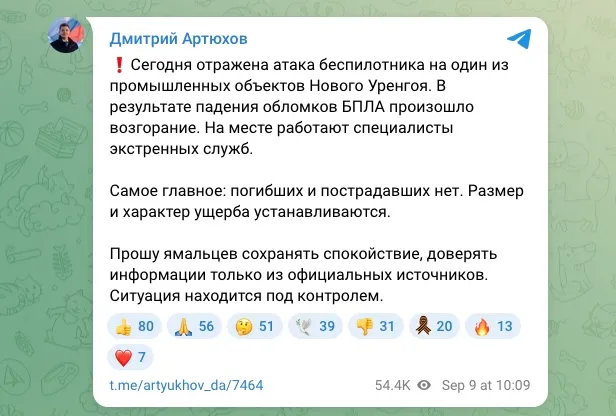
Dmitry Artyukhov, the region’s governor, said the attack targeted an industrial facility in Novy Urengoy. The attack was repelled, but falling debris from the drone caused a fire, he said on Telegram.
“The main thing is that there were no deaths or injuries. The extent and nature of the damage are being determined,” he added.
Artem Zhoga, the Kremlin’s envoy to the Urals, said Wednesday’s strike was the first ever to hit the Arctic part of the region.
Ukraine’s Special Operations Forces (SOF) confirmed the attack in a series of posts on X.
“For the first time! Deepest strike of the war: Ukrainian SOF hit critical russian plants more than 3,000 km away,” it said. “Ukraine’s Special Operations Forces carried out the deepest strike inside russia since the beginning of the full-scale war.”
In the posts, the Ukrainian force claimed it “successfully struck” two gas plants, Novy Urengoy and Purovsky.
“Until today, the area was considered a safe rear zone for the aggressor,” it added.
The Ukrainian force said the facilities play a key role in Russia’s gas industry, processing large volumes of condensate from gas fields across the Yamal region, processing millions of tonnes of condensate per year.
Gazprom used to export gas from Yamal as far as Western Europe until relations broke down following the start of Russia’s war in Ukraine in 2022.
It estimated the region’s gas resources at 26.5 trillion cubic metres as of 2020, enough to cover global demand for more than six years.
Ukraine has escalated its long-range strikes on Russia in recent months, in retaliation for daily Russian bombardment of Ukrainian towns and cities.
Earlier this month, Ukrainian President Volodymyr Zelenskyy said his country’s drones would make Russian airspace “completely unsafe” for the duration of the war.
“Today, an attack by a drone was repelled against one of the industrial facilities in Noyabrsk,” Dmitry Artyukhov, governor of the Yamalo-Nenets Autonomous Okrug, stated on Telegram. “As a result of the drone’s debris falling, a fire broke out. Emergency services specialists are working at the scene. Most importantly: there are no casualties or injuries. The extent and nature of the damage are being determined.”
“I urge residents of Yamal to remain calm and to rely only on information from official sources,” Artyukhov added. “The situation is under control.”
(Dmitry Artyukhov Telegram)
“The criminal Kyiv regime has, for the first time, attacked the Arctic region of the Ural Federal District,” Artem Zhoga, the Presidential Envoy of the Russian Federation to the Ural Federal District, confirmed on Telegram. “As a result of debris from a drone falling on the territory, a fire broke out at a fuel and energy complex facility in the Yamalo-Nenets Autonomous District… The enemy is trying to damage economic facilities in order to sow panic.”
New range record: Ukrainian drones attack Novy Urengoy – nearly 3,000 km from Ukraine.
The facility in Novy Urengoy that processes gas condensate for transport was hit—one of the most important installations in Russia’s gas condensate infrastructure.
The target of the attack was the Novourengoysky Condensate Stabilization Plant (CSP), according to Ukraine’s Armed Forces General Staff, which took credit for the attack.
“On 9th September 2026, units of the Defense Forces of Ukraine struck the Novy Urengoy Gas Condensate Processing Plant in Novy Urengoy, Yamalo-Nenets Autonomous Okrug,” the general staff claimed on X. “The extent of the damage is being assessed.”
The plant has an annual processing capacity of approximately 19.5 million tons, the general staff added.
“It produces stabilized gas condensate, petroleum fractions, diesel fuel and other petroleum products,” the Ukrainian military pointed out. “Its products are used, among other purposes, to meet the needs of the Russian armed forces. Operations against key enemy military targets are ongoing.”
Ukrainian officials did not provide any details about how the strike was carried out.
⚡️⚡️ More than 3,000 km away. Novy Urengoy gas condensate processing plant hit
On 9th September 2026, units of the Defence Forces of Ukraine struck the Novy Urengoy Gas Condensate Processing Plant in Novy Urengoy, Yamalo-Nenets Autonomous Okrug, russian federation.
One video that emerged from the scene showed a column of flames rising in the distance but does not offer much in the way of detail about where the attack took place or the extent of the damage.
Ukrainian drones have for the first time attacked Russia’s largest gas-production hub, almost 3,000 km from the Ukrainian border.
Ukraine struck the Arctic part of the Urals Federal District. A fire started at a fuel-and-energy site.
Another video showed smoke rising in the distance, but again offered little in the way of detail about what happened.
❗️Ukrainian drones attacked Novy Urengoy in Russia for the first time. That’s about 3,200 km from Ukraine!
The Novy Urengoy plant for preparing condensate for transport, located in the Yamalo-Nenets Autonomous Okrug, was the target. It is one of the region’s key gas condensate… pic.twitter.com/KDwOFWicd6
“Novy Urengoy is Russia’s unofficial gas capital, located in the Yamal-Nenets autonomous district in northwestern Siberia,” according to the Moscow Times. Gazprom “estimated the region’s gas resources at 26.5 trillion cubic meters as of 2020, enough to cover global demand for more than six years.”
In Novy Urengoy, Khanty Mansi AD, west Siberia, Russia, long-range Ukrainian drones hit an industrial facility in the city located some 3,000 kilometers (1,800 miles) from the Ukrainian border.https://t.co/bruXXjLYR4
In addition to being the first attack in this region of Russia, this was “the furthest strike since the start of the war,” the Russian Mediazona Telegram channel stated. “Previously, the record for distance was the attack on the Omsk Oil Refinery in July 2026. It is located approximately 2,500 km (about 1,550 miles) from the border in a straight line.”
While the Ukrainian Armed Forces General Staff offered scant details about the strike, officials from the Fire Point weapons company hinted online that one of their drones carried out the attack.
“Guess who traveled over 3300 km (about 2,050 miles) and successfully achieved their goal,” the company stated on a Telegram post that included video of the gas plant attack.
“3200)),” Fire Point’s founder, Denys Shtilierman, teased in an X post with an image of the burning gas plant.
Neither Shtilierman nor the company provided any other details; however Fire Point claims its FP-1 drones can now travel about 2,100 miles (3,400 km) with a 60 kg payload.
Despite Fire Point’s hints, there is no confirmation that the company’s weapons had anything to do with this attack. There is also the chance that it could have been carried out by another system or even from inside Russia. Ukraine has, in the past, relied on proxies to stage attacks deep in Russia. In addition, Ukraine last summer carried out a series of remotely launched drone attacks on Russian strategic aviation. Dubbed Operation Spider Web, it included strikes on the Belaya Air Base, about 3,000 miles from the border.
However, a strike from inside Russia is much less likely than one launched from Ukraine given Fire Point chiming in and the increasing reach of Ukraine’s weapons. We have reached out to Fire Point and Ukrainian officials for comment.
You can see video of the Operation Spider Web attack on Belaya below:
The Novy Urengoy Gas Condensate Processing Plant wasn’t the only site in Russia affected by drone incursions far from the Ukrainian border today.
“A state of emergency has been declared in the Khanty-Mansi Autonomous Okrug due to unmanned aerial vehicle (UAV) activity,” the Russian RIA Novosti news outlet reported on Wednesday. This is located about 1,500 miles from Ukraine.
“Temporary restrictions have been implemented at the airports of Igra, Nyagan, Uray, ‘Sovetsky,’ Surgut, and Khanty-Mansiysk,” the outlet added.
The publication did not report any attacks and Ukraine did not claim any, but video emerged of what appears to be a Fire Point FP-1 drone flying over the area.
While the extent of the damage to the Novourengoysky Condensate Stabilization Plant is unclear at the moment, the attack extends the range of Ukraine’s campaign against Russia’s oil infrastructure.
This summer, Ukraine struck nearly all Russian refineries within range, the Kyiv Post noted.
Russian President Vladimir Putin signed a decree allowing the government to temporarily take control of critical infrastructure if private owners fail to protect it from Ukrainian drone attacks or rebuild it after strikes.
Though Russia is continuing its grinding offensive, the energy infrastructure attacksare clearly taking a major toll. The ability to do so seems to have taken on additional significance in the wake of another round of attempts to end the fighting.
U.S. President Donald Trump’s top envoys, Steve Witkoff and Jared Kushner, recently traveled to both Russia and Ukraine seeking to rekindle peace talks. However, there does not appear to be any immediate resolution in sight.
The expanding range and quantity of Kyiv’s long-range strike arsenal gives Zelensky perhaps his most powerful card to play against Russia’s interest in continuing the war. Ukraine has been improving these weapons by the month and the pace of development of its drones and cruise missiles is rapidly accelerating. The country also has several ballistic missile projects in the works, which will only add to the pressure put on Moscow once operational.
Regardless, earlier this week, Ukrainian President Volodymyr Zelensky said he expects the war with Russia to continue into the winter at the very least. Given that, Kyiv’s campaign against Russia’s energy infrastructure does not seem like it will end anytime soon, either.
Case in point, Ukraine’s long-range drone strikes continued on Wednesday with another attack on Sochi, a Black Sea resort town often frequented by Russian President Vladimir Putin. And, for the second day, drones were visible over Russia’s remote central high-north energy production hub.
KYIV: A Russian drone strike on a shopping centre in the northern Ukrainian city of Sumy killed three people and injured two, Regional Governor Oleh Hryhorov said.
Hryhorov, writing on Telegram, said a fire had broken out, and a photo posted online by the governor showed a badly damaged building and rubble strewn on the ground.
He said rescue teams were tackling the aftermath of the strike.
Sumy and the surrounding region along the Russian border have long been subject to heavy attacks and Moscow has said it wants to establish a buffer zone in the area.
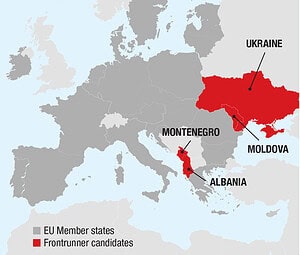
Accession talks accelerate in Brussels as Ukraine, Moldova, Albania, and Montenegro push for faster integration into the EU.
This article appears in the September 2026 issue of Global Finance Magazine.
On July 14, the European Union took its most consequential step toward enlargement in two decades by holding four separate accession conferences in a single day and advancing membership talks with Ukraine, Moldova, Albania, and Montenegro.
European Commissioner for Enlargement Marta Kos (pictured) called it “Super Tuesday.” The EU’s last great expansion, when 10 mostly Central European states joined in 2004, redrew the continent. Bulgaria and Romania joined in 2007, and Croatia in 2013. After that, the bloc shrank when the U.K. left the EU.
A New Geopolitical Calculus
Traditionally, the EU treated enlargement as a distant reward for would-be members rather than as an active geopolitical strategy. But Russia’s invasion of Ukraine, China’s expanding influence, and uncertainty about the U.S. commitment to Europe and NATO have shifted Brussels’ calculus. Rather than an economic transaction in which new participants open their markets in exchange for development funds, membership is now framed as a mutually beneficial bargain over border defense, energy security, and global leverage.
Still, candidates must meet strict reform benchmarks, and none of the new crop are likely to join before 2028. Negotiations cover 35 policy areas, or chapters, grouped into six clusters ranging from fundamentals and rule of law to the green agenda, and all 27 existing members must approve the opening and closing of each chapter: a veto power that has long paralyzed the process.
European Council President António Costa has urged lifting unanimity requirements for early accession stages, but this would require unanimous agreement, the very hurdle it is meant to remove. A proposal floated by French President Emmanuel Macron and German Chancellor Friedrich Merz would partially sidestep this barrier by giving candidates gradual, milestone-based access to the EU single market — covering goods, services, energy and regulatory standards — years before full membership.
Convergence Before Integration
Regardless, economic convergence is already outpacing political integration. Over the past two decades, the Central and Eastern European economies have grown at more than twice the rate of the EU-15, the wealthier Western and Northern European nations that were members before the big Eastern enlargement in 2004.
Some of those newcomers, according to Eurostat data, have since become the bloc’s growth engine. In 2025, the Czech Republic expanded by 2.6%, Latvia by 2.1%, and Lithuania by 2.9%. Poland, the frontrunner, grew by 3.6% and now ranks sixth in the EU by nominal gross domestic product, accounting for 4.9% of its total output, ahead of countries like Sweden, Ireland, and Austria.
It is not just EU officials betting that a second eastward enlargement will strengthen the bloc. Investors have taken notice, too. According to a report by accounting firm Forvis Mazars, mergers and acquisitions in the region hit a record €42.5 billion in 2025, up 36% year-on-year.
Risks loom, however.
Demographic decline, labor shortages, and exposure to geopolitical shocks could undercut the push toward enlargement. Enlargement also carries political costs, including further impeding an already sluggish decision-making process and straining a common budget under pressure from rising defense spending. Ultimately, expansion has come to seem a matter not of if but when. The eastern frontier region is no longer just the EU’s lower-cost manufacturing base, but where the bloc’s defense, industrial policy, and future growth will be decided.
Luca Ventura is a contributing writer based in Italy.
MOSCOW: Russian authorities said Tuesday they have detained a suspect in last week’s shooting that wounded a senior military officer, the latest in a series of attacks on personnel and figures linked to the war in Ukraine.
The Federal Security Service said a 21-year-old Moldovan national was detained for being allegedly “involved in an assassination attempt on a senior military officer of the Russian Defense Ministry” at the behest of Ukrainian intelligence services. He faced charges of attempted murder and illegal arms trafficking, it said.
The officer was shot at least six times on Sept. 3 in the Probuzhdenie settlement on the outskirts of Engels, a city in the Saratov region, said Svetlana Petrenko, a spokeswoman for Russia’s Investigative Committee, which is also involved in the case.
The region is home to a large air force base that hosts Russia’s strategic bombers and has carried out attacks on Ukraine.
The victim, who has not been identified by Russian authorities, survived the shooting and remains hospitalized.
The FSB alleged that the suspect was recruited by Ukrainian intelligence services in 2025 and arrived in Russia in June. He was detained in the southern Astrakhan region as he was trying to leave the country and return to Moldova, the agency said.
Petrenko said he was allegedly offered $70,000 for carrying out the attack.
There was no immediate comment from either Ukrainian or Moldovan officials. Ukrainian President Volodymyr Zelensky alluded to the attack on the day it happened, saying: “Wherever Russian criminals hide, they will be found, and today there is further confirmation of this fact – confirmation in the Saratov region.”
Last week’s attack follows a series of bombings in Russia targeting people involved in the 2022 full-scale invasion of Ukraine. Moscow has blamed Kyiv for some of the blasts.
In late August, a serviceman was killed and his wife was injured by a car bomb on the outskirts of St. Petersburg. Three weeks before that, the director of a factory supplying drones to the Russian military was badly injured and his driver was killed when their car exploded just outside Yekaterinburg, 1,400 kilometers (about 870 miles) east of Moscow.
In those cases, the authorities did not immediately say who they believed carried out the attacks.
Earlier this year, President Vladimir Putin directed the FSB and other agencies to tighten security around military and government officials.
Kyiv has claimed responsibility for some attacks inside Russia. Ukraine’s SBU security service said in 2024 that it had organized the killing of Lt. Gen. Igor Kirillov, who headed the Russian military’s nuclear, biological and chemical protection forces.
Kirillov was killed by a bomb hidden in a scooter outside his apartment building in Moscow, a day after Ukraine’s security service leveled criminal charges against him.

![France's President Emmanuel Macron meets with Ukraine's President Volodymyr Zelenskyy on the sidelines of the United Nations General Assembly in New York City on September 21, 2026 [Ludovic Marin/AFP]](https://i0.wp.com/www.aljazeera.com/wp-content/uploads/2026/09/AFP__20260922__C8XY4MU__v1__HighRes__UsFranceUkrainePoliticsDiplomacy-1790058813.jpg?w=640&ssl=1)