It was a game eight years in the making. The first World Cup match on American soil in more than a generation and the start of a tournament that has the potential to alter the direction of soccer in this country for the next generation.
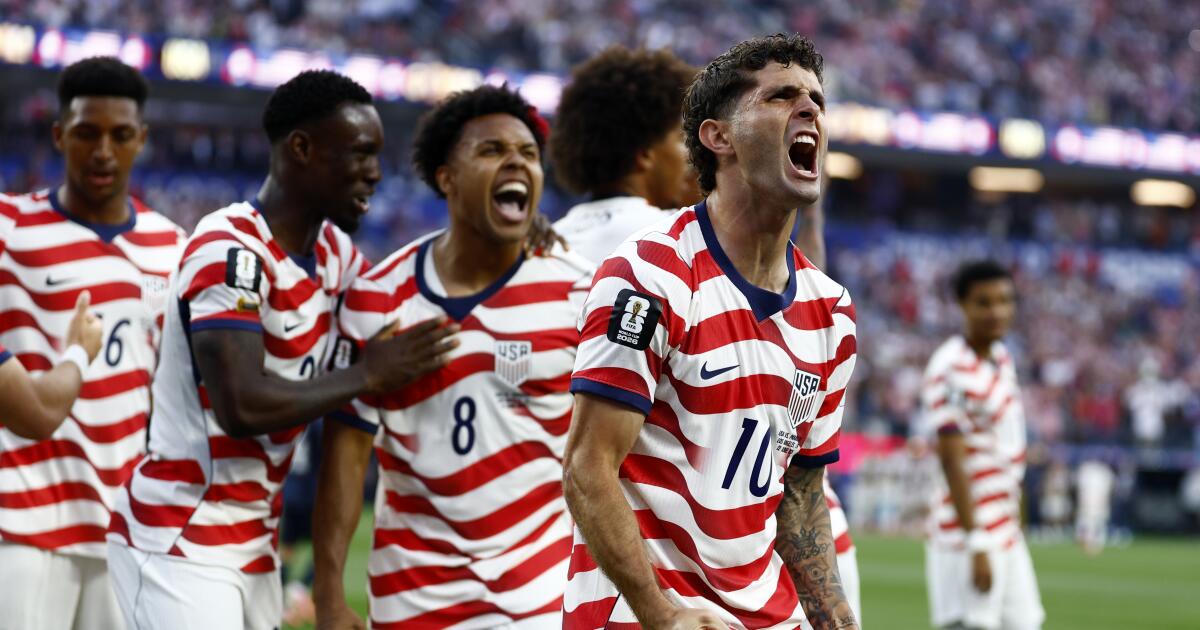
And the U.S. seized on every bit of that opportunity Friday, with Christian Pulisic setting up two goals and Folarin Balogun scoring twice in his World Cup debut, sparking an impressive 4-1 victory over Paraguay in a game that was far more one-sided than the score indicated.
The U.S., which needed a big effort to start the tournament, was on the front foot from the start, going in front to stay in the seventh minute — although it was Paraguayan midfielder Damián Bobadilla who got credit for the goal after stepping in front of Balogun and deflecting in a cross from Weston McKennie.
Pulisic, the American star who is under intense pressure to perform in this tournament, set up the goal, pushing the ball between a pair of defenders before poking it on for McKennie in the center of the box. Bobadilla then did the rest, inadvertently sticking his right foot in front of the ball and bouncing it by Paraguayan keeper Orlando Gil.
Balogun appeared to double the lead coming out of the hydration break midway through the opening half, but the goal was negated by an offside call. That only delayed the second goal, however, with Balogun making it 2-0 by one-timing in a perfect feed from Pulisic from the penalty spot in the 31st minute.
Balogun added to the U.S. advantage just before the intermission, running on to a perfectly weighted through ball from Malik Tillman, stepping through a challenge from Omar Alderete entering the penalty area and turning around Paraguayan captain Gustavo Gómez before left-footing a shot into the top left corner to complete his first brace for the national team.
Gil was just a spectator on the play, with no chance to best the save. The goal marked the first time Paraguay had given up three scores in a World Cup game — much less one half — since 2002 and it came at the end of what was arguably the best opening 45 minutes a U.S. team has played in the tournament in decades.
Gio Reyna scored the fourth U.S. goal on the final play of the game.
Pulisic left in favor of Sebastian Berhalter to start the second but the U.S. continued to dominate in every way it was possible to dominate, controlling the ball for nearly 60 of the 90 minutes and completing more than twice as many passes. Paraguay’s first shot on goal didn’t come until the 73rd minute when Mauricio, a halftime substitute, took advantage of a slow-reacting U.S. defense to pull a goal back.
U.S. coach Mauricio Pochettino also got a solid game out of center back Chris Richards, playing for the first time since tearing two ligaments in his left ankle a month ago.
The Americans will face Australia in the second of three group-stage games next Friday in Seattle, where a draw will all but guarantee them a spot in the round-of-32, something Pulisic said should be just the first objective for this team.
This World Cup is the largest and most ambitious sporting event in history, with three host countries — Canada and Mexico, in addition to the U.S. — and a record 48 teams playing 104 games in 16 cities spread across four time zones. A long run by the American team, playing on home soil, could excite a nation and give soccer the kind of boost it hasn’t seen since 1994, the last time a World Cup was played here.
It could also change the narrative of a tournament whose run-up was clouded by outrageously high ticket prices, travel bans, the threat of ICE raids at tournament venues and the war in the Middle East, the first to pit a World Cup host against a World Cup qualifier.
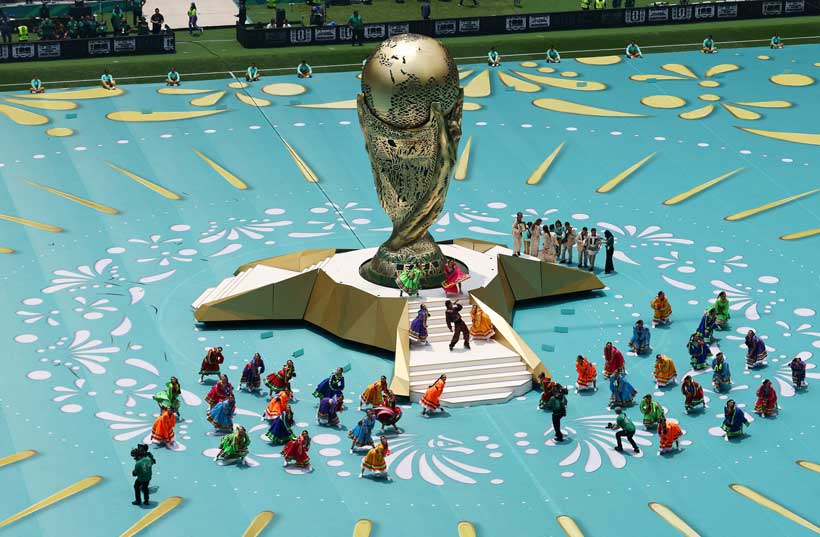
And the U.S. portion of that tournament opened with pomp despite those circumstances, with Thai pop star Lisa, Nigerian recording artist Rema and Brazilian singer Anitta headlining a 10-minute mini concert staged before a massive replica of the World Cup trophy set over a blue map of the U.S. Katy Perry mounted a stage of her own an hour later to debut her song “Wonder” as the flags of the 48 participating countries circled around her.
President Trump did not attend the game, just as Mexican president Claudia Sheinbaum skipped her country’s opener Thursday in Mexico City and prime minister Mark Carney missed Canada’s first game Friday in Toronto. Secretary of State Marco Rubio took Trump’s place in the Hollywood-heavy crowd of 70,492 that packed SoFi Stadium, one which included Tom Cruise, David and Victoria Beckham, Halle Berry, Rob Lowe, Becky G, Jaime Foxx, Paris Hilton, Bill Gates, Justin Trudeau and Kareem Abdul-Jabbar.
That crowd was a sea of blue and red — the U.S. and Paraguay share the same colors — but the cheering was primarily for the Americans since Paraguay rarely mounted a threat.
Chinese media and think tanks view the United States’ hosting of the FIFA World Cup from a purely geopolitical, economic, and commercial perspective, critically assessing the infrastructure and political climate. Chinese circles see the tournament not merely as a sporting event but as a central tool for the United States to polish its image, bolster its global leadership amidst current international polarization, and advance its political agenda. This perspective is highlighted through several key points, the most important being the geopolitical dimension. Here, Chinese think tanks argue that the tournament reflects the level of competition between major powers, with Washington attempting to use hosting as a soft power tool to project its influence. However, Chinese media, in turn, emphasized the state of sharp international polarization and division, criticizing the political challenges and the wrangling that accompanied the broadcasting negotiations. Furthermore, a number of (commercial considerations) have been raised, with the tournament facing criticism from Chinese media due to its exorbitant cost and the significant time difference between North America and China, leading to a decline in Chinese public interest. This hesitation was reflected in the negotiations, as FIFA incurred financial losses after China Media Group (CMG) signed the broadcasting agreement late and at a price significantly lower than FIFA’s requested.
Regarding the (organizational and policy challenges), Chinese research and media institutions expressed reservations about the tournament’s logistical challenges, particularly the longer travel distances between host cities compared to previous editions, as well as concerns related to US immigration laws and security restrictions. Despite the absence of the Chinese national team from the tournament, China’s commercial involvement was substantial. Beijing demonstrated its active presence through Chinese commercial sponsors, such as Hisense, and sporting goods factories in eastern China, which reaped significant economic benefits from manufacturing tournament flags and souvenirs. Chinese media coverage, particularly through its official channels, was extensive. CGTN, the Chinese state broadcaster, developed comprehensive plans to broadcast and cover the matches, ensuring the event reached millions of Chinese fans across its various platforms.
Furthermore, Chinese state media and intelligence and military think tanks utilized Washington’s hosting of the FIFA World Cup to offer a number of strategic, media, and intellectual analyses regarding China’s calculations in response to American actions. Major events are often used as a primary arena for geopolitical competition between the two superpowers. Beijing’s vision can be summarized by its use of major sporting, cultural, and other events as a political tool. Beijing views Washington’s hosting of major international tournaments or events as more than just sporting or cultural occasions; it sees them as an extension of American information and decision-making strategies aimed at projecting American influence and hegemony globally. While China seeks to highlight international contradictions, Beijing has directed its media apparatus to demonstrate that Washington’s attempts to unilaterally assume leadership or project messages of unity are, in reality, met with sharp division and polarization within the international system. Here, China has attempted to counter American soft power. This media coverage of the FIFA World Cup in the United States reflects a continuous Chinese effort to neutralize Western and American soft power by focusing on structural issues in international relations, such as the absence of multipolarity, and by promoting the Chinese model as an alternative striving for a more balanced world.
In this context, Chinese media and think tanks view the United States’ hosting of the World Cup through the lens of soft power, geopolitical strategies, and trade, while sharply criticizing the infrastructure and political circumstances surrounding the tournament, particularly in the aftermath of the Iran War and a number of global geopolitical upheavals stemming from US policies. Chinese analyses focus on purely commercial interests, criticizing the exorbitant costs of broadcasting rights. Conversely, they highlight the role of leading Chinese companies in profiting from the event by providing innovative and advanced broadcasting technologies and exporting merchandise and fan supplies. However, they also offer several critical observations regarding the infrastructure and political climate. Chinese research centers express critical skepticism about the readiness of US cities, suggesting that complexities related to visa requirements and a strict security and political environment could hinder fans and undermine the freedom of movement necessary for such events.
Based on the preceding understanding and analysis, we can discern the perspective of Chinese media and research centers that the United States exploits hosting international sporting and political events as a prominent tool for employing sports to enhance American soft power, attempting to project influence to manage conflict, and solidifying its leadership of the global order. Therefore, Chinese think tanks and intelligence agencies have developed a comprehensive media and research plan to expose American polarization worldwide. Conversely, Chinese media and think tanks emphasize Washington’s failure to garner international consensus, highlighting the sharp division and widening gap between Western powers and the rising powers of the Global South. This underscores the mechanism of conflict transformation, where competition is no longer limited to the economic and military spheres but has expanded significantly to encompass soft power tools and media discourse. This reflects a picture of expanded strategic competition and its impact on international stability.
Earlier Friday, Downdetector showed more than 100,000 people were having problems logging in to Facebook as of 10 a.m. EDT. It also showed more than 9,000 users reporting problems with Instagram and nearly 20,000 with Facebook Messenger.
Some users confirmed in the comments on Downdetector that they were experiencing issues with these platforms, noting that they were “automatically logged out,” “Can’t log in,” or were receiving an “Unknown error.”
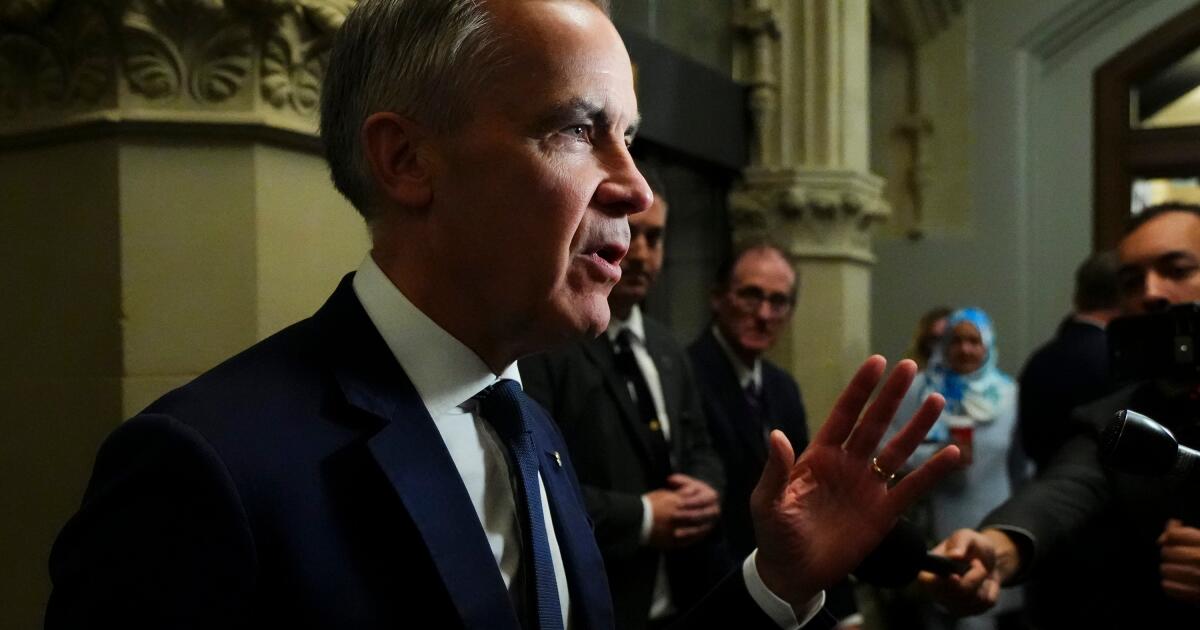
PARIS — Canadian Prime Minister Mark Carney became a symbol of middle power resistance after a celebrated speech earlier this year, but he is expected to be more muted in his criticism of President Trump at an upcoming summit in Europe.
Carney’s speech at the World Economic Forum in Davos, Switzerland, helped make him an international political star in January, when he declared the global rules-based order over and condemned coercion by great powers on smaller countries. The prime minister received widespread praise and attention for his remarks and upstaged Trump at the gathering.
But the G7 summit of industrialized democracies that begins Monday in France comes ahead of the scheduled July 1 review of the United States-Mexico-Canada Agreement, or USMCA, the latest iteration of the North American free-trade pact that has intertwined the economies of the United States, Mexico and Canada since the early 1990s. It is a crucial moment in trade talks, and Trump said this week that he may not renew the deal.
More than 70% of Canada’s exports go to the U.S., so preserving the accord is critical for Canada.
Canadian historian Robert Bothwell said Trump is more of a problem for Carney “than anybody else because we are more exposed to the United States than anybody else.”
Trump leaves for the G7 summit right after he hosts UFC fights at the White House on Sunday for his 80th birthday.
The summit will unfold as tensions are ramping up between Trump and Canada. One of the world’s most durable and amicable alliances — born of geography, heritage and centuries of common interests — is broken, as seen in several recent examples of tension between leaders.
Ontario Premier Doug Ford, the leader of Canada’s most populous province, had a reception with the U.S. Chamber of Commerce in Washington canceled Monday at the last minute. Vic Fedeli, one of Ford’s ministers, said if Trump forced the chamber to cancel, “Ford should be wearing that as a badge of honor.”
Trump said again this week that the U.S. doesn’t need anything that Canada has. Carney has set a goal for Canada to double its non-U.S. exports in the next decade, saying Trump’s trade war is causing a chill in investment.
In other developments, the opening of a major Canadian bridge across the Detroit River that Trump previously threatened to block was delayed Thursday due to unresolved issues.
Trump’s actions, including launching a trade war and suggesting Canada become the 51st U.S. state, have infuriated Canadians and created the political environment for Carney to win the job of prime minister after promising to confront Trump.
Trump administration officials keep noting that only two countries, China and Canada, retaliated against America in the trade war. U.S. Trade Representative Jamieson Greer says Canada’s retaliatory measures are a major issue in talks.
Daniel Béland, a political science professor at McGill University in Montreal, said Carney seems to have moderated his tone toward the Trump administration to avoid worsening relations.
“There is a clear tension between what Prime Minister Carney said in his Davos speech about middle powers standing up to hegemons and his attempt to nudge the U.S. administration ‘in the right direction’ with regard to the USMCA review and trade policy more generally,” Béland said.
Carney has downplayed Trump’s most recent comments about Canada becoming the 51st state.
Canada and Mexico want the USMCA to be renewed for another 16 years. Trump has mused about withdrawing from it. More likely it will be subject to annual reviews for the next 10 years.
Carney arrived in Paris on Friday morning and will meet with French President Emmanuel Macron in the evening, a few days before the summit in Évian-les-Bains, France.
The prime minister will also travel to Ireland this weekend to meet with the Irish prime minister in a bid to diversify trade away from the U.S.
This is Carney’s ninth trip to Europe in the 15 months since he became prime minister in March 2025.
The U.S. “will clearly remain Canada’s largest trading partner for the predictable future,” Béland said, calling it an inescapable reality that Carney “must keep front of mind even as he seeks to make Canada somewhat less dependent on trade with the U.S.”
June 12 (UPI) —SpaceX began trading Friday at $150 and has gone as high as $176 as SPCX in its initial public offering, the largest one in history.
Elon Musk and SpaceX President and COO Gwynne Shotwell rang the opening bell Friday. Musk was in Texas and Shotwell was at the Nasdaq in New York City.
After trading opened, the stock topped $160, sending the company to more than a $2 trillion market cap. By early afternoon, the stock was at $176.52.
“I love the incredible people of SpaceX beyond words,” Musk wrote Friday afternoon on X.
The company had traded more than 360 million shares as of 2 p.m. EDT Friday. It has more than 172 million shares on the Nasdaq alone, CNBC reported. Polymarket bettors believe, at 70%, that SpaceX will close at more than $2 trillion Friday. Five other U.S. companies have reached the $2 trillion market cap: Nvidia, Apple, Alphabet, Microsoft and Amazon.
Already a trillionaire, Musk is about to be CEO of two of the Top 10 most valuable publicly traded companies at the same time.
Musk said before the IPO that SpaceX had been cash-flow positive since around 2015, CNBC reported. He said he chose to take the company public now to raise capital for “a significant growth phase.” Some plans for that growth include putting more than 100,000 satellites in orbit for communications and building artificial intelligence data centers in space.
“Having a private company was important to us early on because we weren’t really focused on quarterly financials, we were so focused on the long-term outlook for the company,” Shotwell told CNBC in an interview.
Shotwell said interest from investors also helped drive the decision.
“We’ve been feeling, over the last few years, a lot of pressure from everyday Americans and our friends that wanted to buy stock, and there was just no way for these folks to get in,” Shotwell said.
According to its prospectus, SpaceX has had a total loss of $41.3 billion since it was founded in 2002. Originally founded as a maker of reusable rockets, the only profitable part of the business has been the Starlink satellite Internet service.
In February, SpaceX acquired Musk’s startup xAI, which has been embattled this year for its ability to undress people in AI-generated images. Several countries and people have sued the company to force it to not allow the bot to do so against the victims’ will.
Citadel Securities, which helps execute trade orders, processed more retail activity for SpaceX than any other IPO auction on record, CNN reported the company said. Retail investors are regular people trading stocks instead of professionals.
June 12 (UPI) — A federal judge blocked a lawsuit by Texas Attorney General Ken Paxton against Democratic fundraising platform ActBlue.
In a 15-page ruling, U.S. District Judge Richard Stearns granted ActBlue a preliminary injunction banning Paxton from continuing the litigation, finding that ActBlue was likely to win in its claims that the suit infringed on its First Amendment’s free-speech protections.
The judge said the suit was filed in retaliation of ActBlue raising funds for James Talarico, who is running for Senate against Paxton.
“The lawsuit in Texas is undoubtedly an adverse action,” Stearns wrote in the order. “And having previously found bad faith, the court agrees with ActBlue that the evidence in the record compels the conclusion that, far from protecting Texas consumers, the action was filed in retaliation for ActBlue’s fundraising on behalf of Talarico, Paxton’s current political rival for the Senate seat.”
Paxton began an investigation in 2023 against the organization for allegedly enabling international donors to make gifts through gift cards and prepaid debit cards. President Donald Trump requested the investigation before he was re-elected. Paxton filed suit in April.
“The truth is plain and captured in Paxton’s own declarations: The lawsuit was filed in retaliation for (and in an attempt to suppress) ActBlue’s efforts to fund [James] Talarico’s campaign,” Stearns ruled.
ActBlue sued in Boston to stop Paxton, claiming Paxton’s suit was “rife with false and inflammatory allegations” and was filed soon after a $2 million funding day for Talarico. ActBlue is based in Massachusetts.
“Paxton’s public statements in the wake of filing the case against ActBlue reveal his true motivation,” Stearns wrote. “While a prosecutor is entitled to a large degree of prosecutorial discretion and has a right to make a considered public accounting of his actions, Paxton did not hesitate in drawing a connection between the lawsuit and his candidacy for Senate.”
Paxton had alleged that ActBlue had misrepresented itself to donors.
“The platform does nothing more than facilitate political donations from private donors, who seek out its convenience, anonymity and aggregation of the benefit bestowed on chosen political candidates,” Stearns ruled.
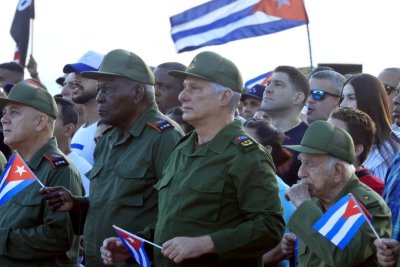
Cuban President Miguel Diaz-Canel (C) attends an event in support of former Cuban President Raul Castro in Havana on May 22 after the U.S. Department of Justice unsealed two days earlier a federal criminal indictment charging the 94-year-old Castro, along with five other co-defendants, for his alleged role in the February 1996 shoot-down of two unarmed U.S. civilian aircraft operated by a Cuban exile relief group. Photo by Ernesto Mastrascusa/EPA
June 12 (UPI) — Cuba’s government on Friday announced a broad package of economic reforms aimed at restructuring key aspects of the country’s economic model, just hours after the United States imposed a full financial blockade on state oil company Unión Cuba-Petróleo, or CUPET.
Speaking on state television, Cuban President Miguel Díaz-Canel defended the shift toward decentralization, saying that “these are times when change is necessary.”
The measures are part of the government’s 2026 Economic and Social Program, a roadmap inspired by the economic models of China and Vietnam. Havana says the plan is intended to address the island’s deep economic crisis, high inflation and widespread shortages of goods and services.
| En declaraciones a la prensa, el Presidente @DiazCanelB informó sobre nuevas medidas que estará tomando el país próximamente para dinamizar la economía cubana, en medio del recrudecimiento sin precedentes del #bloqueo de los Estados Unidos a la Isla.https://t.co/72AGrGjMKj— Presidencia Cuba (@PresidenciaCuba) June 12, 2026
The reforms came only hours after U.S. Secretary of State Marco Rubioannounced on X sanctions against CUPET, freezing all of the company’s assets under U.S. jurisdiction and prohibiting commercial transactions with it.
Rubio said that “Cuba’s communist elites have turned energy into a tool of social control and profit,” accusing the government of hoarding fuel supplies for its own benefit and using them to repress the Cuban people.
“President Donald Trump wants a new future for the Cuban people with greater freedom and opportunity,” Rubio wrote.
The secretary of state said the sanctions were justified because CUPET operates assets that were allegedly confiscated from U.S. owners decades ago. Washington also warned that foreign companies continuing to do business with the state oil company could face secondary sanctions.
Cuba announced the measures two days after the Miami Herald reported on a proposed commercial agreement between Florida-based Vanguard Energy and Cuban agencies to deliver 250,000 barrels of gasoline and diesel fuel intended exclusively for Cuba’s private sector, small and medium-sized enterprises and humanitarian organizations.
The arrangement included a five-year lease of state-owned storage tanks operated by CUPET. Under the proposal, Vanguard would retain ownership of the fuel to prevent it from being diverted to the Cuban government and would operate outside the island’s banking system.
However, within hours of the agreement becoming public, the U.S. State Department halted the shipment, saying the company did not possess a specific license authorizing the transaction and reaffirming that the Trump administration’s sanctions against Cuba remain fully in force.
Despite the tightening U.S. restrictions, Díaz-Canel rejected suggestions that the reforms were a response to pressure from Washington, describing them as a necessary internal restructuring effort.
The economic plan centers on decentralization and greater openness to investment. Municipal governments and state-owned companies will receive expanded authority over imports, exports and foreign currency management in an effort to reduce bureaucratic obstacles.
The government also plans to ease restrictions on private small and medium-sized businesses, open financial investment opportunities for Cubans living abroad and allow foreign companies to lease agricultural land to boost food production.
To support the reforms, Havana plans a significant reduction of the central bureaucracy, cutting the number of government ministries to 20 from 27 through mergers and eliminations.
Díaz-Canel said Cuba must move toward “new models and new actors” capable of making use of existing infrastructure, acknowledging that sectors such as tourism have been hurt by U.S. sanctions.
“We cannot focus only on the large international hotel chains when many of them, because of pressure from the United States government, have left the country,” he said. “We are developing real estate and tourism projects with new models and other actors that have not traditionally participated in these sectors.”
On energy policy, Díaz-Canel said Cuba would continue shifting toward solar power and renewable energy sources.
“We are going to eliminate, as much as possible, the restrictions that exist on vehicle imports,” he said. “We will continue prioritizing, through tariffs and pricing policies, the importation of electric vehicles powered by solar energy.”
Recent U.S. measures against Cuba have significantly tightened the decades-old embargo through Executive Order 14404 and additional restrictions targeting the energy sector, including CUPET. The sanctions also affect senior government officials, their relatives and military-linked entities.
Washington says the measures are intended to cut off revenue to the Cuban government, encourage political change and punish human rights abuses.
Cuban authorities argue that the restrictions have worsened an already severe economic crisis marked by chronic shortages and power outages that have lasted more than 48 hours in some parts of the island.
International organizations, including the United Nations, have warned about the humanitarian impact on the civilian population.
WASHINGTON — A year after the Trump administration kicked off its aggressive immigration enforcement tour with military-style raids across greater Los Angeles, federal officials have veered toward a less flashy but broader strategy: making immigrants’ lives harder so they will leave.
The changes range in scale and scope, from disqualifying immigrants from certain jobs to indefinitely pausing the processing of visa applications. They target those lawfully present as well as the undocumented.
Since President Trump’s second term began, the administration has used executive orders and federal regulations to chip away at services or benefits, such as work permits and small business loans, that immigrants could obtain in the past.
Now, immigrants are finding that freedoms — the ones that once made the U.S. a desirable place to start over — are disappearing. Many are retreating back into the shadows as they fear previously routine tasks, such as traveling across states, filing taxes and seeking medical care.
“The priority is to force people to leave the country or not come, regardless of legal status or really any other criteria,” said David Bier, immigration studies director at the Libertarian think tank the Cato Institute. “They’re taking a sledgehammer to the system.”
Trump won the White House in part on his promise to clamp down on illegal immigration, but recent polling shows support for his agenda has waned, especially after immigration agents shot and killed two U.S. citizens in Minneapolis.
In a statement, White House spokesperson Abigail Jackson said Trump’s highest priority has always been the deportation of immigrants with criminal records. The Department of Homeland Security said Trump also prioritizes immigration that strengthens the country financially, socially and culturally.
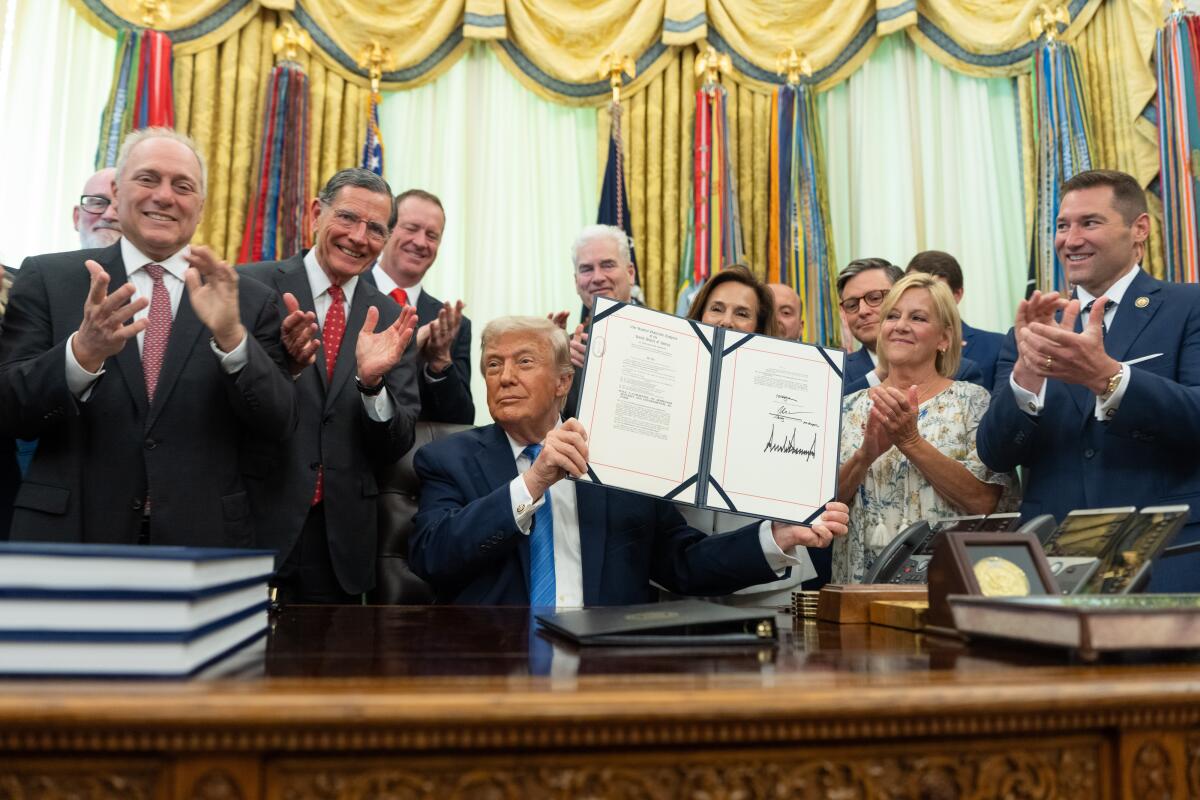
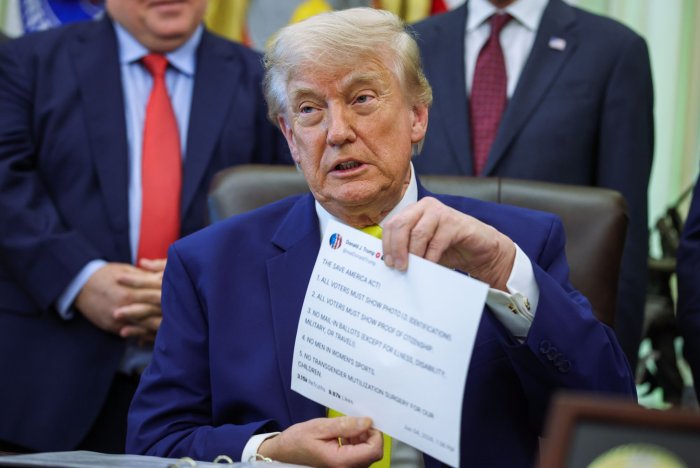
President Trump displays the signed “Secure America Act” during a ceremony in the Oval Office on Wednesday. The act provides $70 billion for immigration enforcement and border-security agencies.
(Aaron Schwartz / CNP, Bloomberg)
The number of arrests by ICE agents has declined. On average, ICE arrested about 1,000 immigrants per day in early March, down from a peak average of just under 1,400 in mid-January, agency data show. And there are fewer detained immigrants — facilities across the country held about 60,000 detainees in April, compared to more than 70,000 in late January.
The downturns prompted some Trump loyalists to say the administration is failing to fulfill his signature promise, which is an assertion the administration rejects.
“ICE is NOT slowing down,” said Homeland Security spokesperson Lauren Bis. “Since Day One, DHS law enforcement has been delivering on President Trump’s promise to the American people to arrest and deport criminal illegal aliens.”
At a border security conference last month, Tom Homan, who leads border policy for the White House, suggested immigration agents would return to more muscular enforcement tactics.
“You ain’t seen s— yet,” he told the audience.
But along with focusing on deportations, the administration is deploying other tactics to deter illegal — and legal —immigration.
ICE agents confront protesters on June 8 as they gather outside the federal immigration center at Delaney Hall in Newark, New Jersey, where ICE is housing detained immigrants.
(Spencer Platt / Getty Images)
Curtailing visas
Last month, the Department of Homeland Security announced that “except in extraordinary circumstances,” immigrants seeking lawful permanent residency must leave the U.S. to complete the process. After a backlash, the administration defended the policy, saying it won’t prevent anyone who qualifies for a green card from getting one.
U.S. Citizenship and Immigration Services, the agency in charge of processing immigration benefits, has upped security screening since Trump took office. The agency says that’s to root out fraud, but critics say all it does is unnecessarily slow down a system that already vets applicants vigorously.
The administration indefinitely banned people from 75 countries from receiving immigrant visas, which allow people to move permanently to the U.S.
In a similar move, the government halted the processing of immigration applications for people from 39 countries and who are already in the U.S. On June 5, a federal judge struck down the policy in a scathing ruling that said the administration “justifies its actions with pretextual concerns of ‘national security’ that mask anti-immigrant sentiments.”
Children of Guatemalan origin, from left, Areimy, Mariela and Enrique, arrive at Miami International Airport on Dec. 4, 2025, as they prepare to leave the United States to reunite with their recently deported parents in Guatemala.
(Chandan Khanna / AFP via Getty Images)
The judge’s ruling may offer relief, but for many immigrants, the effects of the policy are devastating. Armin, a 42-year-old from Iran, said he has racked up more than $15,000 in debt since the pause took effect in December. Armin asked The Times not to fully identify for fear of jeopardizing his immigration case.
The nutritional scientist came to the U.S. in 2019 on a student visa and has a pending green card application under a provision that allows certain highly skilled immigrants to apply for permanent residency without needing an employer to sponsor them.
After receiving his PhD and completing a postdoctoral program, Armin was in between jobs when he received a research grant in November. But with the processing of his work authorization halted, the university that issued the grant said it couldn’t hire him as a research associate. In February, he was turned down for another job.
Armin said he is confused about why the administration won’t differentiate between legal immigrants and those who should be deported.
“I can’t believe it,” he said. “I’m doing research and my research has national interest benefits. You expect support from the government. Unfortunately they don’t differentiate. They don’t care about your resume.”
Bier said the visa policies affect half of all legal immigrants coming from abroad. He published a report in April about how Trump has cut legal immigration far more than illegal immigration, noting that the administration’s policies have led to big drops in visas for international students, high-skilled workers and refugees.
“The legal immigration system is being used as a means to carry out the mass deportation agenda,” he said.
Alessandro Negrete, who lived most of his life in the U.S. undocumented, crosses into Mexico after deciding to leave.
(Robert Gauthier / Los Angeles Times)
Encouraging self-deportation
More than 90,000 immigrants have been granted voluntary departure since the start of the Trump administration, according to federal immigration court data through April that was analyzed by TRAC, a data research organization. Voluntary departure avoids official deportation and can leave open the possibility of an immigrant returning to the U.S. legally.
Homan, who declined to be interviewed for this story, has said self-deportations were part of the administration’s immigration plan all along.
“We knew if we surged unlimited ICE resources in the interior, and we do these operations, that that will force those that are here illegally to leave on their own,” he recently told the Washington Examiner.
Halting work permits
In the past, asylum seekers and others with deportation protections have had the ability to seek permits to work legally in the U.S. But work is now an administration target.
One proposed regulation would prevent asylum seekers from working legally in the U.S. Another proposal, published Friday, would further restrict access to work permits for other immigrants.
Under a rule that took effect last month, asylum seekers pay an annual $102 fee within 30 days of receiving a notice from U.S. Citizenship and Immigration Services. If the deadline is missed, their applications will be rejected — with no opportunity to appeal — and they could be placed in deportation proceedings. Those who apply for asylum with the agency have entered the U.S. legally, such as on a visa, and are not undocumented.
Asylum seekers rest at a Tijuana migrant shelter a day after President Trump began his second term in the White House.
(Robert Gauthier/Los Angeles Times)
Conchita Cruz, co-executive director of the Asylum Seeker Advocacy Project, said many asylum applicants have not received notice that the fee is due.
Cruz said she believes the Trump administration is using these changes as an excuse to dismiss people’s asylum claims. While the president has the power to decide whether to offer or rescind humanitarian programs, such as Temporary Protected Status, the right to seek asylum is enshrined in law.
“We’re worried this is a pretext for people to fall out of the asylum system and fall out of the workforce,” she said.
The processing of work permits has already been slowed, leaving many immigrants who still qualify for employment authorization unable to work.
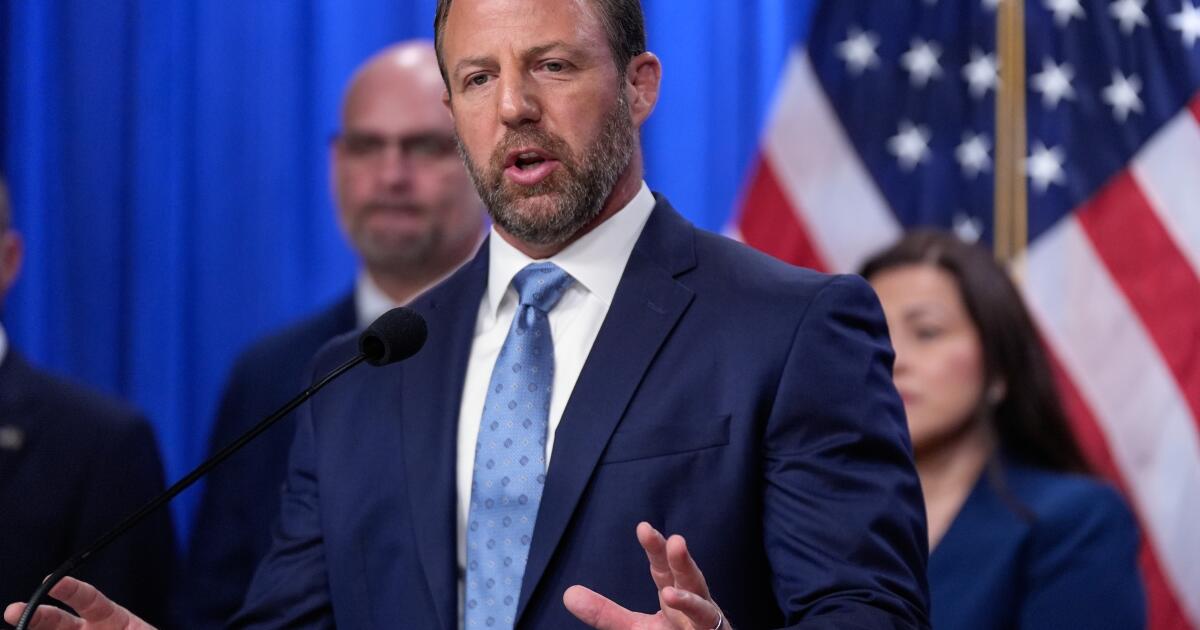
During a House Homeland Security Committee hearing last week, Rep. Lou Correa (D-Santa Ana) asked Homeland Security Secretary Markwayne Mullin to help him speed up the work permit renewals for two police officers who were recently fired by agencies in his district because their DACA status expired.
Mullin said he would help but that Congress ultimately must pass a permanent solution for DACA recipients.
“These are police officers on Main Street, sir,” Correa responded.
“Not all of them are,” Mullin said. “I’m not just going to wave a magic wand and fix them all.”
“You have that magic wand — that’s your job,” Correa said.
It wasn’t just Democrats complaining about slow processing. Rep. Gabe Evans (R-Colo.) similarly asked Mullin for help because many of his constituents — “farm workers, youth ministers, nurses, grocery store business managers” — who have lived and worked in the U.S. legally for decades are now having trouble renewing their visas.
Secretary of Homeland Security Markwayne Mullin, left, and President Trump, center, walk to the motorcade after exiting Air Force One at Joint Base Andrews, Maryland, on May 20.
(Kent Nishimura / AFP via Getty Images)
Calls for mass deportations
Mullin, who took the reins in March after Trump fired his predecessor, Kristi Noem, rolled back some of Noem’s policies, including telling agents to stop entering homes without judicial warrants and canceling some contracts she had initiated.
But the changes and the downturn in arrests have drawn criticism from some fervent Trump supporters.
“Trump’s legacy is tied up in this,” said Mike Howell, a former DHS attorney who founded a group called the Mass Deportation Coalition. “It’s going to be hard to tell a younger voter to get excited to show up when one of their top issues is mass deportation and, a year and a half in, it doesn’t appear it’s going full-steam ahead.”
Howell said enforcement at work sites is critical to scaling up arrests and deportations. That more such operations haven’t happened, he said, is a political decision to appease wealthy donors and special interest groups who don’t want to see their workers deported.
The architect of Trump’s immigration agenda is Stephen Miller, a top White House aid who has called for a “moratorium on immigration from third-world countries,” demanded 3,000 arrests per day and said that immigrants and their descendants “recreate the conditions, and the terrors, of their broken homelands.”
Royce Bernstein Murray, a former Homeland Security official who worked on immigration policy under the Biden administration, said the winding down of flashy enforcement surges has given the administration more time to “focus on tearing down the legal immigration system.”
“This is Stephen Miller’s sweet spot,” she said. “He was never in enforcement — he’s a policy guy. This is really an opportunity for him to make good on all he has planned for years.”
While ICE has, in recent months, returned to its more conventional targeted enforcement tactics, Homan has sought to make clear that mass deportations are still a goal.
“For the people out there saying ‘President Trump’s getting weak on mass deportation,’ you don’t know what the hell you’re talking about,” Homan said at the border expo.
On Monday, Homan told Fox News that he had just reviewed plans for an ICE operation that would surge agents to New York City.
One man was killed as tornadoes touched down accross the midwest. Image courtesy of UPI
June 12 (UPI) — Multiple tornadoes caused severe damage across several midwestern states Thursday evening.
A 54-year-old man was killed in a homeless encampment in a park Wednesday in Des Moines, Iowa, after he was hit by a tree that “broke apart and fell during strong storms,” police said in a statement. They found the man injured, and he died on the scene, CBS News reported.
There have been no other official reports of injuries.
As of Friday morning, nearly 500,000 customers were without power in Illinois, Indiana, Wisconsin and Michigan.
Some of the hardest-hit areas are just south of Chicago in Kouts and Merrillville, Ind., and Bartlett, Naperville, Streator and Dwight, Ill.
A tornado hit Streator at 5:52 p.m. CDT Thursday, and another was reported in Dwight just after 6:15 p.m. The system had traveled east to Lake and Porter counties in Indiana around 7 p.m.
Streator Mayor Tara Bedei said there have been no deaths reported in the city.
“We are incredibly grateful for the safety of our residents and the quick action of emergency personnel,” she said in a statement.
An animal shelter in Springfield, Ill., suffered heavy damage to two buildings, CBS reported, but none of the nearly 150 cats and 28 dogs housed there were injured, said Animal Protective League Executive Director Deana Corbin.
“It pretty much wiped out our shelter facility, took the roofs off both of our buildings,” Corbin said. “It’s a miracle. We were so blessed to not have any injuries of either people or animals.”
Home and news video showed several destroyed homes, including one in which a man was trapped under debris in Streator. He was removed safely with the help of first responders. It’s unclear if he was injured.
Illinois State Police later confirmed “heavy damage” in Streator, and Illinois-18 leading into the town was closed for clean-up and rescue efforts. Displaced residents and separated families in Streator were being sent to Streator City Hall, officials said.
Merrillville Police also reported heavy damage and road closures in the city.
Hobart, Ind., announced Thursday night that it was opening a local gymnasium to those in need of shelter.
“For families displaced by the storm, the Hobart Police Department is opening the gymnasiums at the Police Court Complex as a temporary shelter location,” a police Facebook post said. “The facility has available space, clean restrooms, fans, and good airflow, providing a safe place for those in need. Please note that there is no air conditioning, unfortunately.”
Maple Park, Ill., winery owner Joe Brandonisio told CBS that one of his workers tied himself to a water trailer to keep from being blown away.
“I saw the debris fly up and spin around. I got down in the basement. I told the staff to get down there,” Brandonisio said.
In many ways, the most ambitious World Cup in history — which kicked off Thursday in Mexico City — has inspired more angst than anticipation, more fear than fervor.
The competition, returning to North America for the first time in more than three decades, has expanded to 48 teams and 104 matches, to be played over 39 days in 16 cities in the U.S., Mexico and Canada. The complex planning was eight years in the making.
Yet even before the competition opened with Mexico facing South Africa at the iconic Estadio Azteca, it has been marred by a number of controversies that threaten to overshadow the soccer and cloud the tournament’s legacy.
“I view this World Cup as the most politically combustible World Cup in recent history. And that’s saying something,” said Jules Boykoff, a political science professor at the University of Portland and author of eight books on the politics of international sport.
“We’re in uncharted territory in many ways.”
Relations between the host countries, once strong, have been strained by the Trump administration’s tariff policies and disagreements over border security. Travel bans have barred potential World Cup visitors — and even support staff and match officials — from entering the U.S. and others are fearful of making the trip, worried about ICE raids and immigration roundups.
The U.S. is at war with a tournament qualifier, Iran. And Iran has fired missiles and drones on Jordan, Qatar and Saudi Arabia, nations that also are World Cup participants.
The International Sports Press Assn. said Iranian and African journalists have been denied visas to cover games in the U.S., and Iran protested after more than a dozen members of its support staff had their requests to enter the U.S. rejected. The Iranians, who were forced to move their training base from Tucson to Tijuana, will spend limited time in the U.S. during group-play games that will take place in Inglewood and Seattle.
Players and journalists from Senegal, Uzbekistan and Iraq have been detained at U.S. airports for up to seven hours by immigration officials. Then on Monday, Omar Artan, a decorated referee and the first Somali official selected to work a World Cup, was turned away at Miami International Airport.
In addition, ticket prices have been so high and the lottery process for obtaining them so opaque, the attorneys general of New York and New Jersey have begun formal investigations into FIFA practices. Other states, including California, hosting tournament matches have begun asking questions as well.
All that has conspired to produce a World Cup that is struggling to catch on with the public. According to a recent poll by Yougov.com, a majority of Americans — 54% — say they are not at all interested in the tournament and nearly six in 10 say they will not watch any matches.
“People are just in a bad mood,” Boykoff said. “It’s a tough time.”
FIFA president Gianni Infantino remains optimistic, promising this will be “the biggest, the most inclusive, the greatest FIFA World Cup ever.” He made the same claim about the 2022 World Cup in Qatar and the 2018 tournament in Russia.
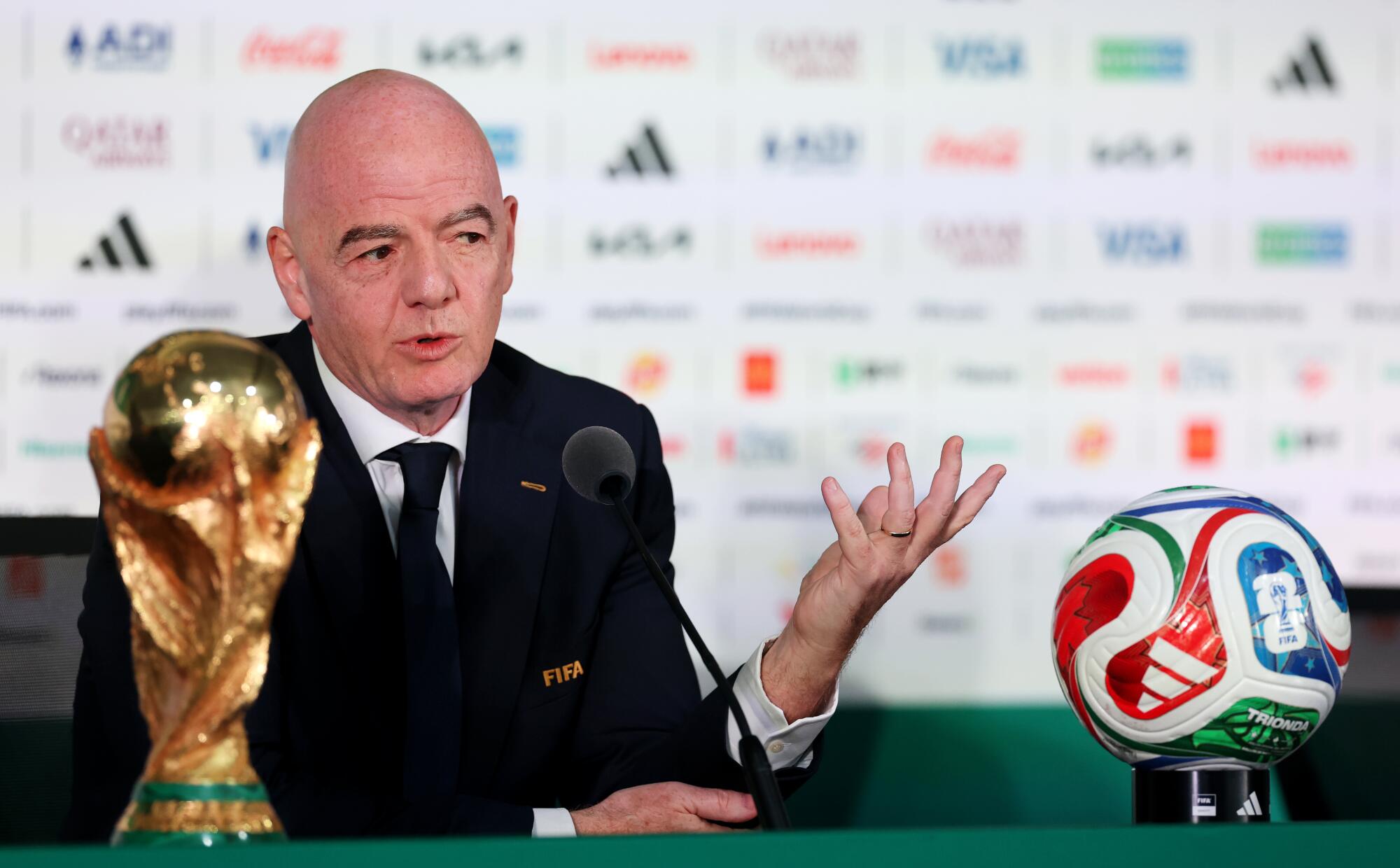
FIFA president Gianni Infantino speaks during a news conference on Wednesday before the start of the World Cup.
(Carl Recine / Getty Images)
“The World Cup should be understood as both a global sporting celebration and a major commercial enterprise, with these two dimensions being mutually enforcing rather than contradictory,” said Steve Georgakis, a lecturer on sports studies at the University of Sydney and a frequent author on soccer.
This year’s tournament is projected to swell FIFA’s coffers by nearly $9 billion and the TV ratings, it says, will be massive.
“Its universal appeal combined with the participation of 48 nations ensures that it remains a genuinely global sporting event,” Georgakis said.
Boykoff has his doubts.
“In this particular political moment, with the Trump administration being erratic and impulsive and needing a win from this tournament and the fact there’s so many moving parts geopolitically, I don’t have confidence that it’s just going to end up being a soccer-focused next five weeks,” he said.
This is not the first World Cup to kick off under some kind of black cloud.
The 1974 tournament in West Germany was tarred by the geopolitical fallout of the 1973 Yom Kippur War. Four years later Argentina’s military dictatorship used the World Cup to sportswash a “Dirty War” in which as many as 30,000 people were tortured, murdered and disappeared.
The 2010 and 2014 World Cups were troubled by cost overruns and delays in the construction of stadiums and other infrastructure and the threat of labor unrest while global outrage over human rights violations and discrimination against women and LGBTQ people hung over the last two tournaments.
Those issues never fully disappeared but were overshadowed by the brilliance of the soccer. Jonathan Wilson, a columnist with the Guardian and author of “The Power and the Glory: The History of the World Cup,” expects the same this summer.
“The other stuff will still be there in the background,” he said, “but fundamentally the football will, for the vast majority of people, take over. It’s just sort of a natural cycle.”
Argentina star Lionel Messi controls the ball during an international friendly against Iceland on Tuesday.
(Butch Dill / Associated Press)
And as with every World Cup, there undoubtedly will be unforgettable moments.
Argentina’s Lionel Messi and Portugal’s Cristiano Ronaldo, the top scorers in soccer history, will be playing in their sixth and final World Cups — Messi chasing a second straight title and Ronaldo pursuing the only prize that has eluded him.
Kylian Mbabbe will be trying to take France to a third consecutive final while young superstars like Erling Haaland of Norway and Lamine Yamal of Spain will be looking to put their mark on their first World Cups.
Four teams — Jordan, Curacao, Cape Verde and Uzbekistan — have qualified for the tournament for the first time.
And there will be other storylines no one saw coming, all of which will contribute to the narrative of this World Cup.
“Major sporting events have a way of capturing public attention and shifting the conversation toward what is happening on the field rather than off it,” Georgakis said.
How much the actions of the Trump administration affect that calculation remains to be seen.
There are travel restrictions in place that fully or partially bar citizens from 39 countries — including a number of World Cup participants — from entering the U.S. And the administration has said ICE and Homeland Security personnel will have a visible presence at World Cup venues, including SoFi Stadium in Inglewood, where the American team will begin play Friday.
“There will be federal agents,” confirmed L.A. County Sheriff Robert Luna, who added that he could not guarantee immigration sweeps would not take place. “ They told us that specifically would not be occurring,” he said. “Any of that’s subject to change.”
Mexico fans celebrate during a watch party at Plaza Mexico in Lynwood on Thursday.
(Kayla Bartkowski / Los Angeles Times)
The difficulty in obtaining visas and the fear of being rounded up by immigration agents are being blamed, in part, for less-than-expected tourist traffic. Hotel operators in all 11 World Cup host cities say bookings for the tournament are well below projections. Several countries have issued warnings about travel to the U.S.
Then there are the own goals from FIFA over tickets and parking prices as high as $900 at some stadiums, weather issues and a short-lived ban on water bottles.
FIFA has defended its policies on ticket prices by arguing that premiums are necessary to maximize revenue, which it will invest in global soccer development. Variable, market-based pricing, it said, simply reflects standard entertainment practices in North America. The organization did, however, reverse its ban on fans bringing bottles into games. Spectators are now allowed to enter stadiums with one soft, plastic 20-ounce water bottle.
And despite a warning from climate scientists that one in four World Cup games could be played in dangerously hot conditions, FIFA will start 40 of them at 3 p.m. or earlier local time, the warmest time of day, to accommodate European TV viewers.
Georgakis said the play on the field will have to overcome all those issues if this World Cup is to earn a favorable place in history.
“Ultimately the success of the World Cup will be judged by what happens on the field,” he said. “If the football is compelling, dramatic and memorable, the tournament will likely be remembered as a great World Cup. If the play falls short, then the off-field issues such as ticket prices, extreme heat, ICE enforcement activities, the Trump administration will receive great attention and could shape perceptions of the event.”
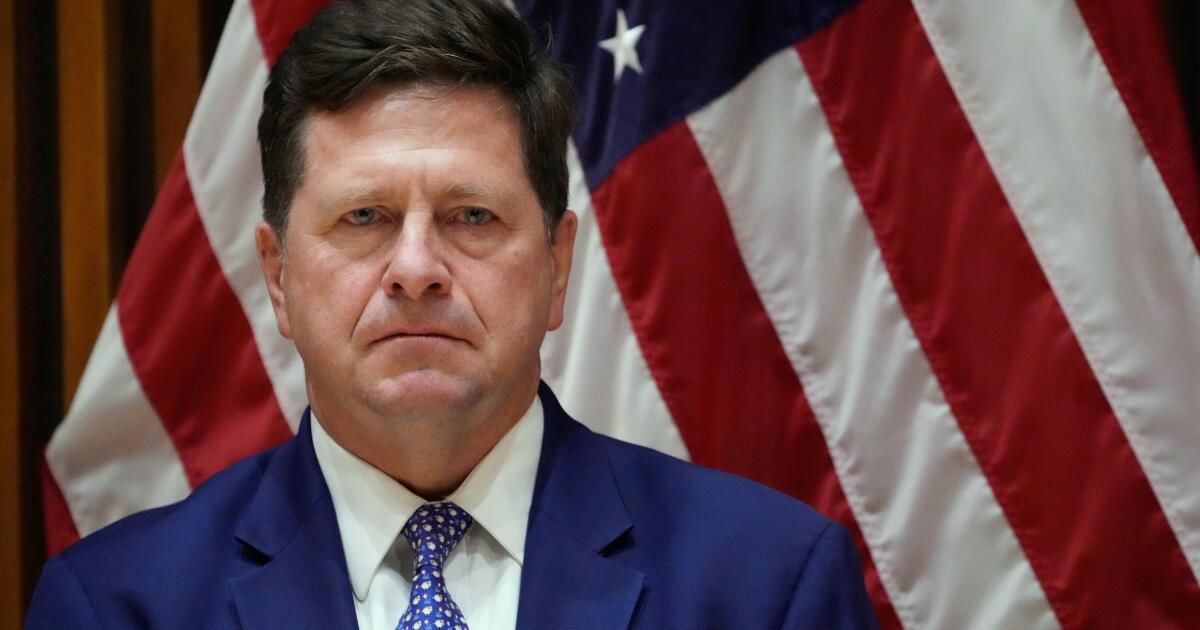
WASHINGTON — President Trump said Thursday that he plans to nominate Jay Clayton, the U.S. attorney for the Southern District of New York and a former Securities and Exchange Commission chairman, as director of national intelligence.
Trump announced the nomination on social media amid pressure from Congress to name a permanent replacement for Tulsi Gabbard, who resigned last month. Trump faced intense pushback over his decision to name Bill Pulte, head of the Federal Housing Finance Agency, as acting director.
The situation has led to a standoff in Congress as Democrats said they would refuse to renew foreign intelligence powers unless Trump pulled Pulte’s nomination and named a permanent nominee.
“Few people anywhere in the Legal Community are respected at the level of Jay,” Trump wrote. “I encourage the United States Senate to confirm Jay as soon as possible.”
WASHINGTON — The Trump administration has identified more than 15,000 cases of adults gaining custody of multiple immigrant children who enter the U.S. without a parent, officials said Thursday, signaling a potential push to prosecute prolific child sponsors.
The Justice Department highlighted cases against three Guatemalan nationals that they say underscore the dangers of improper vetting of sponsors in a program that seeks to unite kids with relatives or family friends after they enter the U.S. Officials said they are investigating numerous other so-called super-sponsors — those who gained custody of more than three unrelated children — to determine whether the sponsors took the kids in fraudulently.
“We will not accept half measures when it comes to securing the border, protecting American lives and saving children from exploitation,” Acting Atty. Gen. Todd Blanche told reporters.
Taking custody of multiple unrelated migrant children is not a crime. The sponsors may be caring and well-intentioned, but senior administration officials calling them out suggests that authorities harbor suspicion about them and may subject them to deeper scrutiny.
Under former President Biden, officials tried to release children to eligible adult sponsors within 30 days, reuniting many families quickly. But the approach also yielded errors, with some children being released to adults who forced them to work illegally or to people who provided clearly false identification and addresses.
Under Trump, the administration tightened rules aimed at preventing traffickers from illegally bringing children into the country, and that has also led to a dramatic increase in federal custody times for kids. As of May, children are held in federal custody for an average of 206 days before they’re released, compared with an average of 37 days when Trump took office. At the same time, the number of total children in custody has steadily dropped.
Striking a balance between releasing children to vetted sponsors and shielding them from danger has proved a contentious partisan disagreement.
Democrats “want to claim that Republicans, because we’re enforcing the laws, it’s inhumane, somehow,” Blanche said after criticizing the vetting procedures under the Biden administration. “What’s inhumane about taking care of our kids?”
The cases announced Thursday include charges against a woman who, authorities say, was living in the U.S. illegally, schemed with others to smuggle kids across the border, then used fake identities to gain custody of them in exchange for money. In another case, a woman is accused of falsely claiming that she was siblings with a teen who had entered the U.S. illegally in her application to become the teen’s sponsor.
The Associated Press has sought comment from attorneys representing the accused in those cases.
Critics of the Trump administration have raised concerns over wellness checks carried out by immigration officers at elementary schools, immigration officers showing up and detaining sponsors at reunification meetings with children, and newly required documentation that’s created a “paperwork barrier” and led to a recent lawsuit.
Even sponsors willing to undergo the new vetting procedures have been forced to wait through unnecessary delays.
A Chicago father who is a U.S. citizen and had a valid birth certificate for his child was kept waiting for five months before the government could schedule a fingerprinting appointment. During the wait, his toddler daughter was sexually abused in federal custody, a lawsuit claimed.
Richer and Gonzalez write for the Associated Press. Gonzalez reported from McAllen, Texas.
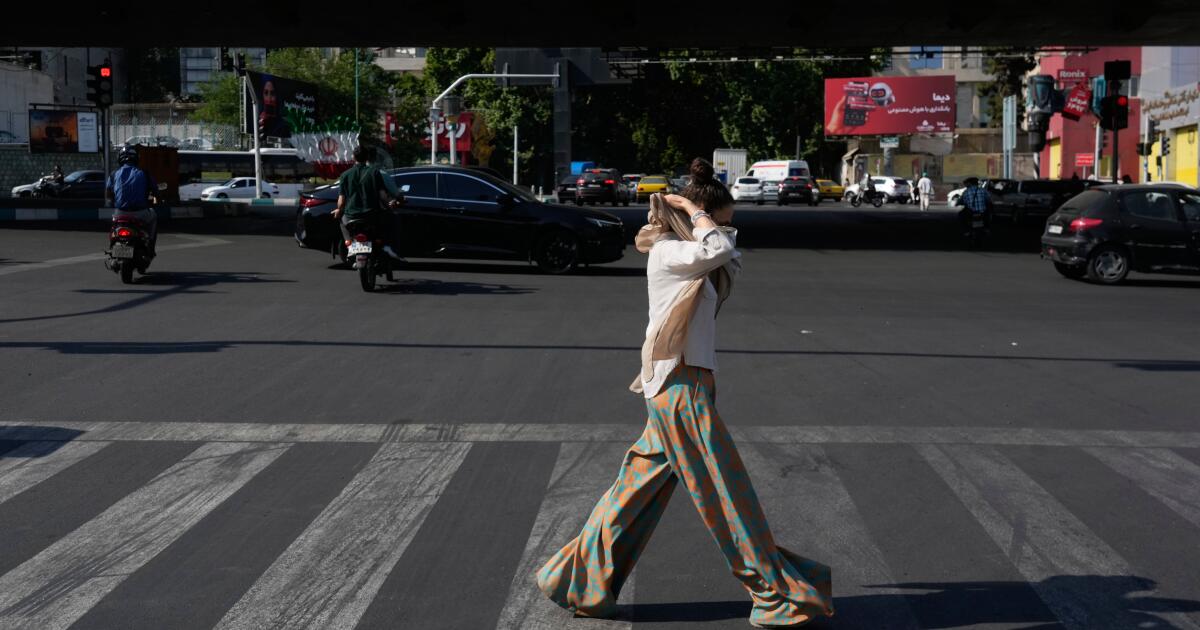
DUBAI, United Arab Emirates — President Trump threatened Thursday to launch major strikes on Iran and seize control of its oil industry as escalating attacks between the countries pushed the Middle East closer to the resumption of a full-scale war.
Trump said in a social media post that the U.S. would hit Iran “VERY HARD TONIGHT” and would “assume total control” of Iran’s oil and gas industries, including the vital Kharg Island oil terminal, in the “not too distant future.”
The American leader’s latest threats came as efforts to negotiate an end to the war appeared stuck. Trump has voiced his frustration with the stalled negotiations, warning earlier in the week that Tehran would “pay the price” for taking too long to reach a deal.
Iran’s monthslong stranglehold on the Strait of Hormuz has disrupted global energy supplies, driven up fuel prices and made food and other basics more expensive well beyond the region.
The U.S. and Iran traded strikes for a second straight day Thursday after reaching a tenuous ceasefire more than a month ago. While the strikes have increased tensions in the region, they have been more limited compared to the early weeks of the war and negotiations between the U.S. and Iran are ongoing.
Trump’s threats on Thursday, while stark, represented his latest verbal escalation in the Iran war. In April, he warned Iran that “a whole civilization will die tonight, never to be brought back again” if it didn’t agree to his terms, before extending a ceasefire.
Trump weighs trying to seize Iran’s main oil terminal
Kharg Island — located on the other side of the Persian Gulf from U.S. bases in Kuwait and Saudi Arabia — is the beating heart of Iran’s oil industry, through which 90% of its exports pass. It is important because Iran’s coastline is mostly too shallow for tanker ships to dock.
It was unclear how serious Trump was about his threat to seize it.
“My preference has always been to take Kharg Island,” Trump said in an interview Thursday on Fox News. “I don’t know that America has the stomach for it to be honest.”
American troops would be vulnerable on Kharg Island because of its close proximity — about 21 miles — to the Iranian mainland, from which missiles, drones and artillery could be fired.
Trump indicated in the interview that he remains averse to sending U.S. forces into Iran. “We could walk in there tomorrow. We could take soldiers — I don’t want to have boots on the ground. But if I wanted to we could put a small group of soldiers and take over the place.”
Trump compared his threat to take over Iran’s oil industry to how the U.S. assumed control of Venezuela’s oil sector after capturing then-president Nicolás Maduro in January.
Iran says US attacks have made ceasefire `meaningless’
American strikes on Iran that lasted into Thursday morning appeared more intense and widespread than the day before.
Tehran released little information on the extent of the damage and said it fired back at Kuwait, Bahrain and Jordan, as it had the previous day.
It was the third time this week that back-and-forth strikes have rattled the Middle East. The first involved attacks between Iran and Israel, followed by the two rounds of fire between the U.S. and Iran, which hit countries in the region that host American bases.
Iran’s Foreign Ministry said in a statement Thursday that the U.S. attacks had “effectively rendered the ceasefire … meaningless,” without saying it was abandoning it.
U.S. Treasury Secretary Scott Bessent said in a social media post that the U.S. would extract funds from frozen Iranian accounts to offset the costs of damage to American allies as well as any tolls Iran imposes on ships seeking passage through the Strait of Hormuz.
Beyond the deadlock over the strait, the two sides also remain at odds over Iran’s nuclear program, which Tehran insists is peaceful but which the U.S. and Israel fear could be used to build an atomic weapon due to its stockpile of highly enriched uranium. The U.S. and Israel said a major reason they went to war on Feb. 28 was to ensure that Iran would never be able to do that.
Iran has insisted that any deal to end the war must also end fighting in Lebanon between its ally Hezbollah and Israel. But Israeli Prime Minister Benjamin Netanyahu appears intent on pursuing his goal of destroying the militant group.
U.S. strikes Iran and Iran fires back at Gulf states
Central Command said its latest round of airstrikes came “in response to Iran’s unwarranted and continued aggression” and targeted “Iranian military surveillance capabilities, communication systems and air defense sites.” It did not elaborate on the damage done by the strikes, which it said ended just before sunrise Thursday in Iran.
Explosions from the strikes echoed around Iran’s capital, as well as the port city of Bandar Abbas and other southern areas along the Strait of Hormuz. Iran’s paramilitary Revolutionary Guard later said sites hit included a manufacturing complex, a military barracks and a local Guard base outside of Tehran.
Kuwait closed its airspace for several hours because of the attack, but did not elaborate on any damage. Jordan said it intercepted 20 Iranian missiles fired toward an area that is home to a base hosting U.S. troops, though no one was hurt.
Bahrain’s Interior Ministry said an 11-year-old girl was hurt and cars and homes were damaged by debris from interceptions responding to the Iranian attack.
Meanwhile, Israel warned residents in the country’s north to seek shelter after the detection of suspected incoming fire from Lebanon, where Israel is fighting the Iran-allied Hezbollah militant group.
U.S. fires on another merchant ship to enforce blockade
The U.S. military’s Central Command said Thursday that it struck a Guinea-Bissau-flagged tanker attempting to evade the American blockade on Iranian ports. It said the M/T Jalveer was transporting Iranian oil when it was disabled late Wednesday after its crew failed to obey U.S. orders.
It’s the ninth merchant vessel the U.S. military says it disabled to enforce the blockade.
Three Indian sailors were killed when American forces struck the Palau-flagged M/T Settebello on Tuesday, India’s minister overseeing ports and shipping said Thursday on X.
U.S. Central Command said American forces issued warnings before firing on the ship, which it accused of trying to evade the blockade.
The leader of the International Maritime Organization, a United Nations agency, condemned the attack.
Gambrell and Madhani write for the Associated Press. Madhani reported from Washington. AP writers Will Weissert, Collin Binkley, Michelle L. Price and Konstantin Toropin in Washington; Sheikh Saaliq in New Delhi; Munir Ahmed in Islamabad, Victoria Eastwood in Cairo and Russ Bynum in Savannah, Ga., contributed to this report.
June 11 (UPI) — President Donald Trump said Thursday that the United States may take control of Iran’s oil and gas industries like it did in Venezuela earlier this year.
Trump posted the threat on social media, warning that the United States will continue attacking Iran after a series of airstrikes on Wednesday.
“The United States will be hitting Iran (Whose Navy, Air Force, Radar, Anti Aircraft, and all other forms of Defense, together with most of its offensive capability, are GONE!), VERY HARD TONIGHT,” Trump wrote. “At some point in the not too distant future, we will be taking Kharg Island, and other oil infrastructure points, and assume total control of their Oil and Gas Markets, much like we have with Venezuela, which is working out brilliantly for both Venezuela and the United States of America.”
About 90% of Iran’s crude oil shipments were exported from Kharg Island before the United States and Israel launched the war on Feb. 28.
The United States has launched strikes on Kharg Island during the Iran war but it has not seized control of any of its oil and gas infrastructure yet.
Trump further discussed taking control of Iranian infrastructure during an appearance on Fox News on Thursday morning.
“Look, my preference has always been take Kharg Island,” he said. “I don’t think America has the stomach for that. I think they’d like to see us come home, but we did it with Venezuela. Venezuela’s worked out great for everybody.”
Fighting has heightened again between the United States and Iran with Iran shooting down a U.S. helicopter earlier this week near the Strait of Hormuz. The U.S. military launched what it is calling “self-defense strikes” on Iranian military surveillance, communication systems and air defense targets.
U.S. Central Command said Wednesday that the strikes were “in response to Iran’s unwarranted and continued aggression.”
Trump has said for weeks that Iran and the United States are close to reaching a peace agreement, saying at several points Iran wanted to reach a deal. Fighting between Iran and Israel paused over the weekend after Trump urged both sides to stop exchanging fire.
The United States continues to enforce a blockade on ships using Iranian ports on the Strait of Hormuz.
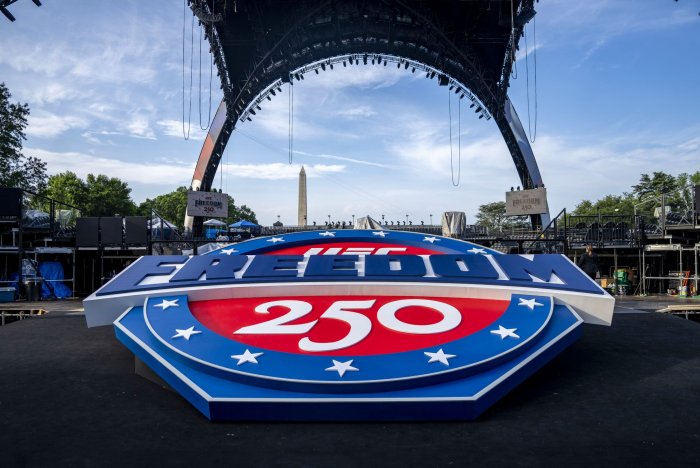
The Ultimate Fighting Championship (UFC) arena is seen as preparations continue for the UFC Freedom 250 event on the South Lawn of the White House on Thursday. Photo by Bonnie Cash/UPI | License Photo
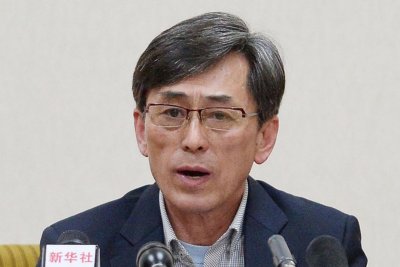
1 of 2 | South Korean Kim Kuk-gi speaking during a news conference in Pyongyang, North Korea. North Korea’s official Korean Central News Agency (KCNA) said that North Korea has detained South Koreans Kim Kuk-gi and Choe Chun-gil on espionage charges. An unnamed official at the North’s Ministry of State Security branded them as ‘spies’ of the South’s National Intelligence Service and ‘heinous terrorists’. Photo by YONHAP / EPA
June 10 (Asia Today) — Senior U.S. human rights officials visiting South Korea met over two days with families of South Koreans detained or abducted by North Korea, civic groups said Wednesday.
The meetings included families of South Korean missionaries detained in North Korea, wartime and postwar abductees and prisoners of war who were not repatriated after the Korean War.
Riley M. Barnes, assistant secretary of state for democracy, human rights and labor, met Tuesday with Choi Jin-young, the son of South Korean missionary Choi Chun-gil, who is being held in North Korea, according to civic groups.
Julie Turner, acting deputy assistant secretary in the State Department’s Bureau of Democracy, Human Rights and Labor, and Belsis Romero, a White House faith liaison, also took part in the visit.
On Wednesday, U.S. officials met representatives of groups representing families of Korean War abductees, postwar abductees and prisoners of war.
The U.S. officials told the families that Washington continues to pay attention to the issue and that its position has not changed on supporting efforts to confirm the detainees’ status and seek their return, according to the groups.
Choi thanked Barnes for calling for the release of South Koreans detained in North Korea, including missionaries Kim Jung-wook, Kim Kuk-gi and Choi Chun-gil, during a video message last month for an international conference announcing the formation of the Republic of Korea Hostage Family Association.
Choi also delivered a letter addressed to President Donald Trump asking the United States to make the safe return of South Korean detainees, including the three missionaries, part of its North Korea diplomacy.
He also delivered 10,000 signatures gathered online and offline, largely through Korean churches in Los Angeles, calling for the detainees’ repatriation and confirmation of whether they are alive.
Kim Jung-sam, the older brother of missionary Kim Jung-wook, also sent a letter asking Trump to speak out during his presidency on detainees and religious freedom.
Choi said he asked U.S. officials to send a message that Washington has not forgotten the detained missionaries.
“I asked that the U.S. ambassador, the secretary of state or the president meet from time to time with families of South Korean abductees, detainees and prisoners of war,” Choi said. “In that context, I also requested that the U.S. ambassador to South Korea attend an event for Abductees Remembrance Day.”
Lee Sung-eui, head of the Korean War Abductees’ Family Union, Choi Sung-ryong, head of the Association of the Families of Postwar Abductees, and Sohn Myung-hwa, head of a group representing families of prisoners of war, met Turner on Wednesday and urged continued U.S. attention to the abduction issue.
Lee delivered a letter asking Washington to place humanitarian issues first in any future U.S.-North Korea talks, including the return of detained South Koreans, confirmation of the fate of abductees and visits by bereaved families to graves in North Korea.
Lee said he emphasized that wartime abductions during the 1950-53 Korean War were “the root of all forced disappearance crimes committed by North Korea.”
Barnes and Turner also met Saturday with Son Hyun-bo, pastor of Segero Church, who led rallies opposing the impeachment of former President Yoon Suk Yeol. The U.S. officials discussed religious freedom issues in South Korea and attended a Sunday worship service.
On Monday, the U.S. delegation also met Chang Wook-jin, director-general for global multilateral diplomacy at South Korea’s Foreign Ministry, to discuss bilateral efforts to promote democracy and human rights.
A South Korean Foreign Ministry official said the U.S. State Department regularly communicates with a wide range of stakeholders inside and outside South Korea while preparing annual reports on human rights, trafficking in persons and international religious freedom.
The official said the delegation’s visit to South Korea was part of that regular outreach.
A civic group official who recently visited the United States and met State Department officials said the bureau’s meeting with families of North Korean detainees appeared connected to Washington’s recent attention to religious persecution.
The official said U.S. officials also asked questions during a recent meeting about religious freedom and human rights issues involving the South Korean government.
June 10 (UPI) — Brad Lander, former New York City comptroller, appeared in a Manhattan court Wednesday after his arrest last year at 26 Federal Plaza, the site of the city’s major immigration court.
Police arrested Lander on Sept. 18 during his attempt, with other officials, to inspect holding rooms for detained immigrants. Police also arrested about 10 other officials, The Guardian reported.
Lander said that he pleaded not guilty to misdemeanor charges so he could question Immigrations and Customs Enforcement operations under oath, WABC-TV reported.
“Someone for the past year has been unreasonably obstructing the usual use of 26 Federal Plaza as an immigration court hearing, but the guilty party is ICE, the guilty party is not us,” Lander said.
Lander was ticketed on a violation for allegedly blocking an elevator bank on the 10th floor of the building. He testified Wednesday that he was there in his role as comptroller and that there were concerns that the holding rooms — usually used for much shorter periods of time — were crowded and unsafe, The Guardian reported. When the officials were not allowed to inspect the rooms, they sat down to wait.
The Guardian said that the trial unfolded “slightlysurreally — with an emphasis on the detail of alleged elevator blocking.”
“Were you trying to block the elevator?” asked Deidre von Dornum, Lander’s attorney.
“No,” Lander said, saying that the officials were there to inspect the rooms. “Our purpose was not to block the elevators.”
He said the elevator near him “did not ding, or open, during that time.”
Prosecutor Arial Cohen said Lander ignored multiple warnings to move.
Michael Bass, another attorney for Lander, said the comptroller was “concerned for the safety of his constituents.”
“Arrest is the bludgeon of suppression, and this case is yet another example of the administration’s suppression of political dissent,” Bass said.
Lander is running for the congressional seat held by incumbent Democrat Dan Goldman.
The American College of Obstetricians and Gynecologists released its recommended maternal vaccine schedule Wednesday, breaking with the U.S. Centers for Disease Control and Prevention in its advice. File Photo by Alex Hofford/EPA
June 10 (UPI) — The American College of Obstetricians and Gynecologists released its recommended maternal vaccine schedule Wednesday, breaking for the first time on advice from the U.S. Center for Disease Control and Prevention.
The group advises four vaccines during pregnancy, including a COVID-19 shot; a flu shot; a tetanus, diphtheria and pertussis (Tdap) vaccine; and a vaccine that protects the fetus against respiratory syncytial virus, commonly called RSV.
“Changing national recommendations coupled with rampant vaccine misinformation are resulting in confusion for both patients and healthcare professionals,” Camille Clare, ACOG president, said in a statement.”It is incredibly important for the public to have access to reliable,evidence-based information on maternal immunizations from a trusted source.”
The schedule also includes additional vaccines for those with certain risk factors and for those postpartum and breastfeeding. Thirteen other medical societies, including the American Academy of Pediatrics, the American Academy of Family Physicians and the American College of Nurse-Midwives, endorsed the list.
In changing the schedule in 2025, the CDC did not its usual process of using a panel of vaccine experts to review studies and make advice. The American Academy of Pediatrics and some U.S. states have also broken with the new CDC guidelines.
“Immunization is an essential part of preventative care forpeople who are pregnant, postpartum and lactating — and for their infants,” ACOG said in its recommendations. “OB-GYNs can reduce the frequency of vaccine-preventable diseases by being aware of current vaccine recommendations, counseling patients to receive appropriate vaccines and integrating vaccination into routine clinical practice.”
Soccer fans gather outside Mexico City Stadium in Mexico City on Wednesday on the eve of the opening match of the 2026 FIFA World Cup between Mexico and South Africa. Photo by Mario Guzman/EPA
June 10 (UPI) — The U.S. Embassy in Mexico issued a travel advisory for American citizens who plan to attend soccer matches at the 2026 FIFA World Cup, warning of security risks, mobility restrictions and significant differences in risk levels among Mexican states.
The diplomatic mission urged travelers to review current advisories for each Mexican state before traveling and reminded them that Mexico includes states classified from Level 1 (“exercise normal precautions”) to Level 4 (“do not travel”).
“If you scored tickets for a FIFA World Cup 2026 match in Mexico, check the latest travel advisory level and risk information before you travel,” the embassy said in a message released this week.
México es un destino vacacional popular, pero los riesgos de seguridad varían mucho según la región, por lo que asignamos niveles de advertencia de viaje para cada estado mexicano, desde nivel 1 (tomar precauciones normales) hasta nivel 4 (no viajar). Si consiguió boletos para un… pic.twitter.com/yQR7UxzOZB— Embajada de EE.UU. en México (@USEmbassyMEX) June 9, 2026
Although the Mexican government has announced deployment of nearly 100,000 security personnel to protect the World Cup host cities of Mexico City, Guadalajara and Monterrey, international travel advisories remain in place because of cartel-related violence and organized crime, which vary by state.
The State Department maintains a Level 2 advisory for Mexico, recommending travelers “exercise increased caution” because of risks related to terrorism, crime and kidnapping.
However, the agency noted that specific areas of the country remain under Levels 3 and 4, the highest risk categories.
According to the advisory, violent crimes including homicide, kidnapping, carjacking, sexual assault and robbery occur in Mexico.
The U.S. government also said there is a risk of terrorist violence and reminded travelers that consular assistance may be limited in certain regions.
U.S. authorities recommended that citizens follow the same restrictions that apply to U.S. government personnel stationed in Mexico.
Those measures include avoiding intercity travel at night, using only regulated transportation services or ride-hailing applications such as Uber and Cabify, avoiding solo travel in remote areas and refraining from driving between border cities and the country’s interior except in specific circumstances.
The advisory also says that emergency services may be limited or unavailable in rural and remote areas.
In addition, it advises travelers to cooperate with highway checkpoints and roadblocks, warning that ignoring instructions or attempting to flee could result in violent situations.
The State Department recommended that travelers enroll in the Smart Traveler Enrollment Program, obtain travel insurance and review security conditions in the states they plan to visit during the tournament.
June 10 (UPI) — Billionaire Microsoft founder Bill Gates told the House Oversight Committee Wednesday that he had no knowledge of Jeffrey Epstein‘s crimes and that Epstein had uses Gates’ personal life to pressure him.
“I never witnessed nor had any indication that Epstein was engaged in ongoing criminal conduct. I never went to his island, his ranch, or his Florida home. I have never victimized anyone,” Gates said in his prepared opening remarks.
“While he may have sought to foster a personal relationship, I was never interested in that and never reciprocated. I learned Epstein had become aware of sensitive information about my personal life, including the fact that I had been unfaithful in my marriage. These affairs had nothing to do with my interactions with Epstein, but they were painful for my family.”
His testimony comes a day after Epstein’s former executive assistant, Lesley Groff, testified saying she knew nothing about Epstein’s crimes.
Gates told the House Oversight Committee Wednesday that he was introduced to Epstein in 2011. Epstein “claimed he could raise billions of dollars for global health from people for whom he provided tax and estate services.”
“I recall being aware that Epstein had faced prior legal issues, but I did not fully understand the extent of the crimes he committed. I accepted the introduction without applying the scrutiny I should have,” he said.
Gates said that Epstein used his knowledge of Gates’ cheating on his wife, “in addition to many lies that he layered on top,” to re-engage with him after Gates had cut off contact in 2014.
“He was unsuccessful in this effort, but it shows some of the ways he tried to leverage his interactions with me to further his agenda. I should never have met with Epstein in the first place,” Gates’ opening statement said.
Before the interview, Gates said he was ready to testify.
“I hope my testimony is helpful to the important work of the committee to find justice for the victims,” Gates said in a brief statement after he arrived in Washington, D.C.
In a statement to The Guardian, a representative for Gates said that he “welcomes the opportunity to appear before the committee” and said that “while he never witnessed or participated in any of Epstein’s illegal conduct, he is looking forward to answering all the committee’s questions to support their important work.”
Rep. Robert Garcia, D-Calif., told reporters earlier this week, “we want to know what did Mr. Gates know, who else was around that orbit, and why Mr. Gates continued to have a relationship with Mr. Epstein.”
Committee Chairman Rep. James Comer, R-Ky., told reporters Tuesday that “anything’s on the table.”
“He seems like he’s — according to his attorneys — I wouldn’t say eager to testify, but he’s willing to testify, and he hasn’t fought it. And I appreciate that.”
Gates became friends with Epstein in 2011, three years after he was convicted in Florida for soliciting an underage girl for prostitution. Epstein served 13 months in jail for that charge and became a registered sex offender.
Epstein died by suicide in jail in 2019.
Gates has publicly expressed regret for his friendship with Epstein. He has said he met with Epstein several times to discuss philanthropy but said it was “foolish” of him.
“Yes, I think I was quite stupid,” Gates said. “I thought it would help me with global health philanthropy; in fact, it failed to do that, and it was just a huge mistake.”
President Donald Trump discusses renovations to the Lincoln Reflecting Pool and makes an announcement on coal in the Oval Office at the White House on Thursday. Photo by Samuel Corum/UPI | License Photo
June 10 (UPI) — President Donald Trump signed a bill to fund the Department of Homeland Security’s immigration enforcement agencies through 2028 after months of battles to prevent it from happening.
“This morning I’m thrilled to sign the Secure America Act to immediately and fully fund the Department of Homeland Security through the end of my term, so we won’t have to be talking about it anymore,” the president said in the Oval Office.
The Senate passed the $70 billion funding package on Friday, and the House approved it on Tuesday.
Democrats fought the funding for months, refusing to agree to the bill unless there were reforms to the organization after two American citizens — Renee Good and Alex Pretti — were killed by federal agents in Minneapolis earlier this year. But the measure was passed via reconciliation, which only requires a majority vote instead of 60 votes needed to overcome a filibuster.
“We’ll give the heroes of ICE and Border Patrol — and that’s what they are, they’re heroes, what they have to go through to keep us safe — the support and resources they need to defend our borders, protect our homeland and to keep America safe,” the president added He also gave House Speaker Mike Johnson, R-La., credit for passing the bill with a slim majority in the House.
“Despite Democrat efforts to shut down ICE and Border Patrol, Republicans have now fully funded these agencies through President Trump’s entire second term to the tune of nearly $70 billion,” Sen. Lindsey Graham, R-S.C., in a statement. “Thanks to President Trump, our border has gone from its weakest point to its most secure point in less than two years.”
LAS VEGAS — Retired Air Force Lt. Col. David Flippo has won the Republican primary in Nevada’s 2nd Congressional District after securing President Trump’s endorsement in the closing weeks of the campaign.
The race, which was called Wednesday, put Trump opposite Republican Nevada Gov. Joe Lombardo and retiring Rep. Mark Amodei, who both backed former state Sen. James Settelmeyer. Amodei announced he was retiring after 15 years, opening up a competitive primary for Nevada’s only Republican-held House seat.
Flippo said he will fight “relentlessly” for secure borders, American energy, tax cuts, national defense and “the America First agenda our country needs.”
“Nevada deserves a fighter, and that’s exactly what I will deliver,” he said in a statement.
Democrats had hoped for a Flippo victory, thinking it would make it easier for them to win over less partisan voters in November in the conservative-leaning district. They nominated the chief of staff to state Atty. Gen. Aaron Ford, former majority floor leader Teresa Benitez-Thompson.
“I will ensure that Nevada families have an authentic Nevadan voice fighting for their needs in Washington DC,” Benitez-Thompson said in a Wednesday morning statement.
The 2nd District race is one of several Nevada contests that will be watched closely this year. In southern Nevada’s 3rd Congressional District, Democratic Rep. Susie Lee will face Marty O’Donnell, a composer known for writing the soundtrack to the video game “Halo.”
Trump won the 3rd district in 2024 and backed O’Donnell, who thanked Trump in his victory statement.
Tuesday’s primary also set the general election contest for governor, with Ford defeating a progressive candidate in the Democratic primary and moving on to face Gov. Lombardo. The incumbent, a former Clark County sheriff, is running on his record of public safety and job creation while pledging to work on housing affordability in a second term.
Ford is tying Lombardo to Trump in placing blame for soaring prices across the state and has pledged to lower costs for families. He would be the state’s first Black governor if elected in November.
In other races for statewide offices, Republican primaries for attorney general and secretary of state included several candidates who had pushed election conspiracy theories or been skeptical of election operations. Adriana Guzmán Fralick, who has expressed concerns about voting security, won the GOP nomination for attorney general and will face Democratic state Senate Majority Leader Nicole Cannizzaro.
The Republican primary for secretary of state, the office that oversees elections, included Jim Marchant, a former state lawmaker who has said the 2020 election “ was probably stolen,” and Sharron Angle, a former state lawmaker who was part of an effort to block the certification of Nevada’s 2020 election results. Another candidate who was competitive in the race, Shirley Folkins-Roberts, is an attorney who has denied that there is widespread voting fraud in Nevada.
In the 2nd District race, Flippo said he understands issues important to the region, including mining, water rights and fuel prices. He sought to turn Settelmeyer’s long political record into a liability, pointing to votes he said did not match conservative values.
He moved to the district this election cycle after losing a race in southern Nevada in 2024. The 2nd District covers all northern Nevada. It mostly rural but includes the major battleground county of Washoe, home to Reno.