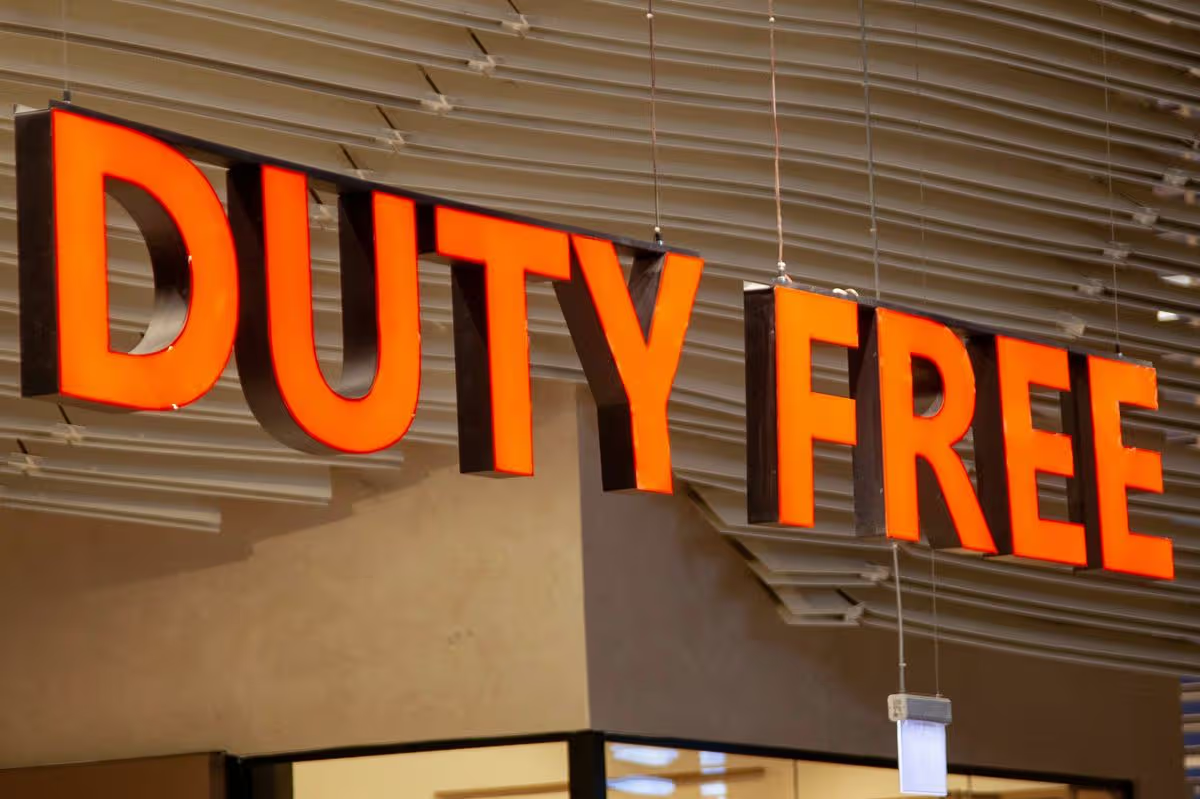
If you’ve made a purchase in duty-free, you may want to check ahead of time to see if you’re actually able to use it on board, as there’s one item strictly prohibited
People travelling to and from holidays need to know this rule(Image: Miragest via Getty Images)
Brits travelling abroad need to stay alert to the items they can and cannot take onboard, but do they know about the rules regarding items they buy at the airport?
Travelling with bottles in any shape or form usually comes with its restrictions, as many airports ask for you to pack liquids in measurements only up to 100ml. However, there are some far stricter rules when it comes to the liquid you’re buying in duty-free – particularly alcohol.
At most airports, you can buy bottles of wine, spirits, beers, and more; sometimes up to a liter of each is sold at discounted prices. And yet, despite being able to make the purchase at the airport, you are strictly prohibited from drinking it or even opening it on the plane.
Duty-free alcohol is generally allowed on board, passing as a form of carry-on luggage, when purchased after getting your security checks. Although it is almost always placed inside a sealed Security Tamper-Evident Bag, paired with the receipt.
Within aviation law, this bag must remain sealed throughout the whole duration of the flight, a rule that is consistent across all airlines. Passengers must not consume their own duty-free alcohol on the plane, as all alcohol must be purchased from the cabin crew.
If there’s anything else you’ve purchased from duty-free, you will need to ensure it is placed in a separate bag or in your carry-on luggage to avoid it being trapped inside the sealed bag for the duration of the flight.
The rule is consistent, yet each airline may handle people consuming this alcohol differently, with potential fines for those who break the rules.
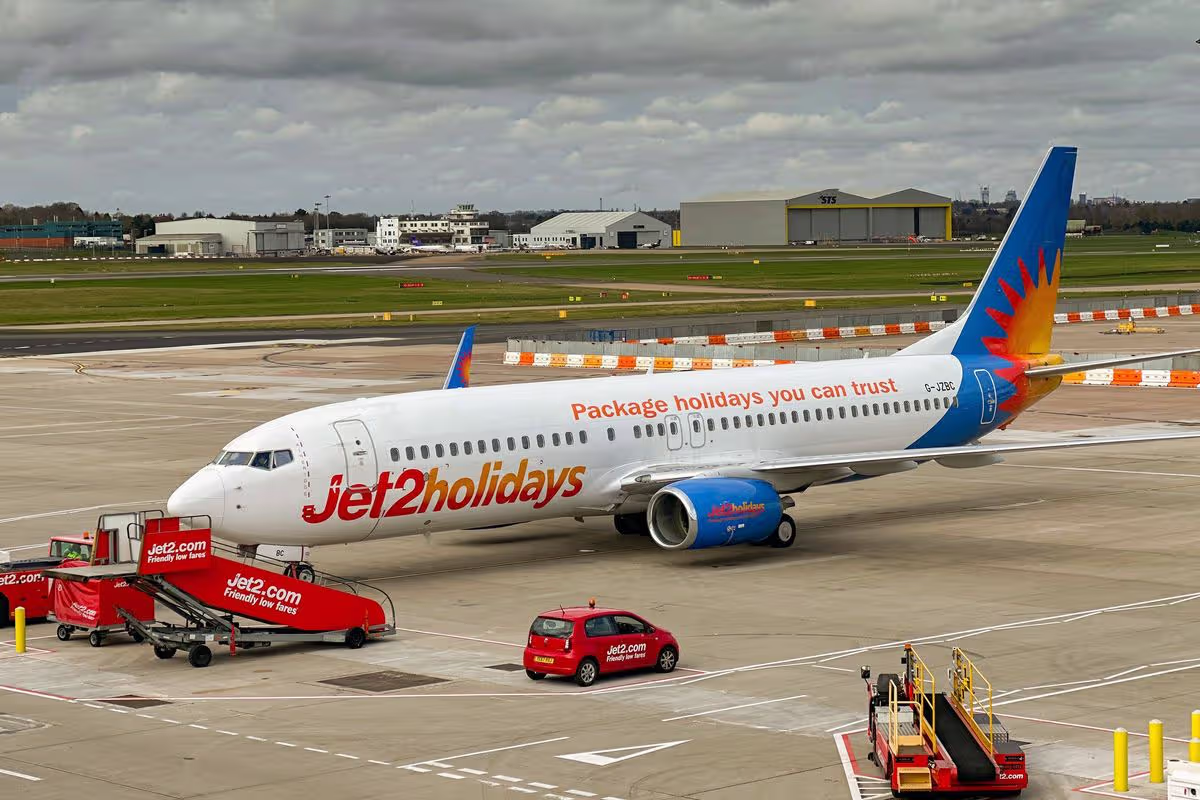
Jet2 states: “You may not bring on board alcohol for the purposes of consumption whilst on the aircraft. For safety reasons, we restrict the consumption of alcohol on board. Only alcoholic drinks purchased on board may be consumed during the flight. It is an offence to be drunk on any aircraft. Jet2.com reserves the right to serve alcoholic drinks to customers at our absolute discretion.”
After some recent confusion with passengers boarding Ryanair flights, a spokesperson made it clear where they stand when it comes to drinking on board. They said: “We are not ‘banning’ or ‘confiscating’ duty-free alcohol at boarding gates. As per Ryanair’s T&Cs, passengers can carry duty-free alcohol onboard but must not consume it during the flight.”
Across the majority of airlines, when it comes to alcohol consumption, they have a zero-tolerance policy on ‘disruptive behaviour’ and have the right to reject drunken and disorderly passengers from boarding the flight.
Meaning, even if you’re yet to take a swig of your duty-free bottle, you should be wary of how much alcohol you’re drinking within airport bars and restaurants.
As for the duty-free bag itself, this is often allowed as an extra courtesy to take on the flight, provided that it fits under your seat. However, this is typically limited to one bag per person and does not encourage passengers to hop on board with multiple additional bags after a huge shopping spree.
As members make purchases, they will progress through three levels and each level increases the benefits like TUI treats, priority support and personalised rewards.
These rewards also include on-board and in-hotel added benefits.
For even more potential wins, there will also be a monthly game with ‘great prizes’ to be won.
For higher tier members, there will be better access to services like priority live chat and priority call support.
The scheme launched in Finland in March of this year and will be rolled out in the UK later this year.
The holidaymaker revealed how he enjoyed a week-long holiday at a budget price
The traveller enjoyed a holiday in Mexico (Image: Getty)
A social media user has wowed travel fans after sharing how much he spent on a week’s holiday in Mexico. The holidaymaker explained his bargain travel hack in a TikTok post shared under the username @Byseyi.
In the viral video, Byseyi revealed he spent £360 per person on a last-minute holiday to Mexico. He said: “So this is one travel tip that I don’t really hear that many people talk about. And this is actually how me and my wife travelled to Mexico for a week for around £360 per person, and that’s flights and accommodation.”
The TikTok creator claims: “So if you’re able to travel last-minute, go and look at TUI’s last-minute flight deals on the flight section of their website. Because what happens is they’re trying to get rid of some of these last-minute flights and not have empty seats going. So we ended up booking a flight for two people to go to Cancun, Mexico, for £538 for both of us.
“Managed to find some good accommodation in Tulum that was cheap for £185. And even right now, if you go on the website, you’ll see a flight to the Dominican Republic for £384 if you’re able to travel in the month of May.
“So it’s really just for those people, maybe you had a holiday that got cancelled and you’re trying to plan a new thing, or you have the flexibility to just travel last minute. So it doesn’t apply to everyone, but for those that it can work for, you can get something good for cheap.”
Content cannot be displayed without consent
The video gained over 115k views and 14k likes on TikTok. Replying to the video, a viewer said: “Thanks for reminding me being fully remote is a win.” A second comment read: “A digital nomads dream lol …let me go check out TUI.” A third social media user wrote: “Yep! TUI got me to Aruba for £196 return, directttt! best!”
Someone else shared: “I always like these deals but they don’t work for people who like to explore more than one city in a country. But I think it’s great when you are simply looking for anywhere to go to.”
Another response said: “How close to the departure date did you book?” The travel lover replied: “Booked on the 23rd of Feb, flew out 3rd of March.”
Passengers looking for last-minute flights can browse deals on TUI’s website, where there’s a section dedicated to cheap flights. Customers can filter their search by departure date, with options ranging from within seven days to three months. Alternatively, customers planning further ahead can refine their search by month.
Chris Logan, Commercial Director at TUI UK and Ireland, said: “If you’ve got a bit of flexibility, our last-minute flight deals can be a brilliant way to grab a great-value getaway. Flying from over 20 airports across the UK, making it easy to pick a date, pack a bag and set off from a nearby airport. There’s a great choice of destinations on offer too – from European favourites like Spain and Greece, to long-haul escapes across the Caribbean, including Mexico, the Dominican Republic and Jamaica, as well as Florida.
“These direct flights include 10kg of hand luggage as standard, with the option to add more, upgrade for extra space or enjoy a more premium travel experience. It’s always worth checking back – you might find something that gets you away sooner than you think.”
Anyone with holidays planned needs to know the rules before they fly
Boarding passes might need to be in a certain form, or passengers are not getting past check-in desks(Image: Getty | Franziska & Tom Werner)
Getting your boarding pass sorted is one of the first things to clear before jetting off on holiday, but some Brits risk being caught out at the check-in desk by overlooking a rule certain airlines have introduced. It is essential to know whether your documents need to be in a specific format to pass through the airport smoothly.
Previously, most UK carriers left it up to passengers to choose between printing boarding passes at home or having them on smartphones at the airport. However, it’s important to understand what your airline now allows, as failing to do so could put your entire trip in trouble.
Paper boarding passes are steadily being phased out in favour of digital options. Most airlines now issue tickets via email, apps, or other methods rather than paper.
In many instances, travellers can still print their passes at home or at the airport. It’s advisable to verify your airline’s specific policies (both outbound and return) beforehand, according to the Express.
Ryanair
Budget airline Ryanair has switched entirely to digital as of November 2025. Passengers travelling with the carrier will receive their boarding pass electronically via the Ryanair app once check-in is complete.
On its website, the airline states that its digital boarding passes “get rid of 300 tonnes of paper annually” and contribute to “lower airport costs and fares for all Ryanair passengers”.
Discussing check-in, Ryanair say that all “passengers will still receive email reminders to check-in online 48 and 24 hrs pre-departure. If any passenger arrives at the airport but hasn’t checked in online (having ignored these reminders), they will still be required to pay the airport check-in fee.”
Ryanair added that “special assistance is available at all airports” for travellers requiring support with digital passes and check-in. Full details can be found here.
EasyJet and WizzAir
For most flights, airlines such as easyJet accept digital tickets. EasyJet does not accept PDF scans displayed on phones, and all digital tickets must be presented via the free EasyJet app. Certain non-UK airports continue to require printed passes.
As of 2026, 21 airports in the easyJet network do not currently accept mobile boarding passes. If you are returning to the UK from any of these locations, you will need to print your boarding pass on paper:
Egypt: Hurghada (HRG), Luxor (LXR), Marsa Alam (RMF), Cairo Sphinx (SPX), Sharm El Sheikh (SSH)
Other Regions: Aqaba, Jordan (AQJ), Belgrade, Serbia (BEG), Pristina, Kosovo (PRN), Tirana, Albania (TIA), Ivalo, Finland (IVL) and Sitia, Greece (JSH)
A handful of airports that handle Wizz Air flights also do not support mobile passes, though there are just five such destinations, as of 2026:
Agadir (AGA)
Marrakesh (RAK)
Cairo Sphinx (SPX)
Zaragoza (ZAZ)
Tirana (TIA)
What about other major UK airlines?
For those flying with other carriers, it is best to check your airline’s website to determine whether a specific policy applies. Rules are larely the same but may vary from location to location.
British Airways: Allows printing at home or at airport kiosks. Digital passes are available via the BA app.
Jet2: Supports both physical and digital tickets. You can print from “Manage My Booking” or use the Jet2 app.
TUI: Both printed and digital passes are accepted.
Virgin Airways: Although the airline “highly recommends” digital, printed copies are accepted, and kiosk printing remains available at major hubs like London Heathrow and Manchester.
easyJet, TUI and Jet2holidays are some of the UK’s biggest package holiday providers
05:07, 10 May 2026Updated 08:57, 10 May 2026
Jet2holidays, TUI and easyJet all make passengers aware in advance(Image: Ceri Breeze via Getty Images)
Travellers planning to book holidays with easyJet, Jet2, and TUI are being cautioned by the travel firms that they could face additional charges they may not have previously been aware of.
With summer now just around the corner, millions of Brits are eagerly looking forward to a well-deserved break in the sun. easyJet, TUI, and Jet2holidays rank among the UK’s biggest package holiday providers, with countless travellers turning to them to arrange all manner of trips overseas – and 2026 is set to be a busy one.
When browsing the respective websites, customers can explore a vast range of holidays and will be presented with a price for their chosen trip. Each of these operators helpfully outlines why these holidays may carry extra costs, and how much travellers might be expected to fork out.
It all comes down to tourism taxes. The amount you’ll pay depends on your destination, the length of your stay, and whether you’re travelling during peak season.
Alongside the quoted price for your holiday, whether booked through TUI, easyJet, or Jet2holidays, you’ll also find an estimated tourism tax figure for the full duration of your trip. This is typically payable directly at your accommodation upon arrival.
In any destination where a tourism tax applies, all holidaymakers will be required to pay a standard rate – regardless of which airline or travel operator they have chosen to book with.
The money-saving guru has urged those who have paid for trips with major holiday firms and airlines to avoid the DIY approach
15:04, 08 May 2026Updated 15:15, 08 May 2026
Martin Lewis gave advice for anyone booking holidays amid the Iran conflict(Image: ITV)
Martin Lewis has delivered a stark warning to anyone who has already booked a holiday for this summer – and explained why people could be making a big mistake getting flights and hotels separately. In a recent update, the money-saving guru has urged those who have paid for trips with major holiday firms and airlines, including TUI, Jet2, Ryanair, Wizz, easyJet and British Airways, to pay close attention.
It was suggested this week that the UK could be worst hit by jet fuel shortages because it has ‘critically low levels’ of supplies and poor refining tools, by Goldman Sachs. The giant investment bank Goldman Sachs said in a research note to clients: “The UK is the largest net importer of jet fuel in Europe, and it holds no strategic reserves, leaving commercial inventories as the primary buffer.”
During his Money Show Live on ITV, the financial expert responded to an audience member who asked: ‘If my flight’s cancelled due to no jet fuel will you definitely receive at the moment package holidays give you a certain as well.’ Mr Lewis explained that holidaymakers would lose their hotel booking costs if they had arranged accommodation independently from flights reserved with airlines such as Jet2, TUI, Wizz, Ryanair or easyJet – as they would not be protected under consumer regulations.
He said: “No. And I think this is what people need to be very aware of. If you booked a package holiday where you booked everything in one, then under the package holiday regulations and rules and protections generally if your flight went you would get everything back.”
He added: “And so actually at the moment package holidays give you a certain level of extra security that you wouldn’t get if you did a DIY booking where you bought your hotel and flight separately.” The reason for this, he explained, stems from the fact that the hotel reservation itself remains entirely valid: “Because the point is if you lose your flight and you’ve DIY booked, there’s nothing wrong with your hotel.
“The issue is you can’t get there. Your hotel is still there. It’s not faulty. It’s not cancelling. So, you don’t have those consumer rights.” If the accommodation provider hasn’t violated any terms, then guests might examine how they’ve paid for their booking – but that route offers no solution either. He said: “So, you would then say, ‘What about using a credit card or debit card protection?’ It won’t work because there’s nothing faulty. And that’s just giving you the same replica rights that you would have with the retailer.”
For those still seeking a solution, travel insurance may seem like the next logical port of call. Mr Lewis revealed: “So, you’ then say, ‘What about travel insurance?’ This is the bad bit. We were checking 40 travel insurance policies. Of those, only a few would have covered you for the knock-on eventuality of your flight being cancelled due to jet fuel and then your hotel costs.
“Only about three or four and most of those were package bank accounts where it’s linked to your bank account. Only one standalone provider. So we need to be blunt at the moment. There is a big risk in those circumstances. If you’re booking, you want something with free or limited cancellation quite short before. So you could just cancel it. You should always talk to the provider.
“Government are saying there isn’t one at the moment and they’re working on consolidating flights and doing things so there won’t be one, but people’s hotel costs if they book separately and other knock-on costs are potentially at risk.”
Speaking on his ITV programme, he also cautioned that neglecting to take one vital step after booking could leave holidaymakers with absolutely nothing if their plans fall through. With the ongoing turmoil in the Middle East sparking serious worries over jet fuel supplies, Mr Lewis warned that those who book a holiday and put off arranging insurance could risk losing everything should something go wrong in the interim.
Mr Lewis emphasised that travel insurance ought to be bought the instant a holiday is booked: “The reason you do that is because half of the cover you’re paying for is in case something happens that stops you going before the trip. And if you don’t have the travel insurance place, you’ve got no cover. So, you may as well have it in place. But at this time of year when many people have already booked, I have a slight adaptation, which is this. If you’ve booked and you don’t have it yet, just get it now.
“Get it done as soon as possible.” A Money Show Live viewer named David said: “I booked flights to Australia for a family group of seven to travel in March next year. I took out insurance immediately. One of our group is now pregnant and can’t travel on the dates planned. It costs £5,000 to reschedule, which I’m happy to report the insurance covered.”
Mr Lewis also commented on the complexities facing larger groups: “Very quick aside on that, think of who you’re booking for. So, if it’s a family group and one can’t go, they’ll often cover you. But if there’s a large group of friends going, you often all get independent travel insurance. Well, then if one can’t go or and you can’t all go on the trip, it’s only the person who’s who’s got that cover. So, you’d need a group insurance policy so that if one can’t go, you all can’t go.”
Jet2 today said now people choosing a package holiday as their preferred method of booking is up 5% to 51% since February. In the same period, the number of people preferring to book through different providers has dropped by six percentage points to 20%. Those choosing ‘accommodation only’ has dropped to 2%.
The primary reasons for choosing a package holiday have remained steady, with value (36%) and ease (36%) the main drivers, however the benefit of ‘added security with one provider, ATOL/ABTA protection’ has increased by four percentage points since February to 26% the poll said.
This protection means that customers are covered should any changes happen to their bookings, including the option of receiving refunds if their travel plans are cancelled, and that those holidays are held to the highest standards when it comes to customer service, changes to bookings, and health & safety.
Jet2 has confirmed it will not introduce surcharges on any booked flights or holidays to cover cost increases, for example jet fuel, assuring customers that the price they book with Jet2 is the price they will pay.
Steve Heapy, CEO of Jet2 said: “Consumers want assurance during times of uncertainty and package holidays provide that assurance. On top of all the protection that our package holidays guarantee, Jet2 is well known as being a consumer champion that goes above and beyond to look after customers. Ahead of a busy summer season, this means new and existing customers know that their well-deserved holidays are in the very best hands with us, and we are very excited about welcoming everyone onboard and taking them on their breaks.”
Each airline has set rules about when to arrive at the airport to avoid delays – check which apply to you before you make your way to the airport this May half-term
Different airlines have different check-in guidelines
If your family is headed abroad in May, it might be wise to pay attention to the latest airport arrival advice from airlines including Ryanair, easyJet, Jet2 and TUI.
Airports are expected to be packed during the school holiday period, and with fluctuating jet fuel prices concerns, many travellers want to be extra prepared for potential delays, longer queues and last-minute schedule changes.
The rules have remained mostly the same in recent months, but some airlines have specific requirements for different types of passengers or groups.
Ryanair
Ryanair advises passengers to arrive at the airport at least two hours before departure to allow enough time for check-in, bag drop and security, and also says passengers must be at the boarding gate at least 30 minutes before departure time.
Even if you’ve booked through an online travel agent, you’ll still need to verify your booking at the airport, and you’re also told to arrive at least two hours early.
Passengers flying easyJet are warned on their website that airports can become especially busy during school holidays, and to allow extra time for traffic, train disruptions and queues.
The airline warns that bag drop at most UK airports closes 40 minutes before departure, although some airports and destinations may close earlier at 60 minutes. Twilight bag drop services are available the evening before flights that are scheduled for the morning.
Jet2
For Jet2, you should arrive at the airport at least two hours before the scheduled departure, or earlier, since the airline’s check-in desks generally open around two-and-a-half hours before flights.
Jet2 closes check-in desks 40 minutes before departure. Traveller are urged to check its latest travel information page at least 12 hours before flying for updates on delays or disruptions.
Like some others, the airline also offers its Twilight Check-in service at selected UK airports, allowing customers on morning flights to drop off bags the night before.
TUI
TUI’s standard check-in opens at least 2.5 hours before short- and mid-haul flights, but for long-haul flights you can check in 3.5 hours before departure.
The company warns that arriving earlier than this will not allow passengers to pass through security sooner, and that those travelling with hand luggage only and who have already checked in online can go straight to security after arriving at the airport.
For groups travelling together on the same booking, TUI advises that only one person needs to go to the bag drop with all passports, visas, boarding passes, and luggage.
For all airlines, general advice is to keep travel documents easily accessible, check flight updates online before leaving for the airport and prepare for longer queues during peak travel periods such as the May half-term.