Torres

Aldo Torres: ‘For Every Barrel of Oil Extracted, a Venezuelan Household Is Left in the Dark’

Aldo Torres. (Venezuelanalysis)

Aldo Torres is a longtime trade union leader in the electricity sector and currently serves as executive secretary of the Venezuelan Federation of Electricity Industry Workers (FETRAELEC). In this interview, he discusses the current crisis in Venezuela’s electricity system, its causes and possible solutions, as well as the impact of opening the sector to private capital.

Based on your experience in the electricity sector, what is the current assessment of the National Electricity System (SEN), and what factors are behind its crisis?

The National Electric System (SEN) has been deteriorating significantly over time. This crisis with recurrent blackouts all over the country is not a recent phenomenon. Without ignoring the impact of the blockade, the main factors, in my view, are the authorities’ incompetence, ineptitude, and lack of will to address a sector of vital importance to the life and development of the nation.

Management corruption has been a determining factor in the degradation of the electricity sector, and this has been publicly evident. In fact, many financial resources allocated for investment and improvement – at a time when there were still no economic or political sanctions – were diverted into the pockets of unscrupulous contractors.

Then, with the blockade, in addition to all its direct consequences, there was a massive exodus of professionals, technicians, and skilled workers. Faced with low wages, dangerous working conditions, and cases of political persecution, many migrated or simply left to find work elsewhere.

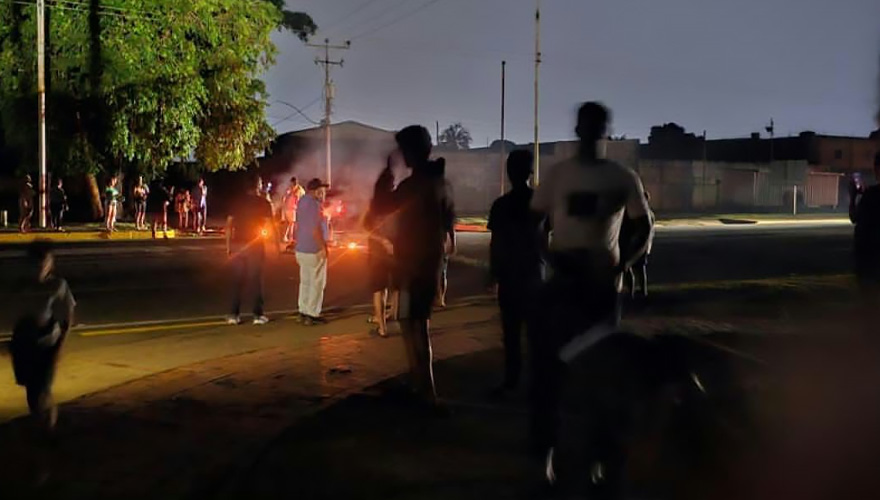
The recurring blackouts have sparked protests, with locals often blocking roads and highways. (El Tigrense)

How did the working class respond to this deterioration you describe?

The workers constantly raised the alarm and denounced the situation. But the response was to ignore their warnings or criminalize them. For example, in 2010, [intelligence agency] SEBIN arrested 11 workers following the explosion of a turbine at the Planta Centro thermoelectric plant in Carabobo State, even though we had warned that the equipment had already reached the end of its useful life.

It is unacceptable that every time there were problems of this nature, management assumed the workers were to blame. All of this also affected the quality of the electricity service.

In short, we have been warning about the possibility of this crisis for many years. In 2008, we issued this warning to the country – and even to President Hugo Chávez – in a report that also included our proposals. After that, between 2009 and 2010, he declared an electricity emergency. 

2011 marked a critical turning point. At that time, workers in the sector, organized in federations such as FETRAELEC, and [state electricity company] CORPOELEC technicians formally warned of an imminent technical and financial collapse of the industry. But after President Nicolás Maduro appointed Jesse Chacón in 2013 and later Luis Motta Domínguez to take charge of the Ministry of Electricity and CORPOELEC, the electricity problem only worsened, leading to the disaster we face today. This crisis has been negatively affecting the lives of millions of Venezuelans on all fronts. Without electricity, water supply, transportation, industries, hospitals, and more come to a standstill.

What might be the possible solutions to the crisis we are facing?

Since January 3, following the US military attack on Venezuela and the tutelage regime imposed afterward, rationing and power outages have increased. Previously, there were 3- or 4-hour blackout periods, sometimes every other day. Now they last 6 or 8 hours, or even longer, every day, with Caracas being the exception.

This worsening situation is directly linked to the increase in oil production. There’s a saying that’s becoming popular: for every barrel of oil extracted, a household is left in the dark. Independent electricity generation for the oil industry would provide some relief from the power rationing that has left Venezuelans overwhelmed and anguished, but it is not the definitive solution to the national electricity crisis.

We, as organized workers, proposed a project for “reactive power compensation” in the electricity grid. This would essentially reduce transmission losses and stabilize the voltage along the lines. It would allow for an immediate increase in the electrical power available to meet demand by optimizing the efficiency of the grid, without requiring an increase in electricity generation. This proposal would apply to high-voltage lines of 765, 400, 230, 138, and 115 kV, and, according to our estimates, we would recover approximately 2,000 MVAr of reactive power that is currently lost due to the grid’s inefficiency. In addition to this, we would be saving hundreds of millions of liters of diesel annually that are used in power plants or independent generators, a significant expense in the national budget. In fact, in 2011, this project was approved in its entirety by CORPOELEC, beginning with Caracas, and a national study was conducted to gradually expand it throughout the country, establishing an order of priority. However, due to administrative changes, it was not carried out.

Venezuelan authorities have pledged to restore 600 MW of generation at the Planta Centro thermoelectric plant in Carabobo State. (Archive)

Workers in the electricity sector have demanded that the sector’s collective bargaining agreement be honored and that the persecution cease. Could you explain these labor demands in more detail? What is the situation for retirees?

As is the case throughout Venezuela, collective bargaining agreements in the public sector have been paralyzed since the government issued and approved the illegal and unconstitutional Memorandum 2792 on October 11, 2018. This memorandum authorized employers to review, modify, or suspend clauses in collective bargaining agreements that they considered “burdensome” or that “jeopardized jobs.” That is why all workers are now facing precarious conditions, and the situation is even more dire for retirees and pensioners.

Furthermore, the imposed guidelines used the minimum wage as the basis for calculating pay scales, eliminating or reducing multiplier factors, professionalization bonuses, seniority pay, and other socioeconomic benefits that were hard-won through working-class struggles. And now the minimum wage is practically zero. Our main demand is that the rule of law be respected, that negotiations on our collective bargaining agreement be restored, and that our basic labor rights be upheld. This is a struggle for the entire Venezuelan working class; it is not limited to the electricity sector, of course.

How do workers view the current opening of the electricity sector to transnational private capital? What will this reform mean for service quality and access, especially for working families?

We have been debating the opening of the electricity sector to private capital in union meetings and open forums. Unfortunately, this is nothing new in the country. This was the case even before Hugo Chávez came to power and the sector was subsequently managed by military personnel who were anything but qualified to do so.

We also face a very difficult situation regarding national sovereignty, stemming from the Trump administration’s effective control over Venezuelan affairs. That is why, now, under these terrible conditions, US capital will come with its respective corporations to take over our natural resources and strategic sectors. It is absolutely outrageous.

The historical precedents of privatized electricity show us that it leads to a profound inequality in access. And the argument of corruption and poor public administration may once again be used to justify privatization. In the 1970s, the Compañía Anónima de Administración y Fomento Eléctrico (CADAFE) and its subsidiaries were victims of severe meddling and sabotage by economic groups and traditional political parties, which turned the company into the poster child of corruption and inefficiency. Then, in the 1990s, they used this as a pretext to carry out a restructuring aimed at privatizing CADAFE. This had a devastating impact on workers, whose ranks were reduced from 3,500 to fewer than 900. With this new opening to private capital, all these risks are repeating themselves.

CORPOELEC workers have demanded the restoration of their collective bargaining agreement. (El Impulso)

Source link

‘Freestyle: A Love Story’ blends romance and Latino joy in 1980s New York

Starring Justina Machado and featuring singer Judy Torres, the 1980s-inspired musical “Freestyle: A Love Story” will make its Los Angeles debut on Nov. 6 at the Wilshire Ebell Theatre.

Bronx-born musician and producer Judy Torres remembers the first time she heard Nayobe’s 1985 song “Please Don’t Go”: the upbeat dance track with an infectious bass line and love-struck lyrics that pleaded with a lover to stay close.

“ I was floored at how beautiful of a vocalist she was,” said Torres of the Afro-Cuban artist, who hailed from Brooklyn but found a musical home in the genre known as freestyle. Though sometimes dubbed as “Latin freestyle” or “Latin hip-hop,” thanks to the many Latino vocalists who came to shape its sound, some fanatics trace the origins of the electro-funk genre to “Let the Music Play,” the 1983 smash hit by D.C. singer Shannon.

As Torres puts it, this distinctly 1980s sound — crafted with synthetic instrumentation and syncopated percussions sourced from Roland TR-808 drum machines, as popularized by Afrika Bambaataa’s 1982 single “Planet Rock” — didn’t have a label then. “It was just music,” she says.

But by 1993, as prominent radio stations transitioned from dance-pop to hip-hop and R&B, the freestyle movement fizzled out.

“Like a record scratch, there were no shows,” added Torres.

The genre’s vibrant, knotty history of set the scene for the musical-dance production of “Freestyle: A Love Story,” of which Torres is a co-producer. Created and directed by George Valencia — alongside his wife, “Scrubs” actor Judy Reyes as executive producer, plus “Ugly Betty” actor Ana Ortiz as co-producer — “Freestyle: A Love Story” will make its Los Angeles debut on Nov. 6 at the Wilshire Ebell Theatre.

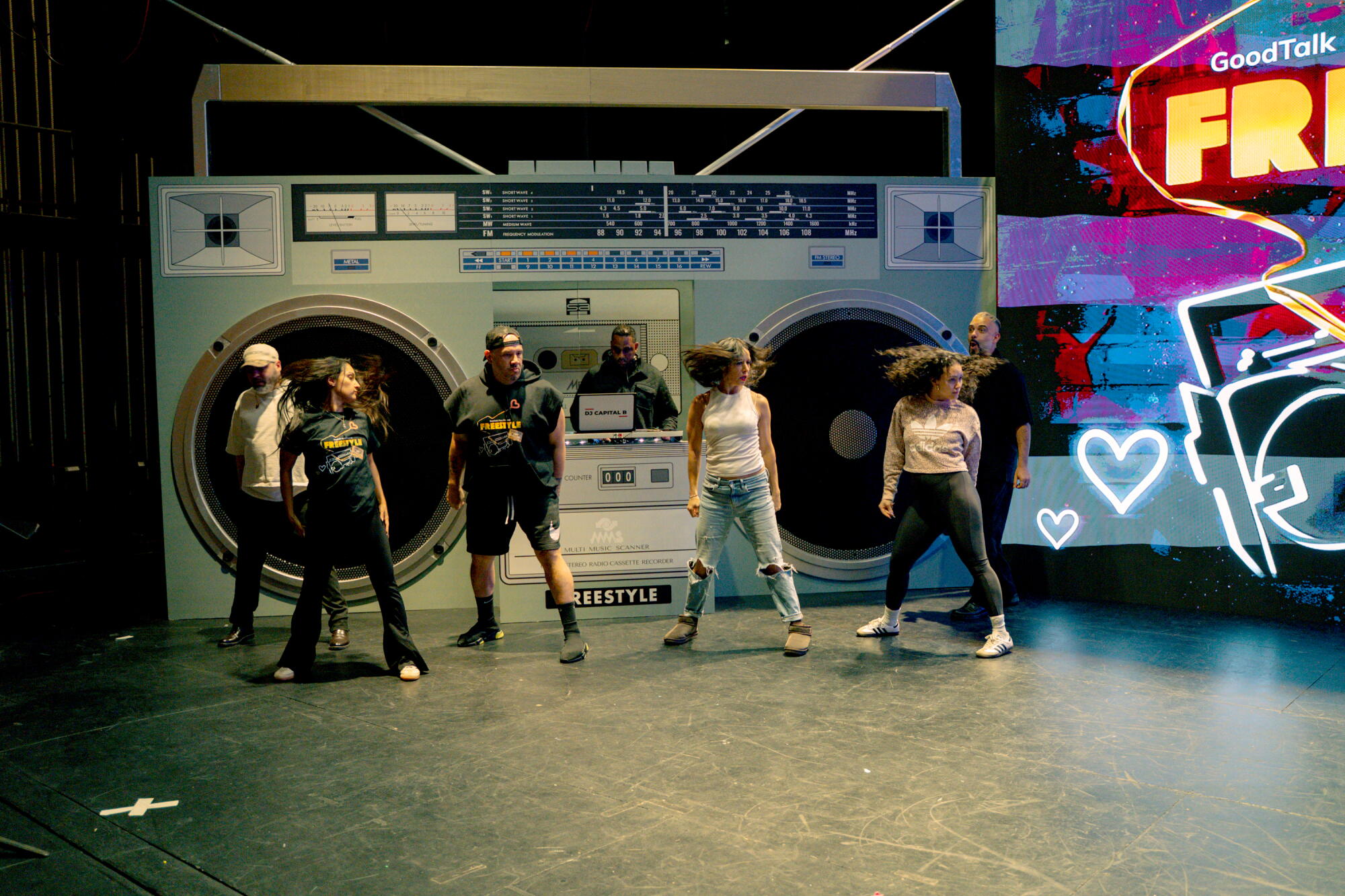
The musical tells the fictional story of two middle-aged Caribbean Latinos, who reunite during a nostalgic night at a Freestyle Extravaganza at New York’s Radio City Music Hall. As 808 kicks echo through the atmosphere, the pair is transported back to 1987: the night they fell in love at a bass-thumping freestyle show.

"Freestyle: A Love Story"

Proceeds from the night will benefit the Sound of GOL Foundation, an organization founded by George Valencia and Judy Reyes that supports Latina soccer players.

(From George Valencia)

“The idea of telling a love story and having that love story run parallel with the actual musical movement of freestyle, which lasted nine years, is basically the whole framework of the play,” said Valencia to De Los.

Proceeds from the night will benefit the Sound of GOL Foundation: an organization founded by Valencia and Reyes, which supports Latina soccer players.

“Right now, in a time that is looking very dark for Latinos in the United States, I want people to take away that our history has proven time and time again that no matter what they do to us, they can’t take away our revolutionary joy,” added Valencia, making mention of the Trump administration’s mass immigration sweeps.

The production will star “One Day at a Time” actors Justina Machado and James Martinez as the former lovers — as well as Torres and K7, a.k.a. Louis Sharpe, frontman of the Latin freestyle group TKA, who will further bring the artists’ perspectives into the narrative.

“It’s the music that was a part of our everyday life,” Machado told De Los. “Wherever there was a huge Latino population, I think it was kind of a rite of passage.”

Machado was particularly obsessed with Lisa Velez, the lead vocalist of Lisa Lisa & Cult Jam, who took freestyle to new heights. The group’s breakout 1985 single “I Wonder if I Take You Home” echoed in the dance clubs before crossing over into mainstream radio and landing the No. 34 spot on the Billboard Hot 100.

Their flamboyant track “Head to Toe,” hit No. 1 on the Billboard Hot 100 in 1987, making it the first time a Latina vocalist (as part of a group) topped the chart.

“When I was on ‘One Day at a Time,’ they knew I loved Lisa Lisa so much they hired her to perform at the wrap party for Season 1,” recalled Machado. “I have a video from 10 years ago, where I am just freaking out — ‘Is that Lisa Lisa?’ I swear I saw nobody else. It was just me and Lisa Lisa … She was my hero.”

Torres said she lost her mind when someone told her Lisa Lisa was Puerto Rican, just like herself. She recalled thinking: “If she can do it, maybe I can do it,”

By 1996, Torres would release her first single, “No Reason to Cry,” a punchy, melodramatic dance track ghostly vocals that reassure someone of her love.

That song reached No. 30 on the Billboard Hot Dance chart the following year. The track was the lead single from her 1989 debut album, “Love Story,” an electrifying project that sonically transports listeners into dramatic telenovela scenarios.

“Freestyle was the original Latin explosion, because it was created in New York, by the people of New York,” said Torres. “It was street kids, Hispanic kids. All of a sudden, the fans were realizing, ‘Wait a minute — this music represents us, the artists look like us.’ It took off so quickly that many of us were signed by major record labels. We were performing all over the country. We had several shows a weekend.”

Still, prominent Latino artists with Spanish surnames, including Torres, were often told they had to change their last name in order to appeal to pop radio stations. She included these experiences into monologues during “Freestyle: A Love Story.”

"Freestyle music was never given flowers,” said Judy Torres.

“Freestyle music was never given flowers,” said Judy Torres.

(From George Valencia)

The artist known as Soavé, who sang the hypnotic 1989 hit “Crying Over You,” revealed to music magazine Wax Poetics in 2010 that his birth name, which is Jeffrey Martinez, “wouldn’t have sold a record.”

Meanwhile, Puerto Rican singer George Lamond, whose 1990 single “Bad of the Heart” peaked at No. 25 on the Billboard Hot 100, professed that he dropped his surname, Garcia, at the behest of his label, Colombia Records. In an interview with Youtuber Honey German, the artist said the label argued that he needed to be more marketable to audiences — but in reality, they didn’t know how to market an artist who was neither Black nor white.

“Now, did I get airplay on the pop stations? No. Is it because I decided to keep [the name] Torres? I’ll never know that,” said Torres. “In a way, we opened the doors [for future Latin stars], because now it’s common for us to hear the last names. Jennifer Lopez, Selena Gomez, Christina Aguilera.”

Torres acknowledged that “freestyle music was never given [its] flowers.” But with “Freestyle: A Love Story,” fans and artists alike can take “a  trip back into time” and revel in its glory for an evening.

“I can’t change it,” said Torres of freestyle’s eventual sunset. “So I have to choose how I’m gonna move forward.”

Source link

PSG vs Barcelona: UEFA Champions League – Yamal, Torres, predictions, teams | Football

Who: Paris Saint-Germain vs Barcelona
What: UEFA Champions League, match day 3
Where: Parc des Princes, Paris, France
When: Tuesday, October 20, at 9pm (19:00 GMT)
How to follow: Al Jazeera Sport will bring you all the build-up and live updates from 16:00 GMT.

One of the most eagerly awaited Champions League matches of the season will be played against the backdrop of turmoil on the streets of the French capital as holders Paris Saint-Germain host Barcelona on Tuesday.

Recommended Stories

list of 4 itemsend of list

The fate of the match has been subject to debate as the French government seeks to control the violent protests gripping the country.

However, once the match gets under way at the Parc des Princes, fans can expect a mouthwatering battle between the Champions League’s top two teams as the back-to-back holders welcome five-time winners.

Boasting a perfect record across all competitions, Spanish giants Barca are arguably one of Europe’s best teams this season.

PSG too have been nothing short of lethal – the Parisians lead the UCL points table and have scored a whopping 10 goals in two games.

There will be plenty of star power on display when the match kicks off as the dazzling duo of Ferran Torres and Ousmane Dembele will headline the star-studded home side.

Lamine Yamal, who is enjoying one of the best starts to a La Liga season for a forward, will be joined by Raphinha for Barcelona.

Here’s everything you need to know ahead of PSG vs Barcelona:

How have PSG played this season?

After seven matches, PSG are second in Ligue 1 with 14 points, behind Lyon on goal difference. They have won four times, drawn twice and lost once in the French top division.

How have Barcelona played this season?

Barcelona are five points clear at the top of La Liga table with nine wins from nine. Their blistering attack has scored 39 league goals.

What happened in the first and second Champions League rounds?

Two-time holders PSG thrashed Slovan Bratislava 6-1 in their UCL opener at home before beating Manchester City 4-2 in a thrilling away fixture.

Barcelona thumped Feyenoord 5-1 at home and bounced back from a goal down to smash Galatasaray 4-1 away.

Those results keep PSG top of the table and Barcelona second, with both on six points.

Barcelona's Spanish forward #10 Lamine Yamal celebrates scoring his team's first goal during the Spanish league football match between Real Betis and FC Barcelona at La Cartuja stadium in Seville on October 17, 2026. (Photo by JORGE GUERRERO / AFP)
Barcelona’s Spanish #10 Lamine Yamal has made an impressive start to the season [File: Jorge Guerrero/AFP]

Will PSG vs Barcelona go ahead amid the protests in France?

Despite the violent protests and nationwide arrests, French Prime Minister Sebastien Lecornu said the match will not be postponed or cancelled.

Lecornu said on Monday that he had asked regional authorities to impose “partial” and “localised” curfews in some cities to protect businesses after weekend demonstrations spilled over into some of the worst street violence in recent years.

“These curfews must be local and partial. It is out of the question to put all of Paris ⁠⁠⁠⁠under curfew.”

At the same news conference, Interior Minister Laurent Nunez told reporters there were no plans to cancel the ⁠⁠⁠⁠match.

Police have arrested at least 2,400 people across France after violent groups clashed with officers and looted shops during nationwide demonstrations that attracted hundreds of thousands of people to denounce rising living costs and poor conditions in schools.

PSG vs Barcelona: Predictions

Opta’s supercomputer has given PSG a 39.7 per cent probability of winning, while Barcelona have a 37.7 per cent chance.

There are 22.6 per cent odds for a draw.

PSG vs Barcelona: Head-to-head

(Only in the Champions League)

  • Matches: 15
  • PSG wins: 6
  • Barcelona wins: 5
  • Draws: 4

PSG vs Barcelona: Form guide

(Last five matches across all competitions; latest game first)

PSG: W-W-W-W-W

Barcelona: W-W-W-W-W

Who are the top players to watch?

Ferran Torres and Ousmane Dembele (PSG): Torres, who joined PSG after four seasons at Barcelona, is their leading scorer with seven goals in all competitions, including an opening day Champions League hat-trick. Dembele has had an all-round impact with six assists and four goals.

Raphinha and Lamine Yamal (Barcelona): With 14 goals, Raphinha is the most prolific striker in European club football this season. Such is his dominance that even a brief injury absence did not take away his top spot. Yamal, on the other hand, has been unstoppable in his own way – the 18-year-old winger’s nine goals and 10 assists make him a once-in-a-generation talent.

Barcelona's Brazilian forward #11 Raphinha (R) celebrates with teammate Spanish forward #10 Lamine Yamal after scoring his team's second goal during the Spanish league football match between Sevilla FC and FC Barcelona at the Ramon Sanchez Pizjuan stadium in Seville on September 19, 2026. (Photo by JORGE GUERRERO / AFP)
Lamine Yamal and Raphinha share 23 goals between them this season [File: Jorge Guerrero/AFP]

Team news and predicted lineups

PSG

PSG suffered a major blow shortly before Tuesday’s trip when left-back Nuno Mendes suffered a thigh injury during their 3-1 Ligue 1 victory at Strasbourg on Saturday.

Mendes will be unavailable for the “next few weeks”, according to the team who are also without Senny Mayulu with a similar issue.

Predicted starting XI: 

Matvey Safonov; Achraf Hakimi, Marquinhos, Willian Pacho, Lucas Digne; Warren Zaire-Emery, Vitinha, Fabian Ruiz; Maghnes Akliouche, Ousmane Dembele, Desire Doue

Ferran Torres, who also helped Spain win the FIFA World Cup 2026, celebrates scoring a hat-trick against Slovan Bratislava
Ferran Torres, who also helped Spain win the FIFA World Cup 2026, celebrates scoring a hat-trick against Slovan Bratislava [File: Franco Arland/Getty Images]


Barcelona

Barcelona have been strengthened by the return of striker Raphinha and midfielder Frenkie de Jong.

Raphinha picked up a knock on recent international duty with Brazil and missed Barca’s wins over Getafe in the league and Galatasaray in the Champions League. Dutch international De Jong has not featured this season due to a knee issue sustained during the World Cup.

Both were on the bench in Barca’s last game, a 5-2 win over Real Betis, with Raphinha coming on as a second-half substitute.

However, defenders Eric Garcia and Jules Kounde are sidelined. Garcia will spend between “three to four weeks” out with a thigh injury, while right-back Kounde suffered an ankle sprain and will miss the game against PSG.

Predicted starting XI: 

Joan Garcia; Xavi Espart, Pau Cubarsi, Gerard Martin, Joao Cancelo; Fermin Lopez, Rodri, Pedri; Lamine Yamal, Raphinha, Anthony Gordon

Source link