top news

French lawmakers advance ban on social media for children under 15

Jan. 27 (UPI) — Legislators in France took the first step toward becoming the first European country to block children from social media with a ban that would take effect at the beginning of the new school year in September.

National Assembly members voted 116-23 for the ban for children younger than 15, which was introduced by a lawmaker representing France’s Champagne region in President Emmanuel Macron‘s Renaissance party, late Monday.

The MPs amended the bill to empower the country’s media regulator to decide which social media services will be included in the ban and not limited to just those most popular with teens such as TikTok, Snapchat and Instagram.

The law would use an as-yet-undecided method of age-verification to block children from accessing those sites the regulator determines are most harmful to children’s mental and emotional health.

An existing smartphone ban for children in junior and middle schools would also be extended to high schools, under the legislation.

Children younger than 15 would be permitted to continue to use platforms on a second list deemed to pose less risk to them, but only if their parents give their consent.

Hailing the vote as a “major step,” Macron urged the Senate, the upper house, where it must also pass to become law, to follow suit and vowed to make sure it was implemented in time for the start of the fall semester.

“To ensure that this ban is effective from the start of the next academic year, I have asked the government to activate the accelerated procedure,” he posted on X.

“Because our children’s brains are not for sale. Not to American platforms, nor to Chinese networks. Because their dreams cannot be dictated by algorithms. Because we do not want an anxious generation,” Macron added.

Fastracking the law will enable it to leapfrog over a logjam in the assembly which has been unable to pass a budget for this year.

National Assembly Deputy Laure Miller, sponsor of the bill, complained afterward that opponents attempted to run the debate, which went on for almost seven hours, off the clock, knowing they would lose when it came to a vote.

“We explained everything to you, but you didn’t want to listen. Obstruction, off-topic remarks, conspiracy-laden speeches… above all, you tried everything to avoid having to vote on this text. Pathetic,” she wrote online.

Miller headed a committee probe into the psychological impact of social media on children that issued its report earlier this month.

MP Louis Boyard from the populist France Insoumise party said the bill had been rushed through.

By granting blanket verification powers to the government and the European Union to check the ages of all social media users, regardless of age, Macronist deputies were sleepwalking France into a surveillance state,” he said on X.

“The Macronists refused to respond or speak in order to have it voted on as quickly as possible. Under the pretext of banning social networks for those under 15, the Macronists seem to be preparing to have everyone monitored.”

He urged the Senate to send it back to the assembly to allow a “more enlightened” public debate to take place.

“The subject is too important to be rushed,” added Boyard, who represents a different district of the same region as Miller.

The development in France comes amid similar efforts being weighed across Europe, including in Greece, Spain, Denmark, Ireland, and Britain, where the House of Lords voted through a ban for children under 16 on Wednesday.

Lawmakers in the upper chamber of parliament passed the amendment to the Children’s Wellbeing and Schools Bill by 261 votes to 150, however, the government signaled it intended to overturn the effort in the House of Commons, the lower house.

The move came two days after the government launched a consultation on a potential ban for under-16s in the wake of the lead taken by Australia, which last month became the first Western country to implement such a ban.

Picketers hold signs outside at the entrance to Mount Sinai Hospital on Monday in New York City. Nearly 15,000 nurses across New York City are now on strike after no agreement was reached ahead of the deadline for contract negotiations. It is the largest nurses’ strike in NYC’s history. The hospital locations impacted by the strike include Mount Sinai Hospital, Mount Sinai Morningside, Mount Sinai West, Montefiore Hospital and New York Presbyterian Hospital. Photo by John Angelillo/UPI | License Photo

Source link

Hyundai ADM Bio to start trials of arthritis, prostate cancer therapy

Dr. John Isaacs from Newcastle University in the United Kingdom speaks on a next-generation rheumatoid arthritis and cancer therapy, Penetrium, during a symposium in Seoul on Tuesday. Photo courtesy of Hyundai ADM Bio

SEOUL, Jan. 27 (UPI) — South Korea’s Hyundai ADM Bio announced plans to launch global clinical trials of its new drug, Penetrium, for rheumatoid arthritis and prostate cancer during a symposium held in Seoul on Tuesday.

Citing promising preclinical results, the biopharmaceutical company said that it aims to begin the clinical tests in the near future.

“In the field of rheumatoid arthritis, we expect to enter clinical trials simultaneously in South Korea and the United States,” Hyundai ADM Bio CEO Cho Won-dong said. “For prostate cancer, we have already received approval from the Korean authorities.”

Dankook University professor Choy Jin-ho, who played a key role in the development of Penetrium, expressed hope that the new-concept drug could bring about a paradigm shift in the fight against multiple diseases, including other types of tumors in addition to prostate cancers.

“A significant portion of anticancer drug resistance is not caused by genetic mutations in cancer cells themselves, but rather by the formation of stroma around them during treatment, which acts like a fortress wall blocking drug penetration,” he said.

Choy said Penetrium was designed to target the “fortress wall,” or the supportive structure around cancer cells, so that drugs could be delivered more effectively.

The symposium brought together experts at home and abroad. Among them were Dr. John Isaacs, professor clinical rheumatology at Newcastle University in the United Kingdom, and Dr. Frederick Millard, a professor of medicine at UC San Diego Health.

Isaacs is one of the leading experts on rheumatoid arthritis, while Millard is known for his contributions to prostate cancer research.

Noting that conventional rheumatoid arthritis treatments often involved immune suppression and significant side effects, Isaacs praised Hyundai ADM Bio’s approach of controlling only the metabolism of pathological cells without suppressing the immune system.

Millard expressed optimism about the new strategy breaking down the protective barriers that shield cancerous cells, instead of targeting them for direct destruction.

The share price of Hyundai ADM Bio jumped 13.56% on the Seoul bourse on Wednesday. Its parent company, Hyundai Bioscience, surged by the daily limit of 30%.

Source link

North Korea fires short-range ballistic missiles toward East Sea

North Korea launched multiple short-range ballistic missiles toward the East Sea on Tuesday afternoon, Seoul’s military said. In this photo, people watch news of the launch at a train station in Seoul. Photo by Jeon Heon-kyun/EPA

SEOUL, Jan. 27 (UPI) — North Korea launched multiple short-range ballistic missiles toward the sea between the Korean Peninsula and Japan on Tuesday afternoon, Seoul’s military said, marking a fresh provocation ahead of a major ruling party congress.

“Our military detected several short-range ballistic missiles launched from an area north of Pyongyang into the East Sea around 3:50 p.m. today,” South Korea’s Joint Chiefs of Staff said in a text message to reporters.

The missiles flew approximately 217 miles, the JCS said, adding that South Korean and U.S. intelligence authorities are conducting a detailed analysis of their exact specifications.

“Under a robust South Korea-U.S. combined defense posture, the military is closely monitoring North Korea’s various movements and maintaining the capability and readiness to overwhelmingly respond to any provocation,” the JCS said.

Japan’s Defense Ministry said it detected two ballistic missiles, both of which splashed down outside Tokyo’s exclusive economic zone.

The launch marked North Korea’s second missile test of the year, following a Jan. 4 firing of what Pyongyang described as hypersonic weapons.

The test took place ahead of the Ninth Congress of the ruling Workers’ Party of Korea, which is widely expected to be convened by early next month. The congress is seen as a forum for the leadership to review policy performance, announce a new five-year economic plan and signal potential shifts in military and foreign policy priorities.

The missile launch also coincided with a three-day visit to South Korea by U.S. Under Secretary of Defense for Policy Elbridge Colby, who traveled on to Japan Tuesday afternoon. During his meetings in Seoul, Colby discussed issues including the security situation on the Korean Peninsula, the transfer of wartime operational control and South Korea’s pursuit of nuclear-powered submarines.

His trip followed the Pentagon’s release of a new National Defense Strategy calling on South Korea to assume primary responsibility for deterring North Korea.

In a statement sent to reporters, U.S. Forces Korea said it was aware of the launch and was consulting with allies and partners.

“Based on current assessments, this event does not pose an immediate threat to U.S. personnel or territory, or to our allies,” the statement said. “The United States remains committed to the defense of the U.S. homeland and our allies in the region.”

Source link

S. Korea calls China’s removal of steel tower in Yellow Sea ‘meaningful progress’

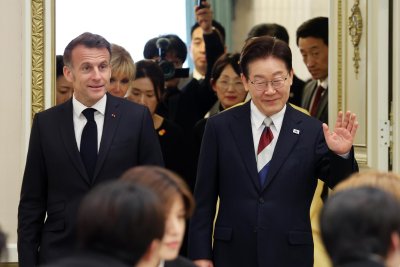
South Korea on Tuesday called China’s decision to remove a disputed steel structure from overlapping waters in the Yellow Sea “meaningful progress.” The subject came up during President Lee Jae Myung’s (L) summit with Chinese President XI Jinping in Beijing in early January. Photo by Yonhap/EPA

Jan. 27 (UPI) — South Korea on Tuesday called China’s decision to remove one of the disputed steel structures from their overlapping waters in the Yellow Sea “meaningful progress” that would help advance bilateral ties.

The foreign ministry made the comment after Being announced that work was in progress to remove part of the three steel structures built in the sea zone where the two countries’ exclusive economic zones (EEZs) overlap.

China built two semi-submersible buoys in 2018 and 2024 and a fixed steel platform in 2022 in the Provisional Maritime Zone (PMZ). The issue has been a source of tensions in bilateral relations, as Seoul has regarded the installations as Beijing laying the potential groundwork for future territorial claims.

“As we have continued talks with China on the matter based on our consistent position that we oppose the unilateral installations of the structures in the PMZ, we assess the latest move as meaningful progress,” Kang Young-shin, director general for Northeast and Central Asia affairs, told reporters.

“The measure can be seen as a change that would help advance South Korea-China relations,” Kang said.

Another ministry official said China would be moving the management platform out of the PMZ, with the operation expected to begin at 7 p.m. Tuesday (local time) and run through Saturday, citing the notice from China’s maritime authorities.

“We have maintained our constructive dialogue with the Chinese side and will continue to seek further progress going forward,” Kang added.

Chinese foreign ministry spokesperson Guo Jiakun said in a briefing that a Chinese company was carrying out the work to remove the management platform, an autonomous operation in progress led by the company in line with its management and development needs.

Seoul and Beijing have agreed to draw the PMZ line as a tentative measure amid the stalled talks over EEZ demarcation in order to allow fishing vessels to operate safely and jointly manage marine resources in the area, while prohibiting activities beyond navigation and fishing.

South Korea has argued that China’s installations of the steel structures run counter to such efforts.

Following the summit talks in Beijing with Chinese President Xi Jinping earlier this month, President Lee Jae Myung said China was expected to remove one of the three steel platforms from the Yellow Sea.

Beijing’s move came after the two countries reportedly reached an understanding that the management platform should first be pulled out of the PMZ, following concerns raised in Seoul over the possibility that the structure could be diverted for other uses.

The platform that China claims to be a management facility for the fish farm is believed to be a repurposed decommissioned oil rig.

Copyright (c) Yonhap News Agency prohibits its content from being redistributed or reprinted without consent, and forbids the content from being learned and used by artificial intelligence systems.

Source link

ICE agents from US set to help with security at Winter Olympics in Italy | Winter Olympics News

The 2026 Milano Cortino Winter Olympics are set to begin on February 6, with shock at the late news of ICE involvement.

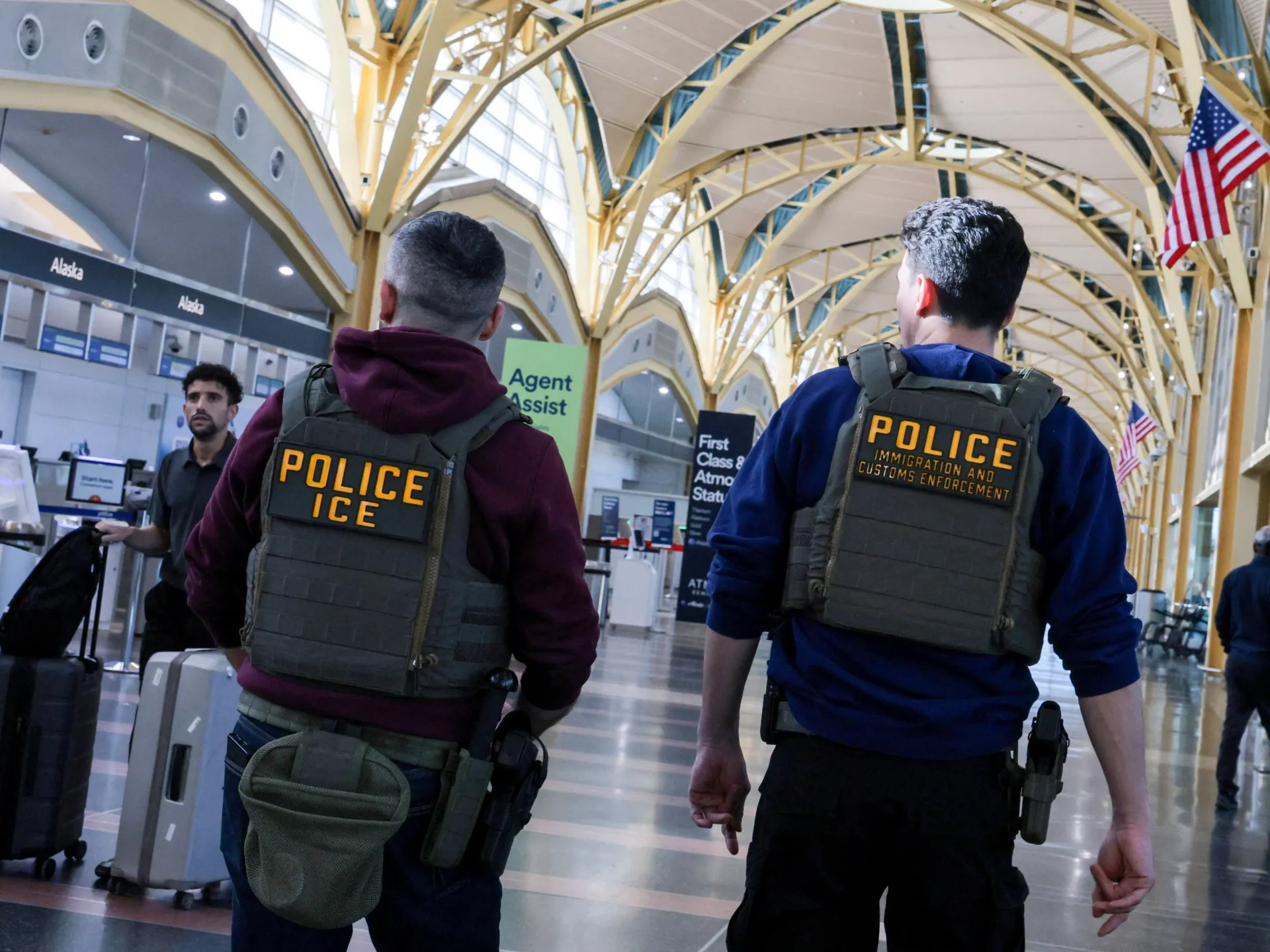
Agents from the United States’ divisive Immigration and Customs Enforcement (ICE) will help support US security operations for the Winter Olympic Games in Italy next month, a spokesperson told the AFP news agency.

“At the Olympics, ICE’s Homeland Security Investigations is supporting the US Department of State’s Diplomatic Security Service and host nation to vet and mitigate risks from transnational criminal organisations,” the agency said in a statement.

Recommended Stories

list of 4 itemsend of list

“All security operations remain under Italian authority.”

It added: “Obviously, ICE does not conduct immigration enforcement operations in foreign countries.”

The potential presence of ICE agents at the February 6-22 Milano-Cortina Games has prompted huge debate in Italy, following the outcry over the deaths of two civilians during an immigration crackdown in Minneapolis.

Italian authorities initially denied the presence of ICE and then sought to downplay its role, suggesting its agents would only help in security for the US delegation.

US Vice President JD Vance and Secretary of State Marco Rubio are attending the opening ceremony in Milan on February 6.

On Monday, the president of the northern Lombardy region, which is hosting several of the Olympic events, said ICE’s involvement would be limited to monitoring Vance and Rubio.

“It will be only in a defensive role, but I am convinced that nothing will happen,” Attilio Fontana told reporters.

However, his office then issued a statement saying he did not have any information on their presence, but was responding to a hypothetical question.

Thousands of ICE agents have been deployed by President Donald Trump in various US cities to carry out a crackdown on undocumented immigration.

Their actions have prompted widespread protests, and the recent killings of US citizens Renee Good and Alex Pretti, both 37, on the streets of Minneapolis, has led to outrage.

The US will host the 2028 Summer Olympics, with the Games being staged in Los Angeles.

Source link

South Korea to send delegation to U.S. after Trump’s tariff hike

SEOUL, Jan. 27 (UPI) — South Korea will dispatch a delegation of senior trade and industry officials to Washington after U.S. President Donald Trump announced a sharp increase in tariffs on Korean goods, the Ministry of Trade, Industry and Resources said Tuesday.

Trade Minister Yeo Han-koo and Industry Minister Kim Jung-kwan will travel to the United States to meet their counterparts for talks on the tariff hike, the ministry said in a press release.

The decision was made at an emergency interagency meeting chaired by presidential chief of staff for policy Kim Yong-beom, convened hours after Trump’s surprise announcement on social media.

Trump said he was raising his so-called “reciprocal” tariffs on South Korea from 15% to 25%, accusing Seoul’s National Assembly of failing to act quickly enough to implement a bilateral trade deal finalized late last year.

“South Korea’s Legislature is not living up to its Deal with the United States,” Trump wrote earlier Tuesday on his Truth Social platform.

He said the higher tariffs would apply to automobiles, lumber, pharmaceuticals and other goods covered by the agreement.

The legislation to implement the deal was submitted to the National Assembly by the ruling Democratic Party in November but has yet to be passed.

Kim, who is currently in Canada, will travel to Washington as soon as his schedule allows to meet with U.S. Commerce Secretary Howard Lutnick, according to the ministry. Yeo will depart from Seoul to hold talks with U.S. Trade Representative Jamieson Greer.

Trump and South Korean President Lee Jae Myung finalized trade negotiations on the sidelines of the Asia-Pacific Economic Cooperation forum in Gyeongju on Oct. 29.

The two sides released a fact sheet in November detailing the terms of the deal, under which Trump’s tariffs on South Korean goods, including automobiles, would be reduced from 25% to 15%.

In exchange for the lower tariffs, South Korea pledged to invest $350 billion in the United States, including $150 billion in the U.S. shipbuilding sector and $200 billion for strategic industries under a memorandum of understanding to be signed by the two governments.

The fact sheet also formalized Washington’s approval of Seoul’s long-sought plan to build nuclear-powered submarines, a capability South Korean officials have framed as part of broader industrial and security cooperation with the United States.

The tariff move comes amid a dispute involving a South Korean regulatory probe into Coupang, a U.S.-listed e-commerce company, following a large-scale data breach.

On Friday, South Korean Prime Minister Kim Min-seok said he addressed the matter directly in talks with U.S. Vice President JD Vance, stressing that American firms had not been unfairly targeted.

“I made it clear that there has been no discriminatory treatment against U.S. companies,” Kim told Korean correspondents in Washington, D.C.

Following Tuesday’s emergency meeting, South Korea’s presidential office said it would react “calmly” to the announced tariff increase.

“Since the tariff increase will only take effect after administrative procedures such as publication in the Federal Register, the Korean government plans to calmly respond while conveying its commitment to implementing the tariff agreement to the U.S. side,” presidential spokeswoman Kang Yu-jung said in a written briefing.

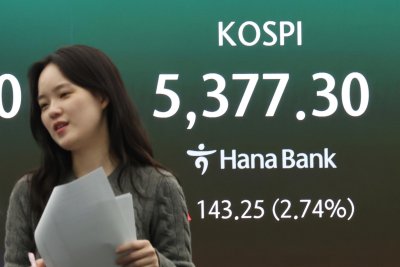
South Korean stocks initially fell on the tariff news, with the benchmark KOSPI dropping by 0.84% in the first 15 minutes of trading before reversing early losses to gain 2.73% and close at an all-time high of 5,084.85.

Source link

PPP leader discharged after hunger strike as Han expulsion timing unclear

People Power Party floor leader Song Eon-seok speaks at a general meeting of lawmakers at the National Assembly in Seoul on Monday. Photo by Asia Today

Jan. 26 (Asia Today) — People Power Party leader Jang Dong-hyuk was discharged from a hospital Monday after four days of treatment following an eight-day hunger strike, but party officials said the timing of major pending decisions, including a motion to expel former party leader Han Dong-hoon, remains uncertain.

The conservative People Power Party said Jang has expressed a strong desire to return to party duties soon, but medical staff advised he needs rest and recovery. The party said Jang will continue examinations and outpatient treatment after leaving the hospital.

Jang was taken from the National Assembly hunger strike site on a stretcher Thursday and hospitalized. He had staged the hunger strike from Jan. 15 to Jan. 22, urging the Democratic Party to accept what the party calls “dual special prosecutors” to investigate allegations tied to the Unification Church and a separate nomination-related bribery case.

At a general meeting of lawmakers Monday, People Power Party floor leader Song Eon-seok called for unity as the party prepares to resume its campaign as the main opposition force. Song said the special prosecutor bills are needed to ensure “black money” does not take root, arguing no one should be exempt from scrutiny.

Even if Jang returns to party work as early as Wednesday, party leaders said it is unclear when the expulsion motion involving Han will be submitted as an agenda item. Chief spokesperson Park Sung-hoon told reporters that the motion was not on Monday’s agenda and said its timing has not been decided.

Park said the period to request a retrial in Han’s disciplinary case has passed and that Han did not submit a defense during that window, leaving the next step dependent on Jang’s decision.

Park added that Jang’s condition appears more serious than initially expected, citing cardiopulmonary symptoms and low oxygen saturation. He said further examinations, including cardiac testing, were scheduled Monday and that the disciplinary motion could be handled as early as Monday.

— Reported by Asia Today; translated by UPI

© Asia Today. Unauthorized reproduction or redistribution prohibited.

Original Korean report: https://www.asiatoday.co.kr/kn/view.php?key=20260127010012299

Source link

Jeju police bust international drug smuggling ring, arresting 12

Police on South Korea’s Jeju Island announce the arrest of 12 people accused of being part of a drug smuggling ring. Photo by Yonhap News Service/UPI

JEJU ISLAND, South Korea, Jan. 27 (UPI) — Authorities on Jeju Island have busted a drug smuggling ring, arresting 12 people accused of trying to import methamphetamine into South Korea through the popular tourist resort island.

The Jeju Provincial Police Agency’s Narcotics Crime Investigation Unit said in a statement Monday that the arrests come after a months-long investigation that began in late October after a non-Korean smuggled about 1.2 kilograms, or 2.5 pounds, of methamphetamine into Jeju in his suitcase.

Police said the alleged courier was a Chinese national in his 30s who departed an airport in Thailand on Oct. 23 for Jeju via Singapore, according to local media.

A police report from late October states that after arriving on Jeju on Oct. 24, the suspect posted an advertisement on social media for a Korean to deliver the package to the mainland.

Jeju Island is visa-free for nationals from all but 23 countries, but those entering visa-free cannot then travel to mainland Korea without proper authorization.

According to police, a Korean man in his 20s replied to the advertisement and received the bag from the suspect on Oct. 27.

Suspecting the bag to contain a bomb, the unidentified Korean citizen contacted the police, resulting in authorities seizing the bag of drugs and the arrest of the suspect at a hotel in Jeju’s northeastern coastal village of Hamdeok.

Through the investigation, Jeju police identified what they described as a “tightly structured distribution network” of drug smuggling, distribution, sale and use.

“Over a three-month period, investigators persistently tracked suspects through stakeouts and investigative trips to Seoul and other regions,” the Jeju Provincial Police Agency said Monday in a statement.

Jeju police said Monday that they have requested an Interpol Red Notice for the operation’s ringleader and smuggling coordinator.

Of the 12 people arrested, seven remain in pretrial detention, according to authorities, who identified two of the arrested as distributors of the alleged drug smuggling organization and five buyers who had received and used methamphetamine.

“Although investigators faced significant difficulties in tracking the organization’s cell-based structure — where accomplices repeatedly recruited couriers through part-time employment under the direction of overseas ringleaders — police ultimately dismantled the domestic-foreign national network through long-term surveillance and extended investigative operations,” Jeju police said.

The development comes as packages of drugs, often ketamine, have repeatedly been discovered washed ashore on Jeju since September.

On Jan. 9, the Jeju Regional Maritime Police Agency announced that the drugs that have washed ashore stem from “a large-scale drug loss incident” in waters off western Taiwan in July. Taiwanese authorities discovered about 140 kilograms, or 308 pounds, of ketamine disguised in green and silver tea bag-style packaging in its waters.

Authorities continue to investigate the criminal group responsible.

A total of 34 kilograms, or 74 pounds, of drugs have washed ashore in Jeju since September, with the last discovery of narcotics in the province occurring Dec. 9 on Udo, a small islet off eastern Jeju.

Source link

Lives on hold for two years: Hope, fear stuck behind Gaza’s Rafah crossing | Israel-Palestine conflict News

Deir el-Balah and Khan Younis, Gaza – For the past two years, Khitam Hameed has clung to the hope of a single sliver of news that could fundamentally change the fate of her entire family.

The reopening of the Rafah crossing, shut and controlled by Israel as part of its genocidal war on Gaza in spite of a ceasefire agreement, would allow her family to travel and reunite with her husband outside Gaza.

Recommended Stories

list of 4 itemsend of list

But for this family, the reopening is not just about freedom of movement. It represents both a chance for reunion after a long separation, and an opportunity to secure treatment for their son, whose life, schooling, and normal childhood have all been destroyed by the two-year Israel-Palestine war.

With the United States pushing a deeply intransigent Israel to progress to phase two of the ceasefire that began on October 10, the reopening of the Rafah crossing was directly tied by the far-right government to the recovery of the remains of the final Israeli captive, and only partially for pedestrian use under strict military supervision.

On Monday, the retrieval of the last Israeli captive’s body appeared to open that locked door, with thousands in urgent need of treatment or family reunification in a state of anxious anticipation.

From her family’s displacement site in the Nuseirat refugee camp near Deir el-Balah in central Gaza, Khitam, 50, a mother of six, sits trying to organise her thoughts as news circulates about Rafah.

Next to her is her 14-year-old son, Yousef, unable to walk, suffering from a rare genetic disorder called Ehlers-Danlos Syndrome (EDS), a painful condition primarily affecting his bone development, with potential cardiac complications.

“Yousef has been undergoing treatment for this syndrome since he was very young … he has had around 16 surgeries,” Khitam tells Al Jazeera.

“We got used to hospitals, but before the war, there was some monitoring and a little hope.”

Since long before October 2023, the Rafah crossing between Gaza and Egypt has been a lifeline for Palestinians, not only as a natural exit and entry point, but also as a symbol of connection with the outside world.

Before the war, the crossing was heavily used by patients seeking medical treatment, families visiting relatives abroad, and the movement of goods and supplies that helped ease Gaza’s economic pressure under Israeli blockade.

Its closure, beginning in May 2024 after Israeli forces took control, marked a dramatic turning point in the humanitarian crisis.

The shutdown affected not just the movement of people, but also significantly reduced the flow of medical aid and essential supplies, impacting thousands of patients waiting for treatment outside Gaza, including children and the wounded, amid a severe shortage of health services and medical equipment.

‘Opening the crossing shouldn’t be a miracle’

Before the war, Khitam and her family monitored Yousef’s condition regularly, and he could walk and move.

But the war halted everything. Hospitals were routinely bombed by Israel, and most ceased functioning. Medics were killed by the hundreds, medications ran out, and medical checkups became nearly impossible.

“Since the war, Yousef’s condition has deteriorated. His legs are weaker, walking is harder, he uses crutches,” Khitam pauses before continuing: “He falls often… and my heart is in my throat every time.”

The mother no longer knows the full extent of her son’s health. “I don’t know if he has heart complications, or if his spine has worsened … we are living with him with no answers.”

The war also separated the family. Weeks before the conflict erupted, Khitam’s 52-year-old husband, Hatim, had left Gaza for Egypt, as an initial step to secure a chance for the family to migrate and access advanced medical care for Yousef.

“Since then, I’ve been alone. Six children, one with a special medical condition, war, displacement, hunger,” Khitam says, her voice exhausted.

“Being displaced alone is so difficult. You don’t know where to go, how to protect your children, how to provide food or safety. The constant anxiety and fear have affected everyone, but Yousef suffers the most.”

“No school, no play, no outings, no treatment … even psychologically, he is exhausted. A child his age should be living his life, not caught between war and illness.”

But, she adds, “just the idea of travelling eases us a bit psychologically. It feels like a door might open” for treatment outside of the besieged enclave.

She still fears how the crossing will operate, even as hope keeps her going.

“Even if the crossing opens, not everyone can leave, and not every case will be approved,” she adds. “Opening the crossing shouldn’t be a miracle… it’s a right.”

Yousef’s story intersects with those of hundreds of families of sick children in Gaza, for whom Rafah is not just a crossing, but a lifeline.

‘The family started a new battle against time’

Local estimates indicate that more than 22,000 patients and injured people, including about 5,200 children, are unable to travel for treatment due to the Israeli closure, with thousands more waiting for approved medical transfers that cannot be executed.

Among them is Hur Qeshta, a newborn girl only 15 days old, born with a large, unusual tumour in her neck, affecting breathing and swallowing.

She requires urgent surgery outside Gaza, according to doctors at Nasser Hospital in Khan Younis, in southern Gaza.

Her mother, Doaa Qeshta, 32 and a mother of five, tells Al Jazeera, “From the first moment she was born, the family started a new battle against time to ensure she could urgently travel for treatment.”

Hur was delivered via Caesarean section and now lies in the Nasser Hospital neonatal ICU, on oxygen and fed via a tube from her abdomen.

“She can’t breastfeed, everything is through a tube, and the mass is growing rapidly … all within 15 days,” says her mother.

Doctors confirmed that surgery inside Gaza is currently impossible due to a lack of facilities.

Doaa links her daughter’s condition to the circumstances during her pregnancy, including displacement in a tent in al-Mawasi, exposure to nearby shelling, smoke, gunpowder, hunger, and lack of nutrition.

“I was pregnant during famine … no food, no vitamins, no safety,” she recalls. “Shelling was nearby, 300 metres (980 feet) away… the tent shook; we thought we were dead.”

“Opening the crossing means saving my daughter’s life,” she says. “I’ve registered the whole family as companions … the most important thing is Hur goes, gets treatment, and survives.”

Of the reopening of the Rafah crossing, Doaa says, “We hear news and live on hope, but we are really in a limbo… we don’t know what’s happening or when. We just pray this is true.”

‘Our lives and futures hang on a hope’

The effects of Rafah’s closure go beyond medical access, affecting an entire generation of youth whose education has been halted at a closed gate.

Among those affected is Rana Bana, a 20-year-old from the Daraj neighbourhood in Gaza City.

She graduated from high school in 2023 with a 98 percent average in the science track, with a focus on pharmacy. Within a single year, she received multiple opportunities abroad, but none materialised due to Rafah’s closure.

“In 2024, I was accepted for a scholarship in Egypt, ready to leave, but the crossing closed. A year later, I got a scholarship to Turkiye, did the online interviews, was accepted, and since then I’ve been stuck,” Rana tells Al Jazeera.

Her Turkish scholarship includes 220 students from Gaza, all from different disciplines, most with high academic grades.

Over the past two years, Rana tried not to stagnate, taking Turkish language courses and exploring alternatives like local universities. But she would hold back each time she heard news of Rafah possibly reopening.

“Every time there’s news the crossing might open, I tell myself, ‘Let me wait a bit’… but it turns out to be just talk, and my hopes are dashed,” she adds. “A lot of our time and life has been wasted waiting … our lives and futures hang on a hope.”

Rana is displaced with her family of eight. They returned briefly to northern Gaza during the first ceasefire, found their home intact, but fled again after fighting resumed, and are now settled in Deir el-Balah.

“My biggest fear is leaving and not being able to come back,” she says. “Before, they [her family] were 100 percent supportive. Now there’s fear because the travel process is unclear, and they don’t know how many will be allowed or registered to travel.”

Many Palestinians fear leaving Rafah would be a one-way ticket as part of an openly touted Israeli plan to permanently expel the population from Gaza.

“We students and youth are the most affected group during the war,” Rana says. “Our years have gone by silently, our studies destroyed by war, and no one talks about us. All we want is education — not travel for tourism or anything else.”

Source link

Korea foreign currency deposits jump on won volatility

Resident foreign currency deposit balances by currency in December 2025. Data from Bank of Korea. Graphic by Asia Today; translated by UPI.

Jan. 26 (Asia Today) — South Korea’s resident foreign currency deposits rose sharply in December as renewed volatility in the won-dollar exchange rate prompted households and companies to park more money in dollars and other foreign currencies, central bank data showed.

Resident foreign currency deposits at local foreign exchange banks stood at $119.43 billion at the end of December, up $15.88 billion from the previous month, the Bank of Korea said.

Market participants increased foreign currency holdings as the exchange rate swung on expectations of further won weakness and repeated government and financial regulator efforts to curb sharp moves, the report said.

The won opened December near 1,470 per dollar and climbed into the 1,480 range by the end of the month before dropping below 1,450 following stronger verbal intervention by authorities. Since the start of the new year, the exchange rate has repeatedly moved higher and then retreated amid official efforts to stabilize the market.

The Bank of Korea said after its Jan. 15 policy meeting that most of the won’s recent weakness reflected external factors, with domestic factors accounting for roughly a quarter, while adding that authorities can mainly focus on smoothing short-term spikes.

Analysts said the dollar could lose some strength from prior levels, reducing the chance of a repeat of last year’s sharp surge in the exchange rate, as uncertainty rises over the U.S. interest-rate path amid growing political pressure on the Federal Reserve.

Park Sang-hyun, an analyst at iM Securities, said the dollar’s influence appears to be “temporarily weakening,” adding that inflation and employment data and political pressure could increase expectations for U.S. rate cuts.

— Reported by Asia Today; translated by UPI

© Asia Today. Unauthorized reproduction or redistribution prohibited.

Original Korean report: https://www.asiatoday.co.kr/kn/view.php?key=20260126010012006

Source link

Russia-Ukraine war: List of key events, day 1,433 | Russia-Ukraine war News

These are the key developments from day 1,433 of Russia’s war on Ukraine.

Here is where things stand on Tuesday, January 27:

Fighting

  • At least two people were injured after Russian forces launched a drone and missile attack on Kharkiv, Ukraine’s second-largest city, Mayor Ihor Terekhov said. The attack also damaged apartment buildings, a school, and a kindergarten, he added.

  • Russian drones also hit a high-rise apartment building in Ukraine’s Kryvyi Rih, President Volodymyr Zelenskyy’s hometown southeast of Kharkiv. The head of the city’s military administration, Oleksandr Vilkul, said the attack triggered a fire, but there were no immediate reports of casualties.
  • A Russian drone and missile attack on the Ukrainian capital damaged parts of the Kyiv-Pechersk Lavra, Ukraine’s most famous religious landmark and a UNESCO World Heritage Site, Ukraine’s Ministry of Culture said in a statement.
  • In Russia, one person was killed following a Ukrainian drone attack in the border region of Belgorod, Governor Vyacheslav Gladkov said on the Telegram messaging app.
  • Ukraine’s military said it struck the Slavyansk Eko oil refinery in Russia’s Krasnodar region overnight. The military said in a statement that parts of the primary oil processing facility were hit. There were no initial reports of casualties.
  • One person was injured, and two business enterprises caught fire in the city of Slavyansk-on-Kuban – also in Russia’s Krasnodar – after fragments fell from a destroyed drone, the regional emergencies centre said.

  • Russia’s Ministry of Defence said that air defence systems had intercepted and destroyed 40 Ukrainian drones overnight, including 34 in the Krasnodar region.

Military aid

  • NATO Secretary-General Mark Rutte said Ukraine’s interception rate of Russian missiles and drones has decreased due to Kyiv having fewer weapons to protect it from incoming attacks. Rutte urged allies to dig into their stockpiles to help defend Ukraine.

Humanitarian aid

  • Czechs have collected more than $6m in just five days in a grassroots fundraising effort to buy generators, heaters and batteries to send to Ukraine, where hundreds of thousands of people are freezing in sub-zero temperatures after Russian attacks on power plants, the online fundraising initiative Darek pro Putina (“Gift for Putin”) said.

Ceasefire talks

  • Talks between Ukrainian and Russian negotiators are expected to resume on February 1, Zelenskyy said in his regular evening address. He urged Ukraine’s allies not to weaken their pressure on Moscow in advance of the expected talks.

  • In a separate post on X, Zelenskyy said military issues were the primary topic of discussion at trilateral talks with the US and Russia over the weekend in Abu Dhabi, but that political issues were also discussed. He added that preparations are under way for new trilateral meetings.

  • The US-brokered trilateral talks in Abu Dhabi between Russian and Ukrainian negotiators were held in a “constructive spirit”, but there was still “significant work ahead”, Kremlin spokesman Dmitry Peskov told journalists in Moscow. The talks should be viewed positively despite these differences, he added.
  • The Kremlin also said that the issue of territory remained fundamental to Russia when it came to getting a deal to end the fighting, the Russian state’s TASS news agency reported. Moscow has insisted that for the war to end, Russia must take over all of Ukraine’s eastern Donbas region.

  • German Federal Minister for Foreign Affairs Johann Wadephul denounced Russia’s “stubborn insistence on the crucial territorial issue” following the talks in Abu Dhabi.

Politics

  • European Union countries have approved a ban on Russian gas imports by late 2027, a move to cut ties with their former top energy supplier nearly four years after Moscow’s full-scale invasion of Ukraine.
  • Ukrainian Minister of Energy Denys Shmyhal welcomed the ban, saying in a statement that independence from Russian energy “is, above all, about a safe and strong Europe”.
  • Germany’s Wadephul said that Russia is testing European countries’ resilience with hybrid tactics, such as the damaging of undersea cables, the jamming of GPS signals and the deployment of a shadow fleet of vessels to break sanctions, as its deadly war in Ukraine continues.
  • Hungarian Prime Minister Viktor Orban said that Budapest would summon Ukraine’s ambassador over what Orban said were attempts by Kyiv to interfere in a Hungarian parliamentary election due on April 12. In recent weeks, Orban has intensified his anti-Ukrainian rhetoric and sought to link opposition leader, Peter Magyar, with Brussels and Ukraine.

TOPSHOT - Pedestrians walk past an amputee begging for alms at a metro station during an air raid alert in Kyiv on January 26, 2026, amid the Russian invasion of Ukraine. (Photo by Sergei GAPON / AFP)
Pedestrians walk past a person with an amputated leg begging at a metro station during an air raid alert in the Ukrainian capital, Kyiv, on Monday [Sergei Gapon/AFP]

Source link

Treasury Department drops Booz Allen Hamilton contracts

Jan. 26 (UPI) — Treasury Secretary Scott Bessent announced Monday that the department canceled all contracts with consulting firm Booz Allen Hamilton because of a data leak that included President Donald Trump‘s tax returns.

The department has 31 contracts with Booz Allen for a total of $4.8 million in annual spending and $21 million in total obligations, a press release said.

“President Trump has entrusted his cabinet to root out waste, fraud, and abuse, and canceling these contracts is an essential step to increasing Americans’ trust in government,” Bessent said in a statement.

Between 2018 and 2020, a Booz Allen employee, Charles Edward Littlejohn, “stole and leaked the confidential tax returns and return information of hundreds of thousands of taxpayers.”

The breach affected about 406,000 taxpayers, including Trump, Amazon founder Jeff Bezos and Tesla CEO Elon Musk.

“Booz Allen failed to implement adequate safeguards to protect sensitive data, including the confidential taxpayer information it had access to through its contracts with the Internal Revenue Service,” Bessent said.

Littlejohn pleaded guilty in October 2023 to one charge of disclosure of tax return information and was sentenced to five years in prison. He admitted to leaking Trump’s tax information to The New York Times and leaking other tax information to ProPublica.

Booz Allen’s stock price dipped by 8% on the news, CNBC reported.

Source link

Costa Rica wraps up election campaign as ruling party leads polls

Laura Fernández Delgado, candidate of the ruling Partido Pueblo Soberano, is leading in polls one week out from Costa Rica’s elections. File Photo by Jeffrey Arguedas/EPA

Jan. 26 (UPI) — With one week to go before presidential elections scheduled for Sunday, Feb. 1, Costa Rica closed its campaign season amid a polarized political climate and with the ruling party leading most opinion polls.

In recent weeks, multiple surveys have shown Laura Fernández Delgado, candidate of the ruling Partido Pueblo Soberano, holding first place with support levels close to 40%. That figure would be enough for the former cabinet minister to secure a first-round victory.

However, polls also point to high voter indecision, estimated at around 45%, in a context marked by political fragmentation and an unusually large field of candidates, local newspaper El Observador reported.

A recent survey by the Centro de Investigación y Estudios Políticos (CIEP) of the Universidad de Costa Rica places Fernández at 30% support, still well ahead of the remaining 19 candidates competing for the presidency.

Second place is held by Álvaro Ramos of the Partido Liberación Nacional, who polls below 8%. Most other candidates register less than 2.3% support.

Fernández, 39, has campaigned on a continuity platform, seeking to capitalize on the popularity of President Rodrigo Chaves, who is expected to leave office with approval ratings near 60%. His support has been driven in part by a confrontational style and rhetoric against traditional politics and established elites.

Chaves, who is constitutionally barred from seeking re-election, has governed amid persistent political tension and frequent institutional clashes. His administration has been characterized by sharp rhetoric, public disputes with other branches of government and a governing style that emphasizes direct communication and political confrontation.

The elections follow a dispute with the Tribunal Supremo Electoral, which in October 2025 asked the Legislative Assembly to lift the president’s immunity to investigate alleged violations of electoral rules, including his participation in campaign activities.

Public security has emerged as one of the dominant themes throughout the campaign, reflecting growing concern among voters over rising violent crime and the expanding influence of organized crime in several regions of the country, according to daily La Nación.

During debates organized by media outlets and universities, candidates broadly agreed that addressing insecurity requires more than law enforcement alone. Proposals have emphasized criminal intelligence, increased police presence, improved coordination among state institutions and the recovery of territories affected by organized crime.

According to CIEP, two out of three Costa Ricans believe the country’s security situation is worse than a year ago. Long viewed as one of Central America’s safest nations, Costa Rica is facing an unprecedented security crisis.

Organized crime, fueled largely by drug trafficking, has expanded its presence in neighborhoods in southern San Jose, as well as in the provinces of Limón and Puntarenas. In 2024, Costa Rica recorded a homicide rate of 16.6 per 100,000 inhabitants, ranking eighth highest in Latin America, surpassing Guatemala and approaching levels reported in Mexico.

Source link

Lula, Trump discuss ‘Board of Peace’, agree to meet in Washington: Brazil | Donald Trump News

Brazil’s President Lula criticises US actions in Venezuela, calling the capture of Maduro an unacceptable line against regional stability.

‍Brazilian ‍President Luiz Inacio Lula da Silva has held a ⁠phone call ​with his US ‍counterpart Donald Trump and agreed ‍to ⁠visit Washington soon, the Brazilian government said in a statement.

The two leaders on Monday discussed several issues during the 50-minute call, including the situation in Venezuela, Trump’s proposed “Board of Peace” for Gaza, and the fight against organised crime.

“Lula and Trump ​exchanged ‌views on the situation in Venezuela, and the ‌Brazilian president stressed ‌the importance of ⁠preserving peace and stability in the region,” ‌the statement said.

Regarding Venezuela, the Brazilian president stressed the importance of “preserving peace and stability in the region”, the statement said.

Lula has criticised the ‍US abduction of ⁠Venezuelan President Nicolas Maduro, who was deposed earlier this month and taken to New York to face drug-trafficking charges. The Brazilian president had condemned the move as crossing “an unacceptable line”.

Lula emphasised to Trump on Monday the need to work for the welfare of ​the Venezuelan people.

The Brazilian government’s statement did not say whether Lula accepted Trump’s ‍invitation to join the initiative.

Board of Peace

Lula also ‌requested that Trump’s new proposal for a Board of Peace “be limited to the issue of Gaza and include a seat for Palestine”, as global powers worry the initiative launched last ‌Thursday could assume a wider role and rival the United Nations.

Lula also urged the “comprehensive reform of the United Nations, including the expansion of the permanent members of the Security Council”.

On Friday, Lula, 80, accused Trump, 79, of trying to create “a new UN where only he is the owner”, with his proposed “Board of Peace” following the October 10 ceasefire in the Israel-Palestine war.

Although originally intended to oversee Gaza’s rebuilding, the board’s charter does not appear to limit its role to the Palestinian territory and seems to aim to rival the United Nations.

Traditional US allies, including France and Britain, have also expressed doubts.

‘Unacceptable line’

Lula and Trump have been in contact several times since their first official meeting in October, which ushered in improved ties after months of animosity between Washington and Brasilia.

As a result, Trump’s administration has exempted key Brazilian exports from 40 percent tariffs that had been imposed on Brazil, and lifted sanctions on a top Brazilian judge.

Earlier this month, Lula said the US attack on Venezuela to abduct President Maduro crossed “an unacceptable line”.

The presidency said the visit would take place after Lula’s trips to India and South Korea in February, and that a date would be set “soon”.

The veteran leftist Lula has held phone calls in recent days with Russian President Vladimir Putin and Chinese President Xi Jinping.

Source link

Commerce Department takes equity stake in USA Rare Earth

Jan. 26 (UPI) — Critical minerals startup USA Rare Earth announced Monday that the Department of Commerce will give the company a $1.3 billion loan and $277 million in federal funding.

USA Rare Earth will issue Commerce 16.1 million shares of common stock and 17.6 million in warrants. The federal government will have an 8% to 16% stake in the company, depending on whether it uses the warrants, a filing with the Securities and Exchange Commission said.

USA Rare Earth shares rose more than 20% Monday after the announcement, CNBC reported.

The injection of funds will help the company build a magnet manufacturing plant in Stillwater, Okla., and a mine at the Round Top mineral deposit in Sierra Blanca, Texas.

CEO Barbara Humpton said the government deal will turn USA Rare Earth into an industry leader.

“This is a watershed moment in our work to secure and grow a resilient and independent rare earth value chain based in this country,” CNBC reported that Humpton told analysts Monday.

“We have long said that meeting the urgent call to reassure the rare earth and critical minerals industry will require a multiplayer solution, and this establishes our company as one of the leaders,” she said.

Commerce will allocate the funding from 2026 through 2028 based on milestones in USA Rare Earth’s business plan, Chief Financial Officer Rob Steele told analysts.

The company needs about $4.1 billion for its plan, he said. It still needs to raise about $600 million more capital.

“We believe we can raise the remaining capital from attractive sources, and you should assume that’s equity capital but that can come from strategic investments as well as institutional investors,” Steele said.

China dominates the global supply chain of rare earth materials. During trade disputes with President Donald Trump, Beijing tried to cut off rare earth exports.

“USA Rare Earth’s heavy critical minerals project is essential to restoring U.S. critical mineral independence,” Commerce Secretary Howard Lutnick said in a statement. “This investment ensures our supply chains are resilient and no longer reliant on foreign nations.”

“The Department of Energy is ending America’s reliance on foreign nations for the critical materials essential to our economy and national security,” said U.S. Energy Secretary Chris Wright in a statement. “The DOE is partnering with USAR to rebuild the critical minerals supply chain. By expanding domestic mining, processing and manufacturing capabilities, we are creating good-paying American jobs and safeguarding our national security.”

“Accelerating the onshoring of rare earth minerals, metals, and magnets is paramount to national and economic security,” U.S. Investment Accelerator Executive Director Michael Grimes said in a statement. “With the Department of Commerce’s funding for USA Rare Earth’s vertically integrated mine-to-magnet operations, we will significantly increase the domestic supply of crucial components for semiconductors, defense and numerous other industries strategic to the United States.”

Source link

Canadian PM Carney unveils multibillion-dollar push to lower food costs | Inflation News

Carney has been under pressure from the opposition to lower prices of food and other essentials for lower-income people.

Canadian Prime Minister Mark Carney has announced a multibillion-dollar package as part of a series of measures aimed at lowering the costs of food and other essentials for low-income families.

On Monday, Carney announced a five-year 25 percent boost to the Goods and Services Tax (GST) credit that starts this year.

Recommended Stories

list of 4 itemsend of list

The GST credit, which is being renamed the Canada Groceries and Essentials Benefit, will provide additional, significant support for more than 12 million Canadians, Carney said in a statement.

The government will also provide a one-time top-up equivalent to a 50 percent increase this year to eligible residents.

“We’re bringing in new measures to lower costs and make sure Canadians have the support they need now,” Carney said.

The measures would cost the government 3.1 billion Canadian dollars ($2.26bn) in the first year and between 1.3 billion Canadian dollars ($950m) and 1.8 billion Canadian dollars ($1.3bn) in each of the following four years, he told reporters at a news conference, according to the Reuters news agency.

While overall consumer price inflation in Canada has eased and came in at 2.4 percent for December, “food price inflation remains high due to global and domestic factors, including supply chain disruptions, higher US tariffs from the trade war and climate change/extreme weather”, Tony Stillo, director of Canada Economics at Oxford Economics, told Al Jazeera.

The government is also setting aside 500 million Canadian dollars ($365m) from the Strategic Response Fund to help businesses address the costs of supply chain disruptions without passing those costs on to Canadians, and will create a 150 million Canadian dollar ($110m) Food Security Fund under the existing Regional Tariff Response Initiative for small and medium enterprises and the organisations that support them.

Changing landscape

“The global landscape is rapidly changing, leaving economies, businesses, and workers under a cloud of uncertainty. In response, Canada’s new government is focused on what we can control: building a stronger economy to make life more affordable for Canadians,” Carney said.

The new measures were unveiled on the day Parliament resumes after its winter break.

Opposition parties have urged Carney to reduce prices of daily goods, especially as sections of the economy have come under pressure from United States President Donald Trump, who has slapped 35 percent tariffs on the country as well as separate tariffs on steel, aluminium and lumber, leading to job losses in those sectors.

Over the weekend, Trump escalated his threats and said he would impose a 100 percent tariff on Canada if it makes a trade deal with China. Carney has been working on diversifying Canada’s exports away from the US, its biggest trading partner and to which nearly 80 percent of its exports went last year, including by increasing business with other markets like China.

Source link

Japan says goodbye to its last 2 giant pandas

Visitors watch giant panda Xiao Xiao at Ueno Zoological Gardens in Tokyo in November. Xiao Xiao and his twin sister Lei Lei will return to China on Tuesday, leaving Japan with no pandas. File Photo by Franck Robichon/EPA

Jan. 26 (UPI) — People flocked to the Ueno Zoo in Tokyo to say goodbye to the last two giant pandas in Japan.

Twin pandas Xiao Xiao and Lei Lei will leave for China Tuesday, marking the first time Japan has had no pandas since 1972, which is when the two countries began diplomatic relations.

The relationship between the two neighboring countries has deteriorated lately after Japanese Prime Minister Sanae Takaichi said Japan would get involved if China attacked Taiwan.

China uses the giant panda as a tool of outreach and goodwill in what is called “panda diplomacy.” Host countries pay about $1 million per year to China.

Zoo visitors needed a reservation to see the pandas on Sunday, with 4,400 slots available, and 108,000 applying for them online, the Tokyo metropolitan government said. Some waited for up to 3 ½ hours to see the pair.

“I have been bringing my son here since he was a baby, so I hope it becomes a good memory for him. I’m glad we could come today to remember them,” Ai Shirakawa told the BBC.

The two were born in Japan in 2021 to their mother Shin Shin and father Ri Ri, who were on loan to Japan for breeding research. Ri Ri and Shin Shin went back to China in September 2024. The siblings’ older sister Xiang Xiang left in February 2023.

Xiao Xiao and Lei Lei became the last pandas in Japan after four others at the Adventure World amusement park in Shirahama, Wakayama Prefecture, left for China in June.

Source link

As US ‘armada’ approaches, Iran warns of dire consequences if attacked | Protests News

Tehran, Iran – Iranian authorities continue to warn of serious ramifications in case of military strikes by the United States, as more people are being arrested in connection with deadly protests amid a lingering internet blackout.

Tehran’s municipality on Sunday unveiled a giant billboard at the Enghelab (Revolution) Square in the capital’s central area, in an apparent warning to the deployment of the USS Abraham Lincoln supercarrier and supporting warplanes near Iranian waters.

Recommended Stories

list of 3 itemsend of list

The image showed a bird’s-eye view of an aircraft carrier with destroyed fighter jets on the deck and blood running in the water to form the US flag.

“If you sow the wind, you will reap the whirlwind,” read an accompanying message in Farsi and English.

Top military figures on Monday reiterated Iran’s readiness to engage in another war with Israel and the US in the case of an attack similar to last year’s 12-day conflict, while the Foreign Ministry promised a “comprehensive and regret-inducing response”.

Speaking to reporters during a news conference, ministry spokesman Esmaeil Baghaei also warned “the resulting insecurity will undoubtedly affect everyone” amid reports regional actors have been directly appealing to US President Donald Trump, who on Thursday said a US “armada” is heading towards the Gulf.

As the European Union ponders listing the Islamic Revolutionary Guard Corps (IRGC) as a “terrorist” organisation following a vote in the European Parliament, Baghaei said Tehran believes “more prudent European countries should be careful not to fall into the trap of the devilish temptations of non-European parties toward such an action”.

The Iranian establishment’s remaining allies in the so-called “axis of resistance”, who took no action during June’s war, have also signalled that they may this time attack US and Israeli interests if conflict breaks out.

Abu Hussein al-Hamidawi, the chief of the Iran-backed Kataib Hezbollah in Iraq, issued a fiery statement on Monday warning of “total war” in case of US aggression. Hezbollah’s Naim Qassem has repeatedly heaped praise on Iran’s Supreme Leader Ayatollah Ali Khamenei, including during a speech on Monday.

The Houthis in Yemen also released a video on Monday that showed US warships and previously attacked commercial vessels, indicating that they could once again become targets despite a Gaza ceasefire deal that stopped the attacks.

More protest-linked arrests reported

Meanwhile, judicial and intelligence authorities continue to report action against “rioters” as the Iranian establishment blames “terrorists” working in line with the interests of the US and Israel during the nationwide protests that started in late December.

Mohammadreza Rahmani, the head of the police authority in the northern province of Gilan, announced 99 new arrests in a statement on Sunday.

He alleged that those arrested were engaged in destroying public property or acted as “leaders” of unrest both on the streets and on social media.

State media said a person “who incited people, especially the youth”, in online posts to participate in protests was arrested in Bandar Anzali, also in the north.

The US-based Human Rights Activists News Agency (HRANA), which says it has confirmed 5,848 deaths during the protests, reported on Monday that at least 41,283 people have also been arrested across the country.

Iranian authorities have not announced any official arrest numbers, but said last week that at least 3,117 people were killed during the protests, including 2,427 described as “innocent” protesters or security forces.

Al Jazeera cannot independently verify these figures.

An Internet Error is displayed on Samaneh's Laptop as she tries to connect to the internet to check on her visa status for her migration process, after a nationwide internet shutdown since January 8, 2026, following Iran's protests, in Tehran, Iran, January 25, 2026. Majid Asgaripour/WANA (West Asia News Agency) via REUTERS ATTENTION EDITORS - THIS PICTURE WAS PROVIDED BY A THIRD PARTY
An ‘internet error’ message is displayed on an Iranian woman’s laptop as she tries to connect to the internet to check on her visa status, after a nationwide internet shutdown since January 8, 2026, following Iran’s protests, in Tehran, Iran, January 25, 2026 [Majid Asgaripour/WANA (West Asia News Agency) via Reuters]

Speaking during a meeting with top judiciary officials on Monday, Chief Justice Gholam-Hossein Mohseni-Ejei reiterated his promise that “no mercy” will be shown when prosecuting protest-related cases.

He also expressed dismay at any calls for negotiations with the US amid what he called “an all-out war and economic blockade” against Iran.

“Some people portray all avenues for confronting the enemy’s aggression and coercion as blocked and repeatedly prescribe negotiation with a treacherous enemy,” he said.

Monitored internet access for businesspeople

Iranians across the country remain afflicted by an unprecedented total internet shutdown that has now lasted nearly three weeks.

A limited number of users have been able to tunnel out using proxies and virtual private networks (VPNs), but the authorities continue to block any proxies offering access to the outside world.

As with previous protests, internet access can only be restored through permission by the Supreme National Security Council, but the council has provided no timeline for reconnecting Iran’s 90-million-strong population.

In the meantime, the state appears to be gearing up to implement its longtime plans to enforce a so-called “tiered internet” that would only allow access to a limited number of permitted individuals and entities.

This week in Tehran, the authorities set up a small office to allow businesspeople who have identification from the Iran Chamber of Commerce to gain limited access to the internet.

Before being allowed to use the internet for a few minutes, they had to sign a form that committed them to use the connection for “business purposes” only, and emphasised they would be legally prosecuted if they “misuse” the opportunity.

A similar small office has also been opened for journalists by the Culture Ministry.

The rest of the population only has access to a local intranet designed to offer some basic services during state-imposed internet blackouts, but even that connection is slow and patchy.

Source link

Mexican influencer reappears in church after four days kidnapped in Culiacán

The Mexican content creator Nicole Pardo Medina, known online as “La Nicholette,” reappeared publicly over the weekend at a church in Culiacán. File Photo by Ulises Ruiz Basurto/EPA

Jan. 26 (UPI) — The Mexican content creator Nicole Pardo Medina, known online as “La Nicholette,” reappeared publicly over the weekend at a church in Culiacán, one day after state authorities confirmed she had been found alive following four days in captivity.

Visibly emotional, Pardo Medina addressed a religious service held in a church in El Salado, a rural area of Culiacán, where she thanked attendees for their support during her disappearance. Videos shared on social media on Sunday show the influencer speaking through tears.

“Thank you to everyone for keeping me in your prayers, for every candle you lit, and for not losing faith,” she said, according to the recordings.

Pardo Medina was reported kidnapped on the afternoon of Jan. 20 in a residential area of Culiacán, the capital of the northwestern Mexican state of Sinaloa. The case quickly drew widespread attention after footage from the security camera of her vehicle circulated online, showing armed men forcing her into another car.

On Jan. 24, the Fiscalía General del Estado de Sinaloa confirmed that the influencer had been located alive. Authorities did not disclose details about the circumstances of her release, identify possible suspects, or provide information about her medical condition. They also did not indicate whether a specific line of investigation has been established.

Unconfirmed reports from local media suggested that Pardo Medina returned to her home in the El Salado area by taxi. That information has not been corroborated by officials.

During the days she remained missing, another video circulated on social media in which the influencer reads a statement accusing a criminal group known as “La Mayiza,” also referred to as “Los Mayos,” a faction linked to the Sinaloa Cartel, of pressuring individuals like her to participate in criminal activities tied to organized crime. In the same video, she alleges being forced to hand over money to state patrols on behalf of a figure identified as “El Mayito Flaco,” among other claims.

Culiacán is considered one of the cities most affected by violence linked to organized crime in Mexico, amid internal disputes between trafficking groups. In recent months, those conflicts have fueled a rise in homicides, kidnappings and disappearances, according to official figures and security analysts.

State authorities have said the investigation remains ongoing but have released no further details.

Source link