top news

Knicks reach NBA Finals after defeating Cavaliers in Game 4 | Basketball News

New York Knicks are heading to the NBA Finals for the first time in 27 years after sweeping Cleveland Cavaliers in East finals.

As the clock wound down, few Cleveland Cavaliers ‌fans could be found. The New York Knicks left them with no reason to stick around.

Karl-Anthony Towns scored ⁠19 points and grabbed ⁠14 rebounds as the Knicks advanced to the NBA Finals for the first time since 1999, routing the Cavaliers 130-93 in Game 4 of the Eastern Conference finals on Monday night.

Recommended Stories

list of 4 itemsend of list

The Knicks extended their franchise ⁠playoff-record winning streak to 11 games – matching the third-longest run in a single postseason in league history – and their long-suffering supporters took over Cleveland’s arena.

“Growing up in the (New York) area, I feel like the word hope has been gone for a ⁠long while, so to restore that is special,” Towns said. “There is nowhere better in the world than when (Madison Square) Garden has hope.”

OG Anunoby contributed 17 points and Landry Shamet scored 16 off the bench on 4-for-4 3-point shooting for New York, which built a 29-point lead in the second quarter and went up 123-78 in the fourth.

Jalen Brunson and Mikal Bridges finished with 15 points ‌apiece, and Josh Hart added six points, 11 rebounds and six assists. The former Villanova championship teammates relished the opportunity to win the East together.

“It’s something that is surreal,” Hart said. “We already share a bond and a brotherhood for life, and we’re going to keep adding memories for that.”

Brunson was named the series Most Valuable Player (MVP) for averaging 25.5 points and 7.8 assists. The Knicks have outscored their opponents by 262 points during their win streak, the most dominant span in league history, playoffs or regular season.

Jalen Brunson reacts.
New York Knicks All-Star guard Jalen Brunson, centre, holds the Eastern Conference Championship trophy after Game 4 [Sue Ogrocki/AP]

‘They’re on a heater’

Donovan Mitchell logged 31 points and Evan Mobley posted 15 points and seven rebounds for ⁠Cleveland, which reached the East finals for the first time since 2018. James Harden had ⁠12 points and five turnovers while missing all six of his 3-point tries.

“Sometimes you’ve got to ultimately give the other team credit,” Cavaliers coach Kenny Atkinson said. “They played great basketball and they’re on a heater.”

The Knicks’ Mike Brown is off to the NBA Finals for the second time as a head coach, ⁠having led the Cavaliers to their first East crown in 2007.

The 37-point defeat was the Cavaliers’ largest ever in a playoff home game.

“We have unfinished business,” Mitchell said. “I have ⁠no doubt this group can get there.”

New York dominated the rebounding battle 60-33, ⁠with backup centre Mitchell Robinson grabbing 10 boards in 18 minutes.

The road team delivered the knockout blow early, with a 20-0 run over a span of 4:39 from late in the first quarter into the second. A dunk by Towns punctuated the surge, making the score 50-26.

The Knicks eventually built a 61-32 lead ‌on Shamet’s third 3-pointer of the half.

Mitchell scored 10 points, and Mobley had seven in the first six minutes, putting the Cavaliers up 17-14. A 9-0 run then put New York on top for good. Robinson entered for New York and made ‌an ‌impact with six points and four rebounds, prompting a 24-9 run to end the quarter.

Cleveland backup point guard Dennis Schroder was a late scratch with an illness.

Among the Knicks’ celebrity fans seated courtside were comedian Tracy Morgan, filmmaker Spike Lee and actor Timothee Chalamet.

New York will play either the Oklahoma City Thunder or the San Antonio Spurs in the NBA Finals. The teams are currently tied at 2-2 in the Western Conference finals.

Karl-Anthony Towns in action.
Towns, left, finished with a team-high 19 points and 14 rebounds for the Knicks in Game 4 [Sue Ogrocki/AP]

Source link

Spaniard tests positive for hantavirus in cruise-linked oubtreak

A second Spaniard who disembarked from a cruise ship in the Canary Islands earlier this month has tested positive for the virus while in quarantine, Spanish health officials said Monday. File Photo by Elton Monteiro/EPA

May 26 (UPI) — A Spanish national who was aboard the hantavirus-hit cruise ship has tested positive for the virus, Spanish health officials said, apparently increasing the number of confirmed and probable cases linked to the outbreak to 13.

The unidentified patient was among the 14 Spanish nationals who disembarked from the vessel in Tenerife, Canary Islands, on the morning of May 10, after the hantavirus cluster was identified earlier that month. Three of the cases have died.

Spain’s Ministry of Health said the patient was confirmed positive while in preventive quarantine at Gomez Ulla Hospital in Madrid, where the individual has been under clinical surveillance and isolation since disembarking from the vessel.

“The positive case was detected during the periodic diagnostic checks carried out on the contacts under follow-up,” the ministry said in a social media statement.

The patient has since been transferred to the High-level Isolation Unit at Gomez Ulla, where they will be under what the ministry said was “specialized medical supervision” and provided with biosafety measures.

“Health authorities stress that the case was detected within the isolation and control system already in place, and therefore does not change the risk situation for the general population or alter the ongoing epidemiological response measures,” health officials said.

The new case was announced a day after World Health Organization Director-General Tedros Adhanom Ghebreyesus said the cruise-linked outbreak had 12 cases.

The ship with about 150 passengers and crew from nearly two dozen nations on board were forced to dock in the Canary Islands earlier this month due to the hantavirus outbreak that at that time was responsible for two deaths and eight cases, six confirmed and two probable.

Among those who disembarked were the 14 Spanish nationals, including 13 passengers and one crew member, who remain at Gomez Ulla Hospital.

With the announcement Monday, two Spanish nationals have tested positive since disembarking from the vessel, with the first positive case being made public by the ministry on May 11.

On Friday, the ministry said that those under monitoring who have been asymptomatic and tested negative for the virus during the first 28 days from the time they were admitted could complete their mandatory 42 days of monitoring at home. The 28-day hospital quarantine is to end around June 7.

Spain’s health minister, Monica Garcia, told reporters on Friday that all 14 Spaniards in quarantine were “doing well.”

“Even the one who had symptoms has begun to be asymptomatic,” she said.

“They have now been able to leave their rooms and share the common areas.”

On Sunday, Ghebreyesus said the cruise-linked hantavirus outbreak was “stable for now.”

Source link

Hyundai Motor Group accelerates Atlas humanoid robot production push

An infographic shows Hyundai Motor Group’s roadmap for deploying Atlas humanoid robots at manufacturing facilities, including plans to build annual production capacity of 30,000 units by 2028 and expand robot operations from parts sequencing to assembly work at its Georgia smart factory. Graphic by Asia Today and translated by UPI

May 25 (Asia Today) — Hyundai Motor Group is accelerating plans to mass-produce humanoid robot Atlas and deploy it at manufacturing sites, creating new software-defined factory and robotics parts organizations as it pushes to build AI-driven future factories.

Industry officials say the leading candidate for Atlas mass production is the company’s Hyundai Motor Group Metaplant America, or HMGMA, in the U.S. state of Georgia.

Analysts say Hyundai’s strategy goes beyond simply introducing robots into factories and instead aims to simultaneously establish AI-based manufacturing systems and a dedicated robotics supply chain.

According to industry sources Sunday, Hyundai Motor Group recently created a new “Software Defined Factory,” or SDF, division and appointed Alpesh Patel to lead the effort.

SDF refers to a next-generation manufacturing system in which AI integrates and controls factory-wide production, quality management and logistics through unified software systems.

The goal is not only factory automation but also real-time analysis of manufacturing data and optimization of quality control and logistics operations.

Patel, formerly with consulting firm McKinsey & Company, joined Hyundai Motor Group in 2023 and previously served as chief innovation officer at the Hyundai Motor Group Innovation Center Singapore, or HMGICS, where he led development of digital manufacturing systems.

Industry observers said Hyundai’s decision to move Patel into a broader group leadership role reflects plans to expand smart manufacturing systems validated in Singapore across global production sites.

Patel is also expected to oversee digital twin operations, production data management and AI-driven factory systems while coordinating future deployment of Atlas robots in manufacturing facilities.

Analysts say humanoid robots require integrated coordination among production equipment, logistics systems and worker movement within a unified software environment to function effectively in factories.

Hyundai Motor Group is also expanding its robotics supply chain infrastructure.

The company recently established a dedicated Robotics Parts Procurement Office and appointed So Hyun-sung to lead the division.

The office will oversee sourcing and cost competitiveness for core humanoid robot components such as actuators, robotic grippers and head modules as Boston Dynamics moves toward mass production.

Boston Dynamics reportedly requested that key Atlas components be mass-produced by Hyundai Mobis.

Hyundai Motor Group plans to build a mass-production system centered on Hyundai Mobis while linking it to global procurement networks to secure supply stability and pricing competitiveness.

Industry officials have also discussed the possibility of constructing a U.S.-based actuator production facility capable of producing about 350,000 units annually.

The company has additionally reorganized teams handling global trade risks amid rapidly changing international trade conditions.

Hyundai recently established a Global Trade Strategy Office under its Global Policy Office to oversee diplomacy, trade and tariff issues, appointing Jang Jae-ryang to lead the division.

Industry analysts said the move is intended to address growing risks involving global manufacturing and supply chains.

Georgia has emerged as the leading candidate for Atlas mass production over Massachusetts, where Boston Dynamics is headquartered, according to industry sources.

Officials reportedly concluded Georgia would allow newly produced robots to be immediately deployed and tested at HMGMA production facilities.

HMGMA already operates as a smart factory combining about 1,700 workers and more than 1,000 robots.

Industry officials said the facility offers advantages for repeated testing, machine learning and operational improvement of Atlas robots in real manufacturing environments.

The site is also viewed as strategically favorable for vertically integrating component procurement, robot production and deployment logistics.

Hyundai Motor Group plans to establish annual Atlas production capacity of 30,000 units by 2028 and gradually deploy more than 25,000 of those robots across Hyundai and Kia production facilities.

Initially, Atlas robots are expected to handle parts sequencing operations at the Georgia factory before expanding into assembly work.

Hyundai also plans to extend SDF technologies to facilities including its Pune plant in India and a dedicated electric vehicle factory in Ulsan, South Korea.

An industry official said Hyundai Motor Group is pursuing more than a traditional automated factory model.

“What Hyundai is building is a future manufacturing system combining AI and humanoid robots,” the official said. “The creation of SDF organizations, robotics supply chains and production hubs is essentially preparation for the era of mass-produced robots.”

— Reported by Asia Today; translated by UPI

© Asia Today. Unauthorized reproduction or redistribution prohibited.

Original Korean report: https://www.asiatoday.co.kr/kn/view.php?key=20260526010007193

Source link

Starbucks’ Korean sales fall after backlash to ‘Tank Day’ ad campaign | Protests

Coffee chain has seen ‘very significant’ drop in sales after campaign that evoked deadly crackdown, local operator says.

Starbucks Korea has suffered a “very significant” drop in sales after a marketing campaign that evoked a brutal 1980 military crackdown on pro-democracy protesters triggered a public outcry, according to the coffee chain’s local operator.

Shinsegae Group, whose subsidiary E-Mart owns the coffee chain in South Korea, has faced mounting criticism over its so-called “Tank Day” campaign, launched on the anniversary of the May 18 Gwangju Uprising, when the military government deployed troops and tanks to suppress pro-democracy demonstrations.

Recommended Stories

list of 4 itemsend of list

In a news conference on Tuesday, Shinsegae Group chairman Chung Yong-jin made a public apology and asked people not to take out any anger on Starbucks Korea employees and front-line staff.

“I take it very seriously, the fact that many people felt deep pain and anger because of Starbucks Korea’s inappropriate marketing campaign,” Chung said.

“I will take all responsibility for the incident.”

Chung also asked people not to take out their frustration on staff at Starbucks shops, saying the responsibility lies with management. There were no immediate reports of major incidents at stores.

Chung issued his first apology on May 19, saying in a statement that the campaign caused “deep pain to the victims and bereaved families of the May 18 Democratization Movement as well as to the public”.

Shinsegae fired the head of Starbucks Korea last week after apologising over the campaign. Starbucks Global also apologised and said that an investigation had begun.

A Shinsegae official said sales had fallen sharply since the marketing controversy.

“While sales are not our main concern at the moment, we have seen a very significant drop,” said the official.

At Tuesday’s news conference, Jeon Sangjin, a senior Shinsegae Group executive, said the company had yet to find conclusive evidence that Starbucks Korea marketing employees intended to mock the pro-democracy movement, an accusation the employees have denied.

However, he said some employees refused management requests to hand over their smartphones during a weeklong internal review.

Jeon said the company would look at the results from the police inquiry, and any employee found to have intended to ridicule protesters would be fired.

The anger over the campaign has triggered public calls for boycotts, amplified by government officials, including Interior and Safety Minister Yoon Ho-jung, who said Starbucks products will no longer be used at government events and lamented the chain’s “anti-historical behaviour”.

The country’s president, Lee Jae Myung, said on X last week that the campaign displayed “inhumane and disgraceful behaviour by cheap profiteers who deny the values of the South Korean community, basic human rights and democracy”.

Hundreds of people are estimated to have died ⁠or gone missing when Chun Doo-hwan’s military government cracked down on the protests in Gwangju.

Many details remain unconfirmed, including who gave the order to open fire.

Source link

Israeli forces strike Lebanon as Netanyahu vows to intensify attacks

May 25 (UPI) — Israeli forces launched a renewed wave of strikes targeting Hezbollah on Monday as Prime Minister Benjamin Netanyahu vowed to intensify attacks against the Iran-backed militia.

The strikes came as Israel and Lebanon have been engaged in U.S.-mediated talks, the first in decades between the two nations, aimed at ending hostilities between Israel and Hezbollah. The attacks were expected to further strain the already frayed negotiations.

Israeli warplanes launched more than 85 munitions, striking more than 70 sites across Lebanon, including about 10 Hezbollah headquarters and weapons storage facilities in Tyre, located in southwestern Lebanon on the Mediterranean.

Infrastructure used by Hezbollah to attack Israel was among the targets struck, the IAF said in a statement, adding the Israeli military “eliminated” alleged motorcycle-riding Hezbollah operatives in southern Lebanon where IDF forces were operating.

The IDF said earlier that it had hit sites in the northeastern Beqaa Valley and several other areas in Lebanon, though it was not clear if that was part of a separate operation.

Netanyahu vowed in a video statement on Instagram to intensify strikes targeting the Iran-backed militia, stating that they were in response to Hezbollah firing fiber-optic drones over the last few weeks at northern Israel.

“We are at war. We are not taking our foot off the gas — on the contrary. I said to press the gas in Lebanon. We will strike them,” he said.

In a sign of concern over potential Hezbollah retaliatory strikes, the IDF issued new, tightened restrictions for northern Israel residents on Tuesday, capping outdoor gathering limits from 200 to 50 people and indoors from 600 to 200.

Hezbollah initially attacked Israel a day after the Israel-Hamas war began on Oct. 7, 2023. The conflict halted 13 months later with a fragile cease-fire that was never fully observed.

In early March, Israel launched renewed attacks on Lebanon, involving ground troops. In April, a cease-fire was announced in the larger Iran war, with Israel claiming it did not apply to Lebanon, while Lebanon and Iran said it did.

In mid-April, amid the confusion, Israel and Lebanon held their first diplomatic talks since 1993.


Source link

U.S. military says ‘defensive strikes’ carried out in southern Iran

The U.S. Central Command said U.S. forces carried out “defensive strikes” in southern Iran on Monday, targeting missile launch sites and Iranian boats attempting to emplace mines. U.S. Navy photo by Mass Communication Specialist Seaman Zoe Simpson

May 25 (UPI) — The United States launched strikes in southern Iran on Monday even as negotiators for Tehran and Washington were preparing for further talks to end their war, a U.S. military spokesman said.

Capt. Tim Hawkins of the U.S. Central Command said in a statement issued to media outlets that the strikes were “self-defensive” in nature and were carried out “to protect our troops from threats posed by Iranian forces.”

“Targets included missile launch sites and Iranian boats attempting to emplace mines,” Hawkins said. “U.S. Central Command continues to defend our forces while using restraint during the ongoing cease-fire.”

The semi-official Mehr News Agency in Iran reported that “several explosions” were heard in the area of Bandar Abbas along the Strait of Hormuz and that civil defense sirens had been sounding there.

The agency said the situation in the city “is completely under control and there is no reason for any concern for the honorable people of Bandar Abbas.”

The announcement of new strikes came only hours after U.S. President Donald Trump wrote on his Truth Social platform that negotiations with Iran were “proceeding nicely,” but also issued a warning that the war could reignite if an agreement isn’t reached.

Iran, meanwhile, confirmed some progress had been made but cautioned that no agreement was on the verge of being signed.

Tehran’s lead negotiator, Parliament Speaker Mohammad Ghalibaf, and Foreign Minister Seyed Abbas Araghchi arrived in Doha for the talks, the semi-official Fars News Agency reported.

The renewed attacks came on the heels of Secretary of State Marco Rubio signaling to reporters while in India that an agreement appeared on the horizon before walking it back hours later.

Rubio had said that the president may have an update on negotiations but later walked that back, saying the agreement was “still a work in progress.”

The United States is seeking to have Iran reopen the important Strait of Hormuz energy route. After that is achieved, negotiations will entered the next phase focused on ending the war.

Iranians rally after a ceasefire announcement at Enqhelab Square, in Tehran on April 8, 2026. Photo by Behnam Tofighi/UPI | License Photo

Source link

Temples open stays for foreign fans attending BTS concert in Busan

The Jogye Gate at Beomeosa Temple in Busan. The temple is known for its foreign visitor temple stay program and was previously visited by actor Chris Hemsworth during a documentary shoot. Photo by Asia Today

May 25 (Asia Today) — Buddhist temples in South Korea’s southeastern region are opening temple stay facilities to help accommodate foreign fans traveling to Busan for upcoming concerts by K-pop group BTS amid severe lodging shortages and complaints over soaring hotel prices.

The Korean Buddhism Culture Corps said Sunday that temple stay-operating temples in Busan and South Gyeongsang Province will provide lodging support for tourists visiting Busan for the “BTS World Tour Arirang in Busan” concerts scheduled for June 12-13.

Public concern has grown over accommodation costs ahead of the concerts as demand from domestic and overseas fans surged.

According to a February survey conducted by South Korea’s Fair Trade Commission and the Korea Consumer Agency covering 135 hotels and lodging facilities in Busan, average room rates during the concert weekend rose about 2.4 times compared with the weekends before and after the event.

The Busan city government has also been conducting inspections since May 13 targeting unfair business practices, including excessive room charges and possible violations of public sanitation and lodging regulations.

Alongside government measures, Buddhist groups said private-sector support was also urgently needed.

The Buddhist cultural organization and participating temples plan to use temple lodging rooms and available indoor spaces to provide safe and stable accommodations for visitors traveling to Busan.

Temples currently participating in the program include Beomeosa, Naewonjeongsa, Hongbeopsa and Seonamsa in Busan, along with Seongjusa and Daegwangsa in Changwon, Tongdosa in Yangsan and Pyochungsa in Miryang.

A representative from the Buddhist cultural organization said the effort was intended not only to provide lodging but also to allow foreign visitors to experience traditional Korean and Buddhist culture in a peaceful temple environment.

Temple stay programs have become increasingly popular among foreign tourists seeking cultural experiences in South Korea. Last year, temple stays attracted 349,236 visitors, including 55,515 foreign tourists.

Participants using temple stays during the BTS concerts will be offered accommodations, temple meals and simple cultural programs depending on conditions at each temple.

Organizers said visitors will also be required to follow temple rules, including check-in and check-out schedules and shared living guidelines, since temples remain active religious and monastic spaces.

The Buddhist organization and participating temples said they are also reviewing interpretation support and visitor guidance measures to help overseas guests stay comfortably.

“We hope to share the spirit of hospitality and generosity embodied by Buddhist temples with fans facing accommodation difficulties,” a representative said. “We want visitors to leave Busan with safe and warm memories.”

— Reported by Asia Today; translated by UPI

© Asia Today. Unauthorized reproduction or redistribution prohibited.

Original Korean report: https://www.asiatoday.co.kr/kn/view.php?key=20260525010007064

Source link

Mark Carney calls Alberta’s separation referendum a ‘dangerous bluff’

Canadian Prime Minister Mark Carney on Monday voiced strongly worded opposition to an upcoming referendum on whether Alberta should secede from Canada, calling it a “dangerous bluff.” File photo by Eric Reid/EPA-EFE

May 25 (UPI) — Canadian Prime Minister Mark Carney on Monday called a bid by the premier of Alberta to hold a referendum on separation a “dangerous bluff” that could produce deep regrets much like Britain’s decision to leave the European Union.

Carney, who was governor of the Bank of England when British voters opted by a narrow margin to approve “Brexit” in 2016, said the referendum proposal announced Thursday by Alberta Premier Danielle Smith risks economic consequences that its backers cannot predict and are not prepared for.

During a press briefing in Ottawa, the prime minister issued his strongest remarks yet on Alberta’s referendum, under which voters will be asked on Oct. 19 if they want to remain part of Canada or if the provincial government should initiate the process for holding a future, legally binding referendum on separation.

The risk in that, he said, is that the results of a referendum on whether to hold another referendum can be seen by many as the final word, even though proponents may say the results can merely be used for leverage.

“In these separation issues, it is often advanced that, ‘vote for this and it is a free option,’ or ‘vote for this, and we will strengthen our hand in a future negotiation.’ That is a very dangerous bluff,” Carney said. “I saw it firsthand in the U.K.”

Britain, he said, is “still trying to undo what people didn’t think they were voting for” with Brexit.

He said Albertans derive great economic benefits from federal government programs such its pension plans, health-care transfers and the Canadian version of Social Security for seniors which would disappear under separation.

Smith, leader of Alberta’s United Conservative Party, announced last week that a citizen-led petition was signed by well in excess of the 300,000 people required to trigger a vote on seceding from Canada’s federal confederation, despite polling showing widespread disapproval of the idea in the oil-rich western province.

She said she herself would vote against secession, but that it was necessary for Albertans to have their say.

“Kicking the can down the road only prolongs an emotional and important debate, and muzzling the voices of hundreds of thousands of Albertans who want to be heard is unjustifiable in a free and democratic society,” she wrote in an opinion piece published in the Calgary Herald.

Carney, leader of Canada’s Liberal Party, argues the 37-word referendum question is a complicated one in which residents were being asked about holding a second referendum rather than a straight-up question about remaining in Canada.

The question reads: “Should Alberta remain a province of Canada or should the Government of Alberta commence the legal process required under the Canadian Constitution to hold a binding provincial referendum on whether or not Alberta should separate from Canada?”

A poll published Monday by the Angus Reid Institute found that across Albertans overall, 60% would vote “no” (Alberta stays) and 35% would vote “yes” (begin the process).

However, when Albertans are instead asked a direct hypothetical — should Alberta leave Canada or stay? — support for remaining in Canada rises from 60% to 67%, while the “leave/yes” side falls from 35% to 30%, the survey found.

Carney told reporters Monday the federal government is reviewing Smith’s question to see if it complies with a Canadian law requiring clarity in referendum questions, adding that he will actively campaign against any move to separate.

“Canadians take care of each other,” he said. “It’s not perfect. We need to continue to work together, we are making progress. We’re Canadian, we’ll come together.”

Smith on Monday fired back at Carney’s remarks.

“This is a decision for Albertans — not Ottawa — and Albertans’ frustrations have been fueled by the last 10 years of disastrous policies from Ottawa under his predecessor, Justin Trudeau,” she said in a statement issued to the CBC.

“I would also remind all Canadians that we should not dismiss the legitimate grievances of Albertans. Instead, we should focus on addressing these issues, restoring hope in Canada and demonstrating that our country can work and is working,” she added.

President Donald Trump meets with Canadian Prime Minister Mark Carney in the Oval Office of the White House in Washington on October 7, 2025. Photo by Shawn Thew/UPI | License Photo

Source link

Czech police detain Russian priest over ‘white substance’ find | Crime News

Moscow condemned the action of the Czech police, calling the detainment a ‘provocation’.

Czech police have detained a Russian cleric after four containers of a suspicious white substance were discovered in his car.

Orthodox Bishop Hilarion was detained in the town of Karlovy Vary, according to a statement released on his Telegram channel by his defence team on Monday.

Recommended Stories

list of 3 itemsend of list

The arrest sparked claims of provocation from Moscow against Czechia’s government, despite Prague having reduced its support for Ukraine since it took office six months ago.

Bishop Hilarion, 60, whose secular name is Grigory Alfeyev, heads the Russian Orthodox Church’s congregation in the western town, which hosts a sizeable Russian diaspora.

The cleric denied any involvement in drug possession. “I have no connection and have never had any connection to the illegal trafficking of narcotic substances,” he said in the statement.

Czech police said only that a man was detained on Sunday evening on a highway between Karlovy Vary and Prague, adding that interrogations were under way and no one had been charged, without disclosing the detainee’s identity.

The Czech Drug Enforcement Centre said it had also acted on an anonymous tip-off reporting the transport of narcotic and psychotropic substances.

Hilarion’s defence said police offered no clear reason for stopping the vehicle and that two patrol cars appeared to be waiting for it on the road.

Hilarion was not permitted to observe the search, his lawyer said, adding that the defence was demanding independent forensic analysis of the substance along with fingerprint and DNA checks.

‘Provocation’

Russian Foreign Ministry spokeswoman Maria Zakharova called the incident an “orchestrated provocation” aimed at discrediting Hilarion, and demanded his immediate release.

“The head of the Czech diplomatic ⁠mission in Moscow will shortly be summoned to ⁠the Russian Foreign Ministry, where a strong protest will be lodged regarding the unacceptable high-handedness of the Czech authorities,” she said.

Russian media reported that the detention followed months of anonymous threats against Hilarion, including threats of physical violence demanding he leave his post in Karlovy Vary.

Hilarion was once considered the right-hand man of Patriarch Kirill – the head of the Russian Orthodox Church and a pillar of support for President Vladimir Putin and his war on Ukraine.

However, the priest reportedly fell out of favour with Moscow’s spiritual authorities and was sent abroad in 2022, shortly after Russia’s invasion.

Pro-Ukrainian activists trample a photo of Russian President Vladimir Putin and Patriarch of Moscow and All Russia Kirill
Pro-Ukrainian activists trample a photo of Russian President Vladimir Putin and Patriarch of Moscow and All Russia (File: AFP)

His assignment to the Czech Republic came after a former aide brought sexual misconduct charges against him, allegations Hilarion denied, claiming the aide had attempted to extort €384,000 from him.

Unlike many senior Russian clergymen who have publicly backed the war in Ukraine, Hilarion has never publicly commented on the conflict.

Separately on Monday, the Czech government, a coalition of populist and far-right parties that took office in December, announced that it had approved a legal amendment ⁠that would ⁠tighten rules for Ukrainian refugees’ stays and financial support. It said it was responding to the abuse of ⁠aid, and the perception that refugees had some advantages over locals.

Source link

Russia warns Rubio strikes on Kyiv to continue, urges U.S. evacuation

Smoke rises following overnight Russian strikes on Kyiv on Sunday amid the Russian invasion. More than 600 drones and 90 missiles struck several sites across Kyiv overnight on Sunday, resulting in multiple fatalities and more than 80 injuries, according to Ukrainian President Volodymyr Zelensky. Photo by Sergey Dolzhenko/EPA

May 25 (UPI) — Russia on Monday warned the United States it will continue targeting “decision-making centers” in Kyiv and advised Washington to evacuate its personnel from Ukrainian capital as it ratcheted up pressure in the conflict.

Russian Foreign Minister Sergey Lavrov told U.S. Secretary of State Marco Rubio in a phone conversation the Russian Armed Forces are now launching “systematic and consistent strikes against facilities in Kyiv used by the Ukrainian Armed Forces and against the relevant decision-making centers,” according to a readout supplied by the Kremlin.

The Russian assault is in response to “the Kyiv regime’s ongoing terrorist attacks against civilians and civilian objects on Russian territory,” the statement said.

Lavrov also warned Rubio that the United States, “along with other states with missions in Kyiv, ensure the evacuation of their diplomatic personnel and other citizens from the Ukrainian capital.”

Earlier Monday, Moscow decried what it called “a bloody drone attack” on a college dormitory on Friday in Luhansk, a part of Ukraine occupied by Russian forces and claimed as a “people’s republic.”

Twenty-one people, including children, were killed and 42 others injured in strike, Russian President Vladimir Putin claimed while calling it a deliberate “terrorist strike.”

Ukraine, however, described it as an attack on the headquarters of Russia’s Rubicon drone military unit in Starobilsk, Luhansk.

That incident was followed by Russia’s largest-ever drone and missile attack on Kyiv overnight from Saturday into Sunday, in which two were killed more than 80 injured.

Strikes were recorded in almost every district of the city, hitting cultural targets such as The National Art Museum, the Chornobyl Museum, the National Philharmonic, the Ukrainian National Academy of Music and the Kyiv Opera Theater, the Kyiv Independent reported.

Julie Davis, the chargé d’affaires at the U.S. embassy in Kyiv, condemned the overnight strikes on Monday, calling them “deliberate strikes on civilian populations and civilian infrastructure” which she deemed “unacceptable.

“As President Trump has stated before, this war must end. We extend our deepest condolences to all those affected by this horrific tragedy.”

Such strikes in the capital are set to continue, Russia warned Monday, although insisting they are aimed at military rather than civilian targets.

“All this has exhausted our patience In this situation,” the Foreign Ministry said. “The Armed Forces of the Russian Federation are beginning to launch consistent and systemic strikes at enterprises of the Ukrainian defense industry in Kiev, including specific facilities for designing, manufacturing and programming drones and preparing them for operation.”

The strikes “will target decision-making centers and command posts,” Moscow claimed.

Firefighters conduct work while smoke rises from a building after it was attacked by Russian drones in Kyiv, Ukraine, on October 17, 2022. Photo by Vladyslav Musiienko/UPI | License Photo

Source link

Trump lays wreath at Tomb of the Unknown Soldier

1 of 5 | President Donald Trump delivers remarks in the Amphitheater after laying a wreath at the Tomb of the Unknowns at Arlington National Cemetery in Arlington, Virginia, on Memorial Day. Photo by Kyle Mazza /UPI | License Photo

May 25 (UPI) — President Donald Trump on Monday laid a wreath at the Tomb of the Unknown Soldier at Arlington National Park in Arlington, Va., to mark Memorial Day.

The annual tradition also saw Trump give an address honoring the 13 U.S. service members that have been lost during the U.S.-Israeli war in Iran during the last three months, the New York Post and USA Today reported.

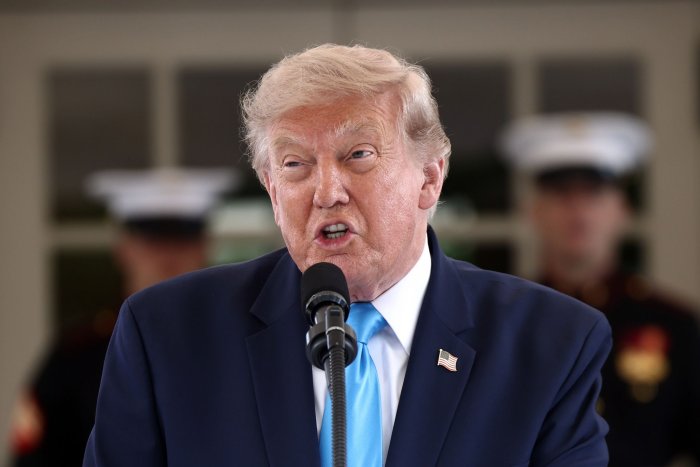
“These incredible men and women gave their lives to ensure that the world’s number one state sponsor of terror will never have a nuclear weapon,” Trump said after laying the wreath.

“Oh, and they won’t,” he said. “They will never have a nuclear weapon. I’m sure you know that one.”

The United States and Iran are reportedly close to a deal to end the war and reopen the Strait of Hormuz. Secretary of State Marco Rubio said early Monday that “we’re either going to have a good agreement or we’re going to have to deal with it another way,” while Iran said the agreement is “still a work in progress.”

The Armed Forces Full Honor Wreath Ceremony started around noon on Monday, with Trump, Vice President JD Vance, Secretary of Defense Pet Hegseth and Major Gen. Antoinette Gant, commanding general of the Joint Task Force for the National Capital Region and Joint Chiefs of Staff Chairman Gen. Dan Caine in attendance.

In his remarks, Trump asked the family Air Force Capt. Airiana Savino, one of 13 service members to die in the Iran war, to stand for applause.

Trump also asked people to applaud for 97-year-old Harry Miller, who lied about his age, joined the armed forces at age 15 and found in the Battle of the Bulge in World War II.

“Harry Miller lied about his age to enlist and was soon fighting to stop the SS Panzer divisions as part of the famed 740th Tank Battalion,” Trump said. “The Daredevils, they were called, of which he is among the last surviving members.”

Members of the 3rd U.S. Infantry Regiment, or “The Old Guard,” place some 250,000 American flags throughout Arlington National Cemetery in preparation for Memorial Day in Arlington, Va., on May 21, 2026. Photo by Bonnie Cash/UPI | License Photo

Source link

Ex-Scottish National Party chief pleads guilty to embezzling funds | Politics News

Murrell admitted the offences at the High Court in Edinburgh after an investigation into the party’s finances.

The former chief executive of the ruling Scottish National Party (SNP), and ex-husband of former First Minister Nicola Sturgeon, has pleaded guilty to embezzling more than 400,000 British pounds ($540,000) from the party’s funds.

Sixty-one-year-old Peter Murrell admitted the offences at the High Court in Edinburgh on Monday, following a years-long investigation into the SNP’s finances and the alleged diversion of donations intended to support the Scottish independence campaign.

Recommended Stories

list of 4 itemsend of list

Murrell, who was the SNP’s chief executive from 2001 to 2023, was remanded in custody by the judge before a sentencing hearing scheduled for June 23.

Judge James Young said Murrell was responsible for a “gross breach of trust” for embezzling offences between August 2010 and October 2022.

EDINBURGH, SCOTLAND - MAY 25: First Minister John Swinney speaks during a press conference following Peter Murrell's embezzlement hearing at the Edinburgh Marriott Hotel Holyrood on May 25, 2026 in Edinburgh, Scotland. First Minister and SNP Leader John Swinney is speaking to the press after Peter Murrell, the estranged husband of former first minister Nicola Sturgeon, admitted embezzling more than £400,000 the Scottish National Party (SNP) between August 2010 and January 2023, during part of his 22-year tenure as chief executive of the party. (Photo by Jeff J Mitchell/Getty Images)
Scotland’s First Minister John Swinney addresses a press conference after Peter Murrell’s embezzlement hearing at the Edinburgh Marriott Hotel Holyrood on May 25, 2026, in Edinburgh, Scotland [Jeff J Mitchell/Getty]

Murrell’s arrest came after a lengthy investigation into the diversion of 600,000 British pounds ($810,400) in SNP donations intended to support the party’s campaign for Scottish independence.

Although part of the United Kingdom, Scotland has a devolved government with powers over areas such as health and education. But the country has so far rejected calls for full independence.

Sturgeon, the former head of Scotland’s administration, quit as SNP leader and first minister in February 2023.

Murrell was arrested in April that year after officers searched the home he shared with Sturgeon near Glasgow, as part of an investigation into the SNP’s finances.

Sturgeon was herself arrested in June 2023 and questioned for seven hours before being released without charge.

Current First Minister John Swinney, who was re-elected to his post following the SNP’s victory in local elections in May, said he felt “betrayed” by Murrell’s actions.

“By embezzling from the SNP, Peter Murrell was stealing the hopes, the dreams and the aspirations of thousands of people all over Scotland,” said Swinney.

Rugby Union - Six Nations Championship - Scotland v England - Murrayfield Stadium, Edinburgh, Scotland, Britain - February 8, 2020 Scotland's First Minister Nicola Sturgeon and Peter Murrell in the stands REUTERS/Russell Cheyne
Nicola Sturgeon and Peter Murrell attend a rugby game in Edinburgh, Scotland [File: Russell Cheyne/Reuters]

‘I am betrayed’

Sturgeon, who was cleared in the probe last year, announced in January 2025 that she and Murrell had separated.

In an Instagram post, she said she was “utterly appalled” by her former partner’s admission and that she had “no knowledge or suspicion whatsoever”.

“To be deceived and let down by a husband I loved and trusted has caused me acute pain,” she added.

Sturgeon stepped down as a lawmaker earlier this year, ending a nearly 30-year career as one of the independence movement’s main figureheads.

Source link

Lebanon marks Liberation Day under Israeli bombardment | Hezbollah News

People in Lebanon have gathered to observe Liberation Day, which marks the date in 2000 when Israel ended its 22-year occupation of southern Lebanon. Al Jazeera’s Zeina Khodr explains how this year’s celebrations come as occupation returns to the country’s south.

Source link

Mexico says it will host Iranian team during 2026 FIFA World Cup | World Cup 2026 News

Mexican President Claudia Sheinbaum has announced that her country will host the Iranian national football team during the upcoming FIFA World Cup, due to tensions with the United States.

On Monday, Sheinbaum said that FIFA, the global football governing body, had approached Mexico about hosting Iran, after the US said it did not wish to do so.

Recommended Stories

list of 3 itemsend of list

“We have no reason to deny them the possibility of staying in Mexico,” Sheinbaum said during her daily media conference.

Previously, Iran had been scheduled to play all three of its group matches in the US.

But the administration of US President Donald Trump has previously said it is not “appropriate” for Iranian team members to be in the country, “for their own life and safety”.

It has yet to grant the Iranian team the necessary visas to travel to the US, despite Trump’s assertion that players and staff would be “welcome”.

Since February 28, the US and Israel have been at war with Iran, and peace negotiations are tense but ongoing.

The head of Iran’s football federation, Mehdi Taj, confirmed on Sunday that the team planned to move its training base from Tucson, Arizona, to the Mexican border city of Tijuana.

Taj explained that team leaders got approval for the move after meeting with FIFA officials in Istanbul, as well as holding an online conference with FIFA’s Secretary General, Mattias Grafstrom.

Switching the team’s base to Mexico, Taj said, would help avoid visa complications, with the team able to travel directly to Mexico aboard Iran Air flights.

But the US-Israeli war against Iran has cast a pall over the World Cup, making the Iranian team’s participation uncertain.

Roughly 3,468 people have been killed in Iran since February’s war began, and more than 26,500 have been injured. Further fatalities have been reported across the region.

The war has also thrown the global economy into turmoil, driving up the costs of fuel and agricultural fertiliser, among other goods.

Iran’s football team has long been a top squad in its region: It currently ranks near the top of the Asian Football Confederation. Its participation in the 2026 tournament marks its fourth straight World Cup qualification.

Trump, however, has sent mixed messages about Iran’s presence at the World Cup, suggesting at times that Iran should sit out the tournament. At other moments, he has expressed ambivalence.

In March, for instance, Politico asked Trump about Iran’s presence at the World Cup. Trump reportedly responded, “I really don’t care”, before calling Iran a “badly defeated country”.

The US, Mexico and Canada are co-hosting the games, with 78 matches in the US alone, including the final. Kick off is on June 11.

Iran is set to play its first two Group G matches in Los Angeles against New Zealand on June 15 and Belgium on June 21, before facing off against Egypt in Seattle on June 26.

The Trump administration’s hardline approach to immigration has raised additional concerns about whether the US will be a welcoming host for fans from around the world.

Already, Trump has moved to suspend visa processing for applicants from nearly 75 countries, including Iran, Brazil, Colombia, Ivory Coast and Senegal, which have teams at the World Cup.

Residents from some of those countries, however, are not required to receive visas to enter the US for short-term visits.

On Monday, Sheinbaum explained that she had been approached by the Iranian team and FIFA officials for help hosting players and staff.

“The United States doesn’t want the Iranian team to spend the night,” Sheinbaum said. “So they asked us, ‘Can we stay the night in Mexico?’ We said sure, no problem.’”

Source link

Oil drops below $100 per barrel, but gas prices remain high in U.S.

May 25 (UPI) — With the United States and Iran reportedly nearing a peace deal, oil prices fell slightly below $100 per barrel early Monday, suggesting optimism from traders to start the week.

Gas prices also declined slightly in the United States in the last week, but remain above $4.50 per gallon for regular on Memorial Day.

President Donald Trump has indicated that negotiations are “proceeding nicely,” and Iran acknowledged that talks have progressed but that a deal has not been reached, The BBC reported.

In European trading, Brent crude dropped to $95.04 per barrel and WTI futures dropped dropped to $91.02 per barrel — both declines of more than 5% — the Wall Street Journal reported.

Even with gas prices high, The Hill reported that more than 39 million people were projected to travel the roads during Memorial Day weekend, even as gas prices have remained consistently high since the start of the war in Iran.

Regular gas on Monday averaged $4.50 per gallon, which is down $0.01 from one week ago, but still $0.40 higher than one month ago, AAA reported.

Similar, diesel averaged $5.59 per gallon on Monday, which is down $0.03 from one week ago, and $0.40 more than one month ago.

“Memorial Day travel is still reaching record levels, but with the smallest year-over-year increase in more than a decade,” said Tiffany Wright, spokesperson for AAA’s The Auto Club.

“Although travel demand remains strong, higher fuel prices and persistent inflation may cause some travelers to shorten trips, delay plans or stay closer to home.”

The longer that the United States and Iran take to agree on a peace plan and the Strait of Hormuz remains closed, gas prices are unlikely to decrease significantly and energy markets will take a while to get back to normal, Axios reported.

“Gas prices are currently falling, but until we see an agreement signed and a significant amount of ships transit the Strait, the national average prices of gasoline will likely remain well above $4.00 per gallon,” said Patrick De Haan, head of petroleum analysis for Gas Buddy.

Members of the 3rd U.S. Infantry Regiment, or “The Old Guard,” place some 250,000 American flags throughout Arlington National Cemetery in preparation for Memorial Day in Arlington, Va., on May 21, 2026. Photo by Bonnie Cash/UPI | License Photo

Source link

Train bomb in Pakistan’s Baloch region: Why violence is on the rise | Armed Groups News

At least 24 people were killed and more than 50 injured when a suicide car bomb detonated on a train carrying soldiers in Quetta, capital of the southwestern Pakistani province of Balochistan, on Sunday.

The attack came amid Pakistan’s Prime Minister Shehbaz Sharif’s four-day visit to China, and the day before his meeting in Beijing with China’s President Xi Jinping, marking 75 years of diplomatic ties between the two nations.

Pakistan is among an exclusive group of countries China regards as an “all-weather strategic partner”, with ties featuring close economic, trade and security cooperation.

Responsibility for the train attack was claimed by the Balochistan Liberation Army (BLA), an armed Baloch separatist group which, apart from calling for an independent state, also strongly objects to large-scale Chinese investment in the region.

While the BLA has long carried out attacks that have killed civilians and members of the security forces in Balochistan and beyond, there has been a recent uptick in such incidents.

We examine what is behind this increase in attacks:

What happened in Sunday’s attack?

Reporting from the scene, Al Jazeera’s Kamal Hyder said several houses and buildings adjacent to the railway line were severely damaged in the blast, which caused train carriages to overturn and catch fire.

According to local media reports, a state of emergency was declared at public hospitals in Quetta, with doctors and other medical staff ordered to remain on duty.

Footage shared online showed charred vehicles and train carriages lying on their sides, with thick plumes of black smoke rising into the sky.

Pakistan has experienced several attacks by separatist groups in recent months. The attacks have increased in ferocity and have also targeted Chinese workers amid protests over Beijing-backed infrastructural projects in Balochistan.

As part of the China-Pakistan Economic Corridor project – one of the main arms of China’s “Belt and Road Initiative” designed to improve trading routes – China’s Xinjiang region has been connected to Pakistan’s deep-sea Gwadar port on the Arabian Sea in Balochistan.

Pakistani Prime Minister Sharif condemned Sunday’s train attack in Quetta in a post on X.

“Such cowardly acts of terrorism cannot weaken the resolve of the people of Pakistan. We remain steadfast in our determination to eliminate terrorism in all its forms and manifestations,” he said.

He added that while initial reports indicated a suicide bombing, this has not been officially confirmed. If it is, Yunas Samad, an emeritus professor of South Asian Studies at the University of Bradford in the UK, told Al Jazeera, “this would reflect tactics that insurgent organisations in the region have increasingly adopted over recent years”.

“There are also persistent claims regarding the circulation of sophisticated weaponry originating from stockpiles left behind after the US withdrawal from Afghanistan,” he said.

Are we seeing a new phase of armed separatist attacks in Balochistan?

According to research gathered by the independent, Islamabad-based think tank Pakistan Institute for Peace Studies, Balochistan recorded at least 254 attacks in 2025 – roughly 26 percent more than in 2024.

A December 2025 report published by independent conflict monitor Armed Conflict Location and Event Data (ACLED) found that separatists had also intensified attacks and pressure on security forces. The report said the number of attacks using improvised explosive devices (IEDs) and grenades, mainly targeting convoys and police stations, grew by more than 65 percent in the first 11 months of 2025, compared to the same time period in 2024.

The Global Terrorism Index (GTI) report this year found that there has been more Baloch armed group activity in Pakistan in 2025 as well. The GTI is an annual report published by the Australia-based independent think tank Institute for Economics and Peace (IEP).

Its 2026 report states that the BLA was responsible for Pakistan’s largest terror attack of 2025 – when the Jaffar Express, a train travelling from Quetta to Peshawar, was hijacked in March.

The BLA claimed responsibility and reported that six military personnel had been killed. Hundreds of people were taken hostage from the train, which was carrying 400 passengers.

“What can reasonably be said is that, following the earlier coordinated attack on the Jaffar Express, the Pakistani authorities appear to have intensified security measures around transport infrastructure, military personnel and key lines of communication,” Samad, of Bradford University, told Al Jazeera.

“The fact that this latest incident nevertheless occurred may suggest that militant groups retain a significant operational capability despite those efforts,” he noted.

The group stunned Pakistan’s security establishment in 2022 when it ‌stormed army and navy bases. In August 2024, militants carried out coordinated ⁠attacks across Balochistan, including highway assaults in which passengers were pulled from buses and shot after identity checks.

“While statistics in such conflicts are always contested and should be treated cautiously, they do indicate that the intensity of the conflict has not significantly diminished,” Samad said.

“Whether this constitutes an entirely ‘new phase’ is perhaps too strong a conclusion at present. However, it does appear to indicate a degree of resurgence in militant capability and confidence among sections of the Baloch insurgency.”

Who are the BLA and major Baloch armed groups?

The BLA, which has a suicide squad called the Majeed Brigade, says it is fighting for the independence of Balochistan, a province located in Pakistan’s southwest and bordering Afghanistan to the north and ⁠Iran to the west.

It is the largest of several ethnic separatist groups that have been fighting the federal government for decades. Balochistan’s mountainous border region serves as a safe haven and training ground for both Baloch separatist fighters and Islamist armed groups.

The BLA often targets infrastructure and security forces in Balochistan, but has also struck in other areas – most notably the southern port city of Karachi.

The BLA has deployed women suicide bombers, including in an attack on Chinese nationals in Karachi, and was designated a “foreign terrorist organisation” by the United States in August 2025 in a move welcomed by the Pakistani government. Analysts say BLA is particularly known for its ability to recruit young, often well-educated fighters.

The group, separately, was at the centre of tit-for-tat strikes in 2024 between Iran and Pakistan over what each said were armed group bases on each other’s territory, which brought the neighbours to the brink of war.

What is the Baloch cause?

Home to about 15 million of Pakistan’s roughly 240 million people, according to the 2023 census, Balochistan is the country’s poorest region despite its wealth of natural resources, including coal, gold, copper and gas.

These resources generate significant revenue for the federal government – unfairly, according to the BLA, which wants Balochistan’s natural wealth to belong to its people and rejects federal control over resource extraction and security.

The province is Pakistan’s largest by area, but smallest by population. It has a long Arabian Sea coastline, not far from the Gulf’s Strait of Hormuz oil shipping lane.

Balochistan is also home to one of Pakistan’s major deep-sea ports at Gwadar, a crucial trade corridor for China’s $65bn investment in the China-Pakistan Economic Corridor (CPEC), a wing of President Xi Jinping’s Belt and Road initiative.

The province is home to key mining projects, including Reko Diq, which is operated by Canadian mining giant Barrick Gold and is believed to be one of the world’s largest gold and copper mines.

China also operates a gold and copper mine in Balochistan.

The province – which was annexed by Pakistan in 1948, six months after partition from India in August 1947 – has a long history of marginalisation. It has since experienced at least five separatist uprisings.

Separatist sentiment was particularly high in the 2000s, around the time the BLA emerged. Analysts of Baloch resistance movements say it was led by Balach Marri, the son of veteran Baloch nationalist leader Nawab Khair Bakhsh Marri.

After the government of military ruler Pervez Musharraf killed prominent Baloch nationalist leader Nawab Akbar Bugti in 2006, the separatist movement escalated.

Rebel fighters have targeted Pakistan’s army and Chinese interests, in particular the strategic port of Gwadar on the Arabian Sea, accusing Beijing of helping Islamabad to exploit the province. Fighters have killed Chinese citizens working in the region and attacked Beijing’s consulate and language centre in Karachi.

More recently, the BLA has also attacked civilians and migrant labourers from other provinces, a shift that officials say marks an escalation in tactics.

Pakistan accuses India and Afghanistan of backing Baloch armed fighters, an allegation both countries deny.

“Baloch separatist groups themselves have, at times, sought to internationalise their cause and last year publicly appealed for diplomatic recognition by India,” Samad said.

“However, establishing clear evidence of direct state support is considerably more difficult, and much of the discussion in this area remains politically contested.”

Hundreds of Baloch activists, many of them women, have protested in Islamabad and Balochistan over alleged abuses by security forces – accusations the government denies.

Over time, the BLA has set itself apart as a group explicitly committed to Balochistan’s full independence from Pakistan. Unlike more moderate Baloch nationalist parties, which press politically for greater provincial autonomy, the BLA has consistently rejected compromise.

Why is this significant now?

Regional stability and international investment

The attack comes as Prime Minister Sharif meets with China’s President Xi in Beijing to discuss economic and security cooperation – something the BLA is strongly opposed to.

The movement could pose a challenge to Pakistan’s attempts to retain Chinese and American investment, experts say, if it reveals a deeper instability.

The Baloch separatist movement is one of the major unresolved questions over Pakistan’s statehood. It is a constant reminder of the challenges of the Pakistani state to stay united, they say.

“More broadly, the persistence of insurgency has had implications for Pakistan’s wider political system,” Samad explained. “Security concerns in Balochistan have increasingly shaped governance and political discourse, strengthening the role of the military and security establishment in national affairs and undermining the democratisation process.”

“Internationally, the issue matters because Pakistan remains a nuclear-armed state of enormous strategic importance,” Samad told Al Jazeera.

“While speculation about state fragmentation is highly premature, any significant escalation in internal instability in a country with nuclear capabilities inevitably attracts international concern. For that reason alone, developments in Balochistan are likely to remain closely watched both regionally and globally.”

Rare-earth metals

Another major issue is that geological assessments suggest Balochistan contains 12 of the 17 rare-earth minerals on the periodic table. Rare earths are critical minerals used to manufacture a vast array of modern items, including batteries, clocks, wiring, military hardware, smartphones and semiconductors, among other technological products.

Since the start of his second term, US President Donald Trump has repeatedly pushed plans to diversify Washington’s stockpile of critical minerals in order to reduce reliance on China, which currently dominates the supply and processing of the world’s rare-earth minerals.

When Pakistan’s Prime Minister Sharif met with Trump at the White House in September 2025, he offered the US access to critical minerals and rare earths.

Then, in December 2025, the US announced a $1.25bn investment in critical minerals mining at Reko Diq to drive “economic growth in Balochistan”.

Source link

Explosion fears tempered as possible crack seen in failing Calif. tank

Andrea Luna, Jules Olivas, Joshua Olivas and Jessica Castro of Anaheim, Calif., shelter in their cars at the John F. Kennedy High School evacuation center on Saturday after leaving their home due to a chemical leak from a storage tank at the GKN Aerospace facility in Garden Grove, Calif. A failing 34,000-gallon tank of methyl methacrylate overheated, prompting tens of thousands of evacuations in the Garden Grove area. Photo by Ted Soqui/EPA

May 24 (UPI) — Tens of thousands of Orange County, Calif., residents remained evacuated Sunday as officials nervously watched the condition of a failing, 34,000-gallon tank containing dangerous chemicals.

Orange County fire officials said a visual inspection of the overheated tank in Garden Grove, Calif., late Saturday showed it has potentially developed a crack, which could reduce the possibility of a catastrophic explosion but increase the likelihood of a massive spill of liquid methyl metacrylate.

“Right now, we’re vetting and validating that information,” Orange County Fire Authority Interim Chief T.J. McGovern said in a video update of the tense situation at the GKN Aerospace facility, located about 33 miles southeast of downtown Los Angeles.

The discovery of a potential crack in the tank “could change the trajectory and our strategy for this event,” he said.

A crack in the tank “may avoid the two concerns that we all had,” Calif. State Sen. Tom Umberg told KCBS-TV. “One was an explosion, the other was a leak of liquid material vaporizing into a toxic fume, a toxic plume.”

California Gov. Gavin Newsom on Sunday transmitted a request to President Donald Trump to declare a federal emergency in support ongoing response operations in Orange County.

The request came a day after the governor’s proclamation of a state of emergency as officials raised the alarm about the possibility of a catastrophic explosion and a major release of toxins.

“California doesn’t wait for disaster to unfold, we act early to protect lives and communities,” Newsom said. “Working together with our local and federal partners, we’re strengthening our ability to respond quickly and effectively in Garden Grove and across the surrounding communities and ensuring that first responders have the resources they need to keep people safe.”

The state says it has already activated its emergency operations center, deployed mutual aid resources and has pre-positioned emergency personnel — including fire, law enforcement and medical teams — in the area around the GKN Aerospace facility, which is just 7 miles west of the Disneyland amusement park.

Nearly 50,000 Orange County residents remained under mandatory evacuation orders on Sunday as an interagency response team eyed the malfunctioning tank, which holds methyl methacrylate, or MMA, a flammable, toxic and highly volatile substance used in the production of acrylic plastics.

Residents were evacuated Friday after a chemical vapor leak was spotted coming from the tank, which has a malfunctioning valve and is unable to be neutralized. Officials say the valve has seized due to a chemical reaction with the MMA.

Water cooling by firefighters has so far kept the tank’s temperature stable and no injuries have been reported.

No unusual readings of toxic material have yet been detected in the area.

The evacuation zone is in a densely populated area of Orange County and has multiple public facilities including schools, hospitals, nursing homes, fire and law enforcement stations.

A unified command has been established between Orange County Fire Authority, Garden Grove Police Department and Orange County Health Care Agency to deal with the emergency.

Source link

Could Israel sabotage US-Iran deal? | Gaza

NewsFeed

As the US and Iran move closer to a peace deal, Israel says it reserves the right to keep attacking regional ‘threats’, including in Lebanon, despite any US‑brokered ceasefire. Meanwhile, criticism within Israel is growing over Netanyahu’s handling of the war.

Source link

New Zealand surfing event halted after water photographer bitten

May 25 (UPI) — A World Surfing League event was temporarily suspended on Monday after a photographer in the water suffered an animal bite to his foot.

The photographer, identified as Australian Ed Sloane, suffered what WSL described in a statement as “a wildlife injury” Monday morning while photographing a surfing heat from the waters near Raglan in northwestern New Zealand.

WSL Commissioner Renato Hickel said in an Instagram story that Sloane was transported to a hospital in stable condition. In an update, Hickel said Sloane was in “great spirits” and that following consultations with the competing surfers and other stakeholders, it was decided that the competition would restart at 1:05 p.m. NZST.

In the event broadcast, streamed live on YouTube, Hickel said WSL activated what he called a code red, halting the heat and clearing the water.

“He’s well considering what happened,” he said, describing the injury as “minor, small puncture wounds.”

He added that officials were unsure if the animal responsible was a shark or sea lion, though they were inclined to think it was a sea lion.

“Nevertheless, very scary,” he said.

Sloane said in a written statement read during WSL’s broadcast and later published to WSL’s Instagram story, that he was bitten on the foot and was receiving medical attention.

“Massive thank you to our water patrol for the quick response, our medical team and all the support from our teams for the immediate assistance I received,” he said.

“I love this place and can’t wait to watch an epic Finals Day.”

Sloane was shooting the final day of the New Zealand Pro.

Hickel said heightened wildlife surveillance, including jet skis, drones and spotters, would be put in place when the competition resumed.

Source link

Samsung Electronics leads smartphone markets in S. America, Middle East, Southeast Asia in Q1

Samsung Electronics Co. topped smartphone markets in Central and South America, the Middle East and Southeast Asia in the first quarter, industry data showed Monday. In this photo, Galaxy S26 Ultra phones are on display at the Samsung Gangnam store on March 11, 2026. File Photo by Yonhap

Samsung Electronics Co. topped the smartphone markets in Central and South America, the Middle East and Southeast Asia in the first quarter on steady sales of its premium Galaxy S26 and budget Galaxy A series smartphones, industry data showed Monday.

According to the data compiled by industry tracker Omdia, Samsung Electronics sold some 12.9 million units of smartphones in the Central and South American market in the January-March period, accounting for 37 percent of the total 34.8 million smartphones sold there over the cited period.

Omdia said the performance was driven by solid sales of Galaxy A series smartphones as Samsung Electronics responded to market demand with a diversified product lineup.

In the Middle East market, where smartphone sales fell 6 percent on-year to 11 million units in the first quarter, Samsung Electronics led the market with a market share of 34 percent on strong demand for the latest Galaxy S26 and Galaxy A series smartphones.

The company also sold 4.6 million smartphones in the Southeast Asian market, accounting for 21 percent of all smartphones sold there in the first quarter.

Omdia said strong sales of the Galaxy S26 series, launched in January, and steady demand for the Galaxy A series helped Samsung Electronics expand its market share in Southeast Asia, where quarterly smartphone sales fell 9 percent from a year earlier.

Earlier, Omdia said Samsung Electronics ranked No. 1 in the global smartphone market in the first quarter with a 22 percent market share.

Copyright (c) Yonhap News Agency prohibits its content from being redistributed or reprinted without consent, and forbids the content from being learned and used by artificial intelligence systems.

Source link

N. Korea to hold key party meeting in late June: KCNA

North Korea will convene a plenary meeting of the ruling Workers’ Party of Korea next month, state media reported Monday. In this February photo, leader Kim Jong Un speaks during the opening of the ninth party congress. File Photo by KCNA/EPA

North Korea will convene a plenary meeting of the ruling Workers’ Party of Korea (WPK) next month for an interim review of state and party policies for this year, state media reported Monday.

The WPK’s political bureau has decided to hold the second plenary meeting of the ninth central committee in late June, according to the Korean Central News Agency (KCNA).

The meeting will be convened “in order to have an interim review of the implementation of the party and state policies for 2026 and discuss the work in the second half of the year and a series of important issues,” the KCNA said, without providing further details.

The North has recently been holding plenary meetings regularly at the end of June and December, while also convening them when important issues need to be discussed.

It remains to be seen whether North Korea will make major decisions regarding its policy stance against South Korea or the United States at the upcoming meeting, amid speculations Chinese President Xi Jinping may visit the North soon.

The planned June meeting comes as North Korea seeks to implement follow-up measures for decisions made at the ninth party congress held in late February.

The following month, the North revised its constitution to add a new territorial clause, defining its territory as the land bordering China and Russia to the north and South Korea to the south, while removing all references to unification with South Korea.

Copyright (c) Yonhap News Agency prohibits its content from being redistributed or reprinted without consent, and forbids the content from being learned and used by artificial intelligence systems.

Source link