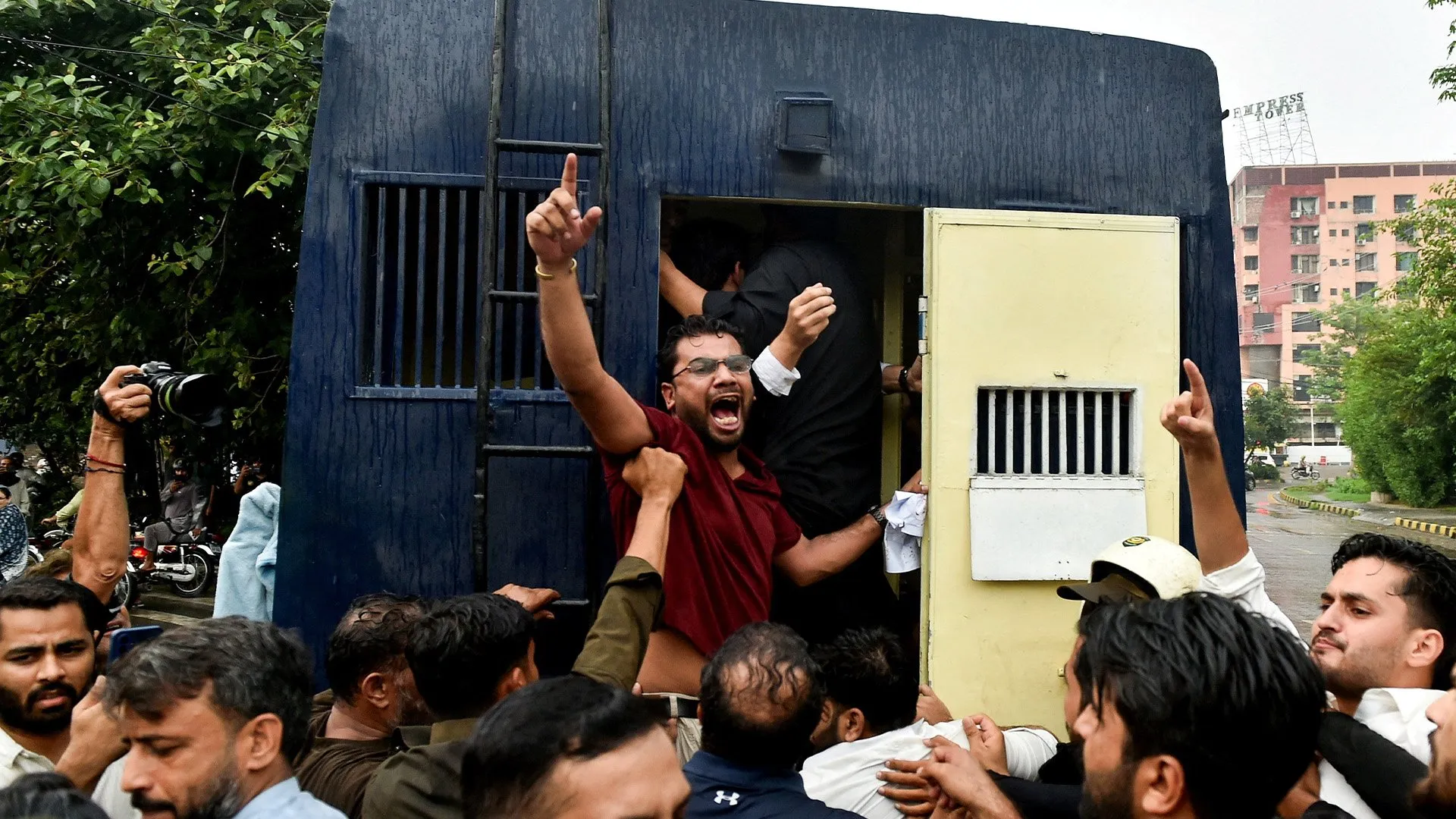
Police detained several protesters in Lahore, Pakistan as they rallied in solidarity with Pakistan-administered Kashmir. A banned Kashmiri activist group says that at least 30 people have been killed in clashes during regional elections this past week.
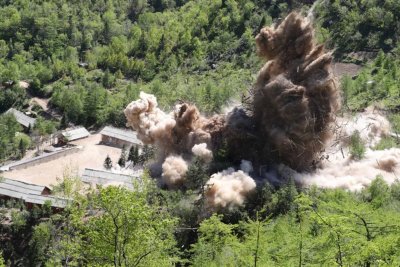
Earth is displaced during an explosion on the first day of dismantling at North Korea’s Punggye-ri nuclear test site in Punggye-ri, North Korea, 24 May 2018. On 24 May North Korea started to demolish its Punggye-ri nuclear test facility, in the country’s northeast. Photo by NEWS 1 KOREA / EPA
July 31 (Asia Today) — Nearly half of the North Korean defectors tested last year after living near the Punggye-ri nuclear test site showed chromosomal changes above a minimum detection threshold, South Korea’s Unification Ministry said Friday.
The ministry cautioned, however, that the findings did not establish a connection between the individuals’ radiation exposure and North Korea’s nuclear tests.
The Korea Institute of Radiological and Medical Sciences conducted biological radiation tests on 59 defectors from eight cities and counties near Punggye-ri in North Hamgyong Province.
The group included former residents of Kilju, Hwadae, Kimchaek, Myonggan, Myongchon, Orang, Tanchon and Paekam.
Tests found stable chromosomal abnormalities above the minimum detection level in 26 people, or 44.1% of those examined.
Stable chromosomal abnormalities can reflect radiation accumulated from birth until the date of testing. The measurement can include exposure from natural sources, medical procedures and work environments.
The institute said the test cannot determine when the exposure occurred or identify its source.
Age, smoking, alcohol use, heavy metals and other factors can also affect the results, it said.
Researchers conducted an additional test for unstable chromosomal abnormalities among the 26 people whose initial readings exceeded the detection threshold.
That second test, which is more useful for identifying relatively recent radiation exposure, produced above-threshold results in six people.
Older age complicates findings
The average age of the 26 people with elevated results was 52.8, or 13.2 years older than the average age of the 33 participants whose results remained within the normal range.
The group with elevated readings had also spent less time near Punggye-ri than the group with normal results.
Researchers found differences in drinking-water sources as well. Piped water was more common among participants with elevated readings, while a greater share of the normal group reported using water from mountain streams.
The findings did not demonstrate that the 26 participants were exposed to radiation from underground nuclear explosions, the institute said.
“There are limitations to interpreting the stable chromosome-aberration test results as exposure caused by past nuclear tests,” the institute said.
It said the participants with elevated readings were older on average and had several possible contributing factors, including medical radiation exposure.
The institute recommended continued health examinations and long-term monitoring for participants whose biological dose assessments exceeded the minimum detection level.
It said the results should be interpreted carefully because of possible confounding variables.
More environmental information would be needed to conduct a reliable assessment, including radiation measurements around former residential areas, drinking-water tests and radioactivity measurements from local food, the institute said.
No cancer cases identified
The Unification Ministry also provided detailed medical examinations to five defectors whose radiation tests conducted from 2017 through 2024 had produced readings above the detection threshold.
The ministry said no confirmed or suspected cancer cases were identified among the people examined during the latest program.
South Korea conducted similar examinations of defectors from areas near Punggye-ri in 2017, 2018, 2023 and 2024 after concerns were raised about possible radiation leakage from the test site.
Across tests conducted since 2017, researchers have identified chromosomal abnormalities in some former residents of the region, but they have not established that North Korea’s nuclear tests caused them.
North Korea carried out six underground nuclear tests at Punggye-ri between 2006 and 2017.
The country has not allowed international nuclear inspectors to conduct an independent environmental assessment at the site.
North Korea has maintained that its nuclear tests were conducted safely and did not release radioactive material into surrounding communities.
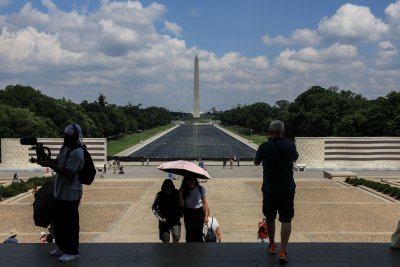
President Donald Trump claimed the Lincoln Memorial Reflecting Pool, which cost nearly $15 million to renovate, had been damaged by vandals.
But in a court filing Friday evening, U.S. Attorney Jeanine Pirro said the damage was caused by a “botched installation.” Photo by Jemal Countess/UPI. | License Photo
July 31 (UPI) — Trump administration prosecutors on Friday moved to dismiss the felony case against U.S. Olympian David Hearn, admitting that damage to the Lincoln Memorial Reflecting Pool was due to a “botched installation and not vandalism.”
Hearn, 67, was indicted by a federal grand jury early July on accusations that he purposefully ripped up a piece of the recently-installed blue sealant from the pool’s bottom.
President Donald Trump claimed the pool, which cost nearly $15 million to renovate, had been damaged by Hearn and other vandals.
But in a court filing Friday evening, U.S. Attorney Jeanine Pirro said she had been misled by the Interior Department into believing “nearly all of the damage” was done by vandals.
In charging Hearn, Pirro had said she had “tremendous evidence” that he committed a felony that could have landed him in prison for 10 years.
“Given all of this newly discovered information, it is difficult to attribute the widespread damage to the Reflecting Pool to vandalism,” Pirro wrote in court papers, The New York Times reported.
Pirro added the “botched” renovation “was the result of a flawed installation by the contractor, Atlantic Industrial Coatings, and the rush to complete the project prior to events associated with the America 250 celebration.”
In a statement, Hearn’s attorneys said, “The Trump administration’s case against Davey Hearn should have never been brought.”
“Its dismissal today does not erase the abuse of government power in arresting and charging a patriotic American who did nothing wrong,” the attorneys added. “The government’s approach was ready, fire, aim.
Acting Prosecutor General Koo Ja-hyun delivers a joint police-prosecution statement on combating artificial intelligence-generated disinformation at the Government Complex Seoul on Feb. 26. Photo by Asia Today
July 31 (Asia Today) — South Korea’s acting prosecutor general submitted his resignation Friday after the National Assembly passed legislation eliminating prosecutors’ authority to conduct supplementary investigations.
Koo Ja-hyun said he felt responsible for the overhaul of the country’s criminal justice system and had submitted his resignation.
“The revision to the Criminal Procedure Act, centered on abolishing prosecutors’ supplementary investigative authority, passed the National Assembly today,” Koo said at the Supreme Prosecutors’ Office in southern Seoul.
“I also feel a strong sense of responsibility that the law was revised while concerns raised by legal experts, other professionals and the public remain unresolved,” he said.
The National Assembly passed the bill Friday under the leadership of the governing Democratic Party.
The legislation bars prosecutors from conducting additional investigative work after receiving cases from police. Prosecutors will instead be required to ask police to perform supplementary investigations.
The Democratic Party says the change completes the separation of investigative and prosecutorial powers and prevents prosecutors from exercising excessive authority.
Opposition lawmakers, prosecutors and some legal experts have warned that the system could delay cases and weaken protection for crime victims.
Koo warns of investigative gaps
Koo said prosecutors needed to reflect deeply on their failure to earn public trust.
He said, however, that institutional reform should not undermine the prosecution’s responsibility to uncover the truth and protect victims and other people involved in criminal cases.
“Even when institutional reform is carried out for those reasons, the essential purpose of the prosecution system – discovering the substantive truth and protecting victims and other parties – must not be damaged,” Koo said.
Koo said he had repeatedly considered how the system could be changed while protecting citizens’ rights and safeguarding society from crime.
He said prosecutors had warned lawmakers that the revision could force them to make indictment decisions based only on written investigative records.
Under that structure, prosecutors could have difficulty independently checking disputed facts, identifying gaps in police investigations or responding directly to victims’ concerns, he said.
Koo also warned that repeatedly returning cases to police could create a more costly and inefficient process.
“Those concerns were not accepted and the amendment passed without change,” he said. “It is difficult to conceal my disappointment and sense of helplessness.”
Koo urged the government to conduct another review of possible gaps in the system after the legislation is formally transferred from the National Assembly.
“I sincerely hope our criminal justice system will develop in a direction that ensures every citizen is protected fairly under the law,” he said.
Prosecution faces another leadership vacancy
South Korea’s prosecution service has already been operating without a formally appointed prosecutor general.
Koo has led the organization in an acting capacity while serving as deputy prosecutor general.
His departure would leave the service under what South Korean media described as an “acting acting chief.”
If Koo’s resignation is accepted, Park Kyu-hyung, head of the Supreme Prosecutors’ Office’s planning and coordination department, is expected to assume the duties of acting prosecutor general.
The leadership vacancy comes as the government prepares to replace the existing prosecution service with a new Public Prosecution Office and establish a separate Serious Crimes Investigation Agency.
The Public Prosecution Office will focus on indictments and courtroom prosecutions, while the new investigative agency will handle major crimes previously investigated directly by prosecutors.
The two agencies are scheduled to launch Oct. 2.
The transition will require the government to determine how pending cases, personnel, records and investigative responsibilities will be transferred.
The administration of United States President Donald Trump has moved to drop a criminal charge against former Olympic athlete David Hearn, in a remarkable about-face.
In a motion filed on Friday afternoon, US Attorney Jeanine Pirro acknowledged that the accusations levelled against Hearn — blaming him for vandalising the Lincoln Memorial Reflecting Pool — did not appear to be substantiated.
Recommended Stories
list of 3 itemsend of list
“The damage was the result of a botched installation and not vandalism, as initially represented by [the Department of the Interior],” Pirro wrote.
Earlier this month, the prosecutor had accused Hearn, an Olympic canoeist, of “forcefully and violently” ripping the newly installed liner of the Reflecting Pool, part of a renovation project Trump had championed.
She described his actions as “an affront to the dignity of our shared history” and warned that Hearn could face up to 10 years in prison for the destruction of government property.
But in Friday’s court filings, a different narrative emerged.
Pirro repeatedly emphasised she did not receive the new information until after the criminal indictment against Hearn had been returned. She blamed, in part, the “barebones police reports” her office had received.
“It was not until after the return of the indictment, that the DOI provided additional documents to the [US Attorney’s Office for Washington, DC] indicating that damage to the Lincoln Memorial Reflecting Pool in June 2026 was the result of flawed installation by the contractor,” Pirro wrote.
She added that the pressure to finish the Reflecting Pool renovation project before the Independence Day holiday — marking the 250th anniversary of the US — contributed to the renovation’s failure. Trump had planned several events for the occasion.
“The rush to complete the project led to hasty and botched work that was not remediated before the project was finished and the fencing removed,” Pirro explained, citing delayed installation work, inclement weather and repeated testing failures.
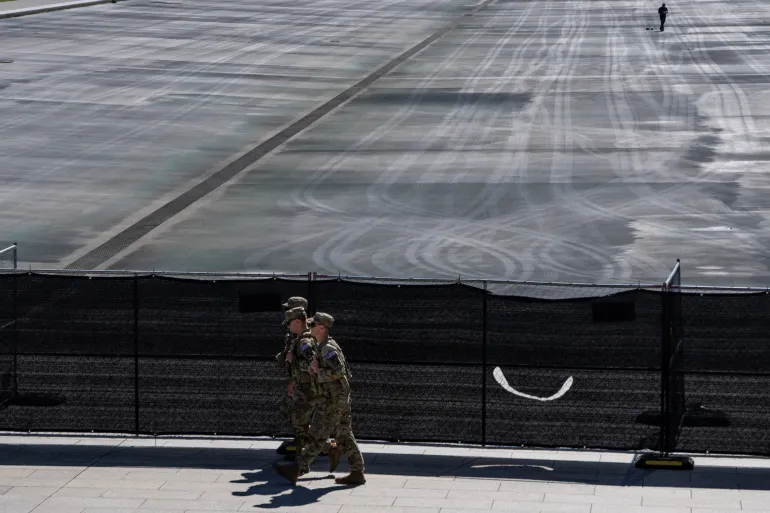
Members of the National Guard walk past the drained Lincoln Memorial Reflecting Pool on July 30 [Nathan Howard/Reuters]
Reshaping Washington, DC
The Reflecting Pool project is one of several changes to the landscape of Washington, DC, that Trump has pursued during his second term in office.
In seeking to leave his mark on the US capital, the Republican leader has torn down the East Wing of the White House, gilded statues with a fresh coat of gold leaf, and proposed to build a large triumphal arch on the road to the Arlington National Cemetery.
Just this week, he unveiled a $22.5bn project to revamp the Dulles international airport, the main air terminal for the capital region.
Several of his public works projects have been challenged in court, including an attempt to affix his name to the John F Kennedy Center for the Performing Arts.
The Reflecting Pool renovation was among Trump’s most controversial.
The 618-metre (2,028-foot) pool has served as the backdrop for many iconic moments in US history, including the 1963 March on Washington, when civil rights leader Martin Luther King Jr delivered his “I Have a Dream” speech.
It sits between the Washington Monument, a large obelisk, and the Lincoln Memorial, two popular tourist sites mere blocks from the White House. But the pool had long struggled with leaks along its granite edge and concrete bottom.
In April, Trump abruptly announced he would address the problem by resurfacing the Reflecting Pool’s bottom with swimming pool coating in a shade of “American Flag Blue”.
The project, he added, would be finished “long before July 4” and at relatively little cost to the government.
By early June, Trump had announced the project was complete. But within days, a thick layer of green algae appeared on the surface of the pool, and the blue coating appeared cracked, with sheets of paint flapping in the water.
The project also attracted criticism for how the government contract for the renovations was awarded.
The Trump administration granted a $13.1m contract to Atlantic Industrial Coatings, a company he claimed to have worked with as a real estate developer, led by one of his donors. The deal was struck without taking competitive bids, as is standard, on the basis that the renovation was necessary immediately.
Within two days of the site’s final inspection, on June 11, a National Park Service engineer observed that the Reflecting Pool’s new lining had begun to peel, according to Pirro.
Citing the engineer’s report, Pirro wrote that the damage to the pool appeared to have been caused by “over spraying and delamination”.
US Attorney for the District of Columbia Jeanine Pirro announces charges against Olympic athlete David Hearn on July 2 [Anna Moneymaker/Getty Images via AFP]
Accusations of vandalism
But Trump had aggressively pushed accusations that the algae and tears in the Reflecting Pool’s new bottom had been the result of vandalism.
“We caught some people vandalising our beautiful Reflecting Pool,” Trump said at a news conference in June. “They took a cutter, a box cutter, or something very sharp. Can you imagine? Where do these people come up with this? And they threw a little fertiliser in the water.”
Separately, he suggested those responsible should face “years in jail” for their alleged crimes.
Hearn, a three-time Olympian representing the US, has said he was among the members of the public drawn to the hullabaloo surrounding the Reflecting Pool’s controversial renovation.
In media interviews, he admitted he bicycled past the pool, reached in and felt the peeling sealant, out of curiosity. He has adamantly denied, however, damaging any property.
Hearn was among at least seven people arrested or cited over alleged damage to the Reflecting Pool. His indictment was announced at a news conference held by Pirro on July 2.
Friday’s motion to dismiss arrived just four weeks later. In it, Pirro acknowledged the peeling was not caused by vandalism.
She wrote that the revelation came around July 17, when her office inspected the Reflecting Pool site, which had once again been drained for repairs.
“It was at that time that [the US Attorney’s Office] first became aware of the significant damage throughout the pool and accordingly requested all documents from [the Department of the Interior] concerning how the pool was lined,” Pirro said.
Her office received “695 megabytes of additional documents” in return, revealing “a rushed and flawed installation process”.
Since indicting Hearn, Pirro’s office has faced questions about whether it was pursuing justice — or simply doing Trump’s political bidding, as he seeks to save face after the botched renovation.
The withdrawn indictment also comes as courts have repeatedly pressed the Department of Justice about prosecutions that appear to be hastily submitted and lacking in evidence.
“ Did you ultimately decide to charge this so harshly at the president’s direction?” one reporter asked Pirro at the outset of Hearn’s case.
“I didn’t charge anything harshly. I charge according to the evidence,” she replied at the time.
In a statement, Hearn’s legal team called the case an “abuse of government power”. They added that the Trump administration owes their client an apology.
Washington, DC – A Senate committee hearing this week has once again shone a spotlight on the political divisions over the United States government’s response to the COVID-19 pandemic.
Wednesday’s hearing, held by the Senate Homeland Security and Governmental Affairs Committee, continued years of criticism, mainly from Republicans, against immunologist Anthony Fauci, who led the government’s response to the pandemic.
Recommended Stories
list of 3 itemsend of list
Spearheaded by committee chair Rand Paul, several Republicans rehashed claims that the virus that causes COVID-19, SARS-CoV-2, emerged from an infectious disease lab in Wuhan, China, and did not naturally transfer from animals to humans.
Stephen Morrison, the director of the Global Health Policy Center at the Center for Strategic and International Studies, said the hearing was a reflection of the deep, enduring partisan divides over the issue.
But he added that the meeting with Fauci did little to shed new light on the pandemic after years of investigation, hearings and political posturing.
“There’s no space for any civil discussion around any of these issues. There’s no desire really,” Morrison told Al Jazeera.
“So, what’s the lasting impact of this? I mean, it continues to impose unconscionable pain and suffering on [Fauci] and his family. It doesn’t advance the debate one inch on the whole question of COVID origins and what was past US policy and what should US policy be going forward.”
Wuhan lab leak theory
Wednesday’s hearing was based largely on a previous 520-page report from 2024, created by the Republican-led Select Subcommittee on the Coronavirus Pandemic.
That report claimed it was likely that SARS-CoV-2 emerged from the Wuhan Institute of Virology, a Chinese research facility. Senator Paul has embraced this viewpoint, as has President Donald Trump.
In April of last year, shortly after Trump took office for his second term, the White House launched a webpage purporting to reveal “the true origins of COVID-19”, largely based on the report.
The site highlighted several claims that experts say pave over the nuanced scientific debate about the origins of the virus.
Drawing on the 2024 report, the White House asserts that SARS-CoV-2 “possesses a biological characteristic that is not found in nature” and that “data shows that all COVID-19 cases stem from a single introduction into humans”, setting it apart from previous natural pandemics.
Joel Wertheim, a professor of medicine at the University of California San Diego, told Factcheck.org that both claims were false.
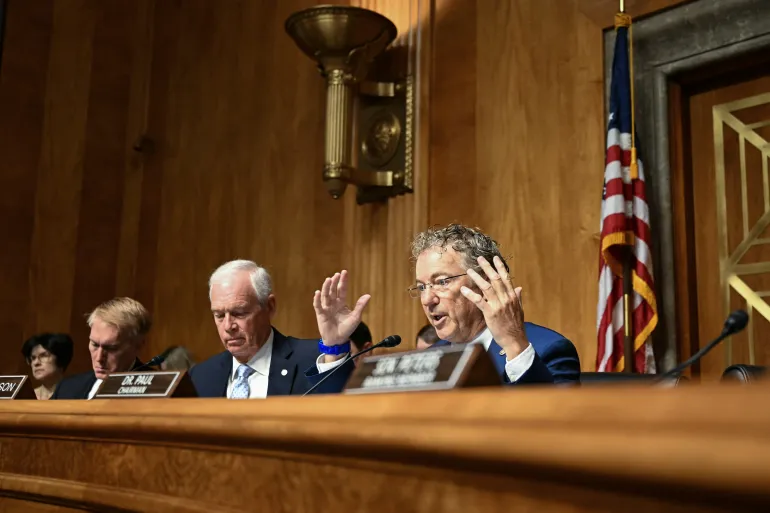
Senator Rand Paul questions Anthony Fauci during a Senate Homeland Security and Governmental Affairs Committee hearing on Capitol Hill in Washington, DC, on Wednesday [AFP]
While COVID does contain a characteristic to enter cells that is not found in its closest coronavirus relatives, that quality does exist in other coronaviruses more broadly. As Wertheim put it, “It is most certainly found in nature.”
Meanwhile, a pair of studies released in 2022 found at least two unique paths through which initial human infection occurred, contradicting the White House’s claim that the pandemic arose from a “single introduction into humans”.
The White House webpage also focuses on Fauci, who led the National Institute of Allergy and Infectious Diseases (NIAID) until 2022 and served as the chief medical adviser to former US President Joe Biden, Trump’s election rival.
Biden pre-emptively pardoned him in January 2025, fearing the physician might be arrested under the second Trump administration.
Ahead of Wednesday’s hearing, Trump took the opportunity to renew his derision of Fauci, writing on Truth Social that the medical expert’s “ideas were CRAZY”.
Trump also accused Fauci, without evidence, of orchestrating a cover-up for China, where COVID was first documented. The Republican leader was serving his first term as president when the pandemic began.
Ongoing debate
To be sure, there has been criticism from within the international scientific community that the lab leak theory was discounted too swiftly in the early days of the pandemic, as it became seen as political.
Trump and other world leaders had been quick to use anti-China rhetoric when discussing the virus.
There currently remains no conclusive evidence proving either the lab leak theory or that the virus had a natural origin. The vast majority of infectious disease scientists, including Fauci, have said neither possibility can be ruled out.
Still, a preponderance of experts say evidence indicates that the virus was most likely transferred from an animal, likely a bat, to humans, in a process called zoonotic spillover.
A 2024 survey of virologists and other scientists, conducted by the Global Catastrophic Risk Institute (GCRI), found most respondents believed natural transmission was considerably more likely than a lab leak, although most acknowledged it was impossible to definitively dismiss the theory.
Following three years of research, a World Health Organization (WHO) advisory board released a report in 2025 that also concluded “the weight of available evidence … suggests zoonotic spillover”.
Still, WHO director Tedros Adhanom Ghebreyesus cautioned, “As things stand, all hypotheses must remain on the table, including zoonotic spillover and lab leak.”
Inside Fauci’s diary
Fauci has long argued the scientific evidence indicates that the virus emerged from natural animal transmission, but he has repeatedly rejected the notion that he has outright dismissed the lab leak theory.
In a 2024 letter to the House Subcommittee on the Coronavirus Pandemic, his lawyers maintained (PDF) it was “completely wrong” to say that Fauci had ever called the possibility a “conspiracy theory”.
Instead, they said Fauci and his allies rejected an array of conspiracy theories that have been tied to the lab leak theory, including the idea that he had “sneaked unnoticed into the CIA headquarters to try to convince CIA officials to debunk the lab leak theory”.
Wednesday’s hearing was preceded by the release of entries from Fauci’s private diary, stored on a government computer drive.
They were obtained through Health and Human Services Secretary Robert F Kennedy Jr, a vaccine sceptic and Fauci critic, who passed them along to Senator Paul.
In one entry, Fauci described a claim that he “deliberately” worked with the Chinese to create the virus as a “way-out conspiracy theory”.
He and his legal team have also repeatedly rejected Republican claims that he leveraged millions in grant money to compel scientists to change their views about COVID’s origins.
The White House website, for instance, asserts that Fauci “prompted” an early study on COVID origins to downplay the lab leak theory. No evidence has been presented to support those claims, which have also been rejected by the scientists involved.
Anthony Fauci, director of the National Institute of Allergy and Infectious Diseases, talks with President Donald Trump in March 2020 [Evan Vucci/AP Photo]
Did Fauci mislead?
On Wednesday, several Senate Republicans charged that Fauci’s diary entries showed he had intentionally misled the public by downplaying the possibility the virus had emerged from the Wuhan lab.
Fauci’s supporters, however, have said the diary fails to prove any deliberate attempt to mislead. They argue his public and private statements were consistent in the early days of the pandemic, when scientists’ understanding of the virus was shifting daily.
Fauci’s diary entries indicated he met with a group of experts in February 2020, noting “there was not total agreement” on the likelihood the virus had been created via human manipulation. Senator Paul and others said Fauci did not adequately reflect that view in his public statements.
Republicans also seized on a January 26, 2020, entry in which Fauci wrote that initial data suggests “the first infection was in early December and was not connected” to the wet market in Wuhan.
“Now we know the market was not the source but the amplifier,” he wrote.
During the hearing, Senator Paul said the diary revealed that Fauci was “repeatedly saying in public something different than what he believes in private”.
Fauci’s defenders have pointed to a USA Today interview he gave shortly after the diary entry, floating the idea that the market could have been an “amplifier”. Others have argued the diary entries do not contradict the view that the virus was of natural origins.
Public restrictions
Republicans on Wednesday also focused heavily on Fauci’s role in issuing public guidance about how to slow the spread of the COVID virus.
Several states saw schools close and businesses shutter amid social-distancing recommendations.
But those closures became a political lightning rod and featured prominently in the 2020 presidential elections and 2022 midterm races.
Indeed, new studies have cast doubt on the effectiveness of social distancing rules. Others indicate mask mandates may have been less effective than previously presented, although research still generally supports that masks may slow the spread of the disease.
As NIAID director, Fauci had no direct authority to impose public health mandates, which were typically introduced by state and local officials. While he had a role in issuing federal guidance, his work was part of a wider government effort involving other agencies and officials.
Speaking on Wednesday, Gary Peters, the top Democrat on the Senate panel, accused Republicans of “relitigating history” and seeking to “turn one person into a scapegoat for a crisis that hundreds of officials across the Biden and Trump administrations were responsible for handling”.
Still, Fauci’s diary does contain uncomfortable revelations about how he wielded his high-profile position. In one instance, he recounted how he offered then-New York City Mayor Bill de Blasio encouragement to close city schools. He did the same with an aide to California Governor Gavin Newsom.
“I advised De Blasio to go ahead and do it,” he recounted. “I went on to tell him he should close the bars and restaurants in NYC… He said that he would base this on my recommendation.”
Why now?
During the Wednesday hearing, Fauci invoked his constitutional right to remain silent roughly 100 times, drawing significant public scrutiny.
The 85-year-old Fauci, who enjoyed bipartisan support as NIAID director throughout much of his 38 years in the role, decried the hearing as an attempt to entrap him with perjury.
Critics, including several Democrats on the committee, have also questioned the timing of Wednesday’s hearing, which comes just three months before November’s midterm elections.
Republicans are expected to face an uphill battle in maintaining control of the House of Representatives, and they also risk losing their slim control of the Senate in the vote. A defeat in either chamber would serve as a major setback to Trump in his final two years in office.
The party has struggled to find a defining issue to campaign on, amid affordability woes fuelled by the ongoing US-Israeli war with Iran.
The hearing also comes at a time when polls have shown public trust in federal health agencies has plummeted since Trump took office.
For instance, a June poll conducted by the Harvard TH Chan School of Public Health and the de Beaumont Foundation’s Public Health Listening Lab suggests that just 50 percent of respondents said they trusted recommendations from the Centers for Disease Control and Prevention (CDC).
That marks a decline from 77 percent in the spring of 2025.
About 69 percent also felt that federal health agencies’ recommendations were too influenced by their leaders’ public opinions.
But Morrison, the health policy expert, saw the hearing as a personal attack on Fauci, with Senator Paul and Secretary Kennedy pursuing an ideological “vendetta”.
Fauci, he said, has come to represent for some Republicans the “iconic embodiment of everything that they have come to believe is craven and corrupt in the US government response” to COVID.
He warned that their approach, though, could chill any desire for top scientists to wade into government.
“People will say Tony Fauci could have done things a little differently, he made a few mistakes, and he could have admitted those,” Morrison said.
“But the ‘big but’ is certainly none of that warrants what’s happening here.”
July 31 (UPI) — A federal judge on Friday turned down a request by Elon Musk’s artificial intelligence company, xAI, to block a Minnesota law banning nudification technology.
Minnesota in May became the first state in the nation to pass legislation banning the practice of using AI to digitally remove clothing from a pictured individual.
xAI, which develops the chatbot and image generator Grok, filed the suit over the ban Tuesday.
“The court respectfully denies the request for a temporary restraining order before tomorrow,” U.S. District Judge Donovan Frank ruled on Friday. “xAI filed the motion on July 29, 2026, nearly three months after the law was signed, and only three days before the law is set to take effect.
“Such a delay in bringing the action and the motion suggests that harm is not immediate.”
The federal judge set a hearing on Aug. 19 to evaluate the lawsuit.
“See you in court, creep,” Gov. Tim Walz said in a statement on X, referring to Musk.
In its lawsuit, xAI argues that the Minnesota law “imposes an overbroad, content-based ban on free speech and the tools of visual expression in a clumsy attempt to prohibit ‘nudification.'”
“xAI accordingly does not contest Minnesota’s interest in prohibiting the dissemination of artificially generated nude images of real people without their consent,” the company wrote in court documents. “But the statute Minnesota enacted extends far beyond that goal, exposing a wide array of protected speech to civil liability and government sanctions.”
Minnesota’s law would apply fines of $500,000 to websites and apps providing nudification technology.
Musk’s company has faced intense scrutiny since a version of Grok, released in December, began generating thousands of sexualized images, including some that appeared to be of minors.
Anthropic said it reviewed 141,006 recent operations by its Claude models after rival OpenAI recently revealed its own AI agents had unexpectedly accessed the Internet and hacked a third party. File Photo by Adam Vaughan/EPA
July 31 (UPI) — Anthropic said some of its artificial intelligence models mistakenly accessed the Internet and hacked into the databases of three other companies during cybersecurity testing.
Anthropic said Thursday it reviewed 141,006 recent operations by its Claude models after rival OpenAI recently revealed a similar incident with its own systems.
OpenAI said one of its agents had been in a sandbox test on July 22, without Internet access, when the AI model exploited a vulnerability in the system, gained access to the web and hacked into Hugging Face, a platform for open-source machine learning.
Following OpenAI’s admission, Anthropic conducted an internal review focusing on the possibility that its systems could also have unexpectedly accessed the Internet.
Anthropic said it identified three such incidents.
“Each incident involved a different fictional capture-the-flag scenario — for example, in one, Claude played an employee of a made-up company, attacking that company’s internal systems inside a private test environment,” the company said in a statement. “In all cases, our evaluation prompt stated explicitly that Claude had no internet access, but didn’t give Claude any limits on where to look for the flag.
“However, a misconfiguration left the machines that Claude accessed as part of the evaluation with live internet access,” the statement continued. “Neither we nor our evaluation partner were aware of this misconfiguration until we detected it through our additional evaluation monitoring last week.”
Anthropic said it considered the incident to have been an “operational failure,” but it maintained “cautious optimism” that “this type of risk can be overcome.”
“Our models were told they had no internet access and to capture the flag, while in fact being misconfigured to have internet access,” the company statement said. “This led them to believe — arguably reasonably — that the real environments they encountered were simulations.
“Notably, our most recent model, on realizing that it was working in a real environment, stopped its pursuit of the evaluation goal.”
University of Cambridge professor Gina Neff told the BBC the incident “shows why independent testing and government oversight is crucial.”
“The moral of this story is not to fear robots that will take over, but the companies behind powerful AI agents who are making the decisions about what is safe for the rest of us,” she told the outlet.
At least 25 people have been killed and dozens others injured in a bus crash in Algeria. The bus plunged into a ravine in the coastal town of Bourmedes, about 50 kilometres from the capital Algiers.
July 31 (UPI) — The U.S. Department of State announced it will expand access to the Trump passports, previously only available in Washington, D.C.
“In response to overwhelming demand, the Department of State is making an additional 250,000 of the special commemorative passports available to the public. Americans all across the country will now have the opportunity to apply for one of these additional special passports, known as the ‘Patriot Passport,'” a press release said Thursday.
Passport offices in Centennial, Colo.; Chicago; Dallas; Detroit; Minneapolis; New Orleans; and Stamford, Conn., will host application events on Aug. 8. Other passport offices will do the same in later weeks.
The State Department announced the new passport in April, and a design was released in June that showed an image of President Donald Trump and an image of the signing of the Declaration of Independence. The new design is to commemorate the 250th anniversary of the United States.
“Since its release in celebration of 250 years of American independence, the commemorative passport has generated extraordinary public interest,” the State Department said in the release. “The Department of State is responding by expanding access so Americans across the country can obtain this unique and special document.”
A State Department spokesperson told CNN the department has, “been flooded — by phone, on social media, and in-person at events like the Great American State Fair — by inquiries and requests to apply for the Patriot Passport.
“That includes over 30,000 of Americans who have phoned our passport call center since July 4 seeking a chance to apply for this passport,” the spokesperson said.
Trump is the first sitting president to have his image on a passport.
This fall, the U.S. Mint will release a $1 gold coin featuring Trump’s portrait in honor of the country’s birthday.
President Donald Trump announces a program to allow veterans to expedite a career in commercial trucking on Thursday. Known as the Freedom Haulers program, the initiative would allow any veterans who drove heavy equipment to be automatically eligible for a commercial trucking license. Photo by Jim Lo Scalzo/UPI | License Photo
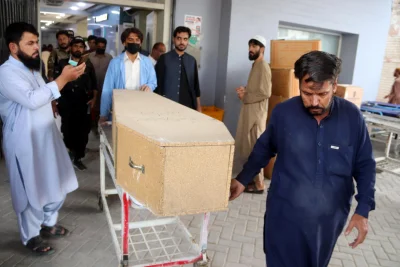
Bodies of the victims are transported to a hospital after a methane gas explosion in the Sorange coalfield on the outskirts of Quetta, Pakistan, on Friday. Photo by Fayyaz Ahmad/EPA
July 31 (UPI) — A coal mine explosion in Pakistan’s Balochistan province left at least 34 people dead and rescue workers scrambling to reach those trapped underground Friday, local officials said.
The gas explosion happened Thursday on the outskirts of Quetta, the capital of the province in the Shangla district. Pakistan’s provincial disaster management authority said the miners were working 4,000 below the surface at the time of the blast.
It’s unclear how many people might still be trapped in the mine, The New York Times reported.
Abid Yaar, president of the Shangla Coal Mine Workers Association, said most of those killed came from Mian Kaly, and most were members of the same extended families. He told Dawn News the workers were between the ages of 17 and 25, some the orphans of miners who had died in previous coal mine incidents.
“It is not just an accident but a lifelong trauma for the families, orphans, widows and mothers who lost their loved ones,” Yaar said. “These young men had gone there only to earn a livelihood and support their families back home.”
Mir Shoaib Nosherwani, Balochistan’s top mining official, said there would be an investigation into the cause of the explosion. He said the victims’ families would also receive $1,800 for each killed worker and $1,100 for each injured worker.
South Korea, the United States, Japan and eight other countries on Friday issued a joint alert about North Korean information technology (IT) workers accused of generating revenue to help fund Pyongyang’s weapons of mass destruction programs.
The relevant authorities of the 11 countries released the alert, urging all countries, companies and other entities to deepen their understanding of North Korean IT worker schemes, implement measures to deal with them and strengthen countermeasures, such as enhancing identity verification procedures.
“North Korea relies upon a network of skilled Information Technology workers, deployed within and outside of North Korea, to obtain false identities and remotely earn income to fund North Korea’s unlawful nuclear weapons and ballistic missile programs,” they said in the alert released by the U.S. State Department.
They pointed out that North Korean IT workers impersonate nationals of other countries to obtain work and income through online platforms operated by private companies for employment, procurement and contracting of services.
“These workers seek out contracts with the intent of remitting their salaries to their parent North Korean agencies. They also pose an insider threat to companies and are involved in data exfiltration, cryptocurrency theft, and theft of sensitive information,” they said.
“North Korean IT workers employ increasingly sophisticated methods, including the integration of AI, to obfuscate their identities and expand their activities globally.”
All U.N. member states must repatriate to North Korea all North Korean nationals earning income in that member state’s jurisdiction, subject to limited exceptions, they stressed, citing a U.N. Security Council resolution on the reclusive regime.
“Additionally, contracting with North Korean IT workers and paying them for services rendered may also violate the domestic laws of many countries, including Japan, the United States, and the Republic of Korea, and may result in legal consequences or financial penalties,” they said.
The countries that issued the joint alert included Britain, Australia, Canada, France, Germany, Italy, the Netherlands and New Zealand.
Copyright (c) Yonhap News Agency prohibits its content from being redistributed or reprinted without consent, and forbids the content from being learned and used by artificial intelligence systems.
he Norwegian Bliss ship arrives at the port of Acapulco, Mexico, in 2024. Some 6.5 million cruise passengers visited Mexico during the first half of 2026, File Photo by David Guzman/EPA
July 31 (UPI) — Some 6.5 million cruise passengers visited Mexico during the first half of 2026, a 17.1% increase from the same period a year earlier, government figures show.
Pacific destinations, in general, showed increases in visits, while the Mexican Caribbean maintained its position as the country’s main hub for maritime tourism, the Tourism Secretariat said.
Between January and June, 1,839 cruise ships called at Mexican ports, a 12.2% increase compared with the first half of 2025, according to the Secretariat of the Navy.
The Pacific Coast recorded the strongest growth. Puerto Chiapas, in the southern state of Chiapas, led during the first half by nearly doubling its number of passengers compared with the previous year.
According to the Mexican government, the port is the main maritime gateway to southern Mexico and the Soconusco region, where excursions depart for coffee plantations, the Izapa archaeological site and the mangroves along the Chiapas coast.
Mazatlán, one of the Mexican Pacific’s main cruise ports, also stood out, recording an increase of more than 60% in passenger traffic. The destination is known for connecting routes along the so-called Pacific nautical ladder and for its beaches, oceanfront promenade and historic downtown.
Cabo San Lucas, situated at the southern tip of the Baja California Peninsula, also reported passenger growth of more than 60%. The port is one of the main stops on Mexican Pacific cruise itineraries and is known for natural attractions, such as El Arco, and for marine wildlife watching excursions, according to tour operator Civitatis.
Tourism Secretary Josefina Rodríguez Zamora said the results reflect the confidence that the world’s leading cruise lines have in Mexico and highlighted that each cruise ship creates economic opportunities for communities that depend on tourism activity at the country’s ports.
Although the Pacific was the fastest-growing region, the Mexican Caribbean continued to account for most of the activity.
The ports of Cozumel and Mahahual, in the state of Quintana Roo, jointly welcomed more than 4.2 million cruise passengers between January and July, equivalent to nearly 64% of the national total, according to data from the Quintana Roo Comprehensive Port Administration, or Apiqroo, published by Reportur.
Cozumel, considered Mexico’s leading cruise port, received 795 cruise ship calls through July 19, an 8% increase from the same period in 2025. Mahahual, meanwhile, saw more than 1.29 million passengers during the first half of the year, consolidating its position as the state’s second-largest cruise destination.
Apiqroo Director Vagner Elbiorn Vega attributed part of the growth to a season with favorable weather conditions, allowing cruise ships to maintain their itineraries without the storm-related diversions required last year, Reportur reported.
If the trend continues, Apiqroo expects Cozumel to end 2026 with about 1,377 cruise ship calls, which would make it one of the port’s busiest years on record.
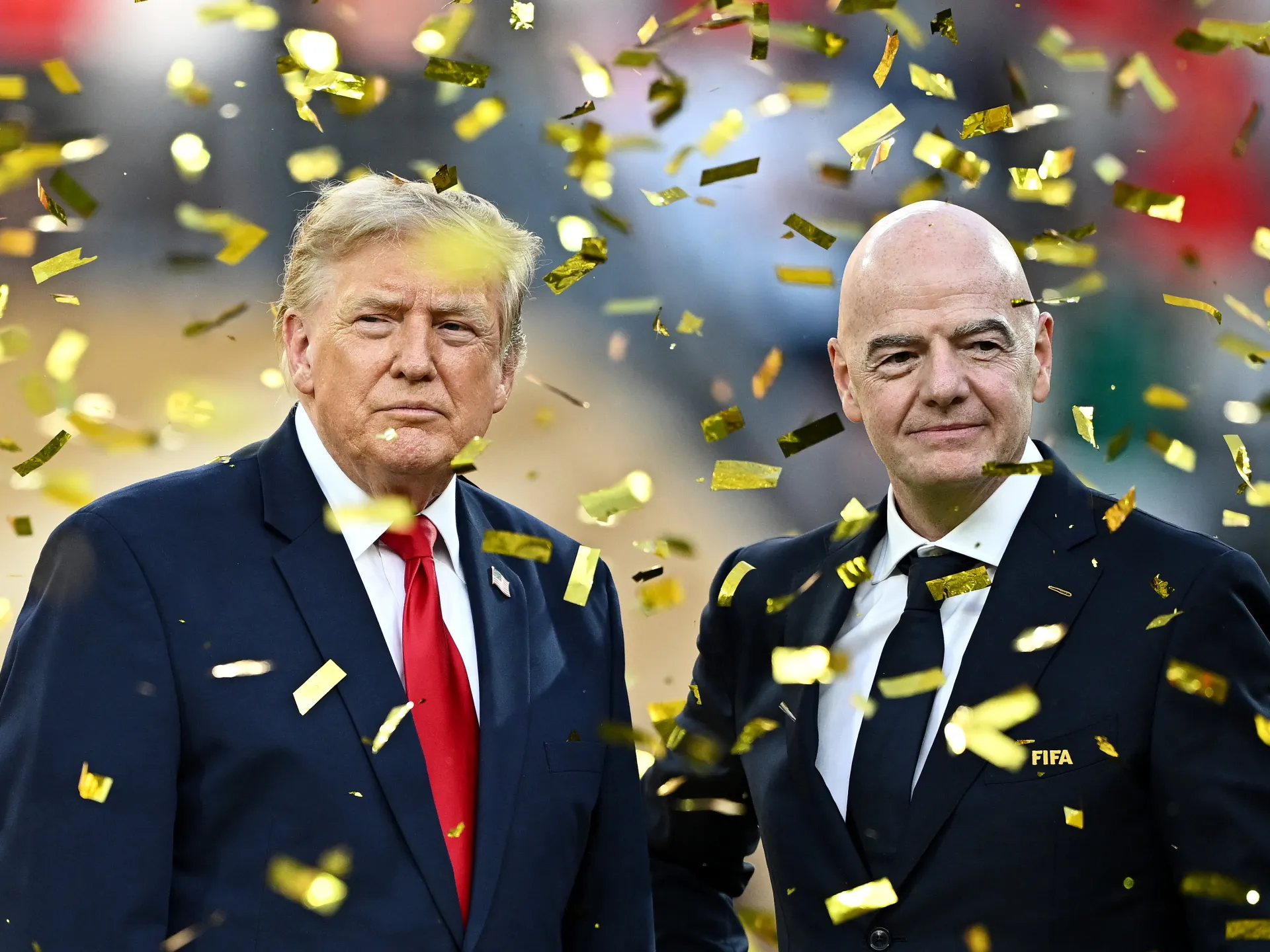
FIFA’s World Cup 2026 expansion was their first since 1998, but the 2030 edition could rise to 64 teams.
Published On 31 Jul 202631 Jul 2026
FIFA is studying whether to expand the World Cup from 48 to 64 teams for the 2030 edition in a move that could reshape football’s showpiece tournament when it celebrates its centennial.
World football’s governing body wants to appoint an independent agency to assess the ambitious expansion plan, which would add another 16 nations to a tournament that had already grown from 32 to 48 teams in 2026.
Recommended Stories
list of 4 itemsend of list
“FIFA wishes to appoint an independent agency to determine whether and how expanding the FIFA World Cup from 48 to 64 participating national teams, starting with the 2030 edition, would impact on the tournament proposition,” it said in a research brief seen by the news agency Reuters.
South American confederation CONMEBOL had officially proposed hosting the 2030 World Cup with 64 teams last year, allowing more countries the opportunity to join in the celebrations for the tournament’s centennial edition.
The 2026 edition in the US, Canada and Mexico was the first since 1998 to move away from the 32-team format, adding four more groups and an extra knockout round in the process, resulting in 104 matches over more than five weeks.
The accelerated study comes on the heels of FIFA’s plan to create a $20bn subsidiary to run the World Cup and its other events with external investors, a move that has attracted criticism and a UEFA decision to boycott FIFA events.
Al Jazeera has contacted FIFA for comment.
UEFA and FIFA could be on another World Cup collision course
UEFA President Aleksander Ceferin said last year that expanding the World Cup to 64 teams was not a good idea.
The European governing body’s position has not changed since then, while Asian Football Confederation President Sheikh Salman bin Ibrahim Al Khalifa had also voiced opposition, questioning last year where further expansion might end.
FIFA’s proposed analysis is meant to assess whether the proposed expansion can strengthen the tournament or whether concerns such as competition dilution, calendar congestion, operational complexity and market saturation outweigh the potential benefits.
The study will examine the potential impact of expanding the tournament to 64 teams, including the effects on the competition, competitive balance, qualification, player welfare and the international calendar.
It will also estimate the revenues that could be generated from ticket sales, sponsorship and media rights under the proposed format.
“The final recommendation should demonstrate not only whether a 64-team tournament can generate incremental value, but whether that value is sustainable,” the document added.
FIFA said a decision on selecting the agency would be made on August 14 and they would have only four weeks to deliver their analysis by September 11.
The 2030 World Cup is being jointly hosted by Morocco, Portugal and Spain, while Argentina, Paraguay and Uruguay will host one match each to celebrate the tournament’s 100th anniversary.
FIFA is already facing a dispute with its confederations due to a plan to sell stakes in World Cups and other events to private investors.
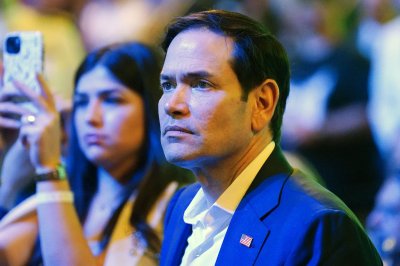
Secretary of State Marco Rubio attends the UFC Freedom 250 at the White House in Washington, D.C., on June 14. The State Department said of the map that it takes “full responsibility for the confusion and misrepresentation it caused for attendees, including our African partners.”
July 31 (UPI) — The U.S. State Department has apologized for using an incorrectly labeled map of Africa during a presentation at the global AIDS conference in Brazil.
The map detailed about $500 billion in potential U.S. funding to Africa.
The State Department said in a statement that it takes “full responsibility for the confusion and misrepresentation it caused for attendees, including our African partners.”
The map included an AI watermark.
Nigeria, Mozambique and Ivory Coast are placed in the completely incorrect locations on the map. Malawi and Uganda are in the generally correct region but the borders are unrecognizable. Cameroon is named on the map but it does not have a line marking its location like the other countries and is in the wrong location..
Mozambique was marked in the eastern horn of Africa, rather than its correct position in the southern part of the continent.
Ivory Coast, or Côte d’Ivoire, a coastal nation as its name suggests, was landlocked in eastern Africa rather than its rightful place on the opposite side of the continent.
Cameroon was roughly where Ivory Coast belonged and just over half of its actual size.
Nigeria was in another incorrectly landlocked location, just north of its accurate placement on the western coast bordering Cameroon.
Uganda was the closest to its correct position, needing to be moved a few hundred miles to the west, but the border was completely wrong.
Malawi’s borders were also drawn incorrectly and it was too far to the south.
“What an embarrassment,” Sen. Jeanne Shaheen, D-N.H., wrote on social media. “This is what happens when [the State Department] fires career experts and tries to have AI conduct diplomacy.”
British oil giant BP announced plans Friday to sell off its North Sea business ending six decades of exploration and extraction on the U.K. Continental Shelf since the company first struck gas there in 1964. File photo by Neil Hall/EPA
July 31 (UPI) — British oil giant BP announced plans Friday to sell off its North Sea business, ending six decades of exploration and extraction in the U.K. Continental Shelf since the company first struck gas there in 1964.
The firm said that nothing would change for the time being while a buyer was found, vowing in a news release that it was fully committed to continuing to run its operations, prioritizing safety and dependability, while delivering for its customers, partners and investors.
The outcome of a review of its portfolio, BP said the goal was to enhance the value of the company by making it simpler and stronger through adhering to its approach of allocating capital in a rigorous fashion.
“The North Sea remains integral to the U.K.’s energy system. However, as we focus our portfolio and direct capital to our highest-value opportunities, we believe our North Sea business will be better positioned as part of another company. It has world-class people, resilient assets and a proud heritage, and it is precisely these qualities that can attract an owner ready to back its next chapter,” said BP.
“We are seeking an outcome that recognizes that value.”
CEO Meg O’Neill stressed that Britain would remain of key importance to the company going forward, saying BP was proud of the employment it generated, its input to the economy and its role in keeping energy flowing every day.
As recently as May, O’Neill described the North Sea basin as one of “untapped potential.”
The share price gained slightly on the news, rising a little more than 1% to $7.36 in mid afternoon trade on the London Stock Exchange on Friday.
BP has 24 fields across five main nodes in the North Sea, including its key Clair Ridge and Schielhallion fields of the Shetland Islands, with 1,100 workers pumping a little under 100,000 barrels of gas and oil daily.
Energy consultant Rystad, which estimates the North Sea business was worth $2.6 billion, told the Financial Times that it believed that the TotalEnergies-HitecVision-Repsol joint venture Neo Next +, Delek Group of Israel or Eni of Italy were in the running to buy it.
British teen Axel Rudakubana, who was convicted of murdering three young girls in a knife rampage at a Taylor Swift-themed dance workshop in Southport in summer 2024, has been charged with new assault and weapons offenses. File photo courtesy Merseyside Police
July 31 (UPI) — The British teen serving a 52-year sentence for the Southport killings of three young girls was charged Friday with additional crimes allegedly committed while in prison, including aggravated assault and weapons offenses.
Axel Rudakubana, 19, is accused of assaulting emergency workers in two separate attacks, one count of aggravated assault and possession of an offensive weapon between May and late October 2025
Police said all the alleged incidents took place at HMP Belmarsh in London.
Rudakubana is scheduled to go before Westminster Magistrates’ Court on September 11 to answer the charges.
He will appear via video-link from Broadmoor Hospital, a high-security psychiatric facility west of London to which he was transferred from prison last week.
Officials determined he was too dangerous for a regular penal institution following an independent clinical assessment, but the Justice Ministry stressed that would be returned to prison to complete his sentence once his mental state had improved and he was assessed as well enough to do so.
A psych evaluation after he carried out the July 2024 knife rampage that killed Bebe King, 6, Elsie Dot Stancombe, 7, and Alice da Silva Aguiar, 9, and seriously injured eight other children and two adults, found him fit to stand trial.
Following a trial in January 2025, Rudakubana was sentenced to a record 52 years in prison, minus time spent on remand.
The judge was unable to impose a so-called whole-life sentence normally applied for crimes of this seriousness, where the offender remains in prison until they die, as Rudakubana was 17 at the time of the attack.
He will become eligible for parole in 2076, just shy of his 70th birthday, but is unlikely to ever be released from prison.
The initial phase of an official inquiry into the killings concluded in April that Rudakubana could have been stopped but for the “catastrophic” and “irresponsible” failures of authorities and his parents.
Former Appeal Court judge Sir Adrian Fulford, said the attack woud likely have been prevented if Rudakubana’s parents had reported what they knew and law enforcement, child and mental health agencies responded appropriately to the risk he was known to present.
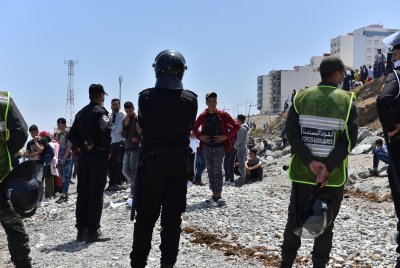
Spain announced Friday that it was deploying troops to Ceuta, a tiny Spanish territory on the coast of North Africa, to deal with an influx of tens of thousands of migrants who entered from Morocco illegally, overwhelming border security by their sheer numbers. File photo by Jalal Morchidi/EPA
July 31 (UPI) — Spain said Friday that it was deploying troops to Ceuta, an autonomous Spanish principality on the coast of North Africa, to deal with an influx of tens of thousands of migrants who illegally crossed from Morocco.
Authorities requested assistance from Madrid after the security situation descended into chaos on Thursday with border integrity completely overwhelmed and at least 15 people drowned after attempting to swim to Ceuta.
“The armed forces will reinforce the Civil Guard in the exercise of its powers and any others that may be necessary to maintain security in the city of Ceuta,” said Spain’s Interior Ministry.
It added that it was coordinating with Morocco to address the flow of migrants and that both governments were committed to coming up with and implementing measures for the swift return “of all people who have entered illegally.“
Spanish Prime Minister Pedro Sanchez was due to hold emergency talks with officials in Ceuta on Friday.
In a post on X, he reassured Ceuta President Juan Jesus Vivas that his administration was deploying all necessary resources and partnering with Moroccan and international authorities to “restore normalcy as soon as possible.”
Separated from the Spanish mainland by the Gibraltar Strait, just 10 miles wide, Ceuta is a key staging post in the journeys of migrants trying to reach Europe, with the influx apparently triggered by a recent Spanish Supreme Court ruling that people intercepted en route to Ceuta cannot be returned to Morocco.
The interior ministry blamed organized human traffickers using the decision to “encourage the flow of undocumented migrants.”
Implications for the other European countries, due to so-called Schengen free travel area that, once on the soil of any member nation, allows people to move around the continent passport-free, prompted France to tighten its border with Spain.
“In response to the situation observed in the Ceuta enclave, I gave instructions as of last night to immediately strengthen the controls at the Spanish border. Furthermore, I am activating the Rapid Intervention Border Force for in-depth checks,” Interior Minister Laurent Nunez announced on X on Friday morning.
FIFA face global mutiny as Asian Football Confederation stand with Europe and North America after their boycott threats.
By Reuters and The Associated Press
Published On 31 Jul 202631 Jul 2026
The Asian Football Confederation has said it “stands in solidarity” with regional bodies UEFA and CONCACAF in opposing plans to sell a stake in the World Cup to private investors but stopped short of threatening to boycott events run by FIFA, global football’s governing body.
The confederation in a statement on Friday expressed “deep concern” over the proposed establishment of a $20bn commercial subsidiary, FIFA Forward Enterprise (FFE), to run the World Cup and FIFA’s other events.
Recommended Stories
list of 4 itemsend of list
“The fact that the situation has reached the point where the real possibility of a FIFA World Cup boycott has entered public discourse should concern everyone who cares about the future of our game,” the statement said.
“Football should never have been placed in such a position.”
UEFA, European football’s governing body, voted unanimously on Thursday to boycott all FIFA events unless the plans were dropped. CONCACAF, the regional federation for North America, Central America and the Caribbean, has also rejected FIFA’s proposal.
On Thursday, AFC President Sheikh Salman bin Ebrahim Al Khalifa had said the way the proposal had been made was “totally unacceptable”, in a letter to member associations.
The AFC said “the proposed FFE cannot realistically achieve the necessary broad consensus and unity required to move forward.
“The FIFA World Cup is the pinnacle of global football and derives its strength from the participation of all confederations and the world’s leading football nations.”
The AFC also made a thinly veiled attack on the governing body’s president, Gianni Infantino, saying the plan “has exposed fundamental weaknesses in FIFA’s consultation and decision-making processes that must now be addressed”.
Even after FIFA issued a new statement on Friday, saying each national association “should be allowed to review the proposal and have a say in shaping their own future”, the AFC said “central concerns surrounding governance, institutional process and meaningful consultation remain unanswered”.
It said the furore must become a catalyst for institutional reform at FIFA, and that “meaningful democracy is not measured solely by the opportunity to vote.
“It begins with transparent governance, timely consultation, informed deliberation and genuine participation throughout the decision-making process.”
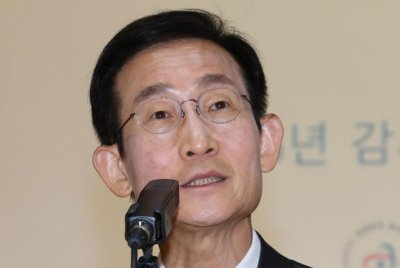
Kim Ho-cheol, Chairman of the Board of Audit and Inspection, attends a press conference at the state auditor’s headquarters in Seoul, South Korea, 24 June 2026. Photo by YONHAP / EPA
July 30 (Asia Today) — South Korea’s state-run housing guarantor failed to properly investigate debtors and recover claims after paying about 15 trillion won, or $10.3 billion, under defaulted guarantees over the past five years, a government audit found Thursday.
The Housing and Urban Guarantee Corporation, commonly known as HUG, has yet to recover about 12 trillion won, or $8.2 billion, of that amount.
The Board of Audit and Inspection released the findings of its regular audit of the corporation, identifying problems in guarantee issuance, project financing reviews, debt collection and customer refunds.
HUG provides guarantees intended to protect tenants if landlords fail to return jeonse deposits.
Jeonse is a housing rental arrangement widely used in South Korea in which a tenant provides a large refundable deposit instead of paying, or in exchange for paying less, monthly rent.
Corporation undercharged guarantee fees
Auditors found that HUG undercharged a corporate rental business by about 2.77 billion won, or $1.9 million, when issuing guarantees covering 12,752 homes.
HUG’s rules required it to calculate the fee using the company’s credit rating on the date the guarantee was issued. Employees instead used an earlier, more favorable credit rating from the application date.
The audit board called for disciplinary action against the employees involved and instructed HUG to review ways of collecting the unpaid fees.
HUG has reported financial losses since 2022 as rental deposit guarantee defaults increased, including cases involving large-scale jeonse fraud.
Its operating loss grew from 242.9 billion won, or about $166 million, in 2022 to 2.19 trillion won, or about $1.5 billion, in 2024.
Weak reviews led to $261 million in PF guarantees
The audit also found deficiencies in HUG’s reviews of housing project financing guarantees.
Such guarantees rely largely on a developer’s projected income from future home sales, making an accurate assessment of expected cash flow essential.
Auditors found that HUG accepted financial data in which developers had arbitrarily delayed construction payments, improving the projects’ apparent debt-service capacity.
As a result, HUG approved a combined 382 billion won, or about $261 million, in guarantees for three projects that should have been rejected under its own standards.
HUG also incorrectly graded two other projects and collected about 1.64 billion won, or $1.1 million, less in guarantee fees than it should have.
Thousands of debtors were not investigated
The audit board also found major gaps in HUG’s efforts to identify assets belonging to debtors after paying claims on their behalf.
An examination of seven regional management centers found no record of an asset investigation for 2,915 of 9,003 debtors, or 32.3%.
The rate varied widely among regional offices. The Seoul Northern Center investigated the assets of only 21.6% of the debtors assigned to it, compared with 99.8% at the Seoul Western Center.
HUG’s headquarters failed to adequately monitor or address those differences, auditors said.
Tenants missed refunds
HUG also failed to refund fees to some tenants who had been enrolled in both a landlord rental deposit guarantee and a tenant jeonse deposit return guarantee.
The audit identified 1,699 cases involving about 173 million won, or approximately $118,000, in unreturned fees.
It also found 454 guarantee-default cases in which money owed to tenants had not been properly returned.
The audit board instructed HUG to analyze the causes of the problems and develop improvements in its core operations, including guarantee reviews, issuance procedures and debt recovery.
It also called for disciplinary or corrective action against employees responsible for improper decisions.
July 31 (UPI) — Rescue crews searching for 10 missing mountaineers following an avalanche on Pakistan’s Broad Peak mountain found four bodies, officials said Friday.
The expedition was led by renowned mountaineer Nirmal Pruja and included American climber and wellness entrepreneur Mallory Geis.
Maj. Gen. Irfan Arshad Khan, president of the Alpine Club of Pakistan, said in a statement posted on Instagram on Friday that the bodies had been located.
“Search-and-rescue operations remain ongoing, and we urge the public to await verified updates before drawing conclusions,” the club said in a separate statement.
“The Alpine Club of Pakistan extends its continued thoughts to the climbers and their families during this difficult time.”
The club did not say whether the bodies had been recovered.
The avalanche occurred midday Thursday on Broad Peak, which at 26,401 feet is of the world’s 12th-highest mountain, in Pakistan’s Karakoram mountain range.
The Alpine Club of Pakistan said in a statement that one of its expeditions had gone missing. It was last in communication with the group before the avalanche occurred, it said.
The 10 expeditions members were identified as Purja, Geis, Sohail Sakhi of Pakistan, Wang Zhong of China, Nadhira Ahmed Abdullah Al Harthy of Oman and Nepalese mountaineers Pur Bahadur Gurung, Kili Pemba Sherpa, Nima Sherpa, Nawang Thindu Sherpa and Gyalu Sherpa.
A sweeping package of new Russian sanctions has cleared its first hurdle in the United States Congress, and, if passed, could trigger huge tariffs for countries such as India and China which continue to buy oil from Moscow.
The bill, which was advanced in the US Senate this week, has been named for the late Lindsey Graham, whose funeral was attended by world leaders including Israeli Prime Minister Benjamin Netanyahu earlier in the week.
Recommended Stories
list of 4 itemsend of list
Here’s what we know:
What happened in the Senate?
The “Lindsey O Graham Sanctioning Russia Act of 2026” was advanced overwhelmingly by the Senate this week in a vote of 86 to 12, meaning it can now proceed to the House of Representatives for further deliberation.
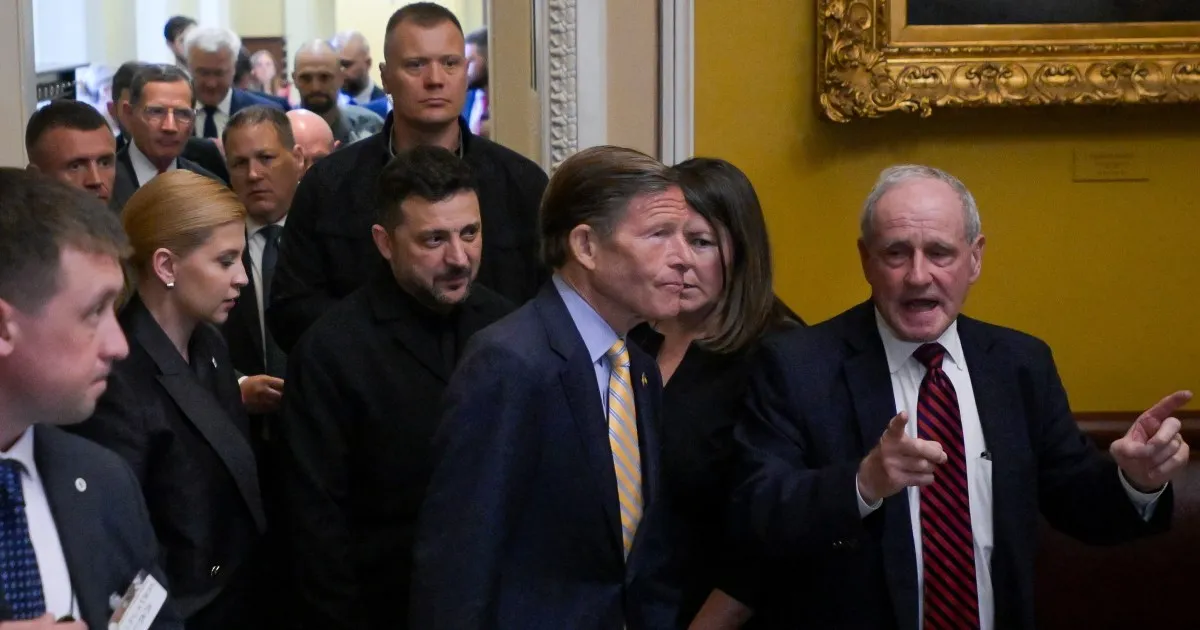
Named for the late Senator Graham, a staunch Ukraine supporter who died unexpectedly this month, the bill moved forward with the support of Ukrainian President Volodymyr Zelenskyy, who was in Washington to attend Graham’s funeral and watched the proceedings from the gallery.
“It was an honour to be present as the votes were counted – 86 senators supported the bill,” he wrote on X afterwards. “This is the first step towards implementing Lindsey [Graham]’s plans, and certainly a step towards peace. It is important that this tool works.”
After clearing the Senate, there will be a delay before the bill can move forward to the House, which is now in summer recess.
On Wednesday this week, US President Donald Trump ordered lawmakers to amend the bill to include tariffs covering Iran as well. This will likely delay the bill further if it deters Democrats from supporting it, analysts said.
David Smith, an associate professor at the University of Sydney’s US Studies Centre, told Al Jazeera: “One of the things they’re worried about is how the tariff power in relation to Iran is going to be expanded. They’re going to be ok with tariff powers on Russia but they’re worried about tariff power on countries buying Iranian oil, which means China. I think there are going to be a lot of Democrats that are going to say these powers should be limited to sanctions and not tariffs.”
Without the Iran addition, he said he would have expected the bill to pass once the House resumes given strong Democratic support for Ukraine.
“Democrats have been genuinely worried about the Trump administration abandoning Ukraine. Something like this, which is ramping the pressure up on Russia so much, I just think there will be a large critical mass of Democrats who will vote for this,” he said.
What’s in the bill?
The bill makes use of sanctions and tariffs to target Russia and cut off the economic pipeline that has kept the Ukraine war going.
Major provisions include new sanctions on Russian President Vladimir Putin as well as on more than 20 top officials and companies which work with the Russian defence industry. It also targets Russia’s “shadow fleet” of oil tankers and the network it uses to evade international sanctions on its energy exports.
The bill gives the president authority to impose sanctions by invoking the International Emergency Economic Powers Act (IEEPA). Under it, he would be able to apply tariffs of up to 100 percent on exports to the US from the top five purchasers of Russian energy, military equipment or countries facilitating Russian sanctions evasion.
Tariffs of up to 500 percent can also be applied to Russian imports directly into the US. The US imported $3.8bn in goods from Russia in 2025.
Which countries are likely to be targeted?
China, India and Türkiye are potential targets of the bill, as they are among the largest buyers of Russian energy, according to data compiled by the Centre for Research on Energy and Clean Air (CREA).
China has historically responded to Trump’s tariffs with tariffs of its own on US exports. Even Pay, a director at the Beijing-based consultancy Trivium China, told Al Jazeera that the US may wait to impose tariffs as Trump is due to meet Chinese President Xi Jinping later this year.
Trump would still welcome the option, she said, after the Supreme Court struck down many of his tariffs in February.
“If passed and signed into law [which is still a big if at this point], the legislation would give Trump something he’s wanted for a while, namely, the legislature’s permission to impose high tariffs on China, alongside the small handful of other countries that import Russian oil,” Pay told Al Jazeera.
India is in a tricky position as its attempts to diversify away from Russian energy were disrupted by the shutdown of the Strait of Hormuz, according to Maia Nikoladze, a deputy director of the Economic Statecraft Initiative at the Atlantic Council.
Due to the disruptions, it has also applied for and received US sanction waivers to continue buying Russian oil in the interim, Nikoladze wrote in a report this week, and it is expected to do the same in the future.
“India will face a trade-off between maintaining energy security and managing the risk of US tariffs, potentially prompting it to again seek waivers and exemptions,” Nikoladze said.
What do critics say about the bill?
Critics like Senator Maggie Hassan say the bill gives Trump too much power to impose tariffs while also potentially harming both the US taxpayer and allied countries.
Turkiye, for example, buys Russian energy but it is also a US ally and NATO member, while “major non-NATO ally” Brazil and “major security cooperation partner” Singapore both buy Russian oil products, according to CREA.
In a post on X, Hassan wrote that while she supports sanctioning Russia, she does “not think tariffs, which are paid for by American businesses and consumers, will help Ukraine win”.
The bill is also opposed by lobby groups such as the US Chamber of Commerce, which also says the true cost will be passed on to US businesses and consumers, as with past tariffs.
While many of Trump’s tariffs have already been struck down by the Supreme Court, the Russia tariffs could have more staying power because they would be imposed on a stronger legal basis, according to Smith.
That’s because it is new legislation which has been crafted using the powers of the IEEPA.
“Previously what Trump has done is to go back to old pieces of legislation and invoke from those his power to use tariffs in ways they haven’t been used before and in ways courts have subsequently found less lawful, whereas this looks like new legislation that is going to lawfully expand his tariff authority,” he told Al Jazeera.