In 1790, the U.S. Supreme Court convened in New York City for its first session. Only three of the six justices were present so there was no quorum.
In 1861, Texas seceded from the United States.
In 1865, U.S. President Abraham Lincoln signed the 13th Amendment, which abolished slavery.
In 1896, Giacomo Puccini’s opera La Boheme premiered in Turin, Italy.
In 1946, Norwegian Trygve Lie was selected to be the first U.N. secretary-general.
In 1947, members of the Jewish underground launched pamphlet bombs throughout Tel Aviv, warning British military authorities to expect further retaliation against its drive to suppress violence in the Holy Land.
In 1951, the Defense Department, responding to needs to effectively execute its Korean War strategy, ordered drafting of 80,000 men during April for assignment to the U.S. Army.
File Photo by Kevin Dietsch/UPI
In 1960, four Black students, later known as the Greensboro Four, staged the first of a series of non-violent protests at a Woolworth lunch counter in Greensboro, NC.
In 2011, Egyptian President Hosni Mubarak, with hundreds of thousands of protesters demanding his departure after a reign of nearly 30 years, announced he wouldn’t seek re-election.
In 2021, the Myanmar military took control of the government and announced a nationwide state of emergency hours after detaining leader Aung San Suu Kyi and other high-ranking elected government officials in a coup.
In 2023, seven-time Super Bowl champion Tom Brady announced his re-retirement from the NFL after 23 seasons in the league.
Jan. 31 (UPI) — Minnesota and the cities of Minneapolis and St. Paul lost their bid to have a federal court order the Department of Homeland Security to end its immigration enforcement effort in the state.
U.S. District Court of Minnesota Judge Katherine Menendez on Saturday denied a motion to enjoin the federal government from continuing its immigration law enforcement surge in the Twin Cities.
“Even if the likelihood of success on the merits and the balance of harms each weighed more clearly in favor of plaintiffs, the court would still likely be unable to grant the relief requested: An injunction suspending Operation Metro Surge,” Menendez wrote in her 30-page ruling.
She cited a recent federal appellate court ruling that affirmed the federal government has the right to enforce federal laws over the objections of others.
“The Eighth Circuit Court of Appeals recently vacated a much more circumscribed injunction, which limited one aspect of the ongoing operation, namely the way immigration officers interacted with protesters and observers,” Menedez said.
“The injunction in that case was not only much narrower than the one proposed here, but it was based on more settled precedent than that which underlies the claims now before the court,” she explained.
“Nonetheless, the court of appeals determined that the injunction would cause irreparable harm to the government because it would hamper their efforts to enforce federal law,” Menendez continued.
“If that injunction went too far, then the one at issue here — halting the entire operation — certainly would,” she concluded.
Menendez said her ruling does not address the merits of the case filed by Minnesota Attorney General Keith Ellison on behalf of the state and two cities, which are named as the lawsuit’s three plaintiffs.
Those claims remain to be argued and largely focus on Ellison’s claim that the federal government is undertaking an illegal operation that is intended to force state and local officials to cooperate with federal law enforcement.
Menendez said Ellison has not proven his claim, which largely relies on a 2013 ruling by the Supreme Court in a case brought by Shelby County, Ala., officials who challenged the 1965 Voting Rights Act.
The act placed additional restrictions on some states based on “their histories of racially discriminatory election administration,” Menendez said.
The Supreme Court ruled a “departure from the fundamental principle of equal sovereignty” requires the federal government to show that geographically driven laws are “sufficiently related to the problem that it targets” to be lawful, she wrote.
Ellison says that the ruling “teaches that the federal government cannot single out states for disparate treatment without strong and narrowly tailored justification,” according to Menendez.
But he does not show any other examples of a legal authority applying the “equal sovereignty ‘test'” and does not show how it would apply to a presidential administration’s decision on where to deploy federal law enforcement to “enforce duly enacted federal laws,” she said.
“There is no precedent for a court to micromanage such decisions,” and she can ‘readily imagine scenarios where the federal executive must legitimately vary its use of law enforcement resources from one state to the next,” Menendez explained.
Because there is no likelihood of success in claims based on equal sovereignty, she said Ellison did not show there is a likelihood that plaintiffs will succeed in their federal lawsuit, so the motion to preliminarily enjoin the federal government from continuing Operation Metro Surge is denied.
Former President Joe Biden appointed Menendez to the federal bench in 2021.
President Donald Trump poses with an executive order he signed during a ceremony inside the Oval Office of the White House on Thursday. Trump signed an executive order to create the “Great American Recovery Initiative” to tackle drug addiction. Photo by Aaron Schwartz/UPI | License Photo
Jan. 31 (UPI) — The Iranian military intends to conduct two days of live-fire naval drills in the Strait of Hormuz, starting on Sunday, despite warnings against it from the U.S. military.
“U.S. forces acknowledge Iran’s right to operate professionally in international airspace and waters. Any unsafe and unprofessional behavior near U.S. forces, regional partners or commercial vessels increases risks of collision, escalation, and destabilization,” CENTCOM officials said in a statement on Saturday.
“CENTCOM will ensure the safety of U.S. personnel, ships, and aircraft operating in the Middle East. We will not tolerate unsafe IRGC actions, including overflight of U.S. military vessels engaged in flight operations, low-altitude or armed overflight of U.S. military assets when intentions are unclear, high-speed boat approaches on a collision course with U.S. military vessels, or weapons trained at U.S. forces,” CENTCOM said.
The Strait of Hormuz connects the Gulf of Oman and the Persian Gulf, with Iran situated along its northern shore and Oman and the United Arab Emirates along its southern shoreline.
More than 100 merchant vessels per day sail through the strait, which makes it an “essential trade corridor” that supports the region’s economy, CENTCOM said, as reported by Fox News.
The deployment comes as the Trump administration considers potential military intervention in the Iranian unrest.
Various estimates place the number of protestors and other civilians killed at between 6,000 and more than 30,000 since protests began on Dec. 28.
Saudi Defense Minister Prince Khalid bin Salman attended a private briefing in Washington, D.C., on Friday and warned that Iran would grow stronger if the United States does not act in Iran is warranted if military action is warranted, Axios reported.
Trump has threatened to target Iran’s leadership with military strikes if widespread killings of protesters continued, but he delayed any strikes after Saudi leaders cautioned against it.
Salman’s comments on Friday indicate a change among Saudi Arabia’s leadership regarding potential military action in Iran.
Meanwhile, Iranian Foreign Minister Abbas Araghchi on Saturday accused the U.S. military of trying to dictate how the Iranian military conducts “target practice on their own turf.”
“Freedom of navigation and safe passage of commercial vessels in the Strait of Hormuz are of vital importance for Iran, as much as it is for our neighbors,” Araghchi added.
“The presence of outside forces in our region has always caused the exact opposite of what is declared: promoting escalation instead of de-escalation,” he said.
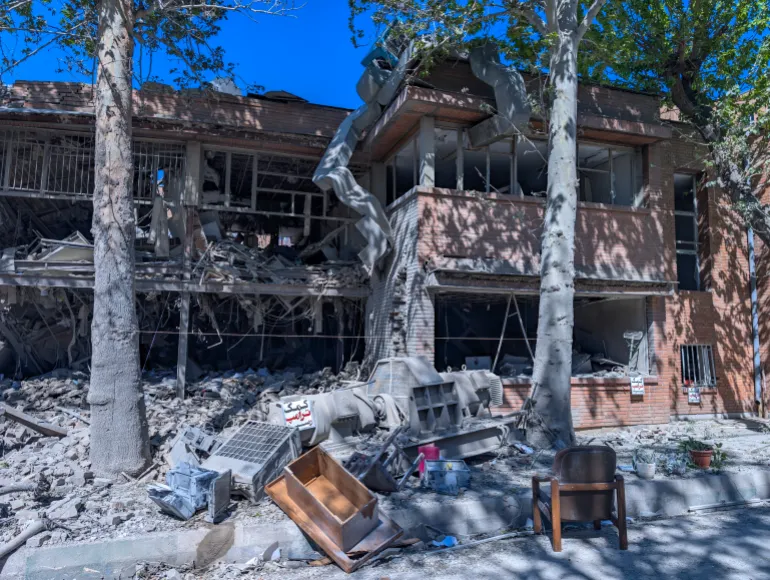
The pending military exercise also is scheduled after Iranian state media reported an explosion damaged a nine-story residential building and killed a young girl and injured 14 in Bandar Abbas, which is an Iranian port city located on the Strait of Hormuz.
Iran’s Fars News Agency denied reports that IRGC Navy leader Brigadier Gen. Alireza Tangsiri died in the blast, which local officials said likely was caused by a gas leak.
“The initial cause of the building accident in Bandar Abbas was a gas leak and buildup, leading to an explosion,” Bandar Abbas Fire Chief Mohammad Amin Lyaghat told Iranian state media. He called the explanation an “initial theory.”
President Donald Trump poses with an executive order he signed during a ceremony inside the Oval Office of the White House on Thursday. Trump signed an executive order to create the “Great American Recovery Initiative” to tackle drug addiction. Photo by Aaron Schwartz/UPI | License Photo
Israel on Saturday launched airstrikes into Gaza, hitting a police station, an apartment building and the Ghaith camp West of Khan Younis, pictured, which shelters displaced people in response to Hamas militants allegedly emerging from a tunnel in Rafah. Photo by Haitham Imad/EPA
Jan. 31 (UPI) — Israel on Saturday launched airstrikes at targets in Gaza, with Palestinian authorities reporting that at least 30 were killed in the attacks.
The strikes come after Israel accused Hamas of violating a shaky cease-fire in Gaza ahead of the expected reopening of the Rafah border crossing between Egypt and Gaza.
The strikes hit an apartment building, tent camp and a police station, hospital officials told the Los Angeles Times.
Ten officers and detainees were killed in the police station strike in Sheikh Radwan neighborhood outside Gaza City. Officials are searching the rubble for bodies and said the number of dead could increase, The Guardian reported.
The outlet added that three children and two women were killed in the apartment building in Gaza City, in addition to seven who died in strikes in the Khan Younis tent camp.
In a statement, Israel said the strikes were in response to militants leaving a tunnel in Rafah, which is controlled by Israel and would constitute a violation of the cease-fire.
The latest outbreak of violence comes one day before the land crossing between Gaza and Egypt in Rafah is due to reopen, part of the multi-part cease-fire that Israel and Hamas agreed to last October.
Israeli officials said the crossing would be open to a “limited” number of people and that all individuals entering or exiting Gaza will be required to obtain a security clearance from Israel in coordination with Egypt, NBC News reported.
Hospitals and ambulances in Egypt already have been preparing to receive sick and injured Palestinians from Gaza when the crossing opens on Sunday morning.
Despite the both Israel and Gaza accusing each other of violating the cease-fire, an Israeli official told The New York Times that Israel will not alter plans to open the Rafah border crossing.
President Donald Trump poses with an executive order he signed during a ceremony inside the Oval Office of the White House on Thursday. Trump signed an executive order to create the “Great American Recovery Initiative” to tackle drug addiction. Photo by Aaron Schwartz/UPI | License Photo
The talks come just a day before a second round of US-mediated talks between Russia and Ukraine in Abu Dhabi.
Published On 31 Jan 202631 Jan 2026
Share
United States special envoy Steve Witkoff has said he held “productive and constructive meetings” with Russian special envoy Kirill Dmitriev in Florida, as President Donald Trump’s administration presses to end Russia’s nearly four-year war in Ukraine.
“We are encouraged by this meeting that Russia is working toward securing peace in Ukraine,” wrote Witkoff in a post on X following Saturday’s talks.
Recommended Stories
list of 3 itemsend of list
US Treasury Secretary Scott Bessent, Jared Kushner, Trump’s son-in-law, and White House adviser Josh Gruenbaum also attended the talks.
Neither side released details of what was discussed.
Dmitriev also met Witkoff and Kushner in January on the sidelines of the World Economic Forum in Davos, Switzerland.
He also held talks on the Ukraine war with US negotiators in a visit to Miami in December.
Saturday’s meeting comes before Ukrainian and Russian negotiators are expected to hold a second round of talks with US mediators in Abu Dhabi to discuss a US-backed plan to end Russia’s war.
Ukrainian President Volodymyr Zelenskyy later appeared to suggest that the meeting would not take place on Sunday, saying in his nightly address that Ukraine was waiting for more information from the US about further peace talks and expected new meetings to take place next week.
A first US-mediated meeting was held in the United Arab Emirates’s capital last week, marking the first direct public negotiations between Moscow and Kyiv since the early weeks of the war.
Trump told reporters in the Oval Office this week that he believes “we are getting close” to a deal to end the war.
Trump announced on Thursday that his Russian counterpart, Vladimir Putin, had agreed to his request not to attack Ukraine’s energy infrastructure for a week amid extreme cold weather, which he said was “very nice” of the Russian president.
The Kremlin confirmed on Friday that Putin had received the request, with spokesperson Dmitry Peskov telling Sky News the Russian leader had “of course” agreed to the proposal.
Zelenskyy wrote on X that the issue of a ceasefire on energy infrastructure attacks had been discussed during last week’s talks, and that he expected the agreements to be implemented. “De-escalation steps contribute to real progress toward ending the war,” he added.
On Friday, the Ukrainian leader said in his nightly address that neither Moscow nor Kyiv had conducted strikes on energy targets from Thursday night onwards.
Several sticking points over the US-backed plan to end the war remain, including Russia’s demand for Ukrainian forces to withdraw from about one-fifth of the Donetsk region, and the potential deployment of international peacekeepers in Ukraine after the war.
These are the key developments from day 1,438 of Russia’s war on Ukraine.
Published On 1 Feb 20261 Feb 2026
Share
Here is where things stand on Sunday, February 1:
Fighting
Russian attacks on Ukraine killed one person and wounded seven others in the Dnipropetrovsk region, according to the country’s emergency service. High-rise buildings, homes, shops and cafes were also damaged.
Another person was wounded by shelling in the Zaporizhia region, the service said, with a blast also destroying three residential buildings and 12 homes.
In the Donetsk region, at least two people were killed, and five more were wounded, in 13 separate Russian attacks across multiple districts, according to Governor Vadym Filashkin.
A total of 172 people, including 35 children, were evacuated from the front line, Filashkin said.
Russian strikes hit state railway infrastructure in the Zaporizhia and Dnipro regions, a tactic Ukrainian President Volodymyr Zelenskyy said was intended to “cut our cities off from one another”.
In total, 303 combat clashes took place throughout Saturday, Ukraine’s General Staff wrote on Telegram, tallying 38 air strikes, 119 guided bombs, 2,510 kamikaze drones and 2,437 attacks on settlements and troops.
The Russian Ministry of Defence said on Saturday that its troops captured the villages of Petrivka, in Ukraine’s southeastern Zaporizhzhia region, and Toretske, in the eastern Donetsk region. Al Jazeera could not verify the claim.
Russia’s TASS state news agency also claimed that Russian forces had taken control of at least 24 Ukrainian settlements since the start of the year, the majority of which were in the Zaporizhia region.
Two people were wounded in a Ukrainian drone attack on a car in Russia’s Belgorod region, TASS reported.
Energy
Parts of Ukraine, including at least 3,500 buildings in Kyiv, faced a blackout throughout Saturday after a failure on interconnection lines with Moldova, officials reported.
The Kyiv metro closed down, forcing the evacuation of hundreds of people, along with the capital’s water and electricity supplies, Mayor Vitali Klitschko wrote on Telegram.
Although the capital’s water supplies had returned by around 10:30pm local time (20:30 GMT), energy workers were continuing to restore heat to roughly 2,600 houses, Klitschko said.
Ukraine is investigating the stoppage, but “as of now, there is no confirmation of external interference or a cyberattack”, the president said. “Most indications point to weather: ice buildup on the lines and automatic shutdowns.”
At the request of the Ukrainian Ministry of Defence, SpaceX has temporarily restricted operations of its Starlink systems in Ukraine to prevent Russian drone attacks, Serhii Beskrestnov, technology adviser to the defence minister, announced on Facebook.
“I apologise once again to those who have been temporarily affected by the measures taken, but for the security of the country, these are now very important and necessary actions,” Beskrestnov wrote.
Politics and diplomacy
United States special envoy Steve Witkoff said that he had “productive and constructive meetings” with Russian special envoy Kirill Dmitriev in Florida.
“We are encouraged by this meeting that Russia is working toward securing peace in Ukraine,” Witkoff said, adding that he was “grateful” for US President Donald Trump’s “critical leadership in seeking a durable and lasting peace”.
US Secretary of the Treasury Scott Bessent, Trump’s son-in-law, Jared Kushner, and White House senior adviser Josh Gruenbaum also attended the talks.
In his nightly address, Zelenskyy said Ukraine is “in regular contact with the US side” and is “waiting for them to provide specifics on further meetings”, expected to take place next week.
“Ukraine is ready to work in all effective formats,” he added. “What matters is the results, and that meetings happen.”
Ukrainian Minister of Foreign Affairs Andrii Sybiha spoke with Deputy Prime Minister of Liechtenstein Sabine Monauni, discussing “developments in the peace negotiations and urgent needs of Ukraine’s energy system”, Sybiha wrote on X.
“We also paid special attention to further sanctions pressure on Russia and joint international efforts to hold it to account,” Sybiha said.
Danish veterans gather for a silent march to the U.S. Embassy in Copenhagen on Saturday to express dissatisfaction with President Trump’s statements about NATO soldiers in Afghanistan. Photo by EPA/Emil Nicolai Helms
Jan. 31 (UPI) — Danish military veterans and others staged a protest march against U.S. President Donald Trump‘s recent comments regarding NATO members and Greenland.
Trump criticized the amount of support the United States received from NATO allies during recent conflicts, and many veterans and others in Denmark took to the streets on Saturday to show their displeasure.
One protester, Danish Lance Cpl. Soren Teigen, said only the president is responsible for the comments.
“I don’t blame American soldiers in any way — we’ve fought side by side, and we still do,” Teigen told The New York Times. “But when the president says something like this, of course it hurts.”
Trump earlier accused NATO allies of shying away from fighting after sending their troops to Afghanistan but allegedly keeping them away from the front lines.
Officials with Danish Veterans & Veteran Support took exception to the president’s comments.
“Denmark has always stood side by side with the USA, and we have shown up in the world’s crisis zones when the USA has asked us to,” the group said in a prepared statement.
“We feel let down and ridiculed by the Trump administration, which is deliberately disregarding Denmark’s combat side by side with the USA,” it added.
Many veterans and other Danes also are unhappy with the president’s efforts to annex or otherwise control Greenland.
Hundreds of Danish military veterans on Saturday quietly marched to outside the U.S. Embassy in Copenhagen, where some placed 44 small Danish flags in planters located nearby.
The flags are to commemorate the 44 Danish military personnel who died in Afghanistan.
U.S. Embassy staff members were unaware of the flags’ meaning and initially removed them, which further upset many Danes.
Upon learning what the flags represented, the embassy staff left alone any that remained or were replaced.
Jan. 31 (UPI) — Immigration and Customs Enforcement officials must release Adrian Arias and his 5-year-old son, Liam, from detention, a federal district court judge ruled on Saturday.
U.S. District Court of Western Texas Judge Fred Biery Jr. on Saturday granted a writ of habeas corpus petition naming the father and son.
Biery likened his strongly worded ruling to placing a “judicial finger in the constitutional dike.”
The petitioners “seek nothing more than some modicum of due process and the rule of law,” Biery wrote.
“The case has its genesis in the ill-conceived and incompetently implemented government pursuit of daily deportation quotas, apparently, even if it requires traumatizing children,” he said.
“This court and others regularly send undocumented people to prison and orders them deported but do so by proper legal procedures,” Biery added.
He accused the federal officers of violating the Fourth Amendment via an unlawful search-and-seizure and said only judicial warrants enable them to arrest or detain people when there is no probable cause to do so.
“Civics lesson to the government: Administrative warrants issued by the executive branch to itself do not pass probable cause muster,” he said.
“That is called the fox guarding the henhouse,” Biery said. “The Constitution requires an independent judicial officer.”
He ordered the federal government to release both from custody no later than Tuesday.
Former President Bill Clinton appointed Biery to the federal bench in 1993.
Federal officers arrested Adrian Arias and detained Liam while enforcing an administrative warrant for the father on Jan. 20 in the Greater Minneapolis area.
The two were transferred to a detention center in Texas, while awaiting deportation.
Liam’s mother, Erika Ramos, told media that she watched from a window as ICE officers detained her son and partner.
She said they led her son to the door and knocked while her son asked her to open the door, but she wouldn’t because she feared she would be arrested.
“When I didn’t open the door, they took Liam to the ICE van,” Ramos said, adding that she thought the officers were using her son as “bait.”
Ramos said she is pregnant and has another child, whom she feared leaving alone if she had opened the door and was arrested.
Homeland Security officials on Jan. 22 said the ICE officers wanted Ramos to open the door so that they could leave her son with her.
“Our officers made multiple attempts to get the mother inside the house to take custody of her child. Officers even assured her that they would NOT take her into custody.
“She refused to accept custody of the child. The father told officers he wanted the child to remain with him.”
They said the officers’ primary concern was the child’s safety and welfare and that the father is from Ecuador and subject to deportation.
Jan. 31 (UPI) — A northeasterly storm has created blizzard conditions in the Carolinas and triggered state of emergency declarations in North and South Carolina and Georgia on Saturday.
The intensifying storm system is centered over the Atlantic Ocean and near the Carolinas and Georgia coastline after its central pressure dropped by up to 40 millibars over the past 24 hours.
Hurricane-force wind gusts of between 60 mph and 80 mph are contributing to blizzard conditions along the Outer Banks coastal plains areas, and more than 10,000 flights have been canceled through the weekend.
The Hampton Roads area of Virginia also is getting pummeled with wintry weather from the storm system, and the National Weather Service has issued a winter storm warning through 7 p.m. EST on Sunday for the commonwealth’s coastal areas and parts of North Carolina.
The winter storm is delivering the most snow in two decades to areas that rarely see significant amounts of snowfall.
Icy road conditions caused hundreds of collisions as of Saturday afternoon, and wave action from the storm’s strong winds and a high tide is threatening to damage or destroy homes along the coast.
The National Weather Service is forecasting between 5 and 9 inches of snowfall and sustained winds of between 33 and 41 mph, with gusts up to 50 mph, along the coastal areas of the Carolinas and into neighboring areas in Virginia and northern Georgia.
The snowfall likely will end during the overnight hours, but northwest winds will remain strong, with sustained wind speeds of between 28 and 33 mph and gusts of up to 50 mph into Sunday afternoon.
Although windy, the clouds are predicted to clear during the afternoon hours.
Ali Larijani says efforts to get a framework for negotiations are advancing, as a US naval deployment in the Gulf fuels concerns.
Iran’s top security official has said progress is being made towards negotiations with the United States, even as the Iranian foreign minister again accused Washington of raising tensions between the two countries.
Ali Larijani, the head of Iran’s Supreme National Security Council, said in a social media post on Saturday that, “unlike the artificial media war atmosphere, the formation of a structure for negotiations is progressing”.
Recommended Stories
list of 3 itemsend of list
Larijani’s post did not provide further details about the purported framework for talks.
Tensions have been rising between Iran and the US for weeks amid US President Donald Trump’s repeated threats to attack the country over a crackdown on recent antigovernment protests, and his push to curtail the Iranian nuclear programme.
The Trump administration has also deployed a naval “armada” to Iran, led by the USS Abraham Lincoln aircraft carrier, escalating fears of a possible military confrontation.
Earlier this week, Trump said the US vessels being sent to Iran were ready to use “violence, if necessary” if Iran refused to sit down for talks on its nuclear programme.
US Central Command (CENTCOM) also warned Iran’s Islamic Revolutionary Guard Corps (IRGC) on Friday over its plans to hold a two-day naval exercise in the Strait of Hormuz, a Gulf maritime passage that is critical to global trade.
“Any unsafe and unprofessional behavior near US forces, regional partners or commercial vessels increases risks of collision, escalation, and destabilization,” CENTCOM said in a statement.
Iranian Minister of Foreign Affairs Abbas Araghchi hit back on Saturday, saying in a social media post that the US military, operating off Iran’s shores, “is now attempting to dictate how our Powerful Armed Forces should conduct target practice on their own turf”.
“CENTCOM is also requesting ‘professionalism’ from a national military the U.S. Government has listed as a ‘terrorist organization’, all while recognizing the right of that same ‘terrorist organization’ to conduct military drills!” Araghchi wrote.
The US designated the IRGC, an elite branch of the Iranian military, as a “terrorist” organisation in 2019, during Trump’s first term in office.
Araghchi added, “The presence of outside forces in our region has always caused the exact opposite of what is declared: promoting escalation instead of de-escalation”.
Reporting from the Iranian capital, Tehran, Al Jazeera’s Tohid Asadi said the situation remains “quite fragile and delicate” amid the US military buildup in the region.
Still, he said that Saturday’s statement by Larijani, the Iranian security official, about progress being made on efforts to hold negotiations was a “positive” sign.
“Diplomatic [efforts] are [on]going,” Asadi said, noting that senior Iranian officials have held talks with allies in recent days amid a push to prevent a confrontation between Washington and Tehran.
The Qatari Ministry of Foreign Affairs said Prime Minister Sheikh Mohammed bin Abdulrahman bin Jassim Al Thani met with Larajani in Tehran on Saturday to discuss “efforts to de-escalate tensions in the region”.
Sheikh Mohammed reiterated Qatar’s “support for all efforts aimed at reducing tensions and achieving peaceful solutions that enhance security and stability in the region”, the ministry said of the talks in a statement.
“He also stressed the need for concerted efforts to spare the peoples of the region the consequences of escalation and to continue coordination with brotherly and friendly countries to address differences through diplomatic means,” the statement added.
The Coordination Framework said that selecting a PM is an internal constitutional matter and should take place without foreign interference.
Published On 31 Jan 202631 Jan 2026
Share
Iraq’s main Shia alliance, which holds a parliamentary majority, has reiterated its support for reinstating Nouri al-Maliki as prime minister, despite United States President Donald Trump threatening to end US support to the country.
The Coordination Framework said in a statement on Saturday that it “reiterates its support for its nominee, Nouri Kamel al-Maliki, for the premiership.”
Recommended Stories
list of 3 itemsend of list
“Choosing the prime minister is an exclusively Iraqi constitutional matter … free from foreign interference.”
Earlier this week, Trump warned Iraq that if al-Maliki were chosen as Iraq’s next prime minister, then Washington would withdraw support, the latest in a growing list of interventions in the politics of other nations made by Trump or members of his administration.
Al-Maliki rejected Trump’s threat on Wednesday in a post on X, condemning the “blatant American interference in Iraq’s internal affairs” and insisting that he would not withdraw his candidacy for the top job.
Trump has been running a campaign to curb the influence of Iran-linked groups in Iraq, which has long walked a tightrope between its two closest allies, Washington and Tehran.
Al-Maliki, 75, is a senior figure in the Shia Islamic Dawa Party. His tenure as prime minister from 2006 to 2014 was a period marked by a power struggle with Sunni and Kurdish rivals, accusations of corruption and growing tension with the US.
He stepped down after ISIL (ISIS) seized large parts of the country in 2014, but has remained an influential political player, leading the State of Law coalition and maintaining close ties with Iran-backed factions.
The US wields key leverage over Iraq, as the country’s oil export revenue is largely held at the Federal Reserve Bank in New York in an arrangement reached after the 2003 US invasion that toppled Iraqi leader Saddam Hussein.
Peter Kornbluh speaks to Marc Lamont Hill on Trump’s abduction of Venezuela’s president and the fallout for Latin America.
Following United States forces’ abduction of Venezuelan President Nicolas Maduro, a new set of questions is emerging as to how far Donald Trump is prepared to go in pushing US power abroad through direct intervention.
But is this a real break with past policy – or the latest iteration of the US’s longstanding interventionist power play in Latin America?
And with Cuba back in the administration’s sights, will Trump push for further action in the region?
This week on UpFront, Marc Lamont Hill speaks with Senior Analyst at the National Security Archive, Peter Kornbluh.
Jan. 30 (UPI) — Frigid temperatures have delayed NASA’s preparations for its wet dress rehearsal for the Artemis II launch, the space agency announced Friday.
NASA was expected to begin the tanking operation Saturday night in preparation for a possible Feb. 6 or Feb. 7 launch date, but those “are no longer viable opportunities,” a release said.
The agency now expects to set Monday as the tanking day with an earliest possible launch set for Feb. 8 at the Kennedy Space Center in Cape Canaveral, Fla.
Tanking operations involve loading propellants into a fuel tank near the launch pad. The outdoor temperature plays a crucial role in that process — it can’t be below 40 degrees Fahrenheit for more than 30 consecutive minutes. The overall average temperature must be above 41 degrees for the rehearsal and launch, WESH-TV in Orlando, Fla., reported.
AccuWeather forecasters said temperatures were expected to plummet this weekend to levels not seen since 1966 in some areas. Temperatures between 20 degrees to 30 degrees were expected Sunday morning in Cape Canaveral.
“Adjusting the timeline for the rest will position NASA for success during the rehearsal, as the expected weather this weekend would violate launch conditions,” a release from NASA said.
In the meantime, the Artemis II crew members are expected to stay in quarantine in Houston. The crew includes Reid Wiseman, commander; Victor Glover, pilot; Christina Koch, mission specialist; and the Canadian Space Agency’s Jeremy Hansen, mission specialist.
Artemis II is NASA’s first crewed mission aboard its deep space rocket, the Space Launch System, and Orion spacecraft. It’s the second flight of the SLS and the first crewed mission near the moon since 1972.
Over 10 days, Artemis II will travel around the moon and back to Earth as the crew tests whether the spacecraft operates as it should in deep space. The long-term goal of the Artemis program is reestablish a human presence on the moon in preparation for the ultimate aim of putting a human on Mars.
NASA has shared a live stream of the launch pad on YouTube as it prepares for the wet dress rehearsal launch.
Argentina has authorized private companies to import and sell liquefied natural gas — a move that removes the state from those operations. File Photo by Olivier Hoslet/EPA
BUENO AIRES, Jan. 30 (UPI) — The Argentine government authorized private companies to import and sell liquefied natural gas — a move that removes the state from those operations and accelerates the privatization of Enarsa, the country’s public energy company.
The decision was formalized through a decree signed by President Javier Milei and published in the Official Gazette this week. The decree also extends through December 2027 a state of emergency in natural gas transportation and distribution, underscoring continued strain on the system.
Enarsa has historically handled production, transportation and marketing of oil, natural gas and electricity in Argentina. With the new policy, the government begins dismantling that role and shifting functions long overseen by the state to the private sector.
The decision addresses a long-standing structural problem. According to the Secretariat of Energy, Argentina lacks sufficient pipeline capacity to move all gas from producing areas to major urban centers.
That limitation becomes acute in winter. As heating demand rises, domestic supply falls short and the country must import liquefied natural gas by ship.
Until now, the state managed that process. Enarsa bought LNG on the international market at high prices and sold it domestically at well below cost, with the gap covered by taxpayer-funded subsidies.
“This change is part of the decision to move forward with privatizing Enarsa’s assets and activities and to remove the state from its role as an entrepreneur and intermediary in the energy market,” the Energy Secretariat said.
Officials said the state should focus on regulating the market, ensuring clear rules, promoting competition and guaranteeing supply rather than directly buying and selling gas.
Under the new framework, Enarsa will stop importing and marketing LNG, and private operators will take over under a competitive scheme.
The system eliminates the implicit subsidy that existed until now and transfers the entire operation to the private sector, subject to competition rules and state oversight.
To implement the plan, the government will sell access to the Escobar terminal on the outskirts of Buenos Aires. It is the country’s only operational facility where imported LNG is regasified for distribution.
The Secretariat of Energy will set the tender conditions. If no bids are received or the process fails, Enarsa may intervene temporarily to avoid supply disruptions.
Because only one terminal is operating, the government also said it will set a maximum gas price for the upcoming winter to prevent abuse of a dominant position.
Juan José Carbajales, a former undersecretary of hydrocarbons, told UPI that privatization basically means giving a private company the job of buying LNG shipments and then selling that gas inside Argentina.
He said the operation is purely commercial and does not include physical management of the Escobar terminal.
“The scheme will be based on requests the awardee receives from power generators and gas distributors, and sales will be capped by a maximum price set by the Energy Secretariat at least for the next two periods,” Carbajales said.
He said the decision reflects the government’s view that the function failed under state management — a stance rooted in broader distrust of public-sector economic activity, in this case Enarsa.
He said the position is ideological and supported by the so-called Bases Law, which prioritizes private initiative in the economy.
The former official added that large budget allocations to Enarsa did not prove a system failure, but rather a political decision by successive administrations to channel residential gas subsidies by buying fuel at international prices and selling it domestically at far lower levels.
He said the measure also aligns with reforms in the electricity market aimed at gradually returning to a system of free contracting between supply and demand.
Carbajales warned gas prices in Argentina could rise if international conditions push LNG costs higher.
“Although the government will cap that value for two years, uncertainty will remain about what happens once the ceiling is lifted,” he said.
The authorization for private companies to import natural gas is part of a broader privatization agenda promoted by Milei. Since taking office in December 2023, his administration has moved to sell or prepare for sale several state-owned companies.
British Prime Minister Keir Starmer (C) on Friday announced China ended its sanctions on six ministers of Parliament a day after arriving for a state visit to China in Beijing. Photo by Lauren Hurley/EPA
Jan. 30 (UPI) — Six British ministers of Parliament, including two peers, no longer are sanctioned by China, British Prime Minister Keir Starmer announced Friday.
Starmer confirmed the sanctions — imposed over criticisms of China’s treatment of its Muslim-minority Uyghur population — immediately were lifted amid warming relations between China and Britain. He made the announcement during a diplomatic trip to Beijing.
“I raised that issue whilst I was here,” Starmer said while interviewed in China. “The Chinese are absolutely clear in their response: The restrictions no longer apply.”
Chinese President Xi Jinping said all British members of Parliament were welcome in China, Starmer told the BBC.
The sanctions included a now-lifted travel ban. Starmer said their removal affirms the effectiveness of his diplomatic approach to the matter.
The prime minister also said he hopes Xi will attend the 2027 G20 summit scheduled to take place in Britain.
China imposed the sanctions on nine Britons, including five Conservative Party ministers and two members of the House of Lords, in 2021 after they raised concerns about human rights violations by China against Uyghurs, a Muslim population in northwest China.
China’s population is more than 90% Han, while Uyghurs account for less than 1% of its people.
The affected MPs and peers said they find “no comfort” in the lifting of sanctions.
Sanctions remain in place for others, and the ministers said they “will not be silenced” on the matter.
China has pressured foreign governments to forcibly return Uyghurs and others to China, “where they are subject to torture and enforced disappearances,” U.S. Secretary of State Marco Rubio said in March.
Crans-Montana event was cancelled after Linsey Vonn was third of first six skiers to crash, but race was deemed safe.
Lindsey Vonn crashed out of a World Cup downhill on Friday that was hazardous to her Olympic medal hopes, though judged safe by race officials and team coaches.
Safe, it was agreed, at the place and exact time that Vonn lost control when landing a jump and spun into an awkward slide into the safety nets, injuring her left knee.
Recommended Stories
list of 4 itemsend of list
“It was probably good light in the spot where she completely missed the line and did the mistake,” World Cup race director Peter Gerdol said.
Gerdol spoke after the late-afternoon meeting of race and team leaders to debrief the day and detail the next morning’s schedule.
At the meeting in Crans-Montana – starting minutes after Vonn posted on social media her Olympic downhill dream next weekend was alive – a broad agreement was that the race had been safe. Some objected to it being cancelled at all.
About 25 minutes after Vonn crashed as the No 6 starter, with the race still paused, Gerdol and the race jury called it off for safety reasons.
“I feel for those guys, they have a tough job,” United States head coach Paul Kristofic said.
Norway’s Marte Monsen waves to the crowd after being stretchered off following a crash during her run [Romina Amato/Reuters]
By 10:50am local time on an overcast day in the Swiss Alps, the light had dimmed since the 10am start and was forecast to get worse. It did.
The race may have seemed unsafe because three of the six starters failed to finish, and even leader Jacqueline Wiles barely made a tight final turn that caused one crash.
Still, the Austria coach said his racer Nina Ortlieb’s exit as the first starter, at the same spot as Vonn, was caused by a poor racing line, not poor light.
Roland Assinger later said racing had been much safer than two weeks ago at Tarvisio, Italy, where the women went “110 kilometres an hour (70 miles per hour) through the fog where you can see nothing”.
Assinger’s view echoed the view of Vonn’s teammate, Breezy Johnson, who was caught swearing on a television hot mic while chatting with racers in the warmup area when the cancellation news came.
World champion Johnson recalled the “(expletive) rain in Tarvisio” and added: “Then they are like ‘This is too bad a visibility.’ Like, what the …” Johnson later apologised for her choice of words in a social media post.
Swiss TV commentator Patrice Morisod, who had chuckled on air hearing Johnson’s words live, later said: “If we cancel such a race then we don’t have ski sport.”
Lindsey Vonn of Team United States is helped to her feet after she crashed out injurying her knee in Crans-Montana, Switzerland [Michel Cottin/Agence Zoom/Getty Images]
What Gerdol and Morisod agreed on was disliking the tight turns into the finish line that sent Norwegian racer Marte Monsen into the fences and almost tricked Wiles.
“It’s not downhill,” Morisod said. “For me, that’s a big mistake for the FIS.”
Gerdol told the coaches’ meeting that the course design will be reviewed before the two-week world championships Crans-Montana will stage in one year.
“In view of the championships next year, we will definitely work on this,” the race director acknowledged.
The 2027 world seems far away when the Milan Cortina Olympics open next Friday, and the marquee women’s downhill is scheduled two days later.
Vonn faces a race to be fully fit for the Olympics she targeted in her remarkable comeback as the fastest 40-something in women’s ski race history.
She might even return on Saturday to start in a super-G on the same hill. “The coach just said he left her on the start list,” Gerdol said, “because he thinks that it could be (possible). Some of the athletes always want to race; this is clear, it is their job.”
German football federation confirms it met to discuss a boycott of the FIFA 2026 World Cup, which is co-hosted by the US.
Published On 31 Jan 202631 Jan 2026
Share
The German football federation has ruled out a boycott of the World Cup despite calls from within to send a message to United States President Donald Trump.
“We believe in the unifying power of sport and the global impact that a FIFA World Cup can have, the federation said in a statement issued late on Friday. “Our goal is to strengthen this positive force – not to prevent it.”
Recommended Stories
list of 4 itemsend of list
The federation, known as the DFB, said its executive committee met and discussed the option of a boycott of the tournament in the United States, Canada and Mexico, a consideration first proposed last week by DFB Vice President Oke Gottlich.
Gottlich, who is also the president of Bundesliga club St Pauli, referred to Trump’s recent actions and statements and said it was time to “seriously consider” a boycott.
In what appears to be a public rebuke to Gottlich, however, the DFB said “debates on sports policy should be conducted internally and not in public”.
The DFB said a boycott “is not currently under consideration. The DFB is in contact with representatives from politics, security, business, and sports in preparation for the tournament” from June 11-July 19.
Trump has sown discord in Europe with his takeover bid for Greenland and threats to impose tariffs on European countries that opposed it, while US actions in Venezuela and at home in dealing with protests in American cities have also raised alarm.
When president, however, Blatter opposed calls to boycott the 2018 World Cup in Russia over concerns about Ukraine.
“Football can not be boycotted in any country,” he said at the time.
Ahead of this summer’s tournament, fans have concerns about high ticket prices, while travel bans imposed by the Trump administration could also prohibit supporters from some competing nations from attending.
Germany’s team, at least, will be there.
“We want to compete fairly against the other qualified teams next summer,” the DFB said. “And we want fans worldwide to celebrate a peaceful festival of football in the stadiums and at fan zones – just as we experienced at the 2024 European Championship in our own country.”
The attack comes amid fears of a return to conflict following clashes between government troops and Tigrayan forces.
Published On 31 Jan 202631 Jan 2026
Share
One person has been killed and another injured in drone strikes in Ethiopia’s northern Tigray region, a senior Tigrayan official and a humanitarian worker said, in another sign of renewed conflict between regional and federal forces.
The Tigrayan official on Saturday said the drone strikes hit two Isuzu trucks near Enticho and Gendebta, two places in Tigray about 20km (12 miles) apart.
Recommended Stories
list of 4 itemsend of list
The official said the Ethiopian National Defence Force launched the strikes, but did not provide evidence.
A local humanitarian worker confirmed the strikes had happened. Both asked not to be named, the Reuters news agency reported.
It was not immediately clear what the trucks were carrying.
TPLF-affiliated news outlet Dimtsi Weyane posted pictures on Facebook that it said showed the trucks damaged in the strikes. It said the trucks were transporting food and cooking items.
Pro-government activists posting on social media said the trucks were carrying weapons.
Ethiopia’s national army fought fighters from the Tigray People’s Liberation Front (TPLF) for two years until late 2022, in a war researchers say killed hundreds of thousands through direct violence, the collapse of healthcare and famine.
Fighting broke out between regional and national forces in Tsemlet in the disputed territory of western Tigray earlier this week, an area claimed by forces from the neighbouring Amhara region.
Tension has been brewing over the presence of troops from Amhara and the neighbouring country of Eritrea in Tigray, violating a peace deal in November 2022 that ended the war.
Last year, the head of Tigray’s interim administration established by Addis Ababa was forced to flee Mekele, the regional capital, amid growing divisions within the TPLF, which controlled all of Ethiopia before being displaced by Prime Minister Abiy Ahmed.
Addis Ababa accuses the group of forging ties with neighbouring Eritrea and “actively preparing to wage war against Ethiopia”.
Earlier this week, national carrier Ethiopian Airlines cancelled flights to Tigray, where residents rushed to try to withdraw cash from banks.
The Tigray war ended in 2022, but disagreements have continued over a range of issues, including contested territories in western Tigray, and the delayed disarmament of Tigray forces.
The province is also suffering the effects of United States President Donald Trump’s funding cuts to the United States Agency for International Development (USAID) last year, which was once Ethiopia’s largest source of humanitarian aid.
Humanitarian organisations say up to 80 percent of the population is in need of emergency support, and funding shortfalls are placing a strain on the health system.
The African Union’s chairperson, Mahmoud Ali Youssouf, on Friday urged all parties to “exercise maximum restraint” and “resolve all outstanding issues through constructive dialogue”.
He emphasised the importance of preserving the “hard-won gains achieved under the AU-led Permanent Cessation of Hostilities Agreement (COHA)” signed in Pretoria in 2022.
Following back-to-back Australian Open wins, Aryna Sabalenka has now lost two consecutive finals with Elena Rybakina defeat.
Published On 31 Jan 202631 Jan 2026
Share
Following two years of triumph at the Australian Open, Aryna Sabalenka is now processing another two years of pain – and a series of missed chances in Melbourne that have left her “really upset”.
A year on from losing the final in three sets to American Madison Keys, Sabalenka fell 6-4 4-6 6-4 to Elena Rybakina on Saturday, the Russia-born Kazakh turning the tables on the Belarusian who beat her for the 2023 title.
Recommended Stories
list of 4 itemsend of list
“I was really upset with myself, I would say, because once again I had opportunities,” Sabalenka said.
“I played great until a certain point, and then I couldn’t resist that aggression that she had on court.”
While the Keys shock left Sabalenka inconsolable and her racket in pieces, defeat to fifth seed Rybakina had its own unique sting.
The world number one held a 3-0 lead in the third set and had all the running before former Wimbledon champion Rybakina broke back in the fifth game and stormed to her second Grand Slam trophy.
“She made some winners. I made a couple of unforced errors,” Sabalenka continued.
“Of course, I have regrets. You know, when you lead 3-0 and then it felt like in a few seconds it was 3-4 and I was down with a break. So it was very fast.
“Great tennis from her. Maybe not so smart for me but, as I say, today I’m a loser, maybe tomorrow I’m a winner, maybe again a loser. Hopefully not. We’ll see.”
It was Sabalenka’s second significant loss to Rybakina in a few months, having been beaten for the season-ending WTA Finals crown.
More alarmingly, it was her third loss in her last four major finals, with Coco Gauff flooring her at last year’s French Open.
Sabalenka did not lose a set coming into the Melbourne final and had won 46 of her 48 previous matches at hardcourt Grand Slams.
Now Rybakina, one of the few players able to match her for power, has dealt Sabalenka’s aura a heavy blow.
Sabalenka laughed ruefully and shrugged through her post-match news conference but was honest enough to admit she had been despondent outside the room.
On court, she draped a white towel over her head to conceal her anguish before gathering herself to deliver gracious congratulations to Rybakina, her most frequent opponent on tour.
She consoled herself that, barring a few errors in the final set, Rybakina had simply wrested the trophy from her grip with the quality of her tennis.
“Even in this final, I feel like I played great. I was fighting. I did my best, and today she was a better player,” said Sabalenka.
“So I don’t know. We’ll speak with the team. Now they try to avoid and escape me because they see that it’s not really healthy to be around me right now.”
The Milano-Cortina Winter Olympics open on Monday but one rapper Ghali’s inclusion draws criticism in his native Italy.
Published On 31 Jan 202631 Jan 2026
Share
The inclusion of Italian rapper Ghali in the cast of performers at the opening ceremony of the Milano Cortina 2026 Winter Olympics has led to a dispute in Italy.
The artist, born in Milan to Tunisian parents, has been criticised in Italy because of his comments on Israel’s genocidal war on Gaza.
Recommended Stories
list of 4 itemsend of list
Al Jazeera Sport takes a look at the latest example of sport and politics colliding and why this case has hit the headlines.
Who is criticising Ghali’s inclusion at the Winter Olympics?
Members of Italy’s right-wing League party, part of Prime Minister Giorgia Meloni’s government, have criticised the choice of Ghali to perform at the event in the San Siro stadium on February 6.
What is Ghali criticised for saying about Israel?
Ghali was at the centre of a political spat two years ago during the popular Sanremo song contest, when he called for a “stop to the genocide” in reference to Israel’s genocidal war on Gaza.
A League party source called Ghali a “pro-Palestinian fanatic” who hated Israel and the centre-right, in comments to the Italian media.
Is Ghali’s Winter Olympics opening ceremony role set to be controversial?
Sport Minister Andrea Abodi said he did not expect Ghali to use the Olympic stage to make a political point.
“I am not embarrassed to disagree with Ghali’s views and the messages he has sent, but I believe that a country must be able to absorb the impact of an artist who has expressed an opinion that we do not share, which will not be expressed on that stage,” he said.
What other names will be alongside Ghali to open the Milano Cortino Games?
Ghali, who has not commented on the dispute, is likely to appeal to a younger audience more than other performers at the opening ceremony, who will include tenor Andrea Bocelli and US pop singer Mariah Carey.
Franco-Malian pop star Aya Nakamura was the target of racist abuse online when it emerged that she would sing at the opening of the Summer Olympics in Paris in 2024.
Cuba’s President Miguel Diaz-Canel has denounced what he called an attempt by his United States counterpart, Donald Trump, to “suffocate” the sanctions-hit country’s economy.
Trump signed an executive order on Thursday threatening additional tariffs on countries that sell oil to Cuba, the latest move in Washington’s campaign of pressure on Havana. The order alleged that the government of communist-run Cuba was an “unusual and extraordinary threat” to US national security.
In a social media post on Friday, Diaz-Canel said that under “a false and baseless pretext”, Trump plans “to suffocate” Cuba’s economy by slapping tariffs “on countries that sovereignly trade oil” with it.
“This new measure reveals the fascist, criminal and genocidal nature of a clique that has hijacked the interests of the American people for purely personal ends,” he said, in an apparent allusion to Secretary of State Marco Rubio, a Cuban American and a known anti-Cuban government hawk.
Cuba, which is suffering rolling electricity blackouts blamed on fuel shortages, was cut off from critical supplies of Venezuelan oil after the US abducted Venezuela’s President Nicolas Maduro and his wife in a bloody military night raid on the capital, Caracas, earlier this month. At least 32 members of Cuba’s armed forces and intelligence agencies were killed in the January 3 attack.
The US has since taken effective control of Venezuela’s oil sector, and Trump, a Republican, has issued threats against other left-wing governments in the region, promising to stop oil shipments previously sent to Cuba.
Cuba’s Foreign Minister Bruno Rodriguez on Friday declared an “international emergency” in response to Trump’s move, which he said constitutes “an unusual and extraordinary threat”.
Venezuela’s government also condemned the measure in a statement on Friday, saying it violates international law and the principles of global commerce.
Reporting from Cuba’s capital, Al Jazeera’s Ed Augustin said Trump’s announcement “is a massive psychological blow”, noting that analysts describe it as the “most powerful economic blow the United States has ever dealt the island”.
Days after Maduro’s abduction and transfer to the US, Trump urged Cuba to make a deal “before it is too late,” without specifying what kind of agreement he was referring to.
In a post on social media, Trump suggested Rubio could become the president of Cuba. “Sounds good to me!” he wrote on his Truth Social platform.
‘There’s no solution’
In Havana, residents expressed anger at Trump’s tariff threat, which will only make life harder for Cubans already struggling with an increase in US sanctions.
“My food is going bad. We haven’t had electricity since 6am,” Yenia Leon told Al Jazeera. “You can’t sleep. You have to buy food every day. There’s no solution to the power situation,” she said.
“This is a war,” Lazaro Alfonso, an 89-year-old retired graphic designer, told The Associated Press news agency, describing Trump as the “sheriff of the world” and saying he feels like he is living in the Wild West, where anything goes.
A man sells vegetables on the street during a blackout in Havana on January 22 [Norlys Perez/Reuters]
Alfonso, who lived through the severe economic depression in the 1990s known as the “Special Period” following cuts in Soviet aid, said the current situation in Cuba is worse, given the severe blackouts, a lack of basic goods and a scarcity of fuel.
“The only thing that’s missing here in Cuba … is for bombs to start falling,” he said.
Meanwhile, Mexican President Claudia Sheinbaum said she would seek alternatives to continue helping Cuba after Trump’s announcement following a decision this week to temporarily halt oil shipments to the island amid heightened rhetoric from Trump.
Mexico became a key supplier of fuel to Cuba, along with Russia, after the US sanctions on Venezuela paralysed the delivery of crude oil to the island.
Sheinbaum said cutting off oil shipments to Cuba could trigger a “far-reaching humanitarian crisis” on the island, affecting transportation, hospitals and access to food. She did not say whether Mexico would cut shipments of oil or refined products to Cuba, which she said accounted for 1 percent of Mexico’s production.
“Our interest is that the Cuban people don’t suffer,” Sheinbaum said, adding that she had instructed her foreign minister to contact the US State Department to better understand the scope of the executive order.
Mexico supplied 44 percent of Cuban oil imports and Venezuela exported 33 percent until last month, while some 10 percent of Cuban oil is sourced from Russia. Some oil is also sourced from Algeria, according to The Financial Times figures.
In November last year, a senior United Nations expert said the long-running US sanctions on Cuba must be lifted as they are “causing significant effects across all aspects of life”.
The US imposed a near-total trade embargo on Cuba in 1962, with the goal of toppling the government put in place by Fidel Castro after he took power in a 1959 revolution. Castro himself was the target of numerous assassination attempts by the US’s Central Intelligence Agency, or CIA.
Alena Douhan, special rapporteur on the negative impact of unilateral coercive measures on human rights, said the “extensive regime of economic, trade and financial restrictions” against Cuba marks the longest-running unilateral sanctions policy in US history.
She noted that there are shortages of food, medicine, electricity, water, essential machinery and spare parts in Cuba, while a growing emigration of skilled workers, including medical staff, engineers and teachers, is further straining the country.
The accumulative effect has “severe consequences for the enjoyment of human rights, including the rights to life, food, health and development”, Douhan said.