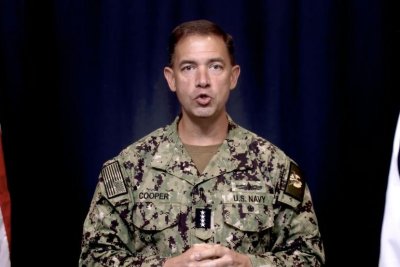
U.S. Central Command said late Thursday that the U.S. military has cleared the Strait of Hormuz of Iranian sea mines. File Photo by EPA
Aug. 28 (UPI) — The U.S. military said it has clear the Strait of Hormuz of Iranian mines, removing a major obstacle to President Donald Trump‘s goal of regaining freedom of navigation through the vital energy route, though Iran refutes the claim.
The strait has become a focal point in the U.S. war against Iran, which has been restricting maritime traffic at the chokepoint via military drones, missiles and mines since the conflict began.
Trump has repeatedly stated for months that the strait is open, despite the number of ships making it through each day dwindling from about 140 vessels to only a handful.
U.S. Central Command Commander Adm. Brad Cooper announced in a video posted online that the U.S. military has “achieved a major milestone” in the Strait of Hormuz.
“We have successfully cleared sea mines in the strait’s international shipping lanes that were laid months ago by Iran’s Islamic Revolutionary Guard Corps. Internationally recognized transit routes in the strait are free of Iranian sea mines, thanks to the incredible work of the U.S. military,” he said.
Cooper made the announcement a day after Trump on Tuesday said on his Truth Social platform that he had been informed that the mines had been cleared by the U.S. Navy.
“Iran has been notified that any ship or boat placing new mines will be immediately and systematically destroyed,” he said.
“Through Space Force, we are watching every square inch of the Strait,” he added. “There is Zero Tolerance policy on mine placement in full force and effect.”
The claim could not be independently verified.
However, Iran’s deputy foreign minister, Kazem Gharibabadi, refuted Trump’s comments, saying only Iran knows where the mines are, Iran’s semi-official Tasnim News Agency reported.
“The Strait of Hormuz is closed both because of the presence of mines and because of our military actions. If America is making this claim, why is not a single vessel passing through?” he said, seemingly meaning none have transited without Iran’s permission.
“These remarks are propaganda intended to create calm in global energy markets. No one has accepted these claims.”
Gharibabadi was speaking about framework for the strait being by Iran and Oman.
A provision of the proposed agreement concerns the implementation of a joint project to clear the strait of mines.
Iran has restricted transit of the strait since the war began Feb. 28, when it was attacked by the United States and Israel. While the United States launched the war with the goal of preventing Tehran from securing a nuclear weapon and encouraging regime change, the Trump administration has now focused on regaining freedom of navigation through the strait. Iran is fighting to maintain its ability to oversee ships transiting the chokepoint.
Tropical Storm Dolly is making its way toward the eastern Caribbean. Image courtesy of the National Hurricane Center.
Aug. 27 (UPI) — The National Weather Service named Tropical Storm Dolly on Thursday, as it makes its way across the Atlantic Ocean toward the eastern Caribbean.
Dolly was located about 1,315 miles east of the Leeward Islands, which include the Virgin Islands, St. Martin and several others, the National Hurricane Center said in its 11 p.m. AST update.
The storm was packing maximum sustained winds of 40 mph and was moving west at a blistering 23 mph.
The NHC said Dolly should continue moving westward for the next couple of days over the central Atlantic and be nearing the Leeward Islands over the weekend.
“Although it will encounter warmer ocean waters, Dolly is likely to move into less favorable atmospheric conditions during the next couple of days,” the NHC said. “Some slight short-term strengthening is possible, but increasing vertical wind shear, relatively dry air and the fast forward motion of the system should begin to adversely affect Dolly fairly soon.”
It is forecast to be a post-tropical storm within 48 hours.
Heavy rain from Dolly could begin to affect the Leeward Islands late Saturday into Sunday, and the Virgin Islands, Puerto Rico and Hispaniola Sunday and Monday. The heavy rain may produce flash flooding, especially in areas of higher terrain, the NHC reported.
Drought and extreme heat are drying up rivers and farmland across Europe, with record-low water levels disrupting agriculture, shipping and even nuclear power plants that rely on rivers for cooling.
Trials for a vaccine for the Bundibugyo strain are ongoing, as DRC authorities try to control the Ebola outbreak.
Published On 28 Aug 202628 Aug 2026
The Democratic Republic of Congo (DRC) has begun vaccinating people against Ebola, with health workers and other front-line workers being prioritised.
However, the vaccine being distributed this week is licensed for another strain, and its effectiveness against the Bundibugyo strain of Ebola has not been determined.
Recommended Stories
list of 3 itemsend of list
There is currently no approved vaccine or treatment for the new strain, and clinical trials are ongoing to find a suitable vaccine for the Bundibugyo strain.
The first injections are being given to health workers in the Congolese city of Kisangani.
More than 50,000 doses of the vaccine have been received, according to the Congolese health minister, Samuel Roger Kamba.
The outbreak is concentrated in the Ituri province, which borders Uganda.
Kamba said: “We will cover all the provinces that are around Ituri, moving in the ring towards the centre of the outbreak.”
The World Health Organization (WHO) said last week that 70,000 doses of the Ervebo vaccine had been approved for use in the DRC.
About 20,000 of the doses allocated to the DRC will be used in a clinical trial to test its effectiveness against the latest strain. Health workers are calling for more doses.
As of Tuesday, the DRC had recorded 5,713 confirmed cases of Ebola, including 2,744 deaths, according to government figures. The outbreak is the deadliest of all past Ebola outbreaks that have hit the DRC.
The outbreak is spreading under extremely difficult conditions, fuelled by insecurity, displacement, a health workers’ strike and intense population movements.
The WHO has said it remains out of control and is on track to surpass the 2014-2016 West Africa Ebola outbreak, the deadliest on record, which killed more than 11,000 people, primarily in Guinea, Liberia and Sierra Leone.
The Food and Drug Administration on Thursday issued an emergency approval for use of the drug ivermectin in the battle against New World screwworm infestations in U.S. cattle. Photo courtesy U.S. Department of Agriculture
Aug. 27 (UPI) — The Food and Drug Administration on Thursday issued an emergency approval for the use of the drug ivermectin against New World screwworm infestations in cattle, adding to the arsenal of weapons available against the flesh-eating insect.
The FDA approved an Emergency Use Authorization, or EUA, for Bimectin, the generic version of ivermectin, for injections in cattle when administered within 24 hours of birth, at the time of castration, or at the appearance of a wounds, the agency announced.
Bimectin injection remains unauthorized for use in lactating dairy cows or in calves that will be processed for veal.
Thursday’s move is the 14th EUA issued by the FDA against New World screwworm as the Trump administration attempts to deal with the still-growing infestation in Texas.
The Department of Agriculture has confirmed 47 domestic cases of New World screwworm, or NWS, in animals as of Thursday.
NWS is widely feared as a serious health and economic threat that could cost billions of dollars in losses to cattle, bison and horses. The pest was eradicated from the United States in 1966 and eliminated as far south as Panama by 2000, but reemerged in 2022 and has continued moving north through Central America and Mexico.
The U.S.-Mexico border was closed last year to protect U.S. animals from the threat. The ban was subsequently lifted on July 26.
Texas Agriculture Commissioner Sid Miller last month urged the FDA to authorize ivermectin in feed as an additional tool to combat the growing NWS threat.
Injectable ivermectin is not enough to keep pace with the outbreak and protect livestock from further infestations, he asserted.
“Texas ranchers are fighting for their livelihoods and the security of the American food supply. They don’t have time to wait,” Miller said. “We’ve already seen this parasite spread across multiple Texas counties in just a few weeks. Every day we delay is another day the New World screwworm gains ground. We need every effective weapon available, and we need it now.”
The Texas Grain and Feed Association “has committed to rapidly manufacture and distribute medicated feed upon approval, ensuring producers can begin using it without delay,” he noted.
Former US Ambassador to Turkiye Francis J. Ricciardone tells Al Jazeera’s ‘This is America’ that Prime Minister Benjamin Netanyahu sees ‘political value’ in labeling Turkiye as Israel’s latest enemy, in the run-up to legislative elections in October.
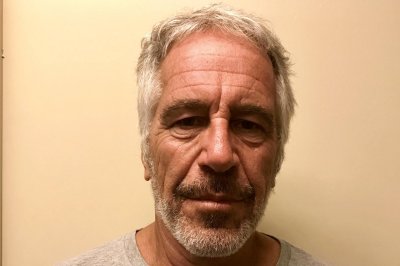
A federal judge on Thursday approved a $72.5 million settlement between victims of Jeffrey Epstein and Bank of America over the bank’s financial dealings with the sex offender. File Photo courtesy of New York State Division of Criminal Justice/EPA-EFE
Aug. 27 (UPI) — A Manhattan federal judge on Thursday signed off on a $72.5 million settlement between Bank of America and victims of Jeffrey Epstein over the banking giant’s involvement in the convicted sex offenders crimes.
Judge Jed Rakoff said the agreement was a move toward accountability for the victims, he added that the pain caused by Epstein could be undone. “No amount of money can ever fully compensate Epstein victims for the harm they’ve suffered,” he said.
Around 60 women who were trafficked or abused by Epstein or any of his associates between June 2008 and July 2019 will be covered by the settlement, attorneys for the women have said.
The Charlotte, N.C.-based bank was accused in a class-action lawsuit of ignoring red flags in Epstein’s transactions in the years after he was first charged with sexually abusing girls and young women.
The lawsuit, which was filed last October, accused Bank of America of “absolute loyalty” to Epstein.
According to Senate Finance Committee data, Bank of America filed suspicious activity reports about more than $170 million in suspicious transactions between billionaire Leon Black and Epstein.
Similar settlements have been reached with JPMorgan Chase for $290 million and Deutsche Bank for $75 million.
Kurdish leader appointed to the role days after the dissolution of the force he commanded.
Published On 27 Aug 202627 Aug 2026
Syrian President Ahmed al-Sharaa has appointed Mazloum Abdi, leader of the now-dissolved Kurdish-led Syrian Democratic Forces (SDF), as a presidential advisor.
Al-Sharaa issued Decree No 164, appointing Abdi as “as an advisor to the Presidency of the Republic” on Thursday, the Syrian state news agency Sana reported.
Recommended Stories
list of 3 itemsend of list
The move comes three days after Abdi announced the dissolution of the SDF and the completion of its integration with the Syrian military.
Abdi is the most senior of several Kurdish figures appointed to state posts. Another commander was made assistant defence minister for the eastern region earlier this year.
The advisory role is a lesser position than one offered in January, when al-Sharaa proposed making Abdi deputy defence minister and nominating him as governor of Hasakah province, in order to restore state control over the SDF-controlled provincial capital.
Al-Sharaa and Abdi first agreed to fold the SDF into the central government in March 2025. That deal made little progress before its year-end deadline, spurring state forces to battle into the northeast in January, taking the cities of Raqqa and Deir Az Zor from the SDF.
A ceasefire that ended the fighting placed Raqqa, Deir Az Zor and Hasakah under central government control and committed the SDF to join the defence and interior ministries under a 14-point plan.
One Kurdish-led force has yet to be absorbed. The YPJ, the SDF’s women’s units, asked to join the defence ministry but were told the army’s structure has no units for women.
Alongside the military track, al-Sharaa issued a decree in January recognising Kurdish as a national language and restoring citizenship to Syria Kurds, the first formal recognition of Kurdish rights since Syria’s independence in 1946.
The SDF was the largest force still outside the army, and its dissolution leaves Damascus with formal authority over almost all Syrian territory. Reunifying the country has been al-Sharaa’s central promise since former Syrian leader Bashar al-Assad was overthrown in December 2024.
Aug. 27 (UPI) — U.S. President Donald Trump on Thursday named a new head of the agency that oversees his ballroom project at the White House and a proposed national arch in Washington, D.C.
Mark Paoletta, the general counsel of the White House Office of Management and Budget, will take charge of the National Capital Planning Commission. He will replace Mark Scharf, who is set to become White House counsel on Monday.
“President Trump has transformed D.C. into a capital worthy of the greatest nation in history,” Mr. Paoletta said in a statement to the news agencies. “I look forward to working with my new colleagues to further the president’s historic restoration and beautification of the National Capital Region, especially in the 250th year of our country’s independence.”
The NCPC is the federal government’s planning agency for projects in and around the capital city. According to its website, it “provides overall planning guidance for federal land and buildings in the region.”
In April, the 12-member panel approved the construction of the ballroom where the East Wing of the White House once stood.
In addition to his post at the OMB, Paoletta has been the acting chief of the Consumer Finance Protection Bureau since the start of August. Brian Johnson has been nominated to fill the role at the CFPB permanently.
Paoletta had represented Ginny Thomas, the wife of Supreme Court Justice Clarence Thomas, during the House Select committee’s investigation of the Jan. 6, 2021 attack on the U.S. Capitol.
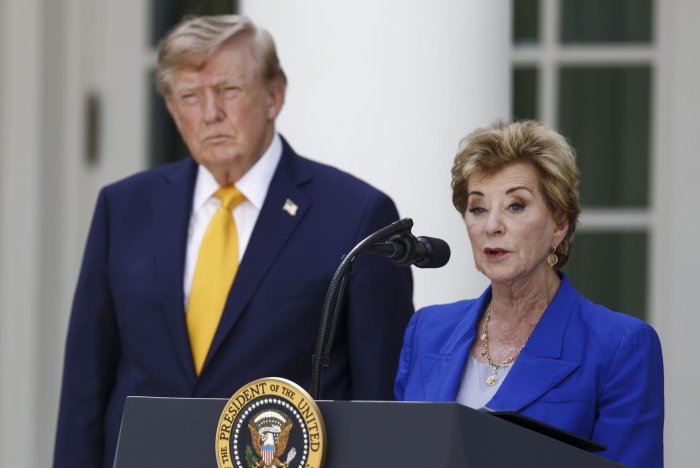
President Donald Trump looks on as Secretary of Education Linda McMahon speaks during a back-to school event in the Rose Garden of the White House on Monday. The event focused on education and the Trump administration’s education policies. Photo by Will Oliver/UPI | License Photo
Alleged senior Tren de Aragua leader Luis Saúl Pérez Nieto, also known as “Páez” or “Nairobi,” was arrested, Colombian President Abelardo de la Espriella (pictured) announced Thursday. Photo by Mauricio Duenas Castaneda/EPA
Aug. 27 (UPI) — Colombian authorities captured an alleged senior Tren de Aragua leader in Bogotá who was wanted by the United States for crimes that include international arms trafficking and drug trafficking, President Abelardo de la Espriella announced Thursday.
Luis Saúl Pérez Nieto, also known as “Páez” or “Nairobi,” was arrested in Fontibón, a district in western Bogotá. De la Espriella identified him as the gang’s top leader in Peru and a trusted associate of Héctor Rusthenford Guerrero Flores, known as “Niño Guerrero,” the leader of the Venezuelan criminal organization.
Tren de Aragua began as a prison gang in Tocorón and expanded across South America and into the United States. It has been involved in murder, extortion, drug trafficking, human trafficking, sex trafficking, kidnapping and other violent acts.
“Nairobi” allegedly coordinated extortion, international arms trafficking, targeted killings and drug trafficking along strategic routes in South and Central America, according to the president’s announcement.
Golpe al Tren de Aragua.
Nuestra Fuerza Pública capturó en Fontibón, Bogotá, a Luis Saúl Pérez Nieto, alias “Páez” o “Nairobi”, cabecilla principal del Tren de Aragua en Perú y hombre de confianza de alias “Niño Guerrero”.
De la Espriella said U.S. authorities wanted Pérez Nieto in connection with those crimes. Colombian and U.S. officials have not publicly disclosed the jurisdiction handling the case, the specific charges against him or whether Washington has submitted an extradition request.
“Colombia will not be a refuge or sanctuary for any criminal,” De la Espriella said. “We will pursue them, capture them and bring them to justice, no matter where they come from.”
The operation involved Colombia’s National Police and Attorney General’s Office, along with the U.S. Drug Enforcement Administration, according to Colombian outlets.
Police sources told Semana that Pérez Nieto was allegedly involved in trafficking ketamine, cocaine and weapons from Bogotá. Authorities had been tracking his movements in the Colombian capital before carrying out the arrest.
Peruvian media also reported the detention, but authorities in Peru had not announced whether Pérez Nieto faces charges or an extradition request there.
Tren de Aragua originated in Venezuela’s Tocorón prison and later expanded across South and Central America and into the United States. Washington designated the group a foreign terrorist organization in February 2025.
The State Department has offered a reward of up to $5 million for information leading to the arrest or conviction of “Niño Guerrero.” The U.S. government has accused him of expanding Tren de Aragua from a prison gang into a criminal network operating across the Western Hemisphere.
1 of 3 | A poster shows the name change from Lake Ontario to Lake America, as President Donald Trump signs an executive order on the renaming, amid a recent trade war with Canada, in the Oval Office of the White House on Thursday. Photo by Al Drago/UPI | License Photo
Aug. 27 (UPI) — President Donald Trump signed an executive order Thursday to rename Lake Ontario as “Lake America” after his dispute with Canada over tariffs last week.
Trump threatened to rename the lake Tuesday on Truth Social, saying, “The United States is giving serious consideration to changing the name of Lake Ontario to Lake America in that we don’t expect to be doing much business with Ontario any longer.”
“We’re going to be changing the name of Lake Ontario, effective immediately, to Lake America,” the president said just before signing the order.
“No message,” he said. “As you know, Canada has been ripping us off for a long time on trade, very, very sadly. Even the military. You know, we defend Canada for nothing.”
Canada is a founding member of NATO.
The order says that within 30 days, Secretary of the Interior Doug Burgum will update the Geographic Names Information System. The GNIS works with the U.S. Board on Geographic Names to standardize geographic names for federal use.
Trump renamed the Gulf of Mexico to the Gulf of America and Mount Denali to Mount McKinley on his first day in office in 2025. He can’t force other countries or private entities to use the new names, but he can force the federal government to.
Because it’s an international boundary water, Canada and the U.S. jointly manage Lake Ontario through the International Joint Commission under the Boundary Waters Treaty of 1909.
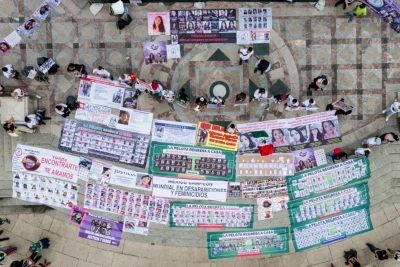
Relatives of missing persons participate in a demonstration at the Angel of Independence in Mexico City in June. File Photo by Tomas Perez/EPA
Aug. 27 (UPI) — More than 100 bone fragments and about 30 teeth were found in El Arenal, a rural community in the Mexican resort city of Acapulco.
The remains were discovered Wednesday at a suspected clandestine extermination site during a search conducted by members of a group named after Vicente Suástegui Muñoz, an activist who disappeared five years ago.
The discovery coincided with the observance of the International Day of the Victims of Enforced Disappearances, which seeks to draw attention to people whose whereabouts remain unknown and demand action to resolve disappearance cases, Infobae reported.
The search occurred in an area considered a priority by families searching for missing relatives because of reports and testimony linked to disappearances in different parts of the region.
Samantha Colón Morales, president of the search collective and Suástegui’s wife, said an anonymous caller alerted her to the presence of bone fragments in the eastern part of Acapulco, local newspaper El Sur reported.
Colón said the site where the remains were found is accessible by dirt roads and is about 40 minutes from the federal highway. Lipsticks, belt buckles and rings were also among the items recovered at the site, she said.
Colón said she believes the property may have been used as an extermination site because of the number of remains and the conditions in which they were found, Quadratín Guerrero reported.
She said that for families of the missing, each piece of evidence recovered could help advance an investigation and eventually establish the identity of a missing person.
Colón explained authorities will analyze the remains to determine how many people they belong to and seek to establish their identities.
More than 115,000 people are listed as missing in Mexico, according to the country’s National Registry of Missing and Disappeared Persons.
Mexico’s disappearance crisis is closely linked to organized crime violence, institutional complicity or inaction and high levels of impunity, which have overwhelmed the country’s forensic services.
Amid limited government resources, hundreds of search collectives have emerged across Mexico. Made up primarily of mothers and other relatives of missing people, their members often risk their lives searching clandestine graves and suspected extermination sites in an effort to find their loved ones.
Last season’s runners-up, Arsenal, will play the likes of Real Madrid, Borussia Dortmund and Lille in the league phase.
Published On 27 Aug 202627 Aug 2026
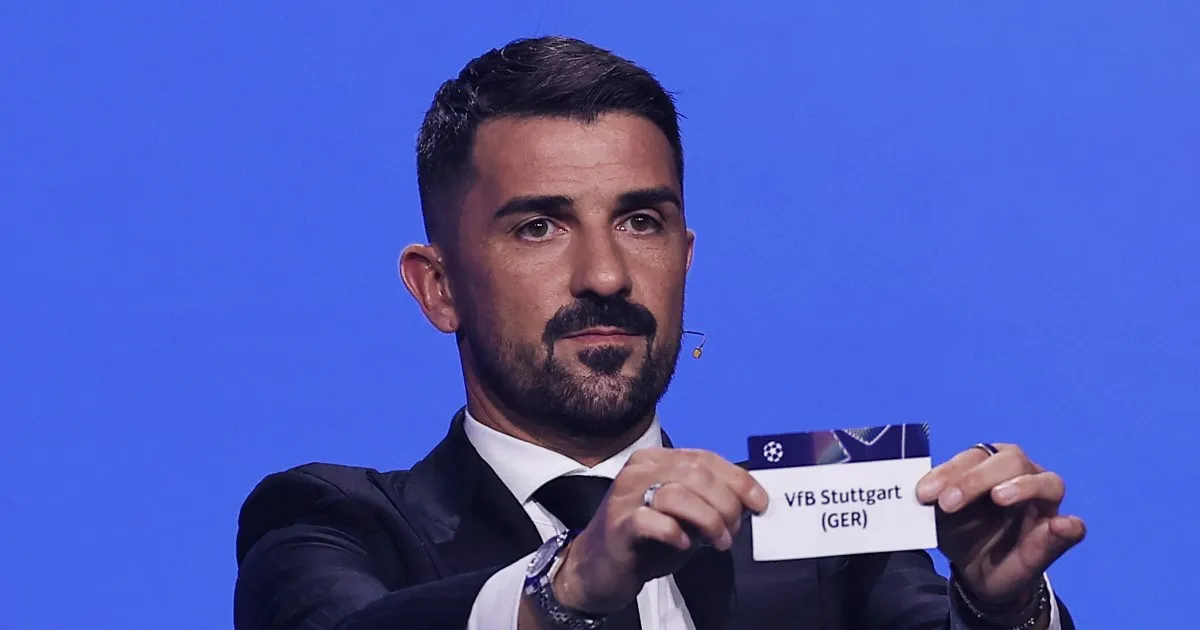
Two-time defending champions Paris Saint-Germain were handed meetings with Barcelona, Manchester City and Aston Villa, among their eight matches in the league phase of this season’s Champions League, when the draw took place on Thursday.
PSG, who beat Arsenal on penalties in Budapest in May to retain the trophy, will play Barcelona, Roma, Turkish champions Galatasaray and Slovan Bratislava of Slovakia at home.
Luis Enrique’s team will travel to England twice to face City and Villa. They beat both teams on the way to winning their first Champions League title in 2025, and also defeated the latter in the UEFA Super Cup in Austria earlier this month.
The French champions will also go to Spain to play Villarreal and Italy to take on a Como side coached by Cesc Fabregas.
“I can’t say anything bad about the Champions League, but I won’t be watching the draw. I will be relaxing and going out on my bike, then we’ll take a look at the menu. But I would sign up for the same result as in the last two years,” Luis Enrique told reporters earlier Thursday.
PSG are aiming to become European champions for a third straight year, something only the Real Madrid of 2016 to 2018 have achieved in the last 50 years.
The first matches in this season’s league phase will be played between Tuesday, September 8 and Thursday, September 10, with the final games in late January. UEFA is expected to announce the full fixture schedule on Saturday.
Last season’s runners-up, Arsenal, the Premier League champions, will notably host Real Madrid, Borussia Dortmund and Lille, as well as Sabah, the club from Azerbaijan who came through four two-legged qualifying ties to reach the league phase for the first time.
The Gunners have a tough list of away ties against Bayern Munich, Real Betis, Napoli and Slavia Prague.
Fenerbahce back, Viking in
Andoni Iraola’s Liverpool will be at home to Atletico Madrid, Porto, Villarreal and Lens, while playing Inter Milan, Club Brugge, Fenerbahce and Austrian league phase debutants LASK away.
Manchester United, who were not in the first pot of seeds, have home games against Bayern, Roma, RB Leipzig and Sabah, and also a series of difficult away fixtures against Atletico, Sporting of Portugal, Villarreal and Como.
Other notable games include Manchester City visiting Barcelona and Real Madrid entertaining Inter, while last season’s Europa League winners, Villa, must go to Barcelona and play Dortmund at home. Unai Emery’s team will also tackle Istanbul giants Galatasaray and Fenerbahce.
The latter are appearing in the Champions League proper for the first time since 2008/09 after beating Lyon in the playoffs this week.
New names in this season’s competition are Como, who have upset the traditional order in Serie A, and Sabah, while LASK made it to this stage for the first time after a stunning comeback win over Celtic in the playoffs.
Last year’s Norwegian champions Viking, from the city of Stavanger, have reached the Champions League proper for the first time, too, and they have a glamorous fixture schedule that includes Bayern, Atletico, Villa and Napoli.
This is the third season since the introduction of the new format for the Champions League, with 36 teams now all pooled together in one giant league and each playing games against eight different opponents.
This season’s final will be played at the Metropolitano Stadium in Madrid on June 5, 2027.
Ratko Mladic, a war criminal convicted over the first genocide on European soil since the second world war, has died prison in The Hague at the age of 84.
Earlier this year, Serbia requested that Mladic be allowed to receive medical treatment outside prison, saying his health condition was “serious” and that he “required serious medical treatment”.
Recommended Stories
list of 4 itemsend of list
The United Nations International Residual Mechanism for Criminal Tribunals said that Mladic was receiving adequate medical care while in detention.
Known as the “Butcher of Bosnia”, Mladic was one of the best-known and most notorious military commanders of the wars that followed the breakup of Yugoslavia.
International courts convicted him of genocide, crimes against humanity and war crimes committed during the 1992–1995 war in Bosnia and Herzegovina. He was sentenced to life in prison
The most notorious part of his criminal legacy is linked to the genocide in Srebrenica, in eastern Bosnia and Herzegovina, near the border with Serbia.
Bosnian Serb forces under Mladic’s command seized Srebrenica in July 1995, despite the UN declaring the municipality a “safe area”. After the enclave fell, more than 8,000 Bosniak (Bosnian Muslim) men and boys were killed by Mladic’s forces in the days that followed.
Some of the civilians were captured and executed at locations in and around Srebrenica. Others were killed after attempting to flee through the forests towards territory controlled by the army of the Republic of Bosnia and Herzegovina.
The bodies of victims were later discovered in numerous mass graves, while many were identified years after the war. The remains of around 1,000 victims are still being sought. International courts established that the killings constituted genocide.
Srebrenica has remained a symbol of one of the gravest crimes committed in Europe since the second world war.
From the Yugoslav army to commander of the army of Republika Srpska
Mladic was born in the village of Bozanovici near Kalinovik, about 40km (25 miles) south of Sarajevo.
He began his military career in the Yugoslav People’s army and gradually rose through the military’s command structure.
When Bosnia and Herzegovina declared independence from Yugoslavia in the spring of 1992, following Slovenia and Croatia, Bosnian Serbs established their own political and military structures and proclaimed Republika Srpska, which controlled territory covering roughly half of Bosnia and Herzegovina at the time.
In May 1992, Mladic was appointed commander of the Republika Srpska’s army. Over the next three and a half years, he sought to seize parts of Bosnia and Herzegovina controlled by the army of the Republic of Bosnia and Herzegovina, including the capital Sarajevo, devastating areas in his path. However, his forces failed to achieve major territorial gains in several key areas.
The political and military leadership of Republika Srpska sought to separate Serb-controlled territories from Bosnia and Herzegovina and create a separate, territorially contiguous Serb state within the country. Republika Srpska would formally become one of Bosnia and Herzegovina’s two entities under the 1995 Dayton Peace Agreement.
Mladic’s forces were involved in a large number of atrocities across Bosnia and Herzegovina.
In addition to the Srebrenica genocide, international courts found Mladic responsible for a campaign of terror against Sarajevo’s civilian population, the hostage-taking of UN peacekeepers and other crimes.
The Siege of Sarajevo
Sarajevo was surrounded by Bosnian Serb forces for almost 44 months. From positions on the surrounding hills, they shelled the city and used snipers against its residents.
More than 11,500 people from all ethnic groups were killed, while many others were wounded or displaced.
The Sarajevo Siege, which Mladic directed, became one of the defining episodes of the Bosnian war and one of the longest sieges of a capital city in modern history.
After the war ended in 1995, Mladic evaded arrest and spent almost 16 years in hiding. He became one of Europe’s most wanted fugitives accused of war crimes.
He was arrested in Serbia in May 2011 in the village of Lazarevo, near Zrenjanin, at the home of a relative. Several days later, he was transferred to The Hague, where his trial began before the International Criminal Tribunal for the former Yugoslavia.
His arrest was one of the key conditions set by the international community for Serbia’s progress towards closer relations with the European Union. Belgrade faced political and financial pressure from Western countries to cooperate with the tribunal and transfer Mladic to The Hague.
In 2017, the tribunal sentenced him to life imprisonment. The courts established his individual criminal responsibility for a number of crimes.
A woman wearing a face mask walks past graffiti depicting former Bosnian Serb wartime general Ratko Mladic in Belgrade, Serbia, November, 2020. Mladic was convicted by a UN war crimes tribunal in 2017 and sentenced to life imprisonment for masterminding crimes by Bosnian Serb forces throughout the war that left 100,000 dead [AP Photo/Darko Vojinovic]
Mladic in Serbia
Although his convictions were final, Mladic continues to have support among sections of the Serbian public and political circles in Serbia and Bosnia and Herzegovina.
In Banja Luka, Belgrade and other areas with predominantly Serb populations, murals depicting him can still be seen. Some members of the public continue to portray him as a military hero rather than a convicted war criminal.
That attitude towards Mladic is part of a broader problem of confronting the legacy of the war in Bosnia and Herzegovina. While international courts have established facts concerning the genocide and other crimes, political and social divisions over the country’s wartime past remain deeply entrenched.
Denial of the Srebrenica genocide and the glorification of convicted war criminals remain serious problems in Bosnia and Herzegovina.
According to data from the Srebrenica Memorial Centre, 149 cases of public denial of the Srebrenica genocide were recorded during the first quarter of 2026, including statements by public figures. That represents an increase compared with 2025, when 99 such cases were recorded.
The UN General Assembly adopted a resolution in May 2024 establishing July 11 as the International Day of Reflection and Commemoration of the 1995 Genocide in Srebrenica.
The resolution was intended to preserve the memory of the victims and promote a culture of remembrance, while also reaffirming the importance of confronting genocide denial and preventing the recurrence of such crimes.
Violence has eased since the US-Iran MoU and Israel-Lebanon framework, but Beirut still reports attacks and demolitions.
Published On 27 Aug 202627 Aug 2026
A Lebanese woman has been killed, and several other people injured by Israeli strikes on the town of Arab Salim, in southern Lebanon’s Nabatieh district.
Lebanon’s Ministry of Health said six people were wounded in the attacks on Thursday, including a child, a woman and two elderly people, while the state-run National News Agency (NNA) reported that the woman who died “had been married for 48 hours”.
Recommended Stories
list of 3 itemsend of list
The newlywed woman’s house was also destroyed in the attack, NNA said.
Lebanese security sources said at least 10 Israeli strikes had been carried out in the wider Nabatieh area. NNA also reported artillery shelling targeting the outskirts of the town of Rashaf in the Bint Jbeil district.
The Israeli military claimed it was targeting Hezbollah after the Iran-backed group struck its soldiers in the south overnight. The army said it struck Hezbollah “weapon storage facilities”.
“Israel targeted the town of Arab Salim in the Nabatieh governorate. It targeted a residential area,” said Al Jazeera’s Zeina Khodr, reporting from Beirut about the deadly strike.
“The Israeli army says it is hitting infrastructure, and that this is in retaliation for Hezbollah launching armed drones at its forces in the Ali al-Taher ridge overnight.
“It’s not the first time the Israeli army accuses Hezbollah of targeting its forces in this area, which overlooks the city of Nabatieh’s strategic high ground, which really remains contested territory. We know that the Israeli army wants Hezbollah to vacate this area, so we’re seeing this increase in military pressure,” she said.
According to Israel, Iran-backed fighters “launched two explosive drones” towards Israeli soldiers operating in the Ali al-Taher ridge, but there were no casualties.
Israel has stepped up its strikes on south Lebanon in recent days, following an August 15 wave of strikes that Lebanon said killed 11 people, including several children. Israel’s military said the raids were retaliation for a Hezbollah attack.
Al Jazeera’s Khodr said that while “there has been a reduction in the violence in recent days, we have also witnessed an escalation by the Israeli army”.
“There is growing concern that the [Israeli] army may broaden this offensive, and it may become even more intense,” she added.
Tensions between Israel and Lebanon have been escalating since Israel’s genocidal war on Gaza began in 2023. Lebanon was dragged into the conflict on March 2, days after the US and Israel launched their war on Iran. Hezbollah struck Israel in support of Tehran. This was followed by massive Israeli air strikes and a ground invasion that Lebanese authorities say have killed more than 4,300 people.
The continued strikes have renewed debate in Beirut over the “framework” agreement Lebanon signed with Israel in June, which envisages a phased Israeli withdrawal in exchange for the deployment of the Lebanese army and the disarmament of armed groups, a reference to Hezbollah.
European football’s governing body considers making a criminal complaint against Infantino over World Cup selloff plans.
Published On 27 Aug 202627 Aug 2026
UEFA has asked a US federal court for permission to obtain testimony and documents from FIFA entities in Florida for use in a planned criminal complaint in Switzerland against FIFA President Gianni Infantino, according to a court filing.
In an ex parte application filed under US law, European football’s governing body said it is considering criminal proceedings against Infantino and potentially other FIFA officials and advisers over a now-abandoned plan to transfer commercial rights linked to men’s and women’s World Cups and the Club World Cup into a new subsidiary called FIFA Forward Enterprise (FFE).
Recommended Stories
list of 4 itemsend of list
“UEFA is actively considering legal action arising out of and in connection with the … plan proposed by FIFA,” read the legal document filed in a Florida court in the United States, according to the AFP news agency.
“More specifically, UEFA and other interested parties are preparing to bring criminal claims in Switzerland against Infantino and possibly other FIFA officials and advisors for criminal mismanagement under Article 158 of the Swiss Criminal Code.”
UEFA alleges Infantino developed the proposal in secret with a small group of advisers and investors, bypassing FIFA’s normal governance processes and failing to consult the FIFA Council, regional confederations or member associations.
The filing asks a US court to authorise discovery from FIFA (AMERICAS), Inc. and FWC2026 US, Inc., two Florida-based FIFA entities. UEFA said the organisations may possess documents and witnesses relevant to how the FFE transaction was conceived, structured, valued and approved.
The Netherlands, Poland, Spain and Sweden wrote the European Commission on Wedneday urging it to kickstart a stalled plan to use Russian assets frozen in Europe’s banks and clearing houses to plug a $26.8 billion gap in Ukraine’s defense funding. File photo by Patrick Seeger/EPA-EFE
Aug. 27 (UPI) — The Netherlands, Poland, Spain and Sweden wrote the European Commission urging it to kickstart a stalled plan to use Russian assets frozen in Europe’s banks and clearing houses to plug a $26.8 billion gap in Ukraine’s defense funding.
The letter to the EU’s top foreign policy chief on Thursday calling for another look at ways to tap into the $244.5 billion of assets came ahead of an informal meeting of foreign ministers being hosted by Ireland on Sept. 1-2, according to Politico, The Kyiv Independent and The Financial Times.
“Ukraine needs more financial support in both the short and long term. We believe now is the time to revert to the issue of how we can make further use of Russia’s immobilized assets for the benefit of Ukraine,” reads the letter, which was addessed to Kaja Kallas and Irish Foreign Minister Helen McEntee.
The call comes three months after the Netherlands raised the issue at a closed-door meeting of the Economic and Financial Affairs Council, arguing that a deal agreed in December for a conditional $105 billion loan over 18 months, would not be enough to keep Ukraine afloat for long.
Efforts back then to leverage frozen Russian assets — the largest portion of which are held in Belgium — were sidelined amid objections from the Belgian government and other EU member states.
The so-called “reparations loan” option, where the assets would be used as surety in the event Russia failed to pay war reparations to Ukraine required to recoup the loan, lacked the votes for the required two-thirds majority of EU states.
What the bloc ultimately finalized in April, was a back-up proposal under which the EU would use its budget to borrow in the international debt markets — with skeptics Hungary, Slovakia and the Czech Republic backing the measure only on condition they would not be on the hook financially.
Wednesday’s letter acknowledges the complexity of the issue but urges policy experts in Brussels to look at alternate solutions that “ensure that the risk rests with all EU Member States and where no Member State holds a disproportionate burden.”
“Now is the time to start a new discussion about how we can make further use of Russia’s frozen assets for Ukraine’s, and our, benefit,” Swedish Foreign Minister Maria Malmer Stenergard told the Financial Times.
Four people claiming familiarity with the letter said it requested the commission revist the issue of the frozen assets and sought an uddate on the formulation of legal and technical tools to get around the veto wielded by Belgium.
Last time around, Belgian Prime Minister Bart De Wever said his opposition was due to Russian legal and economic threats against Belgium, and him personally, and that he needed guarantees that other EU states would share the risks Belgium could be exposed to.
A person familiar with the matter said the Belgian government’s concerns over possible retaliation through the courts and erosion of trust financial markets had not diminished.
In a speech Monday, Ukrainian President Volodymyr Zelensky urged the EU to accelerate the pace of loan tranche transfers, saying that even with the money the country was facing a $26.8 deficit in 2026.
That prompted the EU to point to an additional $25.7 billion already approved, $16.8 billion of which had been provided, and call on other Western partners to follow its lead.
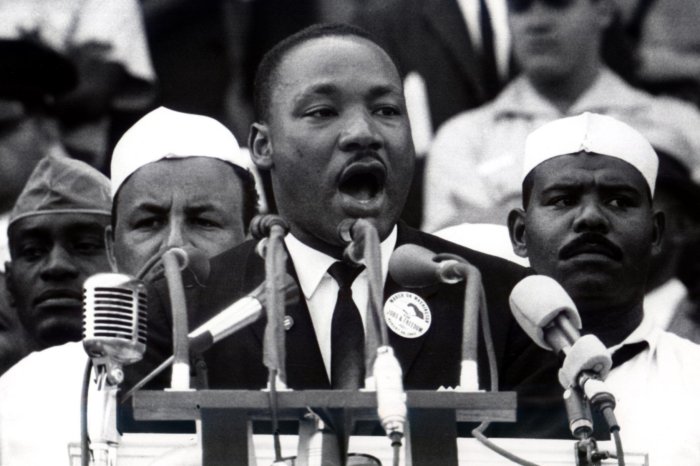
Martin Luther King Jr. delivers his famed “I Have a Dream” speech from the steps of the Lincoln Memorial in Washington on August 28, 1963. The speech galvanized the nation’s civil rights movements and led to the passage of the 1964 Civil Rights Act, the 1965 Voting Rights Act and the 1968 Fair Housing Act. File photo by UPI | License Photo
The U.S. Food and Drug Administration headquarters is shown in Silver Spring, Md. The FDA announced Wednesday it has approved a new treatment for those with advanced pancreatic cancer. File photo by Jim Lo Scalzo/EPA-EFE
Aug. 26 (UPI) — On Wednesday, the U.S. Food and Drug Administration announced its approval of Rasonque, a new treatment option for people with advanced pancreatic cancer.
A tablet taken once a day, the medication targets forms of a protein called RAS, which is a key driver of tumor growth in many patients with pancreatic adenocarcinoma, the most common form of the cancer, the FDA said. This form of cancer develops in cells lining the ducts of the pancreas.
“Today’s approval provides a critical new option for patients facing an extraordinarily difficult and historically hard-to-treat cancer,” said Kyle Diamantas, acting commissioner of the FDA. “It is our fundamental duty to deliver more cures and meaningful treatments to patients as quickly as possible.”
A press release from the FDA said the approval demonstrates the agency’s “commitment to moving with urgency, reducing unnecessary delays and advancing innovative treatments.”
Rasonque has been approved for adults who have metastatic pancreatic adenocarcinoma who have received at one least one prior systemic therapy or those who are not candidates for multiagent systemic therapy.
About 90% to 95% of the new cases of pancreatic cancer diagnosed in the United States each year are this form, the FDA said, citing the National Cancer Institute. Johns Hopkins Medicine also said “the vast majority” of pancreatic cancer diagnoses are this form.
In a clinical trial, the new treatment improved median overall survival to 13.2 months from 6.7 months with standard chemotherapy, the FDA said.
“This drug showed unprecedented results in an area of high unmet need,” said Angelo de Claro, director of the FDA’s Oncology Center of Excellence.
The agency granted this approval to Revolution Medicines Inc.
Aug. 27 (UPI) — The family of King Harald V of Norway gathered at his bedside in an Oslo hospital on Thursday with the Royal Household saying the 89-year-old’s condition was “extremely serious.”
Royal family members were seen arriving by car at Oslo University Hospital, including daughter-in-law Crown Princess Mette-Marit, with Queen Sonja and Crown Prince Haakon canceling all royal engagements.
Norwegian media reported that Princess Astrid, Harald’s sister, was also in attendance.
NRK, the state-owned broadcast network, said the people of Norway should brace for “the worst.”
“The whole nation is with us as we send warm thoughts to the king and the rest of the royal family,” Norwegian Prime Minister Jonas Gahr Støre said in a statement.
The king has been hospitalized for the past 10 days due to complications related to haemolytic anaemia, a rare blood condition where red blood cell attrition exceeds the rate at which they can be replaced, causing fatigue and breathing difficulties.
His condition unexpectedly worsened on Monday and deteriorated still further overnight.
The king has been hit by succession of health issues dating back to 2024 when he had a pacemaker fitted after being taken ill in Malaysia during a holiday, leading to him partially stepping back from royal duties in line with his advanced agee, including a “permanent reduction” in his public engagements.”
He was hospitalized for an infection and dehydration in February during a private visit to Tenerife with Queen Sonja, who is also 89.
His son, Prince Haakon, 53, is next in line in the succession.
There has never been any hint Harald might abdicate to allow Prince Haakon to take over, having long argued that the oath he took before the Norwegian Parliament when he ascended the throne in 1991 was for life.
Martin Luther King Jr. delivers his famed “I Have a Dream” speech from the steps of the Lincoln Memorial in Washington on August 28, 1963. The speech galvanized the nation’s civil rights movements and led to the passage of the 1964 Civil Rights Act, the 1965 Voting Rights Act and the 1968 Fair Housing Act. File photo by UPI | License Photo
SEOUL, Aug. 27 (UPI) — North Korea on Thursday condemned U.S. approval of a possible $125 million sale of Sidewinder missiles and related equipment to South Korea, warning of a “serious, immediate and powerful response.”
In a statement carried by the North’s official Korean Central News Agency, a Foreign Ministry spokesperson called the proposed sale and other recent U.S. actions “hostile moves adversely affecting the security environment of the DPRK and the regional situation.”
The Democratic People’s Republic of Korea is the official name of North Korea.
The spokesperson cited last week’s U.S. State Department approval of a possible sale of 103 AIM-9X Sidewinder Block II tactical missiles, 10 tactical guidance units and related equipment to South Korea.
The statement also pointed to U.S. approvals this year involving naval helicopters, attack helicopter upgrades and precision-guided munitions.
In May, the State Department approved a possible $3 billion sale of 24 MH-60R multi-mission helicopters and a $1.2 billion upgrade package for South Korea’s AH-64E Apache attack helicopters. It approved a possible $106 million sale of Joint Direct Attack Munition guidance kits and related equipment in June.
The sales are “encouraging the ROK to boost its capability to fight a war,” the spokesperson said, using the official acronym for South Korea.
“Now that the military integration of the U.S. and its allies is being accelerated in the Asia-Pacific region, we cannot overlook the adverse effect of the U.S. sale of its weapons to the ROK on the regional security environment,” the spokesperson said.
The statement also criticized a State Department funding initiative announced last week that would provide up to $2.96 million for projects documenting human rights abuses in North Korea and countering Pyongyang’s propaganda and influence operations.
The spokesperson called the initiative a “human rights smear campaign” aimed at creating instability in North Korea’s political system.
The DPRK “will make a serious, immediate and powerful response to the hostile acts in different spheres,” the spokesperson said.
The statement comes as U.S. President Donald Trump pushes to restart direct diplomacy with North Korean leader Kim Jong Un.
Trump last week abruptly ordered the United States and South Korea to curtail their annual Ulchi Freedom Shield military exercise, citing its cost and saying the drills sent an “inappropriate and hostile” signal to Pyongyang.
North Korea has so far shown little inclination to engage, however. Kim Yo Jong, the sister of Kim Jong Un, said last week that Pyongyang had “no interest” in the reduction of the drills.
“If the U.S. calculates that it can propagate its recent measure as the one of so-called good faith, they will not get desired answer,” she said.
Kim Jong Un led a key ruling party meeting this week but made no mention of Trump’s overtures, according to a report Wednesday by KCNA.
Authorities in northern France are investigating an incident in Caen late Wednesday in which at least two people were killed and 10 were injured after a car was driven into a crowd near a train station. File photo by Justin Lane/EPA-EFE
Aug. 27 (UPI) — At least two people were killed and 10 were injured, after a car was driven into a crowd near a train station in Normandy in northern France.
Seven of the injured were in a critical condition in the hospital after the vehicle allegedlly srruck the group of people in the city of Caen late Wednesday evening on purpose, following an altercation, local authoritiies said.
Calvados department prefect David Clavière said the car “deliberately drove into pedestrians in the street opposite the train station.”
A fight had broken out between two groups of men immediately prior to the incident, according to witnesses.
A major emergency response was mounted across the wider Normandy region, leading to the arrest of a 26-year-old Russian-born male suspect in Ouistreham, a port on the Normandy coast.
The deputy prosecutor and police said terrorism had, for now, been ruled out.
“For the moment, we are not dealing with a terrorist motive, but the investigation is only just beginning,” said the city’s deputy mayor with responsibility for security, Bruno Coutanceau.
The incident came a month after a car attack on a Pride parade in Berlin that killed at least one person and injured many more and nine months after 10 people were injured, two critically, when a man purposely drove into pedestrians and cyclists on the French holiday island of Oléron.
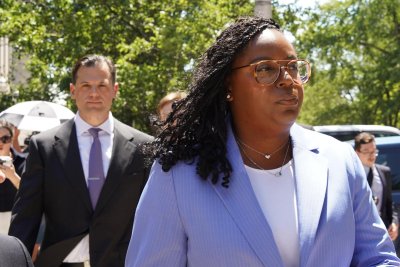
Aug. 27 (UPI) — A divided federal appeals court has ruled that Rep. LaMonica McIver is not immune from prosecution on charges stemming from a confrontation with Immigration and Customs Enforcement agents outside a federal immigration detention facility in 2025.
The New Jersey Democrat was charged with three federal counts of impeding and interfering with federal immigration officers over alleged conduct on May 9, 2025, as they were attempting to arrest Newark Mayor Ras Baraka during an unannounced congressional oversight inspection of Delaney Hall Federal Immigration Facility.
McIver denies the allegations and has sought their dismissal.
The U.S. Court of Appeals for the Third Circuit ruled 2-1 Wednesday that two of the three charges against McIver may proceed to trial, while the third was sent back to a lower court for reconsideration.
McIver said she disagrees with the ruling and was “exploring” her options.
“To protect the people, their elected representatives must be authorized to conduct oversight of the executive branch without fear of retaliation,” McIver said in a statement.
“Today’s decision chills that authority and emboldens the Trump administration to continue persecuting our most vulnerable communities, those who try to defend them and anyone who dares hold the president or his lackeys accountable.
“I will not fold to this administration,” she continued. “The administration will not stop me from doing my job or standing for what is right. This is not over.”
Federal prosecutors charged McIver in a three-count indictment in June 2025, a month after the incident at Delaney Hall.
According to the court document, she and two other members of Congress were at the facility to conduct an unannounced congressional oversight inspection of the facility as a protest was occurring outside against the Trump administration’s hardline immigration policy and Immigration and Customs Enforcement agents.
After arriving at the facility, Baraka entered but was informed by a federal officer he was not authorized to be there, according to federal prosecutors, who said McIver prevented the federal officers from arresting the mayor, who was allegedly given multiple warnings to leave.
Outside the facility, McIver allegedly placed herself in front of Baraka and wrapped her arms around him to prevent his arrest. During the situation she is accused of having “slammed her forearm into the body of one law enforcement officer,” whom she also allegedly tried to retrain by grabbing him.
Court documents also accuse her of striking a second officer with both of her forearms.
Video of the incident posted online shows a chaotic scene that day outside the facility.
Baraka was eventually arrested and charged with trespassing, though the case against him was later dropped.
McIver moved to dismiss the indictment, arguing it violated the Speech or Debate Clause and the constitutional principle of separation of powers as well as under selective prosecution and enforcement claims, while also arguing selective and vindictive prosecution and enforcement.
All three counts accuse her of forcibly assaulting, resisting, opposing, impeding, intimidating and interfering with federal officers. However, the appeals court sent count three back to the lower court to review whether it includes conduct that can be considered legislative acts.
While counts one and two identify specifics act, count three encompasses a range of alleged conduct over a broad time frame, both inside and outside the facility, the court said.
Numerous Democrats came to McIver’s defense, arguing it is an attack on congressional oversight.
“Donald Trump wants Congressmembers to fall in line & not conduct oversight of detention centers,” Rep. Ayanna Pressley of Massachusetts said in a statement.
“And he wants to make an example out of @RepLaMonica. But we’re not letting up.”
New Jersey Gov. Mikie Sherrill similarly said that she continues to stand with her friend.
“Trump weaponizing the Department of Justice to target members of Congress simply for doing their jobs is straight out of his corruption playbook,” she said in an online statement.
“It’s a brazen and unlawful abuse of power, and a direct attack on congressional oversight.”