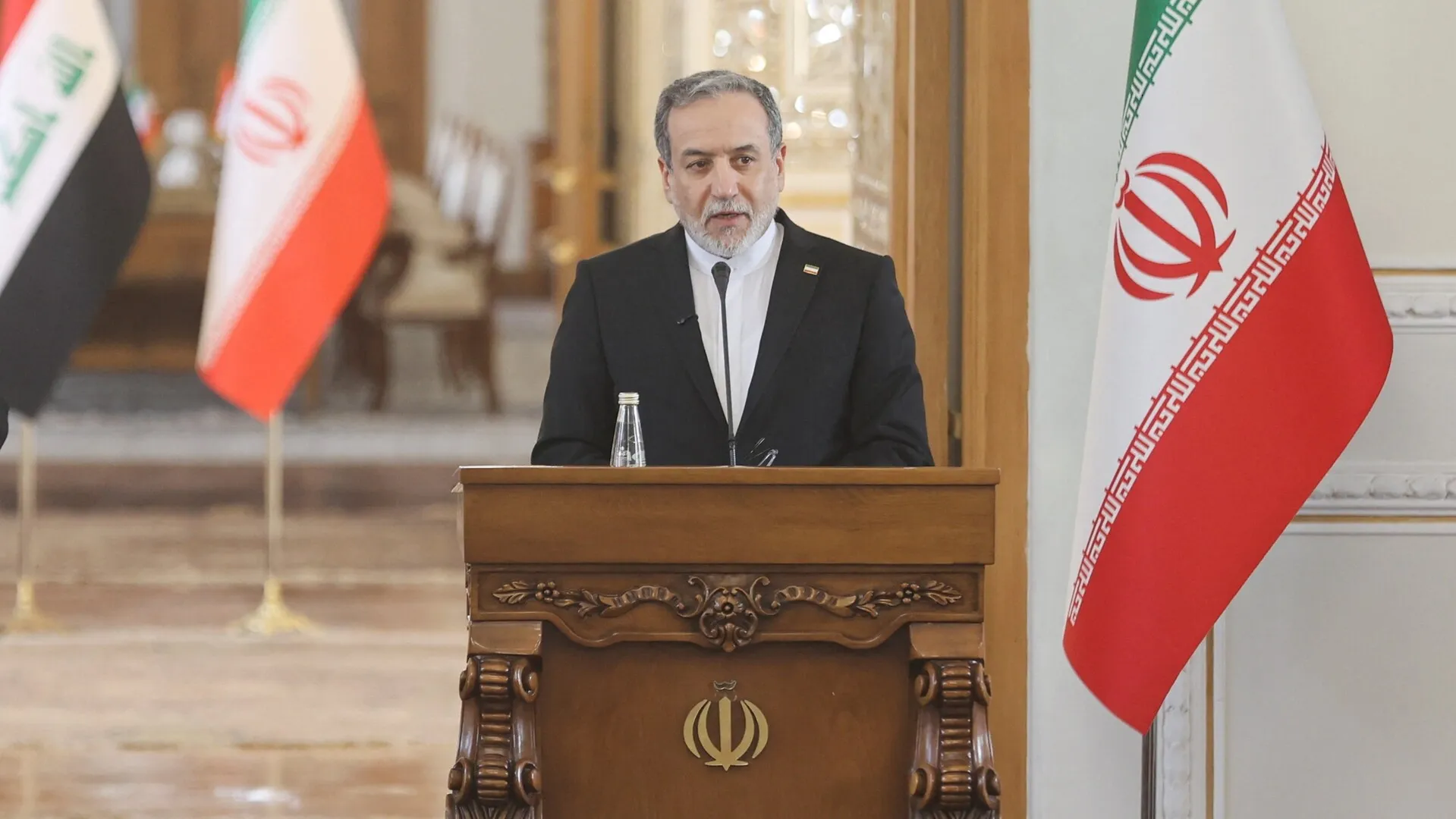
“No negotiations have taken place.” Iran’s foreign minister, Abbas Araghchi says his country is not and will not negotiate with the US while it is under attack. A day earlier, President Trump said the US was already in talks with Iranian officials, which Tehran denied.
March 25 (UPI) — Ha Nguyen McNeill, acting administrator for Transportation Security Administration, said Wednesday that TSA agents are struggling during the shutdown.
She made the comments during a hearing before the House Committee on Homeland Security amid funding issues for the Department of Homeland Security.
“Officers are reportedly sleeping in their cars at airports to save gas money, selling their blood and plasma, and taking on second and third jobs to make ends meet, all while expected to perform at the highest level when in uniform to protect the traveling public,” she said in her opening statement to the committee.
“Many have received eviction notices, lost their childcare, missed bill payments and been charged late fees, damaged their credit, defaulted on loans, and have been unable to even qualify for a loan to help ease the financial burden during the shutdown.”
According to TSAcareer.com, the starting base salary for officers is $34,454. The average is $46,000-$55,000 with locality adjustments.
Officials from TSA, the Coast Guard, the Federal Emergency Management Administration and the Cybersecurity Infrastructure and Security Agency said their readiness has been severely hurt by the partial government shutdown.
McNeill testified that 480 officers have quit the TSA since their pay stopped Feb. 14 and that the agency will not be able to replace them before visitors begin arriving for the World Cup in June.
She said officers spend four to six months in training before working at checkpoints, while the World Cup games begin in 80 days.
“Even if TSA were to hire new officers upon conclusion of the DHS shutdown, those officers would not be able to work on the checkpoints until well after the World Cup has concluded,” she said. “We are facing a potential perfect storm of severe staffing shortages and an influx of millions of passengers at our airports.”
On Tuesday, Senate Republicans said President Donald Trumpwas on board with their plan to reopen the Department of Homeland Security.
On Wednesday, Sen. Lindsey Graham, R-S.C., said he will “expeditiously move” to write the reconciliation process for the new Republican-led measure that will bypass the filibuster even without the 60 votes needed.
“The purpose of the second reconciliation bill is to make sure there is adequate funding to secure our homeland and to support our men and women in the military who are fighting so bravely,” Graham said in a statement.
Senate Democratic leader Chuck Schumer, D-N.Y., said on the Senate floor that “this morning, Democrats sent Republicans our counteroffer on legislation to reopen DHS, pay TSA workers, while at the same time, rein in [Immigration and Customs Enforcement] with common sense guardrails.”
“Our offer is a reasonable, good-faith proposal that contains some of the very same asks Democrats have been talking about now for months,” he said.
Schumer also noted that the ICE reforms are not new or surprise demands.
First lady Melania Trump speaks during the Fostering the Future Together Global Coalition Summit roundtable event in the East Room of the White House on Wednesday. Photo by Bonnie Cash/UPI | License Photo
March 25 (UPI) — Iran’s foreign minister said Wednesday that Tehran has no plans to negotiate with the United States after the Trump administration offered a 15-point peace plan.
During a televised interview on state-run media, Foreign Minister Abbas Araghchi said U.S. officials had been sending messages through intermediaries for “several days.”
U.S. officials who spoke to The New York Times and USA Today late Tuesday, said the United States sent a peace proposal through Pakistan, which earlier had offered to host talks between the two countries. The peace plan addressed Iran’s ballistic missile and nuclear programs, two of the key threats the administration and Israel cited for their decision to attack Iran.
Egypt has also offered to host peace talks.
Araghchi said passing messages through friendly countries doesn’t constitute “dialogue nor negotiation, nor anything of the sort.”
He added that Iran is focusing on defending itself against attacks and has “no intention of negotiating for now,” the BBC reported.
“This is Israel’s war, and people of the region and people of the U.S. are paying the price for it.”
U.S. officials said the proposed peace plan included lifting economic sanctions, limits on Iran’s missile program, making the Strait of Hormuz safe and winding down Iran’s nuclear program in exchange for cooperation on civilian nuclear energy — monitored by the International Atomic Energy Agency.
Destroying Iran’s ballistic missile arsenal, launcher and production plants has been one of the main objectives of the U.S.-Israeli airborne military campaign, along with 970 pounds of enriched uranium; they are determined to prevent Iran from ever converting into a nuclear weapon.
“Basically, it is not logical to enter into such a process with those who violate the agreement,” the source said.
Notwithstanding the assistance of Pakistan’s army chief, Field Marshall Syded Asim Munir, said to have a direct line of communication to the Islamic Revolutionary Guard Corps., communication with, and within, Iran is highly problematic, complicated by a civilian governance vacuum, damage to communications and officials reluctant to meet each other due to fear of being killed
There was no sign in Washington of any imminent let-up in the conflict on the ground.
“As President Trump and his negotiators explore this newfound possibility of diplomacy, Operation Epic Fury continues unabated to achieve the military objectives laid out by the commander-in-chief and the Pentagon,” White House press secretary Karoline Leavitt said in a statement.
However, the offer to Tehran was being seen as evidence of the White House’s desire for an exit strategy from a costly war, now in its fourth week, with Persian Gulf allies being hit by Iranian missiles and drones round the clock and severe disruption to global energy supplies.
Earlier, reports emerged in U.S. media that at least 2,000 paratroopers from the U.S. Army’s 82nd Airborne Division were being deployed from North Carolina to the Middle East, though it was unclear where, as Trump backs up his diplomatic maneuver with military pressure.
The soldiers from the 82nd’s Immediate Response Force are the only U.S. Army division with the ability to mount an airborne assault operation anywhere in the world within 18 hours of receiving orders.
They will join an amphibious force of thousands of U.S. Marines
House Speaker Mike Johnson said Wednesday that the United States doesn’t have “boots on the ground” in the Middle East, but said Tehran should take heed of the U.S. military buildup.
“I think Iran should watch that buildup, and they need to take note of that,” he told reporters.
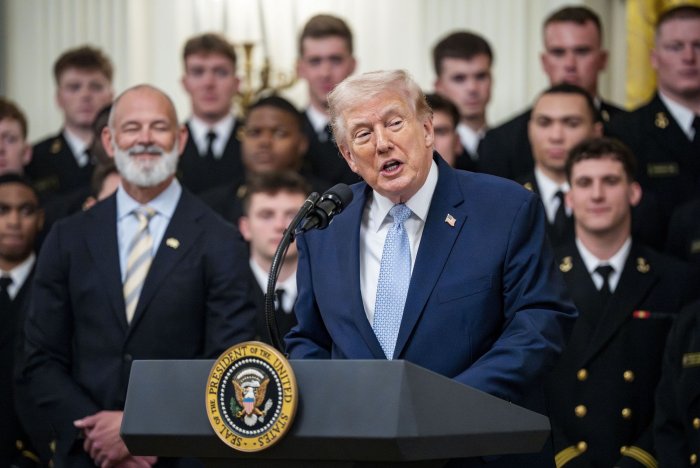
President Donald Trump presents the Commander in Chief’s Trophy to the Navy Midshipmen football team during a ceremony in the East Room of the White House on Friday. The award is presented annually to the winner of the football competition between the Navy, Air Force and Army. Navy has won the trophy back to back years and 13 times over the last 23 years. Photo by Bonnie Cash/UPI | License Photo
1 of 4 | President Donald Trump speaks in the Oval Office of the White House in Washington, D.C., on Tuesday. A Justice Department disclosure sent to members of Congress shows Trump had classified documents related to his personal business dealings stored at Mar-a-Lago after he left the presidency. File Photo by Graeme Sloan/UPI | License Photo
March 25 (UPI) — A 2023 Justice Department disclosure to Congress revealed that President Donald Trump had documents so secretive that only six people had received copies among classified documents he kept at his Mar-a-Lago estate in Florida after he left office.
The disclosure was part of former special counsel Jack Smith’s report on his investigation into Trump, which has not been made public. Elements of the report, though, were distributed to the House and Senate judiciary committees and subsequently made public this week as part of their own probes.
The disclosure detailed the types of documents Trump took with him to his home in Palm Beach after leaving office in 2020. Smith was appointed by former President Joe Biden to investigate the mishandled classified documents, resulting in 41 criminal counts against Trump. Trump-appointed U.S. District Judge Aileen Cannon dismissed the case in 2024 and recently ruled that Smith’s full report can’t be released publicly.
Rep. Jamie Raskin, D-Md., the ranking member of the House Judiciary Committee, sent a letter to Attorney General Pam Bondi on Tuesday questioning why the Justice Department is “fighting tooth and nail to gag Special Counsel Jack Smith and bury his report.” He said the Justice Department’s disclosure sent to the committee earlier this month included “cherry-picked” documents related to the investigation.
“You have, quite amazingly, missed the fact that some of the documents you provided include damning evidence about your boss’s conduct and may well violate the gag order your DOJ and Donald Trump demanded from Judge Aileen Cannon,” the letter read.
Raskin’s letter said that the Justice Department disclosure included information that Trump held documents at Mar-a-Lago that only six people in the government had access to and that other documents related to his business interests.
The disclosure also indicated that White House chief of staff Susie Wiles — then the CEO of Trump’s super PAC — said she observed Trump showing off a classified map to fellow passengers on his private plane.
“This glimpse into the trove of evidence behind the coverup release a president of the United States who may have sold out our national security to enrich himself,” Raskin wrote.
First lady Melania Trump speaks during the Fostering the Future Together Global Coalition Summit roundtable event in the East Room of the White House on Wednesday. Photo by Bonnie Cash/UPI | License Photo
March 25 (UPI) — Environmental organization Oceana has accused the Mexican government of maintaining an opaque response to an oil spill that has affected at least 390 miles of coastline in the Gulf of Mexico.
The oil has largely impacted the southern part of Veracruz state and the northern part of Tabasco state since early March, with dozens of contaminated sites still not receiving attention.
The spill has lasted nearly three weeks without an identified cause or confirmed responsible parties, affects the southwestern Gulf of Mexico reef corridor, a key ecological area that stretches along the coast between both states.
President Claudia Sheinbaum said the Office of the Attorney General is investigating, with support from environmental and energy agencies, while an interdisciplinary team analyzes the causel.
Sheinbaum stated that the spill originated from a private vessel, not state-owned oil company Pemex.
Veracruz Gov. Rocío Nahle said she will meet with officials from Petroleos Mexicanos to evaluate the installation of containment barriers in coastal areas following requests from fishermen.
Nahle said cleanup efforts are intensifying and that specialized mesh barriers are being installed at strategic points along the coastline to contain residues, with plans to expand the work depending on marine current movements.
Crisis ambiental en el Golfo
El derrame de petróleo ya afecta más de 630 km de costa en Veracruz y Tabasco. Hay fauna muerta, playas contaminadas y pérdidas para pescadores y turismo.
Denuncian abandono: el chapopote sigue ahí… y nadie lo retira.
Oceana warned that the situation constitutes a “crisis of transparency and accountability,” noting that official information has been insufficient and contradictory compared to the scale of damage reported by coastal communities.
“The opacity surrounding this spill generates impunity. Without clarity on those responsible, the causes and the impacts, it is impossible for authorities to be held accountable and guarantee reparations,” said Renata Terrazas, the group’s executive director.
According to citizen reports and local organizations, at least 51 sites with the presence of oil have been identified along the coastline, while more than two dozen have not yet received attention.
Reports also indicate impacts on key ecosystems. At least 14 marine species have died, including sea turtles, manatees and various species of fish, and thee has been damage to coral reefs and lagoon systems on which fishing communities depend.
Greenpeace Mexico released an interactive map with real-time reports on the expansion of the spill, including citizen records of thick residues and their impact on wildlife and coastal ecosystems.
However, Veracruz governor downplayed the impact, saying in interviews that it involves “traces” or small “drops” of oil on beaches and asserting that reports of dead wildlife were false — an assessment that contrasts with reports from communities and environmental organizations.
Apenas ayer la gobernadora Rocío Nahle aseguraba que los reportes de fauna muerta eran falsos, las cámaras de N+ confirmaron este martes la muerte de un delfín en Alvarado, Veracruz. El ejemplar presenta presuntos restos de hidrocarburos tras el reciente derrame en la zona. pic.twitter.com/Nat4dYQx8B— NMás (@nmas) March 24, 2026
Oceana called on the government to establish “transparent, agile and binding” interagency coordination mechanisms and to adopt structural measures to prevent the Gulf from facing another environmental crisis without responsible parties or clear information.
“The Gulf of Mexico and its communities cannot continue to be treated as an environmental sacrifice zone,” Terrazas said.
A high-ranking diplomatic source has confirmed that Iran received a 15-point plan from the United States aimed at ending the US-Israeli war on the country.
But the source told Al Jazeera on Wednesday that Tehran described the US proposal as “extremely maximalist and unreasonable”.
“It is not beautiful even on paper,” the source added, calling the plan deceptive and misleading in its presentation.
The comments come as US President Donald Trump has claimed – despite Iranian denials – that negotiations are under way between Washington and Tehran to reach an agreement to end the nearly one-month conflict.
The source explained that Iran has a clear understanding of what conditions it requires for a ceasefire and what it will reject.
The source also stated that there have been no direct Iran-United States talks since the war began – however, messages have been exchanged through a number of mediators.
The response from Iran came hours after sources confirmed to Al Jazeera that Pakistan had shared the US’ ceasefire demands with Iran.
Mediators are pushing for possible in-person talks between the Iranians and the Americans, as early as Friday in Pakistan, Egyptian and Pakistani officials said on Wednesday.
According to Al Jazeera’s Osama Bin Javaid, Pakistan is in a unique position as a mediator because it has a Shia minority, and relatively good ties with Iran including cross-border trade.
It also has a defence agreement with Saudi Arabia, and a Sunni majority that is closely aligned with the Gulf states, he said. Pakistan’s military leader also has a relationship with Trump, Javaid added.
“So, all of this puts Pakistan in a unique position to act between these two sides: it has no US bases on its soil, so Iran cannot accuse it of being used by the United States, and it is a state that has historically tried to mend relations between these actors,” he said.
Egypt’s Foreign Minister Badr Abdelatty, meanwhile, said Cairo was ready to host any meetings related to Iran as long as it serves de-escalation.
Abdelatty said in a news conference that Egypt supported Trump’s initiative to negotiate with Iran.
On Iran’s response to the US plan, he said “we have to continue our efforts, it’s all about diplomacy and negotiations”.
Turkiye has also been been trying to position itself as a possible mediator, with Harun Armagan, a vice chairman for foreign affairs in Turkiye’s ruling AK Party, telling the Reuters news agency that Ankara has been “playing a role passing messages” between Tehran and Washington.
Iran counters with own conditions to end war
Iranian state television’s English-language broadcaster, Press TV, quoted an anonymous official also stating that Iran rejected the US ceasefire proposal.
“Iran will end the war when it decides to do so and when its own conditions are met,” Press TV quoted the official as saying.
The official offered Iran’s own five-point plan, which included a halt to killings of its officials, means to make sure no other war is waged against it, reparations for the war, the end of hostilities and Iran’s “exercise of sovereignty over the Strait of Hormuz”.
Earlier, two officials from Pakistan described the 15-point US proposal broadly, saying it addressed sanctions relief, a rollback of Iran’s nuclear program, limits on missiles and reopening the Strait of Hormuz, through which a fifth of the world’s oil is shipped.
An Egyptian official involved in the mediation efforts said the proposal also includes restrictions on Iran’s support for armed groups.
Israeli officials, who have been advocating for Trump to continue the war against Iran, were surprised by the submission of a ceasefire plan, the Associated Press news agency reported, citing an anonymous source.
Iran remains highly suspicious of the United States, which twice under the Trump administration has attacked during high-level diplomatic talks, including with the February 28 strikes that started the current war.
Iran’s rejection of the US proposal came as Israel launched air attacks on Tehran and Washington deployed paratroopers and more Marines to the region.
Iran, meanwhile, launched more attacks on Israel and Gulf Arab countries, including an assault that sparked a huge fire at Kuwait International Airport.
March 25 (UPI) — Dutch scientist Huub Lilieveld has been named the recipient of the 2026 World Food Prize Wednesday for leading a food safety movement across 113 countries.
For six decades, Lilieveld has researched and advocated for food safety, using scientific evidence to inform regulations and legislation across the globe. His work has culminated in establishing modern global food safety, security, trade and aid standards.
The World Food Prize Foundation is recognizing Lilieveld’s contributions with a $500,000 award.
“Lilieveld lives by his conviction that access to safe food is a universal right — a philosophy shared by the late Dr. Norman Borlaug,” Mashal Husain, president of the World Food Prize Foundation, said in a statement. “Through his lifelong commitment to harmonizing regulations, he has lowered trade barriers, prevented the unnecessary destruction of safe food, promoted innovative food safety technologies worldwide and reduced the risk of foodborne illness outbreaks.”
Foodborne illnesses kill 420,000 people annually. There are about 600 million cases of foodborne illnesses per year.
Lelieveld established the Global Harmonization Initiative in 2004, to connect volunteers and food safety experts around the world to combat safe food insecurity and improve the distribution of safe foods.
“Companies large and small, as well as all consumers are negatively affected by unjustified differences in regulations,” Lelieveld said in a statement. “The Global Harmonization Initiative, therefore, strives not only to reach scientific consensus but also to ensure that findings are accessible to everyone, requiring simplification without compromising scientific accuracy and translation into local languages.”
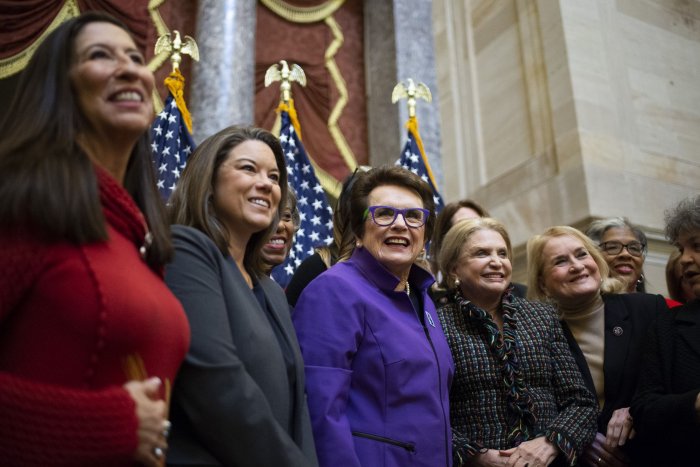
Founder of the Women’s Tennis Association and tennis great Billie Jean King (C) smiles with representatives after speaking during an annual Women’s History Month event in celebration of the 50th anniversary of Title IX in Statuary Hall at the U.S .Capitol in Washington on March 9, 2022. Women’s History Month is celebrated every March. Photo by Bonnie Cash/UPI | License Photo
The number of babies born in South Korea rose at the fastest pace in seven years in January, government data showed Wednesday. In this file photo, a nurse cares for a newborn at a hospital in Goyang on Dec. 26, 2025. File Photo by Yonhap
The number of babies born rose at the fastest pace in seven years in January, driven largely by an increase in marriages, government data showed Wednesday.
A total of 26,916 babies were born in January, up 11.7 percent from the same period a year earlier, according to the data from the Ministry of Data and Statistics.
The January figure was the highest for the month since 2019, when 30,271 babies were born, the ministry said, noting that births are gradually recovering to pre-pandemic levels.
The number of newborns has been on an upward trend since July 2024.
The country’s total fertility rate, the average number of children a woman is expected to have in her lifetime, rose 0.1 from a year earlier to 0.99 in January.
It marked the highest rate since January 2024, when such data began being compiled on a monthly basis.
On an annual basis, the last time the fertility rate exceeded 1 was in 2017, when it stood at 1.052.
The rate then fell to a record low of 0.721 in 2023 before beginning to rebound in 2024.
However, the rate still remains well below the 2.1 births per woman needed to maintain a stable population without immigration.
The ministry said the recent rise in births appears to have been influenced by a continued increase in marriages, government policies supporting childbirth and the growth in the population of women in their early 30s.
In South Korea, where childbirth outside of marriage remains rare, an increase in marriages tends to precede a rise in births.
The number of marriages in January jumped 12.4 percent on-year to 22,640, marking the 22nd consecutive month of growth.
The figure is the highest for the month of January since 2018, when 24,370 marriages were recorded.
The number of divorces also went up 4.2 percent on-year to 7,280 in the cited month, the data showed.
Meanwhile, the number of deaths went down 17.6 percent from a year earlier to 32,454, resulting in a natural population decline of 5,539.
Copyright (c) Yonhap News Agency prohibits its content from being redistributed or reprinted without consent, and forbids the content from being learned and used by artificial intelligence systems.
South Korean chipmaker SK hynix Inc. said Wednesday it has begun taking steps for listing on the U.S. stock market. This file photo, taken Jan. 29, 2026, shows the company’s headquarters in Icheon. File Photo by Yonhap
SK hynix Inc. said Wednesday it has begun taking steps for listing on the U.S. stock market as the chipmaker aims to improve access to global investors amid its artificial intelligence (AI) drive.
The South Korean chipmaker filed a “confidential submission” to the U.S. Securities and Exchange Commission (SEC) the previous day, with a goal to have its American depositary receipts (ADRs) listed on the U.S. stock exchange within the year, it said in a regulatory filing.
“We are preparing with the goal of listing in the second half,” Chief Executive Officer (CEO) Kwak Noh-jung said during a general shareholders meeting in Icheon, some 50 kilometers southeast of Seoul.
“As the issuance size and method have not yet been finalized and the listing review process has begun, I cannot disclose specific details in accordance with domestic and international laws and regulations,” he said. “We plan to proceed in a way that helps enhance shareholder value.”
ADRs refer to securities issued in the U.S. stock market that allow the trading of shares in foreign firms. They allow companies to attract U.S.-based investors without a full listing of common shares.
The size, schedule and other details of the process have not yet been confirmed and will largely be determined by market environments, the company noted, adding the final decision will be made by the SEC.
SK hynix’s move is expected to help the chipmaker broaden its funding base in overseas markets, industry watchers said.
The chipmaker said it plans to make another related regulatory filing within six months or earlier if there are further updates.
Separately, Kwak outlined plans to secure more than 100 trillion won (US$66.8 billion) in net cash to support long-term strategic investment for further growth.
“Financial soundness that enables stable investment is essential to respond to structural demand growth and maintain competitiveness,” Kwak said. “We will secure world-class financial strength to lay the foundation for long-term growth.”
According to an annual report, SK hynix maintained net cash of 12.7 trillion won as of end-2025.
Kwak added the company will continue shipments of its high bandwidth memory (HBM) chips as planned this year and aims to release samples of the next-generation HBM4E product later this year.
“HBM3E chips remain the mainstay, and shipments of HBM4 will increase in the second half. Our overall shipment schedule remains largely unchanged,” he said. “We plan to present samples of HBM4E within the year.”
Copyright (c) Yonhap News Agency prohibits its content from being redistributed or reprinted without consent, and forbids the content from being learned and used by artificial intelligence systems.
Counter-terrorism police in London arrested two men in raids in the capital early Wednesday on suspicion of arson with intent to endanger life two days after an attack that burnt out four ambulances belonging to a Jewish community charity. Photo by Andy Rain/EPA
March 25 (UPI) — British counter-terrorism police made two arrests early Wednesday in connection with an arson attack that destroyed four Jewish volunteer ambulances parked outside a synagogue in London.
The men, aged 47 and 45, were arrested in dawn raids at addresses in northwest London and central London on suspicion of arson with intent to endanger life and taken to a London police station, where they are being held in custody, the Metropolitan Police said in a news release.
The Met said it was continuing to work to identify another suspect, one of three captured on CCTV pouring accelerant onto the ambulances in the Golders Green area of north London before igniting it in the early hours of Monday.
The fires caused oxygen cylinders inside the vehicles to explode, shattering windows in nearby residential properties and forcing the evacuation of at least 34 people, but no one was injured.
Calling it an “appalling attack,” Commander Helen Flanagan, Head of Counter Terrorism Policing London, said officers had been working the case around the clock.
“This appears to be an important breakthrough in the investigation, but we’re also mindful that CCTV footage of the incident suggests there were at least three people involved. We fully recognise the local community will still be concerned and our investigation very much remains active and we will continue to work to identify and seek to arrest all of those who may have been involved,” Flanagan said.
More than 260 additional police officers, backed by firearms teams, have been deployed on the streets of Golders Greens and other areas of London with sizable Jewish populations to provide protection and reassurance to those communities.
Police do not routinely carry guns in the United Kingdom.
“We know that community concerns remain heightened and I want to reassure the community that an enhanced, bespoke policing plan and activity, which is particularly focused around vulnerable areas right across London, will continue over coming days and weeks,” said Detective Chief Superintendent Luke Williams.
“This includes specialist officers and capability being deployed alongside local officers to help protect certain locations and will also involve highly visible armed police patrols to serve as a deterrent to anyone seeking to cause our communities harm. I must stress that these are precautionary and not in response to any specific threat, and we continue to work alongside our colleagues in Counter Terrorism policing to support their investigation,” added Williams who is responsible for policing north west London.
The incident is being treated as an anti-Semitic hate crime, not terrorism, but the Met is investigating a claim made online by an Iranian-linked Islamist group that it carried out the attack.
Speaking during a visit to Washington on Monday, Met Commissioner Sir Mark Rowley warned of what he said was the “rapid growth” of threats from the Iranian regime but said it was “too early” to place the blame on Tehran.
Sir Mark said police were pursuing several leads, including “an online claim of responsibility by an Islamist group who have claimed other attacks across Europe and have potential Iranian state links.”
The ambulances belonged to Hatzola Trust, a non-profit volunteer-run Jewish community group providing first responder medical care and hospital transportation free of charge to residents of north London of all religions.
Hatzola works alongside about 2,000 ambulances and support vehicles operated by the London Ambulance Service which is part of the free National Health Service.
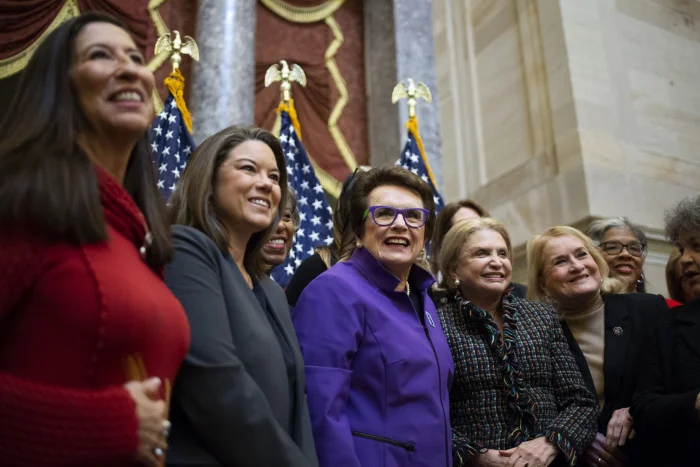
Founder of the Women’s Tennis Association and tennis great Billie Jean King (C) smiles with representatives after speaking during an annual Women’s History Month event in celebration of the 50th anniversary of Title IX in Statuary Hall at the U.S .Capitol in Washington on March 9, 2022. Women’s History Month is celebrated every March. Photo by Bonnie Cash/UPI | License Photo
U.S. Army Paratroopers from the 82nd Airborne Division arrive at Ali Al..Salem Air Base, Kuwait, in January 2020. It was reported Tuesday that the Pentagon was to send a contingent of paratroopers from the division to the Middle East. File Photo by Tech. Sgt. Daniel Martinez/U.S. Air Force/UPI
March 25 (UPI) — The Pentagon has ordered paratroopers to the Middle East, as President Donald Trump pursues a diplomatic solution to the war with Iran while declining to rule out the possibility of launching ground operations, according to reports.
The contingent of paratroops to be deployed are from the Army’s 82nd Airborne Division, out of Fort Bragg, N.C., and will include Maj. Gen. Brandon Tegtmeier, the division commander, The New York Times, CNN and CBS News reported, citing unidentified sources.
The soldiers are specifically members of the 82nd Division’s Immediate Response Force, The Times, CNN and The Washington Post reported. According to the U.S. Army, the Immediate Response Force is its only division capable of beginning an airborne assault operation anywhere in the world within 18 hours of receiving orders.
Rep. Jason Crow, a Democrat from Colorado and a former paratrooper with the 82nd Airborne, lambasted Trump over the announcement Tuesday night.
“These paratroopers, and the American people, deserve better,” he said in a statement. “We must protect our service members and stop spending billions of dollars a day fighting overseas wars of choice, especially as folks back home can’t afford gas, groceries or healthcare.”
The announcement comes as Iran’s claimed closure of the Strait of Hormuz, through which flows about 20% of the world’s oil supplies, has seen energy prices surge and nations scrambling to mitigate the effects on their economies.
It was unclear exactly how many the paratroops would be deployed or where they would be sent, but their deployment could give Trump a rapid-response force in the region, while representing an escalation in the conflict.
Earlier this month, U.S. Central Command said it had struck more than 90 military targets on the Kharg Island, a key location in Iran’s ability to enforce its maritime blockade, including naval mine storage facilities, missile storage bunkers and other military sites.
Trump described the strike as “one of the most powerful bombing raids in the History of the Middle East, and totally obliterated every MILITARY target in Iran’s crown jewel, Kharg Island.”
“For reasons of decency, I have chosen NOT to wipe out the Oil infrastructure on the Island,” he wrote on his Truth Social platform. “However, should Iran, or anyone else, do anything to interfere with the Free and Safe Passage of Ships through the Strait of Hormuz, I will immediately reconsider this decision.”
Trump on Saturday had given Iran a 48-hour ultimatum to open the strait or the U.S. military would “obliterate” its power plants, to which Iran’s parliament speaker, Mohammad Bagher Ghalibaf, responded that if the American president makes good on his threat, critical and energy infrastructure and oil facilities would be “irreversibly destroyed.”
On Monday, Trump announced that he had extended the ultimatum five days after having what he called “very good and productive conversations” on a solution to the war with Iran.
Trump said Tuesday that negotiations with Iran were underway and that the Iranians “want to make a deal.”
Some 450,000 people without electricity in Belgorod region, while power cut off for 150,000 consumers in Chernihiv.
Published On 25 Mar 202625 Mar 2026
Russia and Ukraine have targeted each other’s energy facilities in tit-for-tat attacks, leaving hundreds of thousands of people without power, officials from both countries said, as the world’s attention has shifted to the US-Israel war on Iran.
Nearly half a million people were left without electricity in Russia’s Belgorod region, while 150,000 consumers in the city of Chernihiv and surrounding areas were without power on Wednesday.
Recommended Stories
list of 3 itemsend of list
The electricity distribution company in Ukraine’s northern Chernihiv region said on Wednesday that the energy facility was damaged and repair work would begin as soon as the security situation allowed.
Belgorod Governor Vyacheslav Gladkov said power outages affected some 450,000 people across several districts, including the regional capital of Belgorod, with many residents also facing disruption to heating and water supply. The temperature in Belgorod hovers around 0C (32F).
Gladkov said repair works have already started, but that it would take several days to complete.
Belgorod, which lies about 40km (25 miles) from the border with Ukraine, has been a frequent target of Ukrainian drone and missile attacks in the four years since Russia invaded its neighbour.
In Ukraine’s southern region of Odesa, Russian attacks late on Tuesday killed one person and wounded another, emergency services said.
The attack damaged a private house, sparking a fire, and caused damage to six buildings nearby. Photos posted on Telegram by emergency services showed firefighters putting out flames in a partially destroyed building.
Meanwhile, in Russia, officials said on Wednesday a Ukrainian drone attack targeting a major oil export hub sparked a fire at the Baltic Sea port of Ust-Luga.
Alexander Drozdenko, governor of Russia’s Leningrad region, said the fire was being brought under control and that no casualties had been reported.
March 25 (UPI) — Republican senators have again backed President Donald Trump‘s war against Iran, blocking a Democratic-led effort to curb his ability to wage war without congressional approval.
The Senate voted 53-47, mostly along party lines, on Tuesday evening to block Democrats’ war powers resolution, the third time Senate Republicans have blocked a resolution to require the removal of U.S. forces from hostilities against Iran unless Congress authorizes them.
Sen. Rand Paul of Kentucky was the only Republican to vote in favor of the motion with his Democratic colleagues, while Sen. John Fetterman of Pennsylvania was the only Democrat to vote against it with the GOP lawmakers.
Since the war began on Feb. 28, when the United States and Israel attacked Iran, Democratic lawmakers have argued the war is unconstitutional because only Congress has the power to declare war, while Republicans contend Trump is within his authority as commander in chief to defend the country.
Sen. Chris Murphy of Connecticut said he forced the vote Tuesday to have debate on Trump’s war in Iran.
“This is increasingly important because this war is spiraling out of control,” he said in a video posted to social media ahead of heading into the Senate.
“The cost of plastic just doubled, prices at the pump are sky high, the Strait of Hormuz is still shut down, new wars are breaking out in the region, we’ve had a dozen Americans killed, $2 billion being spent a day and for what!”
From the floor, Senate Minority Leader Chuck Schumer, D-N.Y., called on Republicans to vote in favor of the resolution, saying it was time for the war to come to an end.
“The war is expanding, and the Senate has an obligation to step in,” he said.
“I say to my Republican colleagues: if there was ever a time to stand up for the authority of the Senate, stand up for the powers given to us through the Constitution, the time is now.”
Sen. Jim Risch of Idaho, who has repeatedly argued against the war powers resolution, took to the floor again on Tuesday to say the Democrats were going to receive the same negative result as they had the two previous times.
Iran started the war, he said, pointing to the Iran hostage crisis of 1979 and stating that the Islamic regime has since killed thousands of Americans.
“The president of the United States said, ‘We have had enough.’ He had very good reasons to pull the trigger at the time that he did and… The fact of the matter is, we are in conflict,” he said, stating the Senate needs to back the Americans fighting in the war and their president.
“We all know this isn’t going to go on very long, but it needs to be done.”
The vote was held less than a week after Democrats used the war powers resolution to force a vote on Wednesday on a similar motion, which Republicans blocked in the same 53-47 outcome. Both Paul and Fetterman voted against their parties.
As the United States-Israeli war with Iran sends tremors through the global economy, the poorest members of the Global South are the most exposed to the fallout.
In Asia, Africa and the Middle East, developing economies are bearing the brunt of surging energy costs prompted by the closure of the Strait of Hormuz and attacks on oil and gas facilities across the Gulf.
Recommended Stories
list of 4 itemsend of list
From Pakistan to Bangladesh and Sri Lanka, through to Jordan, Egypt and Ethiopia, policymakers are facing the double whammy of being both heavily dependent on imported energy and having limited financial firepower to absorb the shock of spiking prices.
In Pakistan, which imports about 80 percent of its energy from the Gulf and has lurched between economic crises for years, authorities have scrambled to roll out measures to conserve fuel.
Facing the depletion of the country’s petrol and diesel reserves within weeks, officials have closed schools, introduced a four-day working week for government offices, ordered half of the country’s public sector employees to work from home, and slashed fuel allowances for official business.
Pakistani Prime Minister Shehbaz Sharif said last week that he had decided against a proposed hike in petrol and diesel prices before the Eid Al-Fitr celebration, saying the government would “bear the burden” of rising costs.
Sharif’s announcement came after the government had earlier this month approved a 55 rupee ($0.20) rise in the price of a litre (0.26 gallons) of petrol or diesel.
While government subsidies have helped cushion the blow for the public, there are fears that petroleum prices will surge and bring economic activity to a halt if the war drags on, said S Akbar Zaidi, the executive director of the Institute of Business Administration in Karachi.
“The overall shock is quite severe, although it has not been fully passed on to consumers and to industry,” Zaidi said.
“I expect the next few weeks to make things far worse once the disruption and price factors pass through.”
A man gets his motorcycle refuelled at a petrol station in Dhaka, Bangladesh, on March 9, 2026 [Munir Uz Zaman/AFP]
In Bangladesh, which imports about 95 percent of its oil and is expected to run through its fuel reserves within days, petrol pumps in some districts have run dry despite the introduction of fuel rationing.
Sri Lanka, which imports about 60 percent of its energy needs and is still reeling from an economic meltdown that began in 2019, has declared every Wednesday a public holiday and introduced a mandatory fuel pass for vehicle owners to conserve petrol and diesel, stockpiles of which are projected to run dry within weeks.
In Egypt, one of the biggest energy importers and among the most indebted economies in the Middle East, the government has ordered malls, shops and cafes to close by 9pm on weekdays and 10pm during weekends, and cut back on public lighting.
Facing growing pressure on public finances due to the government’s heavy subsidisation of fuel prices, Egyptian officials on March 10 announced price hikes of between 15 and 22 percent for petrol, diesel and cooking gas.
While acknowledging the burden on the public, Egyptian President Abdel Fattah el-Sisi said the move was necessary to avoid “harsher and more dangerous outcomes”.
“For a majority of developing economies, especially those already grappling with debt and high import dependence, they are facing a potent mix of inflation, currency pressures and fiscal strains,” said Yeah Kim Leng, a professor of economics at the Jeffrey Cheah Institute on Southeast Asia at Sunway University in Kuala Lumpur, Malaysia.
“The hardest hit are net energy and food importers, especially those with fragile macroeconomic foundations and pre-existing vulnerabilities that typified countries with low per capita income and high poverty rates,” Yeah added.
Pakistan, Bangladesh, Sri Lanka, Jordan, Senegal, Egypt, Angola, Ethiopia and Zambia are among the most at risk, according to a recent analysis by the Washington-based Centre for Global Development, which looked at factors including dependence on fuel imports, public debt levels and foreign exchange reserve/import ratios.
Currency depreciation
The weakening of many developing countries’ currencies against the US dollar – the result of investors buying the greenback amid heightened geopolitical uncertainty – has compounded the situation by further driving up costs.
“Countries such as Indonesia and the Philippines have already seen their currencies at near record lows even before the start of the conflict, making imports, including oil, much more expensive,” said Azizul Amiludin, a non-resident senior fellow at the Malaysia Institute of Economic Research in Kuala Lumpur.
Much as the fallout of the war poses particular challenges for governments in developing countries, the effect on citizens is disproportionate, too.
In less advanced economies, citizens spend much more of their pay cheques on fuel and food, leaving them more exposed to rising living costs.
At the same time, governments in developing countries have less capacity to provide a safety net for those at risk of falling through the cracks.
“In vulnerable economies, governments often attempt to shield their populations from price hikes by subsidising fuel and food,” said Yeah, the Jeffrey Cheah Institute professor.
“However, with depleted fiscal buffers and shrinking revenues, this becomes unsustainable. The ensuing austerity, combined with hyperinflation, can trigger widespread social unrest and a full-blown fiscal crisis.”
Motorcyclists crowd a filling station and wait their turn to get fuel, in Lahore, Pakistan, on March 6, 2026 [K M Chaudary/AP]
With the US and Israel barely a month into their war and no clear timetable for its end in sight, many analysts expect things to get worse before they get better.
Khalid Waleed, a research fellow at the Sustainable Development Policy Institute in Islamabad, said rising transport costs would soon be felt at supermarket checkouts.
“Diesel is the backbone of Pakistan’s freight and agricultural economy,” Waleed said.
“Trucking costs have started climbing, and that will feed into everything from flour to fertiliser in the weeks ahead.”
Once Pakistan’s wheat harvest gets under way in April, food prices could spike well beyond their current levels, Waleed said.
“Combine harvesters, threshers, tractors for haulage from field to market, and the trucks that move grain from fields to flour mills and storage facilities all run on high-speed diesel,” he said.
“For a country where wheat flour is the single largest item in the food basket of the bottom two income quintiles, this is not a marginal concern,” Waleed added.
“If diesel prices stay elevated through April and May, Pakistan will harvest its wheat at the most expensive input cost in years, and that cost will transmit directly into food inflation at a time when households have almost no capacity left to absorb further price shocks.”
Trita Parsi, Vice President of the Quincy Institute, argues that Iran is unlikely to agree to end the war without sanctions relief, while there is little sign Donald Trump is willing to offer meaningful concessions, adding that a deal remains unlikely until then.
Iran said Tuesday that a projectile hit within the premises of its nuclear power plant in Bushehr, southern Iran. Photo by Abedin Taherkenareh/EPA
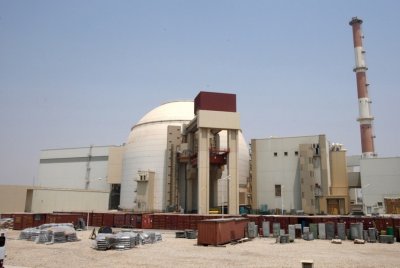
March 24 (UPI) — An unidentified projectile struck the grounds of Iran’s Bushehr nuclear power plant on Tuesday night, according to Iran’s Atomic Energy Organization, the second time in a little more than two weeks that the facility has been threatened by the ongoing war.
The projectile struck at 9:08 p.m. local time, resulting in no casualties or damage, it said in a statement.
“Attacking peaceful nuclear facilities is not only a violation of international regulations and rights, but also seriously endangers #regional security,” Iran’s AEO said in a post tagging the United Nations nuclear watchdog, the International Atomic Energy Agency.
“It is expected that international institutions will adopt a responsible and transparent stance in response to such actions.”
The IAEA said it was informed of the incident by Iran, adding that the plant was operating normally.
The agency’s director-general, Rafael Grossi, reiterated his call “for maximum restraint to avoid nuclear safety risks during conflict,” the IAEA said in a statement.
The incident comes eight days after an unidentified projectile struck near the plant on March 17, the first reported strike near Bushehr since the war between Iran and the United States and Israel began late last month.
Located near Bushehr city on Iran’s southwest Persian Gulf coast, the Bushehr plant began construction in 1975, but its original German contractor abandoned the project following the Islamic Revolution four years later. In the mid-1990s, Russia agreed to complete Bushehr Unit 1, Iran’s first reactor, which began operating in 2011, according to the U.S. Congressional Research Service.
Yoo Yong-weon, a lawmaker of South Korea’s ruling People Power Party, speaks during an interview with Yonhap News Agency about his recent meetings with two North Korean soldiers captured by Ukraine at the National Assembly in Seoul, South Korea, 07 March 2025. The two photographs Yoo is holding were taken from his meetings with the soldiers in Kyiv on 25 February 2025. Photo by YONHAP / EPA
March 24 (Asia Today) — Ukraine’s Defense Ministry has told a South Korean civic group that two captured North Korean soldiers are recognized as prisoners of war and are being protected under the Geneva Convention on the treatment of POWs.
According to a reply disclosed Tuesday by an emergency committee campaigning for the soldiers’ transfer, the Ukrainian ministry said the men are being guaranteed contact with the outside world, access by international monitors and human rights organizations, and other protections required under international humanitarian law.
The ministry also said the principle of non-refoulement, which bars forced return to a country where a person may face harm, is being taken into account in their treatment.
The statement aligns with remarks made March 6 by South Korean Foreign Minister Cho Hyun, who said he had received assurances from his Ukrainian counterpart that the soldiers would not be repatriated to North Korea or Russia. (Yonhap News)
The civic group, however, said the two men remain in a military detention facility under the authority of Ukraine’s Defense Ministry and still hold legal POW status, leaving open the possibility that they could become subjects of negotiations between governments.
The group said the soldiers should be shifted from military custody to an internationally protected status. It called for their transfer to a civilian protection facility and urged direct involvement by the U.N. refugee agency, the U.N. human rights office and the International Committee of the Red Cross.
It also proposed that procedures begin to determine whether the two soldiers should receive refugee status or another form of international protection.
Photo made available by the Emergency Committee for the Free Repatriation of North Korean Soldiers shows a reply from Ukraine’s Defense Ministry regarding two captured North Korean soldiers. /Provided by the committee
Photo shows Foreign Ministry spokesperson Park Il speaking at a briefing in Seoul on March 12. Photo by Asia Today
March 24 (Asia Today) — South Korea is taking a cautious approach to whether it will join as a co-sponsor of an upcoming United Nations resolution on North Korean human rights, officials said Tuesday, citing a need to balance diplomacy with Pyongyang and international cooperation.
The resolution is expected to be adopted at the current session of the U.N. Human Rights Council later this week.
Foreign Ministry spokesperson Park Il said the government’s position remains that improving human rights in North Korea is important and that Seoul will continue to work with the international community. However, he said the decision on co-sponsorship is still under review.
“The issue is being considered comprehensively, taking into account the government’s efforts toward peaceful coexistence on the Korean Peninsula and the content of the resolution,” Park said at a regular briefing.
He added that the government’s cautious stance does not signal opposition, but reflects the complexity of factors involved, and that a decision will be made through consultations among relevant agencies.
A ministry official said there is a procedural window allowing countries to join as co-sponsors within two weeks after the resolution is adopted, giving Seoul time to assess its position.
The deliberations come amid strained inter-Korean relations and President Lee Jae-myung’s call to pursue even limited openings for dialogue with North Korea.
South Korea previously joined as a co-sponsor of a similar resolution at the U.N. General Assembly last November, easing concerns that the current administration might withdraw from such efforts.
Separately, the Unification Ministry has signaled a willingness to ease tensions. Unification Minister Chung Dong-young recently made conciliatory remarks, including urging North Korea not to miss opportunities for dialogue with the United States.
Civil society groups have urged the government to take a more active role. The International Federation for Human Rights and the Transitional Justice Working Group said in a joint letter to Lee that declining to co-sponsor the resolution would send a troubling signal domestically and internationally.
They warned that overlooking human rights concerns may create only a temporary easing of tensions, while leaving underlying instability unresolved and making lasting peace more difficult to achieve.
March 24 (UPI) — Former Kentucky Gov. Matt Bevin was sentenced to 60 days in jail and a $500 fine after he was found in contempt of court Tuesday.
Matt Bevin was found to be in contempt Friday for not disclosing his financial records in a legal battle with his estranged son Jonah Bevin. Jonah Bevin is fighting for retroactive child support after his adoptive parents allegedly abandoned him.
Jefferson County Family Court Judge Angela Johnson told Bevin: “Your arrest warrant will be issued today,” the Kentucky Lantern reported. Bevin had been ordered to appear in the Louisville court in person, but he appeared via Zoom.
Matt Bevin said he was traveling to attend the funeral of his ex-wife’s father Monday and was on his way back. He appeared to be in an office, but didn’t say where he was, the Lantern reported.
During the hearing, Matt Bevin interrupted Johnson several times. He argued that he was trying to get the information to the court but needed more time to collect records. His ex-wife, Glenna Bevin, didn’t have to appear because she already turned in her financial information.
“Every litigant in the commonwealth has to provide such information,” Johnson told Matt Bevin, the Lantern reported. “I cannot treat Mr. Bevin or Mrs. Bevin any differently.”
Johnson told the former governor that once he produced the records, including tax returns, bank statements and details of assets and income, his jail sentence would be dropped.
On Monday, Matt Bevin filed a motion calling for Johnson to be removed from the case for her “personal bias and prejudice,” the Louisville Courier Journal reported.
The case began when Glenna Bevin filed for divorce in 2023. Jonah Bevin, who is one of four children the Bevins adopted from Ethiopia, intervened demanding child support for time he spent at boarding schools for “troubled teens.” A school in Jamaica was raided by law enforcement over allegations of abuse while he was in its custody. The Bevins did not retrieve him after the school was raided and shut down.
Jonah Bevin’s attorneys said he suffered abuse at those schools and that his high school diploma from a school in Florida may not be valid.
Matt Bevin’s affidavit said some of Johnson’s rulings make it “clear to me that Judge Johnson’s decisions are being motivated by her personal desire for publicity and ‘earned media’ as a government employee who must seek re-election to remain a Circuit Court Judge in the future.”
Johnson will be up for re-election in 2030.
John Helmers and Melina Hettiaratchi, Louisville-based attorneys representing Jonah Bevin, said the judge is asking for what is standard in Kentucky family court cases.
“This judge has done nothing but give him a fair shot. When he refused, she held him in contempt — and he responded by trying to get her thrown out of the game for calling a foul,” The Courier Journal reoported their statement said. “Now that it is crystal clear he is going to have to play by the same rules as everyone else, he’s taking shots at the judge.”
Jonah Bevin said in a statement he now has “no support, no resources, and no ability to wait [Matt Bevin] out while he does everything he can to avoid sitting down with a judge.”
On Friday in court, Matt Bevin said he loves all of his children and wants “what is in their best interest.”
Matt Bevin served as the 62nd governor of Kentucky from 2015 to 2019. He lost to current Gov. Andy Beshear, a Democrat.
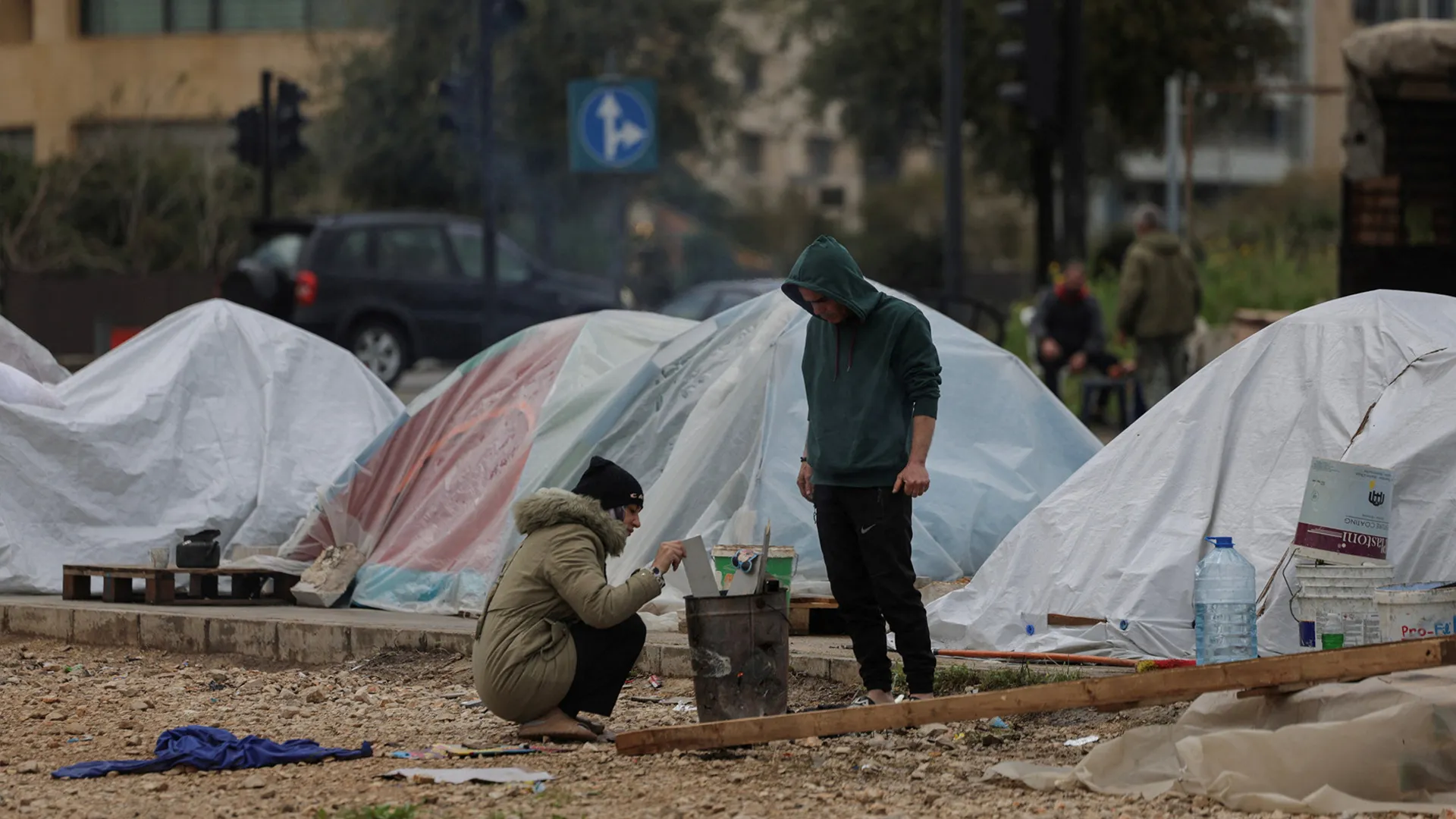
After Israel’s bombing of Beirut’s southern suburb of Dahiyeh, Palestinian refugee Dalal Dawali once again finds herself forcibly displaced. She and her children joined hundreds of families fleeing to Beddawi camp in north Lebanon. Al Jazeera’s Justin Salhani tells her story.