RIYADH: Qatar on Wednesday condemned Houthi attacks on civilian and economic sites in southern Saudi Arabia during a phone call between the two countries’ foreign ministers.
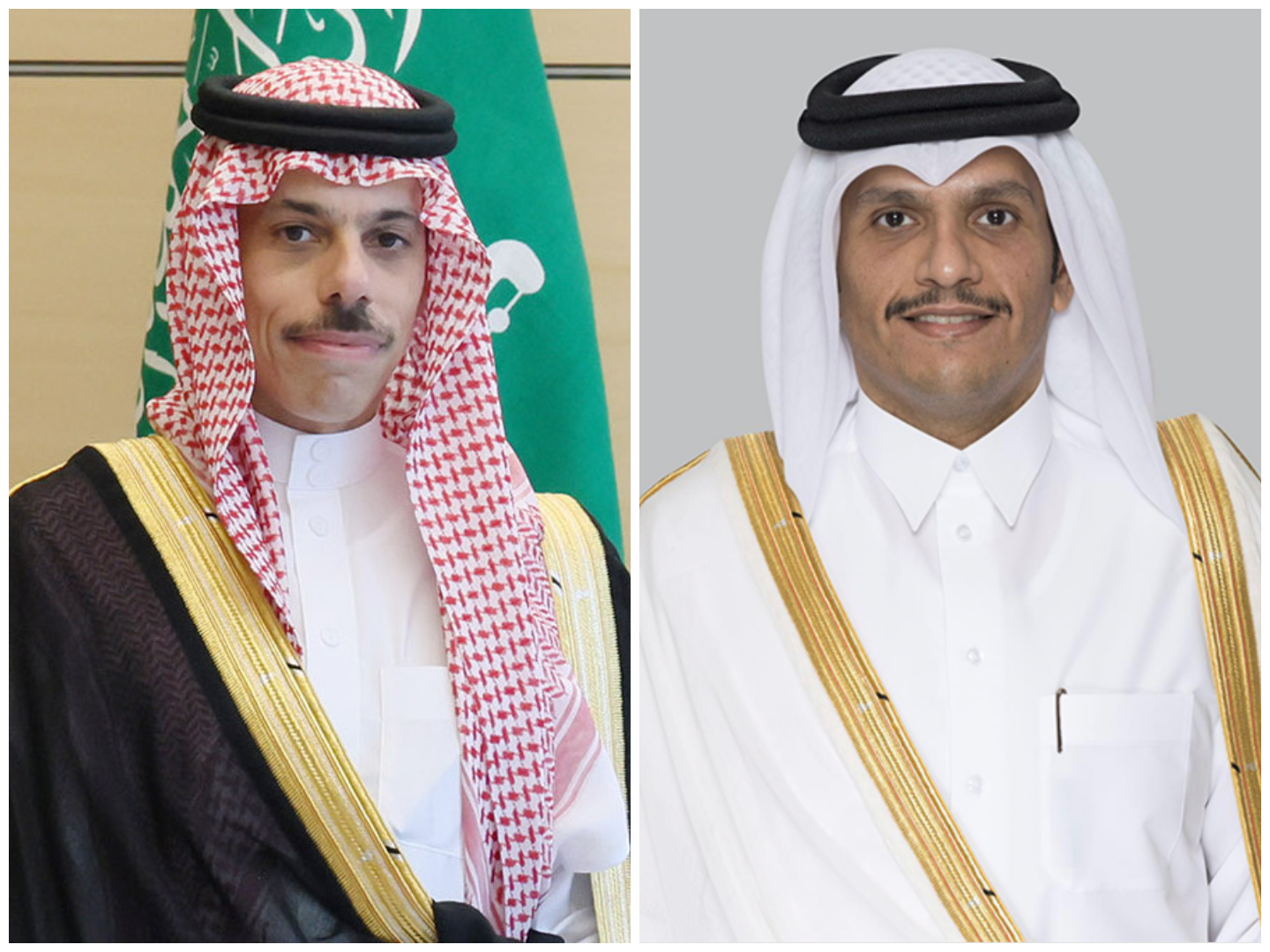
Qatari Prime Minister and Foreign Minister Sheikh Mohammed bin Abdulrahman Al-Thani expressed his country’s condemnation of the attacks during a call with Saudi Foreign Minister Prince Faisal bin Farhan, the Saudi Press Agency reported.
The two officials also discussed the latest regional developments and diplomatic efforts by Saudi Arabia and Qatar to de-escalate tensions and preserve regional security and stability, SPA said.
The call came as the Iran-backed Houthis targeted civilian and economic sites in the southern cities of Abha, Khamis Mushait, Jazan and Najran, injuring 73 civilians, including women and children.
Operations at some energy facilities were temporarily halted.
The Saudi-led coalition described the attacks as a “dangerous escalation” and said it would take measures to protect the Kingdom’s sovereignty, civilians and national assets.
Qatar’s Foreign Ministry separately condemned the attacks on Tuesday as a “dangerous escalation” and a violation of Saudi sovereignty and international law.
Doha reaffirmed its “full solidarity” with the Kingdom and its support for measures taken to protect its sovereignty, security and territorial integrity, adding that Saudi security was an integral part of the collective security of Gulf Cooperation Council states.
It also called on the international community to take a firm position against the attacks and ensure the implementation of relevant UN Security Council resolutions concerning Yemen and the security of navigation in the Red Sea.
Fighting between the Houthis and forces aligned with Yemen’s internationally recognized government has intensified in recent weeks, raising fears of a return to wider conflict after a UN-brokered truce in 2022 largely halted years of fighting between the Houthis and the Saudi-led coalition.
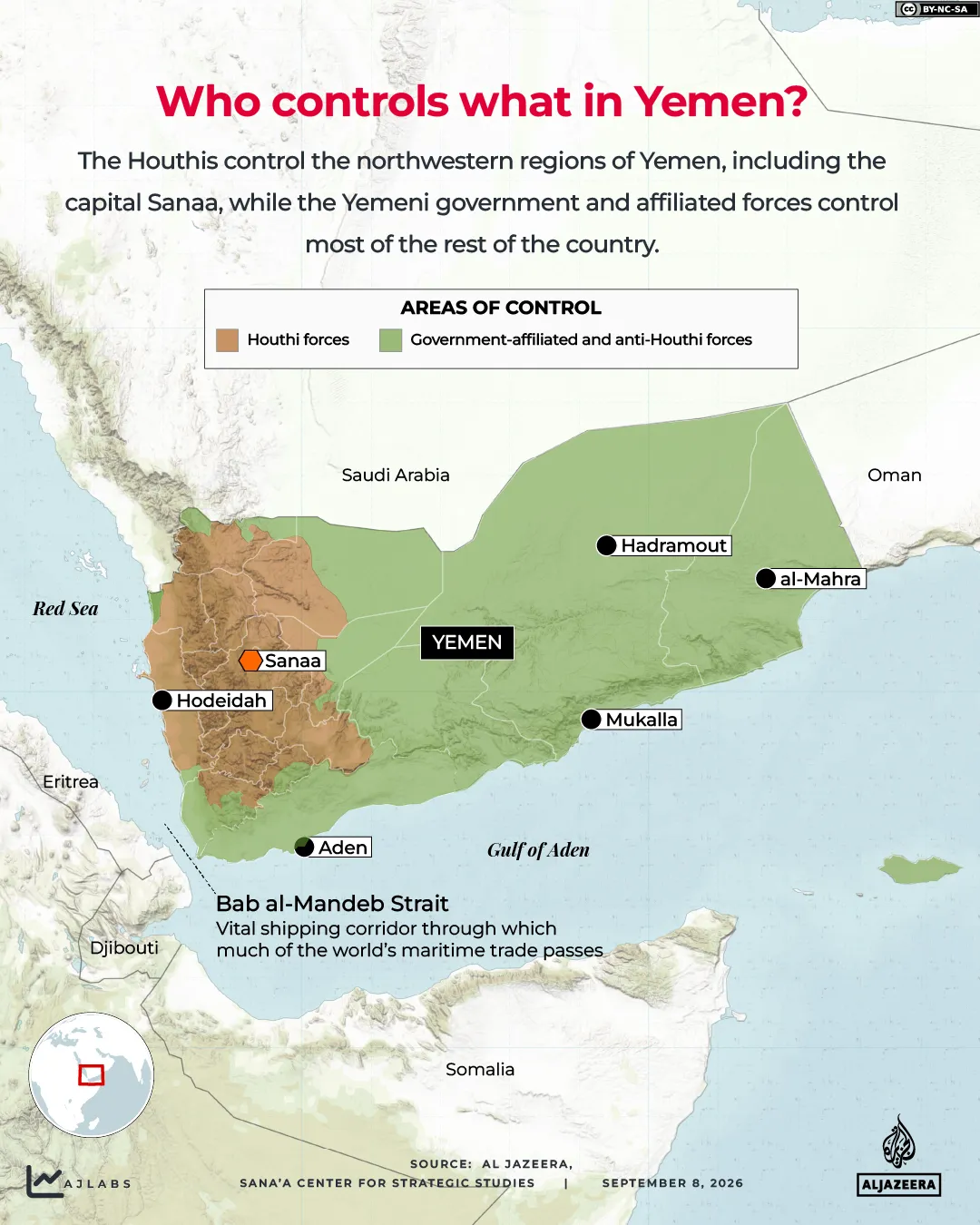
The Houthis, who control Sanaa and much of northern Yemen, declared a naval blockade against Saudi Arabia in July and have since stepped up attacks on the Kingdom and vessels in the Red Sea. Saudi-backed Yemeni government forces have meanwhile launched an offensive on several fronts against Houthi-held areas.
Nature itself seems to resist it. No two leaves are exactly alike, no two fingerprints are identical, and even no two sunsets unfold in precisely the same way, nor does the sky ever paint itself twice in quite the same colors.
The same is true of siblings who grow up beneath the same roof, gather around the same table and receive the same upbringing. They still differ in temperament, in the way they think, in how they respond to the world and even in the dreams they choose to follow. It is as though difference is not an exception to the order of life, but one of its most enduring laws.
And yet, we spend so much of our lives searching for a single formula that will work for everyone: one approach to raising every child, one method for teaching every student, one key to every relationship and one way of leading every team.
We often forget that human beings do not come with instruction manuals. There is no guide explaining how to understand a person, what moves them, what holds them back, or how best to reach them.
A human being has never been an equation whose results can simply be repeated. This may be why dealing with people tests our humility more than almost anything else. It asks us to accept that we will never understand everything; that what pleases one person may unsettle another; that the same words may comfort one heart and wound another; and that silence may feel like respect to one person, yet like neglect for someone else.
Perhaps this is what makes leadership one of the most complex of human experiences. Plans can be revised; processes can be improved; goals can be measured. People, however, cannot be understood through ready-made templates or managed by a single manual.
For all the leadership theories, studies and practices we have accumulated, one truth remains both simple and profound: a human being is always too complex to be reduced to a formula or an equation.
One of the greatest mistakes a leader can make is to use the self as the measure of everyone else: to assume that what motivates us will motivate them, that what convinces us will convince them and that what seems clear to us must surely be clear to everyone around us.
But people rarely work that way.
The leaders who leave the deepest mark are often those who learn to adapt to the differences between people without compromising their principles or lowering their standards. And once we understand this, we begin to understand something else: influence does not begin with changing people. It begins with understanding them.
Perhaps, then,the deeper lesson of leadership is not how to manage others, but how to master ourselves and learn to understand them.
It teaches us patience before judgment, listening before offering solutions, and the humility to set aside our assumptions long enough for another person to reveal who they truly are. Each new personality challenges an old belief. Each encounter reminds us, in a different way, that life was never meant to be navigated by a single formula.
For all the leadership theories, studies and practices we have accumulated, one truth remains both simple and profound: a human being is always too complex to be reduced to a formula or an equation.
That is why leadership, at its core, is an inner journey, one shaped by self-mastery, understanding, and the willingness to accept people as they are.
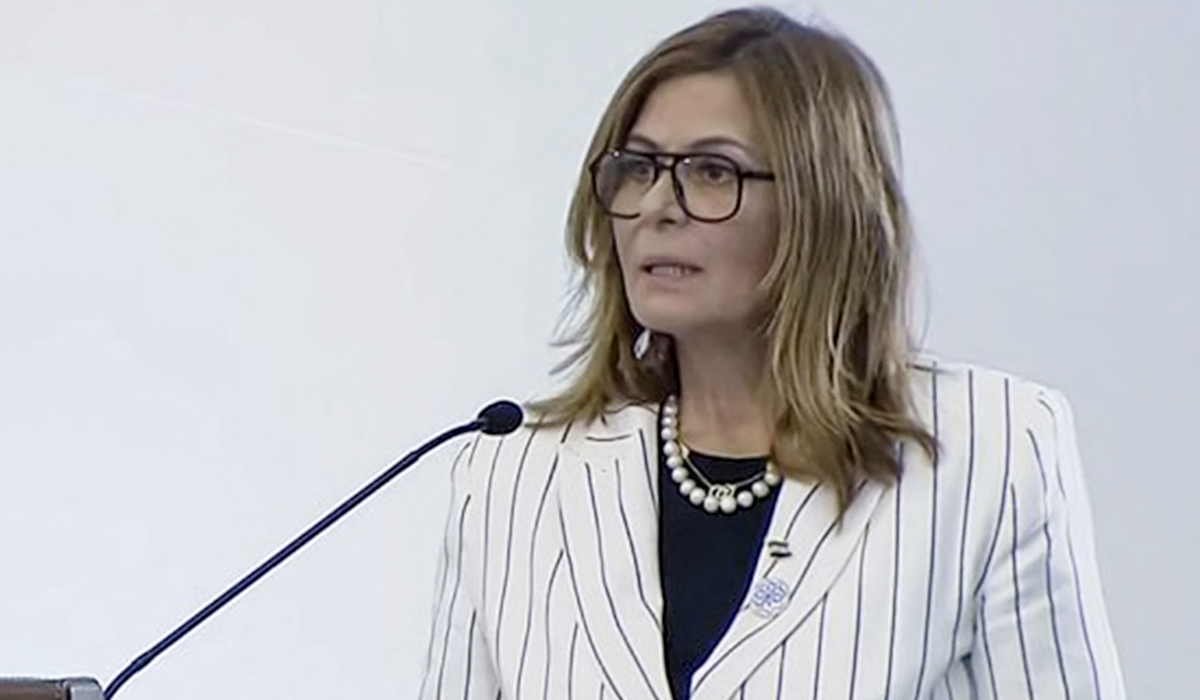
• Asma Al-Janahi is a UAE national with more than 10 years’ management experience in government excellence and the sports sector. She writes about management and social life.
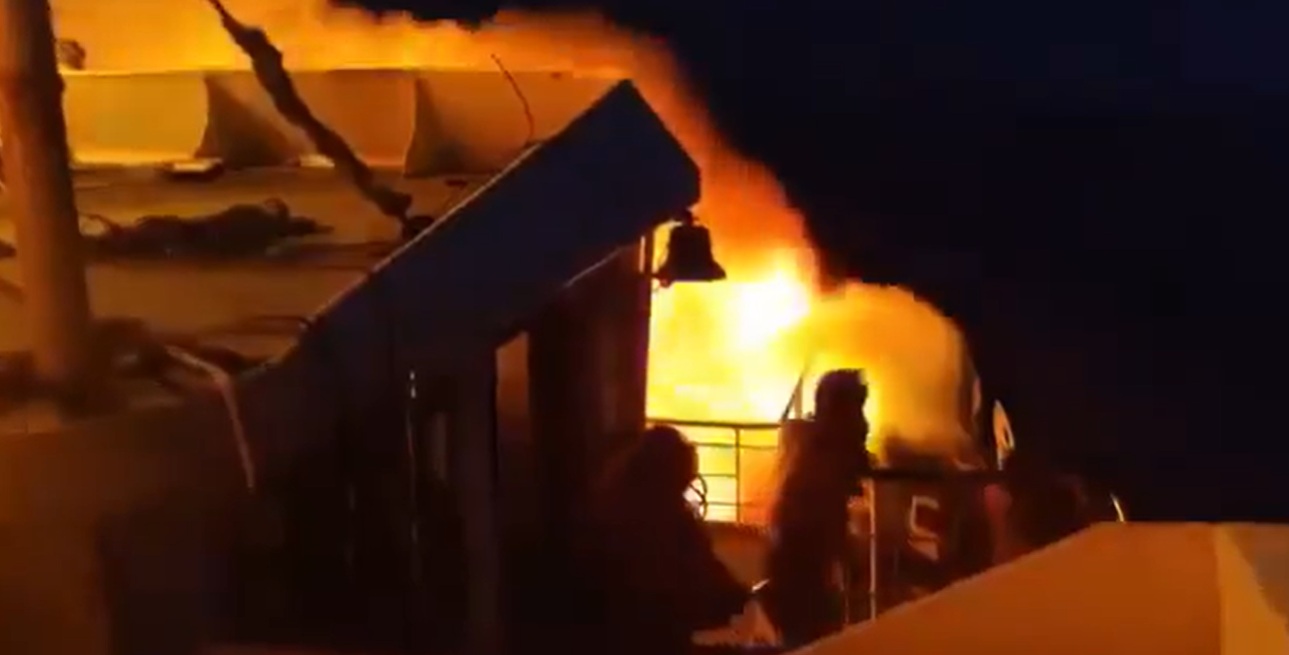
MANILA: A fire broke out Wednesday evening aboard a vessel carrying over 100 passengers near a tourist hotspot in the Philippine province of Palawan, leaving at least five people dead, local media and the coast guard said.
“The Philippine Coast Guard (PCG) immediately responded to a fire incident involving M/V June Aster at the vicinity waters approximately 1.2 nautical miles northeast of Barangay Marcilla,” in the Coron municipality, the service said late Wednesday on Facebook.
Video shared by the coast guard showed the vessel completely engulfed in flames.
Another post over two hours later said “five casualties were initially reported” and brought ashore, with accompanying photos showing several body bags.
The post said 42 people had been rescued, while GMA News reported the ship had been carrying 117 passengers and 17 crew, citing a coast guard official.
Tracking data from MarineTraffic showed the June Aster had departed from Manila.
RIYADH: TikTok has taken down 15,519,240 videos across Egypt, Saudi Arabia, the UAE, Oman, Iraq, Morocco, Lebanon and Sudan during the first quarter for Community Guidelines violations.
The move reflects the scale of the platform’s enforcement efforts and its focus on maintaining safety and accountability across the Middle East and North Africa region, a statement said.
As part of its broader efforts to promote age-appropriate and “authentic experiences” on the platform, TikTok removed 86,288,705 fake accounts and 25,764,372 accounts suspected of belonging to users under the age of 13 globally during the first quarter of 2026.
“These actions reflect the scale of TikTok’s efforts to identify and remove accounts that may not meet its platform requirements, while strengthening safeguards for younger members of its community,” TikTok said.
“Through a combination of automated detection, account-level enforcement, and human review, TikTok continues to reinforce the systems designed to support a safer and more age-appropriate experience.”
Globally, the platform suspended more than 50 million LIVE sessions from January to March, an 18.6 percent increase from the previous quarter. A further 58 million sessions were subject to demonetization or warnings, while 21,966,667 LIVE creators were also demonetized or warned.
Across the eight MENA markets, TikTok said it proactively interrupted millions of livestreams and banned hundreds of thousands of LIVE hosts for violating its guidelines.
In Saudi Arabia, TikTok removed 2,811,302 videos in Q1 2026, with a proactive removal rate of 98.2 percent and 92.8 percent of violative content taken down within 24 hours of being reported. The platform restored 150,916 videos following successful appeals, and also banned 48,106 LIVE hosts while interrupting 371,758 livestreams.
Iraq recorded the highest removal volume in the region. TikTok removed 5,253,566 videos that violated its Community Guidelines during the quarter, with a proactive removal rate of 99.4 percent and 95 percent of violative videos taken down within 24 hours of being reported.
British Foreign Secretary Ed Miliband has said the United Kingdom will sanction illegal Israeli settlements in the occupied West Bank, describing the move as “overdue” and necessary to “salvage” a two-state solution to the Israeli-Palestinian conflict.
He made the comments on Tuesday as 11 nations joined the UK in supporting or considering curbs on trade in goods with settlements that are a barrier to a future Palestinian state.
Recommended Stories
list of 3 itemsend of list
But analysts say the step is far from enough to drive momentum for Palestinian statehood, threatened by ever-expanding settlements in the West Bank and an increasingly hostile Israeli political environment.
Tahani Mustafa, a lecturer in international relations at King’s College London, told Al Jazeera the latest anti-settlement measures are “modest” and unlikely to have a significant impact on ambitions for Palestinian statehood.
“After three decades of breakneck settlement expansion, Palestinian territory is only being held together by its sinews,” said Mustafa. “If what remains is still territorially viable as a state, it is only barely so. Much more decisive action is needed to salvage the two-state solution and a durable lasting solution to the conflict.”
Settlements dividing Palestinian territory
More than 30 years after the Oslo Accords set out a negotiating process aimed at resolving the Israeli-Palestinian conflict, the creation of a Palestinian state alongside Israel has remained the foundation of international efforts to forge peace.
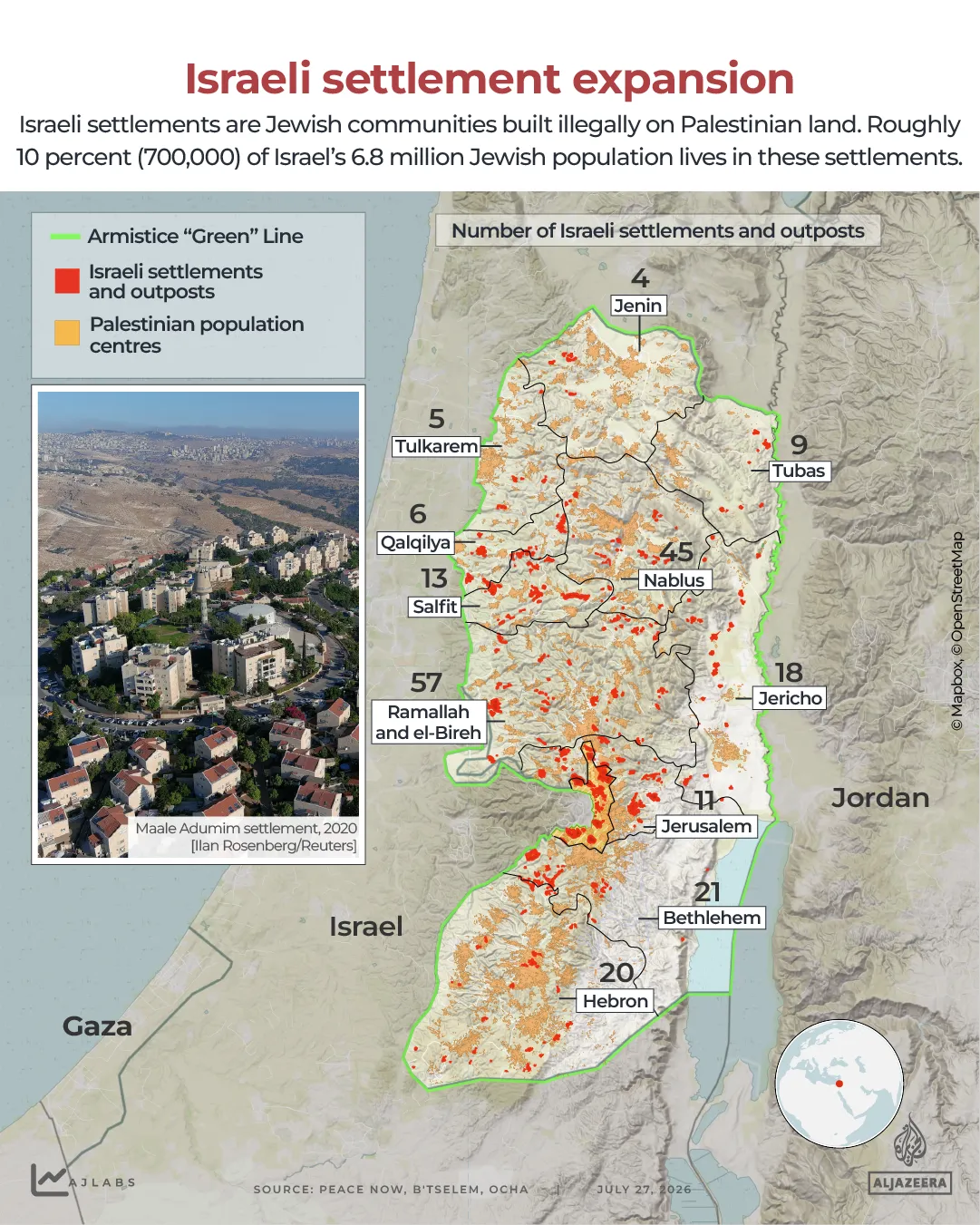
But since the Oslo process began in 1993, the number of Israeli settlers in the West Bank, including occupied East Jerusalem, has ballooned from about 260,000 to more than 700,000, according to the Palestinian Bureau of Statistics, posing a glaring roadblock to the plan.
The challenge is not just the raw number of settlers, but their geographic spread. Today, many Israeli settlements are embedded deep inside West Bank areas that would be needed for a contiguous Palestinian state, including near major Palestinian urban centres such as Nablus, Salfit and Hebron.
Israel’s recent E1 settlement plan, which would build thousands of illegal housing units between the Israeli settlement of Maale Adumim and East Jerusalem, is a case in point. The plan would effectively split the West Bank in two and fully sever it from East Jerusalem, which Palestinians seek as their future capital.
(Al Jazeera)
Experts have long said Israel will need to dismantle some of its West Bank settlements, as it did in the Gaza Strip in 2005, to make room for a cohesive Palestinian state. But many Israeli settlements, especially those closer to Israel’s pre-war 1967 borders, would likely need to be addressed through land swaps.
“A complete withdrawal from some of the deeply embedded settlements is highly unlikely,” so land swaps would be the only way to create some form of Palestinian “territorial integrity”, Andreas Krieg, associate professor at King’s College London, told Al Jazeera.
However, such an arrangement – under which Israeli settlements close to the pre-1967 borders would become part of Israel and some “northern Arab-Israeli communities would be integrated into a Palestinian state” – would be “highly controversial” and face blowback from multiple communities, said Krieg.
He argued that Israelis would be certain to oppose any forced withdrawal from West Bank settlements, while some “Arab-Israelis may not want to live within a Palestinian state”.
Palestinian citizens of Israel make up approximately 21 percent of Israel’s overall population but are treated as second- or third-class citizens at the institutional level. According to rights groups, several dozen Israeli laws actively discriminate against Palestinian citizens across a number of issues, including education and housing.
Israeli ‘consensus’ against Palestinian state
Beyond the physical obstacle created by settlements is the Israeli political landscape, in which the idea of a Palestinian state has become toxic.
The government of Prime Minister Benjamin Netanyahu appears to be among the most hardline in Israel’s history on the issue. Netanyahu has emphatically ruled out the prospect of a Palestinian state, while his far-right Finance Minister Bezalel Smotrich, who also oversees Israeli settlements in the West Bank, has celebrated blocking Palestinian statehood as a badge of honour.
Israeli Finance Minister Bezalel Smotrich meets with families during the inauguration of the new Israeli outpost settlement of Mitzpe Makada near the Palestinian village of Dura in the West Bank, August 31 [Abir Sultan/EPA]
The views of Netanyahu’s most influential domestic critics do not deviate much. His top rival in elections slated for October, former military chief Gadi Eisenkot, has promised not to allow the establishment of a Palestinian state. And Naftali Bennett, a Netanyahu rival from the far right, fervently opposes Palestinian statehood.
As for the Israeli public, a June poll by the Council for a Secure America found that only 22 percent of Jewish Israelis favour a two-state solution, while 63 percent oppose it.
“The consensus within Israel, socially and politically, does not allow for any party to make any steps towards a Palestinian state,” said Krieg.
Meanwhile, Israel’s closest ally, the United States, is unlikely to apply significant pressure over Israel’s settlement policy so long as President Donald Trump remains in office for the next two and a half years, he added.
Krieg said a “best-case scenario” is for Israel’s next elected government to reverse some of the country’s recent settlement advances.
John Strawson, professor at the University of East London, said that any new Israeli government is “unlikely to support a Palestinian state”, but that a more moderate Israeli government may at least “stop the ethnic cleansing and other moves which are aimed at making that impossible”.
“Removing Netanyahu is the first step towards a two-state solution,” said Strawson.
Two states are the ‘only alternative to violence’
If the two-state model is still alive at all, it is largely due to pressure from the international community.
More than 150 countries, including the majority of European Union nations, have recognised Palestinian statehood. And several Arab states with whom Israel seeks better ties have indicated Palestinian statehood is a precondition for normalisation with Israel.
Krieg said Tuesday’s move by the UK and the 11 other mostly European nations is an “overdue step in the right direction”, but also “shows the laziness and lack of creativity on the part of the international community to actually think outside the box in terms of a two-state solution”.
Anders Persson, a political scientist specialising in the Israeli-Palestinian conflict, said that while the settlement sanctions are concerning to Israel, other previous anti-settlement measures, such as 2013 EU restrictions on funds for Israeli entities operating in occupied Palestinian territory, “changed little on the ground”.
He said the latest sanctions may be “too late” and “too limited … to save the two-state solution”.
Strawson said that while a two-state solution may “seem optimistic”, it is the only alternative to “permanent war and violence”.
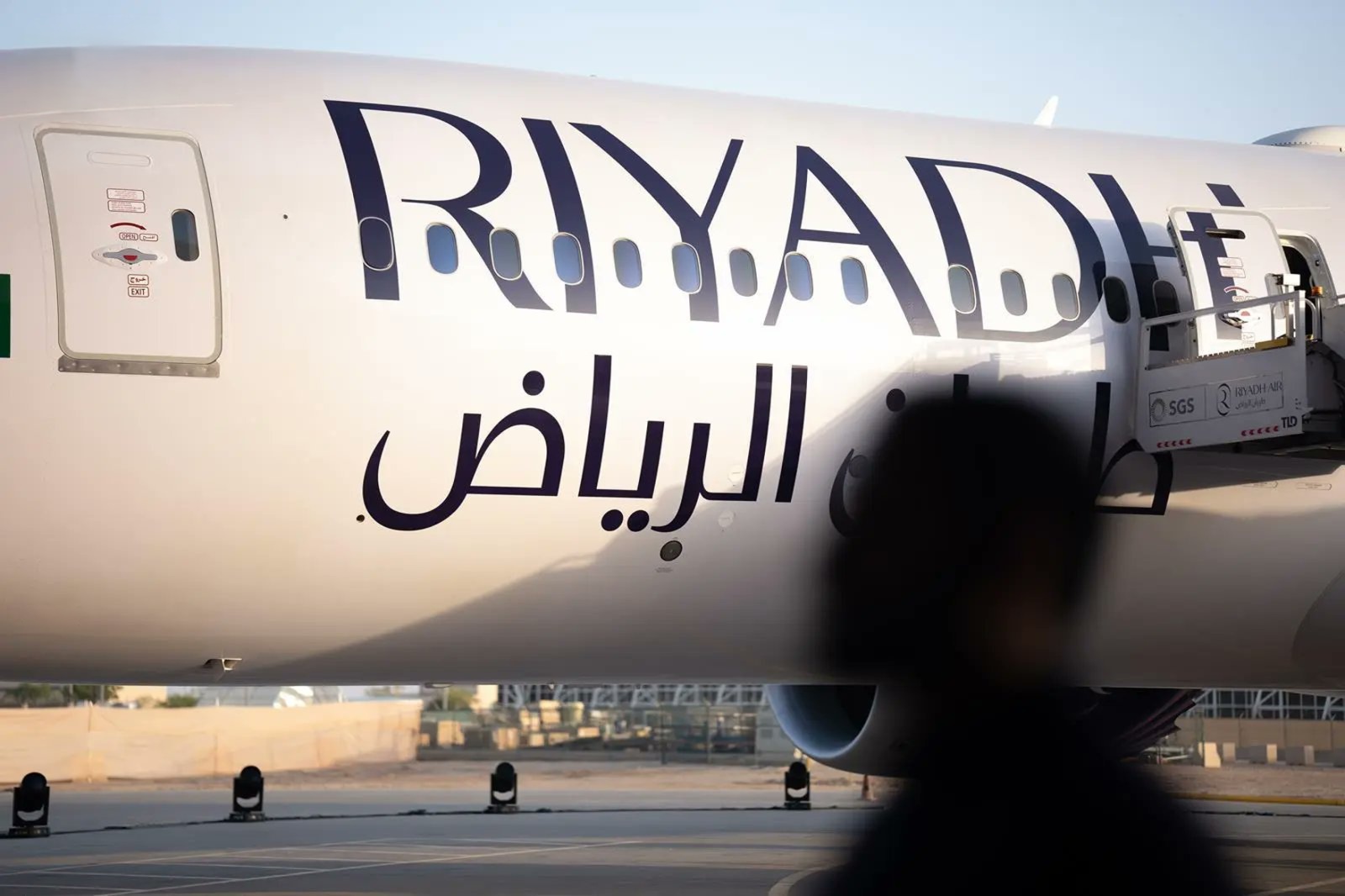
MANILA: Saudi Arabia’s new national carrier Riyadh Air launched its first flight to Manila on Wednesday, marking the latest addition to its growing network of global destinations.
Riyadh Air operated a 290-seat Boeing 787-9 Dreamliner aircraft for the route between the Saudi and Philippine capital, with its arrival at the Ninoy Aquino International Airport around 3:55 p.m. marking the first operation of the service.
“The new … service adds another option for passengers traveling between the Philippines and Saudi Arabia, and another international carrier to NAIA’s growing network. Welcome to Manila, Riyadh Air!” NAIA said in a statement announcing the Riyadh Air service.
There are more than 910,000 Filipinos living and working in Saudi Arabia, as the Kingdom hosts the biggest number of overseas Filipino workers and was their top destination in 2024, according to Philippine government data.
In that year alone, almost 22 percent of Filipinos, or more than 480,000, who sought work abroad chose the Kingdom, driven in part by the Saudi Vision 2030 economic diversification program.
Saudi tourists are also one of the Philippines’ fastest-growing and highest-value markets, according to the Philippine Department of Tourism, with tourism receipts reaching over $37 million in 2024, a 46-percent rise from the previous year.
The Saudi carrier has swiftly expanded its air links with Asia with the launch of multiple flights across the region in recent months, including to Malaysia, Pakistan, India and Thailand.
Riyadh Air’s Manila route followed the airline’s launch of its Bangkok service last week, with Thailand eyeing more high-value tourism from the Middle East.
The Tourism Authority of Thailand is expecting about 600,000 travelers from the Middle East this year, after recording about 210,000 arrivals in the first half of 2026.
It shows similar trends across Asia, where popular holiday destinations are increasingly targeting tourists from the Middle East as part of their tourism growth strategy.
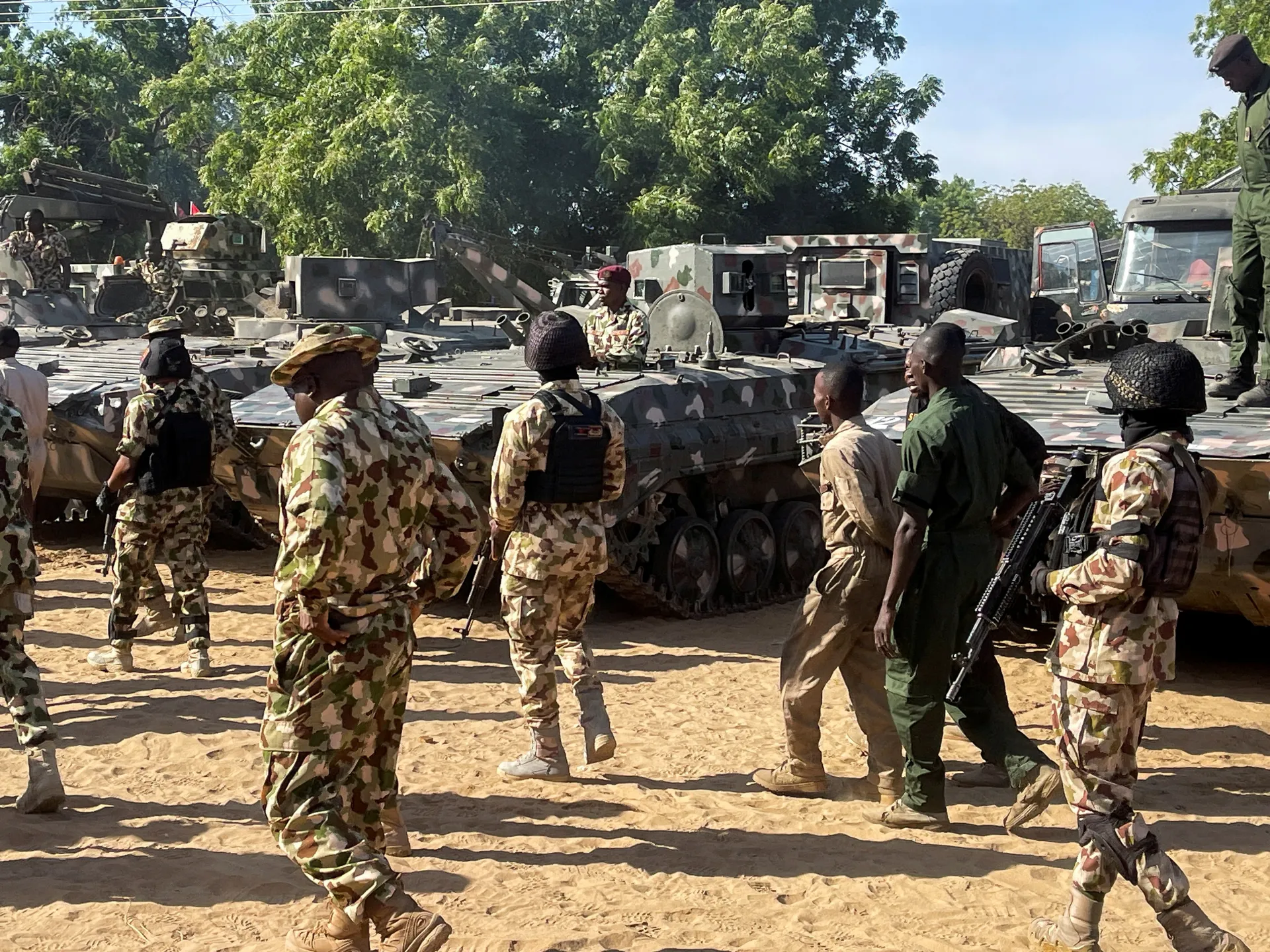
The reported truce follows the release of 360 villagers abducted during a Boko Haram attack in northeastern Nigeria.
Published On 9 Sep 20269 Sep 2026
The Nigerian government has been involved in a secret ceasefire with Boko Haram for the past three months, according to an investigation by The New Humanitarian, in a development that could mark a rare pause in years of fighting in northeastern Nigeria.
The reported truce began in June after negotiations that secured the release of 360 civilians abducted from Ngoshe village, in the foothills of the Mandara Mountains near Nigeria’s border with Cameroon, The New Humanitarian reported.
Three people with contacts among Boko Haram members, including some senior figures, independently told the organisation that the ceasefire had been in effect since June and was likely to be extended for another 40 days.
Two of the sources said attacks had stopped in communities around Ngoshe, which have repeatedly been targeted by the armed group.
Truce followed mass abduction
The 360 villagers were abducted in March during a Boko Haram attack on a nearby army base, according to The New Humanitarian.
The negotiations that led to their release reportedly included a payment of five billion naira ($3.7m) by the Nigerian government.
The alleged payment has become controversial in Nigeria, with the government denying that it paid a ransom.
The New Humanitarian said it contacted government, defence and army spokespeople to verify the reported ceasefire but received no response before publication.
Al Jazeera has not been able to independently verify the reported ceasefire or the alleged payment.
The reported agreement does not include Islamic State West Africa Province (ISWAP), a rival armed group that operates in northeastern Nigeria and the wider Lake Chad region.
Fighting between Boko Haram and ISWAP has continued, according to The New Humanitarian.
Government publicly rejects talks
The reported ceasefire comes despite the Nigerian government’s public rejection of negotiations with Boko Haram, which is designated as a “terrorist organisation” by the Nigerian authorities.
President Bola Tinubu has instead focused on expanding the military’s capacity to fight armed groups. In July, he announced plans to recruit 30,000 additional personnel and create four new army divisions.
Behind the scenes, however, there have been repeated attempts to establish dialogue with Boko Haram, according to The New Humanitarian, citing security officials, diplomats and mediators familiar with previous efforts.
Those efforts have included ceasefire arrangements that eventually collapsed.
Conflict researcher Malik Samuel told The New Humanitarian that the latest reported agreement should not necessarily be interpreted as the beginning of a lasting peace process.
“It could be just a temporary, tactical ceasefire that benefits both sides, but doesn’t really affect the trajectory of the war,” Samuel said.
The current arrangement could also allow Boko Haram to strengthen its position, with two sources warning that the group could use the pause to move equipment into the Mandara Mountains, The New Humanitarian reported.
Boko Haram has carried out attacks and kidnappings in northeastern Nigeria and neighbouring countries around the Lake Chad region since 2009. The group has since fractured into several factions, while ISWAP operates as a separate and rival armed group.
The United States Republican Party – and its talisman President Donald Trump – is descending on Dallas, Texas, to host a rare convention before the midterm elections in November.
Usually reserved for presidential election cycles, Trump’s call to hold the high-cost event before the November 3 midterm vote has underscored both the president’s unorthodox campaign style and the urgency of the political moment for his Republican Party.
Recommended Stories
list of 3 itemsend of list
Trump’s approval rating has tanked in the lead-up to the midterm vote, with polls pointing to a panoply of factors, most notably the US-Israel war on Iran and its knock-on economic effects for US consumers.
The lack of enthusiasm threatens what are already considered long-shot odds in the Republicans’ effort to hold on to control of the House of Representatives. Shifting public opinion has also put control of the Senate increasingly in play, although Democrats still face an uphill battle to pull off an upset.
A loss of control in either chamber would serve as a major check on Trump’s authority in the final two years of his second term.
But not all Republicans have bought into Trump and the party’s claims that the convention will spur voter turnout.
Several, particularly those in the tightest races, have kept the event at arm’s length amid concerns that associating with the president could only further mobilise his detractors.
Here’s what to know:
When and where is the Republican midterm convention?
The convention will be hosted at the American Airlines Center in Dallas, Texas, on Wednesday, September 9 and Thursday, September 10.
The event is expected to run from 3pm to 9pm Central Time (20:00 to 02:00 GMT) on both days.
Trump is scheduled to speak on both nights, including a Wednesday address and the convention’s closing keynote on Thursday from 8pm to 9pm Central Time (01:00 to 02:00 GMT on Friday).
US Vice President JD Vance will close out night one with a speech.
A person takes pictures of signage during preparation for the Republican National Committee (RNC) Midterm Convention at the American Airlines Center on September 7, 2026 in Dallas, Texas [Brandon Bell/Getty Images via AFP]
Is this a typical political convention?
Not at all.
The Republican National Committee (RNC), the party’s official organising body, has billed the Dallas midterm convention as a “first in American political history”.
Both Democratic and Republican national conventions have historically capped the primary season before a presidential election. The emphasis has historically been on the presidential nomination process during the largely ceremonial events.
During those conventions, so-called “delegates” from every state pledge their votes for a candidate based on the primary election outcome from their home state.
A candidate who secures the required majority of delegates formally becomes the party’s presidential nominee at the convention.
Parties also typically hold several smaller meetings surrounding the event to establish and release the party’s official platform.
Why are Republicans holding a midterm convention in 2026?
To start with, there will be no nominating process – presidential or otherwise – during the event, as there is no presidential election in 2026.
Instead, the convention has taken the shape of a supercharged campaign rally and fundraiser.
It has been pitched as an opportunity to introduce candidates in punishing races to potential donors and to give a clear, if Trump-dominated, party message as the races enter their final stretch.
The RNC has promised “a primetime showcase for President Trump’s success, candidates, and causes that have propelled the 2026 midterms to unprecedented focus”.
What’s on the schedule?
There will be quite a lot. The official programme lists “53 items and speakers” on night one, followed by 56 more on night two.
The first night will focus on issues including tax cuts, healthcare affordability, immigration, border policy, trade and domestic manufacturing.
The second night will focus more on affordability and families, including policies related to taxes on tips, overtime and Social Security.
The subject areas hew closely to Trump’s wider political messaging.
The official programme gives relatively little attention to several other subjects. The US-Israel war with Iran and Trump’s aggressive tariff policy receive scant mention.
Who else is speaking?
Trump and Vance are the convention’s marquee speakers, but an array of prominent Republicans and candidates are expected to feature across the two-day programme.
Texas Attorney General Ken Paxton is likely to get a healthy amount of stage time. Paxton is running for Senate against Democrat James Talarico, whose early lead in polling has raised alarm bells for Republicans. A Democrat has not won statewide office in Texas since 1994.
“We’re going to have a lot of speakers, and the ones we want to focus on will be obviously Ken Paxton,” Trump told reporters last week. “We gotta get him elected.”
The race is particularly personal for Trump, who endorsed MAGA-aligned Paxton over Republican Senator John Cornyn, a four-term incumbent seen by many as the surest challenger for Talarico.
Will Trump’s convention help Republicans in the midterms?
It remains to be seen whether the convention will help to turn out voters in a meaningful way.
Trump has proven a canny campaigner in the past, leveraging his eye for television spectacle to build support and turn out low-propensity voters. But several factors could limit the impact.
Trump’s Thursday night speech conflicts with the opening games of the National Football League (NFL) season. The event also runs up against several memorial events for the September 11, 2001 attacks throughout the week.
Some Republican officials have also reportedly criticised the hasty announcement of the event, which Trump called for in late June, raising questions over whether organisers will indeed be able to achieve the spectacle envisioned.
For his part, Trump enters the convention with his approval rating continuing to tank, hovering at a 38 percent average in major polls. Several of the most recent polls, including a Reuters-Ipsos poll and a Financial Times-Focaldata poll conducted in late August, reflected only a 33 percent approval.
Trump entered office in January 2025 sitting at about 52 percent approval.
Why are some Republicans skipping?
To be sure, several Republicans in key races have said they will attend the convention.
They include former Congressman Mike Rogers, who is running against Democrat Abdul El-Sayed for an open Senate seat in Michigan; Ohio Senator Jon Husted, who is facing an unnerving challenge from former Democratic Senator Sherrod Brown; and Georgia Congressman Mike Collins, who is seeking to unseat Democratic Senator Jon Ossoff.
Others have been wary.
Trump’s policies in his second term have cast a long shadow, leaving many candidates calculating whether attendance could backfire and instead energise voters opposed to Trump.
Democratic primary turnout in several key states – including Michigan, Wisconsin, Texas and Georgia – has soared this year, while Republican turnout has remained steady but unextraordinary, as reported by The Associated Press news agency. That has been a worrying sign for Republicans.
Maine Senator Susan Collins, a Republican incumbent seen as vulnerable in her race against Democrat Troy Jackson, has been among those who have said they will not attend.
Several candidates in key House races have pointed to prior commitments.
Representative Mariannette Miller-Meeks told The Bulwark she preferred to spend her time in her home district in Iowa, where she faces a challenge from Democrat Christina Bohannan.
“Because I have a district that I have to be in and take care of, so I’ll be in my district,” she explained about her decision.
Miller-Meeks eked out a victory over Bohannan in 2024, winning by a margin of just 0.1 percent.
Are Democrats countering?
Several left-leaning groups are organising protests.
House Democratic leader Hakeem Jeffries has announced that four Democratic lawmakers will travel to Dallas for counterprogramming during the Republican convention.
However, the cash-strapped Democratic National Committee (DNC) has avoided holding its own midterm convention.
The committee went into debt in the wake of the 2024 presidential election, even putting up its Washington, DC-based headquarters as collateral for a $15m loan, the NOTUS news site reported in July.
The RNC has not yet released a final price tag for its convention.
Yemen’s more than a decade-long civil war has flared up once again after the Houthi rebel group launched an offensive in several locations against Saudi Arabian-backed government forces. The conflict has already spilled over beyond the country’s borders with the Houthis launching an attack on southern Saudi Arabia, targeting oil facilities and wounding dozens of people this week.
The renewed hostilities are the most serious since a United Nations-brokered truce halted large-scale fighting in 2022, after eight years of a full-blown conflict that killed tens of thousands of people in one of the world’s poorest countries.
Recommended Stories
list of 3 itemsend of list
So who is involved in this conflict? Here’s a look at the main actors:
The Houthis
The Houthis, also known as Ansar Allah (supporters of God), are an armed group controlling most parts of Yemen, including the capital, Sanaa, and some of the western and northern areas close to Saudi Arabia.
The Houthis emerged in the 1990s but rose to international prominence in 2014, when the group rebelled against Yemen’s government, forcing it to step down and causing a crippling humanitarian crisis.
The group then spent years, with Iran’s backing, fighting a military coalition led by Saudi Arabia. The two warring sides have also repeatedly tried to hold peace talks.
Seen as part of a regional alliance known as the “axis of resistance” backed by Iran, the Shia Zaidi group nevertheless has its own base, its own interests – and its own ambitions.
The Houthis have demonstrated their missile and drone capabilities during the Yemen war in attacks on Saudi Arabia and the United Arab Emirates, targeting oil installations and vital infrastructure. They have also proven resilient, defying more than 10 years of bombing by the Saudi-led coalition, as well as US and British strikes in recent years.
The group has gained international prominence for its attacks on Israel and shipping in the Red Sea since the start of Israel’s genocide in Gaza in October 2023.
Saudi Arabia
Riyadh entered the Yemen war when it led a military coalition against the Houthis in March 2015, seeking to restore the government of then-President Abd-Rabbu Mansour Hadi. Back then, Saudi Arabia and Iran were at the peak of a regional competition, both deeply distrusting each other. An Iran-supported group expanding control at the kingdom’s southern border was unacceptable, hence the military action.
This was before a China-brokered rapprochement between Saudi Arabia and Iran in 2023 marked the beginning of a more practical and less confrontational relationship.
Presidential Leadership Council
The PLC was established in 2022 when the former president, Abd-Rabbu Mansour Hadi, formally transferred his powers to the new eight-member body.
It represents the internationally recognised government of Yemen, with a mandate to manage the country’s political, security and military affairs, and to steer negotiations towards a permanent ceasefire. It is chaired by Rashad al-Alimi, an adviser to Hadi and former interior minister with the government of the late president, Ali Abdullah Saleh.
The PLC is backed by Saudi Arabia and the alliance that Riyadh leads.
Islah party
The Yemeni Congregation for Reform, better known as Islah, is a Sunni Islamist movement with historic ties to the Muslim Brotherhood. It is a faction within the recognised PLC-led government but has long had an independent identity. Its major stronghold has long been Marib, the country’s sole gas-producing region with one of its largest oilfields.
National Resistance Forces
The National Resistance Forces is a government-aligned military faction led by Tareq Saleh, nephew of the late former President Ali Abdullah Saleh.
The force has maintained ties to Saudi Arabia and, like the Islah party, is part of the PLC. It aims for a unified Yemen, positioning itself as a counterweight to both the Houthis and southern secessionists.
DUBAI: A late-night craving for dessert led Hasan Sarwar to leave investment banking and build Peekabox, a Dubai-founded app that sells fresh unsold food from cafes, bakeries and grocery stores at discounts of 50 to 70 percent.
Sarwar was in a Dubai cafe at about 11 p.m. when he noticed the pastry shelves were still full.
The first brand to sign was Tim Hortons. (Supplied)
“I simply asked them, I said: ‘What do you guys actually do with these items?’ And they said, ‘We make it in the morning, and then throw it the same day,’” he told Arab News. “All of these sort of very high-end pastries are getting thrown every single day.”
He went on to develop the idea, comparing it to Too Good To Go, a model he had used while at university in the UK. “We’ve grown up in Dubai. We know the UAE. We know the F&B space,” he recalled telling his parents.
He started alone. Three months in, he asked his brother Omair to join him as co-founder. “It was way too much work for one person,” Sarwar said.
The first brand to sign was Tim Hortons, part of Dubai’s Apparel Group, after a pitch that ran three months with no app and no demo. “I didn’t leave them alone for three months,” he said. Once the contract was signed, he used the name to bring other brands on, and boxes now come from coffee chains, bakeries, restaurants, grocery stores and hotel buffets.
Customers do not choose what they get. “If you say I have this exact item that you want, people are never going to buy full price,” Sarwar said, describing the surprise box as a way to gamify the purchase without cannibalizing full-price sales. His own highlight came from The Grey, an independent Dubai cafe — a strawberry tart, his favorite dessert, with croissants and pain au chocolat.
Getting there meant fighting the same objection on two fronts. Premium brands worried that discounting would dilute their brand equity, so he pointed them to luxury department store Harrods in London, which runs similar schemes, while customers had to be persuaded the food was fresh rather than left over. Both concerns were successfully countered, he said, pointing to the app’s 45 percent repeat order rate.
Peekabox is now in talks with Ne’ma, the UAE’s national food loss and waste initiative, under the Ministry of Climate Change and Environment.
It plans to open in Riyadh and Jeddah next year with franchise partners that have already committed to the launch. “In terms of Saudi (Arabia) as a market, people are more price sensitive for sure, and also the density of stores is greater,” he said.
Nepal is demanding “climate justice” and $20m in compensation after the recent devastating floods in the country and China’s Tibet region, which led to the deaths and disappearances of thousands of people.
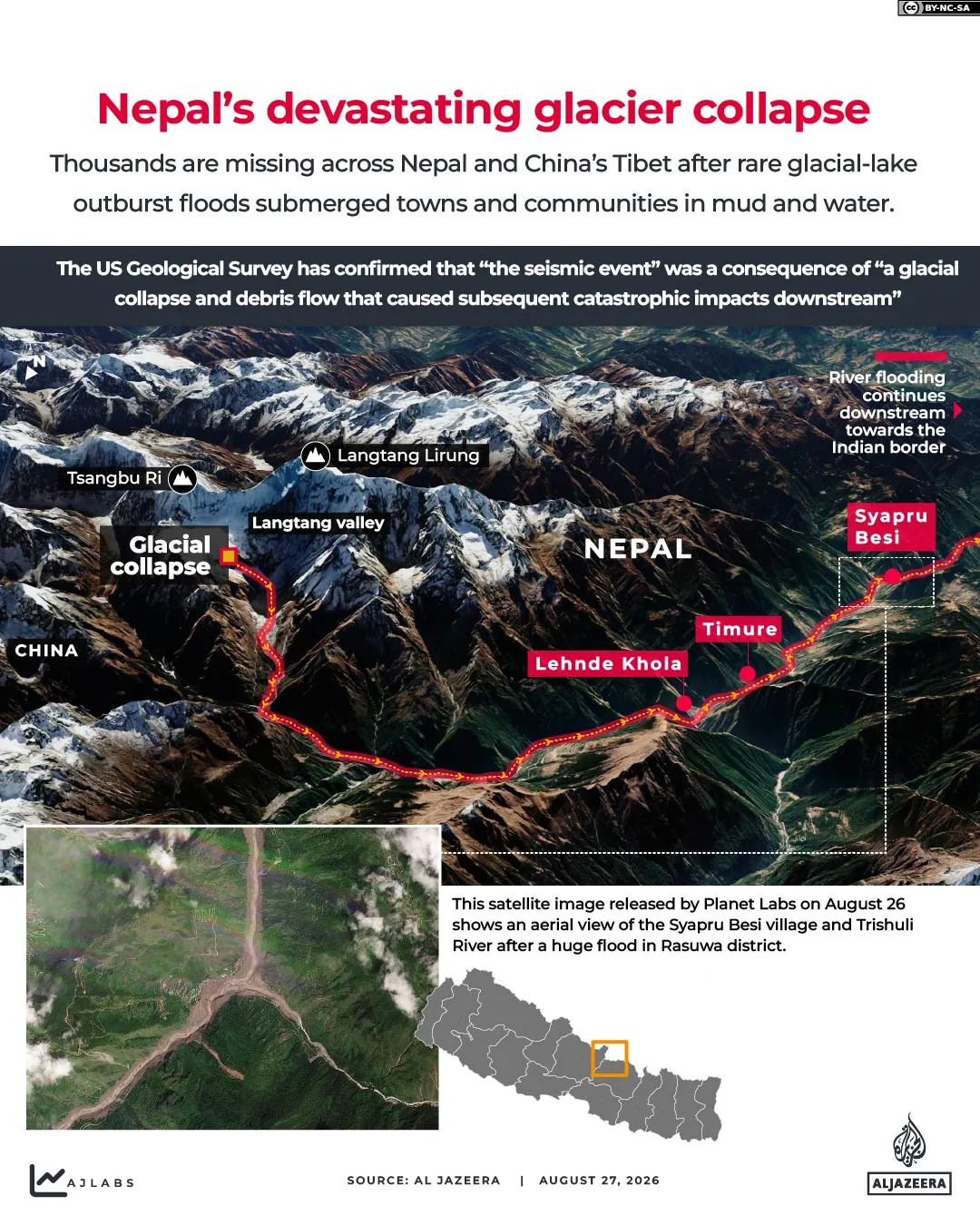
The catastrophe, which scientists say was caused by the effects of climate change, was triggered when part of a mountain glacier collapsed and a torrent of water and mud flooded down into Nepal’s Rasuwa and Nuwakot regions, as well as into China’s Tibet region on August 26. More than 1,300 people have been confirmed dead and more than 5,000 remain missing.
Recommended Stories
list of 3 itemsend of list
“We are paying the ultimate price for a global crisis we did not create,” Nepal’s Foreign Minister Shisir Khanal said last week.
“Support for Nepal should not be seen from an angle of aid or charity, but should be seen from the perspective of climate justice,” he told the AFP news agency.
On Monday, the country’s President Ramchandra Paudel made a similar demand during an address to the nation.
“I make a heartfelt appeal to the international community not only to listen to the voices of ecologically vulnerable countries, including Nepal, but also to take concrete and effective steps to ensure climate justice for them,” he said.
Nepal’s Ministry of Finance and Ministry of Environment have written a joint letter to the United Nations, which set up a fund to respond to loss and damage caused by climate change in 2022 in line with the 2015 Paris Agreement on climate, with a request for $20m in damages.
The UN’s Loss and Damage Fund is, however, facing a $2.8bn funding gap as it prepares to approve its first climate recovery projects.
‘Collective frustration’
Nepal’s leaders may have a point.
Nepal contributes less than 0.1 percent of global greenhouse gas emissions and generates most of its electricity from renewable sources of energy. Yet its geographical location in the Himalayas makes it particularly vulnerable to severe climate and weather events.
Last month’s catastrophic flooding in the country comes against a backdrop of rapid global warming and glacial loss across the Himalayas.
Glaciers across the Hindu Kush Himalaya mountain range – which spans Afghanistan, Bangladesh, Bhutan, China, India, Myanmar, Nepal and Pakistan – lost ice 65 percent faster between 2011 and 2020 than during the previous decade.
Nepal’s glaciers, which are sandwiched between two major carbon emitters – India and China – have lost close to one-third of their ice volume in roughly three decades due to global warming, the United Nations said in 2023.
Tanuja Pandey, a Nepal-based climate activist and lawyer, said there is collective frustration behind Nepal’s demand for climate justice.
“People here feel the world often pays attention to Nepal only when a climate disaster becomes impossible to ignore. It is deeply painful to people here that global attention intensifies when headlines report thousands of people dead or missing and in the end, their suffering does not generate any urgency to fight climate change,” she told Al Jazeera.
Shreya KC, a 28-year-old Nepali climate activist, said there is profound anger and sadness among people in Nepal who say that they must no longer continue to suffer the impact of climate change, which, as they see it, other countries are responsible for.
“My hometown is in Solukhumbu in eastern Nepal,” the activist told Al Jazeera. “It is a district of mountains and is also home to the world’s highest mountain, Mount Everest, and my home is also downstream. After the glacial collapse happened two weeks ago, people in my region have realised that this can now happen anywhere in Nepal since the Himalayas are warming and glaciers are melting faster.”
While Nepal has been actively fighting climate change, Shreya KC said she herself has been involved in projects in the country that focus on clean hydropower generation, forestry and other such climate advocacy programmes.
“Because of other countries,” she said, “today Nepalis are the ones most impacted by climate change. So people want justice.”
[Planet Labs PBC]
Is there such a thing as ‘climate justice’?
According to preliminary estimates from Nepal’s National Disaster Risk Reduction and Management Authority, the country’s property, housing and infrastructure losses in the floods amount to some $2.56bn.
But claiming compensation under a notion of “climate justice” won’t be straightforward, according to Joyeeta Gupta, a professor of Environment and Development in the Global South at the University of Amsterdam.
According to the United Nations, “‘climate justice’ is the moral and ethical principle that seeks to address the disproportionate impact of climate change on vulnerable communities and future generations”.
“I define it as a system of justice where others’ perspectives are taken into account, and no harm is caused to others,” Gupta told Al Jazeera.
Nepal is a country that has very low emissions, she said, but is facing the brunt of climate issues which it never created. “That is reason enough for Nepal to claim climate justice,” she noted.
But, practically speaking, can it? In the pre-1990 period, there was a lot of discussion among nations about the need for large emitters to compensate those that would be harmed, Gupta noted. But soon after that, the term “compensation” disappeared from the agenda of international climate treaties, which turned more to discussions about providing assistance to developing countries that need to tackle climate change instead.
In a July 2025 advisory opinion on climate change, the International Court of Justice (ICJ) declared that “all nations have binding legal duties under international law to prevent significant climate harm”.
The ICJ’s advisory opinion on climate change also says that states breaching their international climate obligations can be required to make full reparations, including financial compensation to “injured states” or countries impacted by climate change caused by the actions of other countries.
While the ICJ’s opinion is not legally binding, Gupta said, it is a statement in international law that could support Nepal’s government’s international appeal for climate justice and compensation.
‘No climate justice without internal justice’
Nepal’s rapper-turned-prime minister, Balendra Shah, is scheduled to travel to New York on September 22 to address the 81st session of the United Nations General Assembly (UNGA) on September 24. His country’s appeal for climate justice is expected to be a key part of his address.
For climate activist Shreya KC, while UN meetings and international conferences on climate change may hold some weight when it comes to discussing climate disasters, right now, what Nepal needs is money.
“So much of our money allotted for healthcare, education and to transition into a more developed nation is now being spent on fighting climate change. So countries who are causing emissions, especially from the global north, need to commit more money to the UN’s Loss and Damage Fund,” she said, adding that money from that fund should be disbursed to vulnerable communities in need, not as a loan but as compensation for bearing the brunt of climate change.
Pandey noted that this is not the first time a climate disaster has occurred in Nepal and said that the new government, which came into power in March this year on the back of Nepal’s Gen Z protests last year, has also failed to make climate a priority in its budget.
While it is a good sign that Nepali politicians are appealing for international climate justice, she said, they also need to address the country’s internal development model to fight climate change in the first place.
“There is no climate justice without internal justice within the country itself,” she said.
“I hope that even in our development, partners and investors stop treating climate resilience as an optional addition to development in Nepal just because we are economically vulnerable.
“Investing in Nepal without investing in sustainability is simply a bad investment.”
On Monday, Nepal declared a national day of mourning to remember the more than 1,300 people who are known to have died in last month’s catastrophic floods. Thousands more are still missing.
The country’s President Paudel used the opportunity to call on people to unite.
“This is not a time for division. Nor is it a time to blame one another or become entangled in political disputes and confrontation,” he said.
“This is a time to demonstrate national unity and solidarity. It is also a time for reconstruction, rehabilitation and economic recovery.”
But Gupta says Nepal’s biggest challenge right now is establishing a precedent for compensation for climate change-related disasters.
“It was recently a glacial collapse in the country, but soon, it will become a bigger issue as time goes on because the monsoon patterns will change, the sea level will rise,” she said.
As many other developing countries – notably island states that face being submerged altogether – are also likely facing similar climate change challenges, the damage could become huge.
“That is going to be a very big reason why many rich countries will probably be unwilling to pay compensation, because that would set a precedent for future issues,” Gupta said.
“But the issues countries like Nepal are facing are a very strong argument to try and convince the whole world to accelerate action to phase out fossil fuels and fight climate change.”
LJUBLIJANA: A chill has set in between much of Europe and Israel recently over its treatment of Palestinians, but the Alpine nation of Slovenia is bucking the trend.
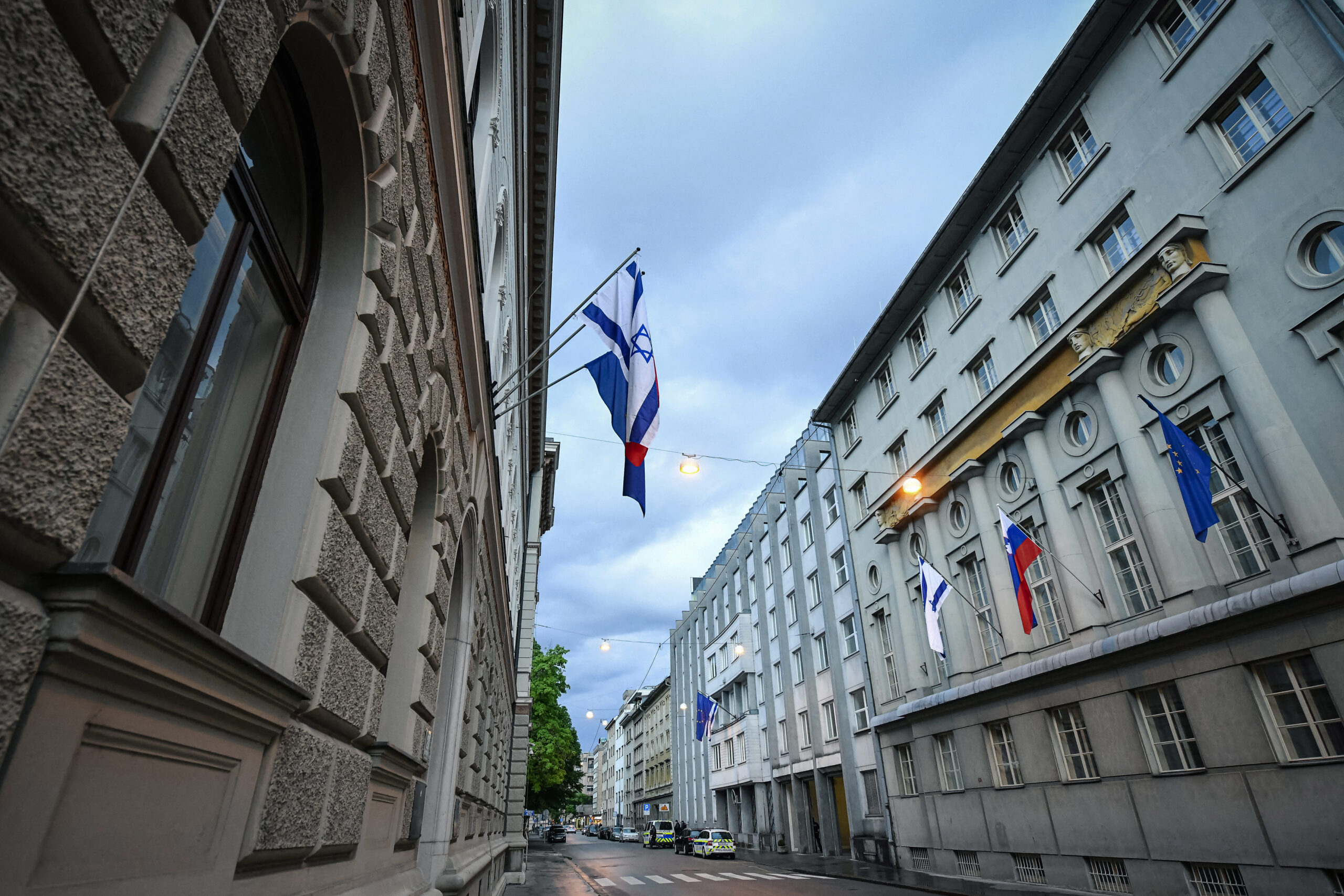
Under nationalist Prime Minister Janez Jansa Slovenia is launching a diplomatic reset of its relationship with Israel, which will send its foreign minister to open its first embassy in Ljubljana on Wednesday.
It is an about-face from the policies of the previous centre-left government, which had been one of the EU’s most critical voices on Israel’s military offensive in Gaza, which it described as “genocide”.
And it comes a day after the United Kingdom and other European countries provoked Israeli fury by banning imports from settlements in the occupied West Bank — the latest move by European governments grappling with growing international condemnation of Israeli policies towards Palestinians.
But in Slovenia, Jansa – who took office for the fourth time earlier this year, and who is often at loggerheads with the European Union – has instead received Israeli accolades for defying the EU over the West Bank settlements.
“Thank you PM Jansa for your courage and clarity amidst EU hypocrisy,” Prime Minister Benjamin Netanyahu posted on X late last month, after Slovenia vetoed an EU statement condemning the settlements.
Under Jansa, Slovenia has also reversed its own ban on imports from the settlements, lifted its arms embargo on Israel and scrapped entry bans on Netanyahu and two of his ministers.
In his first official visit to the country, Israel’s top diplomat Gideon Saar will inaugurate the embassy Wednesday, with his ministry describing Jansa as a “friend of Israel”.
Jansa has said his government was “only normalising Slovenia’s foreign policy and fixing the damage” caused by liberal ex-prime minister Robert Golob.
“To fulfil its priority of improving the well-being of Slovenians, the government will carry out pragmatic policies,” Jansa said in another post earlier.
‘Instrument’
Not all Slovenians are on board, however.
A poll conducted by the daily newspaper Delo in June found that 56 percent of Slovenians opposed closer ties with Israel, while 14 percent supported them.
Several rights groups have announced protests against the embassy’s inauguration, which has also drawn sharp criticism from the opposition.
Golob’s party has described the new embassy as “a return of the favour” for Israel’s alleged support of Jansa during the March election.
The last days of campaigning ahead of the March 22 vote were overshadowed by claims of foreign interference, with authorities probing whether Israeli company Black Cube was behind secretly recorded videos alleging graft in Golob’s government.
Jansa – who faced accusations his party was linked to the videos – has admitted to having met a Black Cube official, but denied being behind the videos.
Daily Dnevnik’s columnist Darijan Kosir in a weekend commentary said Jansa was serving “as the US-Israel’s Trojan horse” in the EU, taking the place of Viktor Orban, Hungary’s long-time premier who lost April elections.
Former president Danilo Turk told AFP that Slovenia has “become an instrument of Israeli policy”.
“This is a very uncomfortable situation,” said Turk, an International Law professor at Ljubljana University.
At this session participants use scraps of paper and other materials to create a fun collage of their friends. It is being held on Sept. 10. Book through experiences.suplift.com .
Barrow pledges new power infrastructure, including a 24-megawatt plant, to tackle The Gambia’s worsening electricity crisis.
Published On 9 Sep 20269 Sep 2026
Gambian President Adama Barrow has said the country will boost energy supplies by next month, hoping to quell violent protests over prolonged power outages as the premier stands for re-election.
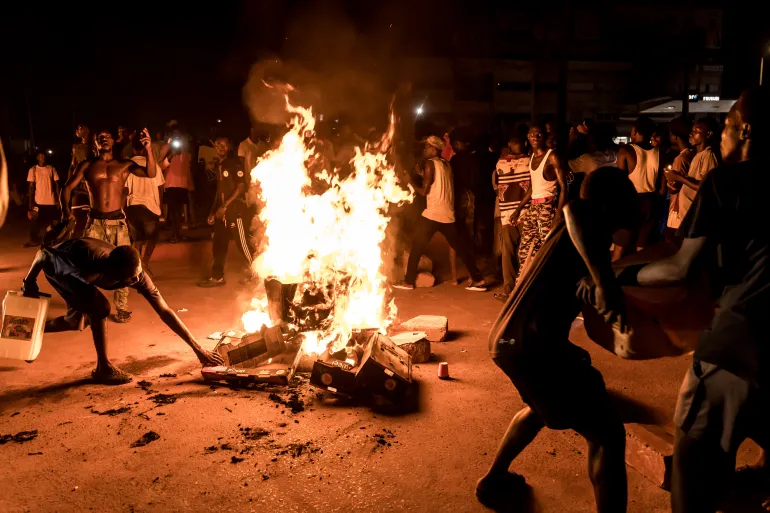
Protesters burned tyres and built barricades blocking traffic, demanding that Barrow resign, in The Gambia’s capital, Banjul, and nearby cities on Monday and Tuesday.
Police used tear gas to disperse crowds who gathered in multiple locations, including near Barrow’s residence and the National Water and Electricity Corporation (NAWEC) headquarters, which supplies the country’s electricity.
Demonstrators burn tyres and block a road during a protest over the country’s ongoing electricity crisis and persistent power outages in Brusubi on September 8, 2026. [AFP]
Barrow declared the outages an emergency and a “national security issue” during a visit to a NAWEC power station. In a national address, he announced that the government would install a 24-megawatt generation machine by the end of October.
“I know that the fans have stopped turning, children work in the dark, mothers throw away stale food, and the heat is unbearable by day and by night,” Barrow said.
The rolling blackouts are taking place during the West African country’s hot season and have lasted up to 48 hours in some places.
The Gambian president also announced an additional 50-megawatt solar power plant that would begin construction soon.
NAWEC Managing Director Gallo said the prolonged electricity cuts were in part due to climate change and the US-Israel war on Iran. The electricity provider, in a statement released in August, also claimed that it was experiencing an “unforeseen surge” in demand due to high temperatures.
The blackouts come just months ahead of the December presidential election, in which Barrow is running for a third term.
Gipsy Kings by Andre Reyes are bringing their legendary sound to Jeddah for the first time on Thursday, Sept. 10, at Abadi Al-Johar Arena. For details, check jeddah.platinumlidt.net .
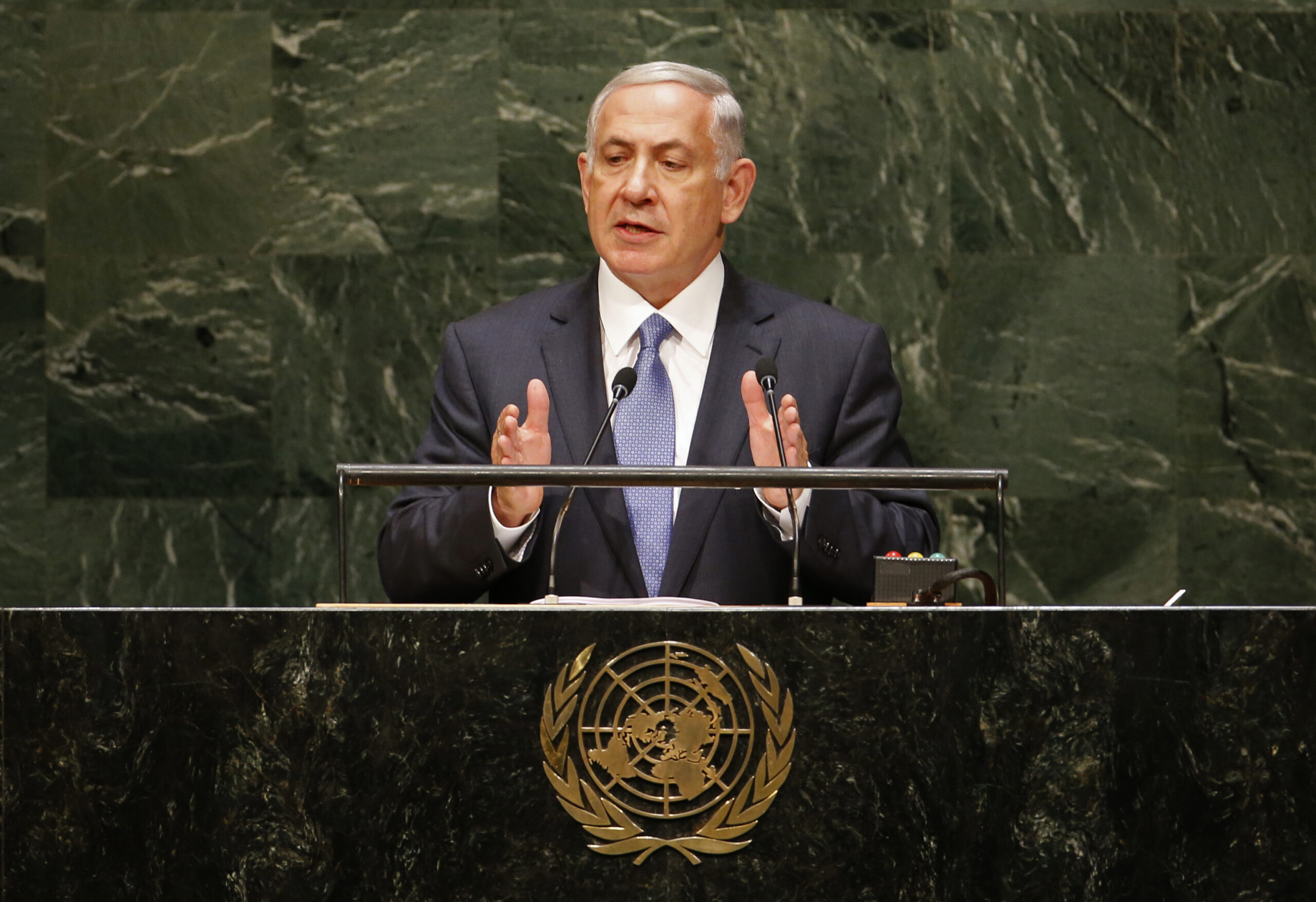
UNITED NATIONS: Israeli Prime Minister Benjamin Netanyahu is making a whirlwind 24-hour trip to speak at the annual U.N. gathering of world leaders this month because “there is no option” after New York’s mayor urged his arrest over the war in Gaza, Israel’s U.N. envoy said Tuesday.
Ambassador Danny Danon accused Mayor Zohran Mamdani of “doing politics” when he called the prime minister a “war criminal” and called for his arrest, which he had to withdraw because New York City does not have authority to take Netanyahu into custody.
“You know, it became very trendy to do politics by blaming Israel,” Danon added. He stressed, “For us, it’s important the prime minister will come.”
Netanyahu has become an increasingly polarizing figure over Israel’s war against Hamas in Gaza. Mamdani, whose office did not immediately respond to messages seeking comment Tuesday, has pointed to the arrest warrant issued by the world’s top war crimes tribunal against Netanyahu in November 2024, accusing him and another Israeli official of crimes against humanity.
The International Criminal Court warrant said there was reason to believe Netanyahu used “starvation as a weapon of warfare” by restricting humanitarian aid and intentionally targeting civilians in the campaign against Hamas — charges Israel denies.
While New York City does not have legal authority to execute an ICC arrest warrant, Mamdani has encouraged the federal government to do so. The U.S. and Israel are not members of the court, and the Trump administration has imposed a series of sanctions on ICC staffers in a campaign to dismantle the tribunal.
Netanyahu is scheduled to arrive in New York late on Sept. 23, address the U.N. General Assembly the afternoon of Sept. 24 and fly back to Israel that night, Danon said.
Danon noted that the meeting of leaders from the 193 U.N. member nations is taking place during the Jewish holidays and an election campaign as Netanyahu tries to keep his job as prime minister.
Danon said protests against Netanyahu would “create more chaos” on New York streets during the high-level meetings the week of Sept. 22-28.
Last year, there was a mass walkout from the U.N. General Assembly hall when Netanyahu started to speak from the podium. This year, Danon said, “I expect that there will be something like another show.”
But the ambassador said Netanyahu is experienced, “and I’m sure he will deliver his speech despite those attempts.”
US military says it struck the five Iranian tankers after IRGC targeted a US warship twice in two days.
The United States has claimed attacks on five Iranian oil tankers in the Gulf of Oman and near Kharg Island after accusing Iran of launching ballistic missiles at a US warship twice in two days.
Iran responded to the attacks on Tuesday by firing missiles at US forces stationed at the Al Azraq base in Jordan. Amman said its air defences intercepted and destroyed 18 of 20 Iranian missiles, while the rest fell in open areas.
Recommended Stories
list of 3 itemsend of list
The exchange of fire comes amid escalating tensions in the Gulf, six months into the US and Israel’s war on Iran, with Tehran maintaining the closure of the Strait of Hormuz and Washington imposing a naval blockade on Iranian ports.
The hostilities briefly drove oil prices to $99.46 earlier on Tuesday.
In a statement, the US Central Command said Iran’s Islamic Revolutionary Guard Corps (IRGC) had targeted a US warship twice over the past two days. The warship “successfully evaded the attempted Iranian attacks” and “no American personnel were harmed”, it said.
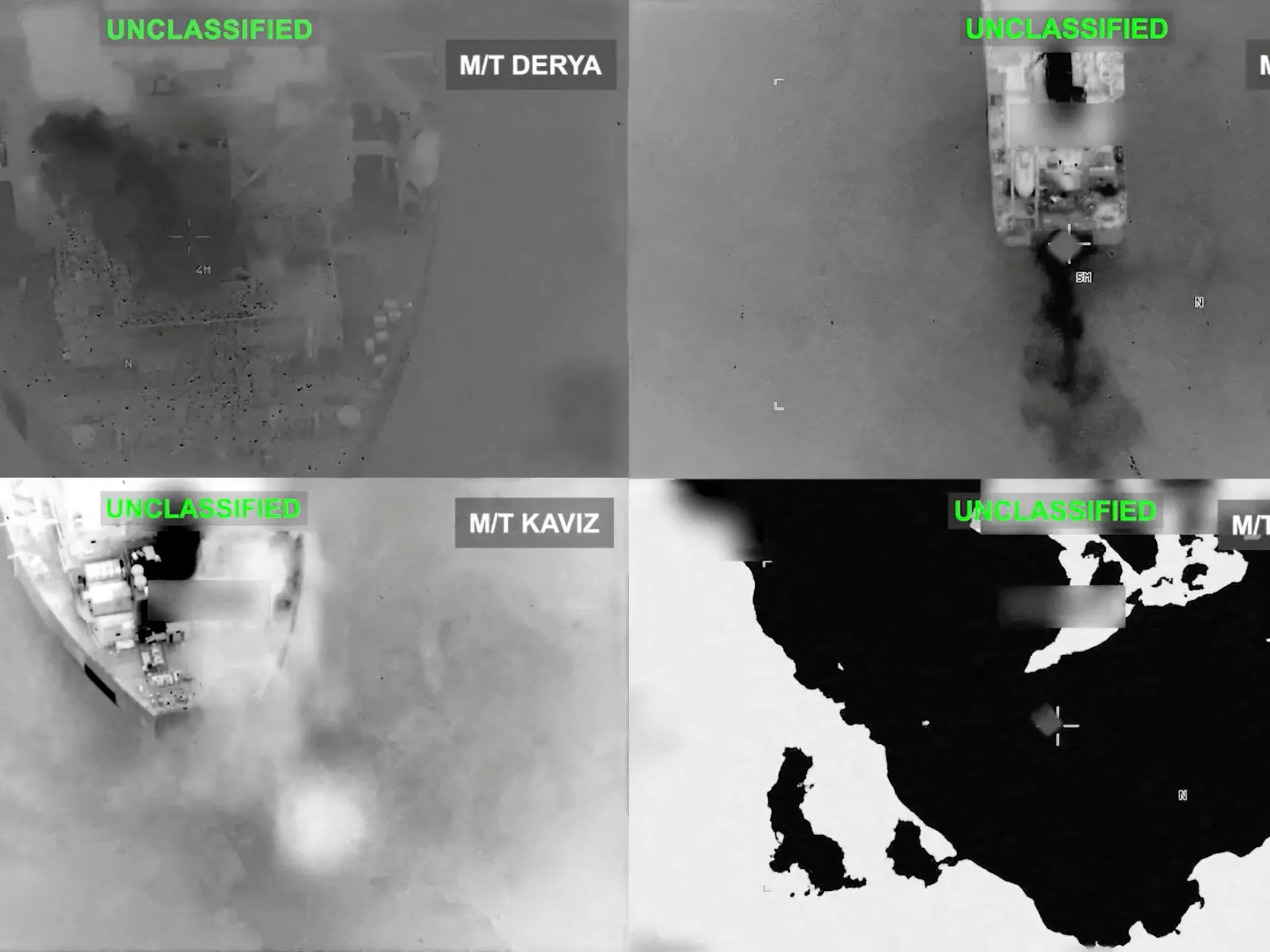
The Central Command said it retaliated by destroying the Iranian oil carriers, M/T Kaviz, M/T Charminar, M/T Horizon 1, and M/T Riesco in the Gulf of Oman as well as M/T Derya near Kharg Island.
“American forces directed the crews to abandon ship before the vessels were struck and rendered inoperable,” the Central Command added.
Iran’s IRIB state broadcaster confirmed the attack near Kharg Island in the Gulf, which handled some 90 percent of Iran’s oil exports before the war. It reported that the crew was evacuated and said a second tanker was hit near the southern port of Jask on the Gulf of Oman.
The IRGC also said “several” Iranian commercial ships were hit, and said it retaliated by subjecting Al Azraq base in Jordan to “fierce missile strikes”. It claimed hangars used by US fighter jets were destroyed in the ballistic missile attacks.
It went on to claim ballistic missile attacks on the US Navy DDG-119 and DDG-53 destroyers, saying “significant damage was caused to these vessels”.
The IRGC also threatened to target oil tankers in Kuwaiti and Bahraini ports, warning crews there to evacuate immediately.
“We warn all the crews of oil tankers in the Kuwaiti and Bahraini ports… to immediately abandon their vessels, whether at anchor or at the ports, because they will be targeted,” it said.
Jordan’s Armed Forces, meanwhile, said its air defences engaged 20 ballistic missiles, “successfully intercepting and destroying 18 of them”. Two missiles “fell in unpopulated areas,” it said in a statement.
The attacks did not cause any casualties and specialised teams “have begun securing the locations where debris and shrapnel fell,” it added.
Earlier, the chief of staff of Iran’s Armed Forces, Ali Abdollahi, had warned that Tehran would strike US military installations across the region if Iranian tankers were targeted.
“The US aggressor army has given Iranian oil tankers an evacuation warning to hit them, so I announce that any attack on Iranian oil tankers will result in the targeting of US bases in the region by the armed forces of the Islamic Republic of Iran,” Abdollahi said on state TV.
US Secretary of State Marco Rubio, however, said Washington would continue to strike Iranian ships.
“Iran continues to try to hit US naval ships, and for every time they do that or try to do that, they’re going to lose tankers,” Rubio told reporters on a visit to Colombia.
ROME: Syria’s future constitution should guarantee the equality and inclusion of all religious minorities to stem emigration, a Syrian minister told AFP on Tuesday.
“We have to have a new constitution, which includes everybody, and (in which) everybody is equal under the law,” Syria’s Social Affairs and Labour Minister Hind Kabawat told AFP.
Kabawat is the only woman and only Christian in the Islamist transition government headed up by Ahmed Al-Sharaa set up after the 2024 fall of former president Bashar Assad.
The transition parliament set up since Al-Sharaa came to power has the task of coming up with a new constitution.
Syria, a majority Sunni Muslim country, is home to one of the world’s oldest Christian communities.
There are also sizeable Alawite, Druze, Ismaili and Kurdish minorities.
The number of Christians has plunged — going down from around a million before the start of the civil war in 2011 — to around 300,000 people, according to experts.
Kabawat said the departure of Christians started long before Assad’s fall.
“I felt the acceleration since the massacres of Hama in the 1980s. Many Christians decided to leave. We used to be 15 percent, then 9 percent, then 4 percent,” she said.
Asked whether the departures had sped up since the fall of Assad, Kabawat said Syrians from different communities were still leaving.
“They’re worried, and they don’t know what kind of government this is,” she said, adding that the government needed to do more to show it was “inclusive.”
Kabawat is in Rome to meet Pope Leo XIV on Wednesday with around 20 Muslim and Christian officials from the Arab world.
RIYADH: With a FIFA Intercontinental Cup clash against Mamelodi Sundowns looming on Sept. 19, Al-Ahli fans have been plunged further into an alarming state of concern.
Just seven days after losing 3-0 to Al-Hilal in their first top-six clash of the season, on Tuesday night Marino Pusic’s side once again conceded three goals, this time to Brendan Rodgers’ Al-Qadsiah.
Al-Ahli have now lost three of their last four games, but even during the four-game winning streak (in all competitions) with which they began the season, many had started to feel the writing was on the wall; Pusic inherited the team late in the preseason and brought with him a football philosophy that often looks like a complete departure from that of outgoing manager Matthias Jaissle.
The 3-2 scoreline away to Al-Qadsiah might not look too worrying on paper but it was the nature of the defeat that will give Al-Ahli much to think about. They were simply outclassed by their opponents in the first 45 minutes, before Ivan Toney led a second-half rally that reduced the deficit but in the end was not enough to rescue a point.
Al-Ahli started the game with only one holding midfielder, Valentin Atangana, allowing Al-Qadsiah’s midfield trio of Julian Weigl, Tijjani Reijnders and Musab Al-Juwayr to overload the center of the pitch on several occasions, leaving the home side with a free player in the final third a number of times.
Such a situation was what led to Al-Qadsiah’s first goal when, in the 14th minute, Reijnders found himself in between Eduard Spertsyan and Galeno in the right half-space. The Dutch international only needed a few touches toward goal before he unleashed a belter of a shot toward the far corner, beating Edouard Mendy.
As Al-Qadsiah’s midfield trio continued to control the game, the wing-backs, Christopher Bonsu Baah and Mohammed Abu Al-Shamat, became the main beneficiaries of Al-Ahli’s narrow defensive focus. As the game entered added time at the end of the first half, Al-Juwayr released Bonsu Baah down the left and he delivered a low cross into the box that found Abu Al-Shamat, who was unmarked inside the Al-Ahli box and finished cleanly to extend the lead.
A third followed two minutes later, with that Al-Juwayr-to-Bonsu Baah connection once again tormenting Al-Ahli. This time they switched the ball to the right flank, where Abu Al-Shamat received the ball and delivered a dipping cross towards Reijnders, who headed home to complete his brace. Al-Ahli mixed things up with a number of substitutions in the second half, including the introduction of Saleh Abu Al-Shamat for Galeno.
And it was Saleh, facing off against his brother Mohammed on the left flank, who injected a renewed spirit into Al-Ahli’s attack with his movement. This ultimately led to Al-Ahli’s revival of sorts in the second half, spearheaded by the league’s top scorer, Toney.
In the 63rd minute, he got on the end of a diagonal cross from Francisco Trincao to finally beat goalkeeper Koen Casteels — who had made four saves up to that point — with a header.
Toney scored again in the 82nd minute, this time latching onto a through ball from Abu Al-Shamat before cutting inside and curling his effort beyond Casteels. The humidity in Dammam clearly had an effect on Al-Qadsiah, who by now had shifted their high-pressing 3-4-1-2 formation into a compact 5-3-2.
This was ultimately enough to hold off Toney and his teammates, and claim a fifth victory from their first six games, their best-ever start to a Saudi Pro League season. In Jeddah, Al-Ittihad followed up on their 2-1 home win against Al-Nassr on Saturday with an identical result, this time against visiting Al-Fayha.
Continuing his fine run of form, George Ilenikhena opened the scoring in the 43rd minute when he headed home the rebound from a Steven Bergwijn shot after it twice struck the crossbar. It was canceled out by Jason just before the half-time whistle, who redirected an Ahmed Bamasud cross with a deft backheel.
Al-Ittihad claimed the victory after Jason handled the ball inside the area in the 68th minute, prompting the referee to award a penalty following a review by the video assistant referee. Substitute Youssef En-Nesyri slotted the ball into the right corner.
Elsewhere, Al-Ettifaq were held to a goalless home draw by Al-Faisaly in what was an underwhelming evening for Arthur Papas’ side, while visiting Al-Taawoun were beaten 1-0 by Al-Hazem, after a mistake by goalkeeper Mailson gifted Aboubacar Bah an open goal in the third minute.
On Wednesday, Al-Kholood host Al-Shabab at 6:55 p.m., then Al-Fateh face visiting Diriyah and Al-Nassr are at home to Abha, with both matches kicking off at 9 p.m.
Allegations of misconduct between two justices threaten to pull court into political battles ahead of upcoming election.
Published On 8 Sep 20268 Sep 2026
Brazilian Supreme Court Justice Andre Mendonca has ordered the suspension of federal police chief Andrei Rodrigues and the force’s intelligence chief Leandro Almada amid growing divisions that have tested the credibility of the country’s highest court.
The suspensions were announced on Tuesday. Mendonca, appointed by former right-wing President Jair Bolsonaro, has accused Rodrigues and Almada of producing six illegal reports on the activities of justices.
Recommended Stories
list of 3 itemsend of list
The move was backed by a majority on one of the high court’s five-member panels.
But it is likely to be challenged by the government, possibly pulling the administration of leftist President Luiz Inacio Lula da Silva into a political battle ahead of October’s presidential election.
“Investigating possible evidence of crimes is correct,” Institutional Relations Minister Jose Guimaraes, a top aide to Lula, said in response to the decision on social media. “But this measure smells electoral to me. That cannot happen.”
Polls show Lula and Jair Bolsonaro’s eldest son, Senator Flavio Bolsonaro, in a tight race ahead of the first round of voting on October 4.
The Supreme Court has been roiled by mutual accusations of wrongdoing between Justice Alexandre de Moraes, appointed under centre-right President Michel Temer, and Mendonca, a Bolsonaro appointee.
De Moraes has become a prominent target of right-wing criticism, particularly after he oversaw the case against Jair Bolsonaro for plotting a coup after the 2022 election.
A report detailing possible links between de Moraes and disgraced banker Daniel Vorcaro was made public by Mendonca last week.
De Moraes, however, responded by accusing Mendonca of abusing his power, citing federal police intelligence reports and urging the court to investigate him. Mendonca has now challenged the legality of those reports.
The Vorcaro corruption scandal has widened to include powerful political figures on both the left and right.
Vorcaro was arrested in 2025 for allegedly overseeing one of the largest bank fraud schemes in the history of Brazil, leaving billions in owed money.
Flavio Bolsonaro has also faced scrutiny for his ties with Vorcaro, after he approached the banker for assistance in funding a film about his father. Jair Bolsonaro is currently serving a 27-year prison sentence.
The right-wing senator used Tuesday’s suspension to push his claim that the prosecution of his father was a political “witch-hunt”. The Federal Police had recommended charges be brought against the elder Bolsonaro in November 2024.
“Lula’s special group in the Federal Police officially unmasked,” Senator Bolsonaro wrote in a social media post. “May the honourable and glorious Federal Police regain its autonomy to go after criminals, and not Lula’s political adversaries.”
William Marcel Murad, the federal police’s executive director, released a statement saying that Rodrigues has the agency’s “full confidence” and that agents “will not be shaken by attacks”.





















![Demonstrators burn tyres and block a road during a protest over the country's ongoing electricity crisis and persistent power outages in Brusubi on September 8, 2026. [AFP]](https://i0.wp.com/occasionaldigest.com/wp-content/uploads/2026/09/afp_6aa0b264c94c-1788916324.jpg?w=640&ssl=1)