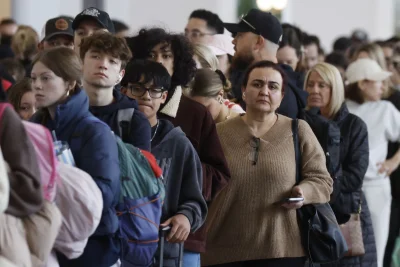
Officials work at a dealing room of Hana Bank in Seoul on Friday, after the KOSPI closed at 3,853.26, down 151.59 points (3.79%) from the previous day. Photo by Yonhap
South Korean stocks closed sharply lower Friday, as renewed concerns over an artificial intelligence (AI) bubble weighed heavily on big-cap tech shares. The local currency fell to the lowest level in seven months against the U.S. dollar on massive foreign stock selling.
The benchmark Korea Composite Stock Price Index (KOSPI) tumbled 151.59 points, or 3.79 percent, to close at 3,853.26.
Trade volume was moderate at 307.95 million shares worth 14.02 trillion won (US$9.5 billion), with decliners outnumbering gainers 718 to 177.
Foreigners sold a net 2.83 trillion won worth of shares, while retail and institutional investors bought a net 2.29 trillion won and 495.46 billion won worth of shares, respectively.
According to the Korea Exchange, offshore investors’ net selling reached its largest level since Feb. 26, 2021, when they offloaded 2.83 trillion won worth of shares.
The index opened lower, tracking overnight losses on Wall Street, and further extended its decline as investors were wary of the valuation of AI-related shares and their aggressive investment plans.
Also affecting the sentiment was the Federal Reserve‘s monetary policy, as expectations for further rate cuts continued to wane.
“The market surrendered its gains from yesterday’s Nvidia earnings surprise. Following recent sharp gains, volatility appears to have persisted,” Han Ji-young, a researcher at Kiwoom Securities, said.
“But there remains ample potential for sentiment to reverse depending on upcoming key economic data and additional AI-related developments,” the analyst added.
Tech shares dipped following a rally in the previous session.
Market bellwether Samsung Electronics fell 5.77 percent to 94,800 won, and chip giant SK hynix plunged 8.76 percent to 521,000 won.
Major battery maker LG Energy Solution lost 3.51 percent to 425,500 won, and LG Chem dipped 5.53 percent to 367,000 won.
Nuclear power plant builder Doosan Enerbility sank 5.92 percent to 73,100 won, and defense giant Hanwha Aerospace shed 5.13 percent to 869,000 won.
Leading shipbuilder HD Hyundai Heavy skidded 4.8 percent to 555,000 won, and its rival Hanwha Ocean lost 4.16 percent to 119,800 won. No. 1 steelmaker POSCO declined 3.42 percent to 310,500 won.
Carmakers finished mixed. Top automaker Hyundai Motor retreated 0.95 percent to 259,500 won, while its sister affiliate Kia rose 0.53 percent to 114,000 won.
Leading financial group KB Financial decreased 0.58 percent to 120,500 won, while internet portal operator Naver surged 2.14 percent to 262,500 won.
The local currency was quoted at 1,475.6 won against the greenback at 3:30 p.m., down 7.7 won from the previous session.
It marked the weakest level since April 9, when it finished at 1,484.1 won. The April 9 figure was the lowest since March 12, 2009, when the won closed at 1,496.5 amid the global financial crisis.
Bond prices, which move inversely to yields, ended higher. The yield on three-year Treasurys fell 3.6 basis points to 2.872 percent, and the return on the benchmark five-year government bonds lost 3.9 basis points to 3.076 percent.
Copyright (c) Yonhap News Agency prohibits its content from being redistributed or reprinted without consent, and forbids the content from being learned and used by artificial intelligence systems.
US President Donald Trump’s decision to snub the G20 summit in South Africa this year has handed an opportunity to China, as it seeks to expand its growing influence in the African continent and position itself as an alternative to the dangers of a unilateralist United States.
Washington said it would not attend the two-day summit set to kick off on Saturday over widely discredited claims that the host country, previously ruled by its white minority under an apartheid system until 1994, now mistreats white people.
Recommended Stories
list of 3 itemsend of list
South Africa’s President Cyril Ramaphosa hit back at Trump’s claim that hosting the summit in Johannesburg was a “total disgrace”. “Boycott politics doesn’t work,” Ramaphosa said, adding that the US was “giving up the very important role that they should be playing as the biggest economy in the world”.
By Friday morning, Trump appeared to have backtracked on his stance somewhat, when speculation that Washington might send a US official to Johannesburg after all circulated.
Regardless, the spat comes as Chinese President Xi Jinping sends Premier Li Qiang to represent him on the world stage. China’s 72-year-old president has dialled back foreign visits, increasingly delegating his top emissary.
“The US is giving China an opportunity to expand its global influence,” Zhiqun Zhu, professor of political science and international relations at Bucknell University, told Al Jazeera. “With the absence of the US, China and EU countries will be the focus of the summit and other countries will look for leadership [from them].”
But observers say that while Trump’s absence will direct heightened attention to Beijing’s statements and behaviour, it does not spell the end of the US-led order altogether.
Jing Gu, a political economist at the United Kingdom-based Institute of Development Studies, said the US’s failure to attend “does not automatically make China the new leader, but it creates visible space for China to present itself as a more stable, reliable partner in governance”.
“It reinforces the perception that the US is stepping back from multilateralism and the shared management of global problems,” she said. “In that context, China can present itself as a more predictable, stable actor and emphasise continuity, support for open trade and engagement with the Global South.”
Expanding influence in the African continent
This year’s G20 will, for the first time, have an African chair and take place on the African continent. The African Union (AU) will also participate fully as a member.
South Africa, which holds the G20 presidency, is expected to push for consensus and action on priority issues for African countries, including debt relief, economic growth, climate change and transition to clean energy.
Zhu, who also serves as editor-in-chief of the academic journal, China and the World, said South Africa’s themes were a “natural fit” for China, Africa’s largest trading partner.
“China aims to become a leader in green energy, and there’s a lot of room for China and African countries to work on that,” he said.
The African continent, with its mineral wealth, booming population and fast-growing economies, offers huge potential for Chinese firms. Li, China’s premier, travelled to Zambia this week, marking the first visit to the country by a Chinese premier in 28 years. The copper-rich nation has Beijing as its largest official creditor for $5.7bn.
Eager to secure access to Zambia’s commodities and expand its exports from resource-rich East Africa, China signed a $1.4bn deal in September to rehabilitate the Tazara Railway, built in the 1970s and connecting Tanzania and Zambia, to improve rail-sea transportation in the region.
“The Chinese economy and African economy are complementary; they both benefit from trade,” Zhu said. The G20 “is a great platform for China to project its global influence and seek opportunities to work with other countries”, he added.
Africa’s growing demand for energy and China’s dominance in manufacturing make the two a good fit, observers say. This is playing out. A report by energy think tank Ember, for instance, found Africa’s imports of solar panels from China rose a whopping 60 percent in the 12 months to June 2025.
According to Gu at the Institute of Development Studies, China will be looking to tap into this growing synergy with Africa and will deliver a three-fold message at this year’s G20.
“First, it will stress stability and the importance of global rules and regulations,” she said. Second, “it will link the G20 to the Global South and highlight issues like development and green transformation”.
Third, “by offering issue-based leadership on topics such as digital economy, artificial intelligence and governance, it will position itself as a problem-solver rather than a disruptor”, the economist added.
“It can contrast, yet again, its declared commitment to multilateralism and responsible behaviour as a major state versus the dangers of a unilateralist America focusing not on public goods but on benefits to itself only.”
China has been looking to expand its influence in Africa as a counterweight to the US-led world order. In stark contrast to Trump’s decision to end Africa’s duty-free era and slap 15-30 percent tariffs on 22 nations, Xi announced at the APEC summit last month a zero-tariff policy for all African nations with diplomatic ties to Beijing.
On that occasion, Xi emphasised China’s commitment “to joint development and shared prosperity with all countries”, stressing the country’s goal to “support more developing countries in achieving modernisation and opening up new avenues for global development”.
Similarly, Li, China’s premier, marked the United Nations’ 80th anniversary at the General Assembly in September by expressing the need for stronger collective action on climate change and emerging technologies, calling for greater solidarity to “[lift] everyone up, while division drags all down”.
His remarks were in stark contrast to Trump’s, who, in his speech, described climate change as the “greatest con job ever perpetrated” and called renewable sources of energy a “joke” and “pathetic”.
Foot said the spotlight will now be on Beijing as it seeks to strike a similar conciliatory pose – and in doing so, set itself apart from the US – at the G20. “Whether Beijing will have a major impact on the G20 agenda is more difficult to determine,” she said.
The administration of United States President Donald Trump has announced new oil drilling off the California and Florida coasts for the first time in decades, advancing a project that critics say could harm coastal communities and ecosystems, as Trump seeks to expand US oil production.
The White House announced the news on Thursday.
Recommended Stories
list of 4 itemsend of list
The oil industry has been seeking access to new offshore areas, including Southern California and off the coast of Florida, as a way to boost US energy security and jobs.
What’s in the plan?
The administration’s plan proposes six offshore lease sales through 2030 in areas along the California coast.
It also calls for new drilling off the coast of Florida in areas at least 160km (100 miles) from that state’s shore. The area targeted for leasing is adjacent to an area in the Central Gulf of Mexico that already contains thousands of wells and hundreds of drilling platforms.
The five-year plan also would compel more than 20 lease sales off the coast of Alaska, including a newly designated area known as the High Arctic, more than 320km (200 miles) offshore in the Arctic Ocean.
Interior Secretary Doug Burgum said in announcing the sales that it would take years for the oil from those parcels to get to market.
“By moving forward with the development of a robust, forward-thinking leasing plan, we are ensuring that America’s offshore industry stays strong, our workers stay employed, and our nation remains energy dominant for decades to come,” Burgum said in a statement.
The American Petroleum Institute said in response that the announced plan was a “historic step” towards unleashing vast offshore resources. Industry groups have pointed to California’s history as an oil-producing state and say it already has infrastructure to support more production.
Political pushback
Leaders in both California and Florida have pushed back on the deal.
Last week, Florida Republican Senator Ashley Moody and Rick Scott co-sponsored a bill to maintain a moratorium on offshore drilling in the state that Trump signed in his first term.
“As Floridians, we know how vital our beautiful beaches and coastal waters are to our state’s economy, environment and way of life,” Scott said in a statement. “I will always work to keep Florida’s shores pristine and protect our natural treasures for generations to come.”
A spokesman for California Governor Gavin Newsom said Trump officials had not formally shared the plan, but said “expensive and riskier offshore drilling would put our communities at risk and undermine the economic stability of our coastal economies”.
California has been a leader in restricting offshore oil drilling since the infamous 1969 Santa Barbara spill that helped launch the modern environmental movement. While there have been no new federal leases offered since the mid-1980s, drilling from existing platforms continues.
Newsom expressed support for greater offshore controls after a 2021 spill off Huntington Beach and has backed a congressional effort to ban new offshore drilling on the West Coast.
A Texas-based company, with support from the Trump administration, is seeking to restart production in waters off Santa Barbara damaged by a 2015 oil spill. The administration has hailed the plan by Houston-based Sable Offshore Corp as the kind of project Trump wants to increase US energy production as the federal government removes regulatory barriers.
“He [Trump] intentionally aligned that to the opening of COP,” Newsom said.
Even before it was released, the offshore drilling plan met strong opposition from Newsom, a Democrat who is eyeing a 2028 presidential run and has emerged as a leading Trump critic.
Newsom pronounced the idea “dead on arrival” in a social media post. The proposal is also likely to draw bipartisan opposition in Florida. Tourism and access to clean beaches are key parts of the economy in both states.
Democratic lawmakers, including California Senator Alex Padilla and Representative Jared Huffman, the top Democrat on the House Natural Resources Committee, warned that opening vast coastlines to new offshore drilling would hurt coastal economies, jeopardise national security, ravage coastal ecosystems, and put the health and safety of millions of people at risk.
“With this draft plan, Donald Trump and his Administration are trying to destroy one of the most valuable, most protected coastlines in the world and hand it over to the fossil fuel industry,” Padilla and Huffman said in a joint statement.
The federal government has not allowed drilling in federal waters in the eastern Gulf of Mexico, which includes offshore Florida and part of offshore Alabama, since 1995, because of concerns about oil spills. California has some offshore oil rigs, but there has been no new leasing in federal waters since the mid-1980s.
Since taking office for a second time in January, Trump has systematically reversed former President Joe Biden’s focus on slowing climate change to pursue what the Republican calls US “energy dominance” in the global market.
Trump, who recently called climate change “the greatest con job ever perpetrated on the world,” created a National Energy Dominance Council and directed it to move quickly to drive up already record-high US energy production, particularly fossil fuels such as oil, coal and natural gas.
Meanwhile, Trump’s administration has blocked renewable energy sources such as offshore wind and cancelled billions of dollars in grants that supported hundreds of clean energy projects across the country.
Local officials said U.S. Border Patrol agents left Charlotte, N.C., for New Orleans on Thursday, but the Department of Homeland Security said its Charlotte operation is continuing. File photo by Tannen Maury/UPI | License Photo
Nov. 20 (UPI) — Charlotte, N.C., officials said Thursday that U.S. Customs and Border Protection agents have left the city, but the Department of Homeland Security insisted that agents are still enforcing immigration law there.
Shortly after the Mecklenburg, N.C., County sheriff announced that agents had left Charlotte, the Trump administration pushed back.
CBP had agents in Charlotte for nearly a week, and DHS said Immigration and Customs Enforcement agents would continue to enforce laws in the city while also transitioning CBP agents to New Orleans.
According to the Department of Homeland Security, CBP has been in touch with officials in Louisiana about mobilizing and deploying agents to New Orleans after Thanksgiving, NBC News reported.
The Department of Homeland Security’s immigration enforcement action known as “Operation Charlotte’s Web” resulted in the arrests of more than 250 people which prompted fear among residents and business owners, local media reported.
The Charlotte operation was the latest in a series of immigration enforcement actions in several large U.S. cities, including Los Angeles, Portland and Chicago, where many of those arrested did not have criminal records, the Chicago Tribune reported.
Local law enforcement and state leaders have pushed back on federal law presence in their cities, saying additional enforcement personnel are not necessary to police municipalities.
At least 250 Border Patrol agents are scheduled to begin arriving in New Orleans Friday, where officials have said they expect as many as 5,000 arrests, local media reported.
More details are emerging from a 28-point peace plan backed by United States President Donald Trump aimed at ending Russia’s four-year war on Ukraine, with several media outlets and officials confirming that the plan, which has yet to be officially published, appears to favour Russia.
Details of the plan also come after US ambassador to the United Nations, Mike Waltz, told the UN Security Council on Thursday afternoon that the US had offered “generous terms for Russia, including sanctions relief”.
Recommended Stories
list of 4 itemsend of list
“The United States has invested at the highest levels, the president of the United States personally, to end this war,” Waltz told the council.
The AFP news agency reported on Friday that the plan, which the US views as a “working document”, says that “Crimea, Lugansk [Luhansk] and Donetsk will be recognised as de facto Russian, including by the United States”.
This corresponds with an earlier report from US media outlet Axios.
The Associated Press (AP) news agency also reported on Friday that the plan would require Ukraine to surrender the Donbas, which includes the Luhansk and Donetsk regions that Ukraine currently partly holds.
Under the draft, Moscow would hold all the eastern Donbas region, even though approximately 14 percent still remains in Ukrainian hands, AP reported.
AFP and AP also confirmed Axios’s earlier report that the plan would require Ukraine to limit the size of its military.
According to AFP, the plan specifically says that the army would be limited to 600,000 personnel. Ukraine is estimated to currently have just under 900,000 active duty military staff.
Two Ukrainian soldiers check the scopes of their anti-aircraft systems to ensure they are working properly before heading out on a mission in the Donetsk region of Ukraine in October 2024 [File: Fermin Torrano/Anadolu]
‘A neutral demilitarised buffer zone’
Ukrainian member of parliament Oleksiy Goncharenko shared a document showing what appeared to be the full 28-point peace plan with his 223,000 followers on the Telegram messaging app, late on Thursday, Ukraine time.
Russia’s state TASS news agency also reported on details included in the document shared by Goncharenko, saying it “purportedly represents a Ukrainian translation of 28 points of the new American plan for a peace settlement in Ukraine”.
New details included in the document shared by Goncharenko include that “Ukraine has the right to EU [European Union] membership” and that the “United States will work with Ukraine to jointly restore, develop, modernise, and operate Ukraine’s gas infrastructure, including pipelines and storage facilities”.
The document also states that Ukraine’s “Zaporizhzhia Nuclear Power Plant will be commissioned under [UN nuclear agency] IAEA supervision, and the electricity generated will be shared equally between Russia and Ukraine in a 50:50 ratio”.
The text of the document shared by Goncharenko also states that “Ukrainian forces withdraw from the part of the Donetsk region that they currently control, and this withdrawal zone will be considered a neutral demilitarised buffer zone”.
Handing over territory to Russia would be deeply unpopular in Ukraine and would also be illegal under Ukraine’s constitution. Ukraine’s President Volodymyr Zelenskyy has repeatedly ruled out such a possibility.
No NATO membership for Ukraine
The AFP news agency also reported that, according to the plan, European fighter jets would be based in Poland specifically to protect Ukraine.
However, Kyiv would have to concede that no NATO troops would be stationed in Ukraine and that it would agree never to join the military alliance.
Additional details reported by AP include that Russia would commit to making no future attacks on Ukraine, something the White House views as a concession by Moscow.
In addition, $100bn in frozen Russian assets would be dedicated to rebuilding Ukraine, AP reported.
Russia would also be re-admitted to the G8 group of nations and be integrated back into the global economy under the plan, according to AFP.
White House Press Secretary Karoline Leavitt said on Thursday that both Ukrainians and Russians have had input into the plan, which she said US Secretary of State Marco Rubio and US special envoy Steve Witkoff have been quietly working on for a month.
Russian President Vladimir Putin, right, welcomes US special envoy Steve Witkoff to their talks at the Kremlin in Moscow, Russia, on April 25, 2025 [Kristina Kormilitsyna/Sputnik/Pool via AP Photo]
Nov. 20 (UPI) — A former congressional staff member has been accused of faking a violent attack against her at a New Jersey park, according to the criminal complaint.
Natalie Greene, 26, allegedly paid a body modification artist to etch wounds onto her skin and then claimed she had been assaulted in a politically motivated attack in July, according to the complaint announced Wednesday.
Greene, of Ocean City, N.J., has been charged with one count of conspiracy to convey false statements and hoaxes, and one count of making false statements to federal law enforcement, according to the U.S. Attorney’s Office for the District of New Jersey.
Greene previously worked for Rep. Jeff Van Drew, R-N.J., his office told NBC News.
“We are deeply saddened by today’s news, and while Natalie is no longer associated with the Congressman’s government office, our thoughts and prayers are with her,” said Aaron Paxton, a spokesperson for Van Dew’s office. “We hope she’s getting the care she needs.”
Prosecutors allege that Greene and an accomplice called 911 on July 23, claiming that they had been attacked by three armed men at Egg Harbor Township state park.
Police located Greene in a wooded area bound with zip ties, with lacerations on her head and chest, according to the criminal complaint. A sexual slur referencing President Donald Trump and a statement calling her former employer a “racist” were written on her stomach, according to photos from the alleged crime scene included in the complaint.
“The investigation revealed that Greene had not, in fact, been attacked by three men at gunpoint on July 23,” the U.S. attorney’s statement said. “Instead, Green had paid a modification and scarification artist to deliberately cut the lacerations on her face, neck, upper chest and shoulder, based on a pattern that she had provided beforehand.”
Law enforcement agents who investigated the incident said they found zip ties in Greene’s car similar to the ones used in the alleged attack. Investigators also found a “zip ties near me” search on her co-conspirator’s phone, prosecutors said.
A search of Greene’s phone found messages with a body modification artist in Pennsylvania, who gave police $500 in receipts for the scarring and apparent injuries he did for Greene. Her phone also allegedly showed a Reddit profile that followed posts for “bodymods” and “scarification,” the court documents state.
Greene told an FBI agent after she was discovered following the attack that she had been receiving threatening messages at work. The alleged co-conspirator who called 911 relayed details of the incident to the dispatcher.
“They were attacking her,” they told the 911 operator. “They were like talking about politics and stuff. They were like calling her names. They were like calling her racist, calling her a whore,” the co-conspirator added.
Greene’s attorney, Louis Barbone, told ABC News that Greene is innocent until proven guilty.
“At the age of 26, my client served her community working full time to assist the constituents of the Congressman with loyalty and fidelity,” a statement from Barbone said. “She did that while being a full time student. Under the law, she is presumed innocent and reserves all of her defenses for presentation in court of law.
Following her arraignment Wednesday, Greene was released on a $200,000 bond, the U.S. attorney’s office said. She faces up to 10 years in prison and a $500,000 fine if convicted.
Nov. 20 (UPI) — Using digital devices creates a data footprint that endangers national security, U.S. military personnel and military operations, the Government Accountability Office said.
The Defense Department has cited publicly available data generated by defense platforms, personal devices and online activities as a growing threat that requires continual caution, the GAO reported on Monday.
“Massive amounts of traceable data about military personnel and operations now exist due to the digital revolution,” according to the report.
“When aggregated, these ‘digital footprints’ can threaten military personnel and their families, operations and, ultimately, national security.”
Such information could enable “malicious actors” to trace the movements of ships and aircraft and otherwise endanger military operations, according to Military Times.
The GAO report says 10 Defense Department components are vulnerable to security lapses that create “volumes of traceable data.”
The vulnerability is especially prevalent for training and security assessment within the U.S. Cyber Command, National Security Agency, Defense Intelligence Agency, Defense Counterintelligence and Security Agency, U.S.Special Operations Command and every U.S. military branch, according to the GAO.
Only the U.S. Special Operations Command has consistently trained its personnel to minimize the risks created by digital information, the report says.
Most Defense Department agencies and offices also fail to undertake threat assessments targeting force protection, insider threats, mission assurance and operations security.
The GAO said information provided via press releases, news sources, online activities, social media posts and ship coordinates might be capable of telegraphing the routes of ships and aircraft and jeopardize their respective operations.
Only three of five offices within the Defense Department have issued policies or provided guidance to minimize the risks of digital information, but even those efforts are “narrowly focused” and insufficient, the GAO said.
The GAO report echoes concerns raised by federal lawmakers after a Signal app discussion of a pending military strike on Houthi targets on March 15 accidentally included The Atlantic journalist Jeffrey Goldberg.
US president’s controversial deployment of soldiers to US cities has raised alarm and a series of legal challenges.
Published On 21 Nov 202521 Nov 2025
Share
A United States federal judge has said the Trump administration must pause its deployment of National Guard troops to Washington, DC, a setback for the president’s push to send the military into cities across the country.
US District Judge Jia Cobb temporarily suspended the deployment in a ruling on Thursday, responding to a lawsuit filed by city officials who said Trump had usurped policing powers and was using the military for domestic law enforcement.
Recommended Stories
list of 3 itemsend of list
The federal government has unique powers in Washington, DC. But the Trump administration has taken the controversial step to deploy soldiers in a growing list of Democrat-led cities, despite frequent protests from state and local officials and a lack of any emergency conditions.
Cobb, who said in her decision that the president cannot deploy soldiers for “whatever reason” he wants, gave the Trump administration 21 days to appeal the order before it goes into effect.
Lawyers for the government slammed the lawsuit that challenged the military deployment as a “frivolous stunt”.
“There is no sensible reason for an injunction unwinding this arrangement now, particularly since the District’s claims have no merit,” Department of Justice lawyers wrote.
Trump has also deployed troops to cities such as Los Angeles, California; Portland, Oregon; and Chicago, Illinois, in what he depicts as an effort to tackle crime and round up undocumented immigrants.
Residents and civil liberties groups have documented aggressive raids and what they say are widespread rights violations and racial profiling by federal agents during those crackdowns, in which US citizens have sometimes been swept up.
Trump has threatened to imprison local and state officials who criticise his deployment of the military.
A legal challenge filed in September by Washington, DC Attorney General Brian Schwalb said that US democracy would “never be the same if these occupations are permitted to stand”.
Trump ordered the first deployment in August, involving about 2,300 National Guard members from various states and hundreds of federal agents from various agencies.
Nov. 20 (UPI) — The Justice Department on Thursday ended its case against a woman who was shot after allegedly ramming a Customs and Border Protection vehicle in October.
Marimar Martinez, 30, and Anthony Ian Santos Ruiz, 21, were charged with assault for following and allegedly ramming a Chevrolet Tahoe driven by CBP agent Charles Exum on Oct. 4, the Chicago Sun Times reported.
U.S. Attorney for Northern Illinois Andrew Boutros filed court papers to end the prosecution on Thursday without citing a reason, though.
U.S. District of Northern Illinois Judge Georgia Alexakis granted the DOJ’s motion to dismiss the case against both defendants early Thursday evening, KTEN reported.
“Border Patrol law enforcement officers were ambushed by domestic terrorists that rammed federal agents with their vehicles,” the Department of Homeland Security said Thursday in a prepared statement, as reported by NBC News.
Martinez “was armed with a semi-automatic weapon and has a history of doxing federal agents,” the DHS added.
Her attorney agreed she had a firearm in her vehicle but argued that she was not brandishing it.
Both defendants pleaded not guilty, but evidence revealed Exum bragged in messages to others about shooting five times and causing seven wounds.
During a recent hearing, a defense attorney asked Exum why he apparently bragged about shooting Martinez while using the Signal messaging app.
He said he is a firearms instructor and “I take pride in my shooting skills.”
Exum was participating in Immigration and Customs Enforcement’s “Operation Midway Blitz” when Martinez and Ruiz allegedly boxed in the vehicle he was driving and then struck it.
The defendants said Exum struck them with the vehicle he was driving and then shot Martinez.
Ukrainian President Volodymyr Zelenskyy has said he’s willing to work with the United States on a plan to end Russia’s war on Ukraine, despite pushback from European allies who say that the US-backed plan heavily favours Russia.
Zelenskyy’s office on Thursday confirmed that he had received a draft of the plan, and that he would speak with US President Donald Trump in the coming days.
His office did not comment directly on the contents of the plan, which has not been published, but the Ukrainian leader had “outlined the fundamental principles that matter to our people”.
“In the coming days, the President of Ukraine expects to discuss with President Trump the existing diplomatic opportunities and the key points required to achieve peace,” Zelenskyy’s office said.
Several media outlets reported that the 28-point plan involves Ukraine ceding territory and weapons. Citing an unnamed US official with “direct knowledge”, Axios reported the plan would give Russia parts of eastern Ukraine that Moscow does not currently control, in exchange for a US security guarantee for Ukraine and Europe against future Russian aggression.
US Secretary of State Marco Rubio and US special envoy Steve Witkoff have been quietly working on the plan for a month, receiving input from both Ukrainians and Russians on terms that are acceptable to each side, White House Press Secretary Karoline Leavitt confirmed on Thursday.
She declined to comment on details of the emerging proposal, but said Trump has been briefed on it and supports it.
“It is a good plan for both Russia and Ukraine, and we believe it should be acceptable to both sides. And we are working hard to get it done,” Leavitt said.
Zelenskyy confirmed later that he discussed the plan with US Army Secretary Daniel Driscoll in Kyiv.
“Our teams – Ukraine and the USA – will work on the points of the plan to end the war,” Zelenskyy wrote on Telegram without commenting directly on the plan. “We are ready for constructive, honest and prompt work.”
Russia appeared to play down any new US initiative.
“Consultations are not currently under way. There are contacts, of course, but there is no process that could be called consultations,” Kremlin spokesman Dmitry Peskov said.
While Zelenskyy has signalled he is willing to work with the Trump administration on a ceasefire, Kyiv’s European allies have expressed scepticism.
“Ukrainians want peace – a just peace that respects everyone’s sovereignty, a durable peace that can’t be called into question by future aggression,” French Foreign Minister Jean-Noel Barrot said during a meeting of European Union foreign ministers in Brussels. “But peace cannot be a capitulation.”
EU foreign policy head Kaja Kallas said any peace proposal would need support from Europe and Ukraine to move forward, with Polish Foreign Minister Radoslaw Sikorski saying that Europe – whose security is “at stake” – expects to be consulted on any potential deal.
“I hope it’s not the victim that has restrictions on its ability to defend itself put on, but it’s the aggressor,” he said.
Fighting continues despite peace talks
Zelenskyy is facing pressure to join the US-backed diplomatic initiative as Ukrainian troops continue to lose ground to Russian forces in the country’s east.
Russian President Vladimir Putin claimed in October that Russian forces had seized almost 5,000 square kilometres (1,930sq miles) of Ukraine this year.
On September 25, the Institute for the Study of War, a Washington-based think tank, independently assessed the real figure to be closer to 3,434sq km (1,325sq miles).
Russia’s General Staff said Thursday that Moscow’s forces had seized the northeastern Ukrainian city of Kupiansk and controlled large sections of the towns of Pokrovsk and Vovchansk – a claim Ukraine vigorously denied.
“The General Staff of Ukraine’s armed forces hereby announces that Kupiansk is under the control of Ukraine’s defence forces,” the Ukrainian General Staff said in a late evening bulletin.
“Also untrue are statements suggesting that 80 percent of Vovchansk in the Kharkiv region has been captured and 70 percent of the city of Pokrovsk.”
This week, a devastating Russian aerial assault on Ternopil in western Ukraine killed at least 26 people and wounded dozens more, Interior Minister Ihor Klymenko confirmed Thursday.
Zelenskyy said on Thursday that 22 people were still missing at the site of Wednesday’s attack on Ternopil when Moscow unleashed 476 drones and 48 missiles across Ukraine. The attack damaged energy infrastructure across seven Ukrainian regions, prompting nationwide restrictions on power consumption.
“Every brazen attack against ordinary life indicates that the pressure on Russia [to stop the war] is insufficient,” Zelenskyy said on Telegram.
The bombardment coincided with Zelenskyy’s visit to Turkiye aimed at reviving peace talks with Russia following his European diplomatic mission.
“We count on the strength of Turkish diplomacy, on [how] it’s understood in Moscow,” Zelenskyy said after his meeting on Wednesday with Turkish President Recep Tayyip Erdogan.
Nov. 20 (UPI) — A federal judge ruled Thursday that President Donald Trump‘s deployment of 2,000 National Guard soldiers to Washington was illegal, saying the president lacks the authority to dispatch troops “for the deterrence of crime.”
U.S. District Judge Jia Cobb said that while Trump is the commander in chief, federal laws constrain his power to federalize and deploy those troops, particularly in Washington, which Congress controls.
“The Court rejects the Defendant’s fly-by assertion of constitutional power, finding that such a broad reading of the President’s Article II authority would erase Congress’ role in governing the District and its National Guard,” Cobb wrote in her 61-page ruling.
Cobb also said that Trump also lacked authority to deploy out-of-state National Guard troops to Washington to assist in law enforcement.
Cobb’s ruling will not take effect until Dec. 11, giving the Trump administration time to appeal. The Supreme Court is on the verge of issuing its own ruling on the deployment of National Guard troops to Chicago. Federal appeals courts are also considering National Guard troop deployments to Portland, Ore., and Los Angeles.
Trump has justified his troop deployments by claiming, without evidence, that large-scale violence and chaos demands the presence of national troops to protect federal functions. State and local leaders, as well as municipal law enforcement officers, have said they don’t need federal help to protect their cities.
Marjayoun district, Lebanon – In his southern Lebanese hometown of Hula, a few metres away from the border with Israel, Khairallah Yaacoub walks through his olive grove. Khairallah is harvesting the olives, even though there aren’t many this year.
The orchard, which once contained 200 olive trees and dozens of other fruit-bearing trees, is now largely destroyed. After a ceasefire was declared between Hezbollah and Israel in November 2024, ending a one-year war, the Israeli army entered the area, bulldozed the land, and uprooted trees across border areas, including Hula – 56,000 olive trees according to Lebanon’s Agriculture Minister Nizar Hani. Israeli officials have said that they plan to remain indefinitely in a “buffer zone” in the border region.
Recommended Stories
list of 3 itemsend of list
Israeli forces are not currently stationed in what remains of Khairallah’s farm, but the grove is fully exposed to Israeli positions in Menora, on the other side of the border. That makes the olive farmer’s every movement visible to the Israeli army, and is why he has been so afraid to venture to his trees before today.
Khairallah Yaacoub harvests olives from his destroyed orchard despite the poor yield [Mounir Kabalan/Al Jazeera]
Harvesting under fire
“This was the place where my brothers and I lived our lives,” said Khairallah, as he walked next to the olive trees that he said were more than 40 years old. “We spent long hours here ploughing, planting, and harvesting. But the [Israeli] occupation army has destroyed everything.”
Khairallah now has 10 olive trees left, but their yield is small for several reasons, most notably the lack of rainfall and the fact that he and his brothers had to abandon the orchard when war broke out between Hezbollah and Israel on October 8, 2023. Khairallah’s aim now is to begin the process of restoring and replanting his olive grove, the main source of livelihood for the 55-year-old and his four brothers.
The farm in Hula, which lies in the district of Marjayoun, once provided them with not just olives, but olive oil, and various other fruits. They also kept 20 cows on the land, all of which have died due to the war.
But with the presence of the Israelis nearby, getting things back to a semblance of what they once were is not easy, and involves taking a lot of risks.
“Last year, we couldn’t come to the grove and didn’t harvest the olives,” Khairallah said. “[Now,] the Israeli army might send me a warning through a drone or fire a stun grenade to scare me off, and if I don’t withdraw, I could be directly shelled.”
Olive trees cut down as a result of the bulldozing operations carried out by the Israeli army in Khairallah Yaacoub’s orchard in the town of Hula [Mounir Kabalan/Al Jazeera]
Systematic destruction
Like Khairallah, Hussein Daher is also a farmer in Marjayoun, but in the town of Blida, about five kilometres (3.1 miles) away from Hula.
Hussein owns several dunams of olive trees right on Lebanon’s border with Israel. Some of his olive trees, centuries old and inherited from his ancestors, were also uprooted. As for the ones still standing, Hussein has been unable to harvest them because of Israeli attacks.
Hussein described what he says was one such attack as he tried to reach one of his groves.
“An Israeli drone appeared above me. I raised my hands to indicate that I am a farmer, but it came closer again,” said Hussein. “I moved to another spot, and minutes later, it returned to the same place I had been standing and dropped a bomb; if I hadn’t moved, it would have killed me.”
The United Nations reported last month that Israeli attacks in Lebanon since the beginning of the ceasefire had killed more than 270 people.
The dangers mean that some farmers have still not returned. But many, like Hussein, have no choice. The farmer emphasised that olive harvest seasons were an economic lifeline to him and to most other farmers.
And they now have to attempt to recoup some of the losses they have had to sustain over the last two years.
According to an April study by the United Nations’s Food and Agriculture Organization (FAO), 814 hectares (2,011 acres) of olive groves were destroyed, with losses in the sector alone estimated at $236m, a significant proportion of the total $586m losses in the wider agricultural sector.
“We used to produce hundreds of containers of olive oil; today, we produce nothing,” said Hussein, who has a family of eight to provide for. “Some farmers used to produce more than 200 containers of olive oil per season, worth roughly $20,000. These families depended on olive farming, honey production, and agriculture, but now everything was destroyed.”
Abandoned
The troubles facing the olive farmers have had a knock-on effect for the olive press owners who turn the harvested olives into Lebanon’s prized olive oil.
At one olive press in Aitaroun, also in southern Lebanon, the owner, Ahmad Ibrahim, told Al Jazeera that he had only produced one truckload of olive oil this year, compared with the 15 to 20 truckloads his presses make in a typical year.
“Some villages, like Yaroun, used to bring large quantities of olives, but this year none came,” Ahmad said. “The occupation destroyed vast areas of their orchards and prevented farmers from reaching the remaining ones by shooting at them and keeping them away.”
Ahmad, in his 70s and a father of five, established this olive press in 2001. He emphasised that the decline in agriculture, particularly olive cultivation in southern Lebanon, would significantly affect local communities.
The olive press in the southern town of Aitaroun has had to shut after a poor olive oil production season [Mounir Kabalan/Al Jazeera]
Many of those areas are still scarred from the fighting, and the weapons used by Israel could still be affecting the olive trees and other crops being grown in southern Lebanon.
Hussein points to Israel’s alleged use of white phosphorus, a poisonous substance that burns whatever it lands on, saying the chemical has affected plant growth.
Experts have previously told Al Jazeera that Israel’s use of white phosphorus, which Israel says it uses to create smokescreens on battlefields, is part of the attempt to create a buffer zone along the border.
But if Lebanese farmers are going to push back against the buffer zone plan, and bring the border region alive again, they’ll need support from authorities both in Lebanon and internationally – support they say has not been forthcoming.
“Unfortunately, no one has compensated us, neither the Ministry of Agriculture nor anyone else,” said Khairallah, the farmer from Hula. “My losses aren’t just in the orchard that was bulldozed, but also in the farm and the house. My home, located in the middle of the town, was heavily damaged.”
The Lebanese government has said that it aims to support the districts affected by the war, and has backed NGO-led efforts to help farmers.
Speaking to Al Jazeera, Agriculture Minister Hani said that the government had begun to compensate farmers – up to $2,500 – and plant 200,000 olive seedlings. He also outlined restoration projects and the use of the country’s farmers registry to help the agricultural sector.
“Through the registry, farmers will be able to obtain loans, assistance, and social and health support,” Hani said. “Olives and olive oil are of great and fundamental value, and are a top priority for the Ministry of Agriculture.”
But Khairallah, Hussein, and Ahmad have yet to see that help from the government, indicating that it will take some time to scale up recovery operations.
That absence of support, Hussein said, will eventually force the farmers to pack up and leave, abandoning a tradition hundreds of years old.
“If a farmer does not plant, he cannot survive,” Hussein said. “Unfortunately, the government says it cannot help, while international organisations and donors, like the European Union and the World Bank, promised support, but we haven’t seen anything yet.”
Nov. 20 (UPI) — Toys that use AI to interact with children might seem like a fun idea, but one organization is warning against them.
The nonprofit Fairplay released an advisory Thursday warning parents to avoid artificial intelligence-based children’s toys this holiday season.
AI toys are chatbots embedded in children’s toys — such as plushies, dolls, action figures, or kids’ robots — and use AI technology designed to communicate like a friend.
Examples include Miko, Curio Interactive’s Grok and Gabbo, Smart Teddy, FoloToy’s Kumma bear, Roybi and Keyi Technology’s Loona Robot Dog. Some of the toys are marketed to children as young as infants, Fairplay said in a statement.
“It’s ridiculous to expect young children to avoid potential harm here,” said Rachel Franz, a Fairplay program director, in a statement to NPR.
“Young children are especially susceptible to the potential harms of these toys, such as invading their privacy, collecting data, engendering false trust and friendship, and displacing what they need to thrive, like human-to-human interactions and time to play with all their senses. These can have long and short-term impacts on development,” she said
Singapore-based FoloToy suspended sales of its Kumma bear after it was found to give inappropriate advice to children, CNN reported Wednesday. The bear’s chatbot talked about sexual fetishes, how to find knives in the home and how to light a match.
FoloToy CEO Larry Wang told CNN that the company had withdrawn Kumma and its other AI toys and is now “conducting an internal safety audit.”
The Toy Association, which represents toy manufacturers, told NPR that toys sold by responsible manufacturers and retailers must follow more than 100 strict federal safety standards and tests, including the Children’s Online Privacy Protection Act, which governs children’s privacy and data security online.
“The Toy Association urges parents and caregivers to shop only from reputable toymakers, brands, and retailers who prioritize children’s safety above all else,” the statement said. The organization added that it offers safety tips for AI and other connected products.
Fairplay offered more reasons that AI toys are not safe for children.
AI toys are usually powered by the same AI that has already harmed children, and young children who use them are less equipped to protect themselves than older children and teens, Fairplay said.
AI chatbots have caused children to use them obsessively, engaged in explicit sexual conversations, and encouraged unsafe behaviors, violence against others, and self-harm.
AI toys may sabotage children’s trust by pretending to be trustworthy companions or “friends.” Young children are likely to treat connected toys and devices as if they were people and develop an emotional attachment to them.
These “relationships” can disrupt children’s real relationships and resilience by offering “genuine friendship,” which isn’t possible from a machine.
Probably most concerning is that AI toys can invade family privacy by collecting sensitive data using audio and video recording, speech-to-text technology, and even voice, gesture, and facial recognition software, Fairplay said.
A child might talk to the toy and tell it their personal thoughts, emotions, fears, and desires, which will be delivered to a third party. They could also record private family conversations or record other children in the room.
Some toys even have facial recognition and video recording, which could take video of children in the bath or getting dressed.
Forecasters warn more flooding, landslides expected as tens of thousands of people are evacuated from their homes.
Published On 20 Nov 202520 Nov 2025
Share
Authorities in Vietnam say at least 41 people have been killed in a barrage of torrential rain, flooding and landslides, as rescue crews worked to save stranded people from the rooftops of submerged homes.
Rainfall exceeded 150cm (60 inches) over the past three days in several parts of central Vietnam, a region home to a key coffee production belt and the country’s most popular beaches.
Recommended Stories
list of 3 itemsend of list
At least 41 people have been killed across six provinces since Sunday, while the search was continuing for nine others, the environment ministry said on Thursday.
More than 52,000 houses were flooded, and nearly 62,000 people were evacuated from their homes, while several major roads remained blocked due to landslides, and one million customers were left without electricity.
A suspension bridge on the Da Nhim River in Lam Dong province was swept away on Thursday morning, the VietnamNet newspaper reported.
Photos taken by the AFP news agency also showed hundreds of cars underwater as flooding inundated entire city blocks in Nha Trang, a popular tourist spot on the coast.
Local business owner Bui Quoc Vinh said his ground-floor restaurants and shops were under about a metre (3.2 feet) of water in the city.
“I am worried about our furniture in my restaurants and shops, but of course I cannot do anything now,” he told AFP.
“I don’t think the water is going to recede soon, as the rain has not stopped.”
The national weather forecast agency has warned of more flooding and landslides on Friday, with heavy rain set to continue in the region.
Deputy Prime Minister Ho Quoc Dung told the leaders of three flood-affected provinces – Khanh Hoa, Dak Lak and Gia Lai – to mobilise the army, police and other security forces to “promptly relocate and evacuate people” to safe areas, according to a government statement.
Meanwhile, state media reported that rescuers using boats in Gia Lai and Dak Lak pried open windows and broke through roofs to assist residents stranded by high water on Wednesday.
People wade through floodwaters near inundated vehicles in Nha Trang on November 20, 2025 [AFP]
Photographs shared in state media reports showed residents, including children, sitting on the roofs of flooded houses and calling for help via social media platforms.
“Any group out there please help! We’ve been sitting on the roof since 10pm last night, including kids and adults,” a resident of Khanh Hoa province posted on a local Facebook page.
Natural disasters have left 279 people dead or missing in Vietnam and caused more than $2bn in damage between January and October, according to the national statistics office.
The Southeast Asian nation is prone to heavy rain between June and September, but experts say the climate crisis has made extreme weather events more frequent and destructive.
Pedestrians pictured Nov. 2024 walking past a Verizon store in Herald Square on Black Friday in New York City, N.Y. On Thursday, Verizon said it will lay off thousands of jobs in a cost reduction measure. File Photo by John Angelillo/UPI | License Photo
Nov. 20 (UPI) — Verizon said Thursday it will lay off thousands of jobs in a cost reduction measure.
The telecommunications giant said some 13,000 workers will be let go due to “cost structure limits” in order for Verizon to be “faster and more focused,” according to CEO Dan Schulman.
“Changes in technology and in the economy are impacting the workforce across all industries,” he said in a message. “We see it in our families and within our communities.”
The company began 2025 with a roughly 100,000 strong workforce.
Schulman told Verizon employees that “every part” of the company will experience “some level of change” as Verizon focuses on “delighting our customers.”
Last month, Schulman, who arrived from PayPal, took over the Verizon helm hoping to cultivate a “leaner” business operation.
A Verizon spokesperson reiterated that cuts do not target a specific department.
The layoffs will impact roughly 20% of Verizon’s non-union management in a pool of approximately 70,000 employees, Verizon spokesman Kevin Israel told USA Today.
Meanwhile, Verizon announced it unveiled of a $20 million career transition fund for its recently fired personnel for “reskilling.”
United States job growth accelerated in September despite a cooling job market as the unemployment rate rose.
Nonfarm payrolls grew by 119,000 jobs after a downwardly revised 4,000 drop in August, according to the Bureau of Labor Statistics (BLS) report released on Thursday.
Recommended Stories
list of 4 itemsend of list
The unemployment rate rose to 4.4 percent, up from 4.3 percent in August.
The healthcare sector had the most gains, totalling 43,000 jobs in September. Food and beverage services sectors followed, adding 37,000 jobs, and social assistance employment grew by 14,000.
Other sectors saw little change, including construction, wholesale trade, retail services, as well as professional and business services.
The federal workforce saw a decline of 3,000, marking 97,000 jobs cut from the nation’s largest employer since the beginning of the year. Transportation and warehousing, an industry hit hard by tariffs, also saw declines and shed 25,000 jobs in September.
Average wages grew by 0.2 percent, or 9 cents, to $36.67.
Government shutdown hurdles
The September jobs report was initially slated for release on October 3, but was pushed out because of the US government shutdown. The jobs report typically comes out on the first Friday of each month. Because of the 43-day-long shutdown, the US Labor Department was unable to collect the data needed to calculate the unemployment rate for the month of October.
Nonfarm payrolls for the month of October will be released as part of the November employment report, which is slated to be released on December 16.
Heading into the economic data blackout, the BLS had estimated that about 911,000 fewer jobs were created in the 12 months through March than previously reported. A drop in the number of migrant workers coming into the US in search of work – a trend which started during the final year of former US President Joe Biden’s term and accelerated under President Donald Trump’s administration – has depleted labour supply.
“Today’s delayed report shows troubling signs below the topline number: the underlying labour market remains weak, leaving working Americans with shrinking opportunities and rising insecurity. Month after month, the Trump economy is producing fewer jobs, more instability, and fewer pathways for families trying to get ahead,” Alex Jacquez, chief of policy for the economic think tank the Groundwork Collaborative, said in a statement provided to Al Jazeera.
Economists estimate the economy now only needs to create between 30,000 and 50,000 jobs per month to keep up with growth in the working-age population, down from about 150,000 in 2024.
Behind the stalling growth
The rising popularity of artificial intelligence is also eroding demand for labour, with most of the hits landing on entry-level positions in white collar jobs, and locking recent college graduates out of work. Economists said AI was fueling jobless economic growth.
Others blamed the Trump administration’s trade policy for creating an uncertain economic environment that had hamstrung the ability of businesses, especially small enterprises, to hire.
The US Supreme Court earlier this month heard arguments about the legality of Trump’s import duties, with justices raising doubts about his authority to impose tariffs under the 1977 International Emergency Economic Powers Act.
Despite payrolls remaining positive, some sectors and industries are shedding jobs. Some economists believed the September employment report could still influence the Federal Reserve’s December 9-10 policy meeting on interest rate decisions.
US central bank officials will not have November’s report in hand at that meeting, as the release date has been pushed to December 16 from December 5. Minutes of the Fed’s October 28-29 meeting published on Wednesday showed many policymakers cautioned that lowering borrowing costs further could risk undermining the fight to quell inflation.
Kenneth Bae, the Korean-American missionary who endured 735 days as a political prisoner in North Korea, is leading a renewed international effort to realize a unified Korean Peninsula. File Photo by Kim Hee-Chul/EPA
SEOUL, Nov. 20 (UPI) — Kenneth Bae, the Korean-American missionary who endured 735 days as a political prisoner in North Korea, is now leading a renewed international effort to realize a unified Korean Peninsula.
Bae, 57, a naturalized U.S. citizen, was the longest-held American citizen in North Korea since the Korean War — an experience he now views as a mission to become a “voice for the voiceless” North Korean people.
Bae’s ordeal began in 2012 when he was arrested while leading his 18th “Love DPRK Tour” group. He was charged with “conspiracy to overthrow the state” and sentenced to 15 years of hard labor. He became the first U.S. citizen to be confined to a North Korean kyohwaso, or re-education camp.
“The ultimate charge was that I had tried to overthrow the North Korean regime through prayer and worship,” Bae said in an interview. His unintentional mistake was bringing an external hard drive containing a documentary that showed the suffering of ordinary North Koreans, which became evidence for the regime’s accusations.
Before his arrest, the “Love DPRK Tour” was focused less on proselytizing and more on cultural exchange and prayer for the land. Bae took some 300 people from 17 countries over two years to engage in activities like making kimchi, learning traditional dance and simply “walking the land” while praying for the North Korean people.
He was released in 2014 after a high-level diplomatic intervention led by then-Director of National Intelligence James Clapper, an event that highlighted his strong, enduring ties to Washington policymakers.
New focus: from defector aid to unification
After his release, Bae initially established the Nehemiah Global Initiative in South Korea, primarily focusing on aiding North Korean defectors with settlement, education and even the financial support needed to rescue family members from third countries. Over eight years, NGI provided English education to about 800 young defectors.
In 2022, he rebranded the organization as the New Korea Foundation International, signaling a critical shift in focus. While support for defectors continues, the core mission is now actively preparing for reunification and the reconstruction of North Korea.
“Reunification is not an option; it is a necessity and a mission for our people,” Bae said, emphasizing the stark difference between his two years of captivity and the seven decades the North Korean populace has lived without freedom.
He insists on a South Korea-led unification that is welcomed by North Korean citizens and supported by the international community. He stresses that the true “target of unification” is the North Korean populace, not the Pyongyang regime.
Mobilizing global support: the “One Korea” campaign
The foundation launched the New Korea Unification Campaign under the slogan, “One State, One Nation, One Future, One Korea.” The campaign is a comprehensive, multi-faceted effort to build global consensus for a free and democratic unified Korea.
The campaign offers three primary ways to participate: sign, give and serve.
• It urges global citizens to join the Signature Campaign (Petition movement) to showcase worldwide support and to join the Nehemiah Prayer Pledge.
This prayer movement, originally launched by Bae’s founding organization, the Nehemiah Global Initiative, already has garnered 6,500 signatures from 75 countries to pray for the people of North Korea and for unification.
• The New Korea Gospel Broadcast is a cornerstone project, a planned U.S.-based AM Christian broadcast intended to reach North Koreans with information about the outside world and the Christian Gospel.
Recognizing the challenges and interruptions faced by official broadcasts like the Voice of America and Radio Free Asia, this private-sector effort aims to maintain a vital source of outside information.
The broadcast will share “letters of hope,” directly inspired by the hundreds of letters Bae received while imprisoned. To fund this critical initiative, the foundation is seeking 1,000 people to contribute $20 per month.
• Other core campaign projects include Raising the Reunification Reconstruction Fund to support relief for refugees, the Human Rights Advocacy Movement and the Nehemiah Scholarship for defectors.
Urgency of the three-year window
Bae views the current geopolitical climate as critical, warning against the danger of the peninsula’s division becoming permanent through the “Two States” theory. He believes that if the two-state narrative is allowed to solidify, it would be a moral “betrayal” of the North Korean people.
He strongly urges the younger generation in South Korea to reject the notion that unification is a financial burden, arguing instead that North Korea is a “land of opportunity.”
“With its natural resources and a combined population exceeding 80 million, a unified Korea would become a powerful and prosperous nation,” he asserted.
He sees the next three years as a crucial window to prevent the permanent entrenchment of the division. Bae is actively appealing to U.S. leaders and policymakers for their support of the Unification Campaign, emphasizing his strong personal connections to American officials and his belief that global consensus is paramount.
Bae believes that by focusing on creating interest, knowing the situation and action, the Korean people and the international community can ensure the path to a single, free Korea remains open.
For more information on the New Korea Unification Campaign, visit the New Korea Foundation International website: newkoreafi.org.
Kanu’s Indigenous People of Biafra (IPOB) wants a swathe of the southeast, the homeland of the Igbo ethnic group, to split from Nigeria.
Published On 20 Nov 202520 Nov 2025
Share
A Nigerian court has convicted separatist leader Nnamdi Kanu on charges related to “terrorism” after a years-long trial.
In his ruling on Thursday, Nigerian Judge James Omotosho said prosecutors proved that Kanu’s broadcasts and orders to his now-banned Indigenous People of Biafra (IPOB) group incited deadly attacks on security forces and citizens in the southeast.
Recommended Stories
list of 3 itemsend of list
The violence was part of his push for an independent Biafra state for the ethnic Igbo-dominated region.
“His intention was quite clear, as he believed in violence. These threats of violence were nothing but terrorist acts,” Omotosho said.
Kanu, who has been in custody since his controversial re-arrest in Kenya in 2021, shouted angrily in objection to the proceedings and was ejected from court ahead of the ruling. He had argued that his unlawful extradition from Kenya undermined any chance of a fair trial.
Kanu pleaded not guilty in 2021 to seven charges that included “terrorism”, treason and perpetuating falsehoods against Nigeria’s former President Muhammadu Buhari.
Kanu was first arrested in 2015, but fled the country while on bail. His social media posts during his absence and his Radio Biafra broadcasts outraged the government, which said they encouraged attacks on security forces.
Ultimately, security agents brought Kanu to court in Abuja in June 2021 after detaining him in Kenya, where his lawyer alleged he was mistreated. Kenya has denied involvement.
In October 2021, Kanu’s lawyers argued that his statements on Radio Biafra shouldn’t be admissible in a Nigerian court since they were made in London.
“I can’t see how someone would make a statement in London and it becomes a triable offence in this country,” Kanu’s lawyer Ifeanyi Ejiofor told reporters at the time.
Kanu, a dual Nigerian-British citizen, started Radio Biafra – an obscure, London-based radio station – in 2009 after he left Nigeria to study economics and politics at the London Metropolitan University.
In one broadcast, Kanu said: “We have one thing in common, all of us that believe in Biafra, one thing we have in common, a pathological hatred for Nigeria. I cannot begin to put into words how much I hate Nigeria.”
IPOB wants a swathe of the southeast, the homeland of the Igbo ethnic group, to split from Nigeria. An attempt to secede in 1967 as the Republic of Biafra triggered a three-year civil war that killed more than one million people.
The Trump administration announced it is rolling back some protections under the Endangered Species Act, which covers animals such as Kali, pictured, a polar bear that lives at the Saint Louis Zoo. File Photo by Bill Greenblatt/UPI | License Photo
Nov. 20 (UPI) — The Trump administration announced that it plans to roll back protection for some animals and plants under the Endangered Species Act, changes that officials say will make the law less confusing.
The U.S. Department of the Interior proposed four rules under the act that it says will strengthen U.S. energy independence, improve regulatory predictability and ensure federal actions align with “the best reading of the law.”
“This administration is restoring the Endangered Species Act to its original intent, protecting species through clear, consistent and lawful standards that also respect the livelihoods of Americans who depend on our land and resources,” Secretary of the Interior Doug Burgum said Wednesday in a press release.
The four proposed rule changes affect how endangered species are determined, listed and delisted; change the definitions for phrasing that describes the effects of a species being listed; eliminate the “blanket rule” in favor of requiring species-specific rules; and clarify how economic, national security and other impacts are weighed when deciding whether to list a species under the act.
In all four cases, the department is rolling back changes made under the Biden Administration to broaden the species that can be protected under the act. The Biden era changes were a restoration of changes made during the first Trump administration.
Although the changes are meant to simplify complying with the act, critics have challenged the changes are not about protecting animals to prevent them from going extinct.
“This isn’t about protecting endangered species,” Stephanie Kurose, deputy director of government affairs at the Center for Biological Diversity, told The Hill.
“This is about the biggest companies in the country wanting to drill for oil and dig coal, even if it causes wildlife like the polar bear and other iconic species to go extinct,” she said.
The proposed rules have been published in the Federal Register and are open for public comment for 30 days starting on Nov. 21.
SEOUL, Nov. 20 (UPI) — A U.N. committee adopted a resolution condemning North Korea’s human rights violations, Seoul’s Foreign Ministry said Thursday, with 61 co-sponsors including South Korea and the United States.
The draft resolution, introduced earlier this month to the Third Committee of the U.N. General Assembly, “condemns in the strongest terms the long-standing and ongoing systematic, widespread and gross violations of human rights in and by the Democratic People’s Republic of Korea, including those that may amount to crimes against humanity.”
The Democratic People’s Republic of Korea is the official name of North Korea.
The resolution calls on Pyongyang to “respect, protect and fulfill all human rights and fundamental freedoms” and to “immediately close the political prison camps and release all political prisoners unconditionally.”
It was approved by consensus during a plenary meeting of the Third Committee on Wednesday.
South Korea was among the initial 41 member states to co-sponsor the resolution, despite speculation that the liberal administration of President Lee Jae Myung might withhold support in an effort to improve relations with Pyongyang.
However, South Korea maintained the position of former President Yoon Suk Yeol’s conservative government, with the Foreign Ministry noting that Seoul’s approach to North Korean human rights would remain a matter of principle.
In a statement on Thursday, the Foreign Ministry said the resolution “urges the DPRK to establish an operating environment conducive to the return of international and humanitarian staff and encourages all Member States and U.N. entities to provide more support for the work of civil society organizations.”
“The ROK government will continue its close cooperation with the international community for the substantive enhancement of human rights of DPRK people,” the ministry added, using the official acronym for South Korea.
North Korea has long rejected such resolutions as hostile acts, accusing the United Nations and Western powers of using human rights as a pretext to undermine its government.
During Wednesday’s plenary meeting, North Korean Ambassador to the United Nations Kim Song said Pyongyang “strongly condemns and totally rejects” the resolution, calling it “a document of political plots motivated by the impure intention of defaming the dignity of our republic and undermining its sovereign political system.”
Representatives of China and Russia also dissociated themselves from the consensus, with Beijing rejecting what it called a “politicized approach to human rights issues.”
A September report by the U.N. Human Rights Office found that North Korea’s human rights situation “has not improved over the past decade and, in many instances, has degraded,” citing worsening food shortages, widespread forced labor and tight restrictions on movement and expression.
This week, North Korean leader Kim Jong Un praised his regime’s state security forces, which run the political prison system and have been widely accused of employing brutal methods of repression and torture. The security apparatus has long been central to maintaining the Kim family’s grip on power through pervasive surveillance and the suppression of dissent.
The United States, which was not initially among the co-sponsoring nations, later joined the group that also includes Australia, Britain, France, Germany and Japan.
The resolution will be reviewed at the upcoming General Assembly plenary next month for final adoption.
Donald Trump has signed a law requiring the US Justice Department to release the remaining Epstein files within 30 days. The Attorney General said her department would comply – but hinted some documents could be withheld for legal reasons.
One soldier was injured Thursday morning after an explosion occurred inside the Demilitarized Zone (DMZ) separating the two Koreas, officials said.
The explosion took place at 9:20 a.m. on the western front of the DMZ in Paju, just northwest of Seoul, for unknown reasons, according to officials.
A 24-year-old Army staff sergeant, who was on a mission to detect land mines on the southern side of the inter-Korean border at the time, sustained what is presumed to be an ankle fracture due to the blast.
He was wearing anti-mine protective gear and sustained non-life-threatening injuries, officials said.
Military authorities are investigating the exact cause of the accident.
Copyright (c) Yonhap News Agency prohibits its content from being redistributed or reprinted without consent, and forbids the content from being learned and used by artificial intelligence systems.