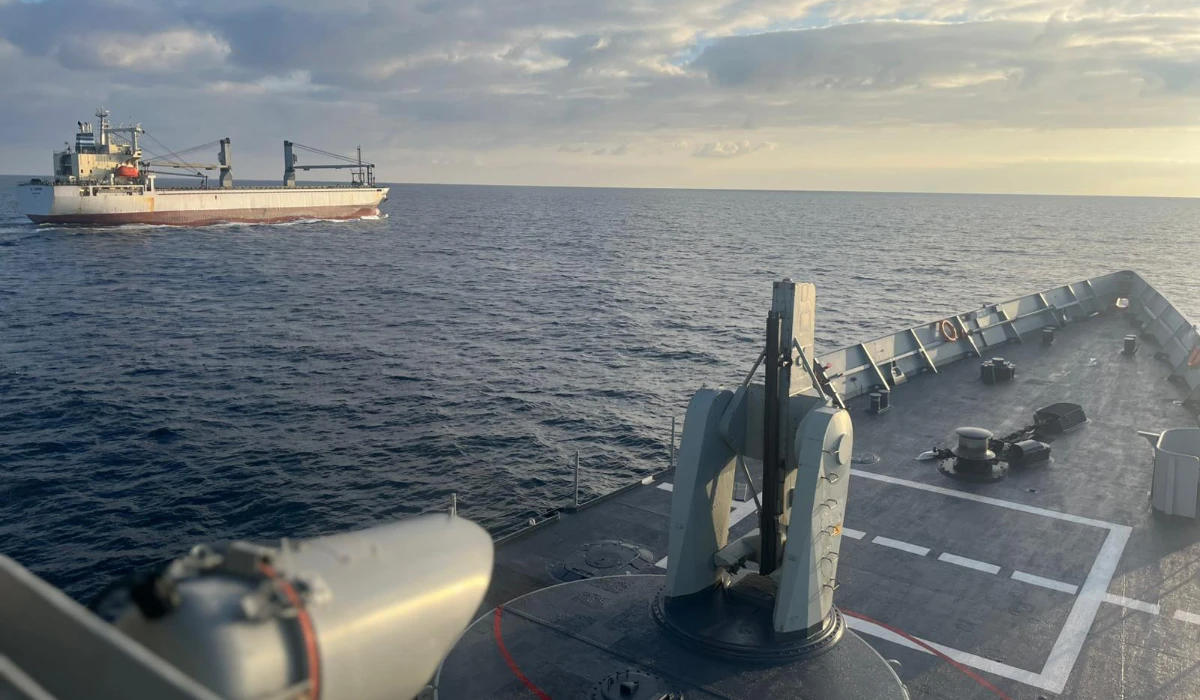
MOGADISHU: Somali pirates briefly hijacked a vessel off the coast of Yemen this week, the European Naval Force and security sources in Puntland said on Saturday.
Six armed men stormed the MT Glamour on Thursday when the ship, sailing under the flag of Saint Vincent and the Grenadines, was about 38 nautical miles (70 kilometers) off the coast.
The Gulf of Aden and the Somali coast have seen a resurgence in piracy since April, with at least 15 attacks recorded this year — the highest since 2013, according to the International Maritime Organization.
Several security sources in the northeastern Puntland region — a major hub of Somali piracy — told AFP that six armed men boarded the Glamour after setting off from a small fishing village.
According to the European Naval Force, the crew stopped the vessel, shut down its systems and took refuge in the citadel as a precaution before the vessel was boarded.
After the hijacking, a Japanese warship approached the vessel and helicopters circled the ship, prompting the pirates to abandon it, the Puntland authorities said.
On Friday, Somali pirates released the cargo ship MV Sward, which was hijacked in April with 17 crew members on board.
Security sources and the authorities in Puntland said a ransom was paid.
Four tankers seized this year remain in the hands of pirates off the Somali coast — the Honour 25, the Eureka, the Asana and the Seamull, which is also known as Sibu 1.
The Seamull, which is part of Iran’s “ghost fleet” accused of exporting Iranian oil, is subject to US sanctions.
SAO PAULO: Former Liverpool playmaker Philippe Coutinho has joined Santos, team-mate Neymar announced on Saturday, although his new club has yet to officially confirm the move.
Coutinho, 34, has been without a club since leaving Vasco da Gama in February, citing mental burnout.
“We’re very happy that you’re here,” Neymar said on social media, with a video showing Coutinho alongside Santos players and coaches.
“Our squad and our fans will welcome you with arms wide open.”
According to local media, former Brazil international Coutinho needs to pass his medical before Santos can confirm his arrival on a contract that runs until the end of the season.
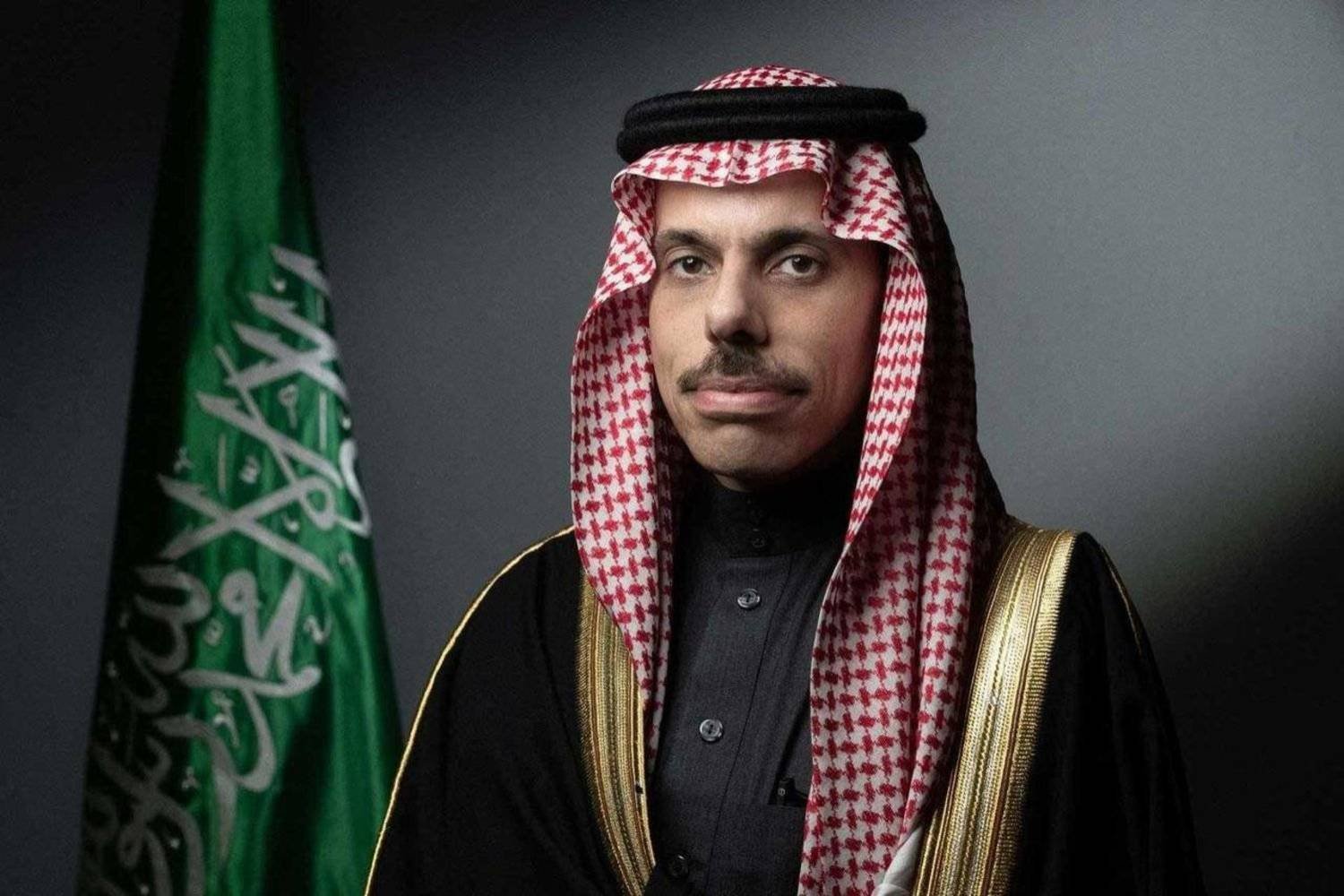
NEW DELHI: Saudi Foreign Minister Prince Faisal bin Farhan arrived in New Delhi on Saturday to represent Crown Prince and Prime Minister Mohammed bin Salman at the 2026 BRICS Summit.
Saudi Arabia is participating in the summit as an invited country, which is being held under the theme “Building Resilience, Innovation, Cooperation, and Sustainability.”
Prince Faisal is scheduled to take part in discussions on key international issues and ways to strengthen multilateral cooperation among BRICS members, partner countries and invited nations, the Saudi Press Agency reported.
The BRICS group comprises Brazil, China, Egypt, Ethiopia, India, Indonesia, Iran, Russia, South Africa and the United Arab Emirates.
Who: India vs Sri Lanka What: Women’s T20 Asia Cup final Where: Dubai International Stadium, Dubai, United Arab Emirates When: Sunday, September 13, 6:30pm local time (14:30 GMT) How to follow: We’ll have all the build-up on Al Jazeera Sport from 3:30pm local time (13:30 GMT) before our live text commentary stream.
Record seven-time winners India face defending champions Sri Lanka in the Women’s T20 Asia Cup final on Sunday, as the 15-match competition in the United Arab Emirates readies itself for its closing act.
Recommended Stories
list of 4 itemsend of list
In a tournament which has largely yielded low-scoring contests, both Indian and Sri Lankan spin units have tasted success – Deepti Sharma spearheading the heavyweights’ charge and captain Chamari Athapaththu leading by example for the title holders.
Shafali Verma and Smriti Mandhana’s terrific top-order pairing has further strengthened India’s title bid at the tournament, where both teams boast a perfect record.
Having reached the final in every edition of the Women’s Asia Cup they have played, India are favourites to add another trophy to their glittering cabinet.
But Sri Lanka possess a threat of their own – they are one of only two sides who have beaten India in the title clash in past and will be eager to retain the trophy they proudly lifted two years ago.
Before Sunday’s showdown, Al Jazeera Sport takes a closer look at the game:
Who did India and Sri Lanka beat in the semifinals?
India defeated Bangladesh in the first semifinal on Thursday by 40 runs before Sri Lanka beat Pakistan by four wickets in Friday’s low-scoring thriller.
When did India and Sri Lanka last meet?
The pair last met in a T20 international in Thiruvananthapuram on December 30, 2025, as hosts India defeated Sri Lanka by 15 runs, sweeping that series 5-0.
Records swing heavily in India’s favour – they have won nine of their last 10 T20Is against Sri Lanka.
How many Women’s Asia Cup titles have India won?
India are the most successful team in the Women’s Asia Cup, having won a record seven titles.
They won the 2004, 2005, 2006 and 2008 editions, when the tournament was played in a one-day international format, as well as the 2012, 2016 and 2022 T20 editions.
How many Women’s Asia Cup titles have Sri Lanka won?
Sri Lanka have won the Women’s Asia Cup once, winning the last edition in 2024 after beating India by eight wickets in the final.
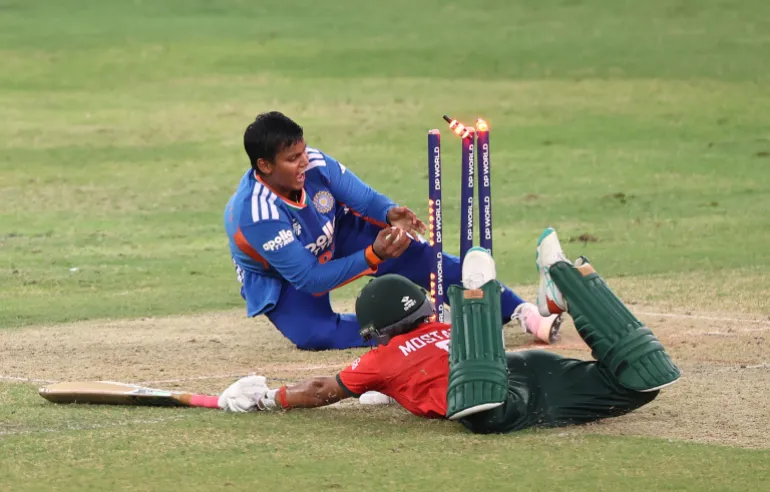
Deepti Sharma attempts to run out Sobhana Mostary during the Women’s T20 Asia Cup semifinal match between India and Bangladesh [Francois Nel/Getty Images]
Who are India’s key players?
India’s openers Shafali and Mandhana are the top two leading scorers in the ongoing edition, having scored 168 and 154 runs each in four matches.
Shafali has registered two half-centuries – scoring identical 64s against Thailand in the opener and Bangladesh in the semifinals – while Mandhana hit an incredible 124 against Hong Kong in the league phase.
With the ball, all-rounder Deepti has been most impactful with her spin bowling, bagging a joint-highest 11 wickets with an average of 3.63.
N Shree Charani has also played a key role with eight wickets and holds the record for the second-most economical bowler (3.27).
Who are Sri Lanka’s key players?
Captain Athapaththu, who bowls right arm off-break, has been Sri Lanka’s most impactful player, sharing the honours of the most wickets with Deepti at 11, with an average of 5.36. Left-arm orthodox bowler Sugandika Kumari has also contributed with six wickets.
With the bat, top-order left-hander Harsthitha Samarawickrama has chipped in 89 runs for the fourth-highest scorer in the competition.
Chamari Athapaththu has been impactful with the ball for Sri Lanka [File: Sameera Peiris/Getty Images]
Form guide
Last five matches, most recent first:
India: W-W-W-W-L
Sri Lanka: W-W-W-W-L
What have the players said?
India’s Deepti Sharma: “[This] team doesn’t take any team lightly … We always think as a team, ‘How we can do better in each and every game. As a collective team performance, how we can do better.’”
Sri Lanka’s Chamari Athapaththu: “If we can execute our plans in the final, I think we can beat any team.”
DRC detected the outbreak of the rare Bundibugyo virus in mid-May; nearly 3,400 people have since died.
Published On 12 Sep 202612 Sep 2026
More than 7,000 Ebola cases have been recorded in the Democratic Republic of the Congo’s (DRC) worst outbreak of the deadly disease, according to figures from Congolese authorities.
The DRC officially detected the latest outbreak in mid-May, but experts suspect it had been spreading under the radar for weeks before.
Recommended Stories
list of 3 itemsend of list
Of the 7,022 registered cases, 3,398 people have died, according to DRC authorities. Currently, 837 people are in isolation or receiving treatment.
The outbreak of the rare Bundibugyo virus, DRC’s 17th Ebola epidemic, began in the northeastern Ituri province.
It has since spread across conflict-plagued, remote eastern and northern regions where armed groups have roamed for decades, the presence of the state is weak and health infrastructure is largely lacking.
Earlier this week, one case of the disease was confirmed in a seventh province, South-Ubangi, which is in the northwest of the country bordering the Central African Republic and Congo-Brazzaville.
Most of the recorded cases remain in Ituri, where Ebola has been detected in schools in the days after the post-summer holiday return to classes, causing alarm among parents and health workers.
“We are very worried because we don’t know which child comes from which family or what the health status of the members of that family is,” Angele Magani, a mother of a schoolboy in Bunia, Ituri’s provincial capital, told the AFP news agency.
“We are so scared, even though the school authorities reassure us about the health measures that have been put in place,” she added.
Bunia school official Roger Mungimbo told AFP that “there is a mandatory hand-washing system with soap, and we have also done everything possible to have a maximum of 30 pupils per classroom”.
“We regularly make the children aware that they must not touch each other, must not greet each other and must wash their hands regularly,” he added.
Ebola, which has killed more than 15,000 people in Africa over the last 50 years, is transmitted through contact with bodily fluids and can cause severe internal and external bleeding and organ failure.
The world’s deadliest outbreak in West Africa in 2014-2016 was the Zaire Ebola virus. That epidemic killed more than 11,325 people, mainly in Guinea, Liberia and Sierra Leone.
The Bundibugyo strain currently seen in DRC has no approved vaccine or treatment currently, although several potential treatments and vaccines are being tested.
The ruling says the Energy Department exceeded its authority by extending the plant’s operation.
Published On 12 Sep 202612 Sep 2026
A federal appeals court has ruled that the United States Energy Department exceeded its authority when it ordered a coal-fired power plant in the US state of Michigan to remain open beyond its planned retirement, dealing a setback to the Trump administration’s effort to keep ageing coal facilities operating.
The US Court of Appeals for the District of Columbia Circuit ruled unanimously on Friday that there was no emergency under federal law that justified keeping the 64-year-old JH Campbell Generating Plant online. Energy Secretary Chris Wright invoked emergency powers last year, arguing that the plant was needed to maintain reliable electricity in the region.
Recommended Stories
list of 3 itemsend of list
President Donald Trump declared a national energy emergency in an executive order in January last year, citing demand increases from artificial intelligence and data centre growth.
Judge Cornelia Pillard, writing for the three-judge panel, said the emergency provision of the Federal Power Act was intended as a “narrow, last-resort backstop.” She said the authority could be used only when immediate action was required, and states or utilities could not address the problem themselves.
Pillard also described the reversal of the plant’s “long and carefully planned retirement” as “disruptive”.
The plant, operated by Consumers Energy, had been scheduled to close in May 2025, but the company has continued operations under energy department orders. That has cost about $259m, according to financial filings, with opponents warning that the expense could ultimately fall on families and businesses in midwestern US states.
The company told The Associated Press it was reviewing the court ruling.
Michigan Attorney General Dana Nessel, a Democrat, whose office joined counterparts in Illinois and Minnesota in challenging the orders, welcomed the ruling. She said the appeals court had “thrown out DOE’s order that had zero basis in reality”.
The Energy Department defended its use of emergency powers, saying the orders helped prevent blackouts and “likely saved hundreds of lives” during periods of peak demand, particularly during severe winter storms in late January and early February.
The department said that during the winter storm peak, coal generation in affected areas increased by 25 percent compared to the previous year.
The Michigan case is one of several legal disputes that have emerged across the country. Secretary Wright issued another emergency order, just hours after the ruling, to a coal plant in Centralia, Washington, to remain in operation. Similar orders have been issued for plants in Indiana, Colorado and Florida, as well as an oil and gas plant in Pennsylvania.
British Prime Minister Andy Burnham maintains that a poll is ‘off the table’ as there isn’t enough popular support for Northern Ireland to leave the UK.
United States President Donald Trump has said that a unified Ireland would be “fantastic”, in remarks made during a visit to Dublin that were not welcomed by government ministers in London.
Trump’s comments on Saturday came weeks after British Prime Minister Andy Burnham said a referendum on Northern Ireland leaving the United Kingdom was “off the table”.
Recommended Stories
list of 3 itemsend of list
“Well, I don’t want to cause any problems, but I will tell you, I’d love to see it unified,” Trump told reporters, while sitting next to Ireland’s Prime Minister, Micheal Martin.
“It’s going to happen eventually … I think it would be a fantastic thing,” he said.
“Now the UK will have something to say about it … but I think it would be a great thing,” he added.
Martin declined to respond to reporters’ questions to comment on the US president’s remarks.
Following Trump’s comments, a spokesperson for Burnham said his position on Irish unification remained unchanged.
Responding to questions from members of parliament on Wednesday about a potential poll in Northern Ireland, Burnham said: “I am not aware that there is majority public support for another referendum, and until that changes, there will not be one”.
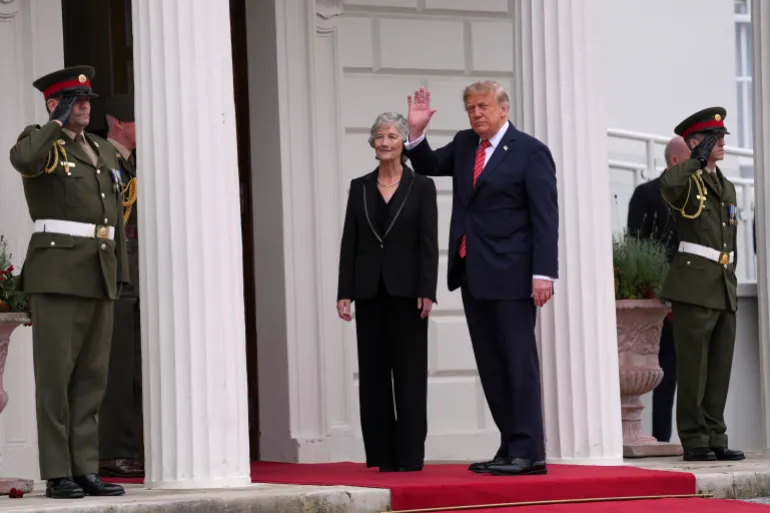
Donald Trump is welcomed by Ireland’s President Catherine Connolly at her official residence in Dublin, September 12, 2026 [Kin Cheung/AP]
Under the terms of the 1998 Good Friday Agreement (also known as the Belfast Agreement), a referendum on leaving the UK can be held only at the discretion of the British government.
The accord ended three decades of violence known as The Troubles. The sectarian conflict involved mostly Catholic nationalist paramilitaries seeking a united Ireland, mostly Protestant unionist paramilitaries wanting to remain part of the UK, and British troops.
Gavin Robinson, leader of the DUP, Northern Ireland’s main unionist party, said that Northern Ireland’s future was a matter for its people to decide, not Trump.
“President Trump knows better than most that elections matter. Northern Ireland’s constitutional future will be decided by the people of Northern Ireland, not by commentary in London, Dublin or Washington.”
While polls show a comfortable majority in Northern Ireland favour remaining in the UK, the gap has narrowed slightly since Britain’s departure from the European Union pushed unity higher up the political agenda.
Trump also met Irish President Catherine Connolly, who was elected head of state last year. When Trump last visited Ireland as president in 2019, Connolly, an outspoken politician with left-wing foreign policy views, protested at Shannon Airport in western Ireland.
During Trump’s current visit, some supporters had urged her to speak out against US military actions around the world and defend Ireland’s neutrality.
People take part in a protest against the visit of US President Donald Trump in the Irish capital Dublin on September 12, 2026 [Adrian Dennis/AFP]
Anti-Trump protests
Anti-war and anti-Trump protests were held in Dublin and some were planned for later in western Ireland, near Trump’s golf course in Doonbeg.
Reporting from the capital, Al Jazeera’s Milena Veselinovic said Dubliners had a “laundry list” of reasons for protesting against Trump’s visit.
“They feel that the Irish government should not be, in their words, rolling out the red carpet for someone like Trump, who they say is a cause of instability in the world and has been enabling Israel’s actions in Gaza … and destabilised the whole of the Middle East.”
Irish people are also protesting against the high cost of hosting Trump, including security, which they say could pay for other things, such as healthcare and social issues, added Veselinovic.
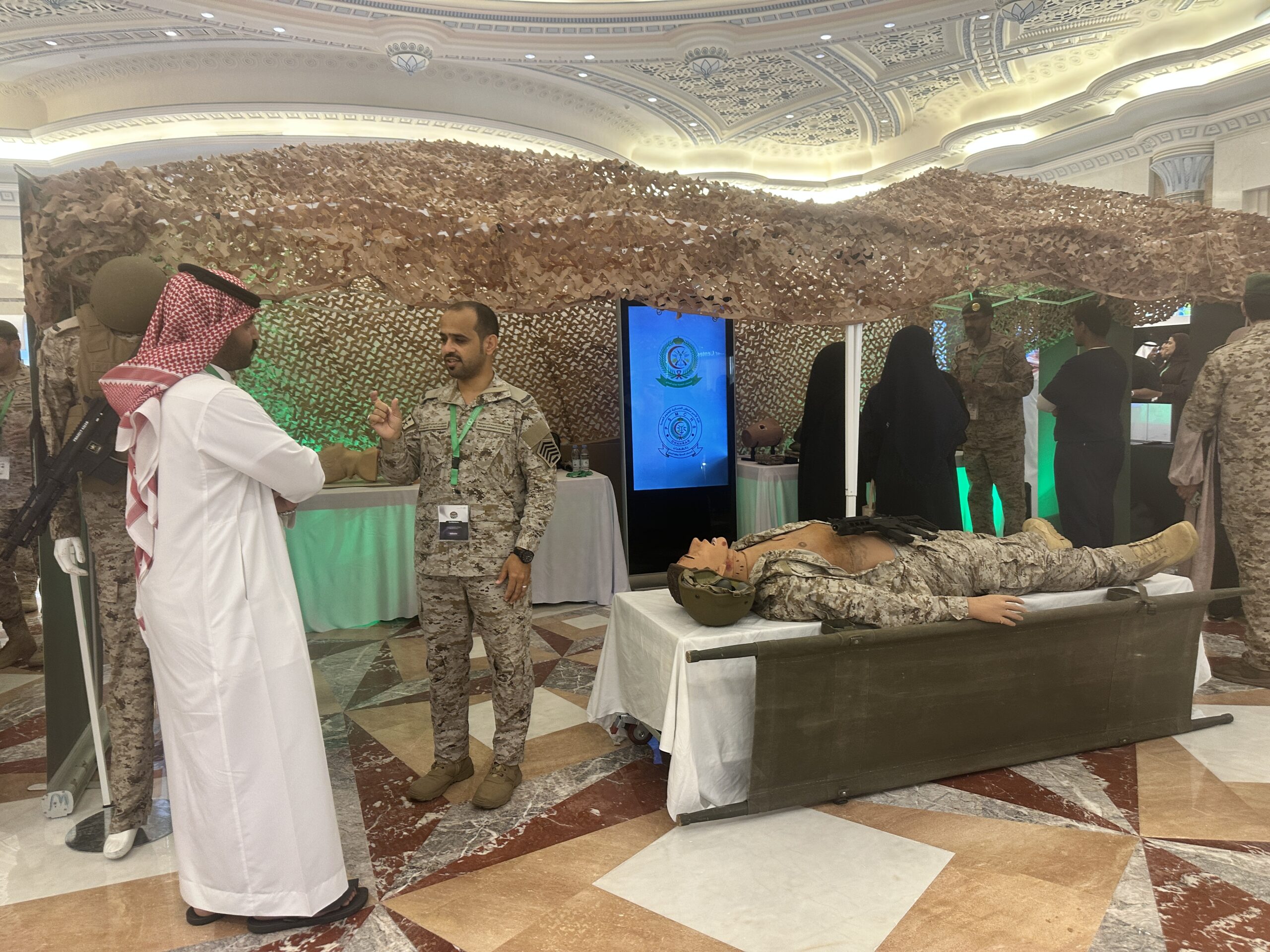
JEDDAH: The 11th Scientific Assembly of the Saudi Society of Emergency Medicine opened in Jeddah on Saturday, bringing together leading experts, specialists and practitioners from Saudi Arabia and abroad.
Held under the patronage of the Ministry of Health until Sept. 14, the event explores the latest practices and innovations, and discusses challenges facing practitioners and the future of the specialty.
This year’s theme, “NextGen EM,” reflects the conference’s focus on supporting the next generation of emergency physicians and practitioners by strengthening their scientific and professional capabilities and connecting them with experienced specialists.
The opening event featured a visual presentation highlighting the importance of emergency medicine, followed by another examining the development and future of the specialty in the Kingdom.
Assistant Minister of Health for Health Services Dr. Mohammed Al-Abdulaali highlighted the rapid development of emergency care and the growing role of technology in the field.
“Emergency departments are among the most rapidly evolving areas of healthcare. Today, one of the first questions being addressed is: What role does artificial intelligence play in emergency medicine?” he said.
“The advances in content, subject matter and technology did not happen by chance. We must advance the science we practice in Saudi Arabia.
“Our role should not be limited to learning, adopting and harnessing knowledge to care for people. We must also play a leading role in contributing to that knowledge, innovating within the field and taking it into new frontiers.”
Addressing emergency department staff, he said: “No one else can truly experience what you do. Words cannot adequately express the importance of your work. You are privileged to care for these lives, and they are fortunate to be in your hands.”
Dr. Roaa Jamjoom, chairperson of the society and a consultant in pediatric emergency medicine, told Arab News that this year’s assembly stood out for its focus on both the present and future of emergency medicine.
“What distinguishes the 11th Scientific Assembly is that we do not only discuss the current state of emergency medicine, but also look ahead to its future,” she said.
“We were keen to bring together the experience of established practitioners and the ambitions of the next generation, while creating opportunities for young professionals to learn, participate and contribute.”
Jamjoom said the gathering also provided a space for exchanging knowledge and strengthening professional connections among practitioners and specialists from different backgrounds.
“NextGen EM reflects our belief that younger professionals are not simply waiting for the future of emergency medicine. They are already helping to shape it,” she added.
Prof. Jameel Abualenain, the society’s president, said: “NextGen EM is not only about the next generation of emergency physicians; it is about the next generation of emergency medicine itself.
“Over the years, the society has grown alongside our specialty. What began as a professional society has become a community that brings together different generations, disciplines and colleagues from across Saudi Arabia and beyond.”
He said the assembly celebrated the society’s journey while looking ahead to the future of emergency medicine. “Every generation inherits something from the one before it: knowledge, experience, standards and, sometimes, challenges.
“Our responsibility is to make sure that the generation after us inherits something better: better emergency care, better education, better science and stronger leadership.”
Addressing younger practitioners, he said: “NextGen EM is not a future you are waiting to enter. You are already part of building it.”
He added that experienced professionals also had a responsibility to open doors, share their knowledge, create opportunities and give the next generation the confidence and space to lead.
“That, to me, is what NextGen EM represents,” he said.
Following the opening ceremony, Al-Abdulaali toured the accompanying exhibition and visited the participating exhibitors’ stands.
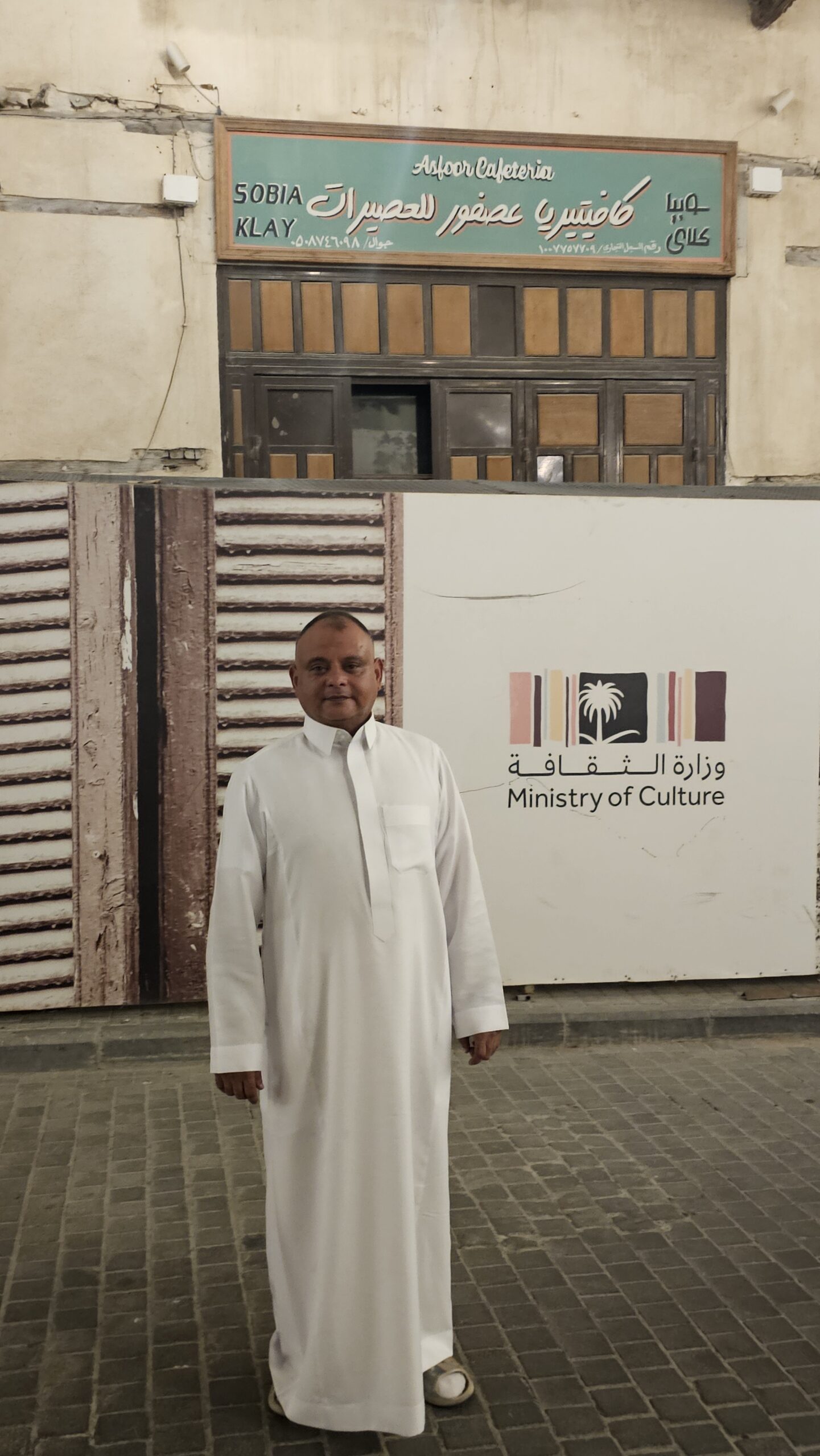
JEDDAH: More than five decades after the greatest heavyweight boxer of all time, Muhammad Ali, visited Al-Balad in Jeddah, the memory lives on through a small family business.
It was 1972 and Mohammed Ba Zaraah was sitting in his cafe, The Bird Shop, when in walked the legendary American fighter and sampled the traditional Hijazi drink, sobia.
It was during Ali’s first visit to the Kingdom to perform Hajj.
Ba Zaraah’s son, Khalid Najee, told Arab News that he was only 12 in 1972 and not in the cafe when the great man came to visit.
“But the story was passed down to me by my father and the shop has remained with the family for more than five decades,” he said.
“My father told me that Muhammad Ali suddenly entered his small shop. He described him as a big man with a nice smile.”
Khalid Najee stands in front of The Bird Shop.
Ali was accompanied by high-ranking Saudi officials and neighbors soon realized that a famous visitor had entered the shop.
Ba Zaraah responded to the unexpected encounter with a gesture of traditional hospitality.
“He immediately offered him sobia,” Najee said. Sobia is a cold drink often made using barley, brown bread or oats soaked in water, with sugar and spices such as cinnamon and cardamom.
For Ba Zaraah, serving Ali a traditional beverage was an instinctive act of hospitality. But after the boxing legend left the visit took on a life of its own in the neighborhood.
“The neighbors started calling my father ‘Clay’ after Muhammad Ali,” Najee said. Ali was born Cassius Marcellus Clay Jr., before adopting the name Muhammad Ali after converting to Islam.
His 1972 pilgrimage to Makkah is well documented, including photographs taken during Hajj.
Asked if he has a photo of the historical visit, Najee said: “Unfortunately, there is no photograph of Ali with my father.”
“There was no camera in the tiny shop that day and the encounter was never expected to become a piece of family history. Instead it survived through memory.”
The old cafe still exists and is currently undergoing restoration as part of the wider preservation and regeneration of Jeddah’s historic district.
For Najee, the restoration project represents an opportunity to carry his father’s story into the future.
“I want to name (it) Clay Sobia,” he said. “It is a tribute to my father and to a moment that connected a small Jeddah shop with one of the world’s greatest sporting legends.”
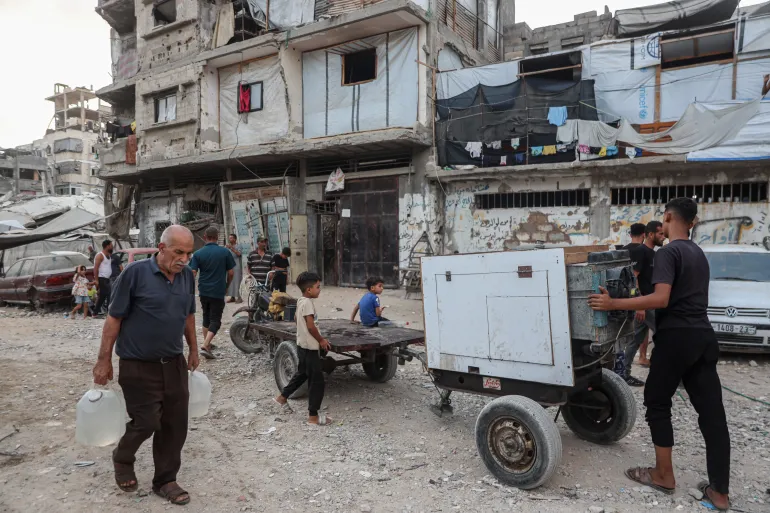
Gaza City, Gaza Strip – For more than four hours, Hajj Rabhi al-Fairi, 79, has been standing outside his home in Gaza City with his children and neighbours waiting their turn to use a small generator.
The generator’s owner pours in the fuel, starts a timer and switches on the machine.
Recommended Stories
list of 4 itemsend of list
Each family gets a few minutes to operate a pump that pushes water up to a storage tank on the roof, before the generator moves on to the next house.
For al-Fairi and his neighbours, this is how they get water.
“We have an old water pump, but there is no electricity to run it. We have to rent a generator,” al-Fairi tells Al Jazeera.
Since the family returned to their home in October 2025, after fleeing a month earlier during Israel’s assault on their neighbourhood, the generator has become a familiar sight on the streets of Nassr.
When it arrives, residents gather around it, each carrying a jerrycan of diesel to operate the machine, which they have to pay for themselves.
“We came back and found the place a tragedy,” he says.
Their neighbourhood and home were badly damaged from years of Israeli bombing, with no municipal electricity or water supplies functioning. The family depends on an old pump – but without electricity, it cannot bring water up to the rooftop tank.
Each family needs only about seven or eight minutes to fill up their tanks, but with the number of flats in their building, the generator needs to be rented for about an hour.
The cost has also risen. Al-Rabhi says families used to pay about 80 to 90 shekels ($26-30) to rent a generator for an hour. At different times, the price has risen to about 100 or 120 shekels ($33-40) an hour, excluding the cost of diesel.
A generator passes through a northern Gaza neighbourhood [Abdelhakim Abu Riash/Al Jazeera]
A generator on wheels
Khalil Abu Ouda, 39, takes a machine mounted on a horse-driven cart from one house to another. The generator’s metal body is covered in black soot and grease, and white smoke rises from the engine when it operates.
At each house, Abu Ouda connects long electrical cables to the water pump. The cables stretch across the street as neighbours gather around the machine to wait their turn.
“Go on, switch it on,” someone calls.
For Abu Ouda, this machine is both a service for the neighbourhood and an essential source of income for his family.
He says there are very few small, mobile generators, like his, left in working condition in Gaza. Many have broken down, while spare parts are difficult to find or too expensive to source due to Israel’s siege.
Mechanics are also expensive to hire, while fuel and engine oil are increasingly scarce and costly.
“If I could, I would lower the price as much as possible,” he says.
At the same time, demand has never been higher.
“People are under pressure and they need water. If I stayed working until morning, I would keep working,” Abu Ouda says.
To cope with the demand, he often works for 10 to 12 hours a day, putting pressure on himself and the machine.
“But this is our livelihood. There is no alternative,” he said.
When the home stops providing
With most Palestinians in Gaza having no home or losing their possessions due to Israel’s genocidal war on Gaza, they have to rent or hire items or services for the most basic household chores.
This includes washing clothes, something once done at home but now impossible to do with no power.
Earlier in the war, Abeer Ghorab, 52, used to wash everything herself. Now she gathers clothes from her tent and takes them to a nearby laundry, where they can be washed and dried in far less time and with less effort.
“When these laundries started opening, they gave us some relief,” Ghorab said.
The difference is particularly important in winter, when heavy clothes, blankets and bedding can take time to dry.
“In winter, the tracksuits are heavy. They need another day to dry,” she said. “When I bring them here, they wash and dry them for me, and I get them back clean and dry. That really helps.”
Abeer Ghorab, 52, a displaced Palestinian woman, takes her clothes to a commercial laundry, paying to wash and dry them as water and electricity remain scarce [Abdelhakim Abu Riash/Al Jazeera]
But due to a limited income, Ghorab cannot afford to use this laundry service every day.
Before the war, Ghorab had a washing machine, a refrigerator and regular electricity at home.
“Things we once took for granted have become dreams. Now we have to pay for every little thing we used to do at home.”
The loss of the household
Across Gaza, the infrastructure that once allowed families to carry out everyday tasks at home has been severely disrupted.
A recent United Nations assessment found that 91 percent of surveyed households experienced moderate-to-high water shortages in early August.
A separate damage assessment by the authority found that 107,941 of the 178,632 housing units inspected – about 60 percent – were severely damaged, destroyed or otherwise considered uninhabitable.
Water systems, electricity, sanitation and household appliances, which families relied on to manage daily life, have also been disrupted.
For families living in damaged homes, tents or makeshift shelters, everyday tasks must be paid for.
A laundry adapting to shortages
Fadi Abu Shawarb, 23, has worked at his family’s al-Hurriya laundry for six years.
Residents now rely on communal washing machines for cleaning clothes [Abdelhakim Abu Riash/Al Jazeera]
Before the war, the business relied on large, 50kg (110lb) washing machines for carpets, blankets and other heavy loads. But due to the high cost of operation, these machines are far too expensive to run.
“We started replacing the 50kg machines with 25kg ones because there is not enough electricity,” Fadi says. “There are no solar panels, no reliable power, and the generators are always breaking down.”
Most of his customers are displaced families who lack electricity, water or washing machines at home.
The laundry now handles about 20 to 30 loads a day, with clothes-washing among the most in-demand services.
A load costs six shekels ($2) when the laundry can use solar power and 12 shekels ($4) when it relies on a generator.
But even that is hard for people to pay. “People’s situation is difficult,” he says.
For Ghorab, the laundry is only one of the many expenses she now has to budget for.
“I feel like I’m going through a difficult time,” she says. “I have to pay for every little thing in my day, and with how difficult things are, it’s hard to keep up with everything.”
The latest developments on the ground in Yemen are so significant that their seriousness cannot be understated. Iran now has an arm on the vital Bab Al-Mandab Strait through its proxy, the Houthi militia, which has seized the port of Mokha and the Yemeni islands in the southern Red Sea.
The Houthis’ aggressive military activities leading up to the attack pointed to one of three possibilities: either they were targeting Saudi areas bordering Yemen to the north, oil facilities in Yemen’s Marib province or the port of Mokha, from which they could go on to threaten international shipping.
The battles of the past few days ended with the seizure of the port of Mokha, Perim Island at the mouth of the Bab Al-Mandab Strait and the islands of Hanish and Zuqar. This confirmed that the operation is an extension of Iran’s activities in the waters of the Gulf. Iran can now halt oil shipping through both the Strait of Hormuz and Bab Al-Mandab. This comes in the decisive weeks leading up to the US midterm elections, meaning that if the Iranians are seeking to resume negotiations with the Trump administration, they will do so under conditions that strengthen their demands.
The issue also has implications for regional security that extend beyond Yemen’s borders. The Houthis now control a port and islands that enable them to threaten shipping and cooperate with Iran-aligned terrorist militias in Somalia.
As for the dynamics of the Yemeni war itself, the Houthis have certainly made significant gains but they have also expanded the front against themselves by seizing areas around Mokha. This vast area will require further confrontations with the Houthis, in addition to forcing them to devote resources to defending the many fronts that have opened for the first time since their defeats in 2018.
The Middle East is going through a dangerous period of turmoil and its flashpoints are interconnected.
Abdulrahman Al-Rashed
In fact, what happened this week resembles what happened nearly a decade ago. Houthi fighters reached the port of Mokha and even pushed beyond it to Dhubab, the last point in southwestern Yemen. It is considered the narrowest point separating Asia from Africa, lying only about 30 km across the sea from Djibouti.
After roughly three years of militia control, coalition forces were able to defeat the Houthis and liberate Mokha, Dhubab and the islands, including Perim and Zuqar.
Yemen’s government forces are going through a period of rebuilding and consolidating their various national forces. This is a difficult task as they work to liberate areas controlled by the Houthis, which are the country’s most densely populated and most rugged regions, amid extremely difficult political and economic conditions. Securing Yemen goes beyond the country’s borders. It also serves regional security and the security of global maritime trade. This requires international support for Yemen, not just support from Saudi Arabia and the countries of the region.
The Middle East is going through a dangerous period of turmoil and its flashpoints are interconnected. We see this in Lebanon, Iraq, Yemen, Somalia and elsewhere, and these challenges require collective cooperation to contain them. Many people underestimate the Yemeni Houthi movement, believing it to be a local problem that can easily be contained militarily or politically. In reality, the Houthis resemble Hezbollah in Lebanon, as well as the Taliban in Afghanistan.
Stopping or containing the threat posed by such armed groups requires a joint effort. The fall of the Assad regime in Syria had consequences that extended beyond its borders, weakening Hezbollah in Lebanon and dismantling part of the region’s network of weapons, drugs and terrorism. Yemen’s forces will not be able to fight the Houthis alone. Regional and international efforts must come together to accomplish the task.
• Abdulrahman Al-Rashed is a Saudi journalist and intellectual. He is the former general manager of Al Arabiya news channel and former editor-in-chief of Asharq Al-Awsat, where this article was originally published.
X: @aalrashed
Abdulrahman Al-Rashed is a veteran columnist. He is the former general manager of Al Arabiya news channel, and former editor-in-chief of Asharq Al-Awsat. Twitter: @aalrashed
TOKYO: Japan strongly condemned the attacks by the Houthis on Saudi Arabia and reiterated its call on them to refrain from escalating the situation both inside and outside Yemen.
“The Houthis’ continued military attacks have resulted in numerous casualties, including among civilians. Japan renews its strong denunciation of the recent series of attacks by the Houthis. Attacks on civilians and civilian facilities, as well as any actions that impede the free and safe navigation of vessels, cannot be tolerated,” Japan’s Foreign Ministry said in a statement on Friday night.
The ministry stressed that stability in Yemen is directly linked to the stability of the entire Middle East, and Japan reiterates the importance of achieving peace in Yemen. It also noted that peace and stability in the Middle East, including ensuring free and safe navigation through the Bab Al-Mandab Strait, are of the utmost importance to the entire international community, including Japan, from the perspective of energy security.
“Japan will continue to make every diplomatic effort, in cooperation with the international community, including Yemen and Saudi Arabia, toward an early de-escalation of the situation,” the statement said.
United States President Donald Trump has made no secret of his hostility towards BRICS.
Last year, he threatened an additional 10 percent tariff on any country aligning itself with what he called the bloc’s “anti-American policies”. Since then, his administration has continued to wield tariffs aggressively against trading partners, including BRICS members such as Brazil, India and China.
The message appears straightforward: Countries that challenge US economic power should expect to pay a price.
But coercion has consequences. And as BRICS leaders meet in New Delhi today, Trump may be strengthening the very incentives that made the bloc attractive in the first place. The more Washington demonstrates its willingness to use access to its markets, its financial system and the dollar as instruments of political leverage, the more reason other countries have to reduce their exposure to them.
This does not mean BRICS is becoming an anti-US alliance. Far from it.
The bloc’s 11 members – Brazil, China, Egypt, Ethiopia, India, Indonesia, Iran, Russia, Saudi Arabia, South Africa and the United Arab Emirates – have enormous political and economic differences. Together, they account for nearly half the world’s population and about 40 percent of global gross domestic product, but they do not share a common ideology, security policy or even geopolitical orientation.
Recent events have made those divisions impossible to ignore. Iran, Saudi Arabia and the UAE find themselves on opposite sides of a growing regional conflict. In May, Iranian and Emirati representatives clashed during a foreign ministers’ meeting in New Delhi. India and China have had a heated border dispute that led to deadly skirmishes in 2020-2021; only in the past two years have their relations gradually stabilised.
So Trump is not producing a united geopolitical front against Washington.
He may, however, be giving countries with otherwise divergent interests a common reason to cooperate economically: Protection against vulnerability to US power.
For countries outside the Western core, dependence on US-centred economic infrastructure carries risks.
The dollar’s centrality gives the US enormous structural advantages. International transactions pass through financial institutions subject to US jurisdiction; access to US markets can be restricted; sanctions can isolate governments and companies from parts of the global financial system.
BRICS’s efforts to diminish dependence on the US financial system do not mean the dollar is about to lose its position as a global reserve currency. This claim is often made around BRICS summits, usually accompanied by breathless predictions of a new BRICS currency. The evidence does not support it.
The dollar remains overwhelmingly dominant. According to the International Monetary Fund, it accounted for 57.1 percent of global foreign-exchange reserves in the first quarter of 2026. The Chinese renminbi accounted for just 2 percent. Indeed, the dollar’s share rose slightly during the quarter.
But replacing the dollar and reducing dependence on it are two very different things.
BRICS countries are already experimenting with the latter. South Africa has connected to China’s Cross-Border Interbank Payment System, allowing transactions with China to be settled directly in renminbi. Brazil and China are increasingly using their own currencies in bilateral trade, while India and the UAE have settled transactions in rupees and dirhams. China and Russia have shifted much of their bilateral trade into their national currencies.
BRICS itself is also moving cautiously towards greater financial connectivity.
Last year, its leaders called for continued work on a cross-border payments initiative and greater interoperability among members’ payment systems. In August, Reserve Bank of India Governor Sanjay Malhotra confirmed that BRICS countries are discussing linking their fast-payment networks and potentially their central bank digital currencies. India itself is also encouraging greater use of the rupee in international trade.
The New Development Bank offers another example. Established by the original BRICS countries as an alternative source of development finance, it has made lending in members’ currencies an explicit strategic objective. Its current strategy targets 30 percent of financing in local currencies, partly to reduce borrowers’ exposure to foreign-exchange risks and costly currency swaps; the number could increase to 40-50 percent for the next cycle, 2027-2031.
None of this amounts to a rival global financial system. Much of it remains experimental, bilateral or limited in scale.
But that is precisely why the fixation on whether BRICS can “replace” the dollar misses what is happening. The more significant development is the gradual construction of options that allow governments and businesses to conduct a number of transactions without relying on the dollar and Western-dominated financial infrastructure.
Trump’s policies give this process additional urgency.
Consider Brazil. Washington imposed a new 25 percent tariff on a range of Brazilian products in July, affecting billions of dollars in exports, despite running a trade surplus with the country. The Trump administration has also scrutinised Brazil’s hugely successful Pix instant-payment system, which competes with established card-payment networks.
Sanctions demonstrate the same vulnerability more dramatically. Russia and Iran have been pushed towards alternative payment and trading arrangements precisely because their access to Western financial networks has been restricted. Washington is now considering further measures that could penalise countries heavily reliant on Russian energy, including China and India.
No BRICS member needs to sympathise with Moscow or Tehran to understand what this implies.
US financial power depends not simply on possessing the world’s largest economy or issuing its dominant currency. It also depends on other countries continuing to regard participation in a US-centred system as more advantageous than the alternatives.
The more frequently Washington turns that system into an instrument of coercion, the stronger the incentive to construct escape routes from it.
That said, most BRICS countries do not appear eager to exchange dependence on Washington for dependence on Beijing.
India maintains extensive relations with the US while buying Russian energy and pursuing closer economic cooperation within BRICS. Brazil has long sought greater autonomy without becoming a Chinese satellite. Saudi Arabia and the UAE remain deeply intertwined with Western economies while expanding their relationships with China.
Their objective is less likely to be replacing one hegemon with another than increasing their ability to manoeuvre between competing centres of power.
That distinction matters. A trade transaction settled in rupees, a loan denominated in renminbi or rand, or a payment made through a system that does not depend on the same Western intermediaries will not overthrow dollar dominance.
But multiply such arrangements across countries and over time, and they begin to reduce the costs of saying no to Washington.
This is why portraying BRICS simply as an anti-US threat risks becoming self-defeating. Punishing countries for seeking alternatives gives them another reason to develop those alternatives.
Trump wants to make challenging US power costly. Instead, he may be making dependence on US power costlier still.
The views expressed in this article are the author’s own and do not necessarily reflect Al Jazeera’s editorial stance.
Protesters and police have clashed in Chile, as the country marked 53 years since Augusto Pinochet overthrew President Salvador Allende in a US-backed coup. Many Chileans say the current far-right government is trying to rehabilitate Pinochet’s image.
NEW YORK: Big-serving Ben Shelton overpowered US compatriot Frances Tiafoe in four sets on Friday to reach the first Grand Slam final of his career, booking a US Open title showdown with Alexander Zverev.
Eighth-seeded Shelton blasted 20 aces on his way to a thrilling 4-6, 6-3, 6-3, 7-5 victory on the Arthur Ashe Stadium court.
Top seed Zverev held off 50th-ranked Russian Karen Khachanov 6-3, 7-6 (9/7), 7-6 (8/6) to reach his third straight Grand Slam final – a run that delivered his maiden major at the French Open and saw him finish runner-up at Wimbledon.
Shelton – who took down defending champion Carlos Alcaraz in the quarter-finals – will now have the chance to become the first American man to win a Grand Slam title since 2003, when Andy Roddick triumphed at the US Open.
“It’s a lot of emotion,” Shelton said in an on-court interview. “My dad, my mom have sacrificed a lot for me to be in this position today. My dad lost his mom earlier this year, and she’s the reason that he was able to play tennis.
“Without her, there’s no Ben Shelton standing here today. So this one is for her. And I’m gonna need you guys on Sunday to bring the energy. I’m going for it. I’m gonna leave it all on the court.”
Zverev is eager for the chance to play spoiler.
“Hopefully I can not make the American dream come true on Sunday,” the German said.
The pulsating all-American semi-final played out in front of a star-studded crowd, with tennis legends including Serena Williams, Stan Smith and Lindsey Davenport on hand along with actors Ben Stiller and Rami Malek and New York Knicks star Jalen Brunson.
Tiafoe claimed the first set after Shelton uncharacteristically double-faulted to trail at 5-4.
They traded breaks early in the second, but Shelton took advantage of Tiafoe’s increasingly erratic serve to break for a 5-3 lead and level the match.
The momentum was all with Shelton, who broke for a 3-2 lead then seized the set with a break in a marathon ninth game that went to deuce seven times.
The tension was mounting in the fourth set, but Shelton kept his composure as Tiafoe raised his level and gained the crucial break in the final game.
On Sunday he’ll be up against an experienced opponent in Zverev, who after laboring through two five-setters to open the tournament has steadily upped his game.
‘Anything but straightforward’
Zverev doused Khachanov’s hopes of reaching a first Grand Slam final, although the Russian – who fell to Zverev in the Olympic gold medal match in Tokyo in 2021 – put up a spirited challenge in the second and third sets.
“Straight-set win, but anything but straightforward,” Zverev said. “He played incredibly well, fought incredibly well.”
Khachanov denied Zverev on two set points in the second set tiebreaker with a thumping forehand and a brilliant backhand down the line before Zverev closed out the set.
Neither player mustered a break point in a tense third set. But when Khachanov took a 6-4 lead in the tiebreaker he surrendered both set points with forehand errors. Zverev came up with his 15th ace and sealed the win when Khachanov sent a forehand long.
“Second and third set I think it’s more than obvious that they could have gone both ways,” Zverev said. “I just played a few points better here and there.”
A somber note was struck during the national anthem ceremonies of both the day and night sessions on the 25th anniversary of the September 11 attacks that brought down the twin towers of the World Trade Center in New York.
“It’s a difficult day to be out here playing,” Shelton said in his remarks to the crowd. “My thought and payers go out to all the families affected by 9/11.”
The women’s final is on Saturday, when Kazakhstan’s Elena Rybakina will try to deny Aryna Sabalenka a third straight title just days after ending the Belarusian’s near two-year reign atop the world rankings by reaching the semi-finals.
RIYADH: Perched atop Mount Munikh west of Al-Majmaah, the historic Munikh Observatory offers a striking example of how traditional Najdi builders used natural terrain and local materials to defend settlements and monitor the surrounding landscape.
Rising about 25 meters above the mountain, the watchtower commands panoramic views of Al-Majmaah and the surrounding farms. Its elevated position once allowed guards to watch approaches to the settlement through narrow openings built into its thick walls.
Historical sources, including writings by Al-Hamdani, associate the name “Munikh” with an ancient town near the mountain. The observatory’s origins are traditionally dated to the 15th century, with the watchtower at the summit specifically dated to 820 AH, or 1417 CE.
What was once a military outpost overlooking a Najdi settlement has been transformed into a year-round cultural destination.
The site was traditionally known as a marqab, or observation post, and formed part of a broader defensive network surrounding the settlement. A stone wall once encircled Al-Majmaah, following the mountain’s natural ridges and incorporating three defensive bastions.
Much of the ancient outer wall was absorbed by modern urban development, but the section on Mount Munikh remains preserved. Its features include thick, tapering stone foundations and strategically placed firing slits designed for defense and surveillance.
The main structure consists of two cylindrical towers, one nested within the other, rising about 12 meters. Local stone was used for the lower sections, while the upper levels were built of mud brick. Tamarisk wood was used for ceilings and lintels, reflecting the builders’ reliance on materials readily available in the Najd environment.
Five projecting defensive balconies strengthened the structure, with four positioned to protect the flanks and another covering the main entrance. The towers are topped with traditional Najdi crenellations, while specialized openings allowed defenders to monitor and respond to threats.
Rising about 25 meters above the mountain, the watchtower commands panoramic views of Al-Majmaah and the surrounding farms
The observatory originally served as an early-warning post, with night-fire beacons used to signal approaching danger. Following the unification of the Kingdom, its vantage point was also used to monitor trade caravans, seasonal floods and pilgrim routes.
Mount Munikh occupies a strategic position in the historic Sudair region of the Najd plateau, about 180 kilometers northwest of Riyadh. Al-Majmaah was once known as “Baldat Munikh,” reflecting the mountain and its importance to the settlement.
The Heritage Commission has in recent years restored the observatory and sections of its fortified walls, adding visitor paths, stone staircases and lighting to improve access while preserving the site’s historic character.
Much of the ancient outer wall was absorbed by modern urban development, but the section on Mount Munikh remains preserved. (SPA)
A Visitor Center now provides an introduction to the history of Al-Majmaah, Mount Munikh and the watchtower. Bilingual interactive exhibits and guided stations offer visitors a closer look at the region’s architectural and defensive heritage.
What was once a military outpost overlooking a Najdi settlement has thus been transformed into a year-round cultural destination, linking Al-Majmaah’s modern visitors with the landscape and traditions that shaped its past.
South Korea said it boosted its surveillance posture and was closely exchanging information on the launches with the US and Japan.
Published On 12 Sep 202612 Sep 2026
North Korea has fired ballistic missiles towards the sea off its eastern coast, according to South Korea’s military.
South Korea’s Joint Chiefs of Staff (JCS) said that it detected several missiles launched from North Korea’s eastern coastal area of Wonsan about 5:20am on Saturday (20:20 GMT on Friday), which flew about 250 kilometres (155 miles). It added that it is closely exchanging information on the launches with the United States and Japan.
Recommended Stories
list of 4 itemsend of list
South Korea’s presidential National Security Office said it held an emergency security meeting with the Defence Ministry, the JCS and other relevant agencies following the launch.
The US Pacific Command said North Korea’s launch event does not pose an immediate threat to US territory or to its allies, adding that Washington remains committed to the defence of South Korea and its other allies in the region.
The missiles were launched a day after South Korea concluded five days of joint maritime drills with the US and Japan that were focused on North Korea.
Hours after the exercises began on Monday, North Korea’s defence minister, Kim Song Gi, criticised the exercise and warned North Korea was capable of taking “strong and reflective countermeasures from the standpoint of power”.
Late last month, North Korea slammed plans for the so-called Freedom Edge exercises in international waters off South Korea as a “threat” to Pyongyang and other countries in the region.
The North also fired a barrage of missiles into the sea on August 20, despite an overture from US President Donald Trump, who said he planned to meet this year with North Korean leader Kim Jong Un.
Participate in a range of activities and games, including rope and ninja courses, soft play, interactive rooms, water play, free-fall experiences, slides, and karting. For booking details, visit webook.com .
RIYADH: Gulf and Muslim organizations on Saturday condemned a drone attack on Saudi Arabia’s East-West oil pipeline, expressing solidarity with the Kingdom and warning that the strikes represented a dangerous escalation threatening regional security and vital infrastructure.
The Gulf Cooperation Council (GCC), Muslim World League (MWL), Organization of Islamic Cooperation (OIC), Qatar and Bahrain issued statements early Saturday after several drones originating from Iraqi territory targeted the pipeline in the Riyadh and Madinah regions, causing injuries and material damage.
GCC Secretary-General Jasem Mohamed Albudaiwi condemned the attack “in the strongest terms,” describing it as “a dangerous escalation and an unacceptable threat” to Saudi Arabia’s security, territorial integrity and vital installations. He said the attack was also a “flagrant violation” of international law.
Albudaiwi reiterated the GCC’s categorical rejection of actions targeting Saudi Arabia’s security, stability and national assets. He called on the Iraqi government to intensify its efforts and take “necessary, decisive measures” to prevent its territory from being used as a launchpad for attacks, stop such operations and deter their recurrence.
He reaffirmed the GCC’s “complete and steadfast solidarity” with Saudi Arabia and its support for measures the Kingdom takes to protect its security, sovereignty, facilities, citizens and residents.
Qatar likewise condemned the attack “in the strongest terms,” saying the targeting of civilian and economic facilities was a “flagrant violation of international law” and a dangerous escalation that could undermine regional security and stability.
Qatar’s Foreign Ministry commended what it described as Saudi Arabia’s responsible approach in supporting the Iraqi government’s efforts to prevent its territory from being used to launch attacks against Saudi Arabia and neighboring countries. It expressed full solidarity with the Kingdom and support for measures to protect its sovereignty, security and facilities.
Bahrain’s Foreign Ministry also strongly condemned the attack, describing it as a flagrant violation of international law, the UN Charter and the principles of good neighborliness. It said the targeting of vital civilian facilities threatened the security of energy supplies.
Bahrain affirmed its full solidarity with Saudi Arabia, stressing that the Kingdom’s security and stability were “an integral part” of Bahrain’s own security and stability. It also recognized Saudi Arabia’s right to take all necessary measures under international law to protect its sovereignty, security, facilities, citizens and residents, and expressed wishes for a speedy recovery for those injured.
The Bahraini ministry called for preventing the territory of any country from being used as a launching pad for attacks against neighboring states. It voiced support for Iraq’s efforts to prevent a recurrence and urged the international community to assume its responsibilities in confronting attacks aimed at harming energy security and destabilizing regional security and stability.
The map illustrates alternative long-term routes for exporting Gulf crude oil, bypassing the Strait of Hormuz, highlighting existing, planned, and under-discussion pipelines across the Middle East, including Saudi Arabia, UAE, Iraq, and Syria.
The Muslim World League also strongly condemned the strikes. Its secretary-general, Sheikh Mohammed bin Abdulkarim Al-Issa, described the attacks as “treacherous criminal attacks” that violate religious values, laws, international norms and humanitarian principles.
Al-Issa said the league, its bodies and global councils, as well as Muslims under its umbrella, stood in full solidarity with Saudi Arabia in measures taken to deter the attackers, preserve its security and sovereignty, and protect citizens and residents.
The OIC also strongly condemned the attack, Al-Ekhbariyah said in a post on X.
Temporary shutdown
The Saudi Energy Ministry said Friday that the pipeline had been temporarily shut down as a precaution after multiple attacks Thursday morning. Several people were injured and received medical treatment, while emergency and specialized technical teams were deployed to secure the pipeline and assess its condition.
The Saudi Foreign Ministry said the drones were launched from Iraq and that Riyadh had decided not to retaliate at this stage following a request from Iraqi Prime Minister Ali Al-Zaidi.
Saudi Arabia said it would give the Iraqi government an opportunity to take the necessary measures to prevent attacks launched from Iraqi territory against the Kingdom and neighboring countries, while reserving the right to take all measures necessary to protect its sovereignty, security, facilities, citizens and residents.
Iraq condemned attacks threatening Saudi security and stability and ordered an urgent investigation into the militia responsible and parties supporting it. Baghdad said its territory and airspace would not be allowed to serve as a launchpad for attacks against any country.
The pipeline shutdown comes as the East-West route has assumed greater importance amid the wider regional conflict and threats to shipping through the Strait of Hormuz. The roughly 1,200-kilometer pipeline carries Saudi crude from fields in the Kingdom’s east to the Red Sea port of Yanbu, providing an alternative route that bypasses Hormuz.
The attack also followed a series of strikes by Iran-backed Houthi forces in Yemen against Saudi civilian and energy infrastructure. Earlier in the week, attacks targeted Abha, Khamis Mushait, Jazan and Najran, causing fires at oil facilities and temporarily disrupting some operations, according to the Saudi Energy Ministry. Those attacks wounded 73 civilians, including women and children.
The latest pipeline attack has heightened concerns over the security of Saudi Arabia’s energy infrastructure at a time when regional hostilities are threatening multiple routes for Gulf oil exports.
NEW YORK: An Iranian American jeweler from New York has been released from prison in Iran, but he is prohibited from leaving the country, according to his family and federal officials.
Kamran Hekmati was let out of Tehran’s notorious Evin prison on Sept. 5 after completing about half of a two-year sentence, his family recently wrote on a website advocating for his release.
The family said they are also “desperately afraid for his health and well-being” as he requires regular medical checkups to ensure his bladder cancer doesn’t relapse.
“The Iranian regime couldn’t care less,” the family wrote of Hekmati’s medical challenges. “Much like other wrongful detention cases in Iran, Kamran appears to be caught up in Iran’s traditional approach of detaining Americans to obtain political concessions from the US.”
Representatives for the family and the federal government didn’t say where Hekmati, who turned 62 in August, is currently staying in Iran.
But Shohreh Nowfar, Hekmati’s cousin in California, said Friday that the family is “excited” and hopeful that his passport can be returned soon so he can leave the country, which has been at war with the US and Israel for more than six months now.
“We continue to hope this is a signal from the Iranian side as to their willingness to send Kamran home,” added Kieran Ramsey, chief investigative officer at Global Reach, a US nonprofit working on Hekmati’s case.
The Iranian American, who is also Jewish, owns a jewelry business in Manhattan’s Diamond District and has lived with his family for years in Great Neck Estates, on suburban Long Island.
He was arrested by Iranian authorities last July after having his passport seized while trying to fly out of the airport in Tehran that May.
Hekmati’s family says he was charged under an Iranian law that bans Iranian citizens from visiting Israel within the last 10 years. But they maintain his last trip to Israel was 13 years ago — prior to the passage of the law — for his son’s bar mitzvah.
“Mr. Hekmati did nothing wrong,” said US Rep. Thomas Suozzi, a Long Island Democrat who advocated for the State Department to officially designate Hekmati as wrongfully detained earlier this year. “We cannot rest until he is reunited with his family.”
The State Department similarly called on Iran to lift its so-called exit ban so Hekmati can return to the US It also said the country should “immediately release” Iranian American journalist Reza Valizadeh and other Americans “unjustly detained in Iran.”
Valizadeh and Hekmati are the two Americans so far officially designated as wrongfully detained in Iran, while up to eight others who have not been publicly named are prohibited from leaving the country, according to Ramsey.
Valizadeh’s lawyer, Ryan Fayhee, declined to comment Friday, citing the risks his client could face behind bars.
But in recent months, the journalist has sent voice messages describing conditions inside Evin prison, a high-security facility that holds many of the Islamic Republic’s political prisoners.
In an August recording, Valizadeh, who has been imprisoned since 2024, said prison officials have not allowed his family to visit for the past five months. He also said medical care is “almost non-existent,” save for the most basic medications.
“Diseases that were eradicated decades ago have returned inside the prison, including pulmonary and gastrointestinal tuberculosis,” he said in the voice message, which was shared by CBS.
Valizadeh also said that prior to his release, Hekmati had been granted a medical furlough for cancer treatment but was ordered back to prison after about a month, rather than being allowed to begin chemotherapy.
Valizadeh is among at least nine reporters currently jailed in Iran, according to the Committee to Protect Journalists.
He was arrested after returning to Iran to visit his elderly parents and charged with collaborating with the US government.
Valizadeh obtained US citizenship in 2022 while working in Washington, D.C., for Radio Farda, the Persian-language arm of Radio Free Europe, which receives US government funding.
A powerful movement is happening in farming today—farmers are reconnecting with their roots to fight climate change.
For one woman, that’s meant learning her tribe’s history to help bring back the buffalo. For another, it’s meant preserving forest purchased by her great-great-uncle, among the first wave of African Americans to buy land.
Others are rejecting monoculture to grow corn, beans, and squash the way farmers in Mexico have done for centuries. Still others are rotating crops for the native cuisines of those who fled the “American wars” in Southeast Asia.
In “Healing Grounds,” Liz Carlisle tells the stories of Indigenous, Black, Latinx, and Asian American farmers who are reviving their ancestors’ methods of growing food.
The rapid Houthi advance down Yemen’s Red Sea coast this week is an astonishing military victory, but not quite the game-changer it is being portrayed as.
The group has been able to threaten the vitally important shipping route, but they have been doing so since 2023. This new victory consolidates that control, proving that Yemen’s government is not currently in a position to defeat them.
Recommended Stories
list of 3 itemsend of list
The prior Houthi control over the northern section of Yemen’s Red Sea coastline, including the major port city of Hodeidah, has allowed the Iran-allied rebel group, for years, to first attack shipping linked to Israel and the United States – and then, in recent months, Saudi Arabian-linked vessels.
That control also damaged the global economy. Long before the US war with Iran and the transformation of the Strait of Hormuz into a tool to throttle international trade, Houthi attacks around Yemen had turned Bab al-Mandeb into a similar weapon, and led to bombing campaigns against the Houthis by the US, the United Kingdom, and Israel.
Houthi officials themselves have emphasised this, with one leading official, Abdulqader al-Murtada, saying earlier this week that the group did “not need control over Bab al-Mandeb, for the blockade [on Saudi ships] is already in place”. Al-Murtada could point Saudi ships that have avoided Bab al-Mandeb since the Houthis began attacking them in July, even before their latest progress.
However, the Houthi lightning advance makes it even easier for the group to disrupt shipping. They now have access to the Red Sea’s narrow entry point and several islands in it, allowing them to use shorter-range weapons and more easily reach vessels they want to attack and board, as well as potentially using sea mines to further restrict shipping.
Not going away
The increase in the Houthi ability to target shipping – even with the caveats outlined above – does have an impact on market sentiment. Oil prices have increased as traders price in the ability for Iran and its allies to disrupt shipping in Hormuz and Bab al-Mandeb, the two maritime chokepoints of the southern Arabian Peninsula.
However, the consequences of this advance are not limited to the increased ability of the Houthis to attack shipping, but to the increasing reality that the Houthi problem on the Red Sea is not going away.
For months, after Saudi Arabia backed a Yemeni government campaign against southern Yemeni separatist forces earlier this year, the mood had shifted in the country’s anti-Houthi camp.
The perception was that the Yemeni government, led by the Presidential Leadership Council, had finally gotten its act together. President Rashad al-Alimi repeatedly spoke of a unified military chain of command, allowing the military to overcome the divisions blamed for its inability to defeat the Houthis.
Yemeni and Saudi officials had hinted at an anti-Houthi campaign all year. The Red Sea coastline was a possible location: the largely flat geography suited the government, allowing Saudi Arabia to effectively use its air power; much of the population is not made up of the Houthis’ traditional support base; and prior Houthi attacks on Red Sea shipping meant that there would likely be international buy-in for such a campaign.
The seizure of the Red Sea coastline has broken all of those narratives.
The momentum the Yemeni government thought it had, even at the start of this week when it claimed advances in al-Jawf, to the east of the Houthi-controlled capital Sanaa, is now gone.
After months of projecting unity, Yemen’s anti-Houthi camp is once again turning on itself, trading accusations of blame for the defeat.
Saudi dilemma
The message the Houthis have for Saudi Arabia is clear: ‘Your partners in Yemen can’t defeat us.’
Therefore, the potential Houthi argument is that Saudi Arabia has to make a deal with them and agree to their terms, including Riyadh funding public sector salaries, access to income from Yemen’s oil and gas reserves, and no restrictions on flights and shipping to Houthi-controlled ports.
The Houthis have an incentive to lock in their gains and raise the cost of escalation before Saudi-backed Yemeni forces can reorganise.
Their attacks on Saudi Arabia, escalating in the past week, have been damaging, and the group is promising more if Riyadh increases its military support for the Yemeni government.
The risk of any such intervention is clearly there for Saudi Arabia. But so is the risk of inaction. The Houthis have repeatedly demanded more concessions when they were in positions of strength.
With the Yemen war unresolved, the Houthis may decide to escalate again in the future, even if a deal is agreed now.
And so, policymakers in Riyadh could determine that it makes more sense to make a concerted effort to deal with the problem head-on now, rather than allow it to fester into the future.












![A generator passes through a northern Gaza neighbourhood [Abdelhakim Abu Riash/ Al Jazeera]](https://i0.wp.com/occasionaldigest.com/wp-content/uploads/2026/09/873A2309-copy-1789208507.jpg?w=640&ssl=1)
![Abeer Ghorab, 52, a displaced Palestinian woman, takes her clothes to a commercial laundry, paying to wash and dry them as water and electricity remain scarce. [Abdelhakim Abu Riash/ Al Jazeera]](https://i0.wp.com/occasionaldigest.com/wp-content/uploads/2026/09/873A2195-copy-1789208594.jpg?w=640&ssl=1)
![Residents wait for a mobile generator to reach their homes so they can pump water, paying by the hour to use the machine [Abdelhakim Abu Riash/ Al Jazeera]](https://i0.wp.com/occasionaldigest.com/wp-content/uploads/2026/09/873A1950-copy-1789208427.jpg?w=640&ssl=1)


