An Immigration and Customs Enforcement officer has fatally shot a motorist in Maine, the second ICE-related fatality by force this week. Protesters took to the streets of Maine, demanding accountability.
Hungarian parliament passes amendment that would remove President Sulyok, appointed under ex-Prime Minister Viktor Orban.
Published On 14 Jul 202614 Jul 2026
Hungary’s parliament has approved a constitutional amendment to remove President Tamas Sulyok from his largely ceremonial position, the latest move to dismantle the power of figures associated with former Prime Minister Viktor Orban.
The measure, passed on Monday with 139 votes in favour and only six opposing, would immediately bring an end to Sulyok’s term in office and pave the way for parliament to elect a new president.
Recommended Stories
list of 3 itemsend of list
Hungarians voted out the right-wing nationalist Orban in April, with new Prime Minister Peter Magyar’s Tisza Party winning in a landslide. The election result ended 16 years of power for Orban’s Fidesz party, which had come to dominate many aspects of the country.
Since Magyar’s victory, he has sought to erode that power, including by removing the current president. The constitutional amendment also introduces a series of judicial reforms, creates a body to investigate alleged financial abuses under the previous government, and imposes a 12-year term limit on lawmakers.
Sulyok now has five days to sign the constitutional amendment passed by parliament. Magyar has said that parliament will launch an impeachment procedure against Sulyok if he does not sign it.
The president and other members of Fidesz boycotted Monday’s parliamentary session.
Sweeping away the old order
The parliament elected Sulyok, a former chief of the Constitutional Court of Hungary, in February 2024. He was nominated to replace Katalin Novak, who resigned after pardoning a man convicted of covering up child sexual abuse.
But days after Magyar’s centre-right Tisza Party won a two-thirds parliamentary super-majority in April, the new prime minister declared Sulyok “unworthy to embody the unity of the Hungarian nation” and demanded that he leave office once the new government was formed.
In June, after the deadline to resign had passed, Magyar branded the president a “puppet” of Orban and promised to strip him and other holdovers from office by constitutional means. Weeks later, he unveiled a reform programme, dubbed “Operation Cleansing Fire”, which seeks to install a new constitution, purge state institutions and establish an anticorruption office.
While the presidency is a largely symbolic post, it is empowered to approve laws and can refer them to the Constitutional Court for review, raising fears that Sulyok might use his presidential powers to stymie Tisza’s ambitious reform agenda.
The jailing of one of Indonesia’s most influential entrepreneurs in a controversial corruption case has raised fears of damage to investor confidence in Southeast Asia’s largest economy.
Nadiem Makarim, the cofounder of the popular super-app Gojek, was last month sentenced to 10 years in prison for allegedly abusing his authority while serving as the country’s education minister.
Recommended Stories
list of 4 itemsend of list
Makarim was found guilty of giving favourable treatment to Google, an early investor in Gojek, when procuring Chromebook laptops for schoolchildren during the COVID-19 pandemic.
Prosecutors argued that Makarim, who served as former Indonesian President Joko Widodo’s education minister from 2019 to 2024, inflicted state losses of $120m, alleging that he should have been aware the laptops would not work in remote areas with poor internet access.
Critics of the prosecution have argued that the case against Makarim lacks evidence and that the startup founder-turned-politician is the latest victim of a campaign of political retribution being waged by the administration of Indonesian President Prabowo Subianto.
Nicky Fahrizal, a researcher of politics and social change at the Centre for Strategic and International Studies (CSIS) in Jakarta, said foreign investors will inevitably think twice before committing capital to Indonesia following the verdict.
“The Nadiem case, along with a string of similar incidents, has served as a warning signal to investors,” Fahrizal told Al Jazeera.
“For them, non-economic factors, such as legal certainty and the quality of the judicial system, are absolute prerequisites.”
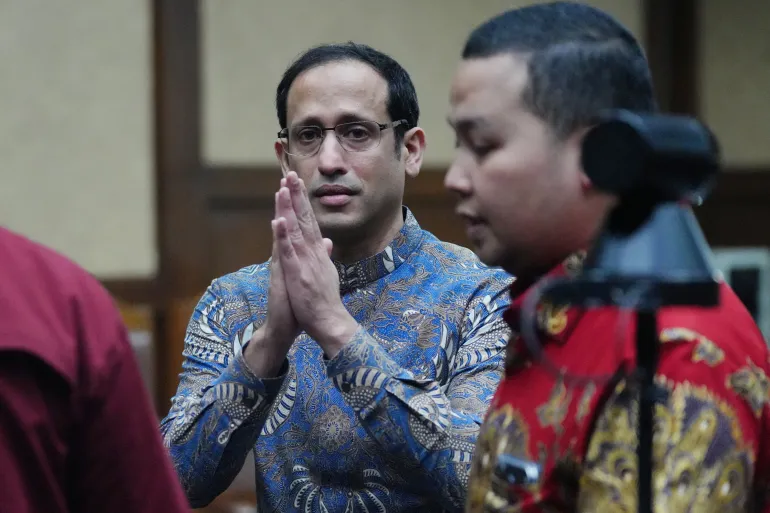
Nadiem Makarim gestures after being sentenced in a laptop procurement corruption case at the Indonesian Court for Corruption Crimes in Jakarta, on June 30, 2026 [Tatan Syuflana/AP]
Makarim was found guilty by a panel of five judges on June 30, following charges related to the procurement of more than 1 million laptops intended for use in schools in remote and impoverished areas.
At the trial held at the Indonesian Court for Corruption Crimes in Jakarta, prosecutors alleged that Makarim deliberately tailored the tender specifications to favour Google, which invested in Aplikasi Karya Anak Bangsa (AKAB), Gojek’s then-parent company.
Scrutiny of the tender process first arose among the public after it emerged that the Chromebooks often did not work in remote areas, raising questions about how Google was chosen in the first place.
“Choosing a device that relies on an internet connection amid uneven infrastructure… demonstrates a mismatch with needs…” Judge Sunoto said during the sentencing.
Following the verdict, prosecutor Corneles Geeb Paulus hailed the outcome as a victory for “the schoolchildren whose rights were taken away and who were deprived of equitable access to digital education across Indonesia”.
Google has denied providing or offering authorities any inducements to win the tender.
The California-based tech giant, which has a market value of more than $4 trillion, was not indicted in the case.
“From a legal standpoint, authorities seem to have hit a wall in their efforts to secure sufficient evidence and establish the necessary criminal nexus to prosecute the corporation,” the CSIS’s Fahrizal said.
“From a political perspective, Google is a tech giant with immense business influence.”
Taking action against Google could have jeopardised the government’s ongoing digitalisation efforts, Fahrizal added, describing the company as “too big to fail” within the digital sector.
Trissia Wijaya, an Indonesian-born research fellow at the University of Melbourne’s Asia Institute, said Nadiem’s prosecution, coupled with the uncertainty of the business environment under Prabowo, would inevitably erode market confidence.
“Regardless of whether Nadiem is actually guilty or not, he is a symbol of startups and market optimism in Indonesia, especially in the mid-2010s,” Wijaya told Al Jazeera.
“When Gojek started booming and gaining traction, Indonesia was one of the main target countries for global investors, both from the US and China, to invest in the fintech industry,” Wijaya added, describing Indonesia’s business environment as being at a “critical juncture.”
Indonesian President Prabowo Subianto gestures during a joint news conference with Singapore’s Prime Minister Lawrence Wong at the Merdeka Palace in Jakarta, Indonesia, on July 6, 2026 [Willy Kurniawan/Reuters]
Since taking office in 2024, Prabowo has faced criticism over his handling of the economy, including high levels of spending on public initiatives, such as his signature free lunch programme, which is expected to cost about $15bn this year.
In June, the Indonesian rupiah hit an all-time low against the US dollar, a nadir economic analysts partly attributed to investors’ scepticism about Prabowo’s populist economic policies.
For his part, Prabowo has denied that he is anti-business, while emphasising that Indonesia must uphold the rule of law.
“Some have claimed that I dislike foreign investors and will drive them away, but that is not the case. I have met many investors who are planning to enter the market,” Prabowo told a conference for young entrepreneurs in the city of Lampung last month.
“The government must create a favorable environment for entrepreneurs, including the enforcement of the law. If the law is not enforced, what ensues is the law of the jungle… law based on power, and in the end, that is not good for any of us.”
‘Credibility’ of government policies
Siwage Dharma Negara, a co-coordinator of the Indonesia studies programme at the ISEAS-Yusof Ishak Institute in Singapore, said Indonesia’s reputation as an investment destination had already been in decline before the Makarim verdict.
“Investors are unsure about the credibility of government policies, and they are unsure about the credibility of institutions, whether executive, legislative, or judicial in Indonesia,” Negara told Al Jazeera.
“Nadiem’s case is only one factor that has damaged foreign investor confidence. But there are many other factors that contribute, including government policies that are increasingly less pro-market.”
Teguh Yudo Wicaksono, an economics lecturer at Universitas Islam Indonesia in Yogyakarta, said that although he does not expect the case to have much of an impact on foreign investment, it could deter Indonesian talent based overseas from returning home.
“This could result in a brain drain and Indonesia losing talent,” Wicaksono told Al Jazeera.
Makarim attended Harvard Business School and Brown University in the United States before returning to Indonesia in 2006 and cofounding Gojek four years later.
In 2019, Gojek, which began as a ride-hailing business before evolving into a super-app that also offers food delivery and digital payment services, became the first Indonesian tech company to achieve a valuation of more than $10bn.
Drivers wear Gojek helmets during the Go-Food festival in Jakarta, Indonesia, on October 27, 2018 [Beawiharta/Reuters]
Not all observers see the Makarim case as a negative for investor sentiment.
I Gusti Ngurah Bayu Pradana, an expert in business law at the Bali-based Malekat Hukum International Law Firm, said the enforcement of corruption law should be seen as a “positive signal for legal certainty and governance quality in a country, rather than a negative one”.
“Experienced foreign investors generally understand that the greatest risk in investing is not the existence of law enforcement, but rather, legal uncertainty, or a situation in which the rules of the game are unclear, legal processes lack transparency, or enforcement is selective and unpredictable,” Pradana told Al Jazeera.
While Makarim was found guilty of abusing authority and causing state losses, he was acquitted of an additional charge of directly seeking to enrich himself, and he was handed a lower sentence than the 18 years sought by the prosecution.
While reading the verdict, Judge Andi Saputra also presented a dissenting opinion, saying that he found “no evidence of malicious intent or malicious acts” and scant “causal connection or indication between the conflict of interest and the corporate crime”.
The Malekat Hukum law firm’s Pradana pointed to the judge’s dissenting view as evidence of the Indonesian judiciary’s independence and rigorous fact-finding.
“For foreign investors considering Indonesia as an investment destination, the takeaway from this case should not be alarm, but rather confidence that Indonesia’s legal system functions and can hold anyone accountable equally before the law,” Pradana said.
“So long as investment contracts are clearly drafted, business processes are conducted transparently, and implementation complies fully with applicable laws and regulations, investment in Indonesia remains a safe and promising choice.”
South Korean Defense Minister Ahn Gyu-back (R) talks with National Security Adviser Wi Sung-lac (C) during the National Fiscal Strategy Meeting, chaired by South Korean President Lee Jae Myung, at the presidential office Cheong Wa Dae in Seoul, South Korea, 13 July 2026. Photo by YONHAP / EPA
July 13 (Asia Today) — South Korean Defense Minister Ahn Gyu-back is facing mounting pressure from an allegation that he deserted his military post four decades ago and growing opposition to his plan to consolidate the country’s three service academies.
The two controversies have converged, raising questions about whether the Lee Jae Myung administration can maintain momentum behind its broader military reform agenda.
Complaint filed over parliamentary testimony
Kim Young-soo, head of the Korea Institute for Military Rights and a former Navy major, filed a police complaint against Ahn on June 27. The complaint alleges Ahn violated a law governing testimony and evidence before the National Assembly.
At a news conference at the National Assembly on Monday, Kim claimed Ahn left his post without authorization for about seven months while serving as a supplementary-duty soldier with an Army unit in Gochang County in 1984.
Kim also alleged that military police arrested Ahn and detained him for 30 days.
The complaint argues that Ahn gave false testimony during his confirmation hearing in July 2025 when he denied that such incidents had occurred.
The case is being investigated by Yongsan Police Station in Seoul. Police are scheduled to question Kim as the complainant Thursday.
The allegations have not been substantiated and remain under investigation.
Ministry calls allegation “clearly false”
The Defense Ministry rejected the desertion allegation Friday, calling it “clearly false.”
According to Ahn and the ministry, he completed his required service and was discharged from supplementary duty in January 1985. He returned to Sungkyunkwan University in March but was told in June that he was required to perform additional service.
The ministry said the issue arose after Ahn’s mother served lunch to active-duty soldiers at the request of his company commander. The period during which the incident was internally reviewed was mistakenly omitted from the administrative process when Ahn was initially released from duty, leading to his recall in August.
The ministry said Ahn was never detained or subjected to disciplinary action.
It has declined to publicly release his military service record, however, arguing that disclosing an incorrect 40-year-old document could create further misunderstanding regardless of the underlying facts.
Ahn has said he will seek to have the record corrected after leaving office.
SBS reported Sunday that a small number of ruling-party officials had examined the military records and said they contained no entries related to desertion or detention.
Military academy announcement abruptly postponed
Amid the dispute, the ministry abruptly postponed the scheduled release of its basic plan for establishing a unified armed forces academy. The announcement was canceled about 100 minutes before a briefing Monday.
The proposal calls for jointly selecting cadets for the Army, Navy and Air Force academies. Cadets would receive common instruction during their first two years and service-specific education during their third and fourth years.
The government has also reportedly considered relocating the Korea Military Academy from its current campus in northeastern Seoul to South Jeolla Province.
The ministry attributed the postponement to Ahn’s attendance at a presidential meeting and his schedule accompanying President Lee to a NATO summit.
The decision was widely interpreted, however, as a response to strong opposition from retired military organizations and alumni associations.
Academy alumni stage first joint protest
The alumni associations of the Army, Navy and Air Force academies held a rally outside the National Assembly on Wednesday opposing the consolidation plan and the proposed relocation of the Army academy.
It was the first time the three associations had jointly mobilized over the issue.
People Power Party Reps. Han Ki-ho and Lim Jong-deuk, both graduates of the Korea Military Academy, attended the demonstration. They described the proposal as a deterioration of national defense rather than genuine reform and called for it to be reconsidered from the beginning.
Twelve former commanders of the Army Training and Doctrine Command also issued a statement calling for a review of the plan.
The opposition People Power Party has linked the military service allegation with the academy consolidation proposal and called for Ahn’s resignation.
Independent lawmaker Han Dong-hoon has also demanded that Ahn release his military service record.
A public petition seeking Ahn’s impeachment had received more than 310,000 signatures as of Sunday.
Thursday’s police questioning of the complainant is expected to become the first major turning point in the dispute over Ahn’s service history.
The policy battle, however, is unlikely to disappear regardless of the investigation’s outcome.
Opposition to consolidating the academies and dismantling the Defense Counterintelligence Command has already developed independently of the allegation against Ahn. The unprecedented joint protest by the three academy alumni associations demonstrates the extent of that resistance.
The ministry’s continued refusal to release Ahn’s service record is also prolonging the controversy. Its decision to postpone correction procedures until after Ahn leaves office risks allowing the dispute to remain a source of political conflict.
At the same time, treating the military service allegation and the academy reform proposal as a single political issue could undermine a substantive national security debate.
Defense experts familiar with the controversy say the allegation should be investigated according to the law, while the merits of military reform should be debated separately according to the national interest.
The Artemis II crew captured this photo of the Milky Way. Scientists said Monday that they’ve discovered erythrulose, a sugar also found in raspberries, in a gas cloud near the center of the galaxy. Photo by NASA/UPI | License Photo
July 13 (UPI) — Scientists have discovered erythrulose, a type of sugar also found in raspberries, in a gas cloud near the center of the Milky Way, the galaxy that also includes our solar system.
This is the first time that researchers have discovered this sugar outside our solar system, although they have found other sugars, including ribose and glucose, in meteorites and asteroids. The study was published Monday in the journal Nature Astronomy.
Along with water and carbon, sugars are a key ingredient in life as we know it. They help to provide energy and serve other important purposes, researchers said.
“We were able to achieve this detection thanks to the combination of exceptionally sensitive observations, extensive frequency coverage and highly accurate laboratory spectroscopic data,” said Dr. Izaskun Jiménez-Serra, study co-author and staff researcher at the Spanish National Research Council. “In addition, our astronomical target is one of the richest chemical inventories in the galaxy, which enhances the probabilities of detection.”
Jiménez-Serra said erythrulose is “particularly relevant for the field of origins of life.”
Erythrulose is made up of four carbon atoms. It was confirmed by use of the Yebes 40-meter telescope and IRAM 30-meter telescopes in Spain, the study said.
The discovery is notable in part because it shows researchers that erythrulose could be found in the interstellar medium before finding its way into rocky planets such as Earth when they first formed, rather than later developing on the young planet. Lab experiments had shown that not enough of the sugar could have formed on pre-life Earth.
“The findings suggest that erythrulose can be made from simpler molecules on dust grains in space, and may then become part of more complex chemical systems,” researchers said.
Erythrulose is important because it changes the makeup of threose, another sugar, which in turn may be part of the origin of the nucleic acids that became RNA and DNA.
July 13 (UPI) — Pete Hegseth, secretary of the U.S. Defense Department, announced Monday that the Pentagon will team up with the Justice Department to “identify and prosecute” those leaking information to the press.
In a video posted on social media, Hegseth said he has delegated tasking authority to the department’s office of general counsel, empowering it to “request and receive all information, records and support across the department concerning media leak investigations.”
“Leaked information risks lives; these new tools and processes will greatly assist us in protecting our joint force,” Hegseth said. He thanked acting Attorney General Todd Blanche for “his help in this important project.”
Representatives from the Times also said a senior FBI official contacted a reporter and senior editor before the story ran, wanting the article to be withheld and asking for the names of sources.
A top newsroom lawyer for the Times said the journalists report the facts and “advance the American public’s right to know how their government is operating and their taxpayer dollars are being used.”
“This brazen act should be seen as nothing more than an attempt to prevent the public from knowing what is happening in their country by intimidating journalists from doing their jobs,” lawyer David McCraw said.
Justice Department spokeswoman Emily Covington said in response to the Times that reporters are not the targets, those leaking classified information are.”
Earlier in 2026, the Justice Department also issued subpoenas to journalists at The Wall Street Journal and The Washington Post. It withdrew them after the news organizations challenged the attempt. Federal agents also raided the home of a Washington Post reporter in January in connection with a government contractor’s handling of classified information.
Olympic canoeist David Hearn departs the Moultrie Courthouse after pleading not guilty to damaging the Lincoln Memorial Reflecting Pool on Thursday. Hearn was indicted on July 2 on one count of destruction of property of more than $1,000 for allegedly damaging the Reflecting Pool, carrying a maximum penalty of 10 years in prison if convicted. Photo by Bonnie Cash/UPI | License Photo
More than 2,800 cases of cyclospora infection have been reported in Michigan and Ohio on Monday, state health officials report. Image courtesy of UPI
July 13 (UPI) — More than 2,800 cases of cyclospora infection have been reported, largely concentrated in Michigan, state health officials reported Monday.
Cyclospora is a parasite that is known to cause “explosive” and “watery diarrhea,” stomach pains, loss of appetite, and weight loss. The outbreak comes about one year after the Trump administration cut funding to state and local health department programs focused on foodborne illnesses such as cyclosporiasis.
On Friday, the U.S. Centers for Disease Control and Prevention reported 843 confirmed cases and 1,500 suspected cases of cyclosporiasis across 31 states. There have been 86 hospitalizations, including 44 in Michigan, and no deaths.
“CDC is aware that states are likely to report higher case counts of cyclosporiasis than reflected in CDC data and is working closely with states to update numbers as additional cases are confirmed,” the CDC said in a statement.
The largest concentration of cases has been in Michigan, where about 2,640 suspected cases have been reported. Neighboring Ohio has reported 177 cases. Neither state’s health departments have identified a source for the outbreak.
Dr. Natasha Bagdasarian, chief medical executive for the State of Michigan, said the state’s health department believes the outbreak is most likely related to produce.
As of Thursday, cases have been reported in 43 Michigan’s 83 counties, including 215 in Monroe and 160 in Wayne County.
July 13 (UPI) — A federal judge in Florida said Monday that President Donald Trump sued the Internal Revenue Service for an “improper purpose” to reach a settlement with the Justice Department earlier this year.
U.S. District Judge Kathleen Williams in the Southern District of Florida added that the settlement Trump reached with the Justice Department protecting him and his family from tax audits is no longer valid.
Williams said Trump’s settlement with a Cabinet-level agency that he presides over is an attempt to “manipulate the judicial process.”
“The nature of the suit itself and the conduct of the Parties and counsel from its filing make plain that this was an attempt to use the Court to provide some legitimacy to an agreement to confer immunity to people and entities affiliated with the President and to earmark billions of dollars from American taxpayers to redress grievances not defined in the law,” Williams wrote.
“In abdicating its responsibility to zealously defend the interests of the United States, the Government entered into a ‘settlement’ that deviated from its litigation posture in similar actions, disregarded DOJ policies, and accomplished objectives beyond those authorized, as well as those specifically prohibited, by law.”
Trump reached a settlement with the government after suing the IRS for $10 billion over a contractor leaking his tax information. Trump is the first president or nominee from the two major political parties in more than 40 years to not disclose his tax information.
Williams has referred Trump’s attorney in the lawsuit, Alejandro Brito, to the Florida bar. The bar will consider whether Brito should be disciplined based on Williams’ finding in her order. She is also sending a copy of her order to the State Bar of New York, where Acting Attorney Todd Blanche is a member.
Olympic canoeist David Hearn departs the Moultrie Courthouse after pleading not guilty to damaging the Lincoln Memorial Reflecting Pool on Thursday. Hearn was indicted on July 2 on one count of destruction of property of more than $1,000 for allegedly damaging the Reflecting Pool, carrying a maximum penalty of 10 years in prison if convicted. Photo by Bonnie Cash/UPI | License Photo
July 13 (UPI) — The attorneys general of 12 states sued Monday to block the proposed merger of Paramount and Warner Bros., saying it would undermine competition in the entertainment industry.
A news release announcing the lawsuit from New York Attorney General Letitia James said Paramount Skydance Corp.’s purchase of Warner Bros. Discovery Inc. “would combine two of the five major film studios and two of the five major basic cable companies, creating a massive conglomerate in markets for basic cable and theatrical film releases.”
“For over a century, Paramount and Warner Bros. have competed to create movies and television that bring people together, inspire and sustain generations of artists, and help us understand the world,” James said. “This merger would destroy that competitions, creating a massive company with unprecedented power and influence over news and entertainment across the globe.”
The release said the merger would increase costs for consumers and put jobs at risk.
The lawsuit comes one month after the Justice Department approved the planned merger, saying it doesn’t harm consumers in the United States.
Warner Bros. shareholders gave their blessing to the merger in April after Paramount offered to buy the company for $31 per share — a deal worth $110 billion.
Joining New York in the lawsuit were Arizona, California, Colorado, Connecticut, Massachusetts, Minnesota, Nevada, New Jersey, New Mexico, Oregon and Washington.
Deadline reported that Paramount could threaten to leave California in retaliation for the state’s involvement in the lawsuit. California Attorney General Rob Bonta described the two companies as “behemoths” in the entertainment industry and said their merger would lead to higher prices, lower quality and less content for consumers.
“California’s film and entertainment industry touches the lives of Americans daily — it comes into the living rooms of families, has a starring role in many young people’s first dates, and is a point of immense pride and employment for Californians up and down our state,” he said in a news release.
“Consolidation here not only leads to higher prices — it also leads to fewer opportunities for important stories to come to life, and fewer ways for audiences to encounter stories, ideas, and perspectives beyond their own experiences.”
Olympic canoeist David Hearn departs the Moultrie Courthouse after pleading not guilty to damaging the Lincoln Memorial Reflecting Pool on Thursday. Hearn was indicted on July 2 on one count of destruction of property of more than $1,000 for allegedly damaging the Reflecting Pool, carrying a maximum penalty of 10 years in prison if convicted. Photo by Bonnie Cash/UPI | License Photo
July 13 (UPI) — Mexico announced the United States will begin to restore Mexican sugar’s access to its market, a measure that could significantly increase exports during the 2026-2027 season and boost income for about 170,000 sugarcane producers.
Mexico’s presidency said in a statement released Friday that the measure is the result of talks with U.S. authorities led by President Claudia Sheinbaum since November 2025.
The U.S. Department of Agriculture estimated the country will need to import up to 1,152,000 tons of Mexican sugar during the 2026-2027 marketing year, an amount 512% higher than the estimate for the current marketing year, according to the statement.
The estimate appears in the World Agricultural Supply and Demand Estimates report published by the U.S. Department of Agriculture on July 10, the Mexican government said.
The presidency said the new conditions could generate a potential increase of up to 4.76 billion pesos, about $272 million, in the price paid by the sugar industry to about 170,000 Mexican sugarcane producers.
The talks that led to the announcement began in November 2025 during a visit by U.S. Agriculture Secretary Brooke Rollins to Sheinbaum, the statement said.
The Mexican government said the outcome demonstrates that “through dialogue it is possible to build important agreements” benefiting agricultural producers and food consumers in both countries.
Sugar trade between Mexico and the United States has been regulated since late 2014 under the so-called suspension agreements, according to background information published by the Latin American and Caribbean Economic System.
In June 2017, the governments of both countries reached an agreement in principle that reduced the share of refined Mexican sugar to 30% of total imports from the previous 53% limit, while increasing the share of raw sugar, the regional organization reported.
The U.S. sugar industry initially refused to support that agreement. Then-Commerce Secretary Wilbur Ross said Mexico had accepted nearly all of the requests made by the industry, but U.S. producers still did not support the proposed terms.
U.S. refiners argued that high-quality Mexican raw sugar was reaching consumers directly instead of passing through their plants, according to the Latin American and Caribbean Economic System.
The dispute involved a coalition of U.S. sugarcane and sugar beet producers, as well as ASR Group, maker of Domino Sugar, and Imperial Sugar.
ASR Group and Imperial Sugar said at the time that the 2014 agreement did not provide sufficient supplies for their refining operations and had asked the U.S. government to end the pact, the regional organization reported.
Outgoing Colombian President Gustavo Petro (shown) has barred President-elect Abelardo De la Espriella from holding his inauguration at a military base. Photo by Aris Mariota/EPA
July 13 (UPI) — Outgoing Colombian President Gustavo Petro has barred President-elect Abelardo De la Espriella from holding his inauguration at a military base, triggering an unprecedented institutional dispute that has clouded the transfer of power and underscored the country’s deep political polarization.
Citing his authority as commander-in-chief of the armed forces until Aug. 7, the leftist president blocked De la Espriella’s plan to take the oath of office before military personnel.
The incoming government had sought to use the ceremony to signal a sharp break with the outgoing administration’s security policies.
“Military and police barracks are under my command until the new president is sworn in and, therefore, until that moment I am the supreme commander of the military forces,” Petro wrote on X.
Cómo dije, en medio de las lentejuelas del nuevo gobierno no votado por la mayoría del pueblo, la ley dice cuál es la sede del Congreso, y es en una sesión del Congreso donde el nuevo presidente debe posesionarse, tal como lo hice yo y todos los demás.
In the post, Petro reiterated his claim that the incoming government “was not elected by a majority of the people,” adding that Colombia’s next president must take office during a full session of Congress “under the laws of the republic and the Constitution.”
Petro’s decision comes amid an institutional crisis and a fractured transition following the June 21 runoff election. After De la Espriella’s victory, Petro alleged electoral fraud and refused to openly recognize the legitimacy of the president-elect.
In response, De la Espriella unilaterally suspended the administrative transition process, accusing Petro of planning a coup to remain in power. International organizations and electoral authorities have validated the election, but the official transfer of information remains frozen.
De la Espriella campaigned on a “tough-on-crime” platform and promised to restore “honor and dignity” to the armed forces, arguing that they had been mistreated and demoralized by the outgoing leftist government’s policies. His request to take the oath of office at a military installation was intended as a symbolic tribute to the troops.
The confrontation highlights Colombia’s sharp political shift after four years under the first leftist government in the country’s history.
According to local media, De la Espriella’s push to hold the congressional session outside the National Capitol also tests his strength against the legislative branch.
Because his party will not hold an absolute majority in the new Congress, which takes office July 20, Petro’s veto highlights the early institutional challenges and opposition the incoming government is likely to face.
Spain-France clash is filled with superstars like Kylian Mbappe, Ousmane Dembele and Lamine Yamal, among others.
European giants France and Spain will compete for a place in the World Cup final on Tuesday, as the first semifinal kicks off in Dallas.
Both sides have some star names among their ranks, with the likes of Kylian Mbappe, Michael Olise and Lamine Yamal set to play a key role in securing their country’s place in Sunday’s final.
Recommended Stories
list of 4 itemsend of list
Here’s a closer look at some of the key players who will decide Tuesday’s first semifinal.
Kylian Mbappe in action against Paraguay during their round of 16 match [Bill Streicher/Reuters]
Kylian Mbappe
World Cup 2026 statistics:
Goals: 8
Assists: 3
Minutes played: 563
The French captain has been in remarkable form at this World Cup, breaking numerous records along the way.
After bagging four goals in the group stages, Mbappe has now scored in every knockout round so far, and he has also provided a number of assists.
The Real Madrid forward is in the form of his life and is the biggest threat in a star-studded Les Bleus XI.
After scoring a hat-trick in a World Cup final loss to Argentina in Qatar, Mbappe will be determined to go one step further this year.
Michael Olise in action against Paraguay [Bill Streicher/Reuters]
Michael Olise
World Cup 2026 statistics:
Goals: 0
Assists: 5
Minutes played: 488
Michael Olise may not have got himself on the scoresheet at this World Cup so far, but he is the player that has provided the most assists.
He has set up five goals for France, and his partnership with Mbappe has been a highlight of the tournament.
The Bayern Munich midfielder has the technical ability to unlock defences, and he will be a key attacking threat in the semifinal with Spain.
France’s Ousmane Dembele celebrates scoring their second goal against Morocco [Mike Segar/Reuters]
Ousmane Dembele
World Cup 2026 statistics:
Goals: 5
Assists: 2
Minutes played: 492
The dynamic Paris-Saint Germain (PSG) forward came into this tournament looking for his first-ever World Cup goal. He now has five of them.
He scored a first-half hat-trick in a group game with Norway and also bagged the second in France’s 2-0 win over Morocco in the quarterfinals.
Les Bleus have been having their own Golden Boot competition, with Dembele pushing Mbappe all the way.
The pair have now scored 13 goals between them at this World Cup, a feat that has not been achieved by two players from the same country since Brazil’s Ronaldo and Rivaldo in 2002.
Spain’s Lamine Yamal celebrates after the match as Spain qualify for the semifinals [Gary Vasquez/Reuters]
Lamine Yamal
World Cup 2026 statistics:
Goals: 1
Assists: 0
Minutes played: 405
At a tournament where stars like Lionel Messi, Kylian Mbappe and Harry Kane have been prolific, 18-year-old Lamine Yamal has just one goal to date, in a routine 4-0 group drubbing of Saudi Arabia.
Despite this, the Barcelona teenage sensation remains a key attacking threat for La Roja and scored against France in the semifinals of Euro 2024.
He was awarded player of the match for his performance in Spain’s quarterfinal win over Belgium, and he has also recorded the most successful dribbles at the tournament so far.
“I know I can contribute even if I don’t score. I know my movements draw in many opponents, so I do everything I can to help the team,” Yamal said after Spain’s victory over Belgium.
Mikel Oyarzabal, left, celebrates scoring his team’s first goal during the round of 32 match between Spain and Austria [Etienne Laurent/AFP]
Mikel Oyarzabal
World Cup 2026 statistics:
Goals: 4
Assists: 1
Minutes played: 519
The Real Sociedad forward is Spain’s top scorer at this World Cup, and he will be La Roja’s biggest hope for goals in Tuesday’s semifinal.
He scored six goals in six games during World Cup qualification and has followed that up with four goals at the tournament proper.
Oyarzabal also has experience of scoring crucial goals at the business end of tournaments. He bagged an 86th-minute winner against England in the Euro 2024 final, proving he can perform under pressure on the biggest stage.
La Roja will hope for more of the same this week.
Mikel Merino celebrates scoring his team’s second goal against Belgium in the quarterfinals [Paul Ellis/AFP]
Mikel Merino
World Cup 2026 statistics:
Goals: 2
Assists: 0
Minutes played: 180
If Spain need a goal against France in the closing stages of the semifinal, then Luis de la Fuente will be turning to one man on his bench.
Mikel Merino has twice played the role of super-sub at this World Cup, coming off the bench to score late winners against Portugal and Belgium.
The Arsenal midfielder is unlikely to start against Les Bleus on Tuesday, but he remains a key part of Spain’s squad and will pose a real threat against tired legs towards the end of the match.
The European Union plans to implement a social media ban on users younger than 13-years-old, Commission President Ursula von der Leyen said Monday. File Photo by Ida Marie Odgaard/EPA
July 13 (UPI) — The European Union plans to implement a social media ban on users younger than 13-years-old, Commission President Ursula von der Leyen said Monday.
The ban would still allow users younger than 13 to use social media with parental supervision. Von der Leyen presented an expert report on the harms of social media use on children that recommended the ban to limit time spent on the platforms.
“It is very clear that we need age-appropriate restrictions to platforms,” von der Leyen said. “This is not about whether children can access social media. It is about whether and when social media can access our children.”
The report, written by child psychiatrist Jorg Fegert and epidemiologist Dr. Maria Melchior, also recommends that social media use be limited to platforms that have certain features such as limits to infinite scrolling. They also recommend that children under the age of 3 have no screen time.
Von der Leyen is expected to announce a law outright banning children and teens from using some social media sites in the coming months. Monday’s report is the first step toward that law.
The European Union is just one body that has considered banning children and teens from accessing social media in recent years. Australia was the first country to implement a ban, barring children under 16-years-old from using social media last year.
Denmark, France, Germany, Spain, India, Indonesia and Malaysia are either considering similar restrictions or have adopted them.
Along with efforts to restrict access to social media, governments and coalitions across the globe have been encouraging major social media companies to change their policies to make their sites safer for children. Among the features they are pushing for are greater control of the data of children, the elimination of features that encourage compulsory use like infinite scrolling and control over age-inappropriate content.
Astronaut Buzz Aldrin walks on the surface of the Moon during the Apollo 11 mission on July 20, 1969. Photo by NASA/UPI | License Photo
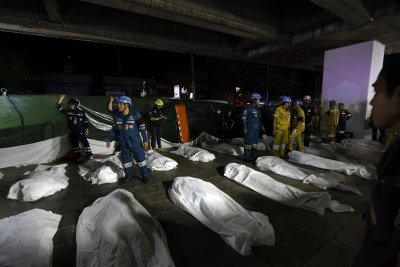
Rescue workers recover the bodies of fire victims outside the burned pub following a fire in Bangkok, Thailand, on Monday. At least 27 people were killed after a fire engulfed the pub, according to Thai Prime Minister Anutin Charnvirakul. Photo by Rungroj Yongrit/EPA
July 12 (UPI) — An intense fire that ripped through a Bangkok pub early Monday killed at least 27 people and injured nearly 20 others, officials said as an investigation was launched into the cause of the blaze.
Authorities received a report of the fire at the Rong Beer Na Lat Phrao pub in Bangkok’s densely populated Chatuchak district at 12:02 a.m. local time, Thailand’s Department of Disaster Prevention and Mitigation said in a statement.
“The fire was burning intensely,” according to the department, which said responders from various agencies worked to extinguish the blaze and rescue the injured and people trapped inside.
Videos of the bar’s entrance posted online show people screaming and running out of the establishment followed by flames erupting from the door.
Officials said the fire was brought under control by 12:32 a.m.
Images of the aftermath posted online by the Department of Disaster Prevention and Mitigation show the charred remains of the bar’s interior.
A preliminary inspection of the scene found that 27 people had been killed, the department said. The identities have not been released, but the department said 18 were women and nine were men.
Of the 18 people injured, eight were listed as red cases, meaning they were either in critical or life-threatening condition, seven were labeled yellow for serious but stable condition and three were considered green cases with minor injuries, the department said in an update.
“Forensic investigators are examining the scene to determine the cause of the fire,” the Department of Disaster Prevention and Mitigation said.
Prime Minister Anutin Charnvirakul arrived at the scene at about 1:30 a.m. and was joined by Disaster Prevention and Mitigation Director-General Teerapat Katchamat and Bangkok Gov. Chadchart Sittipunt.
Anutin told reporters at the scene that most fatalities were the result of smoke inhalation. He said that he was told by witnesses that the fire appeared to have started near a circuit breaker on the restaurant’s stage before the facility was plunged into darkness, the Bangkok Post reported.
Exceptionally hot weather in May and June was responsible for the heat-related deaths of at least 2,700 people in England and Wales, according to British research out Monday. File photo by Facundo Arrizabalaga/EPA-EFE
July 13 (UPI) — Exceptionally hot weather in May and June was responsible for the heat-related deaths of at least 2,700 people in England and Wales, according to British research out Monday that found that human-caused climate change was a significant factor.
Temperature records for both months fell during heat waves May 21-29 and June 18-28, with the bulk of the fatalities — 2,200 — in June when the temperature rose to as high as 99.9 degrees Fahrenheit compared with average daytime highs of 68 degrees Fahrenheit, the Met Office said in a news release.
Researchers from Imperial College London, the London School of Hygiene & Tropical Medicine and the Met Office modeled excess deaths — those over and above normal levels — during both heat waves using historical mortality records and established peer-reviewed methods.
Notably, almost 6 in 10 of fatalities during the May heat wave were attributed to additional heat contributed by human-caused climate change, compared with a little less than 4 in 10 during the heat wave in June, which was hotter and lasted longer.
The scientists said daytime maximum temperatures approximately 7 degrees Fahrenheit higher than they would have been without human-induced climate change had fueled temperatures that would have otherwise been far less likely to occur — making the heat waves far more hazardous to human health.
“We all love the sun, but people need to be aware that we are now seeing dangerous climate-change-fueled heat that is claiming lives, disrupting schools and hospitals and shutting down transport and infrastructure,” said Dr. Clair Barnes, Research Associate in Extreme Weather and Climate Change at Imperial College London.
“It’s time we woke up to the fact that we now live in a country with dangerously hot summers. To protect people during future extremes, we must urgently adapt to the reality of the climate we now have, and double down on global efforts to reach net zero emissions to stop this from getting worse,” she said.
Dr. Malcolm Mistry, Assistant Professor in Climate and Geo-spatial Modelling at the London School of Hygiene & Tropical Medicine, expressed concern that only a few weeks into summer England and Wales had already experienced two record-breaking heat waves.
He warned that with spikes of extreme hot weather more frequent and more intense due to human activity, summer heat waves were “rapidly evolving into a major health risk for people in the United Kingdom.”
Mistry said it was critical that changes to homes, workplaces and critical infrastructure to cope with extreme heat kept ahead of rising health risks in order to protect the elderly, children, babies and other vulnerable groups.
The Met Office said 2026 has been exceptional with the two heat waves topping records that had stood since May 1944 and June 1976.
“For the time of year these events were extreme, even in our warmer climate,” said Climate Attribution Manager, Dr. Mark McCarthy.
The climate division of the U.K. Health Security Agency said that with periods of heat likely to become more intense, longer and more frequent as the world continued to warm, the study showed the “scale of risk associated with extreme heat and the growing threat climate change poses to our wellbeing.”
Continental Europe has also been in the grip of a more or less continuous heat wave since May that has placed health systems under huge pressure, triggered deadly wildfires that have burned through tens of thousands of hectares of woodland and scrubland, crippled power grids and forced schools to close.
The World Health Organization said Sunday that 1,300 excess deaths reported across Europe since June 21 were linked to the high temperatures.
Director-General Tedros Adhanom Ghebreyesus said Europe was warming twice as fast as the rest of the world with 150 million people suffering the negative impacts of the extreme heat.
France’s Health Ministry said Sunday that there were 1,000 extra deaths between Wednesday and Saturday alone, compared with previous months.
This photo, taken Monday, shows the trading room of Hana Bank in Seoul as South Korean stocks plunged by nine percent on tech stock losses amid Middle East tensions. Photo by Yonhap
Seoul shares plunged 9 percent Monday as investors dumped technology stocks for profit-taking amid renewed tensions in the Middle East. The Korean won fell against the U.S. dollar.
The benchmark Korea Composite Stock Price Index (KOSPI) fell 669.01 points, or 8.95 percent, to close at 6,806.93 after falling as low as 6,783.43.
Trade volume was moderate at 469.86 million shares worth 39.8 trillion won (US$26.5 billion), with decliners far outnumbering gainers 713 to 179.
Institutions and foreigners sold a net 2.22 trillion won and 1.7 trillion won worth of shares, respectively, while individuals bought a net 3.9 trillion won.
After opening 0.85 percent lower, the KOSPI extended its losses, triggering a circuit breaker that temporarily halted trading of KOSPI-listed stocks for 20 minutes. It marked the seventh activation of the measure this year.
On Friday, U.S. stocks advanced, buoyed by South Korean chipmaker SK hynix’s multibillion-dollar U.S. share offering. The Dow Jones Industrial Average gained 0.29 percent, while the tech-heavy Nasdaq Composite also rose 0.29 percent.
SK hynix’s American depositary receipts (ADRs) on the Nasdaq closed at US$168 each, well above the offering price of $149.
Despite the successful U.S. market debut, SK hynix shares tumbled as investors took profits and shifted to the company’s ADRs, analysts said.
Investor sentiment was also dampened by heightened uncertainty in the Middle East after the United States and Iran exchanged fresh strikes over the status of the Strait of Hormuz.
“The country’s newly introduced single-stock leveraged exchange-traded funds linked to Samsung Electronics and SK hynix continued to fuel volatility in the stock market,” Samsung Securities said in a research note.
Tech stocks led the decline.
Market bellwether Samsung Electronics plunged 10.7 percent to 254,500 won, while its chipmaking rival SK hynix plummeted 15.37 percent to 1,845,000 won.
Top carmaker Hyundai Motor fell 2.95 percent to 444,000 won, and defense giant Hanwha Aerospace declined 3.21 percent to 936,000 won.
Among gainers, leading battery maker LG Energy Solution rose 0.77 percent, and leading refiner SK Innovation climbed 7.09 percent to 110,200 won.
The Korean won was quoted at 1,503.4 won against the U.S. dollar at 3:30 p.m., down 2 won from the previous session.
Bond prices, which move inversely to yields, closed lower. The yield on three-year Treasurys rose 4.1 basis points to 3.809 percent, and the return on the benchmark five-year government bonds climbed 3.3 basis points at 4.041 percent.
Copyright (c) Yonhap News Agency prohibits its content from being redistributed or reprinted without consent, and forbids the content from being learned and used by artificial intelligence systems.
A vehicle believed to be carrying former South Korean President Yoon Suk Yeol enters the Seoul court complex in southern Seoul on Monday. Photo by Yonhap
A Seoul district court on Monday sentenced former President Yoon Suk Yeol to two years in prison after finding him partially guilty of accepting illegal political funds in the form of free opinion polls from a self-proclaimed power broker.
The Seoul Central District Court convicted the jailed former president on charges of violating the Political Funds Act in a ruling that marked a departure from a separate trial where his wife was acquitted on the same charges.
Special counsel Min Joong-ki’s team earlier indicted Yoon on charges of colluding with his wife, former first lady Kim Keon Hee, and receiving 58 opinion polls worth about 270 million won (US$180,100) in total for free from the power broker, Myung Tae-kyun, between April 2021 and March 2022.
In its ruling, the court recognized that Yoon had received 14 opinion polls from Myung for free over the period, sentencing him to prison and ordering a forfeiture of 13.96 million won.
It recognized the special counsel team’s argument that Yoon had promised to support former Rep. Kim Young-sun’s nomination as a candidate for the conservative People Power Party in the parliamentary by-elections in June 2022 in exchange for the opinion polls.
“The defendant’s actions sowed distrust in politics and undermined the public trust in the development of democracy,” the court said. “A punishment commensurate with the wrongdoing is inevitable.”
The court also sentenced Myung to 18 months in prison on the charges.
The special counsel team had sought a four-year prison sentence for Yoon and a three-year term for Myung.
The ruling diverged from an appellate court’s acquittal of Yoon’s wife on charges of accepting free opinion polls from Myung in a separate trial.
In Kim’s acquittal in April, the Seoul High Court ruled the couple could not be seen as profiting off the opinion polls as Myung had provided them to other people as well. Min’s team has appealed that ruling.
After the ruling, Yoon’s lawyers vowed to appeal, saying the verdict was “difficult to understand” given the former first lady’s acquittal in her trial.
The special counsel team called the latest ruling “very meaningful,” noting the bench appeared to have closely considered the various evidence and arguments presented in its judgment.
It marked the latest conviction for Yoon, who has been standing multiple trials following his failed 2024 martial law bid. In February, Yoon was sentenced to life imprisonment for leading an insurrection through his short-lived imposition of martial law.
Copyright (c) Yonhap News Agency prohibits its content from being redistributed or reprinted without consent, and forbids the content from being learned and used by artificial intelligence systems.
Dramatic video captured the moment waves caused by Typhoon Bavi slammed into a house in China’s eastern Zhejiang province. The storm caused widespread power and phone service outages. Authorities had evacuated more than two million residents.
Yulia Svyrydenko resigned Sunday as Ukraine’s prime minister. File Photo by Teresa Suarez/EPA
July 13 (UPI) — Yulia Svyrydenko has resigned as prime minister of Ukraine, as President Volodymyr Zelensky announced that she would be assuming a new position amid a shift in the war-torn country’s political strategy.
Svyrydenko stepped down on Sunday, five days short of serving a full year as prime minister. No reason was given.
Her resignation came as Zelensky said in a statement that “Ukraine is changing its political strategy.”
Though he did not detail specifically how or why the change was necessary, he indicated the new strategy would prioritize implementing the agreement with the United States for Ukraine to manufacture Patriot missile systems, advancing Europe’s anti-ballistic missile defense project, progressing Kyiv’s European Union membership, improving relations with Poland and Hungary and creating ties with the Middle East for security and economic cooperation and with China to help Russia’s War.
“Accordingly, personnel changes will begin in Ukraine to ensure the implementation of the updated political strategy,” Zelensky said in a statement.
He said he discussed the details with Svyrydenko and together, “we determined that these changes require a renewal of the Cabinet of Ministers.”
“I am grateful to Yulia for her clear, steady and effective work as prime minister, for her years of productive service on Ukraine’s team, and I have offered her the opportunity to lead a new and important area of relations with a key partner,” he said.
“I expect that, together with MPs, we will make the corresponding changes in the government of Ukraine. There will also be changes among the heads of law enforcement agencies.”
Svyrydenko said in a separate statement that she was grateful to Zelensky and was proud to have led the government as the country defended itself against Russia’s invasion.
“At this moment, it is critically important to unite all our strength and resources to make Ukraine stronger,” she said.
“I remain ready to serve the Ukrainian state and carry out every task aimed at strengthening Ukraine’s position, defending our national interests and bringing a just peace closer.”
The announcement also came about seven months after Zelensky’s administration underwent a major reshuffle after 11 officials quit following a mass corruption scandal that rocked the government.
Zelensky separately said Sunday that he met with Interior Minister Ihor Klymenko, Defense Minister Mykhailo Fedorov, Energy Minister Denys Shmyhal and Kharkiv Mayor Ihor Terekhov, among other officials.
I discussed with the President the challenges facing our country, the changes needed to strengthen the Government’s work, and our relations with international partners.
At this moment, it is critically important to unite all our strength and resources to make Ukraine stronger…. pic.twitter.com/lRIgk5yqh0— Yulia Svyrydenko (@Svyrydenko_Y) July 12, 2026
Following the passing of Qatar’s Father Emir Sheikh Hamad bin Khalifa Al Thani on Sunday, his solidarity with the Palestinian people remains one of the defining legacies of his leadership. He is being remembered not only as a regional statesman, but also as a steadfast ally of the Palestinian people and the only Arab leader to physically break the crippling siege on the Gaza Strip.
In October 2012, Sheikh Hamad visited the embattled Gaza Strip, six years after Israel imposed its crippling international blockade on the territory, following the 2006 Palestinian elections.
Accompanied by his wife, Sheikha Moza bint Nasser, and a high-level delegation, the emir bypassed the political isolation imposed on the enclave by Western powers and regional actors, leading to a massive official and popular reception.
The head of Hamas’s diaspora office, Khaled Meshaal, told Al Jazeera that the visit to the Strip means that “Jerusalem, Gaza and Palestine mourn him.”
“He was the first Arab and Muslim leader to visit Gaza, standing by its side with chivalry and magnanimity, as if officially announcing the breaking of the siege in its darkest circumstances,” Meshaal told Al Jazeera. “He was intelligent, brave and a man of principles.”
Ahmed al-Sheikh, a senior journalist, Arab affairs commentator and former news director at Al Jazeera Arabic Channel, said the Father Emir had ”a special kind of love for Palestine”.
“Has any other leader in the Arab world done that [visit to Gaza], except Hamad bin Khalifa?” al-Sheikh reflected in a recent interview.
”Why did he go to Gaza? It’s because he saw that everyone around Gaza is neglecting it”, he added.
The late Emir of Qatar greets people in Gaza City as he arrives for a cornerstone-laying ceremony at a Qatari-funded rehabilitation centre, October 23, 2012 [Hatem Moussa-Pool/Getty Images]
During that landmark visit, Sheikh Hamad announced an increase in Qatar’s reconstruction grant to the enclave from $254m to $400m, laying the foundation for vital housing, infrastructure and healthcare projects that benefited thousands of Palestinians.
Addressing crowds at the Islamic University of Gaza – which awarded him and Sheikha Moza honorary doctorates for their humanitarian efforts – he praised the resilience of the Palestinian people, while criticising the international community’s double standards.
Palestinian leaders and the former Emir arrive at a cornerstone-laying ceremony for a new residential neighbourhood called Hamad in Khan Younis, October 23, 2012 [Mohammed Salem-Pool/Getty Images]
Personal pain and the ‘spearhead’ of liberation
His commitment to the Palestinian cause predated the blockade on Gaza. In 1999, Sheikh Hamad became the first Gulf leader to visit the Palestinian territories since 1967, meeting with the late Palestinian President Yasser Arafat during a critical political impasse.
According to al-Sheikh, the emir viewed the Palestinian struggle through a deeply personal lens. When former Israeli Prime Minister Ariel Sharon besieged Arafat’s headquarters in Ramallah, the emir was profoundly pained. He told his aides that when Sharon attacked the Muqata’a, it felt as though he was attacking Qatar itself.
His connection to Palestine was coupled with a regret that he had never visited Jerusalem before its occupation in 1967, According to al-Sheikh, that prompted him to commission an extensive three-hour documentary on the holy city to capture its history and identity.
Rather than relying solely on international intervention, he believed in the agency of the Palestinian people and that they were the essential spearhead of their movement. “You will do the primary action and without this action there can be no liberation,” the emir once told al-Sheikh.
Defying regional consensus
This stance put him frequently at odds with the regional consensus. During Israel’s devastating 2008–2009 war on Gaza, deep divisions emerged among Gulf Cooperation Council (GCC) members over how to respond to the crisis.
Sheikh Hamad called for an emergency Arab summit in Doha, proposing a $250m reconstruction fund and a maritime corridor to bypass the blockade. He famously expressed his disappointment on live television about the lack of an Arab quorum for the emergency meeting. “God is sufficient for us and he is the best disposer of affairs.”
Some of Gaza’s most vital infrastructure projects before the outbreak of Israel’s genocidal war in October 2023 were the result of financial pledges made by Sheikh Hamad.
Qatar funded the rehabilitation of vital highways and the flagship Sheikh Hamad City in Khan Younis—a $58m public housing project with 53 modern apartment buildings for thousands of low-income families.
The former Emir with Hamas Prime Minister Ismail Haniyeh at a ceremony for a Qatari-funded rehabilitation centre in Gaza City, October 23, 2012 [Hatem Moussa-Pool/Getty Images]
Additionally, the Sheikh Hamad Hospital for Rehabilitation and Prosthetics, which officially opened in April 2019, became the territory’s premier facility for amputees and children with hearing impairments.
Israel’s genocidal war on Gaza has systematically erased much of the infrastructure Qatar helped finance during Sheikh Hamad’s leadership. Satellite imagery from May this year confirms that Hamad City and other areas in southern Gaza have been wiped from the map.
The Sheikh Hamad Hospital managed to resume its vital services last December, despite suffering direct attacks, severe shortages and the broader collapse of Gaza’s healthcare system. Operating the only CT scanner in northern Gaza, the hospital has even opened a new branch in the south to cope with a 225 percent increase in amputation cases.
Sheikh Hamad Hospital’s continued operations during the ongoing genocide in Gaza remain a tangible remnant of the late emir’s unprecedented efforts in the besieged enclave. His support for Gaza will remain for generations to come.
Palestinian children wave Qatari flags while waiting for the former Emir to arrive in Gaza City, October 23, 2012 [Hatem Moussa/AP]