
Dominant Spain beat Argentina to win World Cup after extra time
Ferran Torres scores the only goal of the game as Spain dominate Argentina 1-0, to win their second FIFA World Cup at the New York New Jersey Stadium.
Source link
Ferran Torres scores the only goal of the game as Spain dominate Argentina 1-0, to win their second FIFA World Cup at the New York New Jersey Stadium.
Source link

NEW YORK — What if the Dodgers never get a full season of pitching from Shohei Ohtani?
In his first season with the Dodgers, he did not pitch at all. In his second, he did not pitch until June. And, halfway through this third season, Dodgers manager Dave Roberts admitted Sunday he could not say when Ohtani might pitch again.
“Don’t know yet,” Roberts said.
October might be your immediate concern, and it should concern the Dodgers too. Of the four starting pitchers they would plan to use in the postseason — Yoshinobu Yamamoto, Blake Snell, Tyler Glasnow and Ohtani — Yamamoto is the only one pitching major league innings right now. It’s not Tarik Skubal or bust, but the Dodgers should trade for someone they would start in a playoff game.
Yet, for a player with seven years left on his $700-million contract beyond this one, there might be a lot fewer opportunities to celebrate Ohtani as a two-way player than the Dodgers and their fans envision.
Ohtani did not pitch in his first year and a half with the Dodgers as he recovered from elbow surgery. When his rehabilitation was complete, he was good to go.
This is different. Ohtani is battling irritation in his left knee. Roberts used three concerning words to describe it: “wear and tear.”
There is no easy fix. The lubricant injection Ohtani received a week ago relieves symptoms for a short period of time, usually a few months. It is repeatable, but its benefits are not always felt right away.
The Dodgers had announced Ohtani would start Wednesday. Roberts said Ohtani experienced discomfort while playing catch, and that was enough for the Dodgers to push back his next start to…
“I would say that it’s going to be some time,” Roberts said. “It’s not going to be a day-to-day thing.”

Shohei Ohtani warms up before facing the Tampa Bay Rays at Dodger Stadium on June 15.
(Eric Thayer / Los Angeles Times)
If it is a wear-and-tear thing, there might be no solution besides management over the remainder of his career.
“I think it’s a little bit, it’s just like all of us, all athletes, that kind of have wear and tear,” Roberts said. “That’s just part of it, and now it’s just kind of showing itself a little bit, and then you got to manage it. I think that it’s the years of sliding, pitching, hitting and all that stuff.”
Ohtani is aware of this. He is 32. This is his 14th professional season. He reported to spring training with the goal of winning the National League Cy Young award, in part because who knows how long you can do everything at an elite level on a baseball field?
“Inside, I’m assuming this is my last chance as a pitcher,” Ohtani told the Japanese sports magazine Number in an interview published last month.
In his first 10 starts this season, he posted a 0.74 earned-run average, never giving up more than two runs in a start. In the four starts since the knee irritation surfaced June 10, his ERA is 4.38, and he has given up at least three runs in each start.
Can he pitch effectively if he can tolerate the discomfort? Would he want to? Would the Dodgers want him to, given their investment in him as one of the most dynamic hitters in baseball history?
To this point, Roberts said, Ohtani has experienced the irritation only on the mound, not at bat. As a result, Roberts said, the Dodgers do not believe shutting down Ohtani as a hitter for a few days would help ease the discomfort.
Maybe this works, with the injection calming the knee long enough to get Ohtani through the season, or with the irritation waning. Even then, it’s going to take some time.
“The first step is getting him into a spot where he feels like, and we feel like, he can pitch and not regress,” Roberts said.
Ohtani has not pitched in 16 days, and let’s say he does not pitch for another 16. Then the Dodgers would be looking at building back Ohtani’s endurance as they ramp up for the playoffs. So, even if Ohtani can return, could he pitch deep into a postseason game?

Shohei Ohtani hits a home run against the Tampa Bay Rays at Dodger Stadium on June 16.
(Eric Thayer / Los Angeles Times)
The Ohtani Effect is real, and grand. It is measured in T-shirts and ticket sales, tourists and movie promotions, bobblehead dolls and international corporate sponsorships.
But all of that should not obscure Ohtani’s greatness as a player.
If Aaron Judge cannot hit, he cannot help the Yankees, and they entered play Sunday 18-20 since he suffered a rib injury.
If Ohtani cannot pitch … well, he has hit 11 home runs since then, for the team with the best record in the major leagues.
The Dodgers do not believe Ohtani’s viability as a pitcher is in jeopardy, but we can already hear the cynics: In a worst-case scenario, if he could not pitch well again, would the contract be worth it?
It already is: Two full seasons, two World Series championships.

The TWZ Newsletter
Weekly insights and analysis on the latest developments in military technology, strategy, and foreign policy.
For the first time in U.S. military history, uncrewed surface vessels (USVs) were used as a strike weapon in combat. The use of Saronic Corsair USVs took place July 12 during a series of attacks against “dozens” of Iranian targets, according to U.S. Central Command (CENTCOM). It came as the U.S. and Iran have continued to trade strikes primarily related to control over the Strait of Hormuz, with President Donald Trump proclaiming he wants to take over the strategic chokepoint and reinstate the naval blockade on Iranian ports. Meanwhile, Iran has also been launching attacks against several Arab nations in the most recent flare-up of hostilities as a shaky ceasefire continues to disintegrate.
“Yesterday, using multiple one-way attack surface drones, CENTCOM forces successfully struck a submarine and ship maintenance facility in Iran,” the command stated on X Monday morning. “Three Corsair unmanned surface vessels hit the port at Bandar Abbas Naval Base, marking the first time American forces have employed sea drones in combat operations. Last night’s strikes degraded Iran’s ability to continue attacking commercial shipping.”
Yesterday, using multiple one-way attack surface drones, CENTCOM forces successfully struck a submarine and ship maintenance facility in Iran. Three Corsair unmanned surface vessels hit the port at Bandar Abbas Naval Base, marking the first time American forces have employed sea… pic.twitter.com/bOM2kmgRxz
— U.S. Central Command (@CENTCOM) July 13, 2026
This attack is the latest iteration of the U.S. Navy’s use of drone boats in combat. Last month, a Saronic Corsair USV rescued the crew of a U.S. Army AH-64 Apache that crashed in the Gulf of Oman after it was downed by Iran. That was the first known instance of a drone boat being used to recover personnel as part of a search and rescue mission, and has major implications for these operations going forward.
“The surface drone that assisted in last night’s rescue of the Apache crew off the coast of Oman was a U.S. Navy Corsair unmanned surface vessel operated by U.S. 5th Fleet’s Task Force 59,” U.S. Navy Capt. Tim Hawkins, a CENTCOM spokesman, told TWZ at the time. “The task force began fielding these drones in theater in late March.”

Historic sea drone rescue near Strait of Hormuz for Apache helicopter crew members
Established in 2021, Task Force 59 is a testbed unit that is tasked with experimenting with the integration of new uncrewed and artificial intelligence (AI) capabilities into day-to-day naval operations across the Middle East. It appears that the task force is starting to operationalize those technologies more broadly. Using USVs in an attack role could help reduce the burden on aircraft and crews for strikes, at least against certain targets out to sea and along the coast. Above all else, it creates another vector for kinetic operations against the enemy, which complicates their defensive plans.
In a recent interview with TWZ, Saronic co-founder Rob Lehman declined to provide any details about this mission set or any others Corsair was conducting in the region. However, he did say its success will reverberate across the USV industry.
“I think the tangible impact to the industry is that autonomous systems are now perceived as real credible capabilities rather than a science and technology kind of sideshow where we’re desperately trying to prove that the tech can play a role in these types of operations,” Lehman told us. “So my hope is that not just for Saronic, but all of our partners on the commercial side, that it’s an accelerant to getting more of these capabilities in the war fighters’ hands.”

As we have frequently reported, Ukraine has used USVs to devastating effect on the Russian Black Sea Fleet. The Magura line of drones, among others, has played a key role in this campaign.

Many successful attacks have been recorded against Black Sea Fleet vessels and facilities, forcing the general evacuation of Russian naval assets from occupied Crimea to bases in Russia proper.
The Houthi rebels of Yemen actually pioneered the operational use of kamikaze USVs years ago. We first reported about this capability in January 2017, when an explosive-laden Houthi USV struck a Saudi frigate. Before that, Iran developed various crude kamikaze USVs and those capabilities soon migrated to their Houthi proxies, which put them to use in the Red Sea for the first time.
You can see the January 2017 attack in the video below.

فيديو يؤكد الهجوم الانتحاري على الفرقاطة السعودية
As we have frequently noted, the U.S. and Iran signed a 14-point Memorandum of Understanding (MoU) on June 17. The MoU provided a 60-day extension of the ceasefire to iron out an agreement to end fighting throughout the region, including Lebanon, prevent Iran from seeking nuclear weapons, end U.S. sanctions and resume the flow of traffic through the Strait of Hormuz, among other points.
Control over the Strait has proven to be the biggest flashpoint, as evidenced by the aforementioned flare-up of fighting.
The Islamic Revolutionary Guard Corps (IRGC) has continued to claim it controls the Strait.
⚡️BREAKING
Iran’s Armed Forces on Trump owning the Strait of Hormuz:
“The United States interference in the Management of the Strait of Hormuz have seriously Jeopardized Regional Security and International Trade
The United States shall Never be allowed to Interfere in the… pic.twitter.com/SXs95jTtwv
— Iran Observer (@IranObserver0) July 13, 2026
As we noted earlier in this piece, Trump just proclaimed that the U.S. would take over the Strait.
“We hit them very hard last night,” Trump told Fox News. “Every time they send a drone, we hit them very hard. But we had a deal. What nobody knows, we had a deal. It was a done deal, and then they broke it. They always break it. We’ve had 10 deals with these people, and so we’re just going to hit them very hard, and we’re going to keep the Strait, and we’ll probably run it.”
“We’ll become the guardian of the Strait,” the American leader added. “Maybe we’ll call it the guardian angel of the Strait.”
Trump suggested that the U.S. be paid for this effort.
“And we should be reimbursed for that,” he posited. “When we do that, we’re going to be reimbursed because the other nations are very wealthy.”
HAPPENING NOW: President Trump issues a scathing warning to Iran following a broken military agreement, revealing that the U.S. hammered their equipment overnight and may permanently take over security operations in the Middle East.
“Most of their equipment is gone. Their… pic.twitter.com/ttcPSuBLH9
— Fox News (@FoxNews) July 13, 2026
Trump also took to his Truth Social network to say that he is reinstating the naval blockade on Iranian ports that was removed when the MoU was signed last month. He added that the U.S. will impose a toll on shipping.
“The U.S.A. will be, from this point forward, known as “THE GUARDIAN OF THE HORMUZ STRAIT,” but as such, and as a matter of FAIRNESS, will be reimbursed, at the rate of 20% on all cargo shipped, for any and all costs necessary to do the job of providing safety and security to this very volatile section of the World,” the president proffered. “The process and formation will begin immediately.”
BREAKING: Trump:
The Hormuz Strait is OPEN, and will remain OPEN, with or without Iran. We are reinstating the THE IRANIAN BLOCKADE, so named because it is only stopping Iran’s ships or customers from entering or leaving. All other countries will have fair and open use of the… pic.twitter.com/4WNwrKdzs8
— Clash Report (@clashreport) July 13, 2026
The U.S. military using drone boats in a kinetic strike role sets a new precedent not just for operations in the CENTCOM region, but also those in other flashpoints, including the Pacific. It comes as the Pentagon has adopted a number of other capabilities that have been ‘borrowed’ from other conflicts, including the first use of one-way attack drones loosely based on Iran’s Shahed-136, for instance. But it is interesting that these kamikaze drone boats were not deployed at the start of the war, when sea and shore targets were plentiful. That points to the Pentagon still racing to catch-up with some weapons developments from conflict zones overseas or at least at opening the aperture for how and when those technologies are used operationally.
UPDATE: 12:26 PM EDT –
The video released by CENTCOM this morning appears to show one of the Corsair USVs attacking what looks to be a Ghadir class diesel-electric midget submarine.
Given the frequency of U.S. airstrikes on Iran’s key naval base at Bandar Abbas during this conflict, it is unclear how Iran still had any of these vessels left.
As we previously reported, U.S. forces apparently sunk another Ghadir class boat in March. It was struck by an AGM-114 Hellfire missile, a U.S. official told TWZ. At the time, we questioned how many Ghadir class submarines were in Iran’s inventory before the current conflict. However, prior estimates had generally put the size of that fleet at between 16 and 20 hulls.
The Ghadir class boat in the new CENTCOM video was sitting on the dock, so it is possible Iran pulled it out after the ceasefire went into effect.

UPDATE: 1:01 PM EDT –
Saronic released a statement.
“The U.S. military has confirmed that Saronic Corsairs were used by U.S. Central Command in operations against Iran. According to CENTCOM, three military variant Corsair unmanned surface vessels (USVs) struck a submarine and ship maintenance facility at Bandar Abbas Naval Base — the first time American forces have employed sea drones in combat operations,” the company stated. “We are proud that our technology supported this mission and helped degrade threats to commercial shipping. Saronic remains committed to delivering autonomous maritime systems that strengthen the security of the United States and its allies.”
UPDATE 2:38 PM EDT –
CENTCOM provided an update on the blockade.
“At the Commander in Chief’s direction, U.S. Central Command (CENTCOM) forces will resume blockading maritime traffic entering and exiting Iranian ports on July 14 at 4 p.m. ET,” the command stated on X. “CENTCOM forces will enforce the blockade against vessels transiting to or from Iranian ports and coastal areas. The U.S. military continues to support traffic flow through regional waters for all vessels not violating the blockade.”
“The resumption of the U.S. blockade against Iran follows the initial implementation from April 13 to June 18,” the command added. “CENTCOM forces redirected more than 140 compliant vessels, disabled nine non-compliant ships, and allowed over 50 commercial vessels supporting humanitarian aid to pass through the blockade during the two-month period.”
“All mariners are advised to monitor Notice to Mariners broadcasts and contact U.S. naval forces on bridge-to-bridge channel 16 when operating in the Gulf of Oman and Strait of Hormuz approaches,” CENTCOM noted. “Additional information will be provided to commercial mariners through a formal notice.”
Contact the author: howard@twz.com
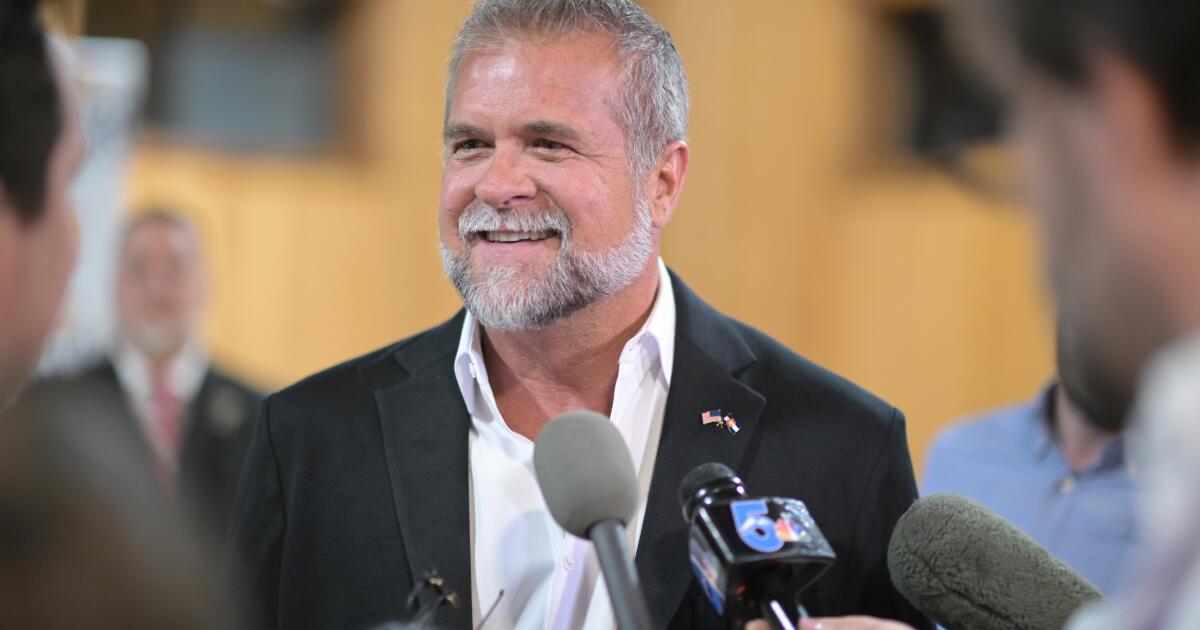
When Victor Marx was 3 years old, he was forced into a voodoo ritual involving a beheaded cat. At age 7, he killed a man.
Or so Marx says.
But he was not just a precocious child.
As an adult running a “high-risk” Christian ministry, Marx says he rescued 45,000 women and children from captivity and abuse. As a civilian, he supposedly called in a U.S. military airstrike that killed 70 ISIS fighters. He’s exorcised demons — and can do so over the telephone, he says, if need be.
True or, most likely, false, those woolly claims and epic tales of derring-do aren’t the weirdest thing about Marx.
The weirdest thing is that Marx is the Republican nominee for governor of Colorado, an actual part of these United States.
A political newcomer, Marx eked out his victory in a three-way race by less than 2,500 votes out of more than 520,000 cast. (It took almost nine days to declare a winner, but surely you knew that already, given the national outcry over how long it took Colorado to count its ballots. Oh, wait. Never mind.)
Although slender, Marx’s victory delivered a strong statement: about the grave condition of mainstream Republicanism; about the increasing embrace of oddity and extremism by a deeply disaffected slice of the American electorate; about the unsettled and unsettling nature of today’s politics.
“It’s almost cult-like,” Dick Wadhams, a former Colorado GOP chairman, said of Marx’s support. “You talk to some of these people, and there is no doubt in their mind he will be governor, because God has decided that he’s going to be governor.”
There’s fat chance of that. (Please don’t smite me.)
Colorado has elected only one Republican governor in the last 55 years, and that was back in 2002. It’s been 10 years since a Republican won any statewide office. The Democratic nominee, Atty. Gen. Phil Weiser, is as close to a November shoo-in — after stomping U.S. Sen. Michael Bennet in the primary — as it gets.
But Marx, 61, a former Marine and expert in martial arts, is nothing if not swaggering. His role model is, of course, the political disrupter and fabulist-in-chief currently occupying the White House.
Like President Trump, Marx relies heavily on personal charisma, a strong social media presence and the purposeful shunning of campaign norms which, to the politically alienated, speaks to his independence from the establishment and offers a welcome break from the same old, same old.
He casts himself as a problem-solver and negotiator par excellence. He skimps on policy and skipped most of the preprimary debates; at the one he did attend, Marx brought his dog, a Dutch shepherd, onstage. In lieu of a closing statement, Marx prayed.
When asked, he hasn’t backed off his fantastical claims. But Marx hasn’t done a very good job substantiating them.
As a young boy growing up in Louisiana, he says, his abusive stepfather — the one who supposedly involved him in a satanic feline decapitation — drove him to rural Mississippi, where Marx shot and killed a man. Police told Colorado Public Radio they had no record of any unsolved homicides from that time.
“How many people have you killed?” Kyle Clark, an anchorman on Denver’s 9News, asked the candidate in a persistent and revealing sit-down interview.
“I don’t think that’s important,” Marx replied. “It’s actually kind of — it’s an odd question to me.”
Actually, it’s not.
(Conceding the Republican race, state Sen. Barbara Kirkmeyer — the runner-up — conspicuously declined to endorse Marx, urging voters to “choose the path that is best for Colorado” in November. “For the record,” she added. “I still haven’t killed anyone.”)
In many ways, Marx is a mainstream conservative Republican. He founded All Things Possible Ministries, a Christian nonprofit that tends to refugees and other victims of trauma. His focus on law and order, tax relief, small government and deregulation are all standard GOP fare.
But his florid tales of youthful homicide, telephonic exorcisms, personally intercepting human smugglers on the U.S.-Mexico border — well, not so much.
Most voters will probably have a hard time getting past those autobiographical extravagances, which could spell trouble — depressed GOP turnout, guilt by association — for other Colorado Republicans, including freshman Rep. Gabe Evans, who’s fighting to hang onto a closely fought congressional seat in the north-central part of the state.
It’s a loss Republicans can ill afford as they desperately seek to preserve their bare House majority.
Despite its preference for Democratic governors, Colorado was, until not that long ago, a competitive two-party state. It was a presidential battleground as recently as 2012. Republicans held a majority in the state Senate as recently as 2018.
But the MAGA-fication of the state GOP has hastened Colorado’s evolution from political battleground to a solidly blue bastion.
“The Colorado Republican Party right now is impotent and irrelevant,” said Wadhams, who fought unsuccessfully against its takeover by Trump-worshiping zealots. “The ironic twist to this story is that polling has shown over the past several months that voters are getting restless about what they see as the decline of Colorado in terms of education, energy, roads and transportation.”
Just last week, the annual Colorado Health Foundation issued its annual Pulse Poll, a dour report card on the state of the state that found three-quarters of respondents were concerned they may not be able to live there in the future.
But don’t expect Democrats to lose their sovereignty anytime soon.
That’s what happens when a party and its voters stop seriously competing and instead indulge their passions and fever dreams. You get candidates, and political caricatures, like Victor Marx.
God help us.

Tuchel can continue to rely on captain Kane – for now.
The Bayern Munich striker will be 36 when the next World Cup rolls around, but seems in no mood to hand up his England boots.
Kane – who scored six goals at this World Cup, but was an unused substitute against France – told the BBC: “One of the best England groups that I have ever been a part of.
“When you see the boys around the hotel, when you see us training on the pitch, when you see us in the changing room, it is a unique group. We had that bond and had so much belief in each other.”
On Tuchel, Kane added: “It is his first major tournament. I think he has learned a lot of the squad, the campaign, the travel and the games and what it takes – the pressure.”
One of England’s wounds that was deepened by the win over France was Tuchel’s decision not to send on Bukayo Saka against Argentina.
The Arsenal winger, an unused substitute in the semi-final, scored a hat-trick on Saturday against Les Bleus – then afterwards said he is fully fit, having endured some injury worries earlier in the North American campaign.
“Of course, I would love to have played more but it’s too late to talk about that,” Saka told BBC One. “I try to do my talking on the pitch and it’s done now, move on. I’m fit.”
On noise around the manager, he said: “I think that’s just part of the game… it’s how you react to it, how you use it as fuel and today we finished strong and that’s all we could really do and we did that.”
England’s twisting World Cup 2026 story has a bittersweet ending – with a thrilling victory in the game no-one wants to be a part of.
But how this campaign will ultimately be remembered might not be truly determined until after this team have produced their sequels.

One year ago, when tickets first went on sale for “The Odyssey” in Imax 70mm, nearly every screening sold out instantly.
The unprecedented ticket mayhem built hype — not just for the film, but for the format. By the time a second round of tickets were made available last month, buyers swarmed with such frenzy that they crashed the AMC Theatres app.
In Los Angeles, home base for cinephiles of every stripe, scoring one of these coveted opening weekend tickets was particularly challenging. Much of the excitement revolved around the fact that “The Odyssey” was the first feature shot entirely on Imax 70mm film, a technical achievement that involved the invention of a new camera.

Share via
Want to see The Odyssey in 70mm but couldn’t get tickets? Glendale’s historic The Alex Theatre has you covered.
For 28-year-old Van Nuys resident Chase Stanley, who tried and failed to secure a ticket, that milestone was top of mind.
“Ultimately, I’m just jealous that I’m not included,” he said. “Since it’s the first movie to capture the whole thing in 70mm Imax, it’s my due diligence to see it like that.”
Despite the enthusiasm from moviegoers, film projection has been considered a dying art since most movie theaters worldwide switched to digital projection in the early 2010s.
More than a marketing tactic, the scarcity of tickets for Imax 70mm screenings underscored both the dearth of theaters capable of projecting films in the premium large format — only 41 — and projectionists with the requisite skills.
A number of renowned directors, including “The Odyssey’s” Christopher Nolan, prefer to shoot on film and strongly encourage analog viewing. But because few theaters own the necessary equipment or employ full-time projectionists, coordinating a release as massive as “The Odyssey” is its own arduous journey.

Jimmy Gonzales is Cepheus, left, Matt Damon is Odysseus and Himesh Patel is Eurylochus in “The Odyssey.”
(Melinda Sue Gordon / Universal Pictures)
There are 25 theaters in the United States showing “The Odyssey” in Imax 70mm, eight of which are located in California. One of L.A.’s favorites is the Universal Cinema AMC at CityWalk Hollywood, where veteran Imax projectionist Taylor Umphenour has worked for the last three years.
On his Instagram page, Umphenour shares “projectionist POV” photos and videos with more than 22,000 followers, giving them a unique glimpse into the projection booth for movies like “Sinners,” “One Battle After Another” and “Project Hail Mary.” His company, Film Leader Co., supervises film restorations and runs technical operations for a smattering of cinema houses across the country.
In addition to his work at CityWalk, Umphenour has been busy for weeks overhauling the projection setup at the historic Alex Theatre in Glendale.

Releases such as “The Odyssey” have renewed interest in film projectionists and specialty theaters, including the historic Alex Theatre.
(Allen J. Schaben / Los Angeles Times)
The 100-year-old venue opened in 1925 as a vaudeville and silent movie house where Walt Disney previewed his animated shorts, but it changed identities many times over the course of its history. Now, Umphenour and his team are working with Miles Williams, the theater’s artistic director, to transform it into a “premier cinema house” in time for “The Odyssey’s” release. It marks the first time the theater has been used for a first-run film release since “Terminator 2: Judgment Day” in 1991.
“What better opportunity to relaunch this venue than to open with Christopher Nolan’s ‘The Odyssey’? That’s why this project is on such a tight turn,” Umphenour said.
His team built an entirely new, massive booth in just three weeks to house sound equipment and projectors capable of running both 35mm and 70mm film. To secure the Alex a last-minute 70mm print of “The Odyssey” — which costs tens of thousands of dollars to manufacture, ship and distribute and runs about four miles long — Umphenour relied on his relationship with distribution executives at Universal.
The Alex will screen the movie in 70mm, which uses the same film stock as Imax 70mm but runs vertically instead of horizontally, making each physical frame roughly three times smaller than its Imax counterpart. Audiences seeking the larger-than-life Imax experience will have to look elsewhere — like CityWalk — but Umphenour believes that analog screenings will still draw a crowd.
“What’s special about these — about running on film, about running 70mm, about handling premium large formats — is that it does remind people how much they love going to the movies,” he said.
“What it’s all about is expanding that sense of scope and horizon, the analog color, that sense of immersion.”
In advance of “The Odyssey’s” release, Imax contracted 130 experienced projectionists and required each to attend an intensive, weeklong training program.
“I’ve said for years that the projectionist is the last performer in a long chain of people that started with an idea,” Umphenour said. “They are the final person to deliver the vision of the filmmakers to the audience, and therefore, one of the most crucial.” Far from simply pressing a button, film projectionists must actively guide a screening, threading and splicing reels and closely monitoring for mechanical issues.
But thanks in large part to the dwindling number of theaters projecting analog film since 2013, finding capable, actively working projectionists for releases like “The Odyssey” can be a struggle.
Sean McKinnon, director of specialty presentations and AV integration at Boston Light and Sound, is in charge of hiring these projectionists for about 60 venues across the country screening “The Odyssey” in 70mm. He did the same for “Oppenheimer” in 2023, which had the longest theatrical window of the year.
“It was pretty challenging finding people for ‘Oppenheimer,’ especially because the film was so amazing, it was in theaters for so long,” he said of the 122-day release. Staffing projectionists for “The Odyssey” has been “definitely easier,” he said, as the “word has gotten out.”
The talent pool McKinnon pulls from includes theater managers, retired projectionists, trainees from specialized college programs and even workers in other professions who take PTO for the occasion.
“We get people from really all walks of life,” he said. “It’s a special event and people want to be a part of it.”

Taylor Umphenour checks the projector’s focus at the historic Alex Theatre in Glendale.
(Allen J. Schaben / Los Angeles Times)
Outside of big cities, the lack of local projectionists also means McKinnon’s company has to fly people to Morrow, Ga., or Valley View, Ohio, for instance, to run the booth for the duration of a film’s run.
Leah Saint Marie, a filmmaker and former projectionist at the Vista Theatre in Los Feliz, attributed the staffing struggle to the experience and knowledge divide between hobbyists and experts.
“Training is pretty easy if you want to be what they call a ‘popcorn projectionist,’” she said. They “can thread the movie and push start, but if there are any mechanical issues, they can’t fix it.”
“I don’t think anybody who’s going to run a 70mm Imax are popcorn projectionists, because it’s very technical,” she added. Each Imax film print of “The Odyssey” is 11 miles long and weighs roughly 600 pounds.
The most recent data from the U.S. Bureau of Labor Statistics estimated that in 2023, there were 2,610 motion picture projectionists employed in the U.S. — an increase from 1,900 in 2022. In 2012, the BLS estimated roughly 8,000 projectionists and predicted the number would decline by 26.5% in the next 10 years — but it ultimately decreased by 76%.
“If you want to maintain expertise in the field, what you want are enough [movie] theaters out there running film that somebody can try their hand at it and get better,” Umphenour said.
Could the overwhelming audience demand for Imax 70mm screenings translate into a resurgence of fully equipped theaters? According to Imax Chief Executive Richard Gelfond, it’s more complicated than that.
“The problem is they haven’t made new Imax film projectors in about 50 years,” Gelfond told Variety on Wednesday. “We build new projectors every day, but film projectors, using this film, it’s not practical. So we’ve got to find them and retrofit them and rebuild them, which is what we did for ‘Odyssey.’ But can all 2,000 of our theaters be film projectors? No. There’s just not that many around.”
That said, Cinemark reportedly installed Imax 70mm projectors at three of its theaters ahead of “The Odyssey’s” release, and there are 11 more theaters projecting “The Odyssey” in Imax 70mm than there were for “Oppenheimer.”

Cinema engineer Justin Dennis is working with projectionist and production manager Taylor Umphenour to build a new projection booth capable of running both 35mm and 70mm film at the Alex Theatre.
(Allen J. Schaben / Los Angeles Times)
Saint Marie recalled working as a projectionist in Pennsylvania during the period when most theaters transitioned from film to digital. While training at a new theater, she was surprised to find an old film projector still stored in the booth, and even more surprised to learn it was for Nolan’s sake.
“When he releases a [movie] on film, we have to have the projector. A lot of places around the United States kept their projectors specifically for Nolan,” she said.
Nolan isn’t the only director with an affinity for large format film and analog media. Quentin Tarantino, Paul Thomas Anderson and Ryan Coogler (whose 2025 hit “Sinners” made quite a splash in Imax 70mm) are others associated with what Umphenour dubbed “the 70mm renaissance.”
According to Saint Marie, theaters worldwide transitioned from film to digital projection mainly because the cost of shipping a Digital Cinema Package is much cheaper than shipping a film release print. But the community of skilled laborers and enthusiastic audiences who champion analog projection say it’s worth it.
“I think there’s something to be said about what film gives you as an artistic community, versus what digital gives you is just consuming as a capitalistic society,” Saint Marie said. To McKinnon, it comes down to the “tradition of humans telling a story by flickering light” harking back to prehistoric times.
For Umphenour, the story of “The Odyssey’s” release and all of the 70mm fanfare is one of preservationists triumphing over countless obstacles.
“There are 70mm theaters running this film throughout the world that, frankly, have been kept alive through the deep devotion of people who care about this format,” Umphenour said. “They really do deserve to be celebrated because, like so many things in life, if you don’t have people that care about it, you don’t end up with a thing.”
“The results of all this work are not images projected on screen,” he continued. “It’s a community brought together to hear a story well told, which allows them to create a life memory they get to carry forward for years and years.”

Film projection takes center stage at the Alex Theatre.
(Allen J. Schaben / Los Angeles Times)

NEW YORK — Shohei Ohtani was at the top of the Dodgers’ lineup Friday against the New York Yankees, five days after receiving an injection in his left knee. And he’s penciled in to pitch against the Philadelphia Phillies on Wednesday.
Ohtani received an orthovisc shot in his knee to lubricate the joint and relieve irritation, manager Dave Roberts said, and did not have it drained.
“It gives him some relief in his knee which we were hoping to get,” Roberts said. “Then the four days off with no activity which gives it a chance to settle in.”
Ohtani was expected to be in the lineup for all three games against the Yankees. He planned to play catch and throw off the mound in the coming days, and the team would monitor his response before finalizing pitching plans.
Taking the mound Wednesday would give Ohtani more recovery time heading into the team’s day off. When asked if Ohtani would shoulder two-way duties Wednesday, Roberts said, “We’ll see when we get there.”

Dodgers star Shohei Ohtani hits his 300th career home run against the Colorado Rockies at Dodger Stadium on July 7.
(Eric Thayer / Los Angeles Times)
When it isn’t possible to have Ohtani pitch before a day off, Roberts would like to rest him the following day.
“It’s all contingent on how his knee is feeling,” Roberts said of Ohtani’s second-half workload. “I think we are certainly more prepared to back off on the workload if it calls for it. But Shohei wants to be out there as much as he possibly can.”
Asked if Ohtani would need offseason surgery, Roberts said: “I would highly doubt that.”
Coming out of the break, the Dodgers shuffled their rotation to have Roki Sasaki, Emmet Sheehan and Yoshinobu Yamamoto face the Yankees in that order.
That leaves left-handed starters Eric Lauer and Justin Wrobleski (not necessarily in that order), to face the Phillies before Ohtani would take the mound.
The Dodgers are shutting down catcher Will Smith from all baseball activities for a week as he continues to deal with a lingering neck injury. That pushes his return timeline back to at least August, if not later.
“It was flaring up, wasn’t recovering — however you want to word it,” Roberts said. “He didn’t feel like he was making any improvement.”
Smith has been sidelined since early June because of what he described as an inflamed disk. He initially treated it with rest and then an injection. But it still was bothering him during his latest buildup.

“I talked to the trainer, Thomas [Albert], today and he said that Will doesn’t feel any pain,” Roberts said. “Now with that, I think we’re in a much better spot.”
Dodgers utility player Kiké Hernández (strained left oblique) was set to begin a rehab assignment with triple-A Oklahoma City on Friday. And left-hander Blake Snell was scheduled to take the mound for two innings Saturday in his first minor-league rehab start since undergoing surgery to remove loose bodies in his elbow.
The MLB schedule got off to a smoky start out of the All-Star break. With wildfires in Canada raising air-quality concerns in the Northeast and Midwest on Thursday, the New York Mets’ game at Citizens Bank Park in Philadelphia was moved up an hour.
The smoke cleared over Yankee Stadium on Friday afternoon.
“I know that the players got a players’ union text that says it’s a full go,” Roberts said. “They feel good about it. The league feels good. I haven’t heard anything otherwise.”
With a lockout widely expected to start Dec. 1 and no guarantee of an agreement in time to preserve the 2027 season, take MLB’s schedule announcement Thursday with a grain of salt.
Should collective bargaining negotiations wrap up in time, however, the Dodgers are set to open the season at Dodger Stadium on March 25 against the Atlanta Braves.
They end the season on the road, facing a pair of division rivals in the Colorado Rockies and Arizona Diamondbacks from Sept. 21-26.

It pains me to say that most of us are missing the point when it comes to President Trump’s rambling election fraud speech. Which is exactly what he wants.
Within minutes of its airing Thursday night, the internet and pundits were abuzz debating whether voting machines were secure and whether the federal government has a right, or even a duty, to oversee voter rolls (it has neither). Long posts were written condemning voter identification efforts, and more posts written attacking those condemnations.
This, friends, is exactly what the speech was meant to accomplish — myopic bickering.
To be specific, myopic bickering about the past, as a dark future creeps ever closer — like, say, Nov. 3.
The question we should be asking now isn’t whether there is massive fraud in U.S. elections — even the conservative Heritage Foundation has documented only 71 cases of such fraud in California in more than 25 years.
The question is will we allow Trump to sow just enough doubt in the minds of average Americans that what comes next seems inevitable and even necessary?
Trump falsely claimed that he was revealing “an election system so broken and so vulnerable that no one can possibly defend it.”
“This cannot be allowed to continue,” he said.
Those are ominous words, ones we should take seriously.
“This is a very sad thing to be able to say about the president of the United States, but I think it’s quite clear,” said Mindy Romero, director of the Center for Inclusive Democracy, a nonpartisan research facility. “This is about a certain set of political goals, and using this misinformation to achieve those political goals.”
Trump knows that the midterms present a threat to his power and he, and those around him, have been working for years to create a strategy to invalidate our election results just in case they don’t fall in his direction. Whether the overall outcome favors Democrats or Republicans in the midterms, the wins and losses are going to be close, giving him the chance to attack Democratic wins.
On Jan. 6, 2021, Trump learned from the unlikely teacher Mike Pence the difficult lesson that plans work only when people are in place to implement them. As vice president, Pence, you may recall, refused to stop the election certification process that legally, rightfully, fairly allowed Joe Biden to take office.
Since then, Trump has purged dissenters from top roles, instead putting in flat-out sycophants, election deniers and conspiracy theorists — more than one of whom has been associated with the racist Great Replacement theory that Democrats are secretly helping Black and brown people to illegally cross the border in exchange for these folks illegally voting for Democrats, thereby replacing the “true” America of conservative white people.
So the apparatchiks are in place, Soviet-style. There will be no Penceian savior on the inside this time around.
More than one election expert I have spoken to in recent months fear that because there is no one left on the inside to object, we could see post-election turmoil like this: Republicans lose one or both houses of Congress. Trump calls fraud. The Department of Justice or outside lawyers, or both, sue to overturn results. Congress, the Republican one still in place, refuses to seat newly elected Democrats until the court cases are resolved.
A constitutional crisis is at hand. Democrats say they were elected. Republicans won’t let them serve. No one is clear who is in Congress and who isn’t. In effect, the body is frozen and it’s legitimacy undermined. Into that vacuum, Trump pushes his already great power even further.
As movie-terrible as that sounds, that internal structure is in place and this scenario is far less impossible or even improbable than we could hope.
“What we’re talking about is just misinformation and what could be used as a justification for potentially interfering with seating of elected officials,” Romero said. “Particularly Congress.”
Now, with the internal stuff squared away, Trump’s focus is neutralizing outside dissent. That’s you and me, and that’s what this speech was about. Sowing doubt, tossing seeds of chaos into the soil to see what grows. Letting us know it’s coming, so we as Americans have time to bicker, argue, and tear away at our trust in elections so that by the time we vote, we expect the worst to happen.
“Unfortunately, there are some members of the public that are going to believe what they’re being told and when they hear election results, question it,” said Chad Dunn, legal director of the UCLA Voting Rights Project. “This kind of communication misleads Americans and does a disservice to our democracy.”
Dunn told me he’s “as worried as I’ve been in my life” about the next election.
Trump’s far right is wasting no time on this effort. After Trump’s speech, the Department of Homeland Security sent out a letter to California and three other states claiming California has more than 190,000 non-citizens registered to vote, and demanding the state “confirm their intentions to collaborate with DHS in order to ensure free, fair, and honest elections.”
This is a misleading, erroneous count and does not include the obvious fact that there is no evidence that undocumented people actually voted in any California election in any noticeable numbers.
But it creates that chaos and doubt. California isn’t going to share its voter rolls willingly with the federal government because elections — according to the Constitution — are state affairs. And there is no evidence that the federal government has a better way of vetting citizenship than California does. So it becomes one more point of bickering.
But what Dunn, Romero and other honest elections experts want Americans to know is that our elections are free and fair and all is not lost. Far from it.
The answer to the propaganda and lies is to remain aware of it, remain above it. Spread truth and refute falsehoods.
Dunn said that Americans should demand that any voter fraud be taken to the courts — where it belongs, and where we can determine the validity of the evidence.
“If you’re concerned about this, if you’re inclined to believe the president, demand proof, demand resolution in court at trial with the the showing of evidence,” he said. “And reserve judgment until you see that.”
Romero has her own advice — never underestimate the power of the vote.
“Show up and to participate,” she said. “Regardless of how [you’re] going to vote — Democrat, Republican, otherwise — just to show up and participate.”
Because in the end, we only lose democracy if we willingly let it go.

July 17 (UPI) — The Department of Homeland Security on Friday ramped up the Trump administration’s efforts to address what the president claims are lapses in election security, threatening state officials with prison time if they don’t comply with federal demands.
DHS Secretary Markwayne Mullin told reporters in Washington he would apply “maximum pressure” against states that refuse to work with his department.
The Trump administration has focused on noncitizens allegedly casting ballots, which experts say is extremely rare, and the possibility that voting machines can be hacked — although they are, by design, never connected to the internet.
“If the election officials, once we gave them the information they need to secure their elections, and they chose not to, then those individuals can also be held accountable by fines, by penalties, and even, depending on how far it goes, prison time,” Mullin told reporters.
Mullin’s remarks come a day after President Donald Trump, in a primetime address, enumerated a series of debunked claims that the U.S. elections are rigged or have been influenced by foreign governments.
“Our elections were left vulnerable to being rigged and stolen, and the trust of the American people was lost,” Trump said Thursday. “This cannot be allowed to continue.”
Mullin said DHS has found more than 250,000 noncitizens registered to vote in four states — California, Nevada, New Jersey and Pennsylvania — and sent letters to their respective secretaries of state seeking answers.
“Before and after the election, we will scrub all election records looking for illegal aliens and those who are ineligible to vote, including those that somehow voted yet they were deceased,” Mullin said. “If you’re illegal and attempted to vote, or you tried to vote illegally for someone else, we will find you and we will charge you.”
In its letters, DHS did not accuse any of the noncitizens of having actually voted.
“We will pursue maximum pressure on this,” Mullin told reporters. “To let you know, we will be proactively looking at early voting, and then after post-election, we will continue to scrub all those that did vote.”
Al Schmidt, the Republican secretary of state in Pennsylvania, said, “All evidence has shown that noncitizen voting is extremely rare across the country,” including in his state.
“In Pennsylvania, every voter must take steps to verify their identity before they cast a ballot, including providing proper identification every time they register to vote, vote by mail, or vote at a new polling place,” Schmidt told The Hill.
In Nevada, Secretary of State Francisco Aguilar, a Democrat, said the administration’s efforts are intended to undermine elections.
“The administration lacks a fundamental understanding of how elections work,” Aguilar said in a statement. “They just want to cause chaos and doubt ahead of the midterms.”


LeBron James didn’t have a speech prepared.
“I’m just speaking to y’all from the heart,” the NBA’s all-time leading scorer told the audience Thursday night at the Time 100 Sports gala in New York.
In James’ heart and on his mind at that moment was his oldest son Bronny James, who nearly three years ago suffered sudden cardiac arrest as an 18-year-old rising freshman while practicing with the USC basketball team. He later was diagnosed with a congenital heart defect but eventually was able to resume his basketball career.
James and his son ended up becoming Lakers teammates for two seasons before the 23-year veteran became a free agent this summer. Bronny James is entering his third season with the Lakers after contract became fully guaranteed earlier this month.
“Obviously, if it wasn’t for the coaching staff and the medical team and everybody at USC being there in a timely fashion, we’d possibly be sitting here without our oldest son,” said James “So thank you to everybody and all the efforts when it comes to cardiac arrest.”
In June, Time magazine released its inaugural issue highlighting the 100 most influential people in sports, with James on the cover as “athlete of the century.”
James was one of the featured speakers at the gala honoring those individuals, as were fellow Time 100 Sports list members New York Knicks star Jalen Brunson, Olympic gold medalist skater Alysa Liu, Invictus Games founder Prince Harry and women’s soccer legend Alex Morgan.

Savy King and Damar Hamlin speak onstage during the Time 100 Sports gala July 16 in New York.
(Jemal Countess / Getty Images for TIME)
Earlier in the evening, Buffalo Bills safety Damar Hamlin and Angel City FC defender Savy King gave a presentation on their experiences as athletes who suffered cardiac arrest while playing in games for their respective teams.
Like Bronny James, they were both young athletes at the time of their incidents — Hamlin was 24; King was 20 — and both were fortunate to have trained medical staff members on hand to perform CPR and use defribulators to save their lives.
Their message hit home for James.
“Guys, take that serious,” he said. “If you got kids in elementary, you got kids in middle school, kids in high school, colleges. Make sure they have these devices available where you can get them, practice them. It’s very important, super, super important. Obviously, we know how important it is to our family, so we’re a big advocate of that.”

Netflix stock plunged 9% on Friday morning to $67.74 a share, after the streamer’s second quarter earnings report renewed concerns among investors and analysts about the streamer’s future growth.
The Los Gatos-based company on Thursday narrowed its 2026 forecast to $51 billion to $51.4 billion from $50.7 billion to $51.7 billion, causing equity analysts to cut their estimates. The stock reached a new 52-week low on Friday and is down 49% from a year ago.
“This outlook likely reinforces investor concerns,” wrote analysts from Guggenheim Securities in a research note on Friday, which has a “buy” rating on the stock.
Netflix did not immediately respond to a request for comment on its declining stock price.
Investors have been skittish about the amount of time people spend on the streaming platform. Netflix’s share of TV viewing time in the U.S. has steadily declined in recent months as YouTube has gained market share, according to Nielsen data.
Investors are concerned that if people spend less time watching Netflix, it could cause people to cancel their subscriptions and make it more challenging for Netflix to raise prices in markets like the U.S.
Netflix said engagement is healthy on its platform and its programs continue to draw large audiences with popular shows like crime drama series “I Will Find You.”
Netflix said subscribers watched more than 97 billion hours on the streaming service in the first half of the year, up 2% from a year ago.
“We are increasingly concerned that younger generations are less interested in long form content as their time migrates to ‘free’ social media platforms,” wrote Jeffrey Wlodarczak, CEO of Pivotal Research Group in a report on Friday, who has a hold recommendation on Netflix stock. “We believe this will result in slower subscriber growth and attempts by the company to offset this via more aggressive price increases and investment in content.”
Netflix executives in a Thursday earnings presentation emphasized that measuring engagement at the company goes beyond hours spent watching the streaming service.
“There is not a linear relationship between view hours and revenue and profit because all hours are not created equal,” said Greg Peters, Netflix co-CEO on an earnings presentation on Thursday. “All hours don’t provide the same kind of value to the business.”
The streamer said it plans to allocate just over 5% of its content spend on live programming this year. Live content has been a key driver for subscriptions, accounting for six of the top 10 new member sign-up days over the last five years, the company said, even though it makes up roughly 1% of overall watch time this year.
The company is also diversifying the content it offers on its platform, adding live sports games and video podcasts, in addition its large library of TV shows and movies.
Netflix revenue rose 13% to $12.6 billion in the second quarter. Net income was $3.4 billion, up 9% from a year ago.
The company said its advertising business is on track to reach $3 billion in revenue this year, double the amount in 2025.
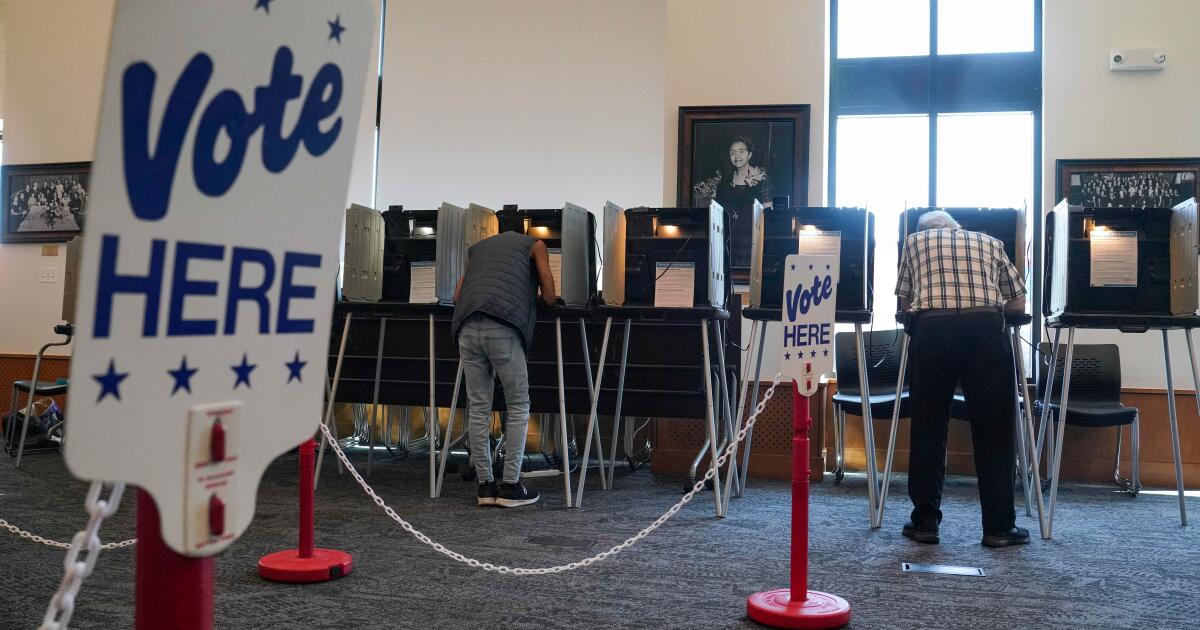
In a speech to the nation Thursday evening, President Trump said Americans deserve secure elections, and he claimed to be using federal authority to prevent them from being “stolen.”
In fact, one of the strongest security features of U.S. elections is the fact that they aren’t conducted at the federal level. America votes in more than 10,000 different election jurisdictions, each with different rules set by state and sometimes local governments.
That structure makes the nation’s elections extraordinarily complicated — and also safe from widespread fraud. And when misconduct does happen — rarely — security protocols frequently catch it.
America’s highly decentralized system of voting exists because the nation’s Founding Fathers gave authority over elections to the states, rather than the federal government. While Congress has the power to regulate elections — and has used that authority to pass such laws as the Voting Rights Act — the Constitution makes clear that states have primary authority to set the “times, places and manner” for elections.
There also is no national election agency that administers the presidential contest, something that’s different from many other countries. And when it comes to doing the day-to-day work of running an election, the responsibility falls to officials at the local level — usually a clerk or election supervisor — with help from staff and volunteers.
While differences in election laws can get confusing, election security experts say this structure is a strength. That’s because to pull off stealing a presidential election — as Trump falsely claims was done to him in 2020 — it would require large numbers of election workers in the most competitive counties across the country who are willing to risk prosecution, prison time and fines while working with officials from both parties willing to look the other way. And everyone somehow would have to keep quiet — a highly unlikely scenario.
There are also shared practices and security measures in place across the country that together work to ensure that only eligible voters can cast a ballot and only one ballot is counted for each.
Most Americans by now have probably heard stories about someone casting multiple ballots, or voting in the name of dead relatives, or stealing mail ballots from mailboxes.
When these incidents happen, they are often caught and prosecuted.
Voting more than once, tampering with ballots, lying about your residence to vote somewhere else or casting someone else’s ballot are crimes that can be punished with hefty fines and prison time. Non-U.S. citizens who break election laws can be deported.
For anyone still motivated to cheat, election systems in the United States are designed with multiple layers of protection and transparency intended to stand in the way.
For example, for in-person voting, most states either require or request voters provide some sort of identification at the polls. Others require voters to verify who they are in another way, such as stating their name and address, signing a poll book or signing an affidavit.
For absentee voting, all states require a voter’s signature, and many states have further precautions, such as having bipartisan teams compare the signature with other signatures on file, requiring the signature to be notarized or requiring a witness to sign.
That means even if a ballot is erroneously sent to someone’s past address and the current resident mails it in, there are checks to alert election workers to the foul play.
Trump has spent six years insisting he won the 2020 election, a campaign he lost to former President Joe Biden.
An Associated Press review in 2021 dug into every potential case of voter fraud in the six battleground states that Trump disputed. It found fewer than 475 cases — a number that would have made no difference in that race.
Allegations from Trump of massive voting fraud have been refuted by a variety of judges, state election officials and an arm of his own administration’s Homeland Security Department. In 2020, then-Attorney General William Barr, a Trump appointee, told the AP that no proof of widespread voter fraud had been uncovered. “To date, we have not seen fraud on a scale that could have effected a different outcome in the election,” he said at the time.
Swenson writes for the Associated Press.

Elizabeth Kobliha knows her one-eyed cat Likho has more friends than she does. So much so that on his 15th birthday last Saturday, the sidewalk outside her downtown Long Beach store where he spends most of his time transformed into a makeshift fair.
There were vendors selling peach cobbler, watches, hot dogs and offering tattoos and face paint. A DJ spun records in celebration.
“He’s a very good businessman. We’ve got stickers, T-shirts, keychains, and buttons [of him], and it all goes under his account, his name,” Kobliha said of the cat.

Share via
Before Likho roamed the 7,000-square-foot Long Beach Vintage Etc, there was Apollo. The “big rag doll” came in with health problems but was the perfect shop cat. Apollo, a Maine coon who died at 13 following a seizure a year after his arrival in 2015, had curbed the shop’s mouse problem and brought “so much love and energy.”
Similarly, Likho, a one-eyed Russian Blue, also was ailing when Kobilha took him in at 8 years old, but she wanted him anyhow.
“I always wanted to open my own shop so I can have a shop cat,” Kobliha says, adding she was inspired by bookstores with cats “just chilling.”

Vendors line the sidewalk for Likho’s birthday party. The cat is a local celebrity.
(Jason Armond / Los Angeles Times)
In 2016, Kobliha was swiping through Facebook when a video stopped her scroll. In it, a woman inside of a hoarder’s garage bobbed a feather toy in front of Likho, who jumped up to catch it.
The post was made by Sia Barbi in collaboration with animal rescue group Stray Cat Alliance after the cat had been abandoned at the Hancock Park home. During the early ‘90s, Sia and identical twin sister, Shane, made waves in the fashion and pop culture worlds, often modeling for Chanel, Thierry Mugler and Jean Paul Gaultier. Their rise to fame began after the Los Angeles Times covered a Sunset Boulevard billboard featuring the twins wearing little clothing that had been causing car accidents.
“Guys of a certain generation would get very hot and bothered over them,” Kobliha said of the Barbi twins. As they exited the modeling industry, they pivoted into animal activism and volunteering for rescue groups and trap, neuter and return programs for cats.

Elizabeth Kobliha holds her cat Likho. When she opened her vintage store, she knew she wanted a shop cat just like chill bookstore cats.
(Jason Armond / Los Angeles Times)
Kobliha wanted to adopt Likho, but first he’d need a $3,000 operation to remove an infected eye, paid for by the Stray Cat Alliance.
“They took care of everything, then we had to wait because he had to recuperate,” she recalls. “The whole time I’m thinking, ‘Oh my God, what if it doesn’t work out? What if the cat gets here and is just absolutely bonkers?’”
That fear was for nothing. Likho, who lives at the shop full-time, acclimated within a day. “He has been a beautiful addition ever since then,” Kobliha says.
He’s since become the face of the shop, with a mural dedicated to him outside to welcome customers. That was done by local muralist LaJon Miller, who worked on another on the sidewalk during Likho’s party.
“I got adopted into it,” he says of the Likho fandom. “He’s been my muse on this street for a while. … He just roams around the store, chills, does his little nap thing, and hangs out with everybody, so he’s very social.”
Likho has never harmed the centuries-old objects in her shop, Kobliha says, but he has spooked suspected ghosts.

LaJon Miller, who calls Likho his muse, paints a portrait of the cat on the sidewalk outside of Long Beach Vintage Etc.
(Jason Armond / Los Angeles Times)
Kobliha believes ghosts once connected to shops at the 1922 building — a former patron of a grocery store shamed for his obesity and a former furniture shop owner who died by suicide — still roam her store’s stalls.
“We see shadow figures … there’s a certain area where they pass back and forth. They don’t do anything, but they’re scary as hell,” Kobliha says of unusual sightings. “Likho is very protective, and we do feel really safe when he’s around.”
“It is a little weird, though, when he’s sleeping, and then suddenly he will jump up and look around,” she adds.
Likho’s biggest fan may be a man named Dom Gomez. He lives within walking distance of the shop, and tends to visit after long shifts at a restaurant aboard the Queen Mary. He stopped by the birthday party wearing his work uniform: a white, button-down shirt and black slacks. His hair slicked; his hands behind his back.

Likho’s face graces merchandise at Long Beach Vintage Etc like this fan.
(Jason Armond / Los Angeles Times)
When he speaks of Likho, he speaks with a tender cadence and dignified countenance, as if he were his own.
“Time flies, you know?” he says, smiling, of visiting Likho over the years. “He gets a lot of love from all the ladies that work here and myself … he has a lot of fans. I don’t know who’s more famous, Muhammad Ali or Likho the Cat.”
On a previous birthday, Gomez wanted to get Likho a gift. He settled on a kid’s denim jacket he modified for a cat with a patch for the Cure on the back but, regrettably, it was a “little too big.” Next year, he’ll give it another shot with a sweater.
“That’s my little buddy right there,” he says. “Today is a special day. I didn’t know a cat could live that long, but I think he’s still got a lot of energy to live … maybe another 100 years, I hope.”
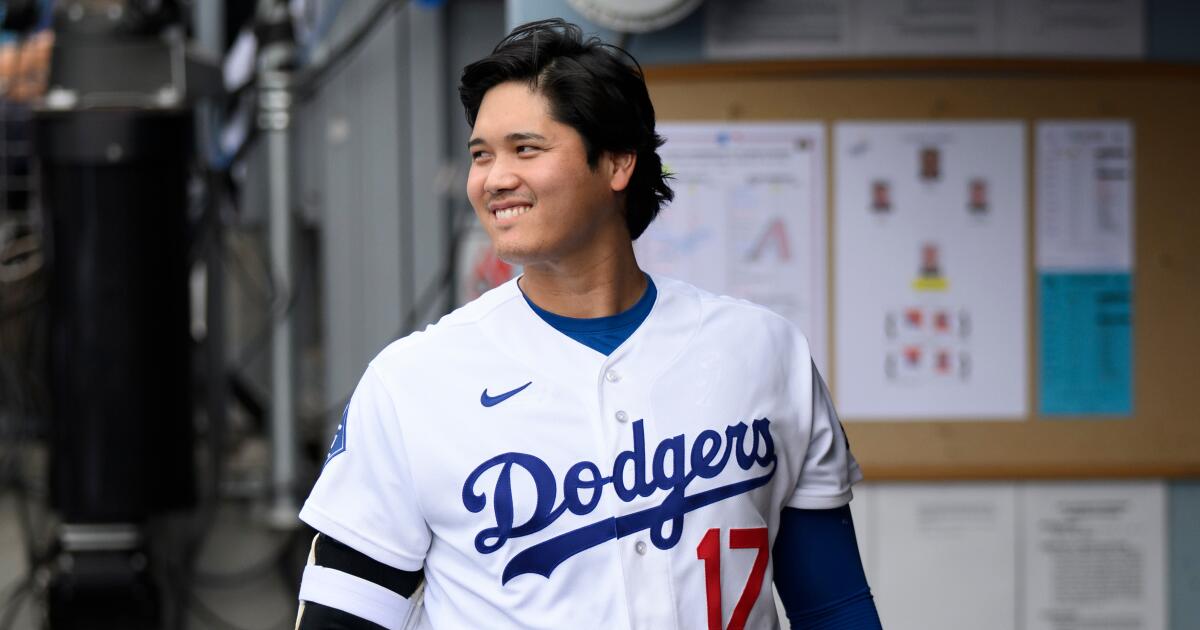
Shohei Ohtani is a global superstar.
The 2026 ESPY Awards provided the latest evidence of that, with the Dodgers two-way player winning two trophies, as determined by fan votes, at Wednesday night’s ceremony in New York.
But as surprising at it may be — especially to those of us in the Los Angeles area who have witnessed the Japanese baseball phenomenon during his nine years with our local MLB teams — not everyone on the planet is familiar with the four-time MVP and two-time World Series champion.
The ESPYs provided evidence of that as well. Boxers Mike Tyson and Jake Paul joined musician DJ Khaled to present the award for best single-game performance. Ohtani — nominated for his historic Game 4 of the 2025 National League championship series against the Milwaukee Brewers — was the winner, as announced by Tyson.
Paul told the crowd that Ohtani was unable to attend the event, but “he sends his gratitude and appreciation to ESPN and everyone who voted for him.”
Afterward, a hot mic picked up Tyson seeming to ask Paul a rather unexpected question:
“Shohei’s a guy?”
The question seemed to be genuine, and Paul gave a casual response to his friend and former boxing opponent. “Yeah, he’s a guy,” Paul appeared to say as the trio started leaving the stage.
The Times reached out to a Tyson representative for comment but did not receive an immediate response.
No shade toward Iron Mike for apparently not knowing much about Ohtani. Tyson is a legend in his sport and has a number of other ventures and interests that occupy his time. While he did throw out a ceremonial first pitch before a Brewers-Pittsburgh Pirates game in 2014, Tyson just might not be all that into baseball.
Also, the name Shohei isn’t at all common in the U.S., even amid Ohtani’s massive popularity. According to Parenting Patch, only nine American babies were given that name in each of the last two years. All of them were boys, but the odds are good that Tyson doesn’t know any of them.
If Tyson hasn’t been following Ohtani’s career, though, he’s missing out. Take the aforementioned Game 4 of last year’s NLCS as an example. Ohtani hit three home runs and pitched six-plus scoreless innings with 10 strikeouts in a 5-1 victory over the Brewers that completed an NLCS sweep and sent the Dodgers to the World Series for the second straight year.
“That was probably the greatest postseason performance of all time,” manager Dave Roberts said after the game.
Ohtani was much more low-key in his postgame assessment.
“This time around, it was my turn to be able to perform,” he said through interpreter Will Ireton. “I think just looking back over the course of the entire postseason, I haven’t performed to the expectation.”
With his performance that night, Ohtani beat out fellow nominees Tyce Armstrong of Baylor baseball (three grand slams in a game), Bam Adebayo of the Miami Heat (83 points in a game) and Hannah Hidalgo of Notre Dame basketball (16 steals in a game) for the award.
That epic game certainly contributed to Ohtani’s other ESPY of the night. He was named best MLB player over fellow nominees Aaron Judge of the New York Yankees, Cal Raleigh of the Seattle Mariners and Paul Skenes of the Pittsburgh Pirates.

“Remake” has a tragic tale to tell and director Ross McElwee wastes no time revealing its grieving heart. Near the start of this funereal documentary, the filmmaker addresses his subject directly: “It’s been seven years since you died,” he says to his late son Adrian through voice-over, “and I still miss you every day.”
Across McElwee’s 50-year career, he has worked intimately without a crew to make sense of his own life by diligently recording it. In the process, he turned his friends and loved ones into the unlikely stars of his acclaimed independent documentaries.
With “Remake,” he looks back at that footage, concentrating on the images he shot of Adrian since his birth in 1989. Adrian died on Christmas Eve 2016 of a drug overdose and McElwee clearly remains shattered. For a documentarian who specializes in personal movies, “Remake” feels especially revealing — both in terms of the glimpses we get of this father-son relationship and of unsolved mysteries that linger just outside the frame.
The film’s title ostensibly refers to a surprising phone call McElwee received about 20 years ago, when he was approached by Steve Carr, the director of broad comedies like “Paul Blart: Mall Cop,” who was eager to adapt McElwee’s 1986 documentary “Sherman’s March” into a movie. That landmark picture features McElwee, then in his mid-30s, as he tries to chronicle the exploits of Union Gen. William Tecumseh Sherman, who laid siege to the South during the Civil War. Except, in the midst of that project, McElwee’s focus shifts, delightfully, to his disastrous love life and the fascinating women he meets in his travels, becoming a deeply humane examination of modern courtship.
Carr doesn’t seem like an obvious choice to oversee a narrative remake, but McElwee decides to sell him the rights anyway. Soon in “Remake,” though, it becomes apparent that this is just one chapter of the story — and hardly the most essential. McElwee’s last film, 2011’s “Photographic Memory,” dealt with his increasingly frayed connection to Adrian, who was already fighting substance-abuse issues. “Remake” retraces Adrian’s childhood while filling in the details of the director’s life after “Photographic Memory,” including brain surgery and the dissolution of his 24-year marriage.
But Adrian is never far from his thoughts or absent from the screen: this smiling, happy boy slowly transforming into an edgy, troubled young man whose sweetness still occasionally shines through.
The passage of time is central to McElwee’s work, but he’s rarely scrutinized the topic as aggressively as he does here. It’s not simply that we watch Adrian age or revisit some of McElwee’s “Sherman’s March” subjects. (“Sherman’s March” is now screening in a new 4K restoration at the Laemmle Royal with “Remake.”) It’s also in the way that McElwee’s formerly wry narration now sounds far more resigned, his voice grown froggy and hushed as he nears 80. McElwee has often pondered the downside of essentially treating himself like a human camera, observing the world rather than fully engaging in it. But in “Remake,” he openly questions his artistic approach and, fittingly, he lets his son be his loudest critic.
As a boy, Adrian is enchanted by McElwee’s filming. In childhood, he paints an abstract picture of God in which the Almighty eerily resembles a movie camera. But although Adrian soon picks up a camera as well, increasingly interested in being a filmmaker himself, he resents how his father intrudes on their time together by constantly shooting their conversations. McElwee’s scenes of them at the Venice Film Festival for the “Photographic Memory” premiere are especially fraught, Adrian’s prickly reaction to a movie about his drug abuse creating tension between the two men at the subsequent press conference.
In “Remake,” McElwee laments that he didn’t do enough to help him navigate addiction and the mental-health issues that exacerbated it. (Adrian was diagnosed with bipolar disorder.) Was McElwee too consumed with his own career to be there for his son? The question haunts “Remake” — he includes an indelible sequence from “Sherman’s March” in which his longtime friend Charleen upbraids him for always having the camera out. “This isn’t art,” she hollers. “This is life!” Did McElwee never come to appreciate the difference?
A eulogy that also serves as an apology, a reckoning and a confession, “Remake” is filled with moments that are crushing because of how understated they are, none more brutal than when McElwee visits Adrian near the end of his life, when he’d moved to Colorado to get a fresh start. “He seemed to be doing OK,” McElwee recalls thinking. “But I always leave knowing I’m probably not seeing the whole picture.”
Even now, poring through his footage, desperately looking for clues, McElwee pines for that larger view — the one that might somehow bring the boy back to his inconsolable father.
‘Remake’
Not rated
Running time: 1 hour, 54 minutes
Playing: Opens Friday, July 17, at Laemmle Royal

ATLANTA — The jury is still out on whether Lionel Messi is the greatest soccer player ever. But there should be no doubt he’s the greatest to ever play in a World Cup.
And you don’t need the records, the wins or the goals to prove that — although he certainly has enough of those. You just need to see Messi at his most magical, as he was Wednesday, setting up a pair of game-changing goals in a seven-minute span to lift Argentina to a 2-1 win over England and into Sunday’s World Cup final with Spain.
“It’s really hard to speak right now, but I’m going to try not to cry,” Lautaro Martínez, who scored the winning goal two minutes into stoppage time, said in Spanish. “I’m already overwhelmed inside. It’s incredible. Everything we’ve achieved is just incredible.”
Like their 13-game World Cup unbeaten streak, dating to the opening game of the 2022 tournament in Qatar. Or back-to-back trips to the final, which gives them a chance to become the first repeat champion in the men’s tournament since Brazil in 1962.

Argentina’s Lautaro Martinez scores his team’s second goal in front of England goalkeeper Jordan Pickford (1) and fellow England players Ezri Konsa (2) and John Stones (5) during a World Cup semifinal in Atlanta on Wednesday.
(Erik S. Lesser / Associated Press)
But it hasn’t been easy. Eleven of Argentina’s 19 goals — including both scores in Wednesday’s semifinal — have come after the 75th minute. They trailed in the 80th minute or later in two of their last three knockout games, only to rally both times.
And Messi has either scored or assisted on three of the four goals that rescued Argentina.
“This group, in the face of adversity, keeps going, keeps going, and never gets tired,” Martínez said. “And we have the best in the world as our example.”
On Wednesday that meant heartache for England, which was as close to a World Cup final as it has been in six decades, leading 1-0 on Anthony Gordon’s second-half goal with just five minutes left in normal time.
But after taking the lead, England turned strangely conservative, dropping all 11 players behind the ball at times, daring Argentina to score. Eventually it did, with Enzo Fernández curling a right-footed shot from about 20 yards past England keeper Jordan Pickford and in at the left post to tie the game.
It was a pass from Messi that found Fernández in space at the top of the box, earning the Argentine captain his record 11th World Cup assist.
“The opponent doubted themselves,” Argentine coach Lionel Scaloni said. “We smelt blood and went for it. We all felt it. “
The tie didn’t last for long though, with Messi threading a perfect cross from the right wing to Martínez, who found space between English defenders John Stones and Ezri Konsa at the far post. Messi’s pass just cleared the leaping Stones, then dipped to Martínez, who nodded it home.

England’s Harry Kane and England’s Jude Bellingham are dejected after losing to Argentina during a World Cup semifinal on Wednesday in Atlanta.
(Jeff Roberson / Associated Press)
When the ball hit the net, the sellout crowd at Atlanta’s massive Mercedes-Benz Stadium erupted.
“Once again, despite falling behind, we managed to turn the game around in stoppage time. That speaks volumes about this group, about this team that never settles, always wants more, always strives for more,” Martínez said.
It also gives Messi a chance to strive for more in Sunday’s final. He has already played in more World Cup games, scored more World Cup goals and had more World Cup assists than any man in history. With a win over Spain, he can join another elite group of men: those who have won back-to-back World Cup titles.
History will eventually decide if it was Messi’s brillance or the tactical surrender of England coach Thomas Tuchel that truly turned the game around. Tuchel, however, said he had no regrets.
“We played the matches how they were,” he said. “We overcame every obstacle. We were very, very close today. It’s not a moment now to analyze the full tournament because we lost a crucial match.”
His captain, Harry Kane, who lost in the semifinal of a World Cup for the second time in three tournament, was also not interested in second-guessing.

Argentina’s Lionel Messi sits on the shoulders of a teammate and celebrates after beating England in a World Cup semifinal on Wednesday in Atlanta.
(Rebecca Blackwell / Associated Press)
“We had a lot of good moments in this tournament, a lot of good games,” he said. “We talked about knocking on the door. We’re close, we just have to find that missing piece in the final stage of the tournament.”
They may be closer than they think: England is the only team this century to score the first goal in a World Cup semifinal but not reach the final, according to the OptaJoe statistical service.
Argentina’s team, meanwhile, is missing nothing — except maybe a second title,
“The people of Argentina should celebrate being in a final,” Scaloni said. “This group of players is difficult to describe in words. They are so special. I’m getting emotional. They fight for everything.
“We’re going to try to win the final. But what else does this team need to do? There isn’t much else to say. I’m eternally grateful to this group of players.”
Sports editor Iliana Limón Romero contributed to this report.

A man who allegedly sent Las Vegas Aces guard Chelsea Gray a profane message that included a racist slur has been fired after social media users figured out where he worked.
On Monday, the former Sparks player posted a screenshot on her Instagram Story of a DM she said she received following her team’s loss to the Indiana Fever on Sunday.
“People act like we make this s— up,” Gray wrote. “And the audacity to tell us as athletes to ‘shut up and dribble.’”
Her post included the sender’s user handle. Folks on social media discovered that the man worked for Hilton Grand Vacations and pressured the company to punish him for his alleged misdeed. Initially, the company wrote on X that it was investigating the matter and would “take appropriate action based on the findings of our review.”
Hours later, Hilton Grand Vacations posted that the person allegedly responsible for the racist message “is no longer with the company.”
“His behavior was in violation of multiple company policies and does not reflect our company’s values in any way,” Hilton Grand Vacations stated.
The Aces posted a statement Wednesday on X condemning the messages directed at Gray and offering support for those who stand up against such attacks.
“We stand behind those who have the courage to speak up for themselves,” the organization stated. “We are united with anyone who has been targeted by this type of unacceptable behavior.
“We stand with organizations, like Hilton Grand Vacations, that hold individuals accountable for racist conduct. We commend them for the swift manner in which they acted in addressing this manner.”
The WNBA reposted the Aces’ statement and said it “stands with Chelsea and every member of our league.”
“We unequivocally condemn racism and all forms of hate,” the league wrote. “There is no place for this behavior in sports or anywhere, and we remain committed to protecting the players and fostering an environment built on respect and inclusion.”
As part of the collective bargaining agreement reached in March, the WNBA introduced a no-hate campaign that included a stronger fan code of conduct that specifies punishments for online abuse of players and other inappropriate behaviors.
Still, Phoenix Mercury forward Alyssa Thomas told reporters last month that she received death threats and racist abuse after an on-court incident in which her fist pressed into Fever star Caitlin Clark’s throat while they were scrambling for the ball. No foul was called at the time, but the WNBA later assessed Thomas a Flagrant 2 foul and suspended her for a game.
Speaking to reporters June 30, Thomas called out the league and commissioner Cathy Engelbert for not doing more to protect players off the court.
“Time and time again, players are going through this and the league remains silent,” Thomas said. “I’m sick and tired of it. It’s time for them to step up and have our backs.”
Engelbert released a statement following Thomas’ comments.
“We are aware of Alyssa Thomas’ comments, and what she and her teammates have experienced is completely unacceptable and not representative of the WNBA community,” the commissioner said. “The league and our security team have been in contact with the Phoenix Mercury organization and remain committed to protecting all players.”
During last weekend’s Fever-Aces game, Gray drew a foul on Clark while driving to the basket, but her elbow also appeared to make contact with the Indiana star’s stomach. Clark doubled over after the whistle in what some said appeared to be an attempt to get a foul called on Gray, but none was called.
The racist message received by Gray did not appear to mention Clark or any specific incident.

WASHINGTON — The Senate unanimously approved a measure Tuesday that would make daylight saving time permanent across the United States next year.
The bipartisan bill, named the Sunshine Protection Act, would ensure Americans would no longer have to change their clocks twice a year. But the bill still needs approval from the House, and the signature of President Biden, to become law.
“No more switching clocks, more daylight hours to spend outside after school and after work, and more smiles — that is what we get with permanent daylight saving time,” Sen. Ed Markey (D-Mass.), the original co-sponsor of the legislation, said in a statement.
Markey was joined on the chamber floor by senators from both parties as they made the case for how making daylight saving time permanent would have positive effects on public health and the economy and even cut energy consumption.
“Changing the clock twice a year is outdated and unnecessary,”said Sen. Rick Scott (R-Fla.).
“I’ve said it before and I’ll say it again: Americans want more sunshine and less depression — people in this country, all the way from Seattle to Miami, want the Sunshine Protection Act,” added Sen. Patty Murray (D-Wash.).
Nearly a dozen states across the U.S. have already standardized daylight saving time.
Daylight saving time is defined as a period between spring and fall when clocks in most parts of the country are set one hour ahead of standard time. Americans last changed their clocks on Sunday. Standard time lasts for roughly four months in most of the country.
Members of Congress have long been interested in the potential benefits and costs of daylight saving time since it was first adopted as a wartime measure in 1942. The proposal will now go to the House, where the Energy and Commerce Committee had a hearing to discuss possible legislation last week.
Rep. Frank Pallone (D-N.J.), the chairman of the committee, agreed in his opening statement at the hearing that it is “time we stop changing our clocks.” But he said he was undecided about whether daylight saving time or standard time is the way to go.
Markey said Tuesday: “Now, I call on my colleagues in the House of Representatives to lighten up and swiftly pass the Sunshine Protection Act.”
A top spokesperson for Los Angeles Mayor Karen Bass left her administration Monday after a brief tenure, joining a growing list of communications aides who have departed over the past nine months.
Kolby Lee, who started as Bass’ director of communications in February, said he was resigning to spend time with family and loved ones.
“I’m very grateful to Mayor Bass for giving me the opportunity to be part of her team and serve the people of Los Angeles,” Lee said in a statement.
Bass’ communications office said in a statement to The Times, “We thank Kolby for his contribution to the office and wish him and his family well.” Bass is running for reelection against City Councilmember Nithya Raman.
The departures began in October, when Zach Seidl, Bass’ longtime deputy mayor of communications, left for the private sector.
Press secretary Clara Karger left in January after working for the mayor for nearly three years.
Bass then brought on Amanda Crumley to replace Seidl. But Crumley lasted little more than a month, leaving in March.
Lee started as communications director shortly before Crumley’s departure, serving for about five months.
During Lee’s time in the administration, Bass was also receiving pro bono communications help from Yusef Robb, an outside consultant who worked on her 2022 campaign.
Robb was not paid by the city for his work and served in an unofficial role providing comments on important issues, including Bass’ involvement in damage control surrounding the 2025 Palisades fire.
Lee provided comment to The Times in a story published Saturday about Robb’s work for the Bass administration at the same time that he is a crisis communications consultant for Lineage Logistics, the company whose Boyle Heights warehouse erupted in flames last month, inundating the area with toxic smoke and rotting food odors.
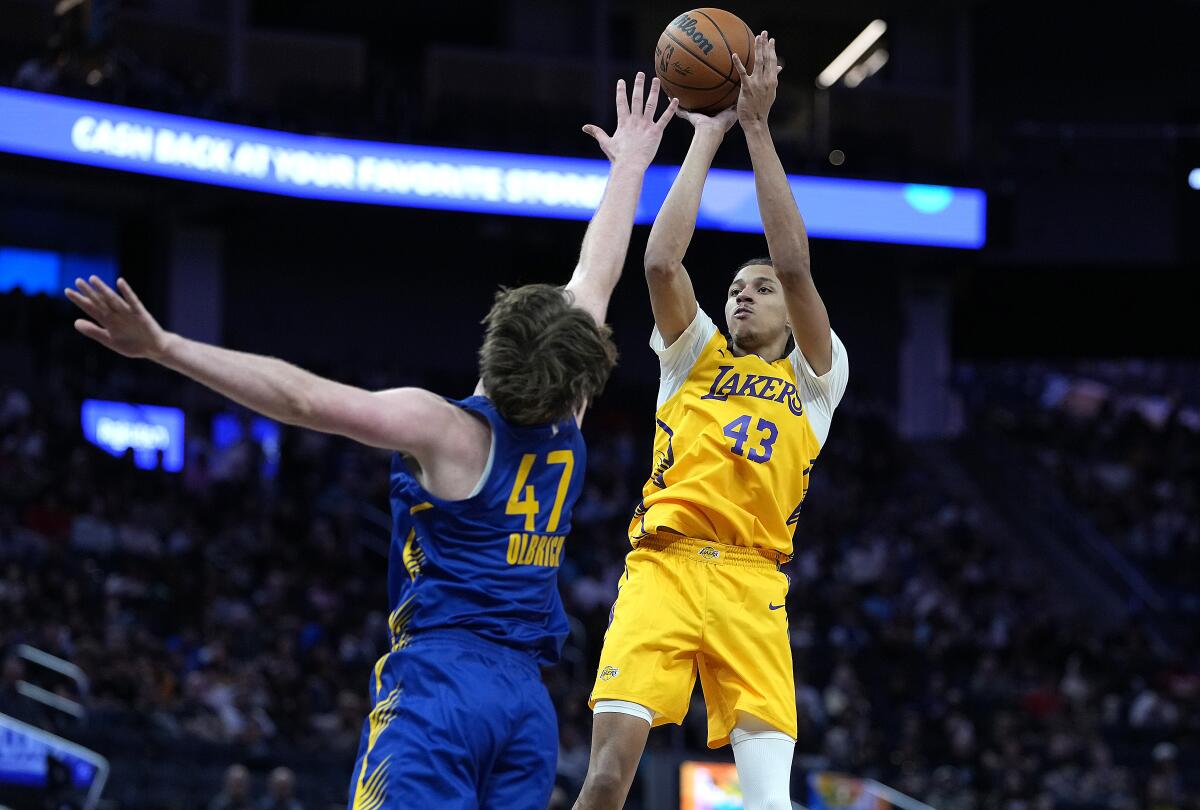
Welcome back to the Lakers newsletter, where we’ve reached the “statement” portion of the summer.
After a busy wave of free agency, the Lakers made many of their offseason moves official this week: Jaden Hardy, Sandro Mamukelashvili, Quentin Grimes, Walker Kessler, Collin Sexton and Kevon Looney are in; Austin Reaves is back; Deandre Ayton is out to Washington.
The onslaught of announcements, photo ops and new social media graphics bring us one step closer to our opening day roster. With the veteran pieces in place, we’ll take a look at how the young players are shaping up.
Get all the Lakers news you need in Thuc Nhi Nguyen’s weekly newsletter.
By continuing, you agree to our Terms of Service, which include arbitration and a class action waiver. You agree that we and our third-party vendors may collect and use your information, including through cookies, pixels and similar technologies, for the purposes set forth in our Privacy Policy such as personalizing your experience and ads.
Adou Thiero hurt his right wrist on a hard fall during the Lakers’ second summer league game this month. The bigger injury risk might be slamming his hand too hard on a dunk.
In his second season and his first summer league, Thiero wants to break into the rotation for the new-look Lakers. The high-flying forward’s progression after an injury-plagued rookie season is one of the key stories of the Lakers’ summer league.
Thiero did not make the strongest summer impression. During the first game at the California Classic in San Francisco, the 22-year-old looked like he was playing in fast-forward. Not in a good way.
Going three-for-10 from the field with nine points and multiple out-of-control drives to the rim, Thiero did not look like the returning NBA player on the Lakers’ summer league roster. He missed the team’s last game in San Francisco because he took a hard fall in the prior game.
Two months after he last played in a competitive game, Thiero said he was just so eager to play in the California Classic that he needed to “take it back a couple of notches and slow my game down.”
Thiero slowed down and soared higher in Las Vegas, where he had 20 points, four rebounds, three steals, two blocks and no turnovers in the Lakers’ Las Vegas summer league opener. The tape on his right wrist didn’t hold him back from slamming dunk after dunk after (windmill) dunk against the Oklahoma City Thunder.
“Gotta put on a show,” Thiero said on the Amazon Prime broadcast of his windmill dunk. “Lakeshow for a reason.”
Thiero, who is still working on improving his three-point shot, could add an athletic, energetic boost to the Lakers offense. With Walker Kessler filling the much-needed lob-catching center role, the Lakers have potential to be one of the league’s best offenses. Luka Doncic and Austin Reaves are just that good.
It’s on the defensive end that young players, including Thiero and rookie Cameron Carr, will need to prove their value. The Lakers, who added Ziaire Williams on a one-year deal Monday in their 15th roster spot, are looking for more defense on the wing.
Thiero said he has had conversations with the Lakers coaching staff about growing into an aggressive point-of-attack defender. His instructions are to “cause havoc,” he said. Thiero has delivered with a team-high nine steals during four summer league appearances.

Cameron Carr shoots over Lachlan Olbrich of the Golden State Warriors during a summer league game.
(Thearon W. Henderson / Getty Images)
Carr has four blocks, including several on jump shots. With a 38-inch vertical and an 8-foot-8 standing reach, Carr used his length and athleticism to lead Baylor with 45 blocks last season.
But as he makes the transition to the NBA level, Carr said there’s still a lot for him to learn. The 184-pound guard plans to make the weight room his second home. He can get deflections but gets beat on drives. Catching up on the court starts with catching up to the speed of the game mentally.
“[In the NBA] they kind of rely on being smarter up top, and so it’s just trying to be ahead of everybody, trying to be ahead of the play, and be in the same space they’re in. We all flow as one,” Carr told reporters in Las Vegas. “I feel like right now, I’m a little bit behind because I’m a little bit younger. I mean, this is my first time practicing, this is the first time playing with them, so it was a little bit just trying to catch up.”
On offense, Carr is already showing important skills that could earn him a rotation spot. His jumper is pure and smooth. He went 11 for 32 from three-point range in his first four summer league appearances, averaging 17 points. He missed the second game in Las Vegas because of a minor thumb injury. At 6-foot-5 with a high, consistent release, Carr had Stan Van Gundy gushing about his shooting on the Amazon Prime broadcast in Las Vegas.
While eyes are fixated on the two most recent draft picks, the Lakers’ leading summer league scorer is unheralded Arthur Kaluma.
The South Bay Lakers forward had a standout 34-point performance against the Dallas Mavericks and is averaging 20 points in four summer league appearances. In Vegas, he’s shooting 76.2% from the field and 59% overall this summer.
Kaluma averaged 14.6 points and 4.9 rebounds for the South Bay Lakers last season. The 6-7 forward is a versatile scorer who can stretch the floor with his three-point shot. He shot 37% from three-point range in the G League last season and made six of 10 threes against the Mavericks in his summer league statement.
The 24-year-old, like many of his summer league teammates, is battling for his NBA dreams. Each team is allowed up to three two-way players at a time, and the Lakers have already announced their maximum allotment. Guard Chris Mañon, who finished second in G League defensive player of the year voting last season, re-signed, and rookies Peter Suder and AK Okereke got their first professional contracts.
But that doesn’t mean all three are locked in for the season. Last year, the Lakers waived Christian Koloko five months after re-signing the center to a two-way deal to add Drew Timme in his spot.
“The G can get grimy, you know what I’m saying?” Kaluma said to reporters in Las Vegas. “It’s a time where everybody is trying to fight for a position and there is a certain hunger that you have to have in order to be successful in the G. And I feel like that drive that I had my first year in it pushed me into this summer to really get better and work on my game and come here and have the opportunity to perform.”
These summer league games don’t officially count. For many in the league, the annual pilgrimage to Las Vegas is more about off-court schmoozing than the on-court product.
But with players trying to make a name for themselves and fighting for their jobs, don’t tell anyone these games don’t matter.
“In these summer league settings, there’s 29 other teams that are looking and watching these games,” Lakers summer league coach Ty Abbott said, “and this is opportunities for all of them. So there’s no room to not take a game seriously. Every possession matters, every rep, every drill, every practice.”
Last week, we asked if you would like to see the Lakers retire LeBron James’ jersey. Here are the results:
Yes: 32
No: 54
Summer league is winding down and I’ll be on vacation this week so the Lakers newsletter will rest for at least one week. Thus no new poll question for now. But if you like the polls — or have poll questions you want to ask your fellow newsletter subscribers — email me your thoughts at thucnhi.nguyen@latimes.com.

The bánh cuốn đặc biệt plate at Bánh Cuốn Lưu Luyến in Garden Grove.
(Thuc Nhi Nguyen / Los Angeles Times)
My Instagram algorithm has been feeding me unrelenting videos of Vietnamese food and this is the rare instance in which I’m not mad at social media platforms tracking my movements. At least they’re delivering something I want.
After being subjected to dozens of videos of people making Vietnamese steamed rice rolls (bánh cuốn), I decided to hunt some down for myself at Bánh Cuốn Lưu Luyến in Garden Grove. The bánh cuốn đặc biệt — a combination plate with plain steamed rice sheets, sheets stuffed with ground pork and mushroom and pieces filled with shrimp — satisfied my internet FOMO cravings. Every plate is complete with an egg roll, tofu, ham, mung beach shrimp cake and vegetables. I think even my mom would approve of this restaurant.
Life after LeBron: Austin Reaves embracing new role on new-look Lakers roster
Lakers sign Ziaire Williams to one-year, $3-million deal to bolster their depth
Lakers land their backup center in veteran Kevon Looney
As always, pass along your thoughts to me at thucnhi.nguyen@latimes.com, and please consider subscribing if you like our work!

Book Review
People Watching in the Desert: A Novel
By Cali Adeline
Harper: 400 pages, $30
If you buy books linked on our site, The Times may earn a commission from Bookshop.org, whose fees support independent bookstores.
“Writers are always selling somebody out,” Joan Didion once wrote. She was talking about journalists, but it can be just as true of novelists. Whether the genre is romantasy or autofiction, making up stories often demands making up stories about real people — exploiting them — to serve a narrative purpose.
Cali Adeline’s debut novel, “People Watching in the Desert,” gives this thorny ethical business an impressively complex treatment for a book that comes on like a beach read. Sonny, its hero, has checked into Sanctuary, a spendy Phoenix-area resort, for an extended stay. She’s 25 and unemployed, and it’s unclear at first how she acquired the funds to splurge on an on-site cottage with a pool, 90-minute massages, and various forced-fun adventures. It’s also unclear why she chose a five-star resort for the splurging, given her discomfort with everything from the menu on down. Sitting down for dinner alone, she “discreetly googled some of the words on her phone under the table: cotija, calabacitas, tabbouleh, bisque.”
Adeline lays out a breadcrumb trail that eventually reveals that Sonny has lugged some especially heavy personal baggage to Sanctuary. Her neglectful, addict mom died when she was a child, only to be replaced with a repressive, overprotective grandmother who stomped on her every ambition. Early adulthood has been defined by failed relationships and uninspiring work. People are to be feared: She’d sooner indulge in croquettes at the resort’s cocktail party than make small talk with other vacationers, and when she braves the world outside her cottage it’s usually with a notebook in her hand.
The early pages of “People Watching” weave Sonny’s perspective with brief sketches of her fellow resort-goers, which usually open with godlike authority: “Allana was ten feet tall and beautiful.” “Chloe and Mark had been married for seven blissful years.” “Dale was invisible. He had that way about him.” The odd bluntness of these statements, combined with their touches of surreality (“ten feet tall”?), makes clear that these mini-bios are scribblings from Sonny’s notebook. Terrified of the world, but determined to better understand what she’s been excluded from for so long, she’s determined to imagine her way into reality.
Sonny’s Walter Mitty-like imaginings do some valuable double duty in the novel. For one thing, they offer some necessary conflict in a setting that’s all about relieving tension. Resorts are, almost by definition, boring, but as Sonny hangs out poolside or does yoga or endures a singing bowl, her mind (and the novel) is reeling with imagined infidelities, deaths, gambling debts and other domestic dramas. Second, her sketches serve as character-defining examples of projection on Sonny’s part, as her observations of others reveal her own concerns about love, sex, money and rejection.
And, of course, she’s deflecting, too — better to make up drama about others than confront her own. The memories Sonny eventually surfaces are more potent than anything she makes up. But they’re also crueler, and you can understand why she’ll think and write about anything but. She recalls a time as a child when she was neglected for days on end and braved a trip to a neighbor for help. “The woman asked Sonny when the last time she took a bath or changed her clothes was and Sonny didn’t know the answer. Her only response was, ‘I’m four,’ as she proudly held up five fingers,” Adeline writes. “She was three.”
Remember the words “beach read” up there? It’s not difficult to predict how Sonny’s arc will curve: It’s a Walter Mitty story, but also an Ugly Duckling story. That notebook full of mini-dramas becomes a source of drama in itself. Say, that bartender is pretty cute, isn’t he? And Sonny eventually integrates with a few of her fellow resort-goers, and learns there’s more to them in reality than her imaginings. As one character gently chastises her, “People can surprise you, Sonny, but you have to let them.”
The pat-ness of Sonny’s Sanctuary journey makes her yet another entry in an evolving genre you might call “Is This Character Concussed?” In these novels, the main character has been so absurdly addled by a (late-revealed) trauma that everyday human interactions are wildly aglow with (at first) terror or (later) manic-pixie wonder. Prime examples include Gail Honeyman’s “Eleanor Oliphant Is Completely Fine,” Sayaka Murata’s “Convenience Store Woman,” and multiple characters in the oeuvre of Sally Rooney and Ottessa Moshfegh. (Women are the most common character in these books, but guys can play too: See Fredrik Backman’s “A Man Called Ove.”) Socially awkward characters offer an opportunity for dry humor and deadpan prose. Because these stories have to dramatize a search for normalcy, its leads tend to be awkward in ways that strain credulity.
But you don’t have to wholly buy into the idea of a character like Sonny to find something intriguing about what Adeline is saying about storytelling throughout “People Watching.” In Sonny’s notebook, every observation is a moral choice, a mini-essay about what proper conduct is, what failure is, how you might get past it, and what our responsibilities to others might be. A notebook is a place of wish fulfilment, and a place for vengeance. Sonny explains at one point that she only started to get free of her grandmother’s clutches once she was capable of imagining her violently erased:
“I wrote a story. About her. And how one day while I was at work the house caught fire. Which wasn’t that far-fetched because the whole place really was a fire hazard. And … and … well, she was asleep inside the house, in the story, and didn’t make it out. I didn’t mean it. I was angry. And it was a story.”
Adeline stresses the word “story” three times in one brief passage. Sonny wants to reassure everybody that she was just making it up. But no writer is, not entirely.
Athitakis is a writer in Phoenix and author of “The New Midwest.”

A proposal to make daylight saving time the year-round default nationwide is once again coming before Congress.
And, as in the past in both California and nationally, proponents and opponents of the switch cite the potential effects (good or bad) on health, business and agriculture as reasons to support or oppose the plan.
The House is expected to vote on the Sunshine Protection Act this week, according to the office of Rep. Vern Buchanan (R-Fla.), the bill’s author.
The Senate version of the bill, SB 29, is sponsored by Sen. Alex Padilla (D-Calif.). In a statement last year he said, “More daylight after work means more business and more active, safer California communities.”
Most of the U.S. went on daylight saving time in the spring, moving clocks one hour ahead of standard time. The bill would end the “fall back” to standard time that typically takes place in November. The change would mean darker mornings and later sunsets. President Trump has indicated that he supports the plan.
It won’t be the first time the debate over timekeeping has made its way to Capitol Hill. In 2022, a bill to make daylight saving time permanent was approved by the Senate, but the effort stalled in the House.
“It’s clear that year-round daylight saving time is a popular, commonsense reform that will improve everyday life for millions of Americans,” Buchanan said in a statement to The Times. “Passing my bipartisan Sunshine Protection Act will bring us one step closer to ending the outdated and unpopular practice of changing our clocks twice a year.”
Areas that already do not observe daylight saving time would be able to stay on permanent standard time, according to the bill text. For example, Arizona and Hawaii do not move their clocks forward or backward.
Lawmakers in California and other states could opt out making daylight saving time permanent, but would need to decide before the law takes effect, Josh Gregory, a senior advisor to Buchanan, said in an email.
The effort has drawn support from both sides of the aisle. In California, Reps. Jay Obernolte (R-Big Bear Lake), Ken Calvert (R-Corona) and Young Kim (R-Anaheim Hills) are cosponsors of H.R. 139.
The proposal also has bipartisan opposition.
Sen. Tom Cotton (R-Ark.) has also been a vocal opponent of permanent daylight saving time. In a speech last year, Cotton argued that while year-round daylight saving time might benefit some activities and areas — such as golfing in Florida and Alabama — residents of northern states and on the western sides of time zones might not see the sun rise until 9 a.m. in the winter.
Cotton raised concerns that students would need to walk to school in the dark and risk being struck by drivers, as was the case in 1974 when the U.S. briefly adopted year-round daylight saving time to combat an energy crisis.
“The darkness of permanent daylight saving time would be especially harmful for schoolchildren and working Americans,” Cotton said.
Rep. Nanette Diaz Barragán (D-San Pedro) told The Times in a statement that she plans to vote against the bill because “medical experts have warned that permanent daylight saving time is bad for our health.”
She supports a different proposal, the Sunshine for Our Kids Act, which seeks to make permanent standard time the default nationwide but gives states the option to opt out. The bill, HR 9638, has been endorsed by the American Academy of Sleep Medicine.
Stanford professor Jamie Zeitzer, a physiologist who studies circadian cycles and how humans respond to light, supports ending the twice-a-year time changes.
The “spring forward” shift results in a loss of sleep and has been associated with a number of negative health effects, he said. The spring clock change has also been linked to more car accidents and cardiovascular incidents, he added.
Zeitzer’s research found that the darker mornings and brighter evenings of permanent daylight saving time weaken the circadian clock for many people.
“The abundance of biological evidence is clear that permanent standard time is a better solution,” Zeitzer said. “When you have a more robust light signal early in the morning, that will help keep your internal circadian system synchronized to the day.”
A 2025 AP-NORC survey found that the current system of changing the clocks twice a year is unpopular. According to the poll of nearly 1,300 U.S. adults, only 12% of respondents favored the current system, while 47% were opposed and 40% were neutral.
In the business world, there’s no consensus on making daylight saving time permanent. Many chambers of commerce and businesses that want to lure customers later in the day generally support it, while agricultural interests and some industries oppose it.
As for making standard time permanent, that faces opposition too. Among the opponents: golf course owners.
Jay Karen, the chief executive officer of the National Golf Course Owners Assn., testified at a congressional hearing in November that losing extra evening daylight could cost the industry $1.6 billion in green fees alone because so many Americans tend to golf in the afternoon or evening.
Buchanan’s office said in a statement that the “well-documented benefits of having more sunshine later in the day after school and after work will be beneficial for millions of Americans’ health and well-being.”
There have been previous attempts to put an end to the twice-annual clock adjustments in California.
In 2018, California voters approved Proposition 7, which was supposed to give the Legislature the authority to impose year-round daylight saving time — but only if the federal government allowed states to do so. It has not yet led to any meaningful change.
Earlier this year, state Sen. Roger Niello (R-Fair Oaks) introduced SB 1197, which seeks to “ditch the switch” by moving the state to permanent standard time.
A spokesperson for Niello’s office said that because his previous efforts failed to gain traction, his current proposal includes a provision requiring California to conform if the federal government adopts permanent daylight saving time.