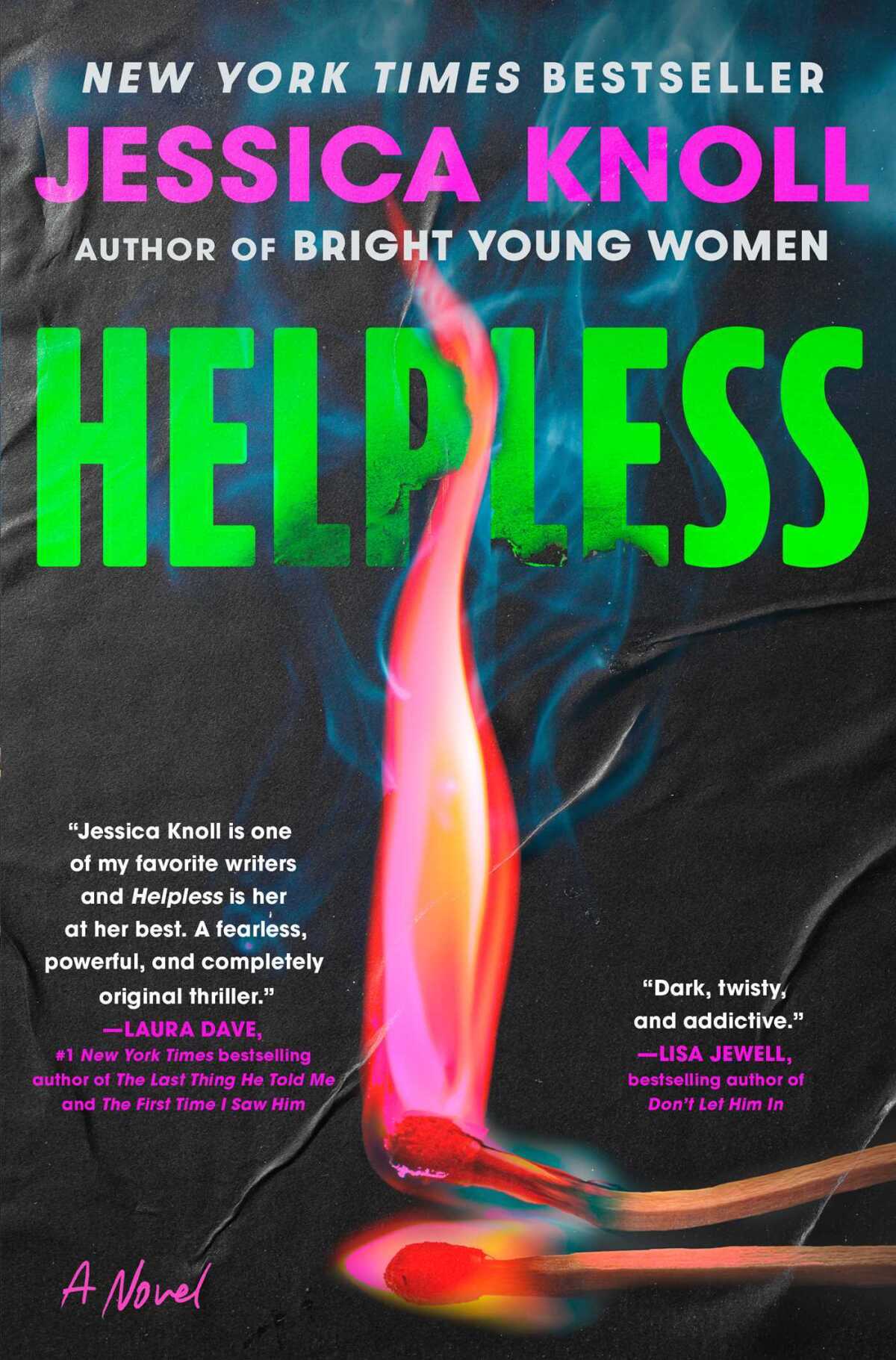
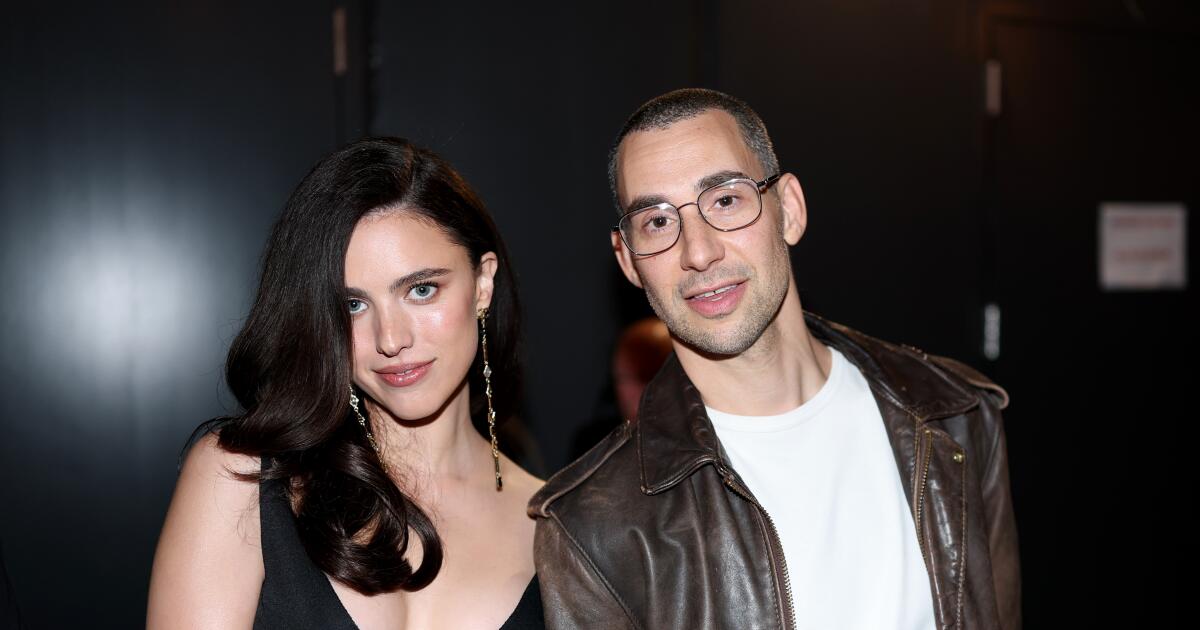
Bestselling author Jessica Knoll’s protagonists mostly follow a specific pattern: They are women who have learned Not. To. Flinch.
On the Shelf
Helpless
By Jessica Knoll Scribner: 320 pages, $28
If you buy books linked on our site, The Times may earn a commission from Bookshop.org, whose fees support independent bookstores.
And, apparently, neither does Knoll. Talking over Zoom about her fourth novel, the erotic thriller “Helpless,” which is out this month, the author is blunt about the challenges it took to complete the book. “It takes a lot of skill to write good sex,” Knoll says. “I relied a lot on feedback from my editor and from my book agents saying ‘this is hot; this is not.’”
Knoll has written romantic scenes before, but “Helpless” needed to be enthralling and economic enough not to get her kicked off of Target’s bookshelves. In the end, the author says, “I went by what felt good and natural for these characters and maybe a little bit of the really unfiltered talk you have with your girlfriends after a couple martinis or are on a girls trip.”
Knoll’s successful career as a novelist rests on her knack for creating provocative page-turners that depict the absolute worst things one person could do to another — but in such a sensational, tongue-prickling-sour-candy kind of way that her books come off as devilishly evil beach reads. Since her debut bestseller, 2015’s “Luckiest Girl Alive,” — a master class in braided narration between a Machiavellian magazine editor and her younger self who endured so much emotional and physical trauma that it’s no wonder she grew up to be extremely calculating — to 2018’s reality TV-set “The Favorite Sister” and 2023’s “Bright Young Women,” a response to the public’s obsession with immortalizing serial killers while also not knowing the name of a single one of their victims. Knoll’s books are not only stories about women who do not care if you like them but also ones where disastrous results await the women who do follow our cultural conditioning to be agreeable to men.
Her “Helpless” heroine is not so different from a lot of her previous main characters: Type A overachievers with cutting inner monologues that let the reader know they’re always one step ahead in the social Darwinism that is female relationships. This time, she’s named Faye Heron, an Emmy-winning Hollywood multi-hyph who found cachet while working on one of those edgy premium dramedies that probably aired on HBO. Faye, and her husband/producing partner, have parlayed this notoriety into indie, cool-kid projects that are just commercial enough that some of the target audiences’ boomer parents may also watch.
When Faye’s beloved college professor dies suddenly and she’s asked to speak at a memorial ceremony, nostalgia and flattery make her drop everything and hightail it back to the leafy northeastern college town. The place is a time capsule with sketchy internet service, drunken frat boys, and — most crucially — Faye’s college boyfriend Henry, who is now married with two kids and still lives in the area. The clothing references and song choices are popcorn for those old enough to remember the aughts but young enough to party during them. The Elsa Peretti-designed Tiffany & Co. heart necklace that was the it-girl accessory of the time, and now is one that Gen Zers are fishing out of the bottoms of their parents’ jewelry boxes, factors significantly into the plot.
Although the story eventually spirals into other tropes of the Knoll-niverse — kidnappings, cover-ups, affairs, the laissez-faire security that only old money affords — Faye stands out because she wants to be told what to do. In a secure and mutually consenting relationship, of course. And preferably after she’s told her partner what she wants.
“Helpless” was influenced by the 1995 Susanna Moore thriller “In the Cut” as well as Sarah J. Maas’ currently uber-popular romantasy series “A Court of Thorns and Roses,” both of which discuss power imbalances and smart women who become enamored with dangerous lovers.
Knoll has always been open about creating work that’s commercial. She famously wrote a 2018 New York Times opinion piece, titled “I Want to Be Rich and I’m Not Sorry,” that discussed her need to rank in money with an almost Scrooge McDuck fervor: “Success, for me, is synonymous with making money,” she writes. “I want to write books, but I really want to sell books. I want advances that make my husband gasp and fat royalty checks twice a year. I want movie studios to pay me for option rights and I want the screenwriting comp to boot.”
(Evelyn Freja / For The Times)
During our Zoom, with the background carefully faded behind her wavy blond bob, she promises that she doesn’t just copy and paste her subjects and settings from what sells.
“I’m just always looking on what the spin is; like, what the timely take is on something that happens to capture my attention,” she continues, citing a habit she credits to her early career working in women’s magazines like Cosmopolitan and Self. She adds that “I just happen to be interested in, like, really dark s—.”
“Helpless,” Knoll stresses, is a work of fiction; even though fans may be looking to draw comparisons to her life since “Luckiest Girl” was heavily influenced by her own career and childhood. Like the book’s Faye, Knoll went to a private liberal arts college. She’s spent time in the Adirondacks with the wealthy families who vacation in bare-basics cabins on the land they own. And she has dealt with her share of studio executives. Unlike Faye, Knoll is happily married to her husband, financial technology executive Greg Cortese. They share a young daughter. Last year, the family moved back to New York after some time in Los Angeles.
She does relate to Faye’s wealth dynamics. Her “Helpless” heroine grew up middle class but now has reached the “made it” level of nervous cockiness that happens when you combine new money and fame; the dream of so many who move to L.A. Henry, Faye’s ex, and his family are so comfortable in their generational wealth that he was raised to wear the same, now-bleach-stained, chambray button-down he had in college than buy a new one because clothes aren’t sound investments.
Knoll says she doesn’t want “things to feel didactic,” but concedes that class divides offer a treasure trove of stories.
“I just find myself going back to, again and again, this idea of someone who is the outsider because they don’t have the pedigree of their peers, but however many years later they’ve accomplished something and they think that they’re on more equal footing with these people from their past,” Knoll says. “Then something happens that brings them back into this environment where maybe they felt less-than years ago. They think that they’re going to go back and be like, ‘well, I’ll show you now because I’ve made it’ and those feelings of inferiority are still there.”
As she’s grown older and her career has become more stable, Knoll says she doesn’t think about success and fame the same way she did when she wrote her viral opinion piece or gave interviews where she talked about money and her own financial security. She says now that her priority is “the longevity of the career.”
Like her heroines, no one tells Knoll what to do. Unless she gives the OK.
Friedlander is a pop culture and entertainment journalist based in Los Angeles who hates coffee but loves Coke Zero.
IF YOU’RE dreaming of a late summer holiday but holding off until the Three Lions finish their World Cup run, let me give you some free advice: stop playing chicken with the booking button.
Because I work in travel, my screen is constantly locked onto live booking data, and I’ve been crunching the numbers from Euro 2024 and the last World Cup, comparing tournament months against normal years, and the trend is identical.
Brits shouldn’t wait until the football is over to book their summer holidayCredit: onthebeach
The second England gets knocked out (or in this year’s case, hopefully lifts the trophy) the market goes completely mental.
Millions of Brits who put their summer plans on ice to watch the football suddenly rush to the package holiday sites at the exact same time.
And according to the data, this massive surge forces package prices to spike five to eight per cent above normal seasonal baselines within hours.
Whether we lose to Argentina on Wednesday or go all the way, demand is going to flood the market.
So if you still fancy a summer holiday this year but haven’t yet booked, you need to beat the post-tournament rush.
And here’s exactly where the data suggests prices are about to climb fastest.
5. Antalya, Turkey
You could stay at Lemas Suites Hotel Side in August with a free boat service to the beachCredit: onthebeach
Turkey always reacts aggressively after a major tournament, especially around the Antalya coast where all-inclusive packages dominate.
Our data shows that the moment football fever breaks, resorts like Alanya experience an immediate eight per cent price hikeabove the normal baseline.
You could stay at the Lemas Suites Hotel Side, which is a cracking value base right near the harbour, but my favourite thing about this hotel is its private river-boat shuttle.
The property sits slightly back from the coast on the side of the Manavgat river, and they run a free, regular boat service that drops you directly onto their private sandy beach lot, completely cutting out the sweaty August coastal walk.
On the Beach offers a five-night stay from August 22 at Lemas Suites Hotel Side, including return flights from Manchester Airport, from £355pp.
4. Canary Islands, Spain
Or if you want to head to the Canary Islands, visit Club Tenerife which is built into the hillsideCredit: onthebeach
The Canaries are Britain’s ultimate safety net for guaranteed summer sun, which makes them prime targets for the post-football booking surge.
The data shows that Fuerteventura’s Caleta de Fuste climbs a massive 17 per cent above normal rates post-tournament, while Matagorda in Lanzarote jumps by 13 per cent.
But, fear not, because you can check in to Club Tenerife in Los Cristianos.
And because the hotel’s built directly into a sheltered hillside, the main sun terraces are entirely shielded from the standard high-summer Atlantic winds that plague the flat beachfront hotels, giving you a proper, peaceful sunbathing setup.
On the Beach offers a five-night stay from August 22 at Club Tenerife in Los Cristianos, including return flights from Liverpool Airport, for £318pp.
3. Crete, Greece
In Greece, you could visit Ourania Apartments in Crete which hosts a local souvlaki nightCredit: onthebeach
Crete is another major mover in our holiday tracking, with the family-heavy resort of Kato Gouves seeing a massive 24 per cent price surge the second England exits a tournament.
You could stay at Ourania Apartments in Kato Gouves – this hotel’s an absolute peach of a pick too.
Every week, the family hosts an incredible local souvlaki night where they cook everything over open coals right in the central courtyard, serving up an elite, authentic Cretan feast for a fraction of what you’d pay at the beachfront tourist spots.
Where do I sign?
On the Beach offers a five-night stay from August 22 at Ourania Apartments in Kato Gouves, including return flights from Manchester Airport, from £383pp.
2. Costa Brava, Spain
On the Costa Brava, MedPlaya Esmeraldas Aparthotel links directly to the beach via an underground walkwayCredit: onthebeach
As you’d expect, Spain always runs hot after the football finishes – but the Costa Brava sees some of the steepest climbs on the board, specifically, the resort of Calella routinely records package prices sitting 25 per cent higher than normal once the tournament wraps up.
These apartments are exceptionally modern, but the best feature here is the private underground walkway that links the complex directly to the beachfront avenue.
It means you can wander from your living room to the sand in about two minutes without ever having to cross the busy main resort traffic.
On the Beach offers a five-night stay from August 22 at MedPlaya Esmeraldas Aparthotel in Tossa de Mar, including return flights from London Gatwick, for £283pp.
1. Costa Blanca, Spain
And in Costa Blanca, head to Jardin Milenio Hotel which sits inside a UNESCO-protected tropical palm groveCredit: onthebeach
The undisputed heavyweight of post-tournament price surges is the Costa Blanca.
Cala de Finestrat routinely explodes by 32 per cent above normal rates, while Albir climbs by 18 per cent.
Even Benidorm, despite its massive hotel capacity, jumps five per cent overnight.
You could opt for five-nights to the Jardin Milenio Hotel in Elche for under £300pp and for peak August, that is an unbelievable data loophole.
The standout feature here is that the hotel is located directly inside the famous Palmeral of Elche – a massive, UNESCO-protected tropical palm grove.
It means the entire pool area is surrounded by thousands of ancient palm trees, giving you a lush, high-end Caribbean resort aesthetic for less than three hundred quid.
On the Beach offers a five-night stay from August 22 at Jardin Milenio Hotel in Elche, including return flights from London Luton for £268pp.
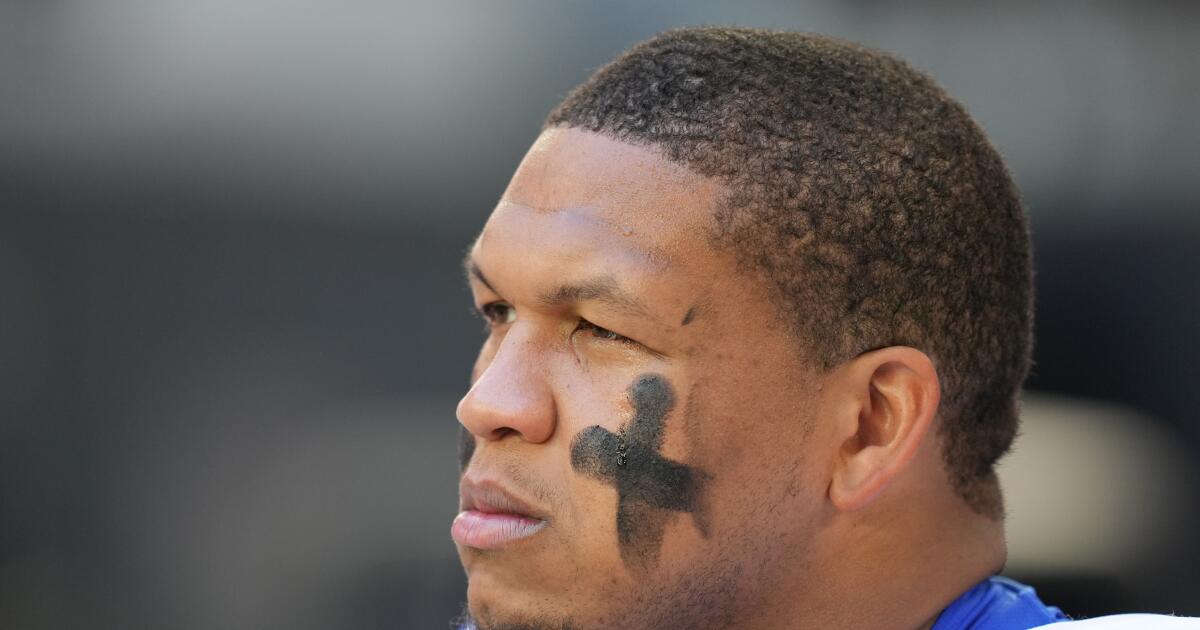
The Dodgers needed to turn things around Sunday to wrap up the first half on a high note. Manager Dave Roberts said as much the night before.
“When you give teams free bases, extra outs, it’s hard to win a game, regardless of the opponent,” he said. “Emmet [Sheehan] needs to go out there and throw the baseball well tomorrow. We’ve got to find a way to win a game tomorrow to feel somewhat better about going into the break.”
Instead, the Dodgers fell to the Arizona Diamondbacks 5-3, swept for the first time this season. It was Arizona’s first sweep at Dodger Stadium since September 2017.
Perhaps the break is coming at a good time.
“I guess,” Roberts said. “Gives guys a reset. … We’ve got some good teams coming up and we’ve got to play good baseball.”
Sheehan at least did his job, holding the Diamondbacks to three runs in 5⅓ innings. It was clear from the first at-bat that his pitch count could limit how deep he pitched into the game. Sheehan won a 14-pitch battle to strike out Ketel Marte.
The right-hander then struck out the side and was efficient enough to pitch into the sixth. He exited after his pitch count reached 101.
Max Muncy swings at a pitch in the seventh inning.
(Ronaldo Bolaños / Los Angeles Times)
Shohei Ohtani sparked the offense with his ninth leadoff home run of the season — and 22nd overall — on a two-hit day. But he’ll get treatment this week instead of playing in the All-Star Game.
It wasn’t a clean defensive game for the Dodgers. In the midst of the Diamondbacks’ two-run fifth, All-Star center fielder Andy Pages tracked a long fly back to the wall but missed the catch as the ball bounced off his glove for an error.
In the sixth, the tying run scored when All-Star third baseman Max Muncy’s throw to the plate hit Geraldo Perdomo in the back as he ran home for another error.
“Just a slump,” Muncy said. “You go through slumps both offensively and defensively, mentally. It’s just one of those stretches for us right now, and I think everyone’s ready for the break.”
Regardless of some sloppiness, the Dodgers have had a successful season going into the break.
“Just flush it,” Roberts said. “We’re still in a really good spot. Don’t let it carry over to the second half.”
They have the best record in the majors (61-36) and an 11½-game lead in the National League West. They also had six players selected as All-Stars.
So, as Major League Baseball pauses play and honors some of the best performers in each league, now’s a good time to hand out our first-half awards.
It was never actually in doubt. Dearica Hamby was going to stay a member of the Sparks. That was just how she worked.
Even when Nneka Ogwumike came into the fold and the frontcourt became crowded, Hamby didn’t doubt her decision to return to the organization that traded for her four years ago.
Loyalty mattered more than anything else.
“That’s who I am,” she said. “I don’t run away from things. I wanted to stay here and help L.A. get back to where it was and is capable of being.”
In a loaded frontcourt, the 32-year-old Hamby has still found ways to shine. Hamby has led the Sparks in scoring four times and led or tied for rebounding 16 times this season after signing a three-year, $3.5-million contract.
She ranks in the top 20 in the league in rebounds and field-goal percentage (plus 25th in scoring) and is eighth in offensive rebounds in establishing herself as an essential piece to the Sparks’ “win now” attempt.
“I think it’s the challenge, because we are so good and we have so much talent,” said Hamby, who is averaging 14.8 points, 7.7 rebounds and 2.3 assists while shooting 52.8% from the field. “You’re forced to produce, but it’s also a blessing. I know it’s probably hard for coach to manage the three’s playing time and stuff like that, but it’s a beautiful problem.”
Hamby was in the headlines when the Aces traded her after she was pregnant. In September of that year, she filed a federal discrimination complaint against the team and league, claiming she was traded because she was pregnant. The two sides resolved matters before trial.
The new CBA this year created a new rule that requires a pregnant player’s consent to be traded.
“I feel like she’s such an anomaly,” said forward Rae Burrell. “I remember when she had her son, and it was crazy because everybody was saying she was coming back so early, I thought that was insane, but now being her teammate, I see it, she’s just kind of a freak of nature, like she’s so athletic, she can do all types of things on the court that you think looks unorthodox, but she makes it happen, but also just love being her teammate. She’s just good people.”
Since that trade, she has been a regular in the Sparks’ starting lineup while averaging double-digit scoring and around eight rebounds per game. She’s one of the most efficient scorers in the league, too.
But Hamby’s games have been all over the board. Against the Aces, she missed all seven of her shots. Against Dallas and Indiana, she made six of eight shots. She’s had eight games with a shooting percentage above 60% and four games under 40%.
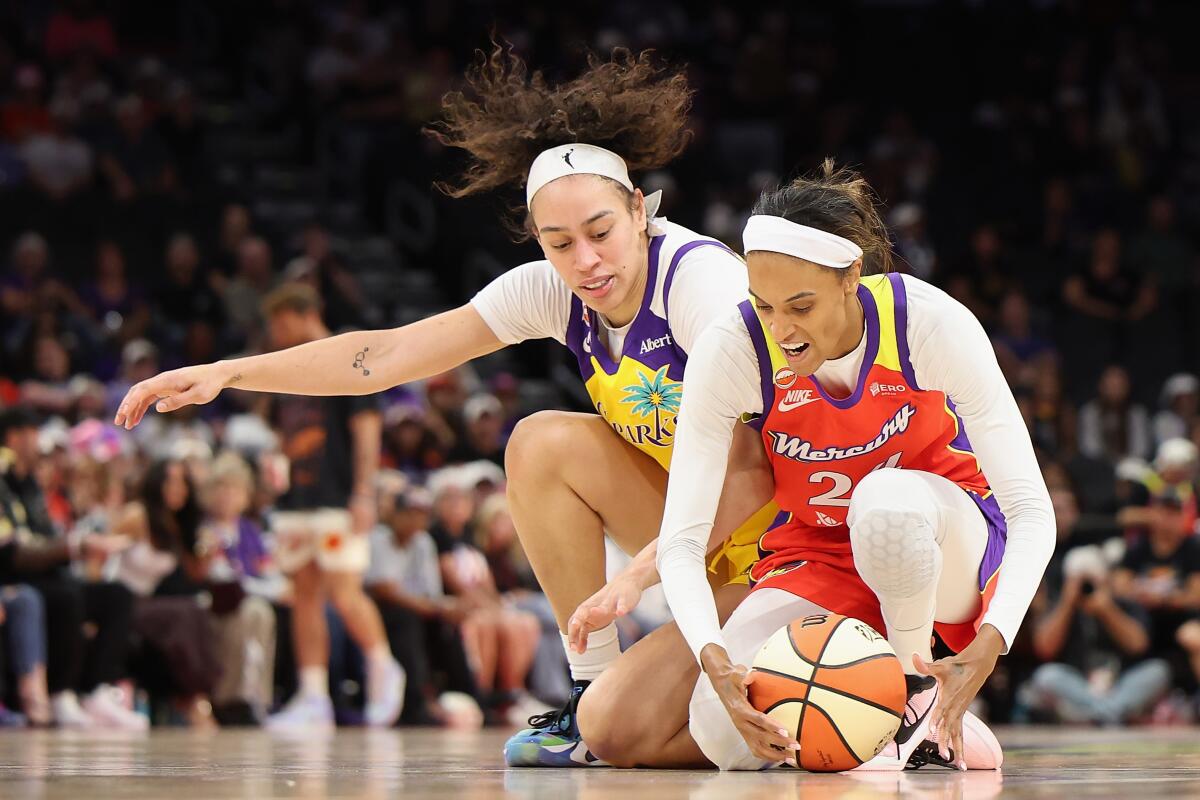
Sparks forward Dearica Hamby, left, tries to steal the ball from Mercury forward DeWanna Bonner during a game in Phoenix.
(Christian Petersen / Getty Images)
Having the three frontcourt players has been an adjustment for coach Lynne Roberts to find how to implement them all in the offense.
“I’m trying to implement the new offense, we’re plugging pieces into play, and things that I may have been able to do last year as freely I’m not as able to do this year,” Hamby said. “So just adjusting for sure, but I think that’s across the board for everybody.”
Before the season, Roberts said that Cameron Brink would come off the bench and Hamby would start. Brink, the only natural center on the team, averages just 17.5 minutes per game primarily because of her 3.7 fouls.
“She’s my vet,” Brink said of Hamby. “I think she’s just such a grounding force for us, and she’s someone that does everything, so I just really feel like I learn from her every day, and I’m just very thankful to be in her presence.”
Hamby averages 3.2 fouls per game and has expressed frustration about the new officiating norms this season, but has avoided true foul trouble. She and Ogwumike work as two fours instead of a team with a traditional five.
“She has a lot of energy,” Ogwumike said. “I think she does a really good job of just having a high motor and going out there and kind of like doing the dirty work. I feel like it’s beneficial to have a loaded frontcourt, to be able to have so many different types of players and a depth where anytime one of us is in, there’s no letdown.”
The Sparks have been the worst defensive team in the league this season and struggled to score when point guard Kelsey Plum was out of the lineup with an ankle injury. Ogwumike might be the other veteran leader, but Hamby has stayed with this Sparks team the past two seasons while Ogwumike was in Seattle.
Now her role has changed, even with that loyalty. She’s playing just over a minute less and they’re asking for better defense and efficiency.
Hamby chose to come back. Now she’s choosing to help build the Sparks up.
“I know my usage is a lot lower,” Hamby said. “A goal of mine the last two seasons was to have those numbers, so to have the same numbers just at a more efficient rate, and so I mean offensively, but with like two fewer shots a game, that’s pretty impressive.”
When the cast members and creators of the 1990s “X-Men: The Animated Series” reunited at the 2019 Hill Country Comicon in New Braunfels, Texas, they went out for dinner and collectively yearned to one day work together again.
“We said, ‘Let’s put it to the universe: Universe, why don’t you manifest that somebody buys the rights to the show and decides to reboot it and bring us all back.’ We toasted the universe and here we are,” recalls Canadian actor Lenore Zann, the voice of the irresistibly tough Rogue, during a recent video call while visiting Los Angeles.
The result of that metaphysical request is Marvel’s “X-Men ’97,” which debuted in 2024 on Disney+, not as a reboot but as a continuation of the original 1992 classic animated show.
The first season of this new era for the X-Men received an Emmy nomination for animated program. Now, the long-awaited second season has arrived, with the fourth episode streaming this week. Even after the controversial firing of showrunner Beau DeMayo, “X-Men ’97” has already been renewed through Season 4 and the voice cast has started recording their lines for Season 3, Zann says.
The show’s success with both fans and critics is in large part due to its commitment to honor the original ‘90s show, about a group of mutants fighting for themselves and for humanity, not only by preserving its hand-drawn animation style and mature themes but also the voices and personalities of the characters.
“When I pitched the show to Kevin [Feige], he got it immediately and his first question was, ‘Are you going to get the original cast back?’ And I was like, ‘Yes, we are,’” says Brad Winderbaum, head of Marvel Television, Animation, Comics and Franchise at Marvel Studios.
Several voice actors from the original “X-Men” animated series returned for “X-Men ‘97,” which has returned for Season 2. From left, Beast (George Buza), Bishop (Isaac Robinson-Smith), Rogue (Lenore Zann), Professor X (Ross Marquand), Magneto (Matthew Waterson) and Nightcrawler (Adrian Hough).
(Marvel)
Not everyone was still around to return — Norm Spencer, voice of Cyclops, died in 2020 — but in addition to Zann, actors George Buza (Beast), Alison Sealy-Smith (Storm), and Cal Dodd, the voice of the lovable clawed grouch Wolverine, have reprised their roles in “X-Men ’97.” Their emblematic voice performances, Winderbaum says, are baked into his psyche.
“Any time Lenore says the word ‘sugah,’ it just makes me melt into a puddle on the floor,” Winderbaum says, laughing. “She is Rogue and, when she turns it on, she becomes an icon.”
Busy with her political career as part of Canada’s parliament, Zann stepped away from the entertainment business for over a decade. Zann was back home in Truro, Nova Scotia, figuring out her next chapter when she received an email from a friend who said producers at Disney were looking to have her audition for a show. She was skeptical.
Zann eventually got a call from casting director Meredith Layne and a screenplay with lines that were instantly familiar from her time voicing Rogue, the spunky heroine whose touch can be deadly, in the ‘90s.
”I thought, ‘I guess they’re looking for Rogue, so I’ll just give them Rogue,’” she recalls, laughing. “And I did my Rogue voice, which is basically just my own, but with a bit of a Southern accent thrown on,” she adds with a slight twang.
The producers then asked her if she would reprise her superhero for a new generation of kids.
Doing her Rogue voice, Zann recalls: “I said, ‘You had me at hello, sugah.’”
She revels in the similarities between her and Rogue. “We’re both social justice warriors. We really fight for people to be accepted as who they are.”
In 2024, Zann published “A Rogue’s Tale: A Memoir,” a tome recounting her storied life, titled after a memorable episode in the ‘90s series that revealed her beloved mutant’s backstory.
Wolverine in a scene from Season 2 of “X-Men ’97.”
(Marvel)
For Dodd, leaving behind Wolverine after five seasons of the original show felt like losing a part of himself. “X-Men ’97” offered him a chance to feel complete once again.
“I was so happy because when I first created the voice of Wolverine in ‘92, he became very quickly like my brother or my right arm,” Dodd says during a recent video call. “I got my arm back, and my brother.”
After all these years, Dodd was also pleased to see how the most important character of his career looked in the new series. “Out walks Wolverine and I just went, ‘Holy crap, you look great, bub,’” he recalls, laughing about his first time recording lines for “X-Men ‘97.”
When he first auditioned for the role in the ‘90s, Dodd had no idea who Wolverine or the X-Men were. At the time, he was making a living as a singer for commercials and jingles in Toronto.
Dodd remembers the lines he was asked to deliver were directed at the villainous mutant Sabretooth. He had never seen an image of Wolverine or any of the characters. “At one point, I said to them, ‘Is this an animal cartoon?’ They just thought I was a complete imbecile,” he recalls with a chuckle.
In that initial scene, where Sabretooth attacked Jubilee, a member of the X-Men who Wolverine sees as a daughter, his line was: “All right, you egg-sucking piece of gutter trash. You always like pushing around people shorter than you. Well, I’m shorter. Try pushing me.” Dodd recites it from memory in Wolverine’s voice with a growl.
“The lines I was reading, I’d heard them before in the small town that I grew up in Canada; it’s a fisherman’s town, a tough little town,” says Dodd about his reference for Wolverine’s voice. “I knew guys that were exactly like him, and I knew the way they sounded.”
Even without any notion of the X-Men, he nailed it.
“The next morning, they called me and said, ‘We would love to have you as our Wolverine for the very first X-Men animated series,’” Dodd recalls. “And I said, ‘I would love to be your Wolverine, whoever, and whatever he is.’”
1
2
1.Cal Dodd, voice actor for Wolverine in “X-Men ’97.”2.Lenore Zann, who voices Rogue.(Pauline Aguirre)
When Rogue came into Zann’s life, she already had a notable career as a screen and stage actor. Zann had starred as Marilyn Monroe in a rock opera about the actor’s life, for which she received much praise. “My agent called me and she said, ‘Lenore, they’re doing this animated series, and they’re looking for “a woman with a deep husky, sexy voice who can do a Southern accent,”’” Zann recalls, laughing. “And she said, ‘That’s you!’”
Back then, Zann wasn’t interested in doing voice work, so she missed the first auditions. But about a month later, she says, her agent called again. They still hadn’t found the right voice, so she pushed Zann to audition. She walked in and looked at a drawing of Rogue that Larry Houston, the storyboard artist and director of the show, had drawn.
“She had a very sassy attitude, and she had her hand on her hip and her head back with the hair flowing. I was like, ‘Yeah, I can do that.’ And then I went into the studio, put the headphones on, and opened up my mouth, did the first line: ‘I remember I had a boyfriend, when I kissed him, poor boy went into a coma for three days,’” she says in Rogue’s voice. That was enough for her to land the life-changing part.
At the end of the first season of “X-Men ’97,” both Rogue and Wolverine find themselves in difficult times. Wolverine’s clash with Magneto, the perennial antihero, left him severely injured, physically and mentally.
“He’s as tough as nails and he is more pissed off than anything that he was the only one that stood up to Magneto. He’s disappointed,” says Dodd. “And it’s a struggle for him in Season 2 for a lot of it. And then you see what happens. He’s in a funky place, but he’ll handle it.”
Part of that healing process will involve leaning into the humor tat Dodd imbues in his delivery. “What I think is surprising when you go back and watch that original animated series is how funny Cal is,” says Winderbaum. “Wolverine has amazing one-liners throughout that original series.”
As for Rogue, she is grieving the loss of Gambit, a.k.a. Remy LeBeau, who died in the first season. To voice Rogue’s sorrow, Zann leaned into her own grief over the passing of her 17-year-old niece from cancer. In Season 2, Rogue is trying to move forward.
“She’s still basically on a hero’s journey wanting to get justice for what happened to Remy and for the genocide that she witnessed and that she is a survivor of,” Zann says. “She still got survivor’s guilt, and she’s still trying to find her place within the X-Men now that the one that she loves is gone.”
At comic conventions, Zann and Dodd often meet fans of the original show, who are now adults, and their children, who have also come to love the characters. The emotions that people share with them are at times overwhelming.
“Many times, they tell us that this show saved their lives. They were either LGBTQ+ or they were bullied, or they just felt othered,” Zann explains. “A lot of folks who are Latino tell me that when they were little kids, their parents were agricultural workers, and they learned how to speak English from watching our show. We made them feel it’s OK to be different.”
“I see grown men in tears. They’re in their 40s and they’re crying,” Dodd says about meeting lifelong fans. “I can tell you that Wolverine can cry as well.”
Zann believes the X-Men are like modern-day mythological heroes. Through their fantastical ordeals, the X-Men illustrate qualities that inspire viewers, young and old.
“They are a group of misfits who band together to learn how to control the things that make them different and learn to accept and love themselves,” she says. “It’s an honor to be part of this incredible group of people and these characters that can really touch lives and help change them for the better.”
In 1975, 31-year-old Mick Jagger told People magazine that “I’d rather be dead than sing ‘Satisfaction’ at 45.” The Rolling Stones’ frontman is still very much alive, despite having performed that song in concert hundreds of times since then, most recently in 2024 during the band’s “Hackney Diamonds” tour. Jagger was 80 at the time.
“Time waits for no one,” as the Stones once sang, but apparently that doesn’t apply to the “World’s Greatest Rock and Roll Band.” To paraphrase the group’s first Top 10 U.S. hit in 1964, time is on their side. Yes, it is.
Consider the fates of the British Invasion superstars who emerged from England alongside the Stones in the 1960s. The Beatles broke up in 1970. The Kinks dissolved in 1996. The original Animals imploded in 1966. The Who called it quits in 1982 but has reunited repeatedly, including for its recent North American farewell tour.
And then there’s the indestructible, indefatigable Rolling Stones. With the partnership of Jagger and guitarist Keith Richards still front and center, the Stones will release their 27th studio album, “Foreign Tongues,” on Friday. Over the decades, they have produced classics such as “Exile on Main St.” and “Some Girls,” mediocrity like “Steel Wheels,” and abominations such as “Dirty Work.” We rank the group’s six-decade studio output from worst to first. All albums are the U.S. editions.
27. ‘Dirty Work’ (1986)
Never has an album cover so captured a band’s mood. “Dirty Work” features a photo of sullen, unsmiling Rolling Stones looking like they’d rather be anywhere else. The music reflects that disinterest. Apart from the cover of “Harlem Shuffle,” nothing here is memorable. It’s no surprise that the Stones nearly broke up during this period.
26. ‘Undercover’ (1983)
The follow-up to the brilliant “Tattoo You” landed with a thud. Although the song “Undercover of the Night” nicely melds a solid guitar riff with trenchant lyrics about political corruption and violence in South America, the rest of the album wilts.
25. ‘Bridges to Babylon’ (1997)
Another in a series of disappointing releases, “Bridges to Babylon” has one great song, “Saint of Me,” and lots of filler.
24. ‘Steel Wheels’ (1989)
Touted as a return to form, this album certainly outshines “Undercover” and “Dirty Work.” But that’s not saying much. With dated production and too many songs that make a good first impression but fail to stick, “Steel Wheels” has gathered moss over the years.
23. ‘Voodoo Lounge’ (1994)
Like its predecessor “Steel Wheels,” this is another attempt to recapture their classic sound. To an extent, the record succeeds. “You Got Me Rocking” sounds like a throwback to something on “Exile on Main St.,” while the ballad “Out of Tears” echoes “Angie.” With the exception of “Love Is Strong,” however, most of the songs here are little more than pleasant exercises in nostalgia.
22. ‘The Rolling Stones: England’s Newest Hitmakers’ (1964)
A solid debut, “England’s Newest Hitmakers” features covers of songs by Willie Dixon, Chuck Berry and Jimmy Reed, firmly grounding the group in its American blues and R&B influences. The sole Jagger/Richards original here, “Tell Me,” only hints at the duo’s future songwriting prowess.
21. ‘Black and Blue’ (1976)
After guitar virtuoso Mick Taylor’s departure from the Stones in late 1974, the band used “Black and Blue” to audition potential replacements. They settled on Ronnie Wood, a former member of the Faces who, ever since then, has engaged in the ancient art of guitar weaving with Keith Richards. Heavy on grooves and jams, this album sometimes feels unfocused and indulgent. The excellent ballads “Memory Motel” and “Fool to Cry” are essential.
20. ‘12X5’ (1964)
A step forward from their debut, “12X5” has the magnificent covers “Time Is on My Side” and “It’s All Over Now.” For those who like their Stones bluesy, early albums like this offer a cornucopia of treasures.
19. ‘Blue & Lonesome’ (2016)
Recorded in just three days, this album of blues covers sizzles. The Stones sound absolutely committed, with Jagger’s harmonica and vocals particularly strong.
18. ‘The Rolling Stones, Now!’ (1965)
On the band’s third U.S. album, the Stones rock harder and softer. Their version of Willie Dixon’s “Little Red Rooster” is a slow burn. The ballad “Heart of Stone,” one of their best early originals, made the Billboard Top 20.
17. ‘Foreign Tongues’ (2026)
The Stones have rarely sounded looser or more alive. Produced again by the classic-rocker whisperer Andrew Watt (Paul McCartney, Elton John, Pearl Jam), the band delivers a clutch of strong songs. In a just world, the single “In the Stars” would be a hit. “Back in Your Life,” fueled by some of Wood’s most sensitive and impassioned playing, is a stunner. At 14 songs and 62 minutes, the album would have benefited from trimming three or four of the more generic tunes. Still, it’s amazing that Jagger and Richards, both 82, and Wood, 79, have made such a fresh and vital record. Sometimes you can get what you want.
16. ‘A Bigger Bang’ (2005)
For the band’s first album of originals in eight years, the Stones remind you what makes them great. The first of their three late-career triumphs, “A Bigger Bang” brings attitude, funk, dirty rockers and dreamy ballads. The blazing “Rough Justice” and the slinky, sexy “Rain Fall Down” are topflight.
15. ‘Hackney Diamonds’ (2023)
Eighteen years passed between the release of “A Bigger Bang” and this album. It was worth the wait. “Hackney Diamonds” is another strong effort, with the banger “Angry” sounding urgent and, well, genuinely angry. The gospel-tinged “Sweet Sounds of Heaven,” featuring Lady Gaga, finds her and Jagger trading vocals and pushing each other to the stratosphere. It’s the best song the group has made since “Tattoo You’s” “Waiting on A Friend” and “Start Me Up” in 1981. The absence of late drummer Charlie Watts is felt, but Jagger and Richards prove that old geezers can still rock.
14. ‘Out of Our Heads’ (1965)
A very strong outing that includes originals “The Last Time,” “Play With Fire” and “Satisfaction,” one of the best rock songs ever written.
13. ‘It’s Only Rock ‘n Roll’ (1974)
Keith Richards’ deepening heroin problem meant Jagger had to carry more of the load himself. On this album, he acquits himself admirably. The anthemic title track positively swaggers. The poignant “Time Waits for No One” features one of Taylor’s most beautiful solos, a fitting coda to the end of his five-year career with the Stones. A fine album with several good songs and a couple great ones.
12. ‘December’s Children (And Everybody’s)’ (1965)
A hodgepodge of live cuts, outtakes, British LP tracks and singles, this album shows the Stones rapidly gaining confidence and playing with equal parts finesse and fire. Any album with “Get Off of My Cloud” and “As Tears Go By” is worth the price of admission.
11. ‘Their Satanic Majesties Request’ (1967)
Released months after “Sgt. Pepper’s Lonely Hearts Club Band,” this occasionally ill-advised foray into psychedelia pales in comparison to the Beatles’ masterpiece. That doesn’t mean it’s bad. In fact, the Stones never sounded as adventurous or experimental. When it works, as it does on “She’s a Rainbow” and “2000 Light Years From Home,” candy-colored bliss follows.
10. ‘Emotional Rescue’ (1980)
An underrated gem often overshadowed by its predecessor, “Some Girls,” and its successor, “Tattoo You,” “Emotional Rescue” finds the Stones in fine form at the dawn of a new decade. The rhythm section of bassist Bill Wyman and drummer Watts locks in, while Richards and Wood converse with their guitars as only they can. Jagger sounds energized on the rockers “Let Me Go” and “She’s So Cold” and sexy on the incredibly funky “Dance (Pt. 1).”
9. ‘Goats Head Soup’ (1973)
Considered a big letdown after the magisterial “Exile on Main St.,” this album has received a well-deserved critical reappraisal and aged like a fine wine. It’s not the Stones at their peak, but close enough. “Angie” is absolutely gorgeous, while “Star Star” captures the Stones at their most profane.
8. ‘Tattoo You’ (1981)
Needing new material for their 1981 tour, the Stones cobbled together “Tattoo You” from leftovers and half-finished songs dating back to “Goats Head Soup.” Jagger penned new lyrics, recorded new vocals, and presto — the band made its last classic. “Start Me Up,” the band’s best rocker since “Brown Sugar,” propelled the album to multiplatinum sales and shook stadiums around the world. It still does.
7. ‘Aftermath’ (1966)
The first Stones album composed entirely by Jagger and Richards, “Aftermath” represents a quantum leap forward or two. Brian Jones, before drugs and paranoia dimmed his creative spark, made some of his greatest contributions, elevating “Paint It Black” with his sitar and adding the indelible marimba riff to “Under My Thumb.” The Stones had finally lived up to all the hype.
6. ‘Between the Buttons’ (1967)
The American version kicks off with the one-two-three punch of “Let’s Spend the Night Together,” “Yesterday’s Papers” and “Ruby Tuesday” and doesn’t let up. Arguably the band’s poppiest album, it sounds like groovy Swinging London set to music.
5. ‘Some Girls’ (1978)
After the lackluster “Black and Blue” and the mixed critical reception of “It’s Only Rock ‘n Roll” and “Goats Head Soup,” some wondered if the Stones had lost their musical magic. They needn’t have worried. The band, hungry to prove the doubters wrong, made one of its strongest albums. With Wood now fully integrated into the group , punky, guitar-centric rockers like “Respectable,” “When the Whip Comes Down” and “Shattered” snarl. Jagger, entranced by the sounds coming out of New York’s discos at the time, contributed the No. 1 “Miss You.” Add “Beast of Burden” and the countryish “Far Away Eyes” to the mix and you have the ingredients for a stunning comeback.
4. ‘Beggars Banquet’ (1968)
The start of one of the strongest four-album runs in rock history, “Beggars Banquet” is a near-perfect listen from beginning to end. New producer Jimmy Miller helps strip the band down to its rawest, raunchiest essence on songs like “Sympathy for the Devil,” “Stray Cat Blues,” and “Street Fighting Man.” For the first time, the Stones had released an album on par with some of the Beatles’ best work. Indispensable.
3. ‘Sticky Fingers’ (1971)
Unbreakable love (“Wild Horses”); heartbreak (“I’ve Got the Blues”); slavery, interracial sex and heroin (“Brown Sugar”); addiction (“Sister Morphine”) — “Sticky Fingers” has it all, along with some of the most powerful music in the Stones’ catalog. If a Martian came to Earth and wanted to know what made the Stones special, a listen to “Sticky Fingers” would make it abundantly clear.
2. ‘Let It Bleed’ (1969)
By the end of the ’60s, the dream had faded. Vietnam, inner-city riots, and the assassinations of Robert F. Kennedy and Martin Luther King Jr. had cast a pall over the Day-Glo optimism of the Love Generation. The Rolling Stones were there to chronicle the impending hangover. “Gimme Shelter” reflected the growing dread of the times. It’s among the darkest, grittiest and most transcendent songs ever recorded, with Jagger singing about rape and murder over Richards’ shimmering guitar. In the powerhouse “Midnight Rambler,” Jagger takes on the persona of a killer, even name-checking the Boston Strangler. Dark stuff. Yet the superb “You Can’t Always Get What You Want,” replete with a gospel choir, the country stylings of “Let It Bleed” and “Love in Vain,” sung by Jagger with utter conviction, give the album incredible diversity and depth.
1. ‘Exile on Main St.’ (1972)
And then there was one. Recorded largely in the steamy, sweltering basement of Richards’ rented French villa, Nellecôte, “Exile” reeks of filth, decadence and decay. With Jagger’s vocals often buried deep in the muddy and murky mix, the album initially sounds like a druggy demo. But listen again. And again. Slowly, it reveals itself as quintessential Stones, a potent admixture of styles, sounds and soul. Richards tosses off one indelible riff after another, making “Rocks Off,” “Happy,” “Tumbling Dice” and “All Down the Line” rock and roll perfection. You like your Stones with a dash of Americana? “Sweet Virginia” might be the band’s best country rocker. Blues? Try “Ventilator Blues.” Gospel? “Shine a Light,” accented with Billy Preston’s piano and organ, transports listeners to a higher place. Other Stones records contain more classics and better production, but none holds together as well as a whole or comes as close to the sublime as this one.
Marc Ballon, a former Times, Forbes and Inc. Magazine reporter, teaches an advanced writing class at USC. He lives in Fullerton.
For half a century, Deidre Hall has taken on every kind of disaster in the drama-packed town of Salem, Ill., as a star of “Days of Our Lives.”
There was the time — actually, it happened twice — when her character, Dr. Marlena Evans, was famously possessed by the devil and even levitated.
In Sunday Funday, L.A. people give us a play-by-play of their ideal Sunday around town. Find ideas and inspiration on where to go, what to eat and how to enjoy life on the weekends.
Or the time a serial killer, who was actually Marlena under hypnosis, seemed to kill several beloved characters. The long-running show’s storylines have become legendary, and in March, while promoting “Hail Mary,” actor Ryan Gosling even gave Hall a shout-out, admitting he was a fan, praising the hard work of soap opera actors and calling her an “OG acting inspiration.”
But Hall’s real life in Santa Monica is much quieter than her character’s, and she likes it that way.
“When I bought my house in Santa Monica, I didn’t realize how great it would be to live near Montana Avenue,” says Hall, 78, about the popular shopping spot. Every day, she walks to the main street with her golden retriever, Riley, and enjoys Pilates, art and good food along the way. “The owners of the Farms Market even keep dog biscuits, so guess where the dog wants to go every time we walk — the Farms, of course,” she says, laughing.
When she isn’t filming the daily soap opera, which airs on Peacock, Hall enjoys raising monarch butterflies, exploring the shops and restaurants on Montana, and hosting movie nights at home with her two sons.
Here’s what a perfect day in L.A. looks like for her.
This interview has been lightly edited and condensed for length and clarity.
7 a.m.: Breakfast and dog walk
I usually kick off my day with a protein shake, feed our golden retriever and take her out for a walk. She’s a phenomenal girl. When we adopted her, her name was Riley, but I did think about naming her after Mrs. Hughes from “Downton Abbey.”
10 a.m.: Church and garden time
After I walk the dog and go to church, I like to spend some time in my yard. I’m not a natural gardener, but I really enjoy it. I started raising monarch butterflies because my identical twin sister, who played my twin on the show, planted a butterfly garden. Monarchs are amazing because they are transitional. Every year, they travel from Mexico to southern New England, but it’s getting harder for them. Their numbers have dropped by about 80%. To help, I plant milkweed, which is what they need to survive. I buy my milkweed from the Staghorn Garden on Wilshire Boulevard in Santa Monica. Julie, who owns the nursery, is delightful and has a wide variety of milkweed. The monarchs always seem to find my garden. Julie was raising some caterpillars too, and she cared a lot about them. We talked about how important it is to help the butterflies. That’s why I do this. Sometimes I get milkweed with eggs already on it, and Julie knows her butterflies are going to a good home.
1 p.m.: Walk to Montana Avenue for some lunch
I live near Montana and love taking long walks, going to Pilates and trying out the great restaurants nearby, like R+D Kitchen and La La Land. I’m a big fan of the waffles at the Courtyard Kitchen. Just a few days ago, I had a chicken salad on raisin bread with an Arnold Palmer, and it was delicious. It is right on Montana and has a nice outdoor seating area. It’s one of my favorite spots. La La Land always has a long line in the morning, which is perfect if you want coffee. They serve coffee, doughnuts, croissants and avocado toast. There’s plenty of outdoor seating, and you can even bring your dog.
2 p.m.: Peek inside a clock shop
There’s a small clock shop on Montana Avenue that’s closed on Sundays, but if you walk by, you’ll see all kinds of clocks — standing, table and wall clocks. The owner is great at fixing them. Once, I bought a wall clock from MacKenzie-Childs, but it didn’t work. And I was really upset because it matched everything else on my countertop. I brought it to the owner and said, “I love this, but I can’t make it work.” He fixed it right away. His name is John, but I call him Geppetto. And we all know why. He really does have a magic touch.
2:30 p.m.: Visit a neighborhood art gallery
Ten Women Gallery is run by 10 artists, all of whom show their work there. I was drawn to some watercolors there, bought a few cards and spoke with one of the artists. She told me, “You seem to love watercolors,” and mentioned that the artist who painted them, Pamela Harnois, lives in Los Angeles and teaches nearby. I got Pamela’s name and found out she taught at the Brentwood Art School. I was so inspired by her gift that I started taking private lessons with her on Saturdays. That gallery is where I discovered my love for watercolor painting.
3 p.m.: Grab some ice cream at Rori’s
The other day, my longtime girlfriend wanted to get ice cream and told me, “We are walking to Rori’s Artisanal Creamery.” It’s a small shop on Montana near Lincoln. They make everything themselves, using local ingredients from grass-fed cows with no added hormones. The place is family-owned and probably has the healthiest ice cream you’ll find. They switch up their flavors often, but my favorite is the salted caramel.
6 p.m.: Family dinner and movie night at home
R+D Kitchen is always packed, so my sons, who are 31 and 33, do the cooking. They come over, and together we make salads and cook dinner. There’s a neighborhood grocery store called the Farms, off Montana, a small family-run place that has everything we need. Everyone knows each other there, and people bring their dogs. We try to have movie night every Sunday. Sometimes the day changes, but we always make sure to have one night a week where we cook a meal and sit down as a family. Keeping that tradition has become really important to us. My sons are great cooks, which is funny because they definitely didn’t get that from me. [Laughs]
9 p.m.: Take Riley for one last walk and visit neighbors
After dinner, I take my dog for a walk. It’s a great way to meet neighbors. We always go around the same block. We’ve met so many people, and since she’s a golden retriever, she loves meeting everyone.
10 p.m.: News, knitting and bedtime
I am a news junkie, so I usually watch whatever is on the news before I go to bed. I have a long-standing passion for knitting. Lately, though, the news would make me drop a stitch.
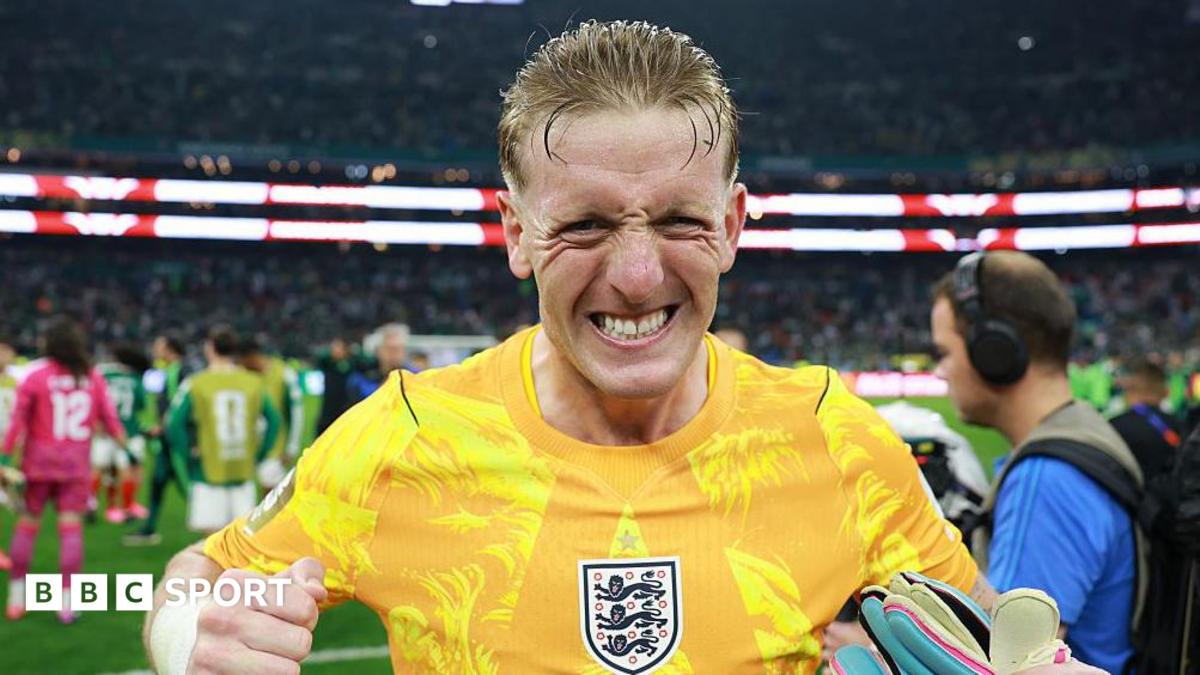
Pickford made an uncertain start to the World Cup, at fault when he was beaten at his near post when DR Congo took the lead against England in Atlanta before captain Harry Kane’s two late goals saw them through.
In the pressure cooker of the Azteca, however, Pickford had his finest game for England, with two brilliant first-half saves from Mexico striker Raul Jimenez, followed by an outstanding display of penalty-area command in a frantic second period.
“It was a very brave display of goalkeeping,” said Robinson. “I really admired what he did out there in that second half and his two saves in the first half kept England in the game. They could have been out of it by half-time if it wasn’t for him.”
Pickford won widespread praise for the way he took charge of his penalty area, taking the initiative by coming for crosses and corners on a regular basis as England, down to 10 men after Jarell Quansah was sent off early in the second half, came under siege.
“He decided that he was going to stand up. He came for crosses, made decisions to go for balls, making life easier for his defenders because of how good he was.
“The easiest thing as a goalkeeper is to stay on your line because you don’t get criticised. If you stay on your line you can’t make a mistake, but he showed maturity and bravery.
“He showed the way his game has developed by coming off his line, making those decisions, making big bold calls. That’s where you see how much he has evolved.
“Jordan took it upon himself, punched the ball, caught the ball, made life easier for his defenders.
“He doesn’t mind what players are in front of him. It doesn’t faze him. He’s played with a different back four for most games, with the full-backs alternating and a change in central defence.
“The players know him and trust him. I think there is a good relationship there.”
And Pickford’s Mexico masterclass can bolster England’s confidence as they try to overcome the dangerous Norwegians and master striker Erling Haaland, who demonstrated their threat by beating Brazil 2-0 in the last 16.
“I think Jordan Pickford’s confidence will be at an all-time high and the team’s will be as well after their win against Mexico,” added Robinson.
“I questioned them on air when Thomas Tuchel went to a back five after 71 minutes. I was thinking I wasn’t sure they would hang on, and that would have been a stick he would have been beaten with.
“It did go right and Jordan Pickford was a big part of it going right.”
It is easy to see why people love the Northumberland village so much. The centre is quaint and pretty, the beach sandy and impressive, and the castle perfectly preserved and towering
Bamburgh has won, yet again(Image: TimMcGuinness/ChronicleLive)
Has there been a run as dominant as this in the history of British seasides?
Once again, Bamburgh has been named the best coastal town or village the UK has to offer, bringing the run of victory to six in a row in the Which? annual survey.
It is easy to see why people love the Northumberland village so much. The centre is quaint and pretty, the beach sandy and impressive, and the castle perfectly preserved and towering.
In a gushing show, 5,320 Which? readers handed Bamburgh perfect marks for its seafront, scenery and beach. “It is a wonderful historic village with miles of sand and glorious views,” one happy visitor enthused.
Another said: “Bamburgh Castle, a stunning building, is the core of the village and leads through the sand dunes to an extraordinary beach, which never fails to captivate us.”
And a third agreed: “It’s just gorgeous and is as good now as it was years ago; it’s not been spoiled by commercialisation. What made it successful then has been retained.”
But amid all of the enthusiasm for the settlement of 300 people, not everyone is convinced by its dominance of the Which? survey. In fact, a number of locals are fed up with the limelight that is being cast on Bamburgh.
“I wish they wouldn’t do things like this. All it does is make rich southerners read it and then decide to buy a holiday house there, pushing up house prices and pushing out actual locals,” one irked person wrote online.
Another chimed in: “Peace and quiet?! Not on a sunny summer’s day. The village (it is not a Town) is rammed with vehicles and visitors.”
The gripes are consistent. Back in 2022, when Bamburgh’s reputation as the best of the best was still being forged, resident John Graham shared his frustrations. He said: “When the sun is out the place can be overrun. In the day, you get the ice-cream brigade leaving their rubbish everywhere and in the evenings the drunken louts have their fun.
“On an average morning in the summer, I pick up five or six burnt-out disposable barbecues and half a dozen or so bin bags full of bottles and cans.”
One business owner said it is really sad to see a big increase in litter being dumped in the sand dunes below the castle. They added: “A friend of mine summed up the problem quite well the other day when he said it’s like over-fishing.
“Pubs and hotel owners might be enjoying the money rolling in, but the more people who come here, the more damage is done to the environment.”
I visited last summer and was not overly impressed by what I found. One major issue was the cars. On a hot June day, the stream of traffic on the arterial road that runs through Bamburgh’s centre is relentless. The closest train station is seven miles away in Chathill, and the buses are sporadic, so any hopes of embarking on a relaxing, car-free day trip will prove difficult.
For me, the real issue with Bamburgh is its vibe. Central to the charm of Britain’s great seaside towns is a slightly edgy, salty quality in some way connected to large quantities of sailors. Bamburgh, with its Farrow and Ball doors and memorial benches, has none of this.
The stars of the show in Bamburgh are the beach and the castle. It is undeniable that the combination of the two — how the 1,400-year-old fort hangs above the broad, sandy shore — is magnificent. You won’t find me criticising Bamburgh Castle.
The beach, however, is arguably a little one-note. Once you’ve waded out half a mile to get to a patch of water deep enough to paddle in, you’ll be frozen by a North Sea that rarely swells itself into anything remotely as interesting as what you’d find on the UK’s Atlantic coast.
If you’re in search of a very long beach, Camber Sands near Rye in East Sussex not only enjoys a lot more sunshine — as one of the sunniest places in the country — it also has superior sand dunes, particularly so if you’re a teenager interested in launching yourself off their summits.
Belgium became the first team to beat Spanish goalie Unai Simón on Friday. But they couldn’t beat his team, with second-half substitute Mikel Merino scoring in the 88th minute to lift Spain to a 2-1 victory in a World Cup quarterfinal before a sold-out crowd at SoFi Stadium.
The win, which extended Spain’s unbeaten streak to 36 games, sends the team on to Tuesday’s semifinal with France in Arlington, Texas. For Belgium, its first loss in 19 games ended its tournament.
The turning point came not on the pitch but on the Belgium bench, where coach Luis de la Fuente sent backup goalkeeper Senne Lammens on for an injured Thibaut Courtois in the 71st minute.
The dropoff in talent wasn’t great — Lammens started 32 times for Manchester United this season — but the difference in experience was. Courtois was playing in his 21st World Cup game, second-most all time, and had been brilliant up to then against Spain, making four saves.
But just before the second-half hydration break, he dropped to the turf with a thigh injury that required attention from trainers. He tried to continue, but moments later De la Fuente made the change, with Courtois walking to the bench in tears.
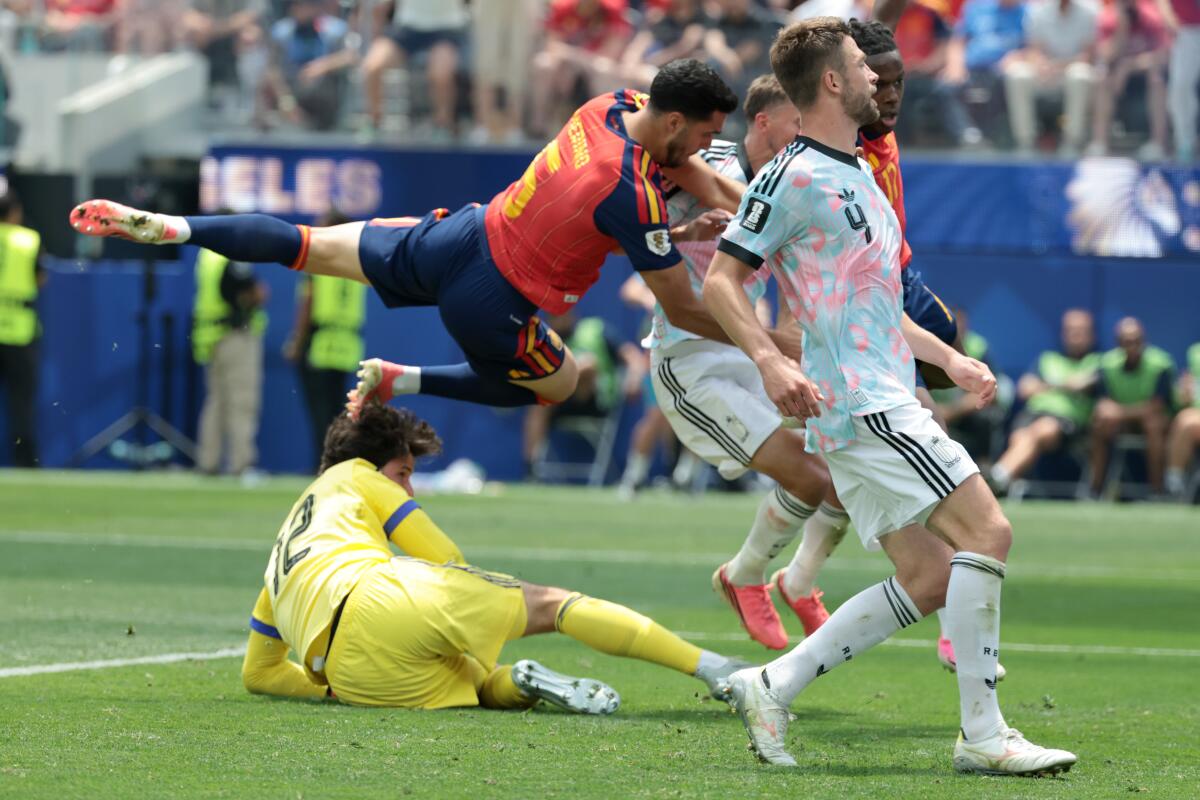
Lammens stopped the first shot he faced, a low shot from close range by Pau Cubarsí in the 88th minute, but he pushed the rebound right at Merino, who had come on less than two minutes earlier. His tap-in was his second winning goal in as many games for Spain.
The goal overcame a score from Belgium’s Charles De Keterlaere, who became the first player to score on Spain in this World Cup when he beat Simón with a spectacular goal late in the first half.
Spain midfielder Mikel Merino scores off a header in front of Belgium goalkeeper Senne Lammens during the second half of Spain’s 2-1 quarterfinal win in the World Cup quarterfinals Friday at SoFi Stadium.
(Robert Gauthier / Los Angeles Times)
Not only has Spain given up the fewest goals in this tournament, it has given up the fewest shots as well. Before De Keterlaere, no one had come close to scoring against Simón since the final group-play game — of the last World Cup.
But if La Roja, ranked third in the world by FIFA, had been an immovable object in this World Cup, Belgium had been an unstoppable force, scoring 12 times in its previous three games. Entering the quarterfinals, only France and Argentina had scored more often.
And no team had taken more shots than Belgium’s 107.
Spain struck first Friday, with Fabián Ruiz giving Simón a 1-0 lead with his first goal of the tournament in the 30th minute. The sequence started with Pedro Porro sending a cross into the box for Dani Olmo, whose shot was parried away by Courtois. But Ruiz pounced on the rebound and deflected a shot past defender Timothy Castagne and into the back of the net.
De Keterlaere matched that 11 minutes later, shielding Cubarsí with his body and one-hopping a Castagne cross past a flat-footed Simón for his third goal in two games, one Courtois reacted to by charging out of the his penalty area toward the Belgian bench, waving his gloved fists in celebration.
Spain, the reigning European champion, last advanced beyond the round of 16 at the World Cup in 2010, when it allowed just two goals en route to its only title. Belgium, ranked eighth in the world, was playing in the quarterfinals for the third time in four World Cups.
“President Trump is excited to welcome the Los Angeles Dodgers BACK to the White House to celebrate their World Series championship!” White House spokesperson Taylor Rogers said in a statement to The Times.
“Back” to the White House.
How embarrassing.
The 2017 NBA champion Golden State Warriors wouldn’t go. The 2018 Super Bowl champion Philadelphia Eagles wouldn’t go. The 2025 NBA champion Oklahoma City Thunder wouldn’t go.
And now this group of Dodgers is going twice?
Their first visit last spring was bad enough, with Trump noting, “That is a very good-looking group of people,” while the Dodgers stood around him in slack-faced awe.
Dodgers owner Mark Walter smiles while listing to President Trump speak during the Dodgers’ championship visit to the White House in April 2025.
(Alex Wong / Getty Images)
Some, including Dodgers officials, argued this was a visit about tradition, not politics. Teams have been visiting the White House since President Andrew Johnson hosted two amateur baseball clubs in 1865. The Dodgers said they were just abiding by this once-revered sports custom. They said they were showing respect for this country’s highest office, not necessarily the man inhabiting it.
Understood. But what happened two months after that first visit altered even that flimsy bit of logic, as the man inhabiting the office rained terror on Los Angeles with the midsummer ICE raids that changed the lives of thousands.
Many impacted were the Dodgers fans who filled the stadium every night for the team with arguably the largest immigrant fan base in sports. Some even were wearing Dodgers caps and jerseys when they were swept up and hauled away.
While other pro sports teams in town immediately condemned the raids, the Dodgers said nothing until finally announcing and fulfilling a $1.1-million donation to community organizations to support families impacted by Immigration and Customs Enforcement.
At the time, only one Dodger spoke out publicly, with Kiké Hernández writing on Instagram, “Los Angeles and Dodger fans have welcomed me, supported me and shown me nothing but kindness and love. This is my second home. And I cannot stand to see our community being violated, profiled, abused and ripped apart. ALL people deserve to be treated with respect, dignity and human rights.”
A year later, Hernández is still on the Dodgers, he has much clubhouse credibility, and yet they’re still going back? Were they not listening?
The roster is filled with other levelheaded veterans who surely realize that by serving as a cheap Trump photo-op, they are honoring a man whose policies have ravaged their fans more than any other group in America, and yet they’re still going back?
An organization cannot boast of sharing a uniform with Jackie Robinson while sharing a very public afternoon with President Trump. That doesn’t work.
Kiké Hernández was the only Dodger who spoke out publicly last year.
(Gina Ferazzi / Los Angeles Times)
An organization that admirably fought back against the wishes of a conservative clubhouse to pioneer Pride Night cannot be the same organization that publicly normalizes the morality of President Trump. That doesn’t compute.
Can’t anyone on Vin Scully Avenue see the big picture here?
Maybe Jose Madera, director of the Pasadena Community Job Center, can show them.
Madera, a die-hard Dodgers fan, hasn’t attended a game since last summer’s ICE raids because he’s lost faith in the Dodgers’ connection with the Los Angeles community.
He says this latest news of a second White House visit only frays that connection further.
“It’s very disappointing to hear that our team is going to shake the hand of a person who has sent so much hate and terror into our community,” he said. “Thousands of families in our city live in fear … we can’t stand for what’s going on.”
Madera said the Dodgers need to remember who they are.
“The Dodgers bring so much joy to our community, but a large part of their fan base is the immigrant community, and they need to stand with us,” he said. “It’s very disappointing that they’re not, and we need to hold them accountable.”
It’s not too late. The Dodgers still have time to change their minds and do the right thing. They still have time to acknowledge that this is not about eschewing tradition or succumbing to politics or anything but common human decency.
The president has treated the Dodgers fans with a careless disregard for their basic humanity, and the Dodgers need to let him know this is not OK.
“They still have a chance to decline,” Madera said. “We’re all hoping they do.”
Yeah, sure, in two weeks they could strut into the most celebrated residence in America as two-time defending champions.
Three wins to go. How can your team reach the final and win World Cup 2026? Click here to find out.
Who: Spain vs Belgium What: FIFA World Cup 2026 – quarterfinal Where: Los Angeles Stadium in California, United States When: Friday at noon (19:00 GMT) How to follow: We will have all the build-up on Al Jazeera Sport from 15:30 GMT before our live text commentary stream.
Recommended Stories
list of 3 itemsend of list
After crushing the “American dream” by taking down cohosts USA in a politically influenced encounter, Belgium are gearing up for their next big challenge.
They face the daunting task of tackling Spain, whose robust defence and careful, possession-based football have made them one of the bookmakers’ favourites at the tournament.
Since an unconvincing performance in the first match, Spain have improved with each contest and punched their ticket to the quarterfinals in style.
They are the first team in history to keep six consecutive World Cup clean sheets – a record achieved by taking out Portugal on Monday and ending Cristiano Ronaldo’s last bid for a world title.
Belgium’s knockout campaign in North America has been nothing short of a roller-coaster, and come Friday, it could take another turn if they upset the reigning European champions to reach the semifinals.
Al Jazeera tells you everything about Spain vs Belgium:
How did Spain and Belgium reach the quarterfinals?
Spain topped Group H with seven points, beating Saudi Arabia and Uruguay and drawing with Cape Verde. They began their knockout campaign with a 3-0 thrashing of Austria in the round of 32 before beating Portugal 1-0 with a late goal in an Iberian football derby in the round of 16.
Belgium topped Group G with five points, winning against New Zealand, and drawing with Iran and Egypt. They defeated Senegal 3-2 in extra time in the round of 32 before thrashing the USA 4-1 in the last 16 contest that was eclipsed by the bitter row over Folarin Balogun’s red card ban.
Courtois is confident Belgium can take down Spain
There may be only five spots between Spain’s and Belgium’s FIFA rankings with La Roja third and Belgium eighth, but the gap in their quality is quite stark.
Spain, the 2010 world champions, are unbeaten in 35 matches, a run that has turned coach Luis de la Fuente’s side from promising European champions into a team that exert confident control over their opponents.
Historically, Belgium have been far behind their Spanish counterparts, especially at major tournaments, having been knocked out in the group stage at the 2022 World Cup and in the last 16 at Euro 2024.
Yet goalkeeper Thibaut Courtois believes Belgium can pull off an upset after finally beginning to show some form at the tournament with a come-from-behind extra-time win and a statement performance in their last two games.
“Everyone on our team realises it’s possible. I think we have a strong squad with qualities that Spain will have to take into account,” Courtois told reporters on Wednesday.
“There are always surprises, and I think we can be one of them. Eliminating the European champions would obviously be a huge upset. The confidence is there.
“People were a bit disappointed in us, but we’ve set that right. We’re getting better and better,” he added about Belgium, whose best finish was third place at the 2018 World Cup.
The World Cup is likely the last hurrah for the remainder of Belgium’s so-called golden generation, including creative midfielder Kevin De Bruyne and striker Romelu Lukaku.
Lukaku is Belgium’s top scorer at the tournament with three goals while Leandro Trossard has made an all-round impact with two goals and two assists. Charles De Ketelaere and Youri Tielemans also have two goals each.
‘Yamal brings so much to the team’: Olmo
Slowly finding his feet in his debut World Cup, the prodigiously gifted Lamine Yamal has not enjoyed the hero’s status he’s often used to.
With one goal in five games, the 18-year-old winger – who came into the World Cup on the back of a hamstring injury – is playing catch-up with Mikel Oyarzabal, Spain’s leading tournament scorer with four goals.
Midfielder Dani Olmo said his Barcelona teammate Yamal is growing into the tournament.
“He brings so much to the team with his dribbling and presence. When he receives the ball, two or three opposing players close in on him, which opens up space,” he said.
“Lamine scores and assists. He’s always done that in his short career, and even when he doesn’t, he’ll keep helping us with the work he’s doing.”
Spain forward Lamine Yamal is playing at his maiden World Cup [Etienne Laurent/AFP]
Spain vs Belgium prediction
The Opta supercomputer gives Spain a 59.3 percent likelihood of winning in regulation time while Belgium’s chances of winning are 18.3 percent.
The model estimated a 22.4 percent probability of the game going to extra time.
Kickoff time, TV schedule
Spain: LA1, Teledeporte, RTVE Play, DAZN Mundial (9pm, Central European Summer Time)
Belgium: VRT Max, Tipik, Auvio, Sportz, VRT (9pm, Central European Summer Time)
United Kingdom: STV, STV Player, ITVX, ITV1 (8pm, British Summer Time)
To check the TV listings for your country, head to FIFA’s TV listing schedule here.
Who will the winner face in the semifinals?
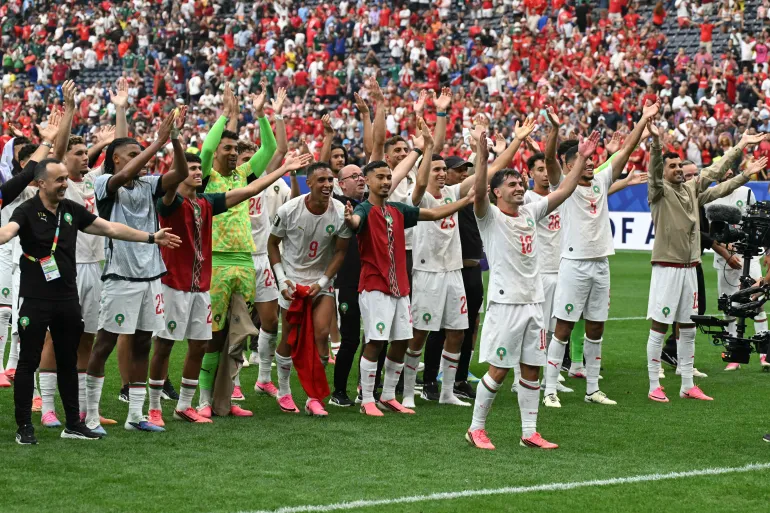
The winner of the Spain vs Belgium match will face France in the semifinals on Tuesday in Dallas, Texas. France defeated Morocco 2-0 on Thursday to reach the last-four.
Head-to-head
Spain and Belgium have met twice at the World Cup with honours even at one victory apiece.
Their first meeting dates back to 1986 when Belgium beat Spain 5-4 on penalties in the quarterfinals. Then they met in the group stage in 1990 with Spain winning 2-1.
Friday’s match will be Belgium’s third quarterfinal in four World Cups and fourth overall.
For Spain, the quarterfinals have not often been a happy hunting ground. They have only cleared this stage twice, making it to the final group stage in 1950 and beating Paraguay on their way to lifting the trophy in South Africa in 2010.
Team news
Belgium’s midfielder Amadou Onana will miss the remainder of the World Cup after suffering a torn anterior cruciate ligament (ACL) in his right knee during the last match.
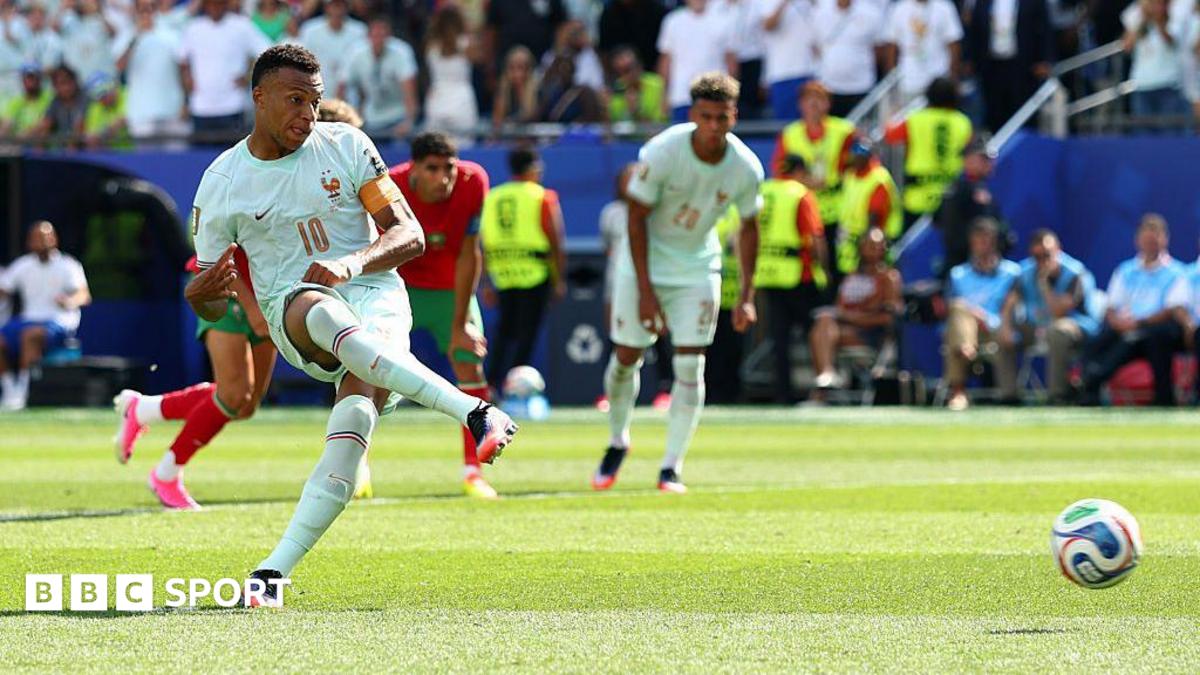
Whether or not France’s World Cup campaign ends with a third world title, few will remember Kylian Mbappe’s penalty miss in their quarter-final victory over Morocco.
The match in Foxborough was goalless when Mbappe was fouled by Noussair Mazraoui. The France captain stuttered in his run up, looked up at goalkeeper Yassine Bounou, and saw his tame penalty easily saved.
Mbappe made amends on the hour mark when his sensational curling effort broke a stubborn Morocco defence, before Ousmane Dembele doubled France’s lead six minutes later to secure a 2-0 win.
But his earlier blunder, uncharacteristic for the joint-top scorer in this tournament, begs the question: Is it time players stopped with the ‘stuttering’ penalty kicks?
In the list of things football traditionalists hate about the modern game, stuttering run ups are high up alongside players wearing gloves with short sleeve shirts, diving, and of course the video assistant referee (VAR).
There is no strict definition of a stutter, but under Fifa rules, a player is allowed to stop or feint during the run-up as long as they don’t do it directly before kicking the ball.
It’s nothing new – John Aldridge, Mexico legend Hugo Sanchez and Pele all used the stutter to gain an advantage – but it can backfire spectacularly if the goalkeeper doesn’t commit to diving early.
Mbappe joins Bruno Guimaraes, Jorgen Strand Larsen, Lionel Messi and Harry Kane (though he was able to retake his penalty against Croatia, which he scored without having a stutter in his approach) in missing penalties after stuttering in the run-up.
Of the 26 ‘stutter’ penalties taken during this World Cup – penalty shootouts included – 11 have not been scored, which leads to a conversion rate of 57%.
“This stuttering penalty seems to be the one. The goalkeepers seem to have got a march on it now,” said Ian Wright on ITV.
Marko Arnautovic, Raul Jimenez, Neymar, Mbappe, Cristiano Ronalo, Yoane Wissa and Kai Havertz have used the technique successfully.
Meanwhile, 24 of the 35 ‘non-stutter’ penalties taken have been scored, a conversion rate of 68%.
In general, this has been a poor World Cup for players looking to convert from 12 yards.
A total of 30% of non-shootout penalties have been missed this summer, the second most of any World Cup since records began in 1966.
When shootout penalties are added to the equation, then the miss rate rises to 35%, the highest of any World Cup since 1966.
“There is an arms race going on. It is definitely harder to score a penalty now. The reason being, the goalkeepers are bigger now, more athletic,” former Scotland winger Pat Nevin said on BBC Radio 5 Live.
“If your keeper goes the right way, you must hit the side netting with pace, even then it still might be saved.
“A very good penalty is no longer a certainty, so you have to re-think it. I need to make sure he goes the wrong way, hence the stutter, you try to send them the wrong way.
“Of course the goalkeepers have the data, they know what everybody does, there is no hiding what you prefer because it shows up. There is a constant running battle to figure out how you get the advantage.
“Mbappe knows what his advantage is: preparation. He has a set up [placing the ball before taking the penalty], he went through it twice today but problem is that he had to go through it three times, and the third time [he missed].”
Weekly insights and analysis on the latest developments in military technology, strategy, and foreign policy.
An image has appeared, apparently for the first time, showing a Chinese J-15T carrier-based fighter launching while carrying four anti-ship missiles. The photo offers the clearest indication yet that China’s rapidly evolving carrier force is overcoming one of its longstanding operational constraints: getting heavily loaded strike fighters airborne from its flattops.
The image, at the top of this story, shows a J-15T in full afterburner moments before leaving the deck of the Fujian, the first People’s Liberation Army Navy (PLAN) carrier equipped with catapults. The fighter is armed with four YJ-83K anti-ship missiles — double the number previously seen carried by a J-15 — amounting to a weapons load of roughly 6,400 pounds before accounting for any additional stores that may not be visible.
Previously, in fact, it seems that the latest J-15T version has only ever been seen with a single YJ-83K training round, while the aircraft was still in prototype form.
Two views of a prototype J-15T carrying a single YJ-83K training round and an inert PL-15 medium-range air-to-air missile. via Chinese internetvia Chinese internet
The YJ-83K is a widely used subsonic anti-ship missile, broadly equivalent to the U.S.-made AGM-84 Harpoon. The radar-guided, turbojet-powered weapon has a reported range of around 112 miles and is armed with a 360-pound high-explosive, semi-armor-piercing warhead. The YJ-83K is a sea-skimming missile cruising at an altitude of 65-100 feet, before dropping down to 16-24 feet during the terminal phase. Most significantly, each of these weapons weighs around 1,600 pounds.
A YJ-83K anti-ship missile under the wing of a STOBAR J-15 version. via Chinese internet
The very reason behind the development of the J-15T was to maximize the potential of Flanker operations from the Fujian, which is equipped with an electromagnetic aircraft launch system (EMALS), and subsequent carriers. As such, the J-15T is primarily distinguished from the original J-15 in being equipped for catapult takeoff but assisted recovery (CATOBAR) operations, as well as short takeoff but assisted recovery (STOBAR) operations.
Videos provide a comparison of a STOBAR J-15 carrier launch and a CATOBAR J-15T launch from Fujian:
The previous two PLAN aircraft carriers, the Liaoning and Shandong, both employ ‘ski-jump’ takeoff ramps to launch fixed-wing STOBAR aircraft.
As we have discussed in the past, the primary benefit of the J-15T is its ability to be catapult-launched from a carrier with a heavier payload of fuel and weapons. After all, the Flanker airframe has always been able to carry impressive fuel and weapons loads, but this has been strictly limited when configured for STOBAR operations. This is something that has hampered Russian Navy carrier operations, as much as Chinese ones.
Another STOBAR J-15 armed with a YJ-83K, on the deck of the Liaoning. via Chinese internet
Also significant is the fact that the J-15T has started to introduce domestically produced WS-10H turbofans in place of the Russian-made AL-31F engines previously found on production J-15s.
One of the prototype J-15Ts fitted with WS-10H engines. via Chinese internet
In the past, it appears that the heaviest loads seen carried by STOBAR J-15s launched from the Liaoning or Shandong comprised two YJ-83Ks and four air-to-air missiles, or, for air defense, four PL-12 medium-range air-to-air missiles and two short-range PL-8B air-to-air missiles.
Regardless, the fact that J-15Ts are now launching from the carrier with weapons loads of around 6,400 pounds is significant.
As well as increasing the anti-shipping potential of the J-15T, the same payload could be translated into additional fuel or other weapons loads.
Among the other weapons options for the jet are the more advanced PL-10 short-range and PL-15 medium-range air-to-air missiles. The J-15T has also been noted with the long-range YJ-15 anti-ship missile, and with a ‘buddy’ refueling pod. Other versions of the YJ-83K that could find their way onto the J-15 include the improved YJ-83KH, which features an imaging-infrared seeker and extended range.
A poor-quality but interesting image of a J-15T carrying a pair of YJ-15 anti-ship missiles. via Chinese internet
The ability for the J-15T to launch from a catapult-equipped carrier with a heavier payload doesn’t just impact the potential of the strike fighter. It will also translate to the two-seat carrier-compatible J-15 versions, intended to take on additional roles. Chief among these is the CATOBAR-capable J-15DT electronic warfare aircraft, intended to operate in a role similar to the U.S. Navy’s EA-18G Growler. With its array of external jamming pods, the J-15DT also needs to launch (and recover) at heavier weights to make the most of its potential.
A J-15DT catches the wire onboard the aircraft carrier Fujian. via Chinese internet
There are also rumors concerning a CATOBAR version of the two-seat J-15S, which could serve as a carrier trainer and/or as a multirole strike platform equivalent to the F/A-18F. Here, again, the EMALS will greatly enhance its capabilities.
Beyond marking another milestone in the rapid evolution of China’s carrier aviation capabilities, the new image suggests that the combination of the J-15T and the catapult-equipped carrier Fujian is beginning to deliver the kind of fully armed launch performance that its ski-jump carriers have long struggled to achieve.
Rams offensive lineman Alaric Jackson is not facing charges related to his arrest last month on suspicion of domestic violence, the Los Angeles City Attorney’s office confirmed.
“Charges are not filed against the respondent at this time, however, the case stays open throughout the length of the statute of limitations. It can be re-evaluated if there are further developments,” said Ivor Pine, a spokesperson for the Los Angeles City Attorney’s Office.
Pine said the matter has been assigned for a City Attorney hearing, a pre-filing diversion that is an alternative to misdemeanor prosecution.
Jackson was arrested on June 9 after police responded to a call at a West Hills home involving Jackson and a pregnant woman.
Jackson, 27, could still face discipline from the NFL if the league determines that he violated its personal conduct policy for the second time.
In 2024, Jackson served a two-game suspension. If the league finds he committed another violation, Jackson could face a six-game suspension or possible banishment for at least one year.
The Rams are scheduled to report to training camp on July 25 in preparation for their Sept. 10 season opener against the San Francisco 49ers in Melbourne, Australia.
Staff writer Gary Klein contributed to this report.
Bonnie Tyler, the husky-voiced, powerhouse vocalist who performed memorable and dramatic pop rock songs including “Total Eclipse of the Heart” in the 1980s, has died.
The Welsh singer died in a Portugal hospital on Wednesday night, according to a statement on her official website and social media accounts Thursday morning. Prior to her death, Tyler was hospitalized and underwent emergency intestinal surgery in May 2026. She was placed in an induced coma to aid her recovery which she awoke from in mid-June but remained “very unwell,” her family said at the time. She was 75.
“Bonnie’s family and team are heartbroken to announce that Bonnie unexpectedly passed away last night in hospital in Portugal as a result of the illness that she was being treated for,” the statement read.
A three-time Grammy Award nominee, Tyler first rose to fame in the late 1970s. She was known for her raspy vocals, offering listeners an edgier sound that also melded rock and pop. Tyler released a total of 18 studio albums, beginning with her debut, “The World Starts Tonight,” in 1977. But she solidified her place in music with collaborations with songwriter-producer Jim Steinman, a hitmaker who worked with Meat Loaf, Air Supply and Celine Dion.
Tyler contributed her powerful voice to Steinman’s dramatic “Total Eclipse of the Heart,” which was released in 1983 ahead of her fifth studio album, “Faster Than the Speed of Night.” Steinman initially envisioned the power ballad as a core piece in a musical adaptation of “Nosferatu,” but with Tyler, the number took on a different life.
“Total Eclipse of the Heart” climbed music charts and earned Tyler a Grammy nomination for female pop vocal performance in 1984. In addition to its commercial and critical success, Tyler’s moody hit became a mainstay in pop culture, covered in the musical TV series “Glee” and finding new life in versions by One Direction, Kelly Clarkson and several other musical acts.
“When I first heard it, I couldn’t believe it had been given to me to record. I just cried at the intense emotion of it and was so happy to have that song,” Tyler told the Guardian in 2009. “Now when I go on stage and sing ‘Total Eclipse,’ everybody sings with me. So many people say they fell in love to it and it means a hell of a lot to them. It’s such an anthem, and such a wonderful feeling, I never get tired of singing it.”
“Total Eclipse of the Heart” wasn’t the only celebrated hit from Tyler.
A year later, she performed “Holding Out for a Hero,” produced by Steinman and co-written by Dean Pitchford, for the 1984 film classic “Footloose,” starring Kevin Bacon. The energetic anthem, which features Tyler’s thunderous voice over a racing beat, also climbed the Billboard Hot 100 (it peaked at No. 34) and went on to be featured in other screen projects, including a pivotal scene in the animated comedy “Shrek 2,” with Jennifer Saunders performing the hit.
Tyler, also known for “Bitterblue,” written and produced by Dieter Bohlen, continued releasing music throughout the ’90s and early aughts. Amid the process of creating her 16th album, “Rocks and Honey,” Tyler joined the Eurovision Song Contest in 2013 to represent the United Kingdom. Though she finished 19th, she said at the time she was glad she competed “because it was an incredible experience,” likening it to the Grammy Awards. She released “Rocks and Honey” that same year, her penultimate album, “Between the Earth and the Stars,” in 2019 and her final album, “The Best Is Yet to Come” in 2021.
In 2022, she was appointed a Member of the Order of the British Empire during Queen Elizabeth’s Platinum Jubilee, recognizing Tyler’s contributions to music.
Tyler was born Gaynor Hopkins on June 8, 1951, to homemaker Elsie and coal miner Glyndwr, and was one of seven children. She was raised Protestant and cared for by her grandparents in the small Welsh town of Skewen. Her passion for music could be traced to watching British charts program “Top of the Pops” with her father, writing down lyrics to the hits of the time and singing them herself. Tyler officially caught the singing bug after placing second at the talent show hosted by a local rugby club.
After the contest, the singer continued her artistic pursuit, performing with a handful of bands including Bobby Wayne & the Dixies and, later, Imagination. She was eventually scouted and traveled to London to record a few demos but did not immediately hear back. “After two years, someone called me out of the blue and told me I’d got a record deal on the same label as Elvis,” she recalled to the Guardian.
The singer underwent several name changes over the course of the career. First she pivoted to Sherene Davis to avoid confusion with fellow Welsh vocalist Mary Hopkin. Then once more, at the behest of RCA Records, to Bonnie Tyler — a name she conjured up by mixing and matching names she read in a local newspaper.
Now Bonnie Tyler, the singer released her debut single “My! My! Honeycomb!” in 1976 and her debut album the following year. However, she would not come into her signature sound until the spring of 1977. Tyler suffered nodules on her vocal cords and underwent surgery to remove them. She feared her career would end as a result, though that would be far from the case.
Tyler, after a brief recovery period, returned to the recording studio with a huskier, edgier voice. “It turned out losing my voice was not too treacherous for me,” she told the Guardian. She released “It’s a Heartache” in 1977 with her raspy voice front and center.
“I had my first hit in America with my new husky voice on ‘It’s a Heartache,’” she said. “Maybe my husky voice was what that song, and my career, needed.”
After her tenure with RCA Records, Tyler signed with CBS Records in 1982, leading to her memorable collaborations with Steinman. At the end of the ’90s, Tyler signed with Hansa/BMG Ariola and, eventually, with EastWest Records and continued to find success in continental Europe. In addition to her albums, Tyler embarked on several tours, most recently her Between the Earth and the Stars live tour in 2019. Her most recent release was “Together” in July 2025, produced by electronic music artist David Guetta, which samples the chorus of “Total Eclipse of the Heart.”
Tyler married former Olympic martial artist Robert Sullivan in 1973. The pair never had their own children — the singer suffered a miscarriage at age 39 — but experienced “no shortage of children,” she told the Guardian in 2012. Tyler had numerous godchildren, more than a dozen nieces and nephews and multiple great-nieces and great-nephews. With her fame, Tyler supported her family and purchased several properties including a home in Mumbles, Wales, and a home in Portugal.
When Tyler reflected on her decades-long career for the BBC in 2019, she said she had long exceeded her own expectations.
“I didn’t expect ever to be making records,” she said at the time. “I was just happy being in a band, singing.”
Three wins to go. How can your team reach the final and win the World Cup 2026? Click here to find out.
Who: France vs Morocco What: FIFA World Cup 2026 – Quarterfinals Where: Boston Stadium, Foxborough, Massachusetts, the United States When: Thursday, July 9, at 4pm (20:00 GMT) How to follow: We will have all the build-up on Al Jazeera Sport from 17:00 GMT before our live text commentary stream.
Recommended Stories
list of 4 itemsend of list
The 2026 World Cup rolls into the quarterfinal stage, kicking off with a blockbuster battle between title favourites France and African champions Morocco.
France, two-time world champions and the 2022 edition’s runners-up, have been the most well-balanced team in the football tournament in North America, scoring a whopping 14 goals while leaking only two en route to a perfect five wins out of five.
Spearheaded by Golden Boot leader Kylian Mbappe, and boasting a tantalising trio of Ousmane Dembele, Michael Olise and Bradley Barcola, France have arguably the most lethal and enviable attacking unit in the tournament.
But the next challenge in their bid for a third world title is far from easy.
The French are up against Ismael Saibari and Brahim Diaz’s Morocco, who stunned the Netherlands in the knockouts and will be eager to take down another European giant.
The Atlas Lions, no longer challengers but contenders, are looking to reach back-to-back semifinals for the first time in history.
Al Jazeera tells you everything about France vs Morocco:
How did France and Morocco reach the quarterfinals?
France topped Group I with a perfect record of nine points, winning against Norway, Senegal and Iraq. They thrashed Sweden 3-0 in the round of 32 before beating a stubborn Paraguay side 1-0 in the last-16.
Morocco came second in Group C with seven points, securing victories over Scotland and Haiti, and a draw with Brazil. They began their knockout campaign with a thrilling 3-2 penalty shootout win over the Netherlands in the last-32 before smashing Canada 3-0 in the round of 16.
Morocco: Not simply challengers, but serious title contenders
Four years ago in Qatar – when Morocco stunned Spain and Portugal to become the first African and Arab nation to reach the World Cup semifinals – they earned the reputation of challengers.
But since then, the Atlas Lions have roared their way to the top, not just at the continental level but on the world stage.
As winners of the 2025 Africa Cup of Nations (AFCON) and buoyed by a 34-match unbeaten streak, FIFA world number six-ranked Morocco head into Thursday’s clash not just to pull off an upset, but to continue their promising bid for a maiden world title.
Morocco’s forward Brahim Diaz and teammates celebrate after winning the round of 16 match against Canada at the Houston Stadium in Texas in the US [Ronaldo Schemidt/AFP]
“We’re no longer a surprise today, and that’s a great source of pride,” said Morocco coach Mohamed Ouahbi, who took over four months ago.
“I think this is only the beginning, and I hope we’ll keep producing this kind of run for many years.”
World-class winger Brahim Diaz has been one of Morocco’s heroes at the World Cup, thanks to his four assists, while striker Ismael Saibari leads the goal-scoring charts with three. Soufiane Rahimi and Azzedine Ounahi have also contributed, with two goals apiece.
Saibari, who scored in each of the three group games and struck the winning penalty against the Dutch, has been ruled out of the quarterfinal, dealing a huge blow to Morocco.
The 25-year-old, one of the standout players of the tournament, came off early in the first half in the last game with a hamstring injury and has not recovered in time to face France.
France finding different ways to win
Mbappe’s seven goals in five games have strengthened France’s bid for the 2026 title, while also keeping him in pole position to become the first player to win the Golden Boot more than once.
The game was far from pretty, but France got the job done, demonstrating that Didier Deschamps’s side possesses both the steely determination and extraordinary talent to become world champions.
French midfielder Manu Kone and Paraguayan forward Gustavo Caballero fight for the ball [Charly Triballeau/ AFP]
“I think that playing a match like that at this stage of the tournament was fruitful for us, because it gives answers about what the players are capable of in the face of that kind of adversity,” France’s assistant coach Guy Stephan told reporters on Monday.
“It was a day when it would have been easy to lose control, and nobody lost control. So that is still proof of maturity, even if they are young players.”
Stephan knows Morocco will pose a far different challenge from Paraguay, describing the North Africans as a “well-organised, well-structured team” who are equally impressive in transition.
“They also have individual strengths, whether on the right side or the left side … It’s undeniably a quality team,” he said.
France vs Morocco prediction
The Opta supercomputer gives France a 61.7 percent likelihood of winning in regulation time, while Morocco’s chances of winning are 16.2 percent.
The model estimates a 22.1 percent probability of the game going to extra time.
France vs Morocco: How to watch, match schedule
France: beIN SPORTS 1 (10pm, Central European Summer Time)
Morocco: beIN SPORTS (9pm, Western European Summer Time)
United States: Peacock, Fox, Fox One, Telemundo App, Telemundo Network (4pm, Eastern Daylight Time)
United Kingdom: BBC One, BBC iPlayer (9pm, British Summer Time)
To check the TV listings for your country, head to FIFA’s TV listing schedule here.
Morocco’s forward Soufiane Rahimi poses for a photo with fans [Ronaldo Schemidt/AFP]
Who will the winner face in the semifinals?
The winner of the France vs Morocco match will play Spain or Belgium in the semifinals in Dallas, Texas in the US on July 14.
France vs Morocco: Head-to-head
The last time Morocco met France was when the Atlas Lions made their maiden World Cup semifinal appearance. It dates back to December 2022, and Morocco suffered a 2-0 defeat.
Overall, they have met six times, with France winning four matches while two ended in a draw.
France midfielder Aurelien Tchouameni is doubtful due to an adductor injury he sustained before the round of 16.
Three France players – Olise, Barcola and Manu Kone – were booked in the last game and risk receiving a ban should they pick up another yellow card against Morocco.
Entertainment power couple Margaret Qualley and Jack Antonoff have reportedly gone their separate ways for now.
“The Substance” and “Maid” star Qualley, 31, and Taylor Swift and Lorde collaborator Antonoff, 42, split and are going through a “rocky” time in their relationship, a source confirmed to People on Wednesday. Neither representatives for Qualley nor Antonoff immediately responded on Wednesday to The Times’ request for comment.
Speculation about the pair’s split began late Tuesday, with internet sleuths noting that Qualley — daughter of actor Andie MacDowell and Paul J. Qualley — apparently scrubbed photos featuring the Bleachers frontman from her Instagram page. Qualley in March shared photos from her A-list marriage to Antonoff to promote his upcoming song “Dirty Wedding Dress,” according to a social media page dedicated to the “Once Upon a Time … in Hollywood” actress. Those intimate black-and-white images are no longer visible on the actor’s page.
Reports of the Qualley-Antonoff split also come less than a week after Antonoff attended Taylor Swift and Travis Kelce’s lavish, but secretive, wedding bash in New York City sans Qualley. In addition to Antonoff, his fashion designer sister Rachel Antonoff and his ex-girlfriend Lena Dunham, models Gigi Hadid and Karlie Kloss, Sabrina Carpenter, Ashanti and Nelly were also in attendance at the Madison Square Garden spectacular.
Notably, Dunham in her latest memoir “Famesick” — released in April — wrote about Antonoff’s alleged romance with a “teen pop star” during their own romance. Many pop fans suspect the pop star, whom Dunham did not identify — to be “Melodrama” artist Lorde. When the rumors of the relationship publicly surfaced in 2018, Antonoff denied “seeing anyone” and dismissed the chatter as “dumb hetero normative gossip.”
Qualley and Antonoff tied the knot in August 2023, a little over a year after they got engaged in May 2022. Their nuptials at Parker’s Garage on Long Beach Island counted Cara Delevingne, Lana Del Rey, then-item Zoë Kravitz and Channing Tatum and Swift among the attendees.
Qualley and former fun. member Antonoff were first romantically linked in August 2021 when they were spotted kissing while on a date in Brooklyn, People reported. Their relationship gradually entered public consciousness, between Instagram posts, joint appearances at red carpet events and tidbits about their romance in various interviews.
“I am so happy that I found my person,” Qualley told Harpers Bazaar in September 2023. “And it’s real. It’s amazing. It’s the best feeling in the world. I’m so excited and so at ease all at once.”
Everyone knew going in that Lionel Messi would be the narrative centerpiece of the 2026 World Cup. Easily the most recognized name in the competition, Messi is considered by many to be the greatest soccer player of all time and, as the captain of 2022 winner Argentina, he is the reigning World Cup champ. At 18, he scored his first World Cup goal in 2006 and has competed in every World Cup since. He celebrated his 39th birthday before this year’s knockout rounds began, so it’s not unreasonable to assume that this will be his last.
No matter what Messi did, or failed to do, it would be News. Everyone with even a passing interest in the event knew this. Including me.
But I didn’t expect to completely fall for the guy. He’s a professional male athlete, for heaven’s sake, and I don’t emotionally invest in professional male athletes. Admire some of them, sure; watch with bated breath and then scream in astonishment when they pull off some amazing feat or another, absolutely. But the only athletes that have ever touched my heart have been women — Nadia Comăneci; Billie Jean King and the Title IX-sparking stars of women’s tennis; Dorothy Hamill; Brandi Chastain and 1999 Women’s World Cup winners; Venus and Serena Williams; Simone Biles; Caitlin Clark.
But here I am, at age 62, truly, madly, deeply in love with Lionel Messi.
I know, I know, me and half the world. Which normally would serve as an effective prophylactic. I am habitually wary of super-intense fandoms and the men who inspire them; stadiums filled with people chanting a single name inevitably set off internal alarm bells. As I have asked several times in columns throughout the years, how many “heroes” must we watch falter under pressure or be exposed for decidedly unheroic acts before we wise up and get out of the pedestal-placement business?
Yet here I am, stalking him on Instagram, up all hours flicking through interviews and career highlight clips. (I even watched the Apple TV docuseries “Messi Meets America”!) Here I am, literally praying to God, who clearly has more important things to do, for Argentina to advance and screaming Messi’s name every time he scores, assists or pretty much does anything at all.
In a matter of weeks, I have become addicted not just to watching the man play but seeing how he reacts when a shot is made or a game won.
Every World Cup player is happy when they or their team scores, but Messi is delighted. Like a kid seeing a puppy under the tree on Christmas morning. Like he cannot believe this wonderful thing that has just happened even if he was the one who sweat and ran and defied physics to make it happen.
His smile is infectious and even when he is running toward the stands, arms spread wide, after making some impossible shot or other, it never seems self-congratulatory. He is simply filled with joy and wants to spread it around. The field, the stadium, the world.
And his hugs. Long, deep, radiating emotion, utterly unself-conscious. Everyone needs to find someone who hugs them like Messi hugs people — teammates, coaches, opposing players, young fans. I could watch videos of him hugging his mentor and former teammate Ronaldinho or Argentina coach Lionel Scaloni all day long. (I’m not saying I have, nor am I saying I haven’t.)
Sometimes the hype gets a bit nauseating — former teammates who claim he never makes a mistake, commentators who refer to him as superhuman (despite the fact that he has missed as many penalty kicks as he has made in this World Cup). Whether Messi himself agrees that he is the GOAT is none of my business, but he doesn’t act like many sports stars who have received similar adulation. He doesn’t peacock, he doesn’t preen; he is visibly angry with himself when he doesn’t produce. He isn’t perfect — in various past games, he has gotten into heated disputes and shoving matches and famously (and many believe deservedly) taunted Netherlands coach Louis van Gaal during World Cup 2022. But for a man who has been such a star for so long, he presents himself as simply a player among players. The captain, certainly, but not the most important person on the field.
That is the most lovable, and superhuman, thing about him.
It feels pretty basic, not to mention embarrassing, to have a sudden summer crush on Messi, but I don’t care. He’s married to his childhood sweetheart, has three adorable sons and a picture of his mother tattooed on his back. He lets his teammates hoist him in the air and allows sports commentators to regularly (and lovingly) refer to him as “Little Messi.” He gets angry sometimes, but in this tournament he has yet to noticeably hector the refs or rumble with his opponents. He wants to win, obviously, but his joy comes from playing the game well rather than defeating another team.
That’s why, despite my newfound addiction to Messi delight, the moment I loved him best was when he didn’t celebrate at all. In the round of 32, Argentina (No. 2 in FIFA rankings) seemed guaranteed a win over Cape Verde (67). But even with Messi’s early goal, the game was a nail-biter, with Cape Verde scoring two brilliant goals while their goalie Vozinha made eight saves, including four shots (one of them a free kick) from Messi. After Argentina won in additional playing time, there was none of the usual jubilation. Instead, a subdued Messi walked to the midfield to shake hands with his opponents, a sign of exhaustion, no doubt, but also of respect. He hugged Vozinha and told him that his country should be proud of him.
The exuberance was back Tuesday, however, when, after trailing Egypt for most of the round of 16 game, Argentina managed to pull off the comeback of the tournament, going from a 0-2 deficit to a 3-2 win after the 79th minute, with Messi scoring the tying goal.
This time, the smiles, the hugs, the radiant joy filling Atlanta Stadium could have powered the entire state of Georgia. This time, Messi was so happy, he wept.
So did I. The World Cup is over in less than two weeks, and France and Spain are currently the 1-2 favorites to win the thing. My love for Messi is, after all, just a summer romance.
And as with any summer romance, I want it to last forever.
“While this diagnosis does not change the tragedy of his passing, it provides important context about some of the struggles he may have been facing,” Kneeland’s family, including girlfriend Catalina Mancera, said in a statement.
CTE is a degenerative brain disease that has been found in people who experience repetitive head trauma and can be diagnosed only after death.
“We share this information to help people understand what NFL and other high contact sport athletes might be struggling with,” the family said. “Raising awareness is important to us. We continue to remember Marshawn with compassion for the person he was, rather than defining him by the final moments of his life. One Love.”
Frisco, Texas, police said Kneeland didn’t stop when state Department of Public Safety troopers tried to pull him over on Nov. 5 for a traffic violation. The 2024 second-round draft pick was pursued by authorities in his vehicle and then on foot before being found “deceased with what appeared to be a self-inflicted gunshot wound,” Frisco police said in a statement at the time.
Police-dispatch audio from the incident revealed that Kneeland had sent out a group text to say goodbye to his family.
Researchers at the Boston University CTE Center analyzed Kneeland’s brain tissue and determined that the athlete, who started playing tackle football at age 7, was in stage one of four of CTE.
“Unfortunately, I was not surprised to find CTE in the brain of Mr. Kneeland, because we have found this progressive brain disease in nearly half of the athletes we’ve studied who have died before the age of 30,” Dr. Ann McKee, the center’s director, said in a statement.
“Thanks to the generosity of our brain donor families, we now better understand the earliest stages of CTE, and it is bringing us closer than ever to diagnosing it during life. My team and I are fully dedicated to finding effective treatments and a cure for CTE.”
The Associated Press contributed to this report.
Suicide prevention and crisis counseling resources
If you or someone you know is struggling with suicidal thoughts, seek help from a professional or call 988. The nationwide three-digit mental health crisis hotline will connect callers with trained mental health counselors. Or text “HOME” to 741741 in the U.S. and Canada to reach the Crisis Text Line.
The attacks have triggered fires in two districts of Kyiv, according to the city’s mayor.
Published On 7 Jul 20267 Jul 2026
Russian missile attacks have struck Kyiv in the third large-scale assault on the Ukrainian capital in less than a week.
Early on Wednesday, Kyiv Mayor Vitali Klitschko said in a statement on Telegram that the Russian strikes had triggered fires in two districts of the city. It is not clear if there have been any casualties or damage.
Recommended Stories
list of 3 itemsend of list
Moscow also launched a large-scale attack on Kyiv on Monday, killing at least 14 people and damaging at least a dozen buildings.
Both Russia and Ukraine have recently expanded their use of long-range weapons, including missiles, marking a new front in Moscow’s four-year war.
Ukraine has focused its attacks on Russian energy facilities to weaken its war efforts.
Ukraine said on Tuesday that its drones attacked a dozen tankers from Russia’s “shadow fleet” over the past two days that were delivering fuel to Moscow-occupied Crimea. Kyiv’s military said they had struck eight vessels subject to sanctions in the Sea of Azov, each with a deadweight of about 7,000 metric tonnes. Two more tankers were hit later in the day.
The Sea of Azov is a key supply route for Russian forces in Crimea and other occupied parts of southern Ukraine.
Russia annexed Crimea in 2014 – in a move that has been unrecognised internationally – eight years before launching its full-scale invasion of Ukraine.
Moscow has not publicly commented on this week’s attacks on Ukraine, which also included strikes on electrical substations, radar systems, and missile installations.
Attacks amid NATO Summit
The latest exchange of fire between Russia and Ukraine also comes amid NATO’s annual summit, which began on Tuesday. The military alliance’s leaders have gathered in Turkey’s capital Ankara for the two-day summit, where defence spending and the Russia-Ukraine war is under discussion.
NATO is expected to pledge further military support for Ukraine, as President Volodymyr Zelenskyy urges the alliance to step up aid for the country’s air defences following a deadly escalation of Russian attacks on Kyiv.
Zelenskyy – who has renewed his call for Ukraine to be allowed to join the alliance – wrote on social media on Tuesday that he had signed new agreements with Estonia, the Netherlands, and Denmark in Ankara.
The deals create “new opportunities for joint production, the development of innovative defense technologies, systematic exchange of expertise, and the export of Ukrainian battlefield-proven solutions”, he said.
Further agreements are expected with Germany, Norway, Finland, and Canada.
US President Donald Trump is also expected to meet Zelenskyy on the summit sidelines on Wednesday, having spoken with Russian President Vladimir Putin ahead of the NATO gathering.
Asked about Russia’s war in Ukraine, Trump said he hoped it would be settled “soon”.
“I think they both want to make a deal,” Trump said.
“It’s too bad it took so long, but I think something’s going to come out.”
Welcome back to The Times’ Lakers newsletter, where it’s been a, uh, busy week.
Over a short seven days, the Lakers confronted their past, welcomed their present and got a glimpse at their future. Starting with LeBron James officially filing for divorce last Tuesday, the Lakers transformed into almost a completely new team overnight.
But did they turn into a better team?
All things Lakers, all the time.
Get all the Lakers news you need in Thuc Nhi Nguyen’s weekly newsletter.
By continuing, you agree to our Terms of Service, which include arbitration and a class action waiver. You agree that we and our third-party vendors may collect and use your information, including through cookies, pixels and similar technologies, for the purposes set forth in our Privacy Policy such as personalizing your experience and ads.
Hello to a new era
The relationship was characterized by passive aggression, cryptic tweets and small slights that added up to a big, if not inevitable, breakup. After such a complicated tenure, at least LeBron James’ Lakers career ended with clarity.
By informing the team before free agency started that he would not be returning next season, James offered a clean break when both sides needed it. The 41-year-old, who is still the best unrestricted free agent on the market, will keep the rest of the league hostage. The Lakers can move forward in peace.
They didn’t take long to find their rebound star.
The Lakers went all-in to get center Walker Kessler. Not just with the four-year, $130-million contract — which is longer than many of the other deals signed this month — but with the draft capital. When a simple offer sheet wouldn’t have been enough to pry the restricted free agent away from Utah, the Lakers threw in two first-round picks (2031, 2033) and two first-round swaps (2028, 2030). They don’t control their own first-round pick until 2032, meaning there aren’t many exit ramps if things go wrong.
But, on the other hand, what if they go right?
Kessler, 24, is seen as a “perfect” fit for the Luka Doncic-Austin Reaves Lakers, a league source told my colleague Broderick Turner. He’s an elite rim protector, averaging 2.4 blocks per game in his four-year NBA career. He led the NBA in offensive rebounds in 2024-25 and ranked fourth in rebounding rate, according to Basketball Reference.
He’s what Doncic asked for.
The concern might be more about an unproven track record. He only played five games last season because of a shoulder injury. He finished third in rookie of the year voting in 2023 but has only one full-time starting season. Even then, he played only 58 games in 2024-25.
It’s a big bet for a player who hasn’t even approached an All-Star conversation.
(Thuc Nhi Nguyen / Los Angeles Times)
Six of the Lakers’ top nine players from last season are gone. The Lakers started reloading their draft assets by trading Deandre Ayton on Friday, shipping the big man to Washington for Jaden Hardy and second-round draft picks in 2031 and 2032. Hardy, like new free agent addition Quentin Grimes, is another Doncic teammate from Dallas.
With Ayton’s departure, the Lakers are on the hunt for a backup center. They have two remaining roster spots and are still in the mix to add a two-way wing defender. Rookie Cameron Carr is showing in summer league that he could be an immediate three-point threat. He has some work to do in the weight room and needs more reps to be ready on the defensive end to fill the three-and-D responsibility Rui Hachimura held.
Hachimura was the last of the Lakers’ unrestricted free agents to settle on a new home. The 6-foot-8 forward was a valuable asset to the Lakers and maybe wasn’t appreciated enough for his willingness to accept different roles, even moving to the bench briefly during an important contract year.
Hachimura, who made about $18 million last season, got looks from across the league but agreed to a two-year, $28-million deal with the Clippers on Monday.
Even for some NBA players, moving is prohibitively inconvenient.
Goodbye to the old
Outsiders looked at James’ initial move to the Lakers as something that went beyond basketball reasons. Perhaps the breakup was the same way.
Doncic, Reaves and James could have been as competitive as any trio in the league, evidenced by the short, successful glimpses we saw last season. The basketball could have been beautiful.
But if James would have played out his career with the Lakers, there always would have been an awkward pall over the final years. This relationship wasn’t serving either party anymore. He was right that it was simply time to move on.
On paper, he leaves behind a historic chapter of an unparalleled career. Already a Hall of Famer before he came to L.A., James won the Lakers’ 17th NBA championship, ending a 10-year title drought for the franchise. He broke the NBA’s all-time scoring record while wearing a Lakers jersey in front of a sold-out Lakers crowd.
In the hearts of Lakers fans, the legacy is complicated. Fans never got to create the everlasting joyful memories we saw at the Knicks championship parade or, if you’ve been watching soccer, in this month’s FIFA World Cup. Perhaps the Lakers faithful will never forgive him for his role in the disastrous Russell Westbrook trade that set the organization back for years. James, for all his personal accolades and cultural influence, still stands no chance against the spirit of Kobe Bryant, especially after Bryant’s shocking death in 2020.
The comparisons were unrelenting. But James never shied away from them.
“Truly a honor to wear the [purple and gold],” James wrote on Twitter with purple and yellow heart emojis, responding to a kind statement from Lakers governor Jeanie Buss. “… Hope I made a few proud during my stint.”
Most breakups are hard. The end of this relationship, at least, is a rare instance when you can smile both because it’s over and because it happened.
Poll results
Last week, we asked which unrestricted free agent would you most like to keep. Ultimately, no one gets their wish; all have signed elsewhere. There were 39 total votes, with several submitting two names, but for the sake of this count, I only took each ballot’s first choice.
Here are the results:
Rui Hachimura: 23
Marcus Smart: 9
Luke Kennard: 5
Jaxson Hayes: 1
“Marcus Hachimura”: 1
New question
Last week’s poll didn’t have a particularly long shelf life. The first wave of free agency swept up almost all the available Lakers players within hours. This new question could fuel debate to outlast all of our natural lives: Would you like to see the Lakers retire LeBron James’ jersey? Slide into my inbox (thucnhi.nguyen@latimes.com) to vote!
—Yes
—No
Favorite thing I ate this week
The special combination bánh mì (bánh mì đặc biệt) from San Francisco’s L&G Vietnamese Sandwich.
(Thuc Nhi Nguyen / Los Angeles Times)
When I was young(er), my parents went grocery shopping at the Vietnamese store Saturday mornings, and on his way out the door, my dad would poke his head into my room and ask simply, “One or two?” He was asking how many Vietnamese sandwiches I wanted for lunch.
Bánh mì remains my ultimate comfort food, and I liked the special combination bánh mì (bánh mì đặc biệt) from San Francisco’s L&G Vietnamese Sandwich so much that I went twice in three days. It had all the right Vietnamese cold cuts with the perfect pate and mayo ratio, and for an $11.50 deal, I even risk the caffeine-fueled heart palpitations to add a Vietnamese iced coffee.