Spring is the season of creation, a time of renewal and new beginnings. In Los Angeles, alas, we were, last spring, a city of cinders. It was a time to mourn.
A hard year followed with floods, ICE, AI, etc., menacing our native optimism. Making matters worse, in December we lost L.A.’s grand visionary vizier, the architect who time and again built us out of civic funk and transformed L.A., inspiring the city he so loved to look good, feel good and do good.
But that is still the case. So many plans Frank Gehry imagined for L.A. still remain. Gehry bequeathed blueprints and models, sketches and concepts, for his large and devoted team of younger architects and next-generation visionaries equipped to fabricate our way out of angst.
Isn’t there supposed to be an Olympics on the way for which the city appears ill-prepared? Spring 2026 is the time to build.
A couple of springs ago, L.A. County dubbed the blocks around Gehry’s masterpiece, Walt Disney Concert Hall, the Grand Avenue Cultural District. This includes the rest of the Music Center, Museum of Contemporary Art, the Broad and Colburn School. The Grand, Gehry’s resplendent complex across the street from Disney, had recently opened and ground was about to be broken for the Colburn Center, a 1,000-seat concert hall equipped to also serve dance, opera and whatever yet-to-be-invented genres Gehry designed it to enable.
The Colburn Center is well on its way to completion next year. Bits of the building’s pink skin have started to peek out like spring blossoms on the construction site at 2nd and Olive. The Broad has begun an expansion. But after two years, nothing else has been done to make this the cultural district it must become, one unlike anything else in any city.
Four springs ago I toured Grand Avenue with Gehry to gather what he had in mind for an arts district. When Disney Hall opened in 2003, it instantly became an enduring symbol of L.A., overtaking the Hollywood sign in many cases. The Dodgers want to parade joy in winning their second World Series in row last October, where else but in front of Disney? But not in front of all Gehry had in mind.
We will soon have a pair of futuristic new museum buildings to show off this year: the David Geffen Galleries, the controversial Los Angeles County Museum of Art’s Peter Zumthor building (I predict it will prove a sensation), and the new Lucas Museum of Narrative Art (no predictions on that one) next door to the Coliseum. But the fact that each is a 15-minute ride away from the cultural district’s new Metro station only makes the district even more of a center.
A center, indeed. Gehry’s vision included completing the original plans cost-cut out of Disney a quarter-century ago, along with new modifications and much more throughout the area. Some are more costly than others. Enough could be done on Grand Avenue in time for the Olympics to make a difference if we begin this minute.
Since its opening, Disney has been — shamefully — the most poorly lit building of its stature in the world. Gehry had chosen the specific steel for its capacity to reflect light. His idea was to project on the building whatever concert was taking place that night. No sound, just imagery. Belt-tighteners didn’t want to commit the $2 or $3 million or whatever and go through the trouble.
It was spectacularly tested at the hall’s 10th anniversary, but with tacky prerecorded video and crummy amplification. Facilities are now included in the Grand for projectors. It would have been amazing in 2003 and will be amazing now. The Grand has been disappointingly slow to attract the restaurants, bars, cafes and shops it needs to create a scene. The projections could change all that and even create enough of a ruckus to get a reluctant, car-crazed city to make that Grand Avenue block pedestrian.
There is much more for Disney. Gehry wanted to turn BP Hall, where preconcert talks occur, into a small chamber music hall with a suspended balcony. He had plans for reconfiguring the seldom-used small outdoor Keck Amphitheater into an enclosed jazz club for Herbie Hancock and turning the little-used 1st Street entrance into a glass-enclosed bar that would be named the Ernest, in tribute to Ernest Fleischmann, the L.A. Phil executive director who was responsible for building Disney.
Disney was supposed to have a pit for the orchestra, allowing for staging opera and dance. The plans exist. That could be done in a summer for a couple million. Bottom-liners had also nixed Gehry’s original design for a more gracious lobby with a cafe out front, not the gloomy one installed against his will.
The Colburn Center has the potential for being another game changer for the area, a vibrant new hall where we are promised upward of 200 events a year from all walks of musical life, local and international. But Gehry had in mind even more.
He intended to lower the steep and pedestrian unfriendly 2nd Street hill, so that it would be an easy walk from the new Metro station two blocks away, and add two more pedestrian blocks by diverting traffic to the 2nd Street tunnel. This would connect the cultural district with Grand Central Market on one end and the Broad on the other. Then 2nd could itself become a lively street with the stores and restaurants a “district” needs.
A model of architect Frank Gehry’s design of an addition for Colburn School.
(Christina House/Los Angeles Times)
The extraordinary original plans for the Colburn Center included turning the parking lot across 2nd from the hall into a public plaza with a giant video wall and high-end outdoor sound system, for projecting nightly concerts in the hall. Gehry was a devoted outdoor-indoor architect, and he designed for the hall a balcony on which musicians can perform.
That initiative has thus far been blocked by City Hall officials, fearful of the tunnel’s aging infrastructure. Although if that’s the case, I’m not all that eager to be in the tunnel as it currently is when the Big One comes along. This is where L.A. shows its moxie. Upgrade the tunnel. Now! If this were Beijing, New Delhi or Hanoi, it would be a no-brainer.
Gehry next proposed building low-cost artist housing in Grand Park directly across from the Music Center, which would further create a true arts community. There has been talk of renovating the Dorothy Chandler Pavilion for three decades and that’s all it’s been. The corporate-esque recent Music Center plaza could use a little excitement, maybe a Phase II.
Arts make a city. The Edinburgh Festival in Scotland was created after World War II to help bring the city back to life. After its fire-bombing, Tokyo founded a bevy of symphony orchestras as a phenomenal experiment in mass antidepression. Beethoven’s Ninth Symphony played no small role in lifting the collective mood, preparing Tokyo to create what now feels like the world’s most arresting capital.
Unlike Scotland, unlike England, unlike Germany, unlike France, unlike Italy, unlike Poland, unlike Russia, unlike Finland, unlike the Czech Republic, unlike China, unlike any number of countries, America has no major international arts festival these days. We had one in L.A. in 1984 with the Olympic Arts Festival. The Cultural Olympiad in 2028 has shown no bones. But if we make the cultural district what it could be, there would be no better place anywhere for a major festival.
We have the goods. L.A. artists helped make the modern Salzburg Festival the meaningful model for all others. In 1992, the summer before Esa-Pekka Salonen became music director of the Los Angeles Philharmonic, he and the orchestra were invited to shake up clinging Austrian tradition. With the help of director Peter Sellars, they staged Messiaen’s epic opera “Saint François d’Assise,” with pyramids of televisions, resulting in music and monitors upending, in Mozart’s hometown, the role of the modern opera and, so to speak, the sound of music.
Over succeeding decades, both Sellars and Salonen have been Salzburg Festival lodestars. Last summer they were back staging two monodramas, Schoenberg’s “Erwartung” and “Abschied” (the last movement of Mahler’s symphonic song cycle “Das Lied von der Erde”). Conductor and director looked with shocking depth into the “Expectation” of death and gave a “Farewell” to the “Song of the Earth” we all await. I saw it twice and can’t imagine how anyone came away from it quite the same person, not more alive, not more fragile. Art on the stage doesn’t get deeper than “One Morning Turns Into an Eternity,” as Sellars named the production. Salonen, who conducted the production with Vienna Philharmonic, is now about to become the L.A. Phil creative director in the fall and will bring the production to Disney with the L.A. Phil next season. It is thus far the most important opera news of next season in America. All the more reason to build that pit in the hall and get started on much bigger plans.
Salzburg, which manages to come up with around $80 million from here and there, also helped with the question I’ve evaded: Who’s going to pay for all this? I’ve evaded it because it’s the wrong question. Money only started pouring into the building of Disney Hall when people got wind of what it was going to become. Five years ago, Crypto.com paid more than $700 million to change the name of Staples Center. That amount, which created nothing but an advertisement for a product of dubious value to society, is the price of two Walt Disney Concert Halls and probably all of Gehry’s projects put together. It is the amount that could fund nearly nine Salzburg-scale festivals.
If we let ourselves believe that L.A. wealth only cares for mega-crypto advertising, mega-mansions and mega-yachts, then L.A. is over. It isn’t. Do we want to show only that to the world? Downtown, and prominently Crypto.com Arena in L.A. Live, have been designated a center for LA28, as we’re calling the Olympics. That makes a graciously glorifying cultural district, which functions as creation being existential not commercial, just up the road from L.A. Live, L.A. live.
When one morning turns into an eternity, you don’t ask for the bill.
I’ve seen enough. It’s time to revise our expectations about the midterms.
For more than a year now, conventional wisdom has been that Democrats would take back the House — but not the Senate — in the November midterms.
That’s because this year’s Senate map would require Democrats to win numerous seats in red states.
In fact, if you had asked me a couple of months ago, I would have told you that, yes, Democrats have a shot at the Senate, but in the same way my teenage son has a shot at someday dating Sydney Sweeney. Which is to say, technically possible but cosmically unlikely.
I’m not alone. Independent journalist Chris Cillizza recently observed that for the first time ever, prediction markets like Polymarket and Kalshi showed Democrats with a narrow edge.
Now, prediction markets are not scientific. Neither, for that matter, is licking your finger and holding it up to the wind — but both have outperformed political polling at various times in the last couple of years.
The difference is that in prediction markets, people are wagering actual money, which tends to sharpen the mind in ways that answering a pollster’s call during dinner does not.
Of course, you probably haven’t heard much about this revised political outlook. That’s because nobody has any incentive to shout it from the rooftops.
Democrats don’t want to inflate expectations and risk turning a solid win into a perceived disappointment. Republicans, meanwhile, are not eager to advertise that their Senate majority is wobbling like a shopping cart with a bad wheel. And we pundits, chastened by having been burned, are reluctant to get too far out over our skis.
Even Cillizza still leans Republican on balance. But if I had to bet today — and I tend to define bet as “regret later” — I’d put my chips on the Democrats. Not because it’s a sure thing, but because almost every political and economic development seems to be trending in their direction.
History helps. The “out” party in the midterms usually does well. Current events help. Policies, including the war in Iran and rising gas prices, tend to sour voters on whoever’s in charge. And candidate quality helps. Voters do occasionally notice who’s actually on the ballot, and Democrats are serving up a semi-respectable offering.
Let’s pause to appreciate what’s at stake. Control of the Senate isn’t just about who gets the nicer office furniture. It determines judicial confirmations, including the possibility that Trump could fill a fourth Supreme Court vacancy (if one opens up in 2027 or 2028).
Now, it would be irresponsible of me to just drop this idea without delving into some logistical details.
For Democrats to flip the Senate, they need to net four seats. That means defending everything they already have while winning four more. The encouraging news (if you’re rooting for the Democrats) is that there are at least eight plausible opportunities for that to happen.
In North Carolina, incumbent Gov. Roy Cooper, a Democrat, is widely expected to win. In Maine, Republican Sen. Susan Collins once again finds herself in a political knife fight — her natural habitat, though perhaps not her preferred one. She will face Maine’s current governor or a flamboyant and controversial oysterman. I’m not sure who’d be the tougher opponent.
Out in Ohio, former Sen. Sherrod Brown benefits from the rare political skill of being a Democrat who still seems at home in Ohio.
The Democrat running in Alaska is a former member of Congress (and the first Alaska Native elected to Congress). And for the open seat in Iowa, Democrats seem likely to nominate a two-time Paralympic gold medalist who represents the reddest state house seat held by a Democrat.
Then there’s Texas, the perennial Democratic mirage — always shimmering on the horizon. But this year, it might come into clear view. James Talarico has emerged for Democrats, while Republicans are stuck choosing between scandal-plagued Atty. Gen. Ken Paxton and incumbent Sen. John Cornyn — a process that currently resembles a family feud conducted with vicious attack ads.
Meanwhile, in Nebraska and Montana, Democrats aren’t even pretending to compete. Instead, they’re relying on independents who — like Sens. Bernie Sanders and Angus King — would likely caucus with them.
In Nebraska, independent Dan Osborn already proved he can make it close: He lost in 2024 — a bad year to run against a Republican. And in Montana, the sudden announced retirement of Sen. Steve Daines has created an opening that didn’t exist five minutes ago (in political time).
Let’s not get carried away. The idea that Democrats could sweep all these races is still the kind of thing you say after your third drink. But winning half of them? That’s no longer fantasy. That’s … plausible. Maybe even more likely than not.
This isn’t a safe bet. It’s not even a comfortable one. But for the first time, it’s starting to look like smart money isn’t laughing at the idea anymore — it’s quietly sliding chips across the table.
KTLA-owner Nexstar Media Group said it has closed its deal to acquire rival Tegna’s TV stations, despite opposition from eight state attorneys general who filed a lawsuit to block the merger.
The acquisition was approved by the Federal Communications Commission’s Media Bureau and the Justice Department, Irving, Texas-based Nexstar said Thursday.
“This transaction is essential to sustaining strong local journalism in the communities we serve,” Nexstar founder and Chief Executive Perry Sook said in a statement. “By bringing these two outstanding companies together, Nexstar will be a stronger, more dynamic enterprise — better positioned to deliver exceptional journalism and local programming with enhanced assets, capabilities and talent.”
Sook also mentioned President Trump and FCC Chairman Brendan Carr by name in the statement, saying the company was “grateful” they recognized the “dynamic forces shaping the media landscape” and allowed the transaction to move forward. Trump had supported the deal.
The surprise announcement came only a day after eight state attorneys general, including California’s Rob Bonta, sued to stop the deal, arguing it would give Nexstar too much control of local TV stations. At the time, Bonta said the combination would cause “irreparable harm to local news and consumers who rely on their reporting as a critical source of information.”
Nexstar is the largest TV station owner in the U.S., with 164 outlets including KTLA in Los Angeles. If the merger with Tegna succeeds, Nexstar would have 265 TV stations reaching 80% of the U.S. and multiple outlets in a number of markets.
The suit also claimed it would give the combined company too much leverage in negotiating fees from pay-TV providers that carry their stations, which could raise costs for consumers.
The plaintiffs in the suit also include state attorneys general in Colorado, Connecticut, Illinois, New York, North Carolina, Oregon and Virginia.
FCC Commissioner Anna Gomez said the merger violates the existing national ownership cap of 39% under federal law and said the acquisition did not receive a vote before the entire commission. The FCC approved this deal with waivers, meaning the company can operate in violation of that ownership cap.
“A transaction of this magnitude, which includes new and novel issues before the FCC, demands open deliberation before the full Commission, not a quiet sign-off meant to avoid public scrutiny,” Gomez said in a statement. “Given the increasingly alarming pace of reckless media consolidation, the American public deserves to know how and why this decision was made.”
The FCC did not respond to an immediate request for comment.
Times staff writers Stephen Battaglio and Meg James contributed to this report.
“The best way I can describe it is, it’s an addiction,” says Taylor Frankie Paul.
The star of “The Secret Lives of Mormon Wives” is seated by a window in an empty Starbucks within a downtown Salt Lake City hotel, reflecting on her relationship troubles in an interview Feb. 19. Followers of Paul’s screen life are all too familiar with the drama. Now, others can’t escape knowing about it too.
Days later, a dispute with her on-again, off-again partner would lead to an investigation by police that surfaced in multiple news reports this week, and on Thursday, the release of a video recording of a separate dispute in 2023 would lead to a pause on “The Bachelorette,” her latest starring role on reality TV, three days before it was set to premiere.
Her brush with fame began with #Momtok, as the self-proclaimed founder of the Utah-based group of Mormon moms that spawned the so-called corner of TikTok where they shared choreographed dance videos and light lifestyle content. But in 2022, she rose to notoriety after revealing in a TikTok Live session details about an arrangement she had with her then-husband Tate Paul to pursue intimate relations with other consenting couples (without having extramarital sex); she confessed to violating their agreement by having an emotional affair. The salacious revelation, which became known as the “soft-swinging” scandal, lit up social media and, eventually, led to the creation of Hulu’s breakout hit “The Secret Lives of Mormon Wives.” Much of Paul’s story across the show’s four seasons has revolved around her rocky relationship with Dakota Mortensen, the man she began dating following her divorce.
Dakota Mortensen and Taylor Frankie Paul in a scene from “The Secret Lives of Mormon Wives.” The pair share a 2-year-old son.
(Fred Hayes / Disney)
Even as the show documented the lead-up to Paul becoming the new face of “The Bachelorette,” her biggest screen opportunity yet, the pair’s on-again, off-again dynamic remained as turbulent and confusing as ever, down to the “Mormon Wives” season’s final minutes. A despondent Paul nearly upended the start of production on ABC’S dating series when she missed her flight to Los Angeles after sleeping with Mortensen, who is the father of her youngest son, Ever, the night prior. (She took a later one.)
“I was just still stuck in the cycle,” she says, noting she hasn’t watched the “Mormon Wives” finale. “That’s why I knew I had to leave [to do ‘The Bachelorette’], if that makes sense … I can’t help people understand it because my own brain doesn’t understand it. The only thing I can relate it to is, it is a drug; the toxicity is a drug. It’s always a mind game and I fall for it every time, and I cave and it’s just so dumb. I get exhausted saying it to people because I’m like, ‘I don’t blame you guys. I’m mad at me.’”
The hook of a 31-year-old mother of three trying to find love — who unapologetically wears her troubles on her sleeve — was supposed to be what made her a desirable candidate for the latest crossover experiment to hit Disney’s reality TV universe. But in the week leading up to Sunday’s Season 22 premiere of “The Bachelorette,” reports surfaced detailing allegations of domestic violence involving Paul and Mortensen. Utah’s Draper City Police Department confirmed there is an open investigation involving the pair; a spokesperson for the department declined to share more details amid the ongoing investigation. But according to a person familiar with the situation, allegations were made by both parties involving incidents on Feb. 24 and Feb. 25, less than a week after our interview. No charges have been filed in the case.
Taylor Frankie Paul in a promotional still from ABC’s “The Bachelorette,” now on pause.
(Sami Drasin / Disney)
Paul was previously arrested and charged in 2023 for a separate dispute involving Mortensen, eventually pleading guilty to one count of aggravated assault; other charges were dropped. Part of that incident was documented in the first season of “Mormon Wives.” On Thursday, TMZ published a video of the incident, leading Disney Entertainment Television to hit pause on the planned premiere of “The Bachelorette.” “In light of the newly released video just surfaced today, we have made the decision to not move forward with the new season of ‘The Bachelorette’ at this time, and our focus is on supporting the family,” the statement from Disney read. Whether the season will be released at a later time or be re-edited remains to be seen, according to a person familiar with the matter.
“Taylor is very grateful for ABC’s support as she prioritizes her family’s safety and security,” read a portion of a statement provided by a representative for Paul. The statement went on to say Paul suffered “extensive mental and physical abuse as well as threats of retaliation.”
While Season 5 of “The Secret Lives of Mormon Wives” began production in January, cameras were not following Paul during the time of the recent incidents; Paul was focused on publicity commitments for “The Bachelorette.” Hulu and ABC declined to comment on the ongoing investigation. Mortensen could not be reached for comment. Production on “Mormon Wives” is currently on pause and a decision on Paul’s status as a cast member has not been made, according to a person briefed on the situation.
Paul’s chaotic reality now casts a shadow on both shows. The programming experiment aimed at expanding and blending the audiences of ABC’s veteran dating series and Hulu’s budding answer to the “Real Housewives” franchise now becomes an example of too much of a good thing — in this case, overextending a breakout hit early in its run — and how it can backfire. And it puts a spotlight on the discourse surrounding vetting failures and oversights in reality TV, as well as the compulsion or limits by viewers to rubberneck, particularly by savvy viewers of a genre that thrives on sordid personal drama.
How the ‘Mormon Wives’ crossover took shape
At a time when the traditional television landscape faces steep challenges, accelerated by a radical shift in viewing habits spurred by streaming and social media, Disney has been blurring the lines between its linear and streaming properties — ABC and Hulu — to maximize the reach of its unscripted assets. “Mormon Wives,” which has released four seasons in less than two years, has become a key player in that effort. Earlier this year, two of its cast members, Jen Affleck and Whitney Leavitt, competed against each other on “Dancing With the Stars.” And Paul’s casting as “The Bachelorette” makes her the first heroine who was not a contestant on a previous season of “The Bachelor.”
Prior to the reports about Paul, The Times spoke to Robert Mills, who leads Walt Disney Television Alternative, as well as show producers, about collaboration efforts within the company’s broadcasting universe as a way to expand and reward viewer curiosity.
Mills, a veteran ABC unscripted executive, said it was a way the company can distinguish itself from its competitors, particularly as it seeks to build Hulu’s unscripted slate against streaming rivals with deeper benches. And the possibilities on how to apply it to “Mormon Wives” began the summer ahead of its launch. As “Dancing With the Stars” producers were in the final stretch of casting the show’s 33rd season, Mills says there was talk of having one of the women be a contestant on the competition that fall, to coincide with the new show’s arrival.
“I do remember saying, ‘If it’s not this season, I know we’re going to have somebody next season because you can just feel this,” he says, referring to the energy surrounding “Mormon Wives.” “When the show took off, then it became, ‘OK, now we know we’re doing it.’”
And while having a cast member compete on “Dancing With the Stars” may, on its own, create a curiosity factor for audiences of both shows, the added layer of having the journey play out on “The Secret Lives of Mormon Wives” had the potential to heighten the story and viewing experience. And why not have two “Mormon Wives” cast members in the same season to see how their competitiveness plays out? So they did.
Dancer Jan Ravnik with partner Jennifer Affleck on “Dancing With the Stars.” (Eric McCandless/Disney)
Mark Ballas and Whitney Leavitt, who reached the semi-finals on the dancing competition series. (Eric McCandless/Disney)
The casting process for “DWTS” was documented in the third season of “Mormon Wives,” with Affleck and Leavitt pitching themselves to ABC executives. And their journey on the competition, including moving their families to Los Angeles and their eventual falling out, is featured in Season 4.
Corporate synergy within the Disney portfolio is nothing new, particularly on “Dancing With the Stars.” Disney Night is a recurring themed episode on the competition show, with contestants dancing to Disney, Pixar and Marvel tunes. And the series has featured stars from “Bachelor” nation before. But navigating the ins and outs of stories that intertwine without overstepping has required nimbleness.
“We basically carved out times where they [the ‘Mormon Wives’ crew] could film rehearsals and we always had a producer present just in case something happened that was dramatically important for our show,” says Conrad Green, the showrunner of “Dancing With the Stars.” “It’s like a gentleman’s agreement — we’re borrowing talent off another show so we have to work together and it works for everyone’s benefit.”
Stretching out a successful series typically leads to spin-offs — and yes, Mills says, those conversations are happening with “Mormon Wives” — at least at the time of the interview. In the meantime, the crossover strategy has become its key feature. Its third season featured the fallout from an explosive crossover with Hulu’s “Vanderpump Villa,” which follows Lisa Vanderpump, a former Bravo star, and her staff at various luxury European estates. MomTok stars Demi Engemann and Jessi Ngatikaura were guests on that show’s second season and got embroiled in drama with staff member Marciano Brunette, who alleges he had intimate connections with both women. The recent fourth season of “Mormon Wives” revisits the crossover, with some of the women’s spouses partaking in their own “Villa” getaway that fuels more drama.
Layla Taylor, left, Jessie Ngatikaura, Mikayla Matthews and Demi Engemann of “The Secret Lives of Mormon Wives” at the castle in “Vanderpump Villa.”
(Andrea Miconi / Disney)
Paul’s casting in “The Bachelor” universe continues the long-running franchise’s efforts to revamp as it ages, to mixed results. In 2021, the franchise cast its first Black male lead; last year, it entered the senior citizen dating space with spin-off “Golden Bachelor.”
After Paul posted a TikTok in June 2025 jokingly announcing her “bid” as a single mother looking for love, members of the company’s publicity department took notice and, before long, discussions began. When the idea to bring on a star outside the franchise was presented to”The Bachelorette” showrunner Scott Teti, he did some homework.
“Of course, I had heard of her — it’s hard not to hear of that name,” he says. “But I had to familiarize myself with it because I hadn’t watched her show. Instantly, you realize how honest and truthful she is, almost to a fault. Although she’s unrelatable in a lot of ways, with the attention she gets from media and social media … she has a layered story that I think is very relatable to a lot of people — being a single mother and not having success in past relationships and still really wanting to find love.”
He adds that though she was a “fish out of water” the first night, she found her way. “She made herself vulnerable and she finally let her walls down and made herself open to being in a relationship, finding someone,” he says. “At the same time, because she is used to doing things her own way, and not really caring what anybody thinks, that is what made it interesting. That is why this season is so big, and there are so many pivotal points in the season that will leave you on the edge of your seat.”
At least that was the plan.
Dressed in beige lounge pants and an oversize T-shirt adorned with mushrooms when we meet, Paul is affable despite her sluggish demeanor as she navigates the schedule demands in this window between “Mormon Wives” Season 4 and her debut as “The Bachelorette.” She pulls out her phone to share a series of TikTok videos that capture what she says is her current mental state — one features a man sarcastically talking about how he’d rather be petty than regulate his emotions. No stranger to finding a wide audience with viral videos, Paul sees the crossovers as “genius marketing.” But also acknowledged their potential challenges to #MomTok.
“I think it’s really cool to see all the different opportunities you can venture off into,” she says. “I think the con of that, with #MomTok, is that with all the opportunities, it kind of spreads us apart. We’re doing our own thing. It could break friendships. You’re getting envious. You get competitive.”
As the cast’s fame and opportunities grow, whether across Disney or outside of it — Leavitt, for example, is starring as Roxie Hart in “Chicago” on Broadway — the way to keep the series interesting is to incorporate all those moments into the show rather than pretend they live outside of it.
“We have not shied away from breaking the fourth wall,” says “Mormon Wives” showrunner Andrea Metz. “We have not shied away from talking about what is really happening with them. And I think that people like that. The trajectory of their fame and their stars rising has been very quick, but it’s also been really exciting.”
And the highs and lows are in full view, as this week proves.
Was she ready for ‘The Bachelorette’?
How all this might impact #MomTok — the power of their clique to withstand the various in-fighting and drama has become a perennial concern each season — is already playing out in the headlines.
Before recent allegations against Paul threatened the outcome of “The Bachelorette,” Paul’s entanglement with Mortensen had already cast doubt for some viewers of both franchises about whether she went into the dating series with any seriousness. The break between wrapping “Mormon Wives” and starting filming on “The Bachelorette” was one day. Paul admits she isn’t sure she was ready for the experience.
“I might not have been ready, but ready is a decision — just do it,” she says. “It was like a rehab, almost. It’s full detox. I had no contact — in no world does it happen with the co-parent. Whether or not I was ready, it was what was so needed for me, at the very least to just get away from it. And I wanted to find someone and love.”
“‘The Bachelorette’ is one of the hardest things I ever did,” she continues, “but also the most amazing things I ever did. I have my kids back home. I’m not just here looking for me. The emotional exhaustion was a lot. I’m dating 20-something guys. I am putting my all into one conversation after the other, every single day, all day. Your brain is just kind of fried.”
Then she considers a question that didn’t feel as prescient then: Does she feel like it broke the cycle she’s had with Mortensen?
“Yeah, I feel like it helped,” she says. “Obviously things — [we’re] within the process of the show, I can’t speak on it yet. But you’ll see it all unravel.”
Detroit Pistons star Cade Cunningham has suffered a collapsed lung and will miss at least two weeks with less than a month remaining in the NBA’s regular season, the team announced Thursday.
Cunningham was injured Tuesday night when he collided with Washington’s Tre Johnson while diving for a loose ball during the first quarter of the Pistons’ 130-117 victory over the Wizards. He took awhile to get up but remained in the game for just over a minute before leaving for good at the 6:40 mark.
The Pistons said at the time that Cunningham was suffering back spasms. In a statement Thursday morning, the team said that after further testing the 24-year-old guard “has been diagnosed with a left lung pneumothorax” and will be reevaluated in two weeks.
ESPN reports that the “collapse of Cunningham’s lung is considered mild” and “there is some optimism that Cunningham will be back in time for the start of the playoffs.”
The Pistons, who currently have a 3.5-game lead over the Boston Celtics atop the Eastern Conference standings, wrap up their season April 12 against the Indiana Pacers. The playoffs begin April 18.
Cunningham was drafted at No. 1 overall by Detroit in 2021 and has been an All-Star selection the past two seasons. He is averaging 24.5 points and 9.9 assists in 61 games this season but needs to play in at least four more games to be eligible for such honors as All-NBA team and MVP consideration.
Weekly insights and analysis on the latest developments in military technology, strategy, and foreign policy.
The latest addition to the Japan Air Self-Defense Force (JASDF) is, without question, one of the ugliest military aircraft to grace an apron today. With its enormous, bulged nose and other awkward protuberances, the Kawasaki EC-2 is, nevertheless, an important addition to the JASDF at a time when it faces increasing challenges from various sophisticated threats. The aircraft, which has generated much interest, took to the air for the first time today at Gifu Air Base, in the prefecture of the same name.
Derived from Japan’s indigenous C-2 twin-jet transport, the EC-2 is a standoff electronic warfare aircraft, the development of which began in 2021. Its primary role is to interfere with an opponent’s operations on the electromagnetic spectrum, from outside the range of air defense threats.
Specifically, the EC-2 is based on serial 68-1203, which was the third C-2 transport completed, before being modified for its specialist role.
As for the C-2, this military airlifter sits somewhere between a C-17 and a C-130 in terms of size and capabilities. In fact, it is probably closest in most regards to the four-turboprop Airbus A400M, but is powered by a pair of General Electric CF6 high-bypass turbofans — similar to those on many 747s and 767s, for instance.
A standard Japan Air Self-Defense Force C-2 transport aircraft. Australian Department of Defense SGT Pete Gammie
Returning to the EC-2, this aircraft is the successor to the JASDF’s one-off and now-retired Kawasaki EC-1, which was converted from an existing C-1 transport airframe and was for many years operated by the Electronic Warfare Operations Group (Denshi Sakusengun) at Iruma Air Base, in Japan’s Saitama prefecture.
A series of photos shows the now-retired Kawasaki EC-1:
Gifu is home to the JASDF’s Aviation Development and Testing Group, which will put the EC-2 through its paces before it is approved for operational service.
Before its first flight, the EC-2 became a peculiar object of interest for spotters and locals alike, with photographers taking numerous shots of the aircraft as it underwent taxi trials at Gifu.
Prior to that, the EC-2’s appearance had only been publicly known thanks to a rendering released by the Japan Ministry of Defense.
Schematic rendering of the EC-2. Japan Ministry of Defense
Back in 2022, a spokesperson from the Japan Ministry of Defense’s Acquisition, Technology & Logistics Agency (ATLA) told Janes that the C-2 was selected as the platform due to its ability to carry a significant amount of equipment to enable it to conduct “effective jamming” from outside of the opponent’s threat envelope.
“[The] C-2 transport aircraft has been selected as the base platform after considering such factors as its flight performance, maximum payload, and cost,” the ATLA spokesperson said at the time.
“By choosing the C-2 as the base platform, we make use of the existing infrastructure of the C-2 and thus effectively and efficiently operate the new C-2-based standoff EW aircraft,” the spokesperson added.
Compared to the C-1, the C-2 has a significantly higher payload capacity. The new transport can carry a payload of nearly 80,000 pounds for a maximum takeoff weight of 310,000 pounds, as opposed to a payload of around 26,000 pounds and a maximum takeoff weight of 100,000 pounds for the older C-1. You can look at a very direct visual comparison of the C-1 and the C-2 here.
A Japan Air Self-Defense Force C-1 transport aircraft in 2017. The last examples of these aircraft were retired in March 2025. KAZUHIRO NOGI/AFP via Getty Images AFP Contributor
Reportedly, however, at least some of the equipment previously used in the EC-1 — including the J/ALQ-5 electronic countermeasures system — has been ported over to the new EC-2.
Like its predecessor, the EC-2 has a huge bulbous nose, but it also adds two large, bulged fairings in tandem on the top of the fuselage. Meanwhile, there are two other prominent fairings mounted on either side of the rear fuselage.
Very few details of other specific equipment have been released, but imagery of the aircraft confirms that missile approach warning sensors (MAWS) are installed around the fuselage as part of its self-defense suite.
In an operational context, the EC-2 would use its powerful jamming systems to disrupt enemy sensors — especially those belonging to air defense systems and communications — on the ground and in the air, from a long distance.
The details that have been released relating to the EC-2 refer to program costs. Namely, the FY2025 Budget Request notes that around $260 million was allocated to the development of the aircraft. This is part of a total of around $3.2 billion that is being spent to upgrade intelligence collection and analysis capabilities.
Reflecting the increased emphasis on electromagnetic spectrum operations, Japan plans to buy four EC-2s, compared to having just one EC-1 in the past.
The EC-2 is the second specialized variant of the C-2, after the RC-2 signals intelligence (SIGINT) platform, first flown in 2018 and now active with the Electronic Warfare Operations Group. This aircraft was converted from the second C-2, serial 18-1202, and was officially handed over to the JASDF in 2020.
The RC-2 also has fairings on top and on the sides of the fuselage, and atop the tail. The nose radome is enlarged, and there is an extensive under-fuselage antenna ‘farm.’
According to statements from the Japan Ministry of Defense, it seems the EC-2 and RC-2 will likely work in concert. Specifically, the RC-2 is part of a wider effort to “improve capabilities to gather electromagnetic information necessary for electronic jamming and electronic protection.” This suggests that the RC-2 will conduct regular peacetime missions to gather data on locations and types of threat emitters, as part of generating an electronic order of battle, with this information then being used to ensure the EC-2 is able to target specific emitters.
As part of its fiscal 2023 budget, the Japan Ministry of Defense received a little over $25 million to explore the missile-toting C-2 concept, with a plan to continue technical research until fiscal 2024. If judged successful, full-scale development would then follow. The current status of that effort is unclear.
One factor that has stood in the way of additional procurement is the very high cost of the C-2, with around $2.3 billion plowed into the development effort and each airframe priced at approximately $176 million, as of 2017. This means Japan has been buying these aircraft at a slow rate, with the aim of fielding a frontline fleet of 16. The high cost has also contributed to a failure to win any export orders, which, if secured, would have helped to bring down the price.
The EC-2 seen on its first flight earlier today, accompanied by a Mitsubishi F-2B chase plane:
However, there is clearly a need for the EC-2, and it seems likely that the program will yield further examples of the standoff jammer.
In the past, Japanese defense officials have described the regional environment as “severe” and increasingly complex.
After all, Japan faces an increasingly challenging security environment, with the key threats provided by Chinese, North Korean, and Russian military activity. China has intensified its air and naval operations in the East China Sea and the wider Western Pacific, including deploying aircraft carriers and conducting frequent patrols near Japan’s southwestern islands. North Korea continues to test ballistic missiles capable of reaching Japan, while Russian aviation activity around Japanese airspace has also increased, including joint patrols with the Chinese military.
Outside of Japan, this type of platform is of growing interest, with a number of significant active procurement programs. In the past, we have looked in detail at the U.S. Air Force’s EA-37B Compass Call, as well as its derivative for Australia, the MC-55A Peregrine.
The second MC-55A Peregrine for the Royal Australian Air Force arrived at RAAF Base Edinburgh, South Australia, last week. Dsperandio dean sperandio
While its bizarre appearance might be the most obvious feature of Japan’s new EC-2, this ungainly machine will play an important role in the modernization of the Japan Air Self-Defense Force, as it increasingly looks at how to dominate the electromagnetic domain.
Lavenham in Suffolk is home to over 300 preserved Tudor houses and charming timber-framed buildings – and was used as the filming location for Godric’s Hollow in Harry Potter and the Deathly Hallows
It was once of the wealthiest areas in the country(Image: Getty)
Tucked away in Suffolk lies a remarkably well-preserved village, famed for its collection of over 300 Tudor houses, instantly recognisable by their timber-framed design.
During England’s Tudor period, this very village was among the country’s most affluent areas, but today it serves as a living museum for history enthusiasts and tourists seeking a glimpse into the past.
Lavenham is the quintessential ‘higgledy-piggledy village’, boasting a variety of architectural styles, but it’s the Tudor buildings that truly set it apart.
So much so, that hundreds of its structures are listed and thus protected to maintain their original appearance, whilst the National Trust owns some of its most significant sites, renowned for their historical importance within the village.
Best UK holiday cottage deals
This article contains affiliate links, we will receive a commission on any sales we generate from it. Learn more
Sykes Cottages offers a wide range of handpicked holiday homes across the UK and Ireland, from cosy countryside retreats to stunning coastal escapes. Prices start from £27 per night
The area’s grandiose atmosphere is rooted in the village’s wool trade history, as it gained fame for producing high-quality lavender blue broadcloth.
However, when the trade declined in the 17th century, there were no attempts to rebuild; instead, efforts were focused on preserving what already existed.
Historic Buildings
Among these stunning structures stands a 15th-century Tudor building located on Main Street, known as the Crooked House.
This particular spot inspired the well-known nursery rhyme There Was A Crooked Man, and much like the Leaning Tower of Pisa, its upper section exhibits a noticeable tilt.
Dating back to 1395, this stunning edifice, now adorned in a vibrant orange hue, is owned by two ‘crooked men’, husbands Alex and Oli.
Visitors are invited to explore the interior and receive a warm greeting from its owners, complete with a guided tour of its captivating rooms.
In addition, the village is home to the Lavenham Guildhall, currently under the stewardship of the National Trust, and serves as a showcase for local history.
This bewitching structure sits at the very heart of the village and has functioned as a community hub throughout its 500-year existence, assuming new roles and changing hands over time.
A recent guest shared on TripAdvisor: “Was very impressed with our visit to this NT property. Instead of being stuffed with display cases full of historic relics, the approach here is to set up the Guildhall how it would have been used through its history and have minimal information boards and artefacts that support and demonstrate that approach.
“But the real stars here are the volunteer guides, and all three who were working the different rooms at the time we visited had fantastic knowledge that could bring the building to life.”
Harry Potter
Already famous in its own right, Lavenham elevated its status when it featured on the silver screen as the filming location for Godric’s Hollow in Harry Potter and the Deathly Hallows Part 1.
The idyllic setting portrayed the location of Harry’s parents’ graves in the film. In a poignant and memorable scene in the movie, he and Hermione visit the village on Christmas Eve.
De Vere House served as the exterior of the Potters’ ruined home, which was later modified for the screen using computer-generated imagery. The Guildhall was also utilised, depicted as the abandoned house sitting in the backdrop of the village.
The already serene village gained an added sense of tranquillity when it was blanketed by a thin layer of snow as the two characters strolled down its Main Street.
However, it is widely understood that the Hollywood actors themselves did not actually set foot in Lavenham and were instead superimposed onto the village’s backdrop after filming in a studio.
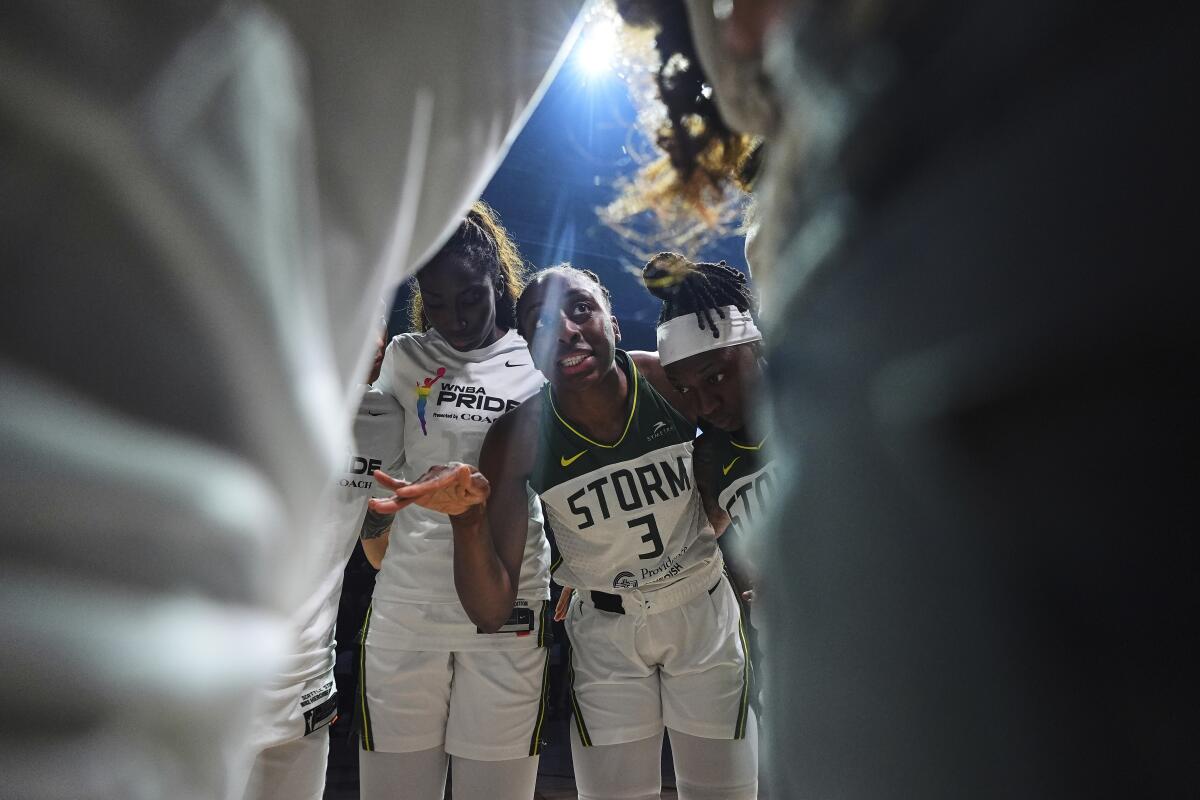
Seattle Storm forward Nneka Ogwumike (3), president of the WNBA players’ union, said for the first time, player salaries will be tied to a meaningful share of league revenue.
(Lindsey Wasson / Associated Press)
The league and players association have not made the terms public yet, but the salary cap will start at $7 million, up from $1.5 million in 2025, and the supermax will start at $1.4 million, up from $249,244 in 2025, a person with knowledge of negotiations not authorized to discuss them publicly told The Times. ESPN was the first to report the figures.
The total salary cap will jump by around 4.64 times the previous amount. The super maximum salary will be elevated by 5.61 times the previous amount. It means the top players will be eligible for larger raises than the league’s middle class.
The average salary will be $600,000, a bump from the previous average of $120,000, and the minimum salary will be more than $300,000, up from $66,079.
“For the first time, player salaries are tied to a truly meaningful share of league revenue, driving exponential growth in the salary cap, increasing average compensation beyond half a million dollars and raising the standard across facilities, staffing and support,” union president Nneka Ogwumike told reporters.
The main sticking point during negotiations was revenue sharing, and that number will be around 20% for the entirety of the multi-year deal. The league had previously offered 15.5%, a source told The Times, and players went down from their 40% ask to around 26% at the end of February, and then reached the agreement around 20% on Wednesday morning. The Athletic first reported the shift in revenue sharing figures.
Players had been negotiating for a percentage of overall revenue without factoring in expenses while the WNBA was seeking sharing tied to net revenue, mirroring the NBA’s structure that deducts expenses before sharing 50% of profits. The players secured a gross revenue deal, which gives them a cut of WNBA revenue without factoring in expenses, a person with knowledge of the deal not authorized to discuss it publicly told The Times.
“This deal is going to be transformational, and you’ll see all the details hopefully soon,” WNBPA vice president Breanna Stewart told reporters on Wednesday. “But it’s gonna build and help create a system where everybody is getting exactly what they deserve and more from on the court and off the court aspects.”
MIAMI — The victors erupted onto the field and into multiple dogpiles. Some wore national flags around their shoulders. Within minutes, the Venezuelans wore T-shirts that read: “The Best Baseball in the World.”
The players from the United States watched from their dugout. Within minutes, they trudged back onto the field so a silver medal could be draped around their necks. Not every player wore the medal all the way back to the dugout.
You can say all you want about how the World Baseball Classic has matured into a must-see event for fans and a must-play event for the game’s elite players. You can salute Venezuela for a spirited and thrilling victory, and the Venezuelan fans for nine innings of joyful delirium.
But you also can say this: A U.S. team billed as featuring a killer lineup could not hit, and the U.S. could not use its best pitcher because the San Diego Padres said so. The result: For the second consecutive World Baseball Classic, the U.S. lost the championship by a 3-2 score.
U.S. captain Aaron Judge looks across the field after striking out against Velezuela at the World Baseball Classic Tuesday.
(Lynne Sladky / Associated Press)
“I’m not OK with winning silver,” Bryce Harper said. “I don’t want to win silver.
“I want to win gold, just like anybody else. But, at the end of the night, they did it, they won, all the congratulations to them. They fought hard. I’ve got nothing but respect for them.”
By the time the eighth inning rolled around, the mighty U.S. offense had not gotten a runner into scoring position on Tuesday, and had gone scoreless for 18 of its previous 19 innings. With two out in the eighth, and Venezuela up 2-0, Bobby Witt Jr. walked, and Harper followed with a 432-foot home run, so monstrous that Venezuelan pitcher Andres Machado could only watch the flight of the ball and smile.
Harper stood and watched too, then he flipped his bat toward the dugout. At third base, he stopped to give a salute, then spotted the cameraman trailing him around the bases and pointed to the American flag on his left sleeve.
“Just enjoying the moment,” Harper said. “Super grateful for it.”
With the game tied 2-2 entering the ninth, the pitcher trotting in from the U.S. bullpen should have been Mason Miller, who had not given up a hit in the WBC and struck out 10 of the 14 batters he had faced.
Before the game, U.S. manager Mark DeRosa had said Miller would be available. After the game, DeRosa said he and Miller’s employers, the Padres, had agreed Miller would only be used to protect a lead.
Once the game entered the ninth, Miller would not be able to protect a lead, since the U.S. was the home team and there could be no save situation for him. DeRosa nonetheless declined to use Miller.
“Honoring the Padres,” DeRosa said.
This is not on DeRosa, but that is nonsense. If a closer cannot be used three times in five days — with another week to ease into the regular season by throwing bullpens or in structured B games, or taking a few days off, or whatever — then he should stay home.
Venezuela scored the winning run in the ninth off Garrett Whitlock, on a walk, stolen base and RBI double by Eugenio Suárez.
In its final five WBC games — after routs of Brazil and Britain — the U.S. scored more than five runs once, with a two-run win, a two-run loss, a two-run win, a one-run win, and a one-run loss. In the semifinal and final, the U.S. combined to bat .159 and strike out 25 times, and every run came on a home run.
That — not any attempt at small ball — is American baseball. And the U.S. was outslugged by six other teams, including Australia and Italy. For glory, as the U.S. team hoodies said.
“A lot of pop ups, a lot of just-missed pitches,” U.S. captain Aaron Judge said. “I wouldn’t say we tensed up. We just didn’t execute when we needed to.”
Said DeRosa: “I mean, surprised because of the names at the back of the jersey, but not surprised because of where they’re at in spring training.
“Yeah, that’s my answer. I really don’t have a rhyme or reason to why. I just think you’re either hot or not in a seven-game blast like this.”
American Bryce Harper celebrates at home plate with teammates after hitting a two-run home run during the World Baseball Classic Tuesday in Miami.
(Lynne Sladky / Associated Press)
The WBC absolutely was a blast. The Venezuelan fans delivered concert-level noise all night long, without needing a silly stadium host or scoreboard command to do so. The WBC allowed fans to bring in 16 “permissible instruments,” including bongos, cowbells, maracas and trumpets.
“There’s bands playing,” Judge said. “There’s chants going on. You don’t usually hear that too much in the World Series games. That’s amazing. So much fun.”
More Americans watched the U.S.-Dominican Republic semifinal than watched last year’s NBA All-Star Game, according to Fox. The championship game almost certainly will have drawn more viewers than at least one game of last year’s NBA Finals.
In the 10 minutes I spent along the concourse before Tuesday’s game, I counted fans wearing the jerseys of many national teams and 17 MLB teams, plus the late and greatly beloved Montreal Expos. Japan did not qualify for the final four, but I nonetheless counted 11 fans in Japan jerseys with Shohei Ohtani’s name on the back. The advertisers believed too: DeRosa spoke in front of a banner displaying the logo of nine corporate sponsors, eight of them Japanese.
After such a lively event, can these players get fired up to go back to spring training, and then for the grind of a 162-game season?
“I’m always fired up for the Yankees, but I’m still pissed about this,” Judge said.
“I’m looking forward to the next time we get a chance to throw on the red, white and blue and take care of business.”
That would be the 2028 Olympics in Los Angeles, where Dave Roberts has expressed interest in managing Team USA at Dodger Stadium. The major leaguers are almost certainly coming, even if the details are still being worked out.
Four of the five members of the Board of Fire Commissioners, which oversees the Los Angeles Fire Department, are stepping down at a time when the department is under intense scrutiny because of its missteps in handling the devastating Palisades fire.
The departures, which include board President Genethia Hudley Hayes, come after the agency’s top watchdog, Independent Assessor Tyler Izen, retired this month.
The fire commissioners are appointed by the mayor and are supposed to provide civilian oversight for the Fire Department. But during critical discussions about the Palisades fire, the commissioners have largely been quiet.
Addressing the LAFD’s failure to fully extinguish the Lachman fire, which later reignited into the Palisades fire, Chief Jaime Moore conceded at a January board meeting that mop-up procedures needed to be strengthened. Moore also admitted that the LAFD’s after-action report on the Palisades fire was softened to shield top brass from scrutiny.
The commissioners did not ask any questions about Moore’s remarks and only praised him.
In an interview at the time, Hudley Hayes said she did not know who ordered the changes to the after-action report — and despite her oversight role, was “not particularly” interested in finding out.
“Our job is to take the report that we have in front of us. Our job is to make sure those recommendations that came to us from a public report are taken care of,” said Hudley Hayes, a former school board member who said she was first appointed to the commission by then-Mayor Antonio Villaraigosa, served eight years and then was appointed again by Mayor Karen Bass.
On Monday, Corinne Tapia Babcock, one of the four commissioners stepping down, said that by the time items come to the board, they often have already been negotiated by the fire chief, the mayor and the City Council.
“It’s more of an approval, ceremonial role,” she said.
After Babcock said she wasn’t planning to stay on past the end of her term in June, Bass’ office asked her to serve instead on the Board of Fire and Police Pension Commissioners, and she accepted.
On her way out, Babcock said she suggested that the fire commission be expanded to seven seats, instead of five, to include an active and a retired LAFD member.
“I think there could be more opportunity for the commission to have more of a say if there was some lived experience,” said Babcock, whose father is a retired fire chief.
Jimmie Woods-Gray, whose term was set to expire in 2028, is also stepping down. She said family commitments have left her with less time to devote to the board.
She said she is leaving with some frustrations about the management of the LAFD, including its reluctance to refer allegations of wrongdoing by its members to an independent investigation rather than an internal inquiry.
“One of the problems I’ve always had with the Fire Department is that they always investigate themselves,” she added.
Hudley Hayes, whose four-year term would have expired in June 2027, said the tumult within the LAFD had no bearing on her exit, which she had been planning since before the Palisades fire. After the fire, Bass and an aide asked her to stay on, Hudley Hayes said.
“For me, it’s time,” she told The Times on Tuesday, adding that her last day would be March 30. “At 81, it’s time for me to take care of Genethia.”
The one remaining commissioner is Elizabeth Garfield, a retired lawyer who represented the United Firefighters of Los Angeles City, the labor union for LAFD firefighters, in negotiating three collective bargaining agreements. She was appointed in September.
Bass has named four new commissioners to replace the departing ones: John Pérez, a former speaker of the California Assembly who will step down from the Board of Harbor Commissioners to join the fire commission; Jerry P. Abraham, a physician who is the director of public health, integration and street medicine at Kedren Health; Jose Campos Cornejo, a manager at the Metropolitan Water District of Southern California; and Yolanda Regalado, a former Los Angeles County sheriff’s deputy whose three brothers were firefighters and who now owns a cafe in San Pedro.
Yusef Robb, a Bass spokesperson, said in a statement that the mayor “is confident that her reform agenda for the Fire Department will not only continue, but will accelerate under the fresh perspective and leadership of her new appointees.”
LAFD spokesperson Stephanie Bishop said the agency “welcomes the new members of the Fire Commission and looks forward to working alongside them.”
Sharon Delugach, who was vice president of the fire commission and whose term was set to expire in 2029, bid farewell at a meeting this month.
“I still intend to help and fight and advocate,” she said. “I’m only leaving because I don’t feel like I’ve got the time at this point to be the kind of commissioner I want to be. I don’t want to just come to meetings.”
Delugach did not return a call Tuesday for comment.
Izen retired this month as the LAFD’s independent assessor, who reports to the commission and conducts audits of operations and the department’s handling of complaints. He could not be reached for comment.
Anxieties due to war. A culture inhospitable to LGBTQ+ communities. And an underpinning of loneliness and suppressed yearning.
The play “5 Lesbians Eating a Quiche” is set in 1956, but its themes resonate in 2026. The United States is at war. Attacks on gay marriage and other LGBTQ+ rights remain a cornerstone of today’s conservative movement. A reimagining of the 2011 production, one popular with universities and fringe festivals, seeks to further modernize the show in which a morning gathering quickly turns into a stay in a Cold War-era bomb shelter after near nuclear annihilation.
When I arrived at the back room of a Glendale church, I was given a new name. It was clear that “Todd” was not welcome here. “Joan” turned out to be a suitable replacement, and I was immediately asked how my life had been since my husband had died. For on this night I would no longer be occupying the role of a straight white male. Every audience member is asked to take on the persona of a widow, for losing a husband appeared to be a perquisite to enter this meeting of the Susan B. Anthony Society for the Sisters of Gertude Stein.
How did he die, I was asked. “Ski accident,” I blurted out. “Yours?” A camping travesty that led to a bear mauling, I was told. Ad-libbing, in addition to quiche, was on the menu tonight. Metaphors, absurdities and seriousness intermingle in this production from New Forms LA and directed by Marissa Pattullo.
Pattullo’s vision for “5 Lesbians Eating a Quiche” ramps up the interactivity, seeking to transform a largely traditional proscenium show, albeit one with a few moments of fourth-wall breaking, into one that is centered around audience participation. Staged in a flex space without a tinge of irony at the Glendale Church of the Brethren, “5 Lesbians,” written by Evan Linder and Andrew Hobgood, has been reconstructed as a largely immersive production, that is one that asks audiences to lean in and interact.
Jessica Damouni’s Ginny Cadbury devouring breakfast in “5 Lesbians Eating a Quiche,” a show that unfolds as a giant metaphor.
(New Forms LA)
While there is a small stage, it is used sparingly. The five-person cast roams the room, sitting at various circular tables to blur the lines between script and improvisation. Typically a svelte 75-minute show, on the night I saw the production it swelled to about two hours, allowing time for drinks, mingling and, of course, the eating of a quiche. Pattullo has added an intermission, with quiches courtesy of Kitchen Mouse and Just What I Kneaded included in the ticket.
For quiche, I was told often, was the primary topic of conversation at the Easter-timed meeting, so much so that it was clear within moments that this was a gathering not of breakfast enthusiasts but of the repressed. The hidden meaning is no secret; it’s in the title of the play.
“It’s a giant metaphor,” Pattullo, 30, says. The show, she adds, “keeps finding ways to make sense with the times, whether it’s Trump being elected, or we’re at war. Or gay marriage. All of those things. A bomb going off and being trapped inside. It speaks to whoever is watching it.”
Pattullo, who splits time building New Forms LA and serving tables at Los Feliz’s Little Dom’s, first discovered the show while in college in the Midwest. It immediately resonated, and Pattullo has been tinkering with ways to perform it live ever since. During the worst of the COVID-19 pandemic, she staged an online version of the show, and debuted it as an immersive production last winter. It’s back for two weekends this month.
“5 Lesbians” makes a relatively smooth transition to the immersive format. Perhaps that’s because the audience, in the script, is cast as attendees of the Susan B. Anthony Society for the Sisters of Gertude Stein’s brunch meeting, whose motto is “no men, no meat, all manners.” For about the first 30 minutes of the show we largely interact with the actors. Dale Prist (Nicole Ohara) has hidden ambitions. Vern Schultz (Chandler Cummings) seems ready for the group to cut its charade. Lulie Stanwyck (Noelle Urbano) is fighting so hard to stay prim and proper that she feels on the verge of bursting.
“I really like to play,” Pattullo says, referencing how “5 Lesbians” lends itself to improvisation. “Some of the girls I think are very ‘stick to the script.’ I’m like, ‘Stray from the script.’ If people come in late, call them out. If people are talking, call them out. You can adjust and improvise in immersive theater. Having a script but being able to break from it, is really fun for me. It tickles me.”
Wren Robin (Emily Yetter), Vern Schultz (Chandler Cummings) and Lulie Stanwyck (Noelle Urbano) protect breakfast in “5 Lesbians Eating a Quiche.”
(New Forms LA)
There’s an underlying tension in the show because it walks a line between silliness and graveness. Ultimately, “5 Lesbians” is about finding joy in dark times, and moments inspire uncomfortable laughter, such as jokes about gay marriage being legal in four years’ time (1960) or Ginny Cadbury (Jessica Damouni) devouring a quiche in a way that leaves nothing to the imagination. But it’s also a show about how stressful moments can bring about vulnerability and community, as the whole church practically exhaled when Wren Robbin (Emily Yetter) finally let her hair down and expressed who she truly was.
“5 Lesbians Eating a Quiche”
“Even when we did it back when I was in college, Trump had just won, so it just feels like it’s keeping relevant,” Pattullo says. The timeliness, she says, makes it such an amusing play to perform.
Pattullo will sometimes, depending on cast availability, take on a role in the show. It’s a chance, she says, to amplify the play’s wackiness, which she believes helps puts audiences at ease and makes its difficult subject matter easier to digest. She tries to create the most outlandish tale possible for when relaying to guests one on one how her husband perished.
“My story was a raccoon attack,” she says. “Because my husband thought the raccoon was behaving with foreign intent, like the raccoon was a spy or something. It was just stupid.”
Or it was evidence of how immersive theater can delight when it deviates from the script.
The United Farm Workers said it would not participate in celebrations of its founder Cesar Chavez amid what the labor union described as “troubling allegations” against the iconic Chicano figure.
The union, in a statement released Tuesday, did not detail the accusations against Chavez but said they were concerning enough for the organization to take action. But several events around the country honoring Chavez including events in Tucson, Houston, Corpus Christi, San Antonio and San Bernardino have been canceled in recent weeks, with little explanation given by organizers.
The claims against Chavez “are incompatible with our organization’s values. Some of the reports are family issues, and not our story to tell or our place to comment on. Far more troubling are allegations involving abuse of young women or minors. Allegations that very young women or girls may have been victimized are crushing. We have not received any direct reports, and we do not have any firsthand knowledge of these allegations,” the union said.
Canceling events, the union said, would “provide space for people who may have been victimized to find support and to share their stories if that is what they choose.”
Chavez is a towering national figure credited with organizing and raising the lives of migrant farmworkers in California and beyond and giving voice to the struggles of Mexican Americans.
Bursting into national prominence in the mid-1960s in the San Joaquin Valley, Chavez galvanized public support on behalf of them after organizing community groups across Central and Southern California. For decades, agricultural laborers had lived in substandard housing and were paid terrible wages. Efforts to organize migrant laborers were usually crushed violently by farmers and local law enforcement.
Chavez and his associates joined a grape pickers’ strike in 1965 launched by Filipino organizers centered around Delano, the heart of California’s table grape crop. Those early years were marked by bitter and sometimes brutal incidents involving picketing farmworkers who screamed “Huelga!” — “Strike!”—and growers who vowed never to give in to Chavez and his movement.
Sen. Robert Kennedy and Cesar Chavez as Chavez ended a 25-day fast.
(Bettmann Archive)
That eventually transformed into a boycott that earned international attention. Chavez, drawing on his Catholic faith, fasted for 25 days in 1968 to draw attention to the violence swirling around the effort, ending it by sharing bread with then-presidential candidate Robert F. Kennedy. Two years later, the UFW was able to secure contracts for more than 10,000 grape pickers.
Those successes made Chavez an almost mythic figure. The UFW flag — a stylized black Aztec eagle against a red background — became synonymous with the Chicano movement that was emerging at the same time. Posters and murals featuring Chavez’s beatific face sprouted in the Southwest and beyond. He traveled across the United States espousing his philosophy of nonviolence, union and dignity for farmworkers.
But Chavez’s legacy became increasingly tarnished as the years went on. Labor victories became fewer and fewer. His fierce criticism of illegal immigration — Chavez argued that they undercut his unionization efforts — put him at odds with immigration activists. A 2006 Times investigation detailed how dozens of former associates and workers left the UFW because of what they described as Chavez’s increasingly autocratic ways.
Cesar Chavez talks to striking Salinas Valley farmworkers.
(Sakuma / Associated Press )
When the Los Angeles County Board of Supervisors decided to change the name of Brooklyn Avenue in East Los Angeles and Boyle Heights to Cesar Chavez Avenue after the labor leader’s death in 1993, many in the community opposed it, citing the economic burden businesses would undergo to update their addresses and the erasure of the community’s history on the street.
Yet his standing among Latinos nationwide was such that schools, streets and parks were renamed in his honor in the years after his death. In 2012, President Obama went to tiny Keene, Calif. — where Chavez had set up both his home and the operational headquarters of the United Farm Workers — to dedicate the César E. Chávez National Monument.
It’s unclear the source of the new allegations or when they might become public. But there has been rumbling for weeks among activists that something about Chavez was coming.
Huerta is not commenting on the issue at this time, said Eric Olvera, spokesperson for Huerta.
The news comes two weeks before Cesar Chavez Day, observed March 31.
Local organizers in Los Angeles haven’t announced whether they will cancel their events.
The UFW was vague about the claims but suggested they were serious enough for extreme action.
“These allegations have been profoundly shocking. We need some time to get this right, including to ensure robust, trauma-informed services are available to those who may need it.
“We understand this will be tremendously painful for many and we encourage our community to seek mental health support if they experience distress.”
Tuesday morning, the Cesar Chavez Foundation said in a statement that it had “become aware of disturbing allegations that Cesar Chavez engaged in inappropriate sexual behavior with women and minors during his time as President of the United Farm Workers of America.”
The foundation said it was working with leaders in the farmworker movement to be responsive to these allegations and support the people who might have been harmed.
“In partnership with the UFW, we are establishing a safe and confidential process for those who wish to share their experiences of historic harm, and, if they choose to, participate in efforts toward repair and reconciliation,” the statement said. “In addition, we are investing time and resources to ensure the Foundation promotes and strengthens a workplace culture that is safe and welcoming for all.”
In the 48 hours before the UFW and Cesar Chavez Foundation made their statements, La Unión del Pueblo Entero, a community-based union and nonprofit in the Rio Grande Valley of Texas, which was founded by Huerta and Chavez, erased the names and affiliation with the leaders from its website.
The new allegations could have implications beyond Chavez’s place in history. If he has been accused of sexual abuse, a legal expert said it could spark legal claims against the union he ran for so long.
In California, Assembly Bill 250 opened a two-year window to file sex assault claims beyond a previous statute of limitations. The Catholic Church, Scouting and public school districts, as a result, have been hit hard with lawsuits.
“It is [a] matter [of] who knew what and when,” said John Manly, a sexual abuse attorney, adding that Chavez’s leadership role could create liability for the UFW.
WASHINGTON — President Trump has once again mocked Gov. Gavin Newsom’s dyslexia as “disqualifying” for leadership, marking at least the fourth time in a week that the president has targeted the California Democrat for being open about his diagnosis.
In remarks Monday in the Oval Office, Trump said Newsom was “dumb” and should never be allowed to be president because he has “admitted that he has learning disabilities, dyslexia.”
“That’s how crazy it’s gotten with a low-IQ person,” Trump said. “Honestly, I’m all for people with learning disabilities but not for my president. … And I know it’s highly controversial to say such a horrible thing.”
But in the course of his needling, Trump mistakenly elevated his political rival to the rank of commander in chief — repeatedly referring to Newsom as “the president of the United States.” Newsom took the opportunity to turn the tables on the president.
“I, GAVIN C. NEWSOM, AM OFFICIALLY PRESIDENT OF THE UNITED STATES (THANK YOU DONALD!)” he wrote on X Monday.
The clash is the latest in a storied contest of chest-beating between Trump and Newsom, who have made sport of bad-mouthing one another across campaign rallies, interviews and social media.
A model stealth bomber sits in front of President Trump during an executive order signing in the Oval Office Monday.
(Aaron Schwartz / Bloomberg via Getty Images)
The president has frequently cast Newsom as a symbol of the liberal governance he opposes, while the governor has leaned into the confrontations, often using them to elevate his national profile and position himself as a leading Democratic counterweight. His sparring with the president appears to be part of an aggressive strategy to amplify his own messaging as he weighs a potential run for president in 2028. This time, Newsom used the spotlight to support young people with dyslexia.
“To every kid with a learning disability: don’t let anyone — not even the President of the United States — bully you,” Newsom wrote on X. “Dyslexia isn’t a weakness. It’s your strength.”
The insults first materialized when a video went viral of Newsom speaking at a book tour appearance with Atlanta Mayor Andre Dickens during which he discussed his lifelong struggle with the learning disability. Since then, the president has repeatedly poked at the vulnerability.
Trump has brought up the governor’s dyslexia at least four times in the last week. He mentioned it at a political rally in Kentucky last week, where he equated dyslexia with a “mental lack of ability,” and again during a Fox News Radio interview on Friday, in which he reiterated that “presidents can’t have a learning disability.” In a post on Truth Social, Trump labeled Newsom’s admission a “politically suicidal act,” calling him “dumb” and “A Cognitive Mess!”
After the Kentucky rally, Newsom responded to Trump.
“I spoke about my dyslexia, I know that’s hard for a brain-dead moron who bombs children and protects pedophiles to understand,” he said.
Dyslexia affects as much as 20% of the population, according to the Yale Center for Dyslexia and Creativity. Despite affecting a such a wide portion of the population, the condition is widely misunderstood, according to dyslexia researcher Dr. Helen Taylor of the University of Cambridge.
“In some ways, Trump’s awful comments are just a cruder version of assumptions that already run through our culture,” she said. “If anything, [it’s] the opposite. There is evidence of an overrepresentation of people with dyslexia in business leadership roles.”
According to Taylor, there is a link between dyslexia and “enhanced abilities” in areas such as discovery, invention and creativity.
“The same cognitive trade-offs that can make routine tasks like reading more difficult support strengths in navigating complexity and guiding groups toward better future outcomes,” she said.
Newsom often describes his early experiences with dyslexia as a source of insecurity when he was growing up. In his memoir, the governor writes about his mother, Tessa Newsom, attempting to help him with homework. The lessons ended with him “running out of the room screaming that I didn’t know what was wrong with my brain.”
Back when Newsom was a boy in the 1970s, dyslexia was recognized but still not fully understood. He recalls a day when his mother grew so concerned that she took a deep breath and told him, “It’s OK to be average, Gavin.”
“I understood even back then that this, too, came from her deep reservoir of love for me,” Newsom writes in his book “Young Man in a Hurry.” “But I don’t recall crueler words ever said about me.”
The challenges from his learning disorder persist in his work at the state Capitol. Newsom finds reading off a teleprompter challenging. His aides describe days of painstaking preparation before major addresses to live audiences. Late edits to a speech, and the resulting changes to the words on the screen, threaten to throw off his delivery.
All memos in the governor’s office are written in 12 point Century Gothic font with specific spacing between lines, formatting that his aides say helps him with his disability.
The governor reads his daily briefings a few times in the morning, underlines sentences and writes down notes to retain the information on yellow cards he keeps in his suit pockets.
The ritual, he has said, helps him compensate for his dyslexia and feel confident communicating. But it also adds to the public perception of Newsom as a smooth-talking, and at times rehearsed, politician. His excessive preparation has become a trait he considers a “super power.”
His effort to thoroughly absorb reading material and desire to understand issues before he speaks about them means he’s often well-prepared. In his perception, the learning disorder has brought out his grit and resilience, and helped him hone other skills, such as quickly reading a crowd.
Without missing a beat, Newsom directed the journalist to the exact page in his 246-page budget that touched on the issue.
“While people with dyslexia are slow readers, they often, paradoxically, are very fast and creative thinkers with strong reasoning abilities,” according to the Yale Center for Dyslexia and Creativity.
The governor’s wife, Jennifer Siebel Newsom, discussed the president’s attacks Tuesday in a video on X in which she emphasized that “learning differences do not determine someone’s potential.” She listed a number of qualities she considered disqualifying for the presidency, including being a convicted felon, bankrupting businesses, having numerous associations with convicted sex offender Jeffrey Epstein, and sending “masked extremists to terrorize Black and brown communities and rip kids away from their families.”
“Everything that Donald Trump represents is frankly beyond disqualifying,” she said. “Day in and day out, Trump says things that make him unfit for office. He degrades our vulnerable communities, our institutions, even the Constitution itself.”
Two of the Newsoms’ four children have also been diagnosed with dyslexia.
Quinton reported from Washington, D.C., and Luna from Sacramento.
Welcome back to this week’s Lakers newsletter, where we are fully scoreboard watching.
The Lakers have 14 games left and are surging up the Western Conference standings. With six consecutive wins and nine in their last 10, the Lakers (43-25) are third in the West and suddenly have a 1.5-game lead on fourth-place Houston.
The team that couldn’t beat anyone good suddenly has statement wins over four teams with .600 records. The turnaround from fighting to stay out of the play-in to now being in position for homecourt advantage left even JJ Redick struggling to find the right description.
“Is coalesce a word?” Redick said after the Lakers outlasted the Denver Nugget in overtime on Saturday. “Is that the right word? For coming together? Jelling? I think it feels like we’re coalescing right now in a really nice way.”
All things Lakers, all the time.
Lakers’ ‘Big Three’ finds its pecking order
The defining moment of LeBron James’ performance during the Lakers’ game of the season officially went down as a turnover.
His Superman dive to save a loose ball with 54.3 seconds left in regulation against Denver on Saturday turned into one of James’ five turnovers because the Lakers did not corral the jump ball. But the statistical and physical sacrifice of the play showed the type of role James will play on this team coming down the stretch of the season.
“It’s a great example of leadership,” Redick said. “Leadership is not just the voice who’s talking. Leadership is then what you do on the court, and if you want to be a winning team then you need guys who are willing to take the lead and make winning plays.”
With Luka Doncic and Austin Reaves starring, Redick acknowledged that “the best thing for our team is [James] being the third highest-used player.” Since returning from hip and elbow injuries that kept him out of three games, James has had the third-highest usage rate on the team in each of the last three games. All were wins.
Redick acknowledged that “finding the groove” between James, Doncic and Reaves has been “the challenge for all of them, not just LeBron, all season.” It was more difficult because alternating injuries limited the trio’s time together on the court.
The season-long advanced metrics have favored having just Doncic and Reaves on the court, who have a plus-eight net rating together, as opposed to all three (plus-3.2 net rating). But the modest rating of the Doncic, Reaves and James combination has taken dramatic leaps this week alone.
James, Doncic and Reaves outscored opponents by 32.7 points per 100 possessions in wins against the Bulls and Nuggets.
The Lakers have gotten their “best win of the season” four times in the last nine days. Two were without James when the Lakers blew out the Knicks and the Timberwolves. He returned and the wins got grittier: an overtime thriller against Denver and Monday’s tense victory in Houston.
Other teammates made the flashy, standout plays. Doncic nailed the game-winning basket in overtime against Denver, and Reaves forced extra time with a one-in-a-hundred intentionally missed free throw. Deandre Ayton had four consecutive points late in the fourth quarter against Houston that put the Rockets away.
The NBA’s all-time leading scorer, meanwhile, has been a relatively quiet seven-for-13 from the field in each of the last three games, scoring no more than 18 points. He doesn’t mind as long as it adds up to wins.
“If it benefits others, it benefits the team,” James said last week. “The team is most important.”
It won’t count in the stat sheet, but watching James fly across the floor at 41 years old against Denver was “one of the biggest plays of the game,” Reaves said Saturday. Redick joked that after 23 NBA seasons and three years of high school he had never seen James lay out for a loose ball like that.
Because he never had, James replied.
And after sharing a photo on social media of a bright red court burn the size of a nickel, James might never do it again.
“Might be it for diving for the year!” James wrote in an Instagram story showing the wound. “Ouch! Lol!”
Deandre Ayton arrives just in time
Deandre Ayton shoots against the Minnesota Timberwolves.
(Ethan Swope / Associated Press)
Nearly 10 years before teaming up for the Lakers, Rui Hachimura and Deandre Ayton were just teenaged prospects with big dreams. They first met at a Basketball without Borders camp in 2016. The roster that year also included future NBA champions Shai Gilgeous-Alexander and Isaiah Hartenstein. Hachimura recalled Ayton dominating everyone. Then the 7-foot center from the Bahamas inexplicably disappeared.
“That’s what I remember,” Hachimura said with a smile remembering his first impression of his future Lakers teammate. “I was like, ‘Where’s this guy going?’”
When Hachimura shared that anecdote in October, it was an unintentionally fitting description of Ayton’s career. Over the last eight years, the former No. 1 pick has dominated and disappeared in equal measure.
Just in time for the Lakers’ biggest games of the year, the enigmatic center returned to his “DominAyton” mode.
Ayton averaged 13 points and 9.8 rebounds per game in wins over the Knicks, Timberwolves, Bulls and Nuggets after coming back from a one-game injury absence. When Jaxson Hayes and Maxi Kleber were sidelined for games against Minnesota and Chicago, Ayton starred with back-to-back double-doubles.
“Felt like I picked up my energy and my focus,” Ayton said. “I finally caught up with the team.”
One of the surest signs of Ayton’s engagement is his activity on the boards. The Lakers are 29-7 when Ayton has eight or more rebounds and 8-14 when he has seven or fewer. Lately he has been especially clutch with three rebounds and four points in overtime against Denver and five rebounds with six points in the fourth quarter against Houston when the Lakers finished the game on a 13-4 run.
“He is an X factor for us, if not the X Factor,” Redick said after Ayton scored 23 points with 10 rebounds against the Bulls, “because him playing at a high level raises our ceiling. It changes the makeup of our team.”
Ayton had his son Deandre Ayton Jr. in the locker room after that performance against the Bulls. The five-year-old bounced a white rubber ball on the ground while waiting for his dad to finish showering then joined him at his locker for his media obligations. After the game when the Lakers celebrated “Girl Dad Night,” this proud boy dad left a lasting impression.
“Truly a blessing,” Ayton said of having his son join him at the game, “especially being a Laker. Just hope he [is] inspired.”
On tap
Wednesday at Rockets (41-26), 6:30 p.m.
This game will decide the head-to-head tiebreaker between Houston and L.A. In the tight conference race, the Lakers already own head-to-head tiebreakers against Denver and Minnesota, but not against Phoenix, which is lurking in the seventh spot with a 39-29 record, four games behind the Lakers.
Thursday at Heat (38-30), 5 p.m.
The Heat were one of the hottest teams in the East before losing to the Orlando Magic on Saturday in Norman Powell’s return from injury. Powell came off the bench after missing seven games because of a groin injury and scored 20 points. The Heat were 7-0 during the stretch without Powell, even playing without Tyler Herro for two games.
Saturday at Magic (38-29), 4 p.m.
The Magic’s seven-game winning streak came to an end Monday in Atlanta. Franz Wagner (ankle) has played in just four games since Dec. 7, and Paolo Banchero is averaging 24.8 points on 51.4% shooting, 9.3 rebounds and 4.7 assists during the month of March.
Monday at Detroit (48-19), 4 p.m.
The Pistons are cruising toward the top seed in the East. Cade Cunningham has continued his breakthrough year with 24.9 points and 10.1 assists per game.
Status report
Maxi Kleber (lumbar back strain)
The backup big man has missed four games because of a back injury that started earlier this season and recently flared up against. Kleber has good days and bad days, Redick said, and has been shut down for five days. He did not travel to Houston for the beginning of the six-game trip, but the Lakers hope he can join.
Favorite thing I ate this week
Korean short ribs (galbi) with rice and Vietnamese pickled carrots and daikon radish.
(Thuc Nhi Nguyen / Los Angeles Times)
Made possible only through teamwork with my favorite coworker Brad Turner, I did the impossible: I had two uninterrupted weeks at home during the NBA season. After coming home from a month overseas, I needed that time to settle back into my normal life, including my kitchen. I missed it. We kept it low-key for the homecoming with Korean short ribs (galbi) with rice and Vietnamese pickled carrots and daikon radish. Green onions for garnish because my mom would never let a dish touch the table if it wasn’t garnished.
This stunning 17th century estate was home to the Jones family for centuries and is now a real-life time capsule open to visitors
The home was built as a statement of wealth and power(Image: Getty)
Near Moreton-in-Marsh in Oxfordshire sits a magnificent estate, which once belonged to the very same family for centuries.
Originally constructed as an enormous display of wealth and influence in the early 17th century, it has since transformed into a public space where visitors can explore and immerse themselves in British history.
Chastleton House remained a constant fixture within the same family for hundreds upon hundreds of years, as the estate continued to stay in their possession, handed down through the generations.
Today, the property stands in Oxfordshire as a genuine time capsule, barely altered, featuring an impressive great hall, gallery room and numerous collections that once belonged to the distinguished family.
Best Cotswolds holiday cottage deals
This article contains affiliate links, we will receive a commission on any sales we generate from it. Learn more
The Cotswolds is famous for its rolling hills, honey-coloured villages and quintessential English charm. Sykes Cottages has a wide range of places to stay, starting from £38 per night.
Guests can wander the grounds and take a guided tour of the rooms that contain countless memories for the Jones family.
One visitor wrote on TripAdvisor: “Beautiful house and gardens with discrete but attentive guides. From the entrance to the exit, a fantastic visit. A huge family home with a fascinating past.”
It’s thought that some form of settlement has stood in Chastleton for over 1,000 years, but by the 16th century, the site of the house as we recognise it today was owned by the Catesby family.
That was until Walter Jones bought the land and previous house from Robert Catesby, and it remained within his family for 400 years.
He demolished what remained of the original property and constructed a stunning building in its place, completed in 1612.
His acquisition was intended to mirror his illustrious legal career, and he sought to establish himself as a country gentleman, having now become a landowner.
Throughout the following century, the Jones family continued to form unions with several well-established gentry families, helping to cement this standing.
The final direct descendant of Walter Jones, however, was Arthur Jones, who inherited the estate in 1813 and carried out some structural enhancements to the residence.
Following his death, the property stayed within the family, though not with a direct descendant; rather, it was handed down to a distant cousin by marriage named John Henry-Whitmore Jones.
The final chapter of this family tree’s ownership concluded in 1991, when the National Heritage Memorial Fund purchased Chastleton and transferred it to the care of the National Trust.
Regrettably for the final occupants, the expense of maintaining the building was becoming far too substantial.
Preservation
The National Heritage Memorial Fund acquired Chastleton in 1991, and the majority of its original contents remained precisely as they were before it was transferred to the National Trust.
In an effort to maintain that mystical ambience that can only be attributed to centuries of tales and memories on the grounds, there was a plan to preserve the house, not restore it.
With this, they merely repaired parts that were damaged, which took a total of six years, to ensure the building was structurally sound and stable.
The stunning home was later reopened for the public to witness all its magic up close in 1998.
Visiting
It’s thought that one of the true treasures of the house is the Long Gallery, boasting the longest-surviving barrel-vaulted ceiling in the country. Due to neglect, the plasterwork required some refurbishment, which occurred in 1904.
Part of the room’s splendour is attributed to the mask heads located at the west end of the room, extremely rare survivals from the 1600s era, believed to have been used as a weapon to ward off evil spirits.
Beyond the confines of the house lies a vast, impeccably maintained garden, offering a sense of tranquillity and relaxation. Contributing to this glory is the Jacobean Pleasure Garden, also known as the Best Garden – a name that speaks volumes about its beauty.
To fully appreciate it all, visitors can embark on the Wilderness Walk, designed to provide not just a soothing stroll around the gardens but also the very best views of the house and the ever-changing gardens through the seasons.
One recent visitor said: “The house is amazing, a time capsule of a grand country house decaying over the years, with the fantastic result of being able to see how things really were without Victorian (or other) alterations. And top tip, do enjoy the Chastleton Teas at the church right next door.”
The property welcomes visitors from mid-March onwards with opening hours of 1pm until 5pm. Adult admission is priced at £15, while children’s tickets cost £7.50 and families can purchase a ticket for £37.50.
Former L.A. mayor and current candidate for governor Antonio Villaraigosa wants voters to know that he navigated billion-dollar budgets, cracked down on violent crime and championed the expansion of bus and rail lines.
The onetime state Assembly speaker argues he’s the only Democratic candidate with the experience to do the complicated job of running California.
But Villaraigosa left City Hall in 2013 — eons ago in the world of politics. President Obama was still in office, singer Robin Thicke’s “Blurred Lines” was atop the charts and Apple Watches weren’t yet a thing.
Because of his distance from elected office, combined with a decent but overshadowed fundraising effort, Villaraigosa lacks a high-profile platform to attract attention in today’s fractured media universe, an essential ingredient he needs to remind voters about his experience and accomplishments as mayor and a state lawmaker.
Antonio Villaraigosa gets his photo taken with students from Hazeltine Avenue Elementary School while visiting Placita Olvera in 2013.
(Irfan Khan / Los Angeles Times)
Recent polls show Villaraigosa, 73, wallowing at the bottom of the field, though none of the major Democratic candidates have an overwhelming edge.
Villaraigosa also ran for governor in 2018, coming in third in the primary election behind Democratic rival Gavin Newsom, who went on to win and is now serving his second term, and little-known Republican businessman John Cox.
Political strategist Mike Madrid, who worked for Villaraigosa on that campaign, said the former mayor’s absence from politics in recent years is a major liability in this race.
“He’s a dogged, determined candidate,” Madrid said. “But there are pretty stiff headwinds.”
Villaraigosa got a boost last week when the State Building and Construction Trades Council of California pledged $1 million to an outside committee supporting him.
His allies argue voters aren’t paying attention to the governor’s race because eyes are on President Trump, immigration raids and the Iran war.
But the new funding is a pittance compared to some of his rivals. Billionaire Tom Steyer is tapping tens of millions of his own money to pump out ads. Tech companies and billionaire Rick Caruso are supporting Matt Mahan, the mayor of San José, with millions.
Another contender, Rep. Eric Swalwell (D-Dublin), has the power of incumbency. Swalwell launched his campaign on “Jimmy Kimmel Live!” and is a regular on cable news shows, while former Orange County Rep. Katie Porter, who is also running, recently served in Congress and campaigned for the U.S. Senate two years ago.
With the June primary looming, Villaraigosa’s campaign risks sputtering out.
Angeleno Celine Mares holds a copy of Newsweek featuring newly elected Los Angeles Mayor Antonio Villaraigosa as he is sworn into office on the steps of City Hall July 1, 2005.
(David McNew / Getty Images)
Leaving a Compton church earlier this month, he reacted to Mahan’s support from technology companies, and the billionaire money in the race.
“When you have overwhelming sums of money influencing elections, there’s a great deal of concern for those of us who care about our democracy,” said Villaraigosa. “As much as they say it’s about free speech, it actually drowns out speech.”
(During his 2018 bid for governor, though, Villaraigosa was a major beneficiary of Californians using their wealth to wield political influence. Charter school backers, including Netflix co-founder Reed Hastings and philanthropist Eli Broad, spent around $23 million on efforts to boost his campaign. )
Earlier in the morning, he rallied runners at a 10K road race in L.A.’s Chinatown, lighting firecrackers, posing for photos and looking as energetic as when he was mayor and would dart into the street to personally fill potholes.
Villaraigosa flitted around the racers’ VIP tent, spotted a bowl of fortune cookies and made a beeline. “You have an active mind and a keen imagination,” he read aloud.
“Antonio V.!” a middle-aged man called out as the former mayor passed.
Minutes later, Villaraigosa swapped his black and white Veja sneakers and jeans for dress shoes and a suit for the church service in Compton, at which an overwhelmingly Black audience gave him a warm reception.
Building a coalition of Black and Latino voters helped him win the 2005 L.A. mayor’s race in a dramatic upset of then-Mayor Jim Hahn, and brought wide attention to the one-time high school dropout, who was raised by a single mother on Los Angeles’ eastside.
Newsweek magazine featured Villaraigosa on its cover with the headline, “Latino Power: L.A.’s New Mayor and How Hispanics will change American Politics.”
But national acclaim can be fleeting. Today, voters aren’t as interested in identity-based politics, said Fernando Guerra, a professor of political science at Loyola Marymount University who has known Villaraigosa for decades.
Guerra said Villaraigosa is struggling to differentiate himself in the race because his pitch to voters is not unlike the moderate path taken by Mahan. Another contender, former Health and Human Services Secretary Xavier Becerra, overlaps with Villaraigosa when it comes to biographical details: Both are from the L.A. area, Latino and relatively close in age.
“What’s made it so difficult is that [Villaraigosa said], ‘Here’s my path,’” said Guerra. “Well, guess what, there are one to two more candidates who are also on that path.”
Strategist Madrid questioned whether voters even want to hear about a candidate’s experience at a time when anti-Trump messages rally Californians. “They want a fighter,” he said.
Since leaving the mayor’s office, Villaraigosa has enjoyed success in the lucrative private sector. He purchased a $3.3 million home in the L.A. neighborhood of Beverly Hills Post Office in 2020. . A recent campaign filing shows he’s spent the last few years advising companies including the health company AltaMed, financial lender Change Company and crypto currency exchange Coinbase Global.
Then mayor Antonio Villaraigosa holds a news conference at the Department of Water and Power on Hope Street July 22, 2005, urging all of Los Angeles to conserve energy in an effort to ensure Southern California avoids blackouts.
(Ken Hively / Los Angeles Times)
He also worked for a few years for consulting firm Actum and briefly advised the Newsom administration on infrastructure projects.
“It’s not that I didn’t like the public sector,” said Villaraigosa, explaining his decision to run again. As he talked about his desire to serve, he cast a gauzy image of the aughts in Los Angeles, taking credit for the downtown resurgence, skyline full of construction cranes and fewer homeless people on the streets during that period.
“Most people look back on those years and say they were some of the best years we’ve had in the last 25 — at least,” said Villaraigosa.
Stuart Waldman, president of the business group Valley Industry and Commerce Assn., argues Villaraigosa’s experience in the private sector and distance from elected office is a good thing.
“Look at what the economy was like, look at what the city was like” under Villaraigosa, said Waldman. “That’s what he’s going to be judged on.”
Villaraigosa started his career working for labor and civil rights groups before entering politics. Elected to the state Assembly in 1994, he pushed legislation that banned assault weapons and created healthcare coverage for children. His outgoing personality established him as a coveted fundraiser for Democrats in Sacramento and paved the way for him to be chosen as Assembly speaker.
As L.A. mayor, he brought down gang crime through a program that used former gang members to broker truces. Voters backed his ballot measure to expand L.A.’s transit system through new sales tax money in the middle of the Great Recession. He drove down pension costs after a bruising battle with city unions. At the same time, he established himself as a national leader on climate issues and education.
His reputation took a hit after an affair with a television reporter led to the breakup of his marriage.
The media scene that covered Villaraigosa back then is vastly diminished, with young people now getting news from TikTok videos, message boards or Instagram posts.
Weighing in on recent TV news layoffs in Los Angeles, Villaraigosa called himself “lucky” that there were plenty of newspaper and television reporters covering him as mayor, recalling that he’d get a dozen cameras to his press conferences.
Asked to compare his 2018 campaign for governor with this one, he said, “I didn’t have to reintroduce myself last time in quite the way I’ve had to this time.”
Villaraigosa spent a significant time in Mexico in recent years to see his now ex-wife Patricia Govea, a clothing designer. “She was in Mexico 80% of the time, the last six years. So I` went to Mexico a lot.” The pair’s divorce was finalized last year.
During a debate in front of Jewish voters on L.A.’s westside last month, Villaraigosa appeared to seize on the fact that he was the sole Angeleno on the stage, introducing himself by saying, “It’s good to be home.”
He told the crowd about his work as president of the American Civil Liberties Union of Southern California and criticized UCLA — his alma matter — for its handling of incidents targeting Jewish students on its campus.
It remains to be seen if he’ll have a hometown advantage. In the 2018 race for governor, Newsom won more votes than Villaraigosa in Los Angeles County. While Villaraigosa did well in Latino communities in central L.A. and on the Eastside, Newsom captured more votes in wealthier, whiter areas.
But at the Compton church, a security guard approached Villaraigosa and told him she’d worked on his 2005 campaign, while others promised to vote for him.
“I know he has a track record,” said Valerie Bland, a 63-year-old former port worker from Long Beach, as she watched Villaraigosa work the pews. “I haven’t even looked at anyone else.”
Former Assembly speaker Fabian Núñez, a longtime friend of Villaraigosa and managing partner at Actum, hopes voters dig into Villaraigosa’s record.
“We have short-term memories in this country,” said Núñez.
The U.S. is the favorite to win the World Baseball Classic championship, but the team is still trying to execute “a complete game” after semifinal win.
The fishing village sits magnificently in a stunning cove on a peninsula, offering fresh seafood, timeless charm and an escape from typical tourist crowds
The village seems to be frozen in time(Image: Getty Images)
Cornwall harbours a hidden gem which truly seems frozen in time.
Encircled by stunning scenery and overflowing with authentic Cornish charm, this South Cornwall fishing village stands amongst the area’s most exceptional locations.
Described by Secrets of Cornwall as “a great secret frozen in time”, this tiny harbour village nestles magnificently at the foot of a steep, dramatic valley that opens out onto the splendid Veryan Bay.
Considered the crown jewel of Cornwall’s Roseland Peninsula, this coastal village provides quintessentially Cornish views, yet remarkably stays free from the usual tourist masses.
The late Sir John Betjeman – Poet Laureate and famously the campaigner who saved St Pancras Station from destruction during the 1960s – once described this little hamlet as “one of the least spoiled and most impressive of Cornish fishing villages”, and it’s safe to say Portloe has fully lived up to such acclaim.
Save on the best holiday cottages in Cornwall
This article contains affiliate links, we will receive a commission on any sales we generate from it. Learn more
Famous for its rugged coastline, golden beaches, picture-perfect villages and rich maritime heritage, Cornwall is one of the most-visited corner of the UK. Sykes Cottages has a large number of holiday homes to choose from, with prices from £36 per night.
Timeless Cornish treasure
The village derives its name from the Cornish ‘Porth Logh’, meaning ‘cove pool’ – a fitting description reflecting its picturesque position within a cove surrounded by dramatic hillsides.
This naturally sheltered spot established its role as a flourishing pilchard fishing harbour throughout the 17th and 18th centuries.
In fact, until the 20th century, over 50 fishing boats operated from the village’s protected cove harbour, a number that has since dropped to just two.
These remaining operational vessels continue their work, hauling in lobster and crab which is then supplied to the village’s two venues – The Lugger and The Ship Inn.
Considered among Cornwall’s most delightful villages, Portloe stands as a true hidden gem, preserved from the passage of time and modern development, reports Cornwall Live.
The steep valleys encircling the village have guaranteed Portloe’s protection from urban sprawl over the years, leaving the settlement and its buildings practically unaltered since their initial construction during the 17th and 18th centuries.
Like much of Cornwall, Portloe’s past is linked with smuggling, with French brandy being the main contraband transported through the village in a bid by locals to supplement the hamlet’s dwindling fishing trade.
Famous connections
Portloe provides a genuine escape from Cornwall’s well-known summer crowds, offering simply a scenic historic harbour and a small beach which exposes a limited stretch of sand at low tide – its picture-perfect surroundings undisturbed by tourist commotion.
The village’s unspoilt appeal has also rendered it a popular filming destination over the years, most notably appearing in Forever England (1935) starring John Mills, Treasure Island (1949), The Camomile Lawn (1991), and more recently in Richard Curtis’ rom-com blockbuster About Time (2013), the BBC’s Wild West television series, and Irish Jam (2006).
What to see and do in the picturesque coastal village
Tourists should not overlook Portloe’s two most renowned establishments – The Lugger hotel and The Ship Inn.
Situated right at the top of the harbour slipway, The Lugger provides diners with the opportunity to relish freshly caught lobster, crab and fish while taking in unmatched views of the Cornish coastline.
Immersed in Portloe’s history, The Lugger was once a notorious smuggler’s refuge, with its landlord even meeting his end at the gallows during the 18th century for smuggling French brandy.
For those favouring a valley-facing view and a more traditional pub atmosphere, the much-adored Ship Inn awaits – originally a 17th-century fisherman’s abode that remains decorated with maritime memorabilia.
Serving delicious meals, The Ship Inn has established its reputation on fresh seafood whilst also accommodating lovers of more typical pub favourites.
One Tripadvisor review of this beautiful village reads: “One of those hidden treasures that we love. Tucked away and not easy to find, but so well worth the trip.
“There is no beach to speak of, this is still very much a fishing village. One hotel, one pub, lots of fancy pants second homes and a handful of old fishing boats plying their trade.
“A great place to start a section of the coast path also. Or just sit and be, and let the day drift by.”
Another visitor said about Portloe: “Lovely, timeless location, where they still winch small fishing boats up on the beach. The only other place I know of like this is Cadgwith Cove on the Lizard peninsula. Simple and unspoiled – thankfully not inundated with tourists like Polperro. There are beautiful clifftop walks to enjoy, or you can just sit and listen to the waves lapping on the shore.”
There’s remarkably little else to keep you busy in this charming Cornish fishing village apart from dining, enjoying a drink and absorbing the breathtaking coastal views – and frankly, we can’t think of a better way to spend your holiday time.
“Sinners” entered the night with the record for the most Oscar nominations for a single film, with 16.
It leaves with four awards, won by Ryan Coogler for original screenplay, Michael B. Jordan for lead actor, Autumn Durald Arkapaw for cinematography and Ludwig Göransson for score. Arkapaw became the first woman to ever win in her category.
It seemed every time the film’s title came up during the broadcast there would be cheers and a swell of emotion from the audience. The live performance of the nominated song “I Lied to You” re-created the fantastical moment from the film in which generations of musicians collide, weaving together past, present and future.
Since its release in April of last year, the film has been a cultural touchstone and point of extended conversation on its way to some $370 million in worldwide box office. Among this year’s best picture nominees, only “F1” earned more, with $631 million. When Oscars host Conan O’Brien mentioned the name of the film in his opening monologue, it generated a huge ovation from the room.
Directed and written by Coogler, the film tells the story of twin brothers, Smoke and Stack, both played by Jordan. On the opening night of their juke joint in 1930s Mississippi, they are beset by a small band of vampires, intent on turning everyone inside into bloodsuckers.
In accepting his lead actor award, Jordan thanked Warner Bros. executives Mike De Luca and Pam Abdy “for believing in this dream, this vision of Ryan Coogler and betting on the culture and betting on original ideas and original artistry.” (Including its Oscars for “One Battle After Another” and “Weapons,” Warners Bros. ended the night with an 11-Oscar tally, tying the record for most wins by a single studio.)
Across what seemed an extremely long awards season — a run that was even longer for “Sinners” due to its spring release date — the film had many ups and downs. But its momentum seemed to be peaking at just the right time, as seen with the crucial wins for Jordan and the cast at the Actor Awards on March 1.
Regardless of how one feels about its final tally at the Academy Awards, the movie has already firmly established its continued relevance. As The Times’ Greg Braxton recently wrote, “‘Sinners’ is now being increasingly hailed in Hollywood as a groundbreaking symbol of Black artistic excellence, as well as a timely pushback to the divisive political climate that has reached fever-pitch proportions.”
When Julie Uhrman and a fledgling ownership group that would quickly grow to more than 100 announced plans to start a women’s soccer club in the summer of 2020, the goal was to build something unique and different.
And in that she was wildly successful: four years after its founding, Angel City became the most valuable team in the history of women’s professional sports while funneling millions of dollars to community programs throughout Southern California.
What the team hasn’t done is win. And that, Uhrman said, has to change.
“It’s time to win,” said Uhrman, who this month is stepping down as the team’s chief executive to take a new role as principal advisor. “We’re in L.A. We live in a city of champions and we want to be on the same mantle as them. It’s a process but we have the right team in place, on and off the pitch, to accomplish that.”
Angel City will kick off its fifth season Sunday at BMO Stadium against the Chicago Stars. Over its previous four seasons, Angel City lost 12 more games than it won, finished with a winning record only once and made just one playoff appearance. And it has used four coaches, three sporting directors and more than 70 players in its search for success.
“We needed to rip it up and start again,” Straus said.
As a result, more than half the players on the opening day roster weren’t with Angel City at the start of last season. And nine women who started at least a half-dozen games last season aren’t there this year.
“This is Angel City 2.0,” Parsons said. “We’ve gone through a huge amount of staff change. We’ve gone through a huge amount of roster change. And January 2026 has become Year 1.
“Year 5 is Year 1 of building what we believe is a sporting organization that can get to the top and stay at the top.”
That’s probably not what the team’s long-suffering fans wanted to hear. They wanted to hear that this is the year Angel City wins a trophy. But after watching his team finish 11th in the 14-team NWSL in 2025, Parsons said that’s not realistic.
“You don’t go from 11th to being a top-four team. I think you come from 11th and you become a playoff team ,” said Parsons who, as a manager, took a Portland Thorns team with a losing record to an NWSL Shield and a league title in his first two seasons. “Last year was a tough year. Now we’re in a better place. So we’re still on the journey.”
Angel City coach Alexander Straus watches over a practice session at the team’s training facility in Thousand Oaks in February.
(Damian Dovarganes / Associated Press)
So is the league. With the addition of expansion franchises in Denver and Boston, the NWSL entered its 14th season Friday with a record 16 teams, meaning each club will play a record 30 games. The top eight finishers in the table will make the playoffs.
For Angel City, the makeover to 2.0 really launched about six months before Parsons arrived when Disney CEO Bob Iger and his wife, Willow Bay, dean of the USC Annenberg School for Communication and Journalism, became controlling owners of the club and committed $50 million to improving it. Part of that investment paid for the purchase and renovation of a sprawling state-of-the-art training center at Cal Lutheran University and part of it allowed Parsons to come in and tear things up.
When he took over as sporting director last winter, Parsons quickly set about overhauling the roster, leaving Angel City with one of the youngest teams in the NWSL, averaging 25 years of age, this season. Two players are still in their teens and eight others have yet to turn 23.
A year ago, eight players on the roster were 32 or older.
Among the key offseason additions are defender Emily Sams, an Olympic champion with the U.S. national team, and midfielder Ary Borges, a Brazilian international. They will join a core that includes Japanese midfielder Hina Sugita and Zambian striker Prisca Chilufya, who joined the team at the end of last season.
Of the four, only Sugita, a two-time World Cup veteran, is older than 26.
“We’re getting closer to competing for trophies,” Parsons said. “But making [the] playoffs right now is a logical next step. This year is about showing that we’re going in the right direction. But we can’t jump from 11th to one. Those days are over.
“We have overachieved the last 12 months in building a sporting organization, staffing departments and [constructing a] roster. There’s going to be ups and downs this year, like there is every year.”
Goalkeeper Angelina Anderson, entering her fourth season with Angel City, making her one of the team’s longest-tenured players, believes in Parsons’ deliberate approach and is confident the team is about to turn the corner.
“Having that methodical approach is really smart and it gives us kind of an overview of like, we want to win the championship, we feel like we’re in a really good spot, but there are daily, monthly, season-long challenges that we’re going to have to overcome if that’s where we want to get to,” said Anderson, one of three team captains. “It’s actually a very smart way for all of us to manage our expectations.”
Uhrman agrees too but being realistic is hard. When she helped launch Angel City, it was with the vision of building a winning team and nearly six years later, she’s still waiting for that vision to be released.
“Our aspiration is to win the championship. Our goal is to make the playoffs,” she said. “And we feel very comfortable that we can do that. It is a process. We’re realistic about where we are in the process and what we need to do to develop and grow.
“Believing in the fact that it’s a process is comforting because we are being realistic about what we are. But that doesn’t change what we want to accomplish.”
All the predictions, drama and pageantry of Hollywood’s biggest night will play out at the Dolby Theatre this afternoon as the 98th Academy Awards get underway.
How many awards will “Sinners,” directed by Ryan Coogler, win from its record-setting 16 nominations? And will Coogler win best director? Our critic says, “no.”
Tonight is also a big evening for our entertainment team, which has been producing features, previews, explainers, predictions and so much more.
The 2026 Oscars will air on ABC, and those with cable subscriptions can also watch by logging into the ABC app or abc.com.
The telecast will also stream live on Hulu, YouTubeTV, AT&T TV and FuboTV. Internationally, the ceremony will be broadcast in more than 200 territories. You can check your local listings here.
When the red carpet viewing gets underway
“Chicken Shop Date” host Amelia Dimoldenberg will return, for a third-straight year, as social media ambassador and correspondent for the official red carpet, which will kick off at 3:30 p.m. on ABC and Hulu.
For extended coverage, E! will begin its red carpet broadcast at 1 p.m. ABC’s coverage begins at 12:30 p.m., followed by “The Oscars Red Carpet Show,” hosted by Tamron Hall and Jesse Palmer.
“Sinners” is picking up steam heading into the show
My colleague Greg Braxton wrote about how award prognosticators believe Sinners gained positive press after its stars — Delroy Lindo and Michael B. Jordan — were called a racial slur at the BAFTAs.
Jordan’s and Lindo’s handling of the BAFTA incident, along with warmly received victories for the “Sinners” cast at the Actor Awards on March 1, has given the Warner Bros. release unexpected momentum leading up to Sunday’s Oscars ceremony.
Although it received a record-breaking 16 nominations, the film has been largely overshadowed through much of awards season by Paul Thomas Anderson’s political thriller “One Battle After Another.”
And Timothée Chalamet of “Marty Supreme” had been considered for months as an almost-certain lock for lead actor. But the events in past weeks have seemingly positioned “Sinners” for upset wins in the picture race and lead actor for Jordan.
Every character — from Miles Caton’s rebellious guitarist and Jack O’Connell’s lilting vampire to Wunmi Mosaku’s soulful witch and Michael B. Jordan’s bootlegging twins Smoke and Stack — has been scarred by life in 1930s Mississippi.
She also said the film “Eddington” should’ve been a contender (perhaps a nod to “On the Waterfront”). Ari Aster’s merciless black comedy drags us back to May 2020 when tempers, temperatures and misinformation were heating up across America.
Dueling civic leaders Sheriff Joe (Joaquin Phoenix) and Mayor Ted (Pedro Pascal) agree that COVID has yet to arrive in their New Mexican hamlet.
But with the Oscars, quality is often secondary to an awards narrative. Both movies have cultural relevance.
Both won critical acclaim and, to a degree, commercial success. (Though “One Battle” wasn’t the blockbuster “Sinners” was, it still grossed more than any other movie in Anderson’s career.) “Sinners” scored 16 Oscar nominations, the most in history; “One Battle” was close behind with 13.
There’s much more to read in the above links. Enjoy them and the Oscars.
You’re reading the Essential California newsletter
The week’s biggest stories
(Chris Putnam/FiledIMAGE – stock.adobe.com)
Election news
Oil and the Iran War
Crime, courts and policing
What else is going on
Must reads
Other meaty reads
For your downtime
(Illustrations by Lindsey Made This; photograph by Richard Shotwell / Invision / AP)
Going out
Staying in
L.A. Affairs
Get wrapped up in tantalizing stories about dating, relationships and marriage.
Have a great day, from the Essential California team
Jim Rainey, staff reporter Hugo Martín, assistant editor, fast break desk Kevinisha Walker, multiplatform editor Andrew J. Campa, weekend writer Karim Doumar, head of newsletters
WHITE SALMON, Wash. — Seth McBride’s life was forever changed on a snowy mountainside in British Columbia.
McBride was — and is — a thrill-seeker. Growing up in Juneau, Ala., with the untamed outdoors as his stomping ground, he loved to rock climb, mountain bike and, especially, strap on his skis and fly, soaring headlong off heart-pounding cliffs, crags and cornices.
A few months before his senior year in high school, McBride was at a terrain park at Whistler Blackcomb resort. He was 17. He launched a maneuver he’d completed many times before, a back flip off a steep jump. Only this time, he over-accelerated, over-rotated and came down on his neck. Right away he knew something was wrong.
“As soon as I landed,” McBride recalled more than 25 years later, “I lost all sensation in my legs and my lower back.”
The prognosis was grim; doctors told McBride he probably would never walk again, and he hasn’t.
But that’s scarcely slowed him down.
Views of the 47th president, from the ground up
Before they had kids, McBride and his wife biked 6,500 miles — McBride using a special, hand-cranked cycle — from Portland, Ore., to the southern tip of Argentina. He’s traveled the world as a wheelchair rugby player, winning gold, silver and bronze medals at Paralympic Games in Beijing, Rio de Janeiro and London.
McBride — adventurer, daredevil — appears unflappable. Until it comes to air travel.
It’s not the hassles and aggravation that most people put up with. Every trip requires McBride, 43, to undergo a special regimen, dehydrating himself so he won’t have to use the bathroom in flight. Every excursion includes the likelihood of being uncomfortably jostled or, worse, dropped as he’s being transferred to his seat. He can never be certain his wheelchair, his lifeline, won’t be damaged or missing once his plane lands.
“There are very few places or in my life that I feel less independent” than an airport, said McBride, who still plays competitive rugby at the club level. “None of the systems are set up for wheelchair users to be able to manage things on their own.”
Wheelchairs at Portland International Airport. The all-purpose equipment can’t serve the various needs of disabled travelers.
(Will Matsuda / For The Times)
For a time, as the Biden administration was winding down, it looked as though that was about to change somewhat. The federal government issued a set of regulations that would require airlines, among other things, to assume liability for damaged and delayed wheelchairs and improve training for staff working with passengers facing mobility issues.
But the Trump administration, which has made deregulation one of its highest imperatives, put those requirements on hold while a trade association and several major airlines sue to keep the changes from taking effect.
For McBride and others like him, it’s a disappointing setback that follows years of pressing Washington to make air transit just a bit more decent and humane.
“It sucks,” McBride said of the dignity-deflating status of a wheelchair traveler. “I know quite a few people who simply won’t fly anymore.”
Passengers forced to surrender their wheelchairs “must rely on airline staff and contractors to properly handle a wheelchair or scooter and return it in a timely manner in the condition it was received. Advocates have stressed … that, when an individual’s wheelchair or scooter is damaged by an airline, the individual’s mobility, health and freedom are impacted until the device can be returned, repaired or replaced.”
What’s more, “Advocates note that wheelchairs are often custom fitted to meet the needs and shapes of each user. Spending time in an ill-fitting chair can cause serious injury, such as pressure sores, and even death because of a subsequent infection.”
The Department of Transportation estimated that, in 2024, 1 of every 100 wheelchairs or scooters placed on a domestic flight was lost, damaged or delayed. Which may not seem like a terribly large number, unless you’re the person whose well-being, and even survival, depends on their wheelchair or scooter being at the ready and operational upon arrival.
Mia Ives-Rublee directs the Disability Justice Initiative at the Center for American Progress, a left-leaning think tank. She said airlines, which cater to luxury travelers and treat everyone else like sardines, have long put profit and expedience ahead of the needs of their disabled passengers.
“We’ve seen this tension continue to build as disabled people become more active and the world becomes more accessible. They want to travel, or have jobs that require travel,” said Ives-Rublee. While discrimination is plainly illegal, “Airlines aren’t doing enough to protect our devices,” which has the effect of making it “very difficult for disabled people to travel.”
Ives-Rublee has had nearly a half dozen wheelchairs broken by airlines in the last 20 years, which can be costly as well as life-threatening. A manually operated wheelchair can run as much as $2,000, Ives-Rublee said. A mechanized wheelchair can cost as much as a used car.
McBride mainly travels from Portland’s airport. “There are few places in my life” he feels less independent.
(Will Matsuda / For The Times)
(McBride said he’s suffered nicks and scrapes on his “everyday chair.” Worse, was the damage done to wheelchairs he uses in rugby competition, which “is obviously a big deal” when he’s traveling for a match.)
In their lawsuit opposing the rules change, airlines and their trade group said the Biden administration overstepped its authority and the new requirements were too burdensome. Strict liability for wheelchair damage also could expose air carriers to “unreasonable financial risk,” the suit claimed.
The wheelchair rules were supposed to take effect just before Biden left office. The Trump administration postponed them until March 2025, then pushed implementation to August 2025. Now, the Department of Transportation says it will issue a new rule this coming August, with a 60-day comment period to follow — meaning no change will come until at least 2027.
Ives-Rublee hasn’t much hope for relief.
“Given the nature of the administration right now, I doubt they’re putting much effort into protecting” the Biden-era regulations, she said
::
The last thing McBride wants is anyone feeling sorry for him. He’s no victim.
“It was something s— that happened to me,” he said of the accident that left him paralyzed. “But s— stuff happens to people all the time. What matters is how you move forward and what you can do with your life after that happens.”
McBride was seated at the kitchen table of his custom-built home, two miles above the Columbia River in rural Washington state. The house — one level, bright and airy, with concrete floors to smooth the path of his wheelchair — perches at the end of a steep dirt road. A forest in the backyard gives his children, ages 4 and 8, the same freedom to romp through nature he enjoyed growing up in Alaska. There’s also a climbing wall in his son’s bedroom.
Working remotely, McBride writes for New Mobility, a magazine for wheelchair users, and heads communications and marketing for the United Spinal Assn., a nonprofit advocacy group.
His politics run to the left side of the spectrum. (On a cold, drizzly morning, McBride wore a black Oregon Ducks hoodie, honoring his alma mater, the University of Oregon, and its home in liberal Eugene.) Yet while he’s no Trump fan, McBride doesn’t consider making life easier for wheelchair users to be a partisan issue. After all, he pointed out, it was a Republican president, George H. W. Bush, who signed into law the landmark Americans With Disabilities Act.
“We’ve made a lot of progress as a community working with Republicans, working with Democrats,” he said, as the sun made a brief appearance, illuminating the Douglas firs outside his door. “The basic issues of people being able to access the same services and the same experiences as everyone else shouldn’t be political. … It’s a safety thing.”
He’s not unalterably opposed to deregulation, per se.
“I think it’s a huge issue within systems when it’s overly complex for companies or people to do anything,” McBride said. “But lots of time regulations are there for a reason. It’s when private companies aren’t necessarily doing a good enough job protecting the safety or the rights of all people within a society.”
Given a chance to address Trump or the head of his Transportation Department, Sean Duffy, McBride would say this: Come, let’s take a plane ride.
“Go on a trip with my rugby team and see what it’s like when you have multiple wheelchair users on the same plane,” he said, “and how difficult it is and why we feel like regulations are needed so we can have a modicum of safety and dignity when we’re flying.”
The cost of accommodation might take away some from the airlines’ bottom line. But certain things can’t be priced in dollars and cents.