US President Donald Trump is threatening to attack a heavily-fortified underground nuclear facility in Iran known as ‘Pickaxe Mountain’. It followed a third night of US strikes and a demand the US be paid 20% of the value of all cargo passing through the Strait of Hormuz.
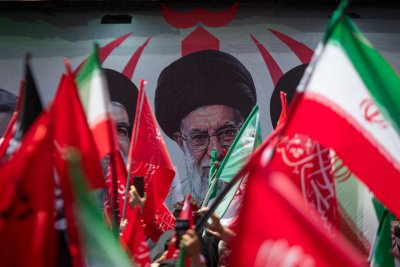
1 of 2 | A handout photo made available by the Iranian Supreme Leader Office shows crowds taking part in the burial of late Iranian Supreme Leader Ayatollah Ali Khamenei in the city of Mashhad, Iran, Thursday. Photo handout by Iranian Supreme Leader Office/EPA
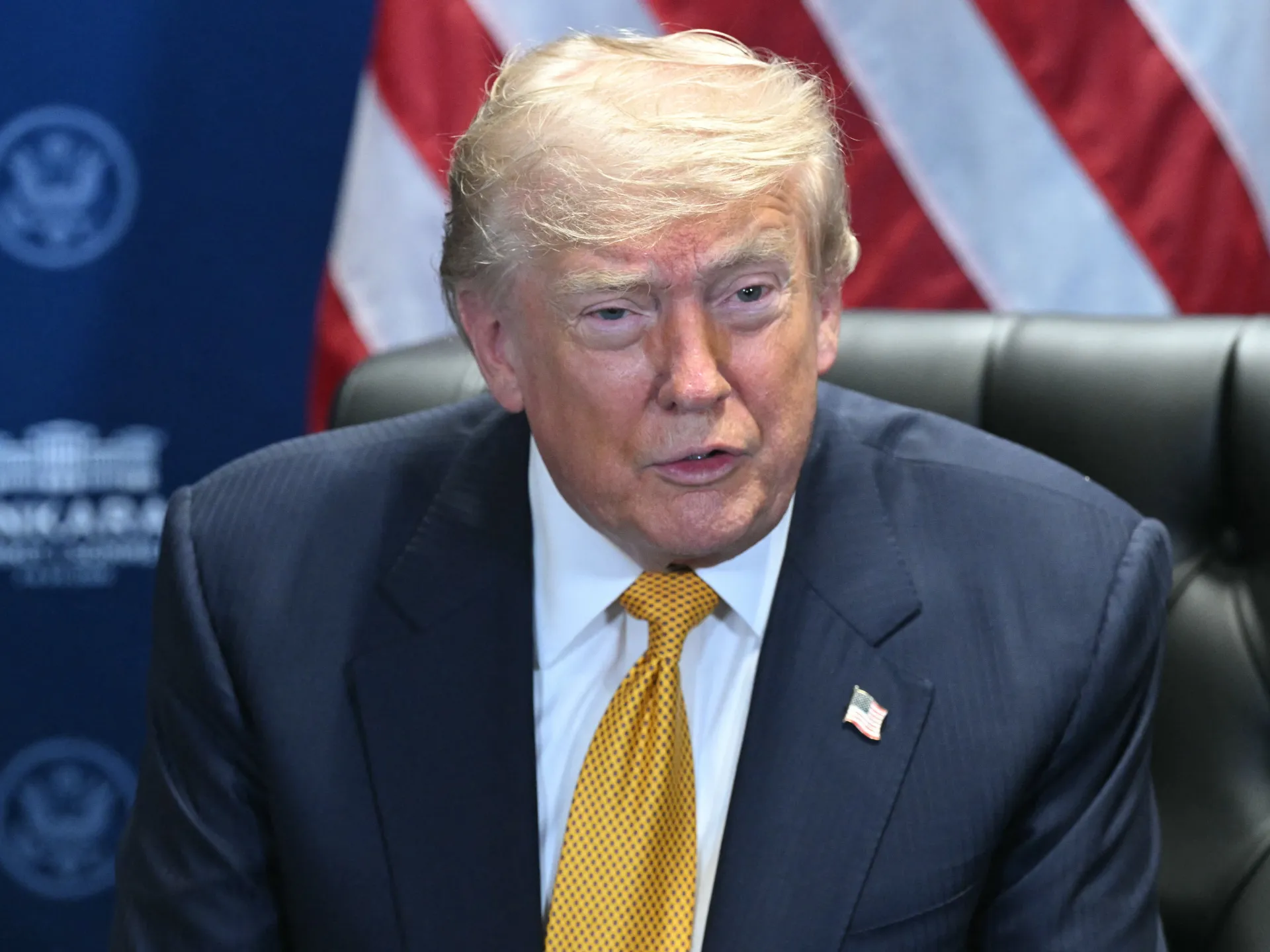
July 11 (UPI) — President Donald Trump threatened to “decimate and destroy” Iran if they carried out an assasination attempt on him.
“1000 Missiles are Locked and Loaded and aimed at the Islamic Republic of Iran, with thousands of more to immediately follow, should the Iranian Government act on its threat, pronounced in many corners of the Globe, to assassinate, or attempt to assassinate, the sitting President of the United States of America, in this case, ME! Orders have already been given, and the U.S. Military is ready, willing, and able, for a one year period of time, subject to extension, to completely decimate and destroy all areas of Iran – PRAISE BE TO ALLAH!,” the president said on Truth Social Friday night.
The comments are likely in response to new intelligence from Israel that Iran has a plan to kill the president, reported by The Wall Street Journal on Thursday. Also, Iran has been holding funeral rites for its supreme leader Ayatollah Ali Khamenei, and photos have emerged of mourners carrying signs that say, “Kill Trump.” Khameinei was killed by an American and Israeli attack on Iran in February.
In a post on X Saturday, Khamenei’s son and successor Mojtaba Khamenei promised to avenge the deaths of those killed in U.S. strikes.
“This vengeance is what our nation is demanding, and this must definitely be done,” Mojtaba Khamenei said.
“I’ve been on their list for a long time. That’s what we’re dealing with,” he said. “The only thing is, I’ve left instructions — if anything happens, to just literally bomb them at levels that they’ve never seen before.”
He said there was no new intelligence on a plot.
“No, no. Israel came up with nothing. No, no,” he said. “I’ve been No. 1 [on Iran’s kill list] for a long time, and it’s the way life is, you know.”
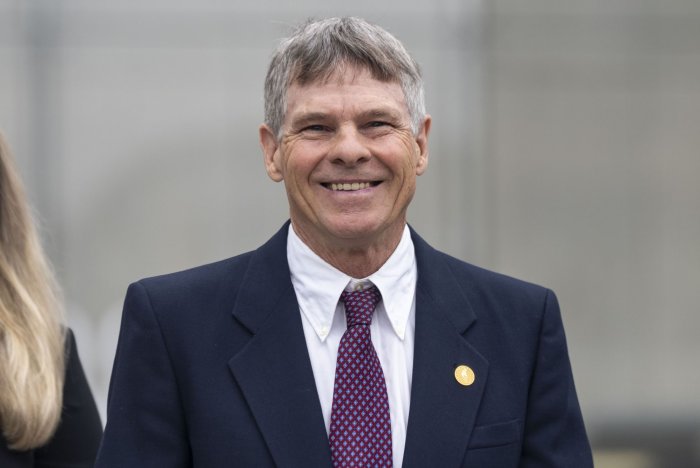
Olympic canoeist David Hearn departs the Moultrie Courthouse after pleading not guilty to damaging the Lincoln Memorial Reflecting Pool on Thursday. Hearn was indicted on July 2 on one count of destruction of property of more than $1,000 for allegedly damaging the Reflecting Pool, carrying a maximum penalty of 10 years in prison if convicted. Photo by Bonnie Cash/UPI | License Photo
July 9 (UPI) — Iran’s Islamic Revolutionary Guard Corps said early Thursday that it has launched attacks targeting U.S. bases in Kuwait and Bahrain, hours after U.S. Central Command announced the completion of its attacks against Iran.
The tit-for-tat strikes follow President Donald Trump a day prior saying the cease-fire agreement between Washington and Tehran was all but over, and threatened the return to all-out war in the Middle East.
Fighting had simmered between the two sides following last month’s agreement to conditions that could lead to an end of the war, but the Strait of Hormuz has proved a sticking point. The Trump administration is demanding a return to freedom of navigation through the chokepoint; Iran is seeking to maintain control over the vita energy transit route.
As negotiations were stalling, three commercial vessels were struck while transiting the strait, resulting in the United States attacking Iran early Wednesday, kicking off the continuing retaliatory strikes as Iran appears unrelenting in its oversight of the Strait of Hormuz.
“America still hasn’t learned that bullying and breaking promises are no longer cost-free. Let me put it plainly: if you strike, you’ll get hit,” Iranian Parliament Speaker Mohammad Bagher Ghalibaf said in a social media statement early Thursday.
“Don’t flail around pointlessly, or you’ll sink ever deeper: the Strait of Hormuz will only open with ‘Iranian arrangements,’ not American threats.”
The IRGC said it had not only attacked but “smashed important infrastructure and facilities” at Arifjan and Ali Al Salem bases in Kuwait and Juffair and Sheikh Isa bases in Bahrain.
State-run Islamic Republic of Iran Broadcasting reported that Iran early Tuesday was attacking U.S. bases from Bushehr city, stating the United States had targeted those assets hours earlier.
The state broadcaster also claimed the U.S. 5th Fleet headquarters in Bahrain was also hit.
The extent of potential damage was not immediately clear, but both Kuwait and Bahrain confirmed incoming attacks.
The elite military unit in charge of protecting the Islamic regime warned that the United States that “should it repeat its aggression, our crushing responses will expand to other American bases in the region,” it said.
The attack came as the U.S. Central Command announced that it had completed strikes against Iran late Wednesday.
CENTCOM said late Wednesday that it had completed strikes against about 90 Iranian military targets, including air defense systems and coastal surveillance assets, were hit. The announced follower an earlier round of U.S. attacks overnight Tuesday that struck about 80 targets in Iran.
June 26 (UPI) — President Donald Trump on Friday threatened to impose a 100% tariff on any country that enacts a digital services tax against a U.S. company.
The new tariff would be applied to all goods shipped into the United States and be levied on top of any other tariff already in effect for that country, Trump said in a post on Truth Social.
At least a dozen nations have digital services taxes, which are meant to limit the influence of large technology companies — especially large U.S. companies such as Apple, Amazon and Meta — and are being considered by several European countries, CNBC and Politico reported.
Canada last year rescinded a digital services tax hours before it was set to go into effect in order to restart trade negotiations with the United States, which Trump held back on until the tax was canceled.
“Please let this statement serve to represent that any Country that imposes such a Tax will immediately be met with a 100% TARIFF on any and all Goods sent to the United States of America,” Trump said in the post.
“This TARIFF will supersede Trade Deals made with the Country, whether implemented, signed, or not,” Trump said. “Additionally, the 100% TARIFF will be immediately imposed, if they proceed.”
Canada’s tax was to be levied against online marketplace and advertising services companies, as well as social media companies, but Trump called it a “direct and blatant attack” on the United States and canceled talks on the tax was rescinded.
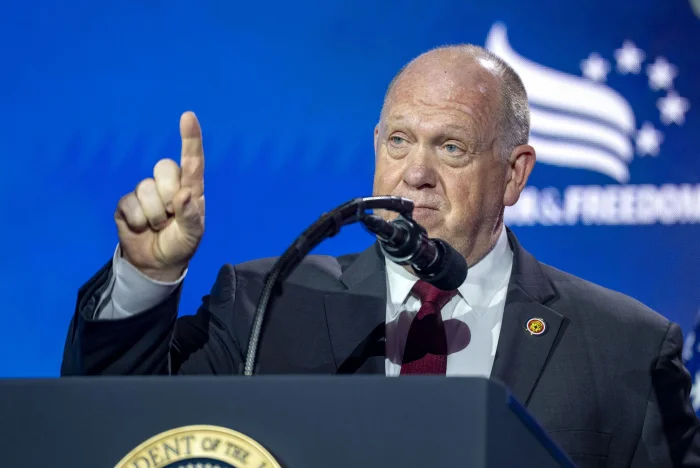
White House Border Czar Tom Homan speaks during the Faith and Freedom Coalition 2026 Road to Majority Policy Conference at the Washington Hilton on Friday. Photo by Bonnie Cash/UPI | License Photo
BUDGET airline Wizz Air has warned that it could be forced to cut UK routes due to rising costs.
It comes after air passenger duty (APD) was raised in April – a tax on airlines that is usually then passed onto passengers by increasing flight fares.
Sign up for the Travel newsletter
Thank you!
Wizz Air is threatening to axe some of its flights from the UKCredit: Shutterstock Editorial
Wizz Air boss József Váradi said that the airline will now look at whether the rise in APD will impact demand for its flights and depending on the results, whether any of the airlines routes should be cancelled.
The APD rise in April hit a record high and further increases are expected in the future.
On economy flight fares, APD rose from £13 to £15 in April, to most destinations across Europe.
For Brits travelling on holiday, this means that a family of four could be spending an extra £60 (£8 more than previously) before even adding luggage to their flight booking.
While Wizz Air has not confirmed which flights are at risk, the airline currently flies to 77 destinations from the UK including holiday hotspots such as Alicante, Tenerife and Majorca in Spain.
The airline boss added that while Wizz Air is mostly happy with its services from the UK, “issues affecting the UK airline industry like APD charge increases” cannot be ignored.
He said: “We have to evaluate how exactly that plays out on our network, our customer base and our financial performance and make decisions accordingly.”
“If the cost of business is going up, that will result in capacity rationalisation if you are unable to pass it on to customers.”
The APD rise comes at a time when many airlines are already feeling the financial pressure of rising air fuel costs.
Váradi added: “I do not think the UK should be overcharging airline customers to raise funds for other activities and commitments, because this is going to undermine airlines and the UK is going to lose out on tourism at the end of the day.”
DUBAI, United Arab Emirates — President Trump threatened Thursday to launch major strikes on Iran and seize control of its oil industry as escalating attacks between the countries pushed the Middle East closer to the resumption of a full-scale war.
Trump said in a social media post that the U.S. would hit Iran “VERY HARD TONIGHT” and would “assume total control” of Iran’s oil and gas industries, including the vital Kharg Island oil terminal, in the “not too distant future.”
The American leader’s latest threats came as efforts to negotiate an end to the war appeared stuck. Trump has voiced his frustration with the stalled negotiations, warning earlier in the week that Tehran would “pay the price” for taking too long to reach a deal.
Iran’s monthslong stranglehold on the Strait of Hormuz has disrupted global energy supplies, driven up fuel prices and made food and other basics more expensive well beyond the region.
The U.S. and Iran traded strikes for a second straight day Thursday after reaching a tenuous ceasefire more than a month ago. While the strikes have increased tensions in the region, they have been more limited compared to the early weeks of the war and negotiations between the U.S. and Iran are ongoing.
Trump’s threats on Thursday, while stark, represented his latest verbal escalation in the Iran war. In April, he warned Iran that “a whole civilization will die tonight, never to be brought back again” if it didn’t agree to his terms, before extending a ceasefire.
Trump weighs trying to seize Iran’s main oil terminal
Kharg Island — located on the other side of the Persian Gulf from U.S. bases in Kuwait and Saudi Arabia — is the beating heart of Iran’s oil industry, through which 90% of its exports pass. It is important because Iran’s coastline is mostly too shallow for tanker ships to dock.
It was unclear how serious Trump was about his threat to seize it.
“My preference has always been to take Kharg Island,” Trump said in an interview Thursday on Fox News. “I don’t know that America has the stomach for it to be honest.”
American troops would be vulnerable on Kharg Island because of its close proximity — about 21 miles — to the Iranian mainland, from which missiles, drones and artillery could be fired.
Trump indicated in the interview that he remains averse to sending U.S. forces into Iran. “We could walk in there tomorrow. We could take soldiers — I don’t want to have boots on the ground. But if I wanted to we could put a small group of soldiers and take over the place.”
Trump compared his threat to take over Iran’s oil industry to how the U.S. assumed control of Venezuela’s oil sector after capturing then-president Nicolás Maduro in January.
Iran says US attacks have made ceasefire `meaningless’
American strikes on Iran that lasted into Thursday morning appeared more intense and widespread than the day before.
Tehran released little information on the extent of the damage and said it fired back at Kuwait, Bahrain and Jordan, as it had the previous day.
It was the third time this week that back-and-forth strikes have rattled the Middle East. The first involved attacks between Iran and Israel, followed by the two rounds of fire between the U.S. and Iran, which hit countries in the region that host American bases.
Iran’s Foreign Ministry said in a statement Thursday that the U.S. attacks had “effectively rendered the ceasefire … meaningless,” without saying it was abandoning it.
U.S. Treasury Secretary Scott Bessent said in a social media post that the U.S. would extract funds from frozen Iranian accounts to offset the costs of damage to American allies as well as any tolls Iran imposes on ships seeking passage through the Strait of Hormuz.
Beyond the deadlock over the strait, the two sides also remain at odds over Iran’s nuclear program, which Tehran insists is peaceful but which the U.S. and Israel fear could be used to build an atomic weapon due to its stockpile of highly enriched uranium. The U.S. and Israel said a major reason they went to war on Feb. 28 was to ensure that Iran would never be able to do that.
Iran has insisted that any deal to end the war must also end fighting in Lebanon between its ally Hezbollah and Israel. But Israeli Prime Minister Benjamin Netanyahu appears intent on pursuing his goal of destroying the militant group.
U.S. strikes Iran and Iran fires back at Gulf states
Central Command said its latest round of airstrikes came “in response to Iran’s unwarranted and continued aggression” and targeted “Iranian military surveillance capabilities, communication systems and air defense sites.” It did not elaborate on the damage done by the strikes, which it said ended just before sunrise Thursday in Iran.
Explosions from the strikes echoed around Iran’s capital, as well as the port city of Bandar Abbas and other southern areas along the Strait of Hormuz. Iran’s paramilitary Revolutionary Guard later said sites hit included a manufacturing complex, a military barracks and a local Guard base outside of Tehran.
Kuwait closed its airspace for several hours because of the attack, but did not elaborate on any damage. Jordan said it intercepted 20 Iranian missiles fired toward an area that is home to a base hosting U.S. troops, though no one was hurt.
Bahrain’s Interior Ministry said an 11-year-old girl was hurt and cars and homes were damaged by debris from interceptions responding to the Iranian attack.
Meanwhile, Israel warned residents in the country’s north to seek shelter after the detection of suspected incoming fire from Lebanon, where Israel is fighting the Iran-allied Hezbollah militant group.
U.S. fires on another merchant ship to enforce blockade
The U.S. military’s Central Command said Thursday that it struck a Guinea-Bissau-flagged tanker attempting to evade the American blockade on Iranian ports. It said the M/T Jalveer was transporting Iranian oil when it was disabled late Wednesday after its crew failed to obey U.S. orders.
It’s the ninth merchant vessel the U.S. military says it disabled to enforce the blockade.
Three Indian sailors were killed when American forces struck the Palau-flagged M/T Settebello on Tuesday, India’s minister overseeing ports and shipping said Thursday on X.
U.S. Central Command said American forces issued warnings before firing on the ship, which it accused of trying to evade the blockade.
The leader of the International Maritime Organization, a United Nations agency, condemned the attack.
Gambrell and Madhani write for the Associated Press. Madhani reported from Washington. AP writers Will Weissert, Collin Binkley, Michelle L. Price and Konstantin Toropin in Washington; Sheikh Saaliq in New Delhi; Munir Ahmed in Islamabad, Victoria Eastwood in Cairo and Russ Bynum in Savannah, Ga., contributed to this report.
June 11 (UPI) — President Donald Trump said Thursday that the United States may take control of Iran’s oil and gas industries like it did in Venezuela earlier this year.
Trump posted the threat on social media, warning that the United States will continue attacking Iran after a series of airstrikes on Wednesday.
“The United States will be hitting Iran (Whose Navy, Air Force, Radar, Anti Aircraft, and all other forms of Defense, together with most of its offensive capability, are GONE!), VERY HARD TONIGHT,” Trump wrote. “At some point in the not too distant future, we will be taking Kharg Island, and other oil infrastructure points, and assume total control of their Oil and Gas Markets, much like we have with Venezuela, which is working out brilliantly for both Venezuela and the United States of America.”
About 90% of Iran’s crude oil shipments were exported from Kharg Island before the United States and Israel launched the war on Feb. 28.
The United States has launched strikes on Kharg Island during the Iran war but it has not seized control of any of its oil and gas infrastructure yet.
Trump further discussed taking control of Iranian infrastructure during an appearance on Fox News on Thursday morning.
“Look, my preference has always been take Kharg Island,” he said. “I don’t think America has the stomach for that. I think they’d like to see us come home, but we did it with Venezuela. Venezuela’s worked out great for everybody.”
Fighting has heightened again between the United States and Iran with Iran shooting down a U.S. helicopter earlier this week near the Strait of Hormuz. The U.S. military launched what it is calling “self-defense strikes” on Iranian military surveillance, communication systems and air defense targets.
U.S. Central Command said Wednesday that the strikes were “in response to Iran’s unwarranted and continued aggression.”
Trump has said for weeks that Iran and the United States are close to reaching a peace agreement, saying at several points Iran wanted to reach a deal. Fighting between Iran and Israel paused over the weekend after Trump urged both sides to stop exchanging fire.
The United States continues to enforce a blockade on ships using Iranian ports on the Strait of Hormuz.
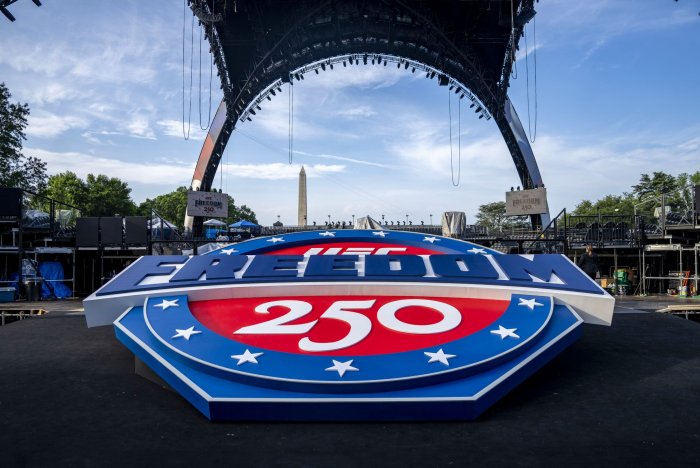
The Ultimate Fighting Championship (UFC) arena is seen as preparations continue for the UFC Freedom 250 event on the South Lawn of the White House on Thursday. Photo by Bonnie Cash/UPI | License Photo
“Life was good back then. We had everything in abundance.”
When Jummai Usman says this, she is anchoring herself to a version of Geriyo, a community in Yola, Adamawa State, in northeastern Nigeria, that younger generations in the area may never know.
Born and raised on the shores of Lake Geriyo, she considers this place her ancestral home. Her parents were fish traders, and she married a fisherman. Her husband would catch the fish and bring them to her to roast and sell to traders, and for decades, this trade sustained them and their children.
Jummai, then married, was 16 years old when the Federal Government of Nigeria established the Lake Geriyo Irrigation Project in 1976. The 24-hectare initiative was managed by the Upper Benue River Basin Development Authority (Upper Benue RBDA) in Yola, under the Federal Ministry of Water Resources.
It began with 52 registered local farmers, offering them irrigation water and modern agricultural extension services, with water pumped directly from the River Benue. Residents were excited about the project at the time, Jummai recalled, and considered it a means of advancement. Farmlands were carved out and assigned to registered farmers, and an office was established to oversee these activities.
“We paid a fine back then, but I don’t remember how much. My husband paid for it. We called it the water and land levy,” Jummai, who is now 66 years old, said.
Over time, more people flocked to the area, and the lakeside settlement gradually expanded. The site has since grown to cover 429 hectares and now accommodates more than 2,000 farmers.
Among them are people like Ali Usman*, who built his life around Geriyo Lake. He moved to the area at the age of 15 and has lived there for about 25 years, farming and fishing along the lake. “I rent three hectares of land annually. I used it to harvest 100 to 120 bags of rice combined,” he said.
Now a father of seven, Ali fears he may no longer be able to provide for his family, as farming and fishing around Geriyo are becoming harder for thousands who depend on the lake for survival.
Long credited with improving livelihoods in the area, the Lake Geriyo Irrigation Project is now at the centre of a slow-moving crisis: a shrinking lake, years of institutional neglect despite millions of naira in rehabilitation funds, and a community that has lost its home. HumAngle spoke to several of the residents, who described losing their livelihoods to years of neglect that have left the lake overwhelmed.
‘Geriyo Lake is dying’
The ecological collapse of Geriyo Lake did not happen overnight. Residents have watched it shrink steadily over the years, especially over the past five years, as its waters have receded, its fish have become scarce, and its capacity to sustain farming and fishing has diminished season by season.
Jummai, who has seen the lake in its glory, says it is dying. She believes the shrinking is responsible for the decline in fishing in the area. “Even when we were living by the riverbank decades ago, the place barely got flooded,” she said, adding that the lake had depth back then.
The heavy rainfall on May 18 in Yola brought much-needed relief to farmers in the area, marking the start of the farming season. However, it also stirred fear and concern among the residents of the Geriyo community. Residents say that if the rain continues at this intensity, their homes and farms may be submerged, and farming will come to a standstill.
Since farmland is usually flooded during the rainy season, some residents told HumAngle they had stopped farming in the area. Others, however, still take the risk, even though the results are often catastrophic.
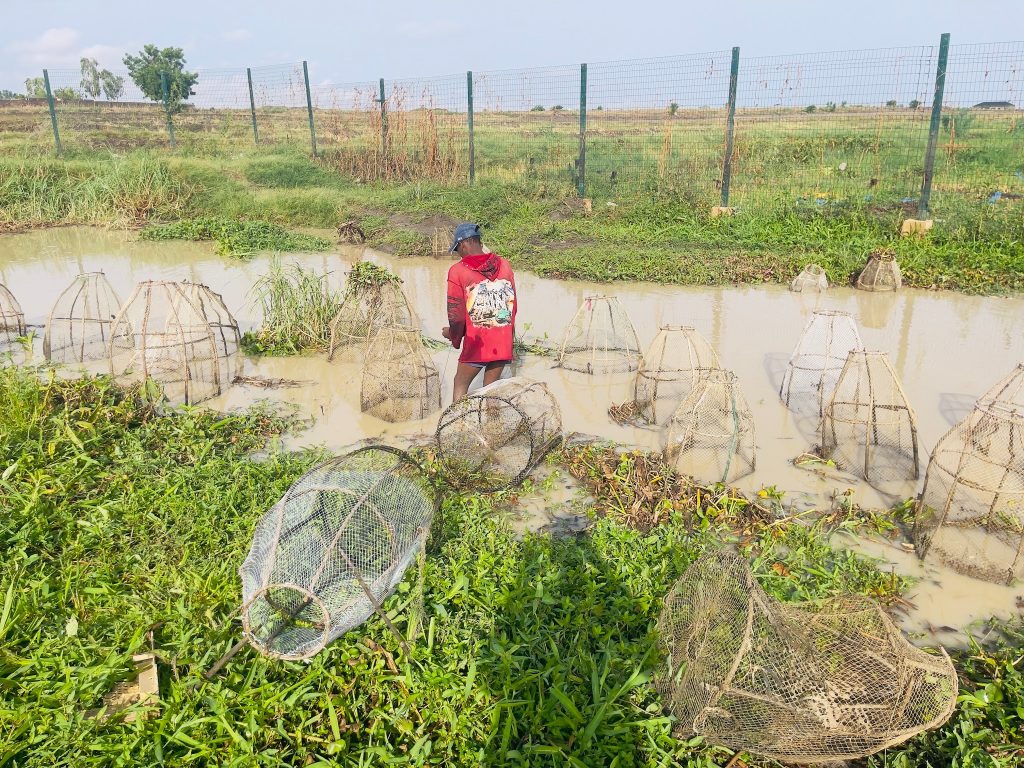
While this fear lingers in the hearts of farmers who are yet to harvest the crops they planted during the dry season, some fishermen seized the opportunity to cast their nets, as they haven’t done so in a while due to the shrinking lake.
“Fish are scarce. We don’t get it like before, so we take advantage of every water channel across the lake to cast our net,” a fisherman in the area told HumAngle, adding that the shrinking lake has affected his trade in the area, making what was once a regular activity only an occasional one.
A fisherman casting his net around a water channel in the Geriyo region. Photo: Saduwo Banyawa/HumAngle.
Bala Abubakar*, another fisherman in the area, said that overfishing, the shrinking of Lake Geriyo, and poor regulatory practices all contribute to the challenges faced by fishermen. Even though regulations stipulate that only registered fishermen are allowed to fish in the lake, and guards have been stationed to secure the lake at night, Bala said some fishermen still bypass these rules by paying a token fee to the guards.
To control fishing in the area, HumAngle learned, the Geriyo Lake is often declared closed by the Upper Benue RBDA and then reopened for a limited period – typically during the dry season when the lake dries up.
“At the time the lake will be opened, there will be a leader for each group, and the leader will present the list of his group members, and they might say the group will pay a hundred or ₦200,000 as a passage fee. It depends. And when the lake opens, the group members will go and catch fish for specific months,” Bala explained.
An environmental assessment by researchers at the Federal College of Education, Yola, in 2024 found that fish populations in Lake Geriyo are declining due to largely unregulated fishing practices. The researchers stated that severe pollution of the lake, caused by urban waste and agricultural runoff, has also displaced the fish. The effects are visible in the market.
Get our in-depth, creative coverage of conflict and development delivered to you every weekend.
Subscribe now to our newsletter!
A dumpsite at the Geriyo Lake area. Photo: International Journal of Chemistry and Chemical Processes.
Rukaiyatu Sani, a resident of Geriyo and a fish seller, says her business has suffered over the past few months. She noted that when the fishermen make a catch, they sell the fish at a higher price because they have other water levies to pay. “For instance, we used to buy a basket of fish for ₦20,000, but now we buy at either ₦40,000 or ₦45,000,” she said.
Bashir Abubakar, a professor of environmental resource management at Modibbo Adama University, Yola, corroborated the researchers’ findings. He attributed the shrinking to “a lot of things”, including siltation. “There are encroachment and unsustainable land uses, overfarming, overfishing, tree cutting, and sediment erosion from urban expansion activities around the lake. So all these are inimical to the survival of the lake itself,” he said.
Bashir explained further that the recurring floods in the Geriyo area stem from its close hydrological relationship with the Benue River — itself under severe stress.
“When the River Benue becomes full as a result of heavy rainfall, Lake Geriyo also becomes full. When there is a reduction in the size or volume of water in the River Benue, naturally, Lake Geriyo too becomes relatively dry,” he said, adding that siltation, climate change, population explosion and pollution are the basic issues affecting Geriyo.
“More than 70 per cent of what used to be the river Benue is now land with evidence of permanent vegetation, which shows water has not been reaching those places. So this one affects Lake Geriyo, too,” the professor said.
We used a combination of planetary mapping tools in Google Earth Engine to track the lake’s footprint over more than two decades. We pulled historical data from NASA and the USGS’s Landsat 9 satellite to map Lake Geriyo as it was in 2000, and contrasted it with high-resolution imagery captured by the European Space Agency’s Sentinel-2 satellite in 2026.
From high above, satellite images of Lake Geriyo reveal a vital ecosystem being choked to death from the bottom up. As the lake loses depth, it accumulates soil over the decades through soil erosion, causing loose soils to progressively fill the lake’s deep basin with mud.
The satellite imagery shows that the visible water area actually climbed from 1.28 sq km to 1.91 sq km. Meanwhile, the terrain satellite explains why: the average slope of the entire lake basin is a mere 1.35 degrees, a gradient so low that the choked water has nowhere to go but out, creating a shallow basin detrimental to both aquatic and life near the banks.
Satellite image analysis of Lake Geriyo between 2000 and 2026. Illustration: Mansir Muhammed/HumAngle
While fishermen in the area are grappling with a changing environmental landscape, farmers are also bearing the brunt of Geriyo’s degradation, which leads to annual flooding and loss of soil fertility.
For instance, Ali, who used to harvest over 100 bags of rice from his combined three hectares, now barely makes half that amount. “If I get 50 bags, that means I am lucky,” he said.
The Lake Geriyo Irrigation Project, established primarily to provide irrigation and agricultural extension services to local farmers in the region, appears to be falling short of its mandate to supply water. While some locals attribute this to the lake’s shrinking, others believe the rise in fuel prices is to blame.
Farmers say they pay a standard levy, but not all of them have access to the same level of service. The higher the service fee paid, the higher the quality of service one can expect from the Upper Benue RBDA office at Geriyo, according to local sources.
“I pay ₦4000 per bed, which only covers the rent fee for land. Those who pay higher enjoy access to irrigation services from the office. Their farms are supplied with enough water, and their harvests are always bountiful compared to ours,” he said.
The complaints about unequal access to irrigation come despite significant public spending on the project in recent years.
Records on GovSpend, a civil society-run platform that tracks and analyses federal government spending, show that ₦32,827,212 was paid to Dect Engineering Limited for “refurbishing, services, lubricating, and installations of M&W pumps at Lake Geriyo Project” on Nov. 18, 2024. Another ₦56,365,196 was paid to South Belgride Oil on Sept. 5, 2024, for the supply of “45,000 litres of diesel” to the site. Both payments were made under the supervision of Upper Benue RBDA.
Despite these investments, farmers say the benefits are not evenly distributed. In Geriyo, the irrigation plant operates mainly between December and May annually, the area’s peak irrigation season, with water pumped two to three times a week. While this suggests that the system is functional, access to the pumped water remains unequal. Consistent with earlier complaints, farmers who pay higher levies receive water directly from the irrigation network, while lower-paying farmers often have to fetch water from the lake themselves.
A screenshot of the payment details on GovSpend.ng.
The disparities extend beyond water access. HumAngle learned that land allocation is also linked to rental costs, with more expensive plots generally regarded as more fertile. Ali said he pays between ₦70,000 and ₦100,000 per year in land rent, while others pay more. Since all fingers are not equal, low-income farmers suffer most from environmental degradation.
The sudden notice to vacate
The ecological crisis, devastating as it is, has been compounded by a series of state decisions that have left the community with nowhere to turn.
In 2023, locals living along Geriyo Lake received a notice from the local office ordering them to leave the area. While some residents left within weeks of the notice being issued, others remained. For Jummai, Geriyo is the only place she has ever known, so she had nowhere else to go.
“We were told that the place belonged to the Adamawa Emirate Council, so the government came to take over,” Ali said. “When they noticed that we were not willing to leave our homes, they gave us a total sum of ₦5 million, which was shared among every household that was yet to vacate the area back then. Each household got ₦57,000, and since people were hungry, we took the money, packed the items we could carry and left our homes.” Jummai’s family also received the money.
A few days after the locals left, houses at the Geriyo Lake were destroyed. The site was declared a government property, and a wall was erected. During a visit to the area in May, HumAngle observed that the fence area is yet to be developed.
Ali told HumAngle that since the sum each household received was insufficient to pay rent for large households or to secure new homes, the affected group went to an open field behind the lake, erected makeshift homes, and settled there so they could continue farming and fishing.
For Jummai, being dislodged from Geriyo Lake meant being stripped not just of her ancestral home but also of her access to a good life. “Before the government came with vehicles and levelled our houses, I lived with my husband and children in a decent home,” she said. Jummai now lives in a makeshift tent with her family. They still fish, but occasionally.
Locals erected makeshift homes behind the Geriyo Lake so they could continue farming and fishing in the area. Photo: Saduwo Banyawa/HumAngle.
Bashir believes that humans are stewards of the environment, and that displacing them undermines the very interventions meant to save it.
“Whatever policy that the government or any agency is making in those areas towards curtailing or reversing what has already happened there, the human perspective should be taken much more seriously within the context of sustainability,” he said, adding that dislodging the dwellers strips every intervention of the human element needed to maintain the environment and sustain livelihoods.
₦500 million, and not so much to show
Another damning dimension of Geriyo’s crisis is not ecological, but administrative.
According to EYEMARK, a government-run digital platform that tracks federal infrastructure projects, more than ₦500 million was allocated for the rehabilitation of Lake Geriyo, which was made by the Federal Ministry of Water Resources to the Upper Benue RBDA from 2019 to 2024, with the project listed as the Yola Reclamation (Lake Geriyo) Project. EYEMARK indicates that the project is ongoing and only 1 per cent complete.
When HumAngle visited the site in May, there were no visible construction activities.
HumAngle filed a Freedom of Information (FOI) request with the Upper Benue RBDA in Yola, seeking information and documents related to dredging, ecological restoration, irrigation, and other related development projects in line with the Lake Geriyo project. We also sought information on the funds appropriated by the Federal Ministry of Water Resources for the Lake Geriyo project from 2019 to 2024.
The Authority had not responded to the FOI request at the time of publication.
Residents around Geriyo, however, said the river has never been dredged.
“One time, we got frustrated over the services and reported to the local office, but nothing was done. We even went to the local radio station to voice our grievances, but nothing has changed,” Ali said.
According to Bashir, effective management of the Geriyo area would require collaboration between the governments of Nigeria and Cameroon, since the Ladgo Dam flows into the Benue River, meaning that what happens upstream has direct consequences for Geriyo’s downstream.
“There is no strong commitment on the part of our government in terms of having a bilateral agreement with Cameroon as to the management of the river itself. So that is why we are always at the receiving end,” he said.
Anxiety heightens
The rainy season has just begun, and Geriyo residents are already on edge, particularly farmers who are yet to complete their harvest from the dry-season farming.
Bashir, the environmental expert, warns of long-term risks if Geriyo Lake is not dredged and rehabilitation measures are not implemented. “The river is becoming shallower and shallower. So whenever we have a lot of water, the river will not contain the water. So you find that the entire floodplain is submerged, with losses of agricultural land, houses, and so on. So these are, of course, things that are increasing year in year out,” he said.
The land where Jummai and her community members erected makeshift tents has been bought, and construction has begun. Photo: Saduwo Banyawa/HumAngle.
Bashir added that since the government has not taken technocentric measures such as dredging the river, residents can settle for local measures to protect the land and the river.
“People should be encouraged to plant trees. If there will be massive afforestation within those areas, I’m very much sure it will go a long way in addressing the issue and reversing it to some level,” he said, adding that planting trees at the riverbanks and areas within the floodplain will help attenuate and reduce the effect of the rainfall.
Two years on, households like Jummai’s continue to live in makeshift shelters behind Geriyo Lake. When the area floods, they gather their belongings and relocate to higher ground. Since the farmlands also flood, the men resort to fishing alone, but even that becomes highly competitive at times. “During the rainy season, when the sites get flooded, the area is left unregulated, and everyone can fish there,” Bala said.
Despite the degradation of the once-thriving Geriyo community, fishermen and local farmers still arrive in their hundreds every day at the lake, hoping to make a catch or bring in a bountiful harvest.
But a far greater problem looms. A private individual and a construction company have bought the land where Jummai and her community members have erected makeshift tents. One day, they might be asked to leave.
*Names with asterisks were used to protect some of the sources.
Satellite analysis and illustration by Mansir Muhammed.
Enrique Riquelme held up a Real Madrid shirt bearing Erling Haaland’s name, while campaigning for club presidency.
Published On 4 Jun 20264 Jun 2026
Manchester City is considering legal action after Real Madrid presidential candidate Enrique Riquelme said he would sign the Premier League club’s Norwegian striker Erling Haaland if elected.
Riquelme, a renewable energy entrepreneur challenging incumbent Florentino Perez, made the pledge during an appearance on Spanish television on Wednesday, where he held up a Real Madrid shirt bearing Haaland’s name.
Recommended Stories
list of 4 itemsend of list
“The stories which have emerged from Spain regarding the future of Erling Haaland are untrue,” a City spokesperson said on Thursday.
“There is no chance of this happening, and there is no contractual clause to enable it. We are considering legal action for the use of our player’s image in this context.”
Riquelme said Haaland, who scored 38 goals in all competitions last season, had a release clause and wanted to move to the Spanish club, adding that he would make the transfer a priority if he wins Sunday’s election.
A joint statement from the 25-year-old footballer’s father, Alfie Haaland, and his agent, Rafaela Pimenta, swiftly rejected the suggestion, describing it as “not true”.
Riquelme added he would try to sign City’s Spain midfielder Rodri, saying he had spoken to the player’s agent and would “do everything possible” to bring the Ballon d’Or winner to Madrid.
The remarks come against the backdrop of Real’s presidential election, the first in two decades in which Perez is not running unopposed, after the club’s two seasons without a major trophy.
Voting is scheduled for Sunday, with some 100,000 club members eligible to take part.
Haaland had the option to join Real in 2022, when he left Borussia Dortmund. But he chose City, where his father played.
While the striker, who won the Premier League Golden Boot for the third time in four seasons, said he would like to play for Real one day, there has been no suggestion he is unhappy at City. He signed a new nine-and-a-half-year contract in January 2025.
Perez announced on Wednesday that, should he be elected, he would bring Benfica manager Jose Mourinho back to Real Madrid for a second term at the helm of Los Blancos.
The Portuguese former manager of Manchester United, Chelsea and Inter Milan previously won the La Liga title during a three-year spell in Madrid.