
tells

Trump tells Coast Guard graduates they will ‘be tested’ in their military careers

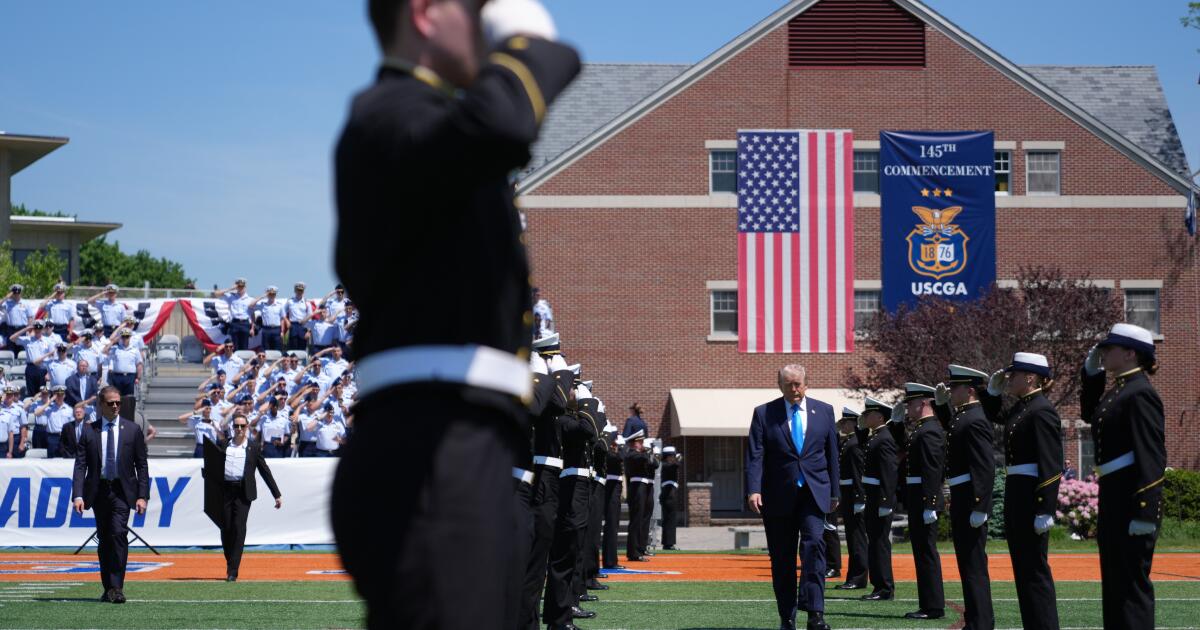
President Trump told the U.S. Coast Guard Academy’s graduates on Wednesday that they show “unbelievable heroism and exceptional selflessness” but that the cadets will “be tested further” as they embark on their military careers.

Trump’s remarks to the class of 2026 were the first time he has given a commencement address at one of the nation’s military academies after sending U.S. troops to fight a new war.

He told the cadets that they will be America’s “first defenders” and “first responders.”

“You’ve all been tested. You’ll be tested further and probably at higher levels as your career goes on,” Trump said.

During his address, Trump quickly touched on the war with Iran, now in its 12th week, as a sign of U.S. success from “the hottest country anywhere in the world.”

“The only question is, do we go ahead and finish it up or are they going to be signing a document? Let’s see what happens,” Trump said.

The Republican president had threatened to launch renewed strikes on Iran this week as talks with Tehran seemed to have stalled and a fragile ceasefire appeared to be teetering. But Trump on Monday said he was giving Iran a few more days because “serious negotiations” were underway.

He has not offered details and has in the past backed away from following through on threats to Iran, citing breakthroughs in talks that have not publicly materialized.

Earlier Wednesday, he told reporters that he’s “in no hurry” to strike a deal to wrap up the war because of political concerns and the November midterm elections.

The commencement was held on a day with scorching heat and there was little shade available as the crowd waited for the ceremony to begin.

At least one person required medical attention after passing out. Others pleaded with organizers for elderly attendants to sit in the shade under tents. Chilled water bottles were distributed freely but quickly became warm.

Trump, who spoke at the academy’s graduation in 2017 during his first term, said he was proud to be the first president to give two commencement addresses at the school.

“We’re going to have to try it maybe a third time, too, to keep that record intact,” Trump said Wednesday.

The president and vice president traditionally speak at one of the military service academies every year. Vice President JD Vance is set to give the commencement address on May 28 at the U.S. Air Force Academy.

Before he flew to Connecticut, Trump told reporters that his message to the cadets would be, “Just enjoy your life.”

“You know, you don’t really realize how important Coast Guard is until you have a hurricane,” Trump said as he praised the maritime service.

Price and Kruesi write for the Associated Press. Price reported from Washington.

Source link

P&O Cruises tells passengers they must pack item or be ‘denied boarding’

P&O Cruises urges all passengers with trips booked to bring proof or risk being ‘denied boarding’ at their own expense

P&O Cruises says all passengers must bring a particular item with them or risk being ‘denied boarding’. The popular cruise operator states that packing the item is compulsory for all guests who wish to sail on the ship, or their holiday could be ruined if they fail to do so.

P&O Cruises is among the largest and most popular cruise operators in the UK, and as the peak travel season approaches, many people will have trips booked. The vessels are designed specifically for the British market and depart year-round directly from Southampton.

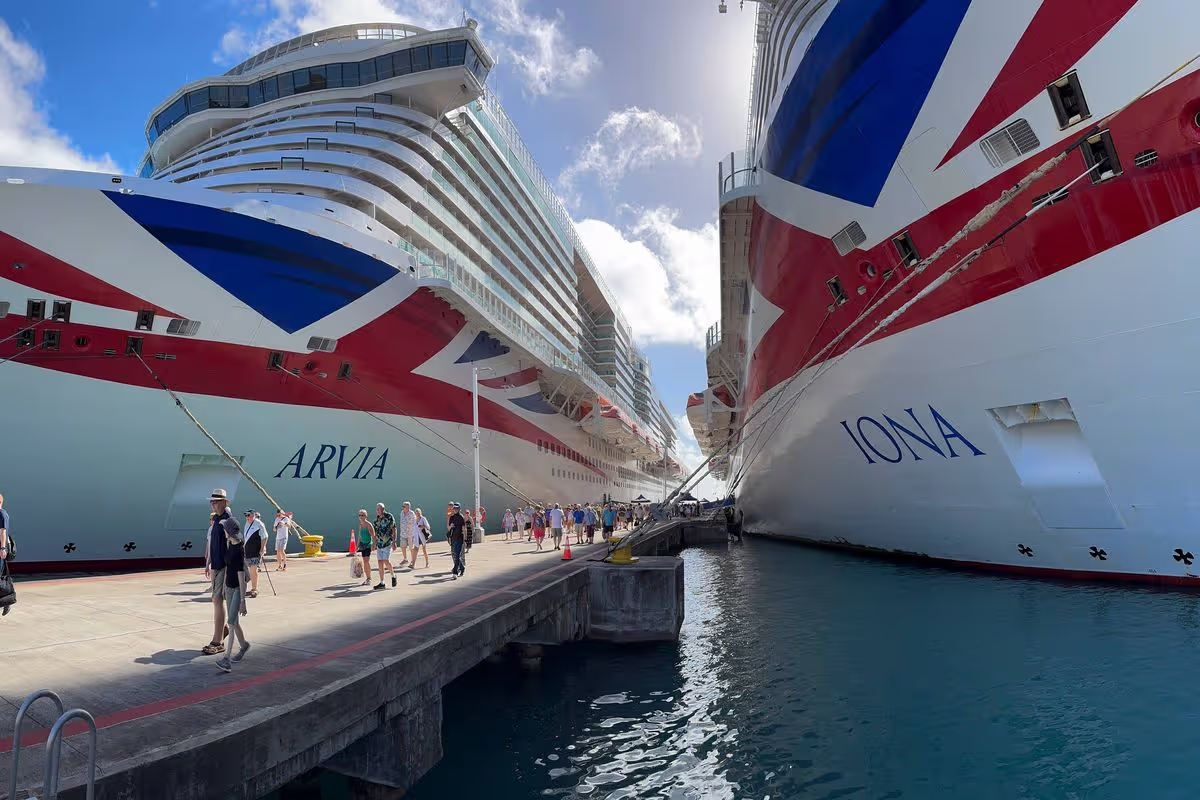
P&O Cruises operates a fleet of seven ships, divided into family-friendly vessels such as Arvia, Iona, Britannia, Azura and Ventura, and adult-only ships such as Arcadia and Aurora, reports the Liverpool Echo. Irrespective of which vessel people embark upon, all guests must bring a crucial item with them. Should customers fail to present the item, P&O Cruises warns: “Unfortunately, you will be denied boarding”.

On the P&O Cruises website, the cruise operator clarifies what passengers need to pack and explains the rationale. A statement reads: “We’re delighted that you’ve chosen to set sail with us, and we cannot wait to welcome you on board. Before we get there, it is mandatory for all guests to have suitable cruise travel insurance cover in order to sail with us.”

It adds: “It is your responsibility to ensure you have appropriate cover in place for the duration of your holiday. Unfortunately, you will be denied boarding, at your own expense, if you’re unable to confirm you have arranged insurance.

“You may be asked for proof of your cruise travel insurance. So, please be sure to bring either a printed or digital copy of your insurance documentation that confirms cover for the named travellers over the dates of travel.”

Outlining the main reason why travel insurance is crucial to arrange before setting sail, P&O Cruises stated: “For many significant purchases in your life, insurance is essential. And holidays are no different.

“Travel insurance ensures you can relax and enjoy your holiday with peace of mind that you’re covered in the event something should go wrong. This includes unforeseen incidents before your holiday, while travelling or while you’re away.”

P&O Cruises provides a checklist for selecting the appropriate level of cruise insurance protection. It includes:

  • Ensure your insurance covers a cruise holiday
  • Covers the full length of the trip
  • Includes all destinations – choose worldwide cover if unsure
  • Includes medical and repatriation cover of £2 million minimum
  • You’ll need to declare any pre-existing medical conditions
  • We would also recommend that you have adequate cancellation cover to cover the cost of your trip

I’ve got travel insurance already. Do I need cruise insurance?

P&O Cruises states: “You will need to look into the level of cover your travel insurance provides. Some bank accounts include travel insurance but the policies often offer limited amounts of cover.

“Standard travel insurance is generally meant for a land-based holiday and as such, won’t cover many of the elements of a cruise holiday. A cruise holiday requires more specialist cover, for example if there was a need to be medically evacuated at sea. The most important thing is to make sure you’ve told your insurer you are going on a cruise holiday.”

What happens if I don’t declare pre-existing medical conditions?

P&O Cruises warns: “You run the risk of not being fully covered and having to pay for medical treatment which can be extremely costly. Emergency medical treatment can even be refused if you do not have the correct insurance, this includes failing to declare pre-existing conditions.”

If I cancel my holiday, will I get my money back?

P&O Cruises states: “If you cancel your holiday, the cancellation policy in our Booking Conditions applies. If you are cancelling due to a medical reason and you have declared the medical condition, your insurer should refund any monies paid less the relevant policy excess.”

Source link

Greenland’s prime minister tells Trump’s envoy self-determination cannot be negotiated

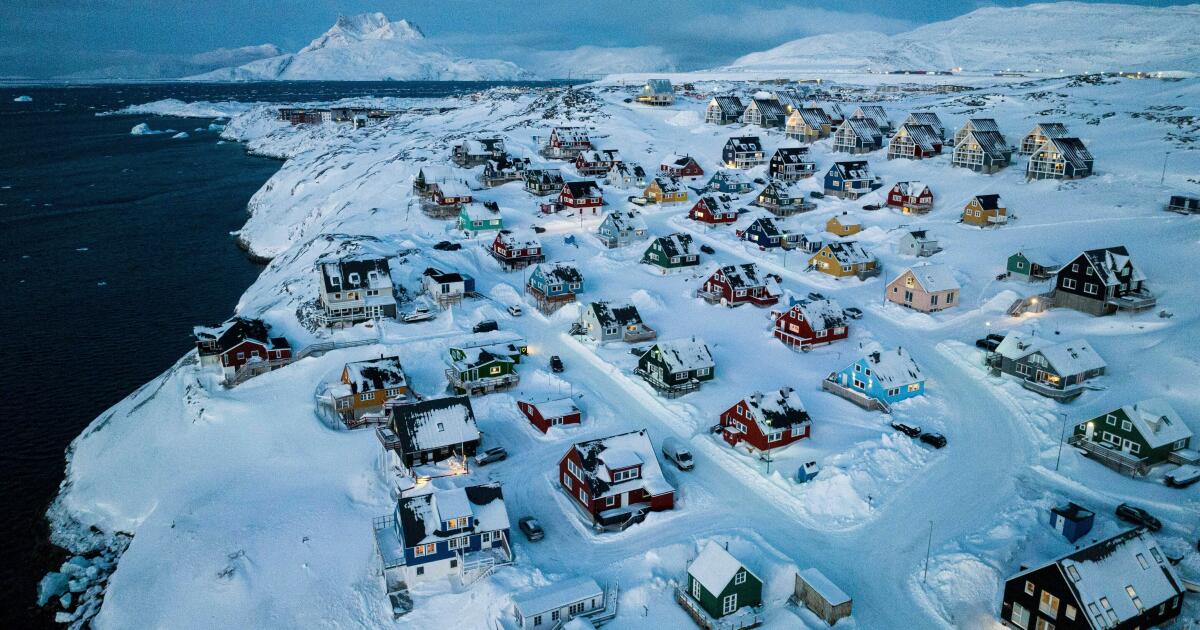
Greenland’s Prime Minister Jens-Frederik Nielsen said Monday that he had a respectful and positive meeting with President Trump’s special envoy to the Arctic territory, but that he made it clear that the Greenlandic people continue to insist on self-determination.

Greenland is a semiautonomous territory of NATO ally Denmark, and Trump in the past has frequently insisted that the U.S. should take control of the island for security reasons, which has raised sovereignty concerns and pushback from Greenlandic and Danish leaders.

“The Greenlandic people are not for sale. Greenlandic self-determination is not something that can be negotiated,” Nielsen was quoted by Danish TV 2 as saying after meeting on the island with the envoy, Louisiana Gov. Jeff Landry.

Nielsen also reiterated that the Greenlandic people “seek good cooperation” with the U.S., and said his “courtesy meeting” with Landry took place with “mutual respect and in a positive atmosphere.”

Landry reportedly said upon his arrival in Greenland on Sunday that Trump had told him to “go over there and make as many friends as we can get,” public Danish broadcaster DR reported.

Greenland’s Foreign Minister Múte B. Egede told reporters Monday that a working group involving the U.S., Greenland, and Denmark continues to try to find a solution to the repeated U.S. demands for control over Greenland. Trump has suggested that Russia or China may be on the verge of seizing Greenland, a notion that regional experts have dismissed.

“We haven’t been the ones creating obstacles to cooperation between the United States and Greenland,” said the Greenlandic foreign minister, who also participated in the meeting with Landry and his delegation in the Greenlandic capital of Nuuk.

“So if we are to continue down this positive and constructive path, we must await the working group’s report,” he said, according to TV 2, adding that the work in the group appears “more promising” than before.

U.S. Ambassador to Denmark Ken Howery, who is also part of the American delegation in Greenland, is expected to inaugurate the U.S. Consulate’s new offices in Nuuk, and both he and Landry are to attend a business fair on Tuesday and Wednesday, local media reported.

Source link

Clinton Tells Students Not to Jump Gun on Economy : Recession: The President-elect, speaking at a Chicago community college, focuses on long road of recovery.

President-elect Bill Clinton used a community college in Chicago Monday to try out an updated economic message that Americans will be hearing frequently from him in the weeks to come: We’re not out of the woods yet.

“When you read that things are getting better with the unemployment rate, inflation rate, housing starts, things of that kind, that’s a good thing,” Clinton told an audience of some 150 students at Wilbur Wright Community College on this city’s northwest side. But, he warned, those improvements are merely part of the short-term business cycle.

“Underneath that,” he said, are “20 years of problems.”

“We may or may not be coming out of the recession,” Clinton said. “There are some good indicators that we are, but the long-term problems are there and that is what I have to address.”

Clinton’s statements reflect a basic dilemma that he faces: He relied on a bad economy to help him get elected. And while he would like to see improvements, he must rely on continued worries about the economy to get his programs enacted over what is certain to be fierce opposition from vested interests in Washington. In addition, of course, having defeated President Bush on the issue of the economy, Clinton would like to be able to say that economic improvements occurred on his watch, not on that of his predecessor.

With the economy showing steady signs of improvement, those factors have impelled Clinton and his aides to try with increasing diligence to focus public attention on the long-term trends of economic stagnation–and his long-term agenda to change them–rather than on talk of a short-term stimulus to help an economy that may well be moving out of recession on its own.

The emphasis on the long-term agenda will be central to the economic conference that Clinton plans to convene in Little Rock next week. Aides envision the conclave in large part as a tutorial to explain to Americans why the country needs Clinton’s agenda of raising taxes, revamping the health care system, and increasing spending on education, training and new technologies to reduce the deficit.

In answering questions from the students, Clinton provided the most detailed view since the election of how he intends to form a coherent agenda out of the many promises he made in the campaign.

Repeatedly he referred to two key proposals: His plan for a national service trust fund to let Americans finance their educations by borrowing money and paying part of it back through public-service work, and his plans to reform the nation’s health care system.

Changing the health care system is the one thing that he would do “if I could wave a magic wand,” Clinton said, reminding the students of the effect that rising health care costs have had on the ability of American companies to compete.

At the same time, the session with the students showcased a shift in Clinton’s rhetoric from the language of the campaign to the sterner realities of governing. During the campaign, Clinton struggled against his natural tendency to give four-part answers to all questions. Now he appears to have given up that fight.

And repeatedly, as the students asked Clinton for more federal money for program after program, the President-elect, mindful of the massive deficit he soon will inherit, responded with a polite version of “no.”

One woman asked if he would provide special incentives for minority students to attend college. No, Clinton said, the goal should be to make loans and scholarship funds broadly available and then recruit in minority communities. A nursing student asked about special incentives to encourage people to pursue nursing careers. No, Clinton replied, noting that nursing salaries have gone up because of shortages.

Still another noted that some of the classes he wanted to take have been canceled due to a lack of funds. Could the federal government help? he asked. “The federal government, with the huge deficits we are now facing, does not have the capacity to take over substantial funding of the community college system,” Clinton replied.

Despite that, Clinton seemed to win the student’s enthusiasm simply by having shown up.

“He could have just gone to Princeton or Yale and spoken in their auditorium. Instead he came here,” said Erika Marie Dimitrijevic, a 35-year-old mother who attends an ultrasound training program at the school. “I think he wants to get closer to the people.”

Dimitrijevic is in many ways representative of the school, whose average student is a 31-year-old woman. Roughly 50% of the 14,000 Wright students are white, while 20% are black and 30% are Latino. About 15% are women who head households.

The President-elect also used the occasion to score some points with the area’s political leaders, who were crucial in his battles to win his party’s nomination and to defeat President Bush. They will be equally important to whatever success he manages in the next four years. Clinton took time to meet with Chicago Mayor Richard M. Daley, along with Daley’s brother William, who has been touted in Chicago as a potential secretary of transportation in the Clinton Administration.

And in speaking to the students, Clinton made a point of praising their local congressman, Rep. Dan Rostenkowski, chairman of the House Ways and Means Committee, whose panel will have jurisdiction over much of Clinton’s economic and health care proposals and whose help Clinton has courted assiduously in recent weeks.

If he succeeds in changing the nation’s health care system, “it will be in no small measure because of Danny Rostenkowski’s leadership,” he said.

Later in the day, Clinton arrived in Washington and courted members of Congress by attending a reception for newly elected freshmen.

He will spend most of today on Capitol Hill, meeting with freshmen congressmen again as well as with congressional committee chairmen.

Clinton’s attempts to woo members of Congress, both the powerful and the new, are in sharp–and deliberate–contrast to the approach of Jimmy Carter, the last Democratic President, whose relations with Capitol Hill were tense and troubled. Clinton and his aides, by contrast, have taken every possible opportunity to try to bring members of Congress onto his team, an effort which is likely to include appointing several to his Cabinet.

The first of those expected Cabinet appointments are expected later this week.

As Clinton left the White House guest quarters at Blair House Monday night, en route to a party at the home of Washington Post Co. Chairwoman Katharine Graham, he was accompanied by several members of his transition team and Lawrence Summers, a World Bank economist, who is considered a possible choice for economic security adviser.

After a scheduled return to Little Rock tonight, Clinton likely will resign from the post of governor Wednesday, closing a 12-year chapter of his life. He is also expected to release new ethics guidelines for his Administration.

Researcher Tracy Shryer in Chicago contributed to this story.

Source link