South Korean president frames the push as a race against time to secure the country’s domination in AI boom.
Published On 29 Jun 202629 Jun 2026
South Korea has laid out a sweeping industrial strategy focused on semiconductor chips and artificial intelligence projects as President Lee Jae Myung pledges to cement overwhelming industry leadership with investments of hundreds of billions of dollars over several years.
Flanked by the heads of the world’s two biggest memory chipmakers, Lee cast the initiative on Monday as a “great leap forward” centred on the “triple axis” of semiconductors, physical AI and data centres.
Recommended Stories
list of 4 itemsend of list
“We must secure the core elements of AI faster than any other country,” the president said in a televised address.
The world’s two largest memory chipmakers, Samsung Electronics and SK Hynix, will invest 800 trillion won ($518bn) with suppliers to build two new chip fabrication sites each in South Korea’s southwest, Industry Minister Kim Jung-kwan said.
Lee said the country’s southwestern city of Gwangju and South Jeolla province will also invest 5 trillion to 20 trillion won ($3.2bn to $13bn) in the projects. Kim said a further 81 trillion won ($52.5bn) is expected to be invested for a chip-packaging cluster in the Chungcheong area near Seoul.
The government also unveiled plans to build AI data centres in the region, backed by 550 trillion won ($356bn) in investments from the SK Group, GS Group and Naver.
“By 2035, an additional 10-gigawatt AI data centre will be built with a total investment exceeding 18.4 gigawatts and 1,000 trillion won,” or $648bn, Science Minister Bae Kyung-hoon announced.
The announcement marks the government’s boldest push yet to align South Korea’s AI and chip ambitions with Lee’s pledge to narrow regional disparities and revive economies beyond the Seoul metropolitan area.
The opposition has criticised the plan, arguing that his government’s decision to locate a second semiconductor cluster in Honam, the traditional electoral stronghold of his liberal Democratic Party, is driven more by regional politics than by industrial logic.
They have accused the government of pressuring memory chipmakers to invest in the region to bolster political support rather than allowing companies to choose the most commercially viable locations.
As part of the overall initiative, the southwest would be the home of new, large chip production clusters, Lee said, in part to use the rich power resources yet untapped there.
The president defended the proposed southwestern chip hub in a series of X posts over the weekend, rejecting criticism that it favours a region where 85 percent of voters backed him in last year’s presidential election.
Every morning Marisol Winfrey Herrera’s three-and-a-half-year-old daughter Jo reminds her to turn off the tap while washing her hands and brushing her teeth.
When they leave home, she reminds her mother to keep a bottle of ice with them to offer it to homeless people, who they sometimes find wilting in the Tucson heat. At first, they press the ice-filled bottles on the homeless folks to help them revive, then they offer the water to drink and hydrate. At her daycare, Jo is taught water-saving habits to combat Tucson’s soaring heat.
It is what prompted Herrera to join No Desert Data Center, a residents’ group that opposes two large data centres coming up on either side of Tucson – the $3.6bn project on the city’s southeast edge and a $5bn project on its northwest side in the town of Marana, together known as Project Blue.
The group believes these would consume more water and power than the city set in the Sonoran Desert can afford.
“We are in the middle of a 30-year drought, which is now an extreme drought,” says Lisa Shipek, co-executive director of the Watershed Management Group, a Tucson-based nonprofit.
“Water was a unifying theme in our campaign. The Colorado River cuts are looming, and this project would take water away,” Herrera told Al Jazeera.
Water flows in the Colorado River, which provides much of Tucson’s water through the Central Arizona Project canal system, have dropped by 20 percent since the year 2000 compared with water flows in the 20th century due to climate change, melting snow caps and warmer weather, making water cuts to Tucson imminent as the state could face as much as 77 percent water cuts.
“We say Not One Drop for data centres,” says Herrera, speaking of the campaign’s particularly emotive appeal for residents as water cuts get deeper and temperatures rise, with Tucson recording the warmest weather in 125 years last July and August.
Beale Infrastructure, a San Francisco-based company that is owned by investment management company Blue Owl in New York, had asked the city of Tucson to acquire 290 acres that were outside city limits for Project Blue. That would make it the city’s largest water consumer and among its largest power consumers. Beale did not respond to an emailed request for comment.
But at city council meetings, City Councillor Kevin Dahl began seeing hundreds of residents turn up to express their opposition to the project.
“Not for many issues do we get so much response,” he said. Herrera was among those who went.
Pitting environment against unions
At council meetings, Beale executives proposed that Project Blue could be the economic engine the city needed. It would create a few thousand jobs for construction workers, ironmongers, plumbers and other such workers during the construction of the project and a few hundred after that.
“Sometimes people travel as far as Phoenix for work,” Dahl said about Arizona’s largest city, which is nearly a two-hour drive from Tucson.
The project could bring jobs closer. Beale also expected the project to generate nearly $250m in taxes for the city, county and state in the first 10 years.
This left councillors with a difficult decision to make, weighing the project’s economic benefits against allocating it a share of the city’s increasingly scarce water and power.
Tucson residents raised questions in a town hall about whether proposed rate hikes by TEP, their power utility, is due to capacity expansion for data centres [Photo Courtesy Kathleen Dreier]
Activists also raised concerns about whether Tucson Electric Power (TEP), the power utility, would raise rates for consumers so it could expand capacity to provide power for Project Blue. After raising rates by 10 percent in 2023, TEP proposed a 14 percent rate hike in June 2025 for grid upgrades made in the previous year.
Lee Ziesche, an activist from the Democratic Socialists of America who is campaigning to make TEP a public utility, said Project Blue could “lead to higher temperatures and higher rates” because of the heat island effect of the air conditioners and higher rates for power.
She often hears from residents that a rate hike would make it hard to pay bills or put on air conditioning, even as the number of 100-degree Fahrenheit (37.8 degree-Celsius) days has increased in Tucson, which is among the hottest cities in the United States.
The same concerns of needing ramped-up air conditioning would plague data centres too, experts say.
“The viability of data centres in Arizona will always be subject to climate change and heat risks,” says Kate Gordon, chief executive of California Forward, a think tank that works on a sustainable economy.
“The heat in Arizona makes energy less efficient, and servers heat up, so projects will need higher amounts of water and cooling, which developers have to balance against a possibly lower real estate and labour cost,” she said. “I am always amazed at how climate does not figure in business plans.”
Dahl and Andres Cano, a supervisor in Pima County, in which Tucson is located, had discussions with Beale representatives.
“We thought they would go elsewhere if the city did not acquire the land” for the project, Dahl said. Cano also came away with the same impression.
In August 2025, Tucson councillors voted unanimously not to acquire the land for the project or provide it with water and power. In December, Cano became one of only two supervisors in Pima County to oppose the project, and it was approved for construction in an unincorporated part of the county.
“It will create short-term construction jobs for what will ultimately be a project with few wins,” Cano said. “This pitted the environment and unions, but industry is not for unions. This will have just about 100 jobs when it is done.”
With no access to Tucson’s water supply, Beale decided to cool its servers with air conditioners rather than water and use a closed-loop water system, so it would recycle and reuse water.
But Vivek Bharathan, a spokesperson for the No Desert Data Center, said using air conditioners would increase power usage.
Nearly half of TEP’s power comes from fracking, he says. Data centre demand will only mean “more fracking somewhere else, climate and health consequences all along the way”.
The state’s largest data centre
Even as Project Blue was making its way through a fraught approval process, Beale announced another data centre project in the neighbouring farming town of Marana. It was to be spread over 600 acres (242 hectares), twice the size of Project Blue. The area was spread over two farm plots, one owned by the Mormon church and the other by a family trust of city council member, Herb Kai.
This project, too, is slated to bring thousands of construction jobs to a farming town as well as tax revenues.
Tucson residents are protesting upcoming data centres [Photo courtesy Kathleen Dreier]
But when Jackie McGuire, a mother of three and former Wall Street banker, heard about it, she and other residents launched a campaign to stop the land from being rezoned for a data centre. Residents wanted Marana to stay a farming town.
McGuire, who works as a research analyst, said the data centres’ servers and large air conditioners that would be installed to keep them running would raise the project’s cost and make Marana unbearably hot.
Temperatures rose by up to 2.2F (1.22C) downwind from data centres in the Phoenix area, a study published in May had found.
“The heat generated will be like one to two million space heaters,” McGuire says. “It can go up to 112 degrees [44.4C] here already. The heat island effect could make Marana uninhabitable.”
The Marana data centre will be provided power by TEP and Trico, which announced a 7.23 percent rate hike in January.
McGuire and other residents campaigned to have a referendum on whether the land could be rezoned for a data centre. Their plea was not successful, and the city council approved the rezoning of the land.
But the experience of the campaign had invigorated McGuire, and she decided to run for city council herself. The central issue of her campaign is to bring transparency to the data centre’s functioning.
Even as the campaigns in Pima County and Marana raged on, La Osa, the state’s largest data centre project, took shape in Tucson’s neighbouring Pinal County. The 3,300-acre project by the Vermaland real estate group was expected to house 59 data centres and two of its own natural gas facilities, as well as a utility-scale battery storage system.
But residents worried about noise pollution from protracted project construction and a possible increase in power costs.
“I’m worried about the constituents in that area, about the power bills going up, even though you’re saying that they’re going to pay for it,” Pinal County Supervisor Rich Vitiello said in a board of supervisors meeting on May 27.
In the face of such opposition, a La Osa lawyer spoke at the meeting to say the project had been scaled down and would now house 11 data centres from the 59 planned earlier.
‘A straw to the aquifer’
Sharing limited water has long been an emotive issue in the state, and the looming Colorado River cuts and data centre projects have brought such concerns to a head.
Arizona fought one of the longest-running cases, stretching more than three decades, in the US Supreme Court over the sharing of Colorado River water with California. Eventually, Congress adjudicated to provide California with a greater share of the water, which turbocharged its economic growth.
“No water can flow into Tucson and Phoenix unless California gets its full share,” says Jason Robison, co-director of the Gina Guy Center for Land and Water Law at the University of Wyoming College of Law. “Arizona has always been in a tough spot.”
It strengthened the state’s long-held tradition of conservation.
“Arizona communities have been preparing for the drought conditions we see today since 1980,” a spokesperson for the Arizona Department of Water Resources said in an emailed response.
Authorities have curtailed lawns in Tucson, he said, and educational campaigns of the kind Herrera’s daughter underwent are the norm.
It has meant that groundwater reserves go deep, and homeowners are assured of a water supply before it is given to data centres or farms.
“The use by data centres is low compared to farm use, especially alfalfa and hay,” says Eric Kuhn, retired general manager of the Colorado River Water Conservation District and co-author of Science Be Dammed: How Ignoring Inconvenient Science Drained the Colorado River.
However, “data centres are not under the same rules to replenish water” as other industries, says Sharon Medgal, director of the Water Resources Research Center at the University of Arizona. “So it adds a straw to the aquifer.”
Arizona’s governor, Katie Hobbs, who is up for re-election in November, has represented to the Bureau of Reclamation that the state is home to essential industry, including semiconductors, space and data centres, and so needs a higher share of water from the Colorado River. Water, as well as its use for data centres, has been an important issue in primary races across the state.
Construction began for Project Blue at the end of April. No Desert Data Centers’ activists arrived just after dawn to protest. Within days, they found subcontractors bringing in water to control dust on site from construction. County authorities cited Beale.
Then Beale began digging wells on site after reportedly receiving permits allowing that from the Arizona Department of Water Resources. This is likely for 31,000 gallons (more than 117,000 litres) a year, which is just enough for toilets and kitchens and will likely be recycled for reuse after.
“This may not yet be a winning story,” Bharathan, the spokesperson for the No Desert Data Center, said. “But it is a continuing story.”
June 26 (UPI) — President Donald Trump on Friday threatened to impose a 100% tariff on any country that enacts a digital services tax against a U.S. company.
The new tariff would be applied to all goods shipped into the United States and be levied on top of any other tariff already in effect for that country, Trump said in a post on Truth Social.
At least a dozen nations have digital services taxes, which are meant to limit the influence of large technology companies — especially large U.S. companies such as Apple, Amazon and Meta — and are being considered by several European countries, CNBC and Politico reported.
Canada last year rescinded a digital services tax hours before it was set to go into effect in order to restart trade negotiations with the United States, which Trump held back on until the tax was canceled.
“Please let this statement serve to represent that any Country that imposes such a Tax will immediately be met with a 100% TARIFF on any and all Goods sent to the United States of America,” Trump said in the post.
“This TARIFF will supersede Trade Deals made with the Country, whether implemented, signed, or not,” Trump said. “Additionally, the 100% TARIFF will be immediately imposed, if they proceed.”
Canada’s tax was to be levied against online marketplace and advertising services companies, as well as social media companies, but Trump called it a “direct and blatant attack” on the United States and canceled talks on the tax was rescinded.
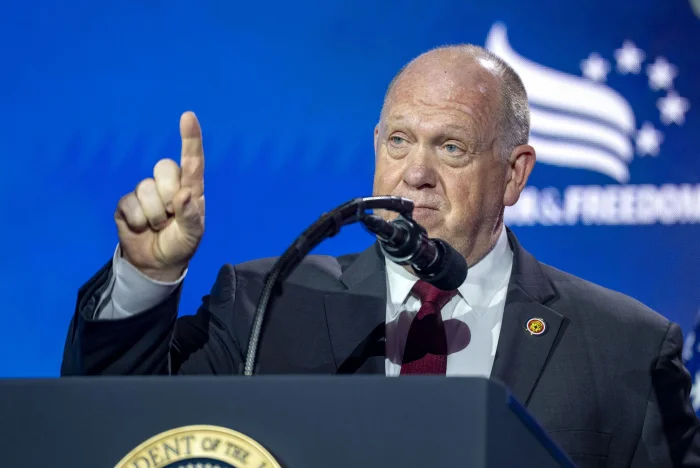
White House Border Czar Tom Homan speaks during the Faith and Freedom Coalition 2026 Road to Majority Policy Conference at the Washington Hilton on Friday. Photo by Bonnie Cash/UPI | License Photo
As the destructive Bobcat fire sent plumes of smoke billowing from the Angeles National Forest in 2020, Ryan Huling recalled that at the time news reports claimed the blaze caused “no injuries” and that no homes had been destroyed.
That irked the Sierra Madre writer, who watched from his cabin as flames incinerated the home of bears, coyotes, pumas and squirrels. He believes countless critters were killed or maimed by flames, and points to accounts of mountain lions emerging with singed paws and bears scrambling into communities.
“Anonymity has done them no favors, in the sense that people don’t know where they live, they don’t know what landmarks are important to them, they don’t know what areas carry special significance to bears and other animals,” Huling said.
Yet through his research he discovered that rapidly advancing technology — including artificial intelligence, GPS tracking and crowdsourcing — is revealing more about animal “societies” than ever before. The revelation launched him on a worldwide tour of non-human communities, culminating in his debut book, “The Hidden Nations of Animals.”
The cover of Ryan Huling’s first book, published in June.
(Penguin Random House)
Published this month, the book’s first chapter takes readers to North America’s “beaver belt,” roughly 1,100 miles in northern Canada that are jam-packed with beaver dams. According to Huling, the sheer density of those dams only became apparent thanks to technology that allows researchers to analyze high-resolution satellite imagery and identify them from space. One analysis found 2,700 dams surrounding a town of only about 1,000 people.
Another stop took him to Zambia, where African mole-rats dig complex tunnel systems that include designated nurseries, pantries and bathrooms. Just before Huling arrived, a researcher had used radio trackers to determine that the subterranean animals operate on a biological clock that has them alternate between a few hours of activity and a few hours of napping — not a bad work schedule!
Some of Huling’s other adventures include exploring a tornado of Mexican free-tailed bats outside of San Antonio and red-crowned cranes that have found refuge in the Korean Demilitarized Zone.
But uncovering these hidden worlds isn’t just left to the experts anymore. While the expense or difficulty of tracking wild animals has resulted in knowledge voids in the past, crowdsourcing is helping to fill in the gaps.
Today, any smartphone-toting nature lover can snap a photo of a great horned owl or a ground squirrel and upload it to a citizen science app such as iNaturalist. Some platforms are specialized, for example Merlin for birds and Happywhale for marine mammals. All that data is a rich playground for scientists. According to an article published last year in BioScience, iNaturalist data in peer-reviewed research grew tenfold in the previous five years.
Now, AI is making it so humans don’t have to necessarily look at the raw material. Instead, AI can mine images, videos or sound clips for the appearance of an animal of interest — or even catalogue individual critters. Happywhale has an AI feature that identifies particular humpbacks by unique patterns and shapes on their tails.
Technology is advancing so fast that Huling said it was hard to stay current. In his prologue, he mentions a researcher showing him a prototype of a teeny solar-powered radio tag for monarch butterflies. By the time the book hit the shelves, the concept was already live — harnessed, in one instance, to study how the brilliant orange insects use overwintering groves along the California coast. Just this week on Instagram, the California Department of Fish and Wildlife highlighted a study in which rare bumblebees are tagged with minute QR codes that can be read by remote cameras.
After about a half-year of travel, Huling returned home with a heightened awareness of what he calls “inconspicuous abundance” — that the world is teeming with more life than meets the eye. He puts this new lens to the test by venturing to the storm-battered shores of San Miguel Island off the coast of Santa Barbara. Considered “uninhabited” in the traditional sense, he finds that the rarely visited corner of Channel Islands National Park is a haven for lumpy seals, glimmering fish and squawking seabirds. Sharks lurk beneath the waves.
“For them, as now for me, this distinctive island remains anything but deserted,” he writes.
On San Miguel Island, Huling saw and heard hundreds of sunbathing seals and sea lions.
(Oliver Uberti / Penguin Random House)
In other animal news
Earlier this month, in Big Bear Lake, a memorial service was held for Sandy Steers, the late conservationist who was best known for turning two bald eagles into an international phenomenon by livestreaming their nest. It was a touching gathering, where Steers’ friends and colleagues got personal about a woman who they said was willing to go to the mat for her beloved raptors.
An illustration for “Hidden Nations” depicts author Huling at home, surrounded by the natural environment — including a black bear.
(Oliver Uberti / Penguin Random House)
For decades, Steers battled a planned development near the nest of famed eagle couple Jackie and Shadow, and helped to negotiate an agreement in which a land trust could buy the site for $10 million. The nonprofit she led is now racing to raise the money by July 31 so it can be bought and conserved.
In the desperately needed good-news department, endangered steelhead trout that scientists feared had perished in last year’s Palisades fire unexpectedly survived — and even had babies. It’s a big deal: they represent the last known population of steelhead in the Santa Monica Mountains.
A civil grand jury has found that the L.A. Zoo needs new leadership, citing deterioration of its facilities and rapidly declining membership. In less than a year, membership dropped 23% and exhibits for lions, bears, sea lions and pelicans have closed because they need major renovations.
Last summer, researchers made an astonishing discovery off the Sonoma County coast — 18 sunflower sea stars, a species decimated by disease and all but gone from California waters. SF Gate writes that the finding was only just announced, with scientists now racing to learn all they can about the survivors. As previously reported, the stars with up to 24 arms could hold the key to restoring the state’s ravaged kelp forests.
And news about the environment
This is the latest edition of Boiling Point, a newsletter about climate change and the environment in the American West. Sign up here to get it in your inbox. And listen to our Boiling Point podcast here.
Three Brazilians with a combined age of 316 have been recognised as the world’s longest-living trio of sisters. Researchers are studying their DNA to better understand the genetic factors behind healthy aging and exceptional genetic longevity.
Lawsuit claims Tesla’s Autopilot shortcomings led to fatal crash; family seeks $1m in damages and punitive measures.
Published On 24 Jun 202624 Jun 2026
The family of a Texas woman who was killed has filed a lawsuit against Tesla after a driver using a Model 3’s automated driving assistance system crashed into a suburban Houston home last week.
The complaint, filed on Tuesday, argues that Tesla should be held liable for the wrongful death of 76-year-old Martha Avila. The family alleges that the automaker, led by Elon Musk, failed to adequately warn drivers about alleged defects in its Autopilot and Full Self-Driving systems.
Recommended Stories
list of 4 itemsend of list
Avila’s daughter, Jennifer Barbour, and her husband, Justin Barbour, said the Model 3’s driver, Michael Butler, told law enforcement he engaged Autopilot before ploughing through the front wall of Avila’s home in Katy, Texas, the United States, on June 19, pinning her before she succumbed to her injuries at a nearby hospital, according to the complaint.
Video obtained by KHOU – Houston’s CBS affiliate — shows the car travelling at top speed over the front lawn of Avila’s home in the Houston suburb before slamming into the front room.
The driver told the Harris County Sheriff’s Office that he was using the technology at the time of the accident. The driver in the incident was not under the influence of alcohol and is cooperating with authorities.
Butler is also a defendant in the Barbours’ lawsuit. It is unclear whether he has a lawyer.
Musk, the world’s richest person, posted on X on Monday night: “FSD drives slowly through neighbourhood streets and this was a high-speed crash!”
Ashok Elluswamy, vice president of AI software at Tesla, posted on X in response, saying that “the driver manually overrode self-driving by pressing the accelerator all the way to 100% of the accel pedal in this residential area.”
The lawsuit filed in a Harris County, Texas, state court seeks more than $1m in damages, and punitive damages reflecting Tesla’s alleged “reckless disregard for a substantial risk of severe bodily injury”.
The National Highway Traffic Safety Administration (NHTSA) has been investigating the crash.
Since 2016, the NHTSA has opened nearly 50 special investigations of Tesla crashes believed to involve advanced driver assistance systems. About two dozen deaths were reported.
In March, the NHTSA escalated its probe into 3.2 million Teslas equipped with Full Self-Driving, on concern the system may fail to detect or warn drivers in poor visibility. In 2023, Tesla recalled about two million vehicles, nearly all of its electric vehicles on US roads, to better ensure that drivers pay attention when using Autopilot.
Tesla has said Autopilot enables vehicles to steer, accelerate and brake within their lanes, while Full Self-Driving lets vehicles obey traffic signals and change lanes.
The carmaker has also said both technologies require “fully attentive” drivers whose hands are on the wheel.
The incident comes as the Musk-owned company is rolling out robotaxis using automated software in several US cities this year and plans to invite Tesla owners across the country to put their cars into the fleet using the same system.
China’s LineShine overtakes US-based El Capitan as most powerful supercomputer, according to the TOP500 list.
Published On 24 Jun 202624 Jun 2026
China has displaced the United States on an influential ranking of the world’s fastest supercomputers, underscoring Beijing’s growing capability to compete with the world’s leading superpower in cutting-edge technology.
China’s LineShine is the most powerful system on the planet, overtaking the US-based El Capitan, according to the biannual ranking announced in Hamburg, Germany, on Tuesday.
Recommended Stories
list of 4 itemsend of list
LineShine, located at the National Supercomputing Centre in Shenzhen, achieved a performance of 2.198 exaflops, carrying out more than 2 quintillion calculations per second – a 20 percent lead over El Capitan, according to the latest TOP500 list.
LineShine’s position marks the first time a Chinese system has topped the list since Sunway TaihuLight did so in 2017.
El Capitan, based at Lawrence Livermore National Laboratory in California, had ranked as the top-performing system since November 2024.
Frontier, hosted by the Oak Ridge National Laboratory in Tennessee, ranked third, followed by Aurora at the Argonne National Laboratory in Illinois and Jupiter at the Jülich Supercomputing Centre in Germany.
Other countries represented in the top 20 include the UK, Japan, South Korea, Italy, the Netherlands, and Switzerland.
Unlike other supercomputers, LineShine runs entirely on general-purpose central processing units (CPUs), which have fewer processing cores and are slower at performing complex tasks than the graphics processing units (GPUs) indispensable to running AI models, such as ChatGPT and Claude.
LineShine is the first and only system to achieve more than 2 exaflops in performance using a CPU-only design, according to the TOP500 list.
The TOP500 list has been published twice yearly since 1993, when computer scientists Erich Strohmaier and Hans Meuer first compiled statistics on supercomputers around the world in preparation for a conference on the topic.
The list ranks supercomputers’ performance using the LINPACK Benchmark, which measures the amount of time it takes to solve a dense system of linear equations.
While the TOP500 list has been influential for decades, experts consider the ranking to have become less relevant since the advent of AI.
While corporate tech giants such as Microsoft and Amazon are at the forefront of today’s advances in AI, the list is largely made up of government and academic initiatives that volunteered their participation.
In a 2015 paper, researchers at Cornell University estimated that El Capitan achieved only 22 percent of the computational performance of xAI’s Colossus supercomputing facility in Memphis, Tennessee.
China and the US are locked in a fierce battle for global supremacy in leading technologies such as AI, with Washington and Beijing rolling out a slew of tit-for-tat sanctions and export controls to blunt each other’s advances.
The 2026 AI Index Report, released in April by Stanford University, found that China had “effectively closed” the AI model performance gap with the US.
While the US produces more top-of-the-line AI models, China holds the advantage in rolling out patents and industrial robot installations, the report said.
June 23 (UPI) — U.N. Secretary-General Antonio Guterres called for AI companies to disclose what the environmental impact of data centers will be by 2030 during a speech Tuesday at London Climate Action Week.
Guterres said that the AI boom and the world’s dependence on oil are driving the climate crisis and laid out plans to curb the damage.
“These crises may seem separate but they share the same destructive origin: fossil fuels,” Guterres said. “And they demand the same answer: a fast, fair transition to clean energy and a surge in adaptation, resilience and climate justice for those already facing climate harm.”
The United Nations’ seven-point plan for energy independence includes quickly cutting emissions to reach net zero emissions by 2050. This would mean the amount of greenhouse gases emitted into the atmosphere are balanced out by the amount of greenhouse gases removed from the atmosphere.
The plan also calls for an acceleration of developing and adopting clean energy, transparency from AI firms on their environmental impact by 2030, ensuring the transition to clean energy is equitable in its job creation and community support, investment in early warning systems, expanding funding for developing countries and combatting climate disinformation.
The United Nations said scientists it supports are warning that average annual temperatures are likely to exceed the 1.5-degrees Celsius above pre-industrial levels target set out by the Paris Climate Accords adopted in 2016. It notes that the United States withdrew from the agreement for the second time under President Donald Trump.
“Every fraction of a degree matters,” Guterres said.
LG Chem CEO Kim Dong-chun speaks during a town hall meeting at the company’s head office in Seoul on Monday. Photo by LG Chem
SEOUL, June 23 (UPI) — South Korea’s LG Chem said Tuesday it will invest nearly $10 billion over the next decade to foster futuristic industries powered by the artificial intelligence boom.
The Seoul-based company plans to spend $9.7 billion on research and development through 2035, concentrating on advanced materials for semiconductors, mobility, robotics and anticancer drugs.
LG Chem said that the initiative comes as profitability in its traditional petrochemical business dipped because of global oversupply and fierce competition.
Through the investment, the chemical giant vowed to achieve a double-digit operating profit margin by the end of the decade.
To complement its organic growth strategy, LG Chem said it will pursue external growth opportunities, including mergers and acquisitions. It recently established an organization dedicated to that goal.
LG Chem unveiled the long-term strategy during a town hall meeting Monday, where CEO Kim Dong-chun stressed the need to strengthen both existing businesses and future growth engines.
“While strengthening the competitiveness of our existing businesses, we will focus our capabilities on future growth pillars to leap forward as a technology-driven converting company,” Kim said.
LG Chem defines a “tech-driven converting company” as an enterprise that leverages its accumulated technological expertise to create high-value-added products and differentiated profit streams.
The share price of LG Chem plunged 9.75% on the Seoul bourse on Monday, while the benchmark KOSPI plummeted 9.99%. LG Chem is a major subsidiary of LG Group, whose businesses also include LG Electronics, LG Display and LG Uplus.
Jinxin Technology (NAMI) said it will change its ADS ratio from one ADS representing 18 ordinary shares to one ADS representing 450 ordinary shares, a move equivalent to a 1-for-25 reverse ADS split.
The China-based digital content service provider said the ADS ratio change is expected to become effective on June 25, 2026.
Under the change, ADS holders of record at the close of business on the effective date will exchange every 25 existing ADSs for one new ADS.
The stock price traded about 17% lower on Tuesday during pre-market trade.
House Energy and Commerce Committee Chairman Brett Guthrie, R-Ky., and ranking member Frank Pallone, D-N.J., announced the agreement that will set new standards for online platforms in respect to child users. File Photo by Annabelle Gordon/UPI | License Photo
June 22 (UPI) — Leaders in the House Energy and Commerce Committee announced a bipartisan agreement Monday to advance the Kids Online Safety Act.
Committee Chairman Rep. Brett Guthrie, R-Ky., and ranking member Rep. Frank Pallone, D-N.J., announced the agreement that will set new standards for online platforms in respect to child users.
The committee passed the Kids Internet and Digital Safety Act in March on partisan lines but Monday’s deal brings some changes to the bill.
“Coming into this Congress, we knew that protecting children and teens online would be one of the most significant challenges this committee would have to address,” Guthrie and Pallone said in a joint statement. “Through empowering parents, establishing safety as a default, strengthening privacy for children and teens, increasing transparency around data brokers, and holding Big Tech accountable, the KIDS Act delivers the 21st century protections parents have demanded and our kids deserve.”
The updated bill is expected to be considered on the House floor next week.
The Senate is considering a different version of the Kids Online Safety Act. If the House bill passes, the differences between the bills will need to be resolved.
One of the key distinctions in the House version of the bill is the absence of a duty of care standard which would require social media companies to design their platforms with the safety of children in mind. This includes implementing measures that block children from consuming age-inappropriate content and assures the platform’s design does not contribute to compulsive use.
States would be allowed to implement stricter regulations.
President Donald Trump presents a Medal of Honor to Tom Ripley on behalf of his father, John W. Ripley, during a Medal of Honor award ceremony in the East Room of the White House on Thursday. Photo by Aaron Schwartz/UPI | License Photo
WASHINGTON — In congressional races across the country, a new crop of super PACs is taking to the air with millions of dollars worth of advertisements to sway voters.
“President Trump said it best, ‘Celeste Maloy will never let you down,’” says one advertisement supporting the Utah Republican representative in her upcoming primary election.
“Standing up to big pharma, fighting for local jobs, Val Hoyle doesn’t back down,” says an ad backing the Oregon Democratic representative ahead of her primary victory last month.
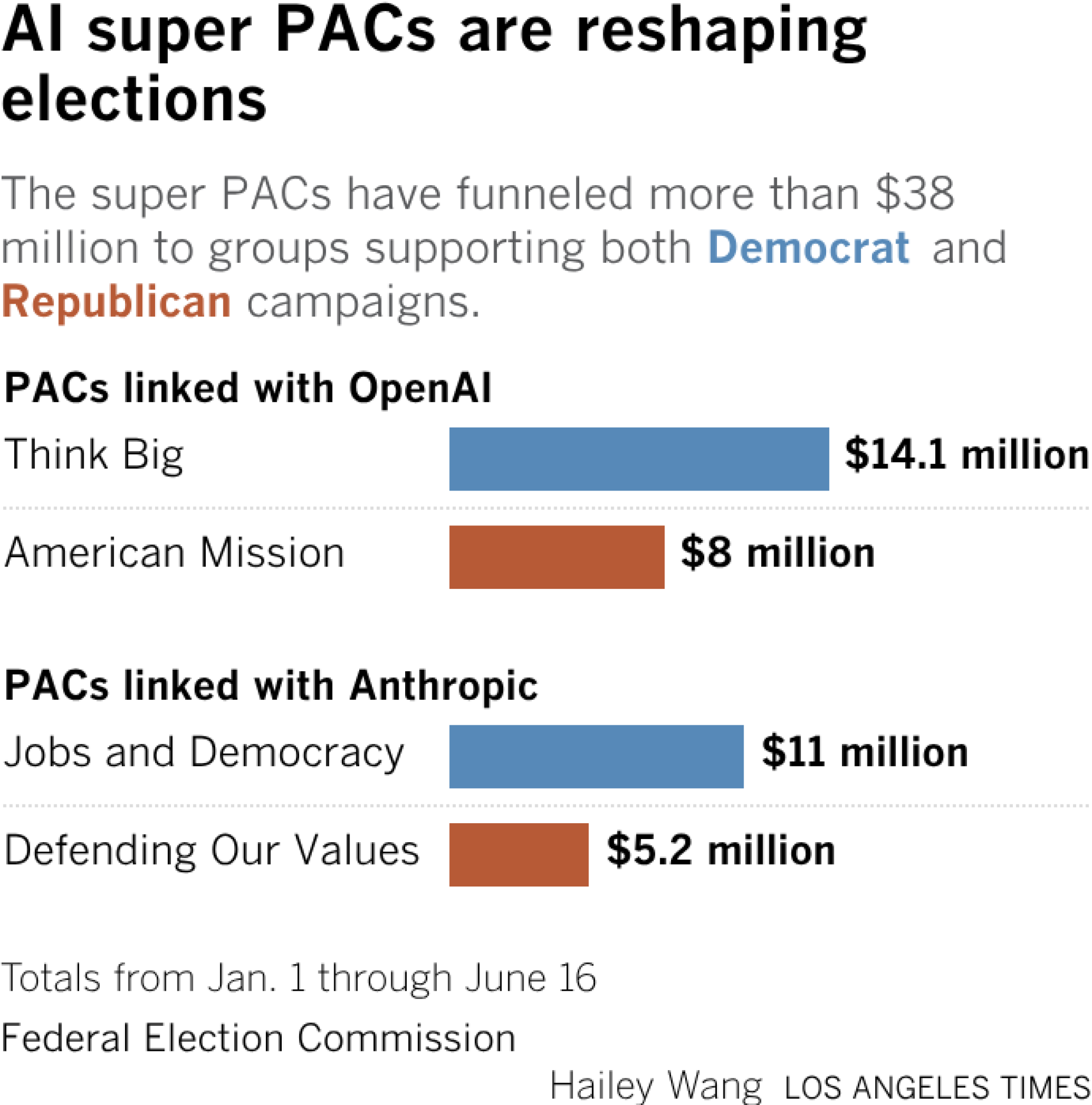
The super PACs have nondescript names — such as Jobs and Democracy PAC and American Mission — and the text is so generic that it almost seems to have been created by artificial intelligence.
That isn’t so far off the mark. The AI industry has funded the ads.
One network of super PACs is linked to Anthropic, maker of the popular AI tool Claude, and the other to Open AI, maker of ChatGPT.
They have been among the most prolific political spenders so far in the 2026 midterm elections, splashing out more than $37 million to date to influence races across the country and making the groups among the biggest outside spenders so far in congressional races. That number could grow exponentially as campaign season heats up closer to the November election — and as the Silicon Valley giants prepare initial pubic offerings that are poised to raise billions of dollars for the companies and their executives.
The AI political spending boom comes as emerging technology companies have become increasingly “comfortable with using their power to achieve a political goal,” said Adam Kovacevich, a former Google public policy executive and founder of Chamber of Progress, a technology trade group with a progressive orientation.
The leading AI companies have a history.
Anthropic was formed by former OpenAI employees who were concerned that the company was less focused on its original mission to safely harness the power of AI.
The companies are now the leading drivers of the burgeoning AI industry, and their competing views about how the technology should be regulated are playing out in a wide-ranging political ad spending war that has targeted congressional races in big cities and rural areas alike.
Anthropic calls for more stringent regulation and supports efforts by states such as New York and California that have passed more aggressive AI laws.
The groups spending in these races are super PACs, which are able to raise and spend unlimited amounts of money in federal races thanks to the 2010 Citizens United Supreme Court decision.
In some races, the AI-backed political groups have spent more than the candidates they are backing.
“There was no way as a grassroots person that I could compete with that kind of money,” said Al Olszewski, whose opponent in a Montana Republican congressional primary beat him by 30 points after getting a boost from $877,000 in ads from a super PAC backed by OpenAI’s co-founder. “I got crushed.”
The AI behemoths have emphasized that they are independent from the political groups.
One group counts $25 million in support from OpenAI co-founder Greg Brockman and his wife, Anna, alongside $100 million tied to one of Silicon Valley’s biggest venture capital firms, which holds a large stake in OpenAI. The global policy chief for OpenAI was reportedly involved in conceiving the group.
The other side has gotten $20 million from Anthropic and millions more from donors whose identities are not public.
This anonymous political cash is commonly known as dark money, and its prevalence is growing.
(Los Angeles Times photo illustration; source photos courtesy of the Tech Oversight Project)
“This has become very normalized now,” said Brendan Glavin, director of insights at OpenSecrets, which tracks campaign spending. “In 2024, we tracked over $1 billion in dark money.”
The political activity of these AI companies and executives reflects a dramatic shift from how emerging technology companies have historically engaged with politics.
Google, for example, didn’t hire its first in-house Washington lobbyist until after the company had gone public in 2005.
“I think that for a long time, the tech industry lobbying strategy was just ‘leave us alone,’” Kovacevich said.
He sees the spending by these AI-linked super PACs as following the recent playbook developed by the cryptocurrency industry, which has funded the only network of political groups that has spent more on congressional races this year than those linked to OpenAI.
“I think what the crypto industry realized was that there’s no substitute for building up political power,” Kovacevich said.
The political stakes for these technology companies are significant.
“AI policy is far from settled,” said Asad Ramzanali, the former deputy director for strategy in the White House Office of Science and Technology Policy during the Biden administration and the director of artificial intelligence and technology policy at the Vanderbilt Policy Accelerator.
Earlier this month, the Trump administration banned foreign nationals from using the most powerful AI model developed by Anthropic — and even banned the company’s own employees from it — which forced the company to restrict access for all users.
Manhattan matchup
The two super PAC networks have largely shied away from producing ads that mention AI and have mostly chosen to avoid competing against each other in the same races.
There’s one big exception.
In the marquee Manhattan Democratic congressional primary to replace retiring Rep. Jerry Nadler (D-N.Y.), each side has spent millions of dollars.
While the field includes Kennedy scion and social media star Jake Schlossberg and former Republican turned Trump critic George Conway, the target of all the AI-backed spending has been Alex Bores, a former Palantir data scientist who now serves in the New York state Assembly.
New York congressional candidate sponsored a state measure Bores requiring major AI companies to be transparent about their safety protocols and promptly report safety incidents.
(Yuki Iwamura / Associated Press)
That’s because Bores sponsored a state bill, known as the RAISE Act, that requires major AI companies to be transparent about their safety protocols and promptly report safety incidents. The bill was signed into law in December 2025.
The ads sponsored by the group tied to OpenAI, which has spent more than $7.5 million in the race, paint Bores as someone who can’t be trusted.
They cite his support from other tech billionaires, including former crypto mogul and convicted financial fraudster Sam Bankman-Fried, whose super PAC spent $100,000 to support Bores in 2022 when he first ran for New York Assembly.
“Is that really who should be shaping AI safety for our kids?” one ad asks.
An ad sponsored by the Anthropic-backed network, which has also spent more than $7.5 million supporting Bores, makes the case that the bill he sponsored is exactly why he should be elected.
“As a computer engineer, Alex Bores saw how dangerous unregulated AI could be and he wrote New York’s RAISE Act to put real safeguards on A.I. and hold big tech accountable,” the ad says.
The AI ad barrage in New York has even included what might be considered a kumbaya moment in the ad wars — another super PAC created to support Bores is most heavily backed by both an employee of Anthropic and an employee of OpenAI, who both focus on AI safety.
The group, Dream NYC, has spent more than $1.7 million supporting Bores.
Bores and fellow New York State Assemblymember Micah Lasher have been atop the most recent polls in the race ahead of the June 23 primary.
A general view of businesses in St. George, Utah, on Wednesday.
(Ian Maule / For The Times)
Rural Republicans
For voters in many parts of the country, the debate over AI policy has played out locally as a debate over the massive data centers required to power the technology.
In Utah, a proposed data center in Box Elder County, backed by “Shark Tank” television personality Kevin O’Leary, has generated controversy because of questions about its impact on resources in the drought-prone state and its environmental effect on the nearby Great Salt Lake.
In the state’s most competitive Republican congressional primary — the vast, newly drawn 3rd Congressional District — both candidates expressed concerns about how the project has been developed and called for greater transparency in this plan and for future data centers in the state.
Utah congressional candidates Phil Lyman and Celeste Maloy in a debate on June 1. A super PAC backed by Anthropic has spent more than $920,000 to support Maloy.
(Rick Egan / Pool / The Salt Lake Tribune Via Associated Press)
Despite their similar position on the project, a super PAC backed by Anthropic has spent more than $950,000 to support Maloy, who is running in the new district after the boundaries of her old district changed.
“It’s a lot of money to throw at a race,” said her opponent, Phil Lyman, a former conservative Republican state Representative who ran to the right of Utah Republican Gov. Spencer Cox in an unsuccessful primary challenge in 2024.
Lyman insists he is no AI skeptic.
“I’m not anti data centers, I’m pro-transparency,” he said. “I think the future is bright with AI.”
The group said it is backing Maloy because it sees her as “someone who’s worked the issue” of AI regulation and who “has demonstrated leadership” with Republicans in Congress.
Maloy’s campaign didn’t respond to request for comment.
Utah congressional candidate Phil Lyman speaks during a Cottage Meeting at the SunRiver Community Center Ballroom in St. George, Utah, on Wednesday.
(Ian Maule / For The Times)
But Lyman suspects the group’s support for Maloy ahead of their June 23 primary has more to do with old-fashioned politics than any emerging technology.
Tunisia goalkeeper Aymen Dahmen makes an “unbelievable save” to prevent Japan from doubling their lead by the finest of margins, in their 2026 World Cup match at Estadio Monterrey.
For decades, historian’s discussion about colonialism has revolved around large armies, territorial conquests and vast empires. Yet, they often fail to focus on the fact that one of the most powerful empires did not begin with soldiers – it emerged because of corporations. The British East India Company, in 1600 started its commercial activities in the sub-continent, initially as a trading merchandise seeking profit in foreign markets. Within the period of two centuries, it acquired its own military, expanded its territorial influence, and started acting as a ruling government that ultimately blurred the difference between private capitalist enterprises and sovereign national authority. More than two hundred years later, Artificial Intelligence (AI) is the latest incarnation of that colonial legacy. Unlike previous forms of colonialism of territory and resources, this control is primarily centered around data, algorithmic decision-making systems, and automated computation. Their territories are not like land, it is the dominance over data ecosystems; their currency is not raw materials, it is ‘data’, and their empires are not built on castles, but are gigantic ‘data-centers’. Instead of emancipation for the marginalized, this technology creates new forms of dependency known as ‘digital dependency’.
The 21st century is witnessing a growth of an imperial empire that is built on establishing control over datasets, computational power, and algorithmic sovereignty. Where a few Chinese and American tech giants such as NVIDIA, Amazon Web Services, Google Cloud, and Microsoft Azure are controlling the digital markets through complete ownership of cloud platforms, chip production, and algorithmic intelligence. These hegemonic corporations act as imperial powers that perpetuate similar inequalities to traditional colonists, in which the global south risks becoming a resource for the tech giants. The comparison might seem like an exaggeration, but in reality AI colonialism follows similar patterns. Historically great economies were built on extraction; they extracted raw materials from peripheries, and then the industrial base at the center transformed into a worthy product, geopolitical influence, innovation, and wealth. Cotton flowed from subcontinent to Britain; rubber moved from southeast Asia to European countries, while minerals obtained from Africa were sent to imperial empires.
Today, the AI economy adopts an akin model where “data” is the vital material for digital functioning. Millions of people from the south utilize these platforms; every search, GPS location, digital personal profile, and digital transaction becomes part of the data ecosystem that is required for its training, but their economic value is located elsewhere. It is particularly evident in African countries, where millions of people rely on these foreign platforms for information. Their data from search engines, digital databases, and social media, is then used to train the AI models, whilst the African community receives little economic benefit or no influence over how these technologies are deployed in their region. By controlling these giant data ecosystems, these tech conglomerates also gain leverage over their political, social, cultural, and economic affairs. Even though having a digital footprint is a sign of progress, when it is foreign owned or funded by external actors, it can be manipulated as imperialistic power that not only controls the data system, but also significantly affects the local traders and businesses.
Similar to east India companies, these tech corporations operate across national jurisdictions, shape economic trajectories and influence domestic governments to sustain their digital dominance. They shape information systems, and their regimes of truth. They decide which technology should be introduced in the market, at what cost, what conditions, and for whom. The east India company governed India not through military conquests but because the local leaders became dependent on the commercial and political networks controlled by the corporation. Their economic dependency paved the way for the east India company’s takeover. Today, the danger is not that the tech corporations will rule the state directly, rather it is the fear that the national governments will become so dependent that the exercises of their sovereign autonomy will be meaningless. AI colonialism is at the front, recreating the colonial dependency traps.
Another manifestation of ‘digital colonialism’ in the global south is the extraction of data through coercive bundles of consent forms. Most people from third-world countries click ‘accept all’ to install an app or to log into a website without reading its full contents. It is an illusion of ‘choice’ created by these companies, but in actuality, these people have no choice. If they ‘refuse’ to click they might lose their access to digital accounts, bank apps, or mobile services. Colonial powers used a similar tactic of ‘terra nullius’ to lay claim on foreign land and resources. The new digital ecosystems are now integrating modern forms of terra nullius to govern the global data and algorithmic infrastructures. In addition to controlling the databases, the new AI colonial world order exploits the cheap labor services of the global south to maximize their profits. During Venezuela’s economic crisis, the prime educated force was readily exploited as ‘cheap labor’ by the Silicon Valley. In exchange for survival income, they were exposed to precarious working conditions, pay-cuts, unstable contracts. This reflects that the AI colonialism is following the legacy of historical empires step-by-step; controlling foreign ecosystems, exploiting cheap labor, and profiting over their raw materials.
The digital hegemony in the global south extends beyond economical matrix; it is the struggle over political influence, power, and raw materials that will ultimately determine who will produce the knowledge, who controls the technology, and who profits off the wealth generated by AI ecosystems. Colonial history should not be merely viewed as the ancient past, but as a lesson to reject the ‘modern empires’. In order to do so, the global south must invest in indigenous technology companies, data systems and regulatory digital frameworks to protect the local’s data. Unless the global south acts collectively against AI colonialism, it may again serve as a colony supplying critical resources that enrich others whilst itself remains excluded from the global power centers.
Artificial intelligence education now starts at the age of six in China. The Ministry of Education has rolled out new guidelines to teach AI at every grade level. For President Xi Jinping, AI is a priority. Will the toddlers of today be the tech titans of the future?
This is a story from the archives. This originally aired on September 18, 2025. None of the dates, titles or other references from that time have been changed.
Episode credits: This episode was produced by Amy Walters, Sonia Bhagat, Sarí el-Khalili, and Tamara Khandaker, with Phillip Lanos, Spencer Cline, Melanie Marich, Kisaa Zehra, Farhan Rafid, and our host, Malika Bilal. It was edited by Kylene Kiang.
Our sound designer is Alex Roldan. Our video editors are Hisham Abu Salah and Mohannad al-Melhem. Alexandra Locke is The Take’s executive producer.
When Brian Grazer has an idea for a movie, he now starts with a chatbot. The co-founder of Imagine Entertainment — the company behind “A Beautiful Mind,” “Apollo 13” and “Liar Liar” — said he sits down with Anthropic’s AI assistant, Claude, to rough out a story before handing it to a writer.
“You can build the whole thing into an outline. You still need a screenwriter. I always believe you need a screenwriter,” Grazer said during a keynote at UCLA’s Entertainment Symposium on Thursday. What once could have taken up to a year, he said, now takes him about a week — but the human writer stays.
That balance — AI as an accelerant rather than a replacement — captures where much of Hollywood has landed in practice. Amazon MGM, Lionsgate, Netflix and Disney have all made major investments in the technology. The sharper question at the symposium, which drew many of the industry’s top lawyers and dealmakers to the Westwood campus, was not whether to use AI but how: who authorizes it, how far it goes and who gets paid.
For the companies building the tools, the answer increasingly comes from the client. Studios, production companies and distributors regularly approach Promise, a generative AI company, to bring AI into their productions, and each arrives with its own usage guidelines, said the company’s president, Jamie Byrne. Those rules govern which AI models Promise may use and what protections apply — effectively letting each client decide how heavily AI figures into the work.
“It comes down to a risk appetite,” Byrne said during a panel on AI. “We know that there’s talent that are staunchly against it. We know that there are many who are okay with it.”
He framed adoption as a competitive necessity: “Every time there’s a technology change, certain studios or production companies rise. Others fall, and it’s usually the ones that are not leaning into the new tool.”
Ron Howard, also of Imagine Entertainment, argued the limits will ultimately be set elsewhere — by viewers. “Sure, it’s about efficiencies and budgets, but more than anything, audiences are going to tell us where those restrictions are,” he said. He expects AI-generated content to settle into its own subgenre over time, with audiences signaling what they will accept.
The most contested ground is labor, where consent has become the dividing line. The emergence of synthetic performers such as Tilly Norwood has made AI a central issue in SAG-AFTRA’s contract. The union’s most recent agreement draws a clear line between authorized digital replicas, which use a performer’s likeness with their consent, and fully synthetic creations.
Talent agencies are organizing around the same principle. In recent years, Creative Artists Agency began digitally scanning clients into what it calls the CAA Vault, building a replica of a client’s image, likeness and voice while leaving the talent in complete control of how it is used.
That control is beginning to carry real value, said Tammy Brandt, CAA’s deputy general counsel, who said she is seeing more deals that involve digital likeness. Hollywood has been slow to work out how to monetize these replicas, she said, but once it does, audiences will start to encounter them more often.
“You have to lean into the technology and understand what it can do, and honestly, how you can make money, work with talent and with creative assets in a way that the user is interested in,” Brandt said. “There’s a little bit of trial and error as you go with that.”
US Department of Justice claims NAACP lawsuit threatens ‘national, economic, and energy security’.
The United States government has intervened on the side of Elon Musk’s xAI in a legal dispute over a $20bn data centre, claiming that efforts to block a related power project threaten national security.
In a court motion filed this week, the Department of Justice requested the dismissal of a lawsuit accusing xAI of illegally operating dozens of natural gas turbines erected to power the Colossus 2 data center in Memphis, Tennessee.
Recommended Stories
list of 4 itemsend of list
The National Association for the Advancement of Colored People (NAACP), the largest civil rights group for African Americans, filed the lawsuit in April under the 1963 Clean Air Act, which allows citizens to seek injunctions and civil penalties against alleged polluters.
The NAACP alleges that xAI built the turbines, located in nearby Southaven, Mississippi, without obtaining the necessary permits, exposing hundreds of thousands of residents to harmful pollutants linked to “increases in asthma, respiratory diseases, heart problems, and certain cancers”.
The lawsuit notes that a “much larger share” of residents are Black compared with the US general population.
In its motion, filed in a US District Court on Monday, the Justice Department accused the NAACP of threatening “national, economic, and energy security by seeking to shut off the power supply for artificial intelligence innovation that supports the Department of War’s military operations”.
The motion also claims that the US Constitution vests the power to seek civil penalties “conclusively and preclusively” in the executive branch, including the “discretion to decide when such an enforcement action is unwarranted or inconsistent with federal enforcement priorities”.
Adam Gustafson, the top prosecutor at the Justice Department’s environment and natural resources division, said in a statement that the government would “not sit idly by while private organisations use environmental laws to undermine our national security”.
xAI, which is a subsidiary of Musk’s SpaceX, did not immediately respond to a request for comment.
Elon Musk listens to a speech by Chinese President Xi Jinping during a state dinner with US President Donald Trump at the Great Hall of the People, in Beijing, China, on May 14, 2026 [File: Mark Schiefelbein/AP]
Earthjustice, an advocacy group representing the NAACP in the lawsuit, condemned the intervention as a “massive power grab” by President Donald Trump’s administration.
“Trump’s Justice Department wants to shield Elon Musk’s data center company, xAI, from being held accountable for its illegal pollution – and it’s attempting to grab power from impacted communities, the courts, and Congress to do so,” Laura Thoms, director of enforcement for Earthjustice, said in a statement.
“There is no moral or legal precedent for this.”
Ann Carlson, a professor of environmental law at UCLA School of Law, described the Trump administration’s argument as a “brazen attempt” to limit enforcement of the Clean Air Act.
“It’s based on a radical notion that the executive branch can dismiss lawsuits brought by citizen groups that Congress has authorised based on no rationale at all,” Carlson told Al Jazeera, adding that the Justice Department’s position would let “polluters off the hook even for blatant violations of the law.”
“This motion is also just one of many ways in which the administration is undermining efforts to protect air quality,” Carlson said.
The Trump administration has cultivated close ties with Musk, the world’s richest man, tapping the tech titan as a temporary cost-cutting tsar and using xAI’s flagship model Grok in the Pentagon’s drive to become an “AI-enabled fighting force”.
In testimony in support of Monday’s motion, Cameron Stanley, the Pentagon’s top official for AI, said that Grok had been used to launch more than 2,000 munitions at 2,000 targets within the first 96 hours of the US-Israel war on Iran.
If Grok cannot be deployed and upgraded due to “limitations in energy supply or limited reserve compute capability”, numerous tools used by the Pentagon would be “severely impacted”, Stanley said in a declaration made under oath.
The lawsuit originally filed in September focused on broader alleged misappropriation of confidential information.
Published On 15 Jun 202615 Jun 2026
A United States federal judge has dismissed a lawsuit by Elon Musk’s artificial intelligence company xAI that accused rival Sam Altman’s OpenAI of stealing trade secrets for chatbots.
US District Judge Rita Lin in San Francisco said on Monday that xAI failed to show that OpenAI induced former xAI senior engineer Xuechen Li to divulge confidential information related to its Grok chatbot, or that OpenAI engineers knew Li might have disclosed any.
Recommended Stories
list of 4 itemsend of list
Lin dismissed the lawsuit with prejudice, saying it would be “futile” to continue. She dismissed an earlier version in February. The lawsuit originally filed last September focused on broader alleged misappropriation of confidential information, including source code, by xAI employees who left for jobs at OpenAI.
Monday’s decision is Musk’s second legal loss against OpenAI in four weeks.
On May 18, a federal jury ruled against Musk, the world’s richest person, in his $150bn lawsuit accusing OpenAI and Altman of “stealing a charity” by betraying the company’s original mission as a nonprofit to enrich themselves.
The xAI business is part of Musk’s rocket, satellite and AI company SpaceX.
Lawyers for xAI did not immediately respond to requests for comment. OpenAI and its lawyers did not immediately respond to similar requests.
Discussing past work
The amended complaint focused on a presentation that Li gave while OpenAI was recruiting him.
Musk’s company said OpenAI wanted secrets related to the July 2025 release of Grok 4, knowing its forthcoming update to ChatGPT “could not compete” on complex reasoning, and because OpenAI was “lagging” in reinforcement learning and post-training techniques that Li understood.
But the judge said asking job candidates to discuss their prior work was routine, and one could not infer that OpenAI pushed Li to leak anything confidential.
“To hold otherwise would potentially expose employers to liability any time they inquire about a candidate’s past work,” Lin wrote.
OpenAI has said Li never worked for the company and that it never acquired xAI secrets.
In seeking dismissal, lawyers for OpenAI wrote: “OpenAI does not need or want anyone’s trade secrets, especially not from xAI, which is failing in the marketplace and hemorrhaging talent.”
Li is being sued separately by xAI and has denied wrongdoing.
Critical infrastructure, such as water utilities, energy grids, healthcare systems, manufacturing plants, education platforms, and transport networks, have become primary targets of ransomware groups. In late April and early May 2026, for instance, Shinyhunters, a hacking group, breached Instructure, an education platform used by K-12 schools and universities across the US, and claimed for ransom. In the report published on CNN, the hacker group said it had breached 275 million personal data and had access to billions of private messages, an action that has affected thousands of schools, causing learning disruptions. Cybercriminals target critical infrastructure because downtime means communities don’t get access to essential services. So, operators or service providers have no option but to pay ransom to restore services quickly. Security gaps also influence the growth of these attacks. Too often, organizations focus on recovery efforts and ransomware encryption instead of prevention. This post highlights ways to prevent ransomware at its early stages, including the use of zero trust architecture and AI.
Promote Cybersecurity Awareness
Ransomware incidents start with malicious malware being injected into tech infrastructure. It then encrypts data and systems, restricting organizations any access to their operations until a ransom is paid. For these attacks to be successful, however, threat actors rely on social engineering attacks like spoofing and phishing, which target employees. An attacker will send a phishing email, impersonating an executive or trusted source like a bank to trick the victim into sharing credentials. Today’s spam emails, especially those generated by AI, are flawless, meaning staff can easily open and click on malware links without suspecting any threat. So, it’s crucial that employees receive adequate training on how to spot and respond to phishing texts or emails and malicious links.
Workers should also know how to generate hard-to-hack passwords. Weak passwords or using the same password for multiple accounts creates an entry point for ransomware. Encourage the use of password phrases, which are a string of unrelated, random words, symbols and numbers. For example, a password like purplegiraffesingstomorrow@17 prevents brute-force logins because a hacker will have a hard time guessing. Alongside passphrases, emphasize the importance of multi-factor authentication, where staff use two or multiple authentication methods to gain permission to accounts.
Enhance Threat Detection and Monitoring Systems
Detecting ransomware at its early stages helps prevent full encryption of sensitive data and infrastructure. And it entails identifying subtle behaviors of the threat, such as lateral movement across networks and devices, data exfiltration, and privilege escalation. Look out for unusual login or data access, increases in CPU usage, and abnormal network traffic to command-control servers. Modern attacks powered by AI and machine learning bypass legacy security systems by using legit utilities like PowerShell scripts and MimiKatz. So, check if there are attempts by script-based systems like PowerShell to inject suspicious code into running processes. Also, inspect if endpoints and firewalls are still running. Attackers often switch them off or configure settings without authorization to create a weak point for malware injection.
Note: lateral movement and zero-day variants aren’t always easy to spot. You need to integrate multiple security tools to detect and mitigate attacks. Use endpoint detection and response tools to catch harmful scripts and abnormal file access before all your data is encrypted. Take advantage of AI-assisted behavioral analytics to learn data access patterns, set a baseline for normal user behavior, and send alerts when there’s unusual or irregular file access patterns to protect against infostealers. Since infostealers act as the initial access for attack vectors, stopping them eliminates the entire kill chain. You can also reinforce your security measures by working with a 24/7 AI-centric SOC. These security experts don’t just distinguish legitimate logins from malware injections. They isolate the host to stop further compromise.
Network Segmentation and Zero Trust Framework
The goal of these two security measures is to limit a hacker’s ability to infect an entire network. Segmenting your networks entails dividing your networks into smaller, isolated sub-networks that make it difficult for cybercriminals to navigate critical network infrastructure. In a situation where a device is compromised, segmentation locks the attack within the specific zone, ensuring it doesn’t access databases or other sub-networks. What does zero trust entail and how does it mitigate ransomware? This tactic works on one strict principle: ‘never trust, always verify’. It doesn’t matter if you’re an authorized user or the devices you’re using are inside the organization. With zero trust in place, every access request is authenticated continuously. Also, users are granted permission to data and tools based on their roles to minimize privilege. Even if an attacker stole credentials, they would be limited to access systems. When combined, zero trust architecture and network segmentation strengthen an organization’s cyber safety strategies.
Hackers know that when they infect essential infrastructure with ransomware, victims will act fast to settle the ransom required to get encryption keys. But service providers shouldn’t wait until an attack has occurred to secure infrastructures. Prevention is the most effective strategy, and it revolves around simple hacks like educating workers about common threats and using strong pass phrases alongside MFA. By detecting threats, implementing zero trust, and network segmentation, organizations can minimize ransomware-related risks.
Was Switzerland’s Remo Freuler offside before he was brought down by Qatar goalkeeper Mahmoud Abunada?
It is the question that, for many, remains unanswered despite Fifa finally releasing images four and a half hours after the incident happened.
The move led to a penalty, converted by Breel Embolo, as the teams drew 1-1 in Saturday’s World Cup Group B match in Santa Clara.
Before the tournament Fifa put a lot of stock in its new, enhanced semi-automated offside system.
World football’s governing body scanned every player at the World Cup to create unique, lifelike avatars.
It was supposed to provide the most accurate illustration of offside decisions we have ever seen.
But it did not work and Fifa had to revert to drawing lines to the players and on the pitch.
Fifa released a statement saying “a brief technical outage prevented the onside animation graphic from being generated”.
It went on to say the lines drawn by the video assistant referee (VAR) showed no offside and released two images – which remain unconvincing – but not the usual avatar graphics.
Within the move, two Switzerland players could potentially have been offside.
Fifa released an image for both as evidence they were onside. The first was for Embolo in the build-up, the second for Freuler before he was fouled by Abunada.
Fifa’s statement read: “The workflow of the VAR was not affected by this issue and followed the normal procedure in checking the on-field decision.
“The lines used by the VAR to check the position of the relevant players did not show the attacking player to be in an offside position in either of the two situations immediately before the penalty decision.”
The semi-automated technology is not flawless. It can be impacted by many things, such as players being close together or even something as random as ticker tape on the pitch.
When the technology fails in the Premier League there is the option to fall back to the old technology where the VAR draws the lines.
But the offside image is produced straight away, not several hours later.
“We all think [it was offside],” Gary Neville said on ITV before the statement was released.
“Everybody at home thinks it. Fifa are the host broadcaster and they have the semi-automatic decision that they can show us.
“There is a massive question over that because it is offside in my eyes until they prove to me different.”
If there is one thing that is guaranteed to create doubt it is delay. It creates a vacuum that feeds conspiracy theories. It might give the impression Fifa is hiding something.
The company said it received an export control directive to suspend access to Fable 5 and Mythos 5 for foreign nationals.
By Al Jazeera Staff and Reuters
Published On 13 Jun 202613 Jun 2026
The AI firm Anthropic has blocked access to its newly released cutting-edge software, following an order by the United States government.
In a blog post published Friday, the company behind the Claude chatbot said government agencies had instructed it to prevent all foreign nationals from accessing the AI models Fable 5 and Mythos 5, citing national security concerns.
Recommended Stories
list of 4 itemsend of list
Anthropic said it received the order at 5:21pm (21:21 GMT) on Friday and that the letter did not explain the government’s specific security concern in detail.
The ban also affects foreigners currently in the US – including those working at Anthropic.
As a result of the order, the company had to cut off access for everyone at short notice, it said.
The artificial intelligence behind Anthropic’s Mythos AI model is particularly adept at detecting software vulnerabilities, some of which have remained undiscovered for decades.
This capability has been used by US authorities and selected companies to plug security gaps.
However, a concern from the outset has been that such AI could become a dangerous cyberweapon in the wrong hands.
The Fable 5 model, released just this week, is based on Mythos technology, but its cybersecurity and biotechnology capabilities are blocked.
Mythos 5 is the non-public full version, which should continue to be used only by government agencies and selected corporate partners to harden their systems.
Anthropic emphasised that it had so far received only partial information from the government.
The company said it had reviewed a report which, in its assessment, was likely to have triggered the order.
Anthropic’s experts concluded that this referred to a limited capability to use the AI to review specific programme code and correct errors.
Models from other providers, such as GPT-5.5 from rival OpenAI, also possess this capability, the company stressed.
Anthropic said it disagreed that software used by hundreds of millions of users should be blocked for this reason, and that the safety measures in Fable 5 have been extensively tested.
Earlier this month, Anthropic proposed that the world’s top artificial intelligence companies coordinate to pause development of advanced AI systems, warning that the technology is improving so quickly that there is a risk humans would lose control.
The company said in a blog post in early June that, as cutting-edge AI gets increasingly faster at carrying out tasks, “it would be good for the world to have the option to slow or temporarily pause” its development.
Earlier Friday, Downdetector showed more than 100,000 people were having problems logging in to Facebook as of 10 a.m. EDT. It also showed more than 9,000 users reporting problems with Instagram and nearly 20,000 with Facebook Messenger.
Some users confirmed in the comments on Downdetector that they were experiencing issues with these platforms, noting that they were “automatically logged out,” “Can’t log in,” or were receiving an “Unknown error.”