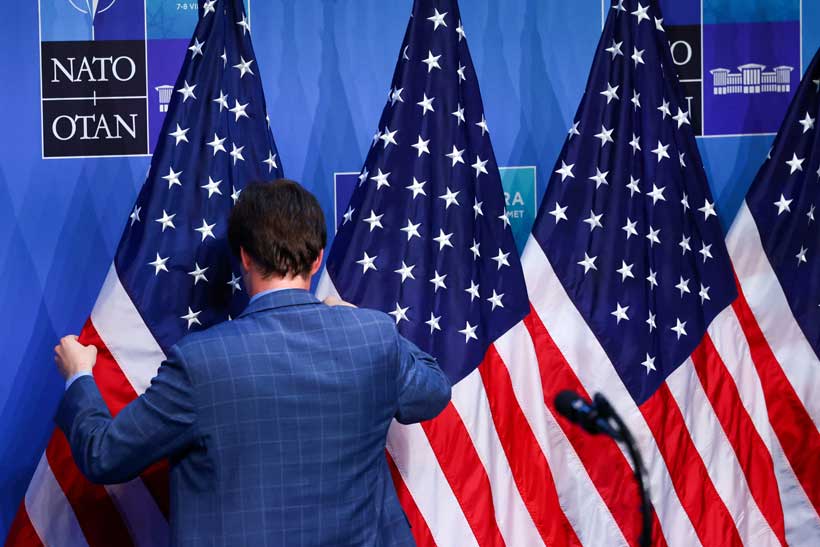
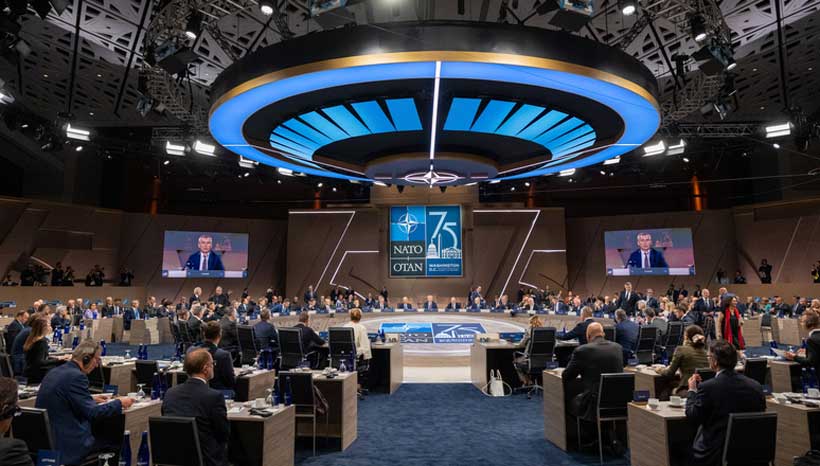
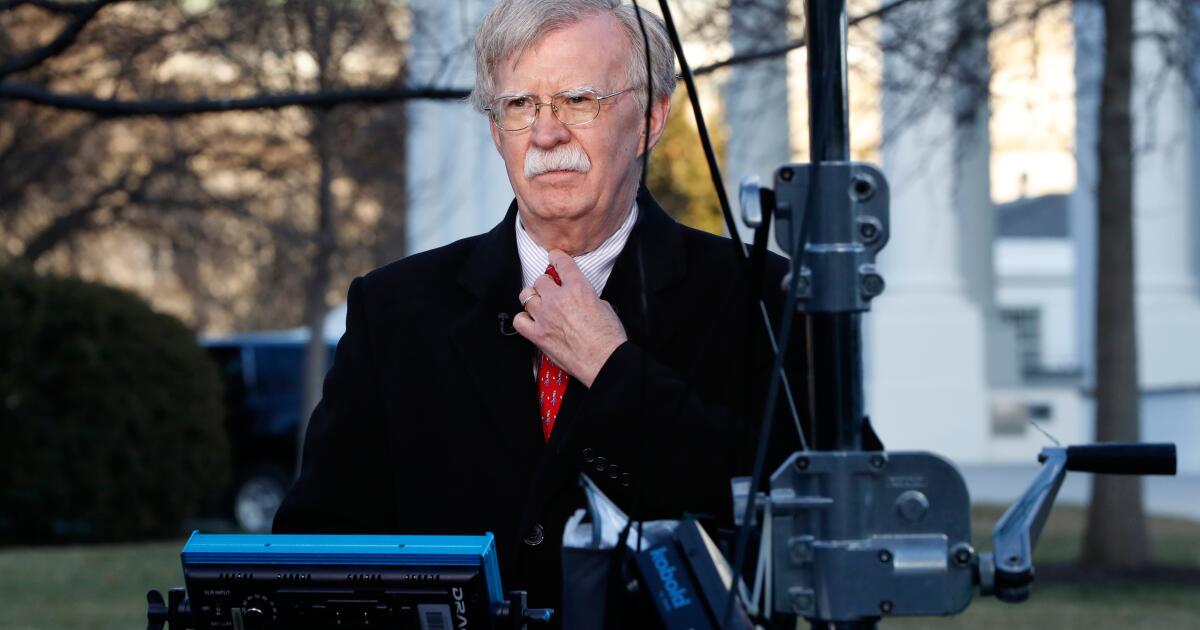
NATO leaders emerged from their summit in Ankara relieved that U.S. President Donald Trump reaffirmed Washington’s commitment to the alliance, but European officials acknowledge that relations with the United States remain fragile and expect further periods of uncertainty.
While the gathering ended on a positive note, diplomats say the alliance continues to face questions over Trump’s long-term approach to NATO, burden sharing and Europe’s security.
Summit ends on a more positive note
The two-day summit began amid fresh tensions after Trump criticized several allies, announced he wanted to cut off U.S. trade with Spain, and revived disputes over defense spending.
However, the atmosphere improved significantly by the end of the meeting.
Stay ahead of the geopolitical week.
MD Briefing delivers expert analysis across five global fronts — the Indo-Pacific, energy, geoeconomics, European security, and the Middle East — every Monday morning. Free.
Trump endorsed the summit declaration reaffirming NATO’s Article 5 mutual defense commitment, praised the unity among allies, and approved a license allowing Ukraine to manufacture Patriot missile interceptors.
European leaders viewed those moves as an important signal that Washington remains committed to the alliance despite months of increasingly strained relations.
Trump also described the summit as one filled with “love,” easing fears that the gathering could end in open confrontation.
European allies remain cautious
Despite the improved tone, European governments are preparing for continued volatility in transatlantic relations.
Officials note that Trump’s approach toward NATO has often shifted rapidly, creating uncertainty over U.S. security commitments.
Recent disputes have included Trump’s renewed interest in Greenland, criticism of allies during the Iran conflict, and repeated suggestions that European members should assume greater responsibility for their own defense.
Many European capitals believe maintaining strong ties with Washington remains essential despite these disagreements.
Without U.S. military capabilities, officials fear NATO’s ability to deter Russia would be significantly weakened.
Rutte emphasizes America’s central role
NATO Secretary General Mark Rutte stressed that the United States remains the alliance’s indispensable military power.
He noted that the U.S. economy accounts for roughly half of NATO’s combined economic strength and that American military capabilities remain unmatched within the alliance.
According to Rutte, NATO’s credibility and deterrence against Russia remain intact despite recent political tensions.
Not everyone shares that optimism.
Some former U.S. defense officials argue that repeated political disputes have already damaged perceptions of alliance unity and provided Moscow with opportunities to question NATO’s cohesion.
Several European diplomats privately acknowledged that while the summit avoided a major crisis, it did little to erase concerns created over recent months.
Defense spending helps ease tensions
One factor that helped calm relations was Europe’s significant increase in defense spending.
Trump has long argued that NATO members rely too heavily on the United States for their security.
Ahead of the summit, NATO officials highlighted large increases in military spending by European members and Canada, presenting the figures as evidence that Trump’s pressure has produced tangible results.
Alliance officials also emphasized billions of dollars in new defense procurement agreements announced during a defense industry forum held before the summit.
The deals covered surveillance aircraft, transport planes, drones and other military equipment worth more than $50 billion.
The announcements were intended to demonstrate that allies are translating higher defense budgets into concrete military capabilities.
NATO counters criticism over Iran conflict
Alliance officials also sought to push back against Trump’s criticism that NATO members failed to support the United States during the conflict with Iran.
Officials argued that, with the exception of Spain restricting U.S. access to military facilities, most allies honored existing agreements governing American military operations.
Those efforts were designed to reassure Washington that European allies remain reliable security partners even when political disagreements arise.
Pentagon review adds fresh uncertainty
Despite the summit’s relatively positive conclusion, uncertainty remains over America’s future military posture in Europe.
The Pentagon has already reduced some of the forces allocated to NATO defense plans and recently launched a review of approximately 80,000 U.S. troops stationed across Europe.
The review has fueled concerns that Washington could further reduce its military presence on the continent as European governments work to strengthen their own defense capabilities.
European leaders seek fewer flashpoints
Several officials suggested NATO may reduce the frequency of high-profile leaders’ summits to avoid repeated political confrontations.
Plans for a NATO leaders’ meeting in Albania next year have reportedly been put on hold as alliance members reassess the format of future gatherings.
Some diplomats believe limiting opportunities for public disputes could help preserve alliance unity while allowing practical cooperation to continue behind the scenes.
Why the Ankara summit mattered
The Ankara summit represented an important test of NATO’s ability to manage internal political differences while maintaining collective security.
Turkey, as host nation, sought to strengthen its standing within the alliance and improve relations with Washington, while NATO leadership worked to keep attention focused on defense cooperation rather than political disagreements.
Although tensions remain, the summit demonstrated that both the United States and European allies continue to recognize the strategic importance of NATO amid Russia’s war in Ukraine and growing global security challenges.
Future outlook
The immediate crisis surrounding the Ankara summit may have eased, but European governments expect relations with the Trump administration to remain unpredictable.
Future disagreements over defense spending, U.S. troop deployments, support for Ukraine, trade disputes and broader geopolitical issues are likely to continue testing alliance unity.
For now, NATO leaders appear determined to strengthen Europe’s military capabilities while keeping the United States firmly engaged, recognizing that preserving transatlantic cooperation remains central to the alliance’s long-term security strategy.
Iran said on Thursday it had targeted U.S. military infrastructure across the Gulf in retaliation for fresh American strikes on Iranian territory, marking the latest escalation in a conflict that is increasingly testing a fragile ceasefire brokered just weeks ago.
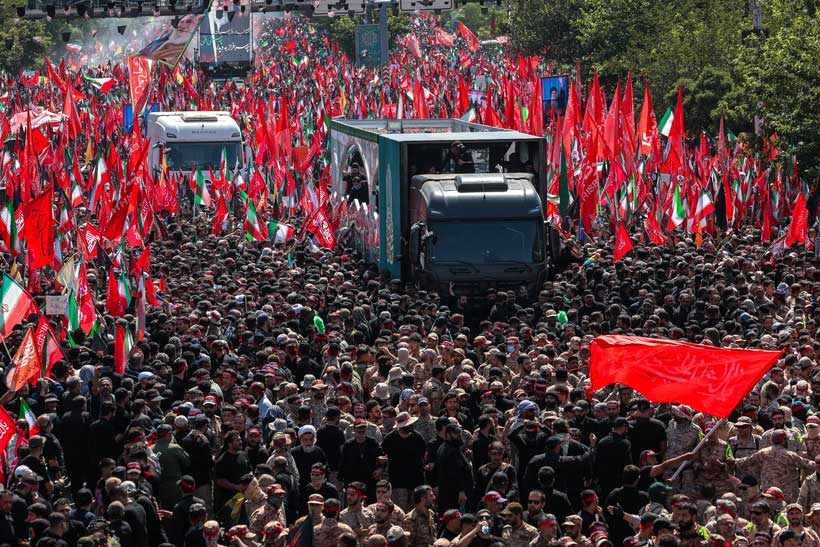
The renewed exchange of attacks came as Iran prepared to bury its late Supreme Leader Ayatollah Ali Khamenei at the holy city of Mashhad following a week of nationwide funeral processions.
Although oil prices eased after surging on fears of wider disruption, investors and governments remained focused on whether the latest violence represented a temporary escalation or the beginning of a broader collapse of efforts to end the conflict.
Iran retaliates after U.S. strikes
Iranian armed forces said they targeted U.S. military facilities in neighbouring Gulf states after American forces struck military infrastructure across Iran’s southern coast and eastern provinces.
Stay ahead of the geopolitical week.
MD Briefing delivers expert analysis across five global fronts — the Indo-Pacific, energy, geoeconomics, European security, and the Middle East — every Monday morning. Free.
According to Iranian officials quoted by state media, the latest U.S. attacks killed 14 people and wounded 78 others across five provinces on July 8 and 9.
The semi-official Fars news agency reported that one strike hit a railway bridge used for trade links with Russia and China.
Explosions were also reported on Thursday morning in Bushehr province, home to Iran’s only operational nuclear power plant, though authorities did not immediately provide details on the cause.
Gulf military installations targeted
Iran’s military said it launched drone and missile attacks against several U.S.-linked military facilities across the Gulf region.
According to Iranian state media, the targets included:
U.S. Patriot missile systems in Kuwait
An early-warning installation in Qatar
A U.S. military fuel storage facility in Bahrain
Kuwaiti authorities said their air defences intercepted a cruise missile, three ballistic missiles and ten drones. Officials reported one person was injured by falling debris.
Qatar, which hosts the largest U.S. military base in the Middle East, called for restraint and urged all sides to return to diplomatic negotiations.
During a phone call with Iranian Foreign Minister Abbas Araqchi, Qatari Prime Minister Sheikh Mohammed bin Abdulrahman al-Thani also condemned attacks on commercial shipping in the Strait of Hormuz.
Strait of Hormuz remains at the centre of tensions
The latest military confrontation follows attacks on commercial tankers in the Strait of Hormuz, one of the world’s most important energy shipping routes.
The U.S. military said Wednesday’s strikes were designed to protect international navigation after blaming Iran for attacks on three commercial vessels.
Although Tehran has not officially claimed responsibility for those attacks, analysts say Iran has increasingly used pressure around the Strait of Hormuz as leverage in negotiations with Washington.
Before the war began in late February, roughly one-fifth of global oil supplies passed through the narrow waterway.
Iran has since exercised significant control over maritime traffic in the strait, giving it considerable strategic influence over global energy markets.
The U.S. Central Command (CENTCOM) said American forces struck around 90 Iranian military targets.
According to CENTCOM, the operation targeted:
Air defence systems
Coastal surveillance infrastructure
Missile and drone storage facilities
Naval assets
Military logistics centres along Iran’s coastline
“The United States is holding Iran accountable for recent unjustified aggression against commercial shipping and civilian crews freely navigating a vital international waterway,” CENTCOM said.
President Donald Trump defended the operation on Wednesday, writing on Truth Social: “This is in retribution for yesterday’s bombing of ships by Iran. If it happens again, it will get much worse.”
Trump says ceasefire agreement is effectively over
While attending the NATO summit in Ankara, Trump said he believed the memorandum of understanding signed with Iran to halt the fighting had effectively collapsed.
Asked whether the agreement remained in force, Trump replied:”It’s a very interesting question. To me, I think it’s over. I don’t want to deal with them.”
He later added that even if another agreement were reached, he doubted Tehran would honour it.
Despite the renewed military exchanges, Trump said he did not expect the confrontation to develop into another prolonged war.
“Anything that happens is going to be over very quickly… and will only make it safer, including for oil,” he told reporters.
Iran vows continued retaliation
Iranian officials condemned the latest U.S. military operation as another breach of understandings reached after the ceasefire.
Parliament Speaker Mohammad Baqer Qalibaf warned Washington that future attacks would receive a military response.
“The U.S. has yet to learn that bullying and breaking its commitments no longer come without a cost,” he wrote on social media.
“The Strait of Hormuz will be reopened only under Iranian arrangements, not through U.S. threats.”
Oil markets remain on edge
Oil prices retreated on Thursday after jumping sharply a day earlier, as traders assessed whether the latest fighting would significantly disrupt Gulf energy exports.
Shipping also remains under close watch.
One of the vessels struck this week the Qatari LNG tanker Al Rekayyat remains stranded off Oman after suffering an engine-room fire following a projectile strike.
Industry sources said its liquefied natural gas cargo appears secure and that the immediate risk of explosion remains low.
Future outlook
The latest exchange of strikes has significantly weakened confidence in the U.S.-Iran ceasefire, even if neither side appears ready for a return to full-scale war.
Attention is now focused on whether further attacks occur around the Strait of Hormuz, where any prolonged disruption could quickly tighten global energy supplies and drive oil prices higher.
Diplomatic efforts led by Gulf states are likely to intensify, but Trump’s declaration that the interim agreement is “over” and Iran’s vow to continue retaliating have raised doubts over whether negotiations can still produce a lasting settlement.
In a draft regulation obtained by Euronews and due to be presented in September, the European Commission plans to tighten access to the EU market by allowing public authorities to exclude foreign companies that present risks of interference from public procurement.
ADVERTISEMENT
ADVERTISEMENT
The draft proposal comes amid heightened geopolitical tensions, with concerns over data leaks from sensitive public services to Beijing and Washington and as well as the weaponisation of the EU’s dependence on rare earths and technology products from China.
The draft document proposes that “public buyers shall take appropriate measures, where relevant at any stage of the procurement procedure, from planning and market consultation to contract award and execution, to ensure the protection of the security and public safety interests of the Union.”
The document adds that risks to security or public safety in a public contract may arise from firms whose “ownership, control, or financing structure” bears “risks of undue interference or influence over it,” as well as companies whose “exposure to third-country legislation […] may compel disclosure of sensitive information or interference with contract performance.”
Finally, public buyers would be allowed to introduce a European preference in public procurement, although the draft regulation would not make it compulsory.
Such provisions could confirm the EU’s protectionist shift towards a “Made in Europe” strategy, which the EU executive already proposed last March for strategic sectors such as clean technologies, the automotive industry and energy-intensive industries.
The risks of foreign interference and data transfer have become more acute in recent years, with the US and China both adopting legislation allowing them to request that companies under their jurisdiction transfer data stored in the EU.
Some European governments are already taking steps to mitigate these risks. In April, the French government ended its contract with Microsoft to protect French health data, and in June, it replaced US tech company Palantir with French company ChapsVision for the processing of sensitive information held by the the country’s domestic intelligence service, the Directorate General for Internal Security.
Over the last few years, several EU countries, including Germany, France, Italy and Denmark, have also cancelled or denied public contracts to the Chinese telecoms giant Huawei over security concerns.
The draft regulation also seeks to protect “critical infrastructure, critical supply chains, critical technologies or essential services, resilience against physical, cyber, or hybrid threats, and prevention and protection against risks of their disruption including due to harmful strategic dependencies on third-country suppliers.”
Last year, China cut off the EU from exports of rare earth minerals, which are essential for green technologies and the defence sector. It also stopped the Dutch-based Nexperia, owned by China’s Wingtech, from importing Chinese chips essential to the EU’s car industry.
Turkey renewed its push for greater defence cooperation within NATO on Wednesday as President Tayyip Erdogan urged alliance members to remove restrictions that limit defence-industrial collaboration among allies. Ankara has long argued that political disagreements should not prevent NATO members from working together on defence projects, particularly as Europe seeks to strengthen its military capabilities in response to growing security threats.
The appeal comes as NATO leaders gather in Ankara for a summit focused on increasing defence spending, expanding military production and reinforcing the alliance amid continued tensions with Russia and instability in the Middle East.
Erdogan calls for equal defence cooperation
Addressing NATO leaders at the opening of the summit, Erdogan said restrictions on defence cooperation between allies should be removed.
“Restrictions among allies on defence cooperation, especially in the defence industry, must be lifted,” he said.
Stay ahead of the geopolitical week.
MD Briefing delivers expert analysis across five global fronts — the Indo-Pacific, energy, geoeconomics, European security, and the Middle East — every Monday morning. Free.
He warned that excluding NATO members that are outside the European Union from European defence initiatives could create unnecessary divisions.
“At a time when a model of cooperation based on common sense and reason is possible, excluding allies that are not members of the (European) Union would lead to artificial divisions in Europe,” Erdogan said.
Turkey seeks greater role in European defence
Turkey has repeatedly sought participation in European defence initiatives, including the Security Action for Europe (SAFE) funding programme, which aims to strengthen the continent’s defence industry.
Despite possessing NATO’s second-largest military and becoming a major producer and exporter of defence equipment, Ankara has largely remained outside several Europe-led security projects because of political disputes with some EU member states.
Turkish officials argue that NATO allies should cooperate more closely regardless of EU membership.
Trump signals possible policy shift
Erdogan’s appeal came a day after U.S. President Donald Trump indicated Washington could ease some longstanding tensions with Ankara.
During a meeting with Erdogan on Tuesday, Trump said he intended to lift U.S. sanctions imposed on Turkey and would decide whether to allow Ankara back into the F-35 fighter jet programme.
Turkey was removed from the programme after purchasing Russia’s S-400 air defence system in 2019, a move that triggered U.S. sanctions and strained relations between the two NATO allies.
Any decision to reverse those measures is expected to face opposition in the U.S. Congress.
Turkey pledges higher defence spending
Erdogan said Turkey remains on track to meet NATO’s target of spending 5% of gross domestic product on defence by 2030.
He announced that Ankara had allocated an additional $24 billion to its Steel Dome integrated air defence project, which is intended to strengthen both Turkey’s national security and NATO’s collective air and missile defence capabilities.
The Turkish president also called on alliance members to assume greater responsibility for Europe’s security while preserving NATO unity.
Future outlook
Turkey is expected to continue pressing for full participation in European defence initiatives as NATO members expand military spending and industrial cooperation. Whether European governments are prepared to ease political objections remains uncertain, while any U.S. decision on sanctions relief or Turkey’s return to the F-35 programme is likely to face congressional scrutiny. The outcome could shape Ankara’s role in NATO’s evolving defence architecture in the coming years.
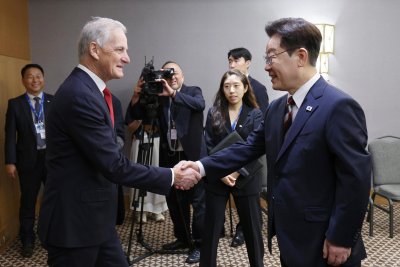
South Korean President Lee Jae Myung (R) and Norwegian Prime Minister Jonas Gahr Store shake hands during their talks in Ankara, Turkey, on Wednesday. Photo by Yonhap
South Korean President Lee Jae Myung and Norwegian Prime Minister Jonas Gahr Store held talks Wednesday on ways to deepen cooperation between their countries in areas such as security and technology.
The two leaders met on the sidelines of the North Atlantic Treaty Organization summit in Ankara, Turkey, where Lee is participating as the leader of one of the alliance’s partner countries.
In his opening remarks, Lee stressed the importance of cooperation and exchanges between the two countries at a time of growing instability in the global security environment.
The South Korean president noted that against such a backdrop, South Korea and Norway are deepening their ties into a mutually beneficial relationship in the areas of the economy, industry, culture and defense.
“During today’s bilateral talks, I would like to discuss in depth how and in what areas we can further deepen our relations,” Lee said.
The Norwegian prime minister noted that the two countries have made progress in bilateral ties since last year, referring to what he described as important decisions in the defense industry that he said would help elevate bilateral ties into a strategic partnership.
In January, South Korea’s Hanwha Aerospace Co. secured a large-scale deal to supply Norway with Chunmoo artillery systems and guided missiles.
The Norwegian prime minister noted the two countries have witnessed progress in cooperation on security, trade and technology, and said he hoped to use Wednesday’s meeting to discuss ways to further deepen their ties.
Lee expressed hope that the two countries would further strengthen cooperation in advanced defense technologies and the broader defense industry, building on Norway’s trust in South Korean weapons systems, presidential spokesperson Kang Yu-jung said later.
The president cited new renewable energy, shipbuilding and maritime affairs as areas in which he hopes South Korea and Norway could achieve tangible cooperation, according to Kang.
Lee also called for the Norwegian government’s cooperation with a South Korean delegation currently visiting Norway to secure additional supplies of Norwegian mackerel, a staple food in South Korea.
Kang said the Norwegian prime minister also voiced hope for stronger cooperation in the maritime and energy sectors, as well as for elevating bilateral ties to a higher level by strengthening cooperation in key areas.
In addition, the two leaders agreed to exchange visits at mutually convenient times while pledging to continue close communication on ensuring peace and stability in the international community, Kang added.
Copyright (c) Yonhap News Agency prohibits its content from being redistributed or reprinted without consent, and forbids the content from being learned and used by artificial intelligence systems.
Relations between North Korea and Japan remain deeply strained due to historical grievances, North Korea’s nuclear and missile programmes, and growing regional security tensions. In recent years, Japan has significantly increased defence spending and accelerated military modernisation in response to North Korea’s missile launches and China’s expanding military presence.
Tokyo has adopted a new national security strategy that includes acquiring long range strike capabilities, expanding missile defence and strengthening cooperation with the United States and other regional partners. Japan says these measures are necessary to deter growing security threats, while North Korea and China have criticised them as evidence of Japan moving away from its post World War Two defensive posture.
The latest remarks come as North Korea also continues expanding its own naval capabilities and developing new missile systems.
North Korea accused Japan on Tuesday of transforming its military into an offensive force, claiming Tokyo’s overseas military ambitions are now a reality rather than a hypothetical threat.
Stay ahead of the geopolitical week.
MD Briefing delivers expert analysis across five global fronts — the Indo-Pacific, energy, geoeconomics, European security, and the Middle East — every Monday morning. Free.
A commentary published by the state run Korean Central News Agency criticised Japan’s defence modernisation programme, pointing to plans to develop unmanned submarines, expand long range missile capabilities and acquire advanced weapons from the United States.
The comments come amid growing military activity across East Asia as regional powers continue strengthening their armed forces.
The KCNA commentary argued that Japan is abandoning its long standing policy of maintaining forces solely for self defence.
It claimed Tokyo is developing unmanned submarines capable of carrying torpedoes and naval mines that could be deployed near neighbouring coastlines to conduct pre emptive attacks during a conflict.
The report portrayed these developments as evidence that Japan is shifting toward a more offensive military posture.
Japan’s Foreign Ministry did not immediately comment on the allegations.
North Korea also highlighted Japan’s efforts to strengthen its missile capabilities.
According to the commentary, Tokyo is pursuing domestically developed long range missiles, a new ballistic missile with a reported range of up to 3,000 kilometres, upgraded anti ship missiles and hypersonic glide weapons.
The report also criticised Japan’s acquisition of United States made Tomahawk cruise missiles as part of its broader military modernisation programme.
Japan has argued that these capabilities are intended to strengthen deterrence against growing regional threats.
The criticism comes as North Korea continues expanding its own military capabilities.
State media recently reported that leader Kim Jong Un observed the launch of a strategic cruise missile and inspected weapons systems aboard the newly built 5,000 tonne destroyer Kang Kon.
Kim has instructed that the vessel enter operational service within two months as part of efforts to strengthen North Korea’s naval combat capabilities.
Pyongyang has also commissioned another destroyer, the Choe Hyon, and announced plans to construct additional warships, including larger 10,000 tonne vessels.
The exchange of criticism reflects broader security tensions across Northeast Asia.
Japan has strengthened defence cooperation with the United States and regional partners while increasing military investment in response to North Korea’s expanding nuclear and missile programmes and China’s growing military activities.
North Korea has responded by accelerating weapons development, conducting missile launches and modernising its naval forces, further contributing to regional strategic competition.
The latest comments highlight the increasingly confrontational security environment in Northeast Asia, where military modernisation by one country is often cited by others to justify their own defence expansion.
As Japan strengthens its deterrence capabilities and North Korea continues developing advanced weapons, the risk of heightened regional tensions and military competition is likely to remain elevated.
North Korea
Seeking to strengthen its military capabilities while criticising Japan’s expanding defence posture.
Japan
Modernising its armed forces in response to growing regional security threats.
United States
Supporting Japan’s defence strategy as part of its broader Indo Pacific security framework.
South Korea
Closely monitoring military developments involving both North Korea and Japan.
Regional Neighbours
Watching the evolving security balance as military competition intensifies across Northeast Asia.
Regional attention will remain focused on Japan’s continuing defence modernisation and North Korea’s naval expansion, including the planned deployment of its new destroyers.
Any additional missile tests, military exercises or defence announcements by either country are likely to be closely monitored by neighbouring governments and could further shape the security dynamics of the Indo Pacific region.
Sudan has been engulfed in a devastating civil war since April 2023, when fighting erupted between the Sudanese Armed Forces and the paramilitary Rapid Support Forces (RSF). The conflict has displaced millions of people, triggered one of the world’s worst humanitarian crises and led to widespread allegations of war crimes and crimes against humanity.
Al Obeid, one of Sudan’s largest and most strategically important cities, has become the latest flashpoint as the RSF intensifies military operations around the city. The situation has raised fears of a repeat of the violence witnessed in Al Fashir in North Darfur, where fierce fighting, civilian casualties and widespread reports of abuses drew international condemnation.
Against this backdrop, the United Nations Human Rights Council has moved to increase international scrutiny by launching an urgent inquiry into alleged violations committed during the escalating violence.
Stay ahead of the geopolitical week.
MD Briefing delivers expert analysis across five global fronts — the Indo-Pacific, energy, geoeconomics, European security, and the Middle East — every Monday morning. Free.
The United Nations Human Rights Council on Monday adopted a resolution condemning escalating violence by Sudan’s Rapid Support Forces in Al Obeid and authorising an urgent investigation into alleged human rights abuses committed during the fighting.
The motion, introduced by the United Kingdom with support from 14 other countries, was adopted by consensus, although China distanced itself from the decision over concerns about country specific investigations conducted without the consent of the government concerned.
The inquiry will seek to document alleged violations as international concern grows over the deteriorating humanitarian and security situation in the city.
Diplomats warned that the situation in Al Obeid could mirror previous atrocities reported elsewhere in Sudan.
Britain’s Human Rights Ambassador Eleanor Sanders urged the council to prevent a repeat of the violence seen in Al Fashir, warning that similar patterns of attacks against civilians must not be allowed to recur.
South Africa also backed the resolution, describing the situation as a critical warning and expressing concern that the RSF was employing tactics similar to those previously documented during operations in Darfur.
The mounting international concern reflects fears that the conflict around Al Obeid could rapidly escalate into another large scale humanitarian disaster.
The United Nations High Commissioner for Human Rights recently warned that a catastrophe is unfolding around Al Obeid.
According to the Human Rights Office, investigators have documented reports of summary executions, kidnappings, torture and widespread sexual violence in areas surrounding the city.
The findings add to a growing body of evidence gathered by United Nations agencies and international human rights organisations documenting alleged abuses committed during Sudan’s civil war.
The Rapid Support Forces have consistently rejected previous allegations, arguing that the accusations are politically motivated and making similar allegations against rival forces.
The newly approved investigation is intended to independently gather evidence, establish facts and improve accountability for alleged violations of international humanitarian and human rights law.
Although the Human Rights Council does not possess judicial authority, its investigations often provide evidence used by international courts, sanctions bodies and future accountability mechanisms.
The inquiry may also increase diplomatic pressure on parties to the conflict while drawing greater international attention to the humanitarian crisis unfolding in Sudan.
While the resolution was adopted without a formal vote, China stated that it did not support investigations targeting individual countries without their approval.
Beijing has consistently argued that international human rights mechanisms should respect national sovereignty and avoid what it considers politically selective investigations.
Despite China’s position, the resolution received sufficient backing from council members to proceed.
The investigation signals growing international concern that Sudan’s conflict is entering another dangerous phase marked by escalating violence against civilians.
Independent documentation of alleged abuses could strengthen future efforts to pursue accountability while increasing international pressure for humanitarian access and renewed peace negotiations.
The inquiry also demonstrates the Human Rights Council’s willingness to respond quickly when there are warnings of possible mass atrocities.
United Nations Human Rights Council
Launching an urgent investigation into alleged abuses and monitoring developments in Al Obeid.
Rapid Support Forces
Facing renewed international scrutiny over allegations of serious human rights violations, which the group denies.
Sudanese Armed Forces
Continuing military operations against the RSF while remaining a central party to the conflict.
Civilians in Al Obeid
Confronting increasing risks from escalating fighting, displacement and humanitarian hardship.
Seeking greater accountability, humanitarian access and diplomatic efforts to reduce violence.
China
Maintaining its opposition to country specific human rights investigations conducted without state consent.
The Human Rights Council will begin organising the urgent inquiry, with investigators expected to collect evidence, interview witnesses and monitor developments around Al Obeid.
Meanwhile, international attention will remain focused on whether fighting intensifies around the city and whether diplomatic efforts can prevent another humanitarian catastrophe similar to those witnessed elsewhere in Sudan.
The Human Rights Council’s decision reflects growing concern that events in Al Obeid are following a pattern already witnessed elsewhere in Sudan’s civil war. The repeated references by diplomats to Al Fashir suggest the international community fears another episode of mass civilian suffering before meaningful intervention becomes possible.
The inquiry itself will not stop the fighting, nor does the Human Rights Council possess enforcement powers. Its primary significance lies in documenting evidence that may later support international legal action, targeted sanctions or future accountability mechanisms. Such investigations also serve as an important warning to armed groups that alleged violations are being monitored by the international community.
The decision also highlights the persistent divisions within the United Nations over country specific investigations. China’s decision to distance itself from the resolution reflects a broader debate between protecting state sovereignty and responding rapidly to alleged mass atrocities. Similar disagreements have shaped international responses to conflicts in Myanmar, Syria and other crisis zones.
For Sudan, however, the immediate challenge remains humanitarian rather than diplomatic. Continued fighting around Al Obeid threatens to worsen displacement, restrict humanitarian access and expose more civilians to violence. If the conflict follows the trajectory seen in other parts of the country, the consequences could further deepen what is already one of the world’s largest humanitarian emergencies.
Ultimately, the inquiry represents an effort to ensure that alleged abuses are documented while there is still an opportunity to deter further violations. Whether it contributes to greater accountability or influences the conduct of the conflict will depend largely on developments on the ground and the willingness of the international community to translate its findings into concrete action.
The Iranians have come out on top after the conflict. They have demonstrated themselves as a pure and united nation by not dividing into small factions during the recent militarily confrontation with the United States and Israel. The Americans and Israelis were seemed to be launching a shock and awe strategy against the Iranians to overwhelm them and easily bring down their regime.
However, they were unable to accomplish their task, resulting in social pressure from within the United States, as 61% people were not in favor of launching a war of choice against Iran while the escalation concluded in huge financial setbacks for both the U.S and Israel.
According to John Kiriakou – the former CIA officer, Trump was told by the Israeli Prime Minister that they could easily topple the regime of Iran due to prevailing social unrest at that time. But the Iranians remained intact and united, rallying behind their government. This shattered Americans and Israelis ambitions.
On the day Americans and Israelis launched an unprovoked aggression against Tehran, Iran imposed a closure of the Strait of Hormuz, which made Iran to maintain upper hand throughout the confrontation and sustain its position against the enemy.
Stay ahead of the geopolitical week.
MD Briefing delivers expert analysis across five global fronts — the Indo-Pacific, energy, geoeconomics, European security, and the Middle East — every Monday morning. Free.
Strait of Hormuz was open before 28th February, but during the war it was observed that the United States presented its closure as a cause of war, whereas it was obviously a consequence of the war. In addition to this context, Tehran laid a lot of mines in the waters of the Strait of Hormuz to hinder the flow of maritime trade across the strait.
From the beginning, the Iranians adopted a military strategy called Mosaic Defense, in which they decentralized their defense system, dividing their military into 31 factions which were able to take any decision on spot without asking from the central command of Tehran. This gave their military to take sudden military decisions and hit military targets as per their choice. This strategy significantly helped the Iranians hold the upper hand in the conflict, maintain their position, and stand firm against their enemy.
The Iranians also pursued the strategy of asymmetric warfare, attacking with cheap Shahed-136 drones and using different types of missiles to overwhelm the enemy. They used drones of worth around 20000 to 50000 $ while the Americans and Israelis were using expensive defensive equipment of worth 1 million to 4million dollars.
Iran fought Americans forces using a strategy called horizontal warfare, broadening the conflict across the Middle East by attacking Americans bases in the region and making the region increasingly vulnerable and unstable for the other countries there. This helped Iran consolidate their hard power in the region.
Islamic Revolutionary Guards Corps (IRGC) eliminated the most expensive radars of the US situated in different countries of the region. They blew up AN/FPS-132 and AN/TPY-2 Radar systems of the US in Qatar and Jordan respectively.
Along with that, they decimated American 5th fleet headquarter in Bahrain, which held 75% of the US military power in the region, resulting in heavy losses for Washington. Furthermore, Iran inflicted pain on more than dozen American bases in the Middle East.
It was seemed that Tehran converted this war into a war of attrition by slowly weakening the Americans over time. They were fully prepared for this protracted war but it did not go in favor of the United States, as Washington was unable to afford a protracted war at lot.
Therefore, President Trump was increasingly perceived as pursuing a deal with Tehran over time, emphasizing that a deal was in progress and would be reached soon. As a result, president trump had to sign a memorandum of understanding (MOU) with Tehran on 17th June 27, 2026 to save the world economy from another Great Depression.
The extent which Washington achieved its objectives remain open to debate. These goals included the overthrow of the regime, the de-weaponization of Iran, and the weakening of the country’s strategic potential.
According to the U.S political scientist Robert Pape, Iran has emerged as the fourth center of power, following the US, China, and Russia. It was obvious that Iran had been preparing for possible military misadventure by the U.S and Israel since 1979.
One of the crucial steps that Iran took after the Islamic revolution was the creation of the Islamic Revolutionary Guards Corps (IRGC) parallel to its national army. Consequently, it had huge leverage over the US and Israel during overall confrontation.
Moreover, this military confrontation between the U.S and Iran gave huge advantage to Tehran, making its position stronger in the regional politics and globally. Resultantly, Tehran has achieved what it had been unable to gain over the last 47 years. It successfully gained the removal of sanctions, the release of its $24B frozen assets, dominance over the Strait of Hormuz, and recognition as a regional power. Apart from that, it still retains its regional proxies and ballistic missile program.
While the Americans and Israelis miscalculated the war, assuming that they could win a quick and decisive victory by decapitating the regime. For that they orchestrated a plan to quickly topple the regime through a shock-and-awe campaign and they wanted to place people on the top that were subservient to them. However, the Iranian military emerged as a key deterrent against the adversary and made the pursuit of Washington’s objectives complicated.
Until not so long ago Latin America had been considered a quiet region, located far from the world’s superpower main strategic confrontations, with sporadic but crucial moments that helped to shape the international order as we know it today. The Cuban Missile Crisis is the clearest example: it became the starting point for a series of agreements and treaties on nuclear and strategic security, involving both the US and the Soviet Union at first, and later extending to other actors of the international community, from Europe, Asia and Latin America, which became the first region free from nuclear weapons after the signing of the Treaty of Tlatelolco in 1967, 5 years after the crisis. After this episode, the region’s relevance seemed to fade, and Latin American countries appeared condemned to a destiny of surfing between weak political cohesion internally and relatively stable economies, even as most of its governments remained closely aligned with Washington on foreign policy matters.
It was precisely during this period of perceived irrelevance that China began building its presence in the region, very gradually and over the course of a little more than two decades. Washington largely ignored this process, even as it became clear that the Asian giant was becoming the largest trading partner for several South American countries, such as Peru and Brazil, and in many cases also the main investor in their economies. This neglect was not born of ignorance: it reflected, instead, a confidence that local governments would remain compliant regardless of who was investing in them. President Trump’s first term illustrates this well. Despite isolated clashes with the governments of Mexico and Venezuela, these episodes looked minor when compared to the “tariff wars” waged against the EU and China. In fact, the only time Trump ever set foot in the region during his entire first term was in November 2018 when he attended the G20 Forum in Buenos Aires. Significantly, there was a planned short visit in Colombia after this event, but I was cancelled. This was widely read at the time as a confirmation that Latin America remained a low priority for Washington’s foreign policy agenda, more due to the expectable compliance of local governments than ignorance of the importance of the region as a resource base capable of fueling US power projection in other regions.
It was only during Trump’s second term that American foreign policy has shifted towards the Western Hemisphere, attributing strategic importance to the region and setting the objective to maintain a near-absolute dominant presence, involving both economic and military dimensions, as is stated in the latest National Security Strategy of 2025.
By the time this shift was formalized, China’s footprint in the region was already deep and country-specific. In Brazil, China had been the largest trading partner since 2009; bilateral trade hit a record $171 billion in 2025, with China accounting for 27.2% of Brazil’s total foreign trade, besides, EV plants and a still planned bi-oceanic railway linking Brazil to Peru’s Pacific coast were being negotiated as part of the Chinese investment strategy in both countries. In Argentina, China became the primary supplier of mobile network infrastructure, part of a broader Chinese push into Latin American 5G and data-center markets. And in Peru, China invested around $1.3 billion in the strategic port of Chancay, a deepwater facility that entered full operation stage in November 2024, and set a new phase for trade between China and South America, bypassing the traditional deepwater ports located in the US, like the ports of Oakland and Stockton. Reinforcing this, China pledged in May 2025, at the CELAC forum ministerial meeting in Beijing, to ramp up its regional engagement even further. These were not isolated transactions but a structural presence, one that the 2025 National Security Strategy now identifies strictly as the rival foothold it intends to dislodge.
Stay ahead of the geopolitical week.
MD Briefing delivers expert analysis across five global fronts — the Indo-Pacific, energy, geoeconomics, European security, and the Middle East — every Monday morning. Free.
Now, within this context in 2026 the declared shift of interests proved it wasn’t merely rhetorical. The year started with the launching of Operation Resolve, when a group of American special military forces conducted a military raid and captured President Nicolás Maduro and his wife in Caracas, transporting them to New York to face narcoterrorism charges. Trump declared that the US was now “in charge” of Venezuela until a transition takes place. This meant in practice that the US would hold control over the country’s oil exports, which during the first four months after Maduro’s capture were estimated at $8 billion, but the data on how much oil has been sold, the revenue from it and the use given to those funds remains secret. The main importers of Venezuelan oil during this period were the United States (43 percent), India (26 percent, part of the strategy to reduce Indian import of Russian oil), and Spain (8 percent). This episode, condemned by critics as a return to the old days of imperialism, set the tone for the rest of the year: a hemisphere where Washington would use military force, tariffs, and other mechanics for pressuring countries to sign economic deals where American core interests prevail.
An example of this is the new and controversial Trade and Investment agreement signed by the United States and Argentina in February of this year. According to the text, Argentina shall adapt the regulatory framework to implement US trade standards and prioritize American direct investment in the country, while the counterpart shall “try to review its tariffs” and “consider supporting investment financing”. Milei’s government has justified this as the price for ideological loyalty and continued financial support after the $20 billion credit line that helped to stabilize the local currency (peso) last year.
On the other hand, Brazil took the opposite path: rather than just seeking accommodation to this policy, the government of Lula da Silva accelerated diversification, finalizing the long-delayed EU-Mercosur agreement in January, deepening trade with China and signing a memorandum of understanding with aims for further strategic partnership with Russia. Notably, the US has implemented another mechanism of pressure here, condemning the imprisonment of former president Jair Bolsonaro and holding a meeting with his son Flavio Bolsonaro, who will participate in the presidential elections this October. This gives clear signs of indirect support for this far-right candidate, following the regional trend with Milei in Argentina and Keiko Fujimori in Peru.
Peru, meanwhile, illustrates a third pattern and an interesting case, because alignment here is imposed less by negotiation than by sheer state fragility. Amid a presidency turning over for the ninth time in a decade, the US State Department warned in February that China’s control over the Chancay megaport threatens Peru’s sovereignty, following a Peruvian court ruling that exempted the port from national oversight. Peru’s case pictures a scenario where both counterparts keep pushing for concessions and more privileges. Under the government of José María Balcázar, the ninth president in 10 years, the country has been involved in the controversial purchase of 12 F-16 jetfighters with a cost of around $3.5 billion. On April he postponed the official ceremony where this deal was supposed to be signed arguing that it would have to be the responsibility of a new president, the decision was met with pushback, both internally, with declarations from the Ministry of Defense and in the US Embassy, with ambassador Bernardo Navarro declaring “If you deal with the U.S. in bad faith and undermine U.S. interests, rest assured, I, on behalf of [President] Trump and his administration, will use every available tool to protect and promote the prosperity and security of the United States and our region.” After this, with both internal and diplomatic pressure, the deal was signed on the 17th of April.
Taken together, these cases suggest the current US approach to Latin America is not fueled by a single ideological logic, but by transactional calculations that value compliance and heavily punishes resistance, exploiting weaknesses here and there and aiming to these policy goal indifferently to whether the country in question is led by a right, left or ideologically undefined government. What seems quite clear is that the decades of quietness in Latin America have ended, not necessarily because the region has changed, many of the deep challenges for development are still present, but because the rivalry that once defined the Cuban Missile Crisis has returned, this time fought over trade tariffs, infrastructure and technology access rather than missiles.
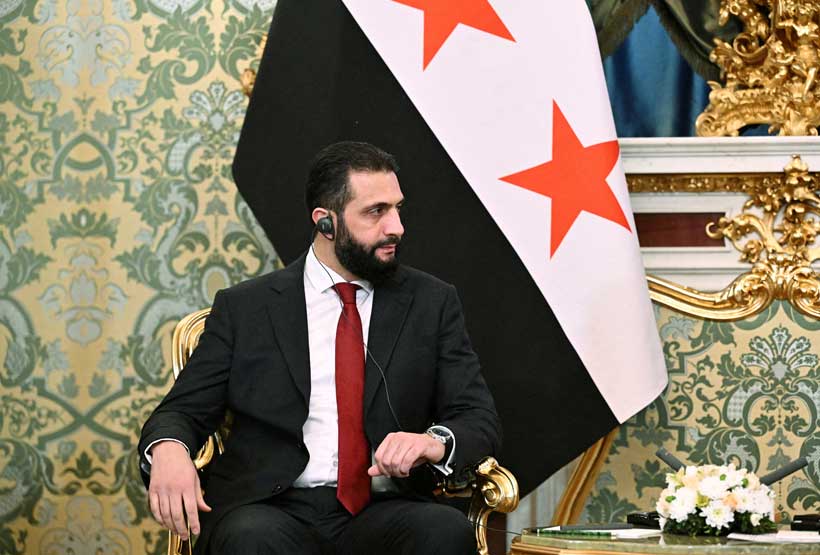
Syria has completed the formation of its transitional parliament after President Ahmed al-Sharaa appointed the remaining lawmakers to the 210-member People’s Assembly, allowing the legislature to convene for the first time next week. The move marks another step in the country’s post-Assad political transition, though the chamber will operate with limited authority under Syria’s interim constitutional framework.
The parliament’s formation comes more than eight months after the selection process began following the overthrow of Bashar al-Assad in 2024, with the new leadership pledging a more inclusive political system while retaining a strong presidential model.
Sharaa completes formation of transitional parliament
President Ahmed al-Sharaa appointed 70 lawmakers to fill the final seats in the People’s Assembly, completing the 210-member chamber after two-thirds of legislators were selected through regional electoral colleges last year.
The Assembly is scheduled to hold its inaugural session on Monday, formally beginning its role as Syria’s transitional legislature.
Stay ahead of the geopolitical week.
MD Briefing delivers expert analysis across five global fronts — the Indo-Pacific, energy, geoeconomics, European security, and the Middle East — every Monday morning. Free.
Women’s representation increases in new legislature
Among the presidential appointments are 15 women, raising the total number of female lawmakers from six to 21.
The appointments address one of the main criticisms of last year’s selection process, which drew scrutiny for the limited representation of women and concerns over political inclusivity.
Sweida seats remain vacant amid security concerns
Lawmakers representing the predominantly Druze province of Sweida have not yet been appointed, with authorities citing ongoing security conditions.
The province has remained outside full government control following deadly clashes between government forces and Druze fighters last year, delaying its integration into the transitional political process.
Parliament to operate under strong presidential system
The newly formed legislature will function under a temporary constitutional framework introduced in 2025 that grants limited powers to parliament while preserving broad executive authority for the presidency.
Although lawmakers can propose and approve legislation, the government is not required to secure parliamentary approval to remain in office, limiting the Assembly’s oversight role during the transition.
Political representation remains under scrutiny
The parliament’s formation has been closely watched as a measure of the new government’s commitment to political inclusion after decades of authoritarian rule under the Assad family.
Rights groups and some Syrian political figures have argued that the appointment process concentrates significant influence in the presidency and called for greater electoral independence, stronger judicial safeguards and broader representation of Syria’s ethnic and religious communities.
Implications
The completion of the transitional parliament provides Syria with its first functioning legislature since the fall of the Assad government, offering an institutional framework for drafting legislation during the transition. However, its limited constitutional authority means executive power will remain concentrated in the presidency, leaving questions over the pace and depth of political reform.
The composition of the Assembly will also be closely monitored by regional governments and the international community as they assess the credibility of Syria’s political transition and prospects for broader engagement with Damascus.
Future Outlook
The People’s Assembly’s first session will signal the beginning of Syria’s transitional legislative process, with lawmakers expected to begin debating new legislation under the interim constitutional framework. Attention will now shift to whether the parliament evolves into a more influential institution ahead of the adoption of a permanent constitution and the eventual holding of nationwide elections.
METALLICA roadies were forced to intervene when a fan jumped on stage at the heavy metal band’s gig in Glasgow.
The US-based group are currently on their M72 World Tour and performed to 56,000 fans at Hampden Park last week.
Sign up for the Showbiz newsletter
Thank you!
A Metallica fan caused chaos at their gig in Glasgow when he jumped on the stageCredit: Tiktok/codyr0slOne member of the security team was forced to shove him downCredit: Tiktok/codyr0sl
But one Metallica fan ended up missing most of the show as he was apprehended by security when he jumped on stage before the concert started.
A tense clip posted on social media showed the animated concert-goer aggressively refusing instructions to get down.
In the end one of the security team was to shove the man from the stage with him being caught by another roadie.
In a separate clip the troublemaker was escorted from the venue by police as fans rushed to comment on the shock events.
The over-excited fan was later seen being led out by security and police officersCredit: Tiktok/ovik8088The band have been levelling stadiums around Europe with their hard rockCredit: Getty
One wrote: “How to waste your night in one easy swoop.”
And someone else said: “Money well spent [eye-roll emoji].”
A source said earlier this year: “Metallica having a residency at the Sphere is all anyone is talking about on the Strip.
“They have been to see the bosses and met all the tech team to talk through and plan out a show in principle.
“The contracts are still to be signed but we were told they are 90 per cent there. Metallica will bring a different feel to a show there and there is a lot of excitement from bosses at the Sphere about what this could look like.”
The airline has shared advice for passengers to help prevent delays during security checks
11:19, 01 Jul 2026Updated 11:19, 01 Jul 2026
The airline shared advice for passengers on its website (stock photo)(Image: Getty)
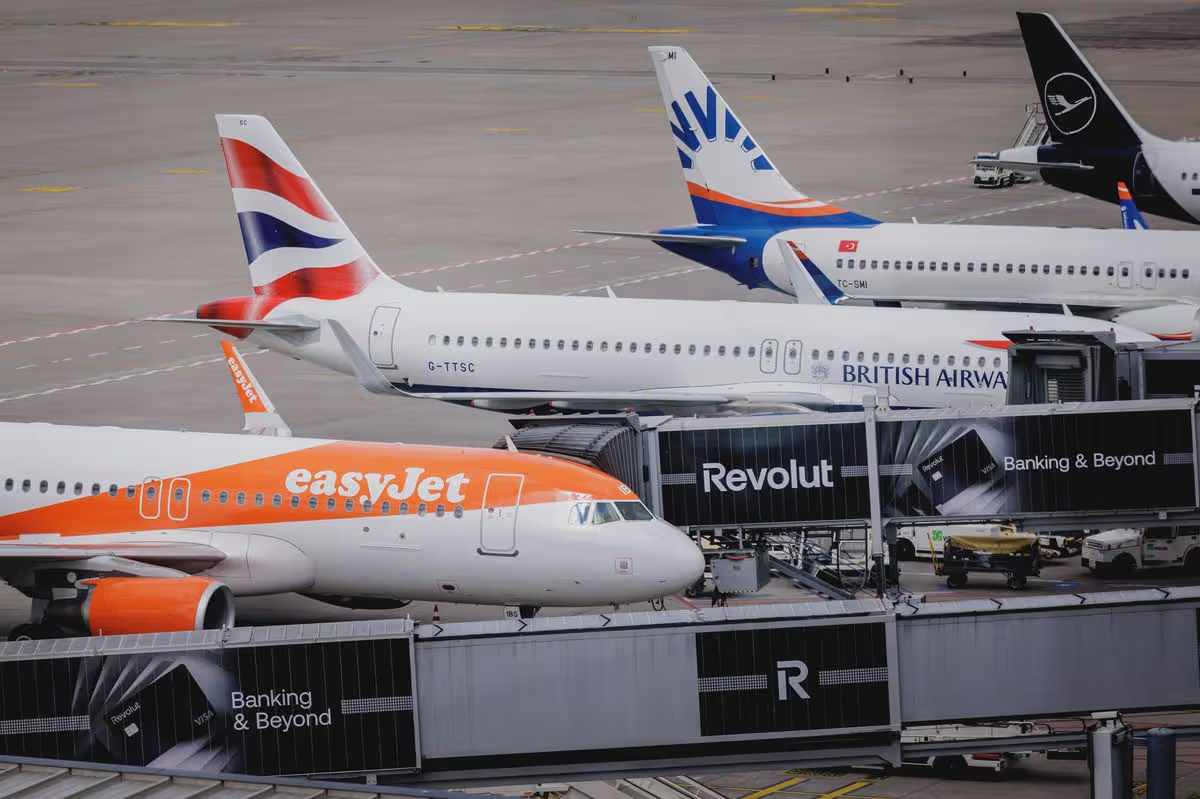
British Airways has advice to help passengers ‘avoid delays’ at the airport. The airline’s website shares the latest guidance and travel updates for customers. It also answers frequently asked questions to help passengers have the smoothest possible experience on travel days.
In the baggage FAQ section, the airline has offered a tip for anyone travelling with medication in their hand luggage. British Airways said it recommends that passengers carry a copy of their prescription for any medication they are carrying.
The advice said: “We recommend you carry a copy of the prescription for your medication to avoid delays at security or customs.” Passengers are advised to carry any essential medications in their hand luggage.
British Airways explained: “If you need to take regular medication, it’s important to pack enough essential medication for your personal use on board – and for the first few days of your journey – into your smaller under-seat item of hand baggage. This is in case your hold baggage is delayed for any reason.”
British Airways adds that this medication shouldn’t be packed in any larger cabin bags. “Avoid packing medication in your larger cabin bag as you may be asked to put it into the hold on busy flights.
“Additional medication for personal use at your destination can also be packed in your checked baggage, so long as you are carrying enough for a few days in your hand baggage in case of any eventuality.”
There are allowances for passengers who need to carry medicines exceeding 100ml. Gov.uk explains: “You’re allowed to carry the following in your hand luggage: essential medicines of more than 100ml, including liquid dietary foodstuffs and inhalers or medical equipment, if it’s essential for your journey.
“You’ll need to carry proof that the medication is prescribed to you (for example, a letter from your doctor or a copy of your prescription) if it’s both: in liquid form and in a container larger than 100ml. You do not need to show proof if the medication is either: in tablet form or liquid in a container that’s 100ml or smaller.”
Gov.uk also shares advice for any passengers travelling with medicine containing a controlled drug. The guidance states: “You must carry medicine containing a controlled drug with you in your hand luggage when entering or leaving the UK.
It may be taken away from you at the border if you cannot prove it was prescribed for you.”
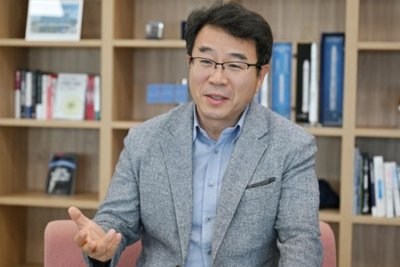
Hyunjoon Kwon, director general for aerospace policy at the Korea AeroSpace Administration, speaks during an interview with Asia Today on Friday. Photo by Asia Today
June 30 (Asia Today) — South Korea is seeking to connect the growth of its commercial space industry with stronger national security capabilities as emerging technologies blur the boundaries between the private and public sectors.
The expansion of security concerns into space, drones and artificial intelligence has increased the importance of the Korea AeroSpace Administration, which is responsible for developing the country’s aerospace industry.
The agency is working with the National Intelligence Service and other government organizations on satellite cybersecurity and broader aerospace security policies.
Hyunjoon Kwon, director general for aerospace policy at the agency, told Asia Today in an interview Friday that space is no longer solely a scientific field.
“Space has moved beyond science to become a domain that can affect both security and industry,” Kwon said. “We need a mutually reinforcing relationship between the market and the public sector.”
Asked how the global space security environment is changing, Kwon said competition is no longer limited to the number of satellites a country possesses.
“The key question is how reliably a country can use and protect satellite communications and satellite imagery,” he said.
Space-based services have been used directly in military operations and critical national infrastructure since the start of the Russia-Ukraine war, Kwon said.
Countries also face increasingly complex threats, including GPS jamming and spoofing, disruptions to satellite communications, cyberattacks and the collision or uncontrolled reentry of objects in space.
Kwon said the agency is developing a national space situational awareness system to strengthen South Korea’s ability to monitor and predict space-related risks.
It is also preparing a cybersecurity response framework to protect space-based services used by the private sector, government and military.
South Korea has rapidly accumulated capabilities in launch vehicles, satellite development and satellite data applications, Kwon said. Its military space capabilities have also expanded.
However, the country still needs to strengthen its domestic production of critical materials, components and software, he said.
Other areas requiring improvement include space situational awareness, satellite cybersecurity and the creation of a sustainable commercial market for space services.
“That is why the growth of private space companies and greater independence in core technologies are becoming even more important,” Kwon said.
Cooperation among the private sector, government and military has entered a stage of institutional development since the establishment of the Korea AeroSpace Administration, he said.
The cooperative channels include a future defense science and technology policy council with the Defense Ministry, an aerospace project memorandum with the Defense Acquisition Program Administration and a satellite cybersecurity consultative body with the National Intelligence Service.
Kwon said the cooperation now extends beyond individual projects to include policy, technology and security.
The agency is seeking to create a structure in which private-sector technology is connected to government and national security requirements, while public and defense demand supports the growth of commercial companies.
Kwon also discussed the government’s recently announced strategy to foster innovative companies in emerging security industries.
“Aerospace is a strategic field that influences both security and industry, extending beyond the boundaries of science and technology,” he said.
Satellite communications, satellite data, unmanned aircraft and space materials and components have significant commercial growth potential while also meeting direct security needs, Kwon said.
The agency plans to focus on establishing a cycle in which the creation of new industries strengthens national security capabilities and security demand encourages further technological innovation.
The plans include developing core technologies for a space data center under the K-Moonshot initiative and building a national platform that will make satellite information available for broader use.
The agency also plans to develop artificial intelligence-powered unmanned aircraft and electric or hybrid vertical takeoff and landing aircraft.
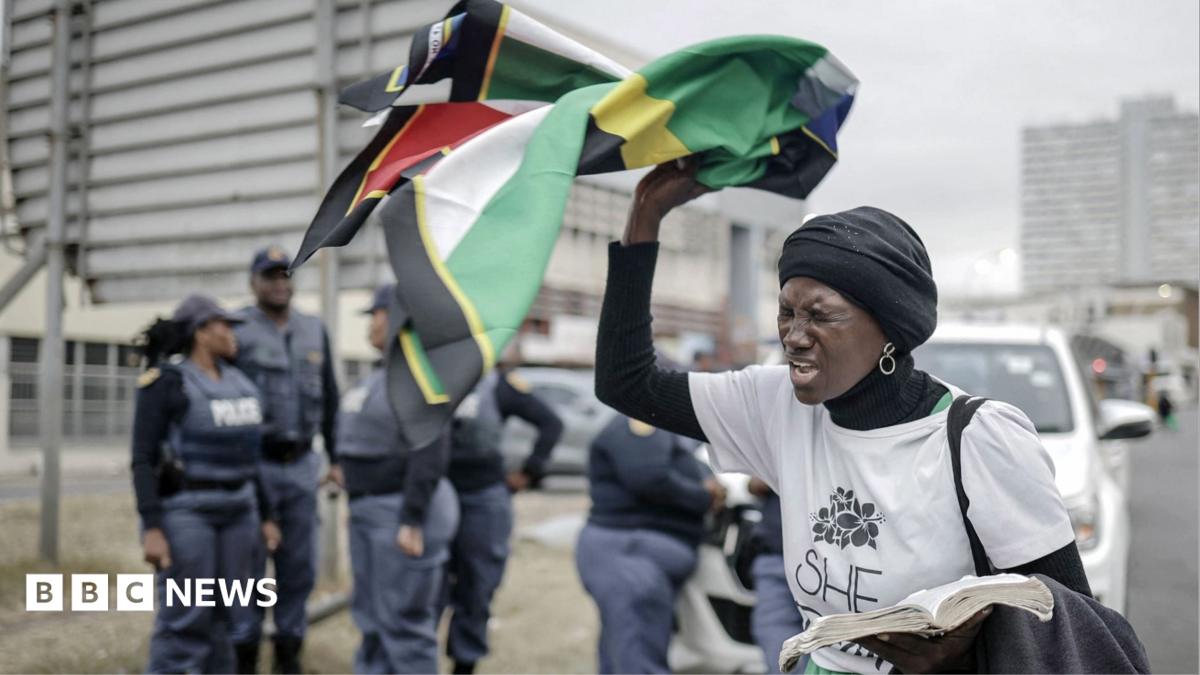
Police and personnel from private security firms have been deployed across South Africa because of fears that anti-immigration protests could turn violent as President Cyril Ramaphosa urged those planning to take part to do so without “intimidation, threats or ultimatums”.
The planned protests mark an unofficial deadline set by campaigners for all undocumented foreigner to leave the country.
Many have already fled to escape violence and intimidation. South African police say 25,000 have been repatriated so far. Most are from other African countries.
One undocumented Malawian told the BBC he was “happy to be going back” but “heartbroken” to be leaving behind four young children.
Johannesburg, where one of the protests is planned, is unusually quiet.
All the shops in the vicinity of where marchers are due to gather are closed, while police visibility is high on the city’s major streets.
Police said that five people were arrested in Johannesburg’s biggest township, Soweto, for allegedly looting a foreign-owned shop.
Five people were also arrested for allegedly breaking into a tuck shop in Hammarsdale in KwaZulu-Natal province.
Many businesses in central Durban, the main city in the province, are shut.
Ramaphosa has repeatedly warned demonstrators to act peacefully and responsibly, while also accepting the need for immigration reforms.
“They work, study, raise families, invest in our economy and contribute positively to our society. They too are entitled to the protection of our laws and our Constitution.
“The right to protest and freedom of expression does not allow people to threaten or intimidate others, or to engage in acts of vandalism or violence,” he wrote.
There are more than three million documented foreign nationals in South Africa, according to official figures.
Ahead of the deadline, thousands of migrants have been awaiting processing in temporary camps for several weeks out of fear for their safety.
“I was so happy when we were able to pull their visas and said they could leave the US soil, and I might’ve sung a song or two or maybe even danced a happy dance.”
He added: “There wasn’t a single team that we had to spend more time dealing with than Iran.”
Iran were only permitted to enter the US the day before their first two matches and had to leave on the same day as the game, under the terms of their visas.
Those restrictions were eased for their final group game in Seattle, allowing them to arrive two days early, but they again had to return to Tijuana after Saturday’s match.
Iran coach Ghalenoei said that the US, co-hosts of the World Cup with Canada and Mexico, had “treated us very unfairly” and that his squad had been given “less than half” the training window it needed to prepare.
Iran captain Mehdi Taremi added: “This kind of tension undermines the joy of the World Cup. I felt the tension from the first moment we arrived.”
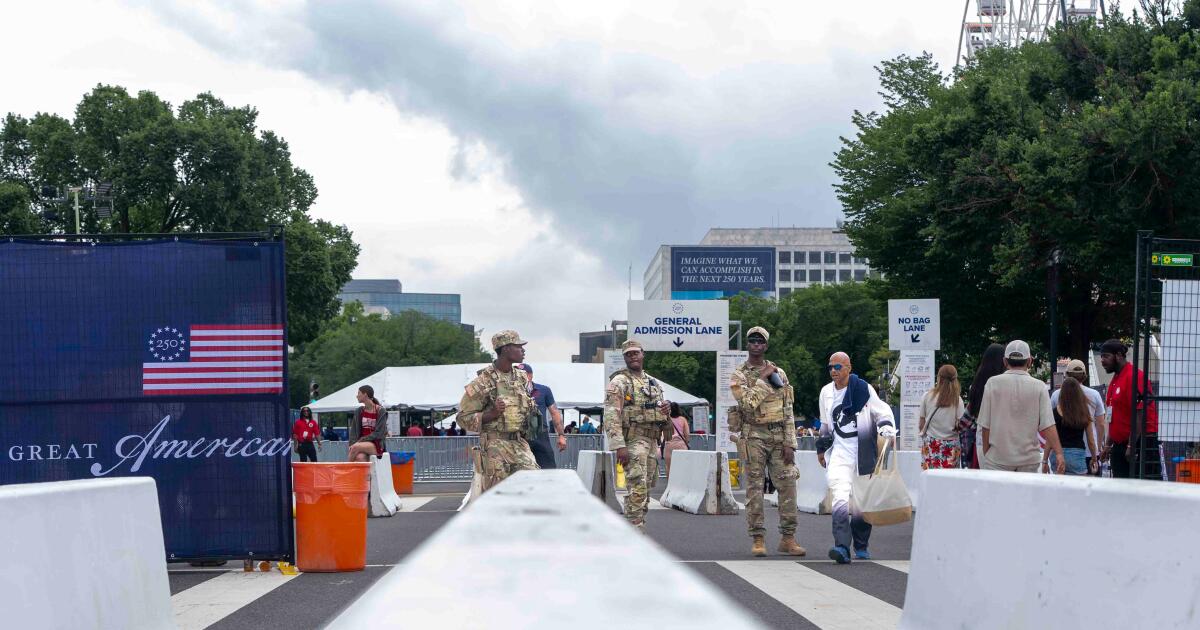
WASHINGTON — Federal law enforcement authorities are preparing for one of Washington’s largest and most complex security operations as the nation’s capital gears up to celebrate the 250th anniversary of the nation’s freedom.
With rising political violence, including recent incidents near the White House, and a president who enjoys being at the center of public pomp yet has repeatedly faced attempts on his life, a major security challenge awaits.
“It comes as no surprise to you that D.C. on a normal day is a target-rich environment,” said Darren B. Cox assistant director in charge of the FBI’s Washington field office at a recent news conference detailing the security preparations. “We are prepared for any threats.”
Hundreds of thousands of people are expected to visit Washington in the coming weeks for the festivities.
The throngs will be joined by thousands of law enforcement officers and agents and 5,000 National Guard troops, along with military-style vehicles and other hardware they don’t often see on the streets of America.
Authorities are preparing for a major security operation
The largest crowds are expected July 4, with multiple events happening simultaneously, including the Great American State Fair, a showcase for each state and a signature attraction of the celebrations that stretches across the National Mall.
The annual fireworks display that night is designated a National Security Special Event for the first time by the Department of Homeland Security, the highest classification for federal security coordination.
For visitors, that means strict ID requirements, long lines and magnetometers, similar to air travel security. Snipers are also expected to be deployed at some events.
Flights at Ronald Reagan Washington National Airport, which is across the Potomac River from Washington, will be suspended longer than in other years because of the scope of the celebrations — from noon on July 4 until the next day. Other America 250 events that include flyovers or parachute jumps could prompt more flight disruptions.
The FBI, Secret Service, U.S. Capitol Police, U.S. Park Police and D.C. National Guard have all been involved in security coordination for the events. At the news conference earlier this month, equipment that could be deployed to guard the city was on display, including BearCat armored SWAT vehicles, Mine-Resistant Ambush Protected vehicles, known as MRAPs, as well as communication vans and FBI diving boats.
“Our protective model is meant to adjust to any type of direct or indirect threats that we come across,” said Tara McLeese, special agent in charge of the Secret Service Washington field office. “I can assure you that we have no lack of imagination as to the potential threats out there.”
Brig. Gen. Leland Blanchard II, interim commander of the D.C. National Guard, said the planning had been underway for months and included rehearsals.
Blanchard said the Guard members would continue the roles they have served the last 10 months as part of a deployment to the city President Trump says is meant to fight crime. Blanchard highlighted that guard members, including military police officers, would be helping with duties like traffic and crowd control as well as responding to emergencies around the events.
President Trump, who has already attended several events leading up to July 4, including the kickoff rally last week launching the Great American State Fair, has said on Truth Social that he would hold a rally on the National Mall.
Speaking at a news conference Monday updating the upcoming security preparations, Cox reiterated that “at this time we are not tracking any credible threats related to the July 4 event, but we always remain vigilant.”
Recent violence has shaped the threat picture
The festivities come at a fraught moment, with recent political violence creating a complex threat environment for authorities. One man, Cole Tomas Allen, has been charged with attempting to assassinate the president after he sprinted past security at the White House Correspondents’ Assn. dinner in April. Allen has pleaded not guilty.
In the following weeks, two men on two separate occasions opened fired at Secret Service officers, the service said. Each incident happened in the vicinity of the White House.
More recently, the FBI announced it had thwarted a planned attack targeting Trump’s UFC cage-fighting show at the White House. Several suspects have been arrested in that case.
Security was already enhanced on the National Mall ahead of the launch of festivities, as Trump claimed without providing evidence that vandals had damaged the Reflecting Pool that he had recently renovated.
Matt Dallek, a political scientist at George Washington University who studies extremism, said Trump posed a unique security challenge because he is “both an accelerant and a target of political violence.”
The nation’s bicentennial offers a historical parallel
Observers draw some parallels to the 1976 bicentennial. The nation was coming off Watergate and Vietnam, and 10 months before the celebration there were two assassination attempts against then-President Ford.
“There was a lot of sourness in the country in ’76, a lot of cynicism about the direction of the country,” Dallek said. But both Ford and his Democratic opponent Jimmy Carter understood the threat political divisions posed and “were looking to bring down the level of vitriol.”
Angelyn Spaulding Flowers, professor of Homeland Security & Administration of Justice at the University of the District of Columbia, said the amount of security was unparalleled for the city, citing the ongoing and open-ended National Guard presence that has flooded Washington with additional security patrols for months.
Strikes come a day after fighters armed with guns and explosives killed three soldiers in Karachi.
By Agence France Presse and The Associated Press
Published On 29 Jun 202629 Jun 2026
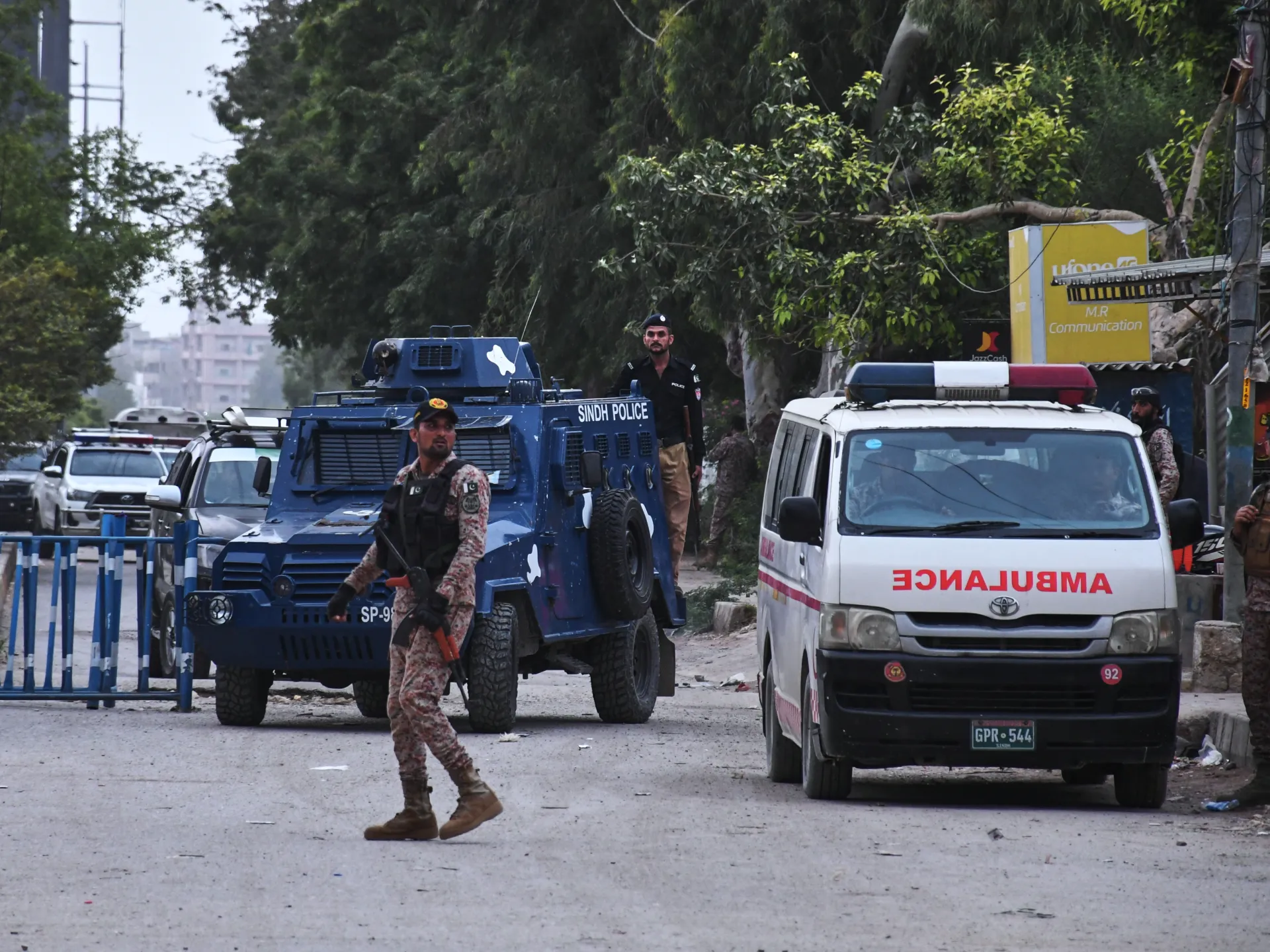
Pakistan’s security forces have carried out a ground operation and air strikes along the Pakistan-Afghanistan border in response to deadly attacks, killing 29 fighters, officials have said.
In a post on social media, Pakistani Minister of Information Attaullah Tarar said the operation was launched in response to multiple attacks by armed groups across the country.
Recommended Stories
list of 4 itemsend of list
“Three targets in Paktia, Paktika and Kunar were destroyed during precision strikes,” Tarar said on X, referring to three eastern Afghanistan provinces.
There was no immediate response from Afghanistan.
Pakistan has witnessed a surge in attacks targeting police and security forces in recent years.
Authorities have blamed the Pakistan Taliban, known by the acronym TTP, and allied armed groups for most of the violence.
It comes a day after fighters armed with guns and explosives targeted the regional headquarters of the paramilitary Rangers in the southern port city of Karachi, killing three soldiers.
Security forces killed three attackers and arrested another assailant, whom the military identified as an Afghan national in wounded condition.
Jamaat-ul-Ahrar, a breakaway faction of the Pakistan Taliban, claimed responsibility for the Karachi attack in a statement on Saturday night.
Tarar said Pakistan’s latest operation along the Afghan border targeted hideouts and safe havens of the Pakistan Taliban.
The Pakistan Taliban are a separate armed group from the Afghan Taliban, although the two are allies.
The Afghan Taliban returned to power in neighbouring Afghanistan in 2021.
The latest operations are likely to further strain the already tense relations between Islamabad and Kabul.
Sunday’s cross-border strikes and ground operation came less than three weeks after Pakistan’s military launched air strikes on what it said were fighter group hideouts in Afghanistan.
They ended about a month of relative calm following what Islamabad had described as an “open war” between the neighbouring countries, despite international efforts to broker a lasting peace.
The escalation follows months of tit-for-tat military action between the countries.
Hundreds of people have been killed in cross-border fighting since February, when Afghanistan launched retaliatory strikes after Pakistan carried out air strikes inside Afghan territory.
Multiple rounds of internationally mediated peace talks have failed to secure a lasting ceasefire.
China also hosted the two sides in April, and Beijing later said that Pakistan and Afghanistan had agreed not to escalate their conflict and to explore a solution.
Since last year, Pakistan has carried out multiple strikes along the border and inside Afghanistan, targeting alleged hideouts of the Pakistan Taliban and other armed groups.
Pakistan accuses Afghanistan’s Taliban government of harbouring fighters who carry out deadly attacks inside Pakistan, especially the Pakistan Taliban.
Elite security personnel carry out a large-scale operation at dawn in the Green Zone and several neighbourhoods in Baghdad, security source says.
Published On 28 Jun 202628 Jun 2026
Several Iraqi politicians, lawmakers and officials have been arrested on corruption charges, Iraqi state-run media report.
Several people, including members of parliament “whose immunity had been lifted and officials whose names appeared in … confessions”, were arrested early on Sunday in the capital, Baghdad, the Iraqi News Agency reported, quoting a security source.
Recommended Stories
list of 3 itemsend of list
It was not immediately clear who had been arrested. There was no immediate official statement on the arrests from the Iraqi government or security forces.
A security source told Al Jazeera that elite Iraqi security forces carried out a large-scale arrest operation at dawn in the fortified International Zone (Green Zone) and several neighbourhoods in Baghdad.
The source said the arrests were carried out by the Counter Terrorism Service and were based on statements provided by Adnan al-Jumaili, deputy oil minister, after his arrest last month on corruption charges.
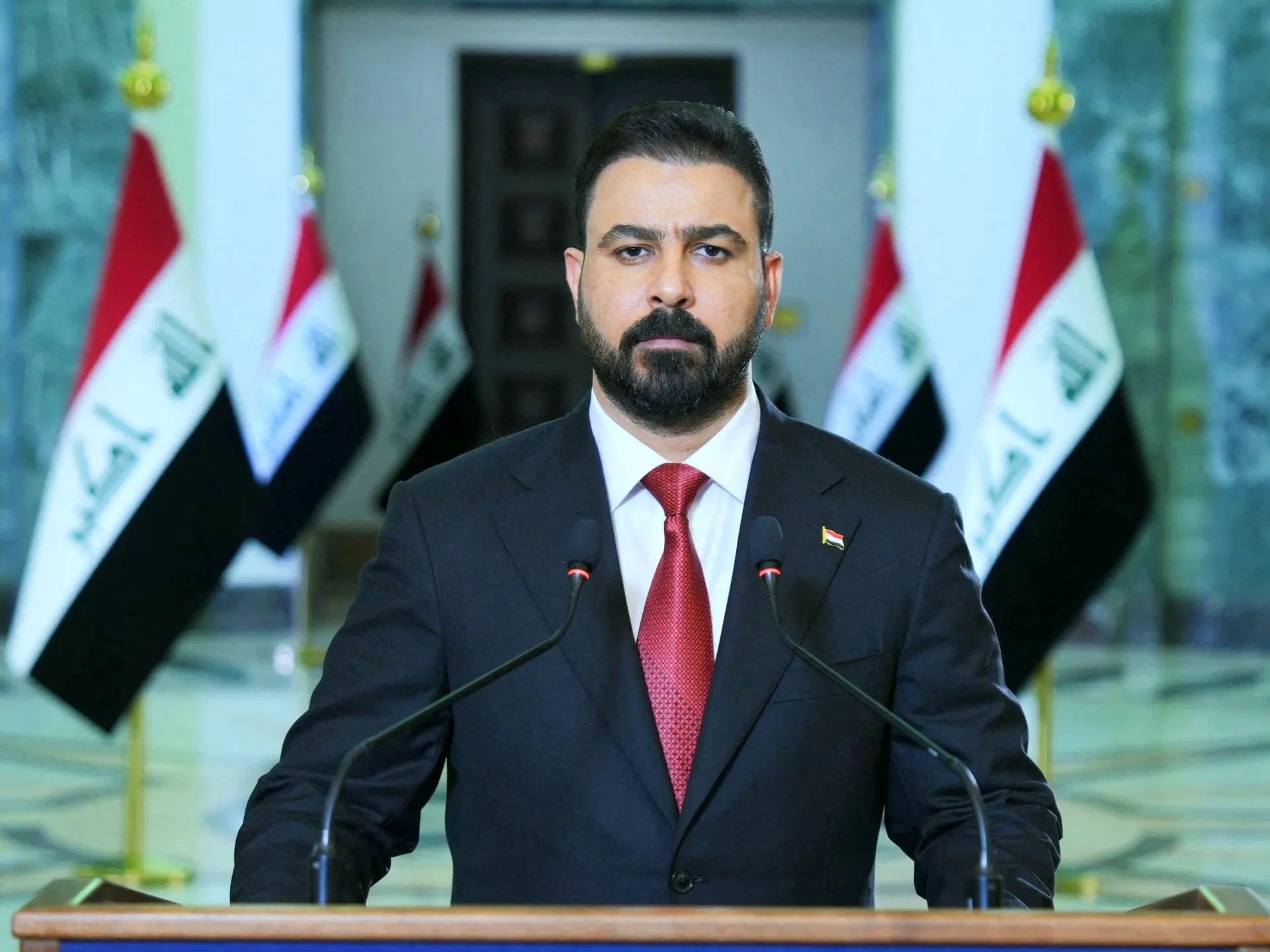
Iraq’s new prime minister, Ali al-Zaidi, has pledged to fight corruption and mismanagement that have plagued Iraq for decades.
Authorities seized about $86m in cash this month that was allegedly part of the corruption case against al-Jumaili.
The Associated Press news agency reported that seven people were arrested on Sunday, including five members of parliament. It cited a security agency report it obtained. The AP said some of those arrested were from the political bloc of former Prime Minister Mohammed Shia al-Sudani.
During November’s parliamentary elections, al-Sudani’s bloc won the largest share of seats, but he did not return as prime minister. He stepped aside amid a deadlock in the Coordination Framework, a group of Shia parties allied with Iran that brought al-Sudani to power. They disagreed for months over their preferred candidate for the post.
Egypt’s foreign ministry used carefully calibrated language on Monday to restate a familiar position: unwavering support for Sudan’s “unity, sovereignty and territorial integrity” and for its “national institutions, particularly the Sudanese Armed Forces (SAF).” Framed as a rejection of “parallel entities” seeking to form an alternative government in exile, the statement is another sign that Cairo is tying its Sudan policy ever more tightly to General Abdel Fattah al‑Burhan and the SAF as the country’s civil war grinds into yet another year.
Behind the diplomatic phrasing lies a blunt political choice. Since the outbreak of fighting between the SAF and the Rapid Support Forces (RSF) in April 2023, Egypt has emerged as one of the army’s main regional backers, both politically and—according to multiple reports—quietly in security terms. Egyptian officials insist they are defending Sudanese state institutions against militia fragmentation and external meddling, a message they repeat in multilateral forums and joint communiqués with Burhan’s Transitional Sovereignty Council.
From Cairo, the stakes in Sudan are seen as existential rather than abstract. Egyptian analysts routinely describe the stability of their southern neighbour as a vital national security concern, citing fears of refugee flows, arms smuggling and jihadist safe havens along the porous border. Control of the Nile is an even deeper driver: since the 2019 fall of Omar al‑Bashir, Egypt has intensified security and military coordination with Khartoum to counter Ethiopia’s upstream Grand Ethiopian Renaissance Dam (GERD) and preserve its historic water share.
There is also a clear regime‑security affinity, however misguided that affinity might be. Burhan, a career officer who trained in Cairo and maintains close ties with Egyptian generals, represents a familiar authoritarian model for President Abdel Fattah el‑Sisi, himself a former general who came to power after a coup in 2013. Supporting the SAF fits Egypt’s long‑standing pattern of siding with Sudan’s army “whoever is in charge of it,” and buttresses Cairo’s broader preference for strong central militaries over messy civilian transitions across the region.
Stay ahead of the geopolitical week.
MD Briefing delivers expert analysis across five global fronts — the Indo-Pacific, energy, geoeconomics, European security, and the Middle East — every Monday morning. Free.
Officially, Egypt insists it is not a party to Sudan’s war. Sisi has repeatedly pledged “non‑interference,” and Cairo frames its role as limited to mediation, humanitarian aid, and hosting millions of Sudanese fleeing the conflict. Egyptian troops captured by the RSF at Merowe airbase in April 2023 were described as participants in pre‑scheduled joint exercises, not combat operations, a spin that few international observers bought.
The line between deterrent presence and de facto involvement has become increasingly blurred. Analysts note years of intensifying joint drills, intelligence cooperation and arms ties between the two militaries since 2019. Think‑tanks and regional media have reported unconfirmed Egyptian airstrikes on RSF positions and possible targeting of gold‑mining camps in northern Sudan, amid allegations by RSF leaders that Cairo is providing drones and tactical support to the SAF—claims Egypt denies. The pattern points towards at the very least a protective security umbrella for Burhan’s forces, far beyond the strict neutrality Cairo proclaims.
Yet in Burhan Egypt is backing a very risky partner. By hinging its Sudan strategy almost entirely on the SAF and Burhan’s sovereignty council, Egypt is betting on a man and an institution that look increasingly incapable of reunifying the country. The war has left tens of thousands dead, displaced over 14 million people, and pushed parts of Sudan towards famine, with the army losing and regaining territory in a grinding stalemate against the RSF. Burhan’s own legitimacy is deeply contested: he led the 2021 coup that derailed a fragile civilian‑military power‑sharing agreement, and his government is widely seen by pro‑democracy groups as a continuation of military dominance rather than a path to elections.
Cairo’s categorical rejection of “parallel governments” sounds like a defence of state unity, but in practice it risks delegitimising genuine civilian coalitions seeking to organise outside the SAF‑RSF binary. By equating Sudan’s “national institutions” with the existing military leadership, Egypt narrows the political horizon and sidelines the broad civilian forces that led the 2018–2019 uprising—precisely the actors most likely to provide a sustainable, inclusive settlement. If the SAF continues to fragment on the battlefield or loses further territorial control, Cairo may find that its red lines have locked it into defending a shrinking power centre with dwindling popular backing.
There is also a long‑term reputational cost. Egypt positions itself as a mediator through formats such as the “Quad”, and hosts conferences of Sudanese civil and political actors in Cairo. But as long as its public diplomacy is tethered to explicit promises that it “will not be lax or late in supporting the legitimate Sudanese government” under Burhan, that positioning is scarcely credible. On the contrary, Egypt has decisively and actively allied itself to Sudan’s military junta.
A savvy shopper has shared the travel essentials she found in Poundland, including 100ml travel-size suncreams and shampoos that are perfect for those travelling with only hand luggage
08:03, 27 Jun 2026Updated 08:03, 27 Jun 2026
She shared what she’d managed to find that would make life a lot easier when travelling (stock image)(Image: Ray Orton via Getty Images)
The prospect of travelling with only hand luggage can fill many holidaymakers with anxiety, prompting them to fork out for hold luggage when their liquids won’t fit in a carry-on bag. The reason, of course, is that when passing through airport security, liquids are restricted to 100ml — which can be a real headache, given that many suncreams come in 250ml bottles, or, even more frustratingly, 125ml — just over the limit.
However, a savvy traveller named Sham has flagged that Poundland stocks “100ml suncreams,” meaning you’ll have “no stress at security” as your liquids will be fully compliant with rules and regulations. Getting through airport security with hand luggage only can actually be a doddle with the right products in tow — and also spares you the nail-biting wait at the baggage carousel, desperately hoping your suitcase has made it to your destination in one piece.
She noted that the mini products are priced at £2, quipping: “We know Poundland’s not all a pound anymore.” Sham revealed that the store stocks suncream, sprays, and even travel-sized shampoos and conditioners — ideal for those heading away long enough to need a hair wash.
She also spotted towel clips for just £1, so you needn’t worry about your towel taking flight if your destination turns out to be a touch on the breezy side. Rounding things off, there was a Malibu fake tan that Sham said she was keen to try before her holiday, adding that she’d heard great things about it — and at just £2, it seemed well worth a go.
In the comments section, one user wrote: “Ah, I need to get to Poundland! Going away soon, so these would be perfect.”
Content cannot be displayed without consent
A second chimed in: “Buying s**** to take on holiday is the most British thing ever. You don’t need half that s***, it will be left in the bag in the hotel the whole holiday.”
However, Sham hit back: “It saves a right packet taking the small ones, perfect amount for your hol.” And there’s no denying that SPF is absolutely essential.
NHS advice on keeping yourself safe in the sun
Sunburn increases your risk of skin cancer. And it does not just happen on holiday. You can burn in the UK, even when it’s cloudy.
There’s no safe or healthy way to get a tan. A tan does not protect your skin from the sun’s harmful effects. Aim to strike a balance between protecting yourself from the sun and getting enough vitamin D from sunlight.
Spend time in the shade when the sun is strongest. In the UK, this is between 11am and 3pm from March to October.
You can also check the UV index on a weather app or website. If it’s three or higher, consider protecting your skin.
Make sure you:
spend time in the shade between 11am and 3pm
never burn
cover up with suitable clothing and sunglasses
take extra care with children
keep babies under six months out of direct sunlight
use at least factor 30 sunscreen – make sure to use enough and re-apply frequently
Do not rely on sunscreen alone to protect yourself from the sun. Wear suitable clothing and spend time in the shade when the sun’s at its hottest.
When buying sunscreen, the label should have:
a sun protection factor (SPF) of at least 30 to protect against UVB
at least four-star UVA protection
UVA protection can also be indicated by the letters “UVA” in a circle, which indicates that it meets the EU standard.
Make sure the sunscreen is not past its expiry date. This is marked by a symbol of an open jar, an M and a number, which shows how many months the sunscreen will last once it’s been opened. Do not spend any longer in the sun than you would without sunscreen.
SMEs and Startups Minister Han Seong-sook attends a meeting of the emergency economic headquarters at the government complex in Seoul, South Korea, 22 May 2026. Photo by YONHAP / EPA
June 26 (Asia Today) — South Korea plans to create an investment and procurement system aimed at producing homegrown security technology companies comparable to U.S. data analytics company Palantir Technologies, the government said Friday.
The Ministry of SMEs and Startups announced the strategy with the Defense Ministry and Korea AeroSpace Administration during a meeting on future security innovation companies at the Blue House.
The plan seeks to accelerate the transfer of advanced civilian technology into national defense and security.
The government aims to develop five security technology companies valued at more than 1 trillion won ($651 million) and 50 companies with annual sales exceeding 100 billion won ($65.1 million) by 2030.
It will designate five strategic sectors covering drones and robotics, defense artificial intelligence and semiconductors, advanced sensors and materials, aerospace technology and cybersecurity and quantum communications.
Officials described the initiative as an effort to cultivate a “Korean Palantir,” referring to the U.S. company known for software that integrates and analyzes large volumes of defense and intelligence data.
The phrase is a policy description rather than the name of a company the government plans to establish.
Investment vehicle modeled on In-Q-Tel
The ministry plans to establish a government-backed investment organization modeled on In-Q-Tel, the nonprofit strategic investor created to support technologies relevant to U.S. intelligence agencies.
The proposed organization would make direct investments in early-stage security technology companies to address funding shortages.
The government also plans to support the establishment of a technology-focused asset management company tentatively called Korea Strategic Technology Partners.
Through government and private investment vehicles, officials aim to create as much as 10 trillion won ($6.5 billion) in strategic technology financing over the next five years.
The money would provide growth capital to startups and smaller companies developing technologies with potential defense, intelligence, aerospace or cybersecurity applications.
Faster research and procurement
South Korea also plans to introduce a special research and development program modeled on the U.S. Other Transaction Authority system.
The system would connect research, testing and government purchasing under a faster contracting process intended for rapidly changing technologies.
Selected companies could receive as much as 10 billion won ($6.5 million) each over five years.
The Defense Ministry and Korea AeroSpace Administration plan to create procurement systems capable of placing some advanced weapons or technologies into initial service within one year.
The government also plans to expand access to defense data through a catalog showing what information may be available to approved companies.
Aerospace authorities will support the development of core technology for a national space data center and platforms that allow businesses to use satellite information.
The strategy reflects the government’s view that traditional defense procurement moves too slowly for technologies such as artificial intelligence, drones, robotics and cybersecurity software.
Support for smaller technology companies
Minister of SMEs and Startups Han Seongsook said the global security industry is shifting rapidly from traditional hardware toward software, data and artificial intelligence.
“The government will provide bold and rapid support so startups and small venture companies with flexible and creative technologies can become leaders in security innovation,” Han said.
The government also plans to protect companies’ intellectual property rights and allow technologies developed through public programs to be adapted for civilian markets.
Officials said the strategy would help smaller companies enter a defense industry that has traditionally been dominated by large manufacturers and hardware-centered weapons programs.
The ministries plan to form an interagency committee, pursue special legislation and revise contracting rules to support the initiative.
GREENBELT, Md. — Former Trump administration national security adviser John Bolton pleaded guilty on Friday to illegally retaining classified information, sealing a deal with federal prosecutors that could allow him to avoid a prison term.
Bolton, who became an outspoken critic of President Trump after serving in the Republican’s first administration, is scheduled to be sentenced on Oct. 28 by U.S. District Judge Theodore Chuang in Greenbelt, Md.
Bolton pleaded guilty to a single count of illegally retaining classified information. His plea agreement with the Justice Department may enable him to avoid time behind bars, but the judge ultimately will decide his punishment.
The plea agreement recommends capping any prison sentence at five years but the judge isn’t bound by that part of the deal. Bolton can withdraw his guilty plea if the judge issues a longer prison sentence or a fine greater than $2.25 million.
Bolton was charged last October with 18 counts of either retaining or disseminating classified information, including diary-like notes that he shared with relatives as he wrote a memoir about his career in government.
Other Trump adversaries have been charged with federal crimes during his second term in the White House. While some of those cases have collapsed under judicial scrutiny and amid claims of political retribution, Bolton didn’t mount a vigorous defense against his charges before cutting a deal.
FBI agents searched Bolton’s Maryland home and Washington, D.C., office last August, but the investigation began before Trump returned to the White House in January 2025.
Bolton served for more than a year in Trump’s first administration before getting pushed out in 2019. He later published a book called “The Room Where it Happened” that presented an unflattering portrait of Trump’s leadership.
The Trump administration fought unsuccessfully to block the book’s release, claiming it contained classified information that could jeopardize national security. Trump derided Bolton as a “crazy” warmonger who would have led the country into “World War Six.”
Bolton’s indictment focused on notes that he shared with his wife and daughter rather than the contents of his book. After sending one document, Bolton wrote in a message to his relatives, “None of which we talk about!!!” In response, one of his relatives wrote, “Shhhhh,” prosecutors said.