season

Dodgers Dugout: Here’s what is causing the Dodgers’ problems this month

Hi, and welcome to another edition of Dodgers Dugout. My name is Houston Mitchell. Maybe the Dodgers can lure Nuke LaLoosh out of retirement.

Are you a true-blue fan?

Get our Dodgers Dugout newsletter for insights, news and much more.

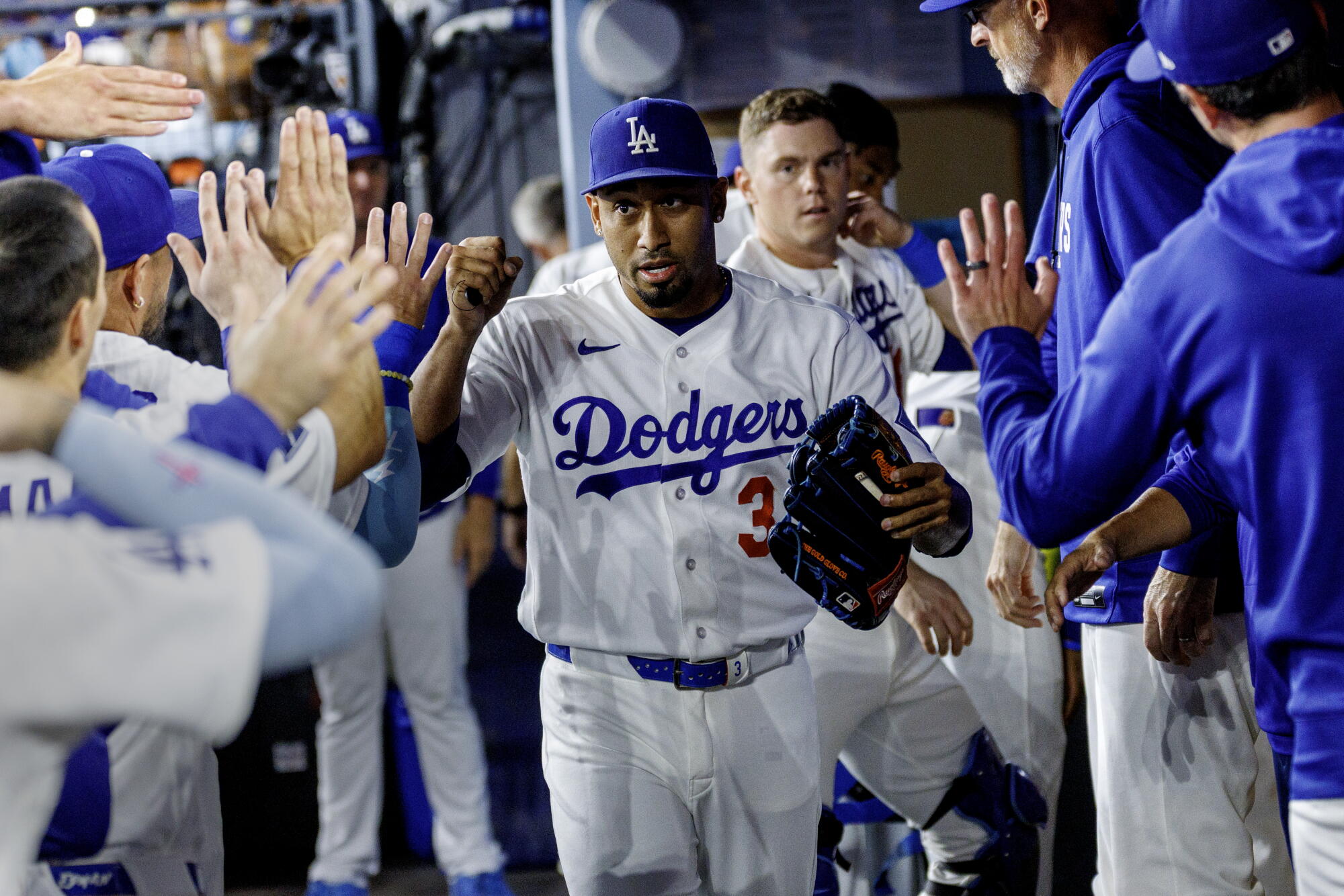
The Dodgers are struggling in June, going 7-6 this month after going 20-11 in March/April and 18-10 in May. Why? Let’s take a look.

Runs per game
March/April: 5.39
May: 5.25
June: 5.54

Batting average
March/April: .273
May: .252
June: .261

OB%
March/April: .350
May: .339
June: .354

SLG%
March/April: .452
May: .441
June: .413

Power is down a bit, but all the other numbers are normal, so offense does not appear to be a big problem. They are hitting about the same in all the clutch stats, so that’s not a big problem. Let’s look at the pitching:

ERA
April: 3.19
May: 2.95
June: 4.73

ERA by starters
April: 2.83
May: 3.31
June: 3.28

ERA by relievers
April: 3.88
May: 2.35
June: 7.51

Ah, we begin to see the problem: The bullpen, which has been outstanding all season until this month.

Let’s look at ERA by each pitcher in June:

Yoshinobu Yamamoto, 1.10 (16.1 IP)
Shohei Ohtani, 2.13 (12.2)
Edgardo Henriquez, 3.38 (5.1)
Justin Wrobleski, 3.38 (10.2)
Eric Lauer, 3.48 (10.1)
Tanner Scott, 4.15 (4.1)
Will Klein, 4.50 (4)
Emmet Sheehan, 4.97 (12.2)
Alex Vesia, 5.40 (3.1)
Roki Sasaki, 5.56 (11.1)
Blake Treinen, 6.23 (4.1)
Jonathan Hernández, 8.10 (6.2)
Jack Dreyer, 9.00 (7)
Kyle Hurt, 21.60 (3.1)

That’s a lot of bad pitching in the bullpen this month. Of course, this is the same bullpen that set a team record for most consecutive scoreless innings. And, just like batters go into slumps, so do pitchers.

“Out of the bullpen specifically, I think maybe some strike throwing, a few more walks that we’re not used to over the last six weeks or so, because they’ve been really, really good,” bench coach Danny Lehmann told reporters after the Dodgers lost to the Chicago White Sox on Sunday. “We’ve gotten bit by the long ball, obviously in Pittsburgh, and here tonight. But overall, it’s more the strike throwing and just getting ahead of guys and doing what they’re supposed to do.”

Are fresh arms on the way?

Well, Brock Stewart is on a rehab assignment in Ontario, but he has been injured so often since the Dodgers traded for him, you can’t expect anything from him. You can just hope. Evan Phillips is on assignment in Oklahoma City, and is on track to return in early July.

“It’s really good to see,” Dave Roberts told reporters recently. “Evan’s a guy that’s very focused and determined, and he’s going to do everything he’s supposed to do to get back. And to potentially have him back is a big weapon that we’ve missed for quite some time, and I miss seeing him around. … I depended on him a lot when he was active, so to get him back is going to be a big boost to everyone.”

There are the usual suspects in the minors, such as Paul Gervase, whom they can turn to, but other than that, it’s just wait and see and hope Stewart and Phillips can come back healthy (especially Phillips, who was a key man in the bullpen for four seasons).

Congratulations!

Roberts missed Sunday’s game for a very good reason: His daughter, Emme, graduated from Stanford.

“I’m really proud,” Roberts told David Vassegh on AM 570 last week. “It is weird, though, because you never want to miss a game. But I think that this is a good reason.

“I think the one thing for me, is the world has evolved, and many can argue not in a good way. In some ways good, some ways bad. But I do think in a lot of ways from the workplace sense of things, it’s more open to people spending time with their families. Knowing that those moments are important, they’re fleeting. The job is going to get done with or without you.

“So I encourage my coaches to enjoy graduations and things like that. One of our coaches had to leave for a surgery for their daughter. I certainly welcome that, because there’s nothing more important than family. And also, I think when you get to do moments with your family and other things that are really important, I think you do your job better, and you feel better for the people you work with and for.”

These names seem familiar

How notable players who were with the Dodgers the last couple of seasons are doing with their new teams (through Sunday). Click on the player’s name to be taken to their full stats page:

Anthony Banda, Twins: 2-0, 4.54 ERA, 1 save, 30 IP, 25 hits, 14 walks, 27 K’s, 98 ERA+

Cody Bellinger, Yankees: .265/.361/.462, 299 PA’s, 14 doubles, 3 triples, 10 homers, 45 RBIs, 128 OPS+

Walker Buehler, Padres: 4-3, 4.14 ERA, 67.1 IP, 68 hits, 22 walks, 58 K’s, 99 ERA+

Mike Busch, Cubs: .253/.377/.412, 313 PA’s, 13 doubles, 2 triples, 8 homers, 42 RBIs, 128 OPS+

Michael Conforto, Cubs: .227/.327/.443, 113 PA’s, 9 doubles, 4 homers, 13 RBIs, 120 OPS+

Justin Dean, Cubs: in the minors

Caleb Ferguson, Reds: 0-0, 2.08 ERA, 8.2 IP, 7 hits, 3 walks, 9 K’s, 219 ERA+

Jack Flaherty, Tigers: 1-8, 5.35 ERA, 65.2 IP, 69 hits, 34 walks, 78 K’s, 81 ERA+, on the IL

Kenley Jansen, Tigers: 1-3, 4.50 ERA, 7 saves, 16 IP, 9 hits, 9 walks, 21 K’s, 98 ERA+

Craig Kimbrel, Rays: 0-2, 5.82 ERA, 17 IP, 19 hits, 8 walks, 18 K’s, 74 ERA+

Gavin Lux, Rays: on the IL

Dustin May, Cardinals: 4-6, 4.21 ERA, 72.2 IP, 71 hits, 20 walks, 66 K’s, 95 ERA+

Zach McKinstry, Tigers: .178/.271/.259, 157 PA’s, 3 doubles, 1 triple, 2 homers, 10 RBIs, 48 OPS+

James Outman, Tigers : .164/.243/.299, 74 PA’s, 4 doubles, 1 triple, 1 homer, 4 RBIs, 49 OPS+

Joc Pederson, Rangers: .239/.344/.438, 210 PA’s, 7 doubles, 2 triple, 8 homers, 23 RBIs, 128 OPS+

Luke Raley, Mariners: .241/.303/.503, 210 PA’s, 6 doubles, 1 triple, 14 homers, 35 RBIs, 126 OPS+

Ben Rortvedt, Mets: in the minors

Corey Seager, Rangers: .186/.284/.373, 204 PA’s, 6 doubles, 9 homers, 24 RBIs, 91 OPS+

Justin Turner, Tijuana (Mexican League): .287/.405/.497, 173 PA’s, 12 doubles, 6 homers, 23 RBIs

Trea Turner, Phillies: .219/.269/.330, 309 PA’s, 11 doubles, 7 homers, 21 RBIs, 63 OPS+

Miguel Vargas, White Sox: .247/.370/.490, 304 PA’s, 11 doubles, 1 triple, 16 homers, 44 RBIs, 138 OPS+

Kirby Yates, Angels: 0-2, 4.38 ERA, 12.1 IP, 9 hits, 5 walks, 16 K’s, 99 ERA+

Up next

Monday: Tampa Bay (Nick Martinez, 2-5, 4.63 ERA) at Dodgers (*Eric Lauer, 2-5, 5.47 ERA [1-0, 2.76 ERA with Dodgers]), 7 p.m., ESPN, AM 570, KTNQ 1020

Tuesday: Tampa Bay (Drew Rasmussen, 6-2, 2.71 ERA) at Dodgers (*Justin Wrobleski, 3-2, 4.50 ERA), 7:10 p.m., SportsNet LA, AM 570, KTNQ 1020

Wednesday: Tampa Bay (*Shane McClanahan, 6-2, 2.43 ERA) at Dodgers (Shohei Ohtani, 6-2, 1.06 ERA), 12:40 p.m., SportsNet LA, AM 570, KTNQ 1020

All times Pacific

*-left-handed

In case you missed it

The hardest days are when calls don’t go through: Andy Pages opens up about family in Cuba

Shaikin: Would Dave Roberts snub Yoshinobu Yamamoto to start Shohei Ohtani in All-Star Game?

And finally

Vin Scully tells us about the history of home plate. Watch and listen here.

Until next time …

Have a comment or something you’d like to see in a future Dodgers newsletter? Email me at houston.mitchell@latimes.com. To get this newsletter in your inbox, click here.
Source link

Sarah Goldberg on ‘The Audacity,’ ‘Barry’ and avoiding being typecast

Few people do simmering panic as nimbly as Sarah Goldberg.

In her role as Dr. JoAnne Felder, a performance psychologist tending to the mercurial psyches of the billionaire man-children of Silicon Valley on the new AMC satire “The Audacity,” Goldberg careens from serene to slapstick as she tries to keep a lid on her increasingly unruly life.

It is the latest in a string of enviably layered characters for the Vancouver native, including her Emmy-nominated breakout turn as aspiring actor Sally Reed on the HBO contract killer dramedy “Barry” and the coolly calculating portfolio manager Petra Koenig on the network’s drama “Industry.”

“I’m definitely learning some large tech and finance words that I didn’t know,” she says with a laugh about her recent wealth-adjacent roles on a Zoom from London, where she makes her home. “I’m not sure if I’ll retain them.”

Given the accolades, it seems likely Goldberg only needs to memorize her lines and the rest will follow.

While she has given a distinctive performance in each of her roles, one of several threads tying the characters together is a moment when fear, rage, excitement, ambition or all of the above collide but must be contained. While that discipline sometimes devolves into delicious displays of apoplexy — witness Goldberg’s incredible, expletive-littered elevator meltdown in “Barry” — the 40-year-old actor is more often the face of diplomacy while telegraphing cortisol levels in the red beneath her placid exterior.

“As a blond Canadian, I really ran the risk of being the girl next door,” she says of her attempt to dodge typecasting onscreen after cutting her teeth onstage in London and New York in the mid-2010s. “I didn’t want to be the girl next door … maybe the girl next door with bodies in the basement.”

While the only bodies to be found in JoAnne’s basement on “The Audacity” are her eavesdropping son and his friends, the London Academy of Music & Dramatic Art (LAMDA) graduate has accomplished the mission of subverting what might have been a perky ingenue image with the role. (One she will continue, since the series has already gotten a Season 2 order.)

When the ethically challenged therapist starts dabbling in insider trading thanks to info gleaned from her patients — including bold tech names Duncan Park (Billy Magnussen) and Carl Bardolph (Zach Galifianakis) — the slippery slope awaits.

Goldberg with "The Audacity" co-star Billy Magnussen.

Goldberg with “The Audacity” co-star Billy Magnussen.

(Ed Araquel / AMC)

“I think that she started her career with a desire to help people and somewhere along the line she’s become incredibly jaded and she’s exhausted by being the most intelligent person in the room and yet having no material wealth to show for it,” says Goldberg of her character, whose struggles extend to motherhood of son Orson (Everett Blunck) and marriage to child psychologist Gary (Paul Adelstein).

It does not help that JoAnne is surrounded by people who have no trouble sliding headfirst down the slope as if it were an Aspen trail.

“She’s working with people who have so many houses that if one burns down, it doesn’t matter, and yet she’s struggling to keep the roof over her own head. So somewhere along the line she starts making these little contracts with herself thinking, ‘In this sea of moral bankruptcy, is my tiny little transgression really so bad? Or is it even justified?’ But these little small pacts start to snowball. You can see somebody torn between their better judgment, their core instinct, their humanity, and someone who is so frustrated that they’re stepping toward a kind of nihilism.”

That sense of inner conflict appeals to Goldberg, who says she knew instantly that she had to play JoAnne when she read the script by showrunner Jonathan Glatzer. “It’s rare for me to go out and be like, ‘I have to play this role!’” she says, adding with a laugh, “I can be quite passive. I can be quite Canadian in the American market. I felt like he’d found this incredible line of satire with pathos, which is my favorite kind of style.

“I’m always interested in playing characters on the precipice of losing their moral compass and which way they decide to go,” she continues. “And if JoAnne has anything in common with Sally from ‘Barry,’ because they’re such different characters, it’s that. … I love that Jonathan’s given JoAnne very mundane relatable problems in a world where the scale is so off and there’s a lot that the average person can’t relate to in that bubble.”

Goldberg has also been busy creating her own bubble, writing, producing and starring in the Canadian-Irish series “Sisters” — which just concluded its second season on AMC — with Irish actor Susan Stanley, her best friend since their LAMDA days. The odd couple sibling comedy finds Goldberg playing Sare, a buttoned-down Canadian who goes to Ireland to find her long-lost biological father (Donal Logue) and discovers shambolic half-sister Suze (Stanley).

“I was pretty shocked at how hard it is to get something made,” she says of the series’ six-year journey to screen. “And then to be in a leadership position where you’re inviting everyone to dinner and you’ve got to make sure there are three courses and being responsible for everybody’s well-being — it was wildly challenging, but absolutely thrilling.”

While she prepares to return to JoAnne’s world in Palo Alto — her hometown of Vancouver serving as a double — Goldberg feels very fortunate about where she’s landed.

“I’ve been so lucky at this stage in my career to work on scripts that I feel are really saying something and characters that I feel are morally complex and also to be in the business at a time where female characters are more complicated.”

Source link

Best British crime series old and new to watch

Summer, and all the vacation days and potential travel that implies, is upon us. And whether flying internationally or taking time off at home, you can’t beat a good British crime drama as the ultimate self-soother (especially in summer when the U.K.’s inevitable drizzly city streets and windswept moors can provide at least visual relief from the heat). The genre is varied, the casts inevitably fine and justice almost always prevails. So here are 15 shows, new and old, to watch. (And if that’s not enough, you can find 15 more here.)

‘Young Sherlock’ (Prime Video)

Will we ever tire of reimagining Sherlock Holmes? Not anytime soon, apparently. Created by Matthew Parkhill and developed by Guy Ritchie (who directed two episodes), this version gives us a college-aged Sherlock (Hero Fiennes Tiffin) banished to the role of Oxford University porter by his fed-up older brother, Mycroft (Max Irons), who hopes to put the arrogant young rip on a steadier path. Alas, before you can say “Sir Bucephalus Hodge” (the Oxford bigwig played by Colin Firth), young Sherlock is up to his flat cap in murder and mystery, which he is determined to solve with the aid of his new best bud — wait for it — James Moriarty (Dónal Finn). An over-the-top romp that proves, if nothing else, the near-miraculous elasticity of Arthur Conan Doyle’s iconic creation.

Mark Gatiss, as Gabriel Book, stands in front of a bookcase.

Mark Gatiss stars as Gabriel Book in “Bookish.”

(PBS)

‘Bookish’ (PBS)

Speaking of Holmes, “Sherlock” co-creator and co-star Mark Gatiss is up to it again, this time in the leading role. In post-World War II London, Gabriel Book (Gatiss) runs a secondhand bookshop, above which he and his beloved wife, Trottie (Polly Walker), live. But all is not what it seems, as Jack (Connor Finch), the young orphan ex-con they take under their wing, soon discovers. Gabriel apparently did something so important during the war that he is now the neighborhood’s go-to crime solver (with a letter from Winston Churchill to ensure VIP access). He also has a personal stake in Jack’s reclamation, which gives the series a fascinating and pathos-filled LGBTQ-history subtext.

Rishi Nair as Alphy Kottaram and Robson Green as Geordie Keating sit in a car.

Rishi Nair as Alphy Kottaram, left, and Robson Green as Geordie Keating in the 11th and final season of “Grantchester.”

(PBS)

‘Grantchester’ (PBS)

The sacred meets the secular in this long-running pairing of a young vicar with a worldly police detective in the titular idyllic Cambridgeshire village during the 1950s and ‘60s. In Seasons 1-4, that vicar is Sidney Chambers (James Norton), a jazz enthusiast plagued by memories of WWII who offers unsolicited insights to gruff and initially ungrateful Det. Inspector Geordie Keating (Robson Green). Friendship inevitably blooms, and when Sidney leaves the scene (and Norton the series) at the end of Season 4, many hearts (including Geordie’s) are broken. But subsequent replacement vicars — Will Davenport (Tom Brittney) in Seasons 5-9 and Alphy Kotteram (Rishi Nair) in Seasons 9-11 — each find their way to Geordie’s side, bringing their own charms, detectival insights and personal woes. The final season premieres June 14.

‘Touching Evil’ (BritBox)

DI Dave Creegan (a young Robson Green) is brought in to help DI Susan Taylor (an even younger Nicola Walker) of the Organized and Serial Crime Unit solve a series of abductions that Creegan comes to believe have been committed by a serial killer. The relationship sticks and the pair goes on to track down all manner of nasty killers with a combination of unconventional techniques and good police work. Green’s Creegan gets top billing, and a deeply resonant personal story, but seeing Walker (who would go on to star in so many fine series, including the terrific crime dramas “River” and “Unforgotten”) play a finely tuned second fiddle is great fun too.

‘Karen Pirie’ (BritBox)

For fans of Scottish crime drama (see also “Case Histories,” “Shetland” and “Dept. Q”), Det. Inspector Karen Pirie (“Outlander’s” Lauren Lyle) is a refreshing historic cases hero. Smart, ambitious and dogged, she is not burdened by a dark past or traumatic pain or the generally dour outlook that plague so many of her peers. Based on the books of Val McDermid, the series is set on the Scottish peninsula of Fife (the first season involves the picturesque town of St. Andrews) and all the gloriously broody scenery that implies. Murder mystery plus vicarious international mini-break.

‘Sister Boniface Mysteries’ (BritBox)

This cheeky spinoff of the iconic “Father Brown” puts a sweet-faced Catholic nun (Lorna Watson) at the center of all manner of murder in the fictional 1960s Cotswolds town of Great Slaughter. Sister Boniface is, of course, not just any nun. Having served as a codebreaker at Bletchley Park during WWII before entering the convent, she holds a PhD in chemistry, which makes her the perfect, if most unlikely, forensic specialist. (She also rides a red Vespa and serves as the convent’s vintner.) Unflappably brilliant and sincere in her vocation, she proves that faith in action can be both serious and great fun to watch.

‘The Bletchley Circle’ (BritBox)

Like Sister Boniface, Susan Grey (Anna Maxwell Martin) served her country as a codebreaker, but she is finding post-WWII life a bit more, well, boring. Forced back into the traditional roles of wife and mother, Susan tries to make do until a series of murders suggests to her a pattern unnoticed by the police. Gathering her former and still formidable colleagues who are also languishing in a sexist world, she creates, for two marvelous seasons, her own private crime unit. (See also, the one-season spinoff, “The Bletchley Circle: San Francisco.”)

‘Sherwood’ (BritBox)

When truculent Gary Jackson (Alun Armstrong) is murdered by an arrow outside his home in Nottinghamshire, near Sherwood Forest, Det. Chief Supt. Ian St. Clair (David Morrissey) is quick to put down any Robin Hood references and look instead at the town’s 30-year-old but still roiling divisions over the U.K.’s 1984-85 miners’ strike. Based on real events, “Sherwood” is both a murder mystery and a contemplation of the damage done by class-based strife and longheld grudges, often based on misinformation. With an incredible cast, including Lesley Manville, Kevin Doyle and Lorraine Ashbourne, it is deeply moving drama that illuminates the personal price of social divisions. Season 3 premieres this year.

Lesley Manville as Susan Ryeland and Timothy McMullan as Atticus Pund stand in the middle of the street.

Lesley Manville as Susan Ryeland and Timothy McMullan as Atticus Pund in “Magpie Murders.”

(Nick Wall / Eleventh Hour Films / PBS)

‘Magpie Murders’ (PBS)

Season 3 of “Magpie Murders” — titled ”Marble Hall Murders” — is also set to bow this year, so now is a good time to catch up on the previous adaptations of Anthony Horowitz’s Susan Ryeland novels, which both satirize and honor the murder-mystery genre. Ryeland (Lesley Manville) is a book editor whose most famous — and tiresome — author, Alan Conway (Conleth Hill), has just turned in his final murder mystery called “Magpie Murders.” Only the last chapter is missing and Conway has just been found dead at his country home. So it’s up to Ryeland, working with Conway’s literary detective Atticus Pünd (Tim McMullan), to figure out what happened, both in real life and in the book. This mystery-within-a-mystery launches two vivid characters, Ryeland and Pünd, working separately and together to solve crimes, sometimes in two different timelines.

Bill Nighy as Alan Lockwood, Sharon Small as Barbara Havers and Nathaniel Parker as Thomas Lynley.

Bill Nighy as headmaster Alan Lockwood, from left, Sharon Small as Det. Sgt. Barbara Havers and Nathaniel Parker as Det. Inspector Thomas Lynley in “The Inspector Lynley Mysteries.”

(Alex Bailey / BBC)

‘The Inspector Lynley Mysteries’ (BritBox)

The many, and voluminous, novels of Elizabeth George are being adapted in “Lynley,” a new series that has its charms. Still, I’m sticking with the older version, which ran from 2001 to 2008. Over six seasons, the unlikely partnership of Det. Inspector Thomas Lynley, eighth earl of Asherton and generally natty guy played by Nathaniel Parker, and his distinctly working-class and perpetually disheveled sergeant, Barbara Havers (Sharon Small), creates a classic odd-couple mix that allows some actual insight into issues of class and gender. But mostly, they make a great detective team, often using their differences to their advantage. The mysteries range far and wide over the U.K., from gritty streets to posh country homes, and 24 90-minute episodes are enough to keep you going all summer long.

Derek Jacobi, wearing a monk's robes, in "Cadfael."

Derek Jacobi in the title role of “Cadfael” in 1995.

(ITV)

‘Cadfael’ (BritBox)

Though the oldest series on this list (1994-1998), “Cadfael,” based on the books of Ellis Peters, remains a classic and constant recommendation. The great Derek Jacobi plays the titular 12th century monk who was once a soldier of the Crusades. Now a botanist and apothecary, Cadfael aids the local sheriff in solving all manner of crimes committed in and near Shrewsbury Abbey during England’s 15-year civil war known now as the Anarchy. Though the series does not delve as deeply into the politics of the time as the novels do, it creates an uncertain world in which violence runs rampant. Mercifully, there is a monk who knows his stuff, and if Jacobi isn’t enough reason to watch, the costumes and landscape are pretty great too.

‘No Offence’ (BritBox)

Joanna Scanlan was punk rock long before her turn in “Riot Women,” especially as the wildly frank, slightly raunchy, take-no-prisoners DI Viv Deering in this blackly funny depiction of the wayward Friday Street division of the Manchester Police. They are not misfits exactly — Deering knows what she’s doing as does her team, including the ambitious Det. Constable Dinah Kowalski (Elaine Cassidy), the self-doubting Det. Sgt. Joy Freers (Alexandra Roach) and Paul Ritter’s wise-cracking Randolph Miller (OK, maybe he is a misfit) — but they are much more recognizably human than most TV coppers. We know they’ll get their man, but it will take some time, and more than a few hilarious and heartbreaking misfires.

‘Inspector George Gently’ (Acorn TV)

After the murder of his wife, Inspector George Gently (Martin Shaw) leaves London’s Metropolitan police force in search of a more peaceful life in 1960s Northumberland. But as anyone who has seen “Vera” could tell him, Newcastle Upon Tyne is far from peaceful. Still brokenhearted, Gently finds himself solving crimes, and trying to teach his sergeant John Bacchus (Lee Ingleby) to be an honorable man in a time of shifting social mores and political upset.

‘Whitechapel’ (Hulu)

Come for the Jack the Ripper overtones, stay for the always great character actor Phil Davis (“Trying,” “Vera Drake”). He plays old-school Det. Sgt. Ray Miles, a member of an East End squad that is less than thrilled by their new guy, opposite the smooth and ambitious Det. Inspector Joseph Chandler (Rupert Penry-Jones), who shows up to his first crime scene in a tux and doesn’t appear to understand that this is the East End. But with what seems like a Ripper copycat on the loose, everyone needs to put aside their preconceived notions and figure out what’s going on. The series is wildly atmospheric with plenty of gallows humor and more than a few truly loopy plotlines, but great fun with Davis managing, as ever, to sell even the most preposterous scene.

James Norton as Henry Alveston, Matthew Rhys as Darcy and Matthew Goode as Wickham stand outside.

James Norton as Henry Alveston, from left, Matthew Rhys as Darcy and Matthew Goode as Wickham in “Death Comes to Pemberley.”

(Robert Viglasky / PBS)

Death Comes to Pemberley (PBS)

This adaptation of P.D. James’ sequel to “Pride and Prejudice” is a miniseries, and just three episodes long, so this might be a bit of a cheat. But if you haven’t seen it, you should. Elizabeth Darcy (nee Bennet) (Anna Maxwell Martin) and Fitzwilliam Darcy (Matthew Rhys) are happily married and planning a ball. Sure, a couple of servants see a ghost in the woods (where Elizabeth encounters a suspicious woman), and Col. Fitzwilliam (Tom Ward) clearly wants to marry Georgiana (Eleanor Tomlinson), who doesn’t seem too keen, but what of it? Then Elizabeth’s sister Lydia (Jenna Coleman) shows up uninvited and hysterical; her still-caddish husband, George Wickham (Matthew Goode), had an argument with his friend Capt. Denny (Tom Canton), and the two vanished into the woods where shots were subsequently heard. Once again, Mr. Darcy must do what he can to protect the dreaded Wickham, and in doing so all manner of secrets are revealed. Jane Austen meets Agatha Christie with a cast either writer would kill for.

Source link

Knicks defeat Spurs to capture first NBA title in 53 years

Jalen Brunson and the Comeback Knicks did it again. And now they’re the Champion Knicks.

For the first time in 53 years, New York rules the NBA. Brunson scored 45 points, including 13 straight for New York in the fourth quarter, and the Knicks beat the San Antonio Spurs 94-90 in Game 5 of the NBA Finals on Saturday night.

The Knicks won the series 4-1, rallying from double-digit deficits in all four of those victories. The deficit was 16 on Saturday night. Brunson and the Knicks were never fazed.

“I have no words,” Brunson said during the on-court celebration. “It’s everything I ever dreamed of.”

New York Knicks guard Jalen Brunson drives as San Antonio Spurs center Luke Kornet.

New York guard Jalen Brunson drives in front of San Antonio center Luke Kornet during the second half of the Knicks’ 94-90 win Saturday.

(Darren Abate / Associated Press)

Brunson, fittingly, closed with a flourish. He set a Knicks record for points in a finals game; it had been 38 by Willis Reed against the Lakers in Game 3 of the 1970 series. It now belongs to the left-handed point guard who changed the franchise’s fortunes when he arrived four years ago.

Mikal Bridges and Josh Hart — the other two parts of the “Nova Knicks” trio that also includes Brunson, three players who were NCAA champions at Villanova and teamed up in New York to try to do the same — combined to score 27 points. Bridges had 14, Hart 13.

“I don’t know what I’m feeling,” Brunson said. “I’m in awe. Whenever someone counted us out, we found a way to come back and do something about it.”

New York Knicks center Karl-Anthony Towns, right, hugs forward Og Anunoby after defeating the San Antonio Spurs.

New York Knicks center Karl-Anthony Towns, right, hugs forward Og Anunoby after defeating the San Antonio Spurs for the NBA title on Saturday.

(Darren Abate / Associated Press)

Dylan Harper scored 25 for the Spurs, who got 19 points, 14 rebounds and five blocked shots from Victor Wembanyama.

The Knicks improved to 4-0 in closeout opportunities this season, winning them all on the road. It didn’t feel like the road, though — not with thousands of New York faithful having made the trip to Texas to see a moment 53 years in the making.

New York got to the brink of this title by rallying from 29 points down in Game 4 to win 107-106 on OG Anunoby’s tip-in with 1.2 seconds left on Wednesday night. It was the largest comeback in NBA Finals history and the biggest comeback in any game this season, regular season or playoffs.

By comparison, then, a 16-point rally in this one seemed easy.

The game followed the same script in the opening minutes as all the others in the series, with the Spurs taking a double-digit lead in the first quarter and then frittering most of it away in the second quarter.

The Spurs became the first team in the play-by-play era, which started in the 1996-97 season, to lead five finals games by 10 points or more in first quarters.

The Knicks simply could not make a shot, missing on 16 of their first 18 tries and each of their first 11 two-point attempts. There even was a point in the second quarter when Wembanyama had more blocked shots (five) than the Knicks had made shots (four). San Antonio’s lead was as many as 10 in the first quarter, as many as 16 in the second.

Of course, none of it mattered much. As always, the Knicks came back.

New York Knicks fans react in New York after the team's title-clinching win over the Spurs on Saturday night.

New York Knicks fans react in New York after the team’s title-clinching win over the Spurs on Saturday night.

(Heather Khalifa / Associated Press)

A 22-9 run in the second quarter got New York within three, before Devin Vassell scored just before the halftime buzzer to give San Antonio a 42-37 edge at the break.

And that capped an opening 24 minutes of either offensive ineptitude or defensive prowess, depending on perspective. The 79 combined points in the first half were the lowest in a finals game since Game 7 of Lakers-Celtics in 2010, and the combined 31.8% field goals shooting by the Knicks and Spurs was the lowest in the first half of a finals game in the play-by-play era.

Brunson won NCAA crowns twice with Villanova — both in Texas, the 2016 one in Houston and the 2018 one in San Antonio, just a few miles away from the arena that the Spurs call home.

A Texas three-step of titles, and this one was surely the sweetest of all.

Source link

Commentary: Cameron Brink is trying to navigate a fouled-up situation

Cameron Brink said she’d appreciate some grace. She really would.

Sparks fans should give her some, because where else is she going to get it?

Certainly not from WNBA refs. Not from opponents with more to play for than ever. Certainly not from the game itself; basketball moves fast, and a bummer can become a bust in a blink.

But Brink, 24, is not on the brink of bust territory, no. Block that thought. Technically, it’s Year 3, but after a torn ACL derailed her as a rookie two summers ago, it’s practically like Year 2 for the former Stanford star. And by design, the WNBA is testing her confidence, her decision-making and her patience as she tries to reestablish herself as one of the WNBA’s best young players.

So, grace.

The recognizable 6-foot-4 forward — she’s the long-blond-haired hooper in the New Balance ads — was the No. 2 overall pick in 2024.

Now she’s her team’s No. 3 option in the post. She’s coming off the bench behind Nneka Ogwumike and Dearica Hamby for the Sparks, who are a modest 6-6 after wins this week over the expansion Portland Fire and the struggling Seattle Storm.

Against the Fire, Brink scored two points and picked up four fouls in nine minutes. Then she went to Seattle and had 15 points in 18 minutes but was pulled with more than five minutes left in the fourth quarter after getting her third, fourth and fifth fouls in 86 seconds. (WNBA players get six fouls before being disqualified.)

For the season, Brink has been called for 49 fouls in 208 minutes. A foul about every four minutes!

They’re silly fouls and they’re phantom calls. Egregious and ticky-tack. Costly and common. A real fouled-up buffet. She sets screens that get scrutinized as if by the most vigilant TSA agent. And sometimes, yes, she’s doing the accidental tripping. Other times, the officials are.

Her reputation precedes her, so everyone gets a superstar’s whistle when being defended by Brink. Opponents bake it into their game plans.

That can’t continue.

All that fouling is hindering Brink’s development because it’s robbing her of important in-game reps — which she needs, foremost, to figure out how to stop fouling.

Sparks forward Cameron Brink, left, blocks the shot of the Tempo's Laura Juskaite during a game last month.

Sparks forward Cameron Brink, left, blocks the shot of the Tempo’s Laura Juskaite during a game last month.

(Jeff Lewis / Associated Press)

“At the pro level,” said Tara VanDerveer, Brink’s coach at Stanford, “every young player always has a lot of work to do. And I saw her make a three. I see her block shots. She rebounds, she can handle the ball, she’s unselfish, she’s a terrific talent. But there’s always things players need to work on.”

We know what Brink’s thing is.

“She has to be disciplined,” VanDerveer said. “And if you want something so badly, if you want to be an All-Star someday or make the Olympic team, you’ve got to be dependable … and I think anyone can change, if it’s behavior they recognize is not in their best interests or not in their team’s best interests. It’s hard, but it’s something I think people can do.

“That’s what Cam is working on.”

And, VanDerveer added, “I’m really so excited that Nneka is there, because she will give her such great guidance and mentorship.”

And grace. Brink is getting that from Ogwumike — also a former Stanford star, the Sparks legend returned to L.A. this season after two seasons in Seattle — and her other teammates.

“I just do my best to lead by example,” Ogwumike, 35, said. “But then also let [Brink] know that she’s very capable, that she’s more than capable, which is exactly why she’s here with us and it’s exactly why we need her on this team.”

Sparks forward Cameron Brink, wearing a facemask, controls the ball while defended by Sun forward Raegan Beers.

Sparks forward Cameron Brink, wearing a facemask, controls the ball while defended by Sun forward Raegan Beers.

(Joe Buglewicz / Getty Images)

But how long will Brink get grace from the Sparks in the what-have-you-done-for-me-lately business of basketball?

The foul trouble tells us why a win-now team wouldn’t trust her, why the Sparks would give meaningful minutes to two veteran post players ahead of her. Why they wouldn’t prioritize Brink’s development alongside winning as they strive to snap a previously unthinkable five-year playoff drought.

And what about fans? How patient will you all be with a player who was drafted immediately after Caitlin Clark and five spots in front of Angel Reese?

These days, that might depend on what the parlay calls for.

Or, preferably, whether you remember Brink’s first 15 WNBA games. All starts, all signs pointing to stardom. She showed up in 2024 throwing lavish block parties. Her 2.3 blocks per game were message-sending spikes, like what Lisa Leslie used to enthrall Sparks crowds with.

From the jump, she had guys coming to games at Crypto.com Arena wearing her No. 22 jersey and little girls arriving in groups with No. 22 painted on their cheeks and “I love Cam Brink” signs in hand.

And then the torn ACL cost her 25 games of her rookie season and another 25 last season, plus her spot on the United States’ Olympic 3×3 women’s basketball team in Paris in 2024.

She had to start over. Lost a lot of ground. But you see that masked woman stuck on the Sparks’ bench for all but 17 minutes per game?

You can’t miss her. She’s looking uncomfortable in protective facial gear that either hinders her breathing or her peripheral vision, her only options to protect the torn septum she suffered in a victory over the Las Vegas Aces last month.

She’s the one with the 6-8 wingspan who’s averaging 9.2 points, 4.3 rebounds and 1.5 blocks while shooting 52.1% from the field in her limited minutes.

She’s still Cameron Brink. Between fouls, she’s fluid and fast and covers more of the court than almost anyone in the WNBA, able to leap from defending guards to centers in a single bound.

“It’s just looking at every day as a new opportunity to learn and grow and not getting too bogged down when things don’t go exactly as you planned,” Brink told me. “Because more times than not, things are not going to go how you want them to. And that’s life. So I just want to be able to put my best effort out there every single night.

She knows what the Sparks need from her: “To perform, just come on the floor and compete.”

To prove she can stay on the floor to compete.

Source link

‘The Vampire Lestat’ boss discusses bringing a glam rock edge to the AMC saga

Some people are still processing “Euphoria’s” evolution away from its roots as a gritty drama that explored highly mature and dark teenage experiences to, in its final season, a fever dream-esque look at adulthood that played like a full-blown neo-noir crime thriller. But another show’s creative transformation has taken the stage now.

The third season of AMC’s adaptation of Anne Rice’s “Interview With the Vampire” brings a reset to the captivating world of bloodsuckers. While the first two seasons adapt the original 1976 novel, relying heavily on the recollection of Louis de Pointe du Lac (Jacob Anderson) as he recounts his centuries-long life and romance with Lestat de Lioncourt (Sam Reid) to a journalist, the new season shifts narrative focus and perspective over to Lestat, who transforms into a charismatic frontman of a glam-rock band to publicly set the record straight. As such, the series has been retitled “The Vampire Lestat,” which is the name of Rice’s second novel. For this week’s Guest Spot, I spoke with showrunner Rolin Jones about the show’s rebranding and Reid’s commitment to the musical challenge.

You are reading Screen Gab newsletter

Sign up to get recommendations for the TV shows and streaming movies you can’t miss, plus exclusive interviews with the talent behind your favorite titles, in your inbox every Friday

Also in this week’s Screen Gab, TV critic Robert Lloyd steers us away from the usual streaming options to recommend a man’s video journal that documents his quest to travel the world by foot, while culture critic Mary McNamara suggests a new British comedy about codependent BFFs navigating the sort of tricky development that would end most friendships.

Speaking of endings to relationships, it was announced this week that “Doctor Who” showrunner Russell T Davies is exiting the series (again) seven months after Disney+ decided not to continue its partnership with the BBC to distribute the long-running sci-fi series. BBC also announced it will not air the show’s previously announced Christmas special this year. Lloyd, a longtime Whoverse follower, is a voice of calm through it all. He shares his thoughts on why the new questions swirling around the franchise don’t necessarily have to be cause for alarm — evolution is part of the show’s essence, he reminds us. Elsewhere in current events, if you’ve been curious (… sure, that’s the right word!) about the UFC Freedom 250 live event that will unfold in an oversize cage on the White House South Lawn in celebration of Trump’s 80th birthday and the country’s 250th anniversary — and will be streamed live on Paramount+ — check out our explainer about the controversy — and lawsuit — it has sparked.

Now if you’ll excuse me, I have another Matthew Rhys story to read so I can maintain my executive membership in the fan club. See you next week!

— Yvonne Villarreal

Turn on

Recommendations from the film and TV experts at The Times

@AlexanderCampbellOfficial (YouTube)

In February 2023, Alexander Campbell, then 27, set out from Sydney to walk west around the world. Currently he is somewhere around Albania, having traversed, among other places, Bangladesh, Nepal, Pakistan, Kazakhstan, Turkey and Bulgaria. He’s been documenting his progress on camera all along the way, but it wasn’t until Day 938, in Georgia, that he began posting the longer, “uneventful” videos that make his channel such a singular, meditative, even hypnotic, form of vicarious travel. Walking alone to the sound of his own footsteps, through sun, rain, sleet, snow and dark of night, over mountains and deserts, through forests and fields, he becomes a character in a peripatetic, nearly one-man show. The occasionally encountered friendly local will warn him about wolves or bears or the hunters who might mistake him for one, though he meets more dogs than people. (He calls them all “Buddy,” warily.) Titles include “I Slept in a Barn Full of Stray Dogs,” “I Got Caught in a Snowstorm With Nowhere to Sleep” and “Something Was Out There in the Forest.”) — Robert Lloyd

A man and a woman singing into a beer bottle.

Jemaine Clement, left, and Nicola Walker in “Alice and Steve.”

(Lara Cornell / Hulu)

“Alice and Steve” (Hulu, Disney+)

What would you do if your ex-turned-longtime bestie slept with your 26-year-old daughter? Well, Alice (“The Split’s” Nicola Walker) 100% loses her mind. Sure, during a drunken convo at a bar, she did tell Steve (“Flight of the Conchords’” Jemaine Clement) that he could have any woman he wanted, but she most certainly wasn’t talking about Izzy (Yali Topol Margalith). Having just returned home after breaking up with her boyfriend, Izzy decides that Steve, now bunking down on the sofa, is “strangely hot” enough for a little rebound sex and then a romantic relationship. And Steve, though initially regretful and more than a little shell-shocked, decides this is what he wants too. “I really like her,” he says by way of sheepish explanation. It leaves Alice no choice but to hilariously alternate between screaming and scheming as she tries to put a stop to the proceedings even at the expense of her marriage, her career, her friendship with Steve and her self-respect.

Clement’s sad-sack charm successfully boosts the leap of faith required to keep Steve from becoming an oblivious creep, but the show belongs to Walker. Her Alice becomes a blazing embodiment of the emotional maelstrom inside every woman who is expected to somehow put on a supportive, understanding face no matter how outrageous or impossible the situation. The laughs she elicits are exhalations of shock, recognition and relief. We can’t all ditch the high road for pure, luxurious fury, but it’s mighty fun to watch someone who does. — Mary McNamara

Guest spot

A weekly chat with actors, writers, directors and more about what they’re working on — and what they’re watching

A shirtless man with long blond hair holds up a black and red sheet draped behind him

Sam Reid as Lestat De Lioncourt in “The Vampire Lestat.”

(Sophie Giraud / AMC)

If you thought posting cryptic digs about an ex on your social media accounts as a way to cope with unresolved emotions was petty, this TV vampire may have you beat. The wild new, music-infused season of “The Vampire Lestat” (formerly “Interview With the Vampire”) revolves around Lestat de Lioncourt (Reid) on an elaborate mission to tell his side of the story after his ex-lover, Louis de Pointe du Lac (Anderson) published a scandalous memoir — with the help of journalist — that detailed their turbulent romance. In his bid to control the narrative, Lestat becomes an immortal glam rocker who launches a music tour and enlists the same journalist — newly turned into a vampire — to direct and film a music documentary about his life. The result is a flamboyant seven-episode season that blends rock-opera style performances (the season will feature 20 original songs) with personal reflections from its flashy frontman. As it enters its second week of release on AMC and AMC+, creator and showrunner Rolin Jones spoke over video call recently to discuss the show’s creative pivot and more. — Y.V.

To kick off the new season, there was an immersive premiere concert event at the historic Beacon Theatre in New York City earlier this month. Was that a surreal experience? Did you feel like a music manager?

I have a hard time talking about the work — the selling of the work, all that kind of stuff. I want to finish my edit, and then I want to like disappear at the Arctic. I knew we were doing this and I knew that there were like fans from all over the world flying in for it — some who didn’t have tickets. I knew there were people who had worked on the show from Seasons 1, 2, and 3 who got on a plane, asked for a ticket, and made a pilgrimage there. I was really moved by it. It was about as good as these things can ever be. It felt really beautiful. It felt like Vampire Church. It was pretty cool. And Sam — “surprising” is not the word because I’ve worked with him for a long time — was way better than he should have been. It’s incredible.

In this TV landscape, taking a show and giving it a new title as it enters its third season is a daring move. The series moves focus to the second book in Rice’s oeuvre. And while it continues the story of these characters, at the same time, it feels like a new show. What made you nervous about carrying out that kind of creative transformation? And what was thrilling about it?

We could start with a thrilling part because the idea to be able to go to the people who worked really hard and say, “Hey, let’s rebuild it” — that’s exciting. That part’s cool. The executing part about it is where the terror begins because most worthwhile art — you can call TV art — invariably has to have risk and danger involved in it, otherwise you’re probably performing a magic trick. No offense to magicians. But you want something that when you turn off the TV, you’re not immediately forgetting. The more risk you do, in terms of form, in terms of all that, you want to be able to feel like you can pull it off because, otherwise, they [the audience] have nothing to grasp onto. [And they say,] “You just destroyed this thing we love, how dare you!” But generally speaking, everybody — from the top of the network down to the actors who are doing it — was down for it. Mostly because, if you listen to our fandom, I think they demand it. They’re out there on a limb telling everybody “it’s the greatest TV show, and blah blah blah” and you have to deliver that for them so that they can continually confidently bombard all their friends and neighbors and say, “Watch the show.” There’s nobody who didn’t give everything [to this season]. It was a real collective leap together.

Sam undergoes quite the transformation to make this rock star vampire persona believable. What struck you about how he approached embodying Lestat this season?

I gained 20 pounds in Toronto, and that’s because I kept stuffing my face with bread, and about every three or four times I would have this big sloth of butter on bread, I’d go, “Poor Sam” because I know Sam had not touched a piece of bread. Let’s start there — 0% body fat, the dimensions on the waist. The level of dedication. He was living and breathing every second about the role and about the demands of it — sing songs, and not only sing songs, but go learn to be a musician, and go train with people who have been doing it their whole life so you can fake it. I feel very confident saying this: Anybody who watches this season and Sam’s performance will feel like, at the end, they saw one of the 10 greatest performances in the history of our medium. I think he absolutely disappeared. James Gandolfini did not sing songs, Swearengen [the “Deadwood” character played by Ian McShane] did not sing songs. Mr. White [the “Breaking Bad character played by Bryan Cranston] did not sing songs. I’ll put him [Sam] up against all of them. He’s incredible.

What if he wants to go off and be a rock star now?

He could do it.

A bloodied man holds a piece of paper with his right hand

Jacob Anderson as Louis De Pointe Du Lac in Season 3 of “The Vampire Lestat.”

(Sophie Giraud / AMC)

You have a rock band posing as vampires fronted by an actual vampire who is the focus of a documentary being directed by a vampire passing as a human. And for all this to work, the band has to be good. What was the challenge of making this fictional band’s stardom believable — the charisma, the presence on stage, the discography? It’s a tall order, in addition to making a compelling TV show.

Anytime you have seen these things, following a band, there’s so many ways it can fall flat. You can do three or four of the things you need to do, and if one of them falls apart, you’re still stuck there, going, “Eh.” We all, who are working on it, love music. We’ve all been in clubs. The first thing we did was remove the stardom for budget reasons, but also for singular storytelling — he decided to do rock ’n’ roll in the year 2025. Some basic building blocks, we need songs. So with [composer and songwriter] Daniel Hart, we bring him into the [writers’] room because it’s not only writing songs, but writing the context about when and where he’s [Reid] singing them. He has to be aware of what we’re doing in the room. We also have to be able to pivot when he has pure inspiration; he can come in with something we’ve never talked about, and go “Boom!” And it’s OK, now what do we do with this song? And quite often this year we restructured episodes because the song was beating our episode. [We had to] hire actors who can play or musicians that can act — and that’s not everybody, so that shrinks that down. Make sure when you’re in the club, or whether you’re singing the song in rehearsal, let us uglify it, embrace the mistake, make it a little dirty. We have a song this year that has some of the most beautiful orchestrations, but because of where it landed in the season and what it talked about, we ended up going with the most stripped down, bare version of it. Don’t worry, you’ll get to hear these beautiful orchestrations [at some point]. [It’s also thinking about] how do you carve out the time you need to shoot it and the playback elements of it, and what sacrifices you have to make on other set pieces that you would normally put in is a lot. But everything from the beginning was with one thing in mind: Do not suck. How can we suck less? Let’s not suck. And we just kept going over and over again with that.

At the end of the first episode we see Lestat reunited with his undead mom, Gabriella, who he has, I think it’s fair to say, an oddly intimate relationship with —

Multifaceted.

And obviously the Louis-Lestat romance is far from being over. What are you interested in exploring within those two dynamics, in particular, moving forward since they’re so central to Lestat?

It becomes immediately about him going, “Let me try to explain this … I might have just repelled 80% of you.” I’m really interested in the viewers who are really off-put by it. I want to see where they’re at by the end of Episode 7, if they trust us. And see what they’re feeling. I guess [some people feel], “Oh, you’re not allowed to do this in the TV world unless you got f— dragons and s—, but all the things that you would have thought [that the network might say], “Don’t do this,” we didn’t really have a lot of those obstacles. There was a lot of trust. The thing with the Lestat character is like it’s probably harder to cuddle up to him like you could Louis. Louis is a Faustian tale; here it’s like a Faustian tale but Elton John’s at the center of it. There’s a series of questions like “Why do you keep doing this to yourself? Why do you keep get trapped into these things?” It’s like going on odyssey, or as Jacob called it, an idiocy, with a character that is exotic and eccentric and contradictory. For us going forward, as we wrote it, every time we fell into the something that felt well-made or cool on a twist or turn level, we found we were very suspicious of it, and we were trying to make alien TV as best we could. So, what do I want? It’s less about exploring those two dynamics, although they’re richly part of this fabric. It was, how can you take them on a magic carpet ride, a very difficult one? The idea is to actually have, by the end, every single person recognize that part of themselves in him. And how can you normalize him over seven episodes? How can you deliver that to an audience?

I know you’ve been superbusy, but what’s the last thing you watched that you found yourself recommending to everyone or something that you were obsessed with right now?

A TV show I’m watching, one that I’m enjoying right now, is “Widow’s Bay” [Apple TV]— that has been very enjoyable. It’s so much fun.

Matthew Rhys’ facial expressions are so good.

Oh, he’s great, and that show just really knows what it is, and is joyfully silly, and has a great atmosphere. It’s one of the most beautifully shot things I’ve seen in a while. I’m not finished yet.

OK, before I let you go, I hope we get a concert out in L.A. at some point.

Wouldn’t that be nice? Where would you put it up? Echoplex?

Maybe the Troubadour.

What about the Greek? That would be nice.

ICYMI

Must-read stories you might have missed

Source link

Dodgers Dugout: How do the Dodgers do in ABS challenges?

Hi, and welcome to another edition of Dodgers Dugout. My name is Houston Mitchell and my second favorite announcer is the great Harry Doyle.

Are you a true-blue fan?

Get our Dodgers Dugout newsletter for insights, news and much more.

Who is the best at ABS challenges?

A friend of mine, Tom Black, asked me the other day why Freddie Freeman never makes an ABS challenge. It made me wonder who makes a lot of challenges, who’s the best at it, etc., which led to this newsletter.

The majors instituted the Automated Ball-Strike challenge system this season, which allows a batter, pitcher or catcher to challenge an umpire’s ball or strike call.

First, some quick ABS rules:

1. Only the batter, pitcher or catcher can make a challenge. No one else.

2. Challenges must be made immediately after the umpire’s call, without assistance from the dugout or other players.

3. The player taps his cap or helmet to alert the umpire to his desire to challenge the call. Players are also encouraged to verbalize their challenge, to leave nothing to doubt, but the cap/helmet tap represents the official challenge.

4. A team gets two challenges per game. If a challenge is successful, they retain their challenge. Theoretically, you could challenge every pitch as long you were correct every time. Once you are wrong twice, you are out of challenges.

5. If a game goes into extra innings, any team that starts the extra inning out of challenges will get one challenge for the 10th inning. If they exhaust that challenge, they will then get another challenge for the 11th, and so on. If a team has challenges remaining at the start of the 10th inning, they will not get an additional challenge for that inning, though they will for any subsequent inning if they are out of challenges at the start of the inning.

There has been an average of 4.1 challenges per game.

From MLB.com:

How is the ABS strike zone measured?

Like the plate, it is 17 inches wide. The top end of the zone is at 53.5% of the player’s height, while the bottom is at 27% of the player’s height. The depth of the zone is 8.5 inches from both the front and back of the plate to its center.

All position players in Spring Training had their heights measured by a team of independent testers conducting manual measurements and by representatives from a research institute using biomechanical analysis to confirm the manual measurements and safeguard against potential manipulation. Players are measured standing straight up without cleats.

And now that the technical stuff is out of the way, let’s look at who is good and bad at challenges (all numbers through Tuesday and courtesy of baseball-reference.com):

Teams that are most successful at getting calls overturned:

1. Arizona, 60.2% (68 of 113)
2. Cincinnati, 59.9% (85 of 142)
3. Detroit, 59.5% (78 of 131)
4. Chicago Cubs, 59.4% (82 of 138)
5. Texas, 58.7% (64 of 109)
6. Dodgers, 58.4% (73 of 125)

The five worst:
1. Pittsburgh, 42.4% (53 of 125)
2. Cleveland, 44.7% (68 of 152)
3. Washington, 45.8%, (60 of 131)
4. Chicago White Sox, 47.2% (76 of 161)
5. San Francisco, 48.1% (65 of 135)

Minnesota has made the most challenges with 179, Boston the fewest with 105.

Best challenge overturned % by hitters (minimum seven challenges):

CJ Abrams, Washington, 100% (7 for 7)
Nick Kurtz, Athletics, 85.7% (6 for 7)
Xander Bogaerts, San Diego, 75% (9 for 12)
Davis Schneider, Toronto, 75% (9 for 12)
Aaron Judge, Yankees, 75% (6 for 8)
Teoscar Hernández, Dodgers, 70% (7 for 10)
Brent Rooker, Athletics, 70% (7 for 10)
Jose Altuve, Houston, 69.2% (9 for 13)

The worst
Trea Turner, Philadelphia, 12.5% (1 for 8)
Spencer Horwitz, Pittsburgh, 14.3% (1 for 7)
Andrés Giménez, Toronto, 14.3% (1 for 7)
James Wood, Washington, 20% (3 for 15)
Mauricio Dubón, Atlanta, 22.2% (2 for 9)

Most challenges by a batter
Sal Stewart, Cincinnati, 29 (65.5%, 19 for 29)
Gary Sánchez, Milwaukee, 19 (42.1%, 8 for 19)
Cam Smith, Houston, 17 (41.2%, 7 for 17)
José Caballero, Yankees, 16 (56.3%, 9 for 16)
Ronald Acuña Jr., Atlanta, 16 (43.8%, 7 for 16)

Best challenge overturned % by catchers, minimum 10 challenges
Carson Kelly, Chicago Cubs, 84.4% (27 for 32)
Mitch Garver, Seattle, 81.8% (18 for 22)
J.T. Realmuto, Philadelphia, 80.8% (21 for 26)
Travis d’Arnaud, Angels, 80% (8 for 10)
Sandy León, Atlanta, 77.8% (14 for 18)
Salvador Perez, Kansas City, 75% (33 for 44)

Worst challenge overturned % by catchers, minimum 10 challenges
Bo Naylor, Cleveland, 33.3% (4 for 12)
Jhonny Pereda, Seattle, 35% (7 for 20)
Samuel Basallo, Baltimore, 36.4% (8 for 22)
Drew Millas, Washington, 38.9% (14 for 36)
Elias Díaz, Texas, 40% (4 for 10)

Most challenges by a catcher
William Contreras, Milwaukee, 81 (60.5%, 49 for 81)
Edgar Quero, White Sox, 66 (48.5%, 32 for 66)
Nick Fortes, Tampa Bay, 58 (58.6%, 34 for 58)
Patrick Bailey, Cleveland, 55 (58.2%, 32 for 55)
Shea Langeliers, Athletics, 53 (58.5%, 31 for 53)

Pitchers don’t make very many challenges. The most is five by Freddy Peralta of the Mets.

How Dodgers batters have done:

Freddie Freeman, 100% (1 for 1)
Mookie Betts, 75% (3 for 4)
Teoscar Hernández, 70% (7 for 10)
Miguel Rojas, 62.5% (5 for 8)
Alex Call, 60% (3 for 5)
Alex Freeland, 50% (1 for 2)
Max Muncy, 50% (2 for 4)
Will Smith, 50% (1 for 2)
Kyle Tucker, 40% (2 for 5)
Andy Pages, 33.3% (3 for 9)
Shohei Ohtani, 33.3% (1 for 3)
Dalton Rushing, 33.3% (1 for 3)
Hyeseong Kim, 0% (0 for 1)

Dodgers catchers
Will Smith, 66% (31 for 47)
Dalton Rushing, 61.1% (11 for 18)

Dodgers pitchers
Tyler Glasnow, 100% (1 for 1)
Edwin Diaz, 0% (0 for 1)
Kyle Hurt, 0% (0 for 1)

Big milestone for Freeman

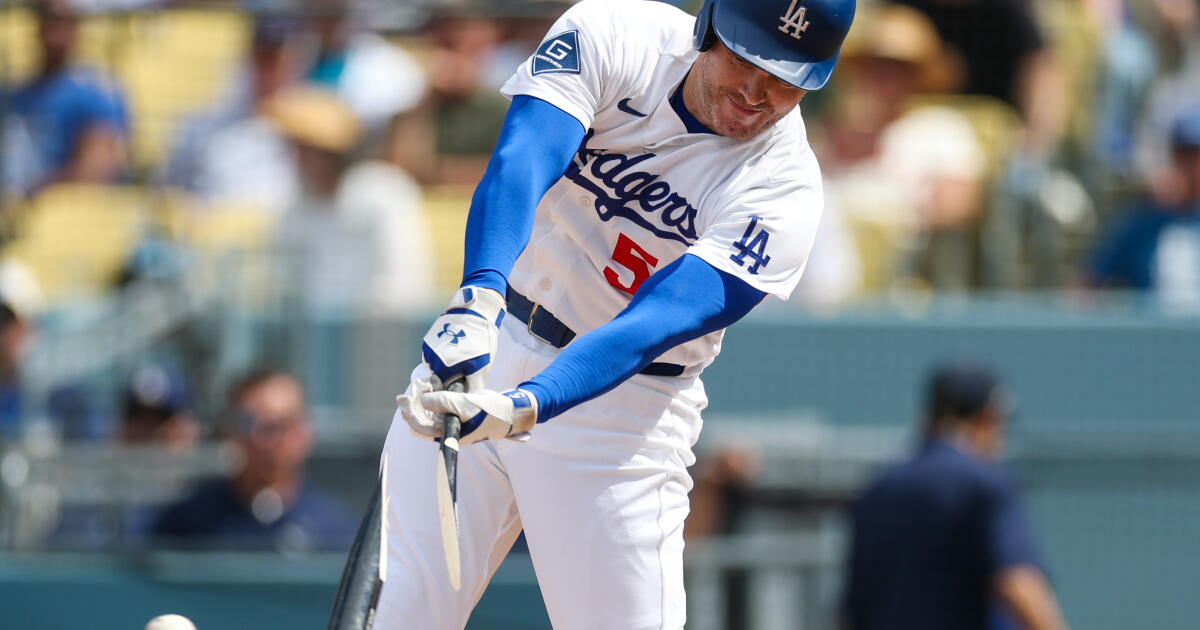
Freddie Freeman got his 2,500th hit during the rout of Pittsburgh on Tuesday.

“It means a lot,” Freeman told reporters after the game. “And then when your manager and teammates appreciate what you’ve done over the course of your career, it does mean a lot. Yeah, there’s always another goal to get to. But to step back and realize how long you have to play … to play at a high level over many, many years to get there, it does mean a lot.”

Freeman became only the 102nd player in history to get 2,500 hits. He is on pace to finish with 167 hits this season, which would give him 2,598 hits in his career, letting him pass the following players on the all-time hits list: Jimmy Ryan, Buddy Bell, Joe Morgan, Todd Helton, Heinie Manush, Garret Anderson, George Van Haltren, Steve Finley, Willie Davis, Manny Ramirez, Richie Ashburn, Ernie Banks, Reggie Jackson, Julio Franco, Vladimir Guerrero and Luis Gonzalez. He would be in 85th place, just one hit behind Steve Garvey.

Through Tuesday, Freeman had 796 of his hits with the Dodgers. Up next in his career is the magical 3,000-hit milestone.

“I would love to,” Freeman said. “I’m not going to deny that. But do I know if I’m going to get there? I don’t know.”

Will Smith to IL

The Dodgers put Will Smith on the injured list because of an inflamed disk in his neck and recalled catcher Chuckie Robinson from the minors. Smith will be eligible to come off the IL next Friday.

“Hopefully, the day I’m able to come off,” Smith told reporters, “I can come back and play, that’s the plan for now.”

Robinson had one at-bat with the Dodgers last season and in 52 games in the majors he is hitting .131.

Ohtani, Wrobleski hurt?

Thursday’s win over Pittsburgh could have proved costly. Shohei Ohtani left the game because of an inflamed left knee, and pitcher Justin Wrobleski left early after getting hit on the inside of his right leg by a liner. He left because of a sore hamstring.

The Dodgers were very optimistic that both would be fine, but we’ll see how they feel on Friday. Ohtani had surgery on that knee in 2019, but this is in a different part of the knee. Not sure if that’s a good thing or bad thing.

“[Friday], he’ll get there, do his routine, play catch, push off, land on it, see how it reacts,” Roberts said. “And then obviously take swings and see how it reacts too.”

Up next

Friday: Dodgers (Roki Sasaki, 3-3, 4.03 ERA) at Chicago White Sox (Sean Burke, 3-3, 3.88 ERA), 4:40 p.m., Sportsnet LA, AM 570, KTNQ 1020

Saturday: Dodgers (Yoshinobu Yamamoto, 6-4, 2.68 ERA) at Chicago White Sox (TBA), 1:10 p.m., Sportsnet LA, AM 570, KTNQ 1020

Sunday: Dodgers (Emmet Sheehan, 3-3, 4.70 ERA) at Chicago White Sox (Erick Fedde, 1-5, 4.69 ERA), 11:10 a.m., Sportsnet LA, AM 570, KTNQ 1020

All times Pacific

*-left-handed

In case you missed it

How the Dodgers plan to shuffle catchers with Will Smith on the injured list

Dodgers Debate: The pitching blues of the summer

And finally

Vin Scully discusses the history of Friday the 13th. Watch and listen here.

Until next time …

Have a comment or something you’d like to see in a future Dodgers newsletter? Email me at houston.mitchell@latimes.com. To get this newsletter in your inbox, click here.
Source link

New Kings coach Peter Laviolette looks to build pillars for success

When Kings’ new head coach Peter Laviolette took a tour around the Los Angeles area, he thought he was only going to get a one-bedroom home with a view of the water. His children, though, piped in: “Make sure you get a four-bedroom,” Laviolette remembered his three children saying.

During Laviolette’s time away from the sport, the 61-year-old traveled to Scotland and watched his son play in the East Coast Hockey League. The time away has given Laviolette time to rethink his coaching, and after 30 years of coaching, including 23 as a head coach in the NHL, he’s bringing a trident approach to reshape culture and win games. Centering a hockey family is one part.

“For me, there’s three real important pieces,” Laviolette said. “First, build a family inside the locker room, inside the organization. Secondly, to really work to try and build the culture to get players and organizations to think about the choices they make and how that can affect the culture. And then the third part is the actual game on the ice, just making sure that every day from the start of training camp we work at the game.”

Los Angeles hired Laviolette to a three-year contract after he spent a year away from the sport. Laviolette’s coaching experience stretches 1,594 games, the ninth-highest career total, with six teams: the Capitals, Flyers, Islanders, Hurricanes and Predators. Most recently, he was fired by the Rangers in 2025 after two years with the team.

His postseason success might be the biggest draw for the Kings, who have seen middling success in the years since their second Stanley Cup title in 2014. Los Angeles made the playoffs each year since the 2021-22 season, but the team did not advance past the first round.

Meanwhile, Laviolette is only the fourth coach in hockey to lead three teams to the Stanley Cup Final. He last won with Carolina in 2006, but he earned two President’s Trophies in 2017-18 and 2023-24 with the Predators and the Rangers.

Kings general manager Ken Holland, left, and Peter Laviolette hold up a jersey with the new coach's name on it.

Kings general manager Ken Holland, left, and Peter Laviolette pose for a photo during the new coach’s introductory news conference Wednesday at the team’s training facility in El Segundo.

(Eric Thayer / Los Angeles Times)

Still, Laviolette, despite his track record of first-year turnarounds, is joining a team in flux. The Kings fired coach Jim Hiller after the Olympic break. Interim coach D.J Smith helped guide the team to an 11-6-6 finish, aided in part by a trade for Rangers winger Artemi Panarin, whom Laviolette has also coached.

“I had a really good relationship with Artemi in New York,” Laviolette said. “He’s one of the most talented players I’ve ever coached, and I’m really happy to get to work with him again. He’s an amazing talent.”

Using the winger to go on the prowl is one of the small changes Laviolette plans to bring. The Kings have historically prioritized defense in a league that has shifted to attacking. Los Angeles fell to 30th in goals per game last season (2.68), the first time the Kings averaged fewer than three goals since the 2021-22 season. The team was also 28th in power-play percentage at 17%. Laviolette acknowledged that Los Angeles needed to change, highlighting that an attack-forward mindset has been a keystone of his coaching.

“I don’t think it should be irresponsible to defense,” he said. “But through my experiences, and even just watching the playoffs right now, this is an attack-oriented game, and you have to be willing to move.”

Where does Panarin fit?

“He has the ability to be a game-breaker and a difference-maker,” Laviolette said. “He’s not just a goal scorer. He’s not just a playmaker. He’s elusive. He’s shifty.”

The goal for next season is to score 250 times, according to Kings’ vice president and general manager Ken Holland. The team scored 220 last season.

“We’ve got to get back to scoring more goals,” Holland said. “Part of that’s going to be personnel driven, part of that’s going to be probably style‑of‑play driven, mentality, and certainly the head coach has a lot to do with it.”

As Laviolette meets current staffers and decides whom to bring in, Holland is managing the phones to reach out to assistant coaches and players. Smith has definitively moved on. Phil Housley, whom Laviolette described as an “excellent coach,” could be another potential candidate. Housley worked with Laviolette as one of the Rangers’ assistant coaches between 2023 and 2025.

Still, it’s hard to say the Kings will be a Cup contender with Laviolette. His teams tend to dramatically decline two or three seasons after his hiring. He struggles to develop younger players, instead relying on veterans to carry the weight. Laviolette will have to amplify players like Quinton Byfield and Brandt Clarke, each a talented 23-year-old with high ceilings.

The Kings’ success will rest in how well Los Angeles adapts to Laviolette’s coaching trident. The veteran coach, to his credit, projected confidence.

“When you put those three things together,” he said. “You can really become an unstoppable force.”

Source link

Wade Meckler, Jo Adell lead Angels’ rout of Astros

Wade Meckler and Jo Adell keyed a five-run second inning with two-run doubles, and Walbert Ureña navigated heavy traffic through five shutout innings to lead the Angels to a 10-1 victory over the Houston Astros on Tuesday night.

Houston put two runners on in the first, second and fifth and loaded the bases in the third, but Ureña (4-4) pitched out of each jam to lower his ERA to 2.44 on the season and 1.84 in eight starts since early May.

The 22-year-old right-hander gave up three hits, struck out seven and walked five in his 107-pitch effort, which included a 97-mph fastball to whiff Joey Loperfido with the bases loaded to end the third.

The Angels scored two unearned runs off starter Kai-Wei Teng (3-5) in the first, one when Nolan Schanuel was hit by a pitch with the bases loaded and the other on Oswald Peraza’s RBI grounder.

Backup catcher Sebastián Rivero sparked the Angels’ second-inning rally with a one-out single. Zach Neto was hit by a pitch and Mike Trout ended an 0-for-22 slump with a single to load the bases.

Meckler doubled to left-center for two runs and a 4-0 lead. Adell doubled to left to make it 6-0, and Peraza’s RBI groundout extended it to 7-0.

The Angels added three insurance runs in the eighth on Trey Mancini’s sacrifice fly and RBI groundouts by Peraza and Denzer Guzman. Relievers Brent Suter, Drew Pomeranz and Kirby Yates covered the final four innings.

Schanuel, who has been slowed by a left ankle injury, exited after three innings because of left calf tightness.

Rivero, who also singled in the third and has seven hits in his last seven at-bats, was removed in the fifth because of a left wrist injury.

Jack Kochanowicz to have Tommy John surgery

Angels pitcher Jack Kochanowicz needs Tommy John surgery, the team said Tuesday, and the 25-year-old right-hander is expected to be sidelined through the 2027 season.

The Angels also said that third baseman Yoán Moncada will have surgery on his balky right-knee. But, the specifics of the procedure and a timetable for the switch-hitter’s return were not known.

Kochanowicz went 2-5 with a 6.19 ERA in 13 starts this season, striking out 47 and walking 36 in 64 innings.

The hard-throwing sinker-ball specialist went 2-1 with a 3.05 ERA in his first seven starts, but was ineffective during his next six starts, going 0-4 with an 11.91 ERA, striking out 17 and walking 15 in 22 2/3 innings.

Kochanowicz’s fastball averaged 97 mph and touched 99 mph against the Dodgers, but he said after the game that his arm bothered him when he threw his changeup.

“Honestly, I didn’t think this was in the cards,” Kochanowicz said before Tuesday’s game against Houston. “I really thought it was just a little angry.

“I mean, my velo was fine, the fastballs, everything was fine. It really was just the changeup.

“I thought it was just kind of general soreness. … I thought I was going to hear back today that it was all right, but man, it is what it is.”

Manager Kurt Suzuki said the Angels are “still evaluating” their options for Kochanowicz’s replacement in the rotation. Among the candidates are left-hander Sam Aldegheri and triple-A right-handers Caden Dana and George Klassen.

Moncada, 31, who signed a one-year, $4-million deal with the Angels in February, was placed on the injured list because of right-knee inflammation on May 22 and transferred to the 60-day injured list on Monday.

He hit .189 with a .605 OPS, three homers and 10 RBIs in 41 games.

Source link

USC paid Lincoln Riley nearly $12 million in lackluster 2024 season

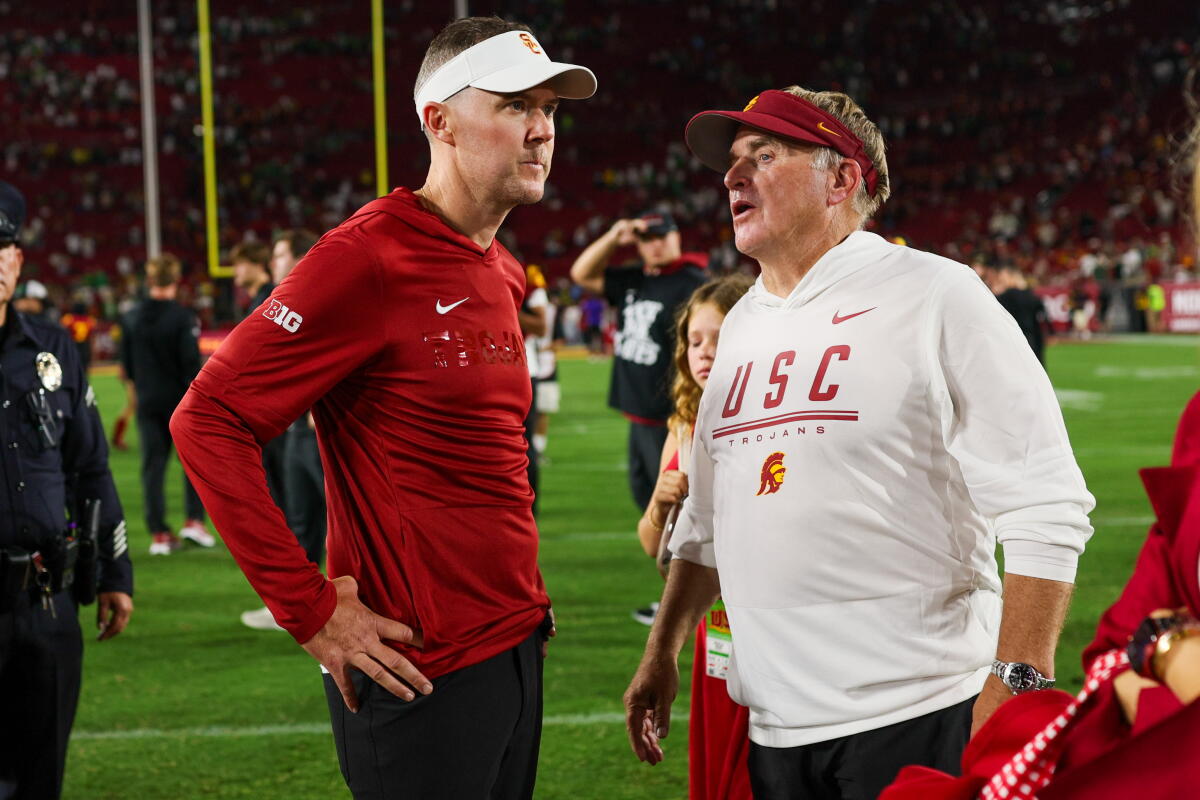
His 7-6 record at USC in 2024 would go down as the worst mark of Lincoln Riley’s career as a head football coach. But in his third and rockiest year at the helm of the Trojans, Riley was still compensated like one of the kings of the sport.

Riley was paid more than $11.8 million in total compensation during the fiscal year 2024, according to USC’s latest federal tax returns, which were obtained by The Times. That total includes a $100,000 bonus and $10.4 million in base pay, believed to be more than all but three college football coaches that season: Georgia’s Kirby Smart, Clemson’s Dabo Swinney and Ohio State’s Ryan Day. All three have won a national title.

For Riley, his pay in 2024 marks just a slight increase from the 2023 season, when USC paid Riley more than $11.5 million in total compensation. The coach’s base pay increased by $145,143 between fiscal years 2023 and 2024, slightly less than it rose following his debut season in 2022 ($168,000).

At least in 2024, USC only had to pay one football coach, after paying Clay Helton a combined $9 million not to coach over the two previous years.

The school would, however, have to pay up a bit to bring in a new men’s basketball coach.

After Andy Enfield left to coach Southern Methodist after the 2023-24 season, USC shelled out more than $6.1 million total in 2024 to lure coach Eric Musselman from Arkansas, according to the university’s latest federal tax records. One million of that was paid to Arkansas to buy out Musselman’s contract.

That puts Musselman at a reported $5.1 million in total pay and benefits from the school in 2024, according to the school’s tax records. That total likely includes additional costs unique to a coaching change. But altogether, it would have ranked Musselman among the highest-paid coaches in the Big Ten for the 2024-25 season.

Musselman didn’t exactly deliver on that investment during the 2024-25 season, as USC bottomed out during its first Big Ten men’s basketball slate. The Trojans finished 17-18 and 7-13 in the Big Ten.

After including her information in tax forms from the previous year, the university did not disclose compensation figures from 2024 for USC athletic director Jennifer Cohen. Federal tax returns filed last May had credited Cohen with more than $3 million in reportable compensation in her first year on the job, $1 million of which was used to buy out Cohen from her Washington contract.

Source link

Queen’s: Emma Raducanu makes winning start to grass-court season

Raducanu had looked far from her best in her past two matches following illness but, 16 days after her first-round exit at Roland Garros, the Briton made afresh on Andy Murray Arena.

The 2021 US Open champion held a commanding 3-0 lead before rain halted play – but that would not disrupt her rhythm.

She captured the first set without reply after just 20 minutes on court, winning 25 of the 31 points played – hitting 11 winners and just two unforced errors.

Raducanu maintained that excellent level to begin the second set with a break of serve – although she would not have it entirely her own way.

A Queen’s quarter-finalist last year, Raducanu was hampered by double-faults as she allowed Blinkova back in – with four successive breaks of serve tying the set at three games apiece.

However, Raducanu broke again, courtesy of a fortuitous net cord, to set up the chance to serve out the match, and she wore a beaming smile in the sunshine as a closing backhand winner down the line on her second match point was met by huge cheers.

Writing ‘back home’ with a heart on a TV camera lens before exiting the court, Raducanu will return to face either Romanian Sorana Cirstea or Australia’s Maddison Inglis in the second round.

Source link

Trey Mancini has three hits in Angels debut, a loss to Astros

Angels first baseman Trey Mancini, a cancer survivor and former Baltimore slugger, had three hits in his first major league game since 2023 on Monday night in a 5-4 loss to the Houston Astros in 10 innings.

Mancini delivered a run-scoring single in the second inning in his first at-bat. He singled again leading off the fourth before adding a third single in the eighth.

The Angels selected the contract of Mancini and put him in the lineup at first base against the Astros after putting infielders Vaughn Grissom (left oblique strain) and Adam Frazier (right elbow inflammation) on the 10-day injured list.

Mancini, 34, agreed to a minor league contract with the Angels in February, a deal that included an invitation to major league spring training. Mancini hit .273 with six homers, 29 RBIs and three steals for triple-A Salt Lake this year.

Mancini has batted .263 with 129 homers and 400 RBIs over parts of seven seasons in the majors. He played parts of six seasons with the Orioles and hit a career-high 29 homers in 2019.

Mancini then missed the 2020 season after surgery to remove a malignant tumor from his colon. He made a successful return to the Orioles in 2021, and he won a World Series ring in 2022 after Baltimore traded him to Houston.

He spent part of the 2023 season with the Chicago Cubs. He has since played in the minor league systems of the Reds, Marlins and Diamondbacks.

Mancini opted out of a minor league deal with Arizona last July after batting .308 with 16 homers for triple-A Reno.

Grissom’s move to the IL was retroactive to Friday. Frazier’s move was retroactive to Saturday.

The Angels also recalled infielder Denzer Guzman from Salt Lake and transferred infielder Yoán Moncada to the 60-day injured list.

Source link

Rams all for Aaron Donald returning to pair with Myles Garrett

Aaron Donald has made no public pronouncements that he will remain retired or return to play for the Rams.

But the three-time NFL defensive player of the year and future hall of famer remains a hot topic, and Rams players are aware of the buzz.

“When you have a guy that’s that serious about even considering coming out, it’s like ‘OK, we might have a chance,’” safety Quentin Lake said Monday after the Rams completed an organized-team activity workout.

Chatter about Donald, 35, has been rampant since last week, when the Rams made another gigantic offseason move by trading for defensive end Myles Garrett.

The possibility of pairing Donald with Garrett — a two-time defensive player of the year — continues to intrigue both in and out of the Rams’ facility.

Like Lake, defensive lineman Kobie Turner insistently cautioned that whatever Donald decides to do or not do was his former teammate’s prerogative.

But the possibilities…

“To just have two historic, if you will, defensive players on that line together,” Turner said of pairing Donald and Garrett, “and to have the rest of us who are trying to build up our reputations, and to build to that level of greatness that they’ve been able to garner, I think that would be cool for L.A.”

Said defensive coordinator Chris Shula: “Would love to have him back — with open arms.”

Shula enters his third season overseeing a defense remade by the March trade for All-Pro cornerback Trent McDuffie, the signing of cornerback Jaylen Watson and the trade for Garrett.

With or without Donald, the Rams are regarded as a favorite to win Super Bowl LXI, which will be played in February at SoFi Stadium.

But the Rams are not hoisting the Lombardi Trophy just yet, Lake said.

“Some people say if he were to come back, just hand the Lombardi to us on a silver platter — but that’s never the case,” Lake said. “Is he a fantastic player? Yes.

“Are there so many things we could do in terms of pressures and blitzes and all that stuff? Of course. … It would be a fun year, I’ll say that.”

With quarterback Matthew Stafford — the NFL most valuable player — back to lead the offense, and McDuffie and Watson solving the team’s greatest weakness, the Rams already were regarded among the favorites to play in the Super Bowl for the first time since winning Super Bowl LVI at SoFi Stadium in 2022.

Then general manager Les Snead engineered the deal for Garrett, sending edge rusher Jared Verse, a 2027 first-round draft pick and future second- and third-round picks to the Cleveland Browns for a player who has 125½ sacks in nine seasons.

Lake, Turner and Shula lamented losing Verse — “a brother for life,” Turner said — but they have welcomed Garrett.

“You give a great player to get a great player,” Lake said, “and luckily, we’ve got arguably the best defensive player in the NFL. … We’re not asking Myles to do anything but just be himself.”

Last season, Garrett amassed an NFL season record 23 sacks.

Rams defensive end Myles Garrett sits between Rams general manager Les Snead and coach Sean McVay.

Rams defensive end Myles Garrett sits between Rams general manager Les Snead and coach Sean McVay, right, during a news conference on June 2.

(Ric Tapia / For The Times)

“We’re going to let him do what he does best,” Shula said, “and we all know exactly what he does best.”

McDuffie and Watson were part of Kansas City Chiefs teams that played in three consecutive Super Bowls, winning titles in 2023 and 2024. Those teams featured dominating pass rusher Chris Jones, so McDuffie knows how a player such as Garrett enables the defense to “flip the script” and attack offenses.

“You just talk about mentality,” McDuffie said, “and a swag.”

Donald, who has 111 sacks, would certainly add to that.

Not every player in their mid-30s could return and play at a high level after sitting out two seasons.

“I don’t think you do that if you’re a normal person,” Turner said, chuckling. “But A.D.’s not a normal person.”

Source link

Tony Awards 2026: ‘Death of Salesman,’ the prestige hit of the Broadway season, is showered with Tony love

The show that has had everyone clamoring for tickets this spring, Joe Mantello’s cobweb-clearing production of Arthur Miller’s “Death of a Salesman,” won, as expected, for best revival.

Mantello, who received a Tony for his direction (his third such award), swept away the cliches that have accumulated around this American classic to reveal a “Salesman” like none we’ve experienced before. The Loman family home isn’t depicted in a literal fashion but instead fluidly suggested in a warehouse space that allows the actors to move unfetteredly between past and present. (The physical production was honored with awards for Mikaal Sulaiman’s sound design, Jack Knowles’ lighting and Chloe Lamford’s scenic design.)

Laurie Metcalf, confirming her standing as the First Lady of the American Theater, won for her portrayal of Linda Loman, a more formidable than usual interpretation of Willy’s stalwart wife. Metcalf, who endowed her characterization with a sharp-edged autonomy and transfixing gravitas, added another Tony to her two previous acting wins (“Three Tall Women,”A Doll’s House, Part II”).

Joe Mantello wins the Tony for his direction of "Death of a Salesman."

Joe Mantello wins the Tony for his direction of “Death of a Salesman.”

(Evelyn Freja / For The Times)

Nathan Lane was in a tight race with John Lithgow, who won for his ruthlessly uncompromising portrayal of a wrathful and dyspeptic Roald Dahl in Mark Rosenblatt’s “Giant.” Lane’s Willy leaves a lasting memory in “Salesman,” but it would be hard to imagine “Giant” having the same impact without Lithgow, who provides a terrifying human foundation to this explosive play about a writer’s political commitments tipping over into toxic antisemitism. (The performance slips into a sinkhole of animus in the uncanny way of one of Dahl’s recognizably terrifying, psychologically plausible stories.) In his almost but not quite valedictory acceptance speech, the 80-year-old Lithgow acknowledged that this Tony win, his third, comes 53 years after his first — and feels every bit as satisfying.

Aya Cash and John Lithgow in "Giant."

Aya Cash and John Lithgow in “Giant.”

(Joan Marcus)

Rather than a slight to Lane, Lithgow’s win is a sign of the dramatic depth that characterized this otherwise squirrely season. Indeed, Lithgow’s performance was as thrilling to experience as that of British powerhouse Lesley Manville, who won for her portrayal of Jocasta in Robert Icke’s modern reworking of “Oedipus.” The play was categorized by the Tony committee as a revival, but it’s really an original drama — one that gave rise to one of the most enthralling productions of the year.

In a season lifted up by Bess Wohl’s magnificent “Liberation” and capacious enough to include a first-rate “Salesman,” a searing “Oedipus” and a smartly contentious “Giant,” it should be no surprise that there were more great performances than statuettes to dole out.

Source link

Tony Awards 2026: “Schmigadoon!” wins best musical in a season saved by revivals

It was a strange year on Broadway, but then it’s been strange everywhere. Our world at times seems downright unrecognizable, with politicians acting like mob bosses, AI transforming not just the internet but potentially the entire economy, the cost of living leaving only the super rich able to keep up, and I won’t even mention the climate crisis, but the forecast calls for more doom and gloom.

Good work, however, won’t be denied, even if Broadway producers have perhaps overlearned the lesson of last year’s sleeper, Cole Escola’s “Oh, Mary!” Parody with a heavy dose of camp has become all the rage in a theatrical season in which the best musical winner, “Schmigadoon!,” is an affectionate sendup of golden age classics by Rodgers and Hammerstein, Lerner and Loewe and their inspired descendants.

If Broadway is changing faster than the old guard can keep pace, the same is true for the culture in general. The economics of producing have scrambled the old playbooks. Unusual risk has occasionally brought unexpected rewards. “Schmigadoon!” fended off the competition to take the night’s top prize along with awards for both its book and score by Cinco Paul.

Michael Arden’s spectacular production of “The Lost Boys” — the staging won awards for Dane Laffrey’s scenic design and Jen Schriever and Arden’s lighting — enriched the 1980s cult film on which the show is based with human substance and high-flying showmanship. Shoshana Bean’s win for her featured performance as a persevering single mom, is a testament to the musical’s capacious heart. Ali Louis Bourzgui’s somewhat unexpected yet eminently worthy triumph for his featured performance as the vampire with front-man magnetism, catalyzed the production’s thrilling virtuosity. But few would describe this year’s ragtag selection of new musicals as robust.

The only overriding lesson may be that there are no overriding lessons. Two-time Oscar winner Adrien Brody made his Broadway debut in “The Fear of 13,” reprising his acclaimed Olivier-nominated London performance. But he didn’t even receive a nomination for his work — a snub that I found unaccountable.

Spoofs like best musical nominee “Titanique,” a zany burlesque of James Cameron’s “Titanic” and all things Celine Dion, found new respectability on Broadway. And “Two Strangers (Carry a Cake Across New York”), the two-person British musical by Jim Barne and Kit Buchan, endeared itself to audiences (if not so much to Tony voters) with its rom-com appeal. But what does it say about a season in which musical revivals upstaged new work?

“Ragtime,” the Lincoln Center Theatre production directed by Lear deBessonet that originated at New York City Center, was not only the most operatic offering of the season but was all the most emotionally stirring and dramatically ambitious. The show, which justly received the Tony for best musical revival contained perhaps the season’s most seismic tour de force. Joshua Henry’s Tony-winning lead performance as Coalhouse Walker Jr., the path-breaking pianist tragically ahead of his time, was astonishing in both its theatrical might and its generosity, which allowed everyone around him to shine, especially Caissie Levy, who picked up a Tony for her lead performance as a white matriarch whose political consciousness courageously awakens.

“Cats: The Jellicle Ball” pulled off the seemingly impossible by making Andrew Lloyd Webber’s megamusical look cool on Broadway. The production’s radical concept brings the queer audacity of Harlem Ballroom culture to these feline proceedings. For their imaginative daring, co-directors Zhailon Levingston and Bill Rauch were justly honored as were costume designer Qween Jean and choreographers Omari Wiles and Arturo Lyons, among the production’s notable awards.

“Chess,” which was strangely overlooked in the best musical revival category (“The Rocky Horror Show” strutted in instead), may not have managed to overcome the challenge of this over-elaborate geopolitical tale, even with a puckish new book. But the production made Nicholas Christopher a likely future Tony winner star.

What was old was new again on Broadway, but let’s hope that producers can still believe that the best is ahead of us.

Source link

Emmet Sheehan struggles as Angels block Dodgers season series sweep

The Angels flipped the script on the Dodgers, preventing a Freeway Series season sweep with a 13-5 win Sunday afternoon at Dodger Stadium.

Emmet Sheehan’s start only lasted 1 ⅓ innings, as he struggled to keep his pitch count low. He threw 35 of his 49 pitches in the second inning alone. Many of those went to Nick Madrigal, who battled Sheehan in a 14-pitch at-bat in which Madrigal won two ABS challenges.

“I thought the stuff was good coming in,” said manager Dave Roberts about Sheehan. “After the first inning, I just didn’t feel comfortable getting him past the 40-pitch mark in one inning. I’m not going to put this guy in harm’s way.”

The Angels third baseman drew a walk, marking the beginning of the end for Sheehan, who already allowed a single. The 26-year-old pitcher loaded the bases with another walk. Angels catcher Sebastián Rivero drove in two runs with a center-field single.

“Frustrating,” Sheehan called his outing. “Couldn’t put guys away, not efficient.”

The game shifted into an unexpected bullpen game, and the Dodgers shuffled through seven pitchers. Edgardo Henriquez retired five consecutive batters. But the Dodgers’ spiral continued. Jo Adell reached first after a ball deflected off the glove of Miguel Rojas. Adell then moved to second on a passed ball by catcher Dalton Rushing. Reliever Blake Treinen then gave up a walk and before Rivero hit another two-run single.

Madrigal beat the Dodgers (42-24) in another double-digit pitch plate appearance in the fifth. Home plate umpire Dan Iassogna called a third strike, but Madrigal argued with the umpire, emphatically slapping his head. After an ABS review, the pitch was determined to be a ball. Rushing, seemingly not pleased with a borderline check-swing call, argued with Iassogna. In the end, a 12-pitch at-bat resulted in another walk.

Coupled with a missed call for a walk on a foul-tip earlier in the game, the check-swing call added to a frustrating afternoon for the Dodgers.

“It should be reviewable,” Roberts said of the foul tip. “That changed the game, and obviously the Madrigal check-swing. I felt that he went. That did impact the game.”

Dodgers manager Dave Roberts walks on the field during the seventh inning Sunday against the Angels.

Dodgers manager Dave Roberts walks on the field during the seventh inning Sunday against the Angels.

(Eric Thayer / Los Angeles Times)

Roberts replaced Alex Vesia with Jonathan Hernández, who gave up a two-run single to Jose Siri. Miguel Rojas threw out Madrigal at home on the hit to limit the damage.

In the third inning, Kyle Tucker drove in a run on a groundout that landed a foot away from home plate, but it gave Shohei Ohtani just enough time to sprint home after Rivero threw to first.

Still, the Dodgers, who had outscored the Angels 41-5 in games this season before Sunday, struggled. Twice, Rushing hit singles. Twice, Ryan Ward, the next batter, grounded into a double play, dashing any momentum. Rushing and Ward hit back-to-back home runs to right field in the sixth, but the Dodgers couldn’t capitalize on the momentum.

Rushing received more playing time than predicted this series, but he said he embraced the opportunity. He matched his career-high with four hits on Sunday. His home run was his first since April 20.

“This year, my whole goal was make sure if there’s an opportunity that I can pick a day that Will [Smith] needs rest, make sure that I can provide just as much as he does with the bat as well as behind the plate,” Rushing said Saturday. “He knows I’ll catch every game if he can’t go back there.”

Catcher Will Smith did not play Sunday because of neck stiffness, despite Roberts predicting the catcher would return for the series finale. Imaging on Smith’s neck came back negative, though it’s unclear if he’ll play Tuesday against Pittsburgh.

“It’s not anything serious, but it’s something that is preventing him from playing,” Roberts said. “It’s kind of a day-to-day thing.”

Rushing’s and Ward’s home runs were quickly negated when Adell hit a two-run homer to left-center field. Zach Neto also hammered a seventh-inning, three-run home run. By the time the game concluded, the bottom of the Angels lineup batted 13 for 15, walking four times. The Angels (25-41) could’ve scored more if not for Neto and Mike Trout, who hit a combined one for 12.

“The bottom half of the order, they were fouling off a lot of balls, we couldn’t put those guys out,” Roberts said. “But, yeah, the Madrigal at-bat really was a difference today.”

Glasnow talks about his injury

Dodgers starting pitcher Tyler Glasnow (back spasms), who was put on the 60-day injured list Saturday, attributed his slow recovery to trying to come back too soon. He plans to rest a few days before building back up.

“It’s uncomfortable,” Glasnow said. “When I get into my load, something feels weird. The more I go, the more it starts to aggravate it. Generally, before I start to throw, as long as it’s completely gone, it gets over the hump, it’s gone, and then I can get back to full speed. I just feel like I haven’t gotten there yet.”

Source link

Sparks ind their defense, roll past Portland to end three-game skid

The quarter mark of a season isn’t necessarily a make-or-break point, but for the Sparks, it was starting to feel like it was close to it.

An 89-72 win over the expansion Portland Fire on Sunday to close a 1-2 homestand felt more necessary than the Sparks might have wanted to admit. But after struggling on the road before losing consecutive games at home against Las Vegas and Dallas amid a three-game losing streak, the Sparks needed something to go right.

Especially defensively, where the Sparks had seemingly been getting worse. They had their best defensive game of the season Sunday, holding Portland to 36% shooting — the second-lowest mark against them this season.

Kelsey Plum finished with 16 points and six assists and Nneka Ogwumike had a double-double with 20 points and 17 rebounds. Dearica Hamby had 22 points with 12 rebounds, a solid response for the veteran forward following her struggles in recent games.

Before the game, coach Lynne Roberts admitted that she would consider benching some players if things didn’t improve.

“That’s the stage we’re at,” she said. “So that’s where we’re at. So stay tuned.”

The Sparks (5-6) stuck with their usual rotation and held the Fire to 72 points, the fewest they’ve allowed in a game this season.

Plum didn’t register a shot attempt until early in the third quarter when she hit a mid-range jumper to go ahead 45-43. The Fire defense smothered her, and while Erica Wheeler and Ogwumike made some shots early, the Sparks mostly didn’t make Portland (6-7) pay for doubling up their star.

The Sparks went on an 8-0 run in the first quarter while the Fire struggled to make shots around the rim.

But the Sparks’ offense went cold in the second quarter, allowing Portland to come back to lead by two at halftime. Portland also dominated on the boards to get extra possessions.

The Sparks adjusted to open the third quarter with six consecutive points. Portland struggled to hold on to the ball and turned it over nine times in the third quarter, allowing the Sparks to outscore them 23-12.

Portland couldn’t recover and the Sparks capitalized on turnovers to pull ahead by as much as 18.

The Sparks will play at the Seattle Storm (3-9) next on Wednesday.

Source link

Ann Patchett’s luminous ‘Whistler’ is the must-read novel of the season

Book Review

Whistler

By Ann Patchett
Harper: 304 pages, $30

If you buy books linked on our site, The Times may earn a commission from Bookshop.org, whose fees support independent bookstores.

At the recent glitzy PEN America Literary Gala at the Natural History Museum in New York City the evening’s MC, B.J. Novak, declared that the crowd was there to celebrate more than just freedom of speech — they were there for “literary glamour.”

“Writing is glamorous,” he declared. “Reading is glamorous.”

For Novak, bestselling novelist Ann Patchett — who has also worked tirelessly on behalf of independent booksellers and in support of her fellow writers, and was one of the event’s honored guests — epitomizes that allure. “I think it’s great that Ann Patchett is a smoke show. She doesn’t have to be,” he quipped. “It’s just cool that she is.”

With “Whistler,” Patchett’s 10th novel, she definitively proves that the “smoke show” moniker, if at all relevant, is icing on the cake. This exquisite writer has once again delivered an incandescent work of fiction — sweet, but never sentimental, infinitely wise and suffused with love. It’s also an ode to New York City itself.

“Whistler” is narrated by protagonist Daphne Fuller, a 54-year-old English teacher married to Jonathan, a restlessly retired doctor and hospital administrator who dotes on his wife and whom he regards as “extraordinary.” When we first encounter the couple, they’re roaming the Metropolitan Museum of Art — which, one gets the sense, they know by heart. As Daphne ponders the sculpture “Two Horses,” by Charles Ray, Jonathan spots an elderly stranger eyeing his wife, casting glances in her direction. The stranger follows them from room to room fixated on Daphne. Jonathan’s curiosity is piqued, and he slips away from his wife’s side to get to the bottom of why they’re being followed — which is revealed to be the novel’s inciting incident.

Turns out that stranger is no stranger at all. He is Eddie Triplett, a long-lost stepfather whose divorce from Daphne’s mother, Abigail, remains an unhealed wound. Running into Eddie now for the first time in more than four decades, Daphne is startled by the rush of emotion she feels: “I hadn’t known there was something in me to break,” she reflects, “but there it was and break it did. I stepped into an open crack in time and fell backwards.”

Eddie, as it happens, is but one of Daphne and her sister, Leda’s, three dads. By the time Abigail marries her third husband, mild-mannered Lucas, and the couple go on to have three sons, Daphne has grown a protective shell. These facts are narrated with detachment by the protagonist herself. As she and Eddie gently unspool their memories and together fill in the blanks, their bond deepens. The “falling backwards” Daphne experiences in Eddie’s company — traversing time — soothes, softens and delights her.

As the novel unfolds, what becomes ever clearer is that Daphne and her author are undeniably similar, though Patchett has observed: “I am normally careful to make sure there is a big wall between my life and my fiction.” In “Whistler,” she throws that caution to the wind. Easter eggs are scattered throughout. Like Daphne, Patchett is married to an older man — also a doctor — whom she adores. She too had three dads, as she chronicled in a 2020 New Yorker piece aptly titled “My Three Fathers.” Patchett and her heroine also appear to share this enviable trait: They navigate life with grace, generosity and utter competence. IRL, Patchett returns emails on the day she receives them, is an outspoken advocate for free expression, is generally renowned for her good deeds. She’s also widely known for her many devoted friendships, though she doesn’t suffer fools. You’d want to be her ride or die. As you would … Daphne’s.

In an interview 10 years ago, Patchett observed that it wasn’t until she read a piece by Jonathan Franzen, “in which he insisted that the novelist had to do what scares him most, and for him, that had been writing about his family,” that she considered following that path in her fiction. “I thought ‘oh nothing would scare me more. I would happily ride down the Amazon in a canoe and deal with snakes’ ” (as she did for “State of Wonder”) “ ‘than face my family.’ ” In 2016 she wrote “Commonwealth,” which drew on her personal experience of divorce and dysfunction, themes she revisits in “Whistler.” But in “Whistler,” it’s as if Patchett herself is in the reader’s ear. (And, by the way, should you pick up the audio version of the book, she narrates and is literally in your ear.)

Patchett has said she had an ulterior motive for writing “Whistler.” She’d been in the midst of writing a different book, a novel about a Wyoming rancher and her horse, Whistler, but it wasn’t clicking. As she pressed on over the better part of a year, a second idea came to her “like a fever dream.” She immediately filed away the messy work-in-progress and began writing a fictional ode to a cherished friend, former publishing executive Jim Fox, to whom “Whistler” is dedicated. Fox had died two years before, on his 85th birthday, and Patchett was still grieving. Her aim, with “Whistler,” she has said, is to put down on paper how much they loved each other. Fox is reborn as Eddie Triplett in the book, a charming and erudite book editor who radiates joie de vivre and is among the loves of his stepdaughter Daphne’s life.

Patchett’s literary style isn’t of the show-offy variety packed with dazzling sentences and edge-of-your-seat cliffhangers. The drama is quiet. Her words accrue and gain power through their spareness and clarity, and a level of character development that forges an easy intimacy with the reader. There’s also a sly wit and sagacity that have become Patchett signatures, honed to perfection in “Whistler,” whether wrestling with the legacy of family trauma, or the human struggle to accept the transitory nature of it all. Or, as Patchett’s mother once admonished after the failure of her daughter’s first marriage: “Stop trying to make everything permanent. It doesn’t work.”

While Patchett has clearly drawn on actual events and individuals to produce this luminous work, she exhibits the expert novelist’s knack for following a plot where the imagination takes it. I don’t recommend consuming “Whistler” in one enormous gulp. I dipped in and out, savoring scenes, reflecting on them, occasionally shedding a tear. In other words, I didn’t want it to end.

Haber is a writer, editor and publishing strategist and co-founder of the Ink Book Club on Substack. She was director of Oprah’s Book Club and books editor for O, the Oprah Magazine.

Source link

Dodgers show courage, honor LGBTQ+ pioneers Glenn Burke, Billy Bean

Let’s go Dodgers. High fives all around.

Because this time, with the newest historical exhibit at Dodger Stadium, the team got it right.

Amid all the historical installations and tributes in the open-air museum that is the Centerfield Plaza, and just a few feet from a Fernando Valenzuela mural, a new display honors Glenn Burke and Billy Bean, two former Dodgers outfielders who were the first and second professional baseball players to come out as gay.

It’s not a fleeting mention on Pride night, it’s a permanent record. A static reminder of progress made — and still to be made. And a much-deserved thank-you.

A wall inside Dodger Stadium features photos honoring former Dodgers and LGBTQ+ pioneers Billy Bean and Glenn Burke.

A wall inside Dodger Stadium honors former Dodgers and LGBTQ+ pioneers Billy Bean and Glenn Burke.

(Ronaldo Bolanos/Los Angeles Times)

“It’ll be here tomorrow, it’ll be here on the weekend and if you come next month, it’ll be here,” said the Dodgers’ team historian Mark Langill, who pointed to a spot just down the hall where in 1976 he was an 11-year-old getting Burke’s autograph.

Baseball is steeped in such history. The personal, the statistical, the societal. And the Dodgers’ is incomplete without their stories — Burke’s and Bean’s.

But the Dodgers have not, of course, always gotten this stuff right.

In 1978, they did Burke wrong, trading him — he believed — after management learned he was gay.

In his three seasons in L.A., Burke had proved himself a capable reserve outfielder who was popular with his teammates.

As far as we know, in 1977, he was the first guy to initiate a high five — spontaneously reaching above his head to slap hands with Dusty Baker after the home run that made Baker the fourth Dodger, along with Ron Cey, Steve Garvey and Reggie Smith, to hit at least 30 home runs that season, a MLB first.

Glenn Burke, left, goes to give a high-five to teammate Dusty Baker after Baker hit a home run in 1977.

Glenn Burke, left, goes to give a high-five to teammate Dusty Baker after Baker hit a home run in 1977. It is believed to be the first instance a high five was exchanged.

(Los Angeles Times)

There’s a fantastic photo of the historic high five included in the tribute to Burke and Bean, which is situated on a hallway wall beneath the left-field bleachers, beside the “Dodger Dugout” augmented reality photo booth.

Burke was also the first guy in that Dodgers clubhouse to crack a joke when the team needed it, his former teammate Rick Monday said.

“When called upon, he could play really well,” Monday said before the Dodgers took the field against the Angels on Friday, when the Dodgers and many of their rainbow-sporting fans celebrated the team’s 13th annual LGBTQ+ Pride Night. “And when we needed a moment of levity, Glenn was not afraid to come forward and put a smile on people’s face.”

But shortly before he died of AIDS in 1995 at 42, Burke published an autobiography, “Out at Home,” in which he described the team’s management being “afraid of my sexual orientation, even though I never flaunted it. To this day, the Dodgers deny trading me because I was gay. But it was painfully obvious.”

“Oh, what he had to deal with and keep it hid,” said Joyce Burke-Henderson, one of Glenn’s sisters at Friday’s pregame unveiling, where family members of both players gasped and cried and cheered the installation’s reveal.

“But as time went on, people did know. And then I think he came to the point where he just didn’t care and he just told it like it was.”

Joyce Henderson, sister of Glenn Burke, speaks about her brother during a ceremony honoring the former Dodger.

Joyce Henderson, sister of Glenn Burke, speaks about her brother during a ceremony honoring the former Dodger and LGBTQ+ pioneer at Dodger Stadium Friday.

(Ronaldo Bolanos/Los Angeles Times)

Burke came out in 1982, three years after playing his 225th and final big league game, in an Inside Sports article, “The Double Life of a Gay Dodger.”

“We just appreciate that now people are opening their eyes and just trusting in the Lord,” Burke-Henderson said Friday, “that things will go forward and work out and everybody will be loved regardless of their situation.”

The Dodgers first honored Burke in 2022, at their ninth Pride Night.

The next season, they made a mess of the Pride festivities, inviting and uninviting and then reinviting the Sisters of Perpetual Indulgence, a group known for its work in support of AIDS patients and whose members dress in drag, as nuns.

In 2023, the Dodgers also invited Bean — who was MLB’s senior vice president for Diversity, Equity and Inclusion. He appeared in a pregame ceremony on the field while protesters gathered outside the stadium.

Bean died the next year, at 60, 11 months after being diagnosed with acute myeloid leukemia.

Greg Baker, husband of the late Billy Bean, wipes away tears during a tribute honor Bean as a LGBTQ+ pioneer.

Greg Baker, husband of the late Billy Bean, wipes away tears during a tribute honor Bean as a LGBTQ+ pioneer at Dodger Stadium on Friday.

(Ronaldo Bolanos/Los Angeles Times)

Once a Northeast Santa Ana Little Leaguer, Bean became valedictorian at Santa Ana High, played for Loyola Marymount and went on to appear in 272 big-league games — including 51 for the Dodgers in 1989 — before abruptly walking away from baseball in 1995.

It got to be too much, he’d explain later, continuing to hustle to keep his baseball career afloat while keeping his sexuality secret, acutely aware of the blowback he’d get if it got out.

“For nine years,” he told the New York Times, “I felt as though I had one foot in the major leagues and one on a banana peel.”

“When he left baseball suddenly, I knew something was wrong,” Bean’s mother, Linda Kovac, said Friday, pausing to wipe away tears. “He was playing very well, it wasn’t like he was kicked out or anything. And it just didn’t make any sense.”

When Bean finally told his family he was gay, in 1996 — three years before clueing in an unsuspecting public via a Miami Herald article — none of his loved ones blinked. That included his stepfather, Ed Kovac, the homicide cop and former Marine who’d had a partner on the force who was gay.

“He worked with someone that he respected, side by side, on criminal cases,” Linda said. “We’re still friends with that guy.”

Linda and Ed Kovac, parents of Billy Bean, hold hands in front of a tribute dedicated to their son at Dodger Stadium.

Linda and Ed Kovac, parents of Billy Bean, hold hands in front of a tribute dedicated to their son at Dodger Stadium on Friday.

(Ronaldo Bolanos/Los Angeles Times)

Knowing someone — or of someone — who is gay or lesbian has long tended to dispel falsehoods and quell fears that might exist.

“One of the most important things any one of us can do in our community is be out, to be proud,” said Greg Baker, Bean’s husband. “The fact that someone can be out in a world that typically doesn’t have a lot of role models of the same ilk, it’s a brave thing to stick your neck out. It’s also very important.”

And it’s not a surprise, Baker said, that more athletes aren’t out in sports like baseball. Not with Gallup polling released last week telling us that with public acceptance of same-sex marriage and relationships in the U.S. has flattened after two-plus decades of growing support — down from 71% to about 65%.

“I want to thank the Dodgers organization,” Baker said. “It’s brave of them in this day and age to spotlight someone in our community when other organizations are trying to erase us.”

The Dodgers have done the opposite, putting up a permanent marker. A long time coming, a tribute to last.

Source link

Emmy voters, ‘The Pitt’ Season 2 is just as good as Season 1

What was the moment from the season finale of “The Pitt” that finally broke you?

Was it the shot of the day-shift staff watching the Fourth of July fireworks from the hospital roof, the sound of “America the Beautiful” playing in the distance? Maybe it was Dr. Al-Hashimi (Sepideh Moafi) crying in her car, realizing she can’t work around the seizure disorder that makes her a liability in the ER. Or perhaps it came when Noah Wyle’s Dr. Robinavitch (a.k.a. Dr. Robby) swaddled Baby Jane Doe, telling her that “everything’s gonna be just fine,” because she has “so many wonderful things to see and so many people to love.”

But what opened the floodgates for me, after the last half-hour of the episode left me completely dazed and dumbfounded, was Drs. Santos (Isa Briones) and King (Taylor Dearden) exorcising the day’s demons by belting out Alanis Morissette’s “You Oughta Know” at a karaoke bar and demonstrating that primal scream therapy is alive and well three decades into the 21st century.

Sign up for The Envelope

Get exclusive awards season news, in-depth interviews and columnist Glenn Whipp’s must-read analysis straight to your inbox.

Which is all to say: “The Pitt” is the only television show I’ve watched that gives me the same feeling I have when I read a great, immersive novel. When the end is near, I’m bereft. I’m Al-Hashimi in her car, wanting to pound the dashboard. I do not want to let these characters go. They’ve given me 15 hours and I still crave more. I would devour a series of short films about odd couple Santos and Whitaker (Gerran Howell) sharing an apartment or a summer spinoff showing Dr. Abbot (Shawn Hatosy) working off-hours as a SWAT medic. Anything to fill the long, “Pitt”-less weeks between seasons.

Instead, I’ll just have to content myself with scrolling through social media, watching fan-made videos of Dr. King self-soothing her way through the day, (this one, set to Vince Guaraldi’s score from “A Charlie Brown Christmas,” is the absolute best) and taking in the compilation of the show’s cast asking, “What’s the status on Baby Jane Doe?” in their best Katherine LaNasa Pittsburgh accent.

“The Pitt” won five Emmys from 13 nominations, including best drama series, for its celebrated first season, a 15-episode run that began with Dr. Robby up on the hospital roof talking down Dr. Abbot after an intense shift. The season ended with Dr. Abbot returning the favor after Robby and his staff ground their way through a day that included a mass shooting, a child drowning and a patient assaulting LaNasa’s no-nonsense charge nurse.

How do you follow that?

For a few episodes this new season, it looked like “The Pitt” wasn’t up to the task. We watched the ER staff dealing with a series of bloody, messy (the disimpaction!) medical maladies, an avert-your-eyes spectacle that felt like the writers were trying to one-up themselves and find the worst possible affliction to make viewers double over. Worse, the thrill of discovery that kept us invested throughout the first season, the slow drip of information about the characters, wasn’t quite there. Something was missing, and it wasn’t just Dr. Robby’s motorcycle helmet.

But the luxury of having 15 episodes is that the writers can take their time laying the groundwork for the story they want to tell.

And what a story it was.

Over the course of the season, we watched Dr. Robby disintegrate, his mental health more precarious than ever because he has done nothing to address his apparent PTSD. “You need help,” Dr. Langdon (Patrick Ball) tells Robby, confronting him in the finale. “Be honest with yourself.”

Robby isn’t the only one struggling, as Dr. Abbot puts it, to “dance through the darkness.” Langdon is back, managing his sobriety. Dr. Mohan (Supriya Ganesh) is having panic attacks. Santos is still dealing with self-harm. Dana remains haunted by that Season 1 patient assault and now carries a syringe containing a heavy sedative just in case somebody emerging from that overcrowded waiting room crosses the line again.

“I’ve seen so many people die that I feel like it’s leaching something from my soul,” Robby says. “I’m tired of feeling like I’m drowning every day.”

And there you have it, the subject of Season 2 of “The Pitt.” Medical professionals are gasping for air, and the American healthcare system, with its focus on profit above all else, is failing them and the patients they treat.

Remember Orlando, the patient with severe diabetic ketoacidosis who arrives at the ER after fainting? Orlando had to ration his insulin because he lacked insurance and felt he had to cut corners. He ends up leaving the hospital early, fearing the cost of treatment. Later he returns, having fallen (jumped) from a catwalk at his construction job, fracturing his skull. But good news: He now qualifies for Medicare and Medicaid due to long-term disability.

It’s a tragedy, one of many reasons the season finale shot of the ER staff holding back tears as they watched the Fourth of July fireworks felt like a body blow. “America the Beautiful”? How can that be true when the current administration is seeking $1.5 trillion for defense spending — nearly 50% more than this year — while cutting healthcare and social safety nets? How can that be true when an act known as the “Big, Beautiful Bill” removed funding from an already frayed healthcare system and exacerbated the shortage of care in rural areas of the country?

That one scene, the culmination of hours of careful, patient storytelling, said more about the disconnect between American ideals and America’s reality than anything else I’ve read or watched this year.

Give “The Pitt” all the Emmys. It has more than earned them.


Source link

North Carolina’s Jason DeCaro shuts out USC baseball in Game 2

Grant Govel was good, but Jason DeCaro was almost perfect.

USC baseball lost 4-0 in Game 2 of the NCAA Chapel Hill Super Regional, meaning its season and quest to break a 25-year College World Series drought will come down to a single game on Sunday.

North Carolina (49-12-1) turned to DeCaro with its season on the line, the seventh career NCAA tournament start for the veteran right-hander. DeCaro delivered a complete-game masterpiece, allowing just two hits — singles in the first and fifth innings — with eight strikeouts and one walk on a career-high 117 pitches.

Outside of giving up a solo home run to Colin Hynek in the second inning, Govel had a strong performance. After throwing 153 pitches across two appearances in the NCAA regionals, including 64 pitches in Monday’s clinching win over Texas A&M, he gave up just five hits and struck out three over five innings and 83 pitches to keep the Trojans in the game. His final pitch was a crucial one, inducing an inning-ending double play with runners on the corners to hold the game at 1-0.

But for all of his great work, the day was all about DeCaro’s dominance.

North Carolina found success against the Trojans’ bullpen in the sixth. Erik Paulsen hit a 339-foot home run over the left-field corner wall to double the Tar Heels’ lead, just the second home run given up by USC’s Sax Matson all season. The Tar Heels added two more on sacrifice flies in the sixth and seventh innings, but failed to drive in more with the bases loaded in the seventh and ninth innings.

Game 3 will be Sunday, with time and broadcast information still to be determined.

Source link

Freddie Freeman hits walk-off homer in Dodgers’ victory over Angels

Freddie Freeman battled in the batter’s box.

No stranger to coming through in a big moment, the Dodgers star was hoping to see a fastball up in the zone from Angels reliever Kirby Yates.

So Freeman stayed patient, working his way into a full count.

Then Yates gave him what he wanted — and Freeman delivered the 20th walk-off hit of his career.

The Dodger Stadium crowd erupted in celebration as Freeman watched the ball soar over the right-center field wall in the ninth inning of a 1-0 victory over the Angels.

Freddie Freeman hits a walk-off home run for the Dodgers in a 1-0 win over the Angels at Dodger Stadium on Friday night.

Freeman grinned as he rounded the bases. He threw a thumbs up at his teammates before they swarmed him in celebration. He finally had given the Dodgers something to cheer for after being held to just two hits over 25 at-bats.

“I’ve been feeling good lately,” Freeman said. “I was tweaking things early on, just trying to find a consistent feel for things. Sometimes it’s just get a couple of hits, get confidence and get going. Nothing really crazy. It’s the same routine, hitting some soft line drives at the shortstop, and things have been working.”

Through most of the game, the excitement was contained to a pitcher’s duel — a chess game of defensive plays, waiting to see who flinched first.

Dodgers pitcher Roki Sasaki was red hot in what would tie for his longest outing of the season. Sasaki, for the first time this season, threw triple digits in back-to-back appearances, topping 100.6 mph. The Japanese pitcher threw all three of his pitches harder than his yearly average.

Freddie Freeman watches his walk-off home run clear the wall in center field.

Freddie Freeman watches his walk-off home run clear the wall in right-center field to cap a 1-0 win over the Angels at Dodger Stadium on Friday night.

(Ronaldo Bolanos / Los Angeles Times)

“I’ve been experiencing a lot of good and bad since 2024,” Sasaki said through interpreter Kensuke Okubo. “But I feel like I’m able to maintain this velocity. I think I’m confident about that, but I’m just keeping working on it to make sure I’m in a better place.”

With the speed uptick, Sasaki has also seen an inverse downtick in the earned runs column on his statline. His monthly ERA reached its zenith at 7.23 in his April starts, descending to its current 4.03 ERA.

In Sasaki’s best starts, the elevated velocity and pitch mix makes the right-hander lethal, giving him extended runway to pitch further into the game. Against the Angels (24-40), the elevated velocity allowed him to throw 4⅓ hitless innings in his career-high 11th appearance of the season. He pitched seven innings, giving up two hits and two walks while striking out 10.

It’s a return to how Sasaki looked when he played in Japan, manager Dave Roberts said. Confidence might be the clearest sign things are clicking. Sasaki thumped his chest after striking out Adam Fraizer in the fifth inning, a rare show of emotion.

“I certainly think we can all agree that the floor for Roki is much higher, and the expectation every time he takes the ball is high, and he’s earned that,” Roberts said. “If you look at the last six or seven stats, it’s been as good as any starter in the big leagues in the consistency of performance. So really proud of him and I know that he wants more, and the floor has just been raised.”

Dodgers pitcher Roki Sasaki delivers in the first inning of a 1-0 win over the Angels at Dodger Stadium on Friday night.

Dodgers pitcher Roki Sasaki delivers in the first inning of a 1-0 win over the Angels at Dodger Stadium on Friday night.

(Ronaldo Bolanos / Los Angeles Times)

Some quick thinking from second baseman Miguel Rojas also helped preserve Sasaki’s strong start. On Nick Madrigal’s sharp line drive in the third inning, the pitcher reached for the ball and popped it up with the tip of his glove. The ball ricocheted off its intended course, but Rojas nabbed it with his bare hand, throwing it to first where a lunging Freeman caught it. The play was initially ruled as an infield single, but it was overturned on review.

“When it hits off a pitcher — you’re already going, committed to one way, then you gotta make another,” Freeman laughed. “The old guy’s still got it.”

Madrigal would break the Angels’ hitless run in the fifth with a double off the left-field wall. But, he was left stranded when Sasaki induced a groundout before his strikeout of Frazier.

The Dodgers (41-23) didn’t fare much better against Angels starter Reid Detmers. In the fourth, Freeman singled and moved to third on a forceout on Kyle Tucker. But, with two outs on the board, Will Smith struck out.

Andy Pages squandered a potential scoring opportunity when he was caught stealing in the sixth. The center fielder, who went one for four, has struggled at the plate in recent games. Against Arizona this week, Pages batted .176, collecting only three hits.

As the innings dragged, both the Dodgers and the Angels failed to find momentum. Reliever Chase Silseth took over in the seventh for Detmers, who gave up just two hits, walked two and struck out six. Silseth silenced the opposing batters, issuing only a walk to Smith.

Edgardo Henriquez took over in the eighth, striking out the first two batters he faced. Then, he hit Zach Neto with a pitch, and after Neto stole second, the Dodgers found themselves in a precarious position with Mike Trout at the plate. Not for long, though, as Henriquez struck out Trout.

Roberts, who had watched Rojas and Santiago Espinal go a combined 0 for 4, pinch-hit for both in the eighth. To a roaring applause, Max Muncy entered the batter’s box, his first plate appearance since a scary collision with the Arizona Diamondbacks’ Ildemaro Vargas on Thursday. Muncy, though, went down swinging.

Tanner Scott took the mound in the ninth a day after he gave up a walk-off home run to Arizona’s Ketel Marte. Jo Adell hit a one-out single then moved to second on a sacrifice bunt by Donovan Walton. Roberts then put Blake Treinen into the game, and he got Oswald Peraza to ground out to first.

With Freeman’s sixth career walk-off home run, the Dodgers beat the Angels for the fourth consecutive time this season.

“Freddie just has aura,” Roberts said. “There’s not too many guys in baseball that you’d want in a game-winning situation, and Freddie does it once again.”

Angels second baseman Oswald Peraza walks back to the dugout after grounding out during the ninth inning against the Dodgers.

Angels second baseman Oswald Peraza walks back to the dugout after grounding out during the ninth inning against the Dodgers.

(Ronaldo Bolanos / Los Angeles Times)

Source link