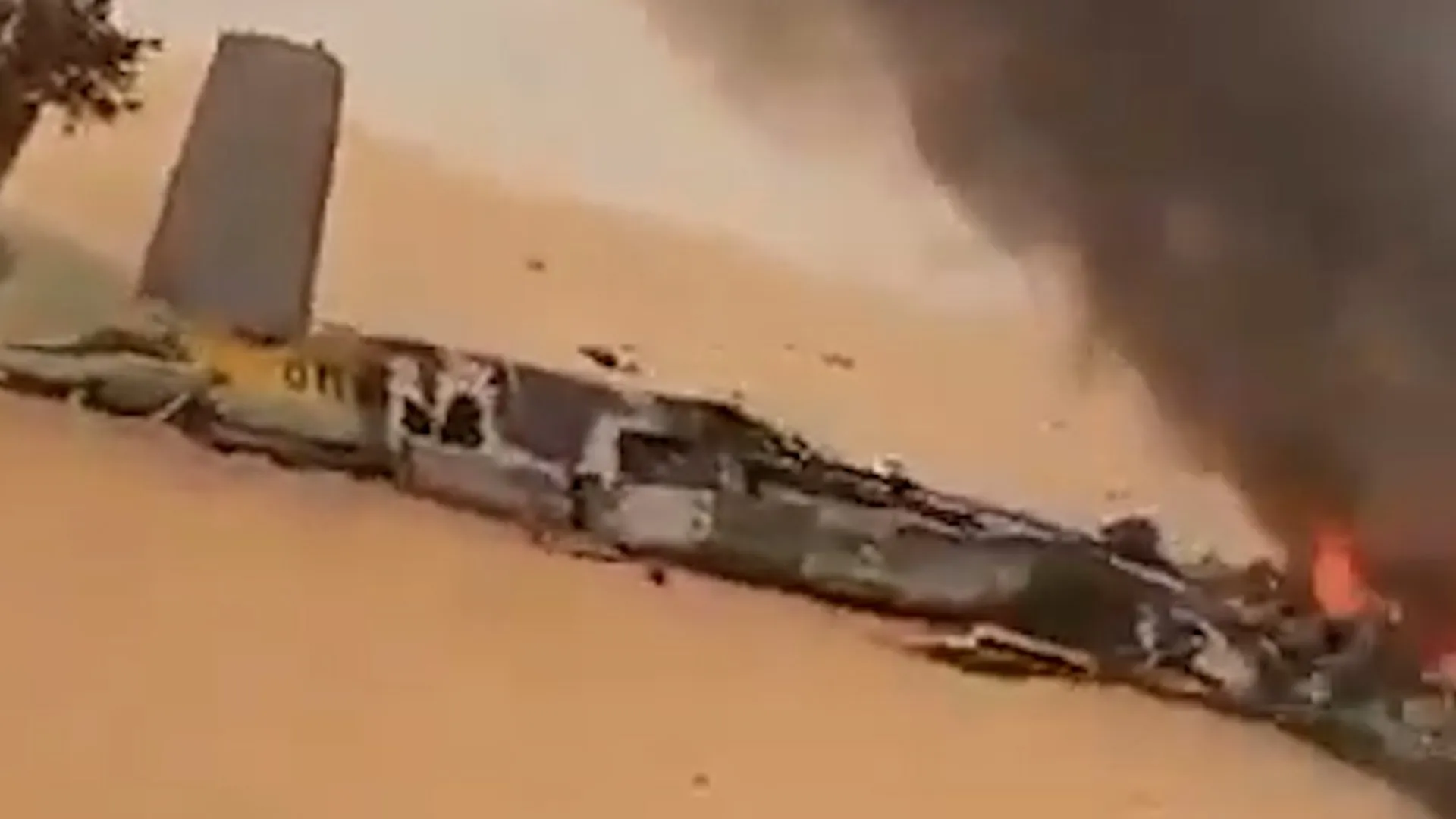
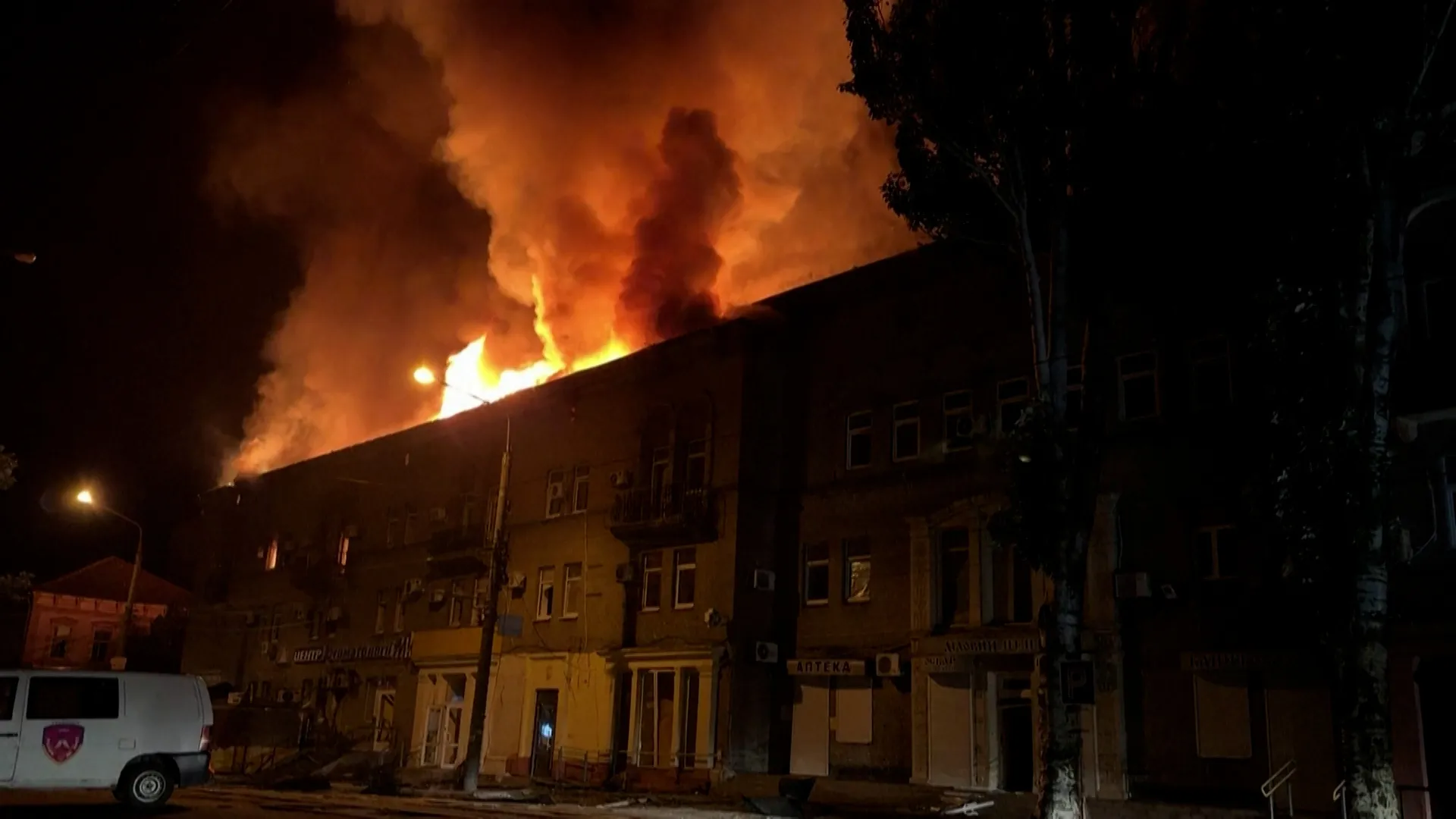
Tuareg fighters in Mali have released footage claiming to show a Russian Africa Corps Mi-24 helicopter crashing after it was reportedly shot down. The incident comes amid escalating clashes between Malian forces, their Russian allies and armed groups.
Weekly insights and analysis on the latest developments in military technology, strategy, and foreign policy.
One of Russia’s commercially flagged vessels in the Baltic has appeared armed with heavy machine guns, and it isn’t just any cargo hauler. The weapons fit is likely intended to provide close-in protection against naval drone attacks but is also evidence of increasingly bold measures taken by Moscow to ensure that military bases in its strategically important Kaliningrad exclave continue to be supported. After all, the ship in question, the Marshal Vasilevskiy, is a highly strategic one — Russia’s only floating storage and regasification vessel — that plays a key role in supporting Kaliningrad.
This comes at the same time that Russia ramps up efforts to protect its notorious ‘shadow fleet,’ used to circumvent Western sanctions on oil exports, despite efforts to interdict it.
Evidence of the armed tanker development was brought to light in an exclusive report from Holger Roonemaa, an investigative journalist working for Delfi Estonia, an Estonia-based news website.
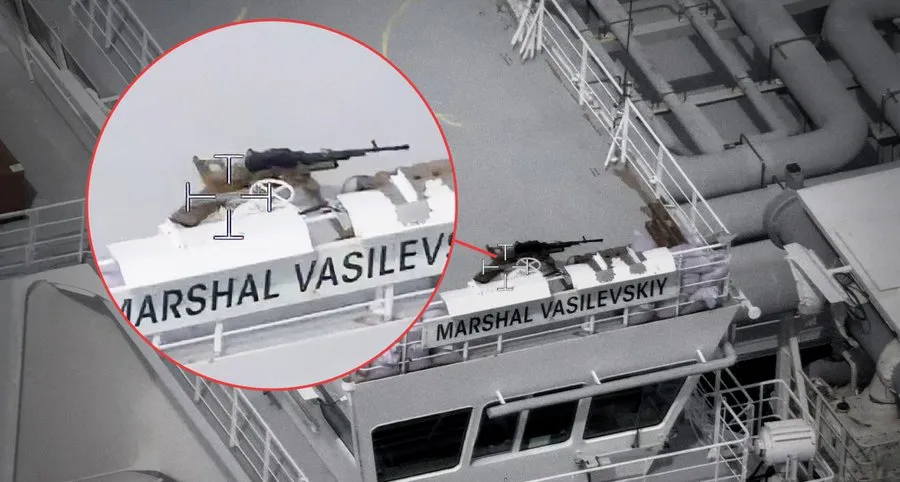
Roonemaa secured the release of imagery from the Estonian Border Guard showing the Marshal Vasilevskiy operating in the Baltic Sea last month, with machine gun positions on either side of the deck above the bridge.
A close-up view of one of the heavy machine guns on the bridge of the Marshal Vasilevskiy. PPA/Delfi Estonia, with permission
The Marshal Vasilevskiy, a 945-foot liquefied natural gas (LNG) tanker of 118,000 gross tonnage, was spotted by an Estonian Border Guard surveillance aircraft as it was sailing past Estonia’s western islands toward the Russian port of Bolshoi Bor in the Gulf of Finland.
The sandbagged gun positions were armed with 12.7mm Kord heavy machine guns, a belt-fed weapon that is used by infantry, as well as being mounted on vehicles and ships.
KORD Heavy Machine Gun
The Marshal Vasilevskiy is not a part of the shadow fleet, but it has been subject to sanctions. Moreover, this appears to be the first direct evidence of Russia installing weapons on a civilian ship in the Baltic region.
The vessel is owned by the Gazprom company and regularly supplies Kaliningrad with natural gas, with four such voyages identified since last August.
A rear view of the Marshal Vasilevskiy. PPA/Delfi Estonia, with permission
Almost certainly, the guns on the Marshal Vasilevskiy are intended to help defend against Ukrainian drone attacks.
The Kord fires at a rate of 600-650 rounds per minute and has an effective range of around 2,000 yards.
Earlier this month, Ukraine used aerial drones to attack the prestigious Russian Navy base at Kronstadt, near St. Petersburg, in what appears to have been the first strike of its kind against the Baltic Fleet.
KRONSTADT (St. Petersburg), June 3. Birds of the @1usc_army, @usf_army hunted down and set ablaze the corvette Boikiy, a guided missile weapons carrier.
06:35, 03.06.26. Veleshchynskyi Dry Dock, Kronstadt (St. Petersburg) – the cradle of the russian Navy.
— 414 Magyar’s Birds (@414magyarbirds) June 3, 2026
By targeting Kronstadt, Ukraine signaled the opening up of a new front in its drone war with Russia, namely against the Baltic Fleet while it is in port.
Previously, Ukraine’s naval campaign had focused overwhelmingly on the Russian Black Sea Fleet. Many successful attacks have been recorded against Black Sea Fleet vessels and facilities, forcing the general evacuation of Russian naval assets from occupied Crimea and to bases in Russia proper. Ukrainian attacks on Russian-linked shipping have also extended, to a more limited extent, into the Mediterranean.
These attacks have also involved a growing and increasingly advanced array of uncrewed surface vessels (USVs, or ‘drone boats’) as well as uncrewed underwater vessels (UUVs).
A video published online shows a Ukrainian FP-1 drone flying just a few meters above the water in the Gulf of Finland during the morning attack on Saint Petersburg. pic.twitter.com/ZTtGb71zdT
While Ukraine, as far as is known, has not launched any USV or UUV attacks in the Baltic, it would certainly be within its capabilities to do so.
At the same time, Russia has no doubt also considered the possibility of an Operation Spiderweb-type attack in the Baltic, in which short-range drones could be launched covertly, in mass, from locations much closer to their targets.
On June 1, the Security Service of Ukraine carried out a brilliant operation— on enemy territory, targeting only military objectives, specifically the equipment used to strike Ukraine. Russia suffered significant losses.
In the same way that Operation Spiderweb used commercial trucks as covert launch platforms for one-way aerial attack drones, any suitable vessel could be used in the same way by Ukraine in the Baltic, whether to launch aerial drones, USVs, or UUVs.
In this context, the Marshal Vasilevskiy would be a particularly prized tanker. It is currently Russia’s only floating storage and regasification vessel, a ship that takes on board super-cooled LNG and then converts it into gas that is then fed into pipelines, in this case, in Kaliningrad.
As well as countering potential drone attacks, putting guns on the Marshal Vasilevskiy sends a signal to NATO forces not to interfere with it. Warning shots could be fired to send a message to boarding parties or helicopters. Russia’s willingness to use warning shots was demonstrated in the English Channel earlier this month. With the Kord gun, the vessel could bring down a helicopter with ease, forcing a boarding force to kinetically attack the ship before attempting boarding.
Typically, the crew of a vessel such as the Marshal Vasilevskiy would not be trained to operate heavy machine guns. This raises the likelihood that the ship’s crew includes members of the Russian military or, more likely, the Federal Security Service (FSB), Russia’s principal security agency. It is not inconceivable that man-portable air defense systems (MANPADS) could also be stowed below decks to defend against an aerial drone attack.
The development comes as Russia takes increasingly forceful measures to protect the vessels of its shadow fleet. These provide Russia with a critical lifeline, allowing oil to be sold and funds generated to continue the country’s war against Ukraine. Both China and India regularly accept such deliveries.
Over the past year, European authorities have intercepted shadow fleet tankers on several occasions, typically on the grounds of flying a false flag or for being suspected of damaging undersea cables.
The Russian shadow fleet vessel Smyrtos is boarded by Royal Marines from 42 Commando and U.K. law enforcement officers on June 14. Crown Copyright
There have been previous reports indicating that shadow-fleet oil tankers regularly include former mercenaries and soldiers among their crews.
Holger Roonemaa has helped establish that almost half of the “passengers” listed as going aboard the Marshal Vasilevskiy also have backgrounds in the Russian military, the National Guard, and/or the FSB.
At the same time, Russian Navy warships are increasingly used for escort, monitoring, and security missions for shadow fleet tankers as they transit the Baltic Sea carrying sanctioned Russian oil to markets prepared to bypass Western restrictions. You can read more about this here.
Returning to this vessel, the appearance of heavy machine guns on it is significant because it illustrates Russia’s militarization of civilian shipping supporting critical operations. There are many historical precedents of merchant vessels being armed during wartime, but it remains unusual to see a commercially flagged tanker openly carrying heavy machine guns in this region. In areas with piracy, it is not uncommon for security crews on vessels to be equipped with small arms, but this is a different kind of weapon, and the ship is operating in waters with no piracy risk attached.
The Marshal Vasilevskiy photographed in port in 2019. Kees Torn
In practical terms, a pair of Kord machine guns could be effective against small drones or boats at close range, but would offer little protection against larger, coordinated attacks, let alone modern anti-ship missiles.
With that in mind, it’s possible Russia might further boost the weapons fit of the Marshal Vasilevskiy to provide a more comprehensive defense. After all, this vessel is a critical asset, due to its unique capabilities in the Russian merchant fleet, and its special role supporting Kaliningrad. This makes it a strategic vulnerability that demands protection. If lost, it could have an asymmetric impact, threatening the ability to keep military assets in the exclave operational.
More broadly, this is evidence of Russia’s growing concern that logistics vessels, including civilian ones supporting critical infrastructure, could become targets in the Baltic region, too, as the war increasingly extends beyond traditional battlefields and further from Ukraine.
Weekly insights and analysis on the latest developments in military technology, strategy, and foreign policy.
The Ukrainian SBU launched a drone strike on Russia’s Saki Air Base in Crimea on Friday. The attack, the latest in a string of strikes against Russian aviation and logistic assets on the peninsula, is part of Ukrainian President Volodymyr Zelensky’s latest campaign to inflict so much pain on Russia that Vladimir Putin moves to end the war.
“At the ‘Saki’ airfield, seven hangars storing aviation equipment were hit, in which Su-30SM, Su-30, and Su-24 fighter jets and frontline bombers were located,” SBU added. “According to preliminary information, at least seven aircraft were destroyed or damaged.”
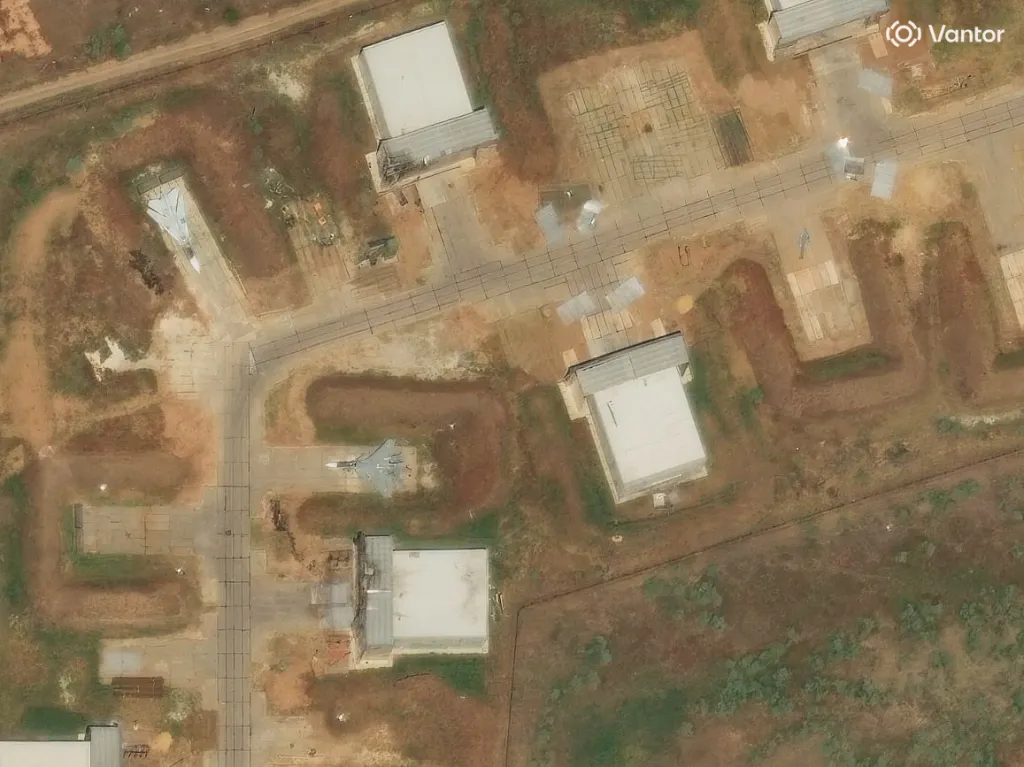
SBU told us it had no visual evidence from either attack to back their claim, but we reached out to Vantor to see if they had any satellite imagery of the base. Vantor provided us a picture that showed damage to four hardened aircraft shelters that was taken this morning. Some of shelters have clear damage to their structures, others literally have their doors blown off and laying on the taxiway in front of them. From the overhead angle of the image, it is impossible to determine if aircraft were in those shelters at the time, and if they were, what, if any damage, was inflicted. In addition, we can’t tell when this happened from just one picture, although imagery we reviewed from Planet Labs dating to June 27th doesn’t appear to show the same damage to the shelters.
It is very possible that any aircraft in those shelters could have been damaged by fire, as the SBU claimed, or by shrapnel, but we just don’t know. Regardless, the shelters remain generally intact. We have written frequently about Russia’s efforts to protect its aircraft this way, including on Crimea.
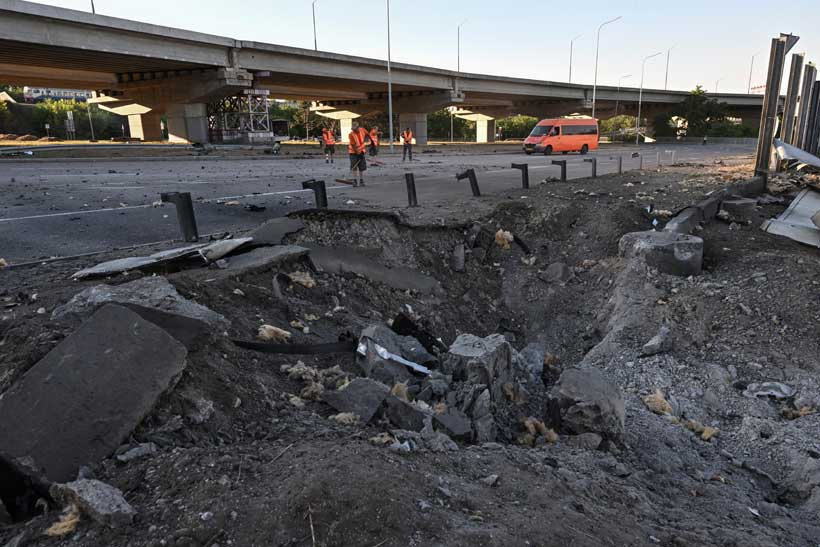
Regardless, these attacks come after months of Ukrainian strikes on bridges connecting the peninsula with the mainland and on it’s fuel infrastructure. The situation has gotten so bad on Crimea that the officials there have tried to initiate gasoline rationing, making life miserable at the height of the traditional summer vacation season there.
The fuel crisis in Russia escalates into a conflict between Crimean Russians and Russians from the nearby Krasnodar region.
Residents of Krasnodar Krai are complaining that “non-Russians” from Crimea have occupied their gas stations.
Amid the ongoing Ukrainian pressure campaign, a Russian military officer said he recently took part in an exercise to see what it would take to fend off Ukrainian attacks on Crimea.
“I participated in the operational command-staff military game ‘Crimean Alert,’” Russian reserve colonel and military expert Viktor Murakhovsky claimed on Telegram. “The game was dedicated to the landing of the Ukrainian Armed Forces in Crimea and our measures to repel it. The staffs were organized according to the scenario from officers (in reserve and retired) of our armed forces.”
“The ‘Blue’ side acted unconventionally, widely using the latest means of detection and destruction,” he added. “The ‘Red’ side was forced to act ‘on the defensive.’ Overall, the exercises went smoothly and at a high level thanks to the organizers.”
Clearly, Ukraine does not possess much of a Navy, let alone landing craft to carry out a Normandy-style invasion. However, that is not the scenario played out in this wargame, according to an analysis by the award-winning The Insider news outlet.
“The scenario clearly simulates an amphibious or maritime operation: numerous blue arrows and routes are drawn across the Black Sea, extending from the direction of Odesa and the northwestern Black Sea toward Crimea,” the publication noted. “Red defensive positions are marked on the map within Crimea, particularly around Sevastopol, in northern Crimea, and in the eastern part of the peninsula.”
The map “shows the Kerch and Kerch Strait area on the right—also densely marked with red icons—indicating that the game scenario accounted for the eastern flank in addition to western Crimea and Sevastopol,” The Insider proffered. “Judging by Murakhovsky’s post, the scenario likely envisioned not a classic World War II-style amphibious landing—with hundreds of ships approaching the shore—but rather a modern operation involving the mass use of drones, long-range precision-guided weapons, reconnaissance systems, and possibly small, high-speed boats.”
1/ QUICK TAKE: Russian authorities are wargaming a Ukrainian landing in Crimea: Recently, a “Crimean Reveille” operational command-and-staff military exercise took place that focused on a hypothetical amphibious landing by the Ukrainian military in Crimea. https://t.co/p0CzROgL8Epic.twitter.com/7iMXPmUOmf
Ukraine, as we reported in the past, has already carried out several incursions on the peninsula. In October 2023, the Ukrainian Defense Intelligence Directorate (GUR) sent a small raiding party into a point north of Tarkhankut Bay. It was carried out by troops traversing the Black Sea on Sea-Doo GTX 300 personal watercraft. They were loaded down by grenade launchers, machine guns, man-portable air defense systems (MANPADS) and other equipment needed to assault Russian positions. You can read more about that raid in our interview with the unit commander here.
Ukrainian forces have already carried out several raids on Crimea. (GUR screencap) GUR screencap
Those attacks did not lead to a sustained presence, but they were not intended to. They were meant as a morale-boosting reminder to Moscow that Crimea would never be completely out of reach.
Whether Ukraine can marshal enough of its asymmetric assets and troops to really carry out any sort of a wide-scale amphibious landing on Crimea remains questionable bordering on impossible. One thing, however, is not. Ukraine is inflicting significant amounts of pain on Russian forces and assets on the peninsula.
UPDATE: 4:49 PM EDT –
Vantor provided us with additional satellite images of Saki. A very cursory analysis shows that six out of seven hardened aircraft shelters were damaged, with doors blown off of four of them.
An image from a video provided by Ukrainian officials shows what purports to be a Russian oil refinery on fire Sunday after being struck by long-range weapons. Ukrainian President Volodymyr Zelensky has launched a 40-day campaign of strikes against Russian oil industry targets. Photo courtesy of the Ministry of Defense of Ukraine
June 28 (UPI) — Ukrainian long-range weapons struck two major Russian oil refineries on Sunday as President Vladimir Putin promised to ramp up security against Kyiv’s attacks in an address to United Russia party members.
Ukrainian President Volodymyr Zelensky announced in a social media post that the Slavyansk oil refinery in the Krasnodar region and another facility in the Yaroslavl region were hit, accompanying those claims were video showing buildings ablaze with thick smoke pouring into the sky.
The Slavyansk refinery is about 186 miles from the front lines of the Russian invasion in eastern Ukraine, while the Yaroslavl facility significantly farther away, at approximately at 434 miles.
Zelensky said Ukrainian forces celebrated the nation’s Constitution Day with the attacks, which continued Kyiv’s recent ramping up of its strikes on Russian infrastructure located far behind the front lines through the use of sophisticated long-range weaponry.
“We continue our operations that weaken Russia’s ability to wage this war,” Zelensky said. “Each of our long-range sanctions means fewer resources serving Russia’s war machine, and another step toward peace.”
Our warriors began Ukraine’s Constitution Day with great accuracy. Last night, our long-range sanctions reached two oil refineries in Russia. The Slavyansk oil refinery in the Krasnodar region was hit – about 300 kilometers from the frontline. We also reached a refinery in the… pic.twitter.com/MiKOSjszFF— Volodymyr Zelenskyy / Володимир Зеленський (@ZelenskyyUa) June 28, 2026
Sunday’s strikes appeared to be a continuation of Zelensky’s newly announced 40-day “influence campaign” of using intermediate- and long-range weapons against Russia’s oil infrastructure in a bid to bring Putin to the negotiating table.
The Russian-installed occupation authorities in the Crimean Peninsula announced a regional state of emergency on Friday amid gas shortages shortly after the initiation of campaign.
In Moscow, meanwhile, Putin on Sunday obliquely admitted Ukraine’s long-range strike campaign was affecting Russians’ lives, but then quickly dismissed those concerns.
In a speech to the 23rd congress of his United Russia Party, Putin vowed to improve security and defenses against Ukrainian attacks.
“The congress of United Russia, our leading political party, is taking place at a difficult time — it would be safe to say that it is a pivotal moment for our country and a period of radical and systemic transformation of the entire world,” the president said, while pointing the finger at “Western elites.”
“Once again, Russia is confidently repelling any attempts to deter our progress. We have sufficient resources, means, and political will, and nobody should doubt that,” he declared.
Putin did not mention the wide-scale gasoline shortages being felt around the country but vowed to ensure the security of Russia.
Weekly insights and analysis on the latest developments in military technology, strategy, and foreign policy.
One of Russia’s biggest advantages in the war against Ukraine is its ability to launch tactical airstrikes from bases largely out of reach of kinetic responses. While we have frequently reported about Ukrainian attacks on these bases, they aren’t sustained enough to stop Russia from generating devastating sorties.
Now Ukraine and NATO are looking to the private sector for ways of changing that equation through what is being called the Airfield Denial Challenge. It offers a 250,000 Euro award to companies or individuals who come up with workable ideas to prevent Russia from being able to use its air bases.
🚀The NATO-Ukraine Joint Analysis, Training and Education Centre (JATEC) and NATO Allied Command Transformation (ACT) have announced the Persistent Airfield Denial Innovation Challenge to find a solution to block enemy airfields. (1/5) ⬇️ pic.twitter.com/8uKWWEI5pQ
“The Armed Forces of Ukraine (AFU) operational experience has firmly established that the ability of the adversary to project air power from secure rear-area airfields remains one of the most consequential asymmetries in the current conflict,” according to NATO’s Headquarters Supreme Allied Commander Transformation (SACT). “Enemy tactical aviation, operating from bases beyond the reach of conventional Ukrainian strike assets, continues to conduct strikes using guided aerial bombs, cruise missiles, and stand-off munitions against friendly forces, critical infrastructure, and civilian population centers.”
Objective control footage shows the aftermath of a FAB-250/500 airstrike carried out by a Russian Aerospace Forces (VKS) Su-34M fighter-bomber on a warehouse in Kharkiv used to store UAVs and their components. pic.twitter.com/vnynslqFiO
“Each sortie originates from an airfield. Every airfield is a node of vulnerability: if it can be persistently denied, the adversary’s air campaign is fundamentally disrupted at source,” SACT suggested.
You can see video from one of the Ukrainian attacks on Russian tactical aviation bases below.
Russia’s Morozovsk Airbase is currently under Ukrainian drone attack, with several explosions seen in the vicinity of the airfield.
Ukraine’s ongoing efforts to halt these attacks are insufficient, SACT posited.
“Current workarounds: manned strike aviation, ground-based long-range fires (MLRS, ballistic missiles), and conventional single-unit loitering munitions have demonstrated limited effectiveness against defended airfield targets,” SACT argued. “They lack the mass-effect, persistence, and EW (Electronic Warfare)-resilience required to simultaneously suppress airfield infrastructure across multiple aim points in a contested environment.”
Ukraine has carried out many strikes on airfields, including one on the Morozovsk airbase in Russia. (Google Earth) Google Earth
The “battlefield logic is clear,” the NATO subcommand added. “Point-defense and reactive interception of individual weapons must be complemented by persistent denial at the source.”
“We must find technologies that will help to permanently limit the enemy’s use of aviation infrastructure: aircraft, runways, fuel and ammunition storage facilities, and ground support infrastructure,” the Ukrainian Defense Ministry (MoD) explained. “Ukrainian miltech companies, startups, and engineering teams are invited to participate.”
SACT said the challenge is technically agnostic and that it is looking for ideas that include, but not are not limited to, the following:
• Uncrewed aerial systems of any configuration or range class
• Autonomous or semi-autonomous munitions and loitering systems
• Swarming and mass-effect approaches
• Alternative delivery mechanisms beyond conventional aerial platforms
Regardless of what type of solution is presented, it “must be capable of operating in GPS-denied and EW-contested environments, across all weather conditions and seasons, and must demonstrate a credible path to rapid fielding.”
In addition, SACT is looking for systems that can conduct sustained strikes deep into contested airspace, operate without “continuous human control,” be fully autonomous and deliver “sufficient mass and precision to suppress multiple aim points across an airfield simultaneously.”
SACT also wants systems that require minimal training, and have AI-assisted target acquisition that “reduces reliance on expert judgment.”
The solicitation comes with the understanding that whatever solutions are presented won’t be proven, but should be at least in the mid-to-upper tier of the military technology readiness level (TRL) scale. It includes systems ranging from those having “high fidelity” laboratory integration of components to those with prototypes “near, or at, planned operational systems.”
U.S. Army
Meanwhile, any solution that will take more than a year to be fielded won’t be considered.
The deadline for submissions is July 20. Ten finalists will be selected on August 11 and will be invited to a “pitch day” on Sept. 3, tentatively in Poland, to showcase their designs.
Whether this ambitious program will actually lead to the fielding of any systems that can persistently deny Russia the ability to launch aircraft is very much in question.
As we have frequently reported, Ukraine has one of the world’s most innovative defense technology infrastructures that has created drones, missiles and other weapons designed, tested and fielded under intense wartime conditions. However, it has still been unable to achieve the goals being sought by this challenge.
One of the big issues Kyiv faces is the limited amount of funds to pursue some of these advances and what the Atlantic Council has described as “Ukraine’s inability to mass produce sophisticated weapons or sustain stable military supply chains.”
Getting an idea into the hands of NATO, which has developed a half-billion dollar fund to develop weapons for Ukraine, could ultimately help turn an idea into a workable weapon to keep Russian tactical aviation at bay. Even if that happens, though, the time it would take to develop these weapons at a scale large enough to make a real difference would be a formidable endeavor.
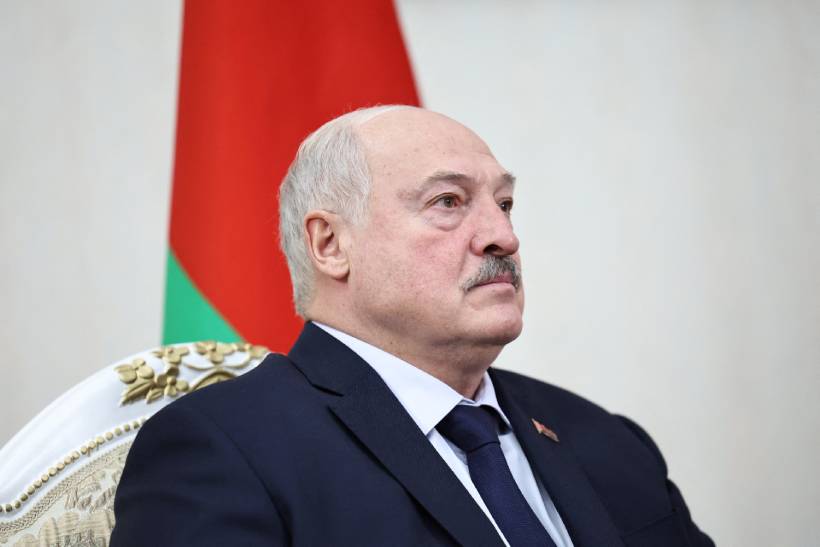
Diplomatic sparring between Ukraine and Belarus escalated sharply on 19 June, when Ukrainian President Volodymyr Zelensky demanded that Belarus dismantle communications infrastructure allegedly used by Russia to extend the range of its strike drones. Zelensky has offered a week for such removals to take place, reportedly saying, “I am giving a week for it to be withdrawn; otherwise, we will do it ourselves.” This marks a severe deterioration in relations since Belarus allowed Russian forces to cross Ukraine’s northern border using Belarusian territory in 2022. Following Russia’s withdrawal from Ukraine’s northern regions, Belarus has not enabled further assaults from its own territory but has actively aided Russian efforts, in part, by allowing drones to operate over Belarusian territory to strike Ukrainian targets with less warning. These increased tensions follow recent statements from Belarusian President Alexander Lukashenko aimed at easing tensions, stating, “If Volodymyr Oleksandrovych was offended, I apologize to him for those words… Perhaps I shouldn’t have spoken so sharply about it. But, on the other hand, he should understand, as we often say: you get what you give.” As Zelensky applies pressure to Russia’s key European ally, Lukashenko’s response may determine whether his country will begin to withdraw support or play a larger part in this war.
Belarus’ Assistance in Putin’s Invasion
Belarus has played a vital role in Russia’s aggression since 2022, remaining one of Moscow’s most important enablers throughout the war. On the opening days of the conflict, 45,000 Russian soldiers crossed into the capital region of Kyiv. Since Russia’s withdrawal from northern Ukraine, Belarus has remained a tacit supporter of the invasion, finding auxiliary ways to support its key strategic ally’s actions in Ukraine without directly becoming involved itself. While weapons transfers and diplomatic support aid Moscow’s war effort, Belarus’ most valuable contributions come from two primary sources. First, Belarus’ expansive border with Ukraine. The two countries share a border that stretches over 1,000 kilometers. The existence of a Russian ally on Ukraine’s northern border introduces the risk of another attack from this direction, requiring the dedication of over 100,000 soldiers to the defense of a region that may not become active for the duration of the war. Second, neutral airspace was made available to long-range strike drones. Without this advantageous lane of attack, Russian drones, such as the Geran-2, must spend hours loitering over Ukrainian territory, where they are exposed to interception attempts while trying to reach their targets. Additionally, and central to Zelensky’s latest ultimatum, Belarus has reportedly allowed Russia to build a network of relays along Ukraine’s border to expand the range of its strike drones, allowing greater operational reach and improved resistance to electronic warfare.
Belarusian Capabilities
Threats made without the capability to enforce them are functionally pointless, suggesting that Zelensky believes Ukraine occupies a militarily advantageous position relative to Belarus. This warrants analysis of Belarus’ military capabilities to determine whether they pose a threat to Ukraine. As of 2022, Belarus reportedly maintained an active-duty army of approximately 48,000 soldiers, with inactive trained reserves and additional supporting personnel amounting to another 300,000 people. The country fields 1,200 main battle tanks and 3,400 other armored fighting vehicles, although it is unclear how many remain in active service. Many of these vehicles are of questionable utility, with Belarus operating mainly vintage Soviet equipment and few vehicles having been modernized to contemporary standards. The Belarusian Air Force fares slightly better, fielding 48 front-line fighter aircraft, of which 16 are new Su-30SM/SM2 airframes. The war and its rapidly changing dynamics have forced Belarus to invest in the modernization of its armed forces. However, in contrast to many Western modernization programs, which frequently involve high-value equipment deals, Belarusian efforts have focused more heavily on improving infantry capabilities. Belarus currently funds several programs for procuring modern armored vehicles and has recently made new equipment purchases from Russia, including the nuclear-capable intermediate-range ballistic missile known as Oreshnik. More transformative, however, are efforts to reform the country’s mobilization system and employment of experienced Wagner mercenaries to train Belarusian soldiers in drone-centric combat techniques. This could be interpreted either as an inability to afford more comprehensive reforms or as a deliberate shift away from traditional reliance on armored formations in favor of unmanned systems. Regardless of the motivation, these programs demonstrate substantive efforts to improve the military readiness of a vital ally to Russia.
Ukrainian-Belarusian Diplomatic Efforts
Zelensky’s demand follows months of escalating tensions between Belarus and Ukraine, contrasting Belarus’ traditionally ancillary role in Ukrainian foreign relations. Due to Belarus’ refusal to participate directly in combat operations, Kyiv had little incentive to press diplomatic issues and antagonize its northern neighbor. Until the recent flare-up, it was in Ukraine’s interest to keep Belarus on the sidelines while accepting the reality of Belarusian aid and weapons transfers that benefited Russia. Relations between the two countries followed a repeated cycle of saber-rattling, military posturing, de-escalation, and periods of calm. Lukashenko has repeatedly offered his services as a mediator between Russia and Ukraine, although Kyiv has rejected these offers because of Belarus’ close ties to Moscow. Tellingly, despite Belarus aiding its aggressor, Ukraine has maintained diplomatic ties with Minsk throughout the conflict. Lukashenko further offered to open bilateral talks with Kyiv in late 2025 in an attempt to reduce rising tensions. These efforts failed to bear fruit as relations deteriorated to their lowest point since the beginning of the war in May 2026. Following the construction of additional drone launching facilities in Belarus and an increase in Russian drone strikes, Ukrainian diplomacy shifted towards the application of direct pressure. Kyiv’s announcement that it had identified more than 500 strategic Belarusian targets in the event of conflict culminated in Zelensky’s ultimatum to dismantle Russia’s drone relay network within a week. The ultimatum suggests that Ukraine is abandoning its previous strategy of managing tensions with Belarus in favor of direct pressure. It also followed the largest Ukrainian drone strike on Moscow to date. Viewed in that context, Zelensky appears to be leveraging Ukraine’s growing long-range strike capabilities while simultaneously attempting to disrupt a component of Russia’s own drone warfare infrastructure.
President Volodymyr Zelenskiy warned that Russian forces are preparing for a large-scale attack on Ukraine, urging residents to be cautious and pay attention to air raid alerts. In his nightly address, he noted that recent Russian strikes have resulted in at least six deaths across various regions. There has been a pattern of heavy attacks on Kyiv and other major cities, with ten fatalities reported last Monday. The historic Pechersk Lavra monastery was also significantly damaged during these strikes.
Zelenskiy confirmed that Ukrainian military efforts would continue, targeting the oil sector. Recently, Ukrainian drones struck an oil refinery in Tyumen, western Siberia, and an oil facility in Moscow twice. On Saturday, Russian forces used glide bombs to attack the city of Zaporizhzhia, resulting in five deaths and ten injuries. Other attacks included a bombing near Sumy that killed one person, as well as drone strikes in the Kherson region and shelling in Poltava that injured three children.
Weekly insights and analysis on the latest developments in military technology, strategy, and foreign policy.
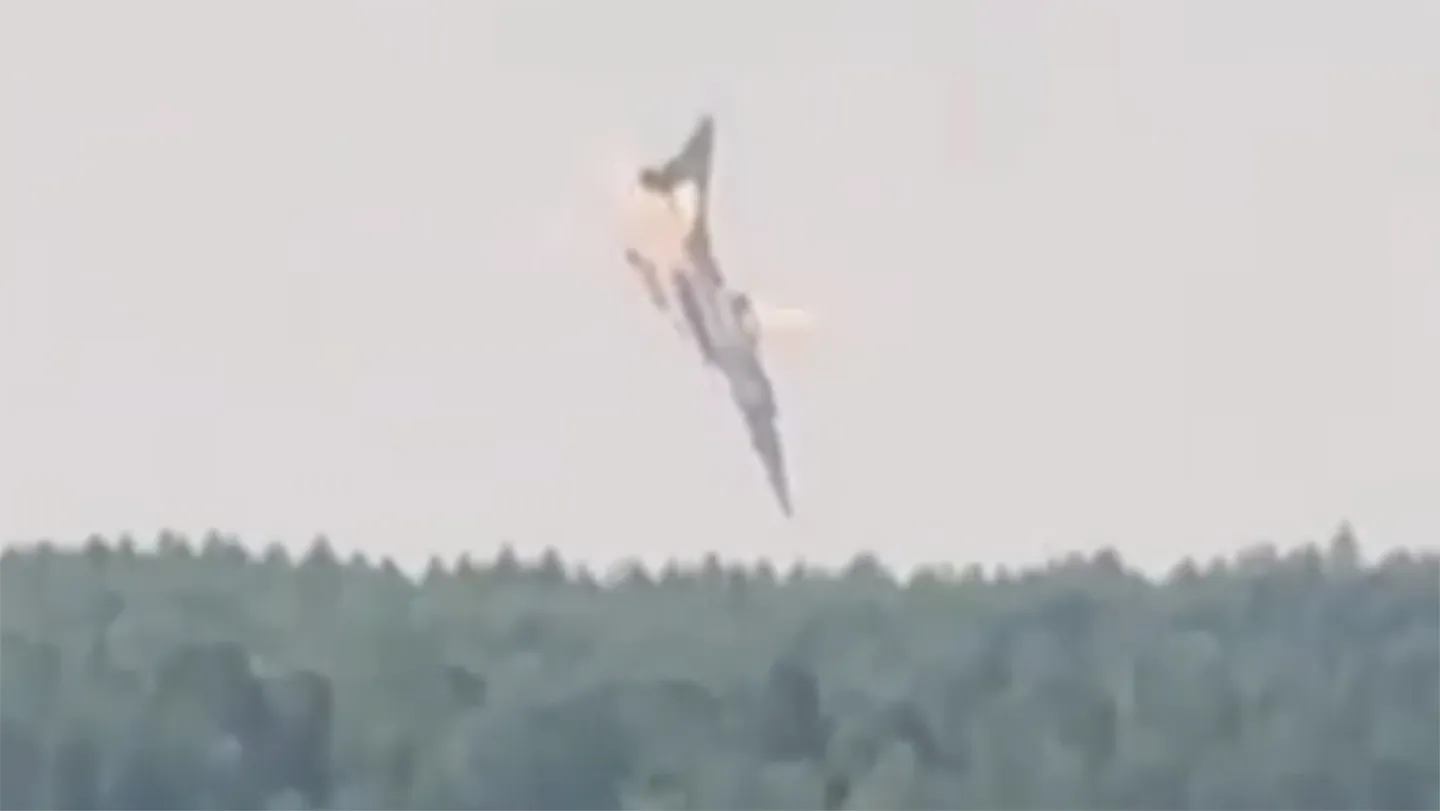
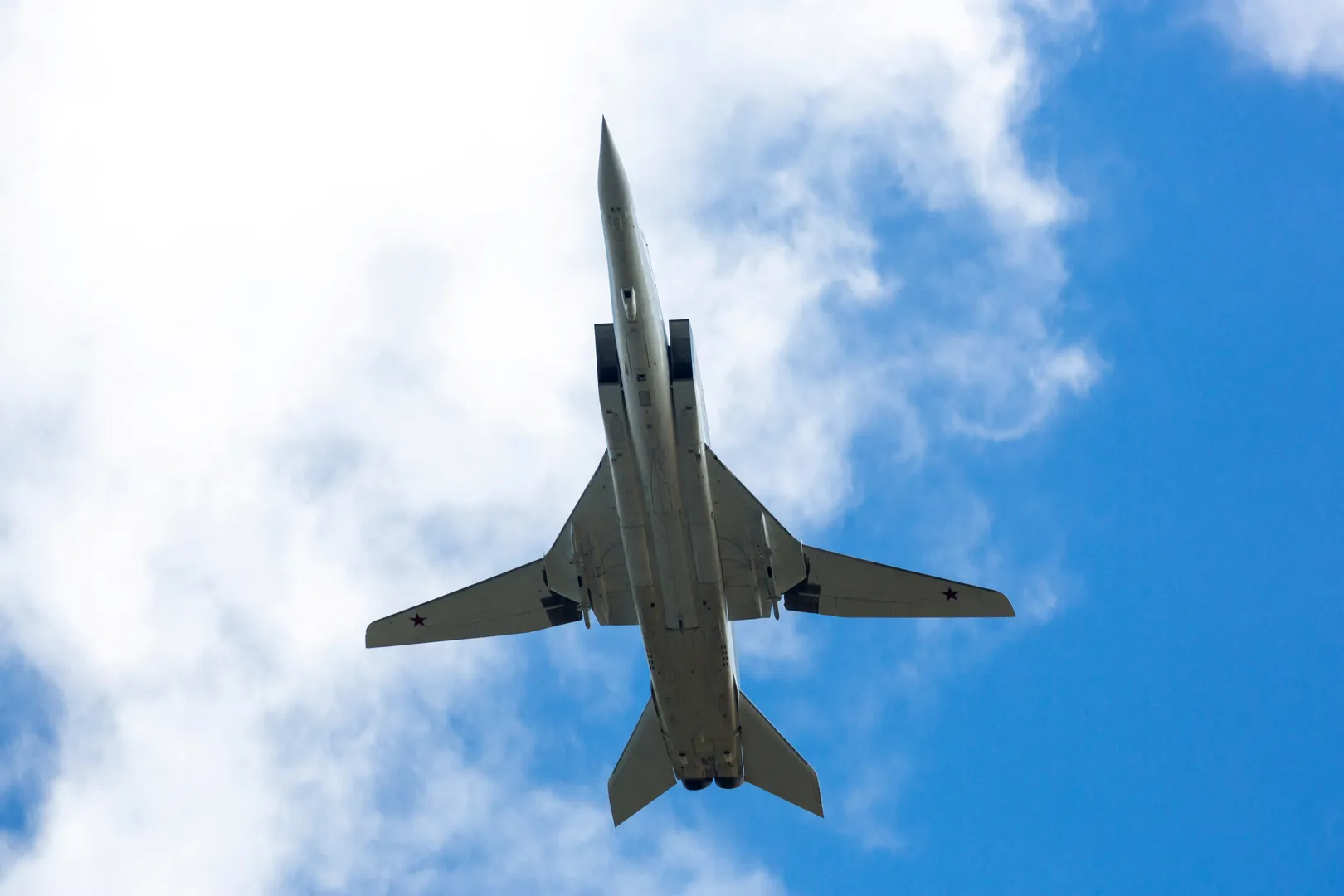
Multiple videos circulating on social media show the crash of a Russian Tupolev Tu-22M3 Backfire-C bomber today. Footage shows the swing-wing bomber entering a steep nose-down dive before slamming into the ground, producing a large plume of black smoke. The footage has not been independently verified, but Russian authorities have confirmed the loss of the aircraft.
The Russian Ministry of Defense said the Tu-22M3 crashed while making an approach to land in the Irkutsk region, in southeastern Siberia, during what it described as a routine training flight. According to the ministry, the bomber was not carrying a combat load, all crew members ejected safely, and there were no casualties or damage on the ground. The cause of the crash has not been disclosed, and an investigation is underway.
The governor of the Irkutsk region, Igor Kobzev, said that the aircraft crashed in the Bokhansky district, near the village of Kamenka. Kobzev added that the crew had been found by local people after ejecting and were already getting medical treatment.
Belaya, near Irkutsk, is an important Backfire base, accommodating the 200th Heavy Bomber Aviation Regiment.
The Tu-22M3 remains a key component of Russia’s Long-Range Aviation fleet and has been used extensively in the war against Ukraine to launch cruise missile strikes in standoff attacks. This makes any loss of the type noteworthy even when it occurs outside of combat operations, as was the case today.
A video from May 2022 that purports to show the launch of Kh-22 cruise missiles, as seen from the cockpit of a Tu-22M3:
The launch of two supersonic cruise missiles kh-22 from a long-range supersonic missile-carrying bomber Tu-22. 📹fighter_bomber pic.twitter.com/kAXU9pP5KW
— Massimo Frantarelli (@MrFrantarelli) May 11, 2022
During the conflict, Ukraine claims to have used a Soviet-era S-200 (SA-5 Gammon) long-range surface-to-air missile to bring down the Tu-22M3 that crashed in the Stavropol region of southern Russia on April 19, 2024, an incident you can read more about here.
Other examples of the Tu-22M3 have been destroyed on the ground by Ukrainian drone strikes during the conflict.
In August 2023, a Backfire was destroyed by a drone strike while on the ground at the airbase of Soltsy-2 in the Novgorod region.
Subsequently, in Operation Spiderweb, in June 2025, four more Tu-22M3s were confirmed destroyed on the ground, while another two were confirmed damaged. At least four more Backfires were targeted in the same attacks and may also have received some degree of damage. On this occasion, Ukraine employed short-range explosive-laden drones that targeted Russia’s missile-carrying bomber fleet in an unprecedented attack on at least four airbases, including Belaya.
Russian films the burning remains of Russian Tu-95s and Tu-22s at the Belaya military airfield in the Irkutsk region pic.twitter.com/GXuWfkIg9c
— Special Kherson Cat 🐈🇺🇦 (@bayraktar_1love) June 2, 2025
Today’s incident also adds to a growing list of recent non-combat accidents involving the aging bomber fleet. Previous such losses, all in the Irkutsk region, occurred in August 2024, April 2025, and June 2026.
After all of these incidents, the Russian Tu-22M3 fleet today numbers around 50 active aircraft, although there are additional non-serviceable aircraft that could be brought back into service after extensive overhaul.
Since the Tu-22M3 has been out of production for decades, every airframe is especially precious. Any loss reduces Russia’s Long-Range Aviation capabilities and readiness. This has an impact not only on the war in Ukraine but also on Russia’s broader Long-Range Aviation force, a key element of the country’s strategic military posture.
We will update this post as we find out more about today’s incident.
Weekly insights and analysis on the latest developments in military technology, strategy, and foreign policy.
The U.K. Ministry of Defense is investigating reports that a Russian Navy warship fired warning shots near a British-registered yacht in the English Channel, according to a statement provided to TWZ today. The reported encounter is the latest in a series of increasingly tense interactions between the United Kingdom and Russia.
The incident reportedly occurred around 20 nautical miles south of the Isle of Wight, off the south coast of England, and outside British territorial waters. According to the Ministry of Defense, the initial report came from the crew of the U.K.-registered yacht, which alleged that a Russian warship fired warning shots at a distance of approximately 500 yards.
According to the Press Association, the incident occurred at around 11:40 a.m. local time, in waters between the Isle of Wight and Normandy.
A Ministry of Defence spokesperson confirmed to us that they are investigating reports of the incident, but stressed that the investigation remains in its early stages.
“No injuries or damage have been reported by the yacht, which is continuing its journey,” the spokesperson added.
The Royal Navy was already shadowing the Russian vessel when the alleged incident occurred, the ministry confirmed.
“HMS Mersey was monitoring the Russian vessel at the time. We cannot provide further comment while investigations are ongoing. A seaboat from HMS Tyne has visited the yacht to gather details and check that they are safe.”
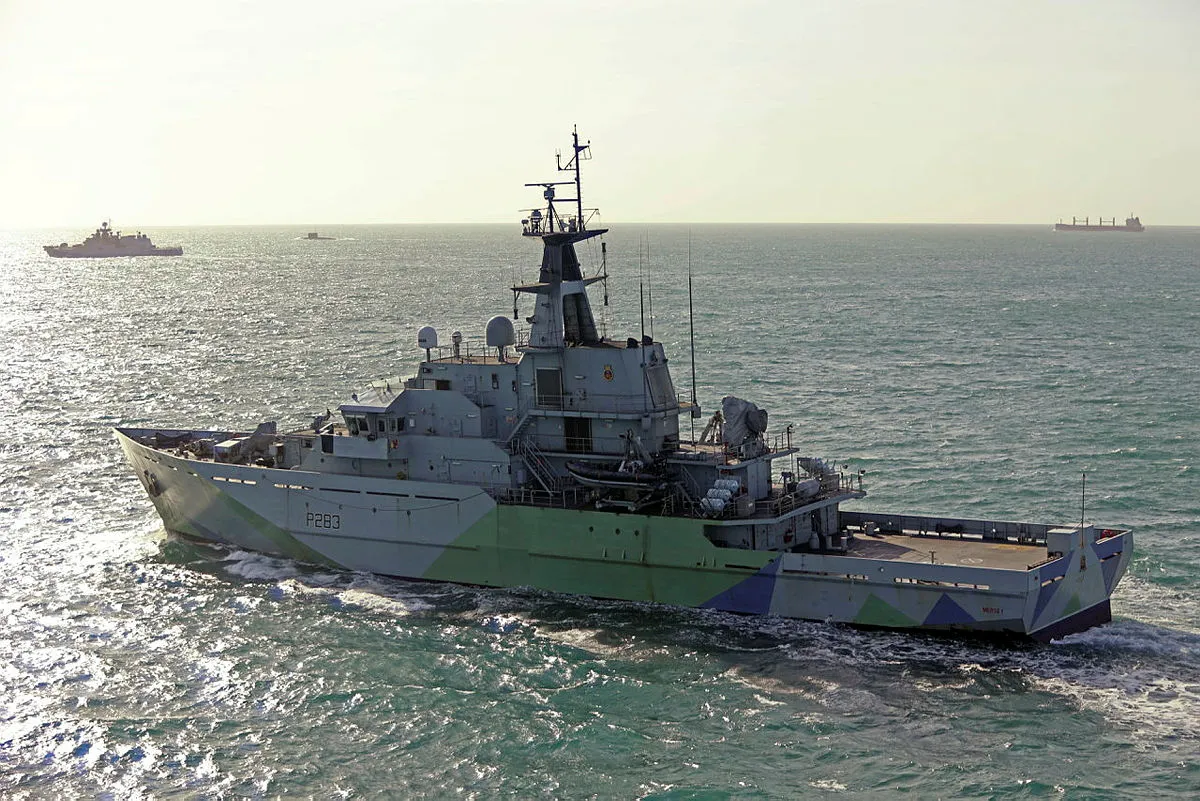
Both HMS Mersey and HMS Tyne are River class offshore patrol vessels, frequently used to shadow Russian and other warships passing through the Channel, which is widely considered the busiest shipping area in the world.
HMS Mersey (foreground) seen here monitoring the Russian frigate Admiral Grigorovich (left) and the Kilo class submarine Krasnodar (center-left) in April of this year. Crown Copyright
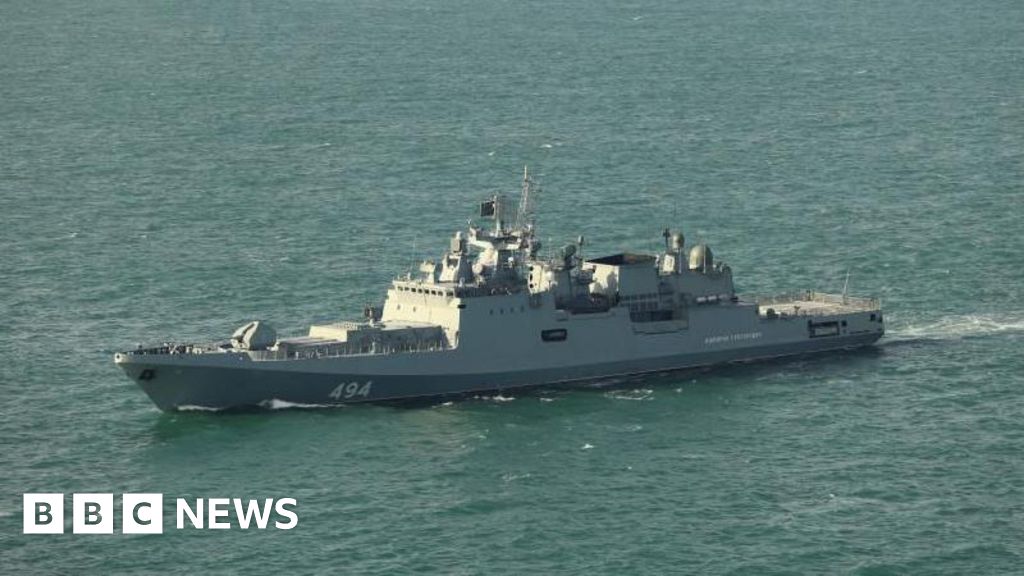
According to unconfirmed reports, the Russian warship said to be involved is the Admiral Grigorovich, the lead ship of its class, which is also known to NATO as the Krivak V class. The frigate is seen at the top of this story, during an encounter with Royal Navy vessels earlier this year, again in the English Channel.
[Unconfirmed] Russian frigate Grigorovich has fired warning shots at a British yacht in the channel.
British and French ships are mobilising in response.
Incident comes after the Royal Navy boarded Shadow Fleet tanker SMYRTOS (IMO: 9389100) which has been sanctioned by HM…
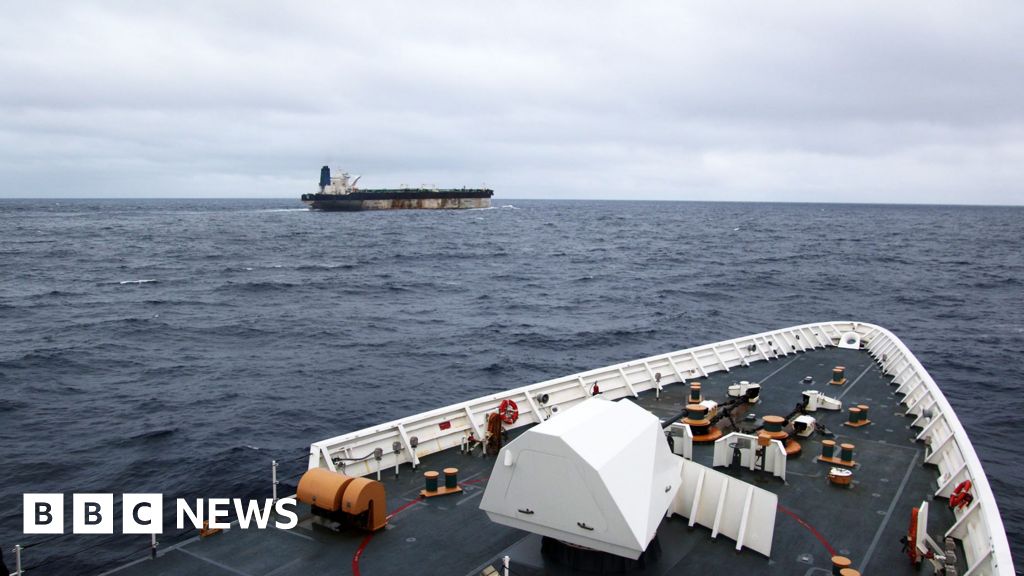
The Ministry of Defence also sought to distance the incident from another recent maritime security operation in the Channel, in which British forces boarded the Smyrtos, a sanctioned shadow-fleet oil tanker, which was sailing under a false Cameroonian flag.
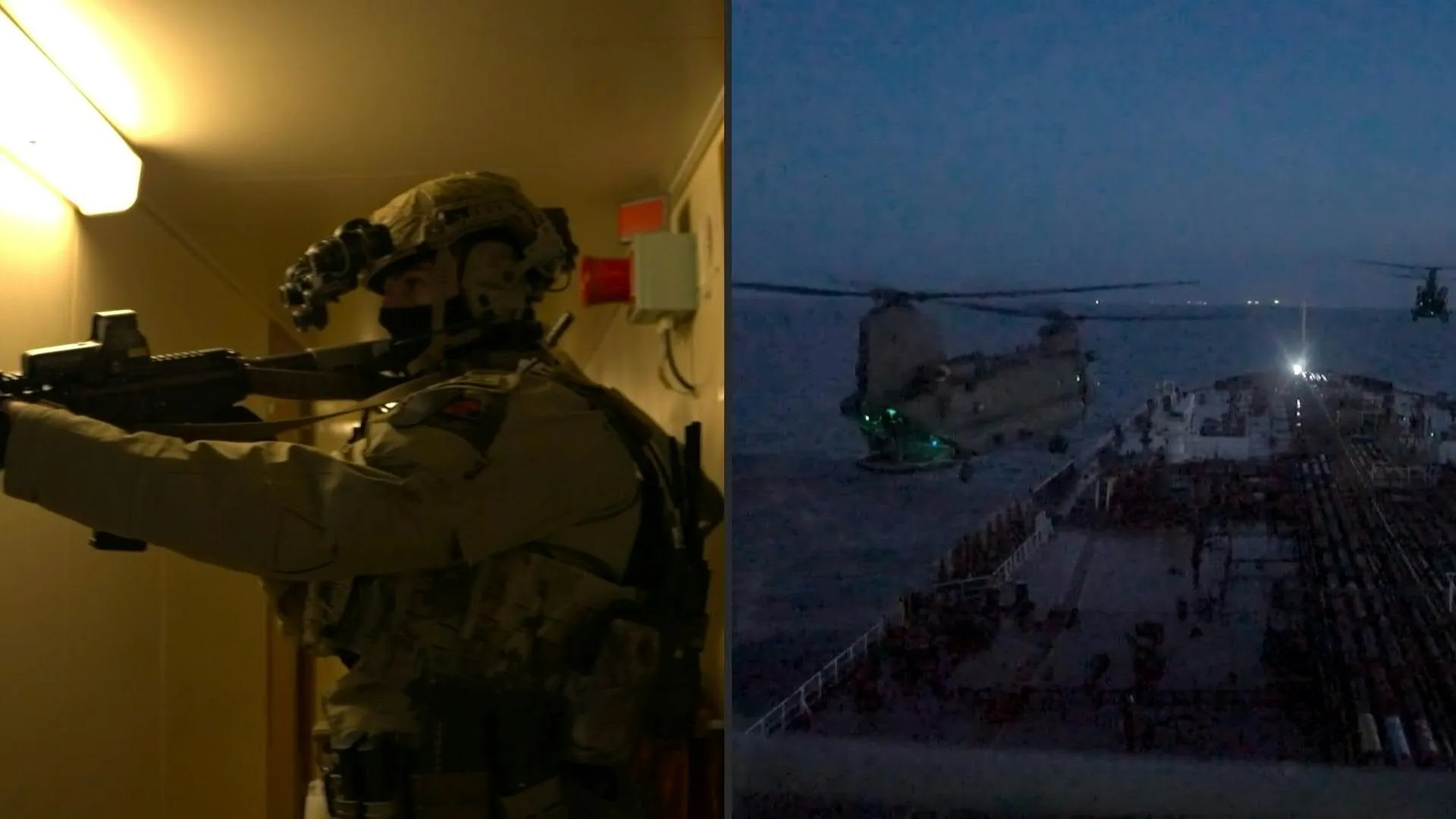
The boarding of the Smyrtos by Royal Marine Commandos and specially trained law enforcement officers from the National Crime Agency last Sunday was the first U.K.-led operation of its kind. The six-hour military operation also involved Chinook, Merlin, and Wildcat helicopters, a Royal Air Force P-8 Poseidon maritime patrol aircraft, as well as the frigate HMS Sutherland and the mine countermeasures vessel HMS Ledbury.
The vessel Smyrtos is boarded by Royal Marines from 42 Commando and U.K. law enforcement officers on June 14. Crown Copyright
It remains unclear exactly which Russian Navy vessel was involved in the incident today, what prompted the alleged warning shots, or whether any communication took place between the warship and the yacht before the incident.
We will update this post as we find out more about today’s incident.
UPDATE: 2:45 PM EDT –
There is growing speculation that the Russian warship involved in the incident may have suffered some kind of mechanical failure or difficulty at sea.
The U.K. Shadow Defense Secretary James Cartlidge said the incident was “very concerning” and the United Kingdom should “be in no doubt that Russia poses a direct threat.”
The leader of the Liberal Democrat party, Ed MacCleary, said: “These reports are extremely concerning. Russia is quite literally on our doorstep. Aggression and intimidation from Putin in the English Channel cannot be tolerated.”
These reports are extremely concerning – Russia is quite literally on our doorstep.
Aggression and intimidation from Putin in the English Channel cannot be tolerated.
This is a clear reminder that the Government cannot afford any further delays to the Defence Investment Plan. https://t.co/xhnoFQ98tE
According to BBC News, the Russian frigate Admiral Grigorovich fired warning shots after the two vessels came into close contact.
The broadcaster further reports that the “small, motorless yacht had drifted towards the warship in foggy conditions after setting off from the United Kingdom.”
The BBC cites the Russian Ministry of Defense as saying that the yacht had been on a “dangerous approach” towards the warship, and its crew fired into its path “with rifles” after making several attempts to contact it over the radio and after launching warning flares.
The Russian Ministry of Defense further claimed that its sailors had acted in “strict accordance with international shipping regulations.”
A U.K. government source told the BBC that a couple in their 60s were onboard the yacht at the time. They said they did not hear when the Russian frigate sounded its horn.
There have also been unconfirmed reports identifying the yacht involved:
Russians are saying the yacht was ‘Bright Future’ – a British registered 40′ sailing yaht in transit from the Solent to Cherbourg. pic.twitter.com/m3lKpgeHkJ
Data obtained by BBC Verifysuggests that the Admiral Grigorovich has been in the Channel for an extended period, repeatedly being re-supplied by a repair vessel, so that it can escort shadow-fleet vessels through these waters.
Based on satellite images it has reviewed, the BBC says the frigate has been re-supplied by the PM-82, an Amur class repair ship, while operating between the Channel and the North Sea in recent months.
In April, the frigate was reported to have escorted six shadow fleet vessels through the Channel while being monitored by the Royal Navy.
Two scenarios with the yacht
1️⃣🇷🇺 response to Smyrtos boarding this weekend – #greyzone 2️⃣Risk of collision with drifting⛵️in low viz, followed by Ch 16 warning(?) then shot across bow in ‘self defence’ – #maritimebuffoonery
At least one Royal Air Force P-8 Poseidon has transited from its base in Scotland to patrol the Channel this evening, according to publicly available flight-tracking data. The maritime patrol aircraft is very likely tasked wth monitoring Russian naval activity in the area.
More details of the incident have been reported by Deborah Haynes, the security and defense editor at Sky News.
Haynes writes on X that the Russian frigate “fired a couple of warning shots” close to the yacht in the Channel after also sounding an alert to avoid it sailing too close. Citing an unnamed defense source, Haynes reports that it is understood that the Admiral Grigorovich appears to be having difficulty controlling its movements, perhaps due to a propulsion issue.
The warning shots “were certainly not fired at the yacht,” the same source said.
Additionally, while the Admiral Grigorovich has been escorting Russian-flagged vessels through the Channel in recent months, Haynes writes that it was not involved with escorting the Smyrtos, which was boarded by British forces at the weekend.
UPDATE: A Russian warship fired a couple of warning shots close to a UK-registered yacht in the Channel after also sounding an alert to avoid it sailing too close, a defence source said. Investigations are still underway to establish exactly what happened. From what is…
After reaching out to the U.K. Ministry of Defense for more clarification, TWZ received the following from a spokesperson:
“Following attempts to contact a British vessel in the Channel, the Grigorovich fired warning shots. These were not aimed at the vessel and were an attempt to prevent a possible collision.”
“We assess that this is an isolated incident and not linked to the UK’s interception of the Smyrtos this weekend. HMS Mersey has been monitoring the Russian vessel and support has been provided to the crew of the yacht.”
“We assess that the Grigorovich was displaying to other vessels that it was drifting rather than being manoeuvred under power, which may have made her feel more vulnerable, leading to warning shots being fired.”
“We assess that after sounding warnings, the Grigorovich fired several warning shots, but these were not aimed at the yacht.”
The spokesperson told us that they further assess that the shots fired were single rounds, rather than automatic fire.
Russian artist Robert Kuzakov, known as Semyon Skrepetsky, was shot dead in Poland just three days after a performance protest in Berlin near the Russian embassy. He was known for his caricatures of politicians including Vladimir Putin and Alexei Navalny.
A suspected Russian drone attack on a residential building in Ukraine has injured at least seven people. Emergency services responded as fire ripped through the building in Zaporizhzhia.
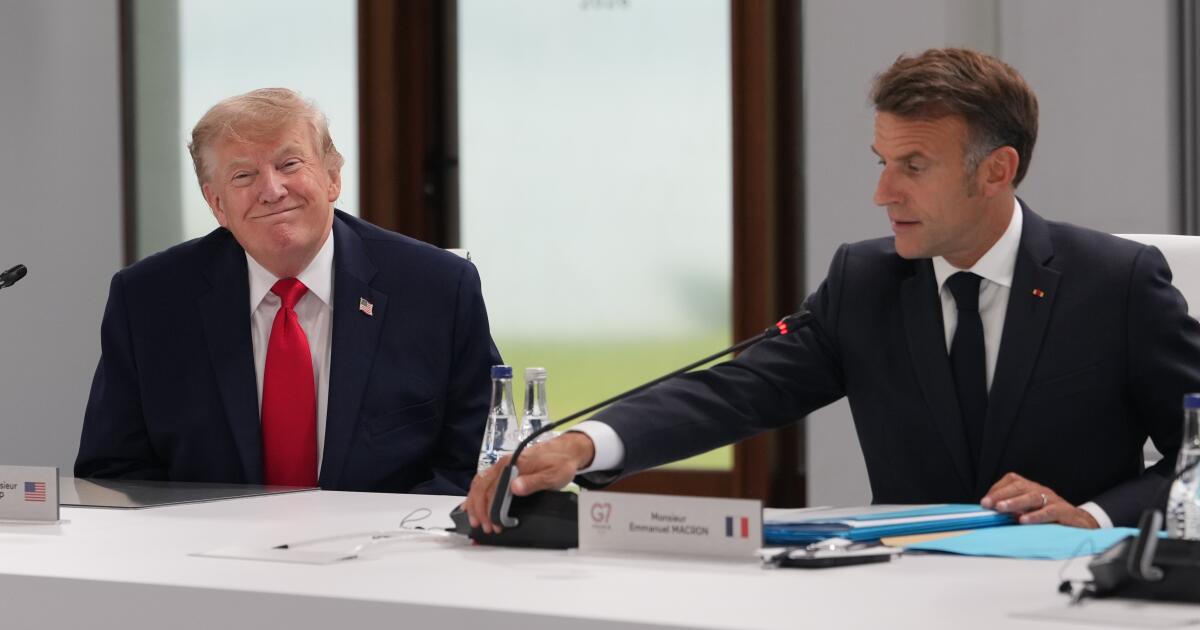
EVIAN-LES-BAINS, France — The United States could soon reimpose sanctions on Russian oil shipments after President Trump and fellow leaders at the Group of Seven summit of major industrialized democracies moved Tuesday to put the war in Ukraine back on top of their agenda, more than four years after Russia launched its full-scale invasion.
The Iran war has recently overshadowed Ukraine, but Trump said he wants to shift the focus following the announcement of an agreement to end the 3½-month-old conflict in the Gulf.
Trump said Iran will soon be “back in the rearview mirror.”
Trump said the sanctions on Russia that were eased during the Iran war to help lower oil prices can go back in place as more oil moves through the Strait of Hormuz.
“Soon we’ll be able to do that because the oil is now flowing,” Trump told reporters in Evian, the French spa town close to the Swiss border that is hosting the summit. “We’re in a position to do that soon.”
The U.S. in March temporarily eased some sanctions on some Russian oil shipments as crude prices sharply increased. The waiver has been extended.
Zelensky joins G7 leaders for talks
Ukrainian President Volodymyr Zelensky joined the G7 leaders for talks on the war in his country. They wrapped quickly, after just 75 minutes.
Zelensky said Ukraine is serious about peace while Russia toys with world leaders. “The entire ‘Seven’ supports Ukraine unanimously today,” he said.
Zelensky added that G7 leaders supported Ukraine’s need for more Patriot missiles and discussed how to increase production by licensing production. Patriot missiles are able to counter Russian ballistic missile attacks on Ukraine’s power grid and cities.
As the U.S. under Trump has cut back aid to Ukraine, France and its European allies are now the biggest providers of military and financial support to Kyiv.
Trump downplayed the impact of the Russia-Ukraine war on the U.S. but lamented the death toll.
“The whole thing is ridiculous,” Trump said. “So, yeah, I’m going to do whatever I can.”
Meanwhile, the U.K. announced new sanctions targeting the “shadow fleet ” Russia uses to ship oil and gas, and the finance networks used by Moscow to evade Western sanctions. The ships targeted include several recently purchased by Russia to transport liquefied natural gas from its sanctioned Arctic LNG 2 project.
Russia fires again at Ukraine’s biggest cities
Hours before the summit began Monday, Russia fired hundreds of drones and dozens of missiles at Ukraine’s biggest cities in a barrage that killed 11 people and set fire to a religious landmark.
The attacks came after Zelensky and Putin spoke separately by phone with Trump on Sunday, the U.S. leader’s 80th birthday.
While campaigning in 2024 for a return to the White House, Trump claimed he could end the Russia-Ukraine war within 24 hours of taking office. However, negotiations have faltered and Trump has acknowledged it has proved much harder than he thought.
Ukraine on Monday officially started European Union membership negotiations, launching a process that will require its government to commit to years of political reforms even as it fights the Russian invasion.
Ukraine sees EU membership as a security guarantee for a stable future once the war ends. Its best guarantee would be membership in the NATO military alliance, but the Trump administration insists that cannot happen, and others are wary of Ukraine joining while the war continues.
Trump says he may send Iran deal to Congress
The U.S.-Iran ceasefire deal got plenty of attention at Tuesday’s sessions, with Trump voicing his openness to sending the deal to Congress for review. The text has not been made public.
“I like the idea, send it to Congress please,” Trump said at the start of a meeting with United Arab Emirates President Sheikh Mohamed bin Zayed Al Nahyan on the summit’s sidelines. He added, “I mean who wouldn’t approve it?”
Republicans on Capitol Hill say they want Trump to provide more information about the agreement, with some expressing skepticism that the deal can deter Iran from pursuing a nuclear weapon.
Trump also met with the Emir of Qatar, Sheikh Tamim bin Hamad al-Thani. The Gulf nations are not part of the G7, but French President Emmanuel Macron extended invitations to their leaders at a fraught moment for their region.
Trump also expressed frustration over Israel’s continued hostilities with the Iranian-backed militia Hezbollah in Lebanon, telling reporters he’s “not happy with the way Israel has handled themselves with Lebanon and with Hezbollah.”
Trump said Israeli operations to target Hezbollah “should have been able to deal with them faster,” adding: “It just goes on forever. And when that happens, it throws a negative light on the big deal. And that’s the deal with Iran.”
Macron said France and other Western partners are “ready to take action very quickly” to help reopen the Strait of Hormuz peacefully to ease the economic impact of rising oil prices. France and the U.K. have championed a mission to restore maritime security there as soon as conditions allow.
The G7 comprises France, the United States, Canada, Germany, Italy, Japan and the United Kingdom. Other guest nations, including Brazil, India, Kenya and South Korea, were invited to participate in some discussions.
Superville, Corbet and Madhani write for the Associated Press. Madhani reported from Geneva. AP writers Jill Lawless and Samuel Petrequin in London, Collin Binkley in Washington and Illia Novikov in Kyiv contributed to this report.
June 16 (UPI) — A Russian warship, the Admiral Grigorovich, allegedly fired warning shots toward a British pleasure yacht Tuesday morning in the English Channel.
The shots came within about 500 yards of the yacht, BBC News reported. The incident took place in international waters between the Isle of Wight, a British island, and Normandy, part of France. Those on the yacht have not reported any damage or injuries.
“We are investigating reports of an incident in the channel,” a U.K. Ministry of Defense spokesperson said.
BBC News said the yacht apparently drifted toward the Russian frigate in foggy conditions. The bigger ship sounded an audible warning — with no immediate response from the yacht — before it fired the shots.
This incident comes after U.K. forces seized a Russian-linked tanker, the Smyrtos, on Sunday in the same area. The tanker was carrying sanctioned oil. However, British authorities said Tuesday’s incident is not linked to that seizure.
It’s not unusual for Russian ships to pass through the channel while being monitored by Royal Navy ships. The Admiral Grigorovich was shadowed Tuesday by the HMS Mersey, BBC News said.
The Russian frigate has regularly escorted shadow fleet vessels — the ships Russia uses to avoid sanctions on oil imposed after its invasion of Ukraine.
James MacClearly, Liberal Democrat defense spokesman, said in The Guardian that reports of a Russian ship firing shots in the English Channel are “deeply concerning.”
“Russian is quite literally on our doorstep,” he said. “Aggression and intimidation in our waters must not be tolerated.”
After the seizure of the Smyrtos on Sunday, British Prime Minister Keir Starmer said it was “yet another blow to Russian and reminds those fueling Putin’s war in Ukraine that they cannot hide.”
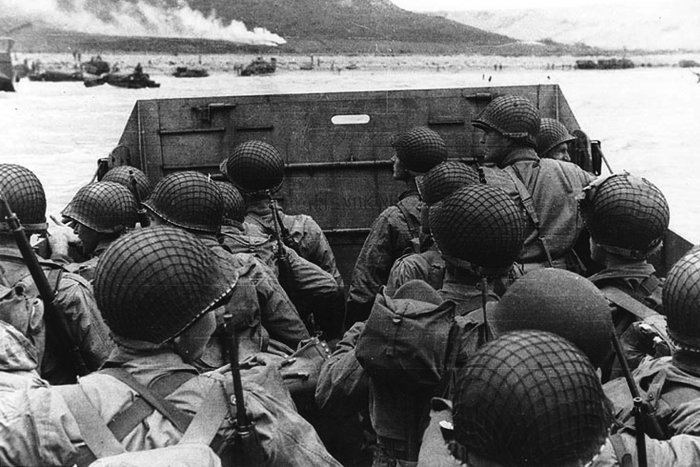
Troops in landing craft approach Omaha Beach on D-Day in Normandy, France, on June 6, 1944. D-Day was the largest seaborne invasion in history and turned the tide of World War II. Photo by UPI | License Photo
A Russian Tu-22M3 strategic bomber crashed in Siberia’s Irkutsk region during a training flight, but all four crew members had managed to safely eject. The Soviet-era supersonic bomber has been used by Russia in combat operations in Syria and Ukraine.
British armed forces intercepted an oil tanker believed to be part of Russia’s sanctioned shadow fleet. The oil tanker ‘SMYRTOS’ was taken in an first-ever operation by the British military in the English Channel.
Ukraine said it reclaimed more of its territory than it lost during May, reversing a Russian trend of monthly net gains.
“The ratio of liberated and lost territories is almost 100 square kilometres (40 square miles) in our favour,” wrote Ukrainian commander-in-chief Oleksandr Syrskii on his Telegram messaging channel.
Recommended Stories
list of 4 itemsend of list
Ukrainian defence news outlet Militarnyi estimated net gains slightly higher, at 120 sq km (46 sq miles), citing sources within the military. Militarnyi said Russia seized 130 sq km (50 sq miles) and lost 250 sq km (100 sq miles) during the month.
The Institute for the Study of War, a Washington-based think tank using open source geolocated information, assessed Ukrainian gains higher still, saying Russia had seized or infiltrated 40 sq km (15 sq miles) in May but lost control of about 280 sq km (108 sq miles).
(Al Jazeera)
The ISW believed Ukraine actually reversed Russian gains in April, when it estimated Moscow’s gains at 28 sq km (11 sq miles) of Ukrainian land and lost 116 sq km (45 sq miles).
The ISW’s assessments suggest Ukrainian gains are growing.
Syrskii said Ukraine reclaimed 600 sq km (230 sq miles) during the first five months of 2026.
However, Russia was successful on one part of the front
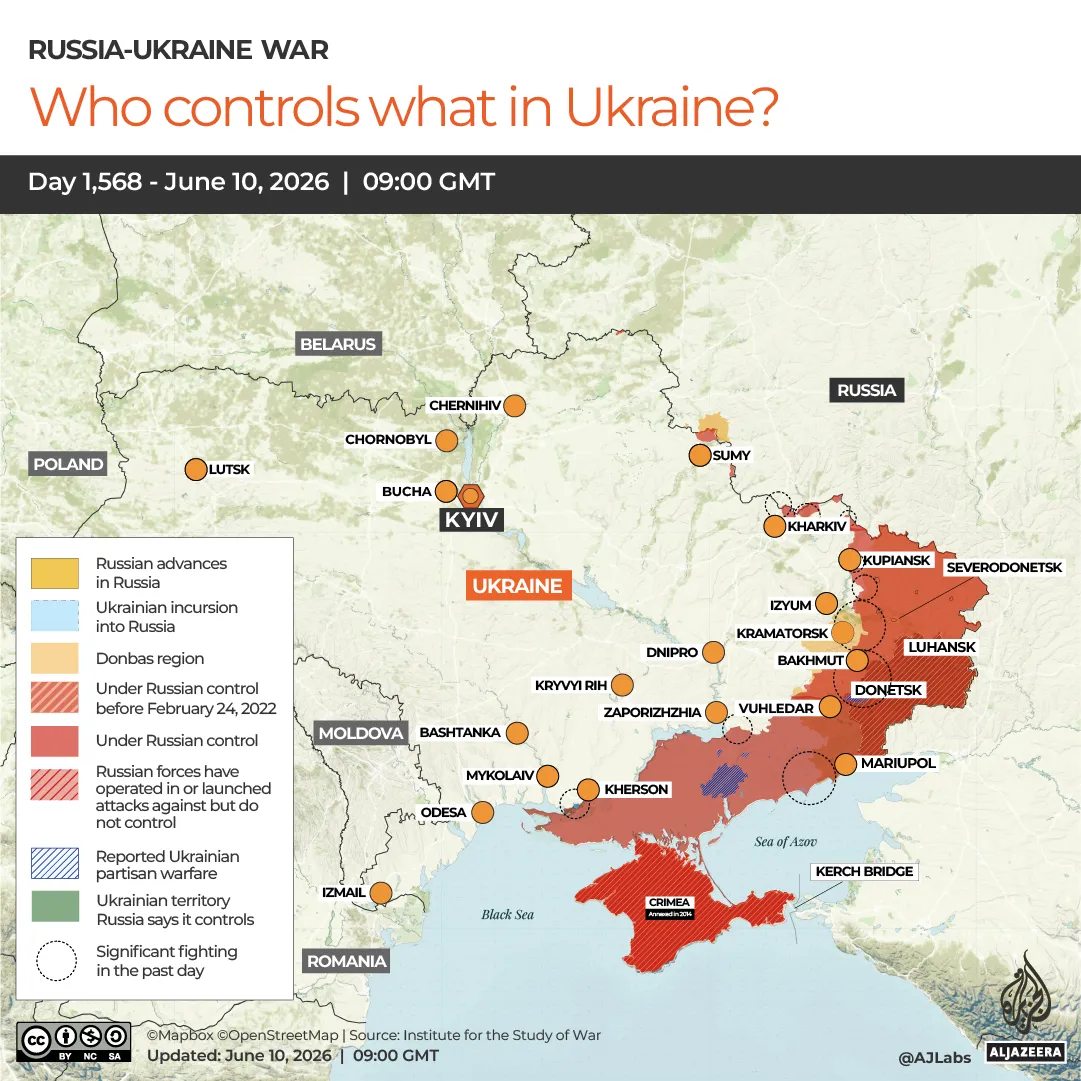
Ukrainian military observer Kostyantyn Mashovets reported on June 10 that Russian forces had advanced into eastern Konstiantynivka, the southernmost of a “fortress belt” of four cities in the eastern region of Donetsk. Russian forces first infiltrated parts of the city last October, and now hold about 13 percent of it, said the ISW.
(Al Jazeera)
Russian President Vladimir Putin has prioritised the capture of the remaining one-fifth of Donetsk he does not possess, but his set deadlines to achieve this have been missed several times.
Putin may be putting out feelers for potential ceasefire talks. Although on June 5 he rejected a call from Zelenskyy for direct talks, Zelenskyy said he had met with Russian oligarch Roman Abramovich who acted as Putin’s intermediary.
Mid-range attacks devastate Russian logistics
Ukraine says its battlefield achievements are thanks to a strategy of disrupting Russian supply lines by striking fuel and ammunition in warehouses and in transit.
“The logistical lockdown is working,” said Ukrainian Defence Minister Mykhailo Fedorov. “The number of hits on enemy targets at a distance of over 50km (30 miles) from the (frontline) has doubled,” he said, comparing May to April.
Syrskii put the May total at almost 2,000 strikes.
The effects of Ukraine’s strategy have begun to build up.
Weeks of attacks in the southern regions of Kherson and Zaporizhia reduced Russian military traffic by more than 70 percent along the M-14 motorway, the main east-west route, said Robert Brovdi, commander of Ukraine’s Unmanned Systems Forces.
(Al Jazeera)
On June 7, regional authorities prohibited traffic along the M-14 altogether, Brovdi said.
That forced Russian planners to route more supplies along two highways that reach Kherson and Zaporizhia, via Crimea – the E105 and E97.
The following day, Ukraine struck a bridge that shoulders the E105 over the Chonhar Strait, leaving only the E97 passable. On June 9, as about 50 Russian fuel and ammunition trucks were routed to the E97, Ukrainian forces ambushed and destroyed some of them at Armyansk, commander Dmitry Filatov told Suspilne Radio.
“This operation would not have been possible if other units had not struck at Mariupol and the road to Berdyansk,” Filatov said, referring to the mainland routes. “This is what led to the units stationed in the Hulyaipil direction starting to be supplied, not via the Mariupol highways, but via Crimea.”
Civilians in Crimea have faced severe fuel shortages as a result of Ukrainian strikes, and these became dramatically worse in the past week.
On June 7, Sevastopol occupation governor Mikhail Razvozhaev rationed fuel to 20 litres per car per day. He later changed that to 20 litres per week.
Shortages were reportedly forcing troop evacuations from some outlying positions.
The Ukrainian underground group Atesh, which operates in Crimea, said Russian units were abandoning their positions on the Kinburn Spit because they were running out of food and fuel.
“We will create conditions under which it will be extremely difficult for military personnel and defence industry workers to remain in Crimea, in the temporarily occupied territories, or to use the routes leading to them,” Brovdi told Reuters.
Although Russia’s air force continues to command the skies over eastern Ukraine and to drop large ordnance there, Ukraine’s own figures suggest its drone superiority is the more effective tool.
Ukrainian short-and medium-range drones hit 180,000 targets in May, said Syrskii, 12.7 percent more than in April.
Ukrainian defenders are also reportedly becoming more adept at shooting down Russian Shahed drones with their own interceptor drones. Although Russia launched 25 percent more Shaheds in May compared to April, shoot-downs increased by 50 percent to about 4,000, said Fedorov,
Fedorov expected a step-change in Shahed elimination once a new generation of interceptor goes into full production which “automates 95 percent of the entire interception process”.
Beyond these mid-range strikes, Ukraine has also continued a successful long-range strike campaign that has devastated Russian refineries, oil depots and offloading terminals, reducing Russian oil production and export revenue.
Russian recruitment is low
Aware of the Ukrainian drone threat, Russia has created unmanned systems units of its own but appears to be having trouble manning them.
Since the beginning of the year, 14,500 people have signed contracts to serve in these units, about 21 percent of the annual recruitment target, said Syrskii. Overall, Ukraine has killed or wounded 12,500 more troops than Russia has been able to recruit this year, he said.
That is both because casualty figures have been rising since last autumn there – Ukraine estimated 31,500 Russian casualties in May – and because Moscow’s recruitment has been falling, despite increased bonuses to sign-up.
Russian opposition source Vazhnye Istorii said 71,200 people had been paid enlistment bonuses in the first quarter of 2026 according to budget data, compared to almost 90,000 in the first quarter of 2025.
It estimated that recruitment in 2025 was already 10 percent lower than in 2024.
To learn more about this campaign, we reached out to one of the soldiers leading this effort from the unit that created it. In an exclusive interview, an Unmanned Systems Department Officer for the First Corps Azov of the National Guard of Ukraine offered us unique insights into how the program began, how it’s going, where it is headed and how AI is helping to identify and hit targets deep behind the lines. It’s a capability we described in great detail — about how it was rapidly gestating and would arrive on the battlefield around now. The officer spoke on condition of anonymity to discuss operational details.
Some of the questions and answers have been edited for clarity.
Azov patrols the border areas around Mariupol.
Ukrainian territory must be free of Russian forces. The surest path to achieving this is pushing the “sanitization zone” for enemy logistics closer to Russia itself and occupied Crimea.
— First Corps Azov of the National Guard of Ukraine (@azov_media) May 25, 2026
Q: Walk me through the genesis of the mid-range strike campaign.
A: I will first of all start with answering the question of why. So the reason why we are currently conducting this campaign is to hunt enemy logistics capabilities, and currently we have a lot of quite cheap assets that can strike enemy targets at quite a deep range. So the overall meaning, the overall sense of this campaign is to strike enemy concentrations of cargo in the places where this concentration is the highest and the protection of those enemy logistical assets is at the lowest level.
So, if we’re talking about enemy logistics very close to the front line, to the line of contact, we are mostly talking about a person with a backpack. Then, if we are moving deeper into the enemy controlled area, further from the front line, then we’re talking about cars. Then even deeper we’re talking about trucks. Even deeper we’re talking about long haulers with trailers, so a higher concentration of cargo. Even deeper into the enemy controlled area, we’re talking about the railroads, the trains that are carrying supplies. So the deeper we go from the line of contact, the higher is the concentration of enemy cargo.
Russian rail logistics are now also the target of Midstrike drones, with lines to Crimea being particularly affected. pic.twitter.com/K1BFd0QVov
The other part of answering this question is basically about how the enemy protects their logistical assets. So the deeper we go from the line of contact, not only is the distance larger, but also the areas that the enemy needs to protect. So just simple mathematical calculations show us that the distance of 50 kilometers deep from the line of contact is usually the most concentrated area the enemy has to defend against our strike assets. But if we go to the depths of 300 kilometers, then the areas that the enemy should protect are much larger, and it’s basically impossible to saturate that area with all the necessary protection assets that the enemy needs to strike down our drones.
The point I would like to make is that we conduct those strike operations at deeper ranges with basically the same assets that we use for the tactical depths, for example, at the depths of 50 kilometers. That means we do not increase the cost of our assets. We just introduced some technical modifications, and we can use the same assets to strike in the deep area.
How Ukraine Uses the US-made Hornet AI Strike Drone To Disrupt And Cut Russian Logistics Lines
Q: What drones are you using to carry out these attacks and how are you increasing the ranges?
A: Basically, we’re using fixed-wing kamikaze drones with some modifications in terms of communication systems. We’ve installed Starlink systems on those drones, and we have also introduced a number of modifications in terms of the engine of the drones – in terms of the overall propelling unit. And this allowed us to increase the range of the assets that we used previously for the range up to 50 kilometers, with some modifications for longer distances.
Q: What kinds of drones are you using?
A: Just the simple fixed-wing chemical drones, such as Hornet systems, such as the Darts systems, and also some other assets that, for now, we prefer not to mention.
Darts
Q: Can you provide additional details about the modifications you have made to these drones and what is their maximum range?
A: Well, I would say that these are quite technical things, and I wouldn’t want to disclose those, because I would want to avoid the situation where the enemy is going to do the same modifications.
Q: Are you reaching as far as 100 kilometers?
A: From what we can say now, we can cover distances of up to 250 kilometers, but as you might understand, with time we will cover longer and longer distances.
Q: Can you describe how these attacks work? Do you operate these as first-person view drones through a video feed? Do they have a terminal seeker?
A: The process is really simple. So, for example, we select a section of the road, or the road as a whole and we distribute that road or the sections among our units. And I would like to mention that this is an all Ukrainian operation. It’s not a task for just one single unit, and basically each unit has its own area of responsibility and its own section of the road.
And then we just send drones there in hunting mode, and I cannot disclose how this works from the standpoint of intelligence, but the overall principle is that the intelligence just gives us the priorities for the targets. For example, they say that you need to target this type of vehicle with these types of cargo.
And in terms of the targeting, I remember that you were also asking the question about how the targets are selected. For this we use both the AI tools and also the operator himself, so we’re using both methods for that.
Q: I want to get back to AI in a bit, but what area of operations do you cover?
A: Our area of interest and area of responsibility is related to all the roads that the enemy is using to bring in supplies to the area of operations of our corps, which is roughly in the area of the town of Dobropillia in eastern Ukraine, and for example, this may be the route from Rostov that goes to Mariupol and then goes to Donetsk, and this could be any other route that the enemy might use to bring military cargo to the area of operations of our corps.
First Corps Azov works in and around the area of Dobropillia in the Donetsk region of Eastern Ukraine. (Google Earth)
Q: What were some of the more successful mid-range drone strike missions you carried out?
A: That’s basically an easy principle. When I said that we are hunting the enemy’s logistics, I mean that this is a daily process. This is a continuous process, and this is not about one standalone mission, when we fly somewhere, when we hit a target and the mission is over.
Last night, Ukraine expanded its mid-range strike campaign to the Sea of Azov, hitting at least 5 vessels carrying Russian cargo.
At least two of the cargo vessels were hit at the occupied ports of Berdyansk and Mariupol, as Ukrainian forces seek to cut off Russian logistics. pic.twitter.com/NoXeAO7Ca6
Q: How are these mid-range strikes on Russian logistics affecting their ability to fight?
A: This is causing shortages of fuel for the enemy. This was already commented on by our media, and also the media resources of the enemy, and now we understand that this is true, not only for Crimea, where there is a severe shortage of fuel now, but also this is true about the other Russian-controlled territories. And basically, when we are striking enemy logistical supplies of fuel, this affects the overall situation, because what is fuel? Fuel is basically the blood of war, which is necessary to fuel the generators that the enemy is using for the FPV operations. The fuel is used for the vehicles that basically bring in those FPVs to the combat zone.
I’d like to add an additional explanation of how this works. If we destroy a car that brings fuel to the line of contact, then we’re talking about destroying like two canisters, so that’s approximately 40 liters of fuel. But if we strike a fuel tank and a tank vehicle, which is bringing fuel to the overall area, so then we can talk about several tons of materials.
Gas stations across Russian-occupied Crimea are facing worsening fuel shortages, with long queues, rationing, and voucher-based distribution reported by residents. Some locals say fuel has become so scarce that it is treated as a luxury, while Moscow insists there is no cause for… pic.twitter.com/0LSYWEqiDH
— Radio Free Europe/Radio Liberty (@RFERL) June 5, 2026
Q: Is this setting the stage for a Ukrainian advance in the east or Zaporizhia?
A: I would say that blocking the logistical supplies to the Zaporizhia Oblast and also to Crimea is a byproduct of our attacks aimed at cutting enemy logistics to our area of operations. Because we’re targeting the roads that go through Mariupol, also to Crimea, to supply the Zaporizhia region, and as well our area of operations. But as for the most strategic aspect of this question of whether this might influence some counter-offensive capabilities of the Ukrainian Defense Forces, I think that is not the question within my scope of responsibility, because I’m an officer responsible for the UAS component of the corps, and I think that this is more of a question that should be directed to the general staff of the Armed Forces of Ukraine.
Ukraine 🇺🇦 continues to launch an important number of mid-range strike, targeting Russian 🇷🇺 logistics in occupied territories
Since early may, more than 270 trucks have been hit, together with multiple fuel depots and trains.
Q: Tell me how you came to use the U.S.-made Hornet drones.
A: I would say that this is also a question that should be directed at one level up from my level. We get those drones, we deploy those drones, but the questions of how we get them and what are the specifics of their supply, this is not a question that I can answer.
A U.S.-made Hornet drone. (U.S. Army photo by Spc. Thomas Dixon) Spc. Thomas Dixon
Q: When did you start getting them?
A: We have been receiving these drones for almost a year.
Q: When you got the Hornet drones, were you given any instructions on what missions to accomplish with them or what targets to pursue?
A: I think that the principle thing to explain here is that the Hornet drone is a tactical level UAV system. It can be used at the maximum range of 50 kilometers – the maximum range of the basic configuration of this drone. The drones we are currently using are the modification of the Hornet drone, but the basic configuration of this drone is only a tactical-level UAV. This is why our mid-strike operations, which have started only recently, are using modified drones.
I think that it is important to add that these modifications are conducted by the units themselves.
The First Corps Azov of the National Guard of Ukraine maintains control over enemy logistics near Donetsk.
Strike UAV pilots are targeting Russian logistics deep in the operational rear. Drone units maintain constant surveillance and fire control over all supply routes around… pic.twitter.com/i4TYOWJBg4
— First Corps Azov of the National Guard of Ukraine (@azov_media) April 16, 2026
Q: When did you begin to make the modifications and was the mid-range strike concept something that Azov developed?
A: Yeah, I would say that basically that was Azov development. So the first tests of these new modifications started in early winter. After approximately a month of testing, we started combat deployment of those drones approximately in January or February of this year. And we use those new modifications to ensure our middle strike operations. In terms of the tactics, I would also like to say that Azov developed new tactics of the deployment of middle strike drones, because the previous tactics they were mostly concentrated on the use of very expensive assets, which are available in limited numbers, so the targeting cycle was different, which is why we needed to develop new tactics and change this targeting cycle.
Q: What systems were you using before that were so expensive?
A: Well I’m not really talking about some specific assets here. I’m mostly talking about the overall tactics and the targeting cycle. So, the tactics of middle strikes were developed for expensive assets that the Corps didn’t have at the moment. So, this is basically why we started developing our own assets that could ensure that we have those middle strike capabilities, and we can also engage targets at the operational level.
Magyar claims a reduction from 3,800 cargo journeys to 1,100 cargo journey (71.05%) along the E-58 Mariupol -Berdiansk – Melitopol – Simferopol highway in the past two weeks
— Ukraine Control Map (@UAControlMap) June 9, 2026
Q: When you added Starlink, did you have to seek permission from SpaceX to use their system for these weapons?
A: The first thing that I would like to say is that we do not use only Starlink. It is just one of the possible communication systems and communication solutions that we’re using. And the second thing that I would like to add is that all the international issues, international cooperation questions, are the issues that should be dealt with at the level of our ministries and at the level of our central government, so once again, this is not a question that I can answer.
Una parte vital de la efectividad de los drones Hornet con los que Ucrania está atacando las rutas logísticas rusas entre 80 y 120km del frente es la recopilacion de datos para que el algoritmo aprenda. Por eso algunos modelos llevan grandes terminales Starlink. https://t.co/yGePjoPo2Kpic.twitter.com/iWu2bLrwq5
Q: Can you tell me what other communications systems you use?
A: No, this information is still secret, because none of those assets have been taken by the enemy, so the enemy doesn’t know yet that we’re using those. But I think that in some time we will be able to go public with those assets and tell more about what we use, apart from Starlink.
Q: Are you using Starlink and the other systems on the Darts drones as well, or just Hornet?
A: Yes, we are using Darts for those middle strike attacks. So, basically, the overall tactics of those mid-strike attacks with small UAV systems, it can use any fixed wing kamikaze drones with modifications which is why we are using Hornets, we are using Darts and also the other types of drones.
While the Ukrainian “Hornet” strike UAV is receiving a lot of attention recently, the “Darts” UAV remains a workhorse for mid-range strike. It, too, has AI terminal targeting and control capabilities to defeat Russian jamming. https://t.co/cNcQytap1Dpic.twitter.com/C8nYJ20Uer
A: Unfortunately, no. The enemy has not yet got hold of those assets, and if one of them will be shot down, or if one of them will be captured by the enemy, then I think that we will be able to go public with those assets.
Q: Can you talk more about how you are using AI for the Hornets and Darts?
A: The AI is used for the so-called last-mile system. I’m talking about the terminal guidance here, and also the AI can also be used to identify the targets, especially when the drone is flying in the autonomous mode. It can recognize the type of the target and it can automatically engage the target. So all of these processes can happen without the involvement of the operator. This allows us to launch several drones at the same time, and this also allows us to ensure a higher level of coordination for those attacks.
I think that one of the examples of these attacks was captured by one of our videos that you might have seen when one fixed-wing drone is observing the target and the other drone is actually hitting it.
1-й корпус НГУ «Азов» контролює ворожу логістику під Донецьком. Знищення російської техніки
Q: Is there a man in the loop or a man on the loop during the terminal phase of the attack or is it fully autonomous?
A: Since we are trying to control the whole process, usually it is the person who takes the final decision and actually makes this decision to strike the target, because we do not want to over rely on the artificial intelligence. If necessary, this whole process can also happen without human involvement, but as I have already mentioned, our policy is that the decision should be made exclusively by the operator.
Q: So this is man in the loop?
A: Yes, so technically men can be out of this loop, but in our case we involve humans in this system, so that’s man in the loop.
Visual look of Hornet UI. Not much new, can mark soldiers individually. Seems aiming is done by either by lock a target (red) or manually aiming by continusly clicking (green) https://t.co/d2LGtV2aON
Q: Have the Russians developed countermeasures for this effort?
A: Since the overall intent was to go to the massive deployment of those drones against the enemy logistics at once, as for now, the enemy has not yet had enough time to adapt to these tactics of ours. And now they’re desperately trying to find some countermeasures to find some ways to react to this.
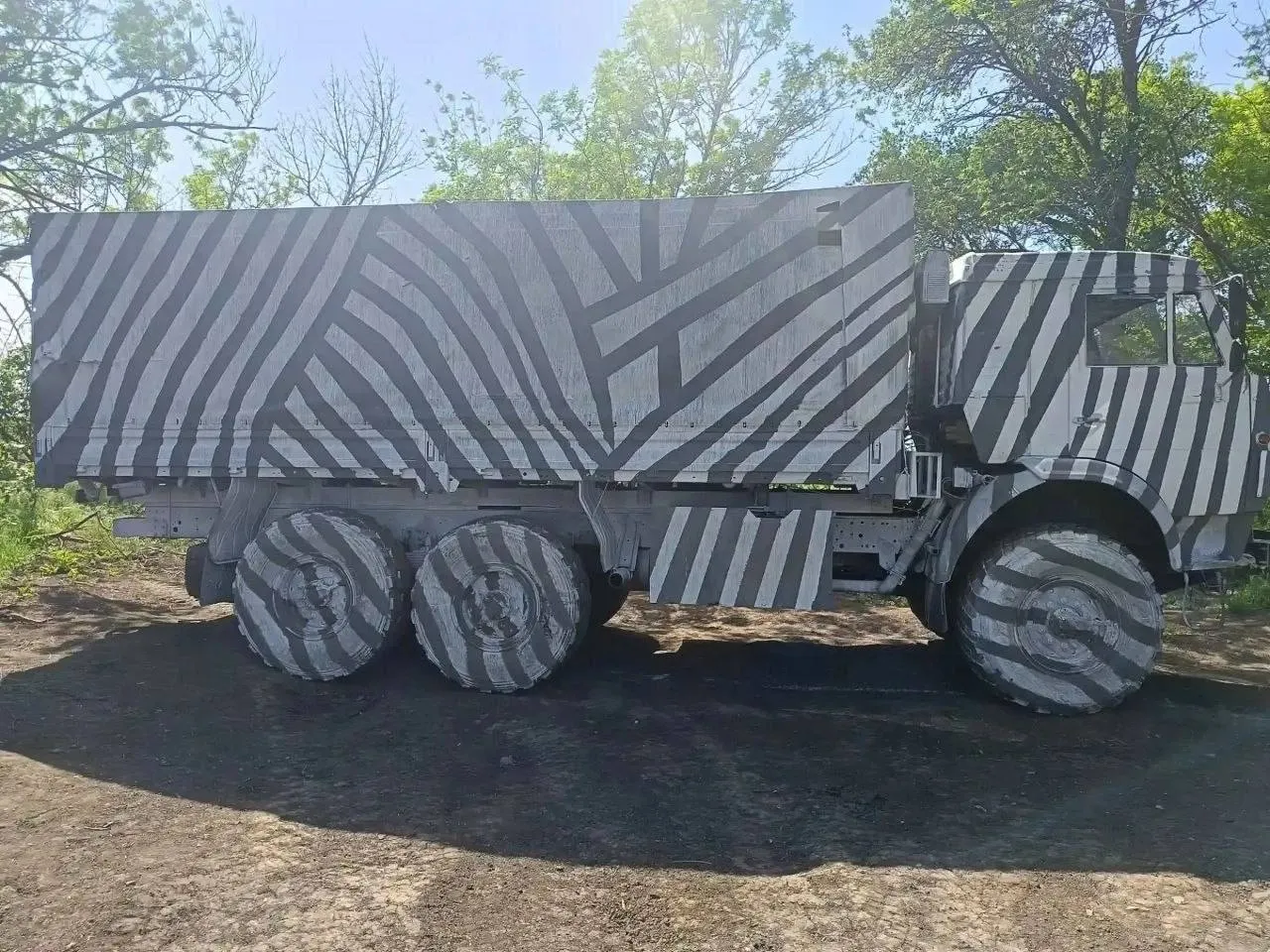
Images showing unusually painted Russian trucks have appeared on social media channels in recent days with a paint scheme designed to throw off Ukraine’s AI-assisted mid-range strike drones. (Via X) via X
They are putting on anti-drone nets deep into their controlled territory. They are placing people armed with shotguns every 50 meters of their critical roads, but basically, as for now, there is no Russian tactic that would be effective in protecting their logistics. I do not say that they will not come up with this tactic in a month or so, but as for now, they do not have an effective countermeasure for that.
The only thing that I would like to add is that we approximately know the direction in which the enemy is moving to ensure counter measures to this tactic of ours, and we already have countermeasures for their countermeasures.
The current Ukrainian superiority in mid-range drone warfare is a brilliant advantage that comes with an expiration date.
Failing to prepare for the day Russia matches this capability guarantees a catastrophic collapse of front line logistics for Ukraine.
Q: Is the AI enhancement helping to mitigate Russian jamming and electronic warfare measures?
A: Well, I would like to say that EW is not the only way to counter UAVs. So, in addition to EW assets, there are other counter drone methods. Nets can be used. Air observation posts can be used. The drones can be shot down with enemy interceptor drones, and also there are hundreds and hundreds of people armed with shotguns who can also try to shoot the drones down. So the EW systems are just a small part of this overall system of drone countermeasures, and it is a general misconception that all anti-drone efforts are from the EW system. I would say that EW accounts for approximately 10% of overall counter drone efforts.
The main idea of the use of the AI systems is not only to help operators to counter enemy drone countermeasures, but the AI also helps the operator with navigation, with orientation, with the identification of the targets. So this is a complex system that helps the operator with many tasks.
Here: strike by the Ukrainian-American “Hornet” drone on occupier positions. Two Russians confirmed as “gruz 200” (KIA). Interestingly, the Russians call this drone “Martian-2” because its capabilities seem “out of this world” to them.
Q: What are the lessons that the U.S. can learn from your mid-range drone strike campaign, given the importance of logistics everywhere.
A: Well, I would say that the main lesson that the U.S. can learn from our experience is that drones in their basic configuration, right out of the box, is not something that can work, and this is not something that can bring you the best results at once. This is why every unit should have their own drone laboratory that can reconfigure those drones and modify them, and I’m not only talking about reconfiguring tactical level drones to turn them into middle strike capacities. I’m talking about all warfare in general.
U.S. soldier Sgt. Kevin Tran, assigned to 173rd Airborne Brigade, sets up a one-way attack Hornet drone during a demonstration in the 7th Army Training Command’s Grafenwoehr Training Area, Germany, March 25, 2026. The demonstration provided leaders with insight into how AI-enabled one-way attack systems operate alongside Army fires formations. (U.S. Army photo by Spc. Thomas Dixon) Spc. Thomas Dixon
Assets become obsolete very quickly and in three months everything can change, starting from the navigation systems and ending with the control systems. For example, today the GPS signal works, in a month it doesn’t work anymore. Today we use this set of frequency ranges, and in a month all those frequency ranges are jammed by the enemy. So I’m saying this for you to understand that for example, if the U.S. government purchases Hornet drones for their units, then the units are going to have good tactical level drones. But if you want to squeeze all of the possible benefits from those drones, then you will need to modify the structure of your units and include the departments, include the sections that will deal with the modification and reconfiguration of those drones to ensure the most efficient results that can be achieved.
From what I see now, the U.S. is mostly just giving the unit some assets, but they are not thinking about re-configuring or repurposing those drones.
Q: Is there anything I haven’t asked you that you would like to address?
A: I think that we have covered all the topics. The only thing that I would like to add is that I would like your audience to see that Ukraine introduces new innovations that can basically change the battlefield, and this is why trying to forecast the outcome of the war based on the number of tanks or aircraft or bombs that would be incorrect, so the victory will belong to the side capable of adapting faster and not to the side that has more resources.
Ukrainian President Volodymyr Zelenskyy arrives at No.10 Downing Street in London on March 17. On Monday, Ukrainian forces said they attacked several Russian locations overnight, including multiple oil depots. File Photo by Hugo Philpott/UPI | License Photo
June 8 (UPI) — Ukrainian forces struck oil depots in Russian-occupied Crimea as well as other command and ammunition locations in Russia, the Ukrainian military said.
The strikes took place late Sunday, the general staff of Ukraine‘s military said in a Facebook post Monday, according to a translation by Ukrinform.
The Grushevaya oil depot in Krasnodar Krai and the Feodosia and Semikolodezyanskaya oil depots in Crimea were among the targets hit during the attacks, The Kyiv Independent and Ukrinform reported. Ukraine also struck the Krasny Line Production Dispatch Station in Volgograd oblast, which supplies oil to the Volgograd refinery and the Sheskharis export terminal.
Ukrainska Pravda reported that the Grushevaya oil depot is one of the largest oil storage facilities in the Caucasus, holding between 1.3 tons to 1.5 tons of petroleum. The site is used to store and transport oil for maritime export and generates a large amount of revenue for Russia.
There were large fires and billowing smoke reported at the oil depots said to be hit.
The strikes hit Russian drone command posts in various locations in Zaporizhzhia, Donetsk and Kursk oblasts. The military also said it hit areas with concentrations of Russian personnel in Donetsk, Zaporizhizhia and Sumy oblasts.
The Russian military said it struck down 310 Ukrainian drones overnight throughout Russia, Crimea, and the Black and Azov Seas.
Troops in landing craft approach Omaha Beach on D-Day in Normandy, France, on June 6, 1944. D-Day was the largest seaborne invasion in history and turned the tide of World War II. Photo by UPI | License Photo
Weekly insights and analysis on the latest developments in military technology, strategy, and foreign policy.
From an early point in the Russian war in Ukraine, we’ve seen many unorthodox efforts to try to improve the chances of survival of fighting vehicles. Now, Russian trucks are receiving ‘dazzle paint,’ borrowing the same kind of tactic Russia has used for some of its most important military aircraft, to try to confuse seekers on standoff weaponry that use image-matching capability.
KAMAZ truck with zebra-style pattern. via Xvia Xvia X
Several images showing the unusually painted Russian trucks have appeared on social media channels in recent days. So far, examples of Ural and KAMAZ heavy-duty truck designs have surfaced. There are at least two distinct patterns so far: a zebra-style application of broadly straight lines, and a more organic, leaf-like, swirling design. In both cases, they extend over most external surfaces, including the wheels and tires. It is not entirely clear if the white paint is applied over a layer of black, or portions of black, or if the white is simply coated over the standard base color of very dark green. It could be a mix of both application concepts, as well.
Ural truck with leaf-like pattern. via Xvia Xvia X
At first sight, the truck patterns recall the iconic paint scheme that the U.K. Royal Navy pioneered for its warships back in World War I. ‘Dazzle paint’ or ‘dazzle camouflage’ was devised in 1917 by official War Artist Norman Wilkinson, as a means of reducing losses to attacks by German submarines, or U-boats. The geometric patterns work by using highly contrasting color blocks, often heavily featuring black and white, as part of a carefully constructed pattern that breaks up the form of the ship and makes it harder to judge range and perspective.
British aircraft carrier HMS Argus wearing dazzle camouflage in 1918. Crown Copyright
As you can read about here, this kind of naval camouflage scheme appeared again during World War II, and on several occasions since then.
The Canadian frigate HMCS Regina, carrying a dazzle camouflage scheme, takes part in an exercise in 2020. Canadian Forces
When first introduced, dazzle paint was intended to trick the human eye, normally looking through a periscope. There was still a benefit to be had in protecting vessels after the introduction of improved rangefinders and radar. For the eye, it made it harder to judge a ship’s course and speed, as well as simply identifying it reliably.
The same basic principle is at work on the dazzle-painted Russian trucks, although now it’s an artificial eye — chiefly using electro-optical and/or infrared cameras — that is supposed to be fooled.
Increasingly, Ukrainian drones are using artificial intelligence (AI) to boost their combat effectiveness. The revolutions that are coming as a result of embedding of AI into lower-end drones is something you can read about in our past feature here. This includes machine vision: a process of the drone learning object recognition, identification, classification, and tracking, as well as providing recommendations for the operator on what to do, provided there is an operator at all and the drone is not running autonomously.
An HX-2 drone in flight. The HX-2 has some capabilities enabled by AI. Helsing
AI-enabled capabilities make lower-end drones more resistant to electronic warfare systems and make it easier for them to be employed in networked swarms. Above all else, they can result in the cutting of the invisible radio frequency tether of constant man-in-the-loop control that in many ways hampers the potential of this class of drones.
The drawback of machine vision that the Russian countermeasure is supposed to exploit is the onboard AI agent’s capacity for learning object recognition. While it may be able to recognize a 6×6 Ural, for example, out of a wide range of potential truck targets, if the appearance of the vehicle is distorted enough, it will not be positively identified, or at least meet the threshold of corroboration that would result in a kinetic act. However, still with many drones that feature AI assistance, a human operator stays in or on the loop for all critical decisions.
This raises the question of how successful the dazzle-painted trucks might be, although the thinking here presumably stresses avoidance of detection during the autonomous target-search phase, rather than the endgame of an engagement. It is also worth noting that these kinds of paint schemes only really have value in areas where they are unlikely to be seen by any Ukrainian human eyes, even remotely via a sensor; after all, they are far more conspicuous than their standard-painted counterparts. It’s also possible that a drone could be taught to specifically hunt these patterns, as nothing else on the battlefield would look like them and they would be confirmed hostile by default.
Overall, paint schemes are another logical, if extemporized response to a growing threat in the Russian rear areas, following the example of the Russian trucks loaded with logs as makeshift armor to protect against kinetic threats in the early phases of the war.
A Russian truck with improvised armor made of logs, in 2023. via X
This has been followed by successive counter-drone measures, best exemplified by the increasingly complicated ‘cope cages,’ ‘turtle tanks,’ nets, and arrays of spikes that have appeared on a range of vehicles on both sides of the war.
Russian ‘turtle tank’ seen operating with additional cage armor and an attached mine roller. via X
Perhaps most apposite, however, is the example of Russian bombers and strike aircraft being covered with disused tires, something that first appeared in around August 2023. TWZwas first to postulate that these were most likely intended to confuse the seekers on Ukrainian cruise missiles and drones that use image-matching capability. This was subsequently confirmed by a senior U.S. military technologist.
A “sort of classic unclassified example that exists is like a picture of a plane from the top, and you’re looking for a plane, and then if you put tires on top of the wings, all of a sudden, a lot of computer vision models have difficulty identifying that that’s a plane,” Schuyler Moore, U.S. Central Command’s first-ever Chief Technology Officer, explained in September 2024.
Moore said this as part of a larger discussion about AI models and data sets.
It’s also worth noting that Russian combat ships based in Crimea also received unique shading to break up their silhouettes for the same purpose during this period.
As well as the possibility of operating in large groups or fully networked swarms, it means long-range one-way attack drones can conduct dynamic targeting deep in contested territory. Trucks, for example, can be hunted and struck far behind the front lines, where once they were safe and where air defenses are sparse.
“Waves of similar drones could be sent to their own individual geographical ‘kill boxes,’ or defined areas of engagement. Collectively, they could put enemy targets at risk over a huge area persistently without ‘doubling up’ and attacking the same target twice. Using machine learning/AI and associated hardware, they could not just identify targets of interest, but also differentiate moving from still targets, to ensure they are indeed active (not destroyed or already damaged) vehicles. Meanwhile, they can be set to engage other target types, such as surface-to-air missile systems or other high-priority targets, regardless of whether they are static or not. Even troop movements on the ground could potentially be recognized and attacked. All the parameters as to what the drone can engage, and where it can do so, can be defined and tailored to each mission before launch.”
A man with a bicycle passes by a burned-out KAMAZ truck, part of a display of Russian military equipment destroyed in the fighting in Ukraine. Photo by Viacheslav Onyshchenko/SOPA Images/LightRocket via Getty Images SOPA Images
It is also worth noting that different types of sensors will be affected to different degrees by passive countermeasures like complex paint jobs. While electro-optical sensors may have issues with the patterns, infrared may not, especially at longer wavelengths.
TWZ has previously highlighted how AI algorithms can be rapidly trained in a digital environment, as well as incorporate data collected from actual real-world employment, to improve their ability to spot, categorize, and engage targets. It is, however, unclear how hard it would be to overcome infinite dazzle patterns. It could, as Schuyler Moore observed, lead to software programmers spending inordinate amounts of time on computer vision with very little to gain, once a new pattern arrived.
While it remains to be seen how effective the dazzle-painted trucks might be, they are another sign of drones, especially AI-enabled ones, being one of the key drivers of innovation on the modern battlefield.
June 1 (UPI) — French President Emmanuel Macron said the country’s navy intercepted a sanctioned crude oil tanker that departed from a Russian port.
Macron wrote on X that a ship called the Tagor was seized Sunday by the French navy “in international waters, with the support of several partners including the United Kingdom, in strict compliance with the law of the sea.”
The Tagor, registered in Madagascar, departed from the Russian port of Umba and appeared on ship tracking sites in the North Atlantic last week, CNN reported.
The European Union, Britain and the United States have all sanctioned the Tagor.
“It is unacceptable for ships to circumvent international sanctions, violate the law of the sea, and fund the war that Russia has been waging against Ukraine for more than four years,” Macron wrote. “These vessels, which fail to adhere to the most basic rules of maritime navigation, also pose a threat to the environment and to everyone’s safety.”
The Tagor is the third ship to be seized on suspicion of being part of a Russian shadow fleet. An oil tanker was intercepted by France between the southern coast of Spain and the northern coast of Morocco in Morocco. Another was intercepted by Belgium with French assistance in March.
Kremlin spokesman Dmitry Peskov released a statement that Sunday’s seizure was “illegal, bordering on international piracy.”
“We absolutely disagree that they are being carried out in full compliance with international law,” Peskov said of the seizures.
The Russian embassy in Paris told Russian state-run news agency TASS that the captain of the Tagor is believed to be a Russian citizen, and the embassy has requested information from French officials about whether other Russian citizens were present on the vessel.
Wreathes are seen amongst the statues at the Korean War Veterans Memorial during Memorial Day weekend in Washington on May 27, 2023. Memorial Day, which honors U.S. military personnel who died while in service, is held on the last Monday of May. Photo by Bonnie Cash/UPI | License Photo