
rule

Major EU travel rule change – all you need to know about new pet passport controls

British tourists have been warned that beloved dogs, cats and ferrets could be turned away at the border as new post-Brexit rules make EU passports invalid – here’s what you need to know

New EU rules could see beloved pets turned away at the border from tomorrow – and there’ll be big changes to what you need to do before taking four-legged friends on holiday.

Anyone travelling into the European Union with pet dogs, cats and ferrets from England, Scotland or Wales can no longer use EU pet passports under post-Brexit arrangements which come in to force on Wednesday.

Until now, people taking their pets abroad – whether by plane, train, ferry or car – could use an EU Pet Passport, even after Brexit.

But EU Regulation 2016/429, known as the Animal Health Law, comes into force this week after a 10-year transition, and means these pet passports will no longer be valid.

Instead, there’s a different document you’ll need to get sorted before you go on holiday. Here’s what you need to know:

READ MORE: Foreign Office issues Greece travel update as holiday hotspot suspends EU ruleREAD MORE: Major EU travel rule change from Wednesday could see UK travellers denied entry

You now need an animal health certificate for every trip

The changes mean that anyone travelling from Great Britain to an EU country with a pet will now need to get an animal health certificate (AHC) before they set off.

Travellers will need to get a vet to issue an AHC within 10 days of their trip. A new certificate will be needed for each trip from Britain to the EU.

The AHC can be used for up to six months for onward travel within the EU and for reentering Britain, as long as rabies vaccinations are still valid.

The GOV.UK website, which says the rules also apply to assistance dogs, states: “If you live in England, Scotland or Wales, from 22 April you cannot use a pet passport (even if it was issued in the EU). If you use a pet passport, your pet may be refused entry into the EU.”

Holiday home owners will not be issued EU pet passports

Pet passports are now only to be issued to people whose main base is in the EU, and not to holiday home owners or seasonal visitors. The Department for Environment, Food and Rural Affairs said individual member states may have specific pet travel requirements and owners should always check the entry details before travelling. British-based travellers can still use EU pet passports for their return journey back home.

Five pet limit and other rules to remember

The switch to the AHC from the EU pet passport means:

  • Extra paperwork will be needed if the owner is not travelling with their pet.
  • Whoever is taking the animal abroad must have written permission from the owner.
  • Up to five days are allowed before the pet and owner must travel abroad.
  • Travellers are now also only allowed to have a maximum of five pets in a private vehicle.

There may be exceptions given for pets travelling to competitions, events or training.

Holidays with pets ‘still possible’

The Animal and Plant Health Agency (APHA) said “holidays with your pets are still possible” despite the new rules. An APHA spokesman said: “Anyone planning to travel should check guidance on Welcome to GOV.UK , and the entry rules for their destination.

“To avoid delays and ensure a smooth journey, pet owners residing in Great Britain should get an Animal Health Certificate if they are travelling from Great Britain to an EU country.”

Source link

Foreign Office issues Greece travel update as holiday hotspot suspends EU rule

Following a major change made by Greece, the Foreign, Commonwealth & Development Office (FCDO) has updated the country’s travel advice for British holidaymakers

The Foreign Office has issued an update on travel to Greece for Brits, and it’s good news.

Since the European Union’s (EU) Entry/Exit System (EES) was fully rolled out earlier this month, there have been major travel disruptions. Holidaymakers have reported substantial queues and delays at airports across Europe, with some lasting up to four hours, while hundreds have missed flights as they try to pass through the new digital border system.

In a bid to ease travel chaos, Greece has chosen to waive the EU requirement for Brits to submit fingerprints and facial scans at airport border controls. In a statement from the Greek Embassy, they announced: “Update for British passport holders travelling to Greece.

READ MORE: Ryanair issues warning to customers – and it’s not down to fuel crisisREAD MORE: Major EU travel rule change from Wednesday could see UK travellers denied entry

“In the framework of the implementation of the Entry/Exit System, as of 10 April 2026, British passport holders are exempt from biometric registration at Greek border crossing points.” There was no suggestion of how long the exemption would remain in place, but soon after, the Foreign, Commonwealth & Development Office (FCDO) revised its travel guidance for Greece.

In an update on Monday, 20 April, the FCDO stated: “Greek authorities have indicated that they will not collect biometric data (fingerprints and photos) for UK travellers as part of EES. Follow the advice of authorities on the ground. If you are a resident in Greece, make sure to show your residence documentation at passport control to ensure you are not registered in EES.”

Greece opted to ditch the new biometric security measures amid concerns about the significant travel chaos they were causing at airports, severely impacting holidaymakers. The relaxed EU rules from Greece are now hoped to improve travel for Brits into the country, allowing for a smoother journey without gruelling wait times and unnecessary delays.

Noting the impact of the EES, Luke Petherbridge, director of public affairs at ABTA, said: “While for many the travel experience remains smooth, we’re disappointed and frustrated to see some passengers being caught up in delays due to EES.

“Abta has been warning destinations and the (European) Commission for some time about the need for proactive steps to be taken to avoid delays, including the full use of contingency measures to stand down biometric checks at busier times, and adequate staffing, especially at peak times.”

The EES was fully implemented across European airports on April 10, 2026, and requires all Brits travelling to the Schengen area to “create a digital record” and register their biometric details, such as fingerprints and a photograph. It’s needed for their first arrival at the airport border in the Schengen area, and after the initial registration, the EES remains valid for three years.

Countries in the Schengen area include: Austria, Belgium, Bulgaria, Croatia, Czechia, Denmark, Estonia, Finland, France, Germany, Greece, Hungary, Iceland, Italy, Latvia, Liechtenstein, Lithuania, Luxembourg, Malta, Netherlands, Norway, Poland, Portugal, Romania, Slovakia, Slovenia, Spain, Sweden, and Switzerland.

However, as it stands, Greece is the only country to relax the EU requirements for Brits. The EES system is not required for travel into the Republic of Ireland and Cyprus, as they are not within the Schengen area.

For more information on the new EES system, visit the government website.

Do you have a travel story to share? Email webtravel@reachplc.com

Source link

Major EU travel rule change from Wednesday could see UK travellers denied entry

You need a new document at a cost of £90 a time

People travelling from the UK to Europe have been warned of a major passport change this week, making documents invalid from Wednesday, April 22. The post-Brexit change means that anyone travelling with a pet will need new documentation or face being sent home.

Until now, people taking their pets abroad – whether by plane, train, ferry or car – could use an EU Pet Passport. The EU Regulation 2016/429 – known as the Animal Health Law – comes into force this week after a 10-year transition.

That means anyone going to Europe with their pet now needs an Animal Health Certificate. The certificate requires a vet visit within 10 days of your trip, a new certificate each time and a £90 payment – per pet.

The Animal and Plant Health Agency (APHA) issued Briefing Note 14/26 on April 17, 2026. This statement marks a significant shift in pet travel rules, effectively ending the “loophole” where Great Britain (GB) residents used EU-issued pet passports to avoid the cost of Animal Health Certificates (AHCs).

A spokesman said: “An EU pet passport, issued to or held by a pet owner who is resident in GB, will no longer be a valid document for travelling with pets from GB to the EU. This applies to EU pet passports issued in an EU Member State or Northern Ireland, including those issued before 22 April 2026 . EU pet passports may only be issued to owners whose main residence is within the European Un ion.”

If your primary residence is in Great Britain, you cannot use an EU pet passport for travel from the UK to the EU, regardless of where or when that passport was issued (e.g., if you obtained it in France or Spain). UK residents must now obtain an Animal Health Certificate (AHC) for every single trip to the EU.

The briefing clarifies that EU pet passports issued in Northern Ireland are also invalid for travel if the owner is a resident of Great Britain.

APHA is updating the AHC forms to align with new EU regulations. While these new templates are being finalised, there is a transition period where older AHC templates will still be accepted for travel into the EU. There are currently no changes to the requirements for pets entering GB. You can still use a valid EU pet passport or AHC to return to the UK.

For dogs, the requirement for a vet-administered tapeworm treatment between 24 and 120 hours before arriving back in GB remains in place.

You should contact your vet immediately to arrange an AHC, as pet passports will no longer be accepted at the border for UK residents from that date.

Updated rules on the movement of dogs, cats and ferrets are included in a January 2026 EU regulation which is coming into force on April 22.

Source link

Jet2 holidays changes to 14 day rule for all travellers and sends email

Airline and travel company has contacted all passengers with holidays booked to inform them of a change to when booking documents are sent out amid Middle East conflict concerns

All Jet2 passengers with holidays booked have been contacted by the operator regarding an important change. Thousands of travellers have received emails notifying them that their holiday documents will be arriving later than originally expected.

This has raised alarm bells among some customers who fear it could be a scam – particularly as Jet2 has recently been warning about numerous fake social media accounts being created in an attempt to defraud passengers.

One passenger wrote on X: “@jet2tweets Hi, I’ve just received this email apparently from Jet2 saying I will now get my holiday documents 14 days before my holiday departure instead of 28, is this true or is it still 28, I’ve a feeling this was a spam email though.”

Another passenger added: “I had the same email. Flying on 25 May with jet2,” A traveller added: “Ive just had the same email !”

The email says: “Just so you know, following a change to when we send out the documents for your holiday, you’ll now receive your documents 14 days before departure, rather than 28 days as stated on your original booking confirmation. You don’t need to contact us or take any action – you’ll recveive your documents 14 days before you travel. Have a lovely holiday!”

Responding on X, Jet2 confirmed it was a genuine message and explained: “Hi there, thanks for reaching out. Yes we can confirm that you will receive your documents 14 days before departure. Should you require any further assistance, then please feel free to send us a DM. “

The shift towards holidaymakers securing their travel documents closer to their departure dates comes amid growing uncertainty sparked by the Middle East conflict. Last week, Fatih Birol, executive director of the International Energy Agency (IEA), warned there could be flight cancellations “soon” if oil supplies remain restricted by the Iran war.

The head of the world’s energy watchdog also cautioned that Europe has only six weeks’ supply of jet fuel because of the Middle East conflict. Iran continues to have a stranglehold on tankers passing through the Strait of Hormuz and has fired at several over the weekend.

Worried holidaymakers have been flooding Jet2’s social media channels with their concerns. One wrote: “@jet2tweets Hi there – we are looking to go away for a week to Malaga in June and want to know how concerned we should be about the reporting of lack of airport fuel and what happens to our holiday should something like this happen and impact our holiday. Can you help…?|”

Another posted: “Are holidays going ahead as usual? We’ve booked an all inclusive 10 day to Crete in June. I’m worried about jet fuel prices.” While a further traveller asked: “You guys aren’t planning on last-minute flight cancellations due to potential jet fuel shortages, are you? Family holiday booked in May, FYI” Jet2 responded: “Hi all, flights are planned to go ahead as normal. If anything were to change regarding your booking, we would be sure to reach out to you directly to make you aware and discuss the options available to you. Thanks”

Meanwhile, Javier Gándara, easyJet’s CEO for Spain and Portugal, spoke at the reopening of the airline’s base in Palma, Mallorca, where he gave his assessment of the current fuel supply situation: “What the producers and airports are telling us is that there won’t be any supply problems for the next three or four weeks.

“Beyond that, it’s difficult to see. In Spain, we are in a comparatively better situation than neighbouring countries for two reasons. Firstly, because of all the crude oil that is imported and then refined here, only 11% comes from the Middle East, which is the percentage affected by the closure of the Strait of Hormuz; the remaining 89% comes from elsewhere.”

He went on to warn: “No one will be immune to potential supply problems. Ships that leave and pass through the Strait of Hormuz and come to Europe take an average of 45 days, and they have already been practically out of service for two months. It will take time to recover all of that. It’s difficult to know what will happen, so we’ll react as we go.”

Source link

Rich House Poor House couple make emotional decision as they ‘break show rule’

One family on Rich House, Poor House decided to ‘break a rule’ halfway through the swap

*Warning: Contains spoilers for the latest episode of Rich House, Poor House*

A Rich House Poor House couple have broken one major show rule.

The hit Channel 5 series sees two families from opposite ends of the wealth divide swap homes, budgets, and lives for a week.

They both experience a dramatic shift in perspective as they step into each other’s worlds but one family appeared to break a rule as they left the property halfway through the swap.

During Sunday’s (April 19) episode, millionaire hotel owners Gez and Rosy Chetal swapped their luxury life with the Bloor family.

In Norfolk, John and wife Ann, live with their three children in a three-bedroom rented terrace house. After basic household bills they have just £79 a week to spend on everything else from food and travel to fun.

Mum Ann works as a cook in a mental health care home, meanwhile husband John works long hours as a bus driver, but they both have a passion for cooking.

Despite both grafting hard, the couple struggle to make ends meet and have previously gone bankrupt for £36k, but they dream of running a music café of their own one day.

Experiencing how the wealthiest 1% live, they exchanged homes for a week with hotel owners Gez and Rosy Chetal, who lived in their luxurious £1.7m 11-bedroom bespoke hotel with their 19-year-old daughter Saanchi.

Given his demanding lifestyle as an entrepreneur, the couple wanted to use the swap as a way for them to spend some quality time together and have a break from their business.

They swapped their hotel— complete with a wine cellar, a large dining room and private chef for a week-long stay in the Bloor family’s house.

While Gez and Rosy were forced to manage on a weekly budget of £79, John, wife Ann and their children got a taste of luxury living with £1,800 to spend.

However, not long into the swap it was clear that the Bloor family struggled to adjust to their new environment living in a hotel as Ann admitted: “My kids are not comfortable.”

After a restless night, Ann was visibly moved as she told husband John: “The children are really uncomfortable. They can’t be in their pyjamas because it’s a hotel, they can’t just go and get a drink, they can’t just go and get a sandwich.” John jumped in and added: “It’s not a home is it?”

Turning to John, Ann explained: “It’s nothing about the hotel. If it was just me and you.. I’d absolutely love it but actually to me we can’t really stay in the hotel.”

The couple then made a big decision and decided to abandon the hotel and use the remaining budget to book a luxury Airbnb, that cost a whopping £1,200.

When the two families finally reunited at the end of their swap, Ann went on to say: “We loved the hotel, unfortunately the children didn’t. They felt very separated from us.” Gez added: “It’s just a big house really, with 11 rooms.”

Rich House, Poor House airs Sunday night from 9pm on Channel 5

Source link

Follow three-week passport rule or risk increased £239 fee

British travellers planning trips abroad must check their passports at least three weeks before departure

Brits heading abroad should carefully check their passports at least three weeks before they travel. Missing certain critical problems could land you with a £239 bill.

Travellers must make sure their passports are valid and in good condition before they set foot on a plane. Any problems could see you turned away at the gate.

To sort this out, your passport will need to be replaced straight away, and putting this off could prove costly as standard passport renewals can take up to three weeks.

Following a price rise earlier this month, a standard passport will set you back £102. However, if you’ve left a passport problem until just days before your trip, you’ll be forced to shell out £239.50 for the one-day express service.

GOV.UK warns: “If your passport is damaged you must replace it. You may not be able to travel with it.”

The HM Passport Office will consider a passport damaged if:

You cannot read any of your details

  • Any of the pages are torn, cut or missing
  • There are holes, cuts or tears in the cover
  • The cover is detaching
  • There are stains on the pages (for example, ink or water damage)

Regarding your passport’s expiry date, the requirements will differ depending on where you’re headed. Some countries insist on at least six months remaining on your passport upon arrival, while others only require three.

For a full breakdown of passport requirements by country, visit the Government website here.

Applying for a passport online

To apply online, head to the Government website here. Key requirements include a digital photograph, a valid payment method (credit or debit card), and your existing passport if you’re renewing.

Furthermore, applicants must supply proof of their identity and citizenship. The application fee for adults stands at £102, while children’s passports are priced at £66.50.

For anyone requiring assistance with the online application, local Post Office branches provide support services. Their staff are able to:

  • Take your digital photo
  • Help with completing the online application

Be mindful that this service carries an extra charge.

Postal applications

Paper passport applications are available from your local Post Office. Keep in mind that postal applications generally take longer to process than online ones.

They’re also more expensive than online applications, setting you back £115.50. You’ll be required to submit a completed application form alongside your supporting documents, two photographs, and the relevant fee.

Post Office staff can assist in making sure your form is properly completed – though you’ll need to supply your own photos. Payment can be made using cash, debit or credit cards.

Fast-track applications

If the standard three-week processing period is cutting it too close with your holiday plans, several quicker options are available for securing a passport. According to the Government website: “You can pay to get a passport urgently if you think the standard service will take too long.”

To take advantage of these fast-track services, you’ll need to secure an appointment at a passport office:

  • The same-day premium service carries a charge of £239.50 (or £253.50 for the 54-page frequent traveller passport)
  • The one-week express service costs £192 for an adult passport (or £206 for the 54-page frequent traveller passport), and £156.50 for a child’s passport (or £170.50 for the 54-page version)

For further information, visit the Government website here.

Source link

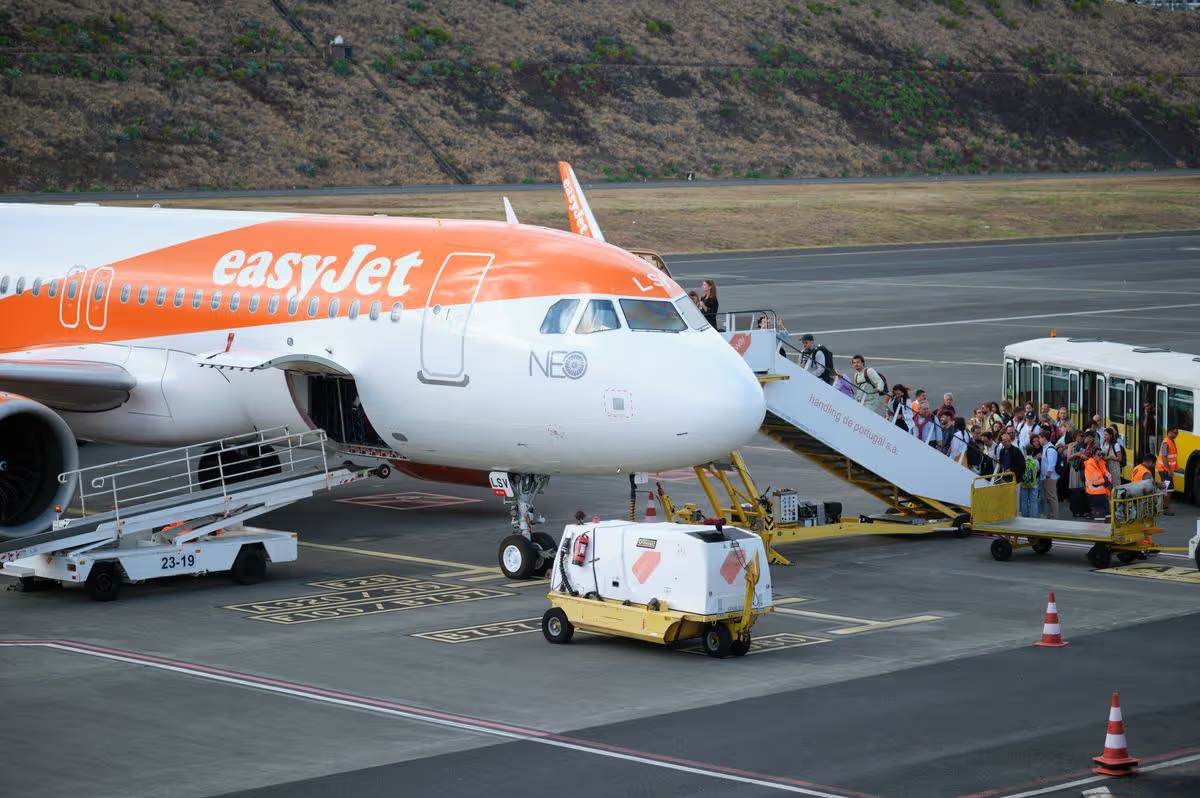
easyJet Portugal update as airline issues warning over new ‘allowance’ rule

EasyJet’s general manager in Portugal has issued a warning over new government proposals the carrier says will artificially inflate prices

easyJet is weighing up plans to cut back operations in Portugal, according to reports emerging from the country. The airline’s general manager there has issued the warning amid a dispute over government proposals which easyJet claims will drive up costs for passengers.

José Lopes, easyJet’s general manager in Portugal, announced on Monday that the carrier may cut back its domestic services following the scrapping of caps on something called the social mobility allowance for air travel. This caps maximum fares for some local passengers – but the changes are set to affect the airline more widely.

“Removing the upper limit will artificially inflate prices,” José Lopes said. He argued that the measure will deliver “zero benefits” for island residents while helping to deter tourists, who makeup the bulk of passengers on domestic routes.

The airline says it will not return to operate Azores routes due to the changes. It had already confirmed its departure from the region from March 29, 2026, blaming a 35 per cent increase in airport fees and what it describes as government inaction.

The easyJet representative was addressing journalists at a press conference in Funchal, held in partnership with the Regional Secretariat for Tourism, to outline the company’s operations and long-term pledges in the Madeira archipelago, SIC Noticias reports. Portuguese media outlets report that at Porto Santo airport, the two existing routes to Lisbon and Porto will be retained, albeit with a reduction to Lisbon owing to constraints at that airport, he indicated.

He warned that if the measure to alter the social mobility subsidy regime – which would remove the maximum limits for air travel for residents of Madeira and the Azores – is implemented, there will be implications for Easyjet’s operations. “I hope that an analysis will be carried out and a way will be found to be more rational and less emotional in dealing with the matter,” he said.

When asked about the possibility of abandoning the route to Madeira, the official ruled out this scenario. Yet reports say he highlighted the possibility of “a reduction in market capacity.”

The changes were given the green light on Friday in the Assembly of the Republic, but have yet to come into force. The amendments stem from two initiatives to revise the legislation put forward by the Socialist Party and Chega.

What is the social mobility subsidy?

The social mobility subsidy set a maximum fare of €79 for residents and €59 for students travelling between Madeira and the mainland (round trip), with an overall cap of €400. In the Azores, residents travelling to the mainland pay no more than €119, while students are capped at €89, with a recently introduced maximum ceiling of €600.

The Portugal Post reports that Portugal Parliament’s recent decision to abolish price caps has placed island connectivity under serious threat, with easyJet warning of capacity reductions to Madeira and confirming it will not operate Azores routes under the new framework.

Ryanair has also revealed plans to cease all operations in the Azores on March 29, 2026, citing cost pressures.

Source link