rule

Travel rule all UK tourists should follow to avoid delays at airport security

When you go abroad, there are all sorts of travel rules people need to follow but a certain guideline is considered crucial. It’s vital to know if you want to avoid delays at airport security

All travellers have been urged to take note of a crucial airport rule, as ignoring it could lead to significant hold-ups at security. It’s well worth bearing in mind as the travel season is already well under way, with scores of Brits eager to head off on their holidays for some hard-earned sunshine and relaxation.

The rule was recently highlighted on TikTok by a travel agent named Jake, who regularly shares straight-talking tips online, and it’s something you may never have previously considered. It’s well worth familiarising yourself with this particular rule, as it could have a real impact on how long you end up waiting in the security queue.

It’s not the first travel tip of this nature to do the rounds recently, either. Previously, holidaymakers were warned to brace themselves for “hell” owing to mounting queues at a popular airport.

Jake said: “This is the number one reason for delays at airport security in the UK right now, and almost everyone has one in their bag. But, there’s one thing that’s catching everybody out.

“It’s these. Reusable, stainless steel water bottles because, while the 100ml rule has been scrapped, and for some airports you can take up to two litres of liquids with you, these still need to be emptied.

“That’s purely because the machines can’t check the liquid that’s in these bottles. So, if you do have one in your bag and it’s got liquid in, then you’re going to have your bag pulled aside.

“You’re going to have that embarrassing moment on the belt where you see your bag go down a different aisle. So, as you’re heading to security, make sure you empty these.

“The good news is though, if you do forget and you have your water bottle in there with liquid in, they’re not going to make you throw your expensive water bottle away. They’re just going to pour out the liquid that’s in there.

“So this is just going to cause further delays for you getting through duty-free and being able to relax before you get on your flight.”

Content cannot be displayed without consent

It might seem like a straightforward tip, but it’s certainly one worth bearing in mind. Sticking to the rule could help you sidestep a major headache that’s easily avoidable.

What you need to know

What you might not realise is that you must fully empty your reusable water bottle before passing through airport security. While the 100ml liquid limit may not apply to the container itself, any liquid left inside is banned and could lead to your bottle being seized.

Even if your local airport permits larger liquid containers or doesn’t require you to remove electronics from your bag, metal or insulated bottles (such as Hydro Flasks or Yetis) typically need to be drained. The sophisticated scanners are unable to “see” through double-wall insulation, so it pays to stay one step ahead.

As Jake highlighted, certain airports now permit passengers to carry containers holding up to two litres of liquid in their hand luggage. However, this is entirely dependent on the specific airport you’re departing from, as it requires state-of-the-art 3D scanning technology.

For this reason, it’s always wise to check the regulations for your particular airport ahead of your journey. At major hubs including London Heathrow, London Gatwick, Birmingham and Edinburgh, you’re allowed to take containers holding up to two litres each.

That said, this rule only applies at select airports. If you’re in any doubt, always confirm with your airport before you travel.

Source link

P&O Cruises reminds passengers of important rule or risk being ‘turned away’

It comes as a passenger claims they were ‘turned away’ on board

P&O Cruises is reminding passengers about a particular item of clothing that is ‘not allowed’ on board under specific circumstances. The cruise line issued the guidance in a recent social media post after a passenger claimed they were ‘turned away’.

On X, a user called Duncan wrote: “@Pandocruises describe ‘formal’. Turned away from one restaurant the other day wearing formal shorts, smart tailored shirt. Dye it showing sine ‘leg’. However, seen plenty of women wearing skirts much shorter than my shorts been welcomed in!”

P&O Cruises responded: “Hi Duncan, smart shorts are not permitted in certain restaurants on board. A suit with jacket and tie is required on formal nights in the main restaurant and other venues.”

On P&O Cruises’ website, there is extensive information regarding the cruise line’s dress code policy, reports the Liverpool Echo. It states: “While we encourage you to relax and enjoy your holiday, we do ask that you adhere to a smart casual dress code in our public areas and restaurants.”

In a key notice to passengers, P&O Cruises confirms that tailored shorts cannot be worn on Black Tie or Celebration Nights, with the exception of the buffet. It adds: “On evening casual nights tailored shorts can be wore in the buffet, The Beach House, and The Glass House, as well as 6th Street Diner, The Olive Grove and The Keel and Cow on Arvia and Iona.” Further guidance states: “Denim, including dark denim, isn’t allowed on Black Tie and Celebration Nights, except in venues with an Evening Casual dress code.”

Content cannot be displayed without consent

For daytime wear, P&O Cruises states: “Feel free to wear your favourite holiday attire, such as shorts, T-shirts, and sundresses, or your typical winter clothing on one of our colder holidays. However, please remember to wear shoes when you’re not by the pool. We also ask that there is no pool wear in the ship’s lounges, inside bars, restaurants or reception.”

Regarding evening attire, the cruise operator noted: “Our dress code varies depending on the night. You can find details of each evening’s dress code in your daily Horizon found in your cabin, or on My P&O Cruises under the ‘Your Itinerary’ section before you sail.”

P&O Cruises operates two principal dress codes: ‘Evening Casual’ and ‘Black Tie’. Evening Casual calls for ‘smart casual attire’, encompassing trousers, smart dark denim, polo shirts, dresses, and skirts.

The Black Tie dress code is reserved for more formal occasions, where passengers are encouraged to “dress to impress”. The cruise line elaborates: “Gentlemen, a dinner jacket or tuxedo is ideal, but a dark suit and tie is also acceptable. Ladies, feel free to wear your favourite evening gown or cocktail dress.”

Passengers are also encouraged to adhere to the dress code for celebration nights, which P&O Cruises describes as special evenings on board where guests can enjoy a more formal dining experience and entertainment. “These events involve a higher level of dress code (black tie) and a more elaborate menu. It’s a chance to dress up, savour delicious food, and enjoy the ambience of a special occasion”, it says.

During celebration nights, most venues will operate a dress code, though some will permit a more relaxed attire for those who prefer it. Passengers can discover which venues are exempt from dress codes in their daily Horizon.

When visiting destinations on excursions, P&O Cruises advises comfortable walking shoes and clothing suited to the climate and culture of the places being visited. “Some cultures have specific dress codes, particularly for places of worship. Please respect local customs and dress modestly when visiting religious sites,” it adds.

For religious passengers, the cruise line confirms that customers are welcome to wear national or religious dress on board. “If you wear a headdress, depending on the amount of your face it covers, you may be asked to unveil for a security photo at check-in and when passing through security check points ashore and on board during your holiday”, it says.

However, certain items of national dress, such as ceremonial blades and swords, including Skean Dhus and Kirpans, are not allowed on board. Passengers can consult the list of prohibited items for further details.

P&O Cruises states that fancy dress, novelty clothing or outfits featuring any inappropriate or offensive language or imagery are banned on board. “We reserve the right to deny embarkation to guests who are inappropriately dressed”, the cruise line states. For further details regarding dress codes, click here.

For passengers who already know which ship they will be sailing on, the dress code for each dining venue on board can be found on the ship page by clicking ‘Dining’. View P&O Cruises ships here.

Source link

Half changing summer holiday plans after new rule as they fear delays

The new system in in place for anyone going to countries like France, Portugal, Spain or Italy

Nearly three out of five UK holidaymakers travelling to Europe this year expect delays thanks to a new rule.

There is widespread concern over the EU’s entry-exit system (EES), a new survey suggests. Almost half of respondents to the poll commissioned by travel company Booking.com said they fear missing flights because of the border checks.

EES involves people from third-party countries such as the UK having their fingerprints registered and photograph taken to enter the Schengen Area, which consists of 29 European countries, mainly in the EU. For most UK travellers, the process is done at foreign airports.

Representative body Airports Council International recently reported that EES was causing delays of up to three hours, with airports in Spain, Portugal, France and Italy among the worst affected. More than 100 easyJet passengers missed a flight from Milan Linate to Manchester last month because of delays at passport desks caused by the ramp up of EES.

The survey indicated that 56% of UK travellers plan to arrive at airports earlier than usual in an attempt to avoid disruption, with 12% intending to arrive at least four hours before departure. More than half of respondents who have travelled to the EU since the introduction of EES said they experienced delays during their journey, while 43% said they were not delayed.

Booking.com advised families travelling to Europe during the May half-term break to ensure their passports are eligible for their dates, and keep items such as a portable phone charger and any medication in hand luggage. Ryan Pearson, regional manager for the UK and Ireland at Booking.com, said: “May half-term is a key moment in the travel calendar, and we know many people are feeling anxious about how the new entry-exit system could impact their trip.

“We want to help travellers feel informed and prepared before they leave, whether that’s checking travel documents in advance or packing the right essentials in hand luggage in case of longer queues. Changes to the way we travel can understandably feel daunting, but we’re already seeing that many journeys are running smoothly. The key is preparation.”

Advantage Travel Partnership, a network of independent travel agents, reported earlier this month that demand for holidays in Greece has surged since the country revealed on April 17 it will not impose EES requirements on UK travellers this summer. The south-eastern European country’s market share of UK holiday bookings rose from 7.7% in mid-April to 9.98% by the end of the month, Advantage Travel Partnership said.

EES was first introduced in October last year, with its roll out ramped up on April 10. EU rules currently allow the checks to be temporarily halted to avoid queues at peak periods.

The Booking.com survey of 2,000 UK adults was conducted by research company Opinium between May 8-12.

Source link

Spain holiday warning as rule could see Brits kicked out of hotels

The UK’s Foreign Office has explained why

With warmer weather finally on the horizon, many Brits are turning their attention to the summer months and making holiday plans.

Spain continues to be the top choice for British tourists, with millions flocking to the European country each year, keen to bask in the sun, relax on its shores and enjoy the cuisine. When travelling overseas, it’s essential to get clued up on any local laws or rules you’ll be expected to follow while you’re there. And if Spain is in your sights this year, there’s one rule you may not know about.

The Foreign, Commonwealth and Development Office (FCDO) regularly provides travel advice for Brits visiting more than 220 countries and territories around the world. In its comprehensive guidance for Spain, the FCDO specifically highlights balconies.

While balconies are ideal for providing a vista and giving guests somewhere to relax outdoors, holidaymakers are required to behave responsibly. FCDO guidance for Spain warns: “Hotels and other establishments will evict you if you behave dangerously on balconies. You could also get a fine.”

Those travelling to Spain are also cautioned that they must present ID if asked by a police officer. The FCDO adds: “This includes the Guardia Civil and national, regional and local police forces.

“The police have the right to hold you at a police station until they have confirmed your identity. Ignoring direct requests of a police officer can be considered as ‘disobedience’, which is a criminal offence.”

Source link

Little-known TUI, Jet2, Ryanair and easyJet rule on duty-free bags

If you’ve made a purchase in duty-free, you may want to check ahead of time to see if you’re actually able to use it on board, as there’s one item strictly prohibited

Brits travelling abroad need to stay alert to the items they can and cannot take onboard, but do they know about the rules regarding items they buy at the airport?

Travelling with bottles in any shape or form usually comes with its restrictions, as many airports ask for you to pack liquids in measurements only up to 100ml. However, there are some far stricter rules when it comes to the liquid you’re buying in duty-free – particularly alcohol.

At most airports, you can buy bottles of wine, spirits, beers, and more; sometimes up to a liter of each is sold at discounted prices. And yet, despite being able to make the purchase at the airport, you are strictly prohibited from drinking it or even opening it on the plane.

Duty-free alcohol is generally allowed on board, passing as a form of carry-on luggage, when purchased after getting your security checks. Although it is almost always placed inside a sealed Security Tamper-Evident Bag, paired with the receipt.

READ MORE: ‘I spent a day on London Underground – I now know which Tube station is the worst’READ MORE: Tenerife tourist shares view from hotel balcony but sight leaves people gobsmacked

Within aviation law, this bag must remain sealed throughout the whole duration of the flight, a rule that is consistent across all airlines. Passengers must not consume their own duty-free alcohol on the plane, as all alcohol must be purchased from the cabin crew.

If there’s anything else you’ve purchased from duty-free, you will need to ensure it is placed in a separate bag or in your carry-on luggage to avoid it being trapped inside the sealed bag for the duration of the flight.

The rule is consistent, yet each airline may handle people consuming this alcohol differently, with potential fines for those who break the rules.

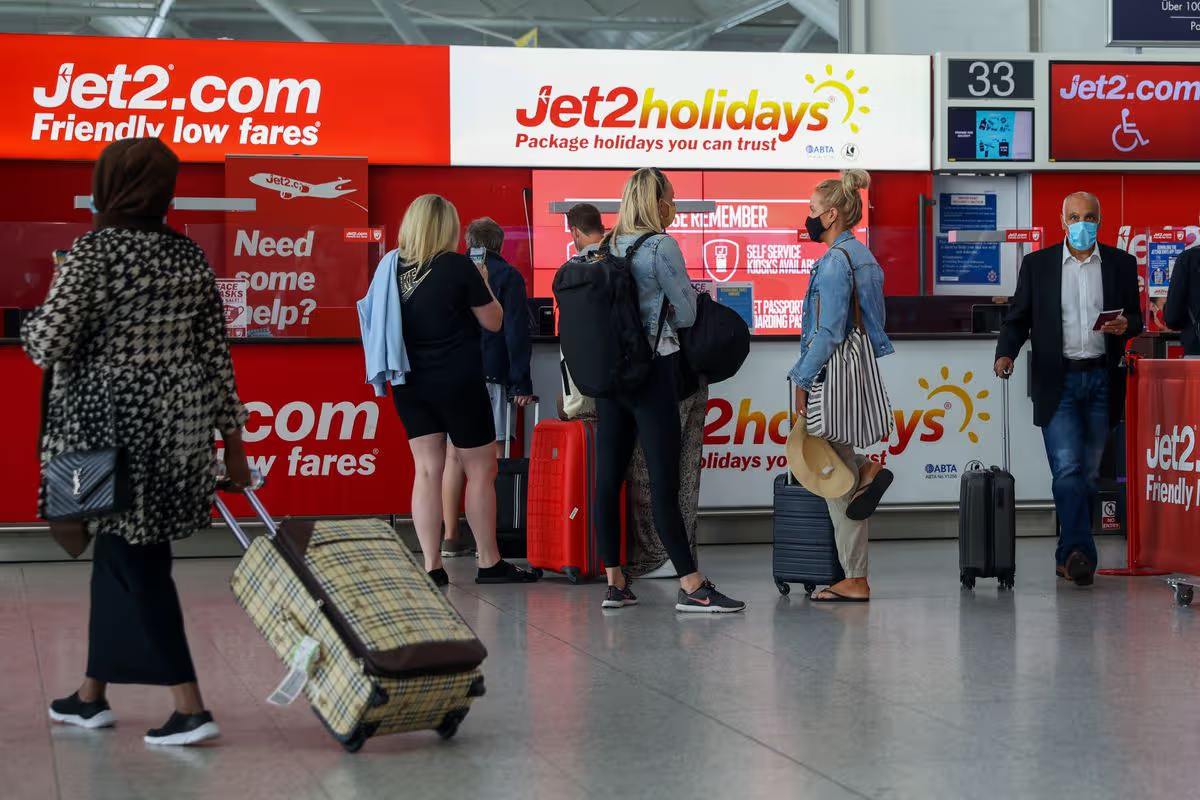
Jet2 states: “You may not bring on board alcohol for the purposes of consumption whilst on the aircraft. For safety reasons, we restrict the consumption of alcohol on board. Only alcoholic drinks purchased on board may be consumed during the flight. It is an offence to be drunk on any aircraft. Jet2.com reserves the right to serve alcoholic drinks to customers at our absolute discretion.”

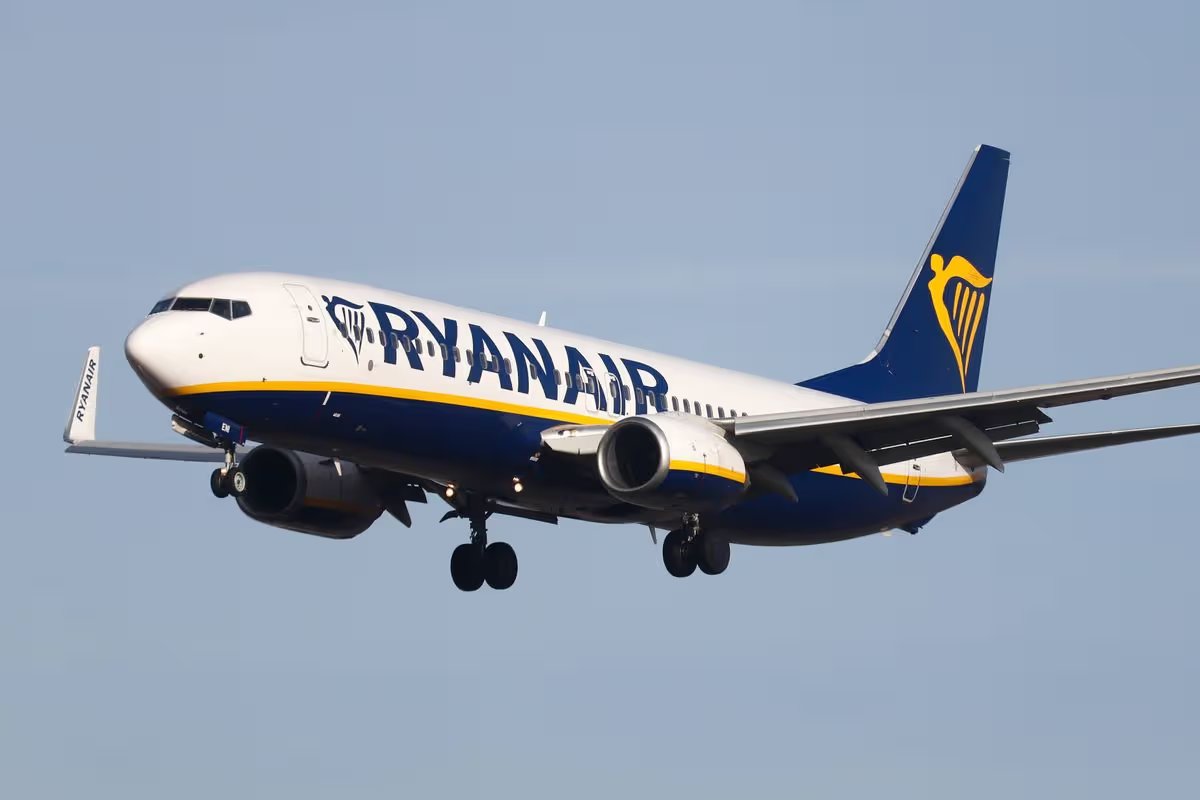
After some recent confusion with passengers boarding Ryanair flights, a spokesperson made it clear where they stand when it comes to drinking on board. They said: “We are not ‘banning’ or ‘confiscating’ duty-free alcohol at boarding gates. As per Ryanair’s T&Cs, passengers can carry duty-free alcohol onboard but must not consume it during the flight.”

Across the majority of airlines, when it comes to alcohol consumption, they have a zero-tolerance policy on ‘disruptive behaviour’ and have the right to reject drunken and disorderly passengers from boarding the flight.

Meaning, even if you’re yet to take a swig of your duty-free bottle, you should be wary of how much alcohol you’re drinking within airport bars and restaurants.

As for the duty-free bag itself, this is often allowed as an extra courtesy to take on the flight, provided that it fits under your seat. However, this is typically limited to one bag per person and does not encourage passengers to hop on board with multiple additional bags after a huge shopping spree.

Source link

Little-known rule could help Brits swerve ‘exceptional’ airport chaos this summer

Many Brits are concerned that the new EU Entry/Exit system (EES) could put a dampener on their holidays, but an obscure clause could mean that the system is paused at the busiest times

Summer 2026 is shaping up to be uncertain for holidaymakers. A combination of the jet fuel issues and new requirements for Brits entering the European Union (EU), means many travellers are braced for delays, cancellations, or long airport queues.

But a little-known clause in the EES rules could become a lifeline for Brits heading to Europe this summer, and it could be invoked if the queues at European airports become too long.

Some countries are already taking their own measures to tackle the chaos caused by EES. Greece has switched from using EES back to manual passport stamping to ensure a smoother entry system. While reports that Italy and Portugal may follow suit have been shut down by Brussels.

READ MORE: Beloved family theme park abandoned and forgotten was once ‘always busy’ and lovedREAD MORE: BBC expert gives Thursday easyJet Jet2 Ryanair TUI holiday update amid ‘rule changes’

However, there are exemptions built into the EES system that could be invoked in “exceptional circumstances” and these could potentially come into play if the new procedures overwhelm EU airports.

A parliamentary briefing notes that the European Commission “referred to the possibility” that EU countries could “suspend EES operations potentially for a further 150 days after the 10 April implementation date.”

This suspension can be for periods of up to six hours in “exceptional circumstances where there are excessive waiting times”, the document went on to say.

This means that up until July 9, some borders would have the power to suspend EES for up to six hours a day.

“Member States should use that possibility only when such suspension is strictly necessary and for the shortest period possible. In the case of partial suspension, the registration of biometric data in the EES should be suspended. In the case of full suspension, no data should be recorded in the EES,” the legislation adds.

Since the implementation of the new system, there have been mixed reports on its efficiency. Some have claimed that it’s made the process of getting through the airport tougher for Brits. Holidaymakers have reported long lines, blaming slow software and machines going down, while others have claimed it’s made little difference in times getting through the airport.

READ MORE: UK Government update for easyJet, Jet2, Ryanair, TUI over cabin ‘ban’READ MORE: UK’s best campsites for families with outdoor pools, on-site bars and pizza ovens

Later this year, the European Travel Information and Authorisation System (ETIAS) will also come into play, requiring Brits to get a pre-travel authorisation before they enter the EU.

While this visa waiver system was set to cost €7, just over £6, the fee has now been set at €20, about £17.37, almost three times the original cost. All travellers aged between 18-70 will need to apply before they travel once the new system is launched.

Have a story you want to share? Email us at webtravel@reachplc.com

Source link

Airport sandwich rule could mean you are breaking the law

In some cases, people could be hit with hefty fines

A UK airport has issued a warning as travellers may be unaware they could be risking a £5,000 fine after taking sandwiches on board a flight. Many passengers purchase food at airports, or pack their own, and carry it onto planes without any trouble.

However, London Luton Airport has highlighted what the law actually states. And if you’re heading abroad anytime soon, it’s well worth taking note.

A post on X from the airport’s official account reads: “It is illegal to bring meats such as lamb, pork or beef or dairy products from the EU into GB in your luggage. This means items such as cheese, cured or raw meats, sandwiches and milk, including duty free purchases.”

The guidance applies to all airports across England, Scotland and Wales. Should you be caught carrying any prohibited items – including sandwiches containing meat or dairy – and fail to declare these to Border Force officers at customs, you could face prosecution, or a £5,000 fine (in England only).

Content cannot be displayed without consent

Rules around bringing in meat, dairy, fish and other animal products differ depending on the country of origin. If you are travelling back from the EU, Switzerland, Norway, Iceland, Liechtenstein, the Faroe Islands and Greenland, you are banned from bringing in any of the following:

  • cheese, milk and dairy products like butter and yoghurt
  • pork
  • beef
  • lamb
  • mutton
  • goat
  • venison
  • other products made from these meats, for example sausages

You can bring in the following for personal use:

  • fish
  • poultry, for example chicken, duck, goose and any other products made from these meats
  • other animal products, for example eggs and honey

You may also bring in up to 2kg per person of powdered infant milk, infant food, or special food required for medical purposes. This is only allowed if it does not require refrigeration before use, and is in branded, unopened packaging (unless currently in use).

If you are travelling from a country outside the EU, Switzerland, Norway, Iceland, Liechtenstein, the Faroe Islands and Greenland, you are prohibited from bringing any meat or meat products, or milk or milk-based products, with the exception of powdered infant milk, infant food or special food needed for medical reasons.

You are, however, permitted to bring in up to 2kg per person of:

  • honey
  • powdered infant milk, infant food, or special food (including pet food) needed for medical reasons – you can only bring it in if it does not need to be refrigerated before use, and is in branded, unopened packaging (unless in current use)
  • live mussels or oysters
  • snails – these must be preserved or shelled, cooked and prepared
  • frogs’ legs – these must be the back (hind) part of the frog with the skin and internal organs removed
  • insect protein

You may bring in up to 20kg per person in total of fish, including:

  • fresh fish – must be gutted
  • fish products
  • processed fish – must be dried, cooked, cured or smoked
  • lobsters
  • prawns

Source link

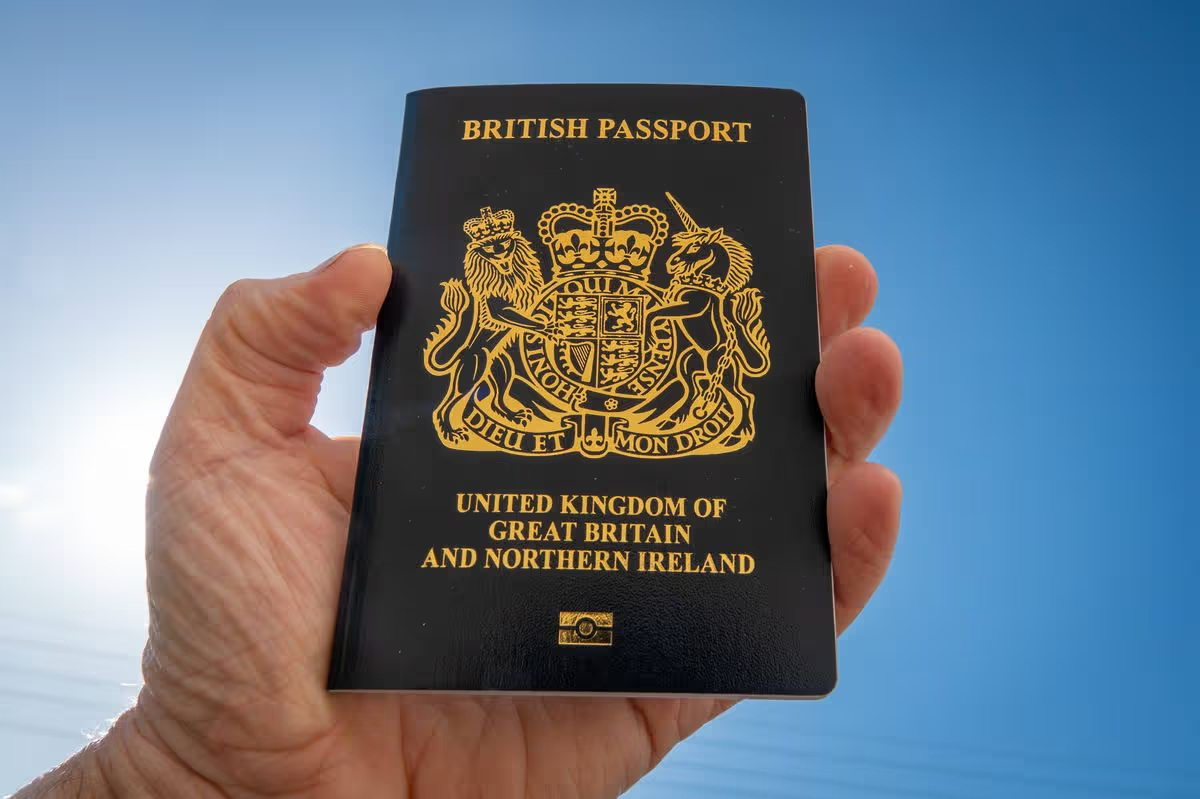
Woman loses £900 and misses 50th birthday abroad due to passport rule that’s STILL affecting thousands

An image collage containing 3 images, Image 1 shows Ali Burridge and Hana Smith making funny faces at a McDonald's, Image 2 shows A group of women in Hawaiian-themed attire standing by a pool under palm trees, Image 3 shows Ali Burridge and her friend Hana Smith on an iPad

A WOMAN was left £900 out of pocket and missed her own 50th birthday abroad because of a passport mistake STILL being made by thousands.

Ali Burridge, from Suffolk, was due to fly to Benidorm with 15 of her friends during the May bank holiday weekend for celebrate her big birthday.

Ali Burridge (right) was forced to miss her holiday abroad because of her passport Credit: SWNS
She was due to fly to Benidorm with her friends for her 50th birthday Credit: SWNS

Having spent £900 on flights and accommodation, she ran into problems after arriving at the airport

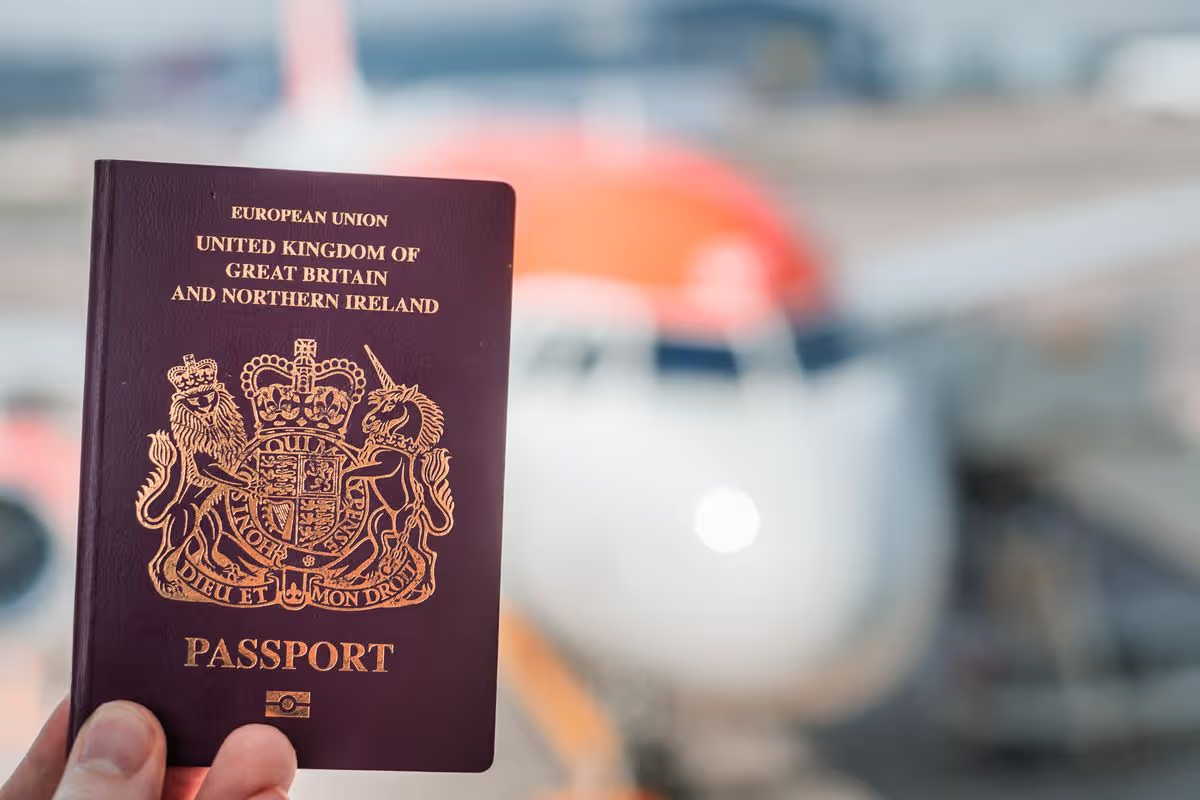
Staff behind the counter at London Stansted gave her the “heartbreaking” news that she couldn’t board the plane due to a passport rule she had “no idea about”.

The rules, which have been in place since the UK left the EU, no longer allows passports to be older than 10 years – unlike previous rules which let you roll up to nine months over.

Thousands of Brits have been caught out by the confusing rule, which is when your expiry date is actually incorrect.

PASS ON

New confusing passport rules are leaving Brits stuck abroad and banned from flights


PASS ON

Airlines could accept expired passports from 1million passengers ahead of new rules

This also caught Ali out, who bought her passport before the new rules and meant she didn’t realise the extra time on her passport was no longer valid.

She said: “It was awful when I was told the news, to be honest, I’m still in shock.

“I had been looking forward to this since my 40th birthday – we had spent the previous year organising it all. In reality, the rule has cost me money and memories.”

Her sister Tracey said the girls were “in tears” after they landed and heard the news, with them travelling out on an earlier flight.

Instead her friends called her from their holiday while she was stuck at home Credit: SWNS

Ali also said that no issues were raised on the website when she checked in two weeks before, despite it asking for her expiry date.

She continued: “If it had flagged the issues, I would have been able to get a new one, which is annoying.”

Despite driving to Peterborough with an attempt to get a new one at the Passport Office, she was unable to in time for her trip.

Instead, she was forced to stay home whilst some of her friends that had already made it out there enjoyed the sun – who managed to FaceTime her while out there.

She added: “I still know and see a lot of people travelling on the old passport, so I want to raise awareness so this doesn’t happen to others.

“You could be easily caught out like me if you don’t travel often. I’m seeing this situation as a valuable life lesson.”

Source link

Ryanair’s ticket rule people born in 2010, 2014 and 2024 have to comply with

Families need to be aware of how this could impact their flights home

Certain young people going on holiday with Ryanair this year could find themselves in trouble if they are booked to fly with the wrong ticket type. It can happen to anyone born in 2010, 2014, or 2024. Ryanair divides its passengers into four categories when assigning seats on planes: adults, teens, children, and infants.

The airline is clear online about who qualifies for specific ticket types when they are travelling abroad with the budget carrier. Outlining the policy online, Ryanair says: “For the purpose of defining our passenger types, adults are over 16 years of age, teens are between 12 and 15 years of age, children are between two and 11 years of age, and infants are those under two years of age.”

This applies from the “date of flight departure”. If families are heading abroad and celebrate a birthday, they need to be aware of how this could impact their flights home. Anyone born in 2010, 2014, or 2024 must comply with the rules.

If a child turns two, 12 or 16 between leaving the UK and returning home, they cannot be booked onto Ryanair flights without potentially facing extra charges. It is important for parents to be aware of this before booking their next holiday – or act now if the plans are already in place.

Ryanair adds: “If an infant turns two years of age or a child turns 16 years of age during your trip, you should purchase two one-way flights rather than a return ticket. You may then connect the bookings by contacting us.”

In terms of pricing, teens (aged 12-15) are treated the same as adults for pricing. They may, however, lose any free seat selection that is offered to under-12s.

The airline has a section on its website for customers who have already made a booking and need to change their passenger type. Changing passenger types may incur fees, and it is generally better to update this to avoid issues at boarding.

Generally, swapping a child or teen ticket to an adult is free when done online, but child passengers will lose their free seat selection privileges and have to pay for a new seat when ageing out of the free under-12s seating offer. The cost of doing this varies, depending on the flight service and the newly selected seat.

In other Ryanair news, the budget airline is selling flights to Spain that are “cheaper than buying dinner”, which is great news if you’re looking for a budget holiday. The travel news was recently drawn to the attention of Spain Explore on Instagram, as they were keen to alert people to the deals.

The page claimed the airline has announced routes to Barcelona that are “cheaper than dinner”. After making a quick check, you’ll see that some flights from the UK are pretty reasonable.

Source link

While ICE cracked down on L.A. protests, Marines were told to use force as ‘last resort’

Before being deployed to Los Angeles during anti-ICE protests last summer, U.S. Marines were given 12 rules for engaging with protesters, and Rule 1 was clear: Force “of any kind” was allowed only as a last resort.

If force were used, the rule stated, it “should be the minimum necessary to accomplish the mission.”

That detail is among 178 pages of federal documents released by the Marine Corps to the nonprofit watchdog group American Oversight through the Freedom of Information Act and shared exclusively with The Times.

The documents paint a thorough picture of how Marines prepared to deploy in Southern California, where they stood alongside National Guard members and agents with the Department of Homeland Security.

The documents also illuminate a glaring contrast between the training of Marines and that of immigration agents, who have been accused repeatedly of using unnecessary force against peaceful protesters, bystanders and immigrants during enforcement operations.

“Ironically, I would’ve felt much safer with Marine engagement than with DHS because of the depth of training,” said Ryan Schwank, a former instructor for Immigration and Customs Enforcement recruits at the ICE Academy within the Federal Law Enforcement Training Center in Georgia.

Schwank is a whistleblower who resigned in February after revealing that the Trump administration had slashed immigration officer training. After reviewing the documents obtained by American Oversight, he said the training given to Marines on crowd control was “significantly more in-depth and longer than training given to an ICE officer, even under the best of circumstances.”

A ICE agent walks through tear gas that was fired to push protesters back

An ICE agent walks through tear gas that was fired to push protesters back during a raid on Atlantic Boulevard in the city of Bell on June 20, 2025.

(Genaro Molina / Los Angeles Times)

The Department of Homeland Security did not respond to questions and instead pointed to a February news release that said training has not been cut back and that new hires receive additional training after leaving the academy.

“ICE law enforcement officers are trained to use the minimum amount of force necessary to resolve dangerous situations to prioritize the safety of the public and our officers,” said Lauren Bis, a department spokesperson. “Officers are highly trained in de-escalation tactics and regularly receive ongoing use of force training.”

Schwank noted that the Marines and ICE officers came to Southern California with different objectives: As protectors of people and property, the Marines had a more limited, reactive mission, while ICE officers were charged with making arrests, a confrontational role.

“We’re giving [ICE officers] less training on it and fewer refreshers than the Marines are getting and yet we’re putting them in a situation where they’re taking the more confrontational actions to where they’re more likely to have to make split-second decisions,” Schwank said.

For most of history, he added, ICE agents detained people who were already in the custody of another law enforcement agency. He said ICE was never meant to act as riot police.

“The real fundamental problem isn’t ICE agents using force,” Schwank said. “It’s ICE agents using force in an environment they are not trained for.”

The training of Marines, and the lead-up to their deployment, is outlined in the documents reviewed by The Times.

On June 6, a commanding general emailed other generals to say that “national-level leadership” had directed Marines to assume an “alert posture” and be ready to support the Los Angeles Police Department, Los Angeles County Sheriff’s Department and ICE officers who were already responding to civil unrest in downtown Los Angeles.

The Marines would safeguard federal facilities and thus “protect lives and property through the restoration of civil order,” the email said.

The Trump administration directed 4,200 California National Guard soldiers and 700 Marines to Southern California starting June 7.

Marines push back anti-ICE protesters in front of the Federal Building

Marines push back anti-ICE protesters in front of the Federal Building during a “No Kings Day” in downtown Los Angeles last June.

(Carlin Stiehl / Los Angeles Times)

First, though, they needed to be trained.

The five-day course reviewed use-of-force policies, less-lethal weapons and handling of civil disturbances.

Overall, the 12 rules emphasized safety, urging Marines to be reasonable, to de-escalate tensions and to avoid confrontations with individuals who posed no threat.

Marines could use non-deadly force, if necessary, to control a situation or protect themselves or other federal personnel, and deadly force “only when all lesser means have failed.”

“Exercise due regard for the safety of innocent bystanders when using any type of force,” the rules state.

Schwank said there is no equivalent to the Marines course at Homeland Security. When he left the academy in February, he said, “there was no crowd control training, period.”

Crowd control was briefly added to the curriculum in 2021 for experienced law enforcement officers, he said, but it was later removed. ICE recruits may also have gotten lessons on crowd control after leaving the academy and joining their respective field offices, he said.

When Schwank left the agency, a six-hour class called “Public Order Public Safety” was in development for the 2026 curriculum, according to documents he provided to Congress. Homeland Security did not respond when asked if the class had started.

“I wouldn’t assume that any of the ICE officers on scene in L.A. had received any sort of actual crowd control class,” Schwank said. “They might have gotten a one-to-two-hour PowerPoint slideshow, but that would’ve been it.”

Marine Col. Beth R. Smith confirmed that the entire 2nd Battalion 7th Marines received academic and practical training before deploying to Los Angeles.

Managing civil disturbances has been an issue for Homeland Security since at least 2021, according to an audit conducted by the agency’s internal watchdog review of a 2020 deployment to Portland, Ore.

That year, President Trump mobilized federal power against the protests that spilled into Portland streets after the murder of George Floyd by a Minneapolis police officer. Trump sent 755 Homeland Security agents to defend federal property in what would come to be seen as a dry run for much larger operations of his second term.

Two vehicles, one in flames

A protester damages a Waymo vehicle at Los Angeles Street and Arcadia Street in L.A. on June 8, 2025.

(Robert Gauthier / Los Angeles Times)

Nested on rooftops, agents launched chemical weapons against protesters. Ground forces fired less-lethal rounds at point-blank range and forced participants into unmarked vans without explanation.

The audit by the Homeland Security inspector general found that only seven of 63 officers reviewed had received any level of riot and crowd control training. Some officers told investigators that they needed additional training, and many “questioned their involvement in the operation” due to the lack of preparation.

”Without the necessary policies, training, and equipment, DHS will continue to face challenges securing Federal facilities during periods of civil disturbance that could result in injury, death, and liability,” the audit concluded.

As of spring 2025, Homeland Security records show, the department had not corrected the training failures flagged in the audit years earlier.

Schwank agreed that the concerns raised in the inspector general’s report were never addressed.

Liz Hempowicz, deputy executive director of American Oversight, said the Marine Corps’ emphasis on de-escalation and on using force only as a last resort stands in stark contrast to what happened on the ground in Los Angeles with immigration agents.

The practices outlined in the documents “differ from positions taken by senior DHS leadership, whose separate internal communications revealed a mindset that appeared far more encouraging of violence,” she said.

Internal Homeland Security emails also obtained by American Oversight revealed that the agency’s lead attorney said federal agents in Los Angeles should have “just started hitting the rioters and arresting everyone that couldn’t get away.”

“These records underscore that the difference between disciplined restraint and unnecessary harm can come down to the tone set at the top — and when that tone shifts toward hostility, the human cost can be devastating,” Hempowicz said.

Jennifer Kavanagh, director of military analysis at Defense Priorities, a military research group, said that for Homeland Security, the issue is partly a training deficiency and partly a cultural shift against agent accountability.

“Trump talks about ‘the enemy within’ — this is what he’s talking about,” she said. “To some at DHS, the enemy within is all immigrants, it’s cartels — it’s also groups that are protesting the government.”

Conversely, the Marines’ documents emphasized personal liability and responsibility. For example, one page said that “if you either use more force than is necessary, or respond with DEADLY-force to a NON-deadly threat — You will likely lose your right to self-defense, and you will be viewed, under the law, as the ‘Aggressor.’”

Marines were told to immediately report anyone violating the 12 rules of engagement.

The high level of training for Marines shows that command considered the optics of military personnel harming or even killing civilians, Kavanagh said. But just because the deployment worked out last year doesn’t make it a good idea in the long run, she said.

Kavanagh, alongside Gov. Gavin Newsom, Mayor Karen Bass, and LAPD Chief Jim McDonnell, opposed the military deployments to Los Angeles last year, maintaining that Marines are trained for foreign combat, not domestic crowd control.

“I see these deployments as a recipe for disaster,” she said.

Schwank said ICE’s training touches on personal liability but not in as much depth. Last fall, Stephen Miller, Trump’s deputy chief of staff, said ICE officers “have federal immunity in the conduct of your duties, and anybody who lays a hand on you or tries to stop you or tries to obstruct you is committing a felony.”

On the ground in Los Angeles, ICE agents and other local law enforcement fired a range of less-lethal weapons at protesters, such as pepper balls, hard foam rounds or canisters delivering flash-bang grenades and tear gas.

At a June 12 protest, a federal agent shoved freelance journalist Anna Sophia Moltke to the ground, causing sprains on her left arm and leg and deep scrapes to her hip and knee that have since scarred. She was carrying a camera, she said, and wore clear press credentials and a helmet that said “PRESS.”

“I remember distinctly there being no violence at all until police and ICE showed up,” she said. “We saw them firing rubber bullets into the crowd. People started running away. I was halfway turned around when they started rushing the crowd, and a tall, 6-foot-4 masked man used both hands to push me onto the concrete.”

Moltke said she recalled a large group of protesters gathered near the Marines stationed at the northern end of the detention center, just before police and ICE swept through and forced her to the ground. To her knowledge, she said the Marines remained at their post and didn’t participate in street skirmishes.

Source link

Jet2, easyJet, Jet2, TUI passengers with flights booked warned of ’14 day rule’ change

The Department for Transport has announced it is consulting on major changes for holidays

Concerns have been raised about potential changes which will mean the end of a ‘14-day rule’ this summer with flights being changed or cancelled at the last minute. The Department for Transport has announced it is consulting on major changes to holidays amid uncertainties about jet fuel supplies as the Middle East crisis continues with no end in sight.

With intense pressure on jet fuel widely tipped to cause travel problems this summer, the government announced over the weekend that airlines will be allowed to group passengers from different flights onto fewer planes. This means that at the last minute, people could be switched to a different flight.

The DfT says it will help cut the likelihood of last-minute flight cancellations this summer in the event of significant disruption due to ongoing global uncertainty caused by the Middle East conflict. It lets carriers such as Ryanair, easyJet, Jet2, British Airways, Wizz Air UK, and TUI, consolidate flights on routes where there are multiple trips to the same destination on the same day.

However, consumer experts said that currently, passengers are protected by a 14-day rule, and it’s ‘not fair’ for people to be shifted at the last minute to suit airlines without compensation. Rory Boland, Editor of Which? Travel said: “Millions of Britons will have already booked their flights for this summer, often paying over the odds for flights at peak times.

“Existing rules already allow airlines to move customers to new flights so long as they give them more than 14 days’ notice and offer the choice between a new flight or a refund. It’s only for cancellations within 14 days that compensation is payable, rightly.

READ MORE: Ryanair, EasyJet, Jet2 and Wizz Air update on summer flightsREAD MORE: Martin Lewis’ urgent warning for TUI, Jet2 and Ryanair bookers ‘do it now’

“It’s not fair for the rules to now be bent in favour of airlines and potentially leave passengers holding the bill. Many passengers will understand that disruptions can occur and may be happy to travel a few hours or a day later, but for those on short trips or connecting flights it could mean the trip is no longer worthwhile.

“Before any changes are made, passengers need cast-iron assurances that their rights will not be weakened and that airlines cannot use reform as cover to shift the cost of disruption onto travellers.”

Conservatives say it could see passengers “herded on to a different plane, at a time of the airline’s choosing”. The DfT says, however, that the measure is designed to give passengers “greater confidence” by helping airlines to lock in their schedules earlier.

Heidi Alexander, the transport secretary, adds: “There are no immediate supply issues, but we’re preparing now to give families long-term certainty and avoid unnecessary disruption at the departure gate this summer.

“This legislation will give airlines the tools to adjust flights in good time if they need to, which helps protect passengers and businesses.”

The Department for Transport said the measures would:

  • help move passengers onto similar services much earlier, helping avoid stressful delays at the airport
  • prevent running flights which have not sold a significant proportion of tickets
  • reduce wasted fuel from flying near-empty planes

Current rules

If your flight is cancelled by the airline, you have a legal right to a choice between being re-routed or a refund. If a flight is subject to a significant delay – at least 2 hours for short-haul, 3 hours for medium-haul and 4 hours for long-haul – passengers are entitled to care and assistance, including food, drink and overnight accommodation where necessary.

Rob Bishton, Chief Executive of the UK Civil Aviation Authority, said: “Passengers in the UK are well protected by some of the strongest rights in the world, offering reassurance if disruption does occur.

“Airlines have a duty to look after their passengers when they face disruption, and should offer a choice between a refund or alternative travel arrangements, including with another airline, if a flight is cancelled.

“Relaxing the rules around slots at airports will allow airlines more flexibility and so we expect them to give passengers as much notice as possible of cancellations during this period.”

If notified of changes to their flights by airlines, passengers are advised to speak to their airline, travel agent or tour operator in the first instance.

Source link