Adele arriving at Aaron Taylor-Johnson’s birthday bash in West LondonCredit: GoffAdele impressing fans during Weekends With Adele in 2022Credit: Getty
Now The Sun can reveal she secretly flew into London earlier this month from her LA bolthole and has been writing and recording at Church Studios in North London over the past week.
In even more exciting news for fans, other famous musicians have been spotted there while she has been inside.
It all leads to hopes the 38-year-old may have collaborations on her next record, having never done so on the core work of her four albums.
American singer-songwriter Justin Vernon, better known as frontman of indie folk band Bon Iver, was photographed outside the studios last Wednesday.
It is not known whether he is working with Adele, although in 2016 she tweeted: “Bon Iver’s music is one of the true loves of my life. Every. Single. Time.”
Gen Z heartbreak singer Gracie Abrams also appeared to be shooting a music video outside at the same time.
Church Studios are also where she made parts of her 2015 album 25.
Adele with sports agent partner Rich PaulCredit: GettyAdele with Lola Young at the O2 Academy BrixtonCredit: Instagram/lolayounggg
A source said: “Adele is spending at least a fortnight in London writing and recording music.
“She was in and out of sessions last week and will be back in there this week, but she is keeping a low profile while she is here.
“She feels safe at Church Studios and it’s where Paul is based, so it made sense to travel over for the sessions, rather than work somewhere else in LA.”
The studios were previously owned by Eurhythmics great Dave Stewart, and it was where the British band recorded their 1983 album Sweet Dreams (Are Made Of This).
Industry insiders believe the move is an attempt to develop a more English-sounding album, after her most recent one, 30, was made in the States.
A second music source said: “Adele has been living in LA for a decade now and although she loves it, her roots in London are very important to her.
“People close to her have been encouraging her to reconnect with where she grew up for her new music, because they believe it will help inspire something different.
“Her last album was well received but it was very Hollywood.
“People loved Adele originally because she was down to earth and relatable, so she’s trying to bring that back by drawing on inspirations in her home town.
“Coldplay, Paul McCartney, Oasis, Mick Jagger, Florence + The Machine, Culture Club, The Streets, Tom Jones, and her close friend Jack Penate have all worked at Church Studios before, so she’s in good company.”
Adele was born in Tottenham, North London, and later moved to Brixton and West Norwood in South London.
On her third album 25, released in 2015 just before she relocated to the US, she had lyrics about the capital and a song called River Lea, about the waterway running through Tottenham.
But 2021’s 30 was written about her divorce from charity entrepreneur Simon Konecki, which happened in LA, and made no mention of the UK.
After releasing the record, she performed two sell-out shows in Hyde Park, followed by her two-year Weekends With Adele residency in Las Vegas and a ten-night residency at a purpose-built stadium in Munich.
Now it is clear the mum-of-one is trying to soak up some British culture while she is here.
Adele was photographed in London nine days ago arriving at the 36th birthday party of actor Aaron Taylor-Johnson.
Gracie Abrams shooting a video at Church StudiosCredit: ErotemeIdol Bon Iver’s Justin Vernon snapped outside the studios last WednesdayCredit: Eroteme
Fans have also claimed Adele was in the audience at a production of Romeo & Juliet in London’s West End on Friday night.
In July 2024, Adele revealed she planned to take a break after her run of Sin City shows.
She said: “I don’t have any plans for new music at all.
“I want a big break after all this and I think I want to do other creative things just for a little while.”
But in February, she flew to Rome for her acting debut in Tom Ford’s upcoming historical drama Cry To Heaven, based on Anne Rice’s 1982 novel of the same name.
She spent several weeks there and will appear opposite Hollywood heavyweights including Colin Firth, Julianne Moore, Nicholas Hoult and Thandiwe Newton.
Two months later, The Sun revealed she was being courted to record a single for the soundtrack.
Adele’s Oscar joy in 2013 with Paul EpworthCredit: GettySince releasing her debut album 19 in 2008, Adele has become one of the 21st century’s best-selling artistsCredit: Handout
But although work has brought her back to the UK, it looks unlikely that a move is on the cards.
The following year Adele talked about how she would find it tough to move back to the UK.
The singer, who now only occasionally returns to London, explained: “I get really bad seasonal depression, so the weather is good for me here.
“It is strange sometimes, because I’m very British. Because it’s a bit harder for me to go out nowadays, what I love the most about LA is everyone goes to each other’s houses. I like that.
“And I actually have made a lot of really great core friends. I didn’t think I’d ever have a real friend group here. I don’t want a bunch of celebrities being my friends — well, only celebrities.
“And my friends are actually from LA, Before I moved here, I’d never met one person who was from LA.
“They’re not famous and they’re great. And having a kid at school, I’ve got great mum friends. I do like it.”
Adele’s 21 was her second hit albumCredit: Handout30 is the fourth studio album by Adele
The same year, she had an emotional exchange with British actor and presenter James Corden on his final Carpool Karaoke segment on The Late Late Show, before he moved back to the UK.
James said: “It’s been a brilliant adventure but I’m just so certain it’s time for us as a family, with people getting older, people that we miss, to go home.”
A teary Adele responded: “I know. I’m just not ready to come back yet, otherwise I would come back with you.”
Adele has won 16 GrammysCredit: GettyAdele with ex hubby Simon KoneckiCredit: Getty Images
She also said she likes being left alone in LA, adding: “For anyone that has never been to LA, you assume it would be the opposite. But there are so many famous people here that they don’t waste their time,” she said.
“I really miss London, but I miss the London from before all of this happened in my life.”
Since releasing her debut album 19 in 2008, Adele has become one of the 21st century’s best-selling artists, and won 16 Grammys.
Her second album 21 racked up sales of 57million, while 30 sold 261,000 copies in its first week to become the fastest-selling album in four years.
Now the pressure is on for Adele to continue her streak of success.
Having named her first four albums after the ages she was when she wrote them — 19, 21, 25 and 30 — it remains to be seen whether her next record will be called 38, her age now.
When 25 came out, Adele said: “I think this will be my last age one.
“I’m sure I’m wrong with this but I feel there’s been a massive change in me in the last couple of years.”
She later decided to name her fourth album after the age she was when she got divorced, and reflected on the future of her titles in an interview at the time.
Adele said: “I am just like everyone else in the world. I can change my mind. And I haven’t got to stay true to something that I’ve said — you know, I think the age thing is a bloody good idea. And so I want to keep going with (the titles). Or I might not.”
Our music insider added: “Adele feels the pressure with her music and won’t rush anything out if it’s not up to scratch with her back catalogue.
“She has been writing for a while now but she is taking her time with it.
“She knows there are always grand expectations and she is determined to only return when the music is the best it can be.”
SOUTHAMPTON, N.Y. — On the edge of the greatest collapse in U.S. Open history, Wyndham Clark held his nerve against a charge by Sam Burns and a Shinnecock Hills gallery that never gave him much love Sunday until he captured his second Open title in four years.
Six shots ahead at the start of the final round, Clark’s final act was two putts from just outside 50 feet for par that gave him a three-over 73 and a one-shot victory over Burns.
Clark, who won the 2023 U.S. Open at Los Angeles Country Club, became the first wire-to-wire winner of the U.S. Open since Martin Kaymer at Pinehurst No. 2 in 2014.
This sure didn’t feel like that. His lead was down to a single shot after just five holes, and the stress followed him the rest of the way.
The clincher for Clark was one of his worst drives of the day on the par-5 16th. He gouged that out and narrowly cleared a bunker. His eight-iron barely stayed on the back of the green. And he rolled in a 30-foot birdie putt that gave him a two-shot lead with two holes to play.
It was a signature moment with muted applause. The gallery rooted against him all day, putting all their support behind Scottie Scheffler and his bid for the career Grand Slam. Scheffler had his own share of mistakes and never got closer than three shots all day.
Clark had the highest final round of a U.S. Open champion since Graeme McDowell closed with a 74 to win at Pebble Beach. No matter. The 32-year-old American has two U.S. Open titles, and two wins in the last month.
Burns closed with a 67, his second chance in as many years to win the U.S. Open. He missed two birdie chances on the final two holes, but what hurt just as much was a three-putt bogey on the 15th when he was trying to catch Clark.
Scheffler, in his first try to get the only major he hasn’t won, was three shots back when he rammed a 30-foot birdie putt some six feet on the 14th and three-putted for bogey and a 71.
Clark capped off quite a turnaround from a year ago. He was playing poor and looking angry, throwing a driver at the PGA Championship that made a marshal flinch, and then bashing in his locker at storied Oakmont Country Club after missing the cut in the U.S. Open last year.
Oakmont banned him until he made good — which Clark did — and he set out to work on his head and his game. Both looked better than ever at Shinnecock Hills.
He finished at four-under 276.
“New York didn’t really like me — I love you guys,” Clark said at the closing ceremony, hoisting the silver trophy. “But I get it. Some of it’s self-deserved. I did some unfortunate things last year that I really regret, and I’ve been sorry multiple times and I’m still sorry, so hopefully I can win you guys over eventually.”
But it was uncomfortable at times, not only seeing a six-shot lead disappear so quickly but a crowd so badly wanting a special day for Scheffler that it turned on Clark. One fan was ejected when he shouted, “Don’t choke, Wyndham” when it was Clark’s turn to hit on the fourth tee.
And there was a loud and instant cheer on the par-three seventh, the kind normally reserved for a shot close to the pin. This was for Clark’s tee shot rolling into a bunker, leading to a short miss for bogey that again trimmed his lead to one shot.
“I get it — they were rooting for Scottie,” Clark said. “Grand Slams only happen a few times. He’s going to get it. He’s the best player in the world. But today it’s my day.”
It almost wasn’t.
But Burns never caught him — he played even par over the last 10 holes. Tom Kim, who like Scheffler celebrated a birthday on Sunday, was on the fringes of seriously contending until he fell back with a bogey on the 17th and shot 70 to finish third.
Clark hit a superb wedge that spun back to four feet for birdie on the 10th to restore the lead to two shots. But then he went long on the 13th with a pitching wedge and couldn’t save par.
Burns last year had to deal with a rain-soaked Oakmont and a couple of shots he missed badly with so much water getting between the face of the iron and his golf ball. This time, it came down to the final two holes.
He made a weak attempt at birdie from 10 feet on the 17th to tie for the lead. His 17-foot birdie chance on the 18th rolled along the right edge of the cup at perfect speed and didn’t drop. Burns let go of his putter and dropped to his knees.
“I honestly thought I made it,” Burns said. ”Just the way it goes sometimes.”
That it went Clark’s way is hard to fathom considering where he was a year ago, where he was a month ago. He was No. 75 in the world, winless in two years, when he shot 60 in the final round to win The CJ Cup Byron Nelson.
Now he goes to No. 8 in the world ranking, and the smile he wore holding that U.S. Open trophy would suggest he feels on top of the world.
As Ecuador forward Enner Valencia raced through on Curacao’s goal inside the opening three minutes, the outcome seemed inevitable.
About 10 yards out and with just the keeper to beat, he looked certain to score. It would give Curacao a mountain to climb – and, as it did in the 7-1 defeat by Germany in their World Cup opener, could well set the tone for what was to come.
But goalkeeper Eloy Room anticipated where Valencia’s shot was headed, stooped low to his left and clawed the ball around the post. It was an improbable, barely believable save.
And the tone was, indeed, set.
By full-time, BBC Sport pundit and former Arsenal defender Martin Keown was joking a calculator might be needed to tot up the number of times Room had bailed his team out.
Yet it was Ecuador who were left counting the cost of their missed chances as World Cup debutants Curacao celebrated their first-ever point in the tournament.
Room, the 37-year-old Miami FC keeper, produced a remarkable and record-equalling performance, making 15 saves to keep his country level and eventually secure a goalless draw which will live long in the memory of the island nation.
Since records began in 1966, no goalkeeper has made more stops in 90 minutes of World Cup action, according to Opta.
Only Tim Howard has made as many in a single game but, unlike Room, he failed to keep a clean sheet after conceding twice in extra-time for the USA against Belgium in 2014.
Room joked after the 0-0 draw that Howard would have been “sweating at home” watching the game and his performance means he “needs a statue in Curacao”.
“Take a bow, Room,” added Keown on BBC One. “Absolutely magnificent.
“The number of saves, you were almost getting a calculator out at the end of the game to count them up.
“It just became a shopping list of saves. His reactions were first class. He seemed destined to keep a clean sheet all night.”
It was a performance that inspired Room’s country to their biggest-ever result.
Elon Musk’s space and AI firm secured first-time ratings from Moody’s, Fitch and S&P Global on Thursday, a milestone that places its debt firmly in investment-grade territory and could allow it to borrow more cheaply as it funds a vast expansion.
ADVERTISEMENT
ADVERTISEMENT
The endorsements arrive less than a week after the company’s record IPO, which raised around $85.7 billion (€73.8bn) in the largest initial public offering in history.
Moody’s assigned SpaceX a Baa1 long-term issuer rating with a stable outlook. In its report, the agency pointed to the firm’s “exceptional franchise strength” as the world’s leading orbital launch provider and operator of Starlink, the largest low Earth orbit satellite broadband network.
The rating is also slightly higher than Tesla’s Baa3. Reacting to the news in a reply on social media, Elon Musk wrote: “Tesla’s credit rating is ridiculously low to be honest.”
According to Moody’s, Starlink has become SpaceX’s primary cash flow generator, underpinning improving scale, wider margins and a gradual shift away from more cyclical launch revenue.
Moody’s also set out the risks. It said the rating was constrained by the heavy execution and financial demands of SpaceX’s large-scale AI buildout, marked by high capital intensity, sustained negative free cash flow and an uncertain range of returns.
The agency highlighted the company’s dependence on the next-generation Starship V3 vehicle, warning that technical setbacks or delays could pressure long-term growth.
It further pointed to elevated governance risks tied to SpaceX’s controlled structure and concentrated voting power, which it said limit independent board oversight and leave the firm heavily reliant on a single individual, Elon Musk.
However, Moody’s still projects strong revenue and earnings growth through 2028, driven chiefly by Starlink, which counted 12 million subscribers as of early June, alongside an expected turning point in the AI division.
The agency cited recent third-party compute deals with Anthropic and Google worth a combined $75 billion (€65bn) as evidence of that potential.
As for the other credit agencies, Fitch issued a BBB+ long-term issuer default rating, also with a stable outlook, citing the company’s commanding lead in commercial launch, where it has delivered more than 80% of global mass to orbit since 2023.
Meanwhile, S&P Global assigned a BBB rating with a stable outlook, weighing the strength of the launch and connectivity businesses against the risks of the nascent AI segment and the company’s substantial capital needs.
Shares slide from their peak
The ratings did little to steady the stock on Thursday.
SpaceX closed at $185, down more than 18% from the high of $225.6 it reached on Tuesday, when its valuation briefly topped $3 trillion (€2.6tn).
The shares fell as low as $172 during the session before paring losses, as investors weighed whether the company’s lofty valuation had run too far.
The retreat has reshuffled SpaceX’s standing among the world’s corporate giants. The company now ranks once again as the sixth most valuable listed firm by market capitalisation, having given back some of the ground it gained earlier in the week.
On Tuesday, it had overtaken Amazon to claim fifth place, and at its intraday peak, it briefly leapfrogged Microsoft into fourth before this week’s slide pushed it back down.
Even after surrendering some of those gains, SpaceX sits among the most valuable companies on the planet just a week into its life as a public firm, and the investment-grade verdict from all three major agencies marks a notable shift in how financial markets judge a business that spent years operating as a privately funded rocket maker.
GRAMMY-NOMINATED producer Tay Keith has been found dead in Nashville.
Brytavious Chambers, 29, better known as Tay Keith, was found dead in his apartment earlier today.
Sign up for the Showbiz newsletter
Thank you!
Tay Keith has been found dead in his apartment in NashvilleCredit: GettyInvestigators say there was no suspicion of foul playCredit: Getty
Police said his body was discovered while officers were performing a welfare check at his home.
Investigators say there was no evidence of foul play, but the exact cause of death has yet to be determined.
In a post on social media, Metro Nashville PD wrote: “No foul play is suspected in the death of Brytavious Chambers, 29, also known as the Grammy nominated record producer Tay Keith.
“He was found dead in his Martin St apt this afternoon by officers performing a welfare check.
The producer’s cause of death remains unknownCredit: GettyKeith currently holds the record for the most No.1s on the R&B / Hip-Hop chartCredit: WireImage
“His death is unclassified pending autopsy results.”
Throughout his career Keith worked with a wide range of music artists, including Beyoncé, Travis Scott and Drake.
The Memphis hitmaker enjoyed huge success on the Billboard Hot 100, earning 11 top 10 hits and four No.1 records.
He was also the mastermind behind Travis Scott’s “Sicko Mode” and Drake’s “First Person Shooter”.
Keith currently holds the record for the most No.1s on the Hot R&B / Hip-Hop songs chart this decade – with six.
His work even earned him a coveted Grammy nomination in 2019.
In the aftermath of his death, tributes for the producer have poured in.
Artist and childhood friend Blocboy JB shared photos of the pair as teenagers with the caption: “Damn Cuz You Just Hurt Me Bad.”
Keith was one of the mastermind’s behind Travis Scott’s ‘Sicko Mode’The song – featuring Drake – has been streamed over 2.5bn times on Spotify
He also posted a video of their call history, writing: “We talked everyday yeen tell me you was leaving.”
Fellow Memphis producer Hitkidd also expressed his disbelief, posting a picture of the pair on Instagram.
The caption said: “I ain’t even got the words, we been doing this since 2010.”
Born on September 20, 1996, Keith stated making music when he 14.
He later received a bachelor’s degree from Middle Tennessee State University.
Signed to a publishing deal with Warner Chappell Music, he was also a member of BMI.
Argentina’s Lionel Messi isn’t the only one scoring in the 2026 FIFA World Cup.
Fox and Telemundo are off to a blazing start in the TV ratings for the quadrennial soccer tournament, delivering big increases over the 2022 World Cup held in Qatar.
Through the first 16 group stage matches, an average of 6 million viewers have watched on Fox and cable network FS1 cable network, a 128% increase over the 2022 FIFA World Cup according to Nielsen data.
The first 12 group stage matches of the tournament drew an average of 7.5 million viewers on the Comcast-owned Spanish language network Telemundo, a 234% increase from four years ago. The Telemundo telecasts are also streamed on Peacock.
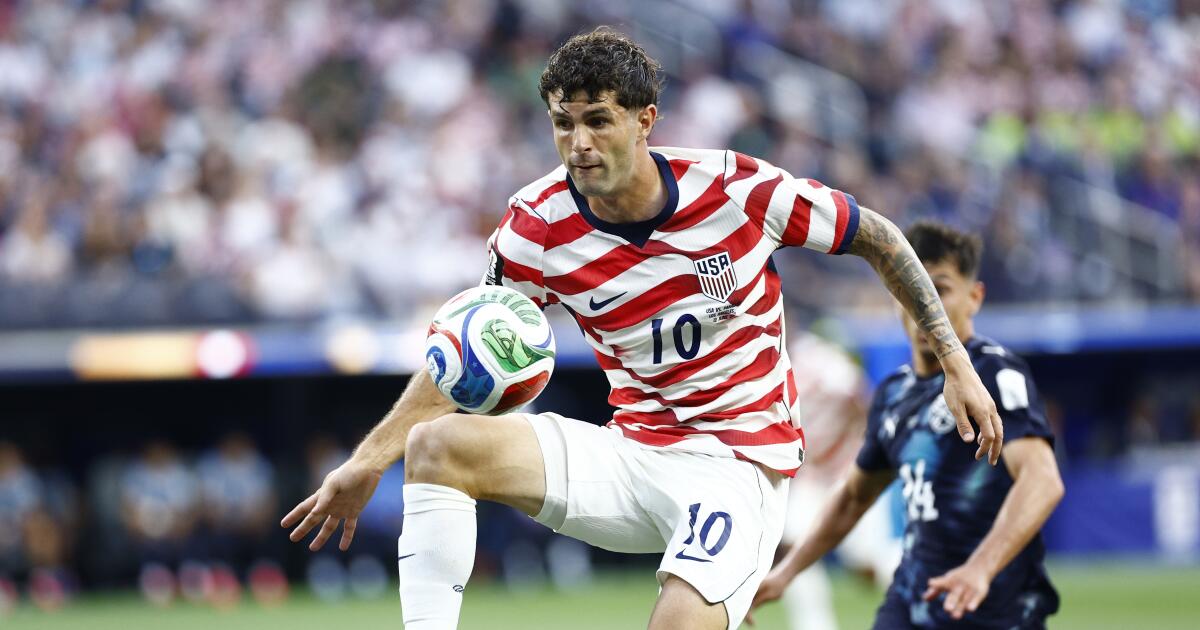
The U.S. Men’s National Soccer Team’s opening match against Paraguay held Friday at SoFi Stadium set a record for the most-watched World Cup game on both and English and Spanish language television. The match scored 18 million viewers on Fox and its streaming platforms, while Telemundo’s telecast averaged 9.5 million.
The early ratings show the enduring power of live sporting events and their ability to draw mass audiences at a time when streaming video has splintered viewership . Scripted hit prime time TV shows need seven days or more of viewing on demand to reach the audience levels the World Cup is attracting in real time.
“Having this World Cup in North America clearly has a huge impact on ratings,” said Patrick Rishe, director of the sports business program at Washington University in St. Louis.
World Cup matches held in the U.S. for the first time since 1994 helps — and a competitive USNMT playing in front of home crowds could turbocharge the ratings to even bigger heights. Fox is expecting another record when the team plays its third group stage match in prime time on June 25.
Some sports media pundits have been citing the addition of out-of-home viewing and internet-connected televisions to Nielsen data as the reason sports ratings have been on the rise. But Mike Mulvihill, president of insights and analytics for Fox Sports, asserts that the viewers have been there all along.
“For many years, the numbers were under-counted and what we’re seeing now is a truer representation of the sports audience,” Mulvihill said in a recent interview. “You just cannot overstate what it means to us to be able to capture all that viewing that’s happening at fan fests, in bars and at smaller watch parties.”
Out-of-home viewing boosted the audience levels for Mexico’s inaugural World Cup match on June 11 by 50%, and contributed several million viewers to the total for the USMNT opener.
Mulvihill projects that by the end of the tournament, 150 million people will have watched some portion of Fox’s 2026 FIFA World Cup coverage. The figure approaches the 170 million people Fox reaches with a slate of regular season NFL games.
“For us, it’s like having two NFL seasons in a single year,” Mulvihill said.
Fox will be able to capitalize on the strong numbers for the early matches. Networks typically hold back some commercial inventory for big events in case audience levels fall short of what advertisers are guaranteed. Fox has surpassed those expectations and can now go back into the marketplace to sell available commercials for the later rounds, most likely for more than what was paid before the tournament.
The 2026 World Cup may also be benefiting from a viewing public that wants a distraction from the ongoing political discord in the U.S. and war in the Middle East.
“Sports still remains the one thing we can all kind of talk about and disagree about without it being divisive,” said Lisa Delpy Neirotti, director of the sports management program at the George Washington University School of Business.
Delphy Neirotti believes the World Cup has some momentum from the NBA Finals, which averaged 20.6 million viewers on ABC for the New York Knicks’ triumph over the San Antonio Spurs, The feel-good story of the Knicks winning their first championship in 53 years delivered the most-watched Finals since 1998 and put fans in the mood for more action.
“Fans were already primed up, meeting with friends, watching sports and now they can continue that camaraderie and that collective experience,” Delphy Neirotti said. “They want to be with community.”
The combined numbers for Fox and Telemundo are highest in Los Angeles, which in addition to a large Latino population has 500,000 Iranians. An average audience of 4.7 million viewers watched the Iranian national team play to a 2-2 tie against New Zealand on Monday, the second most-watched match ever on Fox Sports 1.
But there are plenty of World Cup fans in the heartland. Kansas City had the highest local rating for Fox’s coverage of the USMNT’s match, with more than 9% of the market’s homes tuning in.
Kansas City hosted its first World Cup match Tuesday at Arrowhead Stadium, where Argentina’s Messi set a tournament record with three goals in his team’s 3-0 victory over Algeria. The city has cultivated soccer fans with well-attended watch parties held in its Power and Light District.
“The watch parties that they’ve planned out throughout their cities to give people an opportunity to be part of the event, even though they’re not going to the event,” Rishe said. “Whether you’re watching or just walking by, it’s exciting.”
Employees celebrate after the closing bell in a trading room of Woori Bank in Seoul on Thursday, as the benchmark Korea Composite Stock Price Index surpassed a historic landmark of 9,000 points. Photo by Yonhap
Seoul stocks surged by more than 2 percent past another historic landmark, surpassing the 9,000-point level for the first time in history, as investors bet on chipmakers in the face of a hawkish stance by the Federal Reserve and Iran uncertainty.
The benchmark Korea Composite Stock Price Index (KOSPI) closed up 199.6 points, or 2.25 percent, to 9,063.84, after rising as high as 9,106.07.
The KOSPI continued its winning streak for the sixth consecutive session on the back of optimism over artificial intelligence (AI) and related sectors.
Trade volume was heavy at 505.9 million shares worth 49.9 trillion won (US$32.7 billion). Foreigners were net buyers, snatching up 1.3 trillion won, while retail and institutional investors net sold a combined 1.2 trillion won.
Losers outnumbered gainers 109 to 788.
The index bucked overnight losses on Wall Street caused by Fed policymakers’ remarks that a rate hike would be inevitable to tame inflation.
The continued rally was led by the country’s two major chipmakers, Samsung Electronics and SK hynix, said analyst Kim Seok-hwan from Mirae Asset Securities.
“Investors are anticipating that semiconductor companies could gain better bargaining power due to a sustained supply bottleneck,” the analyst said.
A risk appetite was also revived on anticipation the U.S.-Iran war is nearing its end. The United States has said Iran has agreed to reopen the Strait of Hormuz, a key oil shipping route, and revealed a signed memorandum of understanding on ending the war.
The rate freeze from the Fed, the fourth consecutive on-hold decision, appeared to have a limited impact on investor sentiment.
Market top cap Samsung Electronics rose 4.62 percent to 362,500 won, while its rival SK hynix jumped 6.51 percent to 2,685,000 won.
Non-semiconductor sectors lost ground.
Defense giant Hanwha Aerospace fell 2.86 percent to 1,189,000 won, ship builder HD Hyundai Heavy Industries retreated 3.25 percent to 684,000 won, and major financial firm KB Financial inched down 0.55 percent to 163,100 won.
The Korean won was quoted at 1,527.1 won against the U.S. dollar, down 13.7 won from the previous session.
Bond prices, which move inversely to yields, closed lower. The yield on three-year Treasurys rose 4 basis points to 3.75 percent, and the return on the benchmark five-year government bonds added 5.2 basis points to 3.949 percent.
Copyright (c) Yonhap News Agency prohibits its content from being redistributed or reprinted without consent, and forbids the content from being learned and used by artificial intelligence systems.
Passengers wait to drop their luggage while traveling during the holiday season at Ronald Reagan National Airport in Washington, D.C., on December 22. The airport is scheduled to close for most of July 4 to accommodate events celebrating Independence Day in the capital. File Photo by Bonnie Cash/UPI | License Photo
June 17 (UPI) — Officials at Ronald Reagan Washington National Airport announced Tuesday that the airport is scheduled to be closed for much of July 4 amid a predicted record-breaking week of travel for the holiday.
There are no scheduled flights to or from the airport after noon on July 4, the Metropolitan Washington Airports Authority announced in a release. The day before will also have no flights for several hours in the early afternoon.
The MWAA said the schedule disruption is to accommodate Independence Day celebrations coinciding with the country’s 250th birthday.
“Many events will include downtown flyovers or other aerial displays such as fireworks or parachute jumps, which will affect flights periodically at Reagan National,” the agency said.
Airport officials expected flight operations to return to normal July 5.
AAA projected Tuesday that a record-breaking 72.2 million Americans will travel at least 50 miles away from home to mark Independence Day between June 27 and July 5. That’s up from 71.8 million in 2025.
Stacey Barber, vice president of AAA Travel, said traveling for the July 4th holiday “is tradition.”
“The 9-day travel forecast includes travelers who are vacationing all week and people just getting away for the long holiday weekend,” Barber said. “While the overall number of Independence Day travelers appears to be plateauing, we’re still expecting record volumes this year.”
Among those traveling for the holiday, AAA projected the vast majority — 61.4 million — will do so by car, 5.85 million by air and 4.93 million by other modes of transportation such as bus, train or cruise.
The Top 10 domestic destinations for the holiday week are Seattle; Orlando, Fla.; Anchorage, Alaska; Miami; New York City; Chicago; Fort Lauderdale, Fla.; Fairbanks, Alaska; Denver; and Boston. The Top 10 international destinations are Vancouver, Canada; Rome; Dublin; Paris; London; Calgary, Canada; Reykjavik, Iceland; Amsterdam; Athens; and Barcelona, Spain.
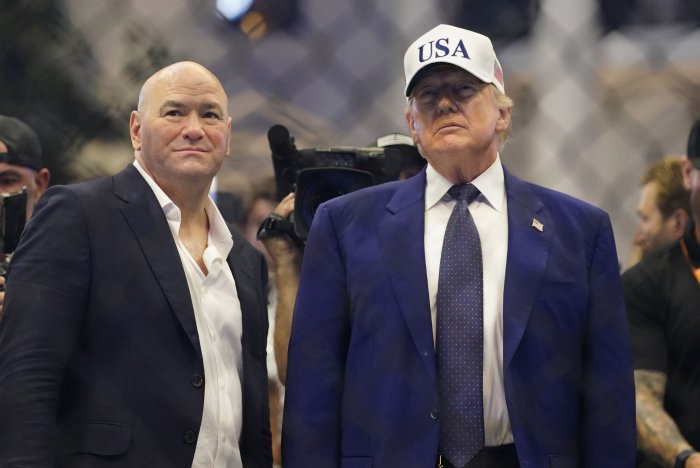
President Donald Trump and UFC CEO Dana White stand in the octagon after the UFC Freedom 250 event on the South Lawn of the White House in Washington, on June 14, 2026. Photo by Bonnie Cash/UPI | License Photo
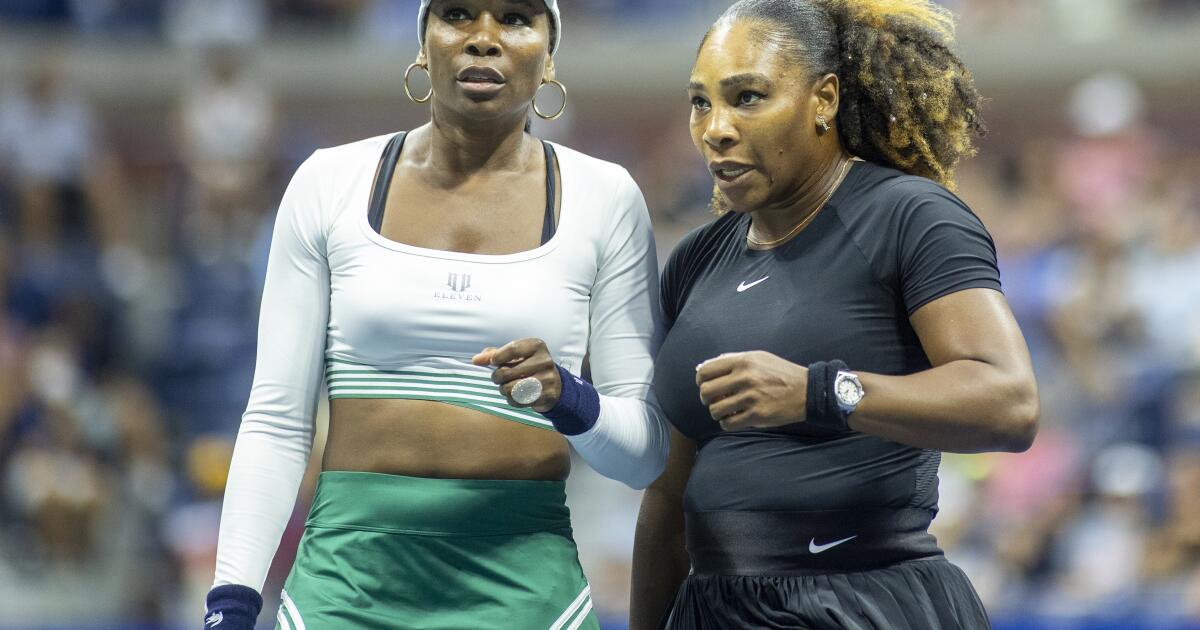
The Williams sisters — Venus, 45, and Serena, 44 — will bring back their doubles partnership at Wimbledon in under two weeks. The All England Club announced the doubles wild card invitation on Tuesday.
Should they win for a record seventh time, the Williams sisters would make history as the oldest Grand Slam-winning doubles combo by nearly 16 years.
The record of 74 years and 303 days is held by Hsieh Su-wei and Barbora Strýcová, who won at Wimbledon in 2023. Venus will turn 46 on Wednesday and Serena will be 45 on Sept. 26, putting their combined age by the tournament’s end at 90 years and roughly 290 days.
The Williams sisters have won six doubles titles together at Wimbledon, most recently in 2016 with the first coming in 2000. They have won 14 Grand Slam doubles titles together, the second most by any women’s team in the Open Era behind the 20 won by Martina Navratilova and Pam Shriver.
Serena recently returned to competition after almost four years away from professional tennis. She will compete in the Berlin Open doubles alongside world No. 10 singles player Karolína Muchová on Tuesday against Erin Routliffe and Giuliana Olmos.
The initial tournament in Serena’s comeback was abbreviated. Her playing partner, Canadian teenager Victoria Mboko, suffered a knee injury that ended their effort at the Queen’s Club Championship after one match, a 7-6(2), 6-2 victory over No. 3 seeds Erin Routliffe and Nicole Melichar-Martinez.
Venus, who will turn 46 on Wednesday, is in the midst of her record 33rd consecutive WTA season. She has been eliminated in the first round of singles at several tournaments while faring better in doubles.
The pairing at Wimbledon will be the first since 2022 for the Williams sisters. Serena took a long hiatus beginning that year and gave birth in 2023 to her second child, Adira River Ohanian.
Many of the sisters’ career highlights have come at Wimbledon. Serena has 14 titles on the hallowed grass court — six in doubles, one mixed doubles and seven in singles. Venus Williams has won 11 Wimbledon titles — five in singles and six in doubles.
Neither Williams sister is slated to play singles in this year’s tournament, although one women’s singles wild card has not been allocated.
Lionel Messi becomes the World Cup’s joint-top all-time leading scorer with a hat-trick, as reigning champions Argentina begin their defence with a 3-1 win over Algeria.
The outbreak caused by the rare Bundibugyo virus strain has reached 782 confirmed cases.
Published On 15 Jun 202615 Jun 2026
The number of confirmed cases in the Democratic Republic of the Congo (DRC)’s Ebola outbreak has surged to 782, with 178 deaths, marking one of the largest daily jumps so far as regional conflict, patient escapes, and limited contact tracing undermine containment efforts.
The Ministry of Public Health confirmed 72 new cases on Sunday over the previous 24 hours, a record single-day increase, with 29 additional deaths.
Recommended Stories
list of 3 itemsend of list
The Bundibugyo virus strain has a 22.8 percent death rate so far, with 40 patients recovering, officials said.
“We remain committed to supporting affected countries until transmission is stopped. We call on partners and donors to urgently mobilise resources to strengthen the response and save lives,” Jean Kaseya, director general of the Africa Centres for Disease Control and Prevention, said on Sunday.
The outbreak stems from the rare Bundibugyo strain, which has no approved vaccine or treatment, unlike the Zaire virus responsible for the DRC’s previous 16 Ebola outbreaks.
Contact tracing coverage has plummeted to 56.5 percent, a sharp decline from the 95% target, Health Ministry officials said.
Doctors Without Borders, known by its French initials MSF, warned that “no one knows the true scale” of the outbreak due to dangerous gaps in surveillance and testing.
Eastern Ituri province remains the outbreak’s epicentre, harbouring nearly 95 percent of all confirmed cases. The virus has since breached into North Kivu and South Kivu provinces and spread across the border to Uganda.
Ituri’s humanitarian crisis exacerbates the medical emergency. Nearly one million residents have fled overlapping armed conflicts involving multiple groups, including the M23 rebel movement that controls Goma, the capital of North Kivu province. The area has endured decades of instability, with United Nations reports documenting massacres of more than 100 civilians in gold-rich Ituri villages as various factions vie for control of the region’s mineral wealth.
Thousands of artisanal miners routinely shuttle between clandestine mining sites scattered across the mineral-dense region, creating transmission hotspots that evade health monitoring. The outbreak is believed to have originated in the mining-intensive Mongbwalu Health Zone in Ituri province.
The World Health Organization announced it is ramping up diagnostic testing and contact surveillance operations. However, MSF reports a critical funding gap of $21.5m hampering response efforts.
CHICAGO — Fans around Rate Field rose to their feet as Yoshinobu Yamamoto embraced his teammates before walking off the mound.
Of course, the Dodgers fans stood. But fans clad in White Sox jerseys joined them, waving White Sox hats in the air, acknowledging the brilliance they’d just witnessed.
In the Dodgers’ 7-1 win against the White Sox on Saturday, Yamamoto carried a perfect game bid into the eighth inning and a no-hit bid into the ninth.
Dating back to Yamamoto’s last start, against the Angels, he retired 45 straight batters, one shy of the major-league record set by Yusmeiro Petit in 2014.
In an eventful game, which included Shohei Ohtani returning to the lineup to homer in his first at-bat, a two-homer performance from Max Muncy, and a team-effort bounce-back after getting blown out the night before, Yamamoto’s performance on the mound stole the show.
Yamamoto, who exited with one out in the ninth inning and a pitch count of 109, was efficient even within each out. A 10-pitch strikeout in the third inning showed how Yamamoto wasn’t going to give in.
The Dodgers right-hander was one pitch away from striking out Jacob Gonzalez for seven straight pitches. But Gonzalez kept fouling off anything close to the strike zone.
For the 10th pitch of the at-bat, Yamamoto challenged Gonzalez with a cutter over the plate. And finally, Gonzalez swung through it.
The next inning, Yamamoto retired the side in eight pitches.
The only thing that slowed his roll was the mound itself. Yamamoto asked for the grounds crew to fix it in the sixth. And then he kept cruising.
Dodgers catcher Dalton Rushing slaps hands with Dodgers pitcher Yoshinobu Yamamoto in the ninth inning Saturday against the White Sox.
(Zoe Davis / Getty Images)
He had help from a steady defense behind him for much of the game.
The sixth inning included two highlight-worthy plays. Tristan Peters hit a sharp ground ball up the first-base line, and first baseman Freddie Freeman made a sliding stop, tossing the ball to Yamamoto at first to complete the play. Then left-fielder Alex Call ran into the retaining wall in foul territory to catch Edgar Quero’s fly ball for the final out of the inning.
For the most part, Yamamoto made it look easy. The hardest contact against Yamamoto came the third time through the lineup. In the seventh, he pumped a heater to the top rail against Miguel Vargas, who stayed on top of the pitch to send a line drive to left field — and right to Call.
In the eighth, he fell behind Colson Montgomery 3-1. But he worked back to a full count. Montgomery then scorched a line drive up the first-base line — into Freeman’s glove.
His perfect game bid ended two batters later, with two outs, on an error.
Yamamoto got Chase Meidroth to chase a slider, hitting a ground ball to shortstop Mookie Betts. But Betts mishandled the hop. The ball shot to his left, where second baseman Santiago Espinal tried to salvage the play but couldn’t pick up the ricochet cleanly.
The no-hit bid was next to fall. Yamamoto piped a fastball down the middle to Peters, who sent it over the wall in right field.
Yamamoto stayed in for one more batter, inducing Quero to fly out, before handing the ball over to manager Dave Roberts. Left-hander Alex Vesia took over for the final two outs.
Ohtani returns, hits home run
Dodgers star Shohei Ohtani runs the bases after hitting a home run against the White Sox on Saturday.
(Matt Marton / Associated Press)
Before Yamamoto took the mound, Ohtani’s return was the big story of the day.
As Ohtani stepped into the batter’s box for the first time, he was greeted by a smattering of boos.
He took his first swing at the second pitch of the game. And he sent it into the right-field stands. A no-doubter, proclaiming that his availability was no longer in doubt.
Ohtani returned to the Dodgers lineup after exiting against the Pirates on Thursday because of inflammation in his left knee.
“I think Shohei drove it,” Roberts said of the decision to play. “Training staff drove it. We took him out of the game the other night just for precautionary reasons. Yesterday, treated it up. Today he feels great. All the confidence that he can go out there and hit, feel good, not regress at all.”
The Dodgers (45-26) will continue to monitor Ohtani’s knee as he prepares to take the mound Wednesday against the Tampa Bay Rays at Dodger Stadium.
“I think we’re full go,” Roberts said before Ohtani threw on flat ground Saturday. “But I do think once he’s out there playing catch and we see how his knee responds to the pressure, the torque will be some good information.”
Even before Ohtani’s knee swelled (it’s still unclear what caused the inflammation) the Dodgers planned to have him pitch the day before their off-day on Thursday.
They switched Ohtani and left-hander Justin Wrobleski in the rotation order, with Wrobleski set to pitch Tuesday on regular rest.
That remains the plan, even after Wrobleski was hit in the leg by a comebacker Thursday. He left the game with a bruised right hamstring.
The Dodgers considered bringing in a spot starter, Roberts said, in order to keep the full rotation on extra rest.
“But considering how Wrobo’s start went short, feels good after it, we feel the four days’ rest will be fine for him,” Roberts said. “And then where Shohei is at, we feel good about just leaving it status quo.”
Ohtani returned without restrictions in his designated-hitter role — except for one request from his manager, after a couple days of parsing whether a steal attempt that was snuffed out by a foul ball had contributed to Ohtani’s injury.
Though they didn’t find a clear inciting incident, Roberts made it clear Saturday: “There will be no base stealing.”
NBA legend Charles Barkley branded the San Antonio Spurs “the dumbest basketball team in the history of civilisation” after the New York Knicks pulled off the biggest comeback in NBA Finals history.
The Spurs led by 29 points as they aimed to level the best-of-seven series in New York before hosting game five, but the Knicks fought back to win 107-106.
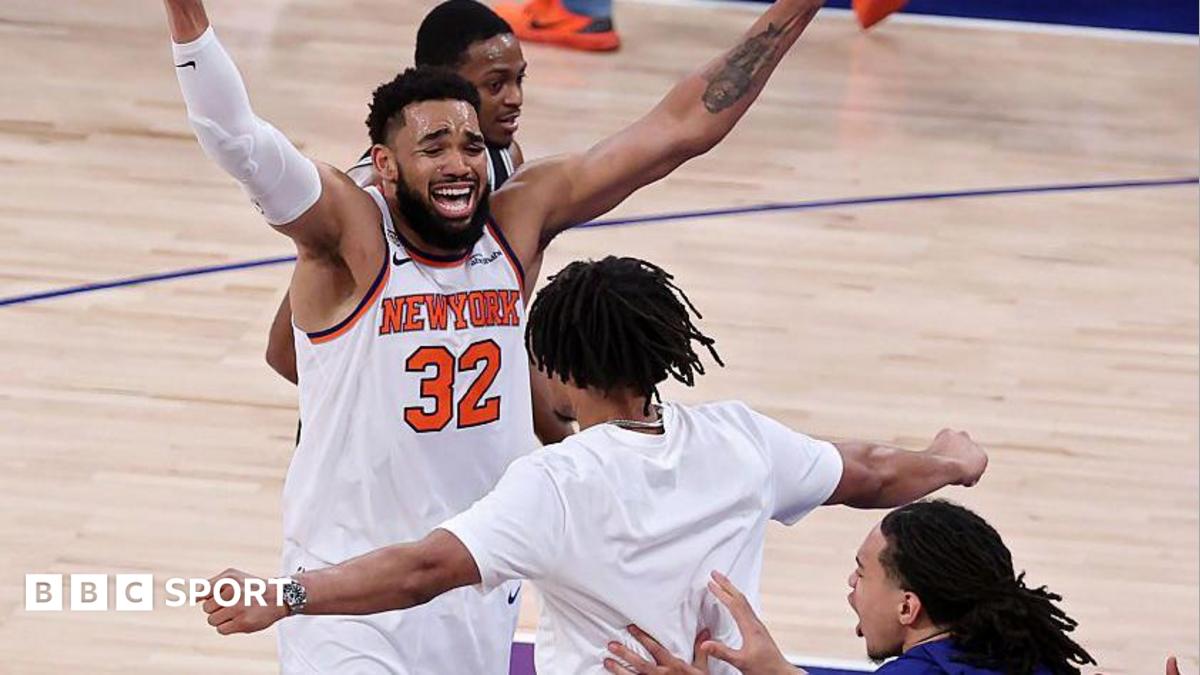
London-born OG Anunoby claimed a tip-in basket with 1.2 seconds left to clinch victory, much to the delight of a star-studded crowd at Madison Square Garden, which included Taylor Swift and Timothee Chalamet.
It gave the Knicks a 3-1 lead in the series and put them within one win of their first championship since 1973.
The previous biggest comeback in the NBA Finals was 24 points, by the Boston Celtics against the Los Angeles Lakers in 2008.
San Antonio went 29 points up in the second quarter and their 27-point lead at half-time (76-49) was the largest for a road team in Finals history, but they then scored just 30 points in the second half.
“That was some of the most mismanaged, stupid basketball,” said ESPN analyst and former NBA most valuable player Barkley.
“When you blow a 29-point lead, the other team has to help, and the San Antonio Spurs helped the New York Knicks win this game.”
Victor Wembanyama scored a team-high 24 points for San Antonio and claimed 13 rebounds.
“I can’t really explain it right now,” said the NBA’s defensive player of the year.
“I don’t know. I think it’s just execution, greediness of some sort. We clearly weren’t the most hungry in the second half.”
The Knicks still trailed 90-75 heading into the fourth quarter but Jalen Brunson put them in front for the first time at 105-104 with 82 seconds remaining.
Anunoby then made a block with 11.1 seconds left, to stop the Spurs leading 108-105, before tipping in the game-clinching score after Brunson’s three-point attempt struck the rim.
“One word that caps that all is just ‘belief’,” Brunson told ESPN. “It was chipping away, one possession at a time. It wasn’t going to be one play to get us back.”
Game five is in San Antonio on Saturday (01:30 BST, Sunday).
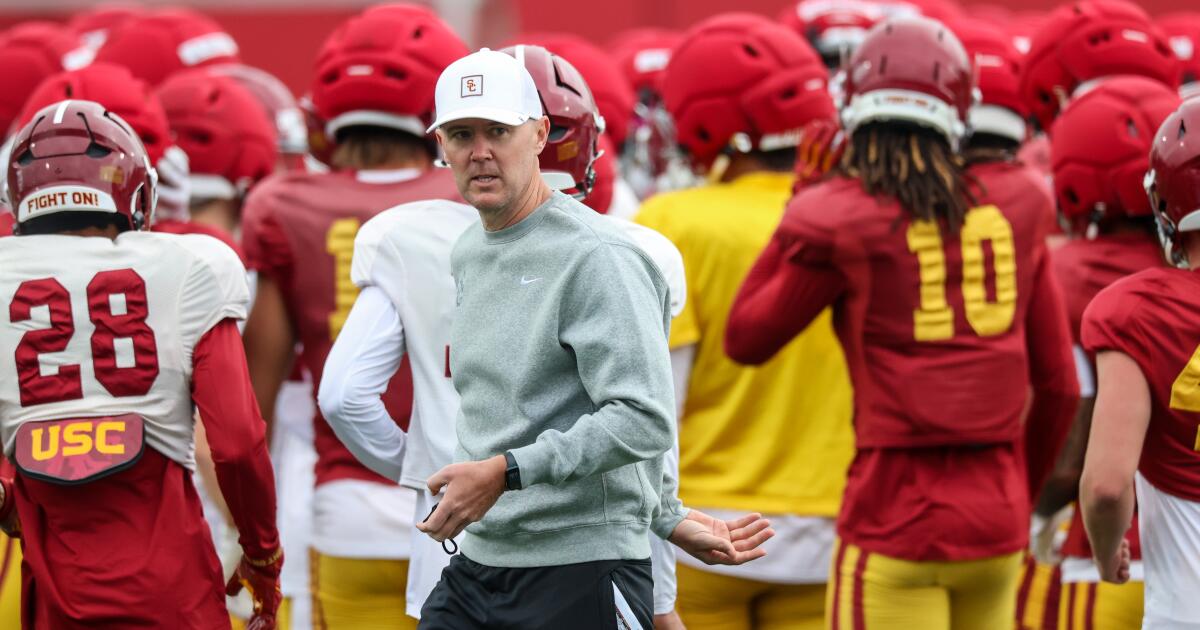
His 7-6 record at USC in 2024 would go down as the worst mark of Lincoln Riley’s career as a head football coach. But in his third and rockiest year at the helm of the Trojans, Riley was still compensated like one of the kings of the sport.
Riley was paid more than $11.8 million in total compensation during the fiscal year 2024, according to USC’s latest federal tax returns, which were obtained by The Times. That total includes a $100,000 bonus and $10.4 million in base pay, believed to be more than all but three college football coaches that season: Georgia’s Kirby Smart, Clemson’s Dabo Swinney and Ohio State’s Ryan Day. All three have won a national title.
For Riley, his pay in 2024 marks just a slight increase from the 2023 season, when USC paid Riley more than $11.5 million in total compensation. The coach’s base pay increased by $145,143 between fiscal years 2023 and 2024, slightly less than it rose following his debut season in 2022 ($168,000).
At least in 2024, USC only had to pay one football coach, after paying Clay Helton a combined $9 million not to coach over the two previous years.
The school would, however, have to pay up a bit to bring in a new men’s basketball coach.
After Andy Enfield left to coach Southern Methodist after the 2023-24 season, USC shelled out more than $6.1 million total in 2024 to lure coach Eric Musselman from Arkansas, according to the university’s latest federal tax records. One million of that was paid to Arkansas to buy out Musselman’s contract.
That puts Musselman at a reported $5.1 million in total pay and benefits from the school in 2024, according to the school’s tax records. That total likely includes additional costs unique to a coaching change. But altogether, it would have ranked Musselman among the highest-paid coaches in the Big Ten for the 2024-25 season.
Musselman didn’t exactly deliver on that investment during the 2024-25 season, as USC bottomed out during its first Big Ten men’s basketball slate. The Trojans finished 17-18 and 7-13 in the Big Ten.
After including her information in tax forms from the previous year, the university did not disclose compensation figures from 2024 for USC athletic director Jennifer Cohen. Federal tax returns filed last May had credited Cohen with more than $3 million in reportable compensation in her first year on the job, $1 million of which was used to buy out Cohen from her Washington contract.
During a trip to the beautiful desert city of Palm Springs in California, home to Golden Age Hollywood stars, I found myself with a Guinness World Record after a jolly great time
12:24, 08 Jun 2026Updated 12:26, 08 Jun 2026
I found myself with a Guinness World Record after a trip to Greater Palm Springs(Image: Getty Images)
If someone told me earlier this year I’d have a Guinness World Record to my name, I would have thought they were joking. But here I am, with the notorious title following a trip to the United States.
You’re probably wondering what on earth I did to secure a Guinness World Record, and no, it wasn’t some ludicrous challenge. Instead, all I needed was a blond wig, red lipstick, and a white dress.
I was in the beautiful desert resort city of Greater Palm Springs, known for its Hollywood glamour, mid-century modern architecture and natural hot springs, when this all took place. The Southern California oasis, nestled in the Coachella Valley, was once home to Golden Age Hollywood stars, including Frank Sinatra and Elvis Presley, but I was there for Marilyn Monroe.
The iconic American actress and model became a global sensation during the 1950s and early 1960s, and was often known for her persona as the ‘blonde bombshell’. She tragically died at the tender age of 36 in 1962, but spent much of her adult life in Palm Springs and is known to have spent time in a trendy bungalow known as the Marilyn Monroe Doll House, which I passed by during my trip, still with its signature pink letter box on the front yard.
This year, on 1 June, marked what would have been Marilyn Monroe’s 100th birthday, and to mark the occasion, Greater Palm Springs hosted a celebration and mega event to secure a new Guinness World Record. And I was lucky enough to be there and take part.
The idea was to gather as many Marilyn Monroe lookalikes as possible in one place for a Guinness World Record attempt. The previous record was 254 in 2020, so there were high hopes that Palm Springs, the home of Hollywood, would surpass it.
I had no idea what to expect, but after signing up for the event and securing my iconic Marilyn Monroe outfit of a styled blond wig, white dress and red lipstick, I was ready to take part. So on Saturday, 30 May, the day before her birthday, I dressed up as the glamorous star and joined my fellow doppelgangers around the Forever Marilyn statue in Downtown Palm Springs, to secure a Guinness World Record.
Remarkably, there were a whopping 1,037 Marilyn Monroe lookalikes in attendance, and it was incredible to be around so many people celebrating the icon. Everyone went all out with their outfits, accessorising with pearls, diamonds, sparkly heels, fans and feather boas.
To secure the Guinness World Record, all attendees had to be dressed in the same iconic white halter dress, platinum wig and red lipstick, and everyone absolutely was. So after gathering in our hundreds, singing happy birthday to Marilyn Monroe, and being thoroughly counted, we successfully obtained a new Guinness World Record.
“People are on a high that they get to participate in this”, Palm Springs mayor Ron deHarte told me. “It’s not unusual to have something flashy going on in Palm Springs, but this is something different.”
The Pride organisation was connected to the event, as Ron noted, “Marilyn Monroe had a voice, and she used it.” And I could feel the celebrations, the love, kindness, acceptance, and overall pride of this city as I put on my best Marilyn Monroe impersonation and joined the joyful, spirited community of Palm Springs for a Guinness World Record.
It was certainly an honour to take part in such an event, and one I won’t forget in a hurry. After all, there are only 1,037 of us across the globe who can say we broke a record by dressing up as Marilyn Monroe in the desert.
Ben Gibbard remembers late 2023 as a time of competing realities.
Onstage, the frontman of Death Cab for Cutie and the Postal Service was thriving as his two bands toured together to mark the 20th anniversaries of Death Cab’s “Transatlanticism” and the Postal Service’s “Give Up.”
Behind the scenes, Gibbard’s personal life was in shambles.
“I was getting off phone calls — very difficult phone calls — 20 minutes before going on in an arena,” he says. The singer and his wife, photographer Rachel Demy, were in the middle of an agonizing breakup that would eventually lead to divorce. Yet audiences in the thousands were turning up nightly to see Gibbard reanimate the peak-millennial classics that made him one of indie rock’s defining stars.
“I’d just tell myself, You’re a professional — you’re gonna go out there and do it, and no one’s gonna know,” he recalls. “It was all waiting for me when I got offstage, of course. But for two hours I was able to disconnect and be a performer, which was incredibly …” Gibbard, 49, trails off into a laugh.
“I don’t know if it was healthy,” he says. “But it was helpful.”
Two and a half years later, that split-screen experience — “this idea of how we compartmentalize our pain or our grief or our trauma,” as Gibbard puts it now — forms a through line of Death Cab’s ruminative new album, “I Built You a Tower.” Due Friday from Anti Records, where the group landed after leaving its longtime home of Atlantic amid a corporate shake-up, the LP sets thoughts of broken fences and never-ending storms against tuneful arrangements that can churn, shimmer or chime.
“I pledge myself to your misery / I kneel at its throne,” Gibbard sings in his still-boyish tenor over the sleek new wave groove of “Trap Door,” “Respecting your proclivity / To languish on your own.” In the fuzzed-out “Envy the Birds,” the frontman recounts an argument between two lovers “spraying bullets of grievances”; the driving “Riptides” is narrated by a guy “too tired to end the war.”
“This record is definitely the result of a divorce,” Gibbard says plainly during a recent visit to Los Angeles from his home in Seattle. “But I didn’t want to make a score-settling record or an angry record. This wasn’t an opportunity to defame someone or make this about how I’d been wronged. People drift apart — relationships don’t work. And I think how that’s affected me at almost 50 is a very different mindset than I found myself in when I was 33 or whatever the last time it happened.”
Gibbard means his first divorce, in 2012, from the actor and singer Zooey Deschanel — a split that inspired Death Cab’s 2015 album “Kintsugi,” on which one song asks, “Was I in your way when the cameras turned to face you?” and another chides an unnamed celebrity: “You’ll never have to hear the word ‘no’ if you keep all your friends on the payroll.”
“There’s some gnarly stuff on that record,” says Gibbard, who’d moved to L.A. to be with Deschanel then promptly left as soon as their marriage collapsed. “It’s not exactly a kind album.”
Bassist Nick Harmer, who formed Death Cab with Gibbard in the late ’90s after the two met as students at Western Washington University, agrees that “I Built You a Tower” represents a shift in perspective. “There’s so much more self-examination — and so much more self-indictment,” he says. (Death Cab’s other members are drummer Jason McGerr, guitarist Dave Depper and keyboardist Zac Rae.)
Which isn’t to say that Gibbard entirely resists placing blame. In “Trap Door” he sings about “a trap door in your heart and a button on your desk well-worn from being pressed.”
The frontman says that in recent years he’d “tried to get away from using the word ‘heart’ because that had been a touchstone for so many of our early records.” Yet this line seemed worth holding onto when it came to him.
“I Googled it to see: Did I already write this?” he says, laughing. “Or is there a very popular song called ‘There’s a Trap Door in Your Heart,’ and now I’m just rewriting it? We’ve made a lot of songs at this point — you gotta check your work.”
Indeed, “I Built You a Tower” is Death Cab’s 11th studio LP. After the band’s previous album, 2022’s “Asphalt Meadows,” fulfilled its deal with Atlantic, Death Cab reupped with the major label for one more record, Gibbard says, based on its strong relationship with the company’s then-CEO, Julie Greenwald.
“Julie was our shepherd and our protector the whole time we were there,” the singer says of Death Cab’s nearly two-decade run at Atlantic, which began with 2005’s Grammy-nominated “Plans.” Yet just days after they reached an agreement for “Tower,” Greenwald was fired and replaced by a new leader, Elliot Grainge, about whom the band felt less than optimistic.
Ben Gibbard
(Cielito Mercado Vivas / For The Times)
“We weren’t given the impression that Elliot had spent a lot of time with ‘Transatlanticism’ in college,” Gibbard says of the 32-year-old exec, who made his name signing rappers like Ice Spice and Trippie Redd. With Greenwald’s help, Gibbard says, Death Cab negotiated an exit from Atlantic with ownership of the new album.
Did Grainge try to persuade the band to stay?
“Never heard a word,” Gibbard says.
In an email, Grainge (whose father is Universal Music Group Chairman and Chief Executive Lucian Grange) said that Death Cab’s music “has meant a great deal” to him.
“Working together may not have been in the cards for us; however, that does not lessen my enthusiasm for the band,” he wrote. “They have delivered an impressive body of work over their decades-long career, and I am looking forward to their new music.”
Death Cab’s Harmer says he and his bandmates “talked for half a beat” about putting out “Tower” on their own before thinking better of the idea.
“We’re not businesspeople,” Gibbard says. “Music is the only thing we know how to do.”
At a friend’s wedding in 2024, the frontman had been seated next to the musician Allison Crutchfield, who was then heading up Anti’s A&R department; early this year, Death Cab announced that it had signed to the indie label, whose other acts include Fleet Foxes and Madi Diaz.
This summer, the band will tour behind “I Built You a Tower,” including two shows in August at L.A.’s Greek Theatre. After the “Transatlanticism”/”Give Up” anniversary outing — not to mention a subsequent tour on which the group looked back at “Plans” — Gibbard is “very ready to play some new material,” he says.
Doing the hits was fun. “But at a certain point,” he adds, “it’s really about moving ahead.”
It’s no secret that vinyl records’ resurgence has hit a new plateau, outselling CDs for the first time since 1987 as of 2022, according to a report from the Recording Industry Assn. of America. Three years later, its year-end report flaunts another statistic: Vinyl record sales surpassed $1 billion in 2025 — the first time since 1983.
But there’s an inevitable downside to anything that’s partially made of liquid dinosaur bones. Modern vinyl records are crafted with PVC resin, which makes up more than 75% of an average disk The synthetic polymer itself is made of chlorine and fossil fuel-derived feed stock.
To put its harm in perspective, a first-of-its-kind report from Vinyl Alliance, published in June 2024, found that 50% of a record’s carbon emissions come from this resin. The carbon footprint of a single LP was estimated to be roughly equal to the pollution a gas-powered vehicle emits over a three-mile trip. It adds up quick, considering that 46.8 million new records were sold last year.
Thankfully, it’s not all grim.
Organizations like Music Declares Emergency and the Music Climate Pact initiative are coming together to address the issue. A campaign by the groups — in collaboration with record labels and distribution teams at Secretly Group, Exceleration Music, Warp Records, Ninja Tune and Beggars Group — features titles pressed on 100% reclaimed material.
The release, set in tandem with World Environment Day on Friday, boasts marquee titles such as Elliott Smith’s “Roman Candle,” Bon Iver’s “For Emma, Forever Ago” and Dinosaur Jr.’s “You’re Living All Over Me.”
“What we found talking to a lot of our artists and to customers is that … they are concerned about the environment, and they want to find ways to reduce their footprint,” says Ben Swanson, co-founder of both Secretly Group and the Independent Record Pressing plant in Bordentown, N.J., where the LPs are made. “It’s about 16% less footprint than the traditional piece of vinyl.”
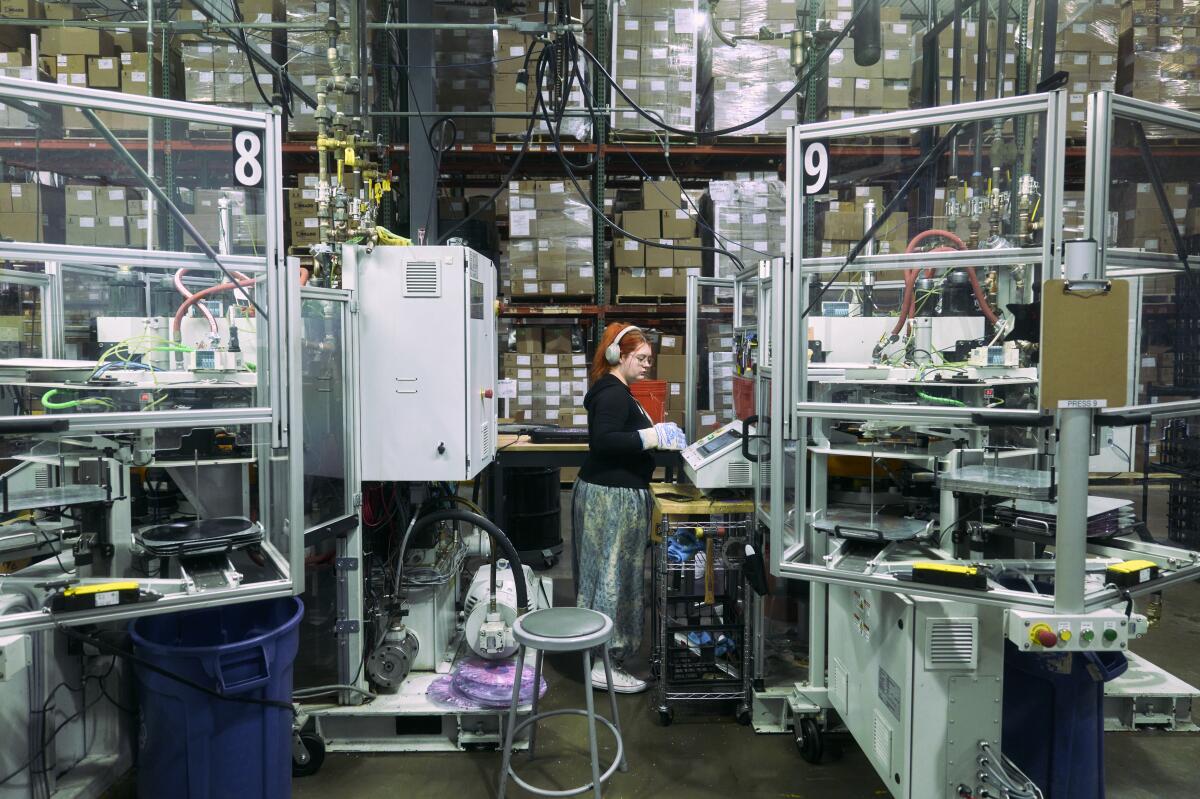
Soren Smith working at Independent Record Pressing in Bordentown, N.J., on May 26, 2026.
(Dutch Doscher / For The Times)
Largely, it’s been people like Swanson who have fully committed to the cause. He says that during the height of the COVID-19 pandemic, in an “activist moment,” several labels signed onto the Music Climate Pact, declaring their intention to reduce their emissions and be better stewards of Earth.
“It had almost no teeth to it,” Swanson explains. “A lot of people signed it, posted something on Instagram, and it sat there for a few years. For us, it was pretty frustrating … it felt very perfunctory.”
His work continued, along with a few others, thanks to support from Murmur, an organization designed to support labels and industry names, effectuating the commitments made when the Music Climate Pact was signed.
“We’re more doers than sayers,” Swanson says. “We’ve really been experimenting with what we’re calling ‘Revinyl’ — post-industrial, pre-consumer, recycled vinyl as a means to reduce our footprint at IRP.”
This is what some of Friday’s release is made of — all the trimmings, tidbits and overstock that would otherwise end up in landfills or on the factory floor. For the time being, it certainly won’t solve the climate cost of vinyl records, but it helps to mitigate it.
Between 2024 and 2025, total units produced at Independent Record Pressing increased by 41% while emissions — which also benefited from lower-carbon transportation — decreased by 34%.
“The idea is, if you can make those records 16% more efficient and also show fans of those records … that it is viable, maybe it makes it a little bit easier next year when we go out to ask other artists to jump on board,” Swanson explains. “We’re not making records that are just going to go sit on the shelf — these are records we’re continually repressing all the time anyway.”
Similarly, Ian Stanton, head of sustainability at Beggars Group, was among the first to sign the pact in 2021. His role was created five years ago to give indie labels a voice in light of minimal resources and capabilities. Though these roles do exist at larger labels, he says they have “slightly different drivers.”
When it comes to records, the pure plastic pollution that comes from them is also a concern. When old records make it to a landfill, they’re not only likely to outlive the site, but can also leach plasticizers, a Keele University report found.
“Vinyl is not like a single-use plastic; we don’t throw it away after one listen. We treasure it, we pass it on through generations, and people have a real connection with it,” he says. “But like any other product, there are ways of making it more sustainable.”
He refers to certain plastics, such as shrink wrap, as the most “visible” aspect of vinyl record pollution to consumers. From a collector’s point of view, shrink wrap can actually increase the value of a record. Though there has been discourse over the years around whether this can actually damage the sleeve, many sellers champion an “in the shrink” label as they mark up prices.
Splatter-patterned records arrive at the trim station at Independent Record Pressing in Bordentown, N.J., on May 26, 2026.
(Dutch Doscher / For The Times)
Other visible aspects, such as the paper sleeves in which the records are housed, are also harmful. However, Swanson says that swapping those for recycled materials outputs a relatively negligible difference in emissions impact, largely due to the process behind producing them.
For the time being, vinyl records made from reclaimed materials are the best that companies like Swanson’s can do, though they’re are always on the lookout for other, viable options for improving their footprint. As an example, they’re actively experimenting with how existing record material can help them.
What can the beat-up, worn-out records at your local thrift store do to dodge a landfill and keep the Earth spinning? As it stands, not much.
Stanton lists an array of challenges, including outdated materials, modern production regulations and contaminants.
“I suppose what we need with PVC for records is a really high-quality, contamination-free material to get that sound reproduction,” he explains. “When you bring in stuff from that post-consumer environment, you’ve got to make sure there’s no contamination in there, because you’re going to end up with sound quality issues.
“It’s all in process,” he adds.
For now, they look to fix the most immediate problems first, such as freight emissions, where Beggars Group has converted the vast majority of its shipping operations to sea freight, a far less harmful alternative compared with air freight.
“We want to look at the full life cycle … not only thinking from the cradle to the grave, but from the point where the raw materials are extracted at the beginning,” Stanton says. “This life cycle analysis now looks at all different environmental indicators on this — the chemical usage, the water usage, and the end-of-life impacts on that side of things.”
An aerial photo made with a drone shows gasses burning off near oil storage tanks and a drilling rig near Karnes City, Texas. Photo by TANNEN MAURY / EPA
June 2 (Asia Today) — U.S. crude oil exports reached a record high in May as demand from Asian and European refiners surged, market data showed.
U.S. crude exports averaged 5.6 million barrels per day in May, surpassing the previous record of 5.2 million barrels per day set in April, according to data from analytics firm Kpler.
The increase was driven in part by a widening price gap between West Texas Intermediate, the U.S. benchmark crude, and Brent crude, the global benchmark.
The spread between WTI and Brent widened to as much as $20.69 a barrel in March, the largest gap in 13 years. In April, the gap averaged $8.86 a barrel, wider than the prewar average of $4.85.
Supply disruptions in the Middle East caused by the war involving Iran also prompted refiners in Asia and Europe to seek more U.S. crude as an alternative.
Asia imported an average of 2.45 million barrels per day, making it the largest destination for U.S. crude for a second consecutive month.
Japan was the biggest Asian buyer, importing 808,000 barrels per day, up 32% from the previous month.
Europe ranked second, importing 2.4 million barrels per day.
Italy led European demand with imports of 335,000 barrels per day. Bulgaria, Croatia, Turkey and Greece also made rare purchases of U.S. crude, according to the data.
Industry analysts expect U.S. crude exports to decline from June. Consulting firm Energy Aspects projected exports would fall to an average of 4.9 million barrels per day in June and 4.6 million barrels per day in July.
Sources and analysts said declining WTI inventories in the United States are expected to encourage domestic storage and reduce export volumes.
Benchmark Nikkei 225 tops 68,000 for first time as AI-driven buying frenzy shows no signs of slowing down.
Published On 3 Jun 20263 Jun 2026
Japan’s stock market has hit an all-time high as a global buying frenzy driven by AI shows no signs of slowing down.
The Nikkei 225 rose nearly 3 percent on Wednesday, lifting the benchmark index above 68,000 for the first time.
Recommended Stories
list of 4 itemsend of list
The latest surge continues a banner year for Japan’s stock market, which is up nearly 33 percent so far in 2026.
“Investor enthusiasm over the AI boom is helping drive Asian equity markets higher,” Khoon Goh, head of Asia research at ANZ, told Al Jazeera.
“While strong demand for high-end chips has seen the top semiconductor companies in Taiwan and South Korea rally strongly, this is also benefiting Japanese markets, which are also getting some tailwind from a weak yen.”
Japanese firms involved in the semiconductor business led the gains.
Tokyo Electron, Japan’s largest manufacturer of semiconductor equipment, soared as much as 14 percent in morning trading.
Advantest, which supplies testing equipment to the semiconductor industry, rose more than 5.5 percent.
Shin-Etsu Chemical, a supplier of silicon wafers used in integrated circuits, gained about 4 percent.
Softbank, which is heavily invested in AI models, chips and data centers, fell about 3 percent, after overtaking auto giant Toyota on Monday to become Japan’s biggest company by market capitalisation.
Ferocious demand for AI chips has been driving record-breaking rallies in stock markets across the globe, taking key indexes in the US, Japan, South Korea, Taiwan to record highs.
During the past month, three memory chip makers – South Korea’s SK Hynix and Samsung Electronics, and US-based Micron – entered the elite club of firms with a market capitalistion of at least $1 trillion.
Only 17 companies have hit the milestone, all but five of which are based in the United States.
Despite concerns about the sustainability of the sky-high valuations in the sector among some investors, tech companies are continuing to commit huge sums to AI-related infrastructure.
US tech giants are expected to spend about $800bn on AI-related capital investment in 2026, according to Goldman Sachs.
Google parent company Alphabet on Monday became the latest Silicon Valley giant to outline its AI-related investment plans, announcing that it would sell $80bn worth of shares to help fund expected capital expenditures of $180-190bn in 2026.
Alice Capsey hits 82 whilst Heather Knight finishes unbeaten on 70 as England chase down 181, the highest run-chase in women’s T20 history in England, to secure a six-wicket win against India, sealing an impressive 2-1 series win in Taunton.
Sure, it might not seem like it from the outside looking in. After all, how can someone who has hit 89 home runs across her college career — one short of the Bruins’ record — and helped one of softball’s most dynamic offensive teams check off a list of new NCAA and program records relate to the other sociology majors in her classes at UCLA?
Grant disappears into her head sometimes, something she readily acknowledges. But her solution might not be as accessible to all the other “Twilight”-binging, video-game-loving UCLA students. She has coach Kelly Inouye-Perez keep her, the Division I home run queen, from getting caught up in the moment.
“She does a really great job with just keeping me neutral,” Grant said. “Sometimes I may get in a little crazy headspace, but she does a really great job helping me get out of those feelings that I’m stuck in, and she pulls me out and makes me realize, ‘Hey, as long as I can be who I am, that’s enough.’”
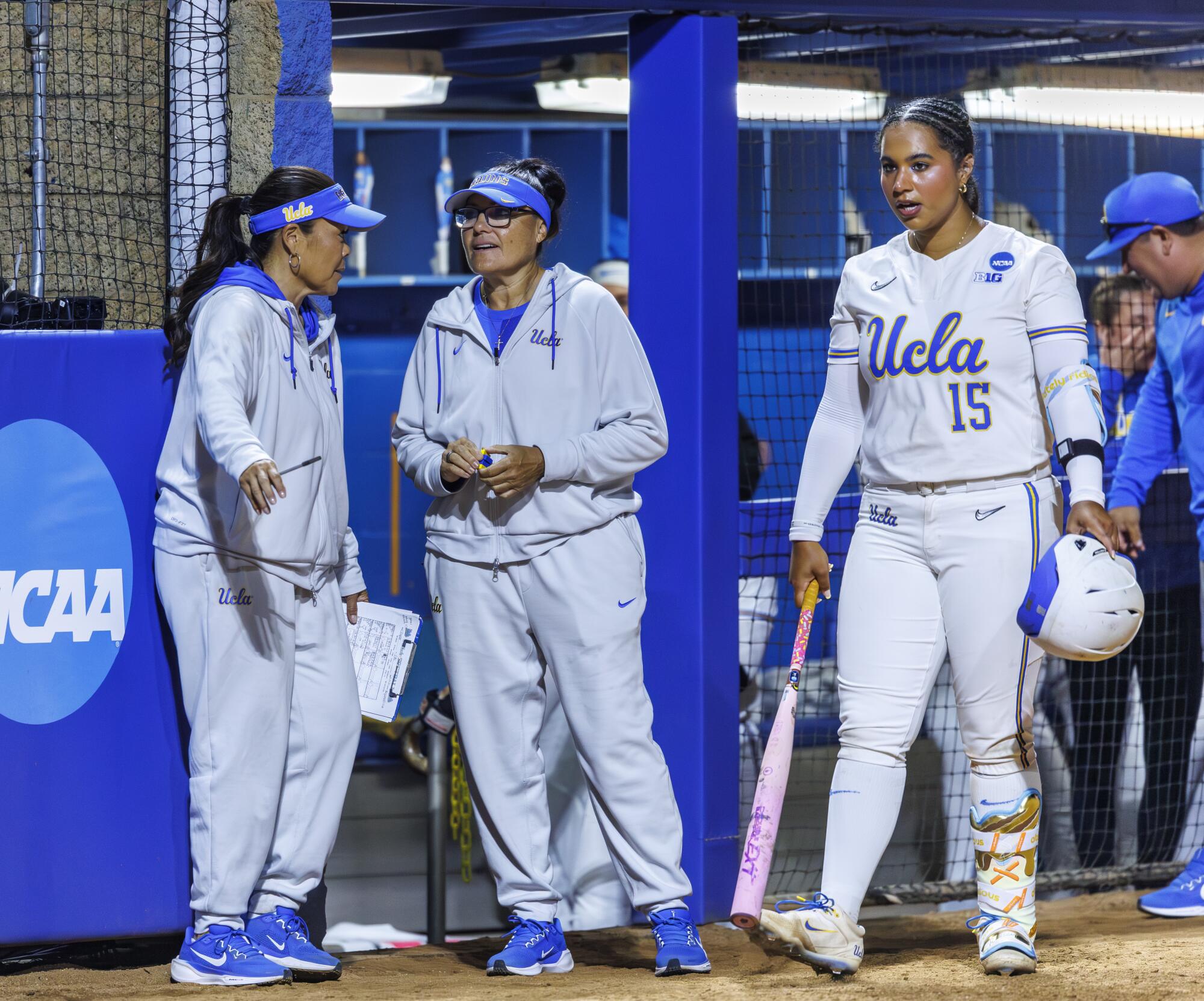
UCLA head coach Kelly Inouye-Perez, left, confers with associate head coach Lisa Fernandez next to infielder Jordan Woolery during NCAA reigonal game on May 15.
(Gina Ferazzi/Los Angeles Times)
Inouye-Perez and assistant coach Lisa Fernandez are some of the Bruins’ biggest keys to success as the team prepares for the start of the Women’s College World Series in Oklahoma City. The Bruins will face Texas Tech at 4 p.m. PDT Sunday in a game airing on ESPN.
UCLA closed its super regional with a single-season home run record (200) and a record for WCWS appearances (34).
Grant is no stranger to the work necessary to see that level of success. But even in her rare bad at-bats and struggles, Inouye-Perez and Fernandez allow her the space to fail. After all, there are nine places in the lineup. One person alone isn’t indicative of UCLA’s wins or losses, Inouye-Perez says.
“We really focus on succeeding and learning how to fail, so they can just get to the next pitch,” Inouye-Perez said. “We talk about the ability to slow the game down, to take deep breaths, to be able to enjoy the moment. It’s not on any one Bruin.”
That mentality doesn’t exist in a void. Inouye-Perez and Fernandez worked in tandem to create the powerhouse team, which is in the midst of one of the best offensive seasons in D1 softball history.
Inouye-Perez is in her 20th year coaching the Bruins and is the only NCAA softball player to win a championship as a player and a coach. She led the 2010 and 2019 teams to those titles. Meanwhile, Fernandez, in her 28th year coaching at UCLA and her fourth as associate coach, has taken primary responsibility for hitting — one of the Bruins’ biggest keys to success. The team leads the nation in batting average (.385), RBIs per game (10.38) and on-base percentage (.496).
“Me and her, we’re workhorses,” Grant said of Fernandez. “We work all day after practice hours together, and it just means the world. You can tell that she loves the game and her little nuggets that she teaches me.”
The Bruins’ success in the batter’s box also has helped raise the tide of a team that could’ve fallen into many pitfalls. The team has only one main pitcher, Taylor Tinsley, who’s spent the most time in the circle in the NCAA tournament with 29-1/3 innings pitched. The Bruins are also young. Of the 21 players on the roster, only eight are seniors, redshirt juniors or juniors.
Seniors Jordan Woolery and Grant are one pace to break NCAA records, but the underclassmen aren’t far behind. Redshirt freshman Aleena Garcia set a single-game RBI record (7) when she hit two three-run homers in UCLA’s 14-4 win over Central Florida in the Super Regional.
Much like Inouye-Perez, Fernandez’s best attribute is her ability to be a sounding board for Grant.
“You get her enthusiasm too,” Grant said. “If you mess up, she’s always there to have your back. She celebrates your wins as well, and she gets very ecstatic about it. It almost makes me laugh, because it makes things so much more fun. She just brings that out of people.”
Even when teams lose to UCLA and Fernandez, it’s still a positive experience for some.
UCLA associate head coach Lisa Fernandez huddles near the mound with starting pitcher Taylor Tinsley (23) during the fifth inning of a comeback win over California Baptist. The Lancers scored 10 runs in the fifth, but Tinsley bounced back from outing.
(Gina Ferazzi/Los Angeles Times)
Central Florida coach Cindy Ball-Malone considered Fernandez one of the best softball players ever, calling her the Michael Jordan of the sport. But what makes her truly impressive, Ball-Malone said, is that Fernandez is an even better coach.
“She’s just a winner,” Ball-Malone said. “I kind of just want to rub up on her or something to get that mojo because she’s got it. Her attention to detail, her belief in the smallest things, that’s why she is so good at what she does.”
It’s no wonder then why so many people, regardless of team affiliation, want to see UCLA’s coaches in person.
If you’re a part of the Bruins, you get to learn from people who have brought the school championships. And, if you’re trying to beat UCLA, there’s no better accomplishment than saying you beat Inouye-Perez and Fernandez’s record-breaking team.
“[Fernandez is] going to push you, and it might be uncomfortable, but dang it, you have no choice but to get better,” Ball-Malone said. “If you can get through her, you can get through anybody, and I’m going to learn from that so I can bring that to this program.”