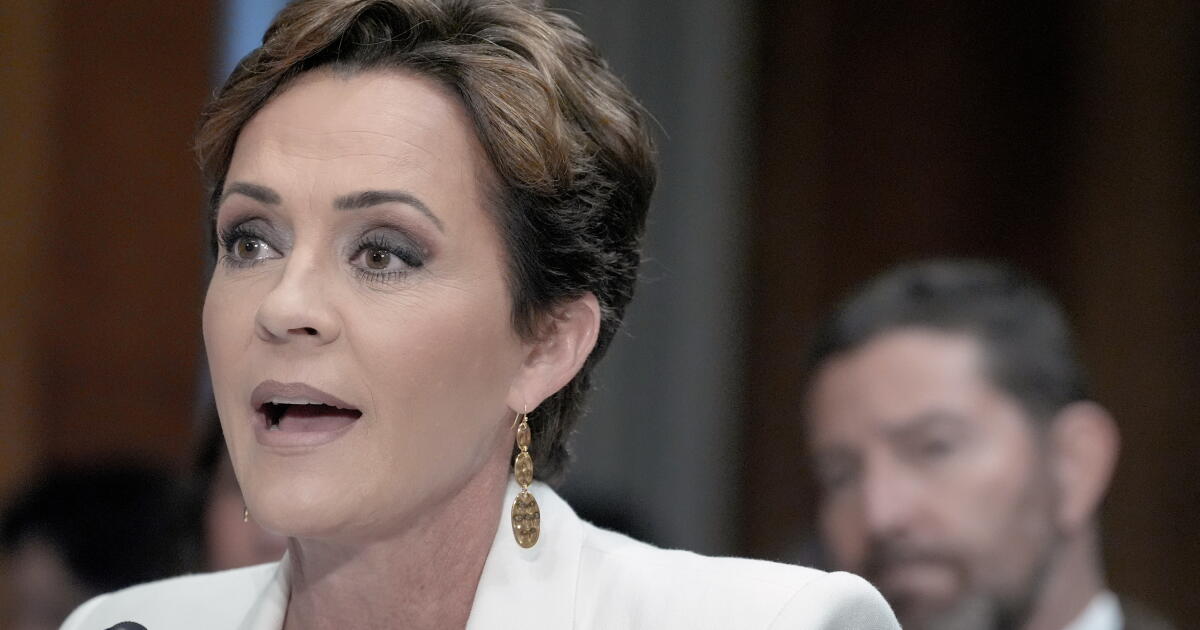
PHOENIX — The U.S. Supreme Court has refused to toss out $122,000 in legal costs that lawyers for former Arizona gubernatorial candidate Kari Lake were ordered to pay for false and misleading statements they made in a lawsuit that sought to require a hand-count of all ballots in the 2022 midterm elections.
The nation’s highest court on Tuesday denied a request from Andrew D. Parker, an attorney who represented Lake in the lawsuit, to review a lower-court decision over the legal costs arising from the unsuccessful litigation.
The lawsuit by Lake and state lawmaker Mark Finchem sought to ban electronic tabulation devices. It was dismissed by a judge who found Lake and Finchem lacked standing to sue and that their lawsuit was filed too close to the election.
In 2022, Lake lost the governor’s race to Democrat Katie Hobbs and Finchem was defeated in the secretary of state’s race by Democrat Andrian Fontes. Both Republicans had promoted the narrative that the 2020 election was marred by fraud.
Maricopa County had sought sanctions against Lake, Finchem and their lawyers, alleging they broke a court rule by making unfounded allegations and by not conducting the necessary research before filing the lawsuit.
U.S. District Judge John Tuchi later concluded the lawsuit’s claims lacked an adequate basis in fact, that the standard inquiry attorneys must make before pressing litigation hadn’t been done and that the lawyers acted recklessly in seeking a court order based on frivolous claims.
The requirement to pay the legal fees applies to the lawyers who pressed the lawsuit, not to Lake and Finchem.
The 9th Circuit Court of Appeals rejected appeals over the lawsuit’s dismissal and the awarding of the legal fees.
The Associated Press left phone and email messages Tuesday for Parker, whose firm is based in Minneapolis.
Earlier this year, Parker asked the Supreme Court to throw out the requirement to pay Maricopa County’s legal fees in the case, arguing such sanctions would deter attorneys from bringing aggressive or novel legal claims.
Maricopa County said lawyers for Lake and Finchem had disregarded a letter that identified false allegations they had made in their lawsuit and relied on some of those claims in a later court filing. The county’s attorneys said those who brought the lawsuit failed to present evidence to support their allegations and falsely alleged that Arizona didn’t use paper ballots and that its electronic voting systems hadn’t been subjected to expert analysis.
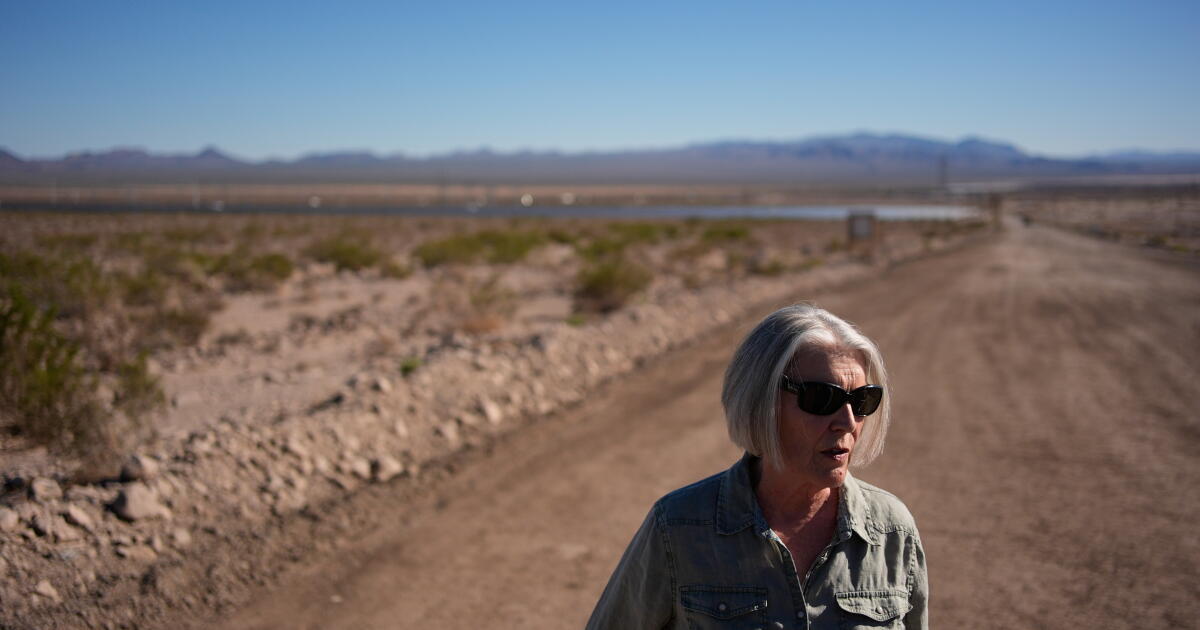
BOULDER CITY, Nev. — Janelle Sorenson loves the clear night skies in Boulder City, less than an hour’s drive from the bright lights of the Las Vegas Strip. It’s a small, quiet town, and she thinks an artificial intelligence data center would ruin the community and scar the desert landscape.
So over the summer, she joined with other residents to successfully oppose plans for one of the giant computing warehouses that have popped up around the country.
But their victory was short-lived. The developers withdrew their application and instead sought adjacent land owned by the federal government — and the U.S. Bureau of Land Management signed off.
“Not only did we not get to decide anything or have a say,” Sorenson said, “we were just really kept in the dark.”
The Townsite data center was the first in the country to be approved on federal public land, though construction is stalled after a judge ruled that the government couldn’t use an old environmental review from when the project was intended to be a solar farm.
Tech companies are eager for vast tracts to build data centers that can be as large as 70 football fields, and Townsite could set a precedent for similar projects on federal property with more than a dozen others in the planning stages. President Trump has been a steadfast supporter of the AI industry, which he views as a source of economic growth and part of a global competition with China.
However, data centers have been unpopular in many communities as voters worry about higher electricity bills, declining water supplies and other effects. In Nevada, where 80% of the land is owned by the federal government, Townsite and other projects have become a dominant issue in the battleground state’s closely watched governor’s race.
Republican Gov. Joe Lombardo, one of his party’s most vulnerable incumbents, doesn’t outright oppose building data centers on public lands, as long as they have community support. He recently signed an agreement with Trump’s Republican administration to streamline infrastructure projects, which could include data centers on federal lands.
Democratic nominee Aaron Ford, the state attorney general, has pledged to oppose data centers on public lands, saying affordable housing should be the priority.
Both say the projects, whether on public or private land, must follow state rules, such as requiring data centers to cover their own energy costs and protecting water supplies, or they would lose eligibility for state tax abatements.
Voters across the political spectrum unite against data centers
Sorenson, the Boulder City resident, considers herself a liberal, but she said her conservative neighbors are on the same page as she is.
“We’re all aligned on this,” she said.
Autumn McGrath-Shook, who lives in the same town, said she recently left the GOP and registered with the Green Party over data centers, though she still identifies as conservative. Worried about the environmental impact on wildlife, she joined forces with “these crazy libs” to oppose the project.
Data centers have quickly become a “catalyzing issue” in the midterms, catching many politicians flat-footed, said David Damore, a political science professor at the University of Nevada Las Vegas.
Some state leaders who were previously supportive of data centers have rushed to respond. For example, Republican Texas Gov. Greg Abbott paused data center approvals until audits are completed, and Democratic Pennsylvania Gov. Josh Shapiro signed an executive order removing data center proposals from a fast-track permitting process and requiring them to receive local approval before seeking state approval.
In August, Ford announced his plan to pause new tax abatements for data centers while an audit is conducted to see whether the projects have fulfilled promises about producing tax revenue and economic benefits.
In September, Lombardo, who has said data centers provide enormous economic opportunity for Nevada, signed an executive order placing more guardrails on them and requiring them to pay more taxes to support schools.
The two have successfully “muddied the waters” on their data center positions, Damore said.
Lombardo criticized Ford for co-sponsoring 2015 legislation that created the state’s tax abatement program for the facilities, a measure that received bipartisan support. Ford criticized Lombardo for giving more than $200 million in tax breaks to data centers, which is connected to the legislation that Ford co-sponsored.
Ford told the Associated Press that he would use “every tool” at his disposal to prevent data centers from skirting state guardrails, including withholding tax abatements and pursuing litigation.
Lombardo, whose campaign declined to make him available for an interview, has a similar pitch. His office said he would not hesitate to confront the federal government to advocate for Nevadans.
But that’s not good enough for McGrath-Shook, who is on the fence in the governor’s race. She thinks Ford is soft on crime, but she views Lombardo as more pro-data centers.
“I would much rather vote for Lombardo than Aaron Ford in a normal world,” she said. “But with the looming data centers, it really changes the landscape — and literally.”
Data centers on public lands are the latest effort in AI race
Last year, Trump signed an executive order to accelerate permitting for AI data centers, and his administration has rolled back the National Environmental Policy Act, saying the bedrock law needlessly delays federal approval for energy and infrastructure projects.
Dan Diorio, executive vice president of state policy and government affairs for the Data Center Coalition, said the industry wants to be a part of the conversation about responsible development on federal lands.
“The good-faith actors in this space are going to be approaching that development responsibly,” he said, “ensuring that it’s going to do no harm on important federal lands.”
But environmentalists are concerned about data centers developing on federal lands to skirt environmental protections and laws and circumvent permitting processes. They’re generally opposed to using public lands for the projects in the first place.
“We believe that public lands are reserved for public good and should be protected and kept in trust for future generations,” said Olivia Tanager, director of the Sierra Club’s Toiyabe Chapter. “And the idea of using public lands for data center construction totally flies in the face of that set of values.”
She said Congress should pass legislation with new standards for environmental reviews and public engagement that could slow development.
“Short of some type of legislation to that effect,” Tanager said, “we’re staring down the barrel of having many data centers move forward on public lands over the next few years.”
The problem they all face is their return address.
“There was a cliche that dates to the ‘60s or ‘70s, or maybe before that,” said Matthew Dallek, who was born and raised in Los Angeles and now teaches political management at George Washington University. “‘As California goes, so goes the nation.’ I don’t think that world exists anymore.”
You’re reading the L.A. Times Politics newsletter
Expert columnists cover the insights, legislation, players and politics you need to know.
By continuing, you agree to our Terms of Service, which include arbitration and a class action waiver. You agree that we and our third-party vendors may collect and use your information, including through cookies, pixels and similar technologies, for the purposes set forth in our Privacy Policy such as personalizing your experience and ads.
Or as Jim Newton, a former L.A. Times reporter and editor and now a biographer and California historian, bluntly put it, the state has migrated in the minds of many beyond its golden confines “from a kind of serious west of the West place to a kind of hippy-dippy silly place.”
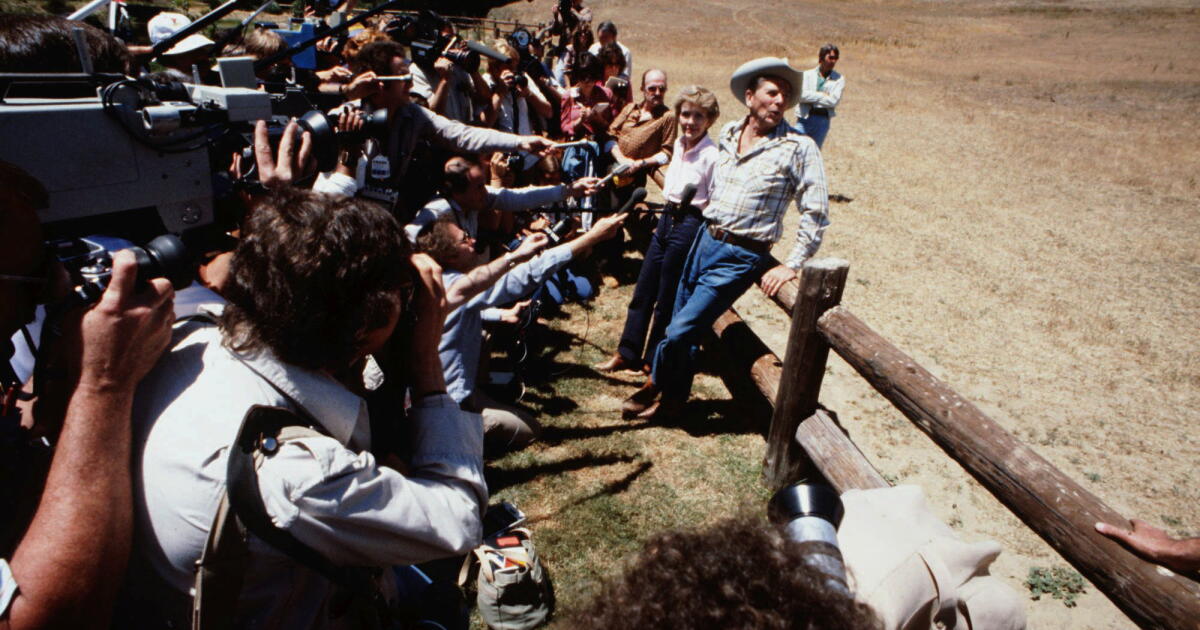
Reagan was a product of the nation’s heartland and a California transplant. The state that launched him to the White House was predominantly white and Republican, an arsenal of the Cold War and the birthplace of a grass-roots anti-tax movement that swept the nation. His conservatism was seen by many as an antidote to the excesses of the 1960s and 1970s.
“California was in some ways on the cutting edge of American politics because it was signaling the direction in which our national politics were trending,” said Dallek, who wrote a book about Reagan’s first electoral victory, in the 1966 gubernatorial race. “Reagan was kind of the tip of the spear.”
Although leaning to the right, especially in presidential races, California was a robust two-party state until the mid-1990s, with several Democrats holding statewide office and long periods when Democrats controlled one or both houses of the Legislature. That competitiveness, along with California’s sizable cache of electoral votes, helped boost Reagan’s political standing nationally.
Many see that progressivism as overly obsessed with identity politics, personal pronouns and the like, ignoring practicalities and the day-to-day concerns of most voters.
(Between the two, California had a seat in the White House for more than half a roughly 40-year stretch. Nixon served two terms as vice president before winning the presidency in 1968. His second term was cut short when the Watergate scandal drove him from office.)
Khachigian noted that Republicans rule over states that are just as politically lopsided as California: Indiana, Mississippi, Idaho and Utah, for instance. “But they don’t seem crazed like California,” he said.
That’s obviously one partisan’s perspective.
‘Far left … ungovernable’
But Dallek agreed it’s no longer a political asset to come from California, which much of the country sees as “pretty far to the left.”
“And somewhat ungovernable at this point,” he added. “You have incredible, insane amounts of wealth concentrated in places like Silicon Valley and parts of Los Angeles and then you have incredible amounts of poverty and homelessness…. There’s not a sense that what’s happening in California really resonates across the country.”
It has the world’s fourth-largest economy, as Newsom and others never tire of pointing out. It remains on the cutting edge of culture, research and technology. It’s still a place that offers fertile ground for the imagination, for reinvention and for second chances.
Newcomers, from other states and abroad, are welcomed like in few other places. The unofficial California credo — live and let live — makes it possible to be one’s authentic self without fear of shame, ostracism or constraint.
Harris, Newsom, Khanna or any Democrat hailing from California will doubtless argue those virtues are what makes the state truly shine, convinced it’s a model they can sell the rest of America.
Carlos Dammeier, administrative law judge, California Unemployment Insurance Appeals Board Bar rating: Qualified
Dammeier began in law enforcement, working for a decade as a dispatcher, jailer and police officer. He went to law school and, for a quarter-century, represented police and other public-sector unions, “handling employee rights cases at every level from administrative hearings to the U.S. Supreme Court,” he said in an email.
In 2013, The Times reported, a law firm in which he was a named partner dissolved after two Costa Mesa City Council members sued one of his clients, the city police union, over legal and political tactics the politicians asserted were overly aggressive.
Dammeier recently said his team was the focus of “antiunion attacks by political forces” and said that after multiple investigations, none of the firm’s attorneys faced charges or disciplinary action.
In 2022, Dammeier became an administrative law judge. His campaign website states he has heard and issued decisions in more than 2,000 unemployment, disability and tax appeal cases.
Priorities are addressing case backlogs and making thoughtful, unbiased decisions.
“Win or lose, everyone needs to know they had fair treatment by our courts,” he said.
He ran for Superior Court seats in Merced and San Bernardino counties in March 2024, losing both races, and also ran unsuccessfully in San Bernardino County in 2016.
David Ross, deputy alternate public defender Bar rating: Qualified
Ross worked as a legislative aide for an Indiana Democrat in Congress and as a TV reporter and documentary producer before becoming a lawyer in 1994, according to his campaign website.
His legal career began in Riverside County, where he served five years as a deputy public defender. In 2000, he became a Los Angeles County deputy alternate public defender in regional branches, including Long Beach and Compton. He has been at the Torrance office since 2018.
Ross, according to his website, has represented more than 10,000 indigent defendants and completed more than 110 jury trials.
A priority would be ensuring people feel recognized in his courtroom.
“My goal is to hear everyone out, so that even if a party ultimately loses, they will walk out of court knowing the judge listened,” he said in an email.
Troy W. Slaten, administrative law judge, state Department of Industrial Relations Bar rating: Qualified
After roles as a child actor on “Cagney and Lacey” and “Parker Lewis Can’t Lose,” Slaten began a two-decade law career in 2005.
He first worked as a private criminal defense attorney, then spent 11 years at an international firm where he focused on criminal, civil and administrative law and, for a time, managed the criminal defense division. He’s regularly cited as a legal analyst on TV and in The Times.
Slaten volunteered as temporary Superior Court judge from 2016-20 and in 2021 became a full-time administrative law judge presiding over workers’ compensation hearings.
“I have uncovered fraud and have helped when injured workers have been denied healthcare and other benefits,” he said in an email.
He has twice run for Superior Court, falling short in 2020 and 2022.
He would prioritize fairness and efficiency. “I would work to ensure cases move forward in a timely and organized manner while preserving due process,” he said.
Outside the courtroom, Slaten announces and deejays UCLA men’s and women’s water polo games.
Donna Tryfman, L.A. County deputy public defender Bar rating: Qualified
A deputy public defender since 1998, Tryfman has had assignments countywide. From 2016-19, she supervised 25 attorneys and mentored new hires as deputy in charge of Eastlake Juvenile Court. She’s worked in collaborative drug court, coordinating with prosecutors, judges and others to help individuals dealing with addiction.
Her current assignment is in the Major Crimes Unit, where she exclusively handles homicides with special circumstances.
Tryfman spent five years as president of the Public Defenders Assn., according to her campaign website, and has proctored a high school program on civic duties and constitutional principles. She has served as a Superior Court judge pro tem, handling traffic and small claims cases. She received the peer-decided Gideon Award as felony attorney of the year in 2025, her bio states.
“I would champion further access to justice by exploring and expanding digital access to the courts in underserved communities,” she said.
ANCHORAGE, Alaska — It’s a long way from Washington, has a small population and hasn’t backed a Democrat for Senate in nearly 20 years.
Yet President Trump on Tuesday will devote a big chunk of his dwindling time ahead of crucial midterm elections to head all the way to Alaska — attempting to bolster a Republican incumbent senator in another sign of GOP fears about retaining control of Congress after Election Day on Nov. 3.
Trump is headlining a rally for Sen. Dan Sullivan in Wasilla, about 45 miles north of Anchorage — famous for being the hometown of former Republican vice presidential nominee Sarah Palin and the headquarters of the Iditarod sled dog race across the state.
Trump’s stop is part of a western swing also taking him to rallies in Arizona and Montana on Wednesday.
“I’m right now going to Alaska to try and help Dan Sullivan. That’s a long way away,” Trump told reporters as he left the White House for the trip on Tuesday. “I would only do it if I thought he was good. And he’s very good. And so, I’m going to Alaska to help Dan Sullivan, and then I’m stopping in numerous places.”
Democrats last won a Senate seat in Alaska in 2008, and the state hasn’t elected a governor from that party since 1998. The only time Alaska didn’t vote Republican for president was during Lyndon B. Johnson’s landslide 1964 reelection.
Yet high gasoline prices from the Iran war and persistently elevated inflation have damaged Trump’s approval ratings enough to leave Democrats dreaming of Alaska upsets.
Trump and Vance have been trying to boost Sullivan repeatedly
Seeking his third Senate term, Sullivan faces Democrat Mary Peltola, a former congresswoman running to put “Alaska First,” emphasizing cost-of-living issues.
Alaska pollster Ivan Moore said he’s seen a decline in Trump’s support statewide that mirrors the president’s falling approval ratings nationally — meaning the Senate race may be decided by Trump 2024 voters who are now unsure they still back him.
“The visit is certainly appropriate. Whether the visit will be effective or not is another matter,” said Moore, who said when he first heard that Trump would visit Alaska, he didn’t believe it would actually happen.
The Trump administration has prioritized the opening of more of Alaska to oil and gas drilling. Vice President JD Vance already campaigned in Fairbanks for Sullivan.
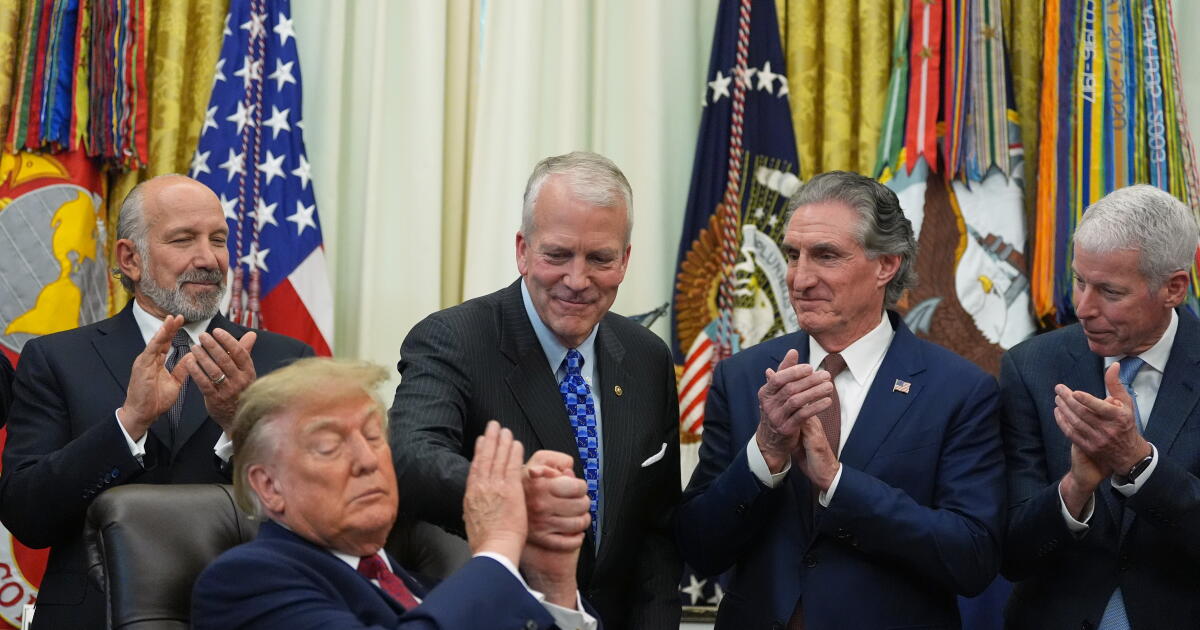
The senator also recently joined Trump in the Oval Office where the president announced a $54 billion investment by South Korea’s government into an Alaska natural gas project. That’s despite South Korea saying the deal, and its total value, haven’t been finalized.
Still, Trump trekking four time zones west to get to Sullivan’s home turf — an unusually long trip so close to the midterms — is his strongest show of support.
Trump last campaigned in Alaska to try to defeat a fellow Republican
Alaska is home to around 740,000 people, making it slightly less populous than Denver. It ranks 48th out of 50 states in population, smaller than all but Vermont and Wyoming.
Trump nonetheless headlined a 2022 rally in Anchorage opposing Republican Alaska Sen. Lisa Murkowski after she voted to convict him on a charge of incitement of insurrection during his second impeachment trial, following the attack on the U.S. Capitol by a mob of his supporters on Jan. 6, 2021.
Trump endorsed Kelly Tshibaka, who challenged Murkowski that year, but that didn’t stop incumbent Murkowski from winning reelection.
This year, there are two Dan Sullivans on the ballot
Trump has complained about Alaska’s unique elections system. The state has open primaries, in which the four top vote-getters — regardless of party affiliation — advance to the general election, which uses ranked choice voting.
That’s led to a scenario where there also will be another Dan Sullivan on the ballot on Nov. 3: retired teacher Dan J. Sullivan, whom Trump and other allies of Sen. Sullivan have called a sham candidate. Dan J. Sullivan has denied this.
At his rally, Trump also plans to stump for Republican Rep. Nick Begich. Begich is facing a competitive challenge from Bill Hill, an independent.
Alaska has a history of rewarding candidates with an independent streak — something Vance acknowledged during his trip to Fairbanks last week. “In very deep red years, Alaska is competitive. In very deep blue years, Alaska is still competitive,” Vance said. “I think it’s just a reality of the politics of the state.”
Independence has been hard to find in the Republican Party where Trump for years had total control. Some Republicans facing tough elections have begun tiptoeing away from Trump on key issues like Iran and tariffs, but not Sullivan, who has been vocal in supporting both.
In a post last week, Trump questioned why three Republicans were running against a Democrat for governor. “How stupid are we to do this?” he said on social media. This comes at the same time state Republican party leaders are urging voters to rank Republicans on the ballot and leave the Democrats blank.
“We want to be clear: we do not support ranked choice voting. It is a confusing, burdensome and costly voting scheme,” party leaders, including GOP chair Carmela Warfield, said in a statement Saturday. “That said, ranked choice voting is the system Alaska will use for the 2026 General Election, and we must work within it for this election to keep Alaska’s recent momentum going strong.”
Trump’s trade war with Canada may also be a factor
Trump has also triggered a trade war with Canada, which shares a 1,500-plus-mile border with Alaska and is among the state’s most important trading partners.
The U.S. banned nearly $1 billion worth of imports from its neighbor to the north — including alcoholic beverages, dairy products and motorcycles — after previously imposing 50% tariffs on about $20 billion in Canadian products. Canada has responded with reciprocal bans and its own import levies, and the back-and-forth could raise prices for Alaska consumers.
Making Canada an enemy of sorts is “discomforting” for many Alaskans, said pollster Moore.
“We associate, I think, probably more closely with the Canadians — more than a lot of the Lower 48,” he said.
Weissert and Bohrer write for the Associated Press. Weissert reported from Washington. AP reporter Michelle L. Price contributed to this report.
COLUMBUS, Ohio — Campaign mailers urging Ohio voters to support a socialist U.S. Senate candidate over Democratic nominee Sherrod Brown are being underwritten by a newly incorporated PAC with ties to President Trump’s MAGA Inc., public filings show.
The mailers are sponsored by Enough Promises Ohio PAC and began arriving in voters’ mailboxes in recent days. They promote independent candidate Greg Levy over Brown with messages such as “Join the Revolution” and “Send a Worker to the Senate.” Levy describes himself as “Socialist running for the U.S. Senate to represent Ohio in 2026” on his X account.
Levy condemned the fliers for falsely impersonating his campaign and engaging in “dirty tricks” designed to mislead voters. He said he is considering legal action.
“This is a highly undemocratic practice and does a disservice to voters in Ohio and throughout the country,” he wrote on X.
According to Federal Election Commission filings, Enough Promises Ohio was founded on Sept. 29. It has not yet had to disclose its contributors, but additional federal filings lay out a trail of associations linked to Republicans.
Enough Promises paid the firm Seven Farms more than $397,000 on two dates last week for printing, postage and mail services either supporting Levy or opposing Brown. Seven Farms, also a new entity, lists as its address the same South Carolina business suite as the one used by Whistlestop Strategies LLC.
Whistlestop is a direct mail outfit operated by Big Dog Strategies LLC, the strategy firm that advises Trump’s MAGA Inc. super PAC and that managed Republican Sen. Bernie Moreno’s successful campaign against Brown in 2024.
Messages seeking comment were left with Enough Promises Ohio and Big Dog.
MAGA Inc. and affiliated groups began pouring huge sums of cash into midterm races in September, after party officials had been urging Trump to begin spending some of the fortune he had amassed to help embattled Republicans before it was too late.
Smyth writes for the Associated Press. AP writer Jill Colvin in New York contributed to this report.
NEW YORK — Elon Musk, the world’s only trillionaire, has quietly become the biggest known donor in this year’s midterm elections, doling out more than $276 million since July to try to save Republican majorities in Congress.
The numbers, first reported by the New York Times ahead of this week’s federal filing deadline, were confirmed by Andrew Romeo, a spokesperson for Musk’s super PAC.
The money includes $158 million given to the Senate Leadership Fund, the main super PAC supporting Republican Senate candidates, one of the largest known political donations in American history, according to the Times.
Another $76 million went to America PAC, a Musk super PAC, which has once again built out a major turnout operation like the one it used to help elect President Trump by knocking on doors in 2024.
Musk also provided $10 million to Lone Star Liberty PAC, a group that supports the Republican nominee for Senate in Texas, Ken Paxton. The race has been a major focus of Musk’s efforts.
It’s a dramatic turnaround since last May, when Musk said he intended to cut back on future political spending. “I think I’ve done enough,” he said at the time.
Despite the cash infusion, Musk has generally kept a lower profile than in 2024, when he appeared on stage next to Trump at rallies, and in the early days of the president’s second term, when he led the Department of Government Efficiency.
He had a falling out with Trump while leaving his government post, but the two have since reconciled. Trump presented Musk with the National Medal of Science last week.
Musk’s net worth has fluctuated around the trillion-dollar line this year based on changes in stock prices, but he topped $1 trillion again last week according to Forbes magazine.
Republican have a gaping financial advantage over their Democratic counterparts — a disparity that has been a rare bright spot for a party that is bracing for major potential losses amid deep voter frustration over the president’s performance, stubbornly high prices and the unpopular war with Iran.
They have been using the money to blanket the airwaves in the race’s final stretch.
“These robust investments have allowed the G.O.P. apparatus to get its message out so Republicans can have a fighting chance to defy history,” Romeo told the Times.
Democrats responded to the news by accusing Republicans of using vast amounts of cash to mask their shortcomings.
“Republicans are hoping to buy these elections, injecting tens of millions into races to try and outrun their unpopular candidates, unpopular president, and unpopular economy,” said Lauren French, a spokesperson for Democrats’ Senate Majority PAC.
SACRAMENTO — The California Secretary of State has mailed a thick “Official Voter Information Guide” to every registered voter. It’s jam-packed with helpful material. But one bit should be totally ignored.
It tells voters to fill out their ballot immediately — ”today” — and return it right now. Don’t take any time, in other words, to think about what you’re voting on.
Here’s what it says in bold ink on the cover of the 173-page guide: “Don’t Delay, Vote Today! Return your ballot as soon as you receive it.”
That’s not just a throwaway line. It’s repeated throughout the guide.
You’re reading the L.A. Times Politics newsletter
Expert columnists cover the insights, legislation, players and politics you need to know.
By continuing, you agree to our Terms of Service, which include arbitration and a class action waiver. You agree that we and our third-party vendors may collect and use your information, including through cookies, pixels and similar technologies, for the purposes set forth in our Privacy Policy such as personalizing your experience and ads.
Under “Quick Facts” for the Nov. 3 election: “Return your ballot by mail as soon as you receive it.”
Who’s writing this stuff? Officially it’s from Secretary of State Shirley Weber. But is some high school freshman who hasn’t taken a civics course the actual author? Isn’t Weber or anyone in the vast bureaucracy proofreading with raised eyebrows?
Doesn’t anyone realize there are 14 complex propositions on the state ballot that voters may want to mull over for more than two seconds? They aren’t all what they seem. Some require reading between the lines.
Proposition 1, for example, is an expensive $11.25-billion bond issue for affordable housing — mostly rentals — requiring at least $500 million in annual state costs for 25 years. That cuts into spending for other services such as education and healthcare. Is the new borrowing actually worth it?
Proposition 39 is relatively easy but needs some thought. It would require everyone to show a government ID before they’re allowed to vote. Is that really needed when there is scant evidence of voter fraud? And it would invariably slow vote counting even more.
Proposition 40 would impose a one-time 5% tax on billionaires’ wealth. Should we set the precedent of taxing people’s wealth? Who’s next? We’ve already got the nation’s highest state income tax.
Proposition 45 would substantially alter the landmark California Environmental Quality Act. It has been terribly abused, stymying housing development. But the Legislature and Gov. Gavin Newsom recently have streamlined CEQA to expedite home construction. This business-backed proposition is geared more toward easing infrastructure projects. Does it go too far?
Then there are some low-profile propositions that are just mind-numbing.
Not to mention some crucial congressional races that may determine control of the U.S. House.
We’re at the peak of campaign season. TV ads are running practically nonstop. Mailboxes are overflowing with political pitches. There are local candidate debates. And newspaper endorsements.
Let the election season play out. Don’t interfere with the political process.
I intend to do what I’ve always done: Wait until the last minute to vote. Something could happen to change my mind on an issue. I’ll take the filled-out ballot to a post office — or maybe a secure official drop box — a couple of days before the election.
Maybe I shouldn’t take the Secretary of State so literally. But since her “give me your vote now” admonition is featured in an official government publication, some voters are likely to accept it and obey.
This is what Weber apparently really means, as also stated in the guide: “Mail your ballot back as soon as possible. … To be counted, [it] must be postmarked no later than election day. We recommend mailing it at least seven days before election day.”
OK, that’s all she should say. End of lecture.
Still, I resent being urged to mail back my ballot a full week before the election. I’ll take my own sweet time that’s allowed by the law, thank you.
I queried the Secretary of State’s press office about the “vote now” edict but didn’t get a straight answer.
“Of course we absolutely encourage voters to carefully review the [guide] contents … and other trusted sources to make a decision that is best for them,” some unnamed spokesperson emailed. The top cause for ballots being rejected is their late arrival, the aide added.
The Postal Service has slowed its deliveries of all mail, especially in rural areas. Plus, President Trump tried to inject mail voting with crippling rules, but the Supreme Court stopped him.
The secretary’s office also emailed me that “when voters return their ballots early, it ensures more time for the ballot [counting] process.”
“It’s not good policy for the SOS to urge voters to vote the minute they get their ballot,” veteran Democratic strategist Garry South told me. “A lot can happen in the last month. And with a ballot that seems like it’s several feet long, I suspect it’s being done to deal with the criticism of how long it takes to count the votes in California.
“But the goal should be for voters to make considered and informed choices, not just to rush into marking their ballots.”
Dan Schnur, a former Republican operative who teaches political communication at USC and UC Berkeley, said: “Weber is under fire for taking too long to count votes. …. But the answer is for her to count faster, not to push voters to rush their decisions.”
Kim Alexander, president of the nonpartisan California Voter Foundation, points out that vote counting, in fact, has sped up during recent elections. And this year, the Legislature appropriated $29 million to speed up counting much more.
But “I don’t agree with the message” in the voting guide, Alexander said. “It’s a long ballot. People need to take some time to decide.”
Voting is a very personal exercise. It’s my duty not only to vote, but to try to get it right.
It’s not my duty to make vote-counting easier for election officials. It’s their duty to count — more swiftly.
In rural Modoc County, in California’s remote northeast corner, Republican gubernatorial candidate Steve Hilton donned a beige cowboy hat and climbed atop a horse.
Riding through a grassy field, with his dress shoes in the stirrups, Hilton lamented to a camera that California was “completely being ruined by killjoy bureaucrats” who put too many rules on fun stuff like beach fire pits and bars that stay open extra late.
In coastal San Luis Obispo County, Hilton boarded a bright yellow dune buggy at the Oceano Dunes State Vehicular Recreation Area and called the California Coastal Commission “idiots” for trying to end off-road beach driving.
And in the Central Valley, he waved the ceremonial green flag at a stock car race at the Madera Speedway, where he was named grand marshal of the annual Harvest Classic. (The designation caused a minor uproar, prompting the operator of the racetrack to make a fake online concession menu that offered a hot dog and soda for $6 for Republicans and $17.50 for Democrats.)
If it seems like Hilton — the British immigrant and former Fox News talk show host — is just about everywhere, taking just about every media interview that comes his way, well, that’s the point, he says.
He has logged thousands of miles on the proverbial campaign trail, visiting all 58 counties in his quest to lead the nation’s most populous state, where no Republican has been elected to statewide office in 20 years.
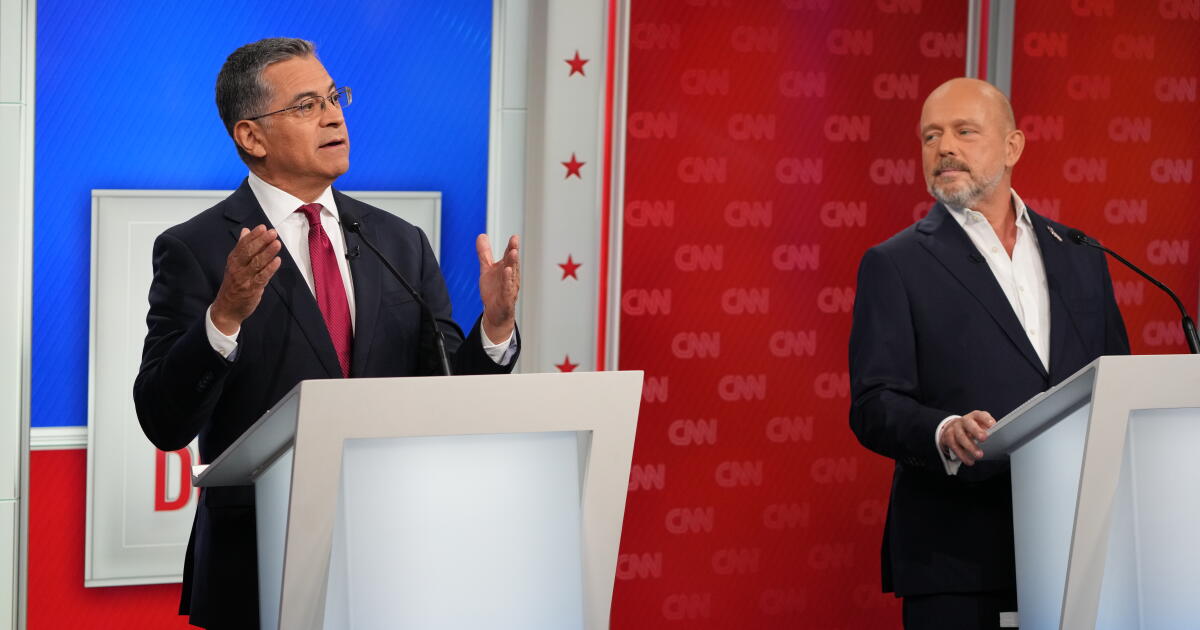
Meanwhile, his heavily favored — and far more staid — opponent, Democrat Xavier Becerra, has kept a comparatively low profile, agreeing to just one debate with Hilton and holding few public events, mostly in urban areas.
In a phone interview while driving through Los Angeles, Hilton said: “Whether I’m in Humboldt or Del Norte or Siskiyou County, my joke is, when people say, ‘Where do you live?’ I say I live in the Hampton Inn somewhere in California because we’re basically in a different place every night.”
The odds are against him.
Sure, California produced GOP presidents Richard Nixon and Ronald Reagan. But today, Democrats outnumber Republicans nearly 2 to 1 in the state, and the current White House occupant shares a mutual disdain with the vast majority of Golden State voters.
Hilton was endorsed during the primary by President Trump, who suggested at a campaign rally this month that Iran could “take out” Los Angeles and San Diego, drawing swift outrage from both Democrats and Republicans.
Hilton has tried to walk a fine line, appealing to the 6 million Californians who voted for the president in 2024 while simultaneously downplaying Trump’s support.
This summer, Hilton took out full-page ads in The Times and the San Francisco Chronicle asking: “Can you be anti-Trump and still vote for me?”
“Yes, I’m the Republican,” it said. “The ‘Fox News guy.’ Endorsed by Trump. But this election is not about who you hate in Washington. It’s about what you love here.”
Corrin Rankin, chairwoman of the California Republican Party, said that 16 years after the state’s last Republican governor, Arnold Schwarzenegger, left office, “it’s safe to say Democrats own all the problems in California.”
“You can’t blame Trump for what’s going on here in California,” she said. “We feel really good about Steve Hilton’s campaign. He is working so hard, up and down the state.”
Hilton has blasted California Democrats as entitled, saying they assume Becerra will cruise to victory in the race to replace termed-out Gov. Gavin Newsom simply because he has a “D” beside his name on the Nov. 3 ballot.
Hilton frequently quotes a September podcast interview by Los Angeles’ Democratic mayor, Karen Bass, who mocked his British accent and said: “The governor’s race right now is over. Our governor’s name is Xavier Becerra. You don’t need an election on Nov. 3. A Republican cannot win in this state.”
Hilton told The Times that Democrats “feel they don’t have to earn your vote. … They can deliver results that are bad as ever, and they don’t need to work hard to deliver results for people or earn their support. And I think it’s that attitude that is going to be their downfall.”
Steve Hilton has the support of 33% of likely California voters, according to a recent poll, while rival Xavier Becerra has 58%.
(Jason Armond / Los Angeles Times)
Becerra is a former member of Congress who represented Los Angeles, and he was the California attorney general and U.S. Health and Human Services secretary under President Biden. He has the backing of 58% of likely California voters, compared with 33% who support Hilton, according to a poll released late last month by the UC Berkeley Institute of Governmental Studies and co-sponsored by The Times.
The poll showed that voters’ top concern was reducing the state’s high cost of living — followed by fighting Trump administration policies.
“Hilton is trying to win an election, so he tries to frame himself as someone who can appeal to the broader electorate,” Underland said. “But at the end of the day, he has the albatross around his neck, which is Trump, who is openly hostile to California.”
Hilton cuts a colorful and pugnacious figure on the campaign trail. He eschews ties and jackets, favoring T-shirts with punchy phrases like, “$ave With Steve” and “WAKE UP” superimposed on a California license plate — a reference to his proposal to eliminate the state’s Department of Motor Vehicles and slash vehicle registration fees, which would cut billions in state revenue.
He wears one bracelet with the name of slain right-wing activist Charlie Kirk, whom he called an “incredibly close friend.” Another reads, “Save Girls’ Sports,” calling back to this spring, when he traveled to the state high school track and field championship in Clovis to protest the participation of a transgender athlete.
Republican nominee Steve Hilton protests transgender athletes’ participation in girls’ sports during a May 29 news conference in Clovis, Calif.
(Tomas Ovalle / For The Times)
Hilton, 57, was born in London to parents who fled conflict in their native Hungary during the 1956 uprising against the Soviet-controlled communist government and later anglicized their surname, Hircsák, to Hilton.
He was a senior advisor to British Prime Minister David Cameron, a member of the Conservative Party, though the men’s once-close friendship never recovered from Brexit, Britain’s withdrawal from the European Union. Hilton supported it; Cameron did not.
Hilton earned a reputation as eccentric but savvy, pushing the Conservative Party to embrace same-sex marriage and more climate-friendly policies. Dubbed “the barefoot revolutionary” for his refusal to wear shoes, Hilton was satirized on the BBC political sitcom “The Thick of It” as Stewart Pearson, the Tories’ “eco-friendly, media-savvy, blue-sky-thinking” communications director.
He and his family moved to California in 2012 after his wife, Rachel Whetstone, was promoted to lead global communications at Google. For six years, he hosted “The Next Revolution,” a weekly Fox News show from which Trump regularly tweeted clips.
In 2015, the couple purchased their home in the Silicon Valley city of Atherton, one of the wealthiest ZIP Codes in the U.S., for $12.5 million, property records show.
Whetstone now leads communications for Sierra, an AI startup founded by OpenAI board Chairman Bret Taylor and Clay Bavor, who met while working at Google. Hilton and Whetstone’s 2024 tax returns show they had a combined household income of $7.5 million, which included his reported earnings of $250,000 from Fox News and her $6.7 million from her then-employer, Netflix.
Hilton became a U.S. citizen in 2021 and last year renounced his British citizenship.
He finished second in the June 2 primary behind Becerra. Under California’s top-two primary system, the first- and second-place finishers, regardless of party, advance to the general election.
The pack of Democratic candidates was so large that party leaders initially urged struggling candidates — including Becerra — to drop out to avoid splitting the vote. Becerra shot to the top of the polls when then-Rep. Eric Swalwell, a front-runner at the time, dropped out of the race after he was accused of sexual assault and misconduct.
Republicans coalesced around Hilton after the president endorsed him over his GOP rival, Riverside County Sheriff Chad Bianco, a staunch Trump supporter who later said the endorsement made Hilton unelectable.
Kim Nalder, director of the Project for an Informed Electorate at Sacramento State, said it is exceedingly difficult for Hilton to distance himself from Trump and the Fox News brand.
“If you had a different brand of Republican they might have a shot,” given the discontent in the state over myriad issues, she said. “But Trump is so politically radioactive in California right now that it is an effective technique to tie this particular candidate to him.”
California’s population growth is stagnant after years of pandemic-era losses, with immigration lagging amid the Trump administration’s crackdown and many residents leaving the state for more affordable parts of the country.
Greg Perrone, past president of the conservative Greater Bakersfield Republican Assembly, said he was impressed with Hilton’s policy knowledge and the amount of detail in his economic plans.
Steve Hilton, right, chats with Sir Richard Branson before a White House dinner with then-British Prime Minister Cameron and President Obama in 2012. Hilton was an advisor to Cameron.
(Susan Walsh / Associated Press)
“There’s a real concern that the current state of the economy is worse than people expected,” Perrone said. “A lot of people hung their hat on Donald Trump saying he was going to bring down prices, and that just has not happened. There’s a lot of angst.”
Perrone said he remains a Trump supporter, though he has been frustrated by the frenetic roll-out of tariffs that, he said, hurt many businesses. While he has been annoyed that Becerra, in his view, has focused more on the president than laying out his own detailed economic plans, he acknowledged that the strategy plays well in blue California.
Christopher Cole, former chairman of the Lassen County Republican Party, said that in his rural corner of the state, he has seen Trump banners that have hung since 2016 start to come down because people are angry about the Iran war, the high cost of fuel and the economy.
“When Trump stupidly endorsed Hilton, it was the kiss of death for any down-ticket Republican,” said Cole, whose county voted for Trump on 76% of the ballots in 2024, the highest percentage in the state, and was the only one to support Bianco in this year’s primary.
“Hilton is a carnival barker and a very wealthy man,” said Cole, who supported Bianco. “You can’t run a multimillionaire when people are struggling to put food on the table.”
Hilton has made a slew of campaign promises to lower the cost of living, including having no taxes on income below $150,000, lowering energy bills by slashing climate-friendly regulations imposed by Democrats, and having $3 gasoline (though governors cannot directly set the price at the pump, which is driven largely by global crude oil supply and demand).
He has tried to channel the state’s discontent into persuading voters to “try something different” by voting Republican.
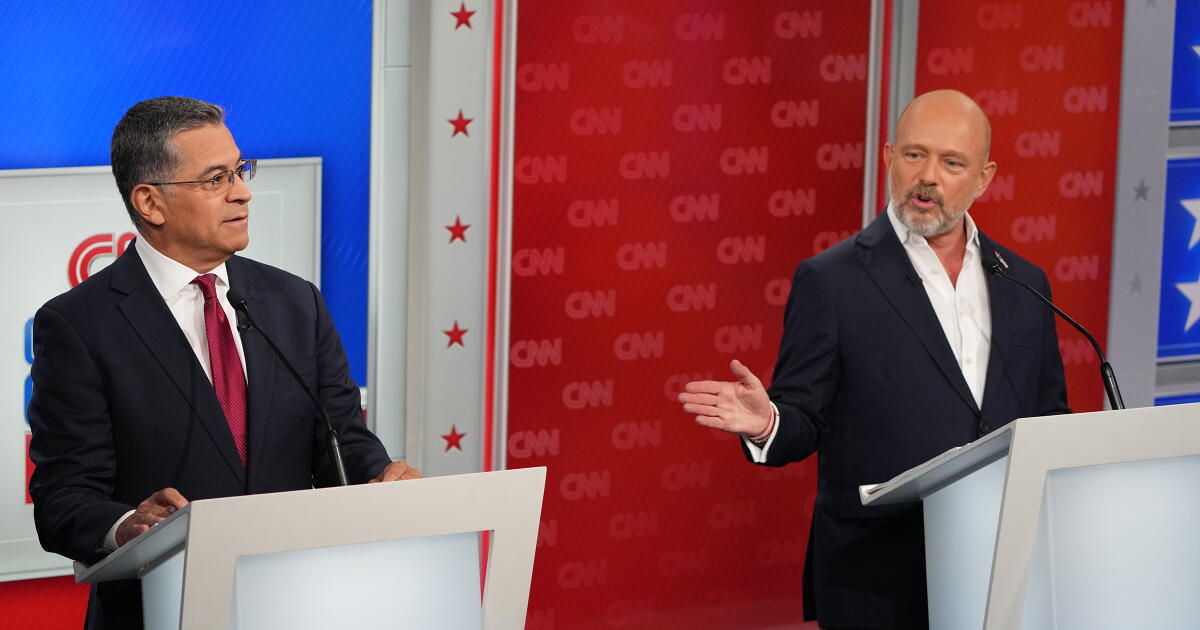
During the gubernatorial race debate on CNN last month, Hilton quoted a former Biden domestic policy advisor who reportedly called Becerra a “bitch-ass,” and his campaign promptly launched a website, bitchassbecerra.com, outlining alleged failures of the politician known for his calm demeanor and decades of government experience.
“I think Hilton got dealt a bad card with Becerra making the runoff,” said Rob Stutzman, a Republican strategist who was Schwarzenegger’s spokesman. “It’s difficult to get anyone outraged about Becerra because he is perfectly boring. He worked for Joe Biden — maybe that upsets some people? — but you can’t associate him with any bizarre, woke policies like you could Kamala Harris or Gavin Newsom.”
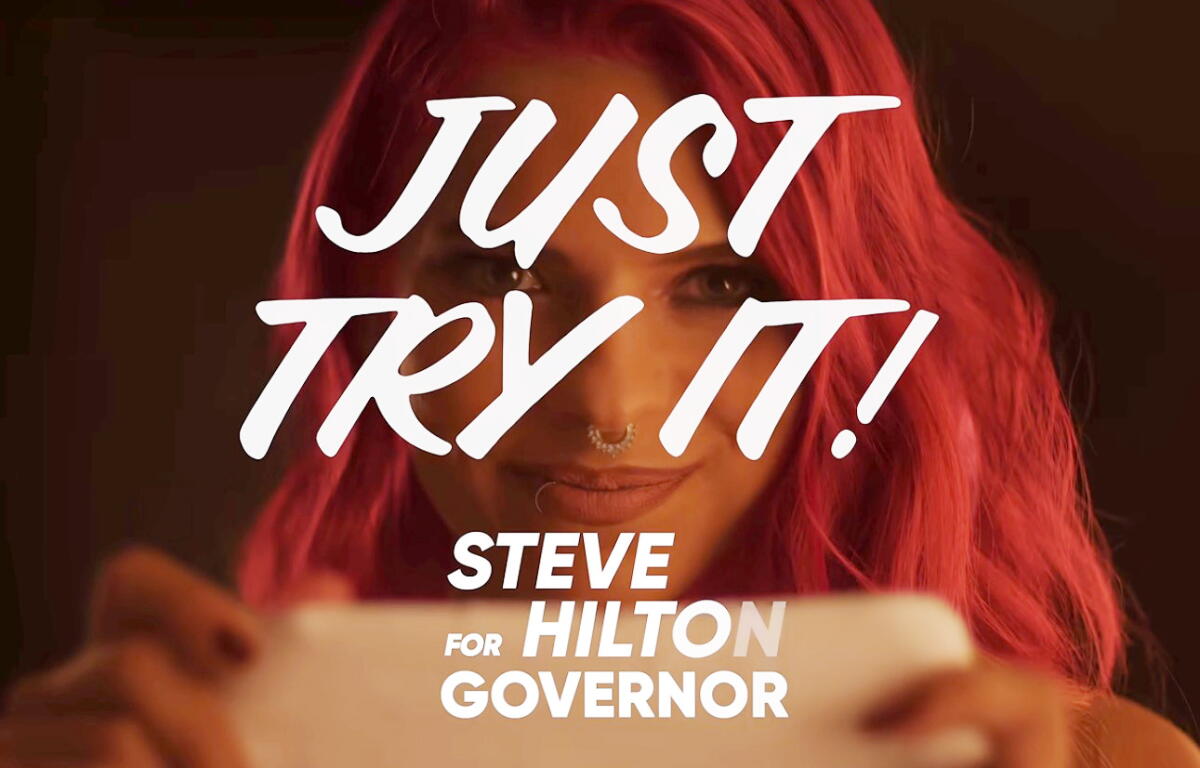
Hilton’s campaign this month released a provocative, sexually suggestive ad titled “Just Try It!” in which two young women sit on a bed in a candlelit room. An LGBTQ+ pride flag hangs on the wall, and they’re seemingly talking through one’s first romantic encounter with another female.
In a recent poll, voters rated California’s high cost of living as their top concern, followed by fighting Trump administration policies. Above, people gather in North Hollywood to watch the Sept. 30 gubernatorial debate.
(Jason Armond / Los Angeles Times)
Wearing a T-shirt that says, “RESIST,” the anti-MAGA mantra, the first-timer nervously says: “I’ve just never done anything like this before. Like, what if my dad finds out?”
The other woman holds her hand as she fills out a ballot for Hilton then says, “Now lick it,” referring to the mail ballot envelope.
Some conservatives condemned the ad, saying it promoted lesbianism. Liberals criticized it, too, saying it was insensitive to the LGBTQ+ community.
The day the ad launched, he told The Times: “I think there’s a very strong sense that things aren’t working in California, and my argument is: ‘OK, let’s try something different.’”
Later, he said he never meant to offend anyone with the risqué ad, which did, after all, do its job in racking up millions of views online — coveted and invaluable publicity for a long-shot California Republican.
Under an existing state appropriations restraint, also known as the Gann Limit, lawmakers cannot spend more in the state budget than an amount determined by a formula that takes annual tax proceeds, changes to the population and cost of living into consideration.
Tax revenue above the limit must be divided between schools and refunds to taxpayers. More recent carve-outs in the law also allow leaders to direct excess funds to infrastructure and local government.
The limit applies to most other appropriations of tax revenue, including money that lawmakers tuck away into the “rainy day” fund and other reserves.
California voters also have capped the amount of money lawmakers can set aside in the rainy day fund at 10% of general fund proceeds in a given year.
The proposed changes would exempt deposits into the rainy day fund and a short-term reserve, called the Projected Surplus Temporary Holding Account, from the state appropriations limit. The cap on the rainy day fund would grow from 10% of general fund tax revenue to 20%.
In effect, the measure would allow the governor and the Legislature to put more money into budget reserves, creating another option to avoid triggering rebates.
For example, if the spending limit is $400 billion for the year, and revenue hits $410 billion, the measure would give lawmakers the option to deposit the $10 billion above the spending limit into the rainy day fund, direct the money to infrastructure or give it to local governments, instead of returning the funding to taxpayers and increasing funding for schools.
Los Angeles Mayor Karen Bass and challenger Nithya Raman will be on the same stage Tuesday night for their final debate before the Nov. 3 election, but the two mayoral candidates are expected to come in with starkly different game plans.
With recent polls showing Raman in the lead, the councilmember will likely try to avoid making any kind of flub during the in-studio debate hosted by NBC4 and Telemundo52 in Universal City.
“A successful debate for Raman is one in which not very much happens,” said Dan Schnur, a professor of politics at USC, UC Berkeley and Pepperdine.
Raman floundered at the last NBC4/Telemundo debate during the mayoral primary, when Spencer Pratt was also on stage. She got better marks after a debate with Bass before the Sherman Oaks Homeowners Assn. in August.
Along with avoiding mistakes, Raman will need to paint a positive view of the city she hopes to lead, said Sara Sadhwani, a professor of politics at Pomona College.
“She needs to able to spell out a vision for the city of Los Angeles and inspire confidence that she would be able to deliver on such a vision,” she said.
For Bass, it’s a different task entirely. The mayor was the top vote-getter in the June 2 primary, but numerous several polls now show her trailing. The Berkeley IGS / L.A. Times poll, conducted Sept. 15-20, showed Raman with an 11-point lead over the incumbent.
To gain ground, Bass needs to go on the attack and convince voters that Raman isn’t fit to lead, Schnur said.
“Bass needs to explain to voters why voting for a relatively unproven candidate would be a dangerous risk to take,” he said. “I’m curious if it will go down the road of the nasty,” Sadhwani said. The debate, being conducted in partnership with Loyola Marymount University, will run from 7 p.m. to 8 p.m. and will be moderated by NBC4 news anchor Colleen Williams, NBC4 chief political reporter Conan Nolan and Telemundo 52 news anchor Alejandra Ortiz.
The Times will have live coverage.
You’re reading the L.A. on the Record newsletter
Sign up to make sense of the often unexplained world of L.A. politics.
By continuing, you agree to our Terms of Service, which include arbitration and a class action waiver. You agree that we and our third-party vendors may collect and use your information, including through cookies, pixels and similar technologies, for the purposes set forth in our Privacy Policy such as personalizing your experience and ads.
An influencer digs in on Bass
Social media creator Ed Choi made headlines this week, posting and then removing an Instagram video showing him and Raman declaring in unison: “Only you can stop fascist liars.”
The pair used that phrase as an image of Bass appeared on the video. Raman, facing criticism for her words, said she was referring to Trump and Immigration and Customs Enforcement raids, not the mayor or Los Angeles Police Chief Jim McDonnell, and had asked for the video to be taken down.
Choi defended his messaging, saying in a subsequent Instagram video that Bass is in fact a fascist, pointing to to Bass’ decision to appoint McDonnell, a former L.A. County sheriff. He also cited the Los Angeles Police Department’s treatment of anti-ICE demonstrators as evidence that the city is “descending into fascism.
Raman voted in 2024 to support Bass’ selection of McDonnell, even as her fellow Democratic Socialists of America colleagues on the council cast opposed his appointment. On the campaign trail, she has repeatedly criticized McDonnell, saying the LAPD should not have used tear gas on anti-ICE protesters exercising their First Amendment rights.
Choi also claims in his video that Raman is committed to defunding the police. But Raman no longer supports that idea, saying in February that LAPD staffing should not get any smaller.
Banned word lawsuit
When the Los Angeles City Council considered banning the use of the N-word and C-word at its meetings last year, Stacey Segarra-Bohlinger was in attendance to give the politicians a piece of her mind.
“This is going to bring lawsuits,” said Segarra-Bohlinger, who often sings parody songs at council meetings and has been a member of the Sherman Oaks Neighborhood Council.
Segarra-Bohlinger filed suit Tuesday, represented by lawyers with the Foundation for Individual Rights and Expression. The group contends that word bans — which can lead to people who use those words getting kicked out of meetings and potentially barred from future ones — violate First Amendment protections of free speech.
“The Council has weaponized the Word Ban and Meeting Ban to silence, remove, and prospectively exclude its critics,” asserts Segarra-Bohlinger’s lawsuit, filed in U.S. District Court in Los Angeles.
Segarra-Bohlinger filed the suit after her repeated use of the C-word at two council meetings last year, once while singing a parody song of the Ghostbusters theme song in which she repeated the line “Council is afraid of the word c—” four times.
Council President Marqueece Harris-Dawson is standing by the ban.
“In a moment of very serious attacks on our basic rights in this country, it’s especially absurd that some individuals would waste the court’s time defending the right of racists and misogynists to hurl invectives at the public simply to hear their own profanity,” he said in a statement to The Times.
State of play
—MONEY, MONEY, MONEY: Hedge fund manager Aaron Sosnick dropped another $3 million into Estamos Con Nithya, the pro-Raman independent expenditure committee sponsored by Western States Regional Council of Carpenters. Sosnick, who has been pushing for an expansion of the city’s bike lane network, has now put $6 million into the committee.
— UNION KERFUFFLE: The LAPD’s officer union said Tuesday it will oppose Measure FD, the half-cent sales tax measure on the Nov. 3 ballot pushed by the city firefighters’ union — setting up a bitter and expensive clash between two of the city’s most powerful unions.
— LEFT UNREAD: Citing lingering concerns about the potential misuse of police license plate readers, the Los Angeles City Council voted Tuesday to delay an agreement that would enable the deployment of hundreds of the controversial devices until officials are satisfied that the technology will be wielded responsibly.
— LAUSD WOES: The state’s school Fiscal Crisis and Management Assistance Team concluded that the Los Angeles Unified School District is at “high risk” of insolvency — and needs to move quickly to avoid losing control over budget decisions.
— HIT THE SKIDS: Federal authorities along with local partners like LAPD made more than a dozen arrests on Skid Row during a massive drug trafficking crackdown in the troubled Downtown neighborhood.
— LAPD’S LEGAL BILLS: The city of Los Angeles has shelled out nearly $480 million over the last five and a half years to end legal disputes involving the Police Department, including claims of excessive force, litigation over traffic accidents and cases filed by employees who allegedly faced retaliation after reporting misconduct.
— POLLING UPDATE: New polling from the pro-Nithya Raman independent expenditure group that was conducted between Oct. 2 and Oct. 7 found that Raman is leading the mayor 43% to 33% with 23% undecided. The poll’s margin of error is 3.5%.
— A separate poll sponsored by the United Firefighters of Los Angeles City, Local 112 and conducted between Sept. 25 and Oct. 5 found a tighter race, within the margin of error, with Raman leading 35% to 33% with 19% undecided. That poll’s margin of error was 4%.
— A third poll conducted for the Bass independent expenditure group Unidos con Bass of 602 likely Latino voters found the incumbent ahead by 12 points, 40% to 28% for Raman. The poll, conducted between Oct. 1 and Oct. 8, has a margin of error was 4%. That’s a 36-point swing from a UC Berkeley IGS/L.A. Times poll from September that found Raman ahead with Latinos by 24 points, 45% to 21%.
QUICK HITS
Where is Inside Safe? The mayor’s signature program went to Councilmember Ysabel Jurado‘s district on Santa Fe Avenue and 23rd Street and moved 35 people indoors.
On the docket next week: Bass and Raman will square off in a debate Tuesday night at 7:00 p.m. on NBC4/KNBC and Telemundo 52/KVEA.
Stay in touch
That’s it for this week! Send your questions, comments and gossip to LAontheRecord@latimes.com. Did a friend forward you this email? Sign up here to get it in your inbox every Saturday morning.
Riders at the Giro di Lombardia staged a protest which delayed the start of the race for five minutes as they sought to draw attention to safety concerns following a series of incidents.
Organisers completed the countdown and a starting flag was waved but the peloton remained stationary, creating confusion among spectators in Bergamo, Italy.
Belgium’s Remco Evenepoel then addressed the crowd, saying “there’s too many incidents happening with vehicles in the race” and highlighting the death of British cyclist Fin Tarling, who died in a collision with a vehicle at the Volta a Portugal in August.
“Unfortunately we lost the life of a brother and of a colleague of us, so we want to make this statement to show to the world that we cannot keep accepting the fact that guys are getting injured or literally dying in what we like the most to do,” added double Olympic champion Evenepoel.
After five minutes had elapsed, a second starting flag was waved and the riders set off for Como.
“This week alone, there were multiple incidents of vehicles on race courses,” said the CPA union, which represents professional cyclists, in a statement which was re-posted on Instagram by riders including Evenepoel and Great Britain’s Tom Pidcock, external.
“This summer, a life was tragically lost to exactly this kind of failure. We will not stand for this any longer.”
The CPA has called for cycling’s governing body, the UCI, to help ensure race organisers “take responsibility” and “act” to improve safety standards.
Earlier this week, Thomas Gloag and Marcel Camprubi were struck by a police motorcycle travelling in the opposite direction during the Tre Valli Varesine race.
“Riders race at high speed with little protection, and we depend on the UCI and race organisers to secure the roads. That responsibility is not being met,” the CPA statement added.
“We did not want to affect the race, only to show what riders can do when we stand as one.
“We love this sport. We respect the race organisers. We want to race hard and put on a show for our fans. However most importantly we want to come home safe to our loved ones.”
The Giro di Lombardia is the last of the season’s five Monuments, a set of long-standing, prestigious one-day races.
It has been won by Tadej Pogacar for the past five years but the Slovenian is not present at the race, which is also the penultimate event on this year’s UCI World Tour calendar, after sustaining a season-ending injury at the Vuelta a Espana.
SACRAMENTO — Over the last week, gubernatorial candidate Steve Hilton has created the exact kind of media kerfuffle he loves best by attacking his rival Xavier Becerra for Becerra’s description of his parents as “immigrants.”
Although Becerra’s mother, Maria, was born in Mexico, his father, Manuel, came into the world in Sacramento, in 1928. Soon after, Becerra’s grandparents moved their young family back to Mexico, where Manuel was raised until he returned to the U.S. as a young man to work.
As my colleague Gustavo Arellano said in a must-read column, this border back-and-forth has been more the norm than the exception for California’s Mexican American population for decades, if not centuries. Manuel Becerra’s luck at being born on U.S. soil may have given him an advantage, but it didn’t make him any less of an immigrant, Arellano explained, especially in an era when Sacramento’s Mexican population was below 2,500 and racism remained openly practiced and disturbingly accepted.
Hilton, however, has seized on Manuel Becerra’s U.S. citizenship to brand the younger Becerra a liar, allegedly falsely framing himself as the son of immigrants to gain identity-politics points in a state of immigrants. Whether one or both of Becerra’s parents qualifies as an immigrant might seem like minutiae to most voters, but Hilton’s accusation has thumped on the nerves on both the left and right — including my own, as the daughter of a South Asian immigrant.
Dog-whistle politics
Scratch the surface of Hilton’s attack and it becomes about something far more than Manuel Becerra’s citizenship — it’s a thinly veiled dog whistle about how a “good” immigrant behaves and how we should handle the “bad” ones. Here’s where all that gets messy for me: I agree with Hilton that being born in the U.S. is a big deal, and being a citizen is a point of pride. It does matter. I also agree with Arellano that Hilton’s attack is despicable.
Somewhere between those points are truths about immigration in America at this fraught and ugly moment, and just how different California is from the rest of the country when it comes to understanding the issue — and why that matters.
California’s Latinos, through numbers, history and hard work, have built political and social power on a scale that few, if any, other immigrant groups anywhere in the U.S. have managed. That unique position in the Golden State has allowed for what I call the magical realism of immigration myths to flourish, a wonderful gift to generations past and present that does not have the same widespread acceptance in other parts of this great country.
I firmly believe there is no such thing as a “true” immigration story.
Many, if not most, immigrants are leaving something painful behind — maybe it’s family, maybe it’s war or abuse. But carrying that burden forward with nothing more than hope to balance it, passing it on to future generations, explaining it to strangers, is too much. So immigration stories get softened over time, with trauma turning into adventure and hard facts blurred into entertaining myths.
That doesn’t make the tellers liars. It makes them human.
In the case of my father’s myth, he would have told you that his journey to America started with Humphrey Bogart. As a teen, he’d cut school to watch black-and-white movies like “Casablanca” in a theater in Ahmedabad in northern India, so long ago that there was an intermission to change the film reels. Enamored of white tuxedos and cool blondes, he started applying to scholarships for college in America — eventually winning a full-ride at a Utah school for his skiing acumen, a sport for which he claimed great skill but in reality had never tried.
My aunts and uncles variously dispute or embrace this tale, which my father loved to tell. I don’t know how true it is, but I do know this. My father’s journey to the U.S. did not begin with Bogart. It began in the city of Karachi, which was in India until the British drew a line on the map and created Pakistan. War broke out, with Hindus killing Muslims and Muslims killing Hindus. My father, a kid, got lost in a crowd with his grandfather. He watched as a mob killed his grandpa, then escaped by himself walking hundreds of miles to safety. He was eventually reunited with his family in a refugee camp, but his India was gone forever.
In its place, he dreamed of Bogart’s America. And when he finally got here, he buried his past under the Utah snow, became such a good skier he was on ski patrol, and didn’t mention his grandpa for nearly 35 years.
Like nearly every child of an immigrant, I love both the truth and the myth of my dad because combined they are the story of my family and of America. But my father was Indian and eventually settled in Ohio, much different than California. There was no larger Indian community back then (though it’s grown significantly, including dozens of family members who followed my father), and little tolerance for anything but assimilation. That was fine by my father. He wanted nothing more than to be American — though he would remain a green card holder for decades, until fear under the first Trump administration pushed him to get citizenship.
Hilton’s audience
Just like for Becerra’s dad, being an immigrant was a state of mind for mine, an experience, not an official status. Had my dad been in California, maybe he would have kept more of his Indian identity. Had Becerra’s dad been in Ohio, maybe he would have kept less of his past.
Neither viewpoint made either man more or less American — but the different myths these two men told about who they were define the difference between California and the rest of the country.
Hilton’s attack on Becerra’s dad was never meant for a California audience, where the Latino experience of fluidity in geography and identity holds center stage. It was always meant for places such as Ohio, and Fox News, where the expectation of assimilation still reigns supreme (just ask the Haitians of Springfield) and where Hilton’s media audience — and his future — resides after he loses in November, which he almost certainly will. Hilton, after all, was the host of his own conservative television show for years.
What seems like an out-of-touch attack by Hilton on brown immigrants in California is actually thoughtful pandering to his people — the right-wing Americans who prefer “good,” deferential, grateful immigrants (like Hilton himself) over the confident California Latinos who take pride in every part of their identity.
Sorry, California Latinos, but this MAGA moment in immigration has nothing to do with criminal records or even legal status. It’s all about attitude, and MAGA hates that you have so much of it. Hilton’s attack hits the target with his right-wing crowd because, to them, not centering his father’s U.S. citizenship is a rejection of the United States, a treachery they not-so-secretly fear all immigrants share.
And here’s the twist — MAGA is right, immigrants are complicated.
My dad may have been one of the “good” immigrants, embracing all things American and quiet about his past. But he always held deep pride in his family and his origins, and he passed that on — as do so many of the other “good” immigrants.
It’s possible, common even, to fully embrace being American while also valuing the myths and truths of immigration. It’s possible to to love this country while also keeping another one in your heart, loudly or quietly. There is no one immigrant experience, no one way to be a real American. Hilton, an immigrant and the son of immigrants, surely knows this.
But where immigrants see complexity, MAGA followers see only perfidy, disloyalty, and that makes them afraid and angry — and ripe for the exploitation of those emotions by someone who can sugarcoat it, twist it, just enough to seem reasonable.
Business groups such as the California Chamber of Commerce, the California Teachers Assn. and Planned Parenthood Affiliates of California oppose the proposal.
Gov. Gavin Newsom and Democrat Xavier Becerra and Republican Steve Hilton, who are running to replace Newsom, also have spoken out against it.
Opponents describe the wealth tax as a “flawed experiment” that will harm California’s economy because companies and rich people will flee the state.
“If they leave, it will create a huge hole in our budget, threatening core services like education, healthcare and public safety,” arguments against the proposition say.
Opponents of the measure say the proposal is an ineffective attempt to address the long-term effects of the healthcare cuts and would harm California’s economy and budget.
The state budget in California already is largely dependent on income taxes paid by its highest earners. Because of that, revenues are prone to volatility, hinging on capital gains from investments, bonuses to executives and windfalls from new stock offerings, and are notoriously difficult for the state to predict.
Billionaires such as Palmer Luckey, the co-founder of defense tech startup Anduril Industries, and entrepreneur Mark Cuban have pushed back against the proposal on social media. Some tech executives have been relocating or moving their assets to try to avoid the potential tax. Google co-founder Sergey Brin has been cutting ties to California, relocating to Nevada while funding groups such as Building a Better California that are backing ballot measures that could nullify the billionaire tax.
More than $187 million has been spent opposing the proposition, with the bulk coming from Building a Better California, cryptocurrency company Ripple Labs and its co-founder Chris Larsen, data from the secretary of state show.
Proposition 39 is opposed by leading state Democrats, major civil rights organizations including the American Civil Liberties Union and major labor unions in the state, who say the measure would disenfranchise eligible voters and expose voters to identity theft by forcing them to write personal ID numbers on mail ballot envelopes.
According to campaign finance reports, the ACLU of Northern California has contributed hundreds of thousands of dollars to defeating the measure. Quinn Delaney, a major Democratic donor and fundraiser for former President Obama, and Patty Quillin, a major philanthropist and wife of Netflix co-founder Reed Hastings, both have given $1.5 million.
The Service Employees International Union Local 2015, which represents long-term caregivers, provided $1 million, the SEIU California State Council for Working People gave $500,000, and the California Teachers Assn., through its independent expenditure committee, gave another $500,000.
Arnulfo De La Cruz, president of SEIU California and SEIU Local 2015, said in a statement that the group’s members “know our nation is stronger when working people make their voices heard and have their ballots counted,” and that strict voter ID laws “are part of Trump and MAGA extremists’ agenda to rig the election system so they can cling onto their own power and get richer from corporate corruption.”
Sen. Alex Padilla (D-Calif.) recently convened a news conference where a slate of Democratic leaders — including state Senate President Pro Tempore Monique Limón (D-Goleta) and Assembly Speaker Robert Rivas (D-Hollister) — called on Californians to vote no on Proposition 39.
The Democrats called the measure a “dirty trick” from “Trump acolytes” akin to historic poll taxes designed to disenfranchise Black voters, and a power grab that would seriously harm millions of eligible voters, especially in Black and Latino communities.
“Proposition 39 is a direct assault on everything California stands for. Our people, our values and our fundamental belief that every eligible voter here in California deserves to have their voice heard and deserves to have their vote counted,” Rivas said.
Your prospect of winning is small. So small, you could peer through a microscope, blink and miss it. How, then do you draw voters to your candidacy and boost your chances?
Actually, let’s not pretend. A very real flesh-and-blood Republican, Steve Hilton, is running for California governor and if your idea for grabbing attention doesn’t involve a make-believe lesbian couple, double entendre and a soft-core porn vibe, you’re very clearly lacking in imagination.
Hilton ran an ad featuring just such elements, garnering coast-to-coast notice, millions of views and ensuring the tagline — “Now lick it” — while not as resonant as, say, “The only thing we have to fear is fear itself,” will forever live in political infamy.
What the spot tries to do, convince folks in this left-leaning redoubt to be venturesome and vote for Hilton, is not the least offensive, though your friendly political columnist, hardly a prude, found the execution a bit, well, icky.
You’re reading the L.A. Times Politics newsletter
Expert columnists cover the insights, legislation, players and politics you need to know.
By continuing, you agree to our Terms of Service, which include arbitration and a class action waiver. You agree that we and our third-party vendors may collect and use your information, including through cookies, pixels and similar technologies, for the purposes set forth in our Privacy Policy such as personalizing your experience and ads.
Being a cis white male of a certain age, however, means perhaps we shouldn’t be the one to judge. We’re certainly not the target audience. So we turned to two of the youngish, hippest people we know, Daughters No. 1 & 2, who are both well-accomplished 30-somethings and truly upstanding citizens.
What follows is their spontaneous reaction.
Daughter No. 1: “Stupid, infantilizing.”
Daughter No. 2: “Wtf is this fake woke AI ad? Ew.”
(For the record, Hilton said the ad was not AI generated. He apologized, sort of, to those who took offense.)
We also asked the Fabulous Mrs Z. — who has impeccable judgment, notwithstanding all the years she’s stayed married to your friendly political columnist — for her response. “It’s just so strange and stupid,” she said. “Why would he approve this ad? It makes me question his judgment.”
What do the pros say?
Of course, that’s just four people — one of whom doesn’t even live in California — so it’s not much of a sample.
For more insight, we turned to some political professionals.
And who better to weigh in than Fred Davis, the madcap genius behind another infamous California campaign spot, the so-called Demon Sheep ad he concocted for Carly Fiorina’s 2010 U.S. Senate campaign. The Felliniesque production included lightning bolts, a Roman column and a man covered in sheepskin crawling on all fours and leering with a glowing red eye — the point being that Fiorina’s rival, Tom Campbell, was supposedly a profligate wolf in fiscal-conservative sheep clothing.
Strange, yes, but definitely more memorable than an accountant in green eyeshade laboring over the books.
Anyway, Davis — who’s featured Paris Hilton, bad hair and a giant rat in a crown as part of his out-there oeuvre — loved the new Hilton campaign spot, calling it “super attention-getting, super interesting.” (Which is not the least surprising from a man whose chosen epitaph is, “If you don’t notice it, why bother?”)
“I think it’s a brilliantly done ad,” Davis said, “wonderfully written.” And, he added, “I can’t imagine it gaining him one vote.”
Which was sort of the point, no?
Kevin Spillane also appreciates Hilton’s effort, given his own Sisyphean struggles as a Republican strategist in California.
A screen grab from Steve Hilton’s “Just Try It” ad. Columnist Mark Z. Barabak found execution of the spot a bit, well, icky.
(Steve Hilton for Governor)
“They’re doing something out there and on the edge. I don’t fault them for that,” said Spillane, who supports Hilton and has contributed to his campaign. “It’s a clever concept of trying to get people to do something that they’re not used to doing.”
Which is to say vote for a Republican for statewide office in California.
But Spillane, too, questioned the execution. “I actually was fine with the ad until they got to the ‘lick it’ line,” he said, insisting he is also no prude. “That’s just a little too explicitly sexual.”
Running, not advancing
To his credit, Hilton has been running hard for governor. Much harder than his Democratic rival and the prohibitive front-runner, Xavier Becerra. Hilton has issued an abundance of policy proposals and spoken before pretty much any group or microphone-wielding reporter or podcaster who’ll have him.
None of which has garnered Hilton anywhere near the publicity captured by his racy “Just Try It, California” ad.
Hilton’s edgy attitude and pugnacious put-downs would place him right at home among the network’s collection of trolls, provocateurs and Democrat-bashing gargoyles.
But Hilton should leave the advertising to someone else.
Democrat Xavier Becerra, the frontrunner to become the state’s next governor, often invokes the story of his parents’ humble beginnings as immigrants from Mexico who, through hard work, built happy and productive lives in California.
“My parents came to California with $12 in their pocket. They lived the California dream,” Becerra said during last week’s gubernatorial debate with Republican rival Steve Hilton, aired nationally on CNN.
Becerra for years has described himself as the “son of immigrants” when talking about his upbringing, but that claim has come under scrutiny by Hilton and other critics who accuse Becerra of embellishing his family history. Becerra’s mother is from Guadalajara, Mexico, but his father was born in Sacramento and raised in Tijuana — making him a U.S. citizen and not a legal immigrant.
“Unlike Xavier Becerra, I am an immigrant. Unlike Xavier Becerra, my father was an immigrant. My stepfather too. My whole family,” Hilton wrote in a post on X.
Hilton is an immigrant from the United Kingdom and is the son of Hungarian immigrants who fled their homeland during a revolution in 1956.
Richard Grenell, a former Trump administration official, accused news outlets of letting a lie “continue for decades” throughout Becerra’s tenure as California attorney general and then as a Cabinet official in the Biden administration.
Becerra has openly discussed the details of his parents’ story, which unfolded on both sides of the border and in many ways reflects Mexican immigrant trajectories during the historical period of the 1920s and 1930s.
During speeches and in interviews Becerra has described how his father, Manuel, was born in Sacramento in 1928 and taken back to Tijuana as a young boy, with few jobs for Americans during the Great Depression, and even fewer jobs for Mexicans working in the U.S. His father traveled between the two countries often, and, as an older child, he would look for work in the U.S.
Becerra on Tuesday accused Hilton of “casting lies” about his family’s background, saying that the Republican failed to understand the struggle that many Mexican immigrants and Mexican Americans faced in this county decades ago. He said his dad would tell of the days when he couldn’t walk into some establishments that had posted signs that read “No dog, Negros or Mexicans allowed.”
“This is what happens when people who don’t understand immigration start to pontificate,” Becerra said Tuesday after a morning rally against Proposition 39, a voter identification measure, at Guelaguetza, a Oaxacan restaurant in Los Angeles’ Pico-Union neighborhood.
“I am very proud of my parents, and I consider them immigrants because even though my dad was born in the U.S. — in a country that wouldn’t treat him the way it would treat other U.S. citizens — my dad was a proud immigrant,” Becerra said. “I am proud that I am their son. I am the son of immigrants.”
G. Cristina Mora, a UC Berkeley professor of sociology studying attitudes toward immigration, said Becerra’s critics misunderstand a common phenomenon at the time, when immigrants moved back and forth across a southern border that was much more porous — very different from the militarized border of today.
Beyond the dwindling jobs and precarious economics of the 1930s serving as a push factor for many Mexican families, a wave of xenophobia also helped send hundreds of thousands back to Mexico. A wave of mass deportations across the Southwest states resulted in more than 1 million Mexicans and their descendants being forced out of their homes and loaded on trains out. More than 60% were U.S. citizens.
Mora, who also serves as co-director of the UC Berkeley’s Institute of Governmental Studies, said “it was a time of very great anti-Mexican fervor.” Many sought to later return. Some were deported multiple times.
“There are many types of immigrants. There’s so much nuance,” Mora said. “To think there’s only one immigrant story would just be to not know California.”
Becerra’s campaign spokesperson Jonathan Underland in a statement accused Hilton of hypocritically attempting to capitalize on an immigrant narrative.
“Steve Hilton doesn’t seem to have a problem with immigrants who look like him — but openly attacks immigrants who look like Xavier Becerra,” Underland said. “Trump ignited a deep anti-immigrant animus among MAGA voters, and Hilton is tapping into that as he scrambles to distract from his bizarre ad campaign that alienated some of his closest allies.” Last week, Hilton’s campaign put out a provocative, sexually suggestive ad that drew criticism from his fellow Republicans.
Becerra, both on Tuesday and throughout his long political career, has often described his parents’ upbringing.
He said his father’s family moved back to Tijuana during the Great Depression. His father, he said, was the eldest child and was forced to leave school after the sixth grade to help support the family. He began working as a preteen, bouncing back and forth between the U.S. and Tijuana. He would tell stories about being a shoe shiner, at times of celebrities and movie stars. He also worked in the farm fields with his dad and sometimes with his uncles.
In the early 1950s he married Becerra’s mother, Maria Teresa, who lived in Guadalajara.
“When they decided to make a go of it outside of Guadalajara, they went to Tijuana. They didn’t have great success, so that’s when they decided to come to the U.S.,” Becerra said on Tuesday. “So when I say my parents came to California with $12 in their pocket, it’s because, Steve Hilton, my parents came to California with $12 in their pocket.”
Becerra’s father later began a construction career that lasted 30 years, while his mother worked as a clerical worker and later purchased rental properties.
Times researcher Cary Schneider contributed to this report.
SACRAMENTO — Look, Xavier Becerra could cruise to a South Pacific island and bask on the beach until election day and Californians would still choose him as their next governor.
Who won the debate? Becerra, because he came across as calm, collected and capable of governing this troubled state — certainly very few voters’ ideal candidate, but the only real choice for most Californians.
Moreover, Hilton’s only previous political experience was as an advisor to a British prime minister and his sole claim to U.S. notoriety was as a Fox News TV host–not exactly resume boosters in California.
He’s a shoo-in simply because he has a “D” beside his name in this state where Democrats outnumber Republicans nearly 2-to-1 and despise the GOP president.
Expert columnists cover the insights, legislation, players and politics you need to know.
By continuing, you agree to our Terms of Service, which include arbitration and a class action waiver. You agree that we and our third-party vendors may collect and use your information, including through cookies, pixels and similar technologies, for the purposes set forth in our Privacy Policy such as personalizing your experience and ads.
“You’re the candidate who is supported by the machine in Sacramento — the unions, big business, all these people that for 16 years have given us the highest cost of living in the country, made it impossible to build anything, given us the highest unemployment rate, the highest poverty rate….
“And that’s why we’ve got to try something different this time instead of voting for more of the same.”
OK, fair point. But try what exactly? That’s where Hilton stalls or veers erratically.
He’d build “10 new cities.” Build them where exactly? He doesn’t say.
He definitely doesn’t want to construct new apartment buildings in the suburbs “when we have got so much space that we could be building on in California.”
Like out in Southern California deserts or Central Valley farm fields — requiring two-hour commutes to urban jobs?
And where does the water come from for these 10 new cities as the West scrambles for what’s left of diminishing supplies? But unfortunately there was no discussion of that during the debate.
One debate exchange that caught my attention was about vaccines. Hilton seemed to be carrying the torch for whacko anti-vaxxer Robert F. Kennedy Jr., Becerra’s successor as U.S. health secretary in the Trump administration.
Debate co-moderator Dana Bash recalled what Hilton said previously about children’s vaccinations: “The government should have nothing to do with these fundamental and vital decisions.” And she asked whether he’d push to eliminate California’s vaccine requirements.
“No,” Hilton replied. “I’m pro vaccine.” But then he seemed to wander all over the stage looking to have it both ways.
It’s a “very, very emotional issue for a lot of parents,” he said, adding there’s “data around the world” showing that where vaccine “mandates are lower… you actually have higher [vaccination] compliance, where parents don’t feel that they’re being bullied into doing something that they don’t want to do. And that’s what I want to see here.”
But he ultimately said,“I’d follow the law.”
In California, the law requires all children without medical exemptions to be vaccinated for several diseases — including polio, measles, mumps, chickenpox, hepatitis B and whooping cough — before they’re admitted to school.
That’s a blessing. When I grew up, practically every kid at some point was bedridden with one or more of those dangerous ailments. Then some saviors invented vaccines.
“We had nearly eradicated measles,” Becerra said, responding to Hilton. “When I left HHS, you rarely heard of a case of measles…. Today, children are dying of measles. Today, the spread of measles has reached a proportion we haven’t seen since the 1960s.
“That’s what happens when vaccine deniers take over.”
Becerra achieved all he needed to in the debate. He didn’t screw up. He kept cool and actually was fairly quick on his feet in replying to Hilton’s attacks, while planting a MAGA hat firmly on the Republican’s head.
He missed an opportunity to accomplish more, however — like making Californians feel really good about voting for him, rather than merely because he’s the only Democrat left standing in the contest to replace the termed out Gov. Gavin Newsom.
Voters might like to hear what Becerra’s vision is — if he has one — for the California he wants to build.
What does he have in mind besides just defending California against Trump? That’s a given. How’s he going to lower our living costs? Upgrade public education? Prevent wildfires? Details, not platitudes.
Rather than relaxing on his lead, Becerra should be constantly moving around the state, introducing himself to Californians and — more importantly — listening to their problems and ideas. To his credit, he’s doing that this week.
“The debate was boring and uneventful, but Becerra won it,” says Republican consultant Rob Stutzman. “He is perfectly vanilla and that makes it really hard to pin him down in an attack.”
“We got the genuine Xavier Becerra. That’s exactly who he is,” says veteran Democratic strategist Garry Sragow, a longtime political ally. “Thoughtful, committed and very decent, but does not go very high on the charisma meter.”
In California right now, a candidate’s charisma rates much lower than a simple “D.”
Brazil’s closely watched presidential election is heading to a second round between leftist President Luiz Inacio Lula da Silva and right-wing Senator Flavio Bolsonaro, prolonging a deeply polarised race with major implications for the country and the wider region.
Brazil’s electoral court confirmed on Sunday that the two candidates will advance to a run-off on October 25 after neither won the majority needed to secure the presidency outright, with Bolsonaro leading at 55.8 million votes to Lula’s almost 53.2 million.
Recommended Stories
list of 4 itemsend of list
Lula, 80, is seeking a fourth, non-consecutive term after a political career spanning nearly five decades.
Bolsonaro, 45, is the eldest son of former President Jair Bolsonaro and is trying to return his father’s right-wing movement to power, even as the former president serves a 27-year prison sentence for plotting a coup after losing the 2022 election.
The election comes at a pivotal time for Latin America’s largest economy. Brazilians are grappling with concerns over crime and the cost of living, while the country faces an increasingly tense relationship with the United States. The vote is also being closely watched across a region that has shifted sharply to the right in a series of recent elections.
While a second round was widely expected, the first-round result did not play out quite as pollsters had predicted.
Here are some of the key takeaways from the election so far.
Brazil is heading for another Lula-Bolsonaro run-off
With nearly 99 percent of votes reported, Bolsonaro had about 47 percent of valid votes, compared with 44.9 percent for Lula. Neither reached the 50 percent threshold needed to win in the first round.
That sets up another Lula-Bolsonaro showdown, four years after Lula narrowly defeated former President Jair Bolsonaro. This time, he will face the former president’s eldest son.
The race could be extremely close, as polling ahead of Sunday’s vote suggested Lula and Flavio Bolsonaro were roughly tied in a potential run-off.
That puts voters who backed one of the other 10 candidates in the first round at the centre of the fight for the presidency over the next three weeks.
Ronaldo Caiado and Renan Santos, who together received about 5.3 million votes, have previously said they will not endorse either candidate in the run-off.
Flavio Bolsonaro did better than polls suggested
Most polls leading up to election day predicted the race would be pushed into the second round, but had Lula finishing the first round ahead of Bolsonaro.
Instead, Bolsonaro emerged with a lead of two percentage points, raising questions about why the final polls underestimated his support.
On Sunday, Bolsonaro said the results showed that Brazilians want change.
Analysts told the Reuters news agency that Bolsonaro may have benefitted from “protest votes” from people who may have preferred another candidate but saw defeating Lula as the priority. Many had been expected to shift their support to Bolsonaro only in a second round, meaning this could have consequences for his support in three weeks.
“The protest vote foreshadows what is to come in the run-off,” political analyst Rafael Favetti told Reuters. “While this should benefit Flavio Bolsonaro now, his growth potential in the second round drops precisely because that support has already been front-loaded.”
After the results came in, Lula said the votes were “unexpected” but that he would come back stronger in the run-off.
“I admit, I was convinced I would win in the first round. The game is about to start. We are in extra time. In extra time, we will win over the Brazilian people,” the 80-year-old said.
The right had a strong night in Congress, too
Bolsonaro’s surprising performance in the first round was part of a broader show of strength for Brazil’s right.
Right-wing parties, led by Bolsonaro’s Liberal Party (PL), were performing strongly in both houses of Congress, with the PL on track to emerge as the largest force in the Chamber of Deputies and making gains in the Senate.
This included victories for other members of the Bolsonaro family, including former First Lady Michelle Bolsonaro, Flavio’s stepmother, who won a Senate seat in the Federal District, her first elected office.
His brother, Carlos Bolsonaro, was elected to the Senate in Santa Catarina.
The results show that the political movement built around former President Jair Bolsonaro – known as “bolsonarista” – remains a powerful electoral force, even with the former president barred from running himself.
“The fact that far-right candidates for the legislature have exceeded all expectations suggests a deeper popular grounding for the bolsonarista project than many expected,” Andre Pagliarini, an assistant professor of history and international studies at Louisiana State University and author of a book on Lula, told Al Jazeera.
“Millions of Brazilians right now evidently feel the right best reflects their values and vision for the future,” he added.
The congressional results matter beyond election night, too. Both houses were already dominated by conservative lawmakers, and a stronger right-wing presence could make it even harder for Lula to push through his agenda if he wins another term.
A Bolsonaro victory, meanwhile, could give him more room to pursue his own priorities, including his pledge to seek an amnesty for his father.
Proposition 42 would prohibit new taxes on “retirement holdings, individually-owned assets, and other forms of personal savings” that take effect after Jan. 1, 2026. That includes financial assets, investment accounts, intellectual property, personal belongings and other assets used for retirement or financial planning.
It also would bar retroactive taxes on past earnings unless the state is using revenue from the tax to respond to emergencies such as a fire or a flood.
Proposition 42 could nullify Proposition 40, the proposed billionaire tax, because the two measures conflict with one another. If voters approve both, the one with the most “yes” votes generally would become law, according to the Legislative Analyst’s Office.
Proposition 42 could reduce state tax revenue but it’s unclear by how much, according to the office’s analysis. Currently, the state does tax certain personal property such as vehicles. It doesn’t tax people for owning financial assets like stocks and investment accounts but does tax income from them.
California Professional Firefighters, the California Federation of Teachers, the Nurse Alliance of SEIU California and the California School Employees Assn. all oppose the measure. They argue that it will make it harder to pass tax hikes to pay for police and fire departments, fix and repair local roads, staff local schools or backfill federal healthcare cuts.
They also argue that Proposition 43 skirts the California Supreme Court’s opinion on the threshold.
Gubnatorial candidate Xavier Becerra opposes Proposition 43. In a statement, he called corporations “special interests” that want the proposition to pass in order to block new taxes.
“Prop. 43 would hand special interests the power to block the resources our communities count on most: fire protection, safe roads, good schools,” Becerrra said.
Assemblymember Buffy Wicks (D-Oakland), who authored the legislation that became Proposition 43 — ACA 22 — opposes the measure and has urged Californians to vote against it. She said the only reason she crafted the bill was because it was a necessary bargaining chip to torpedo another ballot measure backed by the Jarvis taxpayers group that would have devastated revenues for local governments and retroactively rescinded some local tax increases.
The California Taxpayers Assn., the California Society of Certified Public Accountants, the CalAsian Chamber of Commerce and others back the proposition. They say it would result in the government spending taxpayer dollars more wisely while improving transparency.
The bulk of the contributions to support the proposition have come from Building a Better California, data from the California secretary of state’s website show. Top contributors to Building a Better California include Sergey Brin, Google’s co-founder; John Doerr, chairman of venture capital firm Kleiner Perkins; and Eric Schmidt, the former chief executive of Google.
Proposition 41 “requires more accountability, transparency and trackable progress of programs funded by our taxes, so that we stop funding failure and start funding successful outcomes,” a website for the proposition states.