promoting

Ethics complaint filed over ads falsely portraying Raman promoting homeless camps

Los Angeles mayoral candidate Nithya Raman’s campaign team has filed a complaint with the city Ethics Commission against an outside group backing Mayor Karen Bass, claiming its social media campaign promotes an interactive AI phone line with a voice falsely identified as that of Nithya Raman.

The ads, paid for by Thrive LA, are styled as real estate advertisements for a fictitious “Nithya Raman Realty.” Some show an image of Raman holding a tent, with the slogan “Keeping Tents on Our Streets.”

The ads are intended to promote the idea that Raman isn’t tough on homeless encampments, which Raman says misrepresents her position. People who call the number get a Raman sound-alike saying “We’re bringing tent communities to your block. Would you prefer them outside your children’s school, the library, or right outside your home?”

Raman’s campaign claims that Thrive LA broke campaign rules by failing to report the AI phone system on required campaign spending forms, and imitating Raman’s voice without stating who paid for it. Not disclosing that it’s an ad could lead voters to believe the AI voice is actually Raman, according to the complaint.

Ana Teresa Dahan, the executive director of Thrive LA, called the complaint “false and absurd” and added that the organization’s ad spending has been properly disclosed. She said the satire ads are protected political speech and abide by campaign finance rules. The advocacy group will continue running ads until Election Day, she said.

“Nithya Raman wants to run the second-largest city in America, and she can’t handle a parody phone number. Imagine how she’d handle a budget crisis, or a wildfire,” Dahan said. “The only real complaint here is the one Angelenos have about her record.”

Thrive LA defines itself as a centrist political advocacy group backed by business and community leaders. The group also received backlash over anti-Raman ads its ran during her 2024 reelection campaign for councilmember.

How to address the city’s homelessness crisis has been a central issue in the Nov. 3 election between incumbent Bass and challenger Raman, a City Councilmember. Raman has voted against imposing no-camping zones proposed by other City Councilmembers in their districts, but has said she would not oppose such zones if elected mayor.

Raman says she is committed to ending homelessness, but the city has gone about it the wrong way and that no-camping zones just push the problem from one neighborhood to another.

Bass made homelessness a central focus of her first term as mayor and launched Inside Safe to move people into hotels, motels and other interim housing. Unsheltered homelessness decreased for the first two years, but the latest homeless count showed the numbers are growing once again.

The anti-Raman ads, posted on Instagram, show videos of a recreational vehicle driving around L.A. On the vehicle are posters featuring Raman. One shows her pointing toward a large arrow labeled “Designated Poop Zone” next to the words “Coming to a Neighborhood Near You!” One poster includes a phone number that leads to the AI phone line.

The AI-generated voice carries a live conversation with the caller, and doesn’t clarify it’s not a real person unless prompted. When asked by The Times if the phone is being answered by Raman, the AI bot said, “I’m a fictional AI. I’m as imaginary as my campaign promises.”

The advertisement violates state law that prohibits the distribution of digitally fabricated audio of a candidate within 30 days of an election, according to the complaint.

“It’s both sad and illegal for Karen Bass’ conservative allies to be cloning Nithya’s voice, manufacturing her words, and hiding who is paying for it, all to deceive voters,” Liz Garcia, spokesperson for Raman’s campaign, said in a press release. “These are desperate tactics from corporate interests determined to keep their grip on City Hall.

The city’s Ethics Commission didn’t immediately respond to The Times’ request for comment.

Independent expenditure committee that support political candidates have increasingly come under question. These groups can raised unlimited amounts of campaign donations but cannot coordinate its activities with the candidate.

Any audio communication for an independent expenditure group must clearly state that it’s a political ad at the beginning or end of the audio, according to the city’s campaign rules. When inquired by The Times on Monday morning, the AI bot did state the ad was paid for by Thrive LA, uses artificial intelligence and isn’t coordinated with a city candidate or committee.

In audio recordings included in the complaint, the AI bot said that it couldn’t disclose who paid for the line when asked by callers.

Some small business owners in Raman’s district have said they’ve battled homeless encampments and public safety issues without support from Raman’s office.

Even so, homelessness in Raman’s district dropped by 49% this year, and the candidate says that if elected she aims to deliver those same results citywide.
Source link

California GOP group linked to Ohio news site promoting Ramaswamy Acton ad

As Ohio Republican gubernatorial candidate Vivek Ramaswamy came under fire for releasing an attack ad featuring his Democratic competitor’s estranged mother, a mysterious news site was running a Facebook ad boosting the controversial video.

The Buckeye Bulletin, which bills itself as an Ohio-based news platform committed to “reliable journalism” and “strong editorial standards,” popped up suddenly this spring and began pumping out a steady stream of pro-Ramaswamy content.

The publication’s articles have no bylines. There is no list of staff. The website does not feature digital advertisements, nor does it prompt readers to subscribe, but there is also no disclosure of who is funding it.

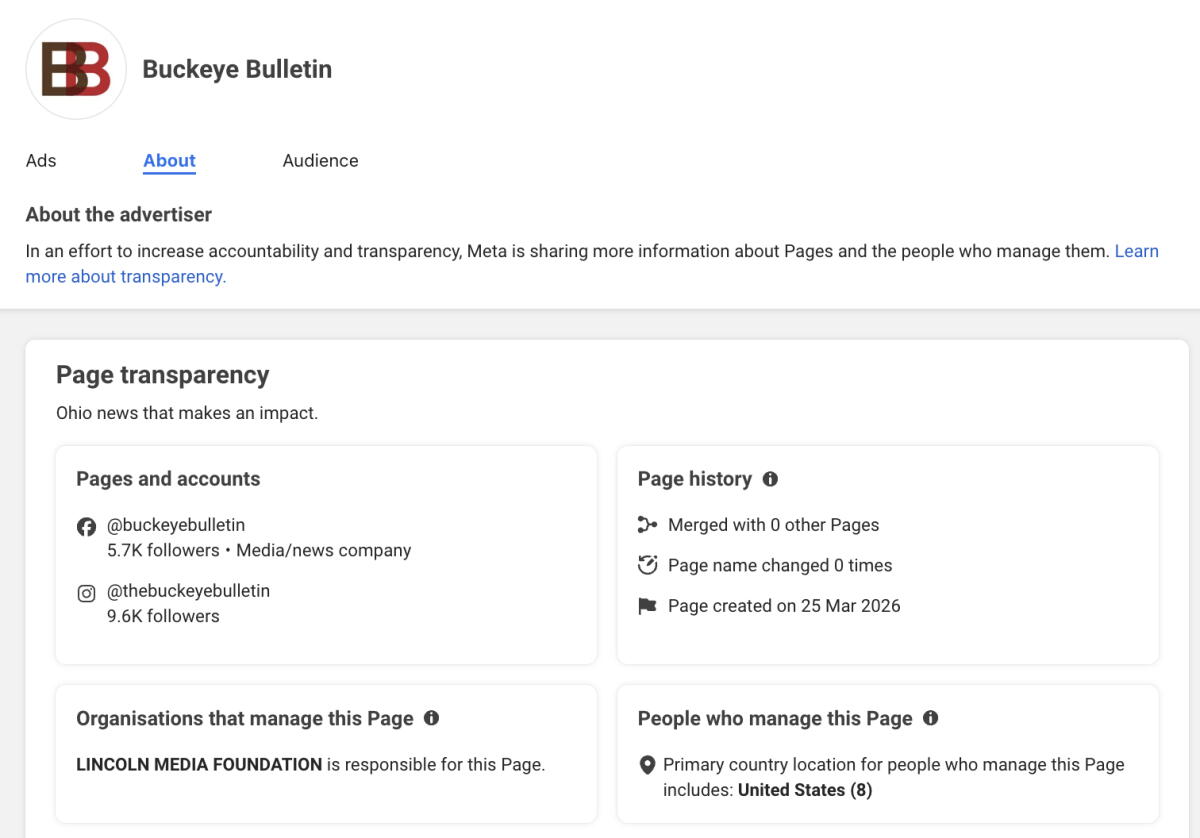
A closer look at the Buckeye Bulletin’s Meta advertising data shows that its Facebook and Instagram accounts are managed by the Lincoln Media Foundation, a nonprofit organization affiliated with the Orange County-based Lincoln Club — the oldest and largest conservative donor organization in California. IRS documents show that the club and foundation are associated organizations and share at least two key executives.

Meta's advertising data

Meta’s advertising data shows that the Lincoln Media Foundation manages the Instagram and Facebook accounts for the Buckeye Bulletin.

(Meta)

The Buckeye Bulletin, Lincoln Club and Lincoln Media Foundation did not respond to requests for comment.

The Bulletin appears to be a partisan site posing as a local news outlet ahead of the midterm elections, a strategy political scientists refer to as “pink-slime” journalism.

This is not the first time a “pink-slime” outlet has been linked to the Lincoln Media Foundation. In 2024 Max Read, director of civic innovation for the Institute for Strategic Dialogue, identified seven such alleged outlets.

With the exception of one Los Angeles-focused site, those outlets all targeted critical states for the 2024 presidential election such as Georgia, Pennsylvania and Wisconsin. Read reported that the media group had spent more than $63,000 on Facebook and Instagram ads, resulting in up to 18 million impressions during the last election cycle.

“[The sites were] very clearly designed to try to influence the information environment ahead of the presidential election,” Read told The Times. “They had all been started early in the year and used advertising on Meta platforms to juice their engagement numbers.”

When asked by The Times to take a look at the Buckeye Bulletin, Read said it appeared to be “pretty much copy and paste the same tactic that they used in 2024, even down to the aesthetics of the Facebook page and Instagram account.”

“It seems like they realized this worked at some level in 2024 and is worth doing again this year,” he said.

Earlier this year, CalMatters identified another outlet tied to the Lincoln Media Foundation called the California Courier, which had been circulating Facebook advertisements criticizing Gov. Gavin Newsom and the statewide redistricting ballot measure Proposition 50.

Since the Buckeye Bulletin’s Facebook and Instagram pages launched in March, the outlet has shared posts touting endorsements of Ramaswamy — a biotech billionaire and former presidential candidate — as well as his platform for addressing Ohio’s healthcare crisis and his stance on religious freedom in schools.

Simultaneously, the outlet’s social media posts have highlighted the refusal of his opponent — Amy Acton, Ohio’s former public health director — to debate, comments on how she “shut down” the state’s economy during the COVID-19 pandemic and a video with a watermark from right-wing political activist Laura Loomer.

This week, the outlet turned attention to Ramaswamy’s controversial campaign ad featuring Acton’s estranged mother, Donna Arthur. In the ad, Arthur calls her daughter a liar and urges voters not to support her.

However, the ad did not acknowledge that Arthur lost custody of her children after their stepfather, Arthur’s husband, was indicted for raping Acton when she was a child — an omission that drew fierce condemnation from Democrats and some Republicans, including Ohio’s Republican Gov. Mike DeWine. Others, including President Trump and Vice President JD Vance, an Ohioan, have defended the ad.

Arthur and her husband fled to Pennsylvania after his 1978 indictment where he died in 2004 without having been brought back to Ohio to face the charge.

Peppered in between political content on the Bulletin’s social media feeds is a smattering of reels related to non-political news, often featuring videos lifted directly from local TV stations. These other posts are used to create a “veneer of genuine local journalism,” Read said.

The language on the Bulletin’s About Us page displays markers of artificial intelligence such as generic mission statements, polished but repetitive phrasing and vague claims about journalistic standards with no details about the publication’s staff.

Of the last 30 posts shared on the Bulletin’s Facebook as of 5 p.m. Friday, 21 were about state or national politics and 10 were about the gubernatorial race. Engagement on the posts dealing with Ramaswamy and Acton is consistently strong for a page with around 5,600 followers.

For example, a Wednesday post on Ohio State Medical Assn.’s PAC endorsing Ramaswamy received more than 770 likes, 260 comments and 150 shares. Another video posted Wednesday with the label “Amy Acton refuses to debate, says mother is lying about her” received more than 4,800 likes, 1,500 comments and 500 shares.

Meanwhile, a non-political Wednesday post on a chemical explosion in Toledo received two likes, no comments and no shares.

The unassuming social media scroller or person who clicked onto the website would have no clue of the Buckeye Bulletin’s apparent connection to a group of wealthy Southern California Republications.

The Lincoln Media Foundation was started by leaders of the historic Lincoln Club, which was founded in 1962 and once counted John Wayne and former President Richard Nixon as members.

Today, the club describes itself as being home to “the most prominent business and thought leaders” in California and says it offers members the opportunity to meet world leaders and “experience their hobbies come to life through a combination of extravagance and leisure.”

The foundation notes that it uses a digital approach to reach communities left out of the national conversation, but its website does not disclose providing funding to any news outlets.

IRS records show that the nonprofit’s financial activities kicked up dramatically in 2024, the latest year for which data are available. The Lincoln Media Foundation reported $3.88 million in revenue in 2024, compared with $738,000 in 2023, $453,000 in 2022 and $415,000 in 2021.

The Buckeye Bulletin’s Facebook and Instagram accounts have spent just over $10,000 boosting posts this year, according to Meta’s ad library.

That’s barely a drop in the bucket in Ohio, where hotly contested races for governor and U.S. Senate have drawn hundreds of millions in spending. But presenting a slanted political view under the guise of local news tends to offer more bang for your buck than traditional advertisements, said Georgia Kernell, an associate professor in the departments of communications and political science at UCLA.

“Voters are so sick of ads; they’re getting tons of clear paid advertisements on the radio, on the television and on their social media feeds now,” she said. “Anything that can kind of look different is going to be more likely to keep their attention.”

Presenting as a traditional news source also increases the likelihood of viewers believing that the information presented is well-researched, she said.

Nik Usher, associate professor of communications at the University of San Diego, said it’s unclear how much influence pink-slime journalism is having on voting behavior, but political strategists are willing to try any new approach to possibly make a difference in tight races.

“This is one strategic effort to throw more spaghetti at the wall, hoping it’ll stick,” Usher said.

Creators of these partisan sites further stand to benefit from the fact that artificial intelligence tools are constantly scraping content from news websites without paywalls.

Researchers at NewsGuard recently found that leading AI chat bots are citing pink-slime websites nearly half the time when users ask questions about candidates and issues in the midterm elections.

Democrats and Republicans have increasingly leveraged pink-slime journalism to influence voters in the past few election cycles.

In 2020, the New York Times identified a network of 1,300 news sites that paid freelance writers to produce biased content for Republican groups and corporate public relations firms. In 2024, the left-leaning Star Spangled Media group used a site called the Morning Mirror to promote down-ballot Democratic candidates, according to research from Columbia Journalism School’s Tow Center for Digital Journalism.

More recently, the evolution of AI has increased the ease with which these websites can be populated with content, eliminating the need to pay writers and automating the production of social media posts.

Usher described pink-slime websites as “explosive bombs for public trust” that take advantage of the gap created by the loss of independent local papers and further diminish expectations for news to be fairly reported.

“Once these sorts of sites are pointed out to the public it further undermines distrust in political institutions, political parties, the news media,” Usher said, “especially when AI is associated with this kind of stuff.”


Source link

Colombian president purges National Museum of works promoting ‘communism’ | Arts and Culture News

Far-right President Abelardo de la Espriella says he will wage a ‘counterrevolution’ against cultural institutions.

Colombian President Abelardo de la Espriella has announced he is spearheading a cultural “counterrevolution” that includes removing dozens of exhibits from the National Museum, drawing protests and comparisons to United States President Donald Trump.

De la Espriella, a conservative Trump ally, said last week that he wants to prevent cultural institutions from being taken over by what he calls “atheist social communism”.

Recommended Stories

list of 3 itemsend of list

Since then, exhibits have been taken down that once addressed the history of social movements, including feminist and LGBTQ+ activism, and Colombia’s political violence.

The changes have sparked protests by civil rights groups, artists and students who have accused the government of censorship and warn that important parts of the country’s history could be erased.

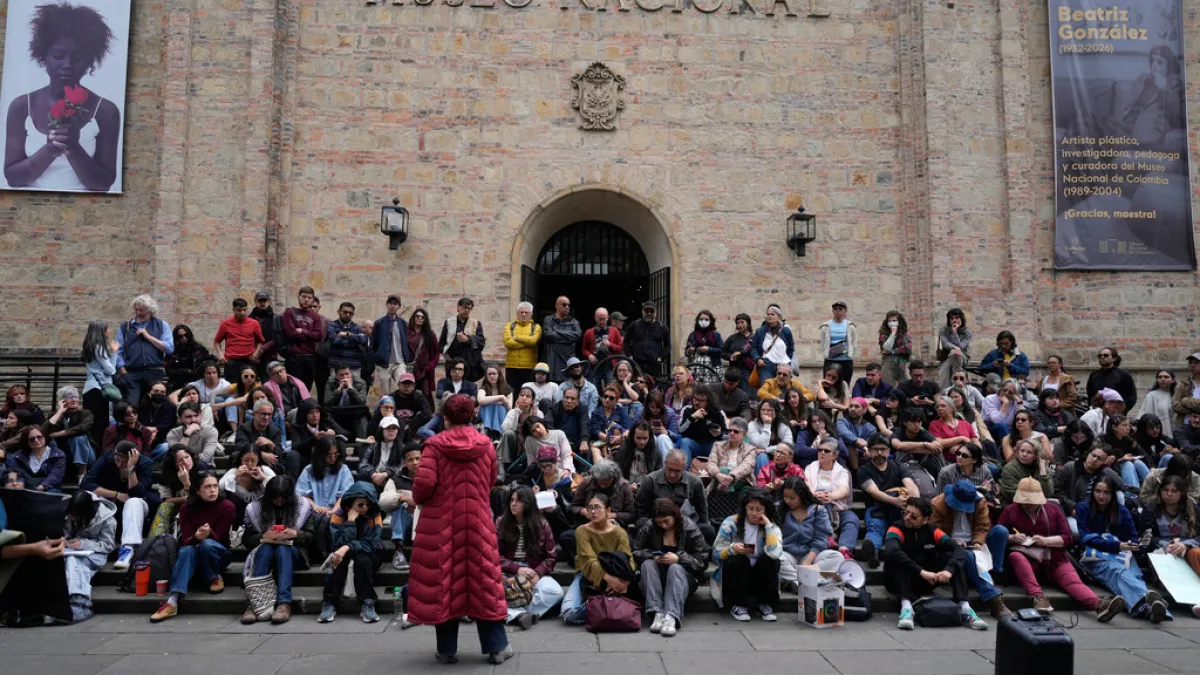
Dozens of demonstrators gathered on Wednesday outside the National Museum in downtown Bogota as riot police guarded its entrance.

“I find it outrageous that they want to erase part of our history,” said Azul Riascos, a history student.

He said the government was promoting a vision of Colombia as exclusively white, Catholic and Spanish-speaking. That image, he explained, excluded Black, Indigenous and LGBTQ+ communities.

Gimena Sanchez-Garzoli, director for the Andes at the Washington Office on Latin America, a research and advocacy organisation, said the Colombian government’s approach reflects a broader trend among Trump allies who are copying US political narratives and strategies.

Trump has been fiercely critical of museums in Washington, particularly those tied to the Smithsonian Institution.

The White House released a report in July branding leaders of the Smithsonian’s National Museum of American History as radical activists and has ordered signs to be installed outside the museum telling visitors that some of the exhibits are inaccurate.

Nearly three months after that order, such signs haven’t been installed. The museum’s director, Anthea Hartig, told Congress that the White House report “does not fairly or accurately characterise the full body of work at the museum”.

Sanchez-Garzoli said Trump’s cooperation with allied Latin American governments on security and counternarcotics efforts also has an ideological dimension.

“These are imported narratives about terrorism and about being ‘woke,’” anthropologist Arturo Sanabria said during Wednesday’s protest, describing the Colombian government’s approach as a form of neocolonial intervention.

Colombia’s Culture Minister Paola Holguin said the government was reviewing and redesigning exhibitions and curatorial practices at other museums overseen by her ministry.

The Foreign Ministry also renamed a courtyard previously honouring an Indigenous leader, describing the change as part of the president’s campaign against “woke” ideology.

“The government is making serious efforts in a cultural battle that probably doesn’t exist,” political scientist Estefania Cardozo said outside the museum. “It is inventing one to erase identities that cannot be erased because they already exist.”

Source link

Mailers promoting a socialist candidate in Ohio’s U.S. Senate race have links to MAGA super PAC vendor

Campaign mailers urging Ohio voters to support a socialist U.S. Senate candidate over Democratic nominee Sherrod Brown are being underwritten by a newly incorporated PAC with ties to President Trump’s MAGA Inc., public filings show.

The mailers are sponsored by Enough Promises Ohio PAC and began arriving in voters’ mailboxes in recent days. They promote independent candidate Greg Levy over Brown with messages such as “Join the Revolution” and “Send a Worker to the Senate.” Levy describes himself as “Socialist running for the U.S. Senate to represent Ohio in 2026” on his X account.

Levy condemned the fliers for falsely impersonating his campaign and engaging in “dirty tricks” designed to mislead voters. He said he is considering legal action.

“This is a highly undemocratic practice and does a disservice to voters in Ohio and throughout the country,” he wrote on X.

According to Federal Election Commission filings, Enough Promises Ohio was founded on Sept. 29. It has not yet had to disclose its contributors, but additional federal filings lay out a trail of associations linked to Republicans.

Enough Promises paid the firm Seven Farms more than $397,000 on two dates last week for printing, postage and mail services either supporting Levy or opposing Brown. Seven Farms, also a new entity, lists as its address the same South Carolina business suite as the one used by Whistlestop Strategies LLC.

Whistlestop is a direct mail outfit operated by Big Dog Strategies LLC, the strategy firm that advises Trump’s MAGA Inc. super PAC and that managed Republican Sen. Bernie Moreno’s successful campaign against Brown in 2024.

Messages seeking comment were left with Enough Promises Ohio and Big Dog.

MAGA Inc. and affiliated groups began pouring huge sums of cash into midterm races in September, after party officials had been urging Trump to begin spending some of the fortune he had amassed to help embattled Republicans before it was too late.

Smyth writes for the Associated Press. AP writer Jill Colvin in New York contributed to this report.

Source link