UFC Freedom 250: What to know about the bout, Paramount, lawsuit
President Trump is known for being combative. And to mark his birthday Sunday, he’s literally picking a fight — actually seven of them. But a legion of opponents are determined to squash the celebration.
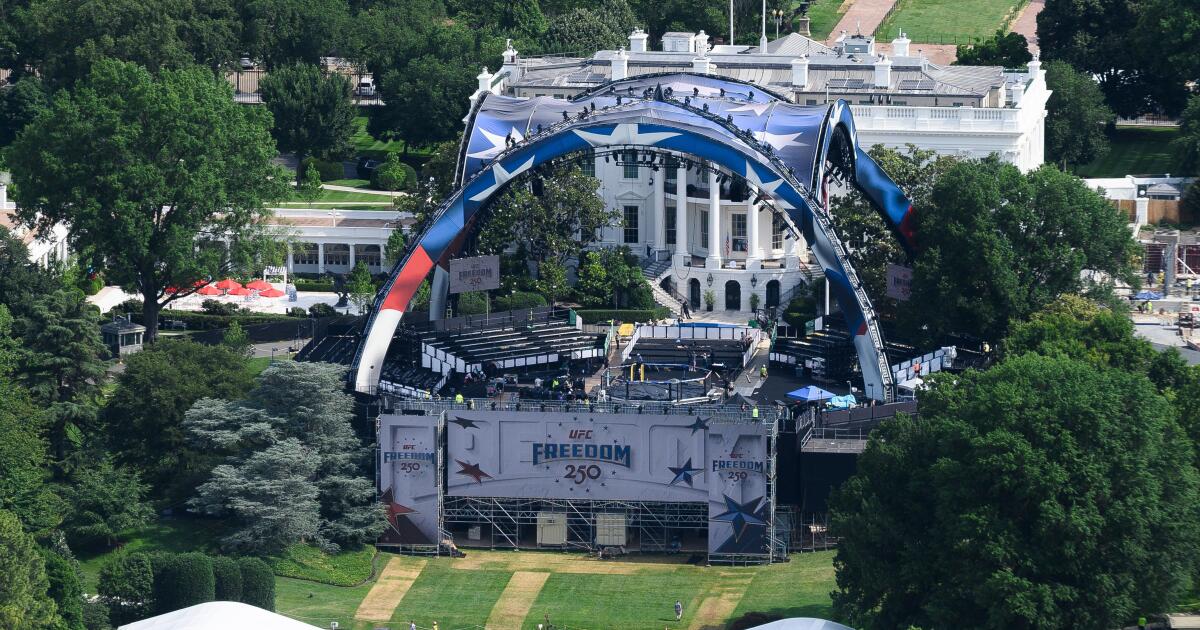
Trump has been gearing up for weeks for UFC Freedom 250, a mixed martial arts extravaganza that will turn the historic White House into a one-night fight house. The event designed to simultaneously celebrate his 80th birthday and commemorate America’s 250th anniversary will take place in a massive octagon-shaped structure that has been erected on the South Lawn of the White House.
The invitation-only event is scheduled to stream live on Paramount+, which is owned by David Ellison, one of Trump’s closest allies. UFC fights began streaming on the service earlier this year, with some airing on CBS, one of the first major deals signed under Ellison.
White House spokesman Davis Ingle has called the UFC card “one of the greatest and most historic sports events in history, and President Trump hosting it at the White House is a testament to his vision to celebrate America’s monumental 250th anniversary.”
But the gala is facing fierce legal challenges from activists who say UFC Freedom 250 is a scam flavored by financial and political corruption, accusing Trump and his close friends UFC chief Dana White and Ellison of benefiting financially from the event. Opponents say Trump has purchased stock in UFC’s parent company, TKO Group Holdings, while pointing out that UFC Freedom 250 is happening several weeks before the Fourth of July anniversary.
White House officials have called those allegations baseless and have asked a judge to dismiss the lawsuit.
As promo spots showing the combatants in fight mode fill the airwaves, the Public Integrity Project watchdog group has filed a lawsuit trying to derail the event. While the National Park Service is named as one of the defendants in the suit, environmental groups and former park service staff have decried the event.

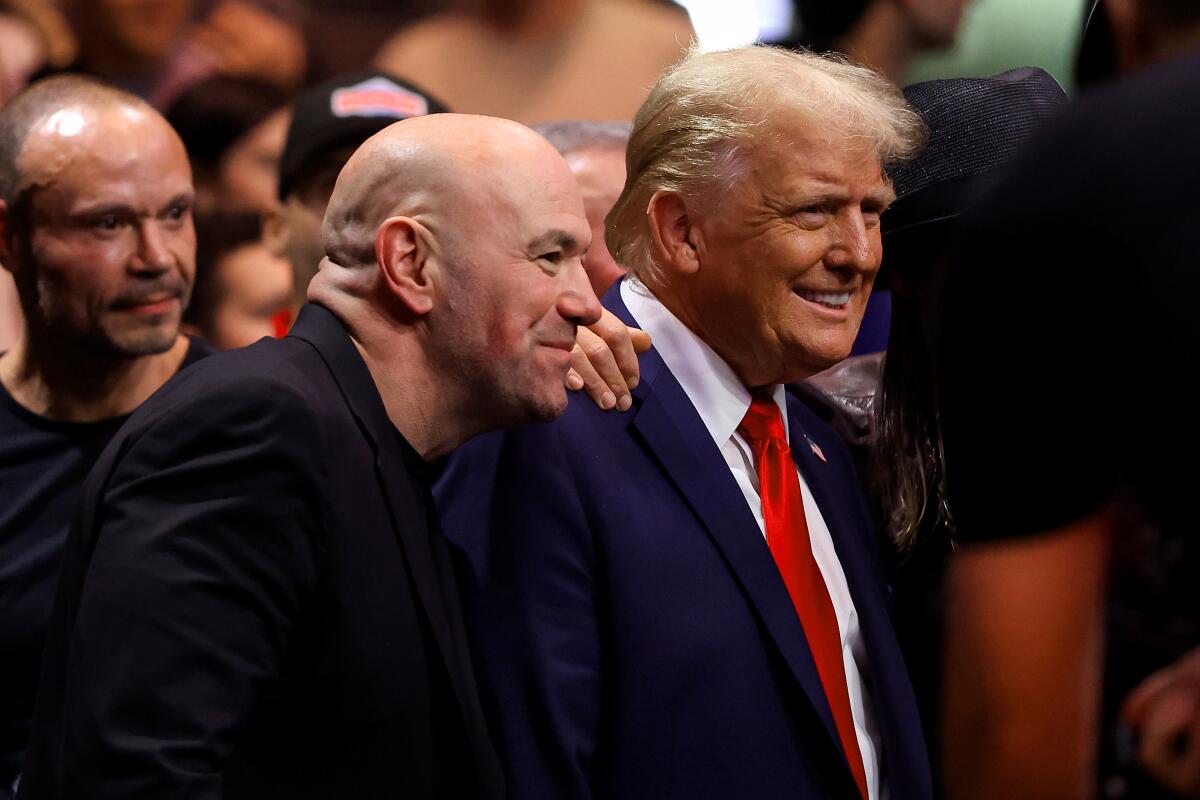
Dana White, left, and then-President-elect Trump attend a UFC event held at Madison Square Garden in New York City in 2024.
(Sarah Stier / Getty Images)
Though some legal experts have predicted that those efforts may fall short, UFC Freedom 250 marks the latest in a relentless stream of furors shadowing Trump as he faces sharply declining poll numbers and harsh criticism over his economic and domestic policies, as well as his handling of the war with Iran. Here’s what we know about the event and what to expect Sunday.
What is UFC Freedom 250?
The event will take place in a mammoth claw-like outdoor arena that will spotlight the White House in the background. Undisputed lightweight champion Ilia Topuria will face off against current interim lightweight champion Justin Gaethje in the main event, which is billed as a five-round title unification battle.
A six-fight undercard, including a heavyweight interim title bout between Alex Pereira and Ciryl Gane, will precede the main event.
Who is putting on the fight?
White‘s UFC is staging the event. White, who has stressed in interviews that no taxpayer dollars are involved, has said that Trump made the suggestion of a White House event when they were together at a recent UFC fight.
Wouldn’t baseball or basketball be a more appropriate sport to feature in a celebration of America instead of a cage fight?
Perhaps. But Trump is a huge fan of boxing and mixed martial arts. He was flanked by several of the fighters who will be participating in the event when he first announced the bouts at the Oval Office. He gushed as he introduced them individually, calling them warriors: “No people in sports are tougher than these people.”
But Conor Friedersdorf, a staff writer for the Atlantic, put forth a different theory: “On Trump’s 80th birthday, blood sport will be the diversion of choice at the White House because he wants to associate his presidency and himself with the violent domination and humiliation of rivals,” he wrote in a newsletter. “America itself is weaker now on the world stage than it was when Trump began either of his presidencies.”
White has credited the president’s devotion to the sport with propelling it into the cultural mainstream, and he is predicting a record-breaking global audience.
Where can viewers watch the event?
UFC Freedom 250 will stream on Paramount+ as part of a $7.7-billion deal that Ellison struck with TKO Group Holdings, the owner of UFC. The broadcast starts at 5 p.m. Pacific.

Dana White, left, and President Trump attend UFC 327 in Miami in April.
(Julia Demaree Nikhinson / Associated Press)
The event is another apparent maneuver for Ellison to curry favor with Trump as he seeks his support and approval for a $111-billion deal to buy Warner Bros. Discovery. Trump has made no secret for his desire for shake up Warner Bros. Discovery-owned CNN, which he regards as a hostile platform.
Will this be a star-studded event?
Don’t expect a New York Knicks-style celebrity row. Although several stars including Dwayne “The Rock” Johnson, Adam Sandler, Mario Lopez and former star quarterback Tom Brady have reportedly been invited by White, none have indicated that they plan to show up.
White has said that 70,000 fans have registered for free tickets to attend the fan event at the Ellipse near the White House.
Since it’s Trump’s birthday, is UFC Freedom 250 a political event?
“This isn’t politics,” White said recently on ESPN’s “The Pat McAfee Show. “This is about the United States, what this country is about … If you love America, you’re going to love this event. It has nothing to do with politics. We just happen to be on the White House lawn and the president of the United States will be there.”
Why is there opposition to the fights?
The lawsuit filed by the Public Integrity Project contends that UFC Freedom 250 violates federal regulations that prohibit sporting events on federal park lands. Two Virginia activists who are plaintiffs in the suit claim that they “want to uphold the rule of law and protect our nation’s most cherished monuments from corrupt exploitation.”
The suit contends that the plan includes a weigh-in at the Lincoln Memorial and a pre-fight walkout from the Oval Office.
According to the suit, “The president is giving White and his company what none have enjoyed before: unfettered access to the White House and Lincoln Memorial to state a private, for-profit sports event with all of the promotional and branding opportunities that accompany such access.”
Brendan Ballou, chief executive of the Public Integrity Project, said in an interview on MS NOW that the event and advertising is “fundamentally the private profiteering of our national monuments, and that is fundamentally what is violating the law and why we are suing.”