popular

Holidaymakers urged to leave these popular items at home or risk airport delays

A skincare expert has shared which beauty products are likely to cause problems at airport security due to hand luggage liquid rules – and how to avoid any hold-ups

With summer getaways fast approaching, countless holidaymakers are gearing up to travel overseas. As skincare continues to surge in popularity, many will be packing their creams and serums – yet skincare specialists are cautioning that transporting these products can prove more complicated than anticipated.

Experts at Landys Chemist have outlined the key ways skincare items can cause issues at airport security.

Skincare specialist Rhysa Phommachanh explained: “Many travellers are now packing full skincare routines in their hand luggage, but it can be confusing knowing which products are allowed. As a general rule, if a product can be spread, rubbed, or sprayed, it will usually fall under airport liquid restrictions.”

For instance, numerous skincare products nowadays appear as jellies, balms and sticks.

All of these are classified as liquids by airport security, as are sheet masks and eye patches.

Failing to adhere to airport security regulations could result in travel disruptions or having your belongings seized.

To conserve luggage space, travellers sometimes transfer larger items into smaller containers to meet requirements.

Nevertheless, these unidentified containers can prompt queries at security and trigger manual inspections, which can prove time-consuming.

It’s also probable that any pressurised containers such as facial mists, setting sprays or spray sunscreens will require manual examination and slow down security lines.

It is crucial to familiarise yourself with the regulations at each airport you pass through, as updated liquid rules are gradually being introduced across the country.

Restrictions may vary from one airport to another, so ensure you are fully aware of the specific guidelines before you board your flight.

When it comes to skincare, a minimalist approach often yields the best results.

As reported by the Express, Rhysa said: “A more simplified approach tends to work best for long-haul travel.

“Basic essentials such as lip balm, a lightweight moisturiser, or a facial mist are usually more than enough to maintain hydration without overwhelming the skin barrier.”

Source link

Popular beach resort warns families to avoid digging holes in the sand

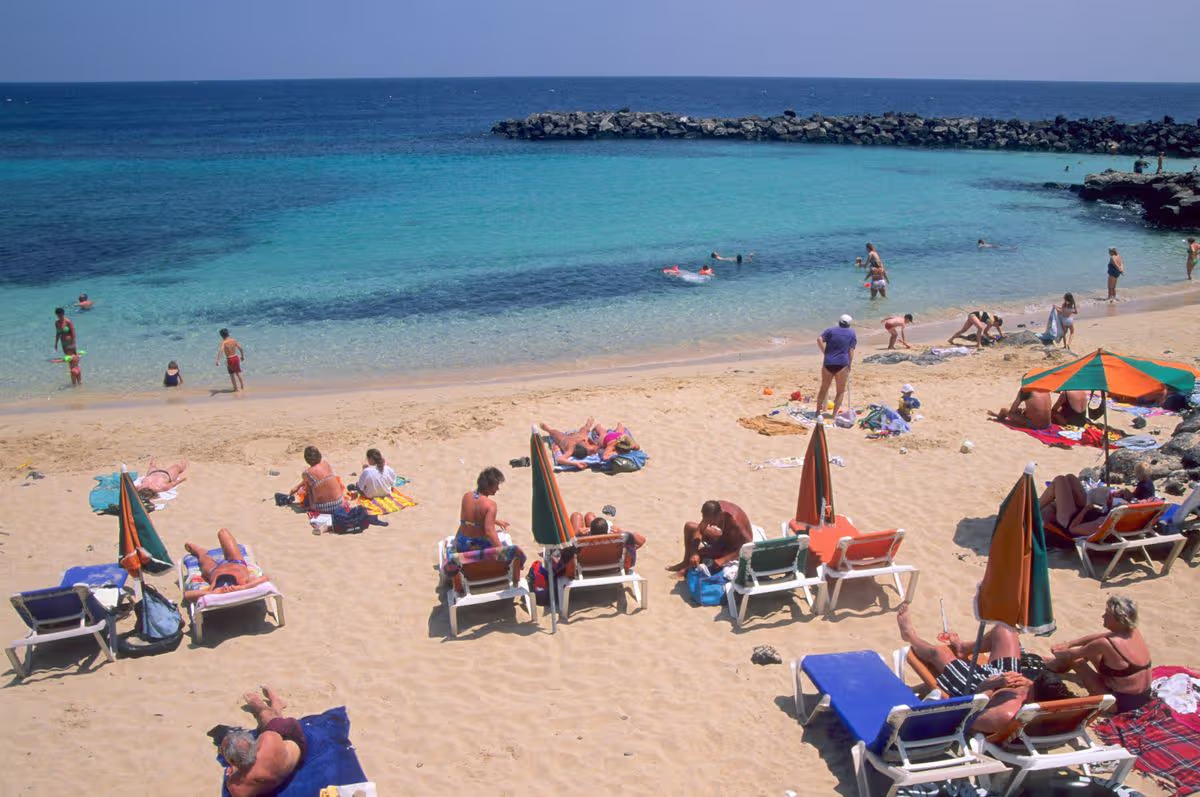
HOLIDAYMAKERS are being warned not to do one common activity at the beach.

Beach days are always fun, especially in the summer with the family – but the public are being warned to never dig a large hole in the sand in one part of the UK.

The coastguard is warning beachgoers to not dig holes on the beach Credit: Getty

This is because a large hole can collapse in on itself and could pose the risk of trapping someone, including kids and pets.

The fresh warning comes from the coastguard at Cleethorpes, a popular seaside town destination with a four-mile beach, traditional pier and family-friendly activities, making it the ideal day out.

According to the BBC, Cleethorpes Coastguard deputy station manager Shaun Lee said: “It’s like an avalanche effect, where the sand just keeps collapsing and collapsing, and then people just get completely buried in it.

He explained that when a hole is dug with steep sides, the wet sand will dry out and make it looser and as a result, more prone to collapsing.

Read more on travel inspo

GO ON

All the little-known websites for cheap or FREE tickets to gigs, theatre & festivals


HOL YES

I’m a travel editor & mum-of-3… my favourite family holidays from just £3pp a night

He added: “We don’t want to be the fun police – just be aware of what you are doing if you are digging holes.”

Also in Lincolnshire, last year coastguards filled a hole in Sandilands Beach that was nearly two metres deep.

At the time, the coastguards said they filled the hole “for safety reasons”.

Last June, the coastguard filled a hole on Weymouth Beach as well, which was around 1.5metres deep.

It took the coastguard three people and 30 minutes to fill.

Senior Coastal Operations Officer Allan Norman, at HM Coastguard, said: “Buckets and spades are a lot of fun – but most of us wouldn’t dream of digging a 5ft deep hole at a park where youngsters are running about and people walk in the evening.

“It’s the same at busy beaches: deep holes can be hard to spot in the sand and pose the risk of someone falling in and being injured, particularly little children and older people.

“There’s also the danger of the sand collapsing on top of you, causing injury and suffocation.

“These incidents require whole teams of rescuers.

“We’d just ask people to stay aware of who else is on the beach and the potential risks of digging too deep.”

Last year, coastguards filled a hole in Sandilands Beach that was nearly two metres deep Credit: Mablethorpe Coastguard

Even though beachgoers are warned against creating large holes at the beach, it doesn’t mean you can’t dig them at all.

Allan advises to just not dig it deeper than waist height and to avoid digging tunnels, which are even more likely to collapse.

He added that you should fill the hole in before you leave the beach.

If you do happen to be caught in a situation where you get stuck in a large hole on the beach, GOV.UK recommends creating a circle of people around the hole, who dig with their hands to create an outer circle.

Then create another circle of people behind that circle, but they will be removing the sand dug from the first circle.

By creating multiple circles, it will make the original hole bigger and more shallow and as a result, it will be less likely to collapse.

In other beach news, here are our 26 must-visit UK beaches for 2026 – including tropical-feel spots and family-friendly finds.

Plus, here’s the UK’s warmest beach that’s also home to two of the ‘most idyllic holiday homes’ and you can stay from just £30pp a night.

Holes can collapse and end up trapping people Credit: Getty

Source link

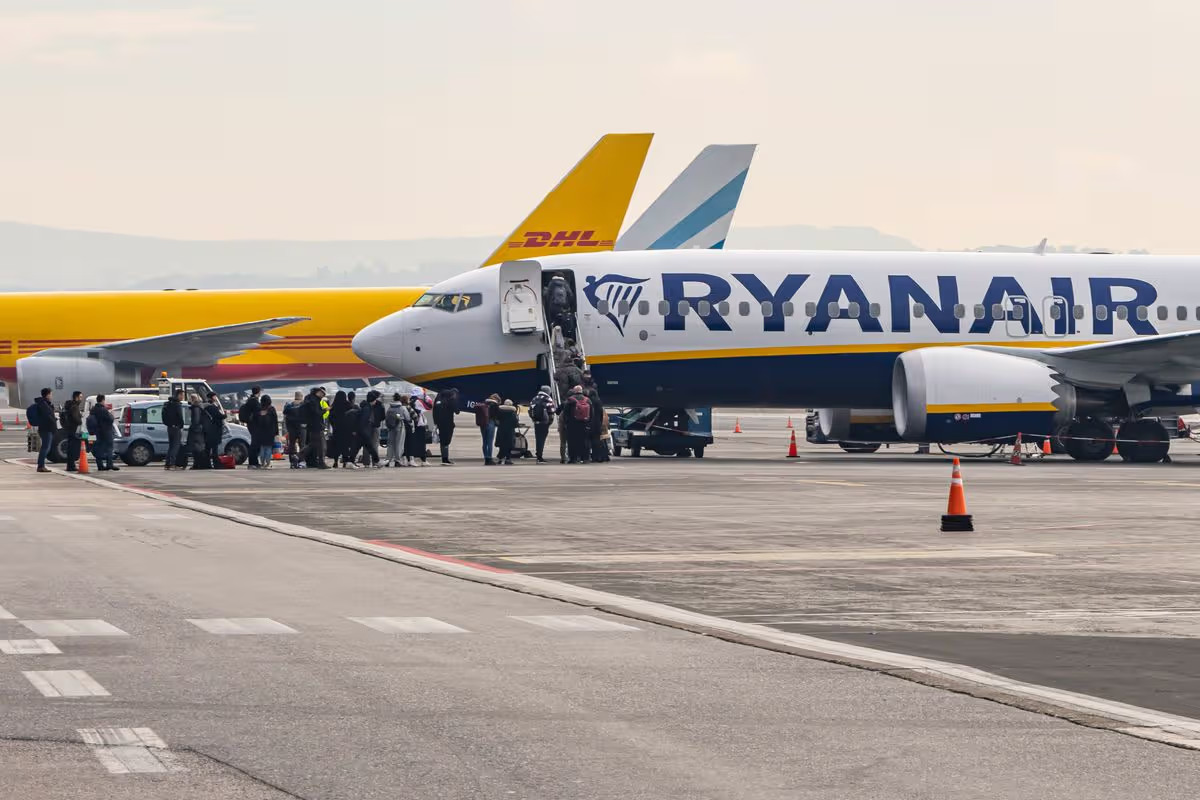
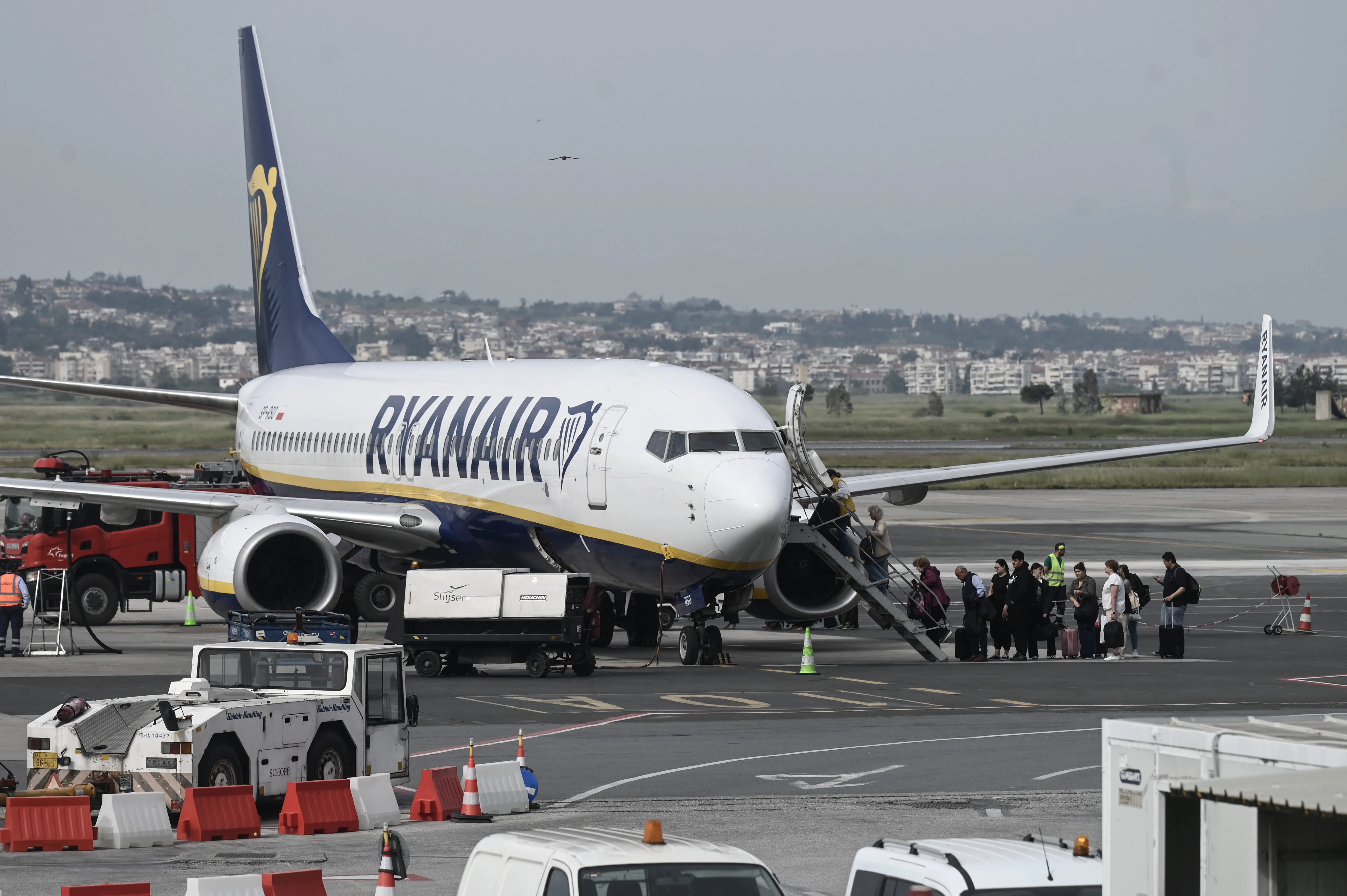
Ryanair threatens to axe flights to popular European hotspot over EU rules chaos

Ryanair has threatened to cancel flights to a popular EU country if border control delays do not improve, as the EU’s new Entry Exit System (EES) causes waits of up to 40 minutes at its airport

Ryanair has threatened to cancel flights to a beloved European hotspot unless lengthy queue delays are brought under control.

David O’Brien, CEO of Ryanair’s Malta subsidiary Malta Air, has put the government on notice that the airline could divert capacity away from Malta to rival Mediterranean destinations if border check hold-ups at the airport fail to improve.

“If we find ourselves with significant congestion and delay, we’d have to redirect capacity away from Malta to other destinations and that’s not something we’d like to do,” he told the Times of Malta.

The EU’s new entry/exit system (EES) has triggered significant delays at a string of busy airports, with passengers in Malta facing waits of up to 40 minutes.

Have you been caught up in EES delays? Email webtravel@reachplc.com

READ MORE: Ten airlines add extra charges as jet fuel crisis gets worseREAD MORE: What the Iran War fuel crisis actually means for your holiday prices

The problem affects all non-EU travellers, with passengers from the UK – Malta’s biggest market – bearing the brunt of the disruption.

“Europe is utterly unprepared in a general sense. We hope Malta is prepared. We haven’t reached summer peak yet,” Mr O’Brien warned.

David Curmi, executive chairman of national carrier KM Malta, also voiced his concerns to the Times of Malta over mounting delays.

“We are unable to wait for passengers to board our aircraft. Passenger compensation regulations state that we have to compensate all passengers, including those who arrive late because of this system,” he said.

Both aviation chiefs have called for the system to be suspended to prevent delays and passengers missing their flights during the peak summer period.

It was announced yesterday that Greece has suspended EU fingerprint and facial scans for British holidaymakers. The country has chosen to abandon the new biometric security measures amid fears about queue chaos spreading across the continent. Queues have been hitting the country, with four-hour waits reported in many destinations, including Greece.

Eleni Skarveli, director of the Greek National Tourism Organisation in the UK, emphasised that the decision would “ensure a smoother and more efficient arrival experience in Greece” and would “significantly reduce waiting times” while easing congestion at airports.

A total of 122 passengers were reportedly prevented from boarding the flight from Milan Linate to Manchester on Sunday due to delays at passport desks triggered by the roll-out of the EU’s Entry Exit System (EES). The 11am departure was delayed for 59 minutes before taking off with the bulk of seats vacant.

READ MORE: Virgin Atlantic launches new 13-hour flights to South Korea – what it’s like onboardREAD MORE: Mum misses £1,400 TUI holiday after making simple battery mistake

Under the EES, travellers are required to register their biometric information, which involves having their fingerprints scanned and photograph captured.

They must also respond to questions about their visit, such as whether they have accommodation arranged, sufficient funds for their trip and a return ticket.

All children must register, though under-12s are exempt from fingerprinting. EES is free for travellers.

Prior to its launch earlier this year, the Home Office warned travellers to anticipate “longer wait times at border control”, while Advantage Travel Partnership advised visitors to southern Europe to “allocate four hours for navigating the new system”.

The system is designed to strengthen border security by reducing illegal migration and identifying visitors who overstay. Once registered, travellers won’t need to repeat the process for three years. Any future border crossing during that timeframe will require verification of an individual’s fingerprints and photograph, which is anticipated to be faster than the initial registration.

Ryanair has been contacted for further comment.

Source link

Popular countries like Spain and Italy will ‘pay Brits thousands’ to move abroad

Destinations loved by Brits are actually paying people to move there. If you fancy a life in the sun, you could make some extra cash while topping up your tan in Spain or Italy

Many people may dream of moving abroad, but you might not realise that some countries will actually pay you to do so. If you fancy living in the glorious sunshine, and making some money in the process, you could actually embark on the travel adventure of a lifetime by packing your bags for good.

Countries like Spain, Italy and Greece will actually pay Brits “thousands” to relocate and start a new life abroad. If you’re fed up of the weather, fancy starting a fresh chapter or simply want to move to somewhere totally different, it may be something worth considering to liven things up.

Schemes people can use were recently highlighted on TikTok by History On A Map to tell people what they need to know. It’s incredible to think you can be paid to relocate to these beautiful countries.

Italy

Italy is one country that pays people to relocate. If you fancy tucking into pasta, enjoying gorgeous wine and immersing yourself in history a little more, you can actually be paid to move here. It explained: “Regions like Calabria, Molise and Sardinia are suffering from massive depopulation.

“To revive these ghost towns, the local governments are offering between €10,000 (£8,705.50) to €30,000 (£26,116.50) to people under 40 who are willing to settle there.”

Content cannot be displayed without consent

It turns out Italian regions such as Calabria, Molise and Sardinia offer financial incentives to boost declining populations in rural areas. There are reported to be schemes that offer up to €30,000 to people willing to move to towns with fewer than 2,000 to 3,000 residents.

Usually, to benefit from the scheme, applicants need to be under 40, start a business or renovate a home. There are some guidelines people need to follow to be able to benefit.

Spain

Again, towns in rural areas are looking for people to move there, such as Ponga in Asturias. The video detailed: “As part of the empty Spain initiative, the town of Ponga is offering €3,100 per person just to move there.”

According to reports, this figure is actually claimed to be between €2,971 and €3,000 per person (often reported as roughly £2,600) to new residents. However, there are additional incentives for couples and families to boost its dwindling population.

If you fancy taking the leap, the scheme requires a five-year commitment to live in the area. In other words, you need to be sure before you apply to move.

Greece

You can also move to the tiny island of Antikythera in Greece. It’s said people can be paid up to €500 per month for the first three years.

The relocation package aims to repopulate the area, providing new residents with a house, a plot of land and the monthly payments. The initiative primarily targets families and skilled professionals such as bakers, builders and farmers to support the local community.

Other options

The video also highlights that people can be paid to move to Japan. The amounts people can be paid differ, as every scheme has its own set of guidelines, and may not be as much as detailed in the video.

While people can’t be paid for simply moving to Ireland, grants are available for people who move to renovate properties on its remote offshore islands. There are all sorts of schemes people can benefit from, but it’s not as easy as packing your bags.

There are rules people need to follow to benefit, and they vary depending on where you want to apply to move. Do your research to find out more.

Source link

Popular European city brings back ‘tourist tax’ this week

A POPULAR European city is set to bring back its ‘tourist tax’ for visitors this summer.

The city became the first metropolitan area globally to charge day-trippers an admission fee, which was introduced on April 25, 2024.

Panoramic view of the Grand Canal in Venice at sunset with a gondolier in the foreground.
A popular European city is set to bring back its “tourist tax” for some visitors this summer Credit: Getty

Day-trippers who book last-minute trips to Venice this summer will feel the biggest sting, with reservations that are made less than four days in advance costing €10 per person.

Holidaymakers who are a bit more organised, and book their trips more than four days ahead of their planned visit, will only have to pay €5.

Entering the city before 8.30am or after 4pm exempts you from paying, as does being a current resident or a Venetian-born visitor, a student, worker, or someone in the city on an overnight stay.

When you’ve secured your QR code via the booking platform, it will be checked at one of seven entry points across Venice, which includes Santa Lucia railway station.

SUNNY STEALS

10 cheap Spanish holidays to book NOW – with all-inclusive breaks from £199pp


SEA IT

UK seaside town undergoing a £40m revamp is home to the country’s best pier 

However, if you do not pay the fee and are not registered for exemption, or if you fail to produce the QR code, you could be fined anywhere between €50-300.

That’s equivalent to up to £260.

The number of pay-to-enter days is increasing from 54 to 60 this year.

However, last year’s stats show visitor numbers dropped only slightly over the summer, from an average of 16,676 in 2024 to 13,046 in 2025.

The new tax is to help incentivise tourists to visit the small Italian city on weekdays, rather than during the weekend.

But it faces opposition as critics argue that it would not teach visitors ‘respect’.

Giovanni Martini, the city council member, said: “Wanting to raise this to 10 euros is absolutely useless. It makes Venice a museum.”

There are now more tourist beds in Venice than official residents, whose numbers stand at an all-time low of 50,000.

The dates the fee will be in place this year

  • April: 3, 4, 5, 6, 10, 11, 12, 17, 18, 19, 24, 25, 26, 27, 28, 29, 30
  • May: 1, 2, 3, 8, 9, 10, 15, 16, 17, 22, 23, 24, 29, 30, 31
  • June: 1, 2, 3, 4, 5, 6, 7, 12, 13, 14, 19, 20, 21, 26, 27, 28
  • July: 3, 4, 5, 10, 11, 12, 17, 18, 19, 24, 25, 26

An image collage containing 1 images, Image 1 shows Crowds of tourists on the Rialto Bridge in Venice, Veneto, Italy
There are now more tourist beds in Venice than official residents, whose numbers stand at an all-time low of 50,000

Source link

British tourist swindled into paying £1,500 for kebab on popular beach

A brazen scammer allegedly charged a British tourist a staggering £1,500 for a kebab – and police near Copacabana beach, in Rio de Janeirom said the man was arrested

An unsuspecting tourist was hit with an eyewatering £1,500 charge for a kebab on a hugely popular tourist beach.

A scammer was arrested on the world famous Copacabana beach, in Rio de Janeiro, Brazil, after he and another person allegedly changed the price on a payment terminal and overcharged the victim by a staggering amount. The Brit reportedly ended up paying £1,480 (10,000 reais) for the meaty treat that should have set her back just £15 (100 reais). Police said the machine was allegedly tampered with and ended up charging the victim a much higher price than what she was told.

This comes as a wave of brazen conners have hit the popular Brazilian beaches in shallow attempts to swindle visitors. Brazilian police, in a statement, said: “We have arrested a criminal that carried out a card machine scam against a British female tourist in Copacabana.”

The detained man was reportedly part of an organised fraud scheme that targeted foreigners, mostly in Rio’s famous Ipanema and Copacabana areas, according to O Globo.

The head of Rio’s tourist police, Patricia Alemany, said her team (named DEAT) were working to find and detainee the people trying to con tourists out of their money, she told the Brazilian site.

She said: “DEAT has been repeatedly arresting these criminals. However, there is no oversight of street vendors on the beach, which creates an environment of public disorder and greatly facilitates this type of crime.”

Another woman was charged nearly £3,000 (20,000 reais) for corn on the cob which had been smothered in margarine. The woman, from Argentina, should have just paid £3 (20 reais) for the food. She said: “I don’t understand numbers in Portuguese. I don’t speak Portuguese.”

Another tourist, from Colombia, was shockingly charged about £400 (2,500 reais) for a caipirinha – a Brazilian cocktail made with a spirit, sugar and lime.

This comes after another shocking scam hit some tourists in Brazil. Last year, cases of “Goodnight Cinderella” spiking scams were reported, where holidaymakers fall for glamorous looking women, especially in Brazil, before they put powerful sedatives in victims’ drinks and then rob them once they pass out.

The scams led to several Brits finding themselves with money, belongings and passports taken by the women who often work in gangs in popular tourist locations like Rio da Janeiro.

Police in Brazil said that British tourists are seen as “easy prey” as they could be unaware to the dangers, often have expensive items on them as well as cash, and do not know the local area well.

A 21-year-old Brit spoke out about how he passed out after taking just a few sips of a drink on his holiday. He was later recorded collapsing unconscious on a Brazilian beach but was rescued by a Good Samaritan. The student revealed he was offered a Capriahna cocktail by a trio women before the incident.

Source link

How popular are the Dodgers? Even the Lakers look up at them. Way up.

The Dodgers are too good, and too rich. If the owners of other major league teams ultimately deem that combination so objectionable that they shut down the sport this winter because of it, they will risk a rupture in one of the greatest fan bases in American sports history.

The four million tickets the Dodgers sold last season tells one part of the story. Here is an arguably better one: For decades, the Dodgers and Lakers have dominated Los Angeles sports and left every other team far behind in popularity.

For now, after back-to-back World Series championships, the Dodgers have left even the Lakers far behind in popularity, and every other team in town even further behind.

In a Loyola Marymount survey asking Los Angeles County residents to identify their favorite among the 12 pro sports teams within the local media market, nearly half picked the Dodgers.

The Dodgers’ lead over the Lakers — 43% to 28% — represented the largest gap between the teams in the nine editions of the survey, first conducted in 2014 by the Thomas and Dorothy Leavey Center for the Study of Los Angeles.

The Rams ranked third, at 7%, followed by the Kings at 5% and the Angels at 4%.

The two women’s teams — Angel City FC and the Sparks — tied for last, each with less than 1% of the vote. Even when the study separated votes by gender, the two women’s teams got less than 1% of the vote from women.

As recently as 2018, five teams beyond the Dodgers and Lakers — the Angels, Clippers, Galaxy, Kings and Rams — attracted at least 4% of the vote. In this year’s survey, only the Rams did.

“I’m a big Rams fan,” said Fernando Guerra, the center’s director, “and I still put the Dodgers first.

“I love all these teams. But, when you have to choose one, it’s the Dodgers.”

Dodgers president Stan Kasten pointed to the popularity and excellence of the players, the cherished ballpark and the generational fan support as factors contributing to the top ranking.

“If you have a lot of good elements but you don’t win, you’re not going to be as high,” Kasten said. “And, if you win but you don’t have the other elements, you’re not going to be as high.

“I think, right now, we’re as close as you can be to clicking on all cylinders.”

Beyond the winning, Guerra cited Shohei Ohtani as a driving force behind the Dodgers’ popularity, and not just as a tourist attraction, merchandise driver, and the foremost product endorser in sports.

In 2018, Ohtani’s debut season with the Angels, 8% of fans that identified themselves as Asian picked the Angels as their favorite team and 34% picked the Dodgers — a terrific showing for the Angels, since the study polls residents in L.A. County, not Orange County.

That demographic this year: 4% picked the Angels, 47% picked the Dodgers.

In their 10 years since returning to Los Angeles, the Rams have made seven playoff appearances and two Super Bowl appearances, winning one. All that, and a half-century in their previous run in L.A., and their membership in the most popular sports league in America, and the best they could do was 7%.

“It’s just tough to break the Lakers’ and Dodgers’ hold,” Guerra said. “It’s not like we don’t love the Rams or the others. It’s just not your top priority.”

The Lakers and Dodgers have combined to win 20 championships in Los Angeles. The other 10 teams that call this market home have combined to win 16.

In the 13 seasons since Mark Walter and Co. bought the Dodgers, the team has won 12 division titles, made five World Series appearances, and won three championships. In the same time, the Lakers have won three division titles, advanced past the first round of the playoffs twice, and won one championship.

Walter bought a controlling interest in the Lakers last year. He has installed Lon Rosen, formerly the Dodgers’ executive vice president and chief marketing officer, as the Lakers’ president of business operations.

“When the Lakers are winning a lot of championships, they’re No. 1,” Rosen said. “When the Dodgers are, they’re No. 1.

“It’s a good position to be in, since we control both teams, and both teams are highly successful.”

In this moment, the Dodgers are highly successful.

“The Lakers and Dodgers are going to be neck and neck very soon,” Rosen said. “The Lakers will 100% be champions again soon.”

The Dodgers do not concede the days of neck and neck will return. Kasten, remember, said the Dodgers were as close as they could be to clicking on all cylinders.

“We don’t take that for granted,” he said. “We know we can do even better.”

Source link