Demonstrators protest against UK government’s proscription of Palestine Action as a terrorist organisation.
Published On 28 Sep 202628 Sep 2026
Police in the United Kingdom have arrested more than 50 people protesting in support of the banned Palestine Action group outside a Labour Party conference in the northwestern English city of Liverpool.
The local Merseyside Police confirmed the arrests in a statement published on Sunday.
Recommended Stories
list of 3 itemsend of list
The police said those taken into custody at the protest, organised by Defend Our Juries, had displayed material in support of Palestine Action, proscribed as a “terrorist” group by the Labour government in July 2025 under the Terrorism Act.
According to the statement, police respected the rights of people to protest lawfully while aiming to keep the peace and ensure the public are safe.
A police officer speaks to a supporter of the group Palestine Action as demonstrators gather to protest outside the conference venue on the first day of the annual Labour Party conference in Liverpool, northwest England, on September 27, 2026 [Oli Scarff/AFP]
More than 250 protesters sat outside the conference centre holding banners with words supporting the group on Sunday, before dozens of police began making arrests.
English band Massive Attack singer Robert Del Naja was among those arrested.
After asking demonstrators if they were going to continue holding up the signs, officers led people away, telling them they had been arrested under the Terrorism Act.
Reporting from Liverpool, Al Jazeera correspondent Milena Veselinovic said the protesters wanted to put proscription “front and centre of the UK Prime Minister Andy Burnham’s agenda” on the first day of his party’s annual conference.
“Being arrested is nothing in comparison to what the people in Gaza are going through, and it’s also worth it, because this is about our right to free speech,” one protester told Al Jazeera.
Another said that “there are priests, there are healthcare workers, there are people who deeply care, and deeply care about right and wrong.”
Kerry Moscogiuri, chief executive of Amnesty International UK, said protesting “is one of the most effective tools” to make government leaders listen and described the arrests as “a truly shameful attack on freedom of speech”.
“The new prime minister can reform our laws so that communities are protected in coming together and demonstrating on the issues they care about. Will he do so?” she said.
Activists also confronted Foreign Secretary Ed Miliband inside a restaurant in Liverpool, demanding that he lift the ban on the group and declare Israel’s genocide in Gaza.
The activists left after Miliband reportedly refused to comment.
A civil disobedience campaign has emerged since Palestine Action was outlawed in July 2025, with more than 3,600 people arrested for showing their support for the group, often while holding signs reading, “I oppose genocide. I support Palestine Action.”
The UK Supreme Court is now set to hear the case after London’s Court of Appeal upheld the government ban in June.
Nobel laureate Maria Corina Machado has been living in exile, with plans to return to Venezuela spoiled multiple times.
Published On 28 Sep 202628 Sep 2026
Hundreds of supporters of Venezuela’s opposition leader Maria Corina Machado have taken to the streets to demand her safe return and presidential elections that could lead to a democratic transition in the country.
In Caracas, hundreds of activists in sky blue shirts – the colour of Machado’s Vente Venezuela party – rode motorcycles through the capital’s main avenues on Sunday, honking their horns and waving Venezuelan flags. Similar demonstrations were held in state capitals, including Valencia, Maracaibo and Merida.
Recommended Stories
list of 3 itemsend of list
“This is not a matter of parties or politics,” said Flavio Valentini, a Vente Venezuela activist in Caracas who grabbed a megaphone and addressed the crowd. “This is a movement for the people and by the people.”
Machado has been living in exile for the past nine months and has had plans to return to Venezuela spoiled multiple times. Opposition activists have accused Venezuela’s government of blocking her return, a claim the authorities deny. Machado’s party said that on Monday night, the opposition leader made three unsuccessful attempts to return.
“We hope this transition process leads us to presidential elections and consolidates a free, democratic country that will be the main ally of the United States,” said Anthony Romero, a leader for Vente Venezuela, in the nation’s capital.
The government has been widely accused of stealing elections, jailing dissidents and stifling freedom of speech. But late last week, Venezuela released more than three dozen political prisoners following a second round of talks backed by the US between the interim government and the opposition.
Machado, one of Venezuela’s most popular political leaders, was barred from running in Venezuela’s last presidential election by courts under the control of former President Nicolas Maduro. But her stand-in candidate is widely believed to have won the election with almost two-thirds of the vote.
Maduro claimed victory nevertheless and unleashed a violent crackdown against dissidents who protested the official results, forcing Machado and dozens of opposition leaders to go into hiding. Machado smuggled herself out of Venezuela last year after she was awarded the Nobel Peace Prize for her efforts to restore democracy in the country.
US special forces abducted Maduro from his Caracas home in January, but Machado has been unable to return to Venezuela since then.
The government is now led by Delcy Rodriguez, a Maduro ally who has opened Venezuela’s oil industry to foreign investment and is working closely with the administration of US President Donald Trump.
Rodriguez told the United Nations General Assembly (UNGA) on Wednesday that Venezuela would hold elections as part of a transition to “full democracy”, but did not give a date for the vote.
Cuba’s deputy foreign minister slams US sanctions, labelling them ‘equivalent to genocide’.
Published On 27 Sep 202627 Sep 2026
A senior official in Cuba has warned that any prospective United States military action taken against the island nation would constitute a serious international crime, and has rejected claims made by US President Donald Trump that Cuba is a failed state.
On Sunday, Carlos Fernandez de Cossio, the country’s deputy foreign minister, told the US cable television channel C-SPAN’s flagship programme, Washington Journal, that it would be an “atrocious international crime for the US to use military force against Cuba, which is a peaceful neighbouring country”.
His comments come after Trump said during his Tuesday speech at the United Nations General Assembly (UNGA) that “freedom will be coming” to the island. His remarks prompted the Cuban delegation to exit the assembly hall. On Saturday, Trump brought up military action, telling reporters, “I don’t think we’ll need the military. Cuba is failing very badly.”
Fernandez de Cossio said that coercing nations who do not “submit” by disrupting their commercial shipments, attempting to handicap a population through starvation, depriving it of stable healthcare and withholding fuel, as the US has “done for nine months now”, is “equivalent to a genocide”.
The US has maintained a foreign policy of maximum economic pressure against Cuba for more than 60 years. The Trump administration has previously said that it wants a shake-up in Cuba’s government. Earlier this year, the administration enforced an additional oil and fuel blockade against the island, which has crippled the nation’s infrastructure, causing widespread fuel scarcity and rolling power outages. Government officials in Cuba cited systemic difficulties in securing food supplies and other basic necessities for the country of more than 10 million.
Fernandez de Cossio said Havana must ready its citizens for the prospect of US military aggression, adding that while Cuba recognises it might stand alone, it will still exercise its legitimate right to self-defence.
He explained that bilateral diplomatic channels with the US remain open but have yielded minimal results due to the economic stranglehold of ongoing sanctions, adding that Havana remains willing to engage with Washington in a “respectful manner” only if discussions accommodate mutual dignity, benefit both populations, and respect state sovereignty.
Several countries condemned the US’s continued economic sanctions and blockade of Cuba during the UNGA earlier this week.
South Korea’s presidential office criticises Ukraine for denying POW nondisclosure agreement.
Published On 27 Sep 202627 Sep 2026
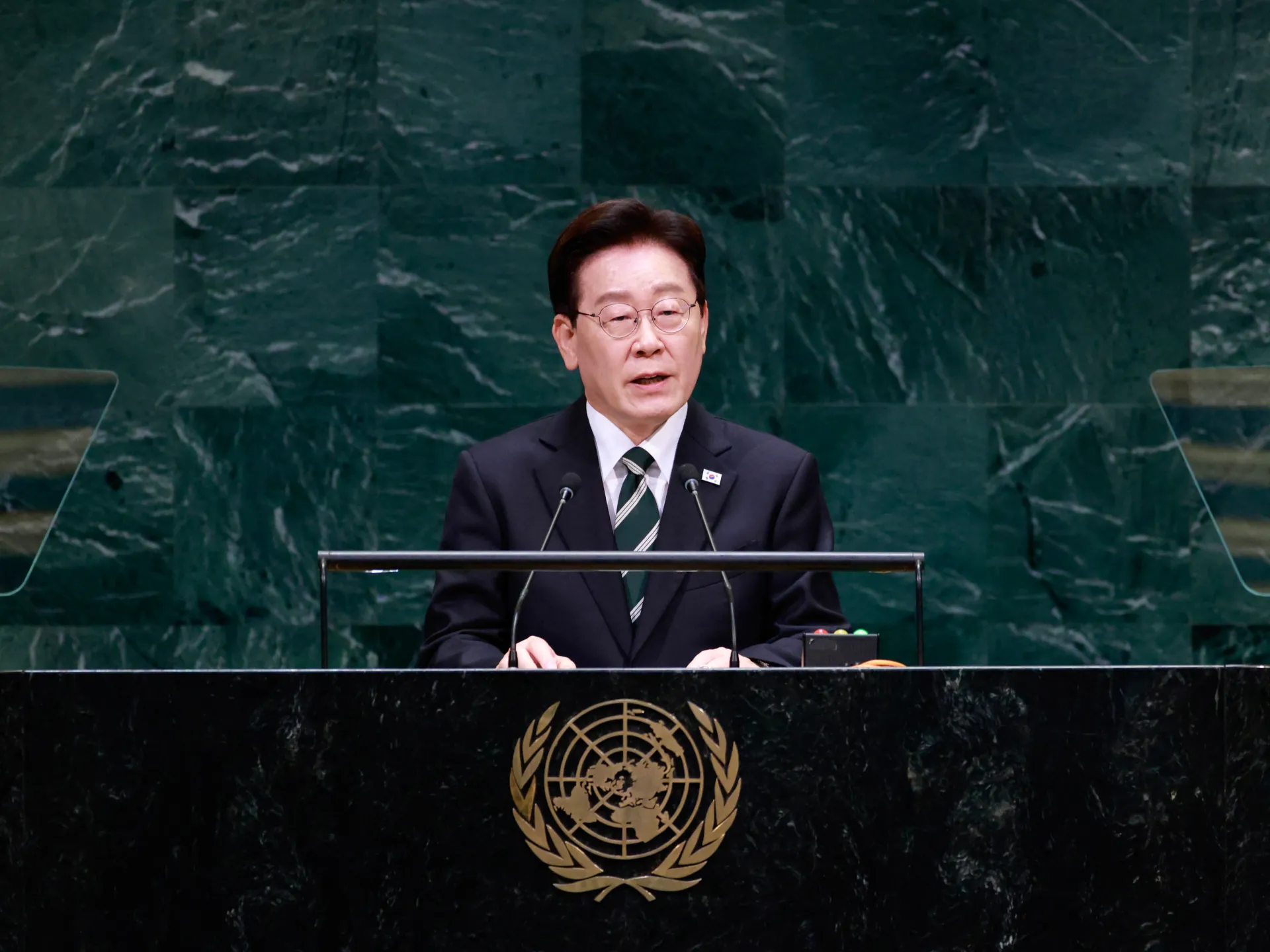
The South Korean president’s office has expressed “strong regret” over Ukraine’s disregard for a nondisclosure agreement with Seoul in the transfer of two North Korean prisoners of war (POWs) to Seoul, South Korean media reported.
Last week, Ukraine’s President Volodymyr Zelenskyy said in an address to the United Nations General Assembly (UNGA) that his country transferred two North Korean POWs to South Korea.
Recommended Stories
list of 3 itemsend of list
President Lee Jae Myung’s office “expresses strong regret over Ukraine’s unilateral disclosure [of the transfer] and its subsequent false announcement that there had not been a non-disclosure agreement”, the Yonhap news agency quoted Seong Ghi-hong, South Korea’s senior presidential secretary for public relations, as saying in a statement on Sunday.
The office said the nondisclosure agreement aimed to safeguard the soldiers from dangers they could face if their transfer were to be disclosed, in accordance with international law and humanitarian principles.
According to Yonhap, a South Korean media outlet, the Ukrainian presidential office said it had disclosed the transfer of the POWs without extensive details on the process, claiming that it would have been strange to keep the entire transfer a secret. Ukrainian media outlets reported a Ukrainian presidential source as denying the existence of a confidentiality agreement with Seoul, Yonhap said.
The South Korean presidential office said the Ukrainian presidential office’s “false” denial of the confidentiality agreement “seriously hampers” bilateral trust and causes serious disruptions to bilateral friendship.
Seong Ghi-hong said the government was considering additional measures over the issue, if necessary, Yonhap added.
North Korean POWS
Ukrainian forces captured the two North Korean soldiers in Russia’s Kursk region in January 2025.
Mounting evidence, including from intelligence reports and testimonies of defectors, has indicated that North Korean soldiers resorted to self-detonation or other forms of suicide rather than be captured.
In his UN address, Zelenskyy said, “These guys are not easy to capture alive.” He added, “One of them, when he realised he was going to be taken prisoner, tried to kill himself. And he was shocked that fate did not let him die.”
South Korean media reported that the two captured soldiers had expressed their desire to defect to South Korea.
The issue of North Korean prisoners of war was a key topic during the NATO summit in Ankara, Turkiye, where Lee met Zelenskyy in July.
Senior presidential spokesperson Kang Yu-jung stated afterwards that both leaders agreed to resolve the status of North Korean POWs in accordance with international law. This built on a prior agreement reached during the South Korea-Ukraine foreign ministers’ meeting in March, where both nations pledged to cooperate on the POW issue.
According to South Korean intelligence, North Korea is estimated to have deployed approximately 14,000-15,000 soldiers to support Russia’s efforts in its war with Ukraine since 2024, primarily in the Kursk border region. South Korean, Ukrainian and Western officials said they suffered heavy casualties, with more than 6,000 North Korean soldiers killed in the fighting.
The transfer comes as South Korea has backed efforts to revive dialogue with North Korea, while United States President Donald Trump has renewed his willingness to engage with Pyongyang.
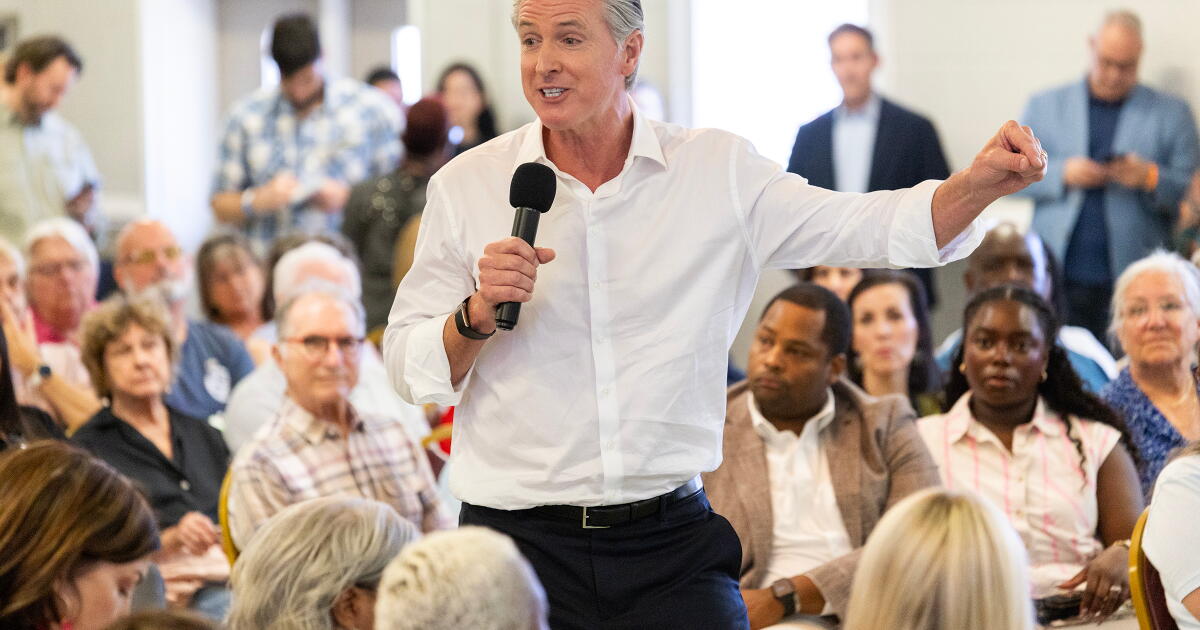
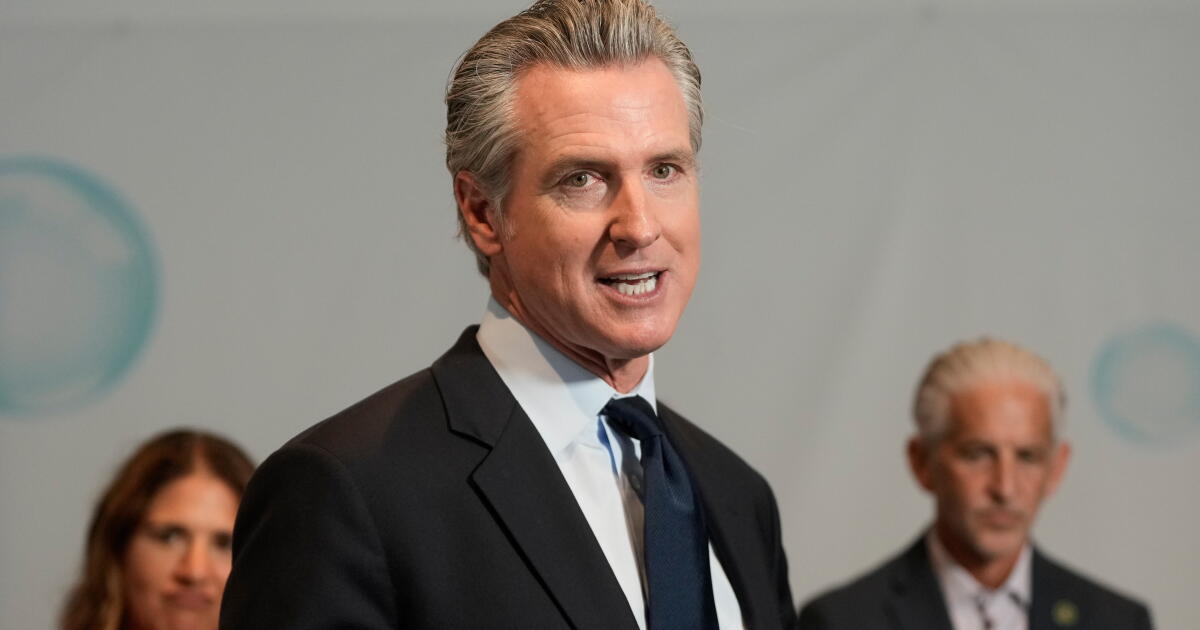
Gov. Gavin Newsom signed a package of bills Saturday that increases protections for LGBTQ people in California, saying the legislation was needed because of recent moves by the Trump administration that threaten that support.
One of the six bills would provide housing, employment and other help to service members discharged from the U.S. military as a result of President Donald Trump’s efforts to ban transgender people from serving.
“I’m grateful to Governor Newsom for signing this legislation and proud that California is standing with the veterans who were unjustly forced out of uniform,” said Assemblymember Chris Ward (D-San Diego), the author of Assembly Bill 1775.
Other bills Newsom signed create stronger privacy protections by limiting the sharing of sexual orientation and gender identity, while also requiring healthcare providers to notify the California Attorney General when they receive a subpoena regarding healthcare activities the state protects.
Another new law will enhance access to drugs known as PrEP and PEP, which are aimed at preventing HIV.
“The Trump administration has launched an all-out assault on the LGBTQ community, using medical records to target U.S. servicemembers and civilians alike, hurting countless people and betraying hard-won trust,” Newsom’s office said in a press release. “California will not stand for it.”
The bills Newsom signed Saturday were priority bills of the California Legislative LGBTQ Caucus.
Since taking office in 2019, Newsom has signed dozens of bills adding protections for LGBTQ people.
The governor’s office noted that this year’s state budget included $66 million to help people get access to gender-affirming care and abortion.
“I’m proud of the work our Caucus has done to advance legislation that meets the real needs of our community, and I thank Governor Newsom for signing these important bills,” said state Senator Sabrina Cervantes (D-Riverside), who is chair-elect of the LGBTQ Caucus.
“This progress reflects what we can accomplish when we work together to build a California where LGBTQ+ people and their families can live with greater safety, opportunity, and dignity,” Cervantes said.
As part of previous negotiations aimed at ending its war on Iran, the United States offered to sell Tehran uranium for use in a civilian programme, but Iran refused, a top US official said on Sunday.
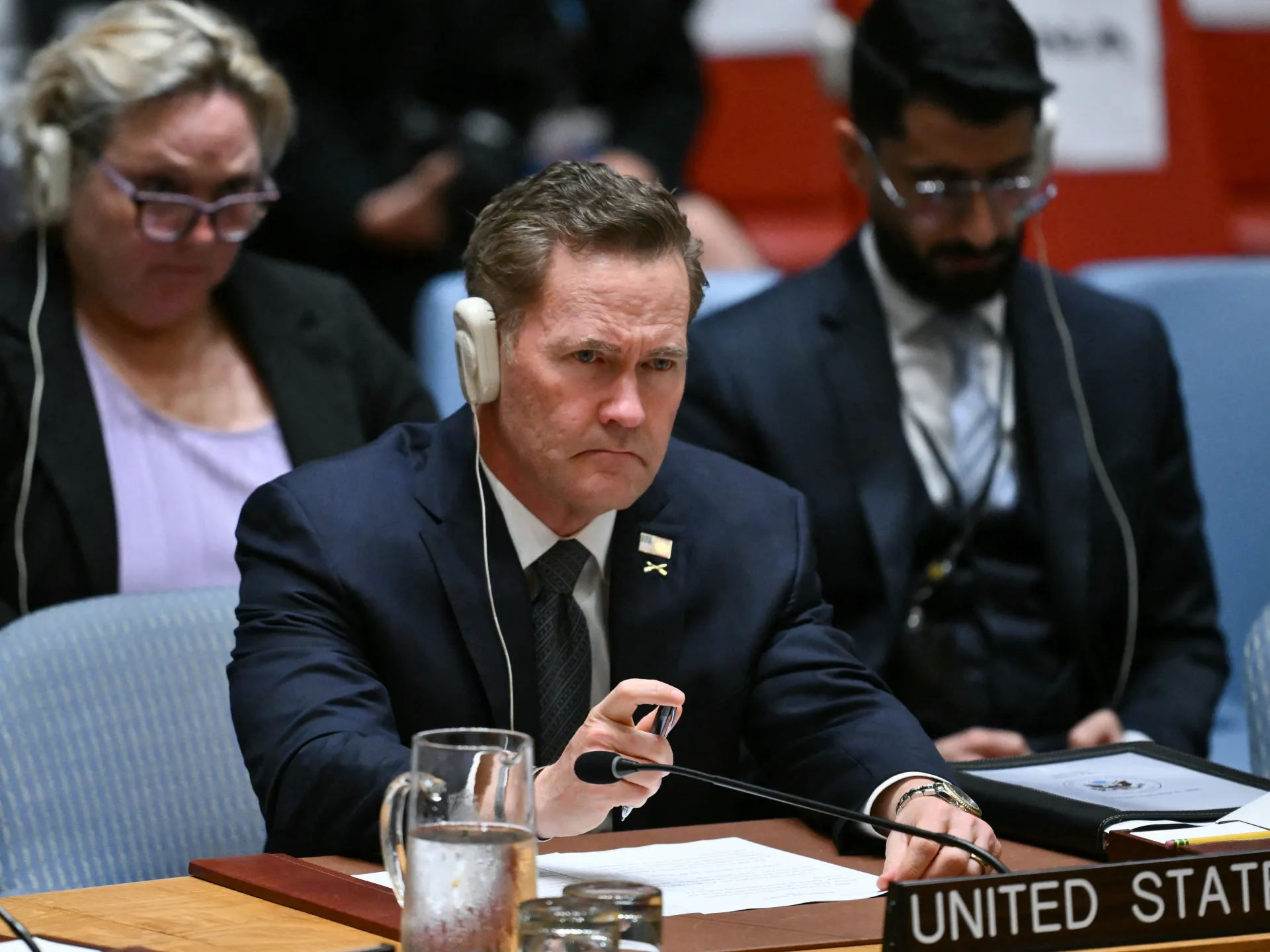
“Heck, our negotiators even offered to sell them uranium,” US Ambassador to the United Nations Mike Waltz said on NBC’s Meet the Press. He said the agreement would have been akin to that with the United Arab Emirates, which has “a peaceful programme, right there in their neighbourhood, and they abide by international law and inspection regimes”.
Recommended Stories
list of 3 itemsend of list
Waltz said the administration of US President Donald Trump was open to allowing Iran to keep a civilian nuclear programme, provided it agreed to its obligations in accordance with international law and the Nuclear Non-Proliferation Treaty (NPT).
There were “a number of ways” President Trump was open to dealing with Iran to ensure it did not have access to highly enriched uranium, or the ability to reconstitute highly enriched uranium, including by having Tehran “hand over” any such material it currently has, Waltz said.
The UAE, a signatory to the NPT, generates electricity from a nuclear power plant and signed an agreement with the US in 2009. Under those agreements, the UAE has agreed not to produce enriched uranium domestically, and not to reprocess spent fuel on its own. Trump said Saudi Arabia and the US reached an agreement on civilian nuclear use this year, but details have not yet been made public, and the US president has also claimed the deal is contingent on Riyadh agreeing to the controversial Abraham Accords. Around the region, Egypt and Turkiye also operate civilian nuclear programmes.
Pakistan openly operates a nuclear arsenal, while experts have long believed Israel secretly possesses one of its own. Neither country is a signatory to the NPT.
A key point of contention between Iran and the US has been what should be done with the uranium that Tehran currently has, and how, or even if, to ensure any future supply of the material is not capable of being used for producing a nuclear weapon. Iran has insisted it has no plans to create a nuclear weapon, and any uranium it possesses and enriches is only for civilian purposes, including for generating electricity and use in medical treatments and scientific research.
Iran is estimated to have more than 440kg (970lb) of uranium enriched at 60 percent purity. Uranium enriched to around 90 percent purity is suitable for a nuclear weapon. Enriching uranium is a complex process that involves isolating the most radioactive isotope in a quantity of uranium. Under the 2015 Joint Comprehensive Plan of Action (JCPOA), Iran agreed to cap its uranium enrichment at 3.67 percent under strict international supervision in exchange for lifting sanctions against its economy. Trump scrapped that deal in 2018, saying it was too generous to Iran.
On September 10, the International Atomic Energy Agency (IAEA) said it was concerned over Iran’s “continued noncompliance” with the Nuclear Non-Proliferation Treaty, of which it is a signatory. Under the treaty, Iran agrees not to produce nuclear weapons and to meet IAEA safeguards to control its supply of uranium used for civilian purposes. The agency has not had access to key Iranian nuclear facilities since June 2025, when Israel and the US attacked sites in the country as part of a 12-day war.
Iranian officials have responded to the IAEA by saying the finding was made “under political pressure from the US and its allies”, and that they have not stopped respecting their treaty obligations, but could not allow inspections until facilities were safe from US and Israeli attacks.
At times, Trump has said he will destroy the enriched uranium Iran has or retrieve it by force. In April, the US president claimed to have convinced Iran to turn over the enriched uranium it had, which he referred to as “nuclear dust”. Iranian officials quickly dismissed those claims, saying enriched uranium would not be transferred outside the country under any circumstances.
On Saturday, Trump rejected a plan submitted by Iran to reopen the Strait of Hormuz within seven days, as Tehran continued to insist that only diplomacy can solve the conflict between the two countries. Speaking to reporters at the White House, Trump said on Saturday that Iran wants to make a deal to open the vital maritime corridor immediately only “because they are losing so badly”.
In an interview on Meet the Press on Sunday, Iran’s foreign minister, Abbas Araghchi, said that Iran is prepared for war to resume, “even if it comes to a doomsday war”.
He added, “If you ask us, there is no reason why we should go back to diplomacy. But I’m still trying diplomacy, because I think we shouldn’t miss any chance for peace.”
The two pandas, Ping Ping and Fu Shuang, arrived from southwestern China.
Published On 27 Sep 202627 Sep 2026
Two giant pandas, Ping Ping and Fu Shuang, have arrived in the US state of Georgia on a 10-year loan as a soft-power gesture from China.
A new agreement between Zoo Atlanta and the China Wildlife Conservation Association makes Atlanta one of three zoos in the US to house giant pandas.
The diplomatic gifts departed early on Sunday from Chengdu Shuangliu International Airport in southwestern China, according to Chinese state media. They arrived after the high-level three-day Washington summit with China last week, where closed-door talks between United States President Donald Trump and Chinese President Xi Jinping yielded no major policy breakthroughs on prickly issues such as AI, trade, Taiwan and the war with Iran.
Although the pandas’ transfer had been finalised back in April, Xi officially announced the arrival timeline on Thursday at the White House, noting that the black and white mammals could reach Zoo Atlanta from the Chengdu Research Base, China’s premier hub for giant panda conservation, breeding and research, within the next few days. The dispatch of the vulnerable species aimed to signal a renewed bilateral friendship between the leaders of the world’s two biggest economies.
Ahead of their arrival, Zoo Atlanta had upgraded its panda habitats and secured a stable, long-term supply of locally grown Atlanta bamboo, which shares a near-identical climate with Chengdu.
The bears completed a 16-hour charter flight across the International Date Line, landing in Atlanta, Georgia, shortly before 7:00am (11:00am GMT).
Midway through its journey through Alaska, the FedEx Boeing 777 had spiked to the top of Flightradar24’s global tracking charts.
Steamed corn buns, bamboo shoots and carrots were prepared to keep the pandas nourished during their flight, Chinese state-run media reported. The US also mobilised a specialised care team to accompany the duo on their flight, they said.
A spokesperson for the zoo told Al Jazeera that their team had “done everything possible to accommodate them”, but a definitive timeline for their arrival – much less their public debut – remains “unconfirmed”.
“This is a thrilling day for Zoo Atlanta and a historic moment for the City of Atlanta, the state of Georgia and beyond,” Zoo Atlanta President and CEO Raymond B. King said in a statement. “We are elated to welcome Ping Ping and Fu Shuang and could not be more excited about sharing that joy with our Members, guests, city and community in the coming weeks.”
Zoo visitors will have to wait a while to see Ping Ping and Fu Shuang, officials said. The bears will be quarantined for about a month in a biosecure area of the wildlife park’s new giant panda complex. The zoo last had pandas in 2024.
Ping Ping, a male, and Fu Shuang, a female, were born in 2020.
Globally revered, the iconic furry animals have been sent across the globe for decades, serving as diplomatic emissaries loaned by China under its infamous “panda diplomacy” initiative through soft-power projection. Beijing leverages the animals’ immense public appeal to cultivate international goodwill, seal lucrative trade deals and burnish its geopolitical image abroad. Similarly, when foreign relationships fray or tensions arise, Beijing lets the loan agreements expire.
Xi has said this latest loan programme was an example of “friendship between the Chinese and Americans”.
Last week’s summit was Xi’s first visit to Washington in more than a decade and the second meeting this year with Trump.
Tangible outcomes of the meetings remain modest, restricted to a two-month extension of the trade truce, Beijing’s revival of giant panda loans and Xi’s support for Trump’s rebranding of artificial intelligence as “super intelligence”.
California Deputy Atty. Gen. Marissa Roy has a lead in the race to replace Los Angeles City Atty. Hydee Feldstein Soto, who lost her seat in a historic primary rout this spring, new polling shows.
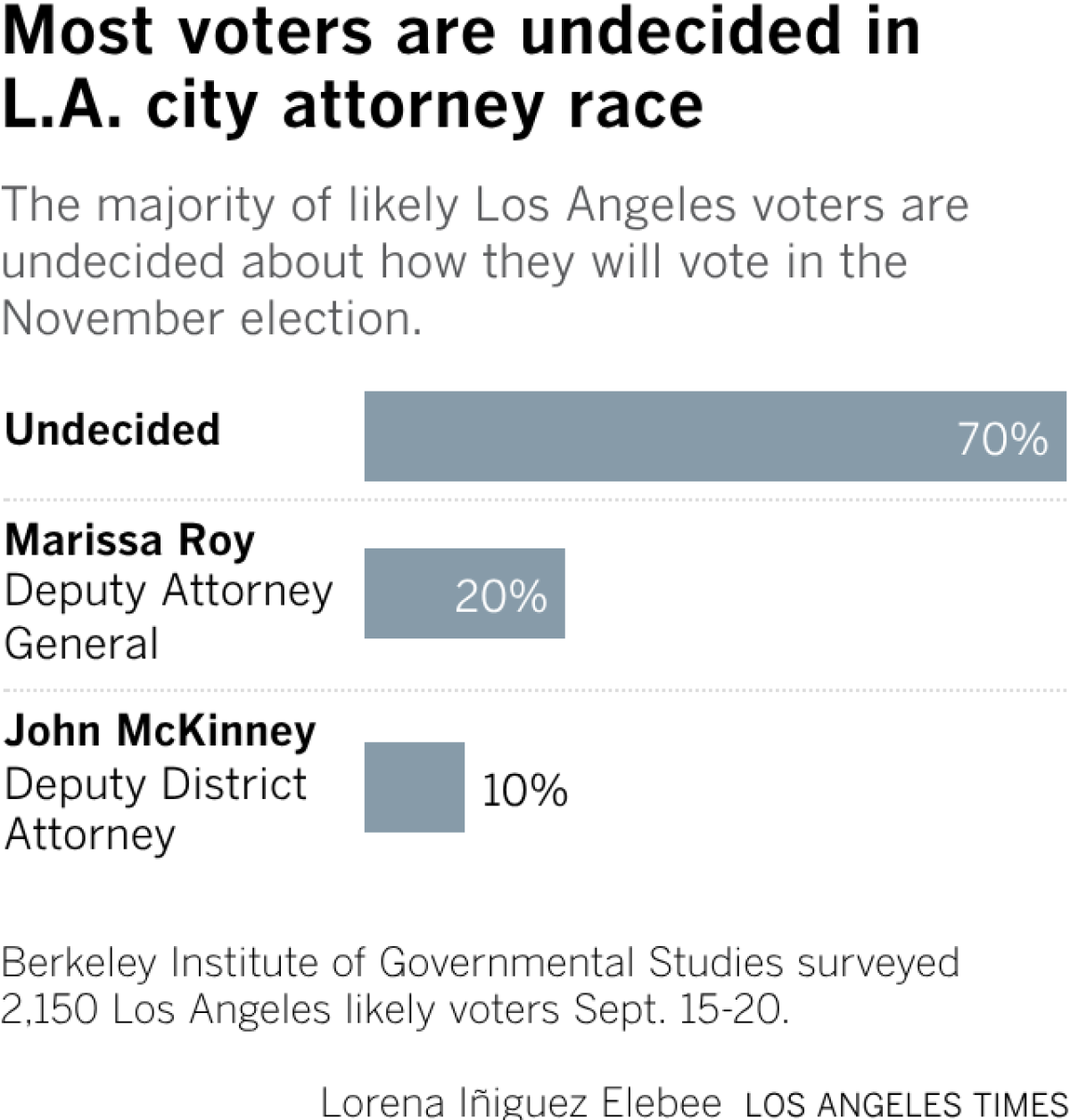
Among likely Los Angeles voters, Roy leads by 10 percentage points over her rival, Los Angeles County Deputy Dist. Atty. John McKinney, following the pair’s shocking electoral upset in June, according to a poll released last week by UC Berkeley’s Institute of Governmental Studies and co-sponsored by The Times.
The spread closely mirrors City Councilmember Nithya Raman’s breakaway lead in her bitter fight to unseat Mayor Karen Bass, who has outraised her for months.
But that’s where the similarities end.
The mayor’s contest has been called a “knife fight” for its no-holds-barred campaigning. It has also drawn sustained — and occasionally sensational — national attention since Raman’s buzzer-beating entrance in February.
By contrast, the city attorney’s race remains all but unknown: More than two-thirds of likely voters are still undecided, versus about a third who remain uncommitted in the mayor’s contest, polling showed.
L.A.’s top litigator commands a budget of nearly $200 million, plays a role in shaping city ordinances, and wages court battles on behalf of the public. The city attorney also prosecutes misdemeanors — a job most other cities keep separate. Each year, the office weighs some 120,000 violations, deciding whether to file charges and how to pursue them.
More recently, city attorneys across the country have championed activist litigation, spearheading suits against the Trump administration, among others.
Yet, few local voters know the job exists, and fewer still know the candidates by name.
Seventy percent of likely voters said they had no opinion of either McKinney or Roy — a fairly typical result for a down-ballot race, experts note.
Still, new data about voter priorities could signal how those undecideds might shake up the race in its final weeks.
Roughly a third of L.A. voters rank “moving homeless people indoors” and “crime and public safety” as top priorities, respectively; just slightly less say “fixing streets, sidewalks, streetlights and other city infrastructure” is essential.
McKinney, 58, pitches himself as a law-and-order moderate with plans to use the city attorney’s prosecutorial power to reduce disorder and move unhoused people off the streets. He manages more than 300 people at the district attorney’s office and spent decades in the courtroom securing high-profile convictions — advantages that he contends outweigh his lack of civil litigation experience.
Roy, 34, campaigns with an aura of sunny progressive pragmatism, arguing that the city can rein in ballooning liability in part by tackling its vexing infrastructure issues. She nods to the recent $17-billion settlement with Meta — a case her team at the attorney general’s office led — as evidence of the kind of ambitious, public interest litigation a large municipal attorney’s office could join.
Those disparate visions — along with crucial endorsements and influxes of cash — helped the pair define clear brands and constituencies going into the primary.
Both also got a boost from nationwide anti-incumbent fervor, staking sides across a mutual opponent whose name recognition had turned sour while rarely taking aim at each other.
But the general election is a different animal.
Although the Los Angeles electorate has been moving leftward for years, primary voters typically skew older and more conservative than those who show up for the general election, experts said.
Polls suggest that fact could create an uphill battle for McKinney, whose sway is biggest among conservatives, about 19% of the city’s electorate.
Some 21% of Republicans and nearly 30% of self-identified MAGA voters favored McKinney in the most recent poll, while Roy is favored by 25% of Democrats and by 3 in 10 voters who identify as progressive or democratic socialists.
By contrast, about a quarter of Republican voters now say they favor Bass for mayor, while Raman has a 14-point lead among Democrats. (Both are about equally underwater with MAGA voters.)
Like Raman, Roy has deep ties to the city’s insurgent democratic socialist political machine and hard-won endorsements from its progressive clubs. She has also successfully courted L.A.‘s influential unions and got an early boost from the L.A. County Democratic Party when it endorsed her this spring.
McKinney is endorsed by the city’s powerful police union and championed by L.A. County Dist. Atty. Nathan Hochman.
The once simple message, “Get out the vote,” now has a corollary: “Protect the vote.”
That message was hammered home Saturday for dozens of voting rights groups, community organizations and unions attending a rally to recruit and train poll watchers for the November election.
Organizers for several groups brought together under the banner of Love Powers L.A. offered scenarios of the threats that could materialize on Nov. 3 — from ICE raids to intimidation by the Proud Boys — and detailed strategies to counter them.
Their goal was to raise a cadre of volunteers for a Neighborhood Vote Protection Program to observe 650 polling places throughout the 11 days of voting and to turn fear and confusion sought by election deniers into a celebration of the right to vote.
“We want to make it a season of excitement,” said Jeremy Payne of the social justice group Catalyst California.
1
2
1.David Gutierrez right, of Inner City Struggle, signs up Jocelyn Elizalde, 22, and Manuel Becerra, 19, from left, to help with outreach, during an event held by Love Powers LA, representing dozens of community groups and labor unions, provide education and training to Angelenos on how to protect their vote and respond to threats of election interference at East Los Angeles College on Saturday, September 26, 2026. (Christina House/Los Angeles Times)2.Participants including Evelyn Gonzalez, right, attend a workshop for activist dance and street activation during an event by Love Powers LA, representing dozens of community groups and labor unions, providing education and training to Angelenos on how to protect their vote and respond to threats of election interference, at East Los Angeles College on Saturday, September 26, 2026. (Christina House/Los Angeles Times)
The event kicked off with multicultural music by Native American, Korean and West African drum ensembles.
“L.A. is a target for retribution and spectacle,” said John Lee, also of Catalyst California. “When they try to steal an election, it is a sign they know they are losing.”
Godfrey Plata of L.A. Forward, left, and Jung Hee Choi of We Are California present skits on how to talk to neighbors about voting during the event Saturday.
(Christina House / Los Angeles Times)
The event, involving numerous nonprofit organizations, stayed away from endorsements or political messages aimed at the coming election. But speakers didn’t hold back on their views of President Trump.
“Trump is a chicken and a loser,” said Jung Hee Choi, of the umbrella group We Are California.
Choi described two personality types, skeptics and frozen, that the group is targeting.
She urged volunteers to hold ballot parties in their homes to move skeptics “from the couch to the poll” and routine voters from the “frozen mode to the fight mode.”
“We need people out at the polls,” she said. “You are the greatest tool to fight back and grow our movement.”
The groups held their event just a day after Trump’s latest move in his attempt to reshape voting in America.
The Supreme Court upheld Trump’s expanded use of government data to search for noncitizens who are registered to vote. The impact of the decision is likely to be limited, other than to highlight Trump’s distrust of elections and his unproven claims that a large number of illegal voters are casting ballots.
Love Powers L.A., representing dozens of community groups and labor unions, provides education and training to Angelenos including Azenith Morales, Marise Roxas, and Liezl Japona, from left, of the Filipino Workers Center, on how to protect their vote and respond to threats of election interference.
(Christina House/Los Angeles Times)
Breakout sessions covered how to plan a ballot party, activist dances and street activations.
Attendee Joe Pugh, who works for the community services organization ATAP, said she planned to host a block party to push the importance of voting in South-Central.
“They’re always talking about ‘my vote doesn’t count,’” she said.
During the poll monitoring session, Emma Olson Sharkey, a partner at the Political Law Group, outlined what poll watchers should look for and what they should do about it.
Their role, she said, is not to engage. They will observe and report any attempt to intimidate voters or poll workers.
The organization provides an online report form to report incidents.
“We hope it is boring,” Payne said. “In most cases, nothing will happen.”
Gov. Gavin Newsom has signed a package of bills that he says are intended to build on California’s record of protecting reproductive rights and expanding access to care.
One of the measures, sponsored by Assemblymember Catherine Stefani (D-San Francisco), increases access to medication abortion by making it available on community college campuses.
Another bill, sponsored by Assemblymember Jacqui Irwin (D-Thousand Oaks), focuses on military veterans, aiming to address a gap in their healthcare after the Trump administration largely banned the U.S. Department of Veterans Affairs from providing abortion services. The measure enables California veterans to access abortion and contraception services through a state program.
“Freedom means being able to make deeply personal decisions without elected officials inserting themselves in pursuit of a political agenda,” Newsom said. “California is protecting that freedom and showing the nation, particularly under increasingly severe attacks by the Trump administration, what is possible when we put patients and people first — not politics.”
The governor announced the signing of the bills on Sunday, saying they will strengthen reproductive healthcare in the state.
One of the bills, introduced by Stefani, expands the ability of certified nurse-midwives to provide care for pregnant and postpartum patients by specifying that supervision by a physician is not required when providing certain services.
The legislation also included a bill sponsored by Assemblymember Celeste Rodriguez (D-San Fernando) that aims to expand access to breast pumps and services for nursing mothers through Medi-Cal.
Rival political rallies have been held in Brazil as campaigns intensify with one week to go until election day. Brazilians head to the polls on Oct 4 to choose between current president Lula da Silva or Senator Flavio Bolsonaro, the son of former far-right President Jair Bolsonaro.
WASHINGTON — Since the 2024 election, Democratic congressional candidates have reached a consensus about how to broadly discuss the border — make it secure — but they still lack a cohesive message about ICE.
Some advocate abolishing the agency, while others offer visions for how to rein it in and reform it.
Meanwhile, for Republicans, President Trump’s immigration policies have offered a win on one issue (the border) while creating another issue that many voters find troubling (violence during raids).
Some battleground Republicans are distancing themselves from Trump and have shifted from talking about mass deportations to emphasizing deporting criminals.
Most voters don’t care more about immigration than the cost of living. But it remains an important issue, and for both Republicans and Democrats, the balance in messaging about immigration is delicate, as about half of Americans see the administration’s tactics against immigrants as too aggressive.
As the Nov. 3 midterms approach, Democratic candidates in various states including Illinois, Minnesota and New Jersey have said Immigration and Customs Enforcement should be abolished. In Michigan, progressive Senate candidate Abdul El-Sayed has said as much — and taken aim at fellow party members.
“The idea that somehow we can’t say ‘abolish ICE’ because we’re so afraid of what they’re going to say, when we’ve seen ICE terrorize people in our streets,” he said before Michigan’s Senate primary in July. “To me, it is exactly the kind of cowardice that we don’t need from Democrats.”
The Democratic dilemma was crystallized last month when Democratic National Committee members approved dueling messages — one to abolish ICE, the other to reform it.
Among those in the reform camp is Randy Villegas, the political science professor running against Rep. David Valadao (R-Hanford) in California’s Central Valley.
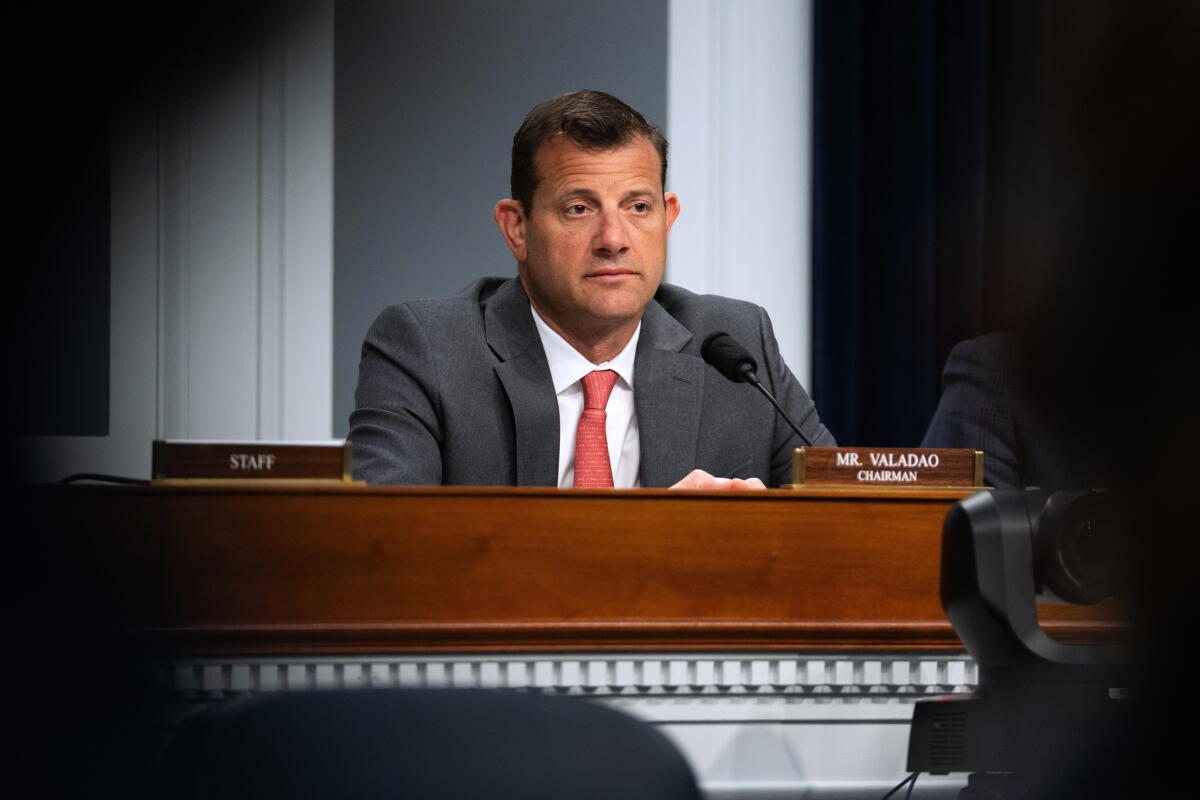
Rep. David Valadao (R-Hanford), presiding over a congressional subcommittee meeting in Washington on March 6, is seeking reelection in California’s 22nd District.
(Allison Robbert / Ap Photo/allison Robbert)
Villegas is in favor of a pathway to citizenship for longtime immigrants as well as a secure border. He’s called for ending the use of for-profit detention facilities and prosecuting ICE agents who engage in illegal conduct.
It’s a personal issue too. Villegas is the son of immigrants from Mexico, and, according to a 2021 NPR story, his brother is a DACA recipient, granted protection under the Deferred Action for Childhood Arrivals program. He said the constituents of the mostly rural 22nd District deserve a representative who understands the effects of the broken immigration system; he recalls his mother being unable to visit her sister when she was dying of cancer.
“Kern County was ground zero for these ICE raids last year. What did Valadao do or say about it? Absolutely nothing. This is somebody who likes to pretend they’re a moderate on immigration. He voted to triple ICE’s budget,” Villegas said in an interview, noting that he organized a local workshop with immigration attorneys.
After the raids, led by Customs and Border Protection agents who were reported to have gone “rogue” weeks before President Biden left office, Valadao released a statement saying he had spoken to agency officials and urged them to target “criminals rather than those responsible for producing our nation’s food supply.”
Valadao, a dairy farmer and the son of immigrants from the Azores islands of Portugal, says on his campaign website that he supports a “reasonable and responsible” pathway to citizenship, a guest worker program that could stabilize the agricultural workforce and a focus on removing immigrants who have committed serious crimes.
Last year, he sponsored the Dignity Act, a bipartisan bill that would create a new temporary legal status for immigrants who meet certain requirements and pass a criminal background check.
Valadao declined an interview request but said in a statement that “our immigration system is broken after decades of inaction, and it’s critical that we restore law and order while recognizing the contributions of people who have lived and worked peacefully in our communities for years.”
In Texas, Democratic Senate candidate James Talarico frequently has said that the southern border should be treated “like our front porch,” with a welcome mat and a lock on the door.
Talarico says immigration enforcement is necessary but that resources should be refocused to target cartels, gang members and human traffickers. As for ICE, he said the government should “tear down this secret police force and replace it with an agency that is actually going to focus on public safety.”
Texas Atty. Gen. Ken Paxton, a Republican candidate for the U.S. Senate, has embraced President Trump’s crackdown on immigration.
(Tony Gutierrez / Ap Photo/tony Gutierrez)
Centrist Democratic strategists said Talarico’s messaging strikes the right tone for swing voters.
During the Biden administration, voters lost trust with Democrats on immigration and border security, said Sarah Pierce, a former U.S. Citizenship and Immigration Services official who leads immigration work at the center-left think tank Third Way. That needs to stay top of mind for Democratic candidates, she said.
“Americans don’t trust that Democrats are even willing to enforce immigration laws, so obviously there’s a lot of pressure on the party to rectify that,” Pierce said. “At the same time, this is the most anti-immigrant administration we’ve had in history.”
Talarico’s opponent, Texas Atty. Gen. Ken Paxton, touts Trump’s hard-line immigration policies and has made border security a key part of his campaign.
Paxton also believes states should work with the federal government on immigration enforcement. This year, his office conducted raids in Houston and transferred 50 immigrants to ICE custody.
James Talarico, the Democratic Senate candidate in Texas, has called for reforming Immigration and Customs Enforcement but unlike some Democratic candidates, he has not called for abolishing the agency.
(Danielle Villasana / Getty Images)
Matt Terrill, a Republican strategist who was chief of staff for then-Sen. Marco Rubio’s 2016 presidential campaign, said Republican candidates need Trump to turn out the GOP base so they retain control of Congress.
Some Republican candidates are conveying a more nuanced message, but it might not matter to voters who already feel betrayed by Trump. That’s the assessment of Matthew Dallek, a political historian at George Washington University who studies Republican and Homeland Security politics.
“A lot of Republican candidates are struggling to figure out a message on what had been a great political strength that has turned into a major liability,” Dallek said. “Different Republicans are giving different answers to try to appeal to the Latino vote, maybe to independents, to voters who might typically vote Republican and support closed borders, but think that ICE has gone too far.”
Many Republican candidates aren’t avoiding immigration. A Third Way analysis of last month’s spending on immigration-related ads in competitive House and Senate races found that Republicans had spent more than $50 million — five times more than Democrats.
At issue, however, is the messaging. Earlier this year, White House officials and House Republican leaders reportedly told their members to avoid talking about “mass deportations” and talk up removing criminals.
Rep. Gabe Evans, who is running for reelection in Colorado, described the distinction as “gangbangers, not grandmas.”
At the Republican National Convention in 2024, Rep. Monica De La Cruz (R-Texas) denounced “open borders” before a crowd waving signs reading “mass deportation now!”
As the Trump administration’s enforcement campaign took shape, however, she signed a letter to House Speaker Mike Johnson calling on ICE to focus its resources on arresting immigrants with criminal records, and in March she intervened after local high school mariachi performers were detained.
This month, De La Cruz released a campaign ad, featuring the wife of a DACA recipient who was detained this year by ICE. The wife said that she had voted for Democrats before, “but Monica puts people over politics.”
A representative for De La Cruz did not respond to requests for comment.
Her opponent, Tejano musician Bobby Pulido, said he doesn’t like talking in absolute terms like abolishing ICE. But without the historic funding approved by Republicans this year, the agency would have been prevented from continuing what he sees as bad policy on humanitarian and economic levels.
But Pulido also says that the Biden administration waited too long to impose border restrictions.
“It feels like it went from ‘let ‘em all in’ to ‘kick ‘em all out,’” he said in an interview. “I don’t think that either one is good. We need immigrants, but everybody always says do it the legal way. We have to actually legislate pathways for that to happen.”
One Republican has directly broken with Trump in her bid for reelection. In a campaign ad released Sept. 17, Florida Rep. Maria Elvira Salazar, standing in front of the White House, speaks directly to the president. “The same Hispanics who helped you get to the White House in 2024 feel betrayed today,” she said.
Polling shows that many in that district, where Latinos make up three-quarters of registered voters and more than half were born outside the U.S., now think Trump’s immigration crackdown has gone too far. Polls also show Salazar is deadlocked with her opponent, Eliott Rodriguez, a fellow Cuban American and newscaster who fired back at her for voting in favor of Trump’s policies.
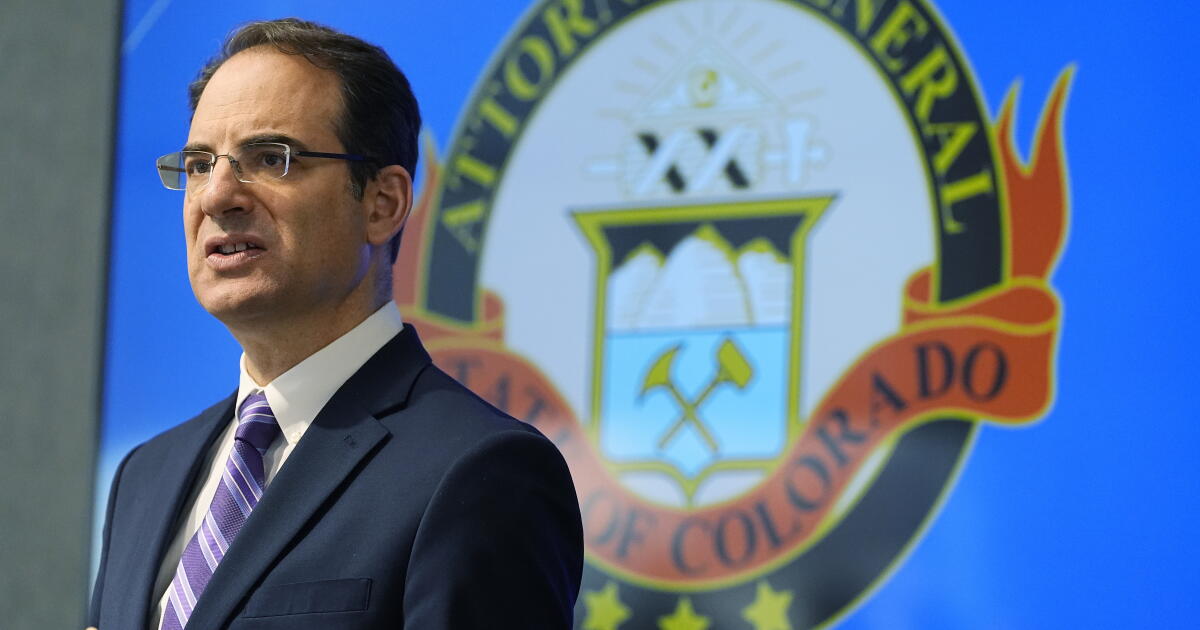
DENVER — The office of Colorado’s attorney general is a perch 10 stories above downtown Denver. From his aerie, Phil Weiser has a sweeping view of the city skyline, the gold-domed Capitol and, occasionally, a red hawk on the wing.
But looking toward November, Weiser sees something darker.
“With this administration what we have seen is it’s important that we not limit our imagination to what … type of harm could happen,” Weiser said during a sunny noon hour in the Mile High City.
For that reason, Colorado’s attorney general and his Democratic peers around the country have spent more than a year strategizing — by phone, via Zoom, sometimes in person — on ways to Trump-proof the midterm election.
They’ve researched history and the law, war-gamed what-ifs, divvied up responsibilities and drafted emergency lawsuits and temporary restraining orders so they can be hurried into court at a moment’s notice.
“We have prepared for a range of contingencies … so that we’re ready to act,” Weiser said.
“We’re not going to be reacting in real time” or pulling all-nighters, he added. “We are going to be following through on plans we’ve made, having looked at what’s possible.”
The efforts of Weiser, California’s Rob Bonta and more than 20 other Democratic attorneys general are part of a mass mobilization aimed at thwarting Trump’s unprecedented efforts to pervert and subvert November’s midterm balloting.
It’s remarkable that kind of man-the-barricades action is needed to preserve and protect the voting franchise in this, the land of the free and home of the brave. But having weighed the threats, Weiser said his greatest fear of election interference comes not from a bad overseas actor or some terrorist group, but rather our own federal government “and what this administration might do.”
So here we are.
To fend off that threat from within, state Democratic parties across the nation are aiming to recruit 10,000 volunteers to guard polling places in the event armed federal agents show up.
Various sponsors have launched education campaigns to explain election rules and offer hotlines for voters who have trouble casting their ballot.
Civil rights groups and democracy-defending organizations have staged their own tabletop exercises brainstorming and rehearsing various scenarios. A group of Democratic U.S. senators has done the same.
“What we’re doing is preparing for the fact that Donald Trump, in 2020, lied about the election in advance, lied about it in the aftermath, went to court … and then he instigated a violent insurrection in this very building,” Marc Elias, a Democratic elections attorney, told MS NOW in a July interview at the Capitol. “So I think we need to take these threats in the 2026 midterm run-up … both seriously and literally.”
In a more courageous, less heedlessly partisan world, Republicans would be working with Democrats to keep the power-drunk Trump in check. (The House and Senate supposedly comprise a separate and equal branch of government, with its own power, prerogatives and such.)
But, as Weiser noted, this Republican-led Congress “has been lacking in backbone, lacking in the role of checks and balances. That has left it to state attorneys general to fill that vacuum, going to court and essentially playing the role of a check on a lawless and often bullying president.”
The nation’s 24 Democratic attorneys general have filed more than 125 lawsuits in Trump’s second term alone, fighting his moves on trade and tariffs, energy and immigration policies and efforts to gut or eliminate programs and whole government agencies. They’ve prevailed in the overwhelming majority of cases that have been adjudicated or settled.
Even before Trump was elected again, some attorneys general began conferring on ways to fight the excesses they anticipated in a second administration. Anyone who didn’t see them coming wasn’t paying attention, said Weiser, who, most likely, will be elected Colorado’s next governor on Nov. 3.
(His victory in Colorado’s Democratic primary stemmed in good part from Weiser’s record battling Trump in court.)
Trump is constitutionally (small “c”) incapable of acknowledging the result of any election he didn’t win. He’s openly urged supporters to “cheat like hell.” Thus, one can only assume malign intent when the president tries to wantonly purge voter rolls, hijack the U.S. Postal service to gum up mail balloting and override the Constitution (capital “c”) by federalizing November’s election.
Some might call such fears melodramatic, or overblown.
Trump’s refusal to accept the outcome of elections “is historic,” the attorney general said. “It is unique. It’s a threat. And it’s why we have to stand our guard.”
Vote, to bring this rogue president to heel. Stay vigilant, to make sure that vote counts.
Army chief accuses Eritrea of funding and supporting armed groups to weaken Ethiopia.
Ethiopia’s federal military has said it is handling rising tensions in the country’s north with restraint, as fears grow that Ethiopia could be heading towards another civil war.
In his first comments on the recent military developments, Army Chief of Staff Field Marshal Berhanu Jula said the army was responding to what he called provocations from the Tigray front with “wisdom and restraint”.
Recommended Stories
list of 3 itemsend of list
He accused Eritrea of funding and supporting armed groups to weaken Ethiopia, describing the “Tsimdo” alliance as an extension of a longstanding pattern of hostile alliances, which he said cannot confront the state without outside backing.
Eritrea, wary that landlocked Ethiopia may be seeking to invade it to gain access to the Red Sea, denied the accusations.
The fighting has spread from Tigray into neighbouring Afar and Amhara regions after seven armed groups announced an alliance, the Ethiopian Peoples’ Forces Alliance for Survival, committed to removing Prime Minister Abiy Ahmed’s government.
In Afar, the latest battles have taken place around Abala, where the military has been trying to prevent rebels from seizing control.
Separately, in North Wollo, a zone of Amhara bordering Tigray, the army said on Thursday it had killed 272 Tigrayan fighters and wounded 260 in a counter-offensive, reporting heavy losses for the Tigray People’s Liberation Front (TPLF).
Members of the armed forces ride a military vehicle as fighting across Ethiopia intensifies amid fears of full-scale civil war [AP]
The TPLF’s Tigray Army said the federal government had launched a “full-scale offensive” involving infantry, mechanised units and drones.
Abdisalam Balema, a TPLF central committee member, told Al Jazeera the situation had become a “full war”.
Fighting has also continued around Sama, Soqota and Raya Alamata, with government forces reportedly closing in on the town of Alamata.
The army command said it prefers a strategy of “strategic calm” over a large-scale military confrontation, arguing the Tigray front’s popular support is dwindling and its leadership divided.
Internet access was reportedly cut across northern Ethiopia on Friday, a day after the UN said it was alarmed by reports of drones being used against civilians there.
The renewed fighting has put the 2022 Pretoria Agreement, which ended a brutal two-year civil war in Tigray, under severe strain. It comes weeks after Washington lifted sanctions on Ethiopia and Eritrea tied to atrocities from the last war, saying the “national emergency … has expired”.
It marks the most serious challenge yet to that agreement, raising fears of a wider regional conflict that could draw in armed groups from across Ethiopia.
Addressing the UN General Assembly, Ethiopia’s president sought to portray the country as a force for regional stability, accusing unnamed external actors of meddling in Ethiopia’s affairs while highlighting Addis Ababa’s role in supporting peace efforts in neighbouring Sudan.
Alemayehu Weldemariam, a professor of law at Indiana University, told Al Jazeera that the federal government bears much of the blame for the collapse of the Pretoria Agreement.
“This war has been in the making for a while now. Much of the provisions in the cessation of hostilities [in the 2022 agreement] were primarily sabotaged by the federal government itself,” he said, citing fuel, service and cash restrictions imposed on Tigray, and the government’s failure to set up the interim administration the deal had promised.
“What was supposed to be an interim arrangement turned out to be permanent,” with Tigray excluded from national elections since, he added.
Demonstrators are demanding early elections and accuse Pedro Sanchez’s government of negligence.
Published On 26 Sep 202626 Sep 2026
Thousands of people have rallied in the Spanish capital to protest the government’s policy on irregular migration and its handling of a recent migrant influx into the North African enclave of Ceuta.
Saturday’s protest in Madrid was organised by right-wing civil society group Sociedad Civil Espanola and backed by the mainstream conservative People’s Party (PP) and far-right Vox.
Recommended Stories
list of 3 itemsend of list
According to the government, 20,000 people attended, while protest organisers put the turnout at 180,000.
At the end of July, more than 70,000 migrants stormed into the autonomous Spanish city of Ceuta from neighbouring Morocco, before most of them were returned. However, thousands remain stranded.
Demonstrators accused Prime Minister Pedro Sanchez and his government of failing to protect the borders of Ceuta.
They are calling for an early election to be held by mid-November, with Vox demanding Sanchez be tried for treason. Spain’s next general election is not due until August 2027.
PP’s secretary-general Miguel Tellado said there was a “widespread feeling that the government has not acted responsibly; there has been a dereliction of duty, extreme negligence”.
“Spanish society has to take to the streets to ask the government to defend our territorial integrity,” he added.
The July 30 and 31 surge of people into Ceuta led to unprecedented scenes and the deaths of dozens of migrants.
Sanchez said on Tuesday that Moroccan border control failed to adequately handle the incident and that an investigation was still under way, adding that Rabat had been asked for answers.
The Spanish government estimates that between 6,000 and 10,000 stranded migrants remain in Ceuta.
Vox leader Santiago Abascal is demanding that everyone who arrived in late July be deported to their country of origin.
Abascal said Ceuta remained “invaded because Sanchez continues to be Morocco’s servant”.
Spanish newspaper El Pais reported on Saturday that the government is planning to approve a decree on Tuesday to accelerate the return of migrants from Ceuta to Morocco.
The protest is the second under the March for Dignity banner. That demonstration was held in late May before the incident in Ceuta and attracted 40,000 protesters, according to the government.
“America will never be a communist country,” states the 30-second television ad.
Never mind that socialism is a more probable scenario given the rise of New York Mayor Zohran Mamdani and Nithya Raman’s healthy lead in the Los Angeles mayoral race. This commercial is not about semantics, political systems or the health of the nation.
It’s about touting the alleged achievements of President Donald Trump, from “reigniting American manufacturing” to “defend[ing] law and order” and giving Americans the “largest tax cuts in history.”
One can argue the legitimacy of such claims if they still have the energy to do so after 10 years of relentless MAGA puffery, but the real issue here is that this particular piece of bluster is produced and funded by the U.S. government.
Laws prohibit taxpayer funds from being used for “publicity or propaganda,” even if the White House is referring to its new ad campaign as a PSA.
“This is the sort of government propaganda one might expect in North Korea, not the United States of America, and it is an egregious and utterly illegal misuse of Americans’ hard-earned tax dollars,” wrote Democratic House and Senate Appropriations Committee members in a letter sent Friday to Trump’s Chief of Staff Susie Wiles.
They demanded that the ad be immediately taken off the air and that “Federal employees who knowingly violated Federal law in working on and paying for this advertisement” be disciplined. “The law is not complicated,” they wrote. “You cannot use taxpayer dollars for political advertisements.”
The spot, which first aired Wednesday on conservative media outlets Fox News and Newsmax, cost $14,000, according to the firm AdImpact, which tracks media spending. By Friday, that number had jumped to $430,000 as the ad hit multiple markets across the country.
And it isn’t the only instance of American tax dollars at work — for Trump. A second ad paid for by you aired Thursday night on CBS.
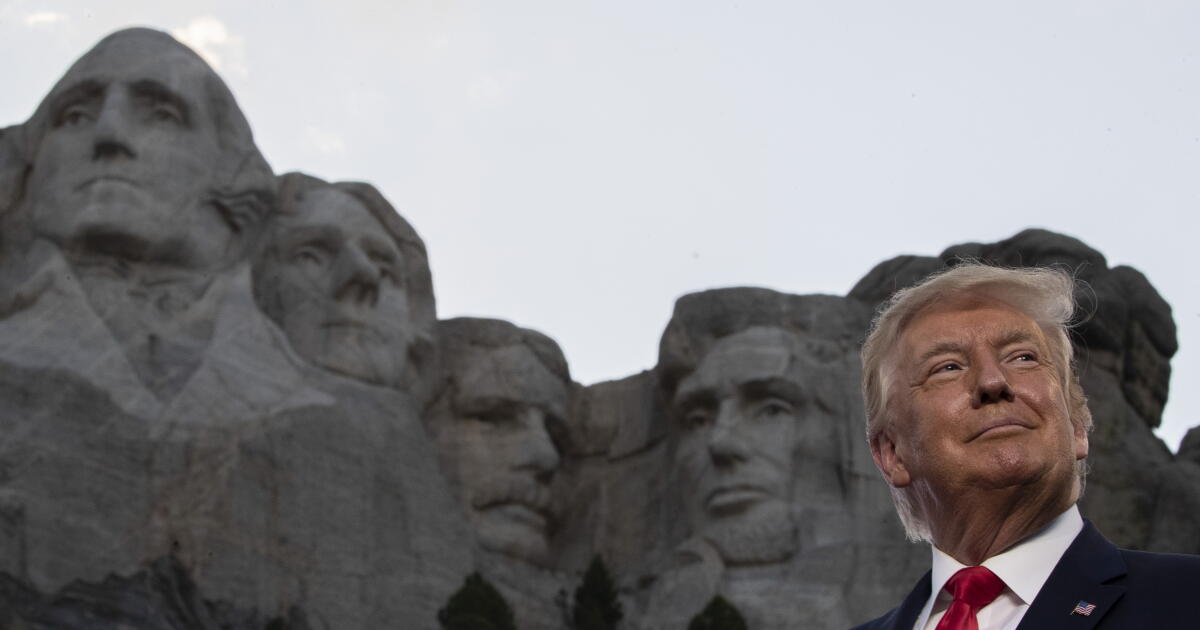
The minute-long commercial featured footage of the president speaking against the backdrop of Mount Rushmore in an audacious display that might have turned George Washington, Thomas Jefferson, Abraham Lincoln, and Theodore Roosevelt to stone if they weren’t already immortalized in granite.
It included clips from the U.S. military’s Jan. 3 capture of Venezuelan President Nicolás Maduro and his wife, snippets from Trump’s Independence Day weekend speech, a voiceover from UFC CEO Dana White praising the president as “the toughest, most resilient person” he’s ever met, and a montage of images featuring Trump, Trump and more Trump. It ends with the star of the show proclaiming, “This is only the beginning of the golden age of America,” then comes the written disclosure: “Paid for by the U.S. Government.”
Anyone who has lived in or traveled to countries with state-run media will recognize the similarities between Trump’s ads and those of, say, former Iraqi dictator Saddam Hussein or current strongmen like North Korea’s Kim Jong Un: the intense leader-like gaze, the baseless claims, substandard production quality and music that suggests the subject of the ad should be worshipped. (Trump’s choice for the first ad was “Love Me” by R&B singer JMSN, who opposed the use with an emphatic “I would never…”)
But on U.S. television, the ad feels more desperate than dictatorial. The whiff of desperation coming from the ad blitz may have something to do with the president’s dismal polling numbers headed into November’s midterms.
The administration has argued its ads are “educational and unapologetically patriotic” public service announcements. The White House said in a statement, “These public service announcements are about reminding Americans to love their country and understand what makes it worth defending, at home, at our borders, and abroad.”
A White House official reportedly said that the PSAs “are clearly not political” and noted that “the President is not on the ballot and the ads don’t have a call to action.”
Trump has repeatedly told his base to vote like he was on the ballot.
With propaganda like this coming out of the White House, communism is hardly the biggest threat facing the country.
Good morning, and welcome to L.A. on the Record — our City Hall newsletter. It’s David Zahniser and Noah Goldberg, giving you the latest on city and county government.
It’s one of the most exacting tasks to face a left-leaning candidate running for office in L.A.: filling out the Democratic Socialists of America’s questionnaire.
During the candidate endorsement process, the DSA’s L.A. chapter issues a lengthy form that ends with a spate of yes or no questions, mainly around hot-button topics: Do you support Medicare for All? Do you favor the policies of the Green New Deal? Would you put a halt to police exchange programs with Israel?
When filling out the form, mayoral candidate Nithya Raman voiced support for all three. But unlike some DSA-endorsed candidates, the council member declined to give a yes or no answer on an assortment of other topics, opting for longer explanations.
You’re reading the L.A. on the Record newsletter
Sign up to make sense of the often unexplained world of L.A. politics.
By continuing, you agree to our Terms of Service, which include arbitration and a class action waiver. You agree that we and our third-party vendors may collect and use your information, including through cookies, pixels and similar technologies, for the purposes set forth in our Privacy Policy such as personalizing your experience and ads.
Raman, a DSA member, declined to check either box when asked if she would work as mayor to repeal a law prohibiting homeless encampments near schools. She did the same on whether to divert funds from law enforcement into other public services.
She also declined to say yes or no on removing police from K-12 schools, and on banning the use of facial recognition and other surveillance technologies.
The answers offer the latest sign that Raman has been proceeding with caution on some of the DSA’s litmus test issues. Raman, who tweeted “defund the police” six years ago, said in February that the ranks of the Los Angeles Police Department should not get any smaller.
Appearing Wednesday in Pico-Union, she said she was proud to have the DSA as part of her coalition but also described herself as politically independent.
“I’ve made sure that the decisions that I’m making, the votes that I’m taking, are ones that are based on an understanding of how these policies are actually going to improve the lives of Angelenos,” said Raman, who received the DSA endorsement earlier this month.
Mayor Karen Bass, Raman’s opponent, did not seek the endorsement, saying she was not aligned with some of the group’s positions.
Raman’s questionnaire stands in contrast with those of some of her DSA colleagues.
HugoSoto-Martínez answered nearly every yes-no question posed by the DSA during his first run for City Council in 2022. Ysabel Jurado did the same during her successful council campaign two years later.
So what were Raman’s longer answers? On homeless encampments, she wrote that she has repeatedly voted against increasing the number of locations where tents are prohibited — and doesn’t want to saddle homeless people with criminal records that could stifle their ability to find permanent housing.
Regarding cuts to the LAPD, Raman said she would expand the city’s network of unarmed crisis response teams, ensuring that “trained professionals” — not police officers — respond to mental health and substance use calls.
On campus police, Raman said schools “should never default to armed officers for discipline or student well being.” And on facial recognition software, Raman said she would prohibit surveillance technologies that lack “clear evidence of need and completely enforceable safeguards for civil rights and privacy.”
“I will also require real oversight and consent before the city deploys any of it,” she wrote.
Raman even declined to say yes or no when asked if she wants noncitizens to vote in local elections. But she explained in writing that she voted earlier this year to put a proposal from Soto-Martínez on the ballot that would give the council the ability to enact noncitizen voting for city and school board elections.
Raman and Bass weighed in recently on the deal struck by California Atty. Gen. Rob Bonta and Paramount Skydance Chief Executive David Ellison on the studio’s merger with Warner Bros. Discovery.
Both mayoral candidates said Paramount should be held accountable for the promises contained in the settlement, which requires the company to distribute 30 films per year in theaters for the first two years after the merger, then 32 films per year for the next three years.
Of the two, Raman sounded more dismayed by the deal.
“There was a better outcome than this,” Raman told reporters at a recent news conference. “But this is the outcome that we have, and now it’s incumbent upon us to fight for the best results for workers here.”
For much of this year, Bass and Raman voiced concern that the merger would trigger mass layoffs within the film and television industries. But last month, Bass began calling for the two parties to engage with each other in good faith, saying too many productions had come to a standstill, putting people out of work.
“The prolonged uncertainty around this decision has already led to job losses and left workers wondering what it would mean for their futures,” Bass said in a statement this week.
The settlement alleviated the anxiety felt by some at City Hall that Paramount might follow through on its threat to leave California.
Bass’ stance aligned her more with IATSE, the International Alliance of Theatrical Stage Employees, whose leaders voiced their own concerns about uncertainty while appearing with the mayor at City Hall last month.
Raman was more in sync with Writers Guild of America West, which denounced Bass for pressing Bonta to seek a resolution, saying “industry workers deserve a mayor who believes in upholding the law.”
Bass’ campaign is supported by IATSE Local 33 and the California IATSE Council, which said earlier this year that the mayor has “done more to bring our jobs back to Los Angeles than anyone in city government.”
On Thursday, the Writers Guild endorsed Raman, saying she is a “true pro-labor candidate who walks the walk.”
State of play
— POLLING PRESSURE: A new poll put Raman decisively in the lead in the mayor’s race, showing her with a double-digit advantage over Bass. The findings will ramp up the pressure on Bass and her allies to go sharply negative against Raman while courting the huge number of voters who say they are still undecided.
— MAKING THEIR CASE: Bass and Raman sat down with The Times for two separate, wide-ranging interviews, discussing issues like homelessness, the Palisades fire and the biggest mistakes they’ve made in office.
— PEOPLE MOVER POSTPONED: The opening date of the People Mover train being built at Los Angeles International Airport has been delayed yet again, with contractors now aiming for early January. The 2.25-mile automated train, which has been over budget for years, was originally supposed to open three years ago.
— EXECUTIVE ORDER: Bass ordered a review of the LAPD’s dealings with mentally ill people this week, saying the training that police officers are receiving is “woefully inadequate.” The mayor said she was particularly troubled by a July 29 incident in which police fatally shot a man who approached them with an aluminum bat.
— HURDLES TO HOUSING: Why has housing production been lagging in L.A.? Real estate developers pointed to a list of reasons, including high interest rates, pandemic-era policies like rent freezes and Measure ULA, the voter-approved tax on high-end property sales.
— TRUMP REBUFFED: An appeals court blocked the Trump administration from stopping the Los Angeles Homeless Services Authority from applying for millions of dollars in federal funding. The agency had applied on behalf of homeless service organizations from across the county.
QUICK HITS
Where is Inside Safe? The mayor’s signature program to address homelessness went to the area around 11th and Irolo streets, a location represented by Councilmember Heather Hutt.
On the docket next week: Bass and Raman are slated to appear Tuesday at the Skirball Cultural Center for the 2026 Jewish Los Angeles Mayoral Forum. The event is hosted by the Jewish Federation Los Angeles, the Skirball Cultural Center, ADL Los Angeles and other groups.
Stay in touch
That’s it for this week! Send your questions, comments and gossip to LAontheRecord@latimes.com. Did a friend forward you this email? Sign up here to get it in your inbox every Saturday morning.
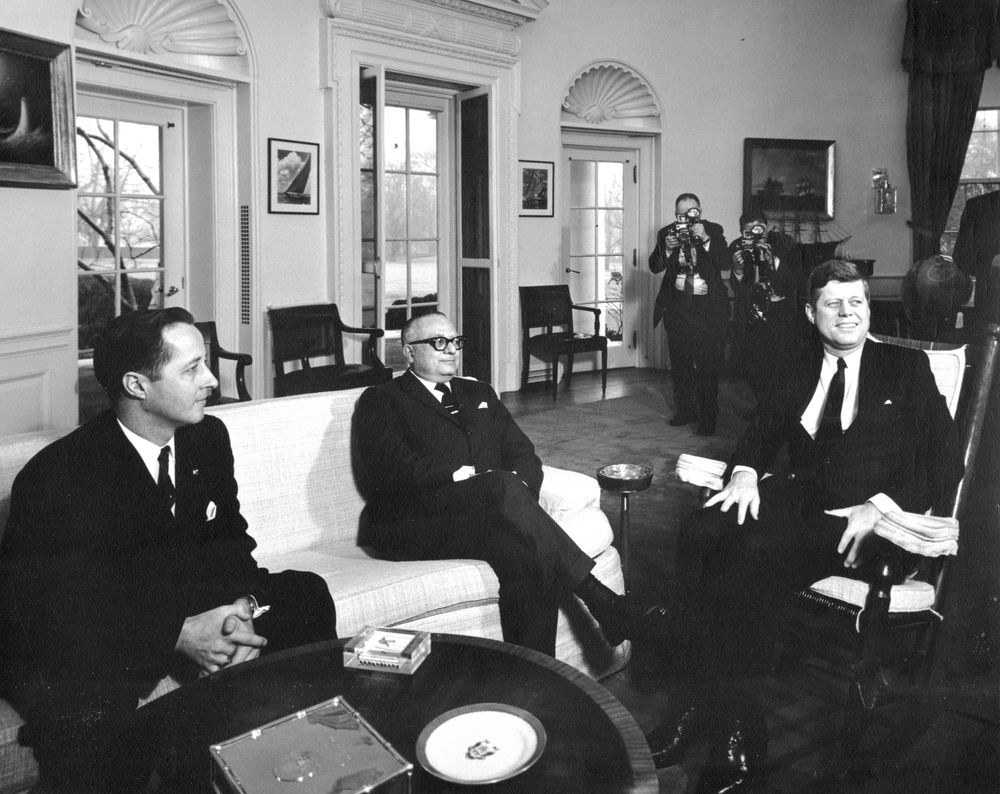
John F. Kennedy receives Betancourt in the Oval Office on February 19, 1963. White House photograph by Abbie Rowe, JFK Presidential Library and Museum.
In 1898, the United States entered Cuba promising to liberate a nation; the subsequent occupation and the Platt Amendment ultimately granted it the right to intervene in the country’s affairs. A century before chavismo, Juan Vicente Gómez found a different formula: domestic order, foreign capital, and oil, all while leaving the citizenry out of the equation. Rafael Osío Cabrices and Marcus Golding have revisited both precedents to reflect on the Venezuela that would emerge after January 3. These two mirrors are uncomfortable, yet they are not the only ones; a third exists—also born of the relationship between Venezuela and the US—though it is based on a different idea of how to build stability.
During the 1950s, Venezuelan social democrat leader Rómulo Betancourt wrote from exile to convince Washington that its policy toward Latin America was based on a flawed premise. While military dictatorships might declare themselves anti-communist and guarantee a certain level of stability, repression, inequality, and a lack of civic participation paved the way for the very radicalization the US wished to contain. A democracy capable of enacting social reforms could serve as a more reliable ally.
This wasn’t Betancourt’s idea alone. Within the US government, there were already officials who viewed reformist forces as a more effective bulwark against communism. Betancourt’s own contribution lay elsewhere: articulating this argument from within Latin America and attempting to prove its validity while in power. Research by Steven Schwartzberg shows that this approach had begun even before the long exile triggered by the 1948 coup.
Upon returning to Venezuela after January 23, 1958, Betancourt did not ask the White House to build Venezuelan democracy. The major political parties agreed on rules for coexistence and the country held elections, which he won. His government undertook agrarian, educational, and social reforms starting in 1959, all while facing military conspiracies, guerrilla violence, and hostility from neighboring dictatorships. There were abuses, restrictions on civil liberties, and incomplete results. It was not a conflict-free democracy, but a democracy struggling to survive.
Both voting and finding a way out of the economic crisis remain priorities that oil alone cannot resolve.
That experience bolstered Betancourt’s argument before Washington. A State Department report from the time described Venezuela as a hemispheric leader in promoting social reform and economic development within a constitutional framework. This foreign alliance rested on a domestic political foundation: it did not rely solely on oil or on a shared stance against a common enemy.
The Cuban Revolution had made this discussion more urgent since January 1959. Upon arriving at the White House in 1961, John F. Kennedy understood that anti-communism alone was insufficient, and he found an exceptional partner in Betancourt. The Alliance for Progress sought to link development, social reform, and representative democracy. When Kennedy visited Venezuela in December 1961, the two governments issued a joint declaration framing economic cooperation within the context of “the effective practice of representative democracy.” Democracy was not a destination to be reached only when conditions became more favorable. It was an integral part of the journey itself.
1961 versus 2026
We can’t idealize that era. The Alliance for Progress yielded uneven results, and the US continued to tolerate dictatorships when it served its interests. Years later, Betancourt would welcome Jimmy Carter’s emphasis on human rights—as Guillermo Ramos Flamerich notes—precisely because such a stance had never been a constant in US foreign policy, which has historically oscillated between democratic values and the immediate benefits of partnering with governments capable of maintaining order.
That tension has returned. Democratization expert Thomas Carothers argues that the Trump administration has departed from five decades of bipartisan US commitment to promoting democracy, adopting policies that favor autocratic regimes instead. Other intellectual figures such as Ricardo Hausmann and Paul Krugman have also questioned the direction of the process: Hausmann warned that if Trump does not facilitate the transition, Venezuelans will have to oppose his strategy; Krugman criticized the agreement with former members of the Maduro government while the democratic opposition is sidelined.
For her part, María Corina Machado continues to regard Trump as a “key ally” but calls for a democratic transition. Nor does Venezuelan society appear willing to trade its vote for a promise of stability: an in-person poll cited by the Financial Times found greater optimism following Maduro’s removal on January 3, but also revealed that the majority wanted free elections in 2026. After the electoral fraud of July 28, 2024, both voting and finding a way out of the economic crisis remain priorities that oil alone cannot resolve.
On July 24, 2026, Donald Trump stated in the Oval Office that Venezuela was “not yet” ready to hold elections. He praised the “fantastic work” of Delcy Rodríguez and linked his assessment of her to the volume of oil the country is shipping—according to the Republican president—to the US. On September 2, he reiterated that Venezuelans were not ready, while Rodríguez avoided setting an election date during a press conference focused on oil deals.
The solution, however, does not lie in waiting for Trump to become Kennedy. Betancourt did not simply wait for a sympathetic US president, either.
The difference compared to 1961 lies in more than just words. Kennedy and Betancourt framed their cooperation within a shared democratic commitment. Current rhetoric allows oil interests to advance in the present while democracy waits for an undated future. This does not mean Washington has permanently abandoned the idea of Venezuelan elections, but it does reveal its priorities: barrels can be counted, legitimacy can be deferred.
This exemplifies what I termed “asymmetric reconstruction” in a previous article for CEBRI: the recovery of certain economic and geopolitical capabilities, while institutions, rights, and public wellbeing progress at a different pace. Here, the warnings of Osío Cabrices and Golding converge. An intervention can displace the actors who fought for democracy; an opening of the oil sector can coexist with opaque deals, unelected authorities, and power structures that have learned to survive by switching partners.
The solution, however, does not lie in waiting for Trump to become Kennedy. Betancourt did not simply wait for a sympathetic US president, either. He organized a political party, built consensus within Venezuela, formulated a vision for the country, and then sought to alter Washington’s calculations. He understood that while a nation like ours cannot dictate the priorities of a major power, it can present itself to that power as a political actor rather than merely as available territory.
The United States’ best ally will not be the most obedient Venezuela.
Venezuela can once again become a solid ally of the United States. To achieve this, it requires competitive elections with a set date; institutions capable of protecting rights, providing services, and managing resources; and an economy that transforms investment into a better life for its citizens. Oil-driven growth can help. It is no substitute for any of that.
It also requires a mature international relationship. Cooperating with the United States should not mean ceding to Washington the decision of who governs Venezuela or when its citizens are ready to vote. Sovereignty does not consist of isolating oneself from the world. It consists of participating in it without losing one’s identity.
History offers three possibilities: the tutelage experienced by Cuba starting in 1898, the order-without-citizenship of the Gómez era, and the democratic alliance Betancourt sought to build with Kennedy. None can be replicated exactly as they were at the time. Yet, we can still decide which model we wish to emulate.
The United States’ best ally will not be the most obedient Venezuela. It will be the Venezuela that regains legitimacy in the eyes of Venezuelans themselves.
WASHINGTON — After two years of struggling to slow down the Trump administration agenda under a Republican governing trifecta, Democrats are hoping to capture both chambers of Congress in the upcoming midterms.
All 435 House of Representatives seats are up for election, with 37 considered competitive, 21 of them toss-ups, by the Cook Political Report — a respected polling analysis site. Republicans currently hold a 218-214 edge over Democrats, with two seats vacant and one independent in the chamber.
To control the House, Democrats need a net gain of four seats.
Recent polls have shown Democrats creeping up on or surpassing their Republican opponents as President Trump’s approval rating hovers under 40%, which may offer an opening in unexpected places. But still, in a time when a more progressive wing has risen in popularity on the left, even some moderate Democrats are suffering from associations with the current administration.
Here is a look at five competitive races:
Ohio 7th: Miller vs. Poindexter
Incumbent Republican Max Miller, mired in controversy, will face union ironworker Brian Poindexter in a 7th Congressional District race that went from solidly Republican to a toss-up in the matter of weeks.
Miller, a second-term congressman, is facing a House Ethics Committee investigation after his ex-wife, Emily Moreno — daughter of Ohio Republican Sen. Bernie Moreno — accused Miller of extreme physical abuse, which he has denied.
Miller also faced accusations from former White House press secretary Stephanie Grisham that Miller had abused her during their relationship. An Ohio judge recently ordered both parties to remove social media posts about each other that were considered disparaging.
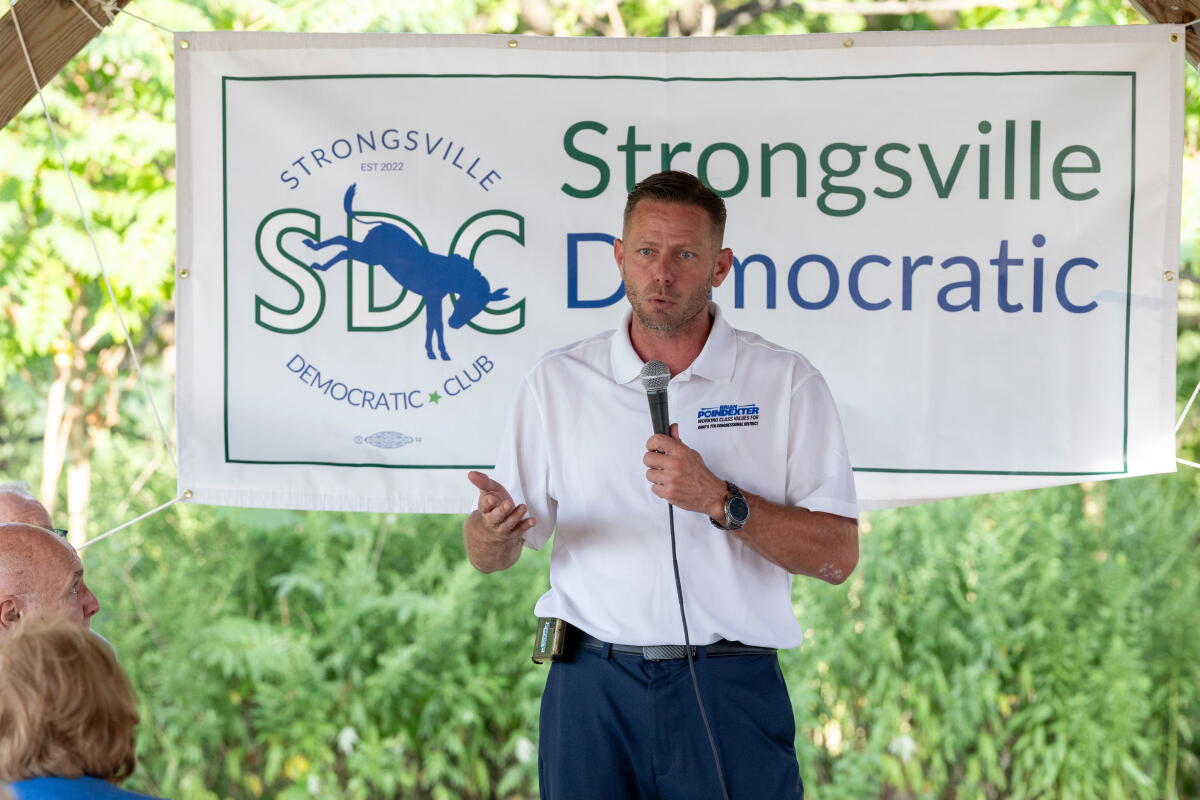
Brian Poindexter, Democratic nominee for Ohio’s 7th Congressional District, speaks at the Strongsville Democratic Club meeting on Aug. 5 in Strongsville, Ohio.
(Nate Manley / Associated Press)
Poindexter, a relative unknown, has surged in the meantime. According to a Co/efficient poll last month, Poindexter was leading Miller by 14 points, with 86% of respondents claiming they were aware of allegations against Miller.
Poindexter has centered his campaign on strengthening unions, retaining healthcare benefits for retirees and injured workers and raising wages.
Miller has attacked his opponent for a 1998 arrest in which Poindexter, a teenager at the time, allegedly tried to swallow a rock of crack cocaine during a traffic stop. Miller also homed in on an instance of alleged assault at a baseball game in 2013 by Poindexter.
Texas 34th: Gonzalez vs. Flores
Incumbent Democrat Vicente Gonzalez Jr. is attempting to retain his seat against challenger Eric Flores, an Army veteran endorsed by Trump.
Elected in 2016, Gonzalez held the 15th Congressional District for three terms until 2021, when a Texas redistricting shift absorbed his McAllen home into the 34th district. He is currently serving his second term under a new map, which favors Republicans and has shed many of his Latino constituents.
Flores, a political newcomer, made his first national appearance at the Republican National Committee’s midterm convention in Dallas, touting his commitment to border security and accusing Gonzalez of allowing migrants to make the community unsafe.
Immigration looms as an issue in the race. Gonzalez has introduced bills to prevent federal and state immigration enforcement officers from entering homes without an official warrant, and to force agents to wear clear identification. He has publicly criticized raids targeting hospitality, medical and construction workers.
Gonzalez has scored endorsements from several progressive organizations in the state, including LUPE Votes — a subsidiary of La Unión del Pueblo Entero.
In a Barbara Jordan Public Policy Research and Survey Center poll from August, Gonzalez was leading Flores, 45% to 42%, with 8% undecided.
North Carolina 1st: Davis vs. Buckhout
Incumbent Democrat Rep. Donald Davis will have to contend with a district that has grown more conservative to retain his seat against Republican challenger Laurie Buckhout.
North Carolina’s 1st Congressional District was the state’s only swing seat held by a Democrat before last year’s redistricting, which made the area lean Republican. This will be a rematch of the 2024 race, which Davis won by less than 2 points, or around 6,000 total votes.
Laurie Buckhout speaks as President Trump and North Carolina Rep. Jennifer Balkcom look on during a campaign rally at the Gastonia Municipal Airport on Sept. 16 in Gastonia, N.C.
(Matt Kelley / Associated Press)
Cook Political Report ranked this race as leaning Republican, calling Davis “the most vulnerable House Democrat in the country.”
It is unclear whether the gerrymandering effort will have been effective enough to make the district flip to Republican. Trump endorsed Buckhout in March and reiterated his support last week.
New York 17th: Lawler vs. Conley
New York Republican incumbent Rep. Mike Lawler is attempting to fend off a challenge from Democrat Cait Conley, a former White House director of counterterrorism on the National Security Council.
Cook Political Report rankings showed that early this year, the 17th Congressional District race went from likely Republican to a toss-up.
Pete Buttigieg went on the campaign trail last week with Conley to promote the candidate’s bid to unseat Lawler.
“Cait is as serious as it gets about keeping our country safe,” Buttigieg said on a rally stage in Tarrytown, “just like she is serious about bringing down the cost of housing, healthcare and energy.”
Lawler has presented a bipartisan image in Congress, but has come under fire in his purple district for aligning himself with the Trump administration on several issues, including his support for the Iran war.
At the Republican National Committee’s midterm convention, Lawler focused much of his speech on lambasting “socialist” Democrats and attempting to appeal to the more “common sense” wing of the opposition party.
“Radical socialists are winning Democratic primaries,” he said. “They claim to be well-meaning, but there is nothing kind-hearted about protecting criminals at the expense of American families … nothing compassionate about prioritizing illegal immigrants.”
Conley, however, has publicly refused to campaign with New York Mayor Zohran Mamdani or Rep. Alexandria Ocasio-Cortez — without condemning either figure — to avoid the open conflict between establishment figures and the more progressive wing of the party.
A July poll from co/efficient showed Lawler leading Conley 50% to 45%, with a nearly 3% margin of error.
Dr. Amish Shah, shown in July, is a Democrat running in Arizona’s 1st Congressional District.
(Ross D. Franklin / Associated Press)
Arizona 1st: Shah vs. Feely
A Democratic PAC plans to invest nearly $1 million to support Democrat state Rep. Amish Shah against Republican Jay Feely, a former NFL player with close ties to the president.
The 314 Action Fund — which seeks to elect Democrats with backgrounds in science, technology, engineering and mathematics — has made a big bet on the Democrat running in the 1st Congressional District, Arizona’s wealthiest, according to the Arizona Mirror.
Former professional football player Jay Feely, shown in April, is the Republican nominee in Arizona’s 1st District.
(Ross D. Franklin / Associated Press)
Subsequent ads have brought attention to Feely’s close association with Trump and his recent attendance at the Republican National Committee’s midterm convention in Dallas. Trump won the state by five points in 2024.
Elon Musk has also figured in this race, with his America PAC giving $24,000 to Republican candidates Feely in the 1st District and Juan Ciscomani in the 6th District, according to the Copper Courier.
The Cook Political Report called the 1st District “one of the most competitive … in the country.”
New Delhi, India – Indian democracy has been shaken by new revelations showing divisions within the body that is in charge of conducting its elections over controversial policies that critics say have disenfranchised tens of millions of people.
India’s Election Commission, a supposedly autonomous constitutional body, is tasked with administering elections in the world’s largest democracy, and in recent decades, had won admirers across the globe for its success in conducting a voting process unmatched in scale and complexity.
But an investigation by The Indian Express newspaper reported that the current chief of the commission frequently overruled concerns raised by his two other equally ranked commissioners about the integrity of ongoing changes in the voter database.
These revelations come after a months-long struggle by India’s opposition parties to bring what they have described as the “sabotaging” conduct of the election commission to the fore, which they say is dictated by Prime Minister Narendra Modi’s party for its electoral benefit.
For decades, India has grappled with deep inequality; divisions along caste, religious and ethnic lines; and the growing role of money in its elections. Yet through it all, the actual conduct of its elections was largely viewed as “free” domestically and by global monitors.
But leading opposition leaders have, in recent months and years, for the first time, questioned whether elections can be trusted and whether votes are counted accurately, as well as whether rights decide who gets to be a voter or if those in authority take the decision arbitrarily. Those concerns, say analysts, are likely to only be amplified by the latest revelations.
“Today, that faith [in the election process] has shaken. It is very shocking for the nation,” SY Quraishi, who headed India’s election commission between 2010 and 2012, told Al Jazeera. “The Election Commission used to be a very reputed institution. Now, it is totally dysfunctional – and that’s an understatement.”
So, what does this mean for India and its democracy?
Indian opposition leader Rahul Gandhi speaks during a news conference to demand resignation of India’s Chief Election Commissioner Gyanesh Kumar, in New Delhi, India, September 24, 2026 [Bhawika Chhabra/Reuters]
What are the latest revelations about India’s Election Commission?
Earlier this week, the Indian Express newspaper published a series of stories, based on internal documents and interviews, laying bare divisions within the poll panel – consisting of three commissioners, Gyanesh Kumar, Sukhbir Singh Sandhu, and Vivek Joshi. Kumar is the commission’s chief.
Indian law requires the commission to decide by a majority. Reports revealed that Sandhu and Joshi resisted and questioned the legality of measures Kumar took unilaterally.
Since June last year, the commission has been revising and updating the voters list state-wise. It has struck off more than 13 million names during the exercise since then, which the critics say targeted economically weaker sections, minorities, and other vulnerable groups of Indian society disproportionately.
Opposition parties took the matter to the country’s top court, which largely signed off on the process to decide on who gets to vote in India. For India’s more than 1.4 billion population, a voting right does not end merely on ballots – rather, several government welfare schemes are tied to voting rights.
Now, reports reveal that some of the strongest resistance to the three-member commission’s decisions was coming from within. In fact, Sandhu and Joshi formally objected on record at least 14 times over the last 10 months to measures issued by circumventing them. Sandhu called it “unauthorised and illegal”.
Those objections related to the new voter registration mandate; deletion and restoration of voters in the rolls; appeals by people against deletions; and the security of the list. In short, everything the commission undertook.
The opposition has alleged that the additions and deletions of the voters are undertaken as an exercise to disenfranchise a section of voters to benefit Modi’s Bharatiya Janata Party (BJP).
The commission maintained that access to the voters’ list is highly secured and decentralised, meaning that even in the remotest parts of the country, a local officer made the judgement and decision.
But the latest revelations show that the commission relied on ECINet, a digital platform that logs nearly a billion voters, which was increasingly centralised, giving more control to New Delhi over editing calls.
In one instance, the newspaper reported that officials in the coastal state of Goa flagged nearly a hundred voters who were mistakenly taken out. Editing access was limited to New Delhi.
So, Goa’s chief electoral officer wrote eight emails to officials in New Delhi in a week before the deadline passed, but got no response and voters were knocked off the list.
An Indian Youth Congress activist, wearing a mask depicting Chief Election Commissioner Gyanesh Kumar and handcuffed, takes part in a protest in New Delhi, India, September 25, 2026 [Rajat Gupta/EPA]
Why is revision of voters’ list controversial?
The Special Intensive Revision (SIR), as the process of revising the list is called, has become controversial mainly because it places an unusually heavy burden on existing voters to prove their eligibility.
Such a drive requires people to produce old records, like birth, land, and education certificates – and puts poorer, migrant, and marginalised Indians at a disadvantage, essentially drawing lines on who gets to vote in India. A minor mismatch, such as a spelling, in decades-old records could result in being struck from the voters list in India.
Opposition parties and civil society groups have argued that mass deletions could significantly alter the electorate before elections.
In some places, the exercise has been reported to disenfranchise minorities, including Muslims. In the eastern state of West Bengal, Al Jazeera earlier reported that the exercise removed 9 million residents from the electoral rolls just days before the state elections that were held in April and May.
Nearly 34 percent of the deleted voters were Muslims in the state, where they only make up 27 percent of the population. Then, Prime Minister Modi’s Hindu majoritarian BJP came to power for the first time in the politically critical state.
The BJP and supporters of the SIR process have argued that it is fundamentally aimed at removing illegal migrants, the deceased or fraudulent voters from the rolls – and have tried to portray many Muslims eliminated from the lists in border states as “illegal Bangladeshi migrants,” despite hard evidence that Indian nationals have been victims of the process.
But as the exercise has been expanded to other parts of the country, those claims have increasingly returned to embarrass even proponents of the exercise: In New Delhi, notices were served to India’s Foreign Minister S Jaishankar and his wife, alongside other high-profile politicians, judges and senior bureaucrats. Several former Indian ambassadors to countries across the world have received notices to prove that they are Indian – even though they have served as India’s sovereign representatives abroad for years.
All of this has turned what was political opposition to the SIR process into much more broad-based, nationwide scepticism about the lack of transparency in the Election Commission’s software, the process of matching voters against decades-old electoral rolls, and the criteria being used to flag voters as having “logical discrepancies”.
“The [revision of voters’ list] fundamentally inverts India’s model of electoral democracy,” said Milan Vaishnav, a senior fellow and director of the South Asia programme at the Washington, DC-based nonpartisan think tank The Carnegie Endowment for International Peace.
“Since the adoption of the Constitution, India has assumed the burden of ensuring that the last man or woman is registered to vote,” he said. Vaishnav added that unlike other democracies, notably the United States, which has repeatedly thrown up barriers to the franchise, “India historically adopted an unusually activist approach to voter registration.”
“Specifically, the way in which [the revision] has been carried out threatens to turn that principle on its head,” he told Al Jazeera. “It is now the voter who must prove his or her entitlement to remain on the electoral rolls.”
Quraishi, the former election commissioner of India, told Al Jazeera that he has been against the policies taken up under the revision.
“I hope [these revelations] are a wake-up call and serious action will be undertaken, including at the Supreme Court, the central government, and the Parliament,” Quraishi told Al Jazeera.
“Because the reputation of the Election Commission has gone into the dumps. And it is very difficult to restore it now,” he said. “We need efforts to rebuild faith in the system.”
Abhijeet Dipke, head of the Cockroach Janta Party (CJP) speaks as the party’s conveners Ashutosh Ranka and Saurav Das look on during a news conference to demand the resignation of India’s Chief Election Commissioner Gyanesh Kumar, in New Delhi, India, September 24, 2026 [Bhawika Chhabra/Reuters]
What is the opposition demanding?
Leader of the opposition Rahul Gandhi has accused the Election Commission of “treason” against the nation, and promised that its leaders will be tried for it, if his Congress Party returns to power.
India’s popular Gen-Z pressure group, the Cockroach Janta Party, whose protest movement led to the ouster of India’s education minister in July, has threatened to hit the streets again if Kumar, the commission’s sitting chief, does not resign by Saturday.
The Cockroach group has also called for an overhaul in the selection process of the next election commissioner.
For its part, the election commission has said in a statement that the investigation report drew on “differing views and deliberations” between the three commissioners rather than official statements of protest. Sambit Patra, a spokesman for Modi’s party, told reporters that any deliberation or divisions in the commission were rather “a sign of a healthy democracy”.
But none of that appears to be cutting ice in a nation where far too many people have now faced the threat of losing their vote through an opaque process.
“Our elections are fundamentally broken,” said Gandhi at a news conference in New Delhi on Thursday. “The sacred belief in elections,” he added, was evaporating.
Aiming at Modi, Gandhi argued that the popularity of a leader could be understood, but not “how anti-incumbency disappears”.
“It doesn’t exist in North Korea. There is no democracy where anti-incumbency doesn’t work. We are looking for answers to where it went here,” Gandhi said, in effect questioning Modi’s re-election first in 2019 and then again in 2024, with a much-reduced mandate – even though there is no firm evidence of widespread voter manipulation helping Modi win those elections. “And we have found answers.”
Women voters stand in queues to cast their ballots at a polling station during the first phase of voting for assembly elections on November 6, 2025, at the Raghopur constituency in the Vaishali district of the Indian state of Bihar [Sachin Kumar/AFP]
What does it mean for Indian polity?
Asim Ali, a political analyst in New Delhi, said that the Indian republic is standing at a “dangerous moment, where we could see a breakdown of the republic.”
“We have reached a situation where every opposition party feels that the democratic guardrails have been destroyed,” Ali told Al Jazeera, adding that the allegations are about the worry that “independent institutions like the Election Commission and Supreme Court have become co-opted.”
The political cleavage has created an extreme polarisation of politics in India. “Politics has assumed a kind of existential stakes, where we have unrestrained politics of friend vs enemy,” he added.
Rasheed Kidwai, a political analyst and senior journalist who has covered the Indian government for several decades, told Al Jazeera that “impartiality is paramount” for the Election Commission.
“The fact is that Caesar’s wife should be above suspicion,” he said. “In India, we have seen difficult times, including a state emergency, but never was the role of the Election Commission compromised at this level.”
Kidwai noted that Modi’s party has ridiculed opposition parties’ concerns about free-and-fair elections, calling them sore losers. “The outcomes of a match are inconsequential, but at least the umpire should play fair,” he told Al Jazeera.
The major criticisms of Indian democracy in recent years have principally related to what happens in between elections, said Vaishnav of the Carnegie Endowment think tank.
While critics “pointed to the erosion of basic freedoms, an uneven rule of law, and the concentration of power in the hands of the executive,” Vaishnav said, “most observers have argued that when the electoral spotlight is on, India’s democracy remains remarkably robust and competitive.”
The conduct of the Election Commission is “now calling this distinction into question”, he added.
Americans have demonized us as criminals, buffoons, lechers, invaders, criminals and job stealers since the fall of the Alamo. Latino culture typecasts hombres as eternal machos always a few drinks away from brawling or bawling. Educators view us as underachievers. The political class long stereotyped Latino men as a sleeping giant who could change the country, if only we showed up to vote with the same enthusiasm as attending a Raiders game or lining up for a sneaker drop.
The blame game continues. A study released this month by UCLA’s Latino Policy & Politics Institute basically paints Latino men as little better than MAGA minions, trumpeting a gender gap on standing up to this administration’s deportation deluge, defending democracy and “fighting the Trump agenda.” To the media and to outraged internet commentators, it didn’t matter that two-thirds of Latino men had responded that each of those three issues was “very important” or “somewhat important.”
We just aren’t anti-Trump enough, which marks us as alien to the president’s critics. The UCLA paper’s cover page even features a red man and a blue woman conversing in what look like Aztec speaking glyphs — as if the sexes can’t understand each other and probably never will.
To explain the Latina-Latino political chasm, UCLA offers hypotheses straight out of “Men Are From Mars, Women Are From Venus.” The women supposedly work more in caretaker jobs like teaching and healthcare, softening their views toward the least of us. The men are in blue-collar sectors with a Darwinian outlook. But it doesn’t take a fancy academic paper to come to that conclusion — all you need to do is, you know, talk to Latino men.
When Trump descended that damned escalator in 2015 to announce his first presidential run by sliming Mexican immigrants as rapists and drug dealers, I knew that this racist excuse for a leader — the most anti-Latino politician in our nation’s history — would nevertheless appeal to many Latino men.
The reasons were evident: Trump’s fame. His strongman persona. His riches. His default setting of, as we Mexicans say, me vale madre — I don’t give a damn what people think. Yet three successive Democratic presidential campaigns willfully ignored these flashing sirens, instead insisting that Green New Deals and diversity, equity and inclusion programs would appeal to working-class Latino men.
Pundits thought we were still motivated by the radical politics of the Chicano movement, as previous generations were. What they didn’t realize was that assimilation had transformed Latino men into the modern equivalent of President Nixon’s silent majority.
A “Latino Americans for Trump” office in Reading, Pa., during the 2024 elections.
(Joe Lamberti / Associated Press)
I’ve always thought Latino male Trumpers were deluded — but I’ve always understood where they’re coming from. They’re believers in rancho libertarianism, my neologism for the individualistic politics exemplified by the Mexican men who raised me and who I grew up with.
Rancho libertarians, like their Scotch-Irish cousins from another mother, are forever skeptical of government, respect insurgents who want to take on the establishment, love their people and subscribe to a bootstraps approach to life. Not as praiseworthy is a tendency to dislike being told what to do, and in proving a point, to not only cut off their nose to spite their face but to lop off their heads as well.
No wonder so many Latino men went for Trump. To quote another Mexican saying, por eso estamos como estamos. That’s why we’re the way we are.
And look at what it’s earned us.
MAGA has been a miasma on this land, but especially for the blue-collar Latinos whom Trump increasingly courted with each election cycle. Immigration agents have arrested U.S.-born Trump supporters and thrown their friends and family members into squalid detention centers to await certain deportation. Diesel and gas prices are outrageously high, after Trump started a war with Iran that seems to have no end.
Nothing has degraded more for Latino men, however, than the simple pleasures of life.
When my dad and my brother had a pool party for some cousins and their children last month at our Anaheim home — no more than 15 people — the cost of carne asada, chicken, chorizo and tortillas from a local carnicería was more than $200. That side of the family never supported Trump while not exactly being wokosos, either. As Spotify blasted Antonio Aguilar and Banda El Recodo, they complained about the economy and the Republicans who have rubber-stamped the Trump agenda, when we should have been talking about the Dodgers and vacations back to our ancestral Mexico state of Zacatecas.
If my Arellano cousins are ready to stick it to Trump on election day, so should the Latino men who supported him two years ago.
In 2024, Latinos were the pivotal vote that delivered swing states to Trump. In this year’s midterms, Latino men are the swing vote within that constituency, from congressional races once considered safely red in Texas and Florida to local elections across the country. It’s gotten so dire for Republicans that Florida Rep. Maria Elvira Salazar put out a television ad warning Trump that “the same Hispanics who brought you to the White House … feel betrayed today.”
Honor remains big among rancho libertarians, and no politician has insulted the Latino way of life more than Trump. Helping to flip the House and Senate to the Democrats wouldn’t end his influence, but it sure would help. Plus, it would be a perfect rebuke to a pendejo who fooled too many good Latino men.
American society, whether the left or the right wing, will never fully accept us. We’ll always be thought of as too conservative, too dumb, too reactionary, too violent by too many.
Well, if we’re going to be loathed, we might as well stand on the right side of history. It’s time for Latino men to stand up and hit Trump with another Mexican saying:
WASHINGTON — President Trump is canceling nearly $1 billion in spending approved by Congress, the White House announced Friday, using a rare and contested power to axe funding for immigrant services and diversity-focused initiatives.
Trump’s Office of Management and Budget described the funding cut as focused on “the most harmful government spending.”
Most of the cuts are focused on Health and Human Services programs that serve refugees and unaccompanied minors accused of being in the country illegally. The administration says the funds are no longer necessary because illegal border crossings have diminished considerably.
Also targeted for cuts were a Department of Education program for migrant students, a Department of Justice office focused on reducing racial tensions, a business development initiative for minority entrepreneurs, housing counseling services from the Housing and Urban Development Department and a series of grants from the Health and Human Services Department that the administration called “outright harmful and blatantly ideological.”
A White House news release announcing the funding rescission notes that some of the organizations are led by people who worked in the Obama administration.
Trump’s move was condemned by Sen. Susan Collins of Maine, a Republican in a tough reelection campaign and chair of the Senate Appropriations Committee.
Collins said in a statement that the action came without warning or consultation. She also said she would work to address with colleagues “these illegal actions.”
“Not only is the delay itself an impoundment that was not reported to Congress, but also it is a usurpation of Congress’s appropriations powers,” Collins said. “OMB is an agency of the executive branch. It does not get to decide which programs are worth funding.”
Under federal law, Congress has 45 days to review the president’s proposed spending cuts before they take effect. But Trump made that all but impossible by announcing them with just five days left in the federal fiscal year and the House out of session through the November election. The Government Accountability Office, which is an arm of Congress, says the maneuver known as a “pocket rescission” is illegal.
Collins called it the latest attempt by OMB to “undermine Congress’s Constitutional power of the purse.”
A year ago, Trump issued a pocket rescission for the first time in nearly 50 years by blocking $4.9 billion in congressionally approved foreign aid. The U.S. Supreme Court declined to block that rescission, saying that Trump’s authority over foreign affairs weighed heavily in its decision. This year, Trump is targeting domestic spending.
The use of a pocket rescission fits into a broader pattern by the Trump administration to exert greater control over the U.S. government, eroding Congress’ power.
What was essentially the last pocket rescission occurred in 1977 when President Carter rescinded it, and the Trump administration argues it’s a legally permissible tool, despite some murkiness, since Carter had initially proposed the claw-back well ahead of the 45-day deadline.
The administration has also fired federal workers, imposed a historic increase in tariffs, and started the war in Iran without going through Congress, putting the burden on the judicial branch to determine the limits of presidential power.
Sen. Patty Murray of Washington, the lead Democrat on the Senate Appropriations Committee, described the White House action as “theft from the American people, plain and simple.”
“These are funds Congress has delivered on a bipartisan basis and should be helping people — not cut off by a president more focused on building a ballroom than investing in families,” Murray said.
Murray said that in recent spending negotiations, Democrats fought to include language to prevent the administration from usurping Congress’ power on spending decisions, but Republicans have declined to go along.
“While Trump spends tax dollars on ads promoting himself” — a reference to a taxpayer-paid TV spot that has drawn bipartisan rebuke — “Congress needs to reassert its powers to help people, and it’s past time Republicans join us in that fight,” she said.
In addition to immigrant services, the White House said it was rescinding $70 million for what it called “woke” international education programs, $28 million in grant funding for Health and Human Services research programs, and $9 million in debt relief for foreign countries that fund climate change policies. An additional $10 million was being withheld from a minority business development program.
Freking and Cooper write for the Associated Press.

![A policeman speaks to a supporter of the proscribed group Palestine Action as they gather to protest outside the conference venue on the first day of the annual Labour Party conference in Liverpool, north-west England on September 27, 2026 [Oli Scarff/AFP]](https://i0.wp.com/occasionaldigest.com/wp-content/uploads/2026/09/AFP__20260927__C9GU2MN__v1__HighRes__BritainPoliticsLabourConferencePalestineConflic-1790556936.jpg?w=640&ssl=1)