Persistent

Study Finds Persistent Negative Perceptions of Chinese Americans

A century and a half after Chinese came to California, one in four Americans hold “very negative attitudes” toward Americans of Chinese ancestry, and a third question their loyalty to the United States, according to a nationwide poll scheduled for release today in Washington.

The survey of public attitudes toward Chinese Americans also found that, while an overwhelming majority of Americans admire Chinese Americans for their devotion to family, emphasis on education and diligence, nearly a quarter would not approve of marriage to a Chinese American.

Twenty-three percent of Americans said they are uncomfortable with the idea of voting for an Asian American candidate for president, compared to 15% for an African American, 14% for a woman and 11% for a Jew.

Thirty-four percent said Chinese Americans have too much influence in the U.S. technology sector. Virtually the same proportion said Chinese Americans are more loyal to China than to the United States.

Those findings would appear to reflect the residue of the federal prosecution of U.S. nuclear scientist Wen Ho Lee, who was accused of transferring nuclear weapons data to unsecured computers on behalf of China.

The poll results, coming at a time of renewed tension between the U.S. and Chinese governments, disheartened experts who have long believed that the American public’s perception of Chinese Americans and other Asian Americans is disproportionately affected by the tone of diplomatic relations. Those experts felt that some of the responses showed that Americans are woefully ignorant about Asian Americans, even in California, where an estimated 40% of the nation’s Asian Americans live.

“We find these findings startling,” said Henry S. Tang, chairman of the Committee of 100, the Chinese American leadership organization that sponsored the telephone survey of 1,216 Americans. The group’s better-known members include cellist Yo-Yo Ma and architect I.M. Pei. “It makes you wonder how not only Chinese Americans, but Asian Americans, can shake this legacy of somehow being less than 100% Americans,” said UCLA political scientist Don T. Nakanishi, director of the Asian American Studies Center.

After a U.S. spy plane collided with a Chinese fighter jet along the coast of southeast China earlier this month, a rash of talk show hosts and radio personalities called for the internment of people of Chinese ancestry. Some even urged a boycott of Chinese restaurants and made fun of Asian accents.

The release of the survey today at the National Press Club is coordinated with the committee’s 10th annual conference during which several panels will discuss the implications of the poll.

The telephone survey, conducted March 1-14 by Yankelovich Partners in consultation with the Anti-Defamation League and the Marttila Communications Group, has a margin of sampling error of 3.1 percentage points.

The main thrust of the study was to probe the public’s attitudes toward Chinese Americans. The survey also tried find out whether attitudes toward Chinese Americans were largely the same or different from those toward Asian Americans in general. It asked 1,002 respondentstheir opinions about stereotypes of Chinese Americans; 214 were asked about identically worded stereotypes of Asian Americans, according to the study. The answers were nearly identical, suggesting that prejudice against Chinese Americans is a subset of broader prejudices against Asian Americans, the researchers said.

Asians Americans were second only to African Americans as undesirable marriage partners. A third of respondents said they disapproved of marrying blacks, compared to 24% for Asians, 21% for Latinos and 16% for Jews.

As for housing, Americans preferred to be neighbors of Asians rather than blacks and Latinos. Seventeen percent of the respondents said they would be upset if an Asian moved into their neighborhood, compared to 21% for Latinos, 19% for blacks and 9% for Jews.

Asian Americans are often told that they excel in technical skills, but lack leadership qualities because they tend not to be assertive.

The poll found that 7% of Americans would not want an Asian American chief executive for a Fortune 500 company, compared to 4% who would not want an African American, 3% a woman and 4% a Jew. And the highest percentage of those surveyed objected to having an Asian American supervisor–6%, compared to 3% to 4% for the other groups.

“What’s disheartening about all of this is these negative views will continue because they are so tied to the things that really relate to our future–high technology, trade, U.S.-China relations,” said political scientist Nakanishi.

(BEGIN TEXT OF INFOBOX / INFOGRAPHIC)

On Chinese Americans

A telephone survey of 1,216 Americans age 18 and older conducted March 1-14 asked about views of Asian Ameri-cans and Chinese Americans.

*

Attitudes toward Chinese Americans

Very negative: 25%

Positive: 32%

Somewhat negative: 43%

*

Positive sentiment toward Chinese Americans (% who said “probably true”)

Have strong family values: 91%

Are as honest as other businessmen: 77%

Are as patriotic as other Americans: 68%

Place a higher value on education than do most other groups in America: 67%

Have contributed much to the cultural life of America: 56%

*

Negative sentiment toward Chinese Americans (% who said “probably true”)

Have too much influence in the U.S. high-technology sector: 34%

Always like to be at the head of things: 32%

Are more loyal to China than to the U.S.: 32%

Hard to get close to, make friends with: 28%

Taking away too many jobs from Americans: 24%

*

Note: Margin of error plus or minus 3.1 percentage points.

Source: Committee of 100

Source link

Photos: Yemen’s hospitals struggle to operate amid persistent power outages | Humanitarian Crises News

Aden, Yemen – In this coastal city long accustomed to sweltering, humid summers, the absence of electricity can reshape an entire day.

When the power cuts out, fans and air conditioners fall silent. Sleep becomes difficult. Students race to finish their homework before darkness arrives. Children spill onto the streets while young men drift towards the sea in search of moving air and cooler waters.

Inside hospitals, where treatment cannot be postponed until the lights come back on, electricity carries a different weight altogether.

Yemen’s power crisis predates the current war. Even before the conflict, only about 55 percent of the population had access to electricity from all sources, which is among the lowest rates in the Middle East and North Africa.

Since 2015, damage to infrastructure, fuel shortages and ageing generation and distribution systems have left supplies even more fragile.

In Aden, power stations continue to face repeated shutdowns, leaving residents without electricity for long periods. Insurance premium increases on tankers carrying fuel to Aden have also reportedly made the crisis worse.


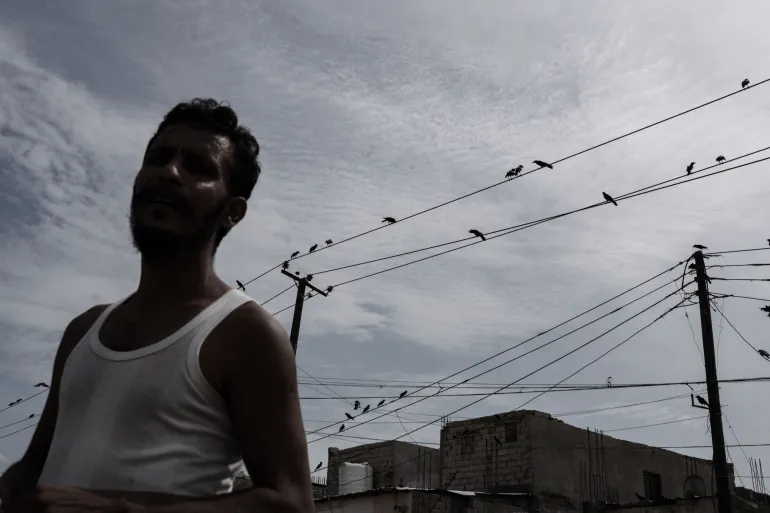
A man walks beneath a web of power lines in a neighborhood in Aden, Yemen. Long and frequent electricity cuts have become part of daily life for residents across the city. Photo: Belal Khaled
A man walks beneath a web of power lines in a neighbourhood in Aden, where long and frequent power cuts have become part of daily life. [Belal Khaled/Al Jazeera]

An assessment by the International Monetary Fund (IMF) published this year said Aden was receiving just two to six hours of electricity a day as structural weaknesses and fuel shortages caused frequent outages.

As the sun sets over the city, a second part of the day begins. Homes and businesses slip into darkness, punctuated only by small lights powered by batteries and solar systems. Residents often do not know how long the latest blackout will last, or how long the power will stay on once it comes back.

During the summer, when temperatures in Aden climb towards 40 degrees Celsius (104 degrees Fahrenheit), the consequences are hard to escape. Residents in the city interviewed in the middle of the year said their homes had become almost unbearable during the prolonged power cuts that plague the city. The heat does not always disappear when the sun goes down.

As the sun sets over Aden, parts of the city begin to fall into darkness, with only scattered lights powered by batteries or alternative energy systems. Residents often do not know how long an outage will last or when power will return. Photo: Belal Khaled
After the sun sets in Aden, most of the city falls into darkness with only scattered lights coming from devices powered by batteries or alternative energy systems. [Belal Khaled/Al Jazeera]

“Sometimes the power comes back while we are asleep, so we wake up to use it. Our lives have become tied to when electricity comes and goes,” one resident said. For her family, an outage is measured not just in hours but in problems. Children are unable to sleep, food spoils in warm refrigerators and housework must wait.

When the heat inside becomes too much, Youssef heads for the coast. The sea, he said, is no longer just a place of recreation but a refuge from the unbearable heat of the city.

“When the electricity is off for hours, it is very difficult to stay inside,” he said. “There is no fan and no air conditioning, and the humidity makes the heat worse, so we come to the sea.”

Towards the end of the day, young men and families gather along the waterfront. Some swim. Others simply sit beside the water and wait for the city to cool. But the sea cannot solve Aden’s electricity crisis. Hours later, Youssef returns home and sometimes finds the house exactly as he left it.

“Sometimes we get back and the power is still out, and we start waiting all over again,” he said.

For children like Mohammed, Saeed and Abdullah, blackouts have changed where childhood takes place. When their homes become too hot, they move into the street, running between houses or sitting with other children until late.

A child walks through a neighborhood in Aden during the day. A generation of children in the city has grown up knowing electricity as something that comes and goes, rather than as a constant part of daily life. Photo: Belal Khaled
A child walks through a neighbourhood in Aden, where a generation has grown up knowing electricity as something that comes and goes rather than being a constant part of daily life. [Belal Khaled/Al Jazeera]

“It gets hot inside the house, so we come down and play in the street,” one of the boys said. “We play football or sit with our friends. Outside is better when the electricity is off.”

For them, a blackout is not an extraordinary event. It is part of the life they have grown up with.

The effects follow them into the classroom. In Aden, the United Nations Development Programme documented more than 7,000 students and teachers struggling in dark, stifling classrooms during power cuts. The installation of solar systems at eight schools and an education office has helped. One teacher reported that some students had fainted due to the heat.

At home, preparing for exams can depend on a rechargeable lamp or a small solar system if they have one.

In hospitals, there is no option but to simply wait out the darkness. Operating theatres, intensive care units, laboratories, medical refrigerators and dialysis machines all depend on continuous power.

The World Health Organization (WHO) says recurring power cuts disrupt lifesaving health services across Yemen, forcing facilities to rely on combinations of grid electricity, generators and solar systems.

In 2025, the WHO supplied about 4.33 million litres (1.14 million gallons) of fuel to 177 health facilities across the country to keep generators and essential equipment running.

A medical incubator inside a hospital in Aden. In health facilities, electricity cuts affect far more than lighting, as operating rooms, intensive care units, incubators, laboratories and medical equipment depend on a continuous power supply. Photo: Belal Khaled
An incubator inside a hospital in Aden. At health facilities, power cuts disrupt operating rooms, intensive care units, incubators, laboratories and vital equipment that depend on continuous electricity. [Belal Khaled/Al Jazeera]

Zeina Ahmed, a kidney patient, watches tubes carry her blood to a dialysis machine.

“For people at home, a power cut means heat and darkness. For us here, the first thing we think about is whether we will be able to have our dialysis or not,” she said.

“I come to the hospital knowing that I need this session. If it is delayed, I keep thinking about when I will get it and whether the machines will continue to work.”

After years of unreliable grid supply, solar panels, batteries and generators have become familiar parts of Yemen’s landscape.

They sit on rooftops, providing power to the homes, businesses and schools that can afford them.

More than half of Yemen’s homes now rely on solar power in some form, according to the WHO, while hospitals and other health facilities are increasingly adopting solar systems to keep essential services running.

Families who can afford to buy larger panels and batteries can power more appliances. Others might have just enough electricity for a light, a fan or a phone charger – a fragile shield against the dark and the heat.

Source link