people

Gas prices, wildfire, insurance, climate – what each candidate said last night

Wildfire and insurance — issues amped by climate change — along with the price of gas, took center stage at the California governor’s debate on Tuesday night.

Here are some of the candidates’ defining statements, starting left of the stage:

Tony Thurmond

The Democratic State Superintendent of Public Instruction addressed the state’s wildfire insurance crisis, where private insurers have been dropping policies as climate changes fuels more frequent catastrophic fire. The state has allowed insurers to raise rates in return for writing more policies, but so far its backup FAIR Plan, meant to provide coverage when other companies will not, continues to grow.

Thurmond said he would withhold tax credits, subsidies and benefits from non-cooperative insurers, although moderators and other candidates raised questions about the legality of this strategy.

“The governor can certainly work with the Insurance Commissioner to say there should be no rate increase unless the insurance industry is actually writing policies. They have failed California in our greatest need. They’ve taken the money for premiums and then when people needed to have support to rebuild their homes, they said, ‘whoops, we’re not going to help you.’ Then they got a rate increase. I’m sorry, where I come from, when you do a bad job, you don’t get a raise.”

Chad Bianco

The Republican Riverside County Sheriff said insurers aren’t leaving California because of climate change, but because the state has failed to pass and enforce vegetation management and defensible space policies that would reduce wildfire risk.

“It wasn’t global warming, stop believing that. It was a failed environmental policy that doesn’t allow fire departments to prevent defensible space around our homes or clear out the brush for 30 years that are building in our mountains and in our hills that took out a city. [Insurers] specifically said we were going to lose a city, and our governor said ‘we don’t care.’ And so the insurance companies left.”

Inadequate brush clearance has contributed to other fires in the state, although it’s not a factor experts cite in the Los Angeles fires specifically.

Tom Steyer

The Democratic billionaire hedge fund founder who is positioning himself as the climate candidate in the race, touted his drive to make oil companies pay for damages from climate change, including rising insurance rates and homes lost to wildfires.

“In environmentalism, I have three real rules. Number one is polluter pays. It’s absolutely critical that if people are going to pollute and damage the environment and cause harm to their neighbors, they pay. Two, we have to include environmental justice in every single environmental rule. And third is we need to start to deploy all of the clean energy stuff that’s cheaper now and get us back to the front of the world in leading it.

“There is one person that the corporations are going after, including Big Oil, who is spending millions of dollars to stop me. The electric monopolies, PG&E, millions of dollars to stop me, because I’m the person on this stage who’s the change agent.”

Steve Hilton

The former Republican Fox News commentator said insurers should be allowed to raise rates consistent with actual wildfire risk. He also advocated for “modern forest management,” removing fuel from forests, as a way to protect against wildfires, reduce carbon emissions from fire, and revive the state’s timber industry.

“We can create jobs and opportunity in rural California and reduce carbon emissions in the process, because we won’t have the mega wildfires.”

Asked if he supports the transition to electrification, he promoted natural gas: “Yes, but let’s be sensible about electric. Right now, we have a fleet of gas fired power stations generating electricity that are running at 10 to 15% of their capacity, even though we have abundant natural gas in California that we could be using to generate affordable, reliable electricity that would lower the cost of electric bills for consumers and businesses.”

According to the U.S Energy Information Administration, California’s natural gas production provides less than one tenth of what the state consumes.

Xavier Becerra

The former Health and Human Services Secretary said he would call a state of emergency as governor to require wildfire insurers to freeze rates and come to the table.

“This affordability crisis is hitting every family, and we have to act as if this were a break glass moment … Rate payers have to understand what their risk is, so they understand why they are going to pay for what they’re going to pay for their home insurance. But an insurance company has to be open and transparent about how its pricing its policies so people can afford it.”

Moderator Julie Watts noted that California home insurance rates are below the national average and questioned the legality of a freeze.

Katie Porter

The former Democratic Orange County Congresswoman was asked whether California should keep its refineries. Two of them closed in the past year, reducing the state’s refining capacity by 20 percent and causing California to lean more heavily on imports.

She said the state should keep the remaining refineries open, but also rapidly scale up green energy to meet the state’s growing electricity demand: “Right now we need to keep all of our energy sources online. That’s just the reality that we’re in. … Right now those refineries, they’re up, they’re running, they’re creating good jobs. Let’s keep them there. But I want to be really clear … The people who work at those refineries, and the people who live in Kern County also face some of the worst pollution and lower life expectancies. Green energy gets us out of that.”

She also backed an idea to have state dollars cover insurance for insurers, known as reinsurance.

Matt Mahan

Democratic San Jose Mayor called to suspend the state’s 61 cent-per-gallon gas tax, used to fund road repairs, bridges, and public transport. The state is looking at a $216.4 billion revenue shortfall over the next decade due to increasing fuel economy and electric vehicles. The other Democratic candidates support keeping the tax; Mahan has instead proposed a flat fee on all vehicles.

He said: “I’m the only candidate on this stage who has pledged to suspend and then reform the gas tax. It is the most regressive tax in California. Working people, rural people, are spending three times as much maintaining our roads as wealthier EV owners.”

On the wildfire insurance crisis he said: “The government in Sacramento created so many restrictions, including taking over a year to approve any rate changes, prohibiting insurance companies from using climate data to project future costs, that they stopped writing new policies. The answer is bring them back, force them to compete, allow them to appropriately price risk, and then hold government accountable for maintaining our wildland, reducing all that vegetation and wildfire risk so that we don’t have these catastrophic fires.”

Antonio Villaraigosa

The former Democratic L.A. mayor expressed his concerns with the readiness of the state’s infrastructure to support a transition to electric vehicles.

“We need an all of the above strategy that understands we’ve got to transition from oil and gas to renewables. But here’s an example: the 2035 mandate [to ban gas-powered car sales]. We built 167,000 charging stations in the last 10 years. We need 2 million more to get to that mandate, and if we build them, we don’t have a grid. So we ought to build the grid instead of arguing about whether or not we need an all-of-the-above policy.”
Source link

John Seymour, Anaheim mayor and U.S. senator, dies at 88

John Seymour was the rare politician who didn’t mind harming his career if it meant doing right by his constituents.

As the newly elected mayor of Anaheim in 1978, he angered the city’s Police Department by suggesting the creation of a citizens oversight commission after residents complained that officers regularly harassed and beat them.

The lifelong Republican upset his party’s conservative base in the 1980s as a state senator, when he announced his support for abortion rights and opposition to offshore drilling.

“I’m not going to always be right,” Seymour told reporters in 1990. “Therefore, to expect one to never change a position on an issue … is too much to ask.”

Appointed to the U.S. Senate in 1990 after Pete Wilson was elected governor, Seymour lost his seat to Dianne Feinstein two years later and never ran for public office again. He remains the last California Republican to serve in that role.

“John was a guy who had great courage, he had great goodwill and a damn good mind,” Wilson, who was mayor of San Diego when he first met Seymour in the 1970s, said Monday. “He not only enjoyed a little combat, he was willing to give the time necessary for it.”

Seymour died on April 18 at his home in Carlsbad. He was 88, and the cause was Alzheimer’s disease, according to his son John.

As his party swung to the right, the moderate Seymour had no problem with becoming a political afterthought.

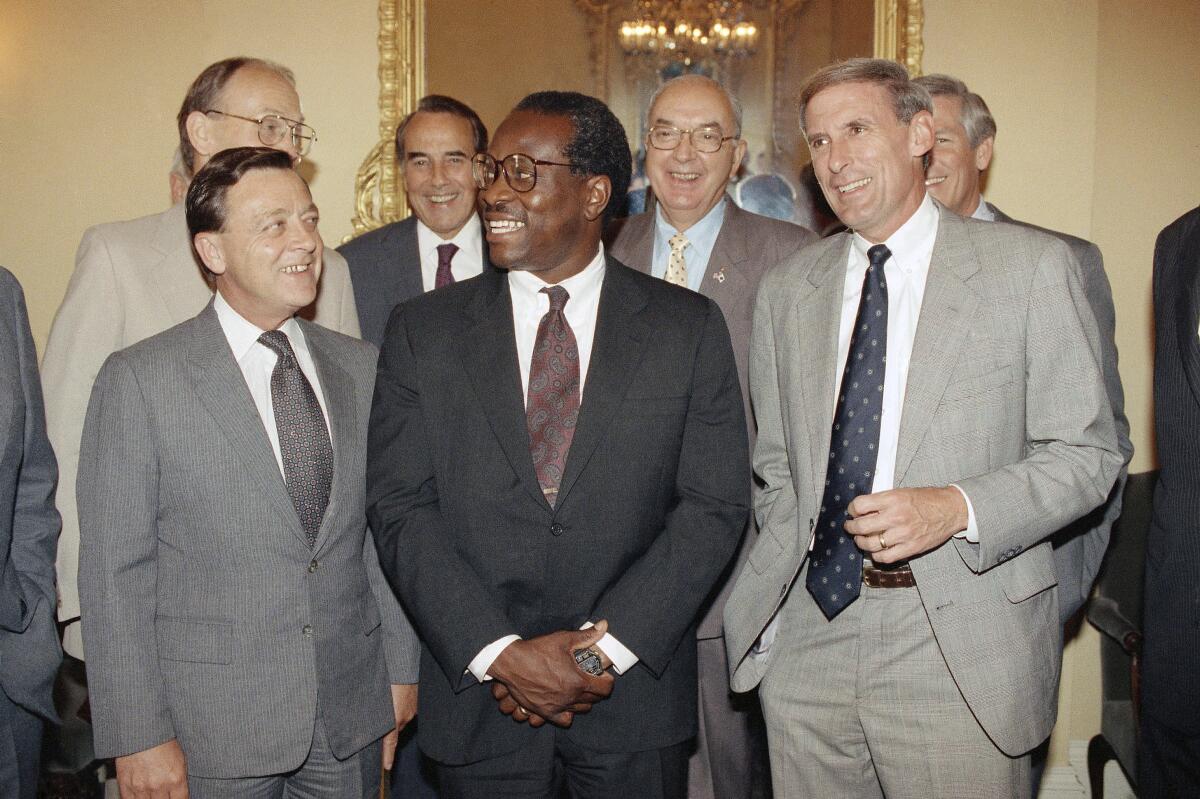
Supreme Court Justice nominee Clarence Thomas with republican senators John Seymour, R-Calif., Larry Craig, R-Idaho.

Supreme Court nominee Clarence Thomas, center, poses with senators on Capitol Hill in 1991. With Thomas, from left to right, are Sens. John Seymour (R-Calif.), Larry Craig (R-Idaho), Bob Dole (R-Kan.), Jesse Helms (R-N.C.), Connie Mack (R-Fla.) and Dan Coats (R-Ind.), right front.

(John Duricka / Associated Press)

“If somewhere in a footnote, history should record my public service, I would hope that they record me as one who cared more for people than for policy, one who was a no-nonsense guy who worked hard for those in need of help, but who wasn’t hesitant to knock heads of bureaucrats in order to get things done,” he told supporters at the kickoff to his Senate campaign in 1992.

Born in Chicago, Seymour settled in Southern California in the 1960s after a stint in the Marine Corps. The UCLA graduate started a real estate business in Orange County as the region transformed from farmland to suburbia. After four years on the Anaheim City Council, he became mayor in 1978.

He quickly established the pragmatic persona that would enable his rise in California politics.

Months after Seymour’s mayoral win, Anaheim police officers stormed a Latino neighborhood and beat up dozens of people in what became known as the Little People’s Park riots. At community meetings, Seymour admitted his shock at learning about the poor relations between the police and many residents.

The mayor described his approach as: “Don’t sweep it under the rug; don’t look the other way. Admit that we have a problem.”

At the same time, Seymour was negotiating with the Los Angeles Rams to move from the Coliseum to Orange County. While other O.C. officials proposed a new stadium, he convinced the Anaheim City Council to convert Angel Stadium into a multipurpose venue that he argued would create “the greatest opportunity for Anaheim since Disneyland and the California Angels.”

The Rams moved to the city in 1980. Two years later, Seymour was off to Sacramento as a state senator.

He became head of the Republican Senate caucus in his first year and bucked the stereotype of an Orange County GOP firebrand by largely eschewing culture war issues in favor of matters like higher pay for teachers and government support for poor parents that sometimes aligned him with Democrats. That made him few friends in his own party, with many finding his personal ambition grating — he once wrote a letter to then-Gov. George Deukmejian asking that he be appointed state treasurer — and a distraction from getting more of their own elected to Sacramento.

Seymour made no apologies for selling himself as a public servant while simultaneously seeking more power.

“I like to do things,” Seymour told The Times in 1987. “I’ve been a doer all my life. I don’t like to sit around sucking my thumb. I like to resolve problems.”

That year, conservative opponents deposed him as caucus chair. They snickered two years later when he announced that while he personally opposed abortion, he now supported a woman’s right to choose.

Sen. John Seymour in 1991.

Sen. John Seymour in 1991.

(Don Boomer / For The Times)

The impetus was a U.S. Supreme Court decision that gave states more leeway to regulate abortion. Since California had legalized the procedure decades earlier, Seymour reasoned that he should respect women’s choices. He spoke with people who were for and against abortion, and with his own family, before going public with his change of heart.

Naysayers accused the state senator of trying to pick up female voters as he was campaigning for the Republican nomination for lieutenant governor against fellow Orange County legislator Marian Bergeson, who opposed abortion. The charge was bogus, according to longtime Seymour campaign advisor Eileen Padberg.

“He didn’t get talked into it — he was an effing Marine,” she said. “He had to be convinced in anything before making a decision. In my career representing hundreds of candidates, John was one of very few who consistently would say about their stances, ‘This is going to kill me, but I gotta do it.’”

Seymour lost the primary to Bergeson. Six months later, he was once again one of the most powerful Republicans in the state when he took the Senate seat Wilson had just vacated to become governor.

Seymour’s son John recalled his father getting the call from Wilson while the family was vacationing in Shasta.

“Dad knew that it was a heavy, weighted responsibility, and that it would affect the family,” John said. “But we kids said, ‘You should do this, if it makes you happy.’”

Seymour became the second Anaheim Republican to serve in the position, after Thomas Kuchel in the 1950s and 1960s.

Wilson told The Times that he originally wanted to keep his friend in Sacramento to help push through his agenda. But the governor figured he needed a trusted voice in Washington even more.

“You’re looking for people who are not only friends but are capable and experienced and understand what’s necessary,” Wilson said. “And I don’t think I was doing him a great favor, because it was a tough time for the state.”

California was weathering its worst recession in decades and a punishing drought. The state’s vaunted defense industry was shedding tens of thousands of jobs with the closure of military bases after the end of the Cold War.

The daunting task didn’t faze Seymour.

“I mean, you gotta be good to succeed in the private sector,” he told The Times in 1992. “But if you’re gonna succeed in getting things done in the public sector, you gotta be better than that! That’s the challenge!”

Seymour spent most of his short time in the Senate in triage mode. He lobbied especially hard for California’s real estate industry, calling himself the “realtors’ senator.” But the diminutive man’s plainspoken demeanor failed to gain traction with California voters — a 1991 Times profile deemed him “the unknown senator.” And his one moment in the national spotlight became fodder for opponents.

In the spring of 1992, Los Angeles erupted in deadly riots after a jury acquitted four police officers who beat Rodney King. As he once did in Anaheim, Seymour went on a listening tour across affected neighborhoods, accompanying President George H.W. Bush.

This time, Seymour was accused of seeking photo opportunities a month before his primary election and being tone-deaf to the riot’s root causes by airing television ads stating, “We can’t be tough enough on lawbreakers.” White House aides ridiculed him in the press as the “Velcro senator.” His Republican opponent, Orange County Rep. William Dannemeyer, labeled him “Senator Flip Flop.”

Seymour easily beat Dannemeyer, then faced Democrat Dianne Feinstein, the former San Francisco mayor whose narrow loss to Wilson in the governor’s race had earned her widespread name recognition. He received only 38% of the vote as Feinstein rode a Democratic wave that swept Bill Clinton into the White House and a record number of women into the U.S. Senate, including Barbara Boxer in California.

California Department of Finance spokesperson H.D. Palmer worked for Seymour at the time and saw his “regular guy” boss give “one of the kindest and most gracious concession speeches I’ve ever heard.”

“Then he went down to O.C. to be with his supporters,” Palmer said. “He was true to his roots.”

Wilson soon appointed Seymour to head the California Housing Finance Agency, which helps first-time home buyers access low-rate loans. He stayed in that role for two years before becoming chief executive of the Southern California Housing Development Corp. The Inland Empire nonprofit, which managed and built affordable housing complexes, is now known as National Community Renaissance, or National CORE.

John, who is the nonprofit’s vice president of acquisitions, said his father had no regrets about leaving politics behind because “housing was his passion. He saw it as a platform for people to grow. He would say, ‘Once you’re housed, you have a big, beautiful horizon to do anything.’”

Seymour did lean on his past to urge skeptical cities and counties to allow affordable housing projects, challenging them to be like him: do the right thing regardless of political cost.

“If in fact you’re going to try to change an environment in which a mayor or city council will do what they know in their hearts is right, you need to offset the political blow,” he said at a housing conference in Cathedral City in 2002. “I challenge you to form a coalition.”

Seymour is survived by his wife of 54 years, Judy; children John, Shad, Jeffrey, Barrett, Lisa Houser and Sarena Talbert; nine grandchildren and eight great-grandchildren.

Source link

Dirk Kempthorne, former Idaho governor and U.S. Interior secretary, dies at 74

Former Idaho Gov. and U.S. Interior Secretary Dirk Kempthorne has died at age 74, his family said in a written statement Saturday.

Kempthorne died Friday evening in Boise, the statement said. No cause was given. He had been diagnosed with colon cancer last year.

“Beyond his public service, he was a devoted husband, father, and grandfather whose greatest joy came from time spent with family and the people he met along the way,” his family said. “He had a rare gift for truly seeing others — remembering names, stories, and the small details that made each person feel known and valued.”

Kempthorne, a moderate Republican, was elected mayor of Boise in 1985 at age 34, and he was credited with revitalizing the downtown by securing an agreement to build a convention center and promoting other development. He served seven years before winning the U.S. Senate seat vacated by Sen. Steve Symms in 1992.

During his time in Washington, he authored legislation — signed by Democratic President Clinton — to end unfunded federal mandates on state and local governments.

Rather than run for reelection in 1998, he entered an open election for governor, trouncing his Democratic opponent by garnering more than two-thirds of the vote.

President George W. Bush appointed him Interior secretary in 2006, a position he held until the end of Bush’s presidency — and during which he lived on a houseboat docked in the Potomac River.

“Dirk was one of the finest public servants I ever knew because he was one of the finest men,” former President George W. Bush said in a written statement Saturday. “He was considerate, smart, and capable. Dirk loved our lands and waters, and as Secretary of the Interior, he was an effective steward of our natural resources.”

He protected polar bears

Environmentalists often found Kempthorne too accommodating to industry, citing his efforts to push oil and gas development in the Gulf of Mexico and off Alaska. More than 100 conservation groups opposed his nomination as Interior secretary, saying that as a senator he had voted to eliminate federal money for recovery of the endangered wolf, to open the Arctic National Wildlife Refuge to oil and gas exploration, and to sell off federal public lands.

Yet in 2008, he bucked other advisers in the White House by insisting that the polar bear should be listed as a threatened species under the Endangered Species Act because of the loss of sea ice in the Arctic. He was prepared to resign over it when Bush decided to back him.

“As Governor, Dirk left an enduring mark on our state,” Idaho Gov. Brad Little said in a written statement. With the partnership of his wife, Patricia, Kempthorne “championed children and families, strengthened public education, and led transformational investments in our transportation system that will benefit Idahoans for generations.”

After leaving the federal government, he became the chief executive of a trade association of life insurance companies.

He helped Afghan refugees

In a 2023 question-and-answer session with the George W. Bush Presidential Center, Kempthorne recalled helping evacuate nearly 400 U.S. citizens and Afghan allies from Afghanistan two years earlier, as many were being sought by the Taliban following the U.S. military’s chaotic withdrawal. Kempthorne and others worked frantically for months to raise money and garner the support of diplomatic channels to charter buses and an Airbus A340 to help resettle the evacuees in the U.S. and Canada.

At one point, with the flight fully booked, the organizers received a list of more people who needed to leave urgently.

“That night, at a total loss for answers, alone, I knelt in prayer,” Kempthorne recalled. “I said, ‘Dear God, we cannot leave these people behind, please give a path forward.’”

He said he then had a vision of Mother Mary holding the infant Jesus. It gave him an idea: The babies on the flight didn’t need their own seats, as their parents could hold them. The organizers confirmed that with the airline and were able to add an additional 50 people to the flight, Kempthorne said.

Kempthorne was born in San Diego and grew up in Spokane, Wash. His father was a regional representative for Maytag, the appliance company. His mother, a homemaker, once worked as a secretary for the Legislature in Nebraska, her home state.

Kempthorne attended San Bernardino Valley College in California before transferring to the University of Idaho, where he served as student body president and met Patricia, his future wife. After graduation he worked as executive assistant to the director of the Idaho Department of Lands before joining the Idaho Home Builders Assn. as the executive vice president.

Kempthorne is survived by his wife, as well as their children Heather and Jeff and their families.

Johnson writes for the Associated Press. Johnson reported from Seattle.

Source link

Agents with search warrants keep focus on Minnesota in fraud inquiry

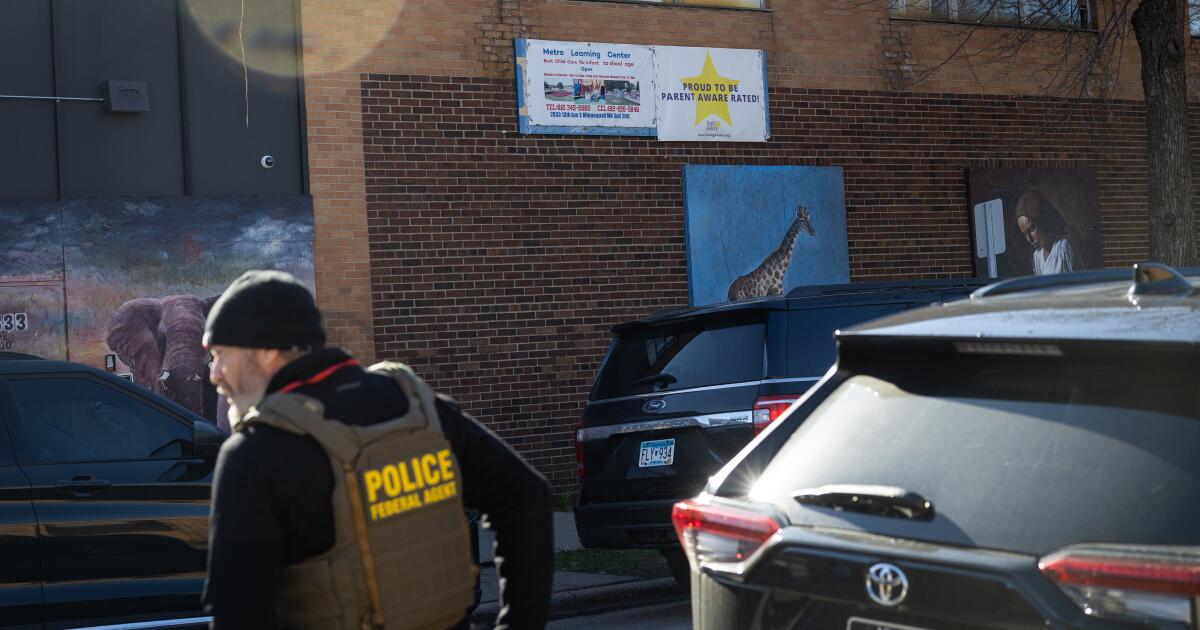
Federal agents executed multiple searches in Minnesota on Tuesday, seizing records and other evidence in an ongoing fraud investigation by the Trump administration of publicly funded social programs for children, authorities said.

Few details were released, though armed agents were seen at child-care centers in the Minneapolis area. KSTP-TV said one crew even had a battering ram.

Democratic Gov. Tim Walz, who has been on the defensive amid Trump administration claims that he hasn’t done enough to root out fraud, welcomed the raids. The state child welfare agency said it shared key information with law enforcement to “hold bad actors accountable.”

“We catch criminals when state and federal agencies share information. Joint investigations work, and securing justice depends on it,” Walz said.

The searches were being conducted at daycares, businesses and some residences, according to a person familiar with the matter who spoke to The Associated Press on the condition of anonymity because they were not authorized to publicly discuss the investigation.

Tensions between Minnesota officials and the federal government were high during an extraordinary immigration crackdown that led to the deaths of two people before Operation Metro Surge was eased in February.

Before that crackdown, the government had brought fraud charges against dozens of people, many of them Somali Americans, who were accused of fleecing a federal program that was meant to provide food to children. The investigation began during the Biden administration. More than 60 people have been convicted.

Various state and federal agencies, including the Department of Homeland Security, participated in searches Tuesday. Officers from Minnesota’s Bureau of Criminal Apprehension were removing boxes at some sites.

“The American people deserve to know how their taxpayer money was abused. … No stone will be left unturned,” DHS said.

Jason Steck, an attorney who represents childcare centers, said the names of targeted businesses that were shared with him show they’re operated by Somali immigrants. They were not his clients.

“A few childcare centers, a few autism centers, a few healthcare agencies of some type,” Steck said, adding that it appeared to be a “particular sweep for fraud.”

The executive director of Child Care Aware of Minnesota, a nonprofit that serves childhood educators, said the publicity will be unflattering.

“The majority are in business to do good business. You’re going to come across individuals who try to capitalize on systems that are broken and need to be fixed,” Candace Yates said.

Right-wing influencer Nick Shirley posted a video in December that caught the attention of the Trump administration. He alleged that members of Minnesota’s Somali community were running fake child care centers so they could collect federal subsidies, fueling suspicions on top of the food aid scandal. The claims were disproven by inspectors.

President Trump, meanwhile, has used dehumanizing rhetoric, calling Somali immigrants “garbage” and “low IQ.”

In February, Vice President JD Vance said the government would temporarily halt $243 million in Medicaid funding to Minnesota over fraud concerns. Minnesota sued in response, warning it may have to cut healthcare for low-income families, but a judge on April 6 declined to grant a restraining order.

Walz told Congress in March that he wanted to work with the federal government in fraud investigations, but that the immigration surge had made it more difficult.

“The people of Minnesota have been singled out and targeted for political retribution at an unparalleled scale,” he said at the time.

Vancleave and Richer write for the Associated Press. Durkin Richer contributed from Washington. AP reporters Steve Karnowski in Minneapolis and Corey Williams and Ed White in Detroit contributed to this story.

Source link

Arby’s sign from Sunset Boulevard location in Hollywood appeared at Stagecoach

A weekend in the desert is a go-to getaway for Southern Californians — even if you’re a beloved neon sign.

Nearly two years after the Hollywood Arby’s closed, its cowboy hat shone again this weekend at the Stagecoach Music Festival in Indio.

The restored sign showed up more than 130 miles away from its original home as part of the roast beef chain’s pop-up at the festival at the Empire Polo Club, where it became one of the event’s go-to photo spots.

“As you can see, everyone’s loving it. Everyone’s getting a photo op standing in front of it,” Arby’s franchisee Roger Amaya said.

Over the three days, people moseyed by the pop-up near Diplo’s Honky Tonk, sometimes lining up to wait their turn to take a photo in front of the sign. Some climbed on the surrounding hay bales for a better pose, asking others in line to snap their photo in front of the cowboy hat emblazoned with the words “Arby’s roast beef sandwich is delicious.”

  • Share via

A number of people we talked to taking photos weren’t from L.A. and didn’t know the lore of the Hollywood Arby’s sign — they just liked the visual.

The sign’s original location was the Arby’s at 5920 Sunset Blvd. in Hollywood, which had been open for more than 55 years when it shuttered in June 2024.

The family that owned the location said at the time that rising food costs, the post-pandemic changes in the neighborhood and a law that raised minimum wage contributed to the closure.

Amaya said that Amir Siddiqi, head of a group of Arby’s franchises, was able to get the sign from the Hollywood location and have it restored.

“We were able to bring it back to life here and bring it to all the fans of Arby’s out there,” Amaya said.

Now that Stagecoach is over, where will the sign go next?

“That’s the big question, so you gotta stay tuned,” Amaya said.

Source link

Bahrain strips 69 people of citizenship over Iran support | US-Israel war on Iran News

Rights groups have described the move as a “blatant abuse of power”.

Bahrain has stripped dozens of people of their citizenship for allegedly supporting Iranian attacks on the country.

Bahrain’s Ministry of Interior announced on Monday that it had revoked the citizenship of 69 people, some of whom were related, after accusing them of sympathising with Iran and “colluding with foreign entities”. The move comes after Tehran carried out strikes on facilities in Bahrain as part of the war launched against Iran by Israel and the United States.

Recommended Stories

list of 3 itemsend of list

The directive, issued by King Hamad bin Isa Al Khalifa, stated that all 69 people were “of non-Bahraini origin”. Under Bahraini law, a person can be stripped of citizenship if they are deemed to have caused harm to the country or shown disloyalty.

The London-based Bahrain Institute for Rights and Democracy described the move as “dangerous” and a clear violation of international law.

The organisation said the individuals had not been publicly identified, and it remained unclear whether they had been arrested, whether they were inside or outside Bahrain, and whether they held another nationality.

Iranian strikes

Tehran began striking its Gulf neighbours on February 28, shortly after Israel and the United States began the war by launching attacks on Iran.

Tehran accused the targeted countries of allowing the US to conduct its strikes from their territory. Iran’s retaliatory attacks reportedly caused significant damage to US military sites across the region, including a Navy base in Bahrain, which was hit by missiles and drones.

Iran ceased its attacks on Gulf neighbours on April 9, following the introduction of a ceasefire brokered by Pakistan. Negotiations to permanently end the war are ongoing three weeks later.

Bahrain’s Shia population has long accused authorities of marginalising them. During the Arab Spring in 2011, mass protests against the country’s leadership broke out. The Bahraini government has long blamed Iran for fomenting unrest against it.

Source link

Latino leaders surge into local office as Trump-era attacks fuel new urgency

Rhetoric dehumanizing immigrant and Latino communities may appear more open and in-your-face in the current political climate. But that has not been a barrier for Latinos seeking elective office or high-level roles in government.

Voters are choosing an increasing number of nonwhite Hispanic leaders to local elective office — and many of the leaders are the first Latinos to hold their seats. Some political science experts attribute the rise of Latino leadership to years of grassroots organizing, coupled with ongoing demonization of their communities by Trump administration officials and conservative activists.

“That’s the difference now, is that there’s this extra incentive of an unrelenting attack on Latinos across the country,” said Anna Sampaio, an ethnic studies professor at Santa Clara University who specializes in race and gender politics.

There are currently an estimated 7,700 Latino elected officials nationwide, according to data from the National Association of Latino Elected and Appointed Officials. That’s up from 6,883 officials in 2020.

Estimated to number as many as 55 million people — 16% of the U.S. population — Latinos are the largest ethnic minority in the country, with politics, interests and priorities as diverse as the national origins represented within their population. But Latinos also are underrepresented as a demographic across elective offices.

Since the beginning of President Trump’s second term, Latino communities have been a target of his hard-line immigration tactics. The feeling of attack doesn’t stop there. From memes shared from the official White House page perpetuating Hispanic stereotypes, a federally led English-only initiative and an anti-diversity, equity and inclusion push have painted a target on Latinos across the country.

It’s all led to more Latinos seeking office to defend their communities and give voice to those who may be afraid to speak out in the current political climate. As a result, legislators have proposed measures that include providing community members with protections against the U.S. Immigration and Customs Enforcement, halting the approval of ICE detention centers in their cities, and calling for a stop to ICE funding, among other actions.

Pennsylvania Latino mayor makes history

Lancaster, Pennsylvania, with a roughly 40% Hispanic population, recently elected Jaime Arroyo their first Latino mayor. Arroyo took office in January, after being elected with 85% of the vote.

“I think being the first Latino to be in this role and the first person of color to be mayor of Lancaster City has been exciting,” Arroyo told The Associated Press, adding that he finds it “extremely exciting to lead and represent our community in this role.”

With rhetoric and national policies — such as heightened immigration enforcement — hurting the Latino communities, Arroyo said, diverse representation in government is more important than ever. He also believes that the rise of elected Latino officials over the last couple of years is the result of generations of Latinos being politically active fighting for civil rights.

“We’re starting to see a lot of the fruits of that labor come to fruition,” Arroyo said. “There’s never a perfect time to serve your community, there’s the right time. And I think right now is the right time for a lot of Latinos to step up into these roles, especially with everything that is going on.”

Latino representation expanding in city councils

Many more Latinos made history when they took office in earlier this year.

In Iowa, Rob Barron was sworn in Jan. 12 as the first Latino representative on the Des Moines City Council. Antonio Pacheco was sworn on Jan. 7 to be the first Latino member of the city council in Conyers, Georgia. In Ohio, Eileen Torres became the first Mexican American women to win a city council seat in Lorain. Sabrina Gonzalez also took office there as the first Puerto Rican women to serve.

And in Michigan, Clara Martinez and Deyanira Nevarez Martinez were sworn in Jan. 1 to the Lansing City Council, making the city the first in the U.S. to have a council with majority Latino representation.

Martinez said her election, and that of Nevarez Martinez, makes a bit statement about “what people are truly open to despite the national rhetoric.”

“I think because of the rhetoric that we are having to face and some of the backlash on the national stage, I think that’s just fueled the fire for so many people,” she said.

The Salt Lake City Council also has a Latino majority, with four of seven seats, after Erika Carlsen, the granddaughter of Mexican immigrants, was sworn in on Jan. 5. Carlsen said her success is possible because of current and previous generations that put in the work to create spaces where Latinas were encouraged to take leadership positions.

“I feel like I’m building on early generations of leadership,” Carlsen said. “That’s both an honor and responsibility to improve Salt Lake City for the people who live here.”

Carlsen said even if representation at the federal level is not high or visible she said having representation at the local level can have a huge impact.

“I think that it’s critically important that we continue to build on this momentum,” Carlsen said. “The majority of change that can happen starts locally, it doesn’t start in Washington but in City Hall, school boards and neighborhoods conversations. That’s the kind of momentum I’d love to see all across the United States.”

Carolina Welles, executive director of The First Ask, an organization that supports first-time female candidates at the state level, said the reason why Latino representation is more visible at the local level is because those leaders are able to built trust with their community much easier given their proximity.

“They actually know what people care about,” Welles said. “They have a stake because they are facing similar things.”

Local level Latino leadership builds on state and federal representation

It’s not just at the local level. Latinos are making inroads at the federal level too.

The 119th Congress has 56 Hispanic or Latino members. That shakes out to 10.35% of total membership, according to the Congressional Research Service.

For comparison, there were only 14 Hispanic or Latino members and all were male in the 99th Congress, 40 years ago.

At the start of 2025, there were seven Hispanic U.S. senators. That number decreased to six when then Sen. Marco Rubio resigned to become the Secretary of State, the first Latino to hold the position.

Last year also marked a record for Latinas at the state level. Latinas held 214, or 2.9%, of seats in state legislatures, according to the Center for American Women and Politics. That was up from 192 seats in 2024.

Currently, New Mexico Gov. Michelle Lujan Grisham is the only active Latina governor in the U.S. Only two Latinas have been elected governor in U.S. history, and both were in New Mexico.

In March, Gina Hinojosa won the Democratic nomination for governor, making her the second Latina to win a major party gubernatorial nomination in Texas.

Latinos saw the biggest rise in elected officials during the Trump administration in response to attacks on their fundamental rights, said Sampaio, the Santa Clara University professor. She said that trend is likely to continue as the administration continues its attacks on immigrant communities.

“We’re likely to see more Latinos run for office at the local level, at the state level and even at the national level in response to the attack on simply their existence,” Sampaio said. “It is unwittingly both terrorizing the Latino community as well as mobilizing communities.”

Figueroa writes for the Associated Press.

Source link

Hollywood residents want more for their tax dollars. Councilman says he’s trying

Hold everything. Hollywood’s Lexington Park will not be getting a new playground after all, and that’s both good news and bad news.

To explain, let me take you back to April 15, when I tagged along with Sabine Phillips on her weekly three-hour inspection of the neighborhood’s chronic trash problem. Phillips, a housekeeper by trade, was hired by one of her clients a few years ago to help clean up their streets.

So each Wednesday, Phillips went out on her yellow Huffy cruiser and routinely logged 50 or more illegally dumped items and reported them to the city’s 311 system for pickup. And each Saturday, she filled up to four or five big bags with smaller bits and scraps of debris.

Near the end of my three hours with Phillips, who got help that day from volunteer Keith Johnson, we visited the Lexington pocket park. There were no kids there, and there never are, Phillips said. That’s because of the glass and needles in the sand, drug activity, sporadic violence, gang tags on the slide and homeless camps.

A guy from the Recreation and Parks Department showed up and said the park was in line for a possible upgrade that could cost as much as $300,000. In my April 18 column, I questioned the wisdom of investing in a playground that would remain unsafe unless there was a plan to address all the aforementioned issues.

Nick Barnes-Batista, communications director for L.A. City Councilmember Hugo Soto-Martínez, wrote to tell me his office was unaware of any playground projects planned for that park.

A spokesperson for Recreation and Parks told me that despite what was said by the employee I met in the park, there is no “immediate playground replacement project on the books.” But the department is “working closely” with the councilman’s office “to identify funding sources and to work with the community on broader park improvements and/or uses.”

OK, so it’s good news that taxpayer funds won’t be plowed into a park that could well be lost to the neighborhood almost immediately, due to all the aforementioned problems.

But it’s bad news and sad commentary that a park in the densely populated heart of the city will remain unusable for the foreseeable future.

The more important consideration, though, is the question of what’s being done to prevent the illegal dumping of furniture, mattresses and other items that sit curbside and often end up as the building blocks of new homeless encampments.

There’s a concentration of social service agencies in the neighborhood, said Stefanie Keenan, a longtime neighborhood volunteer and activist. She’s the one who hired her housekeeper to help look after the neighborhood, and she insists there is not enough enforcement of existing laws to address problems that are both a nuisance and a public safety threat, given the crime and all-too-frequent fires.

A woman pushes her walker past debris in Los Angeles.

A woman pushes her walker past debris in Council District 13 in Los Angeles on Friday.

(Genaro Molina / Los Angeles Times)

Soto-Martínez agreed to talk to me about all of this on Friday morning, when he dropped by the Bresee Foundation, a nonprofit with a range of enrichment activities for youngsters and families in the largely low-income immigrant community, as well as homelessness prevention programs. Staff and volunteers, recruited with support from the council office, were about to head into nearby streets with shovels, brooms and trash bags.

Soto-Martínez acknowledged his district’s many challenges, told the gathering that the strength of a community is its people, and thanked them for their service.

The councilman, a former labor leader who joined the growing progressive wing of the L.A. City Council in 2022 with support from the local chapter of Democratic Socialists of America, has three challengers in the June 2 primary (Colter Carlisle, Dylan Kendall and Rich Sarian). He told me the city has to do a better job of educating people about illegal dumping and how to report it. A related challenge, he said, “is how quickly can we get to it. And that is a budget issue because we’ve cut so many positions on trash pickup.”

Soto-Martínez said his office used discretionary funds to hire two crews from the L.A. Conservation Corps for trash pickup. On homelessness, he said, he has a team strategizing to address the needs, and a medical team that works the streets, and a tiny home village is in the works.

But the housing shortage is a major challenge, he said, and when it comes to entrenched homelessness, “we’re now starting to deal with much more difficult cases.” Namely severe mental illness and serious addiction, both of which generally come under county jurisdiction.

“We created another team that goes out every single day. We door-knock, email and phone-bank people who are at risk of eviction,” Soto-Martínez said, adding that homelessness has declined by 25% during his three years in office.

So what is his message to constituents who say they don’t see enough progress?

“We ask them to give us patience and grace,” he said. “There’s a lot of examples like this, where we’re not just dealing with one thing. We’re dealing with four or five things.”

All of that is true, but the patience he asks for is wearing thin among some constituents.

“We need to find common ground and work together,” Soto-Martínez said. “You know, they see trash as an issue, and they’re doing it their way and we’re doing it our way. But how can we team up and do it together? You know, we’re happy to build those networks out, and under many of the issues they describe, I’m not disagreeing. … We all have the same goal.”

Los Angeles City Councilmember Hugo Soto-Martínez talks about confronting issues in his district.

L.A. City Councilmember Hugo Soto-Martínez gives a pep talk to volunteers before they leave to clean their neighborhood streets of garbage and debris.

(Genaro Molina / Los Angeles Times)

When Soto-Martínez departed for another appointment, the volunteers took to the streets, filling trash bags. They worked their way up Vermont, and a Bresee employee told me he works the same streets every day, trying to clear a path for “safe passage” as students walk to and from school.

As I said in the earlier column, it’s an inspiration to see people step up for their communities, whether out of pride or frustration. And it’s also reasonable to expect more from City Hall.

I drove over to Western and Sierra Vista, met up with Keenan, and told her about my conversation with Soto-Martínez. She said lax city policies and frequent non-response to citizen pleas for help have created the unsolved problems residents deal with daily. She said city officials have to do a better job of helping homeless people off the streets and preventing further deterioration of neighborhoods.

She was encouraged by a message she got from a representative of Mayor Karen Bass’ office who wants to tour the neighborhood with her.

We walked west on Sierra Vista and came upon a dumped sofa, some cabinets, mattresses, and a man who has been living in a curbside encampment for months. He sat near his belongings, which spilled into the street.

Why hasn’t this been addressed? Keenan wondered aloud. She has decided to stop paying her housekeeper to help address the neighborhood’s needs, and she predicted things will only get worse because of it.

I drove over to the Lexington pocket park, which Soto-Martínez called a priority, among many other priorities. Friday was a holiday — Armenian Genocide Remembrance Day. With schools closed, the park would have been a great little neighborhood asset.

But the entrance was closed, with a lock on the gate, and two tarped dwellings were set up against the iron fencing of the empty park.

steve.lopez@latimes.com

Source link

Yes, goth yoga is a thing — and it’s thriving in a Burbank occult shop

It’s 7:50 p.m. on a Tuesday as I enter the dimly lighted metaphysical supply store the Crooked Path. Even inside, it almost looks closed; I barely see the crystal-necklace-studded walls, the bowls of runes and bins of long, black candles around me. Half-filled glass jars (perhaps potions?) sit beyond the store’s elongated bar — the apothecary — where a silent man in black points me past Egyptian deity figurines and a large python named Drakina to … my yoga class.

The backroom that Goth Yoga LA calls home is all black paint, purple lights and sage-y smells; music growls ominously from the speaker system above. Devotees gather for the intimate, pay-what-you-can classes, held at 6:30 and 8 p.m. on Tuesday and Thursday nights. It feels like an open mic night in the Upside Down — and yes, everyone is wearing all black. Everyone but Goth Yoga LA’s leader, Brynna Beatnix. Tonight, Beatnix is giving more Y2K occult-glam. She chats with one heavily-tattooed man stretching in the corner, and welcomes in an older woman in heavy eyeliner who tentatively peeks inside. Is she in the right place? Of course she is.

Students take part in a Goth Yoga LA class, complete with burning incense.
Students take part in a Goth Yoga class.

Students take part in a Goth Yoga LA class, complete with burning incense.

Goth Yoga LA’s masterminds are Beatnix and her partner, James David (who DJs each class). The couple has been active in L.A.’s goth/alternative music and event scene for years, co-creating the popular outdoor roller disco event Skate Oddity during the pandemic. This “goth club on wheels,” brought an inspiring blend of physicality, niche goth music and connection to alt-Angelenos at their most isolated.

As Skate Oddity (and athletically-forward goth events like it) became more popular, so did some pretty gnarly injuries. As a response, Beatnix began hosting communal stretching sessions before the event, complete with vibey dark ‘80s, goth and post-punk soundtrack. “It started as a gathering,” Beatnix said. “And with James and my background in nightlife and music, it gained momentum and grew.”

Soon, Beatnix got her yoga certification and a couple of her goth friends, Sal Santoro and Popi Mavros, offered the backroom of their Burbank-based occult store, the Crooked Path. And from the shadowy, crystal-studded darkness Goth Yoga LA was born.

Brynna Beatnix's classes are defined by deep stretches and dark sounds.

Brynna Beatnix’s classes are defined by deep stretches and dark sounds.

DJ James David provides the music for Goth Yoga LA classes.

DJ James David provides the music for Goth Yoga LA classes.

Beatnix and David created and practice Goth Yoga LA much like yoga itself — slowly, with intentionality. It took them years to fuse music and movement to “get the space right,” and they hope that the result helps participants’ mental health. “The music and the alternative world can already be a coping mechanism. Well, yoga is also a great coping mechanism. So let’s combine the two.”

What resulted is an intimate, therapeutic yoga class shrouded in darkness (literally), where goths, alts, punks — anyone feeling outside of the norm — can work through “heavy feelings” via moody vinyasas. “It just feels really nice to be in a room of people who are kinda literally leaning into the discomfort of being in the chaos of the world right now,” says Heather Hanford, a regular at Goth Yoga LA.

For many, it’s not just about mental health but simply a more welcoming alternative to the Lululemon-coded homogeny of L.A.’s wellness culture. “Some people feel scared of going to traditional yoga studios. One, the prices are really high. Or they don’t really feel accepted there,” Beatnix says. “I’ve even had guys be like, I’m scared to go, because people are going to look at my tattoos and think that I’m a satanist and stare at me.”

Goth Yoga LA participants hold their hands in prayer.

The intimate Goth Yoga LA classes are distinctive because they are mostly shrouded in darkness.

And, of course, it’s not just for goths. Class participant Hanford, who identifies as a neurodivergent non-goth, experiences Goth Yoga LA as much more regulating than a mainstream yoga class. “The lighting and mood music makes it easier to focus on the internal experience than other classes I’ve taken,” she said. “Either intentionally or not, really helps minimize sensory overload.”

As we cat-cow to the Cure, the irony that goth yoga is more approachable, more calming and far less expensive than most traditional classes isn’t lost on me. With its donation-based entry, alternative clientele and bespoke DJ experience, Goth Yoga LA is like the anti-yoga of L.A’.s yoga scene. “I didn’t particularly want to rebel against the yoga studios, I just … am,” Beatnix tells me later. “We just saw something that didn’t exist, and wanted to create it.”

I know the class is coming to an end as ambient noiserock leads us into corpse pose. I inhale, letting new smells — something minty and palo santo-y, maybe? — waft over me. Now back into our original sitting positions, I’m not expecting a namaste. No, I have been warned this class concludes … differently than most.

Goth Yoga LA class participants Ellie Albertson and Jenn Rivera recline in corspe pose.

Class participants Ellie Albertson and Jenn Rivera recline in corpse pose.

In Sanskrit, namaste translates to mean “I bow to you,” or, ”the light in me honors the light in you.” It is meant to be an invitation: a means of being deeply and profoundly seen.

“But that’s just ignoring the dark,” Beatnix says. In her opinion, to truly be seen we must acknowledge our alternative natures, our shadow sides, the otherness of our beings. “My ending is — and it ranges class to class — but generally I say, ‘the darkness in me honors and acknowledges the darkness in each and every one of you.’ We have both light and dark. We are both.”


Source link

10 minutes backstage with Gavin Rossdale at Stagecoach

Gavin Rossdale brought his band Bush to Stagecoach on Saturday — one of several groups at the festival this weekend with indelible rock hits from the 1990s. The 60-year-old, who recently premiered a television cooking show, also put in an appearance alongside Billy Bob Thornton, Wynonna Judd and Gavin Adcock at the fever dream that is Guy Fieri’s Smokehouse. I caught up with him between the two engagements.

This has gotta be your first Stagecoach.
It is. I was waiting till I got an invite. I didn’t want to just get a ticket — I wanted to be invited.

You just did a cooking demonstration with Guy Fieri. How’d that go?
Fantastic — really good fun. We had four people doing different dishes. He’s a great, great man — I love him.

  • Share via

You’ve become a TV chef yourself. What’s the TV-chef-meets-TV-chef vibe?
I felt a kinship. I only had to tell him — we were talking about making the food — I said to him we could cook some secreto pork. That’s the secret, perfect part of the pork that people don’t know enough about. He was so impressed after that he left me alone to just do what I want.

Guy Fieri didn’t know about it, and neither did I.
Oh no, he did.

Clarification: I didn’t know about it. You were there with Gavin Adcock, which means that there were two Gavins.
It was a first for me.

I know that Paramount is here at Stagecoach. Are you interested in pitching an odd-couple comedy with you and Gavin Adcock? He’s a country guy, you’re a rock guy — I think we can make this happen.
He made a big steak sandwich, and I made a sort of a deep-fried chicken with rice and Japanese things. So I feel that we’re opposing sides and we could combine and make a really great balanced meal.

We’ll pitch this later tonight. How did Bush end up on a country music festival?
That is such a good question — you should’ve led with that. And I don’t have any answer for it. It’s like one of those things where I’m just excited to be here and I don’t want to screw it up.

What would screwing it up look like?
Choosing the wrong song.

The deepest cut.
A D-side. Nobody wants it. But it’s so hard to know what everyone knows. I was trying to do the set list, but I was like, Who is everyone here? Is it real cowboys? Is it Palm Springs cowboys? Is it California cowboys? What is it?

Gavin Rossdale and drummer Nik Hughes perform with Bush on Saturday.

Gavin Rossdale and drummer Nik Hughes perform with Bush on Saturday.

(Allen J. Schaben / Los Angeles Times)

Bush is not the only rock band at Stagecoach. The Wallflowers are here, Third Eye Blind is here. You have any beef with these other rock bands?
Not on the culinary stage, because it was all chicken. But no, no — I don’t have beef with anyone. Life is too long for beefs.

If you were to play a country song, what would it be?
Zach Bryan’s catalog is sensational. They’re beautiful songs, and I feel that if I spent a good amount of time, I could do a faithful version à la Bush.

So Stagecoach 2029: Gavin Rossdale sings the Zach Bryan catalog.
Well, not the whole thing.

Source link

Trump was set to ‘let it rip’ with the press. Then came shots, chaos and a call for unity

President Trump was preparing to take the stage at the White House Correspondents’ Assn. dinner Saturday night, eager — by his own account — to “let it rip” before a room of Washington’s elite and reporters he has spent years calling the enemy of the people.

Then shots were heard. Secret Service agents rushed him off the stage. And within hours, the president was at the White House calling for unity, offering overtures to a press corps that he had long clashed with.

“I just want to say you did a fantastic job, what a beautiful evening and we are going to reschedule,” Trump told Weijia Jiang, the president of the White House Correspondents’ Assn., at a news briefing after the shooting at the dinner.

His magnanimity did not last long. On Sunday night, sitting down for an interview with Norah O’Donnell of CBS’ “60 Minutes,” Trump reacted with fury to her reading of the suspected shooter’s manifesto, calling her a “disgrace.”

The manifesto characterized his targets as rapists and pedophiles.

“You’re horrible people. Horrible people,” Trump said. “He did write that. I’m not a rapist. I didn’t rape anybody.

“I’m not a pedophile. You read that crap from some sick person? I got associated with all — stuff that has nothing to do with me,” he added. “You should be ashamed of yourself reading that because I’m not any of those things.”

It marked a return to the familiar dynamic between the president and the press after a night of shared crisis and purpose — raising doubts about how long the goodwill would last.

Just hours before, at the briefing, Trump expressed dismay at the violent outburst at the Washington Hilton, where the black-tie event has been held for more than 50 years.

“I will tell you, I fought like hell to stay, but it was protocol,” the president said. On Sunday he repeated his desire to reschedule the event, telling Fox News that he is committed to attending it in the near future, even proposing to do it within 30 days.

Trump appeared to be enjoying himself moments before Cole Tomas Allen, a 31-year-old tutor from Torrance, allegedly ran past a security checkpoint at the hotel and fired off two shots. Oz Pearlman, a mentalist and the entertainer for the night, seemed to be doing a trick for the president and the first lady when the shots were fired, videos show.

Trump was preparing to deliver remarks at the end of the night. His team was excited about it, and the president had been making tweaks to his speech on Air Force One up until Saturday morning.

“It will be funny. It will be entertaining,” White House Press Secretary Karoline Leavitt said at a red carpet event ahead of the dinner.

The speech was going to mark Trump’s first at the White House correspondents’ dinner. He told Fox News on Sunday that he was “really going to let it rip,” and that he had considered the moment an “important event” until it came to a halt.

Trump said he would like to reschedule the event within the next month, adding that he will make an “entirely different speech” — one that he said will be focused on “love.”

It is unclear how long Trump’s media-friendly tone will last, but some Republicans continued to blame reporters for the violent act. Kari Lake, the senior advisor to the U.S. Agency for Global Media, said some reporters attending the event “have spent a decade spreading absolute lies” about Trump.

Trump, for his part, used the security breach at the event to make the case for his White House ballroom project, claiming that the Washington Hilton is “not a particularly secure building” and is a prime example of why legal challenges holding up its construction need to be dismissed.

“We need the ballroom,” Trump told reporters. “Today, we need levels of security that probably nobody’s ever seen before.”

However, the annual dinner’s venue is picked not by the White House, but by the White House Correspondents’ Assn., an independent organization of journalists who cover the president.

Trump has vowed to return to the event in the near future, and has called for it to take place within the next month to show that “bad people” cannot “change the course of the country.” But the ballroom project could not be ready that quickly.

It remains under construction and “ahead of schedule,” Trump has said. Earlier this month, a federal appeals court allowed construction on the project to continue through early June, as legal challenges remain ongoing.

The construction of the $400-million ballroom on the White House grounds has come under searing scrutiny. The National Trust for Historic Preservation, which sued last year to stop the project, has argued that Trump lacked authority to make architectural changes to the White House grounds.

Carol Quillen, president and chief executive of the National Trust for Historic Preservation, has argued the White House is “the most evocative building in our country” and any changes should go through a review process, including a public comment period. Trump on Sunday described the lawsuit as one brought by a “woman walking a dog.”

The attempted attack, which marks the third time in less than two years that Trump has faced the threat of a gunman, has reignited questions about the tense political environment besetting the United States.

Trump, for his part, called his job a “dangerous profession” and said he believed he has become the target of attacks because of his presidency’s own consequence.

“The people that do the most, the people that make the biggest impact, they are the people that they go after,” Trump told reporters at the White House after being rushed out of the hotel.

In an interview with Fox News on Sunday, he added: “If you’re a consequential president, you’re in much more danger than if you’re not a consequential president.”

As an example, Trump pointed to his war in Iran, a conflict that recent polling shows has contributed to his approval rating falling to around 40%. The president said the war “should’ve been done by previous presidents … but nobody did anything about it.”

At Saturday night’s dinner, people infiltrated the hotel to protest the Iran war and Defense Secretary Pete Hegseth.

Two demonstrators, wearing suits, crashed a red carpet photo shoot in the hotel lobby and called for Hegseth to be arrested for war crimes, underscoring how the foreign conflict is fueling the political rhetoric at home.

In the hours after the shooting, Trump remained defiant. In an interview, he said he was determined to show a unified front and not let “one nut” derail his agenda or events.

“I hate it when a sick, bad person,” he told Fox News on Sunday. “I hate someone like that changing the course of our country.”

Source link