people

From pastor’s son to NFL draft guru: The rise of Daniel Jeremiah

Daniel Jeremiah traces his rise as an NFL draft analyst to two seemingly unrelated events: a prominent football reporter showing up in his living room to visit a televangelist, and randomly bumping into a college roommate of his brother in a press box.

First, understand that Jeremiah is not just one in a sea of people evaluating pro prospects. He’s highly respected in the industry and, in addition to his radio work as a color analyst for Chargers games, has been the NFL Network’s go-to expert when it comes to breaking down the strengths and weaknesses of players and how they fit with a given franchise.

The former college quarterback is glib, quick on his feet and meticulously organized. Reporters turn to him — his pre-draft conference calls with NFL writers from coast to coast have sometimes lasted more than two hours — and super-secretive team scouts trust “DJ” as a peer, an extra set of eyes.

“I like to joke that I can kind of be a cross-checker for these teams,” said Jeremiah, 48, who lives in El Cajon, where he once set San Diego records for passing yards and touchdowns at Christian High. “So they’ll call and say, ‘Hey, where do you have this guy? What do you think of this player?’”

Jeremiah was once part of that world. He was a college scout with the Baltimore Ravens, Cleveland Browns and Philadelphia Eagles. But his path from quarterback at Northeastern Louisiana and Appalachian State to where he is now was anything but a straight line. It was a more unpredictable and roundabout route than any offensive coordinator would dare draw.

Roll back the clock 40 years, when his father, David Jeremiah, was the senior pastor at a Baptist church in El Cajon. Every Sunday, he would go from pew to pew greeting parishioners. Young Daniel was at his side and doing the same, perfecting a firm handshake, practicing looking people in the eye.

The elder Jeremiah would go on to launch an international radio and television ministry. His son, who remains devout, would eventually carve out a career preaching the gospel of the NFL to an audience of millions. Daniel’s description of player traits are digestible and entertaining, whether it’s his own phraseology or the language he learned after more than two decades in the business.

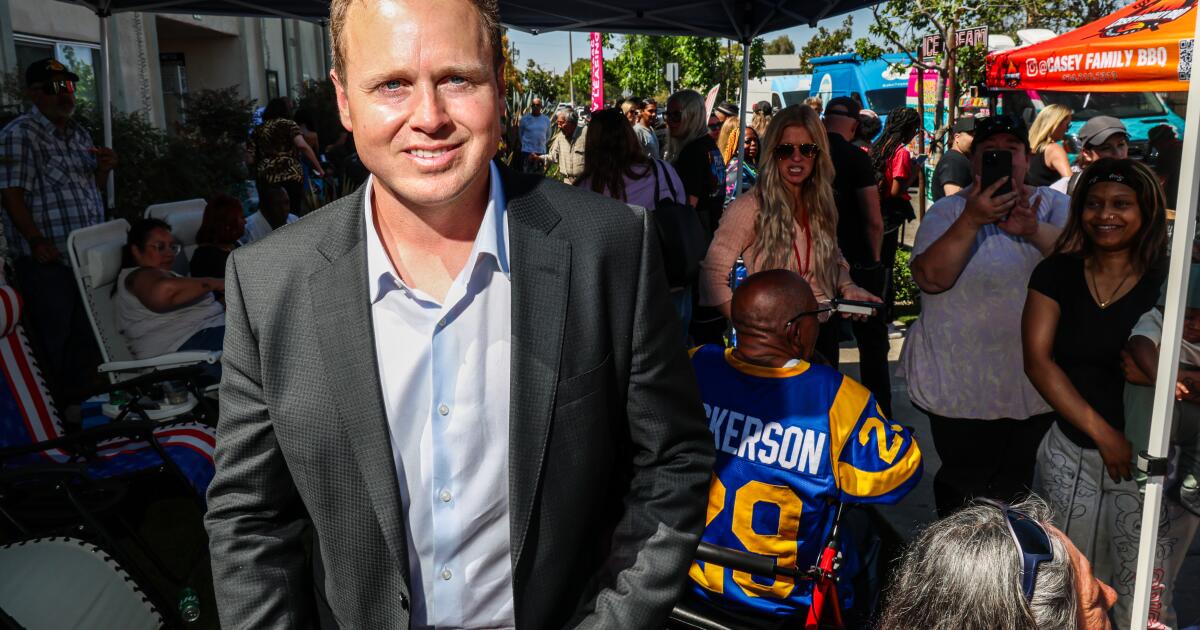
Daniel Jeremiah speaks with a reporter ahead of the NFL draft in Pittsburgh on Wednesday.

Daniel Jeremiah speaks with a reporter ahead of the NFL draft in Pittsburgh on Wednesday.

(Ed Rieker / Associated Press)

An unflinching running back might “choose violence,” a team that builds the line before adding skill-position talent is “putting the hardware store before the toy store,” and an edge rusher who passes the “wet paint” test can get around the corner with such lean that “If he played on a field of wet paint, he did not have a drop of paint on him at the end of the game.”

Said Charlie Yook, executive producer of content for NFL Network: “Daniel is hilarious, a funny guy. It’s a different type of humor. He doesn’t swear. He kind of has that schoolish, boyish, sarcastic type of humor, but it’s still something that everyone can relate to.”

Now, for that renown football reporter who showed up in his living room. It was the late Chris Mortensen, who covered the NFL for ESPN and regularly listened on Sunday mornings to the preachings of Dr. David Jeremiah. In 1998, when San Diego played host to the Super Bowl between Denver and Green Bay, Mortensen used the opportunity to meet his favorite radio minister. The elder Jeremiah invited him over to the house for lunch. Daniel was a college freshman home on winter break. He and Mortensen instantly bonded, and the reporter asked if he’d like to attend Super Bowl media day. Later, he invited the young man to join him at the draft in New York, giving him an assignment to work the phones.

Mortensen would give his landline number at the draft to all the team general managers, reporters and other contacts around the league. Jeremiah manned the phone “like a secretary,” took notes and relayed them during commercial breaks. Already showing a knack for organization, Jeremiah kept index cards sorted by division and by tracked receiver and cornerback needs, keeping tabs on which of those players went there.

“That draft was bigger than this draft for me personally,” Jeremiah said, sitting in the stands at an NFL event in Pittsburgh before a cluster of reporters would surround him for final observations on how the first round would unfold.

So a straight line from there to a Mortensen-like role with NFL Network? Hardly. Jeremiah’s next job was with ESPN’s “Sunday Night Football” and a gig that was football-adjacent. He traveled with that crew as a production assistant, but his role was lining up the scenic footage in every city. Say it was a Rams game in St. Louis, he was the one setting up a shoot at a root beer factory so the network had something local to show coming in and out of commercials.

He did that for two years, but eventually his knowledge of the game as a onetime quarterback made him too valuable to waste. The crew put a headset on him and he would be another set of eyes for camera operators and people in the production truck. What cornerback got beat on that play? He knew. Who’s warming up on the sideline? He was watching. How many times has the defense blitzed? He was keeping track. It was a dream job.

“I was a pig in slop,” Jeremiah said.

But it was but one slop stop in his budding career. While walking through a press box at a game, he bumped into his brother’s old college roommate, T.J. McCreight, who was scouting for the Ravens.

“He goes, ‘Hey, do you think you’d ever have any interest in scouting,’” Jeremiah recalled. “I said, ‘I’ve never … I mean, I love the draft and all that stuff. But I’ve never even thought about scouting, but yeah, absolutely I’d have interest in that.’”

Daniel Jeremiah speaks during a news conference at the NFL scouting combine in Indianapolis on Feb. 25.

Daniel Jeremiah speaks during a news conference at the NFL scouting combine in Indianapolis on Feb. 25.

(Gregory Payan / Associated Press)

Soon enough, he was meeting with Ravens executives who gave him a volunteer assignment at the combine, very high-level stuff.

“I filled the candy jar every day,” he said. “I helped get the players into the interview rooms and all that.”

But he was on his way to eventually spending four years with Baltimore, then following player-personnel director Phil Savage to his GM job with Cleveland, scouting the entire country out of Southern California. When the Browns went 4-12 in 2008, Savage and his hires, Jeremiah among them, were shown the door.

Jeremiah spent two more years with Philadelphia as a West Coast scout before taking an analyst job with NFL Network. He could do the same type of player evaluation without the zig-zagging travel, much better for a father of four.

“I left scouting,” he said. “Scouting didn’t leave me.”

The draft is his Super Bowl, and he’s aware that it’s usually the biggest day in the lives of NFL hopefuls. He keeps that in mind, especially when he’s delivering an honest critique of a player.

“I’m very cognizant of that,” he said. “I don’t know that there’s a right way to do this job or a wrong way. I just know the way that I’ve approached it, and I feel like you could really eviscerate someone on what’s literally the best day of his life. Yeah, I will never do that.”

It’s a delicate balance, though, because he wants to remain true to his scouting beliefs.

“I might not necessarily have a player going to a team,” he said. “But I can try to explain to you why I think that team did what they did. That keeps me from saying a bunch of negative things about a player. I’m not trying to kill the kid, right?”

Said Yook: “There are 200-something guys getting drafted over these three days. You don’t suck if you get drafted in the NFL. Doesn’t matter if you’re pick No. 1 or the last pick. He understands that there’s a very small percentage of people who actually get to touch grass in the National Football League.”

What’s more, people can follow all sorts of twisting paths to success. Jeremiah needs no reminder. Preaching to the choir.

Source link

Trump to again end legal status of people who entered US with CBP One app | Donald Trump News

Judge had previously blocked move to end temporary legal status for those who entered US via Biden-era application.

The administration of President Donald Trump plans to again end the temporary legal status of hundreds of thousands of people who applied for asylum in the United States via the CBP One app.

The plan was detailed in a court filing in Boston, Massachusetts, and comes after a judge ruled that Trump’s earlier effort to terminate the legal status of those individuals was unlawful.

Recommended Stories

list of 3 itemsend of list

Under US President Joe Biden, individuals who registered for an appointment with US Customs and Border Protection (CBP) were preliminarily vetted and granted temporary legal status in the US as their asylum cases were adjudicated.

About 900,000 people were granted so-called humanitarian parole under the programme.

But in April of last year, just months after Trump took office for a second term, many of those individuals received emails saying their status had been terminated.

The message told its recipients it was “time for you to leave the United States”.

Federal Judge Allison Burroughs subsequently ruled that the Department of Homeland Security did not follow the proper procedures in terminating the legal status immigration status of CBP One users.

The US Department of Justice, in the new filings, told Burroughs that the Trump administration was complying with ⁠her order.

However, the department said the administration would begin issuing new parole termination notices, pursuant to a Tuesday memo from CBP’s head, Rodney Scott.

The memo is not public, but according to the Justice Department, Scott provided ‌an explanation for why, in his opinion, “parole is no longer appropriate for those aliens”.

Lawyers for Democracy Forward and Massachusetts Law Reform Institute, which represent the individuals whose status faces termination, urged Burroughs in a subsequent filing to prevent what they called a “deliberate attempt to evade compliance with the court’s order”.

The next hearing was set for May 6.

During his second term, Trump has pursued a hardline immigration policy that has included staunching nearly all asylum claims at the southern border.

Shortly after taking office, Trump’s officials also dissolved the CBP One app and relaunched it as CBP Home, a tool for self-deportation.

His administration has claimed there was an “invasion” at the border that constituted a “national emergency”, thereby allowing Trump to bypass legal requirements to allow individuals seeking asylum into the country.

Asylum, however, is a right enshrined both in domestic and international law, to protect people fleeing persecution on the basis of race, religion, nationality, political opinion or membership in a particular social group.

Separately, on Friday, a federal appeals court ruled against the Trump administration’s ban on asylum at the southern US border, potentially clearing the way for applications to once again be processed.

The administration is expected to appeal the decision.

Source link

Simon Calder issues Europe holidays update as he says ‘so many people are getting in touch’

Travel expert Simon Calder has explored the latest challenges facing UK airlines and passengers amid jet fuel shortages caused by the Iran war

Travel expert Simon Calder has released an update on his podcast about what to do should your flight be suddenly cancelled amid worldwide jet fuel shortages. The highly regarded travel journalist – well known for his frequent TV appearances and contributions to the Independent – has spoken with a prominent industry figure after seeing ‘so many people getting in touch feeling anxious about their holidays.’

He noted that many people were even contemplating whether to stay in England for their holidays. His remarks come as the Iran war continues to rumble on. The conflict, which began on February 28, has restricted the flow of oil and gas across the globe, placing pressure on markets and driving up the cost of jet fuel for airlines, reports the Liverpool Echo.

This week, jet fuel shortages have emerged as a significant concern, as statements from senior industry figures have sparked worry amongst ordinary travellers about the potential impact on their holidays this year. Dan Jorgensen, the EU energy commissioner, this week said: “Unfortunately, it’s very likely that many people’s holidays will be affected, either by flight cancellations or very, very expensive tickets. Even if we do everything we can do, if the jet fuel is not there, then it’s not there.”

Speaking on his podcast on Thursday, April 23, Simon began by saying: “You might be more inclined to stay in England because of all the headlines we’ve been seeing over the past couple of days. For example, Lufthansa of Germany said they were cancelling 20,000 flights.

“I’ve had so many people getting in touch feeling anxious about their holidays when I would hope they would be looking forward to them with great anticipation.” To tackle this, he spoke with Ted Wake, managing director of Kirker Holidays.

Simon put the question to him: “So just suppose I have booked a Kirker holiday. I’m maybe going to some of the great cities in Germany. Amazing cultural treasures to be found. And I’m flying maybe from Birmingham, from Edinburgh, from Glasgow, and suddenly Lufthansa cancels my flight. What do you do then as a tour operator?”

Ted responded: “We would find the nearest flight which would provide a sensible, practical alternative. We would liaise with the client about whether or not it was convenient for them and, if they’re in agreement, Kirker would pick up the tab for any logistical costs that have been incurred.

“There are occasions where tour operators like us might extend the client’s stay by an additional night and we might pick up the tab for that. But if you have booked through an ATOL-protected tour operator and the tour operator is mindful to nurture long-term relationships, it is in our interest to iron out the creases in that way.

“And you have mentioned some regional services there and it may be the case that Lufthansa cancel 1 or 2 of those but there will often be alternative flights, perhaps with a different carrier, and Kirker would pick up the tab for that as well as manage the logistical research in terms of what alternative flight could be suitable to ensure that people have a fabulous holiday.”

Ted’s remarks come just days after EU official Mr Jorgensen cautioned: “[Currently] it is primarily a crisis of prices and not yet a crisis of supply, but unfortunately we cannot be sure to prevent a crisis of supply, especially on jet fuel in the future, if the crisis continues.”

The International Energy Agency has similarly advised that severe supply disruptions could materialise within the next five or six weeks. It was against this backdrop that Simon addressed passenger concerns here in the UK.

Jet fuel flight cancellations and the EES

Ted highlighted that airlines are currently grappling with two distinct challenges – the jet fuel shortage and the new EES system. This system – the Entry/Exit System (EES) – is a new digital border arrangement that introduces additional checks for British travellers heading to numerous European destinations.

It launched this month. On your first visit following the change to a country within the so-called Schengen area (which encompasses many EU nations), you may be required to create a digital record upon arrival at an airport. You may be required to submit your fingerprints and have your photograph taken. The system has resulted in significant delays for some UK travellers since its introduction.

Ted discussed the jet fuel challenges confronting airlines and what this means for everyday passengers across the UK. He said: “I think Lufthansa has got a very comprehensive schedule. Twenty thousand flights isn’t a drop in the ocean but it’s a relatively small number if you look at the overall picture.

“I think other airlines within the UK market will be doing something similar. You might argue that it is a sensible logistical profit management exercise as well as a jet fuel situation, but I don’t see it having a major impact on consumers and if you book through a tour operator – of course, Simon, you tell your readers all the time and indeed your listeners for that matter – if you book through a tour operator, it’s a tour operator’s responsility to iron out all the creases so the consumer is not adversely impacted by the change.”

You can tune in to the podcast here.

Source link

Contributor: Carlson’s cautious apology does little to repair Trumpism’s damage

When you break a promise as clear as “No new wars,” you shouldn’t be surprised when even your most loyal supporters revolt. And that’s exactly what is happening to President Trump.

One such disillusioned supporter is Tucker Carlson — who on a recent podcast with his brother Buckley admitted, in essence, “My bad.”

“You wrote speeches for him. I campaigned for him. I mean, we’re implicated in this, for sure,” Tucker Carlson said during the conversation.

“In real ways, you and me, and millions of people like us, are the reason this is happening right now,” Calson confessed, referring to the Iran war. “We’ll be tormented by it for a long time. I will be, and I want to say I’m sorry for misleading people, and it was not intentional.”

Having worked for Carlson for six years at the Daily Caller, I’ve always found him intelligent and funny and generous, even as I have profoundly differed with him on a variety of issues throughout the Trump era.

It did my heart good to hear him accept some responsibility for what Trump has wrought.

A lot of people were complicit in boosting Trump, and some of them have even subsequently criticized him for various sins (failing to release the Epstein files, going to war with Iran, etc.). But this is the first time I can recall anyone of this stature explicitly apologizing for helping elect Trump. And that warrants a certain amount of respect.

Still, let’s be clear-eyed about what Carlson is — and isn’t — saying here. Specifically, it’s worth noting that the apology doesn’t extend to validating those of us who opposed Trump from the beginning.

In fact, it almost can’t.

Doing that would require the confessor to reinterpret not just Trump’s presidency, but also the entire ecosystem that made supporting Trump a viable option in the first place.

It would mean admitting that the framework he used to evaluate Trump was flawed, not just the outcome.

That would end up being perceived as an indictment on the broader Republican electorate — and on Carlson’s worldview and judgment — not just on Trump’s recent performance or (even more conveniently) the notion that Trump has changed or was co-opted by Israel (or whomever) since 2024.

It’s a much bigger ask than saying, “I regret this specific result.”

Specifically, Carlson is not conceding that the “Never Trump” crowd got it right — which is what those of us who have spent a decade opposing Trump (with little fanfare) have been dying to hear for a decade (even more so than “I’m sorry.”)

This is an important distinction, partly because it means that, although Carlson is now a convenient ally in the “resistance,” he is not opposing Trump for the same reasons that most Democrats or Never Trump conservatives oppose Trump.

If you put aside Trump’s decision to go to war with Iran, the Carlsons’ second-biggest criticism of Trump (based on their two-hour-long podcast) is his failure to more vigorously defend the Jan. 6 Capitol rioters.

That’s right. It’s not that he sicced immigration enforcers on immigrants and that they subsequently killed two American citizens. It’s not that DOGE fired lots of good people. It’s not that this president tried to use the Department of Justice to seek vengeance on his political rivals. It’s that Trump — the person who pardoned these people — wasn’t aggressive enough in defending the criminals who stormed the U.S. Capitol while trying to overturn the 2020 election results.

And while there’s no reason to doubt Carlson’s remarks are sincere (he has been a vocal opponent of war with Iran) and meaningful (he’s an influential figure), his comments may also signal something else: a recognition that opportunity awaits.

Consider this: Trump’s political standing is in deep trouble (Trump’s approval rating is down to 33%, according to a new AP-NORC poll).

What is more, Trump’s fading fortunes aren’t just isolated to Trump. As always, there is collateral damage: JD Vance.

Once seen as Trump’s obvious heir, Vance now finds himself in a difficult position, defending the war in Iran and attacking the pope, while simultaneously releasing a book about his Catholic conversion.

In that sense, Carlson’s apology could be less a grudging epiphany than a strategic recalibration. It acknowledges that Trump has gone off the rails but stops short of examining why it was destined to go wrong in the first place.

Carlson gets close to the answer when he tells his brother, “there were signs of low character. We knew that,” but then dismisses it by saying “there are tons of people of low character who outperform their character.”

Without deeper reflection, this apology risks becoming just another pivot — one that has as much to do with positioning as it does with repentance.

And that would be a shame.

It’s easy to regret an outcome. It’s much harder to interrogate the instincts that led you (and tens of millions of Americans) to enable it.

Apologies like Carlson’s won’t close the chapter on this long national nightmare.

Matt K. Lewis is the author of “Filthy Rich Politicians” and “Too Dumb to Fail.”

Source link

Dumbfoundead reveals his hip-hop survival story in new book ‘Spit’

Jonnie Park has always gone by many names. The most Google-able is his hip-hop moniker “Dumbfoundead,” which he’s gone by for decades as a seasoned battle rapper and an artist who’s put out a jaw-dropping 13 albums while becoming one of the kings of legendary Leimert Park hip-hop crew, record label and open mic Project Blowed. As a resident of L.A.’s Koreatown since childhood, he’s still known as “The Mayor of K-town.” To his friends, he’s just “Dumb.” Of all the aliases and titles he’s fought for, “author” might seem to be the most unlikely. But as a professional when it comes to producing scathing hot bars in battle raps, it felt only right to put his journey down the warpath of rhymes on paper in his debut memoir “Spit: A Life in Battles,” released April 14 on Third State Books.

The memoir (which includes a foreword by Park’s longtime friend, R&B star Anderson .Paak) recounts razor-sharp memories starting from childhood, including the harrowing story of his family’s immigration from Argentina to L.A. when he was 3. He talks frankly about the perils and prejudice of growing up Korean American in Southern California and thrusting himself into the hip-hop scene, where, after stumbling in as an outsider to Black culture, he ultimately found his voice on stage. It speaks to the foundation that later served him well as an actor, podcaster, comedian and recently TV writer for season 2 of the hit show “Beef.” But he says his reputation as a battle rapper is the one that will always matter most.

Recently Park spoke to the Times about the hardest parts of writing his new memoir, the importance of Project Blowed and taking his underground rap mentality with him from the gutter to the stars.

For your memoir you purposely take the parts of your life from childhood until about age of 30, the peak of your hip-hop career. What was it like to go back and take that journey again?

To me, it’s always kind of the core of who I am. Even as a multi-hyphenate, I always say I’m first and foremost a battle rapper. It was such a pivotal moment at a time in my life and I take that label with me wherever I go, so it doesn’t feel too distant. But to actually be in that arena feels very distant. I look back and I just think about the audacity of a young Asian kid in that world. I’m just like “Wow, I really had the balls to do this at one point.” And I still love the subculture of battle rap. It’s something I’m a part of and a story that I want to tell in all these other mediums — whether it’s screenwriting or developing a TV show, I still feel like there’s a lot to be done with that subculture.

Why was it important for you to help your readers learn about the technical aspect of battle rap and what it takes to be a battle rapper?

There’s a lot more layers to it than people know. Obviously we know Eminem’s “Eight Mile” was the height of the story of where battle rap got to, and it did a great job of that. Obviously it’s been many years since then. But I also wanted to let people know that the people involved in this subculture aren’t just in poverty trying to make it out and get on a record label. This is a real subculture that people obsess over and I just wanted to find an excuse to nerd about it and also teach people this kind of new era of battle rap. I also highlight some of my peers really deserved it, and including the open mic I went through called Project Blowed. That’s the one thing I love about this book is that I can immortalize some of my personal heroes and places that I hold dear to my heart.

But mechanics of how our brains work when freestyling is something I find interesting. People always ask me “How do you guys freestyle or battle?” And I was really nervous about explaining it. I just didn’t know how I would do that. I had the help of my co-author, Donnie Kwak, who I’ve known for many years. He’s never written a book either, but he’s just kind of like a big brother to me and we’ve had many conversations about this. So being able to break that down was really cool for me. And I still really love that chapter about freestyling and battling for dummies.

Dumbfoundead smiles against a wall

Dumbfoundead’s memoir “Spit” chronicles his rise through underground battle rap, offering deeper insight into the subculture.

(Lenne Chai)

What was it like for you as you were discovering your voice through open mics at Project Blowed?

Project Blowed freed such a big part of me. I think when I saw the other rappers there, and they were taking [rapping] to heights I never imagined, the styles of raps that I would see here, from there, were so unorthodox. At that point, I was listening to everything on the radio along with mix tapes and stuff. But this was not even that. This wasn’t even like the underground mix tapes. It was the most raw and purest form of rap. It was so weird and abstract, even for me, just the young Korean kid at the age of 14 that hadn’t gone south of Pico Boulevard, growing up on Third Street, and all of a sudden I’m on 43rd. It was like another world for me. Next thing I know, I’m immersed in this world where there’s black kids that are into anime, punk rock and rapping their a— off. And I’m like, “This is insane!” So it did a lot for my perception of everything, more than just hip-hop.

Why was it so important for you to kind of showcase your Korean from not only the standpoint of a rapper but also as a writer?

Definitely the Korean American part was very important to me, because we see Korean culture, Korea especially being this global powerhouse, and what we know of it is the “Squid Games,” and the K-Pop of it all. And so I did want to share this more in the perspective of a Korean American. Even more specifically, in Southern California, in Los Angeles, there is a different vibe of Asian American life than the rest of the country. I’m the epitome of that. A lot of our parents have these wholesale businesses downtown or dry cleaners or liquor stores. Growing up in K-town, a lot of Korean families have a dad who’s an alcoholic, and there’s a lot of domestic violence situations. I think through my story, a lot of people will see themselves in these situations.

Cover of Park's memoir "Spit."

Jonnie Park, a.k.a. Dumbfoundead, writes in his memoir about growing up in Koreatown.

(Third State Books)

I think it also just speaks to all the different layers of struggle, battles that you and your family have gone through. Were there any aspects of this book that were really challenging for you?

The hardest part was definitely writing about my father, and knowing that this book is going to be out in the public because it’s so revealing. There’s affairs, there’s businesses that he worked at that are named. These families do exist — I grew up with that family that my dad had an affair with. I don’t talk to them or anything, but it’s all in the book. And I did want to be honest, I just felt like this is a place to do it if I’m going to do it. I don’t know if my dad will read it, but if it ever got translated into Korean, he’s definitely reading it. I still don’t have a great relationship with my father and I just feel like there wasn’t, there’s not much of a closure to that still. And maybe the book will help open up some new conversations between him and I. So that part was a little difficult, and also talking about some of the domestic violence in my house. Growing up with my dad and my mom, it made me feel for my mom a lot.

The beginning and the end is the most difficult part, because the end really discusses kind of like that insecurity as an artist, and where I’m at in my life as an artist, seeing a lot of my friends becoming extremely successful. I really wanted to be honest about that. The book doesn’t necessarily end with me being triumphant and feeling at ease.I still feel that as an artist, and I think that’s why it’s just an ongoing battle.

Describe what that’s like having come out of that underground rap scene and showing your skills to the world in TV and film while holding on to that underground mentality.

Even being in a writer’s room for “Beef” Season 2 — that was my first writer’s room — felt like a cypher. Knowing when to jump into the conversation at the right time, and knowing when to fall back. That just tells you that the skills that I acquired from freestyling and battle rap, I was able to take into the real world and apply it in so many different places.

I think it’s so interesting that I got that “Beef” Season 2 gig because the showrunner and the creator of the show really loves my perspective on Asian American culture on my podcast [“Fun With Dumb”], just based off of that. I got to a place in my life where I just felt very comfortable being vulnerable and self-deprecating through all the things I’ve done in battle rap. I was able to apply it to podcasting, too. And to have that humor and wit and that vulnerability, that comedic sense that I’ve acquired from battling and freestyling, one thing just led to the other. I still have the same kind of slate of stories and ideas that I’ve been trying to get made for many years. That includes stories on battle rap, K-town and being Korean, American. Those are always kind of the things I take with me to whatever I’m trying to make right now, and maybe once I make those, I can move on, but I’m still working on that.

Source link

Millions of Americans may now also be considered Canadian under new law

Millions more Americans might qualify for dual Canadian citizenship under a recent change to Canada’s requirements that has led to a surge in applications from its southern neighbor.

For people like Zack Loud of Farmington, Minn., it was a surprise to learn that under a new law, Canada already considered him and his siblings citizens because their grandmother is Canadian.

“My wife and I were already talking about potentially looking at jobs outside the country, but citizenship pushed Canada way up on our list,” he said.

Since the new law took effect Dec. 15, immigration lawyers in the United States and Canada say they have been overwhelmed by clients seeking help submitting proof of citizenship applications. Driven by politics, family heritage, job opportunities and other factors, thousands of Americans are exploring whether the easier process makes now the right time to gain dual citizenship.

Nicholas Berning, an immigration attorney at Boundary Bay Law in Bellingham, Wash., said his practice is “pretty much flooded with this.”

“We’ve kind of shifted a lot of other work away in order to push these cases through,” he said.

Immigration attorney Amandeep Hayer said his Vancouver, British Columbia-area practice went from about 200 citizenship cases a year to more than 20 consultations per day.

How the new law works

Canada has been changing its citizenship laws for decades, whether to update historic interpretations of law or to address discrimination issues.

Previously, Canadian citizenship by descent could only be passed down to one generation, from a parent to a child. But the new law opened up citizenship to anyone born before that date who could prove they have a direct Canadian ancestor — a grandparent, great-grandparent or even more distant ancestor.

Those born on or after Dec. 15 need to show that their Canadian parent lived in Canada for 1,095 days.

Under the new law, descendants of Canadians are already considered citizens but must provide proof to obtain a certificate of citizenship. Hayer estimated that there are millions of Americans who are Canadian descendants.

“You are Canadian, and you’re considered to be one your whole life,” said Hayer, who advocated for the new law in parliament. “That’s really what you’re applying for, the recognition of a right you already have vested.”

“The best way I can put it is like, if a baby’s born tomorrow in Canada, the baby’s Canadian even though they don’t have the birth certificate,” he said.

Americans interested in dual citizenship

American applicants have different motivations, but many say President Donald Trump’s immigration crackdown and other topics have led them to seek dual citizenship.

Michelle Cunha, of Bedford, Mass., said she decided to move to Canada after reflecting on decades of political activism and deciding she had “nothing left to give.”

“I put in my best effort for 30 years. I have done everything that I possibly can to make the United States what it promises the world to be, a place of freedom, a place of equality,” Cunha said. “But clearly we’re not there and we’re not going to get there anytime soon.”

Troy Hicks, who had a great-grandfather born in Canada, said he was spurred by an international trip.

“I recently went to Australia and you know, first words out of the first person I talked to in Australia was basically an expletive about Trump and the U.S.,” said Hicks, of Pahrump, Nev. “It was just like, whoa, I walked off a 20-hour flight and literally the first words of somebody’s mouth to me were that. … So the idea of doing that with a Canadian passport just seemed easier, better, more palatable.”

Maureen Sullivan, of Naples, Fla., said she was motivated by the immigration crackdown in Minnesota, which hit home when her teenage nephew encountered federal officers near his high school in St. Paul. Sullivan, whose grandmother was Canadian, said she sees citizenship in Canada as an option in case things in the U.S. “really go south.”

“When I first heard about the bill, I couldn’t believe it. It was like this little gift that fell in my lap,” Sullivan said. “There was kind of this collective excitement amongst the (family) who just felt like, we wanted to feel like we were doing something to take care of our security in the future if needed.”

How much will Canadian citizenship cost?

For those with documentation ready at hand, the proof of citizenship application fee is a relatively inexpensive 75 Canadian dollars ($55).

But costs will climb for those seeking help from an attorney or genealogist to locate records like birth, death and marriage certificates that can establish the lineage to a Canadian ancestor.

Cunha said she used an attorney and estimates the cost will be about $6,500.

However, Mary Mangan, of Somerville, Mass., filed her application in January using advice from online forums.

“There are some situations where a lawyer might be the right thing, but for many people, I would guess 90% of people can probably do this on their own,” Mangan said.

The website for the Immigration, Refugees and Citizenship Canada office, which processes applications, says processing times for a certificate is around 10 months, with more 56,000 people awaiting a decision.

The agency said that from Dec. 15 to Jan. 31, it confirmed citizenship by descent for 1,480 people, though not all were Americans. Last year, 24,500 Americans gained dual U.S.-Canada citizenship.

What’s the reaction in Canada?

Fen Hampson, professor of international affairs at Carleton University in Ottawa, said Canadians are generally a “welcoming people.”

Hampson said some also worry a surge of interest from Americans could delay efforts by refugees and asylum-seekers fleeing vulnerable situations.

“I think where people start looking askance is someone who’s never been to Canada, who has very thin ties. They can get a passport, becoming Canadians of convenience. People don’t like that,” he said.

Raza writes for the Associated Press.

Source link

Effort to hold Uber liable for driver sexual assaults heads to ballot

California’s trial attorneys and Uber — longtime courtroom foes — are officially bringing their fight to the November ballot.

A coalition of lawyers and advocates announced Thursday that it has gathered enough signatures to ask voters to support a “first in the nation” law that would make rideshare companies legally responsible for sexual assaults that happen to a driver or customer during a trip. Uber has argued it’s not liable for assaults committed by drivers, who are considered independent contractors.

“We must hold Uber accountable today,” said Danielle Tudahl, who recounted being sexually harassed and chased by an Uber driver after ordering a ride through the app, at a Sacramento news conference. “Californians are finally demanding action to try and close some of these gaps and put people’s safety over corporate profits.”

Uber has described the ballot measure, which is sponsored by the Consumer Attorneys of California, or CAOC, as retaliation for its own November ballot push to cap how much attorneys can earn in car crash cases in California.

“This ballot measure is a cynical ploy by billboard lawyers,” said Nathan Click, a spokesperson for A More Affordable California, an Uber-backed coalition. “CAOC didn’t spend millions to put this on the ballot to protect survivors — their goal is protecting billboard lawyer profits.”

The coalition that supports Uber announced last week it had gathered enough signatures for a measure that would cap attorney fees for car crash cases at 25%, among other changes.

Uber says its ballot measure will give victims a larger cut of their settlement money, rather than the payout getting siphoned off primarily to attorneys and doctors. Attorneys fire back that it will leave thousands of people with small or thorny cases without a lawyer because they won’t have financial incentive to sue.

Both sides are gearing up for an expensive fight. Uber has given more than $77 million. The Alliance Against Corporate Abuse, the CAOC-backed coalition pushing the sexual assault measure, has raised more than $68 million from law firms across the state, according to campaign finance records.

The money has helped pay for billboards that have sprouted across L.A. informing drivers that, according to the New York Times, Uber received a report of sexual assault or misconduct every eight minutes on average between 2017 and 2022. The company was the subject of a series of investigations by the paper into sexual assault by drivers. The company says it has invested billions in keeping riders safe and has “done more than any other company to confront” sexual violence.

The proposed sexual assault measure would require ride-share companies to let riders know if the person picking them up has a history of sexual misconduct and conduct yearly fingerprint and background checks for drivers.

The company is currently fighting more than 3,000 lawsuits from passengers who claim they were sexually assaulted or harassed by Uber drivers. Those cases are being coordinated by a federal judge in California.

The attorney coalition had also pushed an initiative aimed at nullifying Uber’s fee-capping measure if it passed. Alex Stack, a spokesperson for the campaign, said they were “pausing/withdrawing” the measure to “focus the fight on our sexual assault prevention measure and beating Uber’s initiative.”

Source link

Stop being so chill, Xavier Becerra. Fight for California’s future

Xavier Becerra needed to land a knockout punch, even more so than the five other candidates for California governor he was facing at Wednesday night’s debate.

Instead, he fired off some slaps.

He needed to roar about his many accomplishments in his 35-year career in Sacramento and Washington, to distinguish himself from the relative political neophytes around him.

Instead, Becerra recited his resume with the vigor of someone rattling off his LinkedIn page.

He needed to uplift Californians with a vision of hope, when many feel the state is going in the wrong direction.

Instead, he offered the oratory equivalent of a pat on the shoulder.

No candidate had more at stake that night than Becerra, who went from an afterthought to a contender after Eric Swalwell dropped out and resigned his congressional seat over sexual assault allegations.

Five weeks ago, Becerra and other candidates of color were protesting their exclusion from a USC debate because they were all polling so low. Now, the 68-year-old has a chance to become California’s first Latino governor.

This possibility seems to have uncorked California’s silent majority — the rancho libertarians turned off by hard-right politics but also the wokoso politics they feel have left them behind. The people who yearn for an unglamorous, competent leader after eight years of all-about-me Gavin Newsom and a decade of Donald Trump.

Becerra’s campaign, once as rudderless as a leaf in a river in a race so chaotic for Democrats that many feared two Republicans would win on June 2 and face each other in the general election, suddenly latched onto a palpable wave.

At the Los Angeles Times Festival of Books last weekend, I saw people sporting Becerra campaign buttons who had just come from a rally that was expected to draw a few hundred but instead had over 2,000 RSVPs. On social media, friends who had never especially cared for state politics suddenly declared they were for Becerra and fought off their more lefty pals who think he’s a Latino Ned Flanders not up for this fraught moment.

Unglamorous and competent are Becerra’s middle names, and they were on display at the debate — for better and mostly worse. This was his chance to show both his new followers and undecided voters that they could trust him as California’s next governor.

But where he needed to be limber like a prizefighter, the former California attorney general was as tightly wound as a Rolex.

While the other candidates pressed their palms against the podiums, ready to pounce on every question, Becerra clasped his hands like an altar boy. When he did gesture, his movements never went further than the span of his shoulders.

As the others grinned and grimaced at their rivals’ responses, Becerra was as stone-faced as Buster Keaton. He stumbled more than he should have — how could someone in his position mistake Iraq for Iran when criticizing Trump’s Middle East quagmire? — and rarely seemed at ease, as if the weight of the moment and the good luck of his surge had suddenly hit him at the worst possible time.

Candidates in California's gubernatorial race

Candidates in California’s gubernatorial race, from left, Matt Mahan, Xavier Becerra, Chad Bianco, and Steve Hilton look on during a debate Wednesday, April 22, 2026, in San Francisco.

(Jason Henry / Associated Press)

Becerra’s supporters say a level-headed leader is what California needs. But voters almost never go for what they need — they pick what they want. And California wants someone who’s loud, or at least louder than Becerra. There’s a reason why strident partisans like Republicans Chad Bianco and Steve Hilton and progressives Tom Steyer and Katie Porter have consistently placed high in the polls, while moderates like Becerra, his frenemy Antonio Villaraigosa and San Jose mayor Matt Mahan have lagged.

The weird thing is that Becerra does know how to brawl. Wallflowers don’t go from a working class Mexican immigrant family to Stanford Law School. Wimps don’t survive the ruthlessness of Eastside politics as an outsider to become a congressmember at just 34. Cowards don’t file over 100 lawsuits against the Trump administration as California’s top prosecutor or tackle the coronavirus pandemic as President Biden’s health secretary.

I’ve only encountered the Sacramento native a few times but always came away impressed. In small crowds, he makes people laugh and tear up. He’s quick with ripostes, righteous in off-the-cuff remarks and has a do-gooder aura that never comes off as sanctimonious.

We saw hints of that Becerra at the debate. To Hilton, he quipped, “You can be a talking head and not worry about the consequences of what you do” after the former Fox News host babbled on about how one-party ruled had failed California.

After Porter accused him of not offering hard numbers for his economic plans, Becerra responded that he has balanced federal budgets larger than California’s. “It’s easy to say you haven’t done this; it’s easier to prove that you actually have,” he concluded.

But after Becerra described the evils of racial profiling by law enforcement and Bianco, the sheriff of Riverside County, ranted that California politicians need to stop thinking so much about race, it was Porter who responded with a verbal haymaker as Becerra silently looked on.

You don’t fight as a choirboy in a battle royale. Becerra wasn’t bad at the debate but he also wasn’t great — and that won’t win this race.

Voters want someone who’ll do the job, yes — especially if it comes with no drama. They also want to elect someone they think is a human, not a joyless bureaucrat. So how did Becerra respond to the debate’s last question about what was the last series you’ve streamed?

Becerra flashed his biggest smile of the night. It was such a softball query that even a kindergartener could have slammed it à la Shohei Ohtani.

“I wish I could tell you I had time to watch streaming shows,” he replied.

Dude. We’re all overworked, but everyone I know unwinds by watching mindless drivel (my current obsession is “Vanderpump Villa”). We all need to relax, even for a moment. As my dad says when he sees me filing one columna after another and urges me to take a break, “El trabajo nunca se acaba pero uno sí se acaba.

Work never ends, but people do.

Xavier, you know you’re on the wrong side of California when the only other candidate with a similar answer was Bianco, who said he doesn’t watch television at all.

Being careful has served you well, but this is the greatest opportunity of your life. You don’t have to suddenly become a flamethrower, but some sparks would help. It’s six weeks until the primary, so time to throw down — channel your inner cholo and go get what should be yours.

Source link

In ‘Half Man,’ Richard Gadd mines toxic masculinity via brothers at odds

Plucked from a previous life as a working actor, Richard Gadd experienced a disorienting whirlwind less than two years ago. “Baby Reindeer,” his painfully personal 2024 Netflix show, based on the sexual assault he survived, instantly opened the floodgates of fame for him.

“The show came out on Thursday, and by Sunday, I could barely walk anywhere without being recognized, without being stopped,” Gadd says while visiting The Times’ offices earlier this month. “That’s an adjustment because I always thought if anything like that ever happened, it would be a bit more of a gradual process. But it was overnight, so I didn’t have time to adjust.”

Now the winner of three Emmy Awards and a slew of other accolades for that series, which he starred in, wrote and served as showrunner, Gadd, 36, has already helmed a new emotionally ferocious show.

Probing the tropes of rigid masculinity, “Half Man,” premiering Thursday on HBO, chronicles the destructive bond between two men over several decades. Niall and Ruben — whose respective mothers are romantic partners — call themselves brothers but they couldn’t be more dissimilar.

Bullied at school, meek Niall (played by Mitchell Robertson in his youth and Jamie Bell in adulthood) lost his father as a young boy. He dreams of being a writer. Meanwhile, the insolent and hyper-confident Ruben (Stuart Campbell as a teen and Gadd as a grown-up) has been in trouble with the law from a tender age. Facing any conflict, he resorts to brutal violence. When Ruben takes Niall under his wing, the two become inseparable. But as the years and resentments pile on, their cancerous brotherhood threatens to obliterate them both.

A shirtless man leans his head against another man. His hands are covered in white boxing tape.

“Half Man” follows the destructive bond between Ruben (Richard Gadd), left, and Niall (Jamie Bell) over several decades.

(Anne Binckebanck / HBO)

“Richard’s writing is really unique and really singular,” Bell says on a video call from England, where he’s currently shooting the “Peaky Blinders” sequel series and is sporting a shorter haircut. “He identifies that real gray area of humanity really well and he puts a voice to the most uncomfortable places that we go into or things that we think when we’re alone in the dark, when we think no one’s watching.”

Gadd wrote the first episode of what would become “Half Man” back in 2019, while he still was performing the live version of “Baby Reindeer,” which he turned into the series. At the time, he recalls, society at large was seriously engaging in conversations around toxic masculinity and sexual violence as the #MeToo movement gained strength.

“It wasn’t necessarily that I set out going, ‘Oh, I want to make a show about that,’” Gadd says. “It was more that something must have just drifted into my head thinking, ‘You take two men repressed in their current life, repressed in the modern world. And then you go all the way back to their childhood. You contextualize learned behavior; you contextualize trauma and things they learned that make them these repressed adults. And you bring a bit of context to, I suppose, difficult male behavior in the present.’”

As “Baby Reindeer” launched his career as a creator, Gadd put “Half Man” on ice for four years but couldn’t stop thinking about returning to it. “Even as I was coming to the end of ‘Baby Reindeer,’ I thought, ‘I’m really looking forward to getting back to that project,” he recalls. “The second ‘Baby Reindeer’ finished, I thought, ‘This is what I’m going to do now.’”

Sitting across from the mild-mannered Gadd, the magnitude of his transformation on screen for “Half Man” becomes even more impressive. Gadd comes off as thoughtful and emphatic, while Ruben, his physically imposing character, commands trepidation.

A profile view of a man with shadows partially covering his face.

“The second ‘Baby Reindeer’ finished, I thought, ‘This is what I’m going to do now,’” Gadd says about working on “Half Man.”

(Ian Spanier / For The Times)

Watching Gadd as the rage-fueled Ruben, one might be surprised to learn he originally had no intention of acting in “Half Man.” After wearing multiple hats on “Baby Reindeer,” Gadd thought this time around he could get a purely external bird’s-eye view of a project as showrunner and writer of “Half Man.” But eventually people around him suggested he should be in front of the camera once again.

“My initial response was always, ‘That’s just so far away from anything I’ve done before. It’s so far away from me. Are people going to buy it?’” he recalls. “And behind every single fear-based thought was a worry of what people might think, which in my opinion, isn’t a good enough reason to not do something.”

Convinced audiences would struggle to see the guy from “Baby Reindeer” as this “hard man,” a U.K. term for tough and intimidating men, he had to physically morph. To inhabit a new body, Gadd underwent a strict exercise regimen, and most importantly, a new diet.

“I had a chef make these meals in England, fun enough, and send them up to Scotland where I was filming,” he recalls. “I’d eat them at specific times. You go through periods of fasting and through dehydration whenever you had your top off. There was a real science to it.”

And yet, though he at first worried he wouldn’t look big enough, Gadd refused to portray Ruben with a chiseled physique conceived for mere aesthetics.

“I didn’t want him to have a six pack, I wanted him to feel like a real person,” Gadd says. “Sometimes when you see someone on TV and they’re ripped, I almost don’t think that’s real strength. Someone like Ruben, they wear their life in their body, they’re heavy set. It’s not ripped. It’s bulky. It’s natural to him.”

Before he agreed to play the character, Gadd auditioned numerous actors for the part, but with all of them he felt they were too focused on his appearance as an imposing figure and not his inner turmoil. “Ruben is extremely sad as a person. He’s terribly broken and traumatized,” he says.

Two men seated across from each other at a dining booth.
A man in dark clothing sitting on a hospital bed.
A shirtless bearded man with tattoos on various parts of his body.

For the series, Gadd bulked up to become more physically imposing: “Someone like Ruben, they wear their life in their body, they’re heavy set. It’s not ripped. It’s bulky. It’s natural to him.” Richard Gadd in “Half Man.” (Anne Binckebanck / HBO)

When asked if he sees himself as Ruben, Gadd contemplates the question, debating whether it’s his “jetlagged brain” or ambivalence about finding some of Ruben within him.

“Do I see myself in Ruben?” After a pause, he concedes: “All of his behavior is a reaction to a deep traumatic happening in his life. I can relate to finding it extremely difficult to get past big traumatic events and coming to terms with them and coming to terms with yourself even as a result of them.”

With less hesitation, Bell, 40, acknowledges that he finds a certain kinship with his character. As a teenager, Bell flocked to people with a defiant edge. “I grew up without a father in an all-female household and I felt very naked as a child in terms of needing to be protected by someone who was dominant and aggressive,” he says. “I totally understand why Niall seeks solace in someone like him. No one will touch Ruben. There is a safety in that.”

Gadd says he doesn’t think about celebrities when searching for the actors. “I’m quite fame-averse when it comes to casting because I think sometimes it can get in the way,” he explains. “You can have a show, which starts up with all the best intentions, turn into a sort of acting vehicle for someone, or the discussion becomes about the actor doing this role.”

That said, when the casting director on “Half Man” asked him about his “dream cast,” Gadd expressed Bell was the only one who would genuinely excite him. But could that happen? “In my head, I was still in pre-‘Baby Reindeer’ time where I thought, ‘Well, somebody like him is not going to be interested.’ And then I thought, ‘Well, he might be,’” Gadd says.

For his part, Bell found the “nihilism” in Niall, a man desperately running from his true self and living in Ruben’s shadow, an enticing and complex character to play. “[Niall] conceals himself in many different ways, and has a lot of self-loathing, but at the same time has all these ambitions and actually is incredibly egotistical and thinks that his way is the correct way, and that other people don’t understand that he is terminally unique,” Bell explains with a chuckle.

A man in a navy blue suit leans against a brick wall.

Bell, who plays Niall, says his character “conceals himself in many different ways, and has a lot of self-loathing, but at the same time has all these ambitions and actually is incredibly egotistical …”

(Anne Binckebanck / HBO)

Aside from a tight schedule to produce “Half Man,” the challenge for Bell was adjusting to the dramatic intensity that Gadd was after. “I wasn’t particularly prepared for that, therefore sometimes my reading of certain scenes I’d get wrong. We’d start scenes and Richard was like, ‘You are pitching it at like a six, and this is very much an 11,’” Bell recalls laughing. I was like, ‘Oh, OK.’ That took some modulating.”

In Gadd’s mind, Bell remains an “underrated” artist. A proud Scotsman, Gadd recalls loving Bell in the 2007 romantic dramedy “Hallam Foe,” where the British actor played Scottish. For “Half Man,” Gadd thought Bell could convey the pain that haunts Niall, even as his actions paint him less like Ruben’s victim and more like a vengeful participant in the chaos.

“There’s always something I find so vulnerable about Jamie and I knew that I was going to take Niall in some really big journeys where he was going to almost test the audience’s love for him,” Gadd says. That Niall finds Ruben so alluring is natural to Gadd, who believes the notion of a valiant male figure has been bred into everyone via fables and fairy tales.

Gadd adds that whether or not we like to admit it, we’re drawn to alpha male characters. “Because from an early age, we’ve been told they are always at the top of the social hierarchy. And as a result, we’ve always, as a society, answered to those kinds of people as some sort of leaders.”

And though he says he’s unfamiliar with the “manosphere,” the misogynistic and chauvinistic online community, Gadd doesn’t believe Ruben would fall for the gurus in those circles who claim to have the answers for young guys to become “real men.”

“Ruben carved his own masculinity. To give him credit, if that’s even something you can give him, those spaces wouldn’t hold any weight for him. He’s his own man,” Gad says. “He would never follow anyone on social media. He’s the person to be followed.”

Based on the tone of Gadd’s output thus far, it may come as a surprise that as a young person he dreamed of creating a show along the lines of the U.K.’s “The Office,” which he considers a “perfect piece of art.” The stories he is telling now better reflect his “neuroses” and the experiences he’s endured.

“My life just took a very dramatic turn, and my sensibilities weren’t workplace sitcoms anymore. When I grew up and I was doing comedy I thought, ‘I’ll write a sitcom one day and every character will be sort of funny in it,’” he says. “But my life just took a turn to the point where I needed my writing and my art darkened because what I went through was very dark.”

Humor is not entirely absent from “Half Man,” some of the characters’ reactions to their distressing realities earn a chuckle. Still, Gadd’s funny bone might also find an outlet in other people’s narratives. He was recently announced as part of the cast in Apple TV’s upcoming high-concept series “Husbands,” for which he already shot his scenes. Adapted from a bestselling novel of the same name, it stars Juno Temple as a woman who gets to experience life with a different partner every time she changes the light bulb in her attic.

“I’m very picky with stuff I take on. Because I love writing my own work so much, anything that takes me out on someone else’s show has to be very special. And this was very special,” Gadd says.

“Everything I do doesn’t have to be dark,” he adds with a soft smile.

Source link

DeSantis signs Florida law banning local DEI funding, says white men are ‘disfavored’

White men have been discriminated against through diversity, equity and inclusion programs, Florida Gov. Ron DeSantis said Wednesday after signing legislation which prohibits counties and cities from funding or promoting DEI initiatives.

The Republican governor defined DEI at a news conference as “an ideological construct that is designed to promote a particular political agenda, particularly to the detriment of disfavored groups.”

“The disfavored groups, No. 1, obviously, would be white males, and I think they’ve been discriminated against,” DeSantis said in Jacksonville. “And it’s like a lot of people are, ‘Oh that’s fine. That’s fine.’ No, it’s not fine. It’s wrong.”

While the governor is entitled to his opinion, his views differ from “everyone else’s,” said Evelyn Foxx, president of the NAACP branch in Gainesville.

“If you talked to 100 white men, they wouldn’t feel the same way” as DeSantis, Foxx said when asked Wednesday about his comments. “The governor is out of touch with people, and that is the bottom line.”

Supporters say the purpose of DEI is to remedy the effects of long-term discrimination against certain groups. A nationwide push by conservatives to limit diversity programs has led many companies, schools and governments to pull back on those initiatives, particularly during the current Trump administration, and DEI has been a frequent target for the governor.

DeSantis also said Wednesday that Asian Americans had faced discrimination in university admissions and that people should be judged on their merits. During his two terms in office, DeSantis’ administration has championed legislation which prohibits public colleges and universities from spending money on DEI programs and promoted the “Stop WOKE Act,” which restricts how race and sex are taught in schools.

Democratic lawmakers have warned that the legislation was overbroad and potentially unconstitutional.

Under the legislation, residents can sue local governments for violations. If local officials are found to have funded DEI initiatives in violation of the law, they can be removed from office.

“When people know there is accountability, they are much more apt to toe the line,” DeSantis said.

Schneider writes for the Associated Press.

Source link

Rep. David Scott, a Georgia Democrat seeking his 13th term in Congress, dies at age 80

U.S. Rep. David Scott, a Georgia Democrat and the first Black chairman of the House Agriculture Committee, has died. He was 80.

Scott, who was seeking his 13th term in Congress despite challenges from within his party, was once a leading voice for Democrats on issues related to farm aid policy and food aid for consumers and a prominent Black member of the party’s moderate Blue Dog caucus. But he faced criticism and concerns in recent years because of declining health, enduring a primary challenge in 2024 and facing another one at the time of his death.

Democrats on Capitol Hill praised the longtime lawmaker.

“The news of Congressman Scott’s passing is deeply sad,” House Minority Leader Hakeem Jeffries told reporters on Wednesday.

“David Scott was a trailblazer who served district that he represented admirably, rose up from humble beginnings to become the first African American ever to chair the House Ag Committee,” Jeffries said. “He cared about the people that he represented. He was fiercely committed to getting things done for the people of the great state of Georgia, and he’ll be deeply missed.”

News of Scott’s death came during the Congressional Black Caucus’ weekly luncheon on Capitol Hill. The Black Caucus’ chair, Rep. Yvette Clarke, told lawmakers at the outset of the meeting, according to a person who insisted on anonymity to discuss a private conversation. Many lawmakers in the room, some of whom had served with Scott for decades, were shocked and saddened by the news.

Scott’s death slightly widens Republicans’ narrow House majority going into the thick of this midterm election year.

The congressman was not especially active on the campaign trail in 2026. But he had been dismissive of pressure to retire.

“Thank God I’m in good health, moving and doing the people’s work,” Scott said in 2024.

David Albert Scott was born in rural Aynor, South Carolina, on June 27, 1945, in the era of Jim Crow segregation. He graduated from Florida A&M University, one of the nation’s largest historically Black college campuses — and in office he was an outspoken advocate for federal support of HBCUs. Scott also earned an MBA from the University of Pennsylvania’s Wharton School.

He was already a veteran state lawmaker in Georgia before being elected to Congress in 2002.

Barrow, Brown and Amy write for the Associated Press. Brown reported from Washington.

Source link

Tucker Carlson’s too-little, too-late mea culpa for supporting Trump

Former Fox News host and ex-Trump advocate Tucker Carlson is feeling remorse for the role he and others played in publicly promoting Donald Trump as a candidate and as the president.

“In very small ways, but in real ways, you and me and millions of people like us are the reason this is happening right now,” Carlson said Monday on his podcast, “The Tucker Carlson Show.” He was chatting with Buckley Carlson, his brother and a former Trump speechwriter, about the erosion of conservative values within the Republican Party under Trump.

“I do think it’s a moment to wrestle with our own consciences,” Carlson said. “You know, we’ll be tormented by it for a long time. I will be, and I want to say I’m sorry for misleading people. It was not intentional, and that’s all I’ll say.”

After nearly 10 years of yammering nightly about the greatness of Trump, Carlson picks now to cut the conversation short?

There’s a lot more to say, but this time, it’s about Carlson’s too-little, too-late mea culpa. His claim that he did not intentionally mislead the public is in itself misleading. While Carlson promoted Trump and the Big Lie ad nauseam on his prime-time Fox News show, “Tucker Carlson Tonight,” he was privately disparaging the president and discrediting Trump’s claims that the 2020 election was stolen.

His off-camera thoughts were revealed when internal communications between Fox staffers went public in 2023 due to Dominion Voting Systems’ defamation lawsuit against Fox News for knowingly broadcasting false claims that its machines rigged the 2020 election. Texts and emails from Carlson and other high-profile hosts suggested they knew Trump’s election fraud claims were unfounded, yet they still pushed the “rigged” narrative on air.

In one such example, Carlson texted that Trump needed to concede, and agreed that “there wasn’t enough fraud to change the outcome” of the election, according to the filing. Yet three nights later, he was on air claiming that there were “legitimate concerns” about election integrity. There were several more communications from Carlson where he expressed doubt about Trump’s claims. But in the public eye, he continued to assail the election results and the legitimacy of Biden’s win.

The Fox News host also privately scorned the first Trump presidency as a “disaster,” then turned around and stumped for Trump in 2024, praising him as a “national leader” at the Republican National Convention and campaigning with him in Arizona just days before the election.

If that’s not intentionally misleading the public, then what is?

Perhaps Carlson should have heeded his initial instincts about Trump. Before gaining notoriety with his Fox show, he posted on the website Slate about Trump in 1999, referring to him as “the single most repulsive person on the planet.”

Today the podcaster is among a growing number of right-wing influencers who have turned on their former leader. Former Rep. Marjorie Taylor Greene and conspiracy theorist Alex Jones want to push Trump out of office by invoking the 25th Amendment. Carrie Prejean Boller, who was a Trump-appointed member of the Religious Liberty Commission up until February, simply called him an “evil psychopath”.

Carlson has criticized the Trump administration’s decision to go to war in Iran, calling it “absolutely disgusting and evil” in March, and later said it was the “single biggest mistake” of Trump’s presidency. And when Trump demanded on Truth Social that Iran “open the F—– Strait, you crazy bastards,” Carlson said the post was “vile on every level” and “the most revealing thing the president has ever done. … Who do you think you are? You’re tweeting out the F word on Easter morning?” Carlson said in his podcast.

The president has responded to criticism from Carlson by telling the New York Post that his detractor is a “a low-IQ person” who has “absolutely no idea what’s going on.”

But Carlson is hardly the only American with buyer’s remorse. A recent NBC poll found that Trump is facing the lowest job approval rating of his second term, largely due to strong disapproval of how the president has handled inflation and the cost of living. Carlson, unlike the rest of the country, rode the MAGA wave to prosperity. His show kicked off in 2016, within weeks of the election, and he rose to prominence on the fervor of Trumpism. Supporting Trump was a family business. From his brother, a Republican operative who previously wrote speeches for Trump, to his son, who worked until recently in Vice President JD Vance’s press office.

Now Carlson is making his way back into the conversation by opposing the man he once claimed to revere.

He is asking for forgiveness for backing a faulty product, while also claiming to be a victim of its beguiling charms. “You and I and everyone else who supported him … you wrote speeches for him, I campaigned for him. We’re implicated in this for sure,” Carlson told his brother on the podcast. “It’s not enough to say, ‘Well, I changed my mind,’ or ‘Oh, this is bad. I’m out.’”

True, that’s not enough. Carlson should apologize for misleading the public, intentionally.


Source link

Utah man sees politics in honking citation at ‘No Kings’ rally

On March 28, a sunny Saturday in southwestern Utah, Jack Hoopes and his wife, Lorna, brought their homemade signs to the local “No Kings” rally.

The couple joined a crowd of 1,500 or so marching through the main picnic area of a park in downtown St. George. Their signs — cut-out words on a black background — chided lawmakers for failing to stand up to President Trump and urged America to “make lying wrong again.”

After about an hour, the two were ready to go home. They got in their silver Volvo SUV, but before pulling away, Jack Hoopes decided to swing past the demonstration, which was still going strong. He tooted his horn, twice, in a show of solidarity.

That’s when things took a curious turn.

A police officer parked in the middle of the street warned Hoopes not to honk; at least that’s what he thinks the officer said as Hoopes drove past the chanting crowd. When he spotted two familiar faces, Hoopes hit the horn a third time — a friendly, howdy sort of honk. “It wasn’t like I was being obnoxious,” he said, “or laying on the horn.”

Hoopes turned a corner and the cop, lights flashing, pulled him over. He asked Hoopes for his license and registration. He returned a few moments later. A passing car sounded its horn. “Are you going to stop him, too?” Hoopes asked.

That did not sit well. The officer said he’d planned to let Hoopes off with a warning. Instead, he charged the 71-year-old retired potato farmer with violating Utah’s law on horns and warning devices. He issued a citation, with a fine punishable up to $50.

Hoopes — a law school graduate and prosecutor in the days before he took up potato farming — is fighting back, even though he estimates the legal skirmishing could cost him considerably more than the maximum fine. The ticket might have resulted from pique on the officer’s part. But Hoopes doesn’t think so. He sees politics at play.

“I’ve beeped my horn for [the pro-law enforcement] Back the Blue. I’ve beeped my horn for Black Lives Matter,” Hoopes said. “I’ve seen a lot of people honk for Trump and for MAGA.”

He’s also seen plenty of times when people honked their horns to celebrate high school championships and the like.

But Hoopes has never heard of anyone being pulled over, much less ticketed, for excessive or unlawful honking. “I think it’s freedom of expression,” he said.

Or should be.

A pair of handmade protests signs displayed at a 'No Kings' rally in St. George, Utah

Jack and Lorna Hoopes made their own protest signs to bring to the “No Kings” rally in St. George, Utah.

(Mikayla Whitmore / For The Times)

St. George is a fast-growing community of about 100,000 residents set amid the jagged red-rock peaks of the Mojave Desert. It’s a jumping-off point for Zion National Park, about 40 miles east, and a mecca for golf, hiking and mountain-bike riding.

It’s also Trump Country.

Washington County, where St. George is located, gave Trump 75% of its vote in 2024, with Kamala Harris winning a scant 23%. That emphatic showing compares with Trump’s 59% performance statewide.

St. George is where Hoopes and his wife live most of the time. When summer and its 100-degree temperatures hit, they retreat to southeast Idaho. The couple get along well with their neighbors in both places, Hoopes said, even though they’re Democrats living in ruby-red country. It’s not as though they just tolerate folks, or hold their noses to get by.

“Most of my friends are conservative,” Hoopes said. “Some of the Trump people are very good people. We just have a difference of opinion where our country is going.”

He was speaking from a hotel parking lot in Arizona near Lake Havasu while embarked on an annual motorcycle ride through the Southwest: four days, a dozen riders, 1,200 miles. Most of his companions are Trump supporters, Hoopes said, and, just like back home, everyone gets on fine.

“Right?” he called out.

“No!” a voice hollered back.

Actually, Hoopes joked, his charitable road mates let him ride along because they consider him handicapped — his disability being his political ideology.

Hoopes is not exactly a hellion. In 2014, he and his wife traveled to Africa to participate in humanitarian work and promote sustainable agriculture in Kenya and Uganda. In 2020, they worked as Red Cross volunteers helping wildfire victims in Northern California.

Virtually his entire life has been spent on the right side of the law, though Hoopes allowed as how he has racked up a few speeding tickets over the years. (His career as a prosecutor lasted four years and involved three murder cases in the first 12 months before he left the legal profession behind and took up farming.)

He’s never had any problems with the police in St. George. “They seem to be decent,” Hoopes said.

A department spokesperson, Tiffany Mitchell, said illicit honking is not a widespread problem in the placid, retiree-heavy community, but there are some who have been cited for violations. She denied any political motivation in Hoopes’ case.

“He must’ve felt justified,” Mitchell said of the officer who issued the citation. “I can’t imagine that politics had anything to do with it.”

And yes, she said, honking a horn can be a political statement protected by the 1st Amendment. “But, just like anything else, it can turn criminal,” Mitchell said, and apparently that’s how the officer felt on March 28 “and that’s the direction he took it.”

The matter now rests before a judge, residing in a legal system that has lately been tested and twisted in remarkable ways.

A pair of hands resting on a traffic citation given for alleged excessive honking

Jack Hoopes’ case is now before a judge in St. George, Utah.

(Mikayla Whitmore / For The Times)

As he left an initial hearing earlier this month, Hoopes said his phone pinged with a fresh headline out of Washington. Trump’s Justice Department, it was reported, was asking a federal appeals court to throw out the convictions of 12 people found guilty of seditious conspiracy for their roles in the Jan. 6, 2021, insurrection.

“We have a president that pardons people that broke into the Capitol and defecated” in the hallways and congressional offices, Hoopes said. “Police officers died because of it, and yet I get picked up for honking my horn?”

Hoopes’ next court appearance, a pretrial conference, is set for July 15.

Source link

Nearly 8,000 people died or disappeared on migration routes in 2025: IOM | News

More than four in every 10 deaths and disappearances occurred on sea routes to Europe, the UN agency says.

Nearly 8,000 people died or disappeared on migration routes last year, with sea routes to Europe the most deadly, according to the United Nations.

The UN’s International Organization for Migration said that many of the victims were lost in “invisible shipwrecks,” as it released new figures in a report on Tuesday.

Recommended Stories

list of 4 itemsend of list

“These figures bear witness to our collective failure to prevent these tragedies,” Maria Moita, who directs the UN agency’s humanitarian and response department, told a news conference.

The figure of 7,904 people that the UN counted as died or missing in 2025 constituted a fall from the all-time high of 9,197 in 2024, the IOM said in its report. However, it added that the drop was partly due to 1,500 suspected cases that went unverified due to aid cuts.

Total deaths since 2014 exceed 82,000, with about 340,000 family members estimated to have been directly affected.

Shifting routes

More than four in every 10 deaths and disappearances occurred on sea routes to Europe, the IOM reports.

“In Europe, overall arrivals declined, but the profile of movements changed, with Bangladeshi nationals becoming the largest group arriving while Syrian arrivals fell following political and policy shifts,” the report reads.

Many cases were so-called “invisible shipwrecks” where entire boats are lost at sea and never found.

The West African route northwards accounted for 1,200 deaths, while Asia reported a record number of deaths, including hundreds of Rohingya refugees fleeing violence in Myanmar or misery in crowded refugee camps in Bangladesh.

The organisation stressed that the data showed migration routes “are shifting rather than easing, with risks remaining high along increasingly dangerous journeys”.

“Routes are shifting in response to conflict, climate pressures and policy changes, but the risks are still very real,” said IOM Director General Amy Pope.

“Behind these numbers are people taking dangerous journeys and families left waiting for news that may never come,” she added.

“Data is critical to understanding these routes and designing interventions that can reduce risks, save lives and promote safer migration pathways.”

Source link

‘If my people’: Here’s why the Bible passage Trump will read aloud is so potent and polarizing

The scriptural passage that President Trump plans to read Tuesday evening in a livestreamed Bible-reading marathon dates back to the depiction of an ancient event — but it’s one that carries a highly charged significance in the current religious and political climate.

It has long been quoted and promoted by those who believe America was founded as a Christian nation and should be one. It’s from the seventh chapter of 2 Chronicles, a book in the Hebrew (Old Testament) portion of the Bible.

The 14th verse — the one most often quoted — says:

“If my people, which are called by my name, shall humble themselves, and pray, and seek my face, and turn from their wicked ways; then will I hear from heaven, and will forgive their sin, and will heal their land.”

Trump is among hundreds who are taking turns reading the entire Bible aloud over the course of a week. Most of the readings are taking place at the Museum of the Bible in Washington, though Trump’s is coming by video from the Oval Office.

A passage often quoted at National Day of Prayer events

The Chronicles passage has for decades been a major theme at annual National Day of Prayer events. Organizers of the America Reads the Bible marathon invited Trump to read from it. “It’s a powerful statement that he decided to read that passage,” said Bunni Pounds, founder of Christians Engaged, which organized the project.

The passage has been recited over the decades at countless rallies, services and events, often organized around the disputed belief that America was created as a Christian nation and needs to repent of its sins and return to God. The passage has particularly been associated with annual events commemorating the National Day of Prayer, which has taken various forms since the mid-20th century and became fixed by law on the first Thursday in May since the 1980s.

The verse is set in a context far from modern America — during the reign of King Solomon in ancient Israel some 3,000 years ago. Solomon is presiding over the dedication of the first temple in Jerusalem, and in a lengthy prayer he asks for divine mercy if a future generation sins, is punished with military or natural disaster and then repents. In the key passage, God replies with a promise of restoration.

Critics say the passage is used out of context

But the use of the passage in modern settings has its critics.

The Chronicles passage is “a popular verse among Christian nationalists and has been for quite some time,” said Brian Kaylor, a Baptist pastor and president and editor-in-chief of Word&Way, a progressive site covering faith and politics.

He said its use has taken on a partisan and polarizing tone, often used in tandem with a promotion of a belief in a Christian America in an increasingly diverse country.

“This verse is not about the United States,” said Kaylor, author of “The Bible According to Christian Nationalists: Exploiting Scripture for Political Power.” It is “a promise made to one particular person in one particular moment. It doesn’t really work to pull it out of context and apply it to whatever you want to.”

But many have done so recently and in decades past, either saying America has a divinely ordained destiny similar to ancient Israel’s or simply that they believe every nation has a duty to follow God and repent when needed.

President Dwight D. Eisenhower took the oath of office in 1953 with his hand on a Bible opened to the 2 Chronicles passage. President Ronald Reagan quoted the passage in a proclamation declaring 1984’s National Day of Prayer. A speaker at the 2024 Republican National Convention also quoted it.

The National Day of Prayer, while officially nonsectarian, has long been drawn particular promotion and participation from evangelical Christians. Readings of the “If my people” passage has been a staple of such events.

Politicians, others joining in the Bible-reading marathon

Evangelicals — a loyal Republican voting bloc for decades — have formed a crucial part of Trump’s electoral base. His rallies have featured a fusion of Christian and national symbols and rhetoric, featuring songs like “God Bless USA” and T-shirts with slogans like “Jesus is my savior, Trump is my president.”

Many other Republican politicians are taking part in the Bible reading, along with celebrities, pastors and others. And Trump isn’t the only one reading a passage significant to his office or mission.

Mike Huckabee, a Baptist pastor and U.S. ambassador to Israel, is reading from a Genesis passage in which God says he will bless those who bless Abraham — a passage popular with many evangelicals who believe they have a biblical mandate to support Israel.

David Barton, whose Wallbuilders promotes belief in America as a Christian nation, will read from a passage that gave his organization its name, in which Nehemiah rebuilds the broken walls of Jerusalem.

Smith writes for the Associated Press.

Source link

How L.A., LACMA’s David Geffen Galleries changed architect Peter Zumthor

During a recent Zoom interview from his studio in Switzerland, Peter Zumthor offered a candid look at the making of the Los Angeles County Museum of Art’s new David Geffen Galleries.

The Pritzker Prize-winning architect addressed long-standing criticisms of the building and answered questions about his craft. He noted that the structure is a rejection of the overly “slick” architecture he believes defines the present moment, and shed light on the building’s early development, describing a contained process in which the concept was shaped before being presented to the public.

Finally, he discussed the broader ambition of the endeavor: dissolving traditional circulation and prioritizing emotional experience over institutional order.

The following interview excerpts have been edited and condensed for length and clarity.

You are wellknown as both an architect and a craftsman. I think the biggest place for that focus was the concrete. I’m curious about how you formed it. It’s not the typical museum concrete.

I work like an artist in building. This means I custom-make buildings. I can use a few standard details or products, like in the basement. But where the building has an identity, becomes visible, it’s almost all handmade. I have an image of what I want to do, what the building should do, how it should look. So I need people who can help me make custom-made products.

The people who did the formwork — the concrete pouring — [worked in] groups of 100 or more. They were fantastic. They loved their work. At the beginning, formwork leaked on a door, and it looked terrible. They said, “Peter, we’re sorry. We made a mistake. We can fix this. You will not see this afterwards.” But if you make a mistake, you cannot mend it, because what you’re doing here is a concrete sculpture. Sculptures are never mended.

It’s not a perfectly smooth concrete. I’m assuming that’s on purpose?

I love this kind of rawness. This was what I gladly learned. Michael [Govan] in a very friendly, careful way let me know that he would like more “American details” and fewer “European details.” OK, my European details, they stand. That’s what I did 20, 30 years ago. My background as a furniture maker shows, and I can do this. But the challenge in this museum is to get the right “American” roughness. And I think I pretty much succeeded.

What I learned in California [came] back to Europe, and many times we now say in the office, “Let’s do this more L.A.-style.” Because we have too many slick magazines in the world. We have this corporate architecture which doesn’t want to see any touch of a hand. No mistakes. What we need is not refinement. We need wholehearted directness. This is what I take back from America. There’s a certain freshness. It’s not overly refined. I’m proud of that. The roughness has to do with our times. Because our time is slick and glossy, right? The time to make refined, slick architecture is over.

A concrete museum gallery.

Horizontal light enters from floor-to-ceiling windows around the perimeter of LACMA’s new David Geffen Galleries, which use concrete as a kind of living building material.

(Iwan Baan)

In a 2023 interview with [architecture critic] Christopher Hawthorne, you said there were no “Zumthor details” left in the building. Do you think there are any Zumthor details now?

Of course there are Zumthor details. And I love them. They are not Swiss details. I think Christopher got this wrong. I was actually proudly speaking of how I learned a new way of looking at details. It doesn’t have to be refined all the time.

[Editor’s note: Zumthor told Hawthorne verbatim, “There are no Zumthor details any more,” in the 2023 interview with the New York Times.]

There’s always a tension with every building when it comes to value engineering. Were there any other places where you would want [David Geffen Galleries] to be different?

Basically, I say no. I’m very proud of this building. This is what I wanted to do, and this is what Michael helped me to do. This is exactly it. It’s one of my children and I love it.

Do you see this approach as an evolution in your work? Or is it more specifically for L.A.?

L.A. has changed me. And it’s in a good way. I would [not] have changed and reacted to our slick times the same way without L.A.

There were complaints that the project, and the process, were not as public as some people thought they should be. What is your reaction to that criticism?

I think I can say this: Michael said, “We cannot make a competition or anything like it, because competitions in the U.S. always end up with a winner who doesn’t build because he found out his own way of staging this whole procedure. The first, the most important thing, is that we start on a small budget, just the two of us.” That’s what we did. So when we started to talk about this museum, it was him and me, basically, and he gave me a little bit of money. And he said, “There will come a time when we will have to show something to the public. Let’s see whether people say yes.” They could have said no, but I think what they saw at that point was already too convincing.

Architect Peter Zumthor speaks at the press preview for the David Geffen Galleries at Los Angeles County Museum of Art.

Architect Peter Zumthor speaks at the press preview for the David Geffen Galleries at Los Angeles County Museum of Art.

(LACMA/ Museum Associates / Gary Leonard)

Because the museum’s not organized in a traditional way, it might be harder than normal to navigate for some people. It might be a little confusing. What do you say to that concern?

This will take some time, to see the benefits of this new type of museum. I think if you start to like this building in one corner or in another, or you get lost, you start to understand what it is all about. When something new comes, you have to learn, right? But I hope you can see this building never looks down on you. This building is, in a way, deeply human. And it lets you have your opinion.

There are people who have said, very loudly, this space shouldn’t have lost square footage. What is your response to that?

Small museums are beautiful, big museums tend to be really difficult. And the bigger the museum gets, the more difficult it is to make it easily accessible. So I’m very glad that this is not bigger. But it feels bigger.

What is this with bigness? What kind of a hang-up is this? You don’t have to be big. It has the right scale. We were often asked, “Can you experience this building and this collection in one day?” And we said, “Maybe. But maybe it will be better to come back.” Start from the other end. You have your own personal path. And then you research a little bit further. I think these are the beautiful ideas of how to experience the building. And I think it’s endless.

The interior of a concrete museum.

The interior of LACMA’s new David Geffen Galleries encourages guests to wander and make their own connections rather than follow a linear path.

(Eric Thayer / Los Angeles Times)

Can you go back to the beginning and talk about the core concept for the museum?

There are three major things that I always have to answer, whatever I do. What does the building do with the place? Does it help the place? Does it interpret the place? And then, what is the content of the building? What does the building have to do? Why are we building this?

To start out, there was a museum here which was modeled a bit after Lincoln Center. Later, it got clogged up with new buildings and you didn’t recognize the initial idea anymore. These things we took away. Whenever a building is there, whether it’s beautiful or ugly, it will always have grown into the soul of somebody. There will always be people saying, “No, no, I want to keep it.” This is part of my life. I understand this kind of thing always comes up.

The place was rather difficult because I couldn’t see any big urbanistic concept in L.A. L.A. [is] not urban in the European sense with, for instance, the market square.

There was a master plan, which was made by Renzo Piano. And this presented a long axis, and I tried to follow it. It just did not feel right. So I started to react in a more organic way, inspired by the tar pits. This whole area, which to me, is the ancient part of the site, became the starting point.

There was more: like the idea that side light is the most human light. Yeah, no skylights. And another thing was the museum had to be open to its surroundings. So contemporary L.A. should be present at all times. It should come in, whenever you can look out.

Another important thing … was to create or enlarge the public space that Michael [Govan] had started to create between his buildings. Friday evenings, Saturday, you saw so many families there. There is a desire here, a wish, for public space. This is not exactly the strength of L.A. So I think it was amazing that we were allowed to lift up the building and have the whole ground free for people.

Also, let’s do the museum on one level only. Classical museums have a main level, then they have a second level and a third level, a south wing and north wing and so on. And then, as an artist, you can have your work on the main level in the most beautiful spot. But as an artist, you can also land top left, third level near to the attic. So let’s make a building type which treats everybody equal.

A lofted museum building.

LACMA’s David Geffen Galleries are hoisted above the ground on discrete piers, allowing for ample public space below.

(Eric Thayer / Los Angeles Times)

And then we started to think about how we wanted something open for wandering, experiencing and dreaming. This is always difficult to explain — let’s have the knowledge of art, of the history of art, coming second. It’s not because I think this is a secondary thing. It’s just because our experience should come first.

As a boy, I saw the opposite. There’s a tour and there’s a guide, and the guide starts to tell you what you should think. And I never liked this. We thought we should lay out things on a big plane where you can stroll and wander and develop your interest in art. Follow your own path.

You’re overturning a lot of unspoken rules in the art world. And I guess that’s the point in a lot of ways?

This is our point. You see other rules. For instance, if you do a new museum, the conservators say art can be exposed to less daylight. I told them as a joke, “If it goes on like this, soon the art will be in the basement, locked away.”

We have a building wide and long enough that within the building, you can find strong daylight for, let’s say, china or pottery, which love daylight. Then you can go deep into the building where it gets darker, and you can put pieces you don’t want to expose too much to the light. All without having to flip a switch.

Source link

Witnesses subpoenaed to testify before D.C. grand jury in John Brennan investigation, AP sources say

The Justice Department has subpoenaed several witnesses to testify before a federal grand jury in Washington as part of its investigation into former CIA Director John Brennan, three people familiar with the matter said Monday.

The subpoenas were issued in recent days and represent an effort by the Justice Department to press forward with the investigation even as a Florida-based career prosecutor who’d been helping lead the inquiry left the case after expressing doubts about the legal viability of a potential prosecution.

A former Justice Department lawyer who served as a top prosecutor in the 1980s and later supported legal efforts by President Trump to overturn his 2020 election loss has since been sworn in to serve as a special counselor to the attorney general, and is expected to work on the investigation.

The months-old Brennan investigation is one of several criminal probes the Justice Department has opened over the last year against Trump’s perceived adversaries. It centers on one of the Republican president’s chief grievances — a U.S. intelligence community finding that Russia interfered on his behalf during his successful 2016 presidential campaign.

The subpoenas were described by people with knowledge of them who spoke on condition of anonymity to the Associated Press to discuss an ongoing criminal investigation. At least three were said to have been issued, said two of the people. CBS News earlier reported the issuance of subpoenas.

Brennan served as CIA director under President Obama and was in that role when the intelligence community in January 2017 published an assessment detailing Russian interference aimed at helping Trump defeat Democratic nominee Hillary Clinton in 2016. An investigation led by special counsel Robert S. Mueller III concluded that Russia meddled on Trump’s behalf and that his campaign welcomed the assistance, but it did not find sufficient evidence to prove a criminal conspiracy.

The Justice Department last year received a criminal referral from Rep. Jim Jordan of Ohio, the Republican chairman of the House Judiciary Committee, alleging that Brennan made false statements before the panel in 2023 about the preparation of the intelligence community assessment. Brennan and his lawyers have vigorously denied any wrongdoing.

The investigation has been unfolding for months in Florida, with investigators having lined up interviews and issued subpoenas for records. The latest subpoenas seek grand jury testimony in Washington, an indication that prosecutors expect they would have to bring any criminal case in Washington since that is where Brennan’s testimony took place.

On Friday, it was revealed that a key national security prosecutor in Florida who’d been handling the investigation, Maria Medetis Long, left the case. She expressed doubts about the case and was removed, another person familiar with the matter said.

The Justice Department since then has tapped Joseph diGenova, 81, a Trump loyalist who served as the U.S. attorney in Washington for part of the 1980s, to serve as a special counselor to the attorney general. He was sworn in Monday in Florida and is expected to work on the Brennan investigation.

DiGenova supported Trump’s false claims that the 2020 election was stolen from him. He made headlines that year when he said Chris Krebs, a top Trump administration cybersecurity official who said the election was not tainted by fraud, should be killed. DiGenova later apologized and a lawsuit filed against him by Krebs was withdrawn.

Tucker writes for the Associated Press. AP writer Alanna Durkin Richer in Washington contributed to this report.

Source link

Punk in the Park festival’s founder donated to Trump. The fans revolted

Cameron Collins was sick of Joe Biden.

The owner of concert promoter Brew Ha Ha Productions describes himself as a libertarian-leaning conservative who built his career in San Juan Capistrano. He’d kept his personal politics out of his popular SoCal events, like the ska fest OC Super Show and the nationally touring Punk in the Park fest, a staple for bands like Bad Religion and Pennywise.

On May 30, 2024, Collins felt dismayed that Biden had pursued reelection. In a fit of anger, he donated $225 to Donald Trump’s campaign.

“It was just an impulsive thing,” Collins said in an interview. “Biden had said he was going to run again. I was like, nope. He’d said he wasn’t. It was more about that than anything. I don’t post anything political or talk about anything politically. I’ve never donated to anything like that before.”

That donation proved fateful. After a small punk label discovered and decried Collins’ donation, the scene turned on him. Influential bands pulled out of his festivals or said they wouldn’t return.

On Feb. 27, Collins canceled every Punk in the Park date for 2026.

“The current climate surrounding the events has created challenges that make it impossible for us to move forward,” the organizers wrote on Instagram.

It’s no surprise that an underground music scene would loathe a Trump-donating promoter. Amid the Iran war, raids by U.S. Immigration and Customs Enforcement, and the Epstein files, many Americans want Trump supporters gone from their lives, some viewing any form of support for him as an attack on their and others’ safety and dignity.

Yet until this donation, Collins was a respected promoter whose events sustained hundreds of acts, including progressive bands. Some artists who relied on Collins’ festivals — even if they hate his politics — said the backlash will hurt their livelihoods too.

“It was the worst money I ever spent,” Collins said. “It was not worth this.”

On a March afternoon after canceling his tours, Collins spoke to The Times on a Zoom from his home in Texas. He wore a thick gray beard and the chunky glasses of an aging rocker. His home office was plastered in concert posters from his decades of shows, which include Punk in Drublic (a long-running collaboration with his friends in the left-leaning band NOFX), Silverado Showdown in Orange County and SoCal rock radio station KLOS’ Sabroso Festival.

He expressed bewilderment over the fan revolt that turned him from a scene mogul who gave to pediatric cancer research charities to a villain with a gutted festival business.

“I feel like my reputation with every artist I ever worked with was that they would say, ‘The guy’s got integrity. He treats everyone right. He fights for this scene,’ ” Collins said. “I’m wondering what is happening right now that this has become so polarizing.”

Asked what Trump policies he supported, Collins sighed and said, “A vote for a candidate is not an endorsement of everything they stand for. I am very antiwar. There were promises that Trump made — no more foreign wars, supporting Ukraine by ending that war, lowering prices on gas and on groceries. Dinner table topics.”

Those goals are significantly at odds with the president’s track record. Did Trump deliver on Collins’ donation?

“The way that this whole fiasco has gone down — no one would have voted for that,” he said.

Punk has long struggled with a reactionary streak. British bands in the ‘70s wore swastika armbands for shock value. The Sex Pistols’ Johnny Rotten and the Ramones’ Johnny Ramone turned rightward, and Orange County’s hardcore scene has had neo-Nazi extremists. Gen X punk fans who consider themselves anti-establishment might see online leftists as imposing on their ability to have consequence-free political speech.

Yet the vitality of today’s punk scene is driven by young, racially and sexuality-diverse fans who believe they are in grave danger from Trump’s policies.

Last year, Brandon Lewis, the founder of the Columbus, Ohio-based label Punkerton Records, was poking around on the donor database Open Secrets. He was curious how his scene was donating, and he’d attended Brew Ha Ha events like the Ohio punk festival Camp Anarchy. He checked where Collins put his money and was appalled that it went to Trump.

“We refuse to support, defend, or stay silent about someone who gave money to a man actively destroying everything we care about, deporting our friends and families, erasing the existence of our trans community, stripping away civil liberties, civil rights, and workers’ rights, while dismantling the Constitution itself,” Lewis wrote from Punkerton’s Instagram.

“I’m a combat veteran, and this administration is just pushing everything I believe in about freedom out the window,” Lewis told The Times. “When I would listen to Trump’s rhetoric about ICE — I’ve got friends who are undocumented. Supporting that in a financial way, supporting someone saying my trans friends don’t exist, and to do so coming from a music scene that to me is accepting and kind and certainly not ripping families apart, I couldn’t in good conscience let that go.”

Other bands in the scene, like Dillinger Four, found more donations — around $100 or $200 each — from Collins going to the Trump-supporting political action committees WinRed and Never Surrender and the Trump National Committee. Collins’ support ran deeper than a one-off gesture.

Left-leaning fans demanded that bands drop off Collins’ festival bills.

Dropkick Murphys, a rough-and-ready enemy of Trumpism in punk, had played Collins’ past events. When word of his donations spread, the band came out swinging.

“Punk Rock and Donald Trump just don’t belong together,” they wrote in an Instagram post . “So, upon finding out that Brew Ha Ha promotions donated to the Trump campaign, we will not be playing any more Punk in the Park shows.”

Some acts, like old-guard punks the Adicts and ska group the Aquabats, canceled sets at Collins’ events. Other bands, like Dead Kennedys, said they opposed his beliefs but fulfilled their contracts.

“Dead Kennedys have always stood firmly against authoritarianism, racism, and fascism. That has not changed,” the group wroteon social media. “After these scheduled appearances, we will not be participating in future Punk In the Park events.”

Collins said he understood why bands jumped ship. “There was so much pressure building,” he said. “The bands are a business. You have to say, at what level is the pay worth the headache?”

Yet he insisted that “anyone that pulled off did not pull out because they were standing for something, but were being pummeled to the ground by everyone that said they’d better do it or else. I don’t want those bands to go through that.”

Many fans say that Collins is seeing the predictable consequences of supporting a politician the scene despises.

Others struggled with what to do in response. Monique Powell, the singer for the Orange County ska band Save Ferris, describes herself as a “queer anarchist anti-Netanyahu Jewish child of a North African immigrant,” and far from a Trump sympathizer. Yet Save Ferris played Collins’ OC Super Show event in spite of the protests and bands pulling out.

She said that, while she opposes MAGA, she “wasn’t willing to disappoint fans and put hundreds of people out of work just because someone had a view I didn’t agree with.”

She said Collins “has been an important part of creating and nurturing this scene. He gave a lot of people work. From onstage, I see all the vendors, the stage crew, all providing jobs for people of all backgrounds. He’s given a place for fans to come together, even if they don’t all believe the same stuff.”

Save Ferris was a breakout act in the ‘90s and is now a working-class band on the ska and punk festival circuit. “I see the midsized, hometown venues that the bands of my ilk play — they’re being bought out or dying,” Powell said. “I’m not about to start getting out pitchforks for someone who did something that’s nothing compared to the effects of larger companies.”

Take, for example, Beverly Hills-based concert giant Live Nation, which was in the news last week after a federal jury in New York ruled against it in an antitrust case. Live Nation’s chief executive, Michael Rapino, has donated to Democrats Kamala Harris, Sens. Jacky Rosen of Nevada, Lisa Blunt Rochester of Delaware and Adam Schiff of California, and the music biz-friendly Texas Republican John Cornyn. Live Nation’s PAC has given to Republican Sens. Marsha Blackburn of Tennessee and Ohio Rep. Jim Jordan, alongside several Democrats. Billionaire Philip Anschutz, whose namesake firm AEG is the parent company of Coachella promoter Goldenvoice, has donated millions to Republican politicians, PACs and party organizations for decades — exponentially more than Collins ever did.

It’s fair for to wonder why music fans who hold the line on supporting a Trump donor like Collins might attend those other shows. Lewis said he struggles with that contradiction too but said it hurt worse coming from a punk promoter.

“Donating to Trump is antithesis of what punk means. Hating people for their sexuality or skin color is not punk in the least bit. People clearly expected better from a punk rock festival,” he said.

“I think Live Nation should be broken in half,” Lewis added. “But it’s no knock on someone who wants to see Social Distortion at a Live Nation venue; they need escape as well. I’m just not going to pretend Live Nation is a beacon for good things.”

Those punk communities are pushing back beyond Collins’ events. The SoCal gothic-cumbia DJ collective Los Goths pulled out of the Orange County festival Los Darks after learning its organizers, Peachtree Entertainment, produced the MAGA-champion Kid Rock’s controversial Rock the Country festival. The Los Angeles crust-punk event C.Y. Fest was scrapped after its organizer, Ignacio “Nacho Corrupted” Rodriguera was accused of sexual misconduct (he called the claims “false allegations and misinformation,” but stepped back from the festival).

Collins’ company produces events outside the punk scene, focused on craft beer and other music genres. He recently revamped his upcoming Me Gusta festival into Sublime Fest after the rap group Cypress Hill pulled out. (Last year, Sublime played at the Trump National Doral golf course for the Saudi-backed LIV Golf tour.)

Collins is not sure how he’ll find his way back into the punk scene or if the fans will want him there again.

“I still go out into the audience because I just want to see, is it real? Do people hate me?” he said. “We have bands up there like the Casualties, who are flying [anti-ICE] flags. People are like, ‘You’re a fascist,’ but I’m paying a band to go on my stage to say whatever they want, and then signing a check and going, ‘Thanks for doing it.’ ”

In America‘s current political climate, left-leaning punk fans may not have patience for Trump sympathizers. Having heterodox beliefs is one thing; financially supporting the president is another. Collins is a free market guy, and the punk market has spoken.

Yet huge companies that donate to Trump and his allies are consolidating the industry. It’s harder for progressive punks who want the scene to reflect their values.

“I feel like we created a sustainable, realistic scene that can keep going for years, and bands can earn the money that they need to anchor those tours,” Collins said. His donation caused this avoidable backlash, but “if you take away festivals that are their anchors, like we have been for so many of these artists over the years, how do they tour? This is what the bands are telling me, that ‘we’re the ones getting killed here.’ ”


Source link

L.A. birthday party spots that will spark your inner child

I have a “big” birthday coming up. It’s the big 70 (gulp!). I’d like to throw myself a party, but one that might seem more fit for a 7-year-old than a 70-year-old (except when it comes to the food). I would like for there to be activities or games such as scavenger hunts, escape rooms, billiards, pinball, karaoke, pin-the-tail-on-the-donkey — you name it. But my friends and I also appreciate gourmet-quality food like the stuff that’s served at Providence, Crustacean and Mélisse. Is there any way to combine all of that into a party for 20-30 people? — Marla Levine

Looking for things to do in L.A.? Ask us your questions and our expert guides will share highly specific recommendations.

Here’s what we suggest:

Marla, I love that you want to celebrate your milestone birthday in a playful way that sparks your inner child. Who says you can’t run around and play games with your friends just because you’re a “grown-up”?

Similar to you, I prefer fun activities over stuffy, formal parties. I’ve celebrated my birthday at a go-kart racing track and a bowling alley. One year, I hosted an adult field day at the park with sack races, water balloons and snow cones, so I have some fun ideas for you. While many of these spots don’t offer gourmet-level cuisine — unless you consider chicken tenders and fries fancy — I’ve paired them with nearby restaurants that you can walk to. Depending on your vibe, you can do the activity first then walk to dinner, or vice versa.

One of my favorite adult-only barcades in Los Angeles is EightyTwo in the Arts District. Not only is it nestled between an array of bars, shops and restaurants, it is home to more than 50 vintage pinball and arcade machines. They have all of the classics like “Donkey Kong,” “Galaga,” “Mario Bros.,” “Ms. Pac-Man” and “Mortal Kombat.” On certain nights, you can catch live DJ sets as well. For a meal, consider the Michelin-recommended restaurant Manuela, which received a stamp of approval from the late Times restaurant critic Jonathan Gold. Tucked inside of the Hauser & Wirth complex, Manuela is a farm-to-table establishment with a variety of modern American bites to choose from. Whatever you do, be sure to order cream biscuits for the table.

An activity that instantly makes me feel like a kid again is singing — OK, more like belting — my favorite song into a microphone while surrounded by loved ones. One of the coolest karaoke spots in L.A. is Break Room 86, a nostalgic speakeasy hidden inside Koreatown’s Line hotel, which has private karaoke rooms, live DJs (and sometimes dancers, including a Michael Jackson impersonator) and an ice cream truck that serves boozy ice cream and Jell-O shots. Times senior food editor Danielle Dorsey says, “Entering the bar feels like you’ve stepped through an ’80s time machine with vintage arcade games, stacks of box TVs with static-fuzzy screens and tape cassettes decorating the walls.” Break Room 86 doesn’t open until 9 p.m., so check out Openaire for a sunset dinner. Led by Michelin-starred chef Josiah Citrin (the same guy behind one of your favorites, Mélisse), the rooftop restaurant offers elevated American fare such as a brick-pressed jidori chicken and grilled branzino — and it’s inside a glorious light-filled greenhouse.

Another spot that would make for an enjoyable birthday celebration is Highland Park Bowl, the oldest functioning bowling alley in L.A. Built in 1927 during the Prohibition era, the venue still has that vintage aesthetic with old pinsetters that serve as chandeliers, a revamped mural from the 1930s and eight refurbished bowling lanes. There’s also a billiards room and a full bar (with a tasty cocktail menu that rotates twice a year). When you get hungry, take a quick walk to Checker Hall, a neighborhood bar and restaurant that serves California-Mediterranean food such as skewers, turkish chicken and chicken schnitzel. Actor-comedian Hannah Pilkes told The Times it’s her “favorite bar in all of L.A.” How she described it: “It has the best cocktails and it almost feels like you’re in New Orleans when you step inside. It has a beautiful patio overlooking Highland Park. The decor is funky and kitschy yet classy; it’s magical.” Afterward, you can take another short walk to Jeni’s Splendid Ice Creams for a sweet treat (if you don’t have a cake).

My colleague Todd Martens, who writes about theme parks and immersive experiences, says it’s difficult to find escape rooms that can accommodate 20 to 30 people, but if you don’t mind splitting up and staggering your start times, check out Hatch Escapes near Koreatown. The venue can accommodate about 10 people at a time. Martens wrote about their room called “the Ladder,” which he describes as a “90-minute interactive movie with puzzles, taking guests through five decades, beginning in the 1950s, in which they will play an exaggerated game of corporate life.” The room “incorporates a wide variety of games, puzzles, as well as film and animation,” he adds. If this theme doesn’t spark your interest, there are three other options, including “Lab Rat,” which can accommodate 12 people.

You sound like a fun person, so I have a feeling that anything you do will be a good time. I hope that these suggestions are helpful in planning your special day. If you end up visiting any of these spots, please send us a photo. We’d love to see it. Happy birthday!

Source link

Ordered free, still locked up: Judges fume over ICE detentions

Judge Troy Nunley was fed up.

Federal immigration officials had once again flouted his authority by keeping a man locked up in a California City detention center after Nunley ordered him released. When he was finally set free, the man was booted onto the street with no passport, driver’s license or other personal effects. The judge’s demand that the items be returned were met with silence.

And so on Tuesday, Nunley, the chief judge of the Eastern District of California, slapped Department of Justice attorney Jonathan Yu with an official sanction and a $250 fine.

In a scathing order, Nunley laid out why he was compelled to take such a rare step. The fine may have been less than some traffic tickets, but it’s nearly unheard for a judge to formally admonish a government lawyer.

By Yu’s own admission, he was drowning in work. In his order, Nunley recounted the attorney’s claim he’d been assigned more than 300 nearly identical cases in the last three months, all of immigrants in detention who argued they were being held without cause.

Court filings show many California cases involve longtime U.S. residents unexpectedly hauled off to jail after routine check-ins with immigration officials. One was an Afghan who’d helped the American war effort. Another a Cambodian grandmother of eight who fled Pol Pot’s killing fields as a girl nearly 50 years ago.

Until last year, most would have fought deportation on bond after a brief hearing with an immigration judge. Now, their only hope of release is to file a petition for writ of habeas corpus — a legal maneuver once typically reserved for death row inmates and suspected terrorists — inundating the country’s busiest federal courts with thousands of emergency suits.

The Trump administration attorney said he was trying to “triage” the situation, but Nunley found he repeatedly failed to comply, leaving people with the right to walk free stuck behind bars.

“The Court is not persuaded,” he wrote, issuing the sanctions.

The order came days after Nunley took the unusual step of announcing a “judicial emergency” in the district, which covers nearly half of California, stretching from the Oregon border to the Mojave Desert in the inland part of the state, including Fresno, Bakersfield and Sacramento.

In the last year, the Eastern District has received more petitions from immigration detainees than almost any other jurisdiction in the United States: More than 2,700 since January, compared to fewer than 500 last year and just 18 in 2024. Similar crises are playing out elsewhere, with federal courts in Minnesota briefly paralyzed amid the Trump administration’s enforcement blitz there last winter.

People detained are seen behind fences

People detained are seen behind fences at an ICE detention facility in Adelanto, California on July 10, 2025.

(Patrick T. Fallon/AFP via Getty Images)

In an interview with The Times, Nunley said dealing with the surge of activity since last summer has been “like being hit over the head with a bat.”

“We’re up all night doing these cases,” he said.

So far this year, the Eastern District’s six active judges have ordered almost people 2,000 freed.

“The majority of the cases that we see are cases where people should not be detained,” Nunley said. “They should be receiving hearings to determine whether or not they are to remain in this country, and until they receive those hearings, they should be free.”

Since last July, the Department of Homeland Security has ordered that all immigrants it arrests are subject to “mandatory detention” — a policy that had previously only applied to those caught at the border.

The change came four days after President Trump signed a spending bill that earmarked $45 billion to expand the federal network of immigrant lockups.

“This has been a sea change in the way the government has read the law,” said My Khanh Ngo, a senior staff attorney at the ACLU Immigrants’ Rights Project. “Almost every judge who has looked at this has agreed these people should get bond, and yet thousands of people are still sitting in detention.”

high school students protest immigration raids

Elizabeth Vega, 15, right, and Darlene Rumualdo, 15, from Torres High School join labor organizers, clergy leaders and immigrant rights groups to protest immigration raids nationwide at La Placita Olvera in downtown Los Angeles on January 23, 2026.

(Genaro Molina/Los Angeles Times)

Longtime U.S. residents who might once have fought removal from home — where they can more easily gather evidence to support their case and confer with lawyers — are instead being held indefinitely.

Many have no criminal record. Some have been in the U.S. so long that the countries they came from no longer exist.

“People are locked up in the same facilities as people accused of crimes, people who’ve been convicted of crimes … and then you’re telling people, you have no shot of getting out,” Ngo said. “Detaining people and not giving them the chance to get out of detention is a way of coercing people to give up their claims.”

The habeas process can take weeks or months depending on the judge and the district.

“When the immigration cases dropped on our district, we got hit harder than any other outside West Texas,” Nunley said. “Initially we had more cases than anyone else.”

Today, data compiled by ProPublica and legal activist groups including the Immigration Justice Transparency Initiative show almost a quarter of the roughly 30,000 active habeas petitions in the United States are in California courts. Nunley’s own tabulations show half the California cases are in his district, where a perfect storm of stepped-up enforcement, a large population of immigrant workers and a concentration of detention centers produced a flash flood of habeas petitions.

The cases rely on the Constitution’s guarantee of due process before being deprived of life, liberty or property. But according to court filings, in some instances the government has argued “the Fifth Amendment does not apply” to detained immigrants.

DOJ lawyers responding to the bids for freedom now regularly complain they’re being crushed under paperwork.

Judges accustomed to having government lawyers comply with their orders have been left fuming.

In California’s Central District, which includes L.A. and surrounding areas, Judge Sunshine Sykes wrote a fiery decision earlier this year that said the Trump administration is inflicting “terror against noncitizens.”

Sykes is one of several federal judges across the country that have tried to compel the government to resume bond hearings. The 9th U.S. Circuit Court of Appeals blocked that decision in March, leaving the habeas system in place for now. But with challenges or recent decisions across multiple circuits, experts say the fight is fated for the Supreme Court.

“ICE has the law and the facts on its side, and it adheres to all court decisions until it ultimately gets them shot down by the highest court in the land,” a Homeland Security spokesperson said in an email to The Times.

A woman holds a "ICE not welcome here!" sign at a vigil in San Pedro in January.

A woman holds a “ICE not welcome here!” sign at a vigil in San Pedro in January.

(Gina Ferazzi/Los Angeles Times)

The lawyers fighting to free those jailed under the Trump administration’s mandatory detention policy say they were not initially equipped for these legal battles because they used to be exceedingly rare.

Most federal judges had only seen a handful of habeas petitions before last summer — then suddenly they had hundreds of requests for urgent relief, according to Jean Reisz, co-director of the USC Immigration Clinic.

Reisz said there are efforts to get pro bono law groups trained on how to effectively argue habeas cases, “but it takes a while to get up to speed.”

A Federal agent asks residents to move back at the scene of a shooting

A federal agent asks residents to move back after a shooting during an immigration enforcement operation in Willowbrook on January 21, 2026.

(Genaro Molina/Los Angeles Times)

At the same time, Reisz said, lawyers are pushing judges who oversee the cases to act swiftly, since interminable procedural delays ensure people remain incarcerated.

“Most of the habeas petitions include a motion for temporary restraining orders, and that requires emergency decisions from the courts, which requires the courts to act very fast,” Reisz said.

In California’s federal district courts, the backlog remains thousands deep. Nunley said the system is struggling to keep up with the crush of cases.

“There’s nothing that says that noncitizens should not be entitled to due process,” Nunley said. “These are our people, they reside in our district. They’re entitled to the same due process that you and I are entitled to.”

Source link

L.A. Times Book Prize winners talk AI, book bans, diverse novels

Some of our finest contemporary writers got their laurels Friday night at the 46th Los Angeles Times Book Prizes ceremony at USC’s Bovard Auditorium.

At the awards ceremony, which opens the annual L.A. Times Festival of Books weekend, Oakland-born writer Amy Tan and literary nonprofit We Need Diverse Books received achievement honors, and finalists in 13 other categories became prize winners.

The presenters and awardees who took the stage balanced a spirit of playfulness — Times senior editor Sophia Kercher called the weekend’s festival “my personal Coachella” and Times columnist LZ Granderson saluted his fellow “booktroverts” — and one of reverence as they celebrated writing as an instrument for advocacy, imagination and history-keeping.

As Bench Ansfield virtually accepted his award in the history category for “Born in Flames: The Business of Arson and the Remaking of the American City,” which exposes a pattern of landlords setting residential fires to collect insurance payouts, he said, “It’s a scary time to be a historian in the United States.”

“Our field, like so many other fields, is under attack,” Ansfield said. “To understand the crises in front of us, we have to understand our history.”

Among the crises highlighted was AI encroachment, the subject of science and technology category winner Karen Hao’s “Empire of AI: Dreams and Nightmares in Sam Altman’s OpenAI.” The AI expert and investigative journalist’s book is a critical investigation into the rise of OpenAI and its impact on society.

In Hao’s acceptance speech, read by presenter Jia-Rui Cook in her absence, the author said she “can’t help but be disturbed by how the themes of this book have grown more relevant by the day.”

“That said, I have never been more hopeful of our chance to advance a different future,” the author said, adding that L.A.’s history of resistance movements — including the recent Hollywood strikes — made it an apt place to accept her award.

“Gatherings like this are one of many radical acts of resistance against the imperial project that seeks to strip us of our meaning and our humanity,” Hao said. “Let us continue to resist defiantly together and let us remember lessons in history: When people rise, empires always fall.”

Tan echoed Hao’s sentiments as she accepted the Robert Kirsch Award, which celebrates literature with regional and thematic connections to the Western United States, for her acclaimed portfolio of writing exploring identity and cultural inheritance — often through the lens of the immigrant experience.

In her speech, “The Joy Luck Club” writer said that while she never particularly considered herself a “political writer,” her stance on that has changed as government actions have made her think critically about her own identities.

“My birthright and that of millions of others is now being argued before the Supreme Court, and no matter what the outcome is, it’s been a kick in the gut to know that those in the highest echelons of government and those who support them believe that we don’t belong.”

As an author, Tan said, “I imagine the lives of the people I write about,” and that act of compassion, for writers, inherently “reflects our politics and our beliefs. And so yes, I am a political writer.”

Later, Caroline Richmond, executive director of We Need Diverse Books, celebrated the work of her nonprofit — the recipient of this year’s Innovator’s Award — which has made it so her daughter “has never really had to look that far to find herself on the page.”

Still, she said ongoing book bans are threatening those strides toward a more diverse literary marketplace.

“The work is very much far from over,” Richmond said, “but I have to remind myself that the people banning books are never the good guys in history, and it’s up to us in this room and beyond — as readers, as book lovers — to fight back because diverse books, we really need them now more than ever.”

As the ceremony wore on, the room was as charged with celebration as it was with resistance.

When writer-editor and former child actor Adam Ross accepted the Christopher Isherwood Prize for “Playworld,” a semi-autobiographical novel about a teen growing up in 1980s New York, he gleamed with joy about his second novel being out in the world and finding readers.

“When it became clear to me that I was writing something that was going to be a lot bigger and take a lot longer than I planned, I promised myself I would use all of my ability to capture my experience of a particular era in an enduringly magical city, and to hopefully express it in such a way that any reader willing to embark on a journey with me, but upon finishing close the book and say, ‘Yes, I know exactly what that was like,’” Ross said in his acceptance speech.

“Winning this award makes me feel like I succeeded in that endeavor,” the author said.

Other winners included Ekow Eshun, who topped the biography category for “The Strangers: Five Extraordinary Black Men and the Worlds That Made Them,” which parses Black masculinity as embodied by various civil rights activists, philosophers and other visionaries, and Bryan Washington, who accepted the fiction award for “Palaver,” which details the tense reunion of a Jamaican-born mother and her queer son, who are navigating years of estrangement in Tokyo.

The 31st annual L.A. Times Festival of Books will host 500-plus authors and celebrities and 300-plus exhibitors across more than 200 events including panels, book signings and cooking demonstrations. Top-billed guests include musician-memoirist Lionel Richie, veteran actor and recent Golden Globe Carol Burnett Award honoree Sarah Jessica Parker, and the mastermind behind “Curb Your Enthusiasm,” Larry David.

The schedule for the Saturday-Sunday event can be found here.

Here’s the full list of finalists and winners for the Book Prizes.

Robert Kirsch Award

Amy Tan

Innovator’s Award

We Need Diverse Books

The Christopher Isherwood Prize for Autobiographical Prose

Adam Ross, “Playworld: A Novel”

The Art Seidenbaum Award for First Fiction

Andy Anderegg, “Plum”

Krystelle Bamford, “Idle Grounds: A Novel”

Addie E. Citchens, “Dominion: A Novel”

Justin Haynes, “Ibis: A Novel” | WINNER

Saou Ichikawa translated by Polly Barton, “Hunchback: A Novel”

Achievement in Audiobook Production, presented by Audible

Molly Jong-Fast (narrator), Matie Argiropoulos (producer); “How to Lose Your Mother”

Jason Mott, Ronald Peet, and JD Jackson (narrators), Diane McKiernan (producer); “People Like Us: A Novel”

James Aaron Oh (narrator), Linda Korn (producer); “The Emperor of Gladness: A Novel”

Imani Perry (narrator), Suzanne Mitchell (producer); “Black in Blues”

Maggi-Meg Reed, Jane Oppenheimer, Carly Robins, Jeff Ebner, David Pittu, Chris Andrew Ciulla, Mark Bramhall, Petrea Burchard, Robert Petkoff, Kimberly Farr, Cerris Morgan-Moyer, Peter Ganim, Jade Wheeler, Steve West, and Jim Seybert (narrators), Kelly Gildea (producer); “The Correspondent: A Novel” | WINNER

Biography

Joe Dunthorne, “Children of Radium: A Buried Inheritance”

Ekow Eshun, “The Strangers: Five Extraordinary Black Men and the Worlds That Made Them” | WINNER

Ruth Franklin, “The Many Lives of Anne Frank”

Beth Macy, “Paper Girl: A Memoir of Home and Family in a Fractured America”

Amanda Vaill, “Pride and Pleasure: The Schuyler Sisters in an Age of Revolution”

Current Interest

Jeanne Carstensen, “A Greek Tragedy: One Day, a Deadly Shipwreck, and the Human Cost of the Refugee Crisis”

Stefan Fatsis, “Unabridged: The Thrill of (and Threat to) the Modern Dictionary”

Brian Goldstone, “There Is No Place for Us: Working and Homeless in America” | WINNER

Gardiner Harris, “No More Tears: The Dark Secrets of Johnson & Johnson”

Jordan Thomas, “When It All Burns: Fighting Fire in a Transformed World”

Fiction

Tod Goldberg, “Only Way Out: A Novel”

Stephen Graham Jones, “The Buffalo Hunter Hunter”

Mia McKenzie, “These Heathens: A Novel”

Andrés Felipe Solano translated by Will Vanderhyden, “Gloria: A Novel”

Bryan Washington, “Palaver: A Novel” | WINNER

Graphic Novel/Comics

Eagle Valiant Brosi, “Black Cohosh”

Jaime Hernandez, “Life Drawing: A Love and Rockets Collection” | WINNER

Michael D. Kennedy, “Milk White Steed”

Lee Lai, “Cannon”

Carol Tyler, “The Ephemerata: Shaping the Exquisite Nature of Grief”

History

Char Adams, “Black-Owned: The Revolutionary Life of the Black Bookstore”

Bench Ansfield, “Born in Flames: The Business of Arson and the Remaking of the American City” | WINNER

Jennifer Clapp, “Titans of Industrial Agriculture: How a Few Giant Corporations Came to Dominate the Farm Sector and Why It Matters”

Eli Erlick, “Before Gender: Lost Stories from Trans History, 1850-1950”

Aaron G. Fountain Jr., “High School Students Unite!: Teen Activism, Education Reform, and FBI Surveillance in Postwar America”

Mystery/Thriller

Megan Abbott, “El Dorado Drive” | WINNER

Ace Atkins, “Everybody Wants to Rule the World: A Novel”

Lou Berney, “Crooks: A Novel About Crime and Family”

Michael Connelly, “The Proving Ground: A Lincoln Lawyer Novel”

S.A. Cosby, “King of Ashes: A Novel”

Poetry

Gabrielle Calvocoressi, “The New Economy”

Chet’la Sebree, “Blue Opening: Poems”

Richard Siken, “I Do Know Some Things”

Devon Walker-Figueroa, “Lazarus Species: Poems”

Allison Benis White, “A Magnificent Loneliness” | WINNER

Science Fiction, Fantasy & Speculative Fiction

Stephen Graham Jones, “The Buffalo Hunter Hunter”

Jordan Kurella, “The Death of Mountains”

Nnedi Okorafor, “Death of the Author: A Novel”

Adam Oyebanji, “Esperance”

Silvia Park, “Luminous: A Novel” | WINNER

Science & Technology

Mariah Blake, “They Poisoned the World: Life and Death in the Age of Forever Chemicals”

Peter Brannen, “The Story of CO2 Is the Story of Everything: How Carbon Dioxide Made Our World”

Karen Hao, “Empire of AI: Dreams and Nightmares in Sam Altman’s OpenAI” | WINNER

Laura Poppick, “Strata: Stories from Deep Time”

Jordan Thomas, “When It All Burns: Fighting Fire in a Transformed World”

Young Adult Literature

K. Ancrum, “The Corruption of Hollis Brown”

Idris Goodwin, “King of the Neuro Verse”

Jamie Jo Hoang, “My Mother, the Mermaid Chaser”

Trung Le Nguyen, “Angelica and the Bear Prince” | WINNER

Hannah V. Sawyerr, “Truth Is: A Novel in Verse”

Source link