opening

World’s largest wildlife bridge that’s cost £84.5 million finally has opening date

The project has been delayed by a year.

After multiple setbacks and delays, the opening of the world’s largest wildlife bridge has finally been revealed. Spiralling costs and building delays pushed the project back by at least a year.

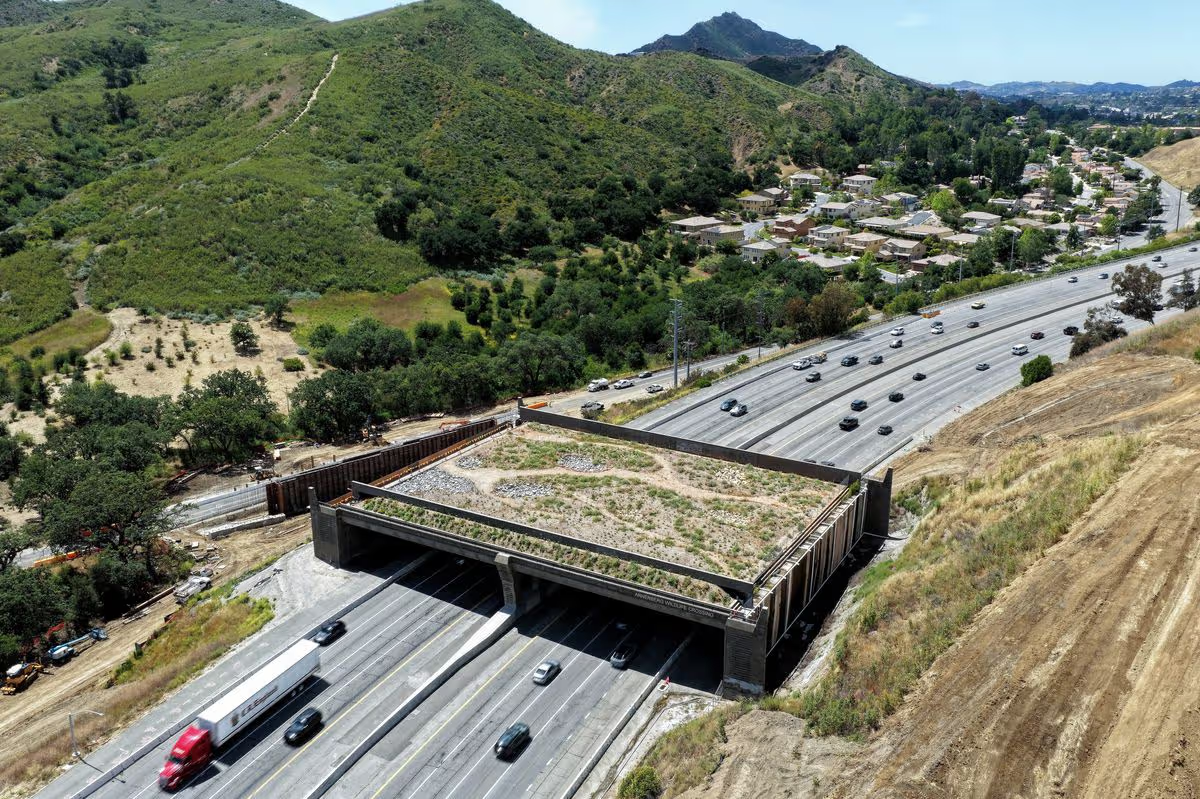
Work has been underway on the bridge for four and a half years. Now, it has been confirmed that the Wallis Annenberg Wildlife Crossing over the 101 Freeway in Agoura Hills, north of Los Angeles, will open on December 2.

The project leaders made the announcement on Earth Day. Managers said: “What a journey this has been! And we cannot wait to celebrate with you all.”

The main section of the bridge, which spans 10 lanes of the freeway, has largely been completed and landscaped. Work still left to do includes building over Agoura Road and connecting both ends of the bridge to the open space on either side.

It will eventually allow wildlife to safely pass through. California’s regional director for the National Wildlife Federation, Beth Pratt, has already seen some wildlife enjoying the bridge.

She told KNX News Radio: “I’ve recorded multiple species of butterflies up here. We’ve had, I think, eight species of birds.

“We’ve had red-tailed hawks and American kestrels fly by, so wildlife are already responding to it, even though it’s not connected to the landscape.”

The goal of the project is to reinvigorate the mountain lion population in the area. Animals that are frequently hit by cars on the freeway are also set to benefit, which include bears, bobcats, foxes, coyotes and deer.

The bridge has faced multiple delays and criticism. In 2022, the project broke ground with a $90million price tag (£66.5million) and was set to be completed by 2025.

However, reports today say the total has climbed to $114million (£84.5million), which has been paid for through private donations and public funds.

Project leaders have said near-record rainfall, which saturated the site in 2023 and 2024, delayed work. Project costs were also pushed higher due to inflation, labour shortages and the complexity of the project.

In a blog post, project leaders said: “The criticism often flattens a far more complicated reality. This is not a standard overpass. Engineers are effectively building a living ecosystem over 10 lanes of one of the busiest freeways in the country.”

It added: “Projects of this scale should be questioned, audited and debated—especially when it’s the public’s money being used.

“But they should also be judged on their purpose. In a region where wildlife populations face genetic isolation and frequent freeway deaths, doing nothing carries its own cost.

“The real question is not whether the crossing is ambitious—it clearly is. It’s whether Southern California is willing to invest in repairing the environmental missteps that made the project necessary in the first place.”
Source link

Refik Anadol’s AI arts museum, Dataland, sets opening date

After more than two and a half years of research, planning and construction, Dataland, the world’s first museum of AI arts, will open June 20.

Co-founded by new media artists Refik Anadol and Efsun Erkılıç, the museum anchors the $1-billion Frank Gehry-designed Grand LA complex across the street from Walt Disney Concert Hall in downtown Los Angeles. Its first exhibition, “Machine Dreams: Rainforest,” created by Refik Anadol Studio, was inspired by a trip to the Amazon and uses vast data sets to immerse visitors in a machine-generated sensory experience of the natural world.

The architecture of the space, which Anadol calls “a living museum,” is used to reflect distant rainforest ecosystems, including changing temperature, light, smell and visuals. Anadol refers to these large-scale, shimmering tableaus as “digital sculptures.”

“This is such an important technology, and represents such an important transformation of humanity,” Anadol said in an interview. “And we found it so meaningful and purposeful to be sure that there is a place to talk about it, to create with it.”

The 35,000-square-foot privately funded museum devotes 25,000 square feet to public space, with the remaining 10,000 square feet holding the in-house technology that makes the space run. Dataland contains five immersive galleries and a 30-foot ceiling. An escalator by the entrance will transport guests to the experiences below. The museum declined to say how much Dataland, designed by architecture firm Gensler, cost to build.

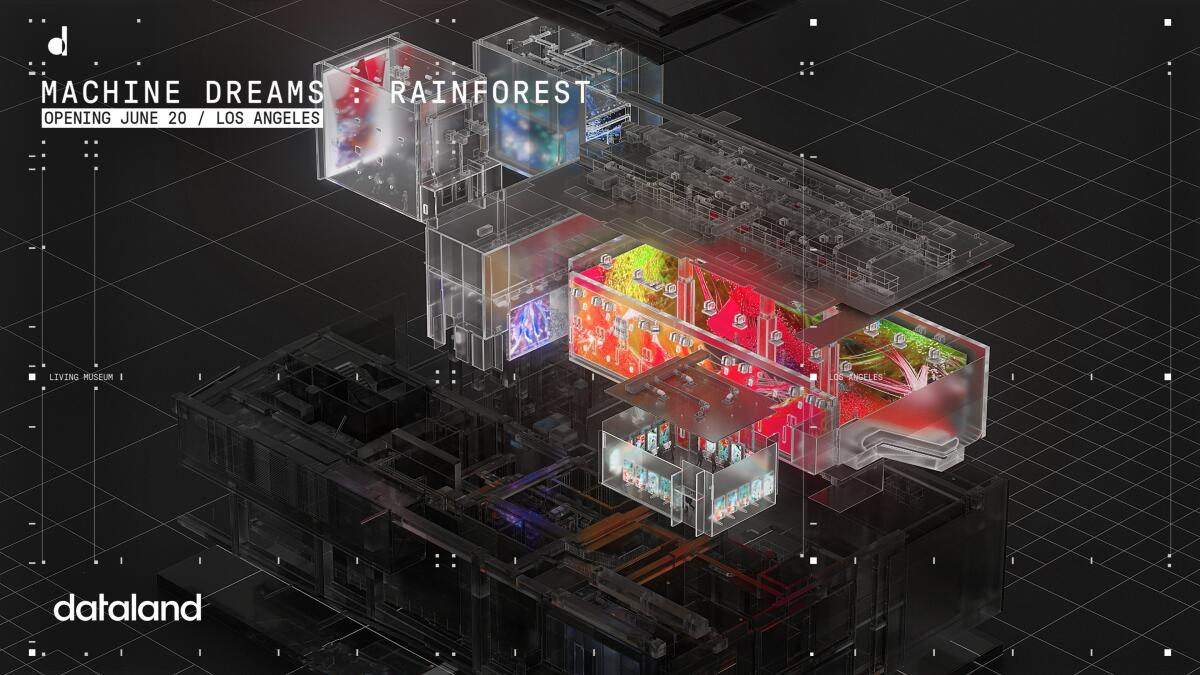
An architectural rendering of a museum.

An isometric architectural rendering of Dataland. The 25,000-square-foot AI arts museum also contains an additional 10,000 square feet of non-public space that holds its operational technology.

(Refik Anadol Studio for Dataland)

Dataland will collect and preserve artificial intelligence art and is powered by an open-access AI model created by Anadol’s studio called the Large Nature Model. The model, which does not source without permission, culls mountains of data about the natural world from partners including the Smithsonian, London’s Natural History Museum and the Cornell Lab of Ornithology. This data, including up to half a billion images of nature, will form the basis for the creation of a variety of AI artworks, including “Machine Dreams.”

“AI art is a part of digital art, meaning a lineage that uses software, data and computers to create a form of art,” Anadol explained. “I know that many artists don’t want to disclose their technologies, but for me, AI means possibilities. And possibilities come with responsibilities. We have to disclose exactly where our data comes from.”

Sustainability is another responsibility that Anadol takes seriously. For more than a decade, Anadol has devoted much thought to the massive carbon footprint associated with AI models. The Large Nature Model is hosted on Google Cloud servers in Oregon that use 87% carbon-free, renewable energy. Anadol says the energy used to support an individual visit to the museum is equivalent to what it takes to charge a single smartphone.

Anadol believes AI can form a powerful bridge to nature — serving as a means to access and preserve it — and that the swiftly evolving technology can be harnessed to illuminate essential truths about humanity’s relationship to an interconnected planet. During a time of great anxiety about the power of AI to disrupt lives and livelihoods, Anadol maintains it can be a revolutionary tool in service of a never-before-seen form of art.

“The works generate an emergent, living reality, a machine’s dream shaped by continuous streams of environmental and biological data. Within this evolving system, moments of recognition and interpretation emerge across different forms of knowledge,” a news release about the museum explains. “At the same time, the exhibition registers loss as part of this expanded field of perception, most notably in the Infinity Room, where visitors encounter the 1987 recording of the last known Kauaʻi ʻŌʻō, a now-extinct bird whose unanswered call becomes part of the work.”

“It’s very exciting to say that AI art is not image only,” Anadol said. “It’s a very multisensory, multimedium experience — meaning sound, image, video, text, smell, taste and touch. They are all together in conversation.”

Source link