Five goals, four water breaks, three red cards and a glittering opening ceremony.
The World Cup 2026 opening day delivered everything you could ask for.
Recommended Stories
list of 3 itemsend of list
From an early thunder strike to a late winning goal, Thursday was filled with drama, stretching from Mexico City to Zapopan.
Al Jazeera breaks down the key takeaways from the 2026 FIFA World Cup’s day 1:
Is this going to be the World Cup with the most red cards?
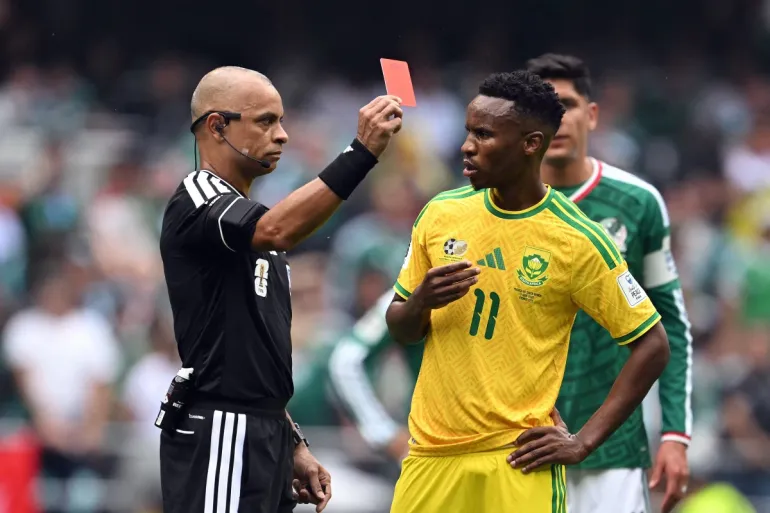
The three red cards brandished to Yaya Sithole, Themba Zwame and Cesar Montes during Mexico’s 2-0 win over South Africa were an unusual sight at a World Cup.
In the last two editions, Qatar 2022 and Russia 2018, only four red cards were handed out during the entire tournament. This year’s World Cup opening game nearly matched that singlehandedly.
With officiating at the start of the tournament usually setting the tone for the rest of the campaign, the sequence of sending offs at Estadio Azteca could be repeated several times during the 39-day, 104-match spectacle in North America.
Thursday’s three reds fell just one short of the record of four at a World Cup 2006 game, nicknamed the “Battle of Nuremberg”, between Portugal and the Netherlands.
The record for the most red cards – 28 – was also set at the same tournament in Germany.
Brazilian referee Wilton Sampaio shows a red card to South Africa’s midfielder Themba Zwane [Yuri Cortez/AFP]
Controversial VAR at the centre of debate again
The look of confusion and disbelief among South African players after Zwane was sent off for flinging an arm into Mexico’s Roberto Alvarado’s face prompted the debate: Is Video Assistant Referee (VAR) playing spoilsport again?
Referee Wilton Sampaio did not initially pull out the red card, but after being sent to the pitchside monitor by VAR, Sampaio decided to send Zwane off.
While the replays were unclear, it seemed Zwane was trying to move past Alvarado, but his hand caught the Mexican’s face in the process.
Zwane was ultimately booked for “violent conduct”, a controversial decision, which seemed harsh given it was not an obvious call. South Africa coach Hugo Broos was not convinced by it, either.
“The second red card, I think the Mexican player blocked my player,” Broos said in the post-match media conference.
“It’s the position of the referee, and we have to accept it also, but I don’t think [it was a red], it was too soft to give that as a red card.”
Hydration breaks or momentum killers?
The introduction of fixed hydration breaks – one in each half – came into effect for the first time at the World Cup on Thursday, and attracted early criticism from viewers and coaches alike.
While some broadcasters stuck with the live feed featuring players, others cut to commercials, disrupting the match-viewing experience for fans watching on TV.
Viewers in the United States were frustrated after broadcaster Fox cut away to full-screen commercials and they missed some live action during the second half of the Mexico vs South Africa opening match.
US head coach Mauricio Pochettino had a mixed opinion over the three-minute breaks, which are held regardless of weather conditions and introduced by FIFA to prioritise player welfare.
“I don’t like it. I only like it when the conditions are very extreme, but when the conditions are good, it is not necessary to have water breaks,” he said during a news conference on Thursday.
“For me, it’s 50-50. For coaches and staff, it’s a chance to make some changes or fix problems. But it’s part of the game, and we accept that.
“I don’t agree with it, but it’s not a big issue and won’t have a big effect on the games,” he said, adding that he did not watch the opening game.
Son Heung-min misfires, but South Korea prevail
Son Heung-min has often been the hero of the South Korea national team on the biggest stage, but on Thursday, even though the talisman got the lion’s share of the chances, he failed to score in their 2-1 win over Czechia.
Son worked seamlessly with the impressive Lee Kang-in and Lee Jae-sung to create a host of first-half chances, with the trio combining darting runs through the middle with a succession of dangerous pass-and-go moves that they just could not finish.
But Oh Hyeon-gyu and Hwang In-beom stepped up to the occasion, bagging a goal each to steer the Koreans to a dramatic late comeback win over Czechia.
South Korea’s Son Heung-min reacts after missing a chance to score in their World Cup opener against Czechia [Daniel Becerril/Reuters]
South Korea vs Czechia: A clash of styles
Even though both teams opted for a 3-4-3 formation, there was a stark difference in their systems and approach.
South Korea played a fluid, possession-based style of football, while Czechia were heavily reliant on dead balls, opting for a rugged, route-one tactic.
Although the Czechs broke forward first with direct, physical play, the Koreans – buoyed by a largely Mexican crowd rooting for them – bounced back with their dominance of possession and stylish play, getting the better of their set-piece specialist opponents.
A NEW hovercraft route is being trialled in the UK this summer – and could be made permanent.
Bookings are now open for the 15-minute trip, with tickets starting at just £12.
Sign up for the Travel newsletter
Thank you!
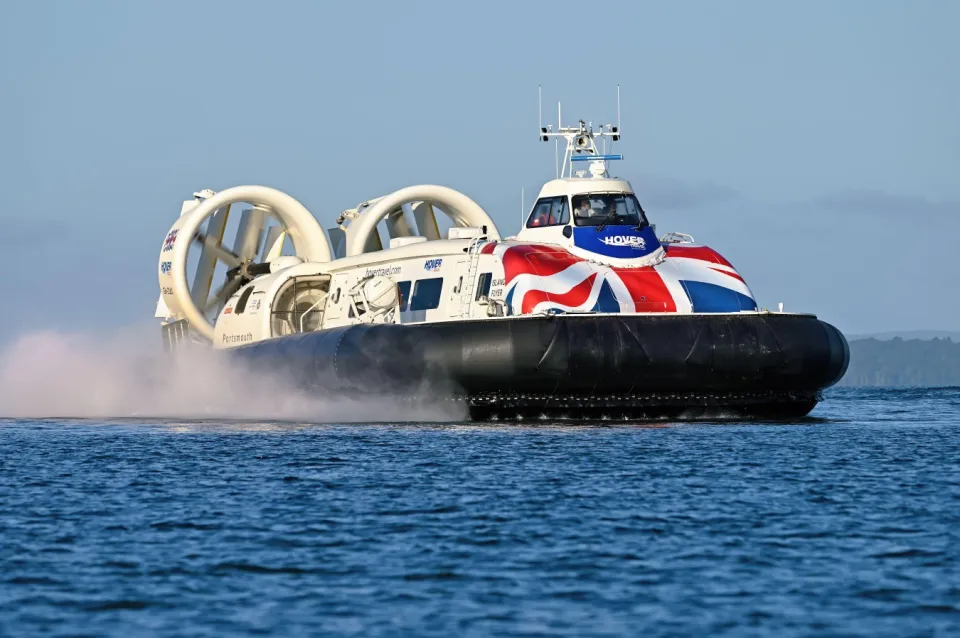
Visitors will fly at speeds of 46mph along the new crossingCredit: AlamyThe 15-minute trip will take visitors to the UK’s sunniest destinationCredit: Alamy
Hampshire and the Isle of Wight will now be connected through a brand new hovercraft crossing, taking place all throughout the summer.
Run by Hovertravel – the world’s oldest and longest-running hovercraft operator – travellers will now be able to make the journey from Lee-on-the-Solent to Ryde in just 15 minutes.
Visitors will soar at speeds of 46mph, while hovering 1.5m above the Solent, on the company’s two- craft fleet: the Island Flyer and the Solent Flyer.
Crossings will take place on June 28, August 22 and September 5, with two departures daily.
The World Cup 2026 starts on Thursday, kicking off the biggest tournament in football history across the United States, Canada and Mexico.
A record 48 teams will play 104 matches over the next six weeks, with millions of fans turning their attention to the opening ceremony, the first games and the storylines set to define the tournament.
Recommended Stories
list of 4 itemsend of list
Here’s what to watch on day one:
What’s the schedule on June 11?
The World Cup gets under way on Thursday, June 11, with two Group A matches taking place in Mexico.
The opening ceremony at Mexico City Stadium in Mexico City begins at 11am local time (17:00 GMT) and will feature a celebration of Mexican and Latin music.
Mexican singer Alejandro Fernandez will perform the national anthem, joined by artists including Mana, Los Angeles Azules, Lila Downs and Belinda. Colombia’s J Balvin and Venezuela’s Danny Ocean are also set to appear, while Shakira headlines the ceremony alongside Nigeria’s Burna Boy with the debut performance of “Dai Dai”, the tournament’s official song.
Later, South Korea take on Czechia at Estadio Guadalajara (Estadio Akron) in Guadalajara, with kickoff scheduled for 8pm local time (02:00 GMT on June 12).
What do the predictions say for Mexico vs South Africa match?
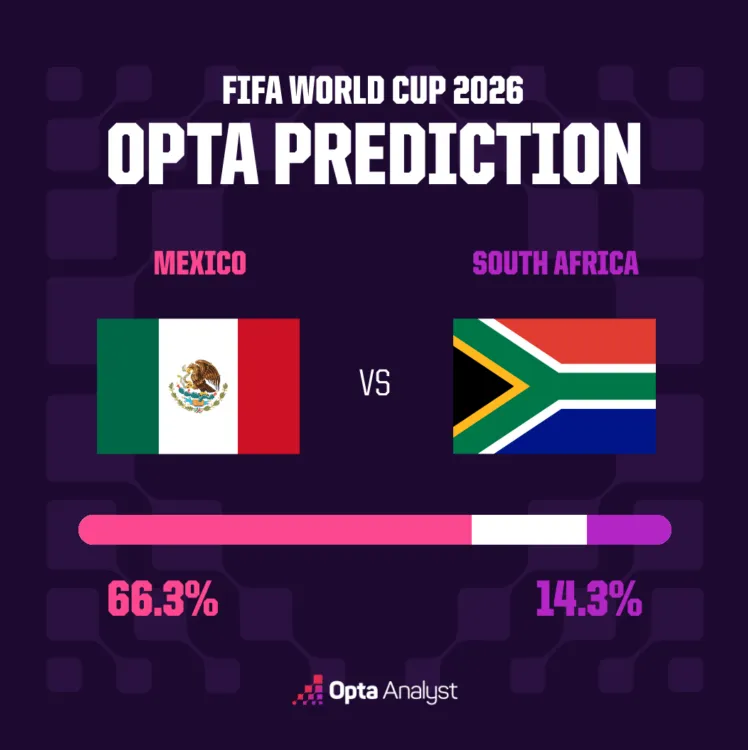
Mexico are the clear favourites to beat South Africa in the World Cup opener, with the Opta supercomputer giving the hosts a 66.3 percent chance of victory based on 10,000 pre-match simulations.
South Africa are assigned a 14.3 percent probability of winning, while a draw occurs in 19.4 percent of the simulations.
Looking beyond the opening fixture, Opta also projects Mexico to finish top of Group A, ahead of South Korea, Czechia and South Africa.
El Tri will be led by veteran striker Raul Jimenez and 17-year-old midfielder Gilberto Mora, while goalkeeper Guillermo Ochoa is set to make history by playing in a record sixth World Cup. South Africa, meanwhile, are appearing at the tournament for the fourth time and for the first time since hosting it in 2010.
Teams playing in Mexico will compete at some of the highest-altitude venues in the tournament. Mexico City Stadium is located about 7,300 feet (2,225 metres) above sea level, while Guadalajara sits at roughly 5,138 feet (1,566 metres).
Image source: Opta website
What do the predictions say for South Korea vs Czechia match?
South Korea are slight favourites against Czechia, with Opta assigning them a 42.9 percent chance of victory compared with Czechia’s 31.1 percent.
The likelihood of a draw stands at 26.0 percent, suggesting a closely contested match.
In the wider Group A outlook, South Korea have a 70 percent chance of reaching the knockout stages and a 21.3 percent probability of winning the group, while Czechia are given a 64.3 percent chance of advancing and a 17.9 percent chance of topping the standings.
Image source: Opta website
What else is shaping the World Cup?
While the opening ceremony and first matches take centre stage, they are far from the only stories defining this World Cup. From immigration controversies and soaring ticket prices to new technology and late injury setbacks, here’s what else is making headlines as the tournament gets under way.
Somali referee Omar Artan receives hero’s welcome after World Cup ban
Artan received a hero’s welcome in Mogadishu after being denied entry to the US ahead of the tournament. Hundreds of supporters waving Somali flags gathered to greet the referee, who had been set to become the first Somali official to officiate at a World Cup.
US authorities stopped him at Miami International Airport, citing unspecified “vetting concerns”, and FIFA later removed him from the referees’ roster. Artan told The New York Times he was questioned for 11 hours before being sent back.
Despite the setback, he remained hopeful. “I promise you, God willing, that I will attend the next one,” he told supporters.
Sky-high ticket prices anger fans
World Cup 2026 is shaping up to be the most expensive in the tournament’s history, with soaring ticket prices, costly transport and accommodation, and concerns over US immigration policies prompting some fans to reconsider attending.
FIFA introduced dynamic pricing for the first time, meaning ticket costs rise with demand. With more than 500 million ticket requests submitted during the initial sales phase, some seats have reached eye-watering prices.
“Already there’s so much inflation. I have to pay so much already for the gas to get here, and now even more for tickets, you know, that’s so awful,” a football fan told Al Jazeera.
“That definitely means I won’t be able to go and I think a lot of people are going to feel very jaded for that. So I really hope they can re-evaluate it or at least give some kind of a discount for people who are really huge fans,” she added.
When tickets first went on sale in December, prices ranged from $140 to $8,680 for the final. By April, FIFA had raised the top price to $10,990, nearly seven times the $1,550 maximum outlined in North America’s original bid.
New tech rules
FIFA and the International Football Association Board (IFAB) have introduced a series of changes aimed at speeding up play and improving decision-making.
These include upgraded semiautomated offside technology, a smart match ball fitted with sensors that send real-time data to VAR, visible five-second countdowns to discourage time-wasting on throw-ins and goal kicks, stricter substitution rules and expanded VAR powers to review clear errors involving second yellow cards, mistaken identity and incorrectly awarded corner kicks.
World Cup injury setbacks
The Netherlands have been dealt a blow with Arsenal defender Jurrien Timber ruled out after failing to recover from a groin injury. The Dutch FA said the 24-year-old was not fit enough to cope with the demands of the tournament.
Brazil have also lost a key defender, with AS Roma right back Wesley ruled out after suffering a left thigh injury in a friendly against Egypt. He has been replaced by Atalanta midfielder Ederson ahead of Brazil’s Group C opener against Morocco.
Why are drinks breaks controversial?
FIFA has introduced mandatory three-minute hydration breaks midway through each half of all 104 World Cup games, saying the measure is necessary to protect players from extreme heat following concerns raised during last year’s Club World Cup in the United States.
Critics, however, argue the rule applies too broadly, even in cooler venues, and have accused FIFA of commercialising the stoppages after allowing broadcasters to air advertisements during the breaks.
Trump might not attend United States World Cup opener
President Donald Trump has not said whether he will attend the United States’s opening World Cup match against Paraguay in Los Angeles on Friday. However, several people familiar with the tournament planning said they do not currently expect him to be there, according to a report by Politico, although his plans could still change.
The US government will still be represented at the match. The State Department said Secretary of State Marco Rubio will attend, along with Transportation Secretary Sean Duffy and Homeland Security Secretary Markwayne Mullin.
Mexico’s Claudia Sheinbaum won’t attend either
Mexican President Claudia Sheinbaum won’t be using the ticket FIFA gave her for the opening match. Instead, it went to Yolett Cervantes Cuaquehua, a 21-year-old from Veracruz who won a contest by showing off her football juggling skills.
The challenge invited young women to keep the ball up for one minute on camera, and Sheinbaum also awarded tickets to three other winners.
“They are the pride of Mexico. They will not represent the president, or the head of government, they will represent Mexico,” Sheinbaum said at a news conference to give away the ticket to Cervantes Cuaquehua.
World Cup celebrations begin amid protests in Mexico City
As Mexico gets ready to host the opening match, protests are taking place across the capital. Teachers from the CNTE union, along with transport workers, farmers and families of missing people, have taken to the streets to demand better pay, pension changes and action on longstanding issues.
Some demonstrations have affected World Cup preparations, with protesters blocking roads leading to the Estadio Azteca and removing some tournament installations.
Police block an avenue to prevent protesting teachers from marching to the stadium that will host the opening match of the FIFA World Cup in Mexico City [Eduardo Verdugo/AP]
The 2026 World Cup arrives carrying more baggage than most.
Alongside the excitement of the opening matches are concerns about immigration crackdowns, travel restrictions, the wars in Gaza and Iran, and the close relationship between FIFA boss Gianni Infantino and US President Donald Trump.
Journalist Ashish Malhotra, speaking to Al Jazeera’s The Take, argued that Trump has placed himself at the centre of the tournament. “One reason, Donald Trump. He’s really put himself front and centre for this World Cup,” he said, adding that the US president is using the event as a distraction from other crises.
Malhotra was equally critical of football’s governing body. “FIFA is 100 percent a political actor and it has been for close to a century,” he said, pointing to the organisation’s history of aligning itself with leaders accused of human rights abuses.
And yet, despite the contradictions, billions are still expected to tune in. “Sports are a bit of a drug. It’s a bit of an addiction,” Malhotra said. “The way that a World Cup brings people together is why people get sucked in.” It is perhaps the tournament’s greatest paradox: even amid controversy, the pull of the beautiful game remains difficult to resist.
A Welsh couple appeared on A Place in the Sun and broke down in tears after buying a Costa del Sol holiday home to honour their late family member.
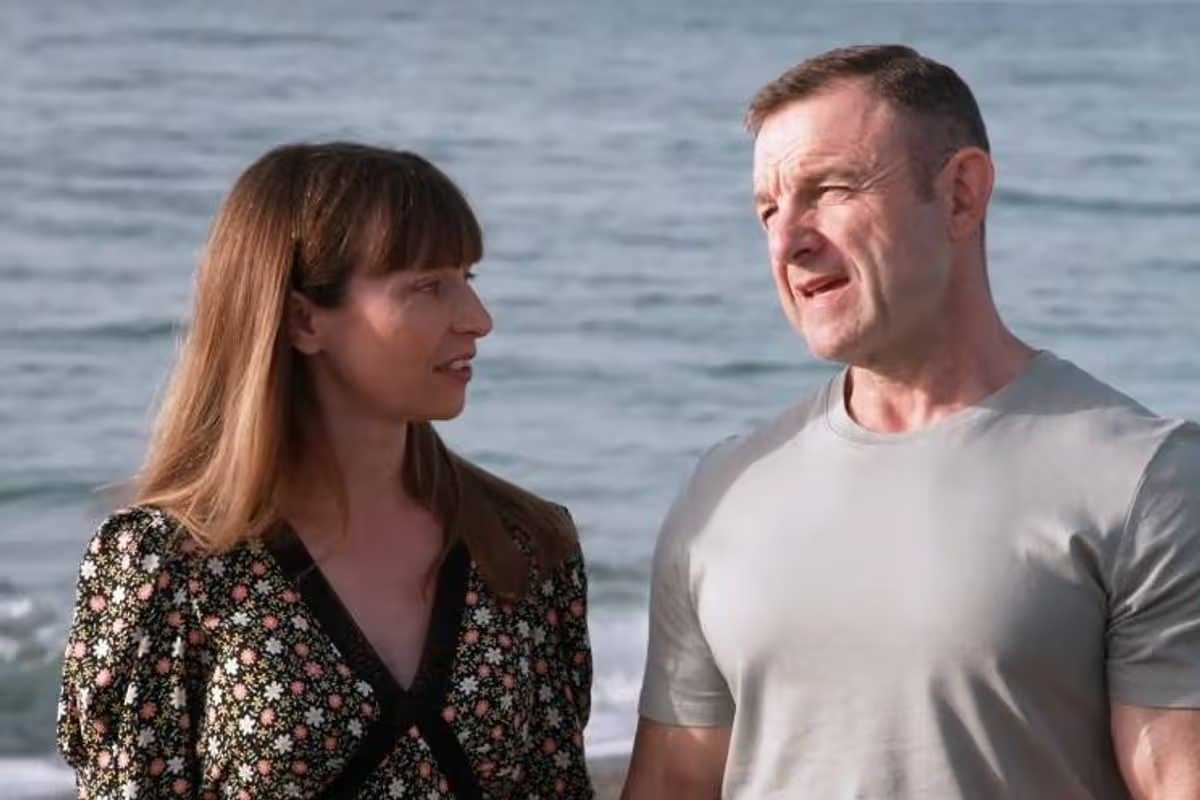
Former bodybuilding champion Darren and his wife Joanne were on the hunt for a holiday home (Image: Channel 4)
A Place in the Sun presenter was moved to tears while discussing a heartbreaking family loss.
During a repeat episode broadcast on Wednesday, June 10, a Welsh couple were searching for a holiday home on the Costa del Sol, enlisting the assistance of host Jean Johansson.
Former body builder Darren and his wife Joanne, had a particularly poignant motivation behind their decision to purchase a property in Spain, wanting somewhere perfect for their three children and wider family.
They also decided to find somewhere following the sad death of Joanne’s brother Matt, with one of their final conversations being him encouraging them to “live the dream”.
Joanne emotionally told Jean: “My brother sadly passed away ten years ago and one of our last conversations was that I had to make sure that we have as much fun as possible and live the dream with our children,” reports Wales Online.
“Because he loved the beach and being abroad so much we thought this would be the perfect way to honour his memory.”
After viewing several properties, with a budget of £205,000, the couple submitted an offer of £170,000 on one apartment they were keen to add to.
At that moment, Joanne shared: “I do feel emotional, I just know this is what my brother would want and I am sure he is just looking down now with a big smile on his face.”
While their initial offer was turned down, their second bid of £178,000 was accepted, leaving Joanne overcome with emotion.
Breaking down, she shared: “This is for you, Matt!”
Expressing her gratitude to Jean, she continued: “We can now live the dream in my brother’s memory.
“The family can come here and think about him, my mum and dad just feel so close to Matt when we are at the beach and they can come here anytime they want now!”
Visibly moved, Jean responded: “I am so happy, I’ve never been happier for a couple.”
Raising a toast, Joanne said: “To Matthew and the family, and to living the dream!”
Jean added to the camera: “That was an emotional end to an exciting search, Darren and Joanne have the dream property for them and the whole family, and I know they are going to have loads of amazing holidays here in Malaga.”
Speaking after the episode originally aired in May 2024, Joanne told A Place In The Sun that they were “definitely living the dream”.
She said they get very emotional when they walk through the door, as the home is so linked to her brother, who loved the beach, but tragically died of cancer at the age of 27.
“We’ve taken out all the children and showed them the places we visited on the TV show, such as Lake Vinuela,” Joanne said.
“It already feels like home and I’d say we are definitely living the dream.”
A Place in The Sun is available to watch on Channel 4.
THE world’s BIGGEST bouncy castle is coming to the UK – and it won’t just be for kids.
‘Mega Bounce’ is set to open at Braintree Village in Essexnext month, and will run until the end of the summerholidays.
Sign up for the Travel newsletter
Thank you!
Inside will be giant slides, obstacle courses, sports challenges and, of course, dedicated bouncing arenasCredit: Jam Press/Mega BounceIt will run for six weeks
The massive attraction spans 2,500 square metres – the size of two football pitches – and is more than eight metres tall.
Inside will be giant slides, obstacle courses, sports challenges and, of course, dedicated bouncing arenas.
And outside of it will be other entertainment zones with food vendors, games such as giant Jenga and Connect 4, and music.
Visitors will also find giant Jenga, Connect 4, ping-pong, food stalls and drink vendors throughout the event arena.
There will be day-time quieter sessions designed for guests who prefer a more relaxed environment, before moving into all-ages sessions featuring music, lighting effects and entertainment throughout the day.
And it’s not just aimed at children – during the six-week run, a number of adult-only sessions will launch.
Once family sessions finish each evening, there will be adults-only events featuring DJs, karaoke, a fully stocked bar and even foam parties..
Josef O’Sullivan, centre director at Braintree Village, said: “After the success of The Monster at Braintree Village last summer, we wanted to come back with something even bigger and better this year.
Tickets will last for one hour sessionsCredit: Jam Press/Mega Bounce
“Mega Bounce making its UK debut here at Braintree Village is incredibly exciting, and we expect to see visitors from far and wide.”
The bouncy castle was previously in Dubai.
Mr O’Sullivan added: “We’re certain that this is going to be one of the best attractions available in the country over the summer holidays.”
Visitors booking a bounce session will get unlimited access to the attraction during a 60-minute slot.
General admission tickets are priced at £18, with discounts available for larger groups and members of Braintree Village’s PLUS+ rewards scheme.
British number one Emma Raducanu wins her opening game of the grass-court season 6-0 6-3 against Russia’s Anna Blinkova, to advance to the second round of Queen’s.
The 2026 World Cup will launch with a series of historic opening ceremonies across North America, marking the first time the tournament has been launched simultaneously in three host countries.
The United States, Mexico and Canada will officially launch the biggest World Cup in history.
Recommended Stories
list of 4 itemsend of list
While the US hosted the tournament in 1994 and Mexico in 1970 and 1986, Canada will host the competition for the first time. Together, the three countries will open the tournament.
This World Cup will feature a record 104 matches spread across 16 host cities. The global event will run from the opening match in Mexico on Thursday, June 11, to the final on Sunday, July 19, in New York.
Here is what we know:
What are the 2026 FIFA World Cup opening ceremonies?
The three interconnected ceremonies staged across Mexico, Canada and the US are built around a shared theme designed to unite the three host nations while showcasing each country’s culture, identity and creative talent.
Each event will begin 90 minutes before the host nation’s opening match.
The ceremonies are being produced by Marco Balich, the creative director behind several Olympic opening ceremonies, including the 2026 Winter Games edition and major international sporting events. While each show will have its own distinct character, all three will be linked by a shared theme centred on football’s ability to unite people across borders.
Each host country will bring its own visual style to the ceremonies. Canada will be represented through a cultural mosaic, Mexico through papel picado, and the US through what Balich called “a super shiny, glowing cup”.
“The FIFA World Cup is a moment the world shares, and that begins with how we open it,” said FIFA President Gianni Infantino.
“Starting with Mexico City and continuing the next days with Toronto and Los Angeles, these ceremonies will bring together music, culture and football in a way that reflects both the individuality of each nation and the unity that defines this tournament. It is a powerful way to begin a truly global celebration.”
According to The Athletic, the ceremony in Mexico City is expected to run for about 16 minutes and 30 seconds, while the shows in Toronto and Los Angeles are scheduled to last approximately 13 minutes each.
Once the performances conclude, the pitch will be handed over to the teams for their pre-match warm-ups. Matchday protocol ceremonies, including the player walkouts and official introductions, will then begin 25 minutes before kickoff and are expected to last about 13 minutes.
Who is playing in the opening games?
Mexico will face South Africa in the first match of the tournament, which will take place following the opening ceremony in Mexico City.
Canada will play against Bosnia and Herzegovina in Toronto, marking a historic milestone as it will be the Canadian Men’s National Team’s first World Cup match played on home soil.
The US will take on Paraguay in their opening match following the celebration in Los Angeles.
When and where are the World Cup opening ceremonies?
Mexico City (June 11)
Mexico will launch the tournament at Mexico City Stadium (formerly known as the Estadio Azteca) 90 minutes before its opening match against South Africa, in a repeat of the 2010 opener.
The ceremony is expected to celebrate Mexican culture through Indigenous performers, contemporary folkloric acts and the traditional art of papel picado.
Artists featured on the Official FIFA World Cup Album are expected to perform, including Alejandro Fernandez, Belinda, Danny Ocean, J Balvin, Lila Downs, Los Angeles Azules, and Mana. The show will also include South African singer-songwriter Tyla.
Shakira is also expected to perform her Dai Dai – an Italian phrase meaning “let’s go” or “come on” – along with Burna Boy. Shakira is also set to co-headline the inaugural FIFA World Cup Final Halftime Show on July 19, alongside Madonna and K-pop band BTS.
Authorities have declared June 11 a public holiday in Mexico City, with schools closed and employers encouraged to allow remote work. Access to the stadium area will be restricted to ticket holders, accredited media and authorised personnel.
Opening day schedule in Mexico 9:00 (15:00 GMT): Stadium gates open 11:00 (17:00 GMT): Opening ceremony begins 12:10 (18:10 GMT): Team warm-ups 13:00 (19:00 GMT): Mexico vs South Africa kickoff
Toronto (June 12)
Canada’s ceremony will take place at Toronto Stadium before the country’s World Cup match against Bosnia and Herzegovina. The opening ceremony in Toronto will kick off at 1:30pm local time (17:30 GMT).
The ceremony will begin with a unique countdown designed to take viewers on a “journey across Canada”, highlighting moments that reflect the nation “from coast to coast to coast”.
Centred on the theme of a cultural mosaic, the event will highlight Canada’s diversity through music and performance, with artists including Alanis Morissette, Alessia Cara, Elyanna, Jessie Reyez, Michael Buble, Nora Fatehi, Sanjoy, Vegedream and William Prince.
The match immediately following the ceremony against Bosnia and Herzegovina is deeply significant, as it will be the first FIFA World Cup match to be played by the Canadian Men’s National Team on home soil.
FIFA President Gianni Infantino noted that the Toronto ceremony will be a “powerful reflection of Canada’s identity” and a “moment of pride, unity and anticipation” as the country steps onto football’s biggest stage.
Opening day schedule in Canada
13:30 (17:30 GMT): Opening ceremony begins. 15:00 (19:00 GMT): Canada vs Bosnia and Herzegovina kicks off.
After the ceremony concludes, the teams will complete their warm-ups before the official pre-match proceedings and kickoff at 3pm local time (19:00 GMT).
Los Angeles (June 12)
The US will host its opening celebration at the Los Angeles Stadium before facing Paraguay.
The ceremony will feature large-scale visuals, immersive storytelling and performances from global artists including Katy Perry, Future, Anitta, LISA, Rema and Tyla.
FIFA President Gianni Infantino highlighted that this specific artist lineup was chosen to reflect the cultural diversity and vibrant diasporas of the US, showcasing the nation’s considerable influence on global pop culture, music, and entertainment.
Opening day schedule in US
16:30 (23:30 GMT): Opening ceremony begins 18:00 (01:00 GMT June 13): The US vs Paraguay kicks off.
How can you watch the World Cup opening ceremony?
Fans in the US can watch the opening ceremonies through FIFA’s official broadcast partners. English-language coverage will be available on FOX and FS1, while Spanish-language coverage will air on Telemundo and Universo.
For free streaming, Tubi will simulcast the opening ceremonies and the opening matches, including Mexico vs South Africa on June 11 and the United States vs Paraguay on June 12.
All 104 World Cup matches will also be available through the FOX One app (subscription required), while Spanish-language viewers can stream every match on Peacock and the Telemundo app.
International broadcasters include:
Canada: CTV, TSN and RDS
Mexico: Televisa and TV Azteca
United Kingdom: BBC and ITV
How many fans are expected to attend and watch?
FIFA has not released an official number for the opening ceremonies. However, the three events are expected to fill their host venues in Mexico City, Toronto and Los Angeles, with a combined live attendance of roughly 200,000 spectators.
The ceremonies will also be broadcast worldwide as part of the opening match coverage, likely attracting a global television audience in the tens or hundreds of millions.
Are the hosting nations facing any challenges before the ceremony?
Yes. In Mexico City, ongoing protests by teachers’ unions and other groups have raised concerns about possible disruptions before the opening match between Mexico and South Africa.
Protesters have threatened to block major roads leading to Mexico City Stadium and other key locations. Authorities have responded with a large security operation and say the opening ceremony is not at risk, although organisers remain on alert as the tournament approaches.
In Los Angeles, officials have focused on security planning, crowd management and preparations for large-scale events across the city. Local authorities have also said they do not expect immigration enforcement operations at World Cup venues.
In Toronto, organisers are preparing for an influx of visitors, with transport agencies adding services and coordinating plans to reduce congestion. Across all three host nations, security and logistics remain key priorities as the tournament gets under way.
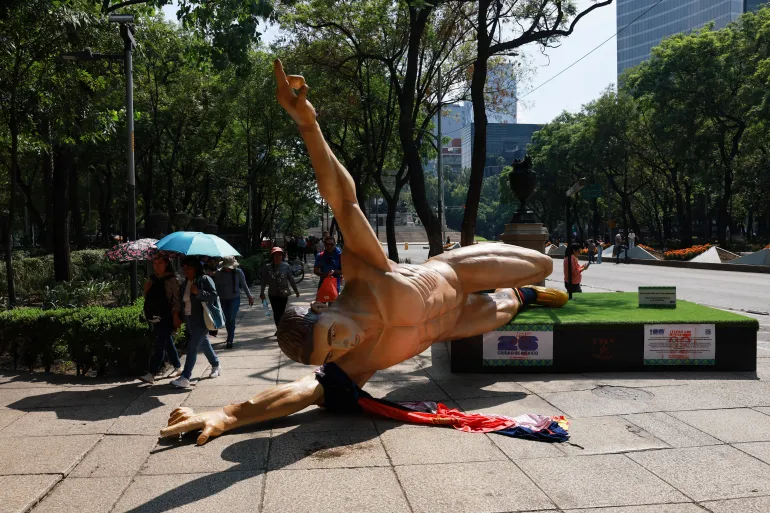
People walk near the fallen statue of a football player, placed along Avenida Reforma for the 2026 FIFA World Cup, that was vandalised by teachers from Mexico’s National Coordination of Education Workers (CNTE), following a protest demanding better wages and pensions, under the slogan “If there’s no solution, the ball won’t roll,” in Mexico City [Henry Romero/Reuters]
The FIFA World Cup begins on June 11. You can follow the action on Al Jazeera’s dedicated World Cup 2026 page with all the latest news, match build-up and live text commentary, and keep up to date with group standings, real-time match results and schedules.
A new Eurocamp in a location just a couple of hours from the UK offers easy access to a Blue Flag beach and one of the biggest waterparks in the entire country – and the perfect day trip is just a short drive away
16:58, 08 Jun 2026Updated 17:07, 08 Jun 2026
This article contains affiliate links, we will receive a commission on any sales we generate from it. Learn more
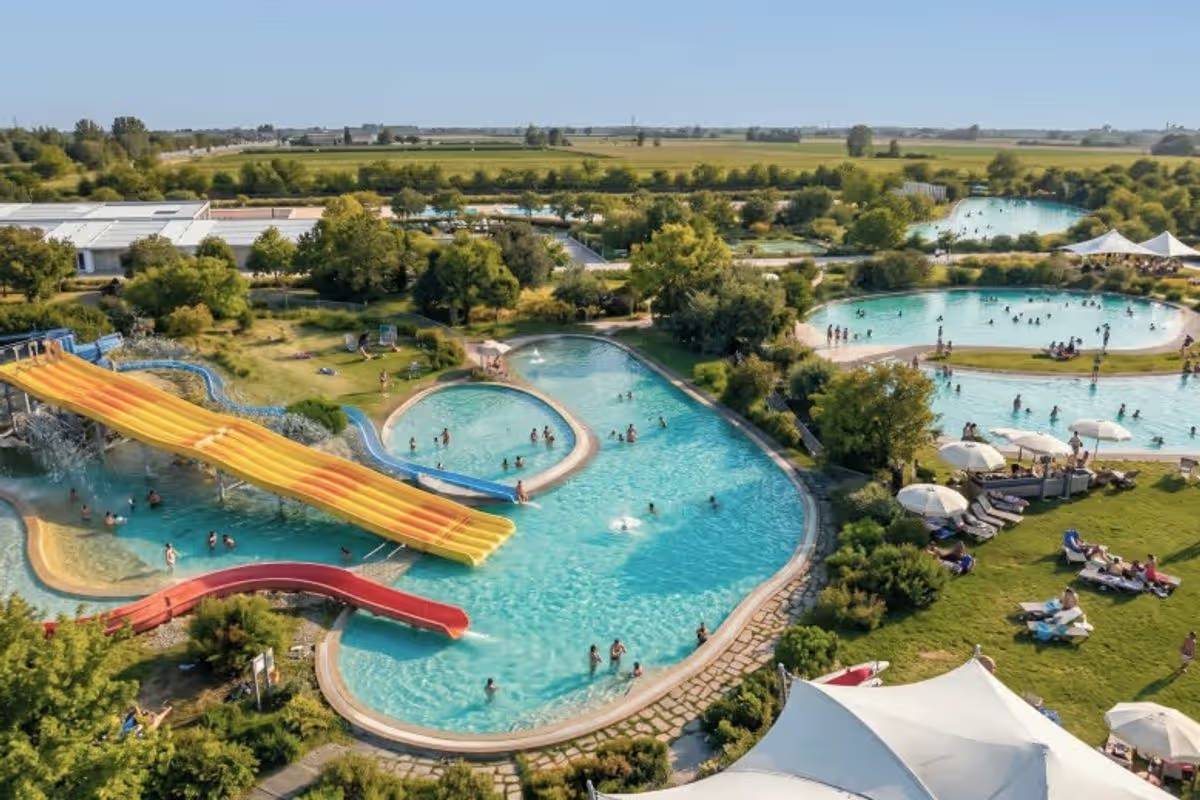
A nine-hectare water park will be at the heart of the new holiday park(Image: Eurocamp)
Already looking for your summer 2027 holiday? A new Eurocamp opening could be the perfect choice if you like a beach and pool holiday, but also want to be in close proximity to an incredibly popular city break destination.
Set to open in May 2027, hu Eraclea Mare is a brand-new camping village on the Adriatic coast near Venice, covering over 100-hectares and set on a spectacular long stretch of Blue Flag beach. Bookings are already open on the Eurocamp website from May 1 next year, just in time for a half-term trip to Italy.
And according to Eurocamp, at the heart of its newest site will be a nine-hectare water park – the largest ever built in an Italian holiday village. It’ll have six pools, including Olympic and semi-Olympic sized options, lagoons, waterslides, and a 40,000 square metre solarium.
But the pool won’t be the only place to make a splash. The park is being built on the long sandy Spiaggia Pannolenci where you’ll find calm, shallow waters for swimming and basking in the Italian sunshine. Or you can enjoy the shaded wooded trails that lead you to the nearby small town of Eraclea Mare.
Back on dry land, you’ll find activities including a tree experience and zip line, mini golf, paintball, and a huge variety of sports to enjoy with the whole family.
The mega-park will also include “30 food and drink outlets” according to Eurocamp’s website, including authentic Italian and Venetian restaurants, gelato shops, and bars. At night, a 1,500 outdoor theatre will host a range of family-friendly entertainment including music and lively events.
The new Eurocamp will also be well-located for day trips to Venice, so you can combine a sightseeing city break with a family holiday. The ferry port of Punta Sabbioni is just a 40-minute drive away, and you can park your car and take a boat in to avoid the traffic. The ferry is a picturesque 30-minute journey and an amazing way to arrive in the city. It docks close to the iconic Piazza San Marco, where you’ll find many of Venice’s top sightseeing spots just a short walk away.
Outdoor enthusiasts will also be able to visit the Dolomiti Bellunesi National Park, otherwise known as the Dolomites, a vast range of mountains and dense, unspoilt forest popular for hiking, sailing on serene lakes, and canyoning your way through its incredible landscape.
The Adriatic coast has a huge range of holiday parks along sparkling sea, and if you’re looking to visit this summer you can choose from existing accommodation options such as the 4-star Holiday Center Pra’ Delle Torri. This site has camping, a holiday village with mobile homes, plus an onsite hotel, with all guests enjoying access to a waterpark with slides.
If you prefer a hotel, you’ll also find the Park Hotel Pineta in Eraclea Mare. Set on a private sandy beach and surrounded by dense pine trees, this relaxed accommodation offers spacious family rooms and apartments.
Have a story you want to share? Email us at webtravel@reachplc.com
MEGAN Thee Stallion nearly blew the roof off Radio City Music Hall after gracing the 2026 Tony Awards stage in barely-there lingerie during the ceremony’s wild opening number.
The rapper bent over in a Moulin Rouge-inspired look and showed off her signature twerking skills before dropping an F-bomb during the live awards show that was televised on CBS and Paramount+ on Sunday night.
Sign up for the Showbiz newsletter
Thank you!
Megan Thee Stallion dropped an F-bomb as she twerked in Moulin Rouge! lingerie for a show stopping Tony Awards opening alongside host PinkCredit: CBSMegan Thee Stallion and host Pink perform during the 79th Annual Tony AwardsCredit: Reuters
Megan, 31, made a surprise appearance during host Pink’s massive Broadway-themed opener on Sunday night, instantly becoming one of the most talked-about moments of the 79th Annual Tony Awards.
The music superstar strutted onto the stage in a sparkling black corset bodysuit complete with fishnet tights, dramatic garters, sequined detailing and towering heels.
She channeled full Parisian cabaret energy inspired by her recent run in Moulin Rouge! The Musical on Broadway.
The Grammy winner joined Pink during a remixed performance of Lady Marmalade, the signature Moulin Rouge anthem, as dancers swarmed the stage in feathered costumes and red velvet-inspired looks.
At several points during the performance, Megan dropped into twerk breaks – which resulted in roaring applause from the crowd.
At another point, the camera cut to stunned audience members cheering and laughing as the Houston-born rapper was bleeped after dropping an F-bomb.
The over-the-top opening number featured more than 170 Broadway performers and included tributes to Moulin Rouge!, Chicago, Rent, A Chorus Line and several of the night’s biggest nominated productions.
Pink, who is hosting the Tonys for the first time ever, kicked things off flying over the audience in a Peter Pan costume and harness before launching into a theatrical mashup packed with celebrity cameos.
Most read in Entertainment
Megan Thee Stallion performs during the 79th Annual Tony Awards in New York CityCredit: ReutersThe music icon came dressed to impressed in Moulin Rouge! inspired lingerieCredit: CBSMegan Thee Stallion backstage after her show-stopping opening number at the TonysCredit: GettyMegan Thee Stallion poses backstage during The 79th Annual Tony AwardsCredit: Getty
Mormon Wives breakout Whitney Leavitt also popped up during the opening dressed in her Roxie Hart costume from Chicago, while Lea Michele belted out surprise vocals during the sprawling musical performance.
Fans immediately flooded social media praising the campy energy of the opener – and Megan quickly emerged as the breakout star of the night.
“One thing Megan Thee Stallion is gonna do is commit to the performance,” one fan wrote on X alongside fire emoji’s.
Another viewer posted: “Megan twerking at the Tony Awards was NOT on my bingo card but she ate.”
Dylan Mulvaney, Megan Thee Stallion, P!NK, and Neil Patrick Harris perform onstage during The 79th Annual Tony Awards at Radio City Music Hall on June 07, 2026 in New York CityCredit: GettyMegan Thee Stallion performs during the Tony Awards opening numberCredit: Reuters
A third fan joked: “Broadway just became the Hot Girl Theater.”
Others praised Pink for embracing the over-the-top antics of the Tonys opener, with one viewer calling it “the most fun opening number in years.”
Megan’s appearance comes just weeks after wrapping her history-making stint in Moulin Rouge! The Musical, where she became the first female-identifying performer ever to play the role of Zidler in any production of the show worldwide.
The 2026 Tony Awards aired live on CBS and Paramount+ from New York City’s Radio City Music Hall.
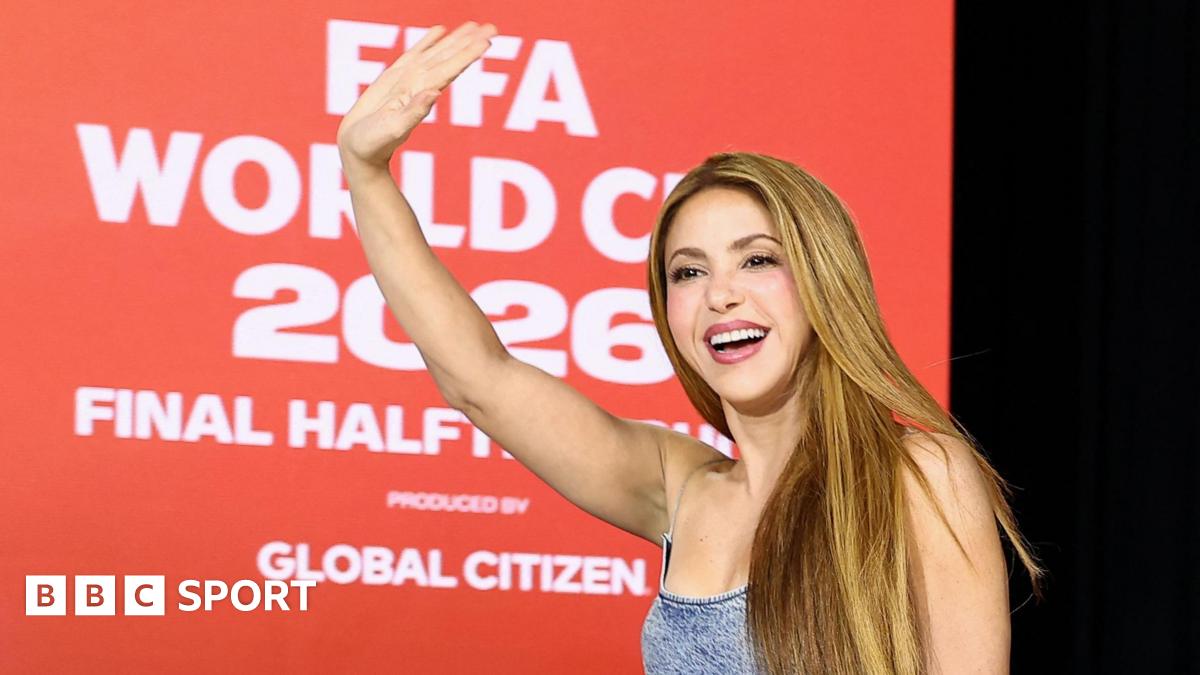
Colombian pop star Shakira will perform her official song for the 2026 World Cup at the competition’s opening ceremony in Mexico.
Shakira will perform Dai Dai, along with Burna Boy, on Thursday, 11 June at Estadio Azteca in Mexico City, before Mexico and South Africa play the first of the tournament’s 104 games (20:00 BST).
Dai Dai – an Italian phrase meaning “let’s go” or “come on”.
Colombian reggaeton star J Balvin and South African singer-songwriter Tyla will also perform at the show in Mexico.
Opening ceremonies will precede each of the first matches played in the host nations of USA, Canada and Mexico.
Canadian singer-songwriters Michael Buble and Alanis Morissette will headline the opening ceremony at BMO Field in Toronto before Canada take on Bosnia and Herzegovina on Friday, 12 June (20:00 BST).
In the USA, pop star Katy Perry and rapper Future will perform before the USA take on Paraguay at SoFi Stadium in Los Angeles on Friday, 12 June (Saturday, 02:00 BST).
Shakira, along with Madonna and K-pop boyband BTS, will also co-headline the Super Bowl-style half-time show at this summer’s World Cup final on 19 July.
Emily Atack has shared a loved up snap with her fiance Alistair GarnerCredit: InstagramThe Rivals star recently opened up about being a victim of sexual abuse on multiple occasionsCredit: Getty
But now it appears she’s moving forward as she took to Instagram to share a sweet picture of the pair.
In the photo, Emily is seen resting her head on Alistair’s shoulder as she smiles while holding a beverage.
She’s wearing a denim jacket while her husband-to-be is sporting a blue jumper, with a pair of sunglasses tucked into the top.
Her followers flocked to the comments section as one gushed: “Gorgeous angels xxxx.”
Another social media user enthused: “Love seeing you happy,” while a third added: “Goddamn beauties!”
The Rivals star revealed she was sexually abused at the age of ten andgot pregnant at 16.
In her most personal interview to date, Emily shared harrowing details of her tough childhood as a “troubled” teenager, which left her “scarred” and “traumatised”.
The TV beauty, who became a household name as Charlotte Hinchcliffe in Channel 4 comedy The Inbetweeners at 17, was in an abusive relationship when she found out she was pregnant.
“I’ve never actually told anybody this, but I was pregnant,” she said. “I was very young and I was in this awful, abusive, horrible relationship and I fell pregnant.
“And it was just in the middle of all this kind of stuff going on with my mum and dad.
She revealed she got pregnant at 16Credit: InstagramEmily and Alistair are looking forward to their wedding in SeptemberCredit: Instagram
“I’ve never spoken openly about how or what happened.
“And I don’t know if I’m ready to yet. But obviously, that pregnancy didn’t continue.”
And she explained how being the subject of unwanted attention by creepy older men had a knock-on effect with her relationships.
“I was keeping so much from my parents when I was young,” Emily said. “It’s going a little bit dark, but I was sexually assaulted first of all when I was ten.
“That was when I was first ever sexually assaulted. And from that moment, I was treated badly, appallingly, by older men from that age throughout my life. I think the loneliness came a lot from that.
“Lots of things happened that my parents to this day still don’t know the detail of, how men have treated me and touched me and whispered things to me in my ear when people aren’t in earshot.
“From that, I then developed a really unhealthy relationship with sex and with boys, because I leaned into that behaviour a little bit.”
Despite her horrendous experiences, Emily has found her happily ever after in fiance Alistair.
The couple got engaged in July last year, a year after welcoming their son Barney.
The pair will be officially tying the knot in September as they count down the days until their man and wife.
City have long been admirers of Newcastle academy graduate Anderson. The player is currently preparing for the tournament in the US, Canada and Mexico, but club-to-club talks can continue to take place.
Captain Bernardo Silva’s exit means City are looking to bolster their midfield and Anderson tops the list of potential targets.
Newcastle midfielder Sandro Tonali is another player understood to be highly rated by City, with reports, external suggesting the Italy international has been monitored as a long-term target.
Nico Gonzalez, who missed out on a place in the Spain squad for the World Cup and also fell out of favour under Pep Guardiola last season, may depart if the right offer comes in.
Sources indicate City are also looking to sign a right-back to supplement Matheus Nunes, 28, who excelled in the position this season after being converted from midfield.
City are eyeing the profile of a young full-back and one who is a natural in that position that can grow into the role in the future.
Comcast NBCUniversal will be investing £5billion into the project, as well as an additional £1billion in capital investment over the first 10 years of operation and £1.3billion from the UK government to support local infrastructure.
It expects to boost the UK economy by as much as £50billion by 2055, and create 28,000 jobs.
Once open, the theme park is set to become the country’s most popular tourist attraction.
Mark Woodbury, Chairman and CEO of Universal Destinations & Experiences, said: “Today marks a significant milestone on our journey to bring Universal United Kingdom Resort, featuring immersive storytelling, thrilling attractions and unparalleled creativity and innovation to the UK.
“This new theme park and resort will create so many new opportunities for the people of Bedford and beyond and allow us to share our distinct experiences with guests from around the world.”
This was echoed by Brian Roberts, Chairman of Comcast Corporation, who said: “This historic partnership is a special moment for our company as we bring our first Universal theme park and resort to Europe.”
As for what kind of themed lands and rides would open at the UK Universal, very little is known.
But there are rumours suggesting that some could be based on James Bond, Paddington, Lord of the Rings, Minions, Jurassic World, and Back to the Future.
It is unlikely to includeHarry Potterdue to licensing rules and that nearby is the Wizarding World ofHarry Potterattraction.
What is known is that across 662 acres, there will be four ‘zones’ – the Core Zone, Lake Zone, West Gateway Zone and the East Gateway Zone.
More accommodation and business hotels will be at the Lake Zone, as well as an entertainment complex and a convention centre.
West Gateway Zone and the East Gateway Zone will be where guests arrive by train and car, with restaurants and hotels.
This is also likely to be where the Entry Plaza area will be, as well as parking and a 500-room hotel.
The Entry Plaza is expected to be the free-to-visit area where tickets aren’t required, similar to Universal’s CityWalk in Orlando.
The UK theme park will be called ‘Universal United Kingdom Resort’Credit: Cover Images
What does the new Universal theme park mean for the rest of the UK?
Outside of the theme park, Universal has committed to creating new training opportunities with apprenticeships and internships.
This is alongside the multi-billion Oxford-Cambridge Growth Corridor which will see Bedford become an “innovation hub”.
Along with the £1.3 billion investment, the government will provide a grant of £400million through the exceptional Regional Growth Fund.
The Department for Culture, Media and Sport will provide a grant of £438million to invest in new community infrastructure, both paid when the park is open.
The Department for Transport is also going ahead with plans to upgrade the strategic road and rail network, on the A421 and at Wixams station at an expected cost of £474million.
Chancellor of the Exchequer Rachel Reeves said: “This landmark investment in the heart of the Oxford to Cambridge Growth Corridor will unlock nearly £50billion of economic growth and create tens of thousands of jobs across Bedfordshire in construction, hospitality, creative and technology sectors.
“Our own investment in transport and infrastructure means that local people will benefit — improving connectivity, backing our creative industries, and bringing millions of visitors to the UK from across the world.
“We have the right economic plan — working with global investors and local leaders so we can deliver jobs, opportunity and long‑term prosperity for Britain.”
The park could even stay open all year round and have longer opening hours than other UK theme parks.
Previous suggestions included opening hours from 7am to 11pm.
Included in the theme park plans is a new train stationwhich is being incorporatedto cope with demand.
A STUNNING 25-acre lavender field is opening to the public for summer.
From this weekend, visitors will be able to visit a sprawling purple paradise for the ultimate picturesque walk.
Sign up for the Travel newsletter
Thank you!
Mayfield Lavender Farm is opening its gates once againCredit: PA:Press AssociationThe purple fields are a short journey from LondonCredit: Oliver Dixon – http://www.olliedixon.co
Mayfield Lavender Farm offers expansive floral fields, perfect for frolicking, and welcomes visitors during the warmer months every year.
With the lavender plants blooming once again, the Surrey farm is open for days out from Saturday, June 6.
Opening hours are from 9am to 6pm every day, with last entries at 5:15pm.
With 25-acres of sensationally scented land to explore, the area is located in Banstead, just 15 miles from central London.
It also provides the perfect backdrop for some striking photography or a serene summer stroll.
The Surrey attraction is open from June 6Credit: Getty ImagesTickets are affordable and guests can enjoy a tractor ride around the fields
With the farm’s gates set to remain open until August 23, flower fans can expect the plants to offer the best blooms in mid July.
There’s even a contrasting red phone box nestled amongst the violet buds that provides a rather aesthetically pleasing Instagram photo opportunity.
Entry to Mayfield is affordable with ticket prices for adults and children over 11 starting from £7.40. Tickets for little ones aged between four and 11 start at £2.50, while under fours get in for free.
General admission tickets allow entry to the fields with access to the on-site cafe and shop.
There’s also the option to pay a little more for the likes of a tractor ride around the fields, the opportunity to adopt a lavender plant and get access to the farm’s potting station.
Tickets can be purchased upon arrival, but it’s recommended to grab them online before you go during busier periods like weekends and school holidays.
There is free parking on site, too, although it is limited.
Visitors can also make their way to the lavender farm via train from London Bridge Station to Woodmansterne, with services taking as little as 40 minutes.
Universal has finally shared an opening date for its highly-anticipated theme park complete with lands inspired by Shrek, Jurassic World and the Minions
17:29, 28 May 2026Updated 17:33, 28 May 2026
This article contains affiliate links, we will receive a commission on any sales we generate from it. Learn more
(Image: Supplied)
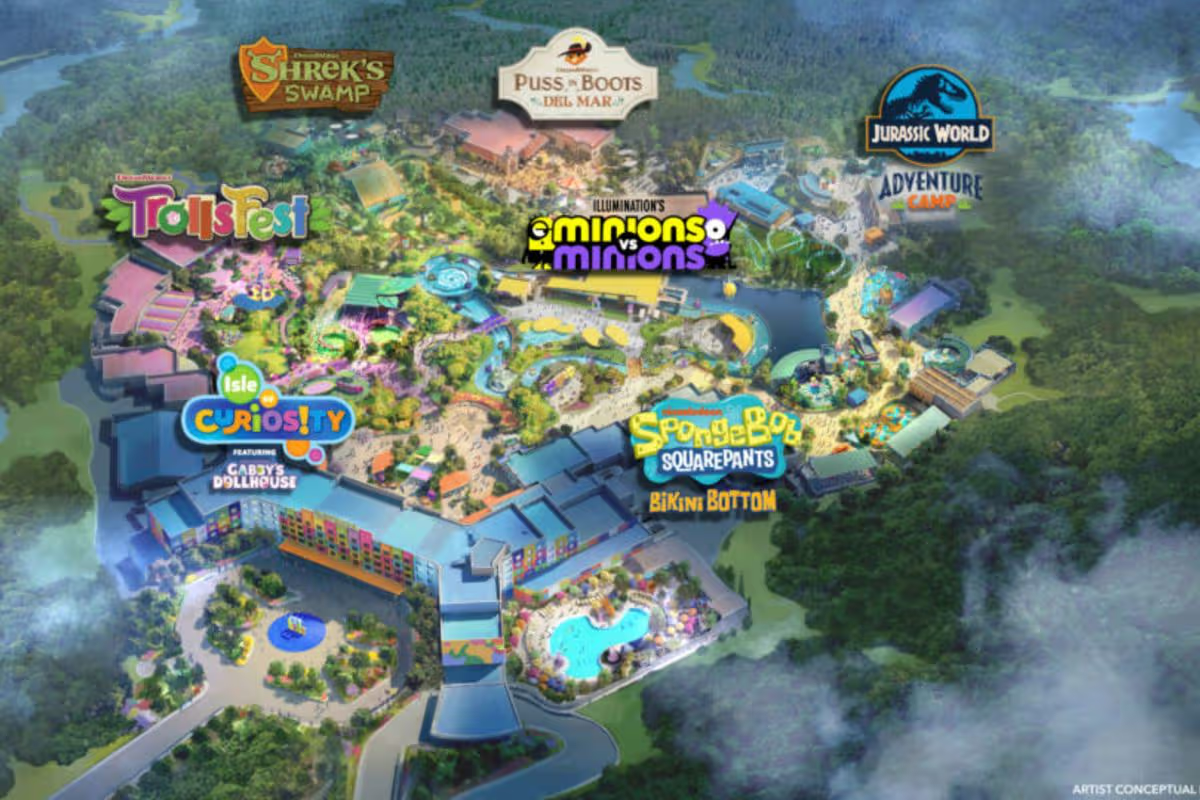
Universal is set to open its huge new theme park later this year, with seven lands including attractions inspired by Shrek, Jurassic World, SpongeBob SquarePants and the Minions.
Universal Kids Resort will open this summer in Frisco, Texas, and the theme park giant has finally revealed its opening date; July 1, 2026. It’s the brand’s first ever ‘theme park specifically designed for kids’, and will be aimed at families with younger children, although there will likely be plenty that grown-ups can enjoy too.
The new theme park will be divided up into seven themed lands; DreamWorks’ Shrek’s Swamp, Jurassic World Adventure Camp, Nickelodeon’s SpongeBob SquarePants Bikini Bottom, Illumination’s Minions vs. Minions: Bello Bay Club, DreamWorks’ TrollsFest, DreamWorks’ Puss in Boots Del Mar and the Isle of Curiosity featuring DreamWorks’ Gabby’s Dollhouse.
That also includes a brand new Universal Kids Resort Hotel complete with 300 rooms and suites, restaurants, an outdoor pool and “other family-friendly amenities” although the resort is remaining fairly tight-lipped about exactly what will be on offer.
You can already book tickets and hotel packages at universalkidsresort.com. For Brits who want to visit, the nearest airport is Dallas/Fort Worth International Airport (DFW), with airlines including British Airways and Finnair both offering direct routes from London Heathrow. According to Skyscanner, you can find fares from £393 in July if you’re keen to be among the first to explore the new theme park!
Of course Universal already has some world-famous theme parks in the USA including Universal Studios Hollywood, and its Orlando resort with various theme parks, including the new Epic Universe offering. If you’re looking to visit on a budget, the likes of AttractionTix and FloridaTix both offer a series of deals including combo tickets if you’re also planning to visit Walt Disney World during your Florida getaway. You can also find out more at universalorlando.com.
There’s good news for Brits too, as plans for a UK theme park are on the way. The theme park, which will be located at the site of a former brickworks, is expected to employ around 8,000 people once complete, with around 20,000 construction jobs during the build, and is expected to represent a £50billion boost to the UK economy.
Last year, the UK government gave the go-ahead for the complex to be built in Kempston Hardwick in Bedfordshire. Universal has confirmed that the Ministry of Housing, Communities and Local Government (MHCLG) had approved the plans.
At the time, Universal published a letter saying the update was an important milestone. The company said: “In the months ahead, we are committed to sharing progress as well as what to expect including job opportunities and how local businesses and suppliers can potentially work with us. The interest and support we’ve already seen from both local companies and residents has been incredibly encouraging.”
Over the summer, Universal said the theme park will be “unlike anything that exists in the UK” as it could feature the tallest rides in Europe – with height limits reaching up to 115m.
A BRAND new aquapark is coming to a UK town just in time for the summer holidays.
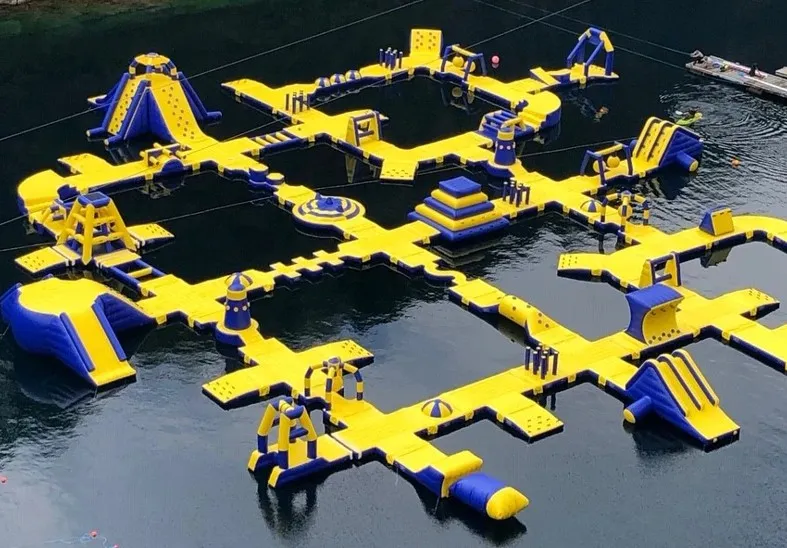
Featuring slides, climbing walls and a splash zone, the inflatable waterpark will be open until the autumn.
Sign up for the Travel newsletter
Thank you!
A brand new aquapark will be opening in Cambridgeshire this summerCredit: OneleisureThe inflatable water attraction will be open in time for the summer holidays and be in place till SeptemberCredit: Oneleisure
Located at Hinchingbrooke Country Park in Cambridgeshire, the brand new aquapark will be open to the public from July 18.
The inflatable park promises a day out of full of water-based fun, including slides, balance beams, climbing walls and splash zones.
Aimed at visitors aged six and over, the temporary water attraction will be open in time for the summer holidays and remain in place until September.
Visitors are able to pre-book online now, and the park expects demand to be high throughout the summer.
Tickets cost £19 per person and include a buoyancy aid, helmet and wetsuit hire.
From mid-July, the aquapark will be open from 10am to 5pm, with each session lasting an hour.
The new inflatable is part of a larger ongoing investment into Hinchingbrooke Country Park, improving its leisure activities and encouraging more visitors to the park’s large natural surroundings.
Executive member for Parks and Countryside, Waste and Street Scene, Cllr Julie Kerr, said: “We’re thrilled to be bringing this exciting new attraction to Hinchingbrooke Country Park.
“It’s a fantastic addition for residents and visitors alike, and part of our ongoing commitment to improving and evolving the park to enhance leisure and outdoor opportunities for users now and in the future.”
Hinchingbrooke Country Park even wants the community to get involved in an important aspect of the opening of the park.
In a post on Facebook, the park called upon residents to submit ideas for a new name for the aquapark, with the winner receiving a free visit for the entire family.
“Think adventurous, fun, family-friendly or inspired by Hinchingbrooke and the local area – we can’t wait to see your ideas,” read the post.
Entries for the competition close on Friday, June 5, and the winner will be announced shortly afterwards.
Some concerns were raised on the Hinchingbrooke Facebook post regarding the local wildlife of the area, but the park revealed they had worked “closely with an independent ecologist to understand how this could impact the wider park”.
An Ecological Impact Assessment was conducted and the park confirmed that their project team is now “working closely” with park rangers to “ensure all recommendations and any appropriate ecological mitigation is completed”.
The park will also be designating specific lake zones purely to wildlife and “adding an additional tern raft”.
The nearby car park is also currently undergoing works, but the park has confirmed this is expected to be complete by the time the aquapark opens.
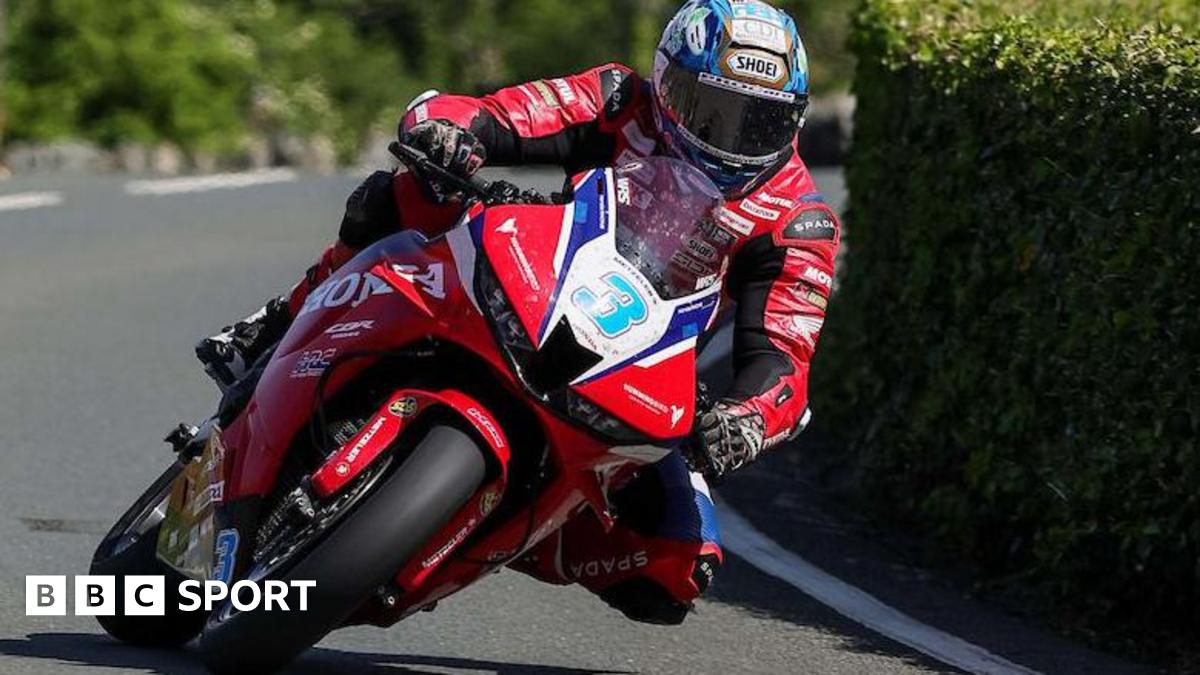
Dean Harrison set the fastest time in Tuesday’s first qualifying session for the Isle of Man TT.
The Honda Racing rider topped the Superbike leaderboard with a speed of 133.925mph, a time of 16 minutes 54.206 seconds.
The five-time TT winner had earlier posted a lap of 133.222 from a standing start on his opening lap before shaving more than five seconds off his lap time on his second circuit.
The Yorkshireman, now based on the Isle of Man, was a double winner in the Superstock class last year, his first race victories since 2019.
Michael Dunlop was second quickest in the Superbike class on his Hawk Racing Honda at 130.341, almost 28 seconds slower than his rival.
Manx rider Nathan Harrison, Ian Hutchinson, David Johnson and John McGuinness completed the top-six leaderboard.
Australian Josh Brookes led the Superstock qualifying leaderboard thanks to a lap of 130.197 on his DAO Racing Honda, with 14-time winner Peter Hickman second behind the double British Superbike champion with 129.42, followed by Jamie Coward at 128.702.
Dunlop was best of the Supersports on 126.922 on his V2 Ducati, the Northern Ireland rider making a strong start in his bid to extend his run of eight consecutive race wins in the class.
Brookes was second at 124.271 on a Suzuki, then Hickman on his Triumph on 123.584.
Paul Jordan topped the Sportbike speeds thanks to a lap of 120.208 on an Aprilia, with Coward (119.199) and Browne (119.097) second and third respectively.
The concluding sidecar session was ended prematurely because of a red-flag situation.
An update from Race Control said they were “managing an incident that occurred at Brandish”.
The opening practice session of the 2026 event on Monday was red flagged following a crash on the northern section of the 37.7-mile (60km) Mountain Course, leading to the abandonment of the remainder of the day’s schedule.
Two spectators have been subsequently flown to the UK for specialist medical care after a competitor crashed into the crowd.
Event organisers said six other spectators and the motorbike racer had been discharged from hospital.
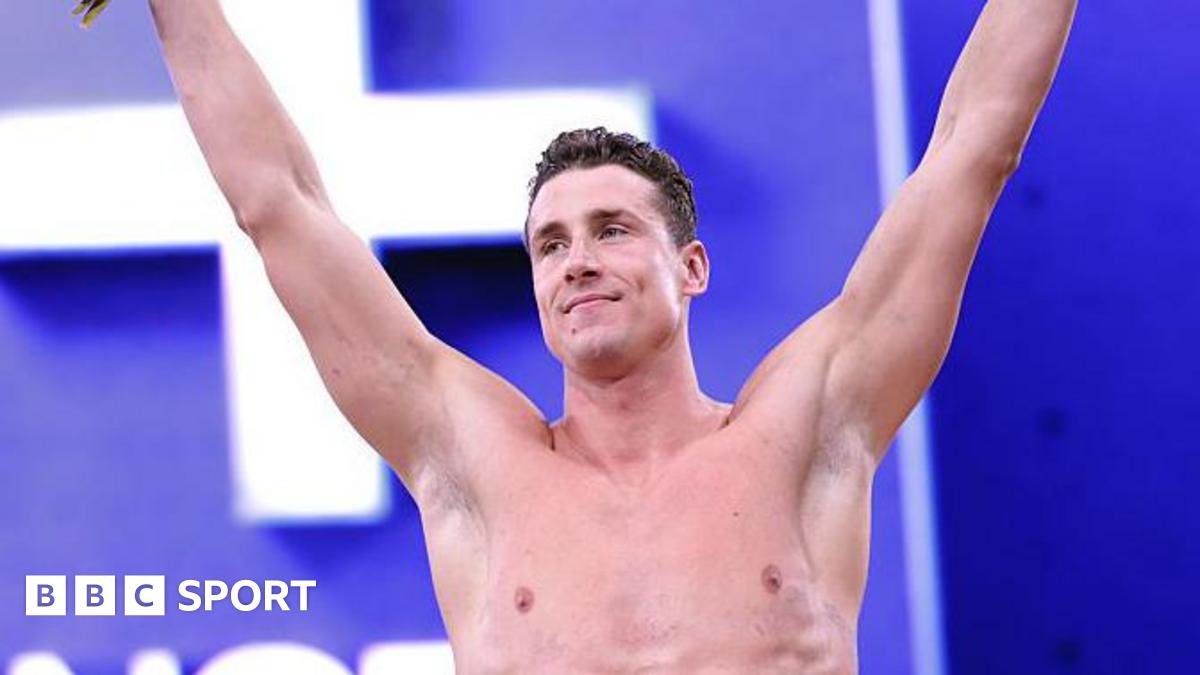
The majority of the 42 athletes taking part used performance-enhancing substances and Enhanced Games said “13 athletes set personal bests”.
The event was played out in front of a curated crowd of around 2,500, with tickets not on sale to the general public.
On the track, American former world champion Fred Kerley – one of the athletes competing ‘clean’ – won the men’s 100m in 9.97 seconds, which was short of his personal best of 9.76.
British swimmer Ben Proud, who won silver in the men’s 50m freestyle at the 2024 Paris Olympics, triumphed in the 50m butterfly, clocking 22.32 seconds which was 0.05secs short of Andrii Govorov’s world record.
“We all know what we came for. And that’s world records. And so to be that agonizingly close, it’s frustrating,” Proud said.
Another British Olympic swimmer, Emily Barclay, won the women’s 50m freestyle in 24.09, around half a second slower than the world record.
Weightlifter Hafthor ‘Thor’ Bjornsson, who played The Mountain in TV show Game of Thrones, was another taking part but was unable to break his own deadlift record of 510kg.
Drugs used at the Enhanced Games must be legal and approved by the US Food and Drug Administration (FDA).
They include testosterone, growth hormone, peptides, anabolic steroids and other substances banned in sport.
Those behind the event argue enhancement already exists in elite sport, but secretly and without transparency, and say bringing it into the open where it can be monitored makes it safer.
However many sporting governing bodies have publicly rebuked athletes for choosing to compete in the games and some sporting governing bodies have banned athletes for taking part.
The IOC and Wada have described the Enhanced Games as “immoral” and “a dangerous and irresponsible concept”, while World Athletics president Lord Coe said anyone taking part was “moronic”.
The project was founded by entrepreneurs Aron D’Souza and Maximilian Martin in 2023 and has attracted backing from prominent investors including billionaire Peter Thiel and Donald Trump Jr.
Martin had predicted that athletes would beat “quite a few” world records at the event.
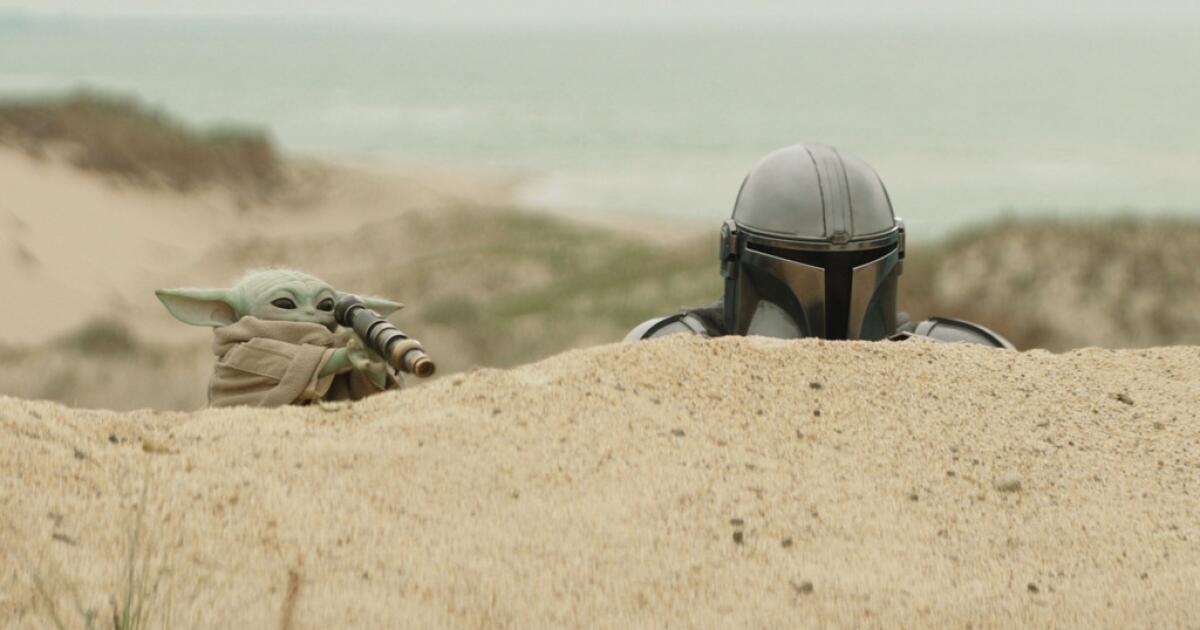
After a nearly seven-year absence from theaters, Star Wars proved it still has the Force, as the latest installment, “The Mandalorian and Grogu,” is on track to earn an estimated $102 million in the U.S. and Canada for the Memorial Day weekend.
Globally, the film was on track to pull in $165 million for the four-day holiday weekend.
Director Jon Favreau’s “The Mandalorian and Grogu” now ranks as the year’s third-highest grossing domestic opening, based on its Friday-Sunday ticket sales of $82 million, according to ticket tracker Comscore.
The results are likely a relief to Walt Disney Co.-owned Lucasfilm, which had not released a theatrical Star Wars film since 2019’s “Star Wars: Episode IX — The Rise of Skywalker.”
Since then, the San Francisco-based studio has largely focused on its Star Wars streaming shows, which have included both live-action and animated series. Some of those shows received mixed reviews, though “The Mandalorian” and “Rogue One” spin-off “Andor” were breakout hits, praised by critics and largely revered by fans.
The movie — starring Pedro Pascal, Sigourney Weaver and Jeremy Allen White — benefited from positive reviews from moviegoers, but it stopped short of shattering expectations. Its initial financial performance was on par with the disappointing 2018 opening weekend for “Solo: A Star Wars Story.” That film notched $103 million in its opening weekend.
Box office revenue for “The Mandalorian and Grogu,” which played in 4,300 theaters, will be just one indicator of the movie’s success.
The Burbank entertainment giant is counting on the film to boost other parts of its business, including views of Star Wars shows on the Disney+ streaming service, its gaming collaboration with Fortnite and its all-important theme parks sector. The main characters are present in the Star Wars: Galaxy’s Edge-themed land, and the Millennium Falcon: Smugglers Run ride has been overlaid with a new “Mandalorian and Grogu” storyline at Disney parks in Anaheim and Orlando.
The weekend ticket sales underscore the enduring appeal of Star Wars, which remains among Disney’s top five franchises, producing more than $1 billion in annual retail sales.
Reception for the film was seen as critical to keeping the franchise fresh in moviegoers’ minds, particularly as Disney prepares for the upcoming 50th anniversary of Star Wars and a new movie starring Ryan Gosling set for next year.
Locally, “The Mandalorian and Grogu” is the first Star Wars movie to be made entirely in Los Angeles.
The film received a state tax credit to film in the Golden State, Favreau said at the premiere last week.
“The Mandalorian and Grogu” faced little new competition at the box office this Memorial Day weekend. Rival studios largely stayed on the sidelines, with no other potential blockbuster debuting at the same time.
Focus Films’ horror hit “Obsession” came in second at the box office with $22.4 million for its three-day total, according to Comscore.
Lionsgate’s blockbuster Michael Jackson documentary, “Michael,” snared $20 million, bringing its total to $314 million. “The Devil Wears Prada 2” came in fourth with $12.6 million, bringing its purse to $196 million since it opened earlier this month.
Amazon’s MGM studio’s “The Sheep Detectives” rounded out the top five with nearly $9 million.
Two Weeks in August made its debut tonight with a star-studded cast
The Two Weeks in August cast have shared the significance over a hidden detail in the show’s opening scenes(Image: Various Artists Ltd/BBC/Robert Viglasky)
The Two Weeks in August cast have shared the significance over a hidden detail in the show’s opening scenes.
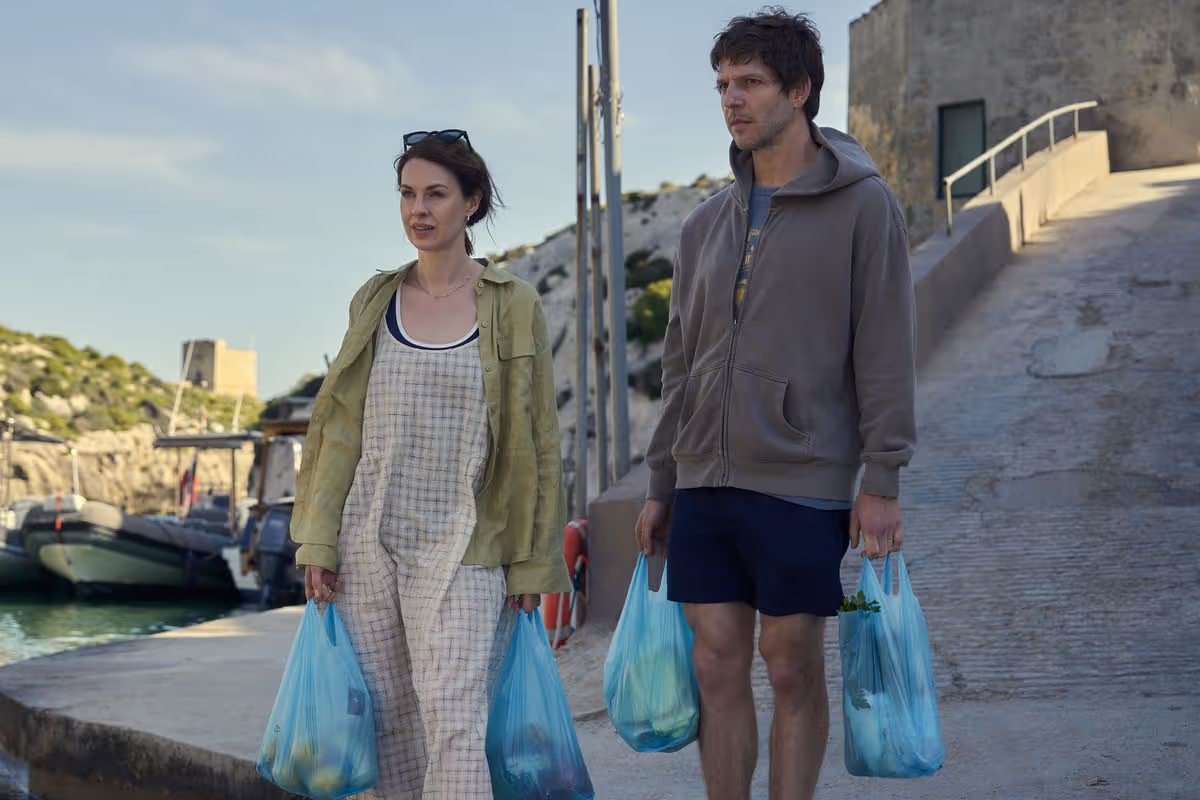
Written and created by Sally4Ever’s Catherine Shepherd, the new ‘witty and painfully relatable’ series follows a group of friends reuniting for a summer holiday. However, the idyllic getaway is soon thrown into chaos thanks to an illicit kiss.
In episode one, viewers are introduced to each of the friends with married couple Zoe and Dan, played by Jessica Raine and Damien Molony, clearly struggling as they attempt to put past events behind them.
The family of four, who have brought their children on the trip, are also struggling with money as is highlighted when Jess, played by Antonia Thomas, suggests they all put €200 each in the kitty.
Things go from bad to worse when Zoe and Dan are tasked with preparing food that evening with their lavish friends wanting seafood, which provides another tense expense for the struggling couple as they opt for store bought fish as opposed to fresh market produce.
Talking about the scenes with the Mirror, Jessica Raine and Damien Molony, who play Zoe and Dan, pointed out a significant hidden detail in the opening moments of the show.
Damien, 42, said: “We had a great opportunity to rehearse before we went out with Tom George, our director. We talked a lot about their past and about their relationship and the fact that, you know, they probably hadn’t had sex in about a year.
“That was a really kind of good starting point to go: ‘Oh, something’s really not right here.’ We would do some improvisations about the journey to the airport in England and what that must have been like.
“Jess had this incredible line in the improv about having to pack pasta in our luggage because we knew we wouldn’t be able to afford food on the island. So much so that they actually put it in the scene.
“So when Jessica opens her suitcase in that first scene on packing, there is pasta in the bag” to which Jessica, 44, added: “Three bags!”
Damien continued: “It was kind of those little details that started to kind of… because in TV, you don’t get that opportunity to rehearse or to really explore the world around the scenes.
“So that was really, really thrilling, and it really informed the rest of the kind of scenes that we shared together because this couple goes on a huge journey.”
Meanwhile, Jess said: “The journey of the fish is really good and I think that’s also a really good point to make about our show is the financial differences in the couples. I don’t think we see that very much.
“We often see a lot of very rich people going on holiday, but I love the reality. I mean, a lot of people are in that position where you’re like, I can’t afford €200 for the kitty and the look that we give each other, we’re just like: ‘Holy moly, this is, we’re way out of our depth’ and they don’t feel able to say.”
The drama is only going to get more intense for the couple and their friends as a synopsis teases: “Set in Greece, Two Weeks in August tells the story of a woman who goes on holiday with her family and friends to rediscover joy in her life. But, here in paradise, what starts with an illicit kiss quickly turns the dream vacation into a nightmare.
“Zoe begins to act on her deepest desires and the holiday she hoped for becomes a reckoning for a group of adults who refuse to grow up. When they discover they are trapped on the island, and become faced with real life-or-death situations, the group soon turn on each other to find out who is to blame.
“Is Zoe responsible for the drama and destruction around her or, as heaven turns to hell, are bigger forces at play? We are in Greece after all, the land of the ancient Gods…”
Two Weeks In August airs Saturday nights on BBC One and BBC iPlayer.
Demonstrators hold signs and wave flags during a protest outside the U.S. consulate in Nuuk, Greenland, Friday. The new diplomatic building officially opened earlier in the day amid tensions over American interests in Greenland. Photo by Oscar Scott Carl/EPA
May 22 (UPI) — A new American consulate opened in Nuuk, Greenland, Friday, and hundreds of Greenlanders showed up to protest it.
There has been a small consulate in the country since 2020, but the new one is 30,000 square feet and is on one of Nuuk’s busiest roads.
The consulate hosted an opening event with visitors and red, white and blue decorations inside. Ambassador to Denmark Kenneth Howery unveiled a new plaque and said he looked forward to a closer partnership with the semi-autonomous country, which is part of the Kingdom of Denmark.
“The Arctic is clearly a region of global importance,” the BBC reported Howery said. “We will always be neighbors and be with you into whatever future you choose as allies and partners.”
But outside, the locals made their voices heard, chanting, “We don’t want your money” and “Greenlanders know a MAGA Trojan horse when we see one,” The New York Times reported.
The locals have dubbed the new consulate, “Trump Towers.”
Protest organizer Aqqalukkuluk Fontain, 37, said, “The waves they are trying to create, and the propaganda they are pushing — people are not falling for it.”
“Our government already told Donald Trump and his administration that Greenland is not for sale,” the BBC reported he said. “Our message is for the American people and to the rest of the world — that in a democratic world, no means no.”
The United States had thousands of troops stationed in Greenland during World War II and the Cold War, but the bases have all closed except one. American officials have begun visiting the old bases as they consider reopening some, The Times reported.
Earlier this week, President Donald Trump’s special envoy to Greenland Louisiana Gov. Jeff Landry visited Nuuk on a “goodwill mission” and found he wasn’t very welcome. He handed out chocolate chip cookies and MAGA hats to few takers.
Inge Bisgaard told the BBC that Landry’s visit was disrespectful. “It’s so important to show this is not OK.”
“We get this fear from the United States. People were just recovering from last time, when it all began again in January,” she said about Trump’s previous comments about buying or invading Greenland.
Protesters stood for two minutes of silence with their backs facing the consulate, then resumed chanting for Americans to go away.
“Look at how little signage there is showing that it’s a consulate,” The Times reported protester Nivi Christensen, a museum director in Nuuk, said. “The other consulates fly large flags outside and are proud of it. This feels different. It feels as though they are doing it in a sketchy way.”
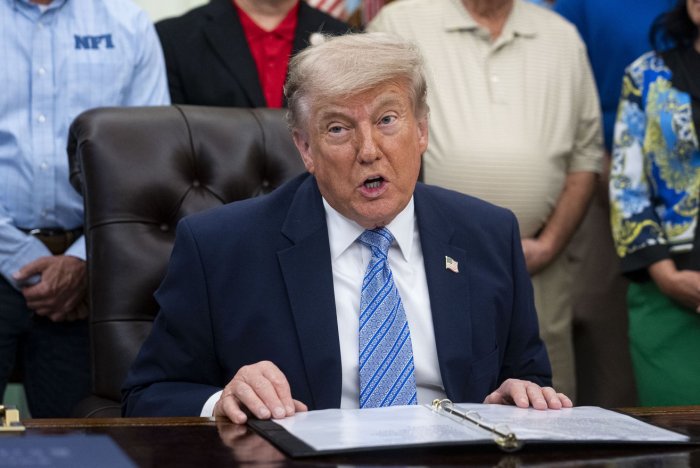
President Donald Trump speaks at an event with Environmental Protection Agency (EPA) Administrator Lee Zeldin in the Oval Office at the White House on Thursday. Photo by Al Drago/UPI | License Photo